
“Creative” and its
variants are a versatile part of the vocabulary of contemporary capitalism,
able to link imagination, aesthetic practice, and religious faith in the
pursuit of private gain. The oldest word on creativity’s family tree is
“creation,” whose first meaning was specifically Christian—the term for the
divine genesis of the universe. One of the newest is the nominal form of
creative, normally an adjective for an original thinker or idea. Creative is
now also a count noun (think of the creatives who may be moving into your
shrinking rust-belt city) and a mass noun (get creative on the horn, said
account services to production). Many people would probably agree that
creativity is an essential human trait, crucial to a happy life, though this
noun is a relatively new coinage. An even more recent development is the notion
that creativity is a trait of capitalist markets. And in the United States, the
political phrase “job creators” borrows some of creation’s residual divine
light to illuminate the benevolent fiat of the capitalist, who is thought to
create jobs out of the formless void.
If creation has been
divine, creativity is decidedly human. The most important conflict in the
etymological history of “creative” is the struggle between its religious and
secular meanings. Before the late 19th century, to the degree that people could
participate in something called “creation,” it was only to approximate the
purity of the original, capital-C Creation, rather than inaugurating their own.
“There is nothing new under the sun,” Ecclesiastes reminded humans inclined to
creative hubris. “The created cannot create,” (creatura no potest creare) added
St. Augustine, insisting that such power resided only in God, and not in his
creations. In the history of the word “creative,” there are actually two
decisive rifts: this initial one between the divine and the human creation
suggested here, and then, once creativity became a human trait, a division
between its aesthetic and productive forms. We can roughly date this latter
conflict to around 1875, the earliest example of the word “creativity” given in
the OED, from an essay on Shakespeare’s singular brilliance.
Creativity was a work
of imagination, rather than production, of artistry rather than labor. One of
the consequences of this split between art and work has been to valorize
creativity as the domain of an intuitive, singular, historically male genius.
Productive creativity, meanwhile, is not art but labor, and thus rarely earns
the title of creativity at all; this is the supposedly unimaginative labor of
the manual worker or the farmer and the often feminized work of social
reproduction. There are obvious class and gender prejudices at work here;
coaxing a crop out of stubborn soil or preparing a family meal with limited
ingredients are not typically seen as creative acts, whereas cooking a
restaurant meal with the harvested crops often is. Other differences are rather
arbitrary. Children’s play is not thought to be brilliant in the way
Shakespeare is; it may, however, qualify as creative because it is appears (to
adults, anyway) to be intuitive.
The widespread
popularity of “creative” in economic discourse today suggests that this old
breach between the imaginative and the productive has partly been closed. The idiosyncratic,
eccentric, even oppositional posture of the creative artist is now an economic
asset, chased by real-estate developers and promoted by self-help writers as
comparable to the spirit of the entrepreneur. The popularity of “creativity” as
an economic value in English can be traced to two major sources—Joseph
Schumpeter, 20th-century economist and theorist of “creative destruction,” and
Richard Florida, the University of Toronto scholar whose book, The Rise of the
Creative Class, became one of the most celebrated and influential urban policy
texts of the early 2000s. “The bourgeoisie cannot exist without constantly
revolutionizing the instruments of production, and thereby the relations of
production, and with them the whole relations of society,” wrote Marx and
Engels in the Manifesto of the Communist Party. In his 1942 classic Capitalism,
Socialism, and Democracy, Schumpeter agreed, up to a point. Schumpeter shared
Marx’s sense of capitalism as a destructive and also transformative historical
process, but he reframed Marx’s history of class struggle motivated by
exploitation as an evolutionary process driven by visionary entrepreneurs. By
opening new markets and breaking down old industrial processes, Schumpeter
wrote, capitalism “incessantly revolutionizes the economic structure from
within, incessantly destroying the old one, incessantly creating a new one.”
This process is what Schumpeter called “creative destruction.”
“Creative” here refers
to the work of forging new modes of production, new markets, and new products,
but it also had a touch of artistry: the ingenuity, vision, and intuition to
make things anew. Even so, creativity still belonged more to the artists’
studio than the corner office until the last half of the 20th century in the
United States, when it came to describe a productive aspect of the psychology
of individual workers. Sarah Brouillette has shown how much the familiar
accoutrements of today’s progressive office culture—foosball tables, bright
colors, and other perks ostensibly meant to cultivate employees’ creativity and
loyalty—owe to the psychologist Abraham Maslow, famous for his 1943 theory of a
“hierarchy of human needs.” Maslow, Brouillette writes, “began imagining all
business culture as an outlet for and source of workers’ enterprising
individual self-fulfillment.” Florida’s notion of “artistic creativity,” which
he regards as integrated with other varieties (economic and technological) is
based on the presumption that “art” equals “self-expression,” a historically
specific assumption which, like “creativity” itself, is mistaken for a
universal and timeless idea.
Indeed, it is this
particularly modernist understanding of artistic work as solitary and
idiosyncratic, oriented towards the expression of the artist’s unique self,
that also came to suit US geopolitical interests in the Cold War, as many
scholars of US and Latin American modernism have shown. Rob Pope, in his
history of creativity, includes two other examples of creativity’s Cold War
deployments. The US psychologist Carl Rogers argued that a prosperous nation
like the United States needed “freely creative original thinkers,” not
ladder-climbing conformists. If the grey Soviet system encouraged the latter,
the multi-colored capitalism of the United States required creative free
thinkers. It is this perceived cultural strength, not just newer and better
weapons, that will beat Communism, J.P. Guilford argued in 1959.
Florida believes
strongly in the naturalness and timelessness of this relatively new idea,
creativity; he describes it as “what sets us apart from all other species.”
Florida elevates creative capitalists from a social type, which they remain in
Schumpeter’s theory of the entrepreneur, to a social class, one that Florida
estimates as constituting a third of the American working population. Its
members include scientists and engineers, architects and artists, musicians and
teachers—anyone, in short, “whose economic function is to create new ideas, new
technology, and new creative content.” The creative class shares certain tastes
and preferences, like nonconformity, an appreciation for merit, a desire for
social diversity, and an appetite for “serendipity,” the chance encounter
facilitated by urban life.
A taste for city life,
in fact, is one of the creative class’s most treasured preferences, and
Florida’s ideas promised to leverage these to repopulate declining urban
centers without significant public expenditure on social welfare or
infrastructure. Politicians in various postindustrial cities in the global
north became eager customers of the consultancy spawned by the success of The
Rise of The Creative Class. We will find in Florida’s account scarcely a trace
of the breach that Williams described between imaginative and productive
creativity. Creativity, Florida writes, is the “font from which new
technologies, new industries, new wealth, and all other good economic things
flow.” Art, music, and gay-friendliness are no longer independent values of
their own, but rather values dependent on their appeal to high-wage knowledge
workers.
Why creativity now?
Jamie Peck, one of Florida’s most unsparing critics, argues that from the
1970s, deindustrializing cities were faced with a dearth of available economic
development options. They began competing with one another not only for
increasingly mobile jobs, but for places in a consumer economy in which cities
became commodities themselves. Abandoning comprehensive urban planning, city
governments focused instead on what Peck calls “urban fragments” with potential
in this consumer market—single districts with marketable appeal due to their
theaters or arenas, historic architecture, proximity to job-rich downtowns, or
some other marketable feature. (Often, these urban fragments become the sort of
generic, purpose-built developments the suburban-born creatives were supposedly
fleeing, like the new creative-class Potemkin village north of downtown Detroit
with the odd name The District Detroit, an ode to urbanity that only a marketer
could love, or even understand.) The creative city becomes a place where a
mobile middle class can participate in this consumer economy as workers and
residents. Since there is a broad affinity between one’s economic and
imaginative activity in the Floridian regime of creativity, you “live, work,
and play,” in the familiar liturgy of bourgeois urban life, as an economic
subject at all hours. Even artistic activity that might have once appeared
oppositional or radical—Florida claims to be a big fan of rap music—merely
buttresses the “creative index” of the city (a metric he developed).
“Whereas classical
liberal doxa assumes that what we are and what we own must not be confused,”
writes Brouillette, neoliberals favor a “union of economic rationality and
authenticity, this perfect marriage between the bohemian and what had been her
bourgeois other.” The extra-economic values of the artist and the priorities of
the market are no longer treated as autonomous, much less antagonistic, but harmonious.
As Brouillette emphasizes, however, it would be a mistake to read the rise of
the creative class as a colonization of the once-pure realms of the artistic
imagination by the market. The rise of the so-called creative class is not a
heroes-and-villains plot of businessmen corrupting creativity. This would be
far too flattering to artists and writers, who are hardly innocent bystanders.
Rather, the business world has valorized unexamined ideas of what “artistry”
means and turned an individualistic, class-bound idea of “the artist” towards
market goals. These meanings of artistry have evolved over the years in complex
ways, but the one that circulates in the economic use of creativity dates to
the origins of the word “creativity” in the late 19th century. Then, as
Gustavus Stadler has shown, creativity was closely aligned with 19th-century
ideas of “genius” and “inspiration,” which were seen as the fruit of an
“irreducible originality,” rather than a social process. As the cult of the
entrepreneur shows, this fantasy of irreducible originality is still with us.
Sometimes, there really is nothing new under the sun.
From : Keywords: The
New Language of Capitalism. Published by
Haymarket Books, 2019.
How ‘Creativity’ became
a capitalist buzzword. By John Patrick Leary. LitHub , March 11 , 2019.

In 1959, a group of
high school juniors in a Brooklyn classroom took a very bad quiz. The
questions, written by a right-wing, pro-business lobbying group, were a mix of
multiple-choice and true-false propositions on economic matters, like When a
company makes big profits in any one year, it ought to raise wages. (Correct
answer: false.) Or: Which of the following do you think should be government
owned and operated? a) railroads b) automobile companies c) banks d) steel
companies e) oil companies f) power companies or g) none of the above. (Correct
answer: g.) Most students failed the quiz; the average score was 45 percent,
but they didn’t appear to mind much. One student told the authors of the quiz
that they represented “a stinking, reactionary organization.”
And so they did. The
quiz was written by the National Association of Manufacturers (NAM), an
organization founded in 1895 to fight organized labor and retooled in the 1930s
as a leading opponent of Franklin Delano Roosevelt’s New Deal. After World War
II, NAM’s eager propagandists began developing free-market economics curricula
for U.S. high schools, which they were convinced were hotbeds of pro-labor and
communist sentiment. Written student feedback recorded in NAM’s files seemed to
confirm those fears. A Brooklyn student wrote on the quiz:
WORKERS OF THE WORLD UNITE!
Down with the capitalist exploiters. These ‘people’ do no work and expect to
receive recompense for laziness. To paraphrase Lincoln, who in his second
inaugural commented in much this way on slavery—‘the taskmaster wringing his
bread from the sweat of another’s brow and the unrequited toil of millions of
laborers.’ This system is contradictory to our ideals. The system must be
abolished and the worker emancipated.
The results showed the
NAM researchers the urgency of their mission. The honor students who flunked
their economics quiz were some of the city’s most elite students, and yet, the
NAM report concluded, they showed an exceptionally “high degree of economic
illiteracy.” Teaching the youth of America to love the “free enterprise system”
again would be a generational task.
Looking back from the
vantage point of neoliberal America circa 2019, it is striking (and a little
cheering) to see the anguish of the defenders of private property at
mid-century. In her 2009 book Invisible Hands, Kim Phillips-Fein showed how
deeply the fall of the “employer’s paradise” of the 1920s shook the ruling
class from the 1930s onward, as workers struck and organized and the public
mood turned against industry. By the 1950s, right-wing writers complained that
socialists still set the terms of debate and commanded the language of the
economy: “55% hold to the Marxist theory ‘from each according to his ability,
to each according to his needs,’” according to the NAM’s report on American
teenagers during the Eisenhower era. Their schoolbooks uniformly “make the
employer look like a piker,” lamented the head of the group’s education
department. “We have not learned to speak our own economic language as well as
the other fellow has learned his specious patter,” wrote Wilbur Brons in the
Chicago Journal of Commerce in 1944. Things were so bad in 1950 that Pierre S.
du Pont, scion of the Delaware chemical dynasty and one of America’s richest
men, felt himself to be living a kind of tragedy. “Perhaps,” he wrote wistfully
to a colleague, “we were born too soon.”
Exiting the
social-democratic nightmare meant, in part, learning, and teaching, a new
language. The socialistic shibboleths of “security,” “planning,” “economic
democracy,” and “full employment” would have to be confronted and countered
with new ideals of competition and entrepreneurship. People like the Brooklyn
high school juniors had learned, through years of Depression and war, to
associate freedom with security from the thing called “the market,” in its
various manifestations: a cruel boss, a closed factory gate, a sped-up assembly
line. To redeem the free enterprise system, the apostles of private property
needed a vocabulary for emancipation through the market. To do this, they
needed to make the market the sort of misty abstraction you could never confuse
with the “sweat of another’s brow.” If only Pierre du Pont could have known how
popular “innovation” would one day become.
One of innovation’s
earliest and most cogent modern definitions, in the economic usage that we’ve
wearily come to know so well, comes from Joseph Schumpeter. The Harvard
economist saw innovation in 1942 as “the entrepreneurial function.” To innovate
meant:
to reform or revolutionize the pattern of
production by exploiting an invention or, more generally, an untried
technological possibility for producing a new commodity or producing an old one
in a new way, by opening up a new source of supply of materials or a new outlet
for products, by reorganizing an industry and so on.
He wrote elsewhere that
“innovations are always associated with the rise to leadership of New Men,”
which pinpoints one of the major paradoxes of the term: its simultaneously
functional and utopian usages. That is, the process of innovation—Schumpeter
famously called it “creative destruction”—is both a workaday managerial process
and also a kind of heroic eruption of market-shaping genius. The ubiquity of
the term today may make us think of high-tech abundance, or perhaps the “better
living through chemistry” that twentieth-century American firms like DuPont
long promised consumers of plastics and nylons. But now, of course, the idea of
innovation—less moored to material things than chemistry was—reigns supreme in
Silicon Valley, the world’s “most innovative neighborhood,” as a typical
description in the business press goes. “Chemistry” implied, at some point in
the process, the production of a material object; tech innovation celebrates
the decisions of the manager in his office.
Still, where, exactly,
did this brand of innovation, in all its world-conquering glory, come from? It
is impossible to date the origins of a word, especially one as vague as this
one, with any certainty, but “innovation” as we use it now—a spirit of
market-serving managerial creativity—begins roughly in 1934. This was the year
that saw hundreds of thousands of workers across the country in a variety of
industries—from longshoremen in San Francisco and Seattle to teamsters in
Minneapolis to textile workers in Alabama—walk off their jobs in a wave of
major strikes. And in the following year, the Social Security Act and the
Wagner Act were passed, landmark pieces of the New Deal. Reacting with alarm to
these events, the nation’s evangelists for private property cast about
desperately for a response.
The New Deal’s domestic
opponents, scrambling for an edge against Roosevelt, fixed on “bureaucracy.” In
the platform of the American Liberty League (a short-lived congress of
industrialists the president eagerly denounced as “economic royalists”) the
first point was “to combat the growth of bureaucracy.” By “bureaucracy,” they
meant the Works Progress Administration, unemployment insurance, labor unions,
Social Security, and the kind of public ownership of major industries the
Brooklyn students were still prepared to endorse in 1959. The problem, of
course, was the widespread popularity of all the above. The defenders of free
enterprise were still using someone else’s terms: “freedom from bureaucracy,”
also a NAM slogan, simply riffed on Roosevelt’s “four freedoms.” What the
American right needed, in other words, was its own positive language of
“freedom” in the market.
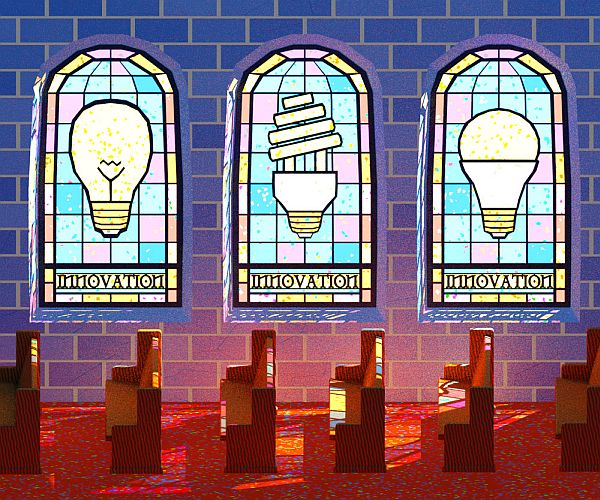
Innovation became the
word for the job. Its very vagueness served as an irresistible selling point.
Like Supreme Court Justice Potter Stewart’s definition of obscenity, innovation
was something that its ardent modern prophets professed to know mostly when
they saw it. And increasingly they came to see it everywhere—particularly in
the internet age’s long tail. By now, virtually any new product is described as
an innovation, but innovation in its most dominant form today is a kind of
spirit, a way of being, an attitude. This helps explain its wide distribution
across profit-making and nonprofit fields. The Harvard Business Review, the
organ of corporate conventional wisdom, defines innovation in one article as
“experimentation, risk-taking, and variety,” which are “the enemy of the
efficiency machine that is the modern corporation.” Putting a man on the moon,
putting the world on wheels, putting an encyclopedia in your pocket: these
breakthroughs are all fruits of this spirit of risk-taking. But even the most
banal, disposable products of our lives are awash in it; if, for any reason,
you find your way to www.band-aid.com, you will find there an article called “A
History of Band-Aid Brand Innovation.” (Sample achievement, 2001: “Band-aid.com
is launched.”)
Most institutions
ritually invoke it for self-justification: Aramark Correctional Services, the
private prison food contractor implicated in Michigan for serving literal
garbage to inmates, sponsors a “Jail Innovations of the Year Award” to
recognize jailers for “innovative contributions made to their jail or
correctional facility.” Politicians of all parties invoke it reverently. There
are, by my rough count, at least a half-dozen Innovation Churches currently
operating across America, and elsewhere, a “theology of innovation” seeks to
update that decidedly old-economy metaphor of the preacher as shepherd in favor
of a new, knowledge-economy pastorate. The evangelical megachurch minister Rick
Warren, for example, has written that “a theology of innovation always reminds
us that God intends us to be creative.” Warren is speaking here of a church’s
organizational culture, and he borrows from the hipster capitalist CEOs who
advocate replacing boardrooms and cubicles with ping-pong tables and reclining
lounge chairs. Submission to God, in Warren’s church, no longer requires Job’s
prostration in the face of the Lord’s unfathomable desires. Instead, Warren
writes, “it’s when I get in a totally prone position”—he means sitting in a
recliner—“that I can be the most creative and can discover what God would have
us do.”
Our children are also
taught to be innovators, from inner-city Atlanta to affluent San Diego, and
from pre-kindergarten through college. A school in Las Vegas promises to
nurture the “entrepreneurs and creators inherent in us all,” starting with
twelve-month-olds in day care; entrepreneurship summer camps teach
middle-schoolers to write a business plan and pitch investors; colleges and
universities increasingly market themselves as laboratories of innovation and
entrepreneurship.
After factories,
prisons, schools, and churches, there isn’t much left over in twenty-first
century American life. Across these various institutions, innovation is so
widespread and its goodness so seemingly self-evident that questioning it might
seem bizarre and truculent, like criticizing beauty, science, or
penicillin—things we think of either as universal human virtues or socially
useful things we can scarcely imagine doing without. Where did this ubiquitous
concept come from—so imprecise, so vapid, in neither its verb or noun form
describing any coherent action or object with clarity or consistency? And what
does its popularity say about us?
Here the postwar usage
of the term is especially telling. Along with “entrepreneurship,” a related
term, innovation became a response to the malaise of bureaucracy typically
shorthanded by the title of William Whyte’s 1956 best-seller, The Organization
Man. Whyte argued that Americans in the fifties—by which he meant middle-class,
professional white men—were “imprisoned in brotherhood.” A stifling spirit of
consensus was sapping the country’s vital and independent energies.
Middle-class, flannel-suited office workers lost in bureaucracies and marooned
in suburbs threatened the vitality of an economy compromised by its own
stability. The old economic virtues had lost their power. What good was a
Horatio Alger story about the importance of thrift in an economy built on
endless consumption? What did “pluck” matter to a middle manager?
The college-educated
youth of the late 1950s were interested in job security, not trailblazing,
Whyte argued. He quotes an economics professor who says his students “do not
question the system. . . . They will be technicians of the society, not
innovators.” In an example of the evergreen nature of blaming social problems
on Kids Today, a youth marketer lamented in 1960 that young men were not the
“pioneer stock” of their grandparents. “I think that a lot of large corporation
heads know it and are alarmed about it,” he said. “They get the organization
man rather than the entrepreneur.” One of the first articles centered on the
topic of innovation in the Harvard Business Review, from 1962, echoed this
suspicion of the “technician” as a compliant facilitator, rather than a dynamic
creator. “In our striving to create and maintain order and stability in large
enterprises,” wrote John J. Corson in “Innovation Challenges Conformity,” “it
has become increasingly clear that we discourage and limit the initiative and
creativeness required for innovation.”
Free enterprise, then
the most popular euphemism for capitalism, described a system and a structure;
innovation was becoming a way to describe a free individual’s way of thriving
inside that structure. Advocates of the new discipline of management began to
emphasize what the MIT business professor Douglas McGregor called in 1960 “the
human side of enterprise”—moral and personal traits like empathy and
innovation, instead of classic administrative traits like discipline and
authority. In his 1954 book The Practice of Management, Peter Drucker, an
Austrian exile often called the “father of management theory,” described the
calling of managers as nothing less than to integrate operations “so as to
utilize the special properties of the human being.”
Drucker, beginning with
his 1939 book The End of Economic Man, was preoccupied by the organization as a
cultural and political problem—he argued that a fetish for organization as such
defined the appeal of Nazism. But in his 1985 book, Innovation and
Entrepreneurship, Drucker sounded an optimistic note. “Where are all the young
people who, we were told fifteen years ago, were turning their backs on
material values, on money, goods, and worldly success, and were going to
restore to America a ‘laid-back,’ if not a pastoral ‘greenness’?” For the
management theorists who came to prominence in the 1960s, the business world
was not the place of one-dimensional men, from which laid-back eccentrics fled.
Quite the contrary: “innovation” was the recovery of the more fully human, the
irrational, the creative, the idiosyncratic in business and in all aspects of
culture influenced by it (which was, Drucker argued, every sphere of human
culture). And so innovation could offer a sense of purpose to workers swallowed
by bureaucratic consensus. As Nils Gilman has argued about Drucker, practical
business advice—the workaday techniques of innovation and
entrepreneurship—became the solutions to the crises of capitalism that erupted
violently at the beginning of Drucker’s career. The innovator, as Schumpeter
had said, was both bureaucrat and hero.
This sort of idealism
still resounds in the vocabulary of the business world today: it is
individualized, moral qualities of innovation and “passion” that ostensibly
drive success, and whimsical fetishes like “leadership” and “design thinking”
package a species of individual deliverance in a cubicle. The freedom from
bureaucracy and order-following that innovation came to promise belongs to what
Drucker called in 1968, with now-quaint optimism, “the knowledge economy.” This
was an economy driven by “ideas, concepts and information rather than manual
skill or brawn.” No longer a rule-following drone in the industrial society,
the worker in the knowledge economy was driven by her independent choices. We
have moved on from an economy of “predetermined occupations into one of choices
for the individual,” Drucker claimed. The knowledge-economy worker can make a
living doing “almost anything one wants to do and plying almost any knowledge.”
“This,” Drucker insisted, defying the biblical warning, “is something new under
the sun.”
For the historian of
such an idea—the supposedly ageless idea of newness itself, of creativity, of
human initiative—the warning in Ecclesiastes against hubris makes a great deal
of sense. What is very old in the literature of business, self-help, and corporate
public relations is constantly made new again. Theirs is a history of expired
prophecies and long-defunct game-changers: from “quality circles” and mind
cures to synergy and emotional intelligence, the fantasy of the
transformational new idea—the better intellectual mousetrap—has long seduced
writers chasing riches and prestige by telling others how to chase riches and
prestige. For example, the number of articles, books, and lectures asserting
that no, “innovation” is not the same as “invention,” might suggest that the
issue has been definitively settled. But business literature is also a history
of endless repetition, of already thin gruel reheated and sold—and sold, and
sold, in a vast publishing market—as fresh nourishment. Innovation, in fact, is
one such example. It’s one of the oldest new ideas in the corporate lexicon, a
novelty that never ages. Forty years after Schumpeter praised the “creative
destruction” of the innovative entrepreneur, the management consultant and
best-selling author Tom Peters paid tribute to these hero-functionaries in his
book In Search of Excellence—the most widely held monograph among libraries in
the United States from 1989 to at least 1997, according to the library database
WorldCat. “Small, competitive bands of pragmatic bureaucracy-beaters,” he
called the apostles of excellence, “the source of much innovation.”
Because it is an ideal
of managerial decision-making, innovation is critical to a vernacular of
neoliberalism that renders invisible most forms of labor performed by most
people on Earth—hot, fast, exhausting, repetitive, alienating, caretaking,
unwaged. Its emergence in the 1950s and 1960s was conditioned by mass culture
and the legacy of the New Deal. Influential theories of entrepreneurship and
innovation in these decades were also invested in questions about the fate of
the non-white world, which was poised as never before to disrupt the world
system.
Drucker said that what
distinguished an “‘underdeveloped country’—and keeps it underdeveloped—is not
so much a shortage of capital as it is shortage of innovation.” Walt Rostow,
the best-selling political theorist whose 1952 book, The Process of Economic
Growth, was an argument for the steps an underdeveloped society needs to “take
off” into development, listed a willingness “to accept innovations” as a major
criteria. This helps explain how “innovativeness” can become a measure, not
just of an industry’s profitability, but of social worth and national
character. When The Economist last October defended the Honduran migrants who
were confronting Trump at the southern U.S. border, they did not invoke civil
rights, the dignity of the individual, or pan-Americanism. They spoke, instead,
of the danger to “American dynamism and innovation.” Central American migrants
include valuable fruit-pickers and home health aides but they can also be
“entrepreneurs and coders,” useful resources for American industry. If
innovation is, as Jill Lepore has argued, the nineteenth-century ideal of progress
“scrubbed clean” of its horrors and “relieved of its critics,” this is once
again proof that Ecclesiastes was probably right: there is nothing new under
the sun.
But in the years since
Rostow, Drucker, and even Tom Peters theorized the mystic inner workings of
innovation, the term has taken on a more abstract, even metaphysical cast. The
Harvard Business School luminary Rosabeth Moss Kanter asserts that “to create a
culture in which innovation flourishes takes courage,” and advises the
courageous to put “innovation at the heart of strategy, and tout it in every
message.” It can also take the form of incantatory rituals (to become more
innovative, management consultant Abhijit Bhaduri suggests “weekly
conversations with millennials to understand how they dream”) and Orientalist
fantasies (one former Microsoft executive listed his job title as “Innovation
Sherpa” on his LinkedIn profile, and the title of “innovation guru” abounds in
the world of business consulting). Often it takes the puzzling form of
tautology. To be more innovative, says Harvard Business School professor
Clayton Christensen, the most revered prophet of the gospel of “disruptive
innovation,” you have to “‘think differently,’ to borrow a slogan from Apple.”
But Christensen here refers to a slogan that advertises Apple’s capacity for
innovation, which lies precisely in the company’s alleged ability to, uh, think
differently. In other words, Christensen is arguing that to innovate, you have
to be innovative. Tautological certainties like this abound in tech-industry
and innovation discourse, whose proselytizers wander in closed conceptual
circles in which capitalism, or a world and a history outside of it, is never
imagined, much less questioned. Where these modern prophets of the innovation
gospel originally hailed it as the means by which capitalism reinvented itself,
and disrupted ossified markets and backward social practices, the innovator’s
prerogative has gradually morphed into the self-evident aim of capitalist
development.
And this means, much
like other varieties of secularized worship, the innovation cult accrues
greater complements of unquestioned social power. The brand of innovation is
everywhere and nowhere. Primary schools, liberal arts colleges, and business
schools all claim to nurture it; entire airports could be filled with the
business-advice tomes that have claimed to teach it; municipal, state, and
federal governments compete to subsidize it; and there are few products that
are not advertised to the consumer as delivering the taste, sound, or
experience of it.
Back here in the
actually existing social world, though, the widespread circulation of the
innovation ideal allows us to employ it as a sort of marker to track the major
distinguishing features of contemporary capitalist ideology: its celebration of
knowledge, rather than labor, as the driving force of the world economy; its
ostensible disdain for hierarchy and bureaucracy; its unskeptical celebration
of technology; and its reframing of the loss of job “security” as the laudable
increase of “flexibility.” The innovator who emerges from this complex history
is a contradictory figure defined by an oscillation between what seem like
contradictory poles: imagination and production, rebellion and convention,
progress and reaction, the common good and private wealth. These paradoxes,
too, are part of the idea’s power, since the underlying vagueness of
innovation-for-innovation’s sake permits it to mean all things to all people.
It cultivates the open-ended creativity typically identified with the artist,
and turns it to profit-making ends, and cultivates it in large firms; it is the
twenty-first century’s theory of progress, but it is a heroism of office work.
It is a theory of novelty that is perpetually repeating itself. And in its
political origins, it is a theory of the new for those outraged by the New
Deal.
Its current power
shows, however, that the leaders of NAM were on to something. To change the way
people think about capitalism, you have to start with how they talk about it.
The Innovator’s Agenda. By John Patrick Leary. The Baffler ,
March 4, 2019.

When General Motors
laid off more than 6,000 workers days after Thanksgiving, John Patrick Leary,
the author of the new book Keywords: The New Language of Capitalism, tweeted out
part of GM CEO Mary Barra’s statement. “The actions we are taking today
continue our transformation to be highly agile, resilient, and profitable,
while giving us the flexibility to invest in the future,” she said. Leary added
a line of commentary to of Barra’s statement: “Language was pronounced dead at
the scene.”
Why should we pay
attention to the particular words used to describe, and justify, the regularly
scheduled “disruptions” of late capitalism? Published last week by Haymarket
Books, Leary’s Keywords explores the regime of late-capitalist language: a set
of ubiquitous modern terms, drawn from the corporate world and the business
press, that he argues promulgate values friendly to corporations (hierarchy,
competitiveness, the unquestioning embrace of new technologies) over those
friendly to human beings (democracy, solidarity, and scrutiny of new
technologies’ impact on people and the planet).
These words narrow our
conceptual horizons — they “manacle our imagination,” Leary writes — making it more
difficult to conceive alternative ways of organizing our economy and society.
We are encouraged by powerful “thought leaders” and corporate executives to
accept it as the language of common sense or “normal reality.” When we
understand and deploy such language to describe our own lives, we’re seen as
good workers; when we fail to do so, we’re implicitly threatened with economic
obsolescence. After all, if you’re not conversant in “innovation” or
“collaboration,” how can you expect to thrive in this brave new economy?
Leary, an English
professor at Wayne State University, brings academic rigor to this linguistic
examination. Unlike the many people who casually employ the phrase “late
capitalism” as a catch-all explanation for why our lives suck, Leary defines
the term and explains why he chooses to use it. Calling our current economic
system “late capitalism”suggests that, despite our gleaming buzzwords and
technologies, what we’re living through is just the next iteration of an old
system of global capitalism. In other words, he writes, “cheer up: things have
always been terrible!” What is new, Leary says, quoting Marxist economic
historian Ernest Mandel, is our “belief in the omnipotence of technology” and
in experts. He also claims that capitalism is expanding at an unprecedented
rate into previously uncommodified geographical, cultural, and spiritual
realms.
Keywords was inspired
by a previous work of a similar name: the Welsh Marxist theorist Raymond
Williams’s 1976 book Keywords: A Vocabulary of Culture and Society. Williams’s
goal, like Leary’s, was to encourage readers to become “conscious and critical”
readers and listeners, to see the language of our everyday lives “not a
tradition to be learned, nor a consensus to be accepted, [but as] . . . a vocabulary
to use, to find our own ways in, to change as we find it necessary to change
it, as we go on making our own language and history.” Words gain their power
not only from the class position of their speakers: they depend on acquiescence
by the listeners. Leary takes aim at the second half of that equation, working
to break the spell of myths that ultimately serve the elites. “If we
understood... [these words] better,” Leary writes, “perhaps we might rob them
of their seductive power.”
To that end, Leary
offers a lexicon of about 40 late capitalist “keywords,” from “accountability”
to “wellness.” Some straddle the work-life divide, like “coach.” Using simple
tools — the Oxford English Dictionary, Google’s ngram database, and media
coverage of business and the economy— Leary argues that each keyword presents
something basically indefensible about late capitalist society in a sensible,
neutral, and even uplifting package.
Take “grit,” a value
championed by charter school administrators, C-suite execs, and Ted Talkers. On
the surface, there’s nothing objectionable about insisting that success comes
from hard work sustained in spite of challenges, failure, and adversity. It can
even seem like an attractive idea: who doesn’t want to believe, as author of the
bestselling Grit: The Power of Passion and Perseverance Angela Duckworth puts
it, that success rests “more on our passion and perseverance than on our innate
talent” — or the race and income of our parents?
What discussions of
“grit” scrupulously avoid, Leary writes, is “the obviously central fact of the
economy”: poverty. Duckworth and other proponents of grit nod to the limited
horizon of opportunity presented to those living in poverty, but insist that
grit can help people “defy the odds.” Implicitly, they accept that most will
fail to do so: they simply promise elevation to the hard-working, the
deserving, the grittiest — that is, to the very few.
“Grit offers an
explanation for what exists,” Leary writes, “rather than giving us tools to
imagine something different.” Rather than attacking the conditions that make
“grit” necessary, the word’s proponents ask women, people of color, and the
poor to overcompensate for the unjust world into which they’ve been born. While
the need for “grit” is most often preached to urban schoolchildren and people
in poverty, its “real audience,” Leary writes, is “perched atop the upper
levels of our proverbial ladder,” a position from which inequality doesn’t look
so bad.
Leary divides his
keywords into four broad categories: first is “late-capitalist body talk,”
which imbues corporations with the attributes of human bodies, like nimbleness
or flexibility, and shifts focus away from the real human bodies whose labor
generates its profits. “Much of the language of late capitalism,” Leary writes,
“imagines workplaces as bodies in virtually every way except as a group of
overworked or underpaid ones.”
Then there’s the “moral
vocabulary of late capitalism,” which often uses words with older, religious
meanings; Leary cites a nineteenth-century poem that refers to Jesus as a
“thought leader.” These moral values, Leary says, are generally taken to be
indistinguishable from economic ones. “Passion,” for example, is prized for its
value to your boss: if you love what you do, you’ll work harder and demand less
compensation. Some are words, like “artisanal,” that reflect capitalism’s
absorption of the countercultural critique that it failed to provide workers
with a sense of purpose and autonomy. Finally, there is the category of words
that reflexively celebrate the possibilities of new technologies, like “smart”:
smart fridge, smart toaster, smart toilet.
As Leary shows, these
keywords reflect and shore up the interests of the dominant class. For the tech
overlords of Silicon Valley, an “entrepreneur” is someone innovative and savvy,
who “moves fast and breaks things.” The entrepreneur alone creates his
company’s exorbitant wealth — not his workers, nor any taxpayers who may fund
the innovations his company sells. (Elon Musk, for example, has received nearly
$5 million in government subsidies). It’s a very useful concept for
billionaires: after all, why redistribute that wealth, through taxes or higher
wages, to those who didn’t create it?
In these short essays,
Leary undermines what Soviet linguist Valentin Voloshinov describes as the aim
of the dominant class: to “impart an…eternal character to the ideological sign,
to extinguish or drive inward the struggle between social value judgements
which occurs in it. ” And in the case of “entrepreneur,” for example, Leary
shows that quite a lot of struggle between social judgements is contained in
the word.
First defined around
1800 by French economist Jean-Baptiste Say as one who “shifts economic
resources . . . into an area of higher productivity and greater yield,” the
word was given a dramatically different inflection by political economist
Joseph Schumpeter. According to Leary, our contemporary view of
entrepreneurship comes from Schumpeter, who believed that the entrepreneur was
“the historical agent for capitalism’s creative, world-making turbulence.” When
we talk about “entrepreneurs” with an uncritical acceptance, we implicitly
accept Schumpeter’s view that wealth was created by entrepreneurs via a process
of innovation and creative destruction — rather than Marx’s belief that wealth
is appropriated to the bourgeois class by exploitation.
By demonstrating how
dramatically these words’ meanings have transformed, Leary suggests that they
might change further, that the definitions put in place by the ruling class
aren’t permanent or beyond dispute. As he explores what our language has looked
like, and the ugliness now embedded in it, Leary invites us to imagine what our
language could emphasize, what values it might reflect. What if we fought “for
free time, not ‘flexibility’; for free health care, not ‘wellness’; and for
free universities, not the ‘marketplace of ideas”?
His book reminds us of
the alternatives that persist behind these keywords: our managers may call us
as “human capital,” but we are also workers. We are also people. “Language is
not merely a passive reflection of things as they are,” Leary writes. “[It is]
also a tool for imagining and making things as they could be.”

Talk
with John Patrick Leary on his book. RisingUp With Sonali, February 15 , 2019
More on John Patrick
Leary’s website Keywords for Capitalism


