Showing posts with label modern art. Show all posts

11/11/2018

The Great War and The Origins Of Modern Horror


In this thoroughly engrossing cultural study,  Wasteland: The Great War and the Origins of Modern Horror W. Scott Poole, a history professor at the College of Charleston, persuasively argues that the birth of horror as a genre is rooted in the unprecedented destruction and carnage of WWI. Filmmakers and artists, many of them veterans, he proposes, saw in horror imagery a way to critique war, and thereby “transformed fantasy into a simulacrum of reality.” Poole locates glimpses of the war’s horrors in work produced during and soon after it—not only explicit references, as in the trench warfare art of Otto Dix and the war dead rising at the end of Abel Gance’s film J’Accuse, but in more subliminal images: the technologized tools of killing in Kafka’s story “In the Penal Colony”; the somnambulist who unthinkingly obeys an authoritarian master in the film The Cabinet of Dr. Caligari; images of body dismemberment in Freud’s essay The Uncanny.

PublishersWeekly ,  July 2, 2018. 


What exactly constitutes horror? Being spooked by the dark, and by the dead who might return in it, may have haunted the earliest human consciousness. Ceremonial burial predates all written history; the act apparently represented an effort to placate the corpse so it would not make an unwelcome return. The roots of religion itself may be in this impulse, with gifts to the dead constituting the first ritual.

In fact, much of what we think of as “natural human life” may stem from the terror of death and of the dead. Even sexual desire, and our constantly changing conceptions of gender roles that accompany it, may have much to do with the terror of the dead. The urge to reproduce, once inextricably linked to sex, may have a connection to a neurotic fantasy of cheating death by creating an enduring legacy. You can test the primal strength of this cultural idea by noting how no one questions the rationality of reproduction, even in a world of rapidly dwindling resources. Meanwhile, people who choose not to have children often receive both religious and secular disdain as selfish, the breakers of an unspoken social contract, or simply odd.

Does the fear of death that drives us mean that horror has always been our dark companion, a universal human experience in which cave paintings and movie screens are simply different media for the same spooky message? Not exactly. The idea of death and ruin as entertainment, even something one could build a lifestyle around, appears first in the 18th century in novels like Horace Walpole’s The Castle of Otranto (1764) and Matthew Lewis’s The Monk (1796). Commentators called this taste Gothic because the interest in ruins and castles called to mind the Gothic architecture of the Middle Ages.

Our contemporary term “goth,” used to describe everything from a style of music to black fingernail polish, of course comes from those 18th-century goths. The wealthy of that century could fully indulge this new fascination, turning estates into faux medieval manors and forcing their servants, on top of all their other indignities, to appear at parties dressed in robes that made them look like what Clive Bloom describes as “ghoulish monks.” It’s hard to call this precisely a popular taste, as the novels of suspense that inspired these ideas were damned or banned in some places and very few people had a suitable estate, or enough money or servants, for playing haunted house.

“Horror” in today’s sense had yet to be born. The word existed, but it had an appropriately weird history. According to the Oxford English Dictionary, “horror” first appeared in the 14th century as a synonym for “rough” or “rugged.” Over centuries, the term started to carry the connotation of something so “rough,” in the sense of “sordid and vulgar,” that it caused a physical shudder.

Once Gothic romanticism appeared in the late 18th century, the word “horror” showed up in poetry and prose in something close to the modern sense. English Romantic poet Robert Southey’s praise of “Dark horror” in 1791 echoed his interest in eerie works in Germany. Even here, the word suggests something a bit sordid rather than spookiness for fun. In a 1798 treatise entitled “On Objects of Terror,” English essayist Nathan Drake used “horror” interchangeably with “disgust” and advised artists only to “approach the horrid” rather than actually enter its darkened halls. In Drake’s view, “horror” meant physical revulsion, not a good scare. Even into the 1800s, the meaning of the word always suggested the body in a state of intense distress. A medical manual from 1822 used the word in this way: “The first attack [of sickness] commences with a horror.”

“The war has left its imprint in our souls [with] all these visions of horror it has conjured up around us,” wrote French author Pierre de Mazenod in 1922, describing the Great War. His word, horreur, appears in various forms in an incredible number of accounts of the war, written by English, German, Austrian, French, Russian, and American veterans. The years following the Great War became the first time in human history the word “horror” and its cognates appeared on such a massive scale. Images of catastrophe abounded. The Viennese writer Stefan Zweig, one of the stars in the firmament of central Europe’s decadent and demonic café culture before 1914, wrote of how “bridges are broken between today and tomorrow and the day before yesterday” in the conflict’s wake. Time was out of joint. When not describing the war as horror, the imagery of all we would come to associate with the word appeared. One French pilot passing over the ruined city of Verdun described the landscape as a haunted waste and a creature of nightmare, “the humid skin of a monstrous toad.”

 The horror of the Great War consumed the lives of soldiers and civilians alike; it sought them out in their sleep, their imagination, and, bizarrely, in their entertainments. The “horror film” had existed almost from the time of the invention of the motion picture itself in the late 19th century. But a new kind of terror film manifested in the years following the Great War. The spook shows not only became more numerous; they took a ghastly turn, dealing more openly with the fate of the dead, even the bodies of the dead. Moreover, an unclassifiable kind of fiction began to appear, frequently called “weird” (as in the pulp magazine Weird Tales, 1923) because there seemed no better word for it. The public, and its practitioners, began calling it horror fiction. Art and literature pursued some of the same themes, even though at the time a strict division between “high” and “low” culture prevented many critics from seeing horror on canvas or in poetry, and still prevents a few today. British modernist Virginia Woolf wrote that certain feelings proved no longer possible after 1914; a sentiment might be expressed in words, she felt, but the body and mind could not experience the sensibilities “one used to have.”

 By the same token, new feelings about death and the macabre began to seek expression. The root of these new cultural forms had a specific and terribly uncomfortable origin: the human corpse. Stirring up the primal, perhaps universal fear of the dead, the Great War had placed human beings in proximity to millions of corpses that could not be buried. Worse, many could not be identified, and more than a few did not even look like what we think human bodies should look like. Shells, machine guns, gas, and a whole array of technology had muddled them into misshapen forms, empty matter, if still disturbingly organic. The horror of the Great War, traumatically reenacted over and over and over after 1918 down to the present moment, drew its chill from the shattered, bloated, fragmented corpses that covered the wastelands made by the war.


 My reading of the roots of horror in the Great War is anything but Freudian. That said, Sigmund Freud appears throughout this account as one who not only was affected by the war but also made some interesting observations about how 1914–1918 transformed European culture and consciousness. He complicated his own ideas because of the conflict, conceding that a death instinct may play at least as important a role in how human beings experience life as sexuality and childhood traumas related to it. Thanatos can be as significant, sometimes more significant, than Eros.

One of the ideas Freud entertained concerned how the war changed the subjects that fiction might explore. “It is evident that the war is bound to sweep away [the] conventional treatment of death,” he wrote in 1915. While his own sons and many of his students fought at the front, he declared, “Death will no longer be denied; we are forced to believe in it. People really die; and no longer one by one. But many, often tens of thousands, in a single day.” Freud hoped, and he expressed it only as a hope, that the return of “primitive” passions, a kind of “bedazzlement” with death, would end when peace returned. He would be mightily disappointed.

One unlikely voice, who indeed had luckily avoided service in the Austro-Hungarian army, helped explain this new, festering reality. Walter Benjamin loved hashish and women too much to get around to writing a proper history; instead, he wrote essays of such beauty and depth that we are still puzzling and wondering over them almost 80 years after his death. He did, during the period that this book covers, fitfully scribble at essays, fiction, personal reflections, and a sprawling unfinished work he called simply “The Arcades Project.”

In 1936, four years before his untimely death, Benjamin wrote an essay he called “The Storyteller,” in which, amid his meditation on the nature of memory, he said this about the Great War:

   “Was it not noticeable that at the end of the war men returned from the battlefield grown silent—not richer, but poorer in communicable experience? What 10 years later was poured out in the flood of war books was anything but the experience that pours from mouth to mouth.”

Benjamin of course knew about, and often criticized, the vast literature that the war produced, especially those works that talked of the “sublimity” of conflict, praised the “beauty” of unremitting violence, and often shaded over into fascism’s dreams of mythic warriors. He wrote the words above about the armless veteran one saw at the café, the cousin who had been at Ypres or Gallipoli and sat silent at family gatherings, sometimes staring off into the middle distance. He wrote of the men who wore masks meant to hide their terrible facial wounds, disfigurements sometimes made even more eerie by the first, halting efforts at combat plastic surgery.

Of these men’s experience of war, Benjamin continued:

   “A generation that had gone to school on a horse-drawn streetcar now stood under the open sky in the countryside in which nothing remained unchanged but the clouds and, beneath those clouds, in a field of force of destructive torrents and explosions, was the tiny, fragile human body.”

 These vulnerable bodies—millions of which would be transformed into corpses by history’s first fully mechanized killing machine, which we call World War I—haunt every decade of the 20th century. Their eyes, filled first with shock and soon with nothingness, became the specters of despairing creativity for a generation of filmmakers, writers, and artists who themselves often went about their work with shattered bodies and psyches. All of the uncertainty and dread that folklore and popular tale had ever associated with automata, the disconcerting effect of a mirror, shadows, and puppets seemed suddenly to become historical reality in the sheer number of millions of dead, millions more permanently disabled and disfigured, and bodies that came marching home like empty husks, the person whom family and friends had known before 1914 having been left in another place.

We must write of such things, Benjamin counseled, “with as much bitterness as possible.” For many in his generation, bitterness even proved too weak a concoction.

I hope the air feels thick with static, the smell of an alchemy gone awry, a precursor to what Benjamin once described as a “single catastrophe” that tore history apart like a massive explosion, “piling wreckage upon wreckage.” Because not only did single acts of horror happen, they produced a world of horror that we still live in, both in our imaginations and in our daily lives. The artists, writers, and directors who experienced the Great War, most of them directly, never stopped having the same nightmare, over and again, a nightmare they told the world. Meanwhile, like a spell gone wrong, the Great War conjured up a new world, a sort of alternate reality distinct from what most people before 1914 expected their lives to be. It was a dark dimension where horror films, stories, and art became a Baedeker’s guide to the new normal rather than entertaining diversions. Monsters had come out of the abyss.

I have tried to write of these things with as much bitterness as possible.


From :  Wasteland: The Great War and The Origins Of Modern Horror.  By W. Scott Poole.
LitHub ,  October 31, 2018 


More information on the book.   Counterpoint Press


In World War I, or what's referred to as the Great War, 16 million people were killed and over 20 million injured. It was destruction on a global scale the likes of which the world had never seen. In fact, despite the numbers, we’ll never know the full story of the war’s devastation. The casualties were catastrophic, and civilians became targets not only in Europe but in sub-Saharan Africa and the Middle East. The Allied blockade caused an unknown number of deaths in Germany and it continued even after the armistice and into the peace negotiations, causing widespread starvation. The true casualty rates may actually be over 40 million. But the numbers do not tell the whole story.
A whole conceptual world died. Certain ideas about the nature of the human being, and optimism about the human future became impossible in a world of poison gas, machine guns, and a shells that could tear a human being in half. It’s hard for us to conceive today how apocalyptic the war seemed. The closest modern comparison would be if a series of “dirty” bombs exploded all over the capitals of the world tomorrow, or a nuclear exchange killed tens of millions. By 1918, the world of 1914 was unrecognizable. It was a shattered image as the "Great War" ingrained itself onto the world's psyche and changed things forever.

In a new book, Wasteland: The Great War and the Origins of Modern Horror, out October 16 on Counterpoint Press, historian W. Scott Poole looks at how the horror genre slowly evolved and took shape after World War I. Major films, with themes still recognizable to horror fans today, like J ’accuse (1919), The Cabinet of Dr. Caligari (1920), and Nosferatu (1922) all appeared within a few years after the end of the conflict. Almost all were produced, directed, and written by veterans who had seen some of the worst of the fighting. VICE talked to Poole to find out why the birth of the horror genre was rooted in the destruction of the Great War, how the definition of the word horror evolved over the years, the debt the White Walkers from Game of Thrones owe the conflict, and the images of the fighting that still linger today.

VICE: Why are you convinced the birth of the modern horror genre was rooted in the destruction of the Great War?

W. Scott Poole:

 The macabre had existed long before the Great War, in epics, gothic novels, the work of Shelley and Stoker and Baudelaire. But new themes that we connect with horror—dismemberment, mutilation, the dead that return for revenge, the sense that not only a house might be haunted, but that the whole world could become a charnel house—this appeared for the first time and found a far larger audience. What I have seen in the writings of veterans, including those who became some of the first horror auteurs, is a desire to compulsively relive the trauma over and over again. Horror is a language of trauma.

V : Why do you think people haven’t considered the wartime context for horror’s emergence before?

WSP :

I can’t claim to be the first to have noticed it. The idea has appeared before, both in fiction and non-fiction. David Skal writes in his popular, now classic book, The Monster Show, of how the beginnings of 20th-century horror are found in a world that dealt not only with a mountain of corpses, but millions of often horribly disfigured veterans. Christopher Bram’s novel, which became the Academy Award-winning film Gods and Monsters, tells the story of James Whale, the director of the 1931 Frankenstein, his final years haunted by his memory of the trenches and of his monsters. My book is new in that it’s the first comprehensive look at this era that shows the links between history and horror.


V : How did the Great War ingrain itself on people’s psyche?

WSP :

Death would never be understood in the same way. This is perhaps the most important way that horror became part, not only of mass culture, but of how we see the world. The 19th century had sentimentalized death in many ways, especially in burial and mourning practices. This became impossible after the Great War, and both soldiers and civilians were buried in mass graves, unidentified and unidentifiable. We see in horror films like Paul Leni’s Waxworks (1924) or The Cabinet of Dr. Caligari (1920) the idea of the body as an automata, a kind of death doll, an empty husk. This is terrifying. It’s a sign of how deeply the world had changed that such stories could, when they made their way to the United States, become the hugely popular monster movies of Universal Studios. It is, I say in the book, as if death had a fandom.


V : Describe what the Great War’s no man’s land was like and how the trenchworks factored into to modern horror imagery?

WSP :

No man’s land, a kind of field of corpses, represents a new sort of haunted house, an embodiment of the most morbid aspects of horror film and what I’d even call horror as a worldview—a way of thinking about the war. Even in sub-genres of horror like the off-road slasher film—the cult classic The Hills Have Eyes would be an example—we see this imagery. The new season of American Horror Story, “Apocalypse,” uses this imagery, combining it with the terror of the figure in the gas mask, an inhuman image that we see used over and over again in horror.


V : How did artists like Otto Dix influence the emerging genre?

WSP :

Otto Dix fought through four years of the Great War and, like so many, came away a confirmed pacifist. He saw art as, in his words, an “exorcism.” It would shock and offer “horror to the moralist.” He, and other veteran/artists like Max Ernst, portrayed images of death, the grotesque, and the morbid. I think readers will be surprised at how much interchange occurred between what we think of as “pop culture,” such as film, and the so-called “high culture” of art. It was a time when, as another veteran artist André Breton described, art must present the nightmares of the world to the widest possible audience. This is why, for example, young surrealist painters loved the film Nosferatu, even dressing like the characters and shouting out their favorite lines at repeated viewings.


V : Describe how the definition of the word horror has evolved over the years?

WSP :

The word horror was not used in our sense before the Great War. The term appeared in the poetry of the Decadents and Romantics but often to describe physical repulsion, in fact, it was also used before the Great War as a medical term for a loss of control of the body. It’s significant to me that the ghost story or the “weird tale” after the Great War becomes a horror story, very literally a story of bodies in agony, reflecting the Dante-esque realities of modern war.

V : How did World War I influence filmmakers like Fritz Lang, F.W. Murnau, Albin Grau, Tod Browning, and James Whale?

WSP :

For all of them, the war left a sense of mental and emotional fragmentation that their films replicated. Lang came back deeply scarred by the war, waving his service revolver around in very public fights with his wife. We see some of this rage and sense of dislocation in his films of crime, serial murder, and, famously, in Metropolis, a futuristic society that has at its heart a beast, a monster that swallows human beings whole. Murnau and Grau both lost comrades in some of the most ferocious fighting on the Western and Eastern fronts, and Grau believed in their making of Nosferatu that he had, in his words, shown the world “the war…the cosmic vampire that has sucked the blood of millions.”
Whale created, after his experience in the trenches both World War I films and the two great Frankenstein films—Frankenstein in 1931 and Bride of Frankenstein in 1935. Today, Frankenstein’s Monster may seem a friendly square head, used to sell everything from cereal to hamburgers. We do well to remember that he is something more terrible than the return of a corpse in Whale’s vision. He’s a field of corpses, a graveyard of bodies stitched together and moving. He’s the nightmare of the last hundred years.

V :  What debt do the White Walkers in Game of Thrones owe to the Great War?

WSP :

The White Walkers are another example—there are many others in mass culture from the films of the late Romero to the fiction of Max Brooks—of our obsession with an army of the dead. Filmmaker Abel Gance first sought to capture this image in a 1919 film made in the final months of the war in which an undead army of veterans rises and returns home, to the horror of their loved ones. Gance used actual veterans of the fighting in Verdun as extras to play the undead army, many of them bandaged, some amputees, others with horrific facial injuries. This idea, the corpses of the last hundred years of conflict ignited by the Great War, obviously haunts us even in our most popular entertainments. If it is escapist, it doesn’t work, it’s a kind of failed leap out of history.


V : What are some images from the Great War that still linger today?

WSP :

Walter Benjamin, a kind of wandering essayist whose work I follow through the book, talks about “wreckage piling upon wreckage” as an image of modern history since 1918. The Great War began this catastrophe. The “peace” created, for example, the very idea of “the Middle East” as Britain and France carved up the now dead Ottoman Empire into colonies. Britain essentially, for example, decided that the nation of Iraq would exist, cobbling it together out of peoples who had little in common.

America and Japan became great powers because of the war, and their competition for the Pacific set them on a collision course that became part of World War II. Indeed, it’s difficult to imagine the Arab-Isreali conflict, the Cold War, or modern terrorism without the world that the alleged peace of 1918 made. In fact, the virulent fascist ideologies of the 20s and 30s, the concept that a people could find transcendence by “making their nation great again,” is entirely a monster born out of the trenches, ideas hatched in the damaged minds of Corporal Mussolini and Corporal Hitler, that shadow us still. We are living in the haunted house, the inescapable haunted house, of no man’s land.


Nearly Every Horror Movie You Love Is Actually About World War I. By Seth Ferranti. Vice  , |
October 16 2018


  Cris Alvarez talks with W. Scott Poole  about his  book that examines the effect World War One had on horror movies. The Art and Design of Sci-Fi and Fantasy, Mystery andHorror, October 29,  2018


Also of interest :

From  July 31 2017 until January 7, 2018 the exhibition World War I and the Visual Arts

was shown at  The Met Fifth Avenue, New York.  Metropolitan Museum of Art


Art as Influence and Response: A First Look at World War I and the Visual Arts. By Jennifer Farrell. Metropolitan Museum of Art  , October 16, 2017


The International Modernisms of World War I.  By Natalie Haddad.  Hyperallergic , December 9, 2017. (review)

The most compelling reason to see World War I and the Visual Arts is Otto Dix’s spectacular, harrowing series of etchings, The War (Der Krieg, 1924). The exhibition includes all 50 prints that comprised the published portfolio, a rarity in itself, as well as a 51st print censored by Dix’s publisher, “Soldier and Nun (the Rape).”   Installed in three rows on one wall, the etchings cycle through battlefields and barracks of the Western Front. (The wall text does not include the titles of individual prints, which provide dates, places, and some context.) Dix, who served in a Saxon machine gun unit on the Western and Eastern Fronts, incorporates small details and art historical references in the images, some of which can only be discerned at close range.
Amid the ghostly moonlight and shadows surrounding a cross and disembodied leg in “Soldiers’ Grave Between the Lines,” the opening print, rats crawl in and out of holes in the earth; the blackened and bloated hands and faces of casualties in “Gas Victims (Templeux-La-Fosse, August 1916)” show the effects of chlorine gas on the body; in the final print, “Dead Men before the Position near Tahure,” dog tags identify a decomposing corpse as a Corporal Müller from Cologne.

The War exponentially enhances and complicates World War I and the Visual Arts. Dix contributed more to the visual representation of war than any other artist in the 20th century, but his contributions — most of all The War — are as paradoxical as the war. Although his work is most often aligned with pacifism, it can be and has been seen as a glorification of warfare, yet it belongs to neither pole. Dix’s war is bizarre and nightmarish and traumatic, but it is not simple. He saw in his experience the human drama and his greatest achievement, which the Met gives us in full, is to confront it.


From June 5 –September 24, 2018 Tate  Britain showed Aftermath, art in the wake of World War One. 
About the fate of Otto Dix’s work The Trench – described by a leading American curator in 1931 as ‘perhaps the most famous picture in post-war Europe … a masterpiece of unspeakable horror’.  Tate Britain

Aftermath: Art in the Wake of World War One, Tate Britain review - all in the mind. By  Katherine Waters. The Arts Desk ,  June  5, 2018

This hits full force in Dix’s Nocturnal Encounter with a Lunatic, 1924. Behind the grinning skeletal figure welters a devastated landscape. Roof beams splay skyward as spatchcocked carcass ribs and the pale star of a dead man drapes over a deeply scored ground. Nothing is alive but the madman, and even that is doubtful, for his eyes are empty beads of light and this is his deadened mind’s landscape. This landscape is inflicted on Dix, who relays it and inflicts it on us. Decades on, people no longer carry this war inside them, but for the madman, this was no fleeting vision: this blasted landscape was the reality in which he lived. The horror is that war happened again, so soon.


Aftermath: Art in the wake of World War One – review. By Alistair Cartwright. Counterfire, September 18, 2018

Two works could stand as bookends to this justifiably historical exhibition. The first is an etching by Otto Dix. It shows three card players at a table. One player holds the cards in his teeth, another with his toes. A pipe is plugged into the place where one player’s ear should be. The wooden peg-legs which rest under the table do not, on a second glance, all belong to the table. The curving ironwork of the table momentarily distracts us from the armature supporting the broken body of the player on the left. Dix turns an archetypical scene of modernity in its heady days of Parisian cafe culture (think Cézanne’s card players from 1894/5, or Toulouse-Lautrec’s treatment of the same theme) into a nightmare fusion of the mechanical and the organic.


26/05/2018

Degas and His Model by Alice Michel


Just finished reading Degas and his model, a touching memoir by Alice Michel.

‘’Pauline thought about how odd it was, this aversion on Degas’s part to any easy grace and his constant search for poses that captured some vigorous action at his tensest moment. At the same time he wasn’t blind to the harmony of line or the beauty of forms, she knew, since he’d often praised his model’s body: her beautiful legs, her charmingly plump arms, her delicate joints. But he couldn’t stand it when Pauline put rouge on her lips or did her hair up in the latest fashion.  Even with his faded eyesight, he’d never fail to notice and, digging his fingers into her hair, he’d tug on it with all his strengths. ‘When someone is as young and fresh as you are, there’s no need to go playing the whore. Just stay as you were born! Natural, without  al this frippery!’ It made her wonder why he so loved to paint the theatre, where everything is a façade . But the question seemed too difficult for her to puzzle out, so she quickly gave up on it.  No longer thinking of anything, Pauline mechanically held the pose.  A furious grunt made her spin around and she was taken by surprise to see Degas threatening her with a hammer. “I’d like to break your head to pay you back for how slack you are!’ he shouted. With a disdainful pout, Pauline looked at the little hammer, barely big enough to pound in a tack. ‘That’s no tool for a sculptor! You need at least a stonemason’s hammer’. ‘It’s true’,  he said, beginning to laugh. ‘I’ll never be any kind of sculptor’

‘’His coloured pencil in hand, Degas hesitated. Finally he applied a tentative stroke to the background of the pastel, then stopped to examine  the drawing, his face rigid in intense concentration. Pauline almost broke out in tears when she remembered the rapid movements he would’ve drawn with in the old days, compared to this trial and error. She left her bench and approached the stove, turning her back on the old artist to shut out the pathetic spectacle.  She had heard barely a handful of scratches of pencil on paper when all of a sudden the dull thud of a heavy body hitting the floor echoed though the atelier.  Degas had fallen completely over, dragging the easel down with him. When Pauline ran to help him up, he cried: ‘Leave me! Pick up the drawings first’. She obeyed and gathered up a number of drawings, that had fluttered off in every direction. The, helping him to his feet, which was no easy task, she asked: ‘What happened? Are you hurt?’ He gingerly felt his arms and legs and said, reassured : ‘No, I haven’t broking anything…As I was getting up, I hadn’t seen that my heel was caught on the easel and it tripped me over. Look, my girl, my nice clothes are covered in dust’


David Zwirner  Books


In contrast, Michel’s Degas is an almost systematic inversion of the reverent testimonials current in the French press in the years after the artist’s death in 1917. Degas, as seen by the model Pauline, is no stoic devotee of the Muses but a curmudgeon subject to sudden bouts of theatrical self-pity, always on the verge of collapsing into melancholy ruminations over his failing sight, his oncoming death. The artist famous for his deft public quips becomes, in private, a mealymouthed, repetitious prattler, retailing twenty-year-old anecdotes for the two-hundredth time. Instead of zingers (e.g., Gustave Moreau is “a hermit who knows what time the trains leave”), the model is obliged to de-escalate incoherent rants about Jewish conspiracies and feign interest in foggy reminiscences of trips to Italy and bouts of pubic lice. This Degas is not only tedious company but a volatile and occasionally violent taskmaster, liable to punch Pauline in the back or threaten her with a hammer when the session isn’t going as well as the artist would like, and perfectly capable of firing her for reading a book or—virulently anti-Semitic as he was—posing for a Jew. But perhaps the most cutting feature of Michel’s portrait is that “old Father Degas” is artistically impotent. He can finish nothing, and statuettes that represent years of work over hundreds of sessions crumble to dust before his eyes, to be begun again, and again, in a cycle broken only by his death. Instead of a prolific visionary, Michel’s Degas more resembles a Beckett character retrofitted for Third Republic melodrama.

The handful of art historians and curators who have drawn on Michel’s text to establish chronologies for specific sculptures, or for information about Degas’s late studio practice, otherwise sparsely documented, have typically assumed that the text is authentic. The editors of the 2012 French edition issued by L’Échoppe come to similar conclusions, asserting that Michel and Pauline are pseudonyms for the same individual, a model relating her firsthand experience. But there are certainly reasons to suspect that the real nature of the text is not so straightforward. In its original publication in the Mercure de France, it was presented without commentary, and no explicit claims were made for its authenticity. Nowhere does Michel state that she is Pauline or that the events she uses Pauline to narrate constitute a “firsthand view.” The model herself remains a cipher: we learn nearly nothing of her family life, of how she came to modeling, of what she does when she’s not posing. She serves instead to establish a perspectival framework that allows Michel to string together anecdotes about Degas, a format typical of accounts of artists’ lives in the period. And those anecdotes often seem carefully considered to hit on aspects of his personality that were, to some degree, commonly known—his political conservatism, his gruff manner—as if Michel were making an effort to hew just closely enough to testimonials by individuals known to have been intimate with the artist. Finally, the decision to begin Pauline’s account in medias res, with Degas’s light curse almost a distant echo of Alfred Jarry’s famous “Pschitt,” is certainly a literary touch. If Pauline is not necessarily Michel and vice versa, who could have been behind all this? An unknown individual capitalizing on the spate of interest in Degas? An associate of the recently deceased artist, male or female, writing under the cover of a pseudonym to slightly deflate his skyrocketing posthumous reputation? A journalist working from interviews with a model or models to produce a synoptic account?

Are the intricate descriptions of the artist’s studio and apartment sufficient evidence to demonstrate a kernel of authenticity somewhere in the text’s nested pseudonyms? Despite the artist’s notorious reclusiveness, previously published memoirs revealed at least some of this supposedly intimate information. But Michel provides one detail that might inspire confidence, precisely because of its seeming inconsequence: Pauline reports two sessions in the course of which Degas drinks an infusion of cherry-bark tea prepared for him by his maid, to ease a bladder disorder that forces him to get out of bed a half dozen times a night to urinate. It’s a microscopic detail that Vollard, in his own subsequently published book on the artist, also mentions: “He was walking about with a bowl of cherry bark tea in his hand and suddenly he looked up absently and said: ‘Do you have trouble urinating? I do, and so does my friend Z.’ ” Homeopathic infusions and troublesome nocturia were not, as might be expected, common features of testimonials about Degas.


From the introduction by Jeff Nagy, who translated  the book.

Paris Review


As we belatedly come to recognize that social progress is halting at best, and it becomes harder to flatter ourselves on our own enlightenment, it also becomes harder to relegate Degas’ inhumanity to an artifact of a time when racism and bigotry were more acceptable. His cruelty becomes, instead, an indelible component of his artistry. This is admittedly precarious territory, but I believe it can be argued that the obdurate politics of the two most prominent anti-Dreyfusards in the history of modern art, Degas and Paul Cézanne, played a role in the coldness infusing their relationship to the human form.
Cézanne famously rendered his sitters, most notably his wife, Marie-Hortense Fiquet, with the same dispassion he would apply to a bowl of fruit, setting off generations of painters and sculptors in search of pure form. But his gaze also turned people into objects of research, whose interest lay primarily in the formal possibilities they presented to the artist’s imagination.

Degas’ portraits can be breathtakingly beautiful, but they are also reserved and distant. The sitters avoid eye contact with the viewer (as a stand-in for the artist), and when they do, as in his self-portrait from 1857-58 in the collection of the Clark Institute in Williamstown, Massachusetts, they look wary and world-weary. In the majority of his signature depictions of dancers and bathers, the model’s face is turned away or obscured. This was very likely done for formal reasons — to direct the viewer’s gaze toward the entire composition, rather than zero in on the face — but it also reduces the subject’s personality to her pose — which was frequently torturous, as Pauline attests — and body type. The artist’s insistence on strenuous positions resulted in muscularly expressive imagery, but it also displayed a not-so-mild sadistic streak.  In contrast to their academic contemporaries, whose cloying and superficial paintings quickly achieved institutional recognition and market success, Degas and Cézanne were unable to cloak their ugliness in glazes and varnish: their conflict is our conflict; their inhumanity is our inhumanity. It was their inadvertent honesty that made them modern.
And the modernism they ignited quickly raced away from them. The dramatic spine running through Degas and His Model is the artist’s inability to complete Pauline’s sculpture — a second version of “Dancer Looking at the Sole of Her Right Foot” (1910-11) — after endless hours of posing. The practice of calibrated accuracy between model and image, which Degas dragged like an albatross from the glory days of the French Academy into the chaos of World War I, had been ambushed decades earlier by the Impressionists, with Pablo Picasso’s “Les Demoiselles d’Avignon” (1907) delivering the coup de grâce. As Nagy writes in his introduction, “perhaps the most cutting feature of Michel’s portrait is that ‘old Father Degas’ is artistically impotent. He can finish nothing, and statuettes that represent years of work over hundreds of sessions crumble to dust before his eyes, to be begun again, and again, in a cycle broken only by his death. Instead of a prolific visionary, Michel’s Degas more resembles a Beckett character retrofitted for Third Republic melodrama.”
The Beckett reference is particularly apt: every afternoon, dressed in rags because he refused to spend money on clothes, Degas would shamble alone around the streets of Paris until twilight forced him back inside. But every morning he would get up, eat breakfast, brusquely greet his model, and engage once again, nearly blind and stewing with resentment, in a solitary, pointless, and fruitless pursuit of beauty — a 20th-century figure despite himself.


Hyperallergic


Here more information on Degas and his loss of eyesight. 


21/02/2017

“Max Beckmann in New York” at The Metropolitan Museum of Art, NY


My students, art majors all, have been complaining about the readings I’ve been assigning as of late. These handouts—essays and excerpted vignettes by writers as diverse as Ernst Gombrich, Fairfield Porter, Camille Paglia, and Robertson Davies—are intended to give students an idea of the sweeping nature of art and art-making, both within academia and out in the much vilified “real world.”The point of these readings—or one of them, anyway—is to encourage students to think beyond mere self-expression and underline that, in the end, art achieves its own wily independence. The complaint is that the handouts are dispiriting. This response is prompted, in part, by the dawning realization—a realization that gains in intensity the closer graduation approaches—that the artist’s life is a tough row to hoe. There’s the cost of studio space in New York City, the vagaries of commerce, the niceties of keeping a roof over one’s head and, not least, the state of the world. What is the worth of art in an age of economic freefall, rampant terrorism, unceasing wars, and distracting technologies? Positivity of some sort would seem to be in order.

And then I found just the reading during an attempt at clearing out my bookshelves. Pulling out a dusty copy of Theories of Modern Art, Herschel B. Chipp’s indispensable compendium of statements, manifestos, and observations by artists, critics, and sundry outliers, I opened it to a random page. There I read that “art is creative for the sake of realization, not for amusement; for transfiguration, not for the sake of play.” The writer continues:

There are two worlds: the world of spiritual life and the world of political reality. Both are manifestations of life which may sometimes coincide but are very different in principle. I must leave it to you to decide what is the more important.

What follows is an avowal, albeit a quixotic one, of art’s primacy in the face of devastation—written, no less, by a refugee fleeing a culture upended by a group of demagogues bent on world domination, ethnic purity, and with few qualms about the cost these goals might take in human life. “Human sympathy and understanding must be reinstated . . . in the midst of a boundless world turmoil.” “On My Painting,” a 1938 lecture by the German artist Max Beckmann, carries with it echoes of life, here, in the twenty-first century.


Although Beckmann refused to explain the symbolism of repeated motifs like crowned figures, fish, ladders and brass instruments, he was clear about one issue. He did not believe in complete abstraction, completely flattened forms, or extreme stylization. Although he compressed space, and is said to have had a horror vacui of deep space (based on battlefield trauma of volunteering as a medical orderly during World War I), he insisted on an empathic identification with actual objects, and the depiction of space and air around them.

Beckmann said, “If the canvas is only filled with a two-dimensional conception of space, we shall have applied art, or ornament. To transform three into two dimensions is for me an experience full of magic.” (Max Beckmann, “On My Painting,” lecture, first read in London, July 21, 1938.) In an earlier essay, he had written, “Quality [is] the feeling […] for the peach-colored sheen of skin, for the glint of a nail, for the sensual in art, which resides in the softness of flesh in the depth and gradation of space, not only on the surface but also in depth.” (Max Beckmann, “Thoughts on Timely and Untimely Art.” In Pan, March 14, 1912.)

Across several countries and decades, he resisted movements that propounded abstraction and pictorial flatness as the apex of painting. He lived in Germany, Amsterdam, and the United States, but he was not an expressionist or pioneer of abstraction like Franz Marc, Kandinsky, or Mondrian, or a New York School Abstract Expressionist. His work was shown in the 1923 exhibition in Mannheim, for which curator Gustav Friedrich Hartlaub coined the movement Neue Sachlichkeit (New Objectivity), but Beckmann was never an overt a societal chronicler as peers Otto Dix and George Grosz. His was not an easy position to occupy; he didn’t fit any established art historical narrative.
Beckmann was in some form of exile for most of his life. He had a nervous breakdown after his service in World War I and did not return to family life with his first wife and son. In the 1930s he was declared a degenerate artist by the Nazis, and was exiled to Amsterdam for a decade. He was never able to penetrate the French art world or the Paris market. He arrived in the United States in 1947, first teaching at Washington University in Saint Louis, Missouri, and then in New York, where he taught at the Brooklyn Museum Art School.


The Neue Galerie painting is one of seven self-portraits viewers encounter upon entering “Max Beckmann in New York.” As opening gambits go, it’s pretty bracing and divulges a surprising admixture of whimsy and artifice. The earliest self-portraits on display are dated 1923; the last is from 1950, the year of Beckmann’s death at sixty-six. Stylistically, Beckmann moved from softly modeled forms to flattened areas of color held in check by brushy black lines. (With the exception of Matisse, and including Picasso, no other twentieth-century painter employed black with as much dexterity or nuance.) Beckmann is revealed to have been more of a showman than some of us previously thought. Cognizant of the status conferred upon The Artist, Beckmann toyed with its presumptions. Whether donning a sailor suit or what looks to be a pair of pajamas, or even (and this is the giveaway) surrounding himself with circus trappings, Beckmann engages in a hugely underplayed form of self-deprecation. His “disdain for people was considerable,” wrote a journalist taking note of the artist in the early twenties, but “under his prickly shell he concealed a highly vulnerable sensitivity, one that he sometimes mockingly exposed.”

The impetus for “Max Beckmann in New York” is Self-Portrait in Blue Jacket, the afore-mentioned canvas from 1950. Painted during the winter and spring of that year, Beckmann depicted himself as being more vigorous and virile than the rumpled figure seen in photographs of the time. The stony visage and ever-present cigarette we know about, but Beckmann’s torso swells upward like those of the warriors seen on the red Attic vases of ancient Greece, heroic images from which he took inspiration. The painting isn’t without its well-played ironies: an insomniac suffering from heart ailments and given to anxiety should be allowed some license when translating physical frailty into pictorial muscle. Beckmann’s health gave out on the corner of Sixty-ninth Street and Central Park West–he died of a heart attack on the way to see “American Painting 1950,” an exhibition at The Metropolitan Museum of Art. Among that show’s featured attractions? Self-Portrait in Blue Jacket. The story is poignant (as Ms. Rewald notes), but am I alone in feeling that the artist might have derived a grim pleasure in its you-can’t-make-this-stuff-up circumstances?


Beckmann was in some form of exile for most of his life. He had a nervous breakdown after his service in World War I and did not return to family life with his first wife and son. In the 1930s he was declared a degenerate artist by the Nazis, and was exiled to Amsterdam for a decade. He was never able to penetrate the French art world or the Paris market. He arrived in the United States in 1947, first teaching at Washington University in Saint Louis, Missouri, and then in New York, where he taught at the Brooklyn Museum Art School.

It may be inconvenient for art historians, but in his painting, Beckmann never gave us everything; he doesn’t allow us to penetrate meaning that way. It is not an accident that Beckmann loved costumes and guises. His painting is poly-referential, suggestive through form rather than content. Addressing his first class at Washington University in 1947 (an advanced painting class he took over from Philip Guston), Beckmann said:

    Please do remember this maxim – the most important I can give you: If you want to reproduce an object, two elements are required: first, the identification with the object must be perfect; and secondly, it should contain, in addition, something quite different. This second element is difficult to explain. Almost as difficult as to discover one’s self.


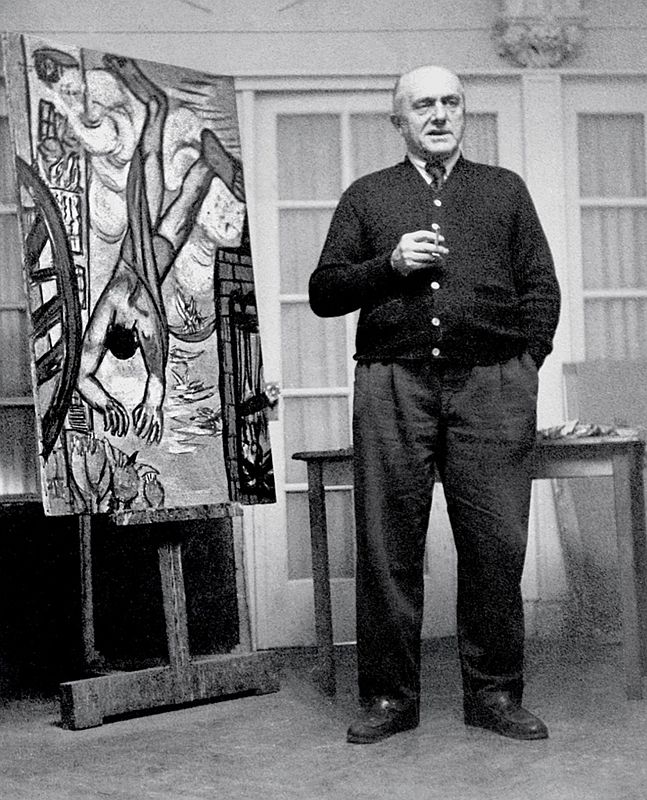
His painting “Falling Man” is difficult to explain, which makes it tempting for an art historian to describe it as a foreshadowing of television news images we saw on 9/11. The painting has also been interpreted as an illustration of Beckmann’s spiritual interests. Like other artists of his generation, he was interested in Theosophy, the concept of the fourth dimension, and he studied Indian philosophy and the Vedas. And yes, Beckmann seemed to embrace the idea, as an artist, that he could be a seer and truth-teller. But “Falling Man” is magic by its own internal, impossible contradictions. The legs and feet are oversized, weighty, splayed, taking up a large piece of the upper part of the painting. Clouds are pressed up against the picture plane; they are thick, tangible paint, all about air and atmosphere, yet they are also light enough to pass though the figure and the tall building at the left.

Beckmann’s painting does not position itself on any one side of a polemical position. Rewald refers to “Bird’s Hell” (1938) as his clearest indictment of Nazism. While this is likely true — the painting is full of nightmarish, weird, perverse imaginings – it is still, determinedly, a message told in metaphor: formal and imagistic. Across his entire body of work, Beckmann matches perversity with tenderness, detachment with intimacy, angst and darkness with celebration and rich color.

He loved to paint women and figures with splayed legs – this vision goes all the way back to the 1906 painting “Death Scene,” made in response to the premature death of his mother. Curiously, a female nude squats at the bedside in grief. The squatting or splayed-leg pose is a leitmotif across his triptychs, and it is featured prominently in “Columbine.” But his depictions of his second wife, Quappi, are about wholeness. In a painting like “Quappi in Grey” (1948), her small, delicate features are held together in Beckmann’s hand, and with his line.


Among the most striking aspects of Beckmann’s vision is that, notwithstanding his meditations on human folly and vice, it never descends into nihilism or despair. The paintings bristle and bump with appetite—for life’s absurdities, absolutely, but primarily for life itself. It’s worth mentioning that a number of Beckmann pictures concern themselves with everyday epiphanies—the ocean as seen from a hotel terrace; the forest surrounding a university town; an untended corner of the studio; and his beloved Quappi, whose handsome countenance appears repeatedly in the oeuvre. The center panel of Departure has famously—and rightfully—been cited as a marker of Beckmann’s holistic worldview. Blue skies and family, the painting would seem to suggest, sustain us in the midst of history’s cruelest turns. It’s no surprise that Beckmann disliked being lumped in with the Expressionists: self-pity and narcissism were antithetical to the “fullness, roundness, and the vitally pulsing” to which he aspired. The stern and heady embrace of “essential things” is palpable throughout “Max Beckmann in New York,” and is but one reason we should look to this demanding artist as a guidepost in our troubled times


Beckmann’s “Self-Portrait with Cigarette” belonged to the Metropolitan Museum until 1971, when its deaccession set off a series of disputes that reshaped museum practices.


Rachel High: As you've just mentioned, the book includes works made by Beckmann while he was living in New York as well as works in New York collections. He didn't live here for very long, but what role did the city play in Beckmann's reception as an artist?

Sabine Rewald: He lived here at the time of the emerging Abstract Expressionist artists. When The Met organized the exhibition American Painting Today, these artists—called "The Irascibles"—wrote a protest letter to the Museum's president because they were enraged that such conservative works were shown. The letter made the front page of The New York Times and a group photograph was later made of them for Life magazine; I illustrate it in my catalogue. Beckmann and the Abstract Expressionists were like ships in the night; he had no idea or interest in what was going on in those circles. He wouldn't set foot in any of the galleries that showed that type of work. Beckmann's work was not much in demand at that time. While he was in voluntary exile in Amsterdam, people admired him for his heroic stance. After a few years in the United States, sales did not go so well. To subsidize his artwork, he taught at the Brooklyn Museum Art School and, in September 1950, he took on an additional teaching position at an art school at West 130th Street. The job did not last long. The school went bankrupt in mid-November. So, being in New York was more for his mental well-being than for his career.


Rachel High: A common thread in your past publications is that they include excerpts from the artist's letters, journals, and other writings, and this book is no exception. How do Beckmann's writings to help the reader understand him and his work?

Sabine Rewald: His writing sheds not a single light on his paintings. He hated to have to interpret his work. When The Museum of Modern Art was thinking of buying Max Beckmann's first triptych, The Departure, which is in the catalogue and the exhibition, Curt Valentin was asked by director Alfred Barr to ask Beckmann what the painting depicted. Beckmann liked to mingle the metaphysical with realism and people often cannot make head or tail out of what is going on in his paintings. Beckmann retorted, "well, if he wants to know what's going on just tell him to return the picture." He wouldn't descend to give interpretations. Once he said, pointing to the sky, "only he upstairs knows what's going on." He hated when people asked for the meaning.
The Germans invaded Amsterdam in 1940 and Beckmann destroyed his diaries up until that year, so only his diaries from 1940 to 1950 are published. They tell you things of daily life, of people who he met, how many hours he worked, of the weather, and of walks, wherever he went. It is interesting to compare the original diaries to the published text. The published diaries were carefully edited by his wife Quappi, who took out derogatory remarks about those still alive then and references to his frequent visits to the Plaza Hotel for a "recovery drink," or two. His original writings are all in Sütterlin, a type of old German script that was taught in German schools when Beckmann was young. On some of his paintings his signature is in Sütterlin. It's very difficult to read and near impossible for someone who isn't German to understand. I'll tell you, I've never worked on a tougher artist than Beckmann. He's tough.