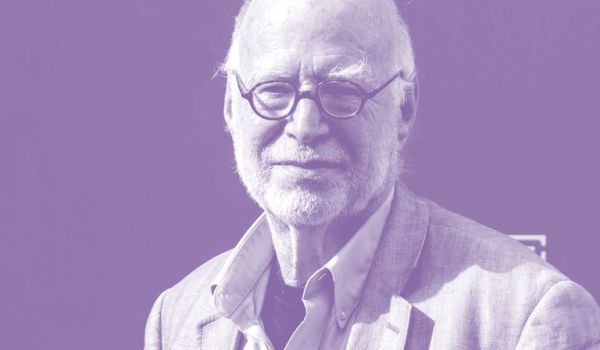
Sociologist
Richard Sennett speaks about his new book, The Performer: art, life,
politics.
The
Performer
explores the relations between performing in art (particularly
music), politics and everyday experience. It focuses on the bodily
and physical dimensions of performing, rather than on words. Richard
Sennett is particularly attuned to the ways in which the rituals of
ordinary life are performances.
The
book draws on history and sociology, and more personally on the
author's early career as a professional cellist, as well as on his
later work as a city planner and social thinker. It traces the
evolution of performing spaces in the city; the emergence of actors,
musicians, and dancers as independent artists; the inequality between
performer and spectator; the uneasy relations between artistic
creation and social and religious ritual; the uses and abuses of
acting by politicians. The Janus-faced art of performing is both
destructive and civilizing.
Worried
about the state of the world and reviews of my new book, I have
retreated to the kitchen to think about something else. I am trying
again to make brioche. This is an egg- and butter-rich dough that
produces something between cake and bread. Jewish grandmothers seem
to know by instinct how to produce it as challah; spread with butter
and honey it accounts for the heart attacks of many Jewish
grandfathers. For the rest of us, preparing the dough by hand is an
exhausting challenge: knead too little, and the ingredients don’t
meld; knead too much, and the dough becomes a rock. Machine kneading
never seems to produce the right consistency. Once again, I kneaded
too much. No doubt my kitchen failure is a sign of inability to leave
things well enough alone.
There was no respite in the kitchen from politics either. Keir
Starmer and his crew face a problem like making brioche—whether to
do too little or too much. Unlike brioche dough, which has to rest
overnight in the fridge in order to rise, Keir hasn’t much time;
people want him to produce results right away. One change will happen
immediately. The quality of his ministers will be infinitely superior
to those of the Tory regime these past years (who, just to push the
kitchen metaphor, are like eggs that are far past their sell-by
date). Tory rot will be hard to clean out in institutions such as the
BBC, but I think many civil servants are going to welcome the
opportunity at last to do good work.
A
companion reflection in the kitchen was about ageing. I have just
turned 81, which is a fact, but not a fact I feel. I still am the
same person I was at 40—anxious, overdoing. But while resignation
is foreign to me, my body is resigning, through various aches, in
bouts of vertigo, above all in deep fatigue—all facts I am not
facing. I envy the serenity of friends my age such as Ferdie Mount.
It’s given him a capacity to judge what’s worthwhile and sound
around him. Serenity is a virtue: anxiety in old age, which is
self-focused, is closer to a vice.
I
share this reflection only because, at the end of life, the personal
seems to me no longer to equate to the political. In politics, we
should be like nervy, fortyish New Yorkers, wanting new things to
happen but not certain what comes next. Anxious rather than
complacent. This is what I admire about Bernie Sanders, the radical
American senator; over the 40 years I’ve known him he has remained
restless and unsatisfied. He is in fact unsatisfiable. Which is a
public virtue.
These
days I go for my daily double espresso to Fidelio, a café-performance
space in Clerkenwell. (The doctor says that double espressos are bad
for blood pressure—but so what? What are we saving ourselves for?)
During the morning Fidelio is filled with out-of-work musicians,
whiling away the time in chat, looking to see if any messages have
come in on their phones. Of course the musicians hate the Tories, but
more important to them is that, since Brexit, there are fewer and
fewer jobs in Europe. They don’t know how to make their careers go
forward; they need a recipe.
I
am shortly to go on a book tour in the US. There, anxiety about what
happens next is coupled with foreboding. It’s more than likely that
Donald Trump will return as president. His histories as an alleged
rapist and fraudulent businessman, as well as his apparent mental
impairment, do not count against him in their minds. Full of
certainties, he appeals to people who also long for a recipe. His is
a mix of revenge, exclusion and repression.
It’s
a frightening experience to attend Trump rallies, as I’ve been
obliged to do in researching my new book. Trump is a great performer:
his timing is perfect, he is a master of eye contact; he always seems
to be focused on someone particular even when speaking to large
crowds; there are lots of call-and-response exchanges between Trump
on stage and the audience. Trump: “Climate science is”…
audience: “fake news!” Crowds get caught up in the immediate
moment and lose their sense of what’s real (even me, I confess; the
rallies are electric).
If
Trump does become president, we will need a strong recipe for the
consequences of this political theatre; we—“weasel Britain”,
“sick Europe”—are targets of his bile. Not-too-little and
not-too-much policies will not protect us against the onslaught.
By
instinct, I am a Momentum leftie. I believe in democratic socialism.
But I certainly don’t believe in Jeremy Corbyn; he has long since
passed his political prime. In politics, not-too-little and
not-too-much is usually a recipe for survival. In our present
circumstances, vis-à-vis America, that won’t work. Nor is prudence
a recipe for growth. We need bolder ideas.
Richard
Sennett’s diary: At the end of life, the personal is no longer
political. By Richard Sennett. Prospect Magazine, February 28, 2024.
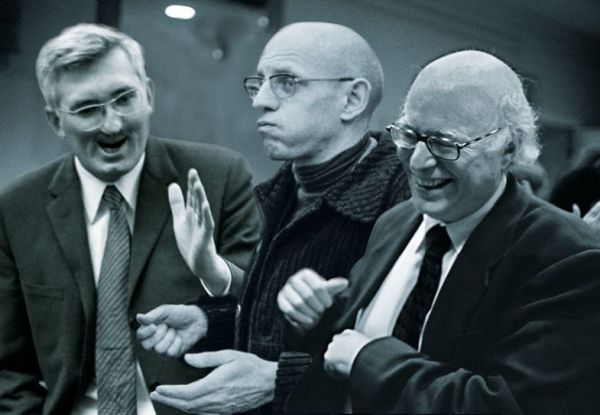
Michel
Foucault, Jurgen Habermas and Richard Sennett
The feted urban sociologist Richard Sennett tells Matthew Reisz about how his former career as a cellist inspired his latest trilogy of books, why his ideal university would be more night school than Oxbridge college and why it helps him to imagine his readers as female biologists
In 2018, Richard Sennett confirmed his reputation as one of the world’s leading thinkers on urban life by completing a trilogy of books on a vast and fascinating theme: “the skills people need to sustain everyday life”.
There were reasons, however, to fear that Building and Dwelling: Ethics for the City – the sequel to The Craftsman and Together: The Rituals, Pleasures and Politics of Cooperation – might be his swansong.
He had already, he wrote, had “an exploratory visit [from the Grim Reaper] in the guise of a stroke”, which led him to concentrate on “what really mattered” but also proved a strange sort of research tool. It helped him “understand buildings and spatial relations differently from the way I had before. I now had to make an effort to be in complex spaces, faced with the problem of staying upright and walking straight.”
Furthermore, needing to take regular exercise, he began to explore Kantstrasse in Berlin. When vertigo forced him to steady himself against shopfronts or walls, the lack of reaction from passers-by, beyond brief glances in his direction, offered vivid, first-hand evidence of how people in cities “don’t get involved” and “close off emotionally”.
All this must have sounded ominous for the many fans of Sennett’s work. But he is now back with the first volume of another ambitious trilogy, The Performer: Art, Life, Politics (Allen Lane). He hopes to follow it up with two further volumes, on narrating and picturing, so as to cover the full range of human “expressive DNA”. And, this time, the subject is one with which he is already intimately acquainted.
Now an apparently vigorous 81-year-old, Sennett is professor of sociology emeritus at the London School of Economics, having spent most of his career there and at New York University, although he notes that he has also “just become attached to Pembroke College in Cambridge, as a kind of hanger-on, because I know lots of people there”.
Yet he came relatively late and unexpectedly to academia. Sennett started off as a performing musician and, he recalls, “expected to spend my life as the last cello in a good orchestra”. When a hand injury and botched surgery put a stop to that, it was the political theorist Hannah Arendt who gave him “the self-confidence to go on in academia. She said, ‘You know nothing, but so what? You‘ve got a brain and can use it. So come and sit in on my lectures. If I can give you any advice, I will.’ That was wonderful.”
Two equally celebrated thinkers, neither of them “standard-issue academics”, later proved to be crucial intellectual interlocutors for Sennett, namely the French historian Michel Foucault and the German philosopher Jürgen Habermas. They would meet up regularly for animated discussions on topics such as “cosmopolitanism”, where levels of agreement or disagreement “depended very much on the time of day and the amount of alcohol we had to drink”.
Such interactions, for Sennett, are at the heart of a productive intellectual life: “Every intellectual needs a Viennese cafe. You don’t need a classroom or a seminar. You need a cafe where you can have one cognac too many and really lay it out and have somebody come back at you.”
Looking back, Sennett is well aware of how lucky he has been. In the 1970s and early 1980s, he reminds us, “there was a labour shortage of academics, which gave us a little more wiggle room in terms of flexibility. I had a wonderful freedom in my thirties and forties. I could write what I wanted.”
Alongside his research and teaching, Sennett has been involved in a number of small-scale planning projects, mostly for poor communities, in Beirut as well as Chicago and New York, and provided consultancy services to a number of UN agencies concerned with urbanism. Although his writing has always focused on the (very broad) themes of cities and labour, he has happily leapt over disciplinary boundaries and addressed his books far beyond a specialist academic audience. He imagines his ideal reader – rather strangely and specifically – as a female biologist: “Since I’m neither of those things, I have to ask myself two questions about what I am writing: would it interest her? And would it tell her anything that is not intuitively obvious? You want to assume your reader is someone like yourself [in terms of curiosity and intelligence], but has different experience. That seems to me to produce writing which will have some spine to it.”
Although full of wide-ranging learning, Sennett’s books are also notable for their personal touches. Together opens in a school playground in London, where a friend of Sennett’s grandson has commandeered the public-address system to blast out Lily Allen’s song Fuck You: “Fuck you, fuck you, very much”. Building and Dwelling describes his own youthful experience of living in New York’s West Village “above Dirty Dick’s Foc’sle Bar, an establishment…which catered for stevedores during the day and transvestites at night”.
It is another striking feature of Sennett’s books that he is very interested in areas of intuitive, non-verbal practical expertise familiar to performers but neglected by most academics. (The Craftsman, for example, examines the “link between hand and head among...musicians, cooks, and glassblowers”.) And he always aims, he says, to offer open-ended “discussions with the reader” rather than easy answers to complex questions.
All these features of his work have gained Sennett a huge cult following. “To call this captivating writer an academic sociologist,” a reviewer in The Independent once wrote, “makes as much, or as little, sense as labelling Mozart a court musician.”
As someone who became an academic as a second choice, Sennett has to some extent “always felt like a fish out of water in academia”, views it with a somewhat sceptical eye and deplores many recent developments. Reflecting on “the relation between intellectual life and academic life”, he has come to the conclusion that “They’re really diverging, particularly in the UK...The bureaucratic world has not made [a younger generation of academics] intellectuals any more.”
Asked about his obvious commitment to interdisciplinarity, Sennett responds: “I never understood what that word means! If you have a subject, you want to know everything about it, all sides of it.” In studying the political life of cities, for example, “if you don’t know about how concrete and glass are organised in urban space, you lose something about the environment in which people are practising politics.”
Furthermore, Sennett finds unhelpful “this notion of ‘I bring one specialised body of knowledge to something, somebody else brings another and somehow they intersect’”. Part of the reason why he decided to work at the LSE, where he helped to found the LSE Cities research centre, was that “you could start with a subject such as inequality and then figure out all the dimensions you needed to know about, rather than just following one approach”. In his ideal academy, departments would be organised around themes such as cities, truth and pleasure. That would work better, in his view, than “the bureaucratic parcelling out of the humanities and social sciences” into traditional disciplines, such as anthropology and sociology.
More broadly, Sennett would like to “organise higher education to be meaningful for people throughout their lives”. To do so, he envisages “the equivalent of gap years, so people would go out and work for five or six years and then start university at 25 or even 30. When I’ve had mature students, they’re always much more satisfying to work with.”
Most school-leavers don’t have a great deal of life experience, Sennett goes on, so “they have to rely on suppositional experience – what something should be like. And suppositional experience is exactly what adulthood should break down. It’s very easy to theorise about something when you don’t have experience to back it up. It becomes slick and all about defending a point of view.”
His ideal university, Sennett concludes, “would look much more like night school than an Oxbridge college”.
At the start of The Performer, Sennett boldly announces that he “wanted to think things out” for himself and hasn’t tried to “slot this book into the burgeoning academic field of ‘performance studies’”.
The book ranges from ancient Greece to modern Japan by way of Renaissance Venice, not to mention Louis XIV projecting his charisma by dancing in front of the French court. It also draws on direct experience, such as attending a gung-ho war film with a wounded veteran and a poignant performance of Shakespeare’s As You Like It on an Aids ward in the early 1980s, when the actors used flesh-coloured cream to “disguise the reddish-brown lesions of Kaposi’s sarcoma on necks, faces and hands”.
So why does Sennett want to distance himself from the kinds of analysis one finds in performance studies?
His book returns to his time as a cellist and as “a sound artist”, who spent three months “splicing and gluing together the tapes” for experimental dance groups. He is very intrigued, he tells Times Higher Education, by the technical challenges of “how to use one’s technique in a way which is expressive” and much less by questions of representation and historical context.
“I’m not very interested in the identities of performers,” he explains, “whether they’re black or gay or anything like that. If you’re a black musician, what you’re struggling with is the same thing that every other musician is, not how to be black but how to perform well. It’s the art part of performing which interests me.”
Another central concern is the continuity between such artistic performance and malign forms of political manipulation. The book includes a disturbing account of a gathering of climate change sceptics Sennett witnessed at the Trump International Hotel. Though he disagreed with their views, he remembers now, “the kids were perfectly reasonable to chat to” over lunch, before they went off to hear a number of inflammatory speakers “performing a kind of climate denial – and performing it well. Then the theatrics catch them up and they lose consciousness of the fact that things are more complex. The moment the performance ends, a more judgmental, calm consciousness returns. It’s a collective surrender through theatre. And something like that may have happened with Brexit.”
As this may suggest, Sennett was partly spurred to write his new book by the rise of political performers who “can overwhelm the judgment of other people. Boris Johnson is a great example. So is Donald Trump...They know how to seduce, and, certainly, we were seduced by Boris Johnson. It was such a low point in what you might call the collective intelligence of the British people. He dumbed them down totally.”
In pointing to the “emotionally compelling...power of manipulative, malign performances”, The Performer also makes the sobering suggestion that the standard “liberal, enlightened remedy for changing people’s attitudes” – more information, more education – may not be enough to combat them.
Sennett has forged a hugely impressive career, of a kind that is hard to imagine today. Among many other topics, his books force us to think again about what higher education could and should be for.
Richard
Sennett: ‘I’ve always felt like a fish out of water in academia’.
By Matthew Reisz. Times Higher Education, February 15, 2024.
When
he started to write The Performer says Richard Sennett, “a cluster
of demagogues had come to dominate the public realm”. Figures such
as Donald Trump and Boris Johnson are skilled at “malign
performances” that draw on a wide range of theatrical devices and
materials. To which, however, the best response is not to abhor their
techniques – to try to fight them only with cold correctness –
but for “art-making” to “push back” in equally compelling
ways. Performance, he believes, and the emotions it arouses, are
fundamental to being human.
Ever
since he published The
Fall of Public Man in
1977, Sennett has described with unique insight and intelligence the
ways that human bodies and actions interact with the cities and
buildings that they inhabit. Now aged 81, he plans to complete a
trilogy, “if I live long enough”, on the “presence of art in
society”, with essays on narrating and picturing to follow. In The
Performer he
brings particular experience to the subject, as he himself trained as
a professional musician – a cellist – at the Juilliard
School in
New York. A career-ending hand injury and a botched operation to mend
it caused him to pursue an academic career in sociology.
He
combines, as he has in previous books, erudition with personal
experience. He cites the Renaissance philosopher Pico della
Mirandola, Freud, Aristotle, his friend Roland Barthes, and Hannah
Arendt, under whom he studied. He also tells stories of Dirty Dick’s
Foc’sle Bar in Greenwich Village in the 1960s, which in his account
was frequented by artists, “gay men of colour”, and unemployed
dock workers. He describes a 1980s production of As
You Like It
– “a creative defiance of death” – by patients in the Aids
ward of the Catholic-run St Vincent’s hospital, also in Greenwich
Village. The notion of “the performer” for him includes political
protesters and people going about their daily lives, as well as paid
actors and players.
He
ranges far and wide, tracing the history of theatrical spaces from
the open-air auditoriums of ancient Greece, to Shakespeare’s Globe,
to Wagner’s opera house in Bayreuth. He dwells on the Teatro
Olimpico, the “first fully roofed, walled-in theatre in Europe”,
designed by Andrea Palladio and Vincenzo Scamozzi in the late 16th
century, and explores the progressive enclosure of theatres and their
withdrawal from the streets around them. He tells colourful stories
of the changing relationship of performers and audiences, once very
different from the respectful attentiveness now considered
appropriate. In the 18th-century Comédie-Française, which stank of
sweat and junk food and pissoirs, there was as much attention on the
sexual adventures in the boxes as anything on stage. In London
theatres of the same century audiences shouted out familiar lines
(“that is the question”, for example, after “to be or not to
be”) and either egged actors on or tried to put them off.
It’s
hard to find definite conclusions in what is an enjoyably wandering
book, but certain themes emerge. Sennett sees performance as complex
and ambiguous, a form that dies if it is enlisted to deliver
simplistic moral messages, but which yet has a capacity for good and
evil. He describes, as an illustration of the latter, how crowds can
be whipped up into unthinking rage and hatred, for example by the
televised racist speeches of the proto-Trump politician George
Wallace,
which captivated the resentful jobless dockers in the Foc’sle Bar.
A more recent case is a conference of climate crisis deniers –
polite people who become inflamed in the auditorium – that Sennett
decides to infiltrate.
Forces
for good might be found in the reciprocity between performers and
audiences and between themselves. Sennett calls the performer a
“sociable artist”. He believes in the “nonverbal communication”
and “wordless cooperation” that exist between players in an
ensemble. The civilising power of performance lies not so much in
what is said as the way it is done.
Things
go wrong when reciprocity is lost. Then a demagogue can command
obedience from a crowd, and the temporary fury of an audience becomes
a permanent feature of life. “Visceral theatre,” says Sennett,
“fills the absence left by empty words.” The question he poses,
without fully answering it, is how the power of performance can serve
freedom rather than destruction.
The
Performer: Art, Life, Politics by Richard Sennett review – all the
world’s a stage, for better or worse. By Rowan Moore. The Guardian,
March 3, 2024
Richard
Sennett urges revitalizing public life, spaces, politics by creating
spaces that engage imagination.
Richard
Sennett began his career as a professional cellist and became a
well-known sociologist whose work looks at urban design, public
culture and art, and how life in cities affects individuals and the
ties between them. And now in a new book, he looks to bring it all
together.
“My
life as a performing musician never really left me during the decades
that I’ve been doing sociology. And in this book, I try and bring
these two realms together,” he said of the soon-to-be released The
Performer: Art, Life, Politics.
Sennett
— who also authored “The Fall of Public Man,” “Flesh and
Stone,” “The Corrosion of Character,” and “The Craftsman” —
spoke about his new work at an event hosted by the Harvard
Graduate School of Design on April 3. He focused his talk
on the power of theater to revitalize public life and even politics.
The
moment a public space transforms into theater is when it becomes “a
realm in which people can diverge from the ordinary, from routine,”
he explained. But there are better and worse ways to do it.
Take
Faneuil Hall or Times Square. These are examples of
“tourist-orientated theater,” in which the spectacle of
performance might draw people into the marketplace. For a day or two
this might be wonderful. But for those who live in the area, it
quickly becomes a place to avoid. “Native New Yorkers [avoid] this
theatrical space like the plague,” he said.
Sennett
said he thought New York had greater success in looking at the
natural world in theatrical terms, pointing to Central Park “where
by putting the cars below ground level … the city has disappeared.”
Sennett
is the winner of multiple global awards, including the Hegel Prize,
the Spinoza Prize, an honorary doctorate from Cambridge University,
and the centennial medal from Harvard University in 2017. He also
serves as a member of the United Nations Committee on Urban
Initiatives, having advised on urban issues for 30 years.
During
the talk, he took the audience through the evolution of public
performance spaces, from ancient Athens to Shakespeare’s Globe
Theatre in London. Earlier spaces, he said, were open and in nature
and over time became more defined.
The
Globe was a structure but still open-air. There were no sets or
backdrops and performances required a particularly active imaginative
collaboration with the audience. This was in the late medieval-early
Renaissance.
In
the same period came the break between “stage and street,”
Sennett said. He pointed to the Teatro Olimpico in Vicenza, Italy, as
an example and joked that all the attendees should be gifted plane
tickets to see it themselves. He highlighted the wood-and-stucco set
imitating an ornate marble wall with openings revealing
realistic trompe-l’œil scenes
of the city.
“They
show an idealized view of the city, perfectly clean, orderly … You
look into a space that’s beautiful, but unreal,” he said. The
backdrop remains the same regardless of whether the performance is
comedy or tragedy. “You get this divorce between what’s happening
in the realm of art and what’s happening as it were looking out
into the city.”
Sennett
characterized this separation between audience, theater, and world as
an illustration of the modern “tension between a street space and
the spaces of imagination.” And
he asked: “How can we make a more porous relationship between the
actual life of the streets and what goes on inside the theater?”
One
solution Sennett pointed to was based on the work of Steve Tompkins,
who designed the Young Vic theater in London in 1970. (Tompkins is
also set to design Harvard’s new theater in Allston.) In
this instance, the theater was designed to incorporate the street
itself into the space, including a café. That had never been done
before, and the idea that people could drink and eat while a
performance was happening was innovative at the time.
The
idea of porous relationships can also be applied to theater and
politics, Sennett said. Take Martin Luther King Jr.’s March on
Washington for Jobs and Freedom. The main organizer of the
protest was Bayard Rustin, an accomplished singer with a performance
background.
The
goal of the massive outdoor gathering at the Lincoln Memorial, where
King delivered his “I Have a Dream” speech, was to create “a
magical space that … re-imagines the street.” There were “lots
of spaces where people come enter from the sides, like coming from
the wings onto a central stage.” Participants were handed signs
that Sennett likened to “masks … that anybody can wear.”
The
result was one of the “great pieces of political theater in
that sense organized in order to give a sense that we’re alone,”
Sennett said.
Political
discourse is in many ways exhausted, he said, and
as a society we need new ways of thinking to bring people together. Re-imagining spaces is one way designers can bring their skills to the
table.
“That’s
the politics that we can build,” he said.