Showing posts with label sexual identity. Show all posts

06/07/2022

Julia Shaw on Bisexuality


There have been suspicions that bisexuality is probably just a trend for almost fifty years. Newsweek has even declared this boldly twice. In 1974 it published an article titled “Bisexual Chic: Anyone Goes.” Two decades later, in 1995, it ran a cover story with the headline “Bisexuality. Not gay. Not straight. A new sexual identity emerges.” New again?
 
These two articles have been widely mocked in bisexual forums. This is particularly true of the 1995 cover, which includes bright white lettering atop a photo of a woman with short hair wearing an oversized black suit and with her arms crossed. She has a guarded expression on her face and is positioned in front of two men in casual gray T-shirts who stare with emotionless expressions into the camera. The photo is so weird, and so over-the-top nineties that it seems almost satirical.
 
The article itself proclaims things like “bisexuality is the hidden wild card of our erotic culture,” suggests there is “an independent bisexual movement,” and allows a fifteen-year-old to debunk the myth of the hypersexual bisexual while simultaneously reinforcing it with the bizarre quote, “A bisexual… doesn’t have any more sex than the captain of the football team.”
 
Given that a key benefit of being the captain of the (American) football team is having lots of sex, I guess this kid is trying to make it clear that he is promiscuous, but not sexually excessive. The article also in various ways conflates polyamory, promiscuity, and gender fluidity with bisexuality. And it taps into the idea that bisexuality is on the rise with the sentence “Many college students, particularly women, talk about a new sexual ‘fluidity’ on campus,” and quotes a bisexual person saying, “It’s not us-versus-them anymore. There’s just more and more of us.”
 
What I find astonishing is that this article could have been written today, with the exact same misconceptions, uneasy feeling of change, and echoes of optimism. Particularly, this idea that there are just more and more bisexual people is still popular today. But is it true? Before I try to answer that, I need to define what bisexuality is. To do that we are going to head back in time to see where the term came from, and three men with alliterative names who were fundamental in establishing bisexuality as an academic and popular concept: Krafft-Ebing, Kinsey, and Klein.
 
It may surprise you that the use of the term bisexual to refer to human sexuality is almost as old as the term heterosexual. In his book The Invention of Heterosexuality, gay history pioneer and activist Jonathan Ned Katz argues that “the idea of heterosexuality is a modern invention, dating to the late nineteenth century.” The first recorded use of the term was in an anonymous pamphlet in 1869, of which it was later established that Karl-Maria Kertbeny was the author.
 
Kertbeny lived a colorful life. He spent time in many major European cities, where he hung out with celebrities like George Sand and the Grimm brothers, hid from authorities by living in a botanic garden in Leipzig, was briefly a police spy, and was in and out of debtors’ prisons because of a series of failed attempts at being a journalist. In his letters, pamphlets, and books he wrote extensively about his view that sodomy laws violated human rights, and that such consensual sexual acts in private should not be subject to criminal law.
 
While writing, Kertbeny, who was probably gay himself, found the need to label and define the sexual norm so that he could explain how same-sex desires and sexual behaviors contrasted with it. This is why he came up with the terms “heterosexual” and “homosexual.” This means that a gay rights activist coined the word heterosexual as a by-product of creating the word homosexual.
 
In the etymology of Kertbeny’s “heterosexual,” “hetero” comes from the Greek heteros which means another, while homos means same, and both are melded with the Latin word sexus. Not long after this, bi, or two, started to be used to refer to people who had both homosexual and heterosexual desires. A way that bisexual researchers often talk about this is that the bi in bisexual means two, but the two are not men and women, they are same and other.


Before being adopted to describe human sexuality, the term bisexual was typically used to refer to creatures and plants which are hermaphroditic, so have both male and female reproductive parts. Even today, in the worlds of botany, entomology, and zoology the term bisexual is often used in this way. Roses are an example of a popular bisexual plant.
 
The first use of the word bisexual in English, in the sense of being sexually attracted to people of multiple genders, was probably in 1892 when American neurologist Charles Gilbert Chaddock translated Psychopathia Sexualis, an influential book by the German psychiatrist Richard von Krafft-Ebing in which he detailed what he considered to be sexual disorders in male prisoners. The book was intended for clinical-forensic settings, and Krafft-Ebing wrote it in intentionally difficult language and with parts in Latin so that laypeople couldn’t read it. The book played an important and controversial role in the discussion among psychiatrists at the time who were trying to understand why people have homosexual desires.
 
Why didn’t these terms exist earlier? As sexuality historian Hanne Blank has argued, people in English-speaking countries didn’t really think about sexuality as an identity before this. They didn’t consider they should be “differentiated from one another by the kinds of love or sexual desire they experienced.” There were words to describe the kinds of sexual behavior people engaged in, but sex was mostly something that people did, not part of who they were.
 
Once sexuality became a hotly political part of identity, people wanted ways to define these new sexual labels. The problem quickly became that what one person meant when they used a label like bisexual was very different from what someone else meant, which is a problem that continues to pose a major obstacle for researchers today.
 
*
 
How many people do you think identify as bisexual today? Depending on who you ask, and how they spend their time, you will probably get very different answers. I need to regularly remind myself that fewer people are bi than I intuitively guess, because my social media feeds make it easy to forget that bisexuality is not the default. We all live in bubbles, and mine is an adorable bi bubble.
 
It is very difficult to get accurate or regular estimates of LGBT+ populations from most countries, especially from countries where homosexual behavior is criminalized. It’s even harder to get information specifically about bisexuality. Still, there are a few studies we can look at. In a summary of eleven studies conducted between 2004 and 2010, including samples from the US, UK, Canada, Australia, and Norway, between 0.5 percent and 3.1 percent of participants identified as bisexual. The summary found that among adults who identify as LGBT, bisexual people are the slight majority. It also found that far more people acknowledge at least some same-sex attraction, between 1.8 percent and 11 percent across the studies. This is one of few studies that gives us a sense of international comparison.
 
Other studies can give us some sense as to whether identifying as bi has increased over time. The Office for National Statistics in the UK estimated in 2017 that 2.3 percent of 16-to-24-year-olds identify as bisexual, while a national survey by the Centers for Disease Control and Prevention in the US in 2016 placed the rate at 5.5 percent of women and 2 percent of men. Both of these surveys reported increases in the rates of people who identified as bisexual, and that in the youngest age groups more people identified as bisexual than gay or lesbian. The findings are also consistent with research which has found that more young women of color are identifying as bisexual today than in the past. However, these studies only capture people who identify as bisexual.
 
Studies have sought to address this shortcoming by asking people in the UK about their sexuality using the Kinsey Scale, and a series of follow-up questions. Using this scale is clever, because if we ask people directly if they are bisexual or homosexual, many say no either because they identify as heterosexual or because they identify outside of these labels (e.g., pansexual, fluid, or unlabeled).
 
According to the researchers of one study published by YouGov in 2015, “with each generation, people see their sexuality as less fixed in stone. The results for 18–24-year-olds are particularly striking, as 43 percent place themselves in the non-binary area between 1 and 5… classed as bisexual in varying degrees by Kinsey.” Note that “non-binary” here means not entirely homosexual or heterosexual, rather than people whose gender identity is nonbinary. This change toward more flexible conceptualizations of sexuality is exemplified by a follow-up study of people who identify as bisexual conducted by YouGov in 2019.
 
In a summary of the results the researcher writes: “When we asked 18 to 24 year olds to choose what best described their sexuality in 2015 just one in fifty (2 percent) said they were bisexual. Our latest data . . . shows that one in six (16 percent) now choose this option—an eight-fold increase.” She continues, “More people than ever identify as somewhere between the extremes of the sexuality spectrum.”
 
Replications of the 2015 YouGov survey were conducted in Germany, Israel, and the US. In all three, at least a third of young people identified as neither exclusively homosexual nor exclusively heterosexual, landing them somewhere on the bisexual spectrum. In all three, young people were far more likely than older people to fall on the bi spectrum and to explicitly identify as bisexual. And, in all three, some of the people who placed themselves on a sexual spectrum denied that such a spectrum exists.
 
This I find a particularly fascinating aspect of these studies. In a summary of the 2015 results the researchers wrote, “People of all generations now accept the idea that sexual orientation exists along a continuum rather than a binary choice,” because 60 percent of heterosexuals and 73 percent of homosexuals in their study supported the idea that sexuality is not binary. Although most of their 1,632 participants agreed that “sexuality is a scale—it is possible to be somewhere near the middle,” 12 percent of heterosexuals and 7 percent of homosexuals chose the “don’t know” option. There was also a third option: “There is no middle ground—you are either heterosexual or homosexual.” I know it shouldn’t shock me, but at least a fifth of people in both groups didn’t believe that bisexuality existed—28 percent of heterosexuals and 20 percent of homosexuals indicated that “there is no middle ground” for sexuality.
 
What’s even more amazing to me is that a substantial minority of these individuals were not entirely homosexual or heterosexual themselves: 11 percent of those who identified as a 3 on the Kinsey Scale, and 27 percent of those who identified as a 4 chose this third option. How do you put yourself in the middle of a sexuality scale, and simultaneously deny that people can be in the middle of a sexuality scale?
 
While I cannot tell you why these participants engaged in such dissonance, I can tell you who they were more likely to be. While 32 percent of those over 50 agreed with this statement, this fell to 22 percent of those aged 25 to 35, and 18 percent of those aged 18 to 24. It seems that younger generations are more likely to both identify as bi and to accept bisexuality as a thing.
 
Enjoyably, further supporting the idea that people are becoming more bi-supportive, the 2019 study found that “if the right person came along at the right time,” about 35 percent of those who identified as heterosexual indicated that they could be (i) attracted to a person of the same sex, (ii) have a sexual experience with them, and (iii) have a relationship with them. Many people today in the UK seem to be open to the idea that they could be attracted to people of multiple genders, which is a beautiful thing.
 
While it is unclear whether bisexual behavior is on the rise, more young people than ever are identifying as bisexual, and it seems that many people are open to falling in love with someone regardless of their gender. Bisexuality is not a fad, or “chic,” or “new”; rather this sexuality label appears to be more accessible and empowering today than it has been in the past.
 
________________________________


Excerpted from the new book Bi: The Hidden Culture, Science, and History of Bisexuality by Julia Shaw, PhD, Abrams Press,  2022.
 
  
Nope, Not a Trend: On the Modern Origins and Evolution of Bisexual Identity. By Julia Shaw. LitHub, June 29, 2022.


The number of people who identify as queer in the UK Census has increased over the past few years. This trend is in particular driven by the rising number of LGBT+ identities among people aged 16 to 24 years. The most popular sexual identity within this emerging group is bisexual – the romantic and/or sexual attraction to more than one gender. Data from the Office for National Statistics (ONS) shows an increase from 0.7 per cent in 2015 to 1.1 per cent in 2019. Rather than a sudden new surge of bisexual desires, increased acceptance, legal protection and visibility are likely to be the cause of this increase.
 
But why should we count how many people are bi, or study what their experiences are? Research is young in this field, but we’re already seeing that tossing all queer identities into one research bucket renders the unique struggles of being bisexual invisible. For a start, it’s hard to even get an accurate sense of the exact number of British people who are bisexual. Many people who are attracted to people beyond one gender, shy away from the identity label ‘bisexual’. When it comes to research, this reluctance has led scientists to come up with alternative ways to capture and categorise sexuality.
 
One of the most common tools used is The Kinsey Scale. First published in 1948 by biologist Dr Alfred Kinsey, it is used to place people on a spectrum of sexual attraction between entirely heterosexual and entirely homosexual, using a scale from 0 to 6. It also includes ‘X’ for those who are asexual. It was so successful that it is still the single most popular scale for classifying sexuality. It’s often what people are indirectly referring to when they say, “Aren’t we all a bit bi?”
 
When YouGov surveys conducted in 2019 used questions that mimicked The Kinsey Scale, researchers found at least a third of people aged 18 to 24 say that they are attracted to multiple genders. A startling figure compared to the 1 per cent reporting to the ONS. Only with research can we cut through the reluctance people have to say “I am bisexual”, and find out whether those attracted to multiple genders need more support than those who aren’t.
 
Since social scientists and other researchers have started to analyse the B, we have begun to understand the struggles that uniquely endanger bi people. Research shows us that bi women are hypersexualised, and stereotypes that see bi women as promiscuous sexual playthings feed into people’s existing rape myths.
 
Accordingly, studies have found that bisexual women are significantly more likely to be raped, repeatedly sexually assaulted, and to be the victims of intimate partner abuse than lesbian and heterosexual women. Had this research homogenised all women into one group, we might never have known that the stereotypes affecting bi women specifically place them at far greater risk of sexual victimisation.
 
A different cluster of toxic assumptions awaits bi men. Bisexual men are seen as lying, to themselves and others, because they are thought to be gay. And, particularly in the 1980s and 1990s, bi men were also seen as murderers in disguise, catching AIDS when having sex with men and giving it their female partners. This left many bisexual men isolated and alone, failed by educational campaigns that rarely moved beyond gay spaces.
 
We need to acknowledge the unique needs of bi people, including a specific focus on bi men. If we don’t, we fail a huge amount of the population. Armed with bi-specific research, we stand a better chance of winning the fight back against the societal biases and misconceptions that hold bisexual people down.
 
As a young researcher, I didn’t know anyone else who was bisexual in my field, or, for that matter, in any field. It was rarely mentioned, not even in lectures specifically on sex and sexuality. When I graduated with my PhD in 2012, I had no idea how useful my background in criminal psychology would come to be when I turned my gaze to studying bisexuality. For my new book, Bi: The Hidden Culture, History And Science Of Bisexuality, I have found and spoken to researchers across the globe and in various disciplines who are all fighting for change.
 
I want the world to be a safer place for people like me. The best way that we can achieve that is to visibly support bi people. Let’s not allow the ‘B’ slip into the shadows of its colourful siblings.
 
 
Why does researching bisexuality matter? By Julia Shaw. Science Focus, May 20, 2022.


Julia Shaw is a psychologist at University College London and part of Queer Politics at Princeton University, a thinktank engaged in the research of LGBTQ+ equality and rights. Her new book, Bi: The Hidden Culture, History and Science of Bisexuality, draws on her experiences of being bisexual and her background in the psychological sciences to explore and celebrate a sexual identity she says remains marginalised and forgotten.
 
What led you to begin researching bisexuality and write this book?
I was writing my second book, Making Evil, which is about criminal psychology and what we associate with the word “evil”. I was writing about the villainisation of LGBTQ+ individuals as evil around the world and how important visibility is. I realised I was still invisible myself, so I came out as bi in that book, because I felt like a hypocrite for telling other people to be out and not being out myself in public.
 
I had so many questions about bisexuality. I figured I’d read a couple of books and I’d be done. But those books with the answers that I wanted didn’t exist, so I decided to write a book instead. I figured if I was struggling to find those answers, other people were as well.
 
Your book discusses one of the first measures of bisexuality, the Kinsey scale, first published in 1948 by the biologist Dr Alfred Kinsey. How did that tool change the field of study?
 
 
The Kinsey scale is a way to see sexuality on a spectrum from 100% heterosexual desires to 100% homosexual desires. Kinsey found that about half of men and about a quarter of women allocated themselves as not 100% heterosexual, which effectively meant that a lot of people were queer. When people talk about sexuality as a spectrum, they’re usually indirectly referencing the Kinsey scale.
 
The book refers to the invisibility of bi people in research on sexuality; why is that?
 
The default is still to ask people their identity, which is a problem for bisexual people. Most people who would fall in the middle of the Kinsey scale aren’t captured by labels – they often refer to themselves as gay or straight. Asking questions about how people behave, and who they find attractive, is going to get you a much more accurate picture than asking people what their labels are most of the time. Research, for some reason, is really reluctant to accept that. Probably because it introduces complexity and complexity is bad for data analysis.
 
 
A fascinating section of the book examines bisexuality in the animal kingdom and the struggle of evolutionary biologists to explain the “Darwinian paradox”: why animals engage in homosexual behaviour if it doesn’t lead to reproduction. You propose the idea that bisexuality is perhaps “the originary state in the evolution of sexuality” – how did you reach this conclusion?
 
 
There’s this assumption that heterosexuality is the norm, because heterosexual sex results in offspring. But looking at the literature on animal behaviour and sexual interactions, I found there are a number of researchers, including in the evolutionary sciences, saying we’ve misinterpreted animal behaviour for a very long time by imposing our sense of decency and our heterosexual bias on to animals, rather than observing and describing what animals actually do.
 
Research has found there’s a lot of sexual behaviour between animals of multiple sexes in the animal kingdom. The explanation for that is: as long as you’re also at least occasionally having sex with the other sex and you’re able to reproduce, then it doesn’t really matter if you also have sex with the same sex. I found it really interesting, because I assumed that I was a deviation, rather than that most animals seem to behave this way.
 
 
You contrast this positive reading of the “original state” of sexuality with Freud’s negative view that everyone starts off bisexual as a child and matures into monosexuality as an adult. Why do associations between bisexuality and immaturity persist?
I get told a lot that Freud thought everyone was bi and I have to correct this so often. Freud did say that, but he didn’t mean it in a good way. He very much saw it as a negative thing to be bisexual as an adult.
 
There are a couple of assumptions that are thrown at you when you say you’re bisexual. One is that you’re greedy; the other is that you want to be the centre of attention, that it’s some sort of performance, especially as a woman, the expectation is that it’s performative for men. Then there’s the idea that it’s a phase. This idea isn’t just held by heterosexual people; it’s also very much held by homosexual and queer people and that is a huge problem. It has led to many bi people feeling excluded or pushed out of queer spaces.
 
We’ve seen people become more comfortable talking about a range of sexual identities in recent years, with the word “queer” gaining particular prominence. You’re saying that due to negative connotations, the term “bisexual” hasn’t been embraced in the same way?
 
 
It hasn’t. People cringe when they say it, or don’t say it, about themselves, because they’re worried about the reaction, including me. There have been many occasions where I’ve used the word “queer” instead of “bi”, because I don’t want the reaction that comes with saying “bi” and “queer” is a bit more vague, frankly. It’s fascinating that because of internalised biphobia in so many people, we shy away from that word. I mean, it’s LGBT and it has been since the 90s. Yet the “B” has been invisible or berated. Lesbian and gay people, I think, need to make space and be more inclusive and conscious of bi people.
 
You discuss how bisexual people are more likely to experience sexual violence, poor mental health and substance abuse than other sexual minorities. What explains this?
 
Bisexual women, compared with lesbian and heterosexual women, are the most likely to be raped and to experience various forms of sexual assault. There’s a layering of stigma that happens with bi women in particular, where there’s the sexualisation of women and the hypersexualisation of bisexuality on top. It makes people take more liberties with how they touch you, how they talk to you, how they sexualise you and whether they’re likely to assault you. This is something we see in research on the treatment of bisexual kids in schools and universities. Until we break down the stereotypes about bisexuality, we are not going to tackle this problem.


What can the study of history tell us about the evolution of attitudes towards sexuality?
 
Sexual desires and behaviours have only really been seen as identities since the 1800s. The idea that it’s something you are rather than something you do – that is a relatively new concept. If you look at how historians try to make queer people visible in history, they often jump too far. If there’s any evidence of homosexual attractions, they say: “Look, there’s a gay person.” I can see why that’s something people want to do. But what it does, in effect, is erase bi people. Because most of those people will also have had wives, or husbands, and heterosexual interactions. That makes it really hard, and often inaccurate, to say that they are exclusively homosexual.
 
 
You discuss the relationship between “compulsory heterosexuality” and “compulsory monogamy”. How could more acceptance and understanding of bisexuality help challenge norms around both?
 
One of the most toxic stereotypes is that bisexual people can’t be monogamous and that bisexual people can’t be trusted in relationships. If you think about it for more than 10 seconds, you understand why that’s an absurd thing to say. I wanted to end the book on the relationship between bisexuality and consensual non-monogamy, because it’s something a lot of bisexual people think about a lot and they get asked about often. If heterosexual people and monosexual people ask themselves the questions they often put to bi people – “How can you be monogamous? Why is one person enough for you?” – the world would be a better place. Having that conversation in a way that is more about deconstructing heterosexual norms and expectations is a really useful thing to do.
 
Julia Shaw: ‘I had so many questions about bisexuality’ By  Laurie Clarke. The Guardian June 4, 2022. 


Discover the hidden culture, history, and science of bisexuality.   Dr Julia Shaw and Ben Hunte discuss her new book “Bi” at the British Library.  June 7, 2022.  Dr. Julia Shaw  BiBook


The hidden science of bisexuality with Julia Shaw – podcast
 
Presented and produced by Madeleine Finlay, additional production by Anand Jagatia, sound design by Tony Onuchukwu, the executive producer was Isabelle Roughol
 
Bisexuality is the largest sexual minority in the world – but according to psychologist Dr Julia Shaw, it’s the least well understood. She talks to Madeleine Finlay about her new book, Bi, which challenges us to think more deeply about who we are and how we love. She discusses the history of trying to define and measure bisexuality, sexual behaviour in the animal kingdom, and how we can improve health outcomes for bi people.
 
The Guardian, June 2, 2022.


For over a century, society has struggled to understand who, why, what and how bisexual and pansexual people are what they are. We’ve tried Venn diagrams, adopted animal mascots, developed TV tropes and launched awareness campaigns. But even now, more than a century after the terms “bisexual” and “pansexual” were coined, people are still confused.
 
Through my years running the Bi Pan Library, a U.S.-based private queer literature archive, I’ve read stacks of nonfiction about fluid sexuality from the past century, and it’s no wonder we can’t get out of this cycle of confusion. If you’re looking for dusty old books by psychiatrists who believed bisexual people are not quite right in the head, you’ll be spoiled for choice. But if you’re looking for something positive, a Bisexual 101 perhaps, your options are limited to just a handful of titles that are still in print. There is certainly supportive, world-shifting bisexual and pansexual writing available if you know where to look, but it has not landed on the shelf without a fight.
 
In the introduction to her hotly anticipated upcoming book, Bi: The Hidden Culture, History, and Science of Bisexuality, Dr. Julia Shaw shares the story of a publisher rejecting the pitch for her book because “we’ve already had that conversation,” despite that same publishing house never having signed a single book about bisexuality, much less anything like Shaw’s unique spin. While Bi does touch on all three things the title suggests—culture, history and science—at its core what Shaw has created is a whirlwind tour of bisexual research, from Alfred Kinsey’s notorious scale, to the life-or-death legal struggles of queer asylum seekers today. (Disclosure: Shaw has made donations toward the resources of Bi Pan Library, which I founded.)
 
That publisher isn’t completely wrong: we’ve certainly had conversations about bisexual identity. But who was speaking during those conversations? And were they enough?
 
Attraction beyond gender is not new, but the first books to focus on the subject didn’t come around until the 1920s, when psychological texts first cast plural attraction as deviant behaviour in need of curing. In Bi, Shaw (whose previous works include 2019’s Evil: The Science Behind Humanity’s Dark Side and 2017’s The Memory Illusion: Remembering, Forgetting and the Science of False Memory), profiles several psychologists and researchers involved in the early evolution of science’s narrative about bisexuality, a problematic cast entirely made up of white men. Physician Havelock Ellis, author of Sexual Inversion, enjoyed an open marriage with his queer wife—and was also an outspoken eugenicist. Sexologist Alfred Kinsey’s work forever changed how the Western world perceives sexuality, but his methods may have blurred ethical lines. Beyond-famous neurologist Sigmund Freud believed children start out with a hazy mingled sexuality—until they grow out of it (and let’s be clear, there’s a long list of other Freudian trash to take out).
 
These white-and-Western ideas trickled down to the English-speaking public through news coverage, and very quickly into pornography (of course). Erotic bisexual novels from the 1960s and ’70s were often thinly veiled as nonfiction case studies of “depraved” sexual fluidity. The back cover of 1966 pulp release Confessions of a Married Man claimed “the secret world of the bisexual has never before been revealed with such stark detail—its deceptions and duplicities, its anguish and its furtive pleasures.” The graphically sexual text presents a “true story” complete with an introduction written by a psychoanalyst. But if you flip to the title page you’ll find a bolded-caps disclaimer: “All of the characters in this book are fictitious …”
 
You can draw a clear line between these early salacious visions of plural attraction in literature and the ugly stereotypes Shaw explores in later chapters of Bi: bisexual people are “slutty,” homewreckers and dangerous, but somehow, at the same time, we don’t exist at all. Although English-speaking bi and pan people in the ’60s were already beginning to gather through the sexual liberation movement and queer organizing, our own perspectives weren’t broadly published or accepted. The story of who we were was still being written by others.
 
Glimmers of hope appeared in the ’70s, with books such as Janet Bode’s View from Another Closet, which allowed queer women to describe their experiences using whatever words they felt comfortable with (including words many people mistakenly think are internet-age inventions, like pansexual and omnisexual). In Bi, Shaw profiles sex researcher Fritz Klein, a bisexual man who in 1978 released his iconic book The Bisexual Option: A Concept of One Hundred Percent Intimacy. If you’ve ever googled “am I bisexual?” you may have come across the Klein Grid, which he presented in The Bisexual Option as a more three-dimensional response to Kinsey’s one-to-six scale. By bringing his personal experiences into his work (much like Shaw has) Klein called for a new generation of scientific research that he hoped would investigate the true challenges and needs of his community without treating us as diseased, or focusing entirely on our sex lives.
 
But speaking of disease—the world’s growing curiosity turned poisonous in the 1980s as HIV/AIDS sunk its teeth in. As Shaw put it, “bi men were seen as a threatening connection between the dirty and the clean … a threat to heterosexuals everywhere.” The literature was nasty. Authors like Ivan Hill profiled bisexual people with straight partners, whipping up fear of inevitable illicit affairs or “unhealthy” open relationships. Hill frames his interviews in The Bisexual Spouse with a nationwide survey measuring psychiatrists’ opinions on sexual orientation; the study asked questions like “can homosexuality be modified toward heterosexuality, and if so, what therapy do you most often prescribe?” It’s nauseating stuff, but when I read my own yellowing copy of The Bisexual Spouse, I was struck by how sadly relatable the stories of his interviewees felt. These were queer people born between the 1920s and 1940s who didn’t have words for themselves, who were afraid they wouldn’t be believed, who faced prejudice in straight and gay communities alike, who felt there were very few resources to help them build a happy, balanced life.
 
It was amidst the fear and judgment of the ’80s that bisexual and pansexual people fighting for control over our own narrative developed a new strategy. The Off Pink Collective in the U.K. independently published Bisexual Lives, a slim book of essays and personal accounts written by and for bisexual people. As far as I know, Bisexual Lives marked the first time a group of bisexual people were able to tell their own stories in a book without being filtered through the lens of psychiatric analysis or pop-nonfiction appeal. Personal essay collections have since become a grand bisexual tradition in resistance to the idea that there is only one way to be bisexual, or even a single definition or word we all agree on. Instead, these writers described bisexuality as our stories, together.
 
Shaw follows this tradition in Bi, illustrating cold, hard, queer statistics with her personal stories of realization, heartbreak and joy. In Chapter five, titled “Invisi-bi-lity,” she describes how she was worried that looking bi would be problematic for her career as an academic. “I was already so used to being sexualized as a young woman that I was worried that the label bisexual would lead to me being hypersexualized and that no one would take me seriously.” She contextualizes this raw vulnerability with sexuality researcher Julie Hartman’s study of what—if anything—it means to “look bi,” and how bisexual people often combat their invisibility with clothing, hairstyles and body language.
 
As bisexuals were increasingly acknowledged in broader queer activism and pop culture in the 1990s, more critical books also sprung up to address the unease many people felt toward “strict” labels. Feminist psychologist Lisa M. Diamond argued in Sexual Fluidity: Understanding Women’s Love and Desire that sexuality could not be measured or described without acknowledging how self-perception can change across a lifetime, praising Klein’s incorporation of past, present and future self-concept in the development of the Klein grid, even though according to Diamond, it “did not take hold.”
 
Speaking of Klein, our researcher friend kept himself extraordinarily busy in the ’90s. He released two more books, founded the American Institute of Bisexuality and in the early 2000s headed up the Journal of Bisexuality, the first academic journal to specialize in bisexual and fluid issues. Many of the queer researchers Shaw references in Bi first presented their work in the Journal of Bisexuality, climbing through the window Klein had propped open for them. At last, scientific research and literature about bisexuality was being wrestled into our custody.
 
Research and academic writing about plural attraction has become increasingly queer-led and destigmatized ever since. Because of this, we’ve begun to better understand the specific challenges our community experiences. Shaw explores much of this new ground in Bi, walking through very recent research into the harrassment bisexual people face in the workplace, our disturbingly high rates of mental illness and intimate partner violence and how sexually fluid asylum seekers slip through inhumane cracks in the legal system. Thanks to queer researchers, being studied may finally begin to work toward our benefit.
 
The 2010–2020 section of the Bi Pan Library collection glows as a bold and unapologetic era of fluid literature; it gave us Shiri Eisner’s radical modern classic (perhaps the most recognizable bisexual book ever published) Bi: Notes for a Bisexual Revolution, a masterful balance of actionable bisexual theory and accessible writing that welcomes people who are new to the ideas. Kate Harrad’s anthology Claiming the B in LGBT: Illuminating the Bisexual Narrative covered vast ground with chapters on race, disability, gender and non-monogomy. Books that enthusiastically embraced the variety of words people use for plural attraction also began cropping up more frequently, like Karen Morgaine’s artful Pansexuality: A Panoply of Co-Constructed Narratives and Faith Beauchemin’s very tiny anthology with a very large name, How Queer! Personal Narratives from Bisexual, Pansexual, Polysexual, Sexually-Fluid, and Other Non-Monosexual Perspectives. The diversity of language Janet Bode first spotlighted in the ’70s blossomed with the ability to connect with like-minded people and to learn about a universe of queer language via the internet.
 
This is an aspect of Shaw’s Bi that may not age well, in the way many books about sexuality, gender and identity naturally fade in relevance over time. Shaw commits to using the term “bisexual” or “behaviorally-bisexual” through the whole book, simplifying the language of plural attraction in the way of a researcher establishing clear vocabulary for a study. But condensing queer language can come at the cost of erasure. In nearly all the books I’ve mentioned so far, people who use words like pansexual, omnisexual, fluid, etc., have had their experiences included in research or storytelling, but their identities painted over, in the end, with the word bisexual. In the future, we might look back on concepts like “the bisexual umbrella” or “bi+” the same way we look back on titles like Bisexuality and Transgenderism, which was the first book about fluid sexuality in the trans community. The phrasing made sense to us at the time, but give it another decade and it would never go to print. Queer language is an ongoing process of building and balancing; rebuilding and rebalancing.
 
We are gearing up for an exciting new decade of sexually fluid literature in the 2020s. Just last year, psychologist Ritch C. Savin-Williams published the first book to focus on bisexual, pansexual and fluid youth, and fellow U.K. author and bisexual activist Lo Shearing released Bi the Way: The Bisexual Guide to Life. At first, Bi the Way looks like it might cover the same ground as Bi, but between the two pink-purple-and-blue covers are very different books. Shaw’s book lays out the story of how fluid sexuality has been perceived scientifically and socially, with a bit of personal storytelling for flair, while Shearing filled Bi the Way with advice about the everyday ins and outs of being bisexual, with a bit of history and social science woven in between. These are complimentary conversations that serve different purposes. Shearing also announced in 2021 they are editing a bisexual anthology with fellow bisexual activist Vaneet Mehta, ensuring the tradition of bisexual storytelling will live on.
 
What the publishers who rejected Bi didn’t understand is that sexuality and gender are ever-shifting, ever-expanding topics. We will never be done talking about being bisexual, or pansexual, or omnisexual, or fluid or whatever brand-new words we embrace in the future. When Bi hits bookstores (June 2 in the U.K., June 28 in the U.S.), it will provide a Bisexual Research 101 course for a fresh audience of international readers (her book is already making publishing history in Germany, where it was published in translation in May) and my library shelves will be one book richer.
 
Julia Shaw’s new book continues the conversation about bisexuality, but is it the one we need right now? By Bren Frederick. Xtra Magazine,  June 2, 2022. 


29/05/2022

Pierre Molinier : No Need To Pray For Him


In painting I was able to satisfy my leg and nipple fetishism.
 —P. Molinier
 
I was showing a friend some pictures by cross-dressing painter-photographer Pierre Molinier, and we were arrested by one of the artist en travesti, posing beside one of his paintings, wearing a maniacal grin of the sort one comes to expect in his photographs—a grin that is rich, beautiful, luxurious, desirable, insane, “Joan Crawford stars in Possessed!” The interior is drab, dreary, “comfortable,” in that asphyxiating way we’re familiar with from Zola’s Thérèse Raquin. Molinier is a character mostly of the postwar period, and his work from the 1960s and ’70s percolates with sick genius, with energized wit. Yet, trawling for references, I want to compare his deportment to the Paris of the Second Empire in the poetry of Baudelaire. The Walter Benjamin quotes feel like they are just there. “Something different is disclosed in the drunkenness of passion: the landscape of the body,” writes Benjamin in his Passagenwerk. “These landscapes are traversed by paths which lead sexuality into the world of the inorganic. Fashion itself is only another medium enticing it still more deeply into the universe of matter.”
 
In most photographs, Molinier wears what is pretty much a uniform: Black stockings encase legs I can’t help feeling are too thin for a man; there are corsets, gauntlets, spike-heeled pumps, garters, maybe a nice lace brassiere. Fetish wear. It’s vaguely humorous, as sexual costumes so often are (c.f. Peter Berlin, Lady Gaga). As ever, Molinier’s truly sinister frozen smile beams sans cesse. It could be a plastic attachment it’s so steady, permanent.
 
Born in Agen, France, in 1900 and a lifelong resident of Bordeaux, Molinier in 1931 married Andrea Lafaye. Already, however, he had acquired some notoriety as a sexual nonconformist. He was an infamous transvestite, but was he substantially or primarily homosexual? It’s hard to say. André Breton liked him. “Be assured, dear Pierre Molinier, that the Surrealists are very much your friends,” he wrote. Breton organized the single exhibition of Molinier’s paintings in the artist’s lifetime, held at the Paris gallery À l’Étoile Scellée in 1955; he also invited the artist to contribute to the magazine Le surréalisme, même. But Breton was a prude, really, and the core Surrealist group quite stridently homophobic. By 1959, the Pope of Surrealism had had it with Molinier’s dildo bisexual transvestite filth, and in particular recoiled, it is said, from the artist’s various lewd advances. Surrealism was such a bourgeois affair.


Molinier was a housepainter by trade, but early on he became possessed by the spirit of the avant-garde and the School of Paris, passing through Impressionist, Symbolist, and Cubist modes in a manner glancingly similar to the young Picabia. The Symbolist phase stuck, and the paintings that were shown at L’Étoile Scellée, as well as those that appear in the following pages—most of them disappeared into private collections; a few were reproduced in a 1979 French exhibition catalogue—suspire the perfumed and humid air familiar from the paintings of Gustave Moreau and Jean Delville. Certain other off-the-most-beaten-track Surrealist painters also come to mind—Remedios Varo and Léonor Fini—and obviously Hans Bellmer’s drawings and photographs. One of the works here, unfinished, portrays a gilt seraphim whose bee-stung lips evoke the artist’s rictus. It has never before been shown; this portfolio is its debutante ball.
 
In 1950, Molinier, in the spirit of Surrealist effrontery and I’m-going-to-kill-myself-I-swear teasing, created a mock tombstone with this epitaph:
 
Here lies
Pierre MOLINIER
born on 13 April 1900 died around 1950
he was a man without morals
he was proud of it and gloried in it
No need to pray for him.
 
Twenty-six years later, he shot himself with a Colt handgun, killing himself in the dark apartment he’d lived in for fifty-odd years. Isn’t parody eo ipso cruel? Even so, Molinier’s works are loving. When guys (especially homosexuals) dress up in women’s clothes, they love it but it’s a mockery. Or so I’ve been told.


Portfolio : Pierre Molinier. Paintings. By David Rimanelli. Art Forum , May 2022.


As the music video for “Whatever Violet Wants” begins, a figure quickly pulls back curtains to reveal a startling silhouette: a glowing white background accentuates a corseted waist and the contours of a rockabilly hairdo, and faintly highlights what we learn a few frames later is a leather harness cupping bare breasts. Violet Chachki has arrived. Pay attention.
 
Chachki—drag queen, model, recording artist, and winner of season seven of RuPaul’s Drag Race—wrote on Instagram shortly after the video’s release that it is a celebration of the French Surrealist artist Pierre Molinier’s work and ideas. This opening scene—which mirrors Molinier’s photograph Le Chaman—is just one moment where this connection becomes clear.
 
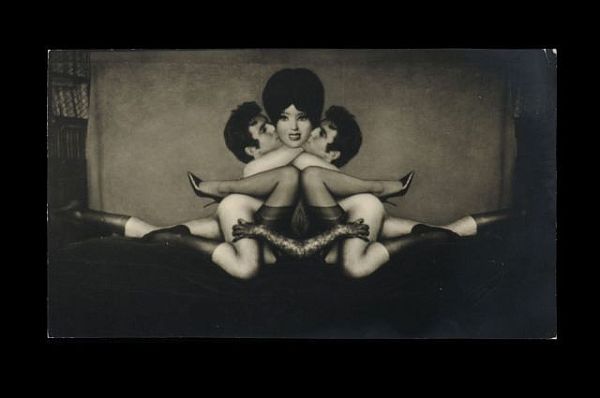
Molinier originally trained as a painter, but is best known for his erotic imagery. He photographed himself—often dressed in corsets and fishnets, holding fetish accessories, or wearing masks—then copied and cut out the images of his body and reassembled them into a single montaged image. “Whatever Violet Wants” brings Molinier’s work to life, recreating and animating the tangle of limbs and fetishistic imagery in an entirely new context.
 
I recently spoke to Chachki about the making of the music video, the art of drag, and how Molinier and other modern artists influence her work.
 
Isabel Custodio: Take me through the genesis of this project. How did you choose “Whatever Violet Wants”?
 
Violet Chachki: I’ve always loved the Sarah Vaughan cover of “Whatever Lola Wants.” I think I first heard it in the movie Kinky Boots, which is about a drag queen who opens a shoe factory in the UK. It’s a very drag, sort of fetishy song about getting what you want and being confident. My drag character is very dominant and domineering, and that’s a quality that I am inspired by. When I see strong, confident women who really know what they want and get what they want, that’s the kind of woman that inspires my drag, so putting a new spin on “Whatever Lola Wants” and doing “Whatever Violet Wants” felt very appropriate.
 
IC : You’ve said that this video is a celebration of the artist Pierre Molinier’s ideas. How do you see the themes of his work in relation to your drag?
 
VC : I’ve always been into subcultures. In the ’50s and ’60s, what Pierre Molinier was doing was super subculture—he was taking self-portraits, it was very private, very intimate. I think that’s actually how I started my drag—in my bedroom, taking MacBook self-portraits. There’s something really intimate about getting in drag in your bedroom in the safety of your own home. Especially for me, as a 16-year-old or a 17-year-old taking self-portraiture. That’s one of the ways that I see me and Molinier’s work overlap.
 
I also identify with his surreal aspects. I think his work has a real escapism to it, which is another thing that I love about drag. You literally get to escape and become someone else and go into a different world. The surreal aspect that Molinier brings into his pieces transports you. The fact that he was doing them before Photoshop—cutting up negatives and creating these surreal images by hand—is just so cool to me. I discovered him right around the time that I was getting into drag and getting into celebrating my feminine side and getting into escapism as a form of therapy.
 
I see myself in him a lot. I think there’s something really exciting about fetish gear and high heels. He would use a lot of props and fetish imagery—there’s something counterculture and taboo about it. I always have been excited by taboo things, especially growing up, going to Catholic school. And I think that was something that he thought was exciting as well, being a bit naughty, I guess. You’re not supposed to do these things, so you do them in private.
 
IC : You were able to use some of Molinier’s actual props in the video. How did that opportunity come about? Were you working with his estate?
 
VC : There was actually an auction a few years ago of his estate, and there were so many props, and shoes, and masks, and everything. I was devastated because I wasn’t in Paris to go to the auction and buy something, because that would be my dream, to own one of the props. Everyone in Paris was going crazy for it at the time, and I think the props just got bought out by everybody and dispersed around Paris. I know Christian Louboutin bought some stuff.
 
I don’t know exactly who we bought the props from, but it was one of the video’s director’s friends who was at the auction and bought a bunch of the props. We were so, so lucky to have some of the actual pieces. It was so cool to be able to wear them. And, of course, we handled them with great care and respect. But I’m hoping one day I’ll be able to purchase a prop of his myself.
 
IC : Throughout the video, you go back and forth between being in and out of drag. It almost gives you another character: a desirer and a desired. Can you walk me through the decision to portray yourself that way?
 
VC : I think it’s nice to showcase yourself as you are. Drag queens are celebrated so much on stage and when we’re presenting as our most creative selves. But it is jarring being onstage in front of 5,000 people, and then—it’s really cliché—but you go back to your hotel and you’re all alone. It’s difficult to be celebrated in drag and then be way less celebrated out of drag. I think I’m also making a conscious decision as I get older to take time for myself and to celebrate myself without makeup—to showcase my natural beauty, I guess, even for my own enjoyment, and to document myself outside of drag and where I’m at in my boy self. Even just posting a boy selfie on Instagram, I lose, usually, thousands of followers. So it is an interesting conversation to think about.
 
I can just hear the video’s director, Ali Mahdavi, in his thick French accent: “You are such a beautiful boy as well.” [In the video] he made the decision to start off out of drag, and then get a little distorted in the middle, and then toward the end in more full high drag. I think that adds a surreal element that’s in touch with Molinier’s. There’s even one part where there are two of me out of drag, licking myself in drag.
 
IC : Unlike your video for “A Lot More Me,” where these intricate, colorful sets play such an important role, your video for “Whatever Violet Wants,” like a lot of Molinier’s work, really came together in post-production. Can you talk about that process and how you wanted the video to visually echo Molinier’s work?
 
VC : I never thought of taking one of Molinier’s images and making it move. And that was Ali’s idea, to take his work and make it even more interesting as a video, because we’ve only seen his work as a still before. So, it was definitely a struggle, and it took a very, very long time, and lots of convincing and throwing money at it. It was definitely difficult to get the post-production correct. Like I said, it’s not the most CGI-gorgeous stuff either, but again, I think that lends itself to Molinier’s work. Even just all the green screen work and getting my lips to be separated and then getting me to kiss myself, it is a lot of finessing. I mean, I’m not Beyoncé. I don’t have, like, endless amounts of post-production money either. But it’s nice because Molinier’s work is a little DIY and a little cut-and-paste. In his work you can really see the scissor snips and all those things. I like that the video echoes that.


IC : You’ve said that drag is all about taking references from pop culture and flipping them on their heads. You’ve specifically cited Erté, Tom of Finland, Busby Berkeley, John Willie, and Dita Von Teese as inspirations. These aren’t pop culture figures that you’re going to find in a lot of mainstream discussions. I’m curious where you first encountered these figures and where you continue to find inspiration for your work.
 
VC : I am a child of the Internet. Tumblr is really what changed the game for me. I got exposed to things in print as well. I remember seeing Heatherette in my friend’s Teen Vogue, and little things like that. But what took it off for me was the Internet. I would see something on Tumblr that I liked, and it would have a little caption. Then I would Google the caption, and then I would find more stuff. And it just kept building and building.
 
And then even with Tumblr, you can like something. So you have an archive of all these things that you’ve discovered. I still, to this day, will go back to my old Tumblr, even though there’s lots of vintage porn that has been removed, and the smutty stuff I liked—John Willie or Tom of Finland—is no longer allowed on Tumblr.
 
And I hate that I’m saying “the Internet,” because I’m really old school. And I do not relate to the youth of today, as far as TikTok and what today’s version of Tumblr, Instagram, or MySpace would be. I was at the right place at the right time as far as the Internet is concerned.
 
 
IC : You’re using references that feel very sexually progressive and very unafraid of displaying queer identity. It feels relevant to a lot of the most eye-roll-inducing parts of Pride discourse, specifically about kink. What I love is that you seem to put your stake in the ground and you’re saying, “This is me. I’m in charge of this, and I’m not even going to entertain this conversation.”
 
VC : Yeah. The same conversation happens around drag. There are certain events where people think that it should be a family-friendly drag event. Of course, that’s not what this is about for me. I think the way the world works is that there are cultural differences and subcultures. Some things are not for everyone, and some things are inappropriate for other people to partake in. And I think that that is more than okay. I think that’s a positive thing. For me, drag is my therapy. Drag is something that I do to escape, to relieve, to celebrate. It’s not necessarily for your children. It’s for me. And there’s nothing wrong with that. You can’t sanitize queer people. It’s not a thing. I mean, not if I’m around.
 
I think about the Sex and the City episode where one of them loses her shoes. She’s like, “What about me? What do I get for not having children? What do I get for not getting married?” There are so many rewards for people who are married and have children. And there should be nothing wrong with being single, having no children, and wanting to design your life that way. The fact that everyone who does have children wants you to think about their children when you’re making your everyday decisions—it’s like, give me a break. Even as drag queens, we get flak from conservatives because parents will bring their children to drag shows and drag events. Then all of a sudden these conservative people are yelling at us. I’m like, “This isn’t my kid. I didn’t bring them.” This has nothing to do with me. I just hate how it has become everyone’s responsibility to parent other people’s children. That’s not my responsibility, darling.
 
IC : Right, and I think that ties back into Molinier’s work and life. I know that he initially was involved with other Surrealist artists. André Breton invited him into his circle, but his work was deemed too radical, too queer. Eventually they parted ways, and Molinier basically worked on his own. What’s interesting is you’re doing the opposite in a way. You’re taking an art form that has been underfunded and undervalued, and entering these very traditional, elite institutions like the Met Gala and Fashion Week. I’m wondering if you see this as a final chapter of Molinier’s legacy—reappropriating these images, but in a totally different social context.
 
VC : It’s interesting you bring that up because I feel like I’m dealing with a similar scenario. For instance, booking a beauty campaign. A lot of drag queens have gotten beauty deals, but it seems like the nature of my work—whether it be Molinier posing in lingerie or corsets, or something else—is a bit more provocative than, say, your average storyteller drag queen. Brands and companies are more willing to give work to more palatable, commercial drag performers who can appeal to the widest audience possible. But you are right in saying that I have brought my style of drag and pro-sex style to these spaces. I think the art world can respect it way more, and I consider the fashion world to be a part of that. But there’s not a lot of money in fashion or art. These days, making money is really about selling products. But I think the art and fashion worlds can see the artistic value in what I do and in what Molinier did—in hindsight now, of course.


IC : Drag feels like the most personal and all-consuming art form. You’re responsible for the complete invention and presentation of a persona. I’m wondering if this makes evolution harder as an artist. Does it ever feel like it’s difficult to experiment because there’s an expectation of who Violet Chachki is, and what a Violet Chachki show might look like?
 
VC : I don’t like to experiment too much, for a couple of reasons. One is that there are just so many drag queens. And there are a lot of drag queens who I don’t think would’ve doing drag even five or six years ago. The acceptance level and the work in the industry has come so far in such a short amount of time that it has become completely oversaturated. So you really have to pick something and stick with it, because you’re bound to get mistaken for someone else. That’s the worst feeling—it has happened to me so many times, where I’m out at an event and I get mistaken for another drag queen.
 
So you have to have a style and stick with it, and be the best at it. That’s what I try to do: know who I am, and deliver at all times. At the end of the day, show business is a business, and it costs. Drag is really expensive, and you have to stand out if you want to get work and be the best in whatever style you’re doing. Drag, for me, is not a forever thing. Glamour and escapism are the principles that I will always be in search of, whether it’s drag or a different sort of creative outlet. I’m trying to get all of the things I want to do done while I still have interest in the art form.
 
IC : You have said that your Digital Follies show, for example, is allowing you to document a very specific point in your career. I’m wondering how this relates to your use of references and your sources of inspiration, because so many of them come from an era when documentation, at least relative to now, was scarce. Are you thinking about the documentation you’ve missed from these sources or what you’re leaving for the future?
 
VC : Yeah. I think that I also like to come back to things and do them better. For example, I did an Erté number in 2012, but it was horrible because I didn’t know what I was doing, and I didn’t have the experience of drag to execute the vision. And so I constantly revisit ideas and try to do them better.
 
For me, documentation is super important. I am planning on doing a book at some point. I also want to have a lot of footage, so we’re constantly taking behind-the-scenes videos. Of course, there’s also the wardrobe. I feel like I’m running a small museum with these clothes—keeping track and taking care of everything is such a chore, and making sure all of that stuff is preserved and documented. It is important to me to archive everything and to sort of check all the boxes of the things that I want to do and document them properly. One day, maybe there’ll be a retrospective. I have no idea.
 
Violet Chachki on the Art of Drag.  The drag superstar talks about queerness, families, and
her tribute to the transgressive artist Pierre Molinier. By Isabel Custodio. MoMA Magazine, June 16, 2021. 


Whatever Violet Wants.  Music Video  Violet Chachki.  Directed by Ali Mahdavi.  
Show Studio


Bordeaux, France, 1968. Pierre Molinier puts on some makeup, a black eye mask covers half of his face, fishnet stockings curve around his elegant legs and a metal chain binds them to the stool he sits on. He starts photographing himself, once standing naked in front of the camera, a second time wearing a wig and his bottom facing the lens. This was a typical moment for the French photographer.
 
After capturing himself on film, Molinier would typically use silver scissors to cut around the body contours in the photos he had just shot, and reassemble them into a single photomontage of his own body; a mise en abyme -- or, the same image replicated to give the impression of infinity -- that he would immortalize with his folding camera.
 
Born in 1900, Pierre Molinier's life and work as a painter and photographer was filled with dark fantasies and sensational anecdotes. He is infamous for his fetishistic depictions of women's legs, his disturbing obsession with his sister, his taste for firearms, his wanderings in silk stocking along the streets of Bordeaux, and his tragic end in 1976 on his bed, a pistol in his mouth.
 
His enigmatic photographs continue to fascinate audiences, artists and photographers, and his multifaceted body of work, with its fantasized and fetishized bodies, is still challenging to this day.
Famous shoe designer Christian Louboutin explores the world's treasures
 
Originally trained as a painter, Pierre Molinier began his artistic career in the late 1920s, producing landscapes and portraits inspired by Impressionism. But then he took a change of course, and in 1951 he presented a controversial erotic painting at a respectable art salon in Bordeaux. Entitled "Le Grand Combat," it depicted a swirling multitude of (possibly women's) legs in fishnet stockings, and, shortly after, he started to send images of his works to poet and writer André Breton, the godfather of French surrealism.
 
His and Breton's encounters led to a solo exhibition at the famous Paris surrealist gallery L'Etoile Scellée in 1956, exposing Molinier's work to a wider audience. On the opening night, Breton wrote to Molinier: "Today, you've become the master of vertigo. Your photographs don't leave a shadow of a doubt as to your aspirations and it seems difficult to me to be more troubling. They are as beautiful as they are scandalous."

Moving away from painting, in the early 1960s Pierre Molinier started to dedicate his practice to photographic work, mainly self-portraits, enhanced by a process of photomontage. His technique often consisted of photographing himself dressed-up, body hair waxed and with make-up on, his face covered with a mask and him dressed in black fetish accessorizes -- corsets, gloves, stockings and high-heels, veils, fishnets, and sometimes a top hat. He would then cut around the outlines of the body parts in the photos and reassemble them in a final collage photograph; an ideal image of himself. Sometimes, he would replace his own head with the face of a doll. The process was similar to the enduring surrealist group drawing game, "Exquisite Corpse." And although he was greatly influenced by the surrealists, Molinier never officially joined that movement, remaining a lone practitioner throughout his life.


Costume was core to his experimental works. Whether dressing up for a self-portrait or using one of his male and female models -- some of whom were his lovers -- all subjects were disguised with outfits and wigs, posing against backdrops of dark fabric in swathes. This theatricality was also a key part of his practice, as he typically shot his erotic scenes in the bourgeois interior of his studio in Bordeaux, using baroque screens, velvet curtains and floral wallpapers as backgrounds. This provocative contrast between the erotic and the acceptable caused an electric tension in his images.
 
Throughout his artistic practice, Molinier deconstructed sexual identities, dismembering the representations and stereotypes of the masculine and the feminine self, stirring up gender trouble and transgressing the presupposed sacredness of the indivisible body.
 
His depictions of transgender, androgynous and transvestite bodies, which were cut up, reassembled and played with, invented a surrealist, pornographic theater of uninhibited desires and fantasies, utterly shocking the French bourgeois audience of the 1960s. His work was considered by many to be perverse, even depraved, and despite Breton's efforts, Molinier was never accepted by the French cultural elite.
 
But it is perhaps because of the unflinching nature of much of his work that Molinier's major legacy has endured, spanning across contemporary visual art, photography, fashion and cinema. His first posthumous retrospective was at Paris' major institution Centre Pompidou, three years after his death, and he is frequently included in shows that explore themes of identity, queerness and photographic innovation, Kiss My Genders at the Hayward Gallery in London was a recent one.
 
His influence can be seen in the work of hugely influential Japanese photographer Nobuyoshi Araki, and controversial American photographer Robert Mapplethorpe -- in its eroticism, fetishism and sexual powerplay. And in the work of Cindy Sherman, whose own self-portraits pushed the boundaries of gender and identity in photography.


French filmmaker Gaspard Noé has expressed his deep fascination for Molinier's colorful character as much as for his decadent images, while fashion designers such as Jean-Paul Gaultier and shoe designer f have carried Molinier's heritage in their collections; his aesthetic mythology and his ode to provocation, mystery and desire.
 
Not just complex in its technique and subject matter, Molinier's kaleidoscopic images confronted traditional ideas of power, domination and gender fluidity. They can be seen as icons for a post-gender era, and the photographer himself as a trailblazer for today's queer and questioning culture. His photomontages of merged body parts transgressed the limits of the human form, creating a space to imagine new visual possibilities -- and political possibilities too.
 
The lone surrealist whose erotic art provokes to this day. By Martha Kirszenbaum. CNN, April 29, 2020. 


Who? An account of French artist Pierre Molinier’s colourful life reads like that of the protagonist in an Oscar Wilde novel. A product of France’s oft-fictionalised fin de siècle degeneration, Molinier defied all societal norms to live a life of hedonistic excess. Both homosexual and a transvestite in an era when both were frowned upon – he asbcribed himself the title of ‘lesbienne’ – Molinier pursued fetishism and the latent eroticism of the subconscious mind to its most extreme degree.

 Born in France in 1900, Molinier began his career as a lowly and unexceptional house painter. In fact it wasn’t until he moved to Bordeaux, the city which marked the beginning of his self-discovery, that he began to delve into the underground culture of 1920s France. He quickly joined a secret society and began to express his fervent interest in the arts, strongly advocating the fashion of the day for throwing ‘salons’ – intimate get-togethers with a select number of likeminded individuals – and showing his erotic, experimental and magic-infused artwork with his peers.

 By 1955 Molinier had begun a fruitful correspondence with André Breton, the founder of Surrealism, who dubbed him 'the magician of erotic art' and decided to include his sensual, and at times violent, works in the International Surrealist Exhibition. This marked the artist’s official induction into the movement, and he soon earned a reputation as an artist who would dare to execute the ideas his reputable contemporaries, who included the likes of Salvador Dalí, only dreamt of.

 His investigation into fetishism and depravity, both through painting and photography, steadily gathered momentum, culminating in an extensive series of portraits and self-portraits in which Molinier himself often features as a many-limbed woman, a dominatrix, or a devil. When his dwindling health prompted his death at the age of 76, it was executed with the all the charisma his character would suggest; a great lover of guns, he died from a single self-inflicted gunshot wound. The death befitted the gravestone the artist had built for himself 26 years earlier, which read: "Here lies Pierre Molinier, born on 13 April 1900, died around 1950. He was a man without morals; he didn’t give a fuck of glory and honour; useless to pray for him."

 What? To call Molinier a master of disguise scarcely seems to do him justice. Costume formed the central tenet of his experimental works, whether it was worn by the artist himself – he loved to dress up as woman in fetishwear, doll's masks and women's accessories for his many self-portraits – or by his subjects – men, women and lovers he disguised with the outfits and wigs, and who posed against a backdrop of swathes of dark fabric.

 Throughout his career, the artist insisted that he created work purely for self his own pleasure; he described eroticism as “a privileged place, a theatre in which incitement and prohibition play their roles, and where the most profound moments of life make sport.” His production methods were often as unusual as the images which came of them. A great believer in the results to be had by intervening in the image-making process, the artist often pleasured himself while pressing the shutter, and mixed the product of his climax with colour pigments in the course of developing the image.


 His photomontages present an especially compelling and fantastical vision. By cutting and pasting body parts and textures from various different photographs to create a final image, Molinier found that he was able to conjure the many-limbed creatures from his own psyche, and hoped that, on seeing them, viewers of his work would be similarly surprised by their own repressed, fetishistic instincts. 70 of these montages were included in The Chaman and its Creatures, an unfinished artist's book made in 1967, to which the foreword reads: “at all times, my acts and my actions in life have stemmed from love or eroticism.”

 Why? Though Molinier’s photographs are neither as shocking nor as revolutionary now as they would have been to a conservative audience in 1950s France, the artist was utterly groundbreaking in his willing embrace of the darkest elements of his own desire. He continually challenged received orthodoxies on art, morality and religion, forcing the advancement of thinking on freedom, integrity and equality in the process. It’s little surprise, then, that his influence continues to resonate in contemporary art today – artists including Cindy Sherman, Robert Mapplethorpe and Ron Athey count him among their forerunners, and the themes of Surrealism and photo-collage he perpetuated continue to play an important role in the art industry.

 This Friday a sale of his work, assembled by his former lover and muse Emmanuelle Arsan and hosted by Artcurial, will take place in Paris, including 200 photographs, collages, drawings and personal letters by the artist. That its name, The Forbidden Sale, would have pleased Molinier only makes the possibility of owning part of the collection more enticing.

The Forbidden Photo-Collages of Pierre Molinier. By Maisie Skidmore. Another Magazine, November 12, 2015. 


The photographs reveal things as though through a keyhole, spotlit vignettes rearing up from a forbidden world. They are small, black-and-white, home-developed silver gelatin prints, and they glower round the walls, not so much inviting as inciting you to look.

 
This small show at Richard Saltoun in London’s Fitzrovia is the first UK exhibition of Pierre Molinier’s work for over 20 years. Molinier, born in 1900, makes the spectator feel like a voyeur. But he wants us to witness what he himself wanted to see: these are episodes from a life in private, revealed to the world. His photographs have the repetitiveness of obsession and pornography. The same old things, again and again, the same focus, the same rooms, the same furniture and paraphernalia.
 
And Molinier himself, again and again. These are more than selfies. He shows too much of himself, nevertheless. A man with a rose in his arse, corseted, masked, veiled, bewigged, high-heeled, impaled, laughing, giving us his rictus grin. Here’s his stockinged legs, bound at the ankles. Here’s his bum. Here it is again. There’s that stool, the chair, the out-of-focus wallpaper. It looks like nothing has changed here in decades.
 
Although many of the photographs date from the 1960s and 70s, they seem to come from an earlier age. There’s something musty and cloistered about them. They show a man alone, a man with mannequins, performing for himself and for the camera – and an invisible audience who might not be there at all.
 
Everything happens in an apartment at 7 Rue de Faussets in Bordeaux. Here, Molinier acted out his fantasy life and death before the camera. In 1950 he photographed himself as a lain-out corpse, and concocted a shot of his own imaginary grave. “He was a man without morals,” he wrote on the cross embedded in the earth. Finally, in 1976, he committed suicide.
 
He left a note on the door: “I’m killing myself, the key is with Claude Fonsale, the lawyer.” Beside his corpse was a second note, railing against “all the bastards who have been a pain in the arse all my bloody life”. Molinier staged his death, just as he staged so much of his life. He found it amusing, he once wrote, that those who would come to dissect his corpse (which he had donated to science) would discover his toenails immaculately painted red. Molinier, who also had a thing about guns, shot himself in the mouth in front of a mirror. He wanted to watch. Throughout his work there is a quest for obliteration, losing himself in sex and in the merger with a fantasised feminine alter ego.
 
A housepainter by trade, Molinier became first a painter of surrealist, symbolist canvases. André Breton encouraged his paintings in the late 1950s, though later dropped the association. Breton may have been attracted to Molinier’s anti-clericism, but not to his sexuality or his photography; the homophobia of Breton’s circle was legendary. Yet Molinier’s art did eventually find its milieu, and he is recognised as a marker in an evolving queer sensibility, along with the wonderful Claude Cahun (whom Breton also supported, then dropped). For Cahun, six years older than Molinier, a kind of private performance photography was also central to her art.
 
Molinier’s paintings are forced, glutinous and airless, while his drawings are more interesting for what they represent than their style. Molinier drew things, I think, to show himself how they looked, their forms and perverse conjunctions already articulated in his mind, just as his photographs recorded events already premeditated – dressed for, lit, framed and staged.
 
It was as a photographer and photomontagist that Molinier really found himself. The photograph became a mirror, a way of seeing and fixing himself as other. Presumably, he wanted to preserve the image of his display in female guise, as well as engaging in certain acts – some of which were only humanly possible through the artifice of photomontage. But his auto-fellatio images were real enough, performed with the assistance of a homemade yoke. Do not try this at home.
 
Molinier’s elaborate fantasy life and gender play became his art. His partners, for the most part, were his own photomontaged and duplicated selves. In his photographs he became both other and himself, man and woman, penetrator and penetrated. At the core of his art, his transvestism signalled the merging of sexes, a multiplication of organs and limbs and selves. He became the object of his own desire, a self that was other.
 
He photographed himself wearing a dildo, having sex with not one, but two montaged doubles over a stool. He made double and triple self-portraits – meeting his younger selves in the developing tray – and images of himself as a kind of devil-shaman, backlit, with both breasts and erection.


The impossible, too, is at the centre of his work: in one photomontage – possibly a perverse play on Velázquez – a figure lounges on a couch in the pose of The Toilet of Venus. Where Velázquez’s Venus is turned away from the viewer, seeing her own face in a mirror, Molinier’s montaged head is reversed on his own shoulders. The legs and female sex are also reversed. Front and back have been recombined, then given an extra pair of legs and an arm that gropes out of nowhere.
 
Other montages are kaleidoscopic Busby Berkeley mirrorings of multiple legs and faces and arses. These images unfold about themselves like flowers and mandalas, made up of body parts dismembered from his own photographs. What human anatomy won’t allow, photomontage and collage make possible. It is all a delirious, rapturous confusion.

The repetition of Molinier’s images, the tiny circus of his performances to camera, reflects his desires and compulsions. In the photographs, not even Molinier changes much. His photographs try to stop time, smoothing out the signs of age in the darkroom and by careful lighting. Molinier is said to have been an influence, or at least a forerunner, of Cindy Sherman, Catherine Opie and Robert Mapplethorpe. In his later years he also used other artists – notably Swiss performer and painter Luciano Castelli and the French artist Thierry Agullo – to model for photographs in roles closely allied to his own. Maybe he saw them as body doubles as he grew older. Last year, a show of Molinier and Genesis Breyer P-Orridge (of Psychic TV and Throbbing Gristle fame, among much else) was held in New York. Posthumously, Molinier has become something of a cult figure. His art was a kind of extreme exposure. Molinier’s life and art are inextricable. It all writhes together.
 
The Temptations of Pierre Molinier is at Richard Saltoun, London W1W, until 2 October 2015

Pioneer of perversity: Pierre Molinier's extreme exposures. By Andrew Searle. The Guardian,  August 25, 2015. 


In his influential 1919 essay “The Uncanny,” Freud points to the repressed as a possible source of the troubling feeling of the uncanny, asserting, “It may be true that the uncanny is nothing else than a hidden, familiar thing that has undergone repression and then emerged from it, and that everything that is uncanny fulfills this condition” .
 
Employing the uncanny, the art of French post-war, post-Surrealist Pierre Molinier and BREYER P-ORRIDGE, the ongoing collaboration between Throbbing Gristle and Psychic TV’s Genesis Breyer P-Orridge and h/er now-late wife Lady Jaye, both uncover the transformative and transcendent power inherent in the malleability of the human body.
 
Pairing these artists in an arresting, unsettling and ultimately inspiring show, Invisible-Exports’ BREYER P-ORRIDGE & Pierre Molinier exhibition forges a powerful aesthetic genealogy between these uniquely subversive artists. Filled with fetish imagery from fishnet tights to dildos and sky-high heels, including BREYER P-ORRIDGE’s aptly named “Shoe Horn,” the exhibition combines BREYER P-ORRIDGE’s pandrogene works with Molinier’s autoerotic black and white photomontages, allowing viewers to perceive the links between these artists, as well as witness the identity destabilizing possibility in body modification.
 
For artists like BREYER P-ORRIDGE who, at least to me, have always seemed almost peerless in their explosion of the binaries of sex and gender, the discovery of Pierre Molinier, who also dared transform his own physical being through technological means, provides an essential link in the trajectory of transgressive art.
 
Quite frankly, I only recently found Pierre Molinier’s demented photomontages in the pages of the enormous tome Art & Queer Culture, which rendered me staring stunned at Molinier’s multiple nylon-ed legs and mannequin mask, which appeared almost like a proto-Narcissister.


A contemporary of the Surrealists and, as his epitaph states, “a man without morality,” Molinier, through the aid of a mirror and photographic manipulation, investigated his own erotic fixations, which even alienated the Surrealists due to his highly disturbing sexual imagination. As Catherine Lord details in Art & Queer Culture, “Andre Breton who became interested in Molinier in the mid-1950s, ceased to publish him ten years later when Molinier proposed a painting of Christ with a dildo up his arse”
 
In the photographs throughout Invisible-Exports, Molinier’s fetishistic montages uncannily erase the separation between animate and inanimate objects through his wild array of limbs, asses and dead-eyed female mannequin masks. In “The Uncanny,” Freud quotes fellow uncanny theorist Ernst Jentsch who placed the source of the uncanny with “doubts whether an apparently animate being is really alive; or conversely, whether a lifeless object might not be in fact animate” (5). Highlighting uncanny objects such as dolls, wax figures and automatons, Jentsch’s animate confusion reflects Molinier’s own blurring of these divisions.
 
Like Jentsch’s dolls, Molinier’s self-portraits appear almost inhuman–a surreally fantastical and almost nightmarish conglomeration of body parts, piling limbs upon limbs and fracturing the apparent stability of anatomy. Not only disturbing the seemingly strict difference between animate and inanimate objects, Molinier’s photomontages also break the binary boundaries between the genders, as well as the unchangeable understanding of the biological human form.
 
Discovering Molinier h/erself in a book on Surrealism while attending a conservative English public school, Genesis Breyer P-Orridge writes on Molinier’s work: “Art like Molinier’s and similar works attempt to solve this auto-destructive trajectory by proposing both a vision of time as a congregation of loops and looping that in themselves require a sense of responsibility for a future as we might all experience just that! And by proposing a massive rethink of our attitude to the human body. A final declaration that it is NOT sacred in any way, merely a cheap suitcase to give mobility to consciousness…”


Mirroring Molinier’s rejection of the sacredness of the body, BREYER P-ORRIDGE’s literal transformation of the body similarly erases these constrictive and restrictive binaries.
 
Taking William S. Burroughs and Brion Gysin’s conception of the cut-up to its absolute limit, BREYER P-ORRIDGE create a collective “third mind” or the “pandrogene” by cutting up the body through cosmetic surgery. Through numerous procedures to look the most like each other as possible, Genesis and Lady Jaye, as BREYER P-ORRIDGE, transcend the singular idea of the self.
 
As BREYER P-ORRIDGE explain in “Breaking Sex,” “We are required, over and over again by our process of literally cutting-up our bodies, to create a third, conceptually more precise body, to let go of a lifetime’s attachment to the physical logo that we visualize automatically as “I” in our internal dialogue with the SELF”.
 
Through post-surgery Polaroids, as well as Molinier-esque images of reflected body parts and fishnet fetishism, BREYER P-ORRIDGE also engage with the uncanny through the eeriness of “doubling.” Pointing to the double as a source of the uncanny, Freud states, “These themes are all concerned with the idea of a ‘double’ in every shape and degree, with persons therefore, who are to be considered identical by reason of looking alike; Hoffmann accentuates this relation by transferring mental processes from the one person to the other–what we should call telepathy–so that the one possesses knowledge, feeling and experience in common with the other, identifies himself with another person, so that his self becomes confounded, or the foreign self is substituted for his own–in other words, by doubling, dividing and interchanging the self.”
 
Through this “doubling, dividing and interchanging the self,” BREYER P-ORRIDGE assert that the binary systems integral to institutional and societal control can be overcome. In “Breaking Sex,” BREYER P-ORRIDGE reveal, “BREYER P-ORRIDGE believe that the binary systems embedded in society, culture and biology are the root cause of conflict, and aggression which in turn justify and maintain oppressive control systems and divisive hierarchies. Dualistic societies have become so fundamentally inert, uncontrollably consuming and self-perpetuating that they threaten the continued existence of our species and the pragmatic beauty of infinite diversity of expression. In this context, the journey represented by their PANDROGENY and experimental creation of a third form of gender–neutral living being is concerned with nothing less than strategies dedicated to the survival of the species”.
 
By rejecting these binary systems, both Molinier and BREYER P-ORRIDGE expose the weaknesses in the restrictions of the human body. Returning to Freud’s understanding of the uncanny as a familiar idea that has been repressed, perhaps Molinier and BREYER P-ORRIDGE’s work causes such a destabilizing sense in viewers due to the underlying truths exposed within them–that the body is not sacred, that it is a potential artistic material like any other and that through this body manipulation, alternative forms of post-binary existence can be found.
 
As BREYER P-ORRIDGE state in “Breaking Sex,” “When you consider transexuality, cross-dressing, cosmetic surgery, piercing and tattooing, they are all calculated impulses–a symptomatic groping toward a next phase. One of the great things about human beings is that they impulsively and intuitively express what is inevitably next in the evolution of culture and our species. It is the Other that we are destined to become”
 
I Am Doll Parts: The Fractured Anatomy of BREYER P-ORRIDGE and Pierre Molinier. By Emily Colucci. Filthy Dreams, October 10, 2014. 


Oh, those Greeks! They knew how to live. What is required for that is to stop courageously at the surface, the fold, the skin, to adore appearances, to believe in forms, tones, words, in the whole Olympus of appearance. Those Greeks were superficial – out of profundity.” —Friederich Nietzsche
 
 ““And eroticism is capable of helping to in the discovery of that new world?” “More than that! It is identical with it, it’s progress itself.”” —Emmanuelle Arsan
 
 
INVISIBLE-EXPORTS is proud to present an exhibition of work by BREYER P-ORRIDGE & Pierre Molinier.
 
 
“Here lies Pierre Molinier,” reads the epitaph of the mercurial transgressive titan of 20th century underground art. “This was a man without morality.”
 
Molinier (1900-1976) was a postwar artistic renegade born into belle époque France, a shape-shifting and iconoclastic self-fetishist, too bold and strange and self-directed an artistic visionary to fit perfectly at home among even the Surrealists, who were his closest radical ilk and his most sympathetic admirers. As a young artist, Molinier established himself as a painter of landscapes, but moved quickly to daring erotic collage and ultimately embarked on a now-legendary project of photomontage self-portraits of himself as a transvestite. They are a mesmerizing series of theatrical images exploring a labyrinthine, refracted identity, many involving dolls, dildos, and prosthetic limbs as “props,” that used Molinier’s own body as central malleable medium for a whole new range of expressive gestures that remain riveting and brave today, and inspired much later figures from Cindy Sherman to Ron Athey. In a retrospective assessment, the Independent called him “a transvestite Baudelaire who rather than words, chooses as his medium the corset, the mask and the chain.”
 
Genesis BREYER P-ORRIDGE (then known as Neil Megson) first encountered Molinier as a schoolboy in a book about surrealism, which was given as an award for “initiative” by the oppressive English public school that s/he attended on a scholarship. S/he has resisted and ruthlessly dismantled the strictures and brutal complacencies of that institution wherever s/he has encountered them in the fifty years since. One of the most rigorous and relentless agents of the postwar Anglo-American vanguard, BREYER P-ORRIDGE has interrogated the meaning and substance of identity in a peerless half-century program of willful reincarnation and shape-shifting. Embracing the body as not simply the vessel but the site of the avant-garde impulse, BREYER P-ORRIDGE has reinvented and reintroduced he/rself again and again—as Fluxus pioneer, groundbreaking performance artist, inventor of industrial music, “wrecker of civilization,” and, most recently, as pandrogyne, in a romantic project of identity and gender merging with her now-late “other half”, Lady Jaye (with whom s/he continues to collaborate as “BREYER P-ORRIDGE”, embodying both Genesis P-Orridge and Lady Jaye Breyer). In each “body of work” — COUM Transmissions, Throbbing Gristle, ruthless collage work and mail art, Pandrogeny —BREYER P-ORRIDGE, a living legend of the Anglo-American underground, reminds us that what is dangerous and what is important are never far apart—and that, when you believe something, integrity demands that you live by it too. That principle of true and total devotion to one’s own irresolvable impulses s/he discovered in Molinier—and the thread of influence that connects them can seem a sort of parable of the secret and often accidental ways that radicals and visionaries pass principles down the generations, like samizdat-in-a-bottle tossed into the sea for some malcontent in need to discover on some other shore, where he might be unable to live without it. And where it might seem to hold the key, even, to the evolution of humanity.
 
“His guerilla darkroom of desire exploded across my visual cortex and embedded its mercurial mandalas in mobius patterns of sensual shrapnel,” BREYER P-ORRIDGE has written, of a first deep encounter with Molinier’s work, a decade or so later. “The visceral wounding of my aesthetic was orgasmic and permanent. Certain congruences and convergences of image were to be forever occupied by his touch. It was fortunate that I had developed my own manner of collaging to a place I felt confident about, so his beachhead into the unconscious didn’t rattle me too much. For in his explorations of the most basic of all subjects…the human body…he applied patterns and interplays so meticulously that they felt as familiar at times as my own.”
 
“I felt very comfortable admitting Molinier into my private pantheon of Occultural Saints alongside Brion Gysin, William S. Burroughs, Austin Osman Spare and Hans Bellmer,” BREYER P-ORRIDGE has written. “So much so that when Colin Naylor, who at that time was editor of Art and Artists magazine, invited me to co-edit with him what turned out to be an encyclopedic reference book called “CONTEMPORARY ARTISTS” that ended up over 1000 pages long, I insisted “Only if you promise to include Brion Gysin and Pierre Molinier”.
 
The affinity is inescapable: both are avant-avant-garde figures who embraced more fully the rhetoric of transgression made notorious by their contemporaries—indeed embodied and performed that rhetoric where others merely paid it lip service. And each, therefore, transformed completely the shape of what seemed possible to whole new generations growing up in their wake, and able to canonize pathbreaking radicals like BREYER P-ORRIDGE and Molinier in their own private pantheons. Molinier “seized the means of perception,” BREYER P-ORRIDGE continued, “and re-configured it. Everything becomes raw material, malleable and neutral. There is no specific gender anymore. No male or female, merely surfaces and a canvas of skin stretched across multiple skeletal frames. The frame of reference, the “classic” and “male” nude is gone. Evaporated into painterly gestures. Lipstick is slashed across one face, more faces. It becomes closer to Japanese calligraphy than to make-up. And what is make-up, but conscious deception?”
 
“The irreversible compulsion of Molinier’s montages, where men become women, become clones of themselves, become animalistic, become erotic, become gross, become romantic, generates a maelstrom of fluid possibilities. We are in the eye of his tornado, red slippers flash past, a witch, a dildo, a mask always a mask. Pierre Molinier insists we face the impenetrable fact of our obliteration. Yet simultaneously he describes a frolicking masqued ball, a carnival of interchangeable characters. All of who can be him and equally therefore all can be ourselves as well.”
 
“Art like Molinier’s and similar works attempt to solve this auto-destructive trajectory by proposing both a vision of time as a congregation of loops and looping that in themselves require a sense of responsibility for a future as we might all experience just that! And by proposing a massive rethink of our attitude to the human body. A final declaration that it is NOT sacred in any way, merely,” BREYER P-ORRIDGE continued, “a cheap suitcase to give mobility to consciousness. Furthermore, a cheap suitcase that breaks down faster the more you ‘travel’.”
 
And yet in perverting these “cheap suitcases,” gestures toward alternative destinies might just be found.
 
Press release  Invisible-Exports, New York, September 2014.


I was first introduced to the work of French Surrealist photographer and painter Pierre Molinier in the mid-90s by Genesis Breyer P-Orridge. Gen had a fantastic velvet-covered book that simultaneously looked both luxurious and terribly smutty. It was easy to see Gen’s attraction to Molinier’s work and the influence was clear in the pandrogynous project which would soon be embarked upon by Breyer/P-Orridge soon after. (It was readily apparent that Joel-Peter Witkin was no stranger to Molinier’s work, either.)

 
Pierre Molinier was a seriously strange fellow. For instance, he claimed to have had sex with his dead sister’s corpse and to have photographed it.
 
“Even dead, she was beautiful. I shot sperm on her stomach and legs, and onto the First Communion dress she was wearing. She took with her into death the best of me.”
 
Molinier’s bizarre fetish photographs represented a very intimate disclosure about his own sexuality and were considered absolutely outrageous for their time. (They’re still outrageous! It wasn’t easy finding a handful that would work on this blog without offending too many people.) Using himself as his primary subject, Molinier’s photo-montage art-form was often about depicting himself as a female (or hermaphroditic) alter-ego usually in the act of… well, auto-fellatio or doing it to him/herself in other creative ways.
 
Using masks, hand-carved dildos and prosthetic limbs, Molinier’s work was done mostly for his private pleasures starting in the early 1950s, but eventually he sent some of his pieces to Andre Breton who showed the work in 1956, thereby placing Molinier in the Surrealist camp. Early attempts to publish his work were made difficult by printers being reluctant to handle it and were abandoned. Eventually several monographs were published and slowly over the years Molinier’s work has become known to a cognescenti particular about such matters.
 
In the 1970’s, his health began to falter. Molinier committed suicide while masturbating, shooting himself in the head in his apartment in Bordeaux in 1976.
 
Below, this strange little animation takes Molinier’s work as a point of departure. Much more chaste than Molinier’s own work, you might want to watch this first before you decide if you want to go any further…
 
Molinier is my revolution. Tom de Pékin.


The Autoerotic Art of Pierre Molinier. Dangerous Minds, May 15, 2014.


Long maligned and marginalised as a pervert of the artistic underground, Pierre Molinier is now recognised as an important Surrealist erotic painter, a fetishist photographer par excellence, a precursor of body art, and a pioneer of the queer movement. All his life he was a pleasure-seeker, fully focused on achieving his passions – anything rather than become a slave to convention.

 
Molinier grew up in the town of Agen in south-western France. At 22, after his compulsory military service, he moved to Bordeaux, earning his living as a house painter, and in his spare time painting landscapes and portraits in a fairly conventional style. He was a member of the Société Bordelaise des Artistes Indépendants (Bordeaux Society of Independent Artists) from 1928, and exhibited regularly in its salons.
 
Although already identifying as bisexual and transvestite, in July 1931 he married Andrea Lafaye, and they had two children, Françoise and Jacques. The relationship became ever more fraught; by the end of the 1930s Molinier moved permanently into a tiny studio apartment, where he spent time with a variety of lovers, and he and Andrea finally divorced in 1949.
 
After World War II, Pierre Molinier definitively rejected his previous life: he spent more time cross-dressing, painted increasingly provocative paintings, and started to take photographs of himself in sexual poses, often wearing stockings and corset. He was a man, but he also wanted to be a woman.
 
For the 1951 Salon des Indépendants, Molinier submitted ‘Le grand combat’ (The Great Confrontation), a half-abstract, half-figurative painting depicting contorted bodies and entwined limbs. The Bordeaux society deemed it indecent and censored it, which elicited a furious response from the incensed artist.
 
In early 1955 Molinier sent reproductions of his paintings and poems to André Breton, who gave him an enthusiastic welcome, assured him of his support and offered to exhibit him in Paris. Subsequently, Molinier designed the cover of the second issue of the magazine Le Surréalisme même (Surrealism Itself) then, invited by Breton, exhibited a canvas at the eighth Exposition Internationale du Surréalisme. Molinier was a member of the Surrealist group from 1955 to 1969, but remained on the fringes of Surrealism. Although close to Breton, and even more so to the anticlerical and antimilitarist painter Clovis Trouille, Molinier rejected most of the Surrealists, who were too puritanical for his taste.
 
 
Pierre Molinier was deeply influenced by the fields of esotericism, magic and shamanism, the character of the shaman arousing his interest because of its ambiguity, neither man nor woman, the messenger between the world of the living and that of the dead. From the mid-1950s Molinier devoted himself to photography, a medium in which he explored his subconscious transsexual desires. He created black and white photographs in which he assumed the roles of dominatrix and succubus previously assumed by the women in his paintings. He wanted his photographs to shock.
 
In the 1970s his health began to decline. He had told his friends that on the day ‘my sperm turns to water and I am unable to orgasm’ he would take his own life; true to his word, when his doctors informed him that he was suffering from prostate cancer he took his own life with a Colt 44 bullet to the head.
 
Pierre Molinier, 1900 – 1976. honesterotica, March 3, 1976.