With its otherworldly woodcuts and ornate descriptions of imagined architecture, Hypnerotomachia Poliphili brims with an obsessive and erotic fixation on form. Demetra Vogiatzaki accompanies the hero as he wanders the pages of this quattrocento marvel, at once a story of lost love and a fever dream of antiquity.


On the right, The Worship of Priapus, featuring nineteen women and five men. In the foreground, priestesses sacrifice an ass beneath the phallic god’s herma —

A
fountain of the “little Priapus”, featuring a weight-sensitive step that, when
depressed, “raises the child’s instrument”, spraying Poliphilo’s face with cold
water
For all that we know, the original “dreamer” remains unidentified. Written in an idiosyncratic hybrid language fusing Italian, Latin, and Greek, and replete with inauthentic Egyptian hieroglyphs and an abundance of architectural and botanical jargon, the rambling text of Hypnerotomachia does little to dispel the mystery of its authorship, even though it does mirror with remarkable accuracy the composite, winding nature of its contents. An acrostic formed by the first letter of each chapter, reading “Poliam Frater Franciscus Columna Peramavit" (Brother Francesco Colonna greatly loved Polia) led scholars to identify a Dominican monk from Treviso as the author of the book. Nevertheless, the polymathy of Poliphilo — along with the cryptic and playful nature of the work as a whole — has raised doubts regarding the plausibility of this hypothesis, with some critics suggesting that “Colonna” could be a pseudonym.

A terrified Poliphilus fleeing from the dragon

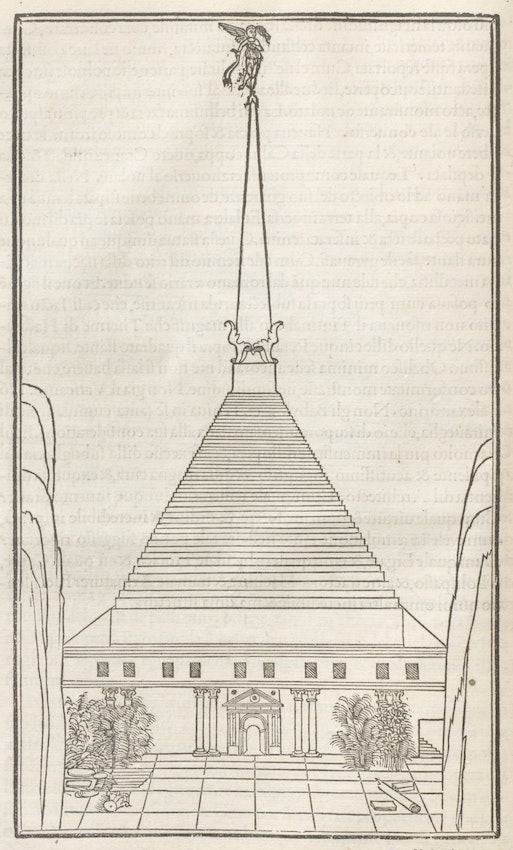
The Temple of the Sun, constructed of white Parian marble, with 1410 steps and a cornucopia-clutching winged figure
“Considered vertically, the building is an unlikely compilation of elements. On top of the temple is a plinth, and on top of the plinth is a pyramid, and on top of the pyramid is a monolithic stone cube and on top of the monolithic stone cube is an obelisk and on top of the obelisk is a bronze statue of a nymph holding an inverted cornucopia. Poised on one leg with the other elevated in arabesque, she pirouettes on a pivot with every shift of the wind, emitting a deafening shriek with every turn. “”

Left: an ornate vessel decorated with “marvelous artificial foliage, such as is not made in our times” and surmounted by a cubit-high coral tree, which is nested in a hillock “studded with incomparable gems”. Right: a perpetual fountain with harpies, scintillating emerald leaves, and a golden pomegranate tree with coral flowers containing “calyxes full of golden bees”


Poliphilo surrounded by remains of classical antiquity. A ferocious wolf eyes him with its jaws agape

Section and ground-plan of the Temple of Venus Physizoa, whose spire is capped by a bronze crescent moon and an eagle with its wings akimbo
In the centuries that followed its enigmatic appearance, Hypnerotomachia came to represent a type of architectural and artistic invention that derives its sensuous, eccentric qualities from the cryptic world of dreams, rather than from the orderly forms usually associated with Renaissance aesthetics. Yet, besides its multiple references to and deviations from architectural rules, the world in which Hypnerotomachia unfolds presents astounding continuities with the broader religious, civic, and cultural context of Venice at the time. The ruination of the world in which Poliphilo wanders coexists with the marvelous monuments he encounters in a way that is reminiscent of the double function of Christian icons in this period. For Hans Belting, the icon’s intentional fragmentation of pictorial space pointed to a transcendental world that remained intact. Accordingly, the kind of memory that these artworks heralded had “both a retrospective and, curious as it sounds, a prospective character”. The icon was not only a trace of something from the past but also something that was promised in the future. A similar dynamic is at play in Hypnerotomachia, against the backdrop of the Venetian art scene and the work of Vittore Carpaccio in particular.

Vittore Carpaccio, Dead Christ, ca. 1520

Detail from Vittore Carpaccio, Dead Christ, ca. 1520


From left to right: a
weathercock, with genius blowing the trumpet; a box tree pruned into the shape
of a man, whose feet rest on vases, and arms support an ornament of towers and
arch; another box tree, this one pruned in the shape of a centrepiece; and the
decorative crowning of the Temple of the Sun
Under
the guise of the dream, Hypnerotomachia seems to present a new symbolic
universe in which the complicated relationship between ancient and modern space
could be redefined. In his influential book, Unearthing the Past, Leonard
Barkan showed how the pace at which antiquities were being unearthed in the
late Quattrocento brought forth a sea change in historical, political, and
aesthetic thought. These resurfaced objects didn’t just challenge established
views on the past. They also generated new kinds of artistic expression and
appreciation, including the production and circulation of drawings and
ekphrastic narratives, the first private collections of antique fragments, and
new forms of theory and practice that embraced architecture’s inventive as well
as restorative potential.
Yet
Hypnerotomachia is much more than an architectural manifesto. These intricate
negotiations also seem to emerge through the orchestration of Poliphilo’s and
Polia’s triste. Almost halfway through his dream, Poliphilo encounters the
beloved and embarks with her on a journey to celebrate their union. The
dreamworld appears to have diminished Polia’s resistance; receptive to
Poliphilo’s advances, the woman sets off to explain her former hesitations and
recent change of mind.

A sequence from Polia’s narrative: “a furious goddess crowned with a wreath of agnus castus, with an unstrung bow and empty quiver, who turned a frightful countenance on me, burning with the desire to wreak cruel vengeance”

Much like Nausicaa’s visitation by the goddess Athena in the opening of the Odyssey’s sixth rhapsody, Polia’s vision at the closing of Hypnerotomachia reaffirms the primacy of a patriarchal, civic order over the sovereignty of a female body. Unlike Nausicaa, however, who was chastised for the messiness hidden behind the ornate doors of her bedroom, Polia is forced to give up idealistic purity and embrace the disturbing disorder of Poliphilo’s world. This reversal becomes all the more pronounced considering how the tactility of Nausicaa’s messy trousseau gives way to fully fledged architectural pandemonium in Hypnerotomachia.
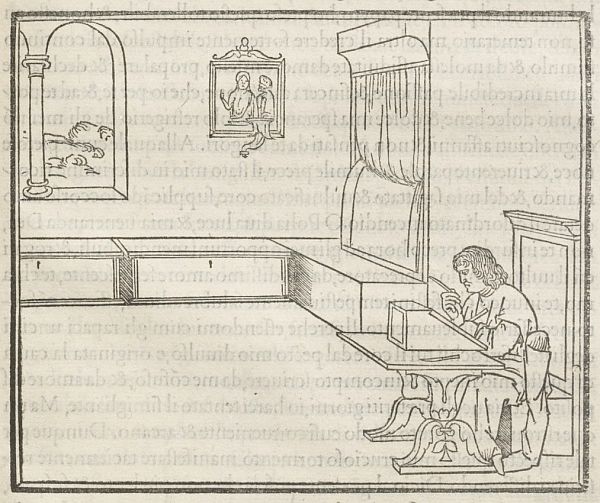
Poliphilus alone, writing to his beloved Polia

“Reader,
if you wish to hear briefly what is contained in this work, know that Poliphilo
tells that he saw remarkable things in a dream, hence he calls the work in
Greek words ‘the strife of love in a dream’. He represents himself as having
seen many ancient things worthy of memory, and everything that he says he has
seen, he describes point by point in the appropriate terms and in an elegant
style: pyramids, obelisks, huge ruins of buildings.” With these words,
Francesco Colonna introduces his Hypnerotomachia Poliphili in 1499, at the
closing of the age of the incunabulum. A Dominican friar living in Venice, he
waited for thirty years before his manuscript, completed in 1467, was published
by Aldus Manutius. This was partially due to the cost of the undertaking, for
the volume, together with its 174 woodcuts by an anonymous artist, was one of
the most extravagant publishing ventures of its day. English readers have had
to wait a lot longer, until this 1999 edition that appears exactly 500 years
after the entry of Hypnerotomachia Poliphili into the Renaissance literary
canon.
Often
mentioned as one of the most handsomely produced books in the Renaissance, the
first edition of Hypnerotomachia Poliphili is exceedingly rare. Many surviving
copies have been mutilated by readers wishing to possess some of its opulently
designed woodcuts. It is, therefore, all the more rewarding that the present
publication attempts to convey the beauty of the original by adhering to its
size, as well as to the layout of the text and the images. Adding to the appeal
of this English edition for bibliophiles is its typeface, favored by Aldus
Manutius and known by modern printers as “Poliphilus.”
Indispensable
to any study of the Renaissance obsession with the lost world of Antiquity, Hypnerotomachia
Poliphili is more admired than actually read. Part of the reason for this is
the notorious difficulty of the original language, a fanciful linguistic idiom
based on Latin vocabulary and Italian morphology and syntax, challenging even
for Colonna’s contemporaries. A labor of love for Joscelyn Godwin, this
translation follows his earlier forays in the intellectual history of the early
modern world, most notably his publications on the seventeenth-century
philosophers Robert Fludd and Athanasius Kircher.
The
story—ostensibly a retelling of a long and involved dream that takes Poliphilo
through a landscape filled with ruins, tablets with inscriptions and
hieroglyphs, and other magnificent or curious remnants of Antiquity—is both
autobiographical and allegorical. Like Dante and his Beatrice, or Petrarch and
his Laura, Poliphilo pursues an ideal lover, a nymph by the name of Polia. And,
like these illustrious examples, he is doomed to lose her at the moment of
their closest embrace, as her body disappears into the air, ending both his
dream and his book. While the exact meaning of this symbolic account is as
elusive as Poliphilo’s pursuit, the author hints at his allegorical intent
throughout, beginning with the names of the two main protagonists. That
Poliphilo (literally “the lover of Polia”) is his alter-ego, is suggested by
the closing words of the nymph in which she calls him a “column of her life”
(Italian “Colonna”). Polia’s own name, deriving from the Greek term for “old
age” or "antiquity, " is generally understood as a hermeneutical key
to the overall theme of this dream-book.
Like its
language, the literary genre of Hypnerotomachia Poliphili is truly a hybrid
one, combining the conventions of romance, travelogue, and antiquarian treatise
in an ever-changing narrative. To follow Poliphilo’s descriptions of the
temples and monuments encountered on his imagined journey is to delve into an
assemblage of favorite Renaissance topoi. At the same time, this learned fabric
is interwoven with passages detailing his desire for Polia, whose undisguised
eroticism brings to mind the popular contemporary literature of a more
lascivious bent. In this manner, as stressed in the dedicatory preface to the
1499 edition, he fashioned a book for many audiences, a cornucopia of knowledge
that could rival the work of the ancients, and be presented with a pleasing
grace and novelty.
Notwithstanding
its textual eccentricity, Hypnerotomachia Poliphili has had a rich pictorial
and literary legacy. Mantegna, Titian, Lotto and Bernini, to name but a few of
the artists it inspired, eagerly drew upon its opulent, often enigmatic
imagery. Equally important was the impact of this volume on emblem books, the
principal vehicle for the dissemination of visual and poetic tropes in the
seventeenth century. From Alciatus and Valeriano, to lesser known authors such
as the Antwerp poet Jan van der Noot, Hypnerotomachia Poliphili was a favorite
sourcebook of Renaissance commonplaces.
Though
its publishing history prior to 1999 includes a number of translations, most of
them are abbreviated versions of the original. Notable among them, at least in
terms of the wider circulation of the text in Europe in the century following
its writing, was the 1546 French edition: Hypnerotomachia, ou, Discours du
Songe de Poliphile. The first and only attempt to translate this work into
English before Godwin was made in 1592, as Hypnerotomachia The Strife of Love
in a Dreame (London, Simon Waterson). Thwarted by the scope of the undertaking,
the translator R.D. (usually identified as Sir Robert Dallington, a courtier
and man of letters), stopped about two fifths into the text, leaving the
English readers for the next few centuries with a little more than a foretaste
of Colonna’s fertile imagination.
In the
brief and excellent introduction to the present edition, Godwin notes that his
translation project would have been a lot more difficult without the critical
edition of Hypnerotomachia Poliphili by Giovanni Pozzi and Lucia A. Ciapponi
(Padua: Editrice Antenore, 1968, reprinted in 1980 with a new Preface and
Bibliography). Unlike that scholarly volume, he intended this translation for a
more general audience interested in the culture of the Renaissance. As he
observes further, while he tried to preserve the spirit of Colonna’s literary
style, he knew that by rendering it in plain, standard English, he would
inevitably lose some of its linguistic wit.
Notwithstanding
this recognition of the limits of any translation, Godwin proves himself a
skillful interpreter of Colonna’s eccentric language. Thus, when Poliphilo
ventures to describe the physical charms of Polia, his words resonate with the
Renaissance poetics of praise of beautiful women, sensitively captured in
Godwin’s translation. Polia’s tresses are “filaments of gold with a changeable
lustre” ( subtilissimi fili d’oro inconstantemente rutilanti), her “festive and
radiant eyesπ are fit to turn Jupiter into a rain of gold” (festevoli et
radiosi ochii, da fundere Iove in piogia d’oro), while her cheeks, “fresh roses
gathered at dawn and placed in vases of purest Cypriot crystal” (fresche rose
alla surgente aurora collecte, et dopoi tra vasi di mundissimo crystalo de
Cypri) (145).
This
rhetoric of desire is even more pronounced in the author’s accounts of ancient
ruins, each one a document of the continuous struggle between Culture and the
implacable forces of Nature. Standing at a “great ruin of walls and enclosures”
(vastitate magna di muri o vero parieti) Poliphilo observes fissures filled
with “salt-loving littoral cock’s crestπsaltwort and fragrant sea-wormwoodπ”
(alcuni lochi vidi il literale cachile et molto kali et lo odoroso abscynthio
marino) (236). At another such edifice, he marvels at “the fragments of holy
antiquity” (gli fragmenti dilla sancta antiquitate) and wonders what their
effects would be “were they whole” (quanto farebbe la sua integritate) (59).
To
render Hypnerotomachia Poliphili in an English version approximating the
hermetic density of the language of the original would have required
philological acrobatics of doubtful merit for readers. Godwin illustrates this
point by comparing two passages, the first of which is a “more faithful”
translation of Colonna’s description of a Fury: “In this horrid and cuspidinous
littoral and most miserable site of the algent and fetorific lake stood
saevious Tisiphone, efferal and cruel with her viperine capillament, her
meschine and miserable soul, implacably furibund.” As we turn to the “plain”
English of the actual translation, we find a welcome respite whose deviance
from the original is more a blessing than a loss: “On this horrid and
sharp-stoned shore, in this miserable region of the icy and foetid lake, stood
fell Tisiphone, wild and cruel with her vipered locks and implacably angry”
(249).
Godwin
may have sacrificed some of Colonna’s linguistic craftsmanship, but he has
certainly shown a great sensitivity towards Colonna’s imagination and mastery
of tropes. In page after page of this expansive and convoluted dreamscape, he
succeeds in imparting the poetic exuberance of the original to the modern
reader. Even if Godwin intended this translation for a number of different
readers, it will undoubtedly rekindle the interest of art historians in this
famous, if still insufficiently explored monument to the Renaissance
infatuation with Antiquity.
Hypnerotomachia
Poliphili: The Strife of Love in a Dream. By Aneta Georgievska-Shine. CCA.Reviews, June 16, 2000.
The Project Gutenberg EBook of Hypnerotomachia, by Francesco Colonna. Translated
by Robert Dallington, 1969.


