Radical, esoteric, and defiantly independent, Ithell Colquhoun (1906–1988) remains one of the most enigmatic figures in British surrealism. A painter, poet, and occultist, her practice dissolved the boundaries between gender, sexuality, and spiritual inquiry, positioning her as a visionary far ahead of her time. Having debuted at Tate St Ives in February 2025, Ithell Colquhoun: Between Worlds comes to Tate Britain from June and promises to be the largest exhibition of her work ever staged, featuring over 170 works, including rare archival material and pieces never before displayed publicly.
Below, in the lead-up to this major exhibition coming to Tate Britain, we delve into the life and work of Colquhoun to explore some of the facets of her legacy that make her such an intriguing figure.
Rewriting the myth: Queer Feminism in Colquhoun’s Surrealism
In 1927, Colquhoun enrolled at the Slade School of Fine Art, where she developed her distinctive approach to symbolism and composition. She was awarded joint first prize in the Summer Composition Competition for “Judith Showing the Head of Holofernes”, an early highlight in the exhibition’s curatorial journey. Reimagining the biblical tale of Judith – the widow who seduces and beheads the Assyrian general Holofernes to protect her people – Colquhoun renders feminist vengeance through a surrealist lens.

Dreamlike fragmentation liberates Judith from the constraints of passive femininity, transforming her into an archetype of mystical, embodied power. As in many of Colquhoun’s early works, the female figures are imbued with a striking masculinity – more muscular and heroic than their male counterparts, their bold, fleshy limbs and austere stances confronting the viewer with authority rather than subservience. Her reworkings of myth often centre the sacred androgynous body, eroticism between women, and archetypes that resist binary structures – offering an ecstatic, visionary model of queer embodiment that feels startlingly contemporary.
Esoteric Foundations : Occult Influences and the Surrealist Rift
From an early age, Colquhoun was drawn to the esoteric. In 1928, she joined the Quest Society, founded by George Robert Stow Mead, former secretary to Helena Blavatsky of the Theosophical Society. The Society aimed to synthesise religion, philosophy, and science through esoteric traditions, and it laid the foundations for Colquhoun’s lifelong spiritual inquiries.
She later affiliated herself with other occultist groups such as the Hermetic Order of the Golden Dawn and the Ordo Templi Orientis (OTO), drawing deeply from ceremonial magic, alchemy, and mystical symbolism. During her time at the Académie Colarossi in Paris, she was also exposed to the work of Salvador Dalí and other surrealists, expanding her interest in automatism and psychoanalytic theories of the unconscious. Colquhoun frequently corresponded with surrealist André Breton and remained deeply engaged with surrealist thought, even as her own practice increasingly veered toward mystical and feminist territory beyond the movement’s patriarchal centre.
Though aligned with British surrealism until 1940, Colquhoun eventually broke away from the movement, finding its increasingly orthodox politics incompatible with her pluralistic worldview. Her estrangement marked a decisive shift away from British modernism and toward a mystical, deeply personal exploration of inner and outer landscapes. “Symbolic scenes of ‘mind pictures’ may be dredged up from the depths of fantasy life,” she wrote, viewing her artistic practice not only as a creative technique but as a mode of divination – capable of accessing realms beyond temporal or bodily experience.

Mysticism of the Land: Cornwall and the Sacred Feminine
In 1958, amid a growing sense of estrangement from the artistic mainstream, Ithell Colquhoun relocated to the remote village of Paul in West Penwith, Cornwall – a landscape she had long regarded as sacred. Steeped in myth and mysticism, the region’s ancient wells, megalithic stones, druidic relics, and carved crosses became more than just motifs in her work; they formed the living architecture of her spiritual imagination. Here, she devoted herself to painting, writing, and esoteric study, weaving together Celtic history, poetic vision, and occult philosophy. For Colquhoun, the Cornish landscape functioned as both psychic terrain and spiritual archive – a liminal space where her artistic, mystical, and intellectual pursuits could converge.
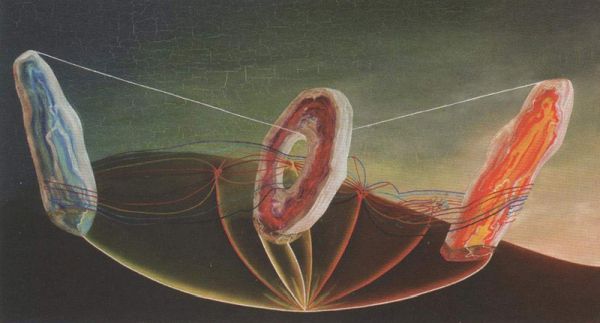
For Colquhoun, myth was not merely inherited – it was alive, continually generated by the unconscious in dialogue with land and archetype. She often invoked sacred geography in her art. Works such as Dance of the Nine Maidens (1940) and Dance of the Nine Opals (1942) depict local rock formations as sentient, mythic figures. The Cornish stones are anthropomorphised, dancing, dreaming, almost breathing – inviting the viewer into a dreamtime where history, magic, and geology converge. Her sketch of Dance of the Nine Opals reveals a meticulous sensitivity to the energetic webs that pulse beneath the surface – currents invisible to the untrained eye yet charged with historical, folkloric, and mystical significance.

The Alchemical Body : Eroticism, Energy an the Feminine
Throughout her career, Colquhoun sought to map the hidden correspondences between plants, planets, body parts, and sacred geometry. Her work is charged with symbolic energy – merging anatomical forms with botanical structures, sexual imagery with cosmic diagrams.

In “Attributes of the Moon” (1947) Colquhoun conjures the landscape not as passive but as generative, and feminine, expressing a vision of the feminine as protean and plural – a living system of symbols in continual metamorphosis. In “The Anatomy” (1942), a yonic work that evokes the enfolding architecture of caves, Colquhoun draws on the elemental symbolism of the earth as womb – simultaneously a site of concealment, transformation, and power. The image recalls the myth of Daphne, metamorphosed into a laurel tree by her father, a river god, to escape the sexual pursuit of Apollo. “The Anatomy” not only asserts the generative force of the feminine, but also reframes retreat and metamorphosis as acts of self-preservation and agency.
Archives of Magic : Colquhoun’s Library of the Occult
A pivotal starting point for the 2025 exhibition was Tate’s acquisition of Colquhoun’s personal archive from the National Trust in 2019. Comprising over 5,000 items, including sketches, writings, and unpublished diagrams, the collection reveals the extent of her devotion to the mystical arts.

Her personal library – now housed in the Tate Archives – includes over 300 volumes on Greek mythology, alchemy, surrealism, Kabbalah, and ceremonial magic. Among them are The Golden Dawn (1937), The Kabbalah Unveiled (1887), Liber 777 by Aleister Crowley (1909), Dreams and Dream Stories by Anna Kingsford (1888), and Witchcraft Today by Gerald Gardner (1954). Together, they trace a lineage of esoteric thought through which Colquhoun developed her own queer, visionary cosmology.
A Radical Legacy
Colquhoun’s work dissolves conventional frameworks of gender, art, science, and spirit. She crafted a language in which imagination was not fantasy but a form of knowledge; where women could be both warriors and mystics; where eroticism was a divine force; and where the land itself was alive with memory and myth.
In our current cultural moment – one increasingly attuned to questions of fluid identity, ecological consciousness, and spiritual resurgence – Colquhoun’s legacy feels not only relevant but radical.
Ithell
Colquhoun: A queer, occultist artist who created between worlds. By
Isabella Greenwood. Dazed, May 27, 2025.


Excellent long read.
Ithell Colquhoun: Mantic Stains, Sex & Surrealism by Andy Wilson. The Traveller in the Evening, March 7, 2025.
On
a hillside not far from Land’s End, at the boundary of four
parishes, stands the Mên Scryfa: perhaps Britain’s most resilient
standing stone.
It is a slab of granite about six feet tall, likely first erected in the Bronze Age, and now set in the middle of a field (where it has served as a scratching post for itchy cows). Draw closer and you see a faint Latin inscription on its surface: “Rialobranus, son of Cunovalus”. The writing is a later addition from the 5th-6th century AD: two figures unknown, likely of noble blood. Run your fingers across the wonky lettering — feel the grooves in the granite, rough-textured as an oyster shell — and you almost sense an uncertainty in the scribe, recording the names in this novel Roman script.
By the 18th century Mên Scryfa had fallen down. It was re-erected in 1825, toppled again by treasure hunters in 1862 and put right again soon after. In June 2023, vandals set the stone ablaze with petrol and dug a ditch in a bid to topple it a third time (without success). On my visit last month, the lichen lost to the fire had started to return. The scorch marks were gone.
The Cornish hedgerows were thin on my visit to Mên Scryfa, the winter air sharp and clear, and so there were sightlines to other prehistoric monuments nearby: ancient barrows, quoits — and megaliths on the horizon that you had to fix your gaze upon a while to be sure they were not figures watching the Atlantic sunset, but cold sightless stones present there for thousands of years.
Here you understand a truth likely evident to Rialobranus, Cunovalus or their scribe. That Cornish granite is a stubborn material: hard to displace and prone to remembering the names of those etched into its grain after they have passed. Perhaps father and son expected a record of their dynasty would perish in parchment, but might endure for eternity if carved into a Bronze Age standing stone.
Penwith (meaning “the headland at the end”) marks the southwestern tip of the British mainland: a hook-shaped peninsula buttressed against the Atlantic by its steep granite cliffs. It counts as one of Europe’s densest prehistoric landscapes: filled with relics from the Neolithic, Bronze Age and Iron Age past. In antiquity this area was a centre for mining: gold and tin were exported through prehistoric seaways. Cornish tin is found in the Nebra sky disc: an Early Bronze Age artefact, discovered in Germany in 1999, that is perhaps humanity’s oldest depiction of the night sky.
For much of winter the peninsula is besieged by gales. For much of summer it is braced against a headwind of mass tourism from the opposite direction. Crowds rush down the A30 to visit the tourist attraction at Land’s End: to watch 4D films, enjoy the Wallace and Gromit experience and take a selfie with the famous sign. For charity cyclists, Penwith flashes by in a flood of endorphins as they begin the long ride north to John O’Groats in Scotland.
I had visited on a beach holiday in August, but exploring its prehistoric sites in midwinter I was in another country. Holiday cottages were untenanted and unlit. Little drifts of storm-blown sand lay unshovelled by front doors. In one, a model boat placed in the window had cobwebs for rigging.
The roads were silent too. Rather than hunting for expensive beachfront parking, my quarry was potholed lay-bys on country lanes. Rather than scrumming through bank holiday crowds, I knocked on farmhouse doors, looking for someone, anyone to direct me to an obscure megalith I had spied on an OS map. Mostly I was alone with the stones — without company but for starling murmurations roused from the hedgerows when a five-bar gate clanged shut behind me.
There was another reason I was here. Tate St Ives has just opened the first major exhibition of Ithell Colquhoun — a painter and writer, much of whose creative output was inspired by Penwith’s ancient landscapes. Born in the hills of Assam in 1906, Colquhoun was a colourful figure. She had studied at the Slade, saw Dali lecture in London and was photographed by Man Ray holding a sheaf of wheat in Paris. She was ostracised by other figures in British surrealism because of her involvement in the occult, but hers was the life of a spiritual seeker.

Countless artists had come to St Ives for its famous light: many sought pastoral visions in Penwith’s fishing villages. Colquhoun came here to paint something beyond the visible: currents of mysterious energy she perceived flowing between ancient sites, cryptic stone circles whose meaning she sought to decode. In her 1957 book The Living Stones, she wrote of “stones that whisper, stones that dance, that play on pipe or fiddle, that tremble at cockcrow, that eat and drink, stones that march as an army — these unhewn slabs of granite hold the secret of the country’s inner life.” This new exhibition was seen by some as being a risky move for Tate: even 36 years after her death there was concern her art might seem too “woo-woo” for Anglo-Saxon sensibilities. But then, strike out beyond the gallery, drive west down the narrowing lanes of Penwith, and you soon remember this is no Anglo-Saxon land.
To cross the River Tamar into Cornwall is to cross a boundary whose subtleties maps don’t represent. In the minds of Penwith locals, a second threshold — the River Hayle — separates their own peninsula from the rest of the county. Penwith was reputedly home to the last native speakers of the Cornish language, and is where Cornwall’s granite backbone breaks out from beneath sedimentary rocks to reach the surface. Here — like Iona, Bardsey, Finistère — there is the sense that Celtic blood runs thickest where the last land succumbs to the sea.
Ithell Colquhoun understood this distinction when she came here in the 1940s. Boarding a Penzance-bound train at Paddington, she was escaping a bombed-out capital, a failed marriage and an unfulfilled love with a woman she had met in a hotel in Mykonos. In Penwith she immediately sensed a change: a “tingling magnetism” and “a balsamic quality of the air that never fails to bring healing”. She had found her cure.
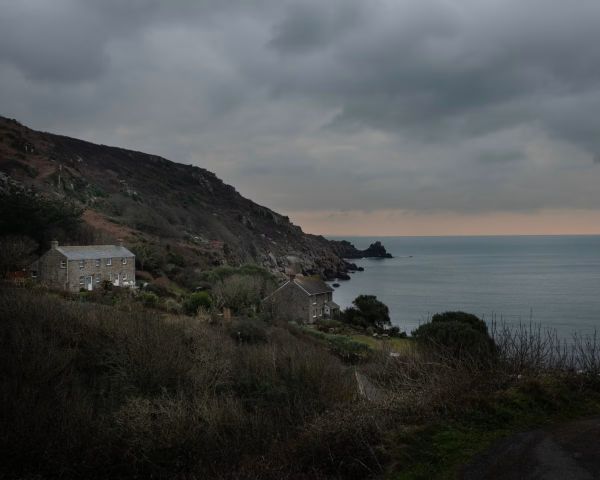
She rented a corrugated iron studio in Lamorna, on Penwith’s southern coast. Where much of the peninsula is moorland dotted with hawthorn and blackthorn, the valley at Lamorna is jungly and — even on my winter visit — faintly tropical. There were bamboo groves and palm fronds rustling in the breeze. Colquhoun wrote of the Penzance dragon trees and other exotic species sustained by the Gulf Stream. Her studio had neither electricity nor a loo but she set to work: painting to the morning song of turtle doves in the valley. Lying in bed after dark, she felt the wings of bats from the attic touching her forehead. To her mind the peninsula was an enchanted land: both Atlantis and Avalon, its “Druidic” temples and Celtic saints manifestations of a deeper power in the granite bedrock. Where others considered it peripheral or at the end of the world, Colquhoun envisaged it a sacred centre of the planet.
Today her former studio — Vow Cave — is a private holiday home. Skylights have been fitted where the bats roosted. The retreat evoked in The Living Stones seems distant, but the prehistoric sites she painted nearby are unchanged. One afternoon I set out to explore some of them in the company of Matthew Shaw and Lally MacBeth, a couple who are the founders of Stone Club, a Cornwall-based organisation celebrating prehistoric landmarks. They first bonded over a shared love of Colquhoun’s work.
We stopped at the Merry Maidens: a late Neolithic to early Bronze Age stone circle that Colquhoun portrayed in Dance of the Nine Opals (1942). We drove down the single-track lane depicted in “Landscape with Antiquities (Lamorna)” (1950). We stopped for lunch at The Kings Arms in Paul — the village where Colquhoun later lived, before passing away in a nearby nursing home in 1988. A group of pagans were sitting at the next table, whispering plans for an evening ritual at a nearby site. “So we do three clockwise perambulations . . . ”

Ritual practices also continue at Penwith’s strangest prehistoric landmark: Mên-an-Tol. The centrepiece of this roughly 3,000-year-old site is a stone with a hole, depicted in Colquhoun’s painting “Sunset Birth” (1942). Folklore tells that women who crawl through it naked will be healed of infertility — early drafts of Sunset Birth show a feminine figure levitating in the circle. “You occasionally see half-dressed people hiding in the bushes,” Lally told me. “Some Cornish women even talk about having their own ‘Mên-an-Tol baby’.”
Ancient sites like Mên-an-Tol were launch pads for Colquhoun’s imagination: prompts for deep time dreams. Her paintings are testament to how objects of such unfathomable antiquity invite a perspective that transcends ordinary sight. But exploring the St Ives exhibition, you sense there is also something unspoken. At the time Colquhoun was working, ley lines and earth energies were a novel idea — they are now universally regarded as pseudoscience. Her interpretation of stone circles as abodes of the divine feminine was once a fashionable one — it is also without evidence.
The function and meaning of those prehistoric sites she painted is uncertain, dating as it does to an unrecorded past. The esoteric, tantric and classical allusions in her art and writing are visionary, but they are also only projections. In one sense Colquhoun was radical. In another, she belonged to a long-established tradition: an outsider in Cornwall, in love with a half-imaginary land.
In the 1980s, encampments of new age travellers were often pitched up by the stone circles of Penwith. Now they are gone but at the centre of the peninsula I tracked down Palden Jenkins, a self-described “aged hippy”. He had lived in Glastonbury and been an activist in Palestine before moving in his sixties to take up residence in a caravan near the Penwith village of Sancreed, with its granite 15th-century church and even older holy well, where pilgrims still come to tie cloth offerings to the trees.
Jenkins runs Ancient Penwith (ancientpenwith.org), a project to map what he described as a “landscape temple”, the network of ancient sites relaying energy in the manner of a “circuit board”. He instinctively understood Colquhoun’s paintings: he too felt the difference when he stepped on to the granite west of Penzance. Palden had been given a terminal bone marrow cancer diagnosis in 2019. He had been a champion fell runner in his youth: now it entailed a similar effort to walk to the Bronze Age barrows on nearby farmland, to have a smoke, reflect and heal.
“Strictly speaking I shouldn’t be alive now,” he told me. “I can’t put that down solely to visiting ancient sites. But they do have an effect on me: like an energy bath. Healing doesn’t always mean getting better, but helping you deal with the situation you have. You have to make peace with your death.”
A stone jetty extends out into a Cornish cove at dusk Lamorna Cove at dusk I drove a final lap around the peninsula. I passed the Mên Scryfa, guarding the boundary of four parishes, and the green valley at Lamorna, of which Colquhoun had written: “here, to exist here was enough.” Lastly, a couple of miles inland from Sennen Cove, I climbed Chapel Carn Brea, Penwith’s most southwesterly hill and itself supposedly a point of convergence for energy lines.
It was a bright, blustery morning. The Isles of Scilly were visible across a shining sea. Even a sceptic could discern energy flows from the summit. Above were the crooked vapour trails of planes changing course as they entered UK airspace. Below, undersea cables relayed power and information across the ocean, out of sight. But most perceptible was the Gulf Stream wind, making landfall after crossing endless leagues of open ocean. And the action of the waves all along that granite peninsula — crashing on the first and last rocks of England. Which, of course, were not quite England at all.
Cornwall’s mystical far west — in the footsteps of Ithell Colquhoun. By Oliver Smith. Financial Times, February 12, 2025.


Lamorna is a small village on the Cornish coast, in the far southwest of Britain. The expansive skies and landscapes of the area have long been a draw for artists, most famously painters associated with the Newlyn school such as Laura Knight, Alfred Munnings and Lamorna Birch. Less well known are the ground-breaking queer artists who set down roots in the village: Marlow Moss, Gluck and Ithell Colquhoun. In this film, we tell their story, and the story of the Cornwall where they lived and loved: a place of international modernism, Celtic spiritualism and the queer avant-garde.

Ithell Colquhoun’s reputation as a Surrealist artist, writer and occultist has been surging in recent years. Most know her through her quirky travelogues of Ireland and Cornwall Crying of the Wind: Ireland(1955) and The Living Stones: Cornwall (1957), her Surrealist occult novel Goose of Hermogenes (1961), or perhaps her idiosyncratic account of the history of the Golden Dawn, The Sword of Wisdom (1975). Her visual art has been less accessible until recently, but is becoming more widely known with recent, beautifully illustrated publications featuring her Taro (tarot) deck and her color study of the Sephiroth of the Tree of Life, The Decad of Intelligence. Her genius is evident, yet so much about this brilliant and eccentric figure remains elusive. As I eagerly await the publication of my own biography of Colquhoun, Genius of the Fern Loved Gully (coming soon from Strange Attractor Preess), I thought I might delight you all with a topic I don’t address in the book in any great depth: Colquhoun seemed to have a weird thing about exploring base bodily functions with some delight. We don’t see this in just a few isolated literary incidents, urination and defecation are deliberate themes, explored sometimes with a strange intimate aside, and sometimes in rather perplexing detail.

Now, it should be noted that Colquhoun wasn’t ever one to shy away from bold and socially prohibited imagery, particularly when it came to sex and bodies. In the 1930s and early 1940s her paintings went from somewhat suggestive studies of plants to vulvic tree trunks and full-frontal male nudes. Her private erotic studies also spared no detail. In her writings, Colquhoun’s treatment of bodily functions was not limited to urination and defecation. Her vignettes and prose poems referred to excreta on a number of occasions, however elimination appears in rather distinctive contexts. In various short pieces, Colquhoun writes of menstruation, skin conditions, scabs, open sores, and some weird brown fluid that seeped out of her navel at some stage which fascinated her. It is clear that she wishes to confront her audience with images that are in many ways completely ordinary yet rarely acknowledged in polite company. These explicit depictions are even more radical coming from a woman writer, when women are, even to this day, generally expected to keep our bodily fluids well out of sight and out of mind. Part of Colquhoun’s approach may have been a Surrealist exercise. Surrealism was and is disruptive to its very core, seeking to unlock the unconscious and to display taboo, dismemberment and horror, often with a generally Freudian sensibility. Yet while Colquhoun’s work can occasionally be macabre, and certainly shocking, she generally does not focus on the overtly morbid (although there are some exceptions). While there is no doubt that some of her prose was meant to shock, the clinical way in which she writes of things that drip and ooze itself is oddly alienating.
Colquhoun’s writing style in general leans toward cold observation, and this is true of even her most Surrealist writings. Although she uses thick description with respect to color and setting and her imagery is consistently rich, even the most bizarre activities in Colquhoun’s writings, including, sex, magic, incest and cannibalism, are depicted quite dispassionately. Colquhoun’s unpublished autobiography Until Twelve, likely written in the 1940s, would have us believe that keen observation was a trait she admired in herself from a very young age. Although her writings about her childhood observations are clearly filtered through an adult lens, she didn’t flinch from honest, seemingly detached reporting of her youthful encounters with sex, menstruation and the pubescent development of young bodies. Her short prose poems from the 1940s and 1950s retain an icy, objective flavor, reading as field notes from an anthropological expedition even when describing edgy subjects such as the prostitutes she carefully observed in her short prose poem titled Sligo Street, 1939. However, her depictions of waste elimination, while also taboo, offer different challenges to the viewer, and perhaps also some opportunities.
Although Colquhoun’s depictions of bodily waste were often matter of fact, they were also ironically tinged with the wider grasping of the ultimate which marked her life’s work. Despite the somewhat clinical treatment, Colquhoun juxtaposes urination and defecation with moments of wonder and transcendence, placing the sacred and profane in proximity, forcing the reader to accept the holy nature of the physical body. In one short prose poem, “Alchemical Text” the physics of urination encourage a meditation upon gender equality and embodiment:

“He said, quoting a sage, that every girl had her roots in earth. I said, where does every boy have his roots? He answered “In the sphere where fireworks explode”. I understood by this the polarity of alchemical earth and air, but wondered if it were valid. For if this distinction was, as it must have been, based upon different methods of making water, then certainly a girl’s water goes directly downwards into the earth; but a boy’s also must eventually return there, and for all its rocket like soaring, is bound at last for earth. “[1]
Another short piece “Images of Joy”, likely written in the 1940s or possibly late 1930s is a short recollection, likely from her time in Greece in the early 1930s, where Colquhoun has an uncommonly aesthetic response to the fecal remains of a wandering peasant:
“I was sitting on a rock between mountains and sea and the sun was blazing down on the aloes, and I thought I was alone. But presently I heard a step and a peasant came along who thought he was alone and let down his pants and had a good shit. It was done in a minute with complete simplicity; he pulled them up again, not wiping his arsehole with so much as a leaf, fastened his belt and walked away.
I went forward to look at what he had done; it was beautiful, three concentric rings of golden brown, decorated like a cake with olive stones and shreds of tomato peel. The topmost ring ended in a little point aiming at the sky. I think the whole lot must have come away clean without leaving a trace; perhaps the intestine had come out a little way like an animal’s to form a funnel, though maybe there was a small stain on his trousers all the same. “[2]
In two of Colquhoun’s longer form writings she juxtaposes urination with sacred sites and landscape. In, The Blue Anoubis, her unpublished 1966 travelogue about Egypt, she describes hiking up her skirts to pee behind a pyramid.[3] In her slightly earlier Surrealist novel I Saw Water, about an order of parthenogenic nuns existing in a shadowy afterlife, Colquhoun much more irreverently counterpoints the body and the altar as sites of sacred activity. The central character of the story, a postulant at the nunnery, finds herself exploring the convent church, when, at one of the altars in a side chapel, she lifts the top off the altar to find it covering a cistern. Overtaken by the urge to urinate she relieves herself in it, wiping herself with letters she finds in her pockets. She only gives the incident the briefest thought when a priest arrives, appearing to not have noticed or cared. Is the implication one of sacrilege, as she uses the altar in a way clearly unintended, or was the altar actually covering up a toilet? The sacred and the profane blur, or perhaps they were always one and the same. [4]

It is likely that Colquhoun was working to prompt a spiritual shift in the reader by elevating the debased and by making no one thing greater than any other. A key may lie in comment she makes in another short essay “Hexentanz”, which details sticky bodily fluids and the taste of ear wax: “Life is not beautiful but it is rich: All must be accepted.” [5] A lifelong animist with an interest in Tantra, Colquhoun wished to confront generally accepted standards of sacrality by uplifting and acknowledging that which is most degraded. While still quite young, at the age of 24, she delivered a paper to the Search Society, a group of occult writers and thinkers led by her distant cousin Edward Garstin, titled “The Connection Between Mysticism and Blasphemy”. Here she challenges standard conventions of blasphemy by arguing that the blasphemous creates the conditions for divine encounters:
“Thus, though the blasphemer may be said to lower the divine, while the mystic raises himself to meet his Lord, yet in fact both perform the same process, that of bringing the divine and the human into contact. Since any vehicle cannot be unworthy of divinity, the doctrine of the Incarnate God and the whole train of sacramental teaching that follows in its wake is in this sense blasphemous...”[6]
By collapsing the categories of the sacred and the blasphemous one can reach an experience where nothing can be destroyed. She states “Where there is nothing, there is God.” “And if all can be destroyed, why, let there be destruction.” During the late 1920s and early 1930s Colquhoun also encountered Hindu Tantra, a tradition with which she felt some affinity due to her birth in the north of India, through the writings of John Woodroffe (Arthur Avalon) and those of her cousin Edward Garstin. It seems quite possible that as she developed as a writer and artist that she extended her ideas about blasphemy into breaking taboos as a way of experiencing enlightenment and non-attachment as part of a Tantrically inspired esoteric framework.

Were Colquhoun’s literary scatological episodes a Surrealist exercise in shattering taboos? Simple juxtaposition of opposing images? Tantrically inspired sacramental meditations? Regardless of intent, she was likely considering some aspect of spiritual refinement, hoping to bring her audience along with her, changing our perspectives and cultivating a new way of seeing. Can’t exactly say that this tendency endeared her to publishers, but I don’t think she ever believed that her work was for the masses anyway.
Images © Samaritans, Noise Abatement Society and Spire Healthcare.
1. “Alchemical Text” in Shillitoe, Richard (ed). Medea’s Charms: Selected Shorter Writings of Ithell Colquhoun. (London: Peter Owen Publishers, 2019) p. 116.
2. “Images of Joy” ibid. pp. 132–133, and in the Tate Hyman Kreitman Archives at TGA 929/2/1/52/38.
3. Colquhoun, Ithell, The Blue Anoubis unpublished mss, c. 1967. Tate Hyman Kreitman Archives, TGA 929/2/1/6/8
4. Colquhoun, Ithell, (eds.) Richard Shillitoe and Mark Morrison, I Saw Water: An Occult Novel and Other Selected Writings (University Park, Penn State University Press, 2014). Kindle edition, location 1435.
5. “Hexentanz” exists in several versions. This quote was from the mss. TGA 929/2/1/52/56
5. Colquhoun, Ithell “The Connection Between Mysticism and Blasphemy” c. 1928/1929 unpublished mss. Tate Hyman Kreitman Archives, TGA 929/2/3/2

Ithell Colquhoun (1906-1988) is one of the 20th century’s most significant British surrealist artists. The daughter of a senior civil servant in India, she studied at the Slade School of Fine Art (1927-31) and had an award-winning painting exhibited in 1931 at the Royal Academy. She travelled widely in Mediterranean countries and lived in London before spending the greater part of her adult life in Cornwall where she painted, wrote and pursued extensive occult research. In 1940 she was ejected from the London Surrealist Group for refusing to compromise her occult interests. Her paintings have appeared in solo exhibitions as well as being shown in major art galleries. A significant body of Colquhoun’s artworks and archives were acquired by Tate in 2019, gifted by the National Trust. Her fame as a writer is largely based on a hermetic novel, Goose of Hermogenes, and two highly personal travelogues The Crying of the Wind: Ireland and The Living Stones: Cornwall. She also published Sword of Wisdom, the authoritative biography of MacGregor Mathers, the founder of the Hermetic Order of the Golden Dawn. She died in Cornwall in 1988.
Dr Richard Shillitoe is an independent researcher. His book Ithell Colquhoun: Magician Born of Nature (2010) includes an extensive catalogue of Colquhoun’s artwork. He co-edited the first publication of Colquhoun’s novel I Saw Water (2014) and edited the illustrated edition of her first novel Goose of Hermogenes (2018). He has recently published Medea’s Charms (2019), a volume of Colquhoun’s poems, essays and short stories. He maintains the website www.ithellcolquhoun.co.uk