Showing posts with label British Museum. Show all posts

23/01/2022

Irving Finkel, Curator of the British Museum, Discovers What May Be the World’s Earliest Depiction of a Ghost


At the back​ of the British Museum is a cavernous room lined with hundreds of cased wooden drawers supported by a central architrave. Each drawer contains tens of glass-topped boxes of various sizes with neat, typewritten labels. The boxes contain clay tablets from ancient Mesopotamia, around 130,000 of them, inscribed in cuneiform, many broken and eroded. An agricultural boom at the end of the fourth millennium bce led the Sumerians to create the first written records, in order to help them keep track of various commodities. These early signs, traced in wet clay with the sharpened end of a reed stylus, looked a lot like the things they represented: a bowl for food or rations, a jug for beer and so on. Over time, the scribes realised that it was quicker to impress than to incise signs into clay, and the resulting script, cuneiform, gets its English name from the characteristic wedges (cuneus in Latin).
 
The earliest written recipes, laundry receipts, peace treaties, poetry, representations of pi and lullabies are inscribed in cuneiform. Six thousand years ago, people living in present-day Iraq washed their clothes and did maths and shared songs and baked bread. They also saw ghosts. In his new book, The First Ghosts, Irving Finkel, the curator in charge of the BM’s clay tablets (and the reason I dropped law to study cuneiform), discusses what these and other artefacts excavated from Mesopotamia tell us about supernatural apparitions and the ways they populated everyday life. The clay tablets, he writes, preserve ‘abundant and surprising details’ in the form of omens, spells, myths, royal propaganda and letters, ‘almost as if they anticipated our interest’.
 
Burial sites from across the ancient world attest to what Finkel describes as ‘the deep-seated conception that some part of a person does not vanish for ever’. The first recorded use of a word to describe a spirit that is separate from, and survives, the human body is a tablet dated to the early third millennium bce, which is inscribed with the cuneiform character for the Sumerian word for ‘ghost’, gidim (although it originated as the script for Sumerian, cuneiform was adapted for a number of other ancient languages, including Akkadian and Hittite). Inhabitants of Mesopotamia were usually interred after death. The Royal Cemetery at Ur, uncovered during excavations in the 1920s, housed sixteen royal tombs that date from roughly the same period as the gidim tablet. The aristocracy of Ur entered the afterlife with crowns, chariots, helmets, harps and daggers. Some of them left this world with an entourage: archaeologists discovered what they described as a ‘great death pit’ adjacent to one tomb, containing the remains of 74 people, including adolescents. One skull from the pit that underwent a CT scan was identified as that of a woman in her late teens or early twenties: the last thing she felt would have been the blunt force of something like a battle-axe.
 
Not every Mesopotamian was buried in such style. Graves have also been discovered beneath and within the walls of family homes, allowing the deceased to be fed and watered by their surviving relatives (ideally by the eldest son), who were also required to recite their names regularly. Sometimes people buried their relatives in coffins shaped like bronze bathtubs, or in large jars. Others wrapped the corpse in reed matting or covered it with broken pieces of pottery before burying it in a pit. Even unborn babies, some barely beyond twenty weeks of gestation, were given a final resting place. Finkel cites a Sumerian poem about Gilgamesh: ‘Did you see my little stillborn children who never knew existence?’ Gilgamesh asks the ghost of his companion, Enkidu. ‘I saw them,’ Enkidu replies. ‘They play at a table of gold and silver, laden with honey and ghee.’
 
Those who went unhappily to their graves or who remained unburied, as well as those whose tombs were untended (or insufficiently tended), became restless ghosts. The spirits that rose from the dead were as varied as their living counterparts: there were ghosts of the very young, of women who died in childbirth and those who died as virgins, of wet nurses, soldiers, slaves. Sometimes they were described according to the way they met their end – by drowning in a river, burning to death, falling off a roof or being slain in war. They retained the characters of the people they had once been, from mild-mannered to malicious. Like more recent depictions of ghosts, the Mesopotamian accounts make clear just how unpleasant these spirits could be. A 99-line spell, which belongs to a much larger work on expelling demons, describes ‘exactly what it was like to be visited by an unknown, unidentified ghost of the roaming, malicious hooligan type’. These ghosts ‘flicker like flame’ and ‘flash like lightning’, they cross the thresholds of houses and descend over the rooftops. They frighten, snarl at and otherwise torment the ‘sick person’. They hide in a house’s holes and crevices, they slither, they stalk people, they roam the streets and steppe.
 
The spirits of the restless dead also caused medical havoc. They formed part of a complex explanatory system for illness, which included deities, demons and even witchcraft alongside causes we would still recognise – a snake bite or the sun’s heat. Some ghosts entered the body through the ear. The word for ‘ghost’ could be written in several ways that exploited the many meanings layered onto each cuneiform sign. As Finkel writes, one sign combined the signs for ‘open’ and ‘ear’, giving a literal reading of ‘ear-opener’. Ghosts, therefore, could cause roaring or ringing ears as well as all manner of medical misery, from madness and headaches to flatulence, fever, chills and depression. Some cuneiform texts that describe ghost-induced illness detail the way the now ghost died, and sometimes the manner of death corresponds to the symptoms the ghost causes: the ghost of a person who drowned, for example, caused shortness of breath in the haunted person, ‘like one who has just come up from the water’.
 
A rich tradition of ghostbusting emerged in response to the many troubles caused by ghosts in ancient Mesopotamia. Those who could afford it turned to scholars known as the ashipu, whose accepted English translation of ‘exorcist’ doesn’t quite capture their professional domain. Usually men (though there are sporadic references to women exorcists, for instance in the Maqlû series of incantations against witchcraft), these scholars spent years mastering medical knowledge and treatment, including what we might call ‘magical’ remedies. Medicine in Ancient Assur by the Assyriologist Troels Pank Arbøll follows the career of one such exorcist, Kisir-Ashur.* By piecing together more than seventy texts found in a private library in the city of Ashur, Arbøll has mapped out Kisir-Ashur’s training, which included anatomy, diagnostics, paediatrics, veterinary medicine and magic. As a trainee, with the help of his father, he learned practical skills that ranged from the use of bandages and emetics to spells and rituals. In one instruction manual, written in the summer of 658 bce, Kisir-Ashur describes how to treat a patient suffering from ghost-induced confusion. After sweeping the ground and sprinkling it with purified water, setting up an incense burner and pouring a libation of beer, the exorcist must make a figurine of the confusion-causing ghost from clay, tallow and wax, which the patient then holds up to the sun god while reciting a long incantation.
 
The medical and magical instruments at the exorcists’ disposal were as varied as their patients’ ailments. Someone troubled by visions of dead people might be told to wear a leather pouch filled with various plants and a soiled rag, or other noxious substances such as sulphur or fish oil (these were also useful in repelling unwanted living visitors). Another ritual calls for three libations of donkey urine; Finkel explains that ‘the thirsty ghost – for ghosts were always thirsty – might take it for a refreshing beer and receive a punitive shock.’ Spells exploit connections not immediately obvious to a modern reader: some of them have abracadabra-like strings of words and syllables whose original meaning might well have been forgotten but whose magical applications remained powerful. Some of these spells involve necromancy, to which Finkel devotes a chapter.
 
Some ghosts formed an intense connection with their victims, requiring the exorcist to create a substitute companion. Around ten lines of cuneiform survive on one side of a broken clay tablet from the fourth century bce. They were written by a Babylonian scribe called Marduk-apla-iddin as part of a manual describing how to get rid of a ghost so persistent it resisted other methods of exorcism. The reverse of the tablet appears to be blank, but under the right light the outlines of two figures appear. It is incredibly rare to find drawings on tablets from ancient Mesopotamia: only a handful have been discovered so far. In this image, a man with a long beard holds his shackled hands in front of him, attached to a rope. On the right, a woman in a smock holds the other end of the rope. The instructions tell us that she has been created as a companion to entice the obstinate ghost into the underworld. Finkel reckons that the figure on the left is ‘the oldest drawing of a ghost in the history of the world’.
 
Students of Akkadian today often read a Babylonian narrative about the journey of Ishtar, goddess of love and war, through seven gates into the ‘Land-of-No-Return’. Ishtar’s descent into that ‘gloomy house’, whose inhabitants live in darkness, eat dust and clay, and wear feathers for clothes, gives us a glimpse of the horrors imagined by Mesopotamians for the afterlife. Another underworld account comes from a nightmare reported by an Assyrian prince called Kummaya, and relates how he was held captive in the ‘House of Death’, which was populated with ‘top-rank underworld gods and demons’. Here he met seventeen embodiments of evil in the form of hybrid demons and ghosts, and a personification of Death with the head of a dragon. It’s not surprising that the bearded Babylonian ghost didn’t want to make the one-way journey through the seven gates.
 
Conceptions of the afterlife were not uniformly bleak. Ancient Mesopotamians were buried with bowls, saucers, bottles, bracelets, beads and even toys. Wherever they were going, the dead, it seemed, could still eat and drink and dress and play. But many of them hung around the living. I imagine ghosts in much the same way the Mesopotamians did. They should look and act like the people they once were, but they represent something beyond the restlessness of the dead, giving shape to what is lost, difficult or unresolved.
 
Review : The First Ghosts: Most Ancient of Legacies by Irving Finkel.
Hodder, 344 pp., £25, November 2021, 978 1 5293 0326 1
 
Roaming, Malicious, Hooligan Ghosts. By Moudhy Al-Rashid. London Review of Books, January 2022,


Irving Finkel speaks to Ellie Cawthorne about his new book, which transports us to ancient Mesopotamia to uncover the earliest written evidence of a belief in ghosts.
 
Ellie Cawthorne: You argue that “most, possibly even all, human beings everywhere truly believe in ghosts”. Why do you think humans are inclined to believe that the dead might return to exist among us?
 
Irving Finkel: In the modern world, ghosts have a funny status. Most people don’t wear their ghosts on their sleeves, because there’s a good chance they’d be branded idiots for believing in such things. But when you look into the matter historically, we have plenty of testimonies concerning ghosts, coming from all over the world and covering a huge span of time. They date right back to the very first written material that we have – cuneiform tablets from ancient Mesopotamia, in what is now Iraq, developed before 3000 BC. And this earliest written evidence is what I focus on in my book.
 
Arguably, you can trace this ghost business back even farther than the beginning of writing. I would posit that the concept of something hanging around after death goes back to the very dawn of mankind. Take as an example a Neanderthal burial in which the body is laid out in a prepared grave, in a particular position, alongside special bits and pieces. The point here is this: if you bury somebody in the ground to get rid of them because they’re smelly and dangerous, that’s one thing. But burying them in a special way with goods implies that your expectation is that, once the horrible bodily chemicals have disappeared, something – most likely the essence of the person – comes out of the body and goes on to some kind of afterlife. And my idea is this: if you’re willing to accept that someone’s spirit can disappear over there, it’s a short step to believing that it can come back again.
 
I think we’re hardwired to believe in ghosts. The most austere, clever scientist in two white coats might look at you as if you’re crazy – but if you make them jump, they will shiver just like everybody else. It’s beneath the skin.
 
AC : Your book focuses on the very first writings on ghosts, on ancient Mesopotamian cuneiform tablets. Why are they so illuminating to study?
 
IF : One of the reasons I wrote this book is that there is a general feeling that ghosts were invented in the 19th century, or perhaps in the Middle Ages. Not many writers even talk about the marvellous stuff on ghosts from Greece and Rome, let alone Mesopotamia [which included Babylonian, Sumerian and Assyrian cultures]. So I thought that I would put the Mesopotamians back on the ghost map to show that these beliefs are truly old and unchanging.
 
If you learn to read Babylonian – it’ll only take you 20 years – and you translate these messages written on cuneiform tablets, you’ll find it extraordinary just how familiar the world of ghosts that emerges from them is. The underlying story is still fairly recognisable to us today: if a ghost is unhappy in the underworld – perhaps if they had a miserable death, or didn’t get the offerings they were due – they could come back. And they could make living people jump or pull their hair, follow them around or make them ill – all kinds of things.
 
AC : You state that ghosts were “not symbols or metaphors, but literal realities” in Mesopotamia. How so?
 
IF :
From the king on the throne to the beggar in the street, the whole population didn’t just believe in ghosts – they took them for granted as a fact of life. Ghosts were just part of the everyday scenario, alongside all the other things you had to worry about, like children, housing, warfare and disease.
 
And since ghosts were an everyday reality, they also called for the undertaking of everyday chores. A household’s oldest son was responsible for making offerings of food and drink to his dead family, who were often buried under the courtyard of the family home. They needed water and food because there was an understanding that the underworld wasn’t very hospitable. Arriving there was a bit like arriving at an Airbnb with no towels or electricity. People had a responsibility to look after the ghosts of their relatives in the sense of reciting prayers in their honour, remembering them, talking about them.
 
The explanations provided for ghosts returning were not metaphorical but literal – there’s a big difference. The Mesopotamians didn’t speak about them in elusive poetics but as something grounded in reality. In many parts of the world, this attitude survives unchanged. In villages in India, you can ask people about local ghosts and they’ll have 100 stories to share immediately.


AC : How did belief in ghosts connect to the wider religious system in ancient Mesopotamia?
 
IF : When we talk about deities in the ancient world, “religion” isn’t necessarily the best word for the system. The Mesopotamians didn’t have a word for “religion”, because their system of gods and goddesses was more than that – it was all-pervading. They had a huge pantheon of deities, and in some ways interactions with ghosts did trade on this system. If someone returned from the dead, a priest or exorcist would be recruited to drive the ghost back. These priests would call on the power of the gods, invoking names such as Ishtar the Goddess of Love to help them to deal with ghosts. On the whole, though, dealing with the dead was slightly unrelated to the prevailing main religion. It wasn’t centrally what we would call a religious matter but more of a traditional matter.
 
AC : Were ghosts always figures to be frightened of?
 
IF : Another jolly good question, because in the later tradition we think of ghosts mainly as clanking ghouls in hotel rooms, bearing frightening messages. In Mesopotamia, people could be startled and sometimes made unhappy by ghosts; if you saw a ghost, on the whole it wasn’t good news – it generally meant that there was a danger that you needed to do something about.
 
However, because people tended to live in extended families, with their relatives and ancestors buried directly under the family home, so quite often you were dealing with a familial ghost. And I feel that the basic position towards a ghost from your own stock was a kind of sympathy. Of course, if that sympathy didn’t work, you could always pay an exorcist to get rid of them with more heavy-duty tools.
 
In addition, there were also lots of unknown ghosts floating about who were nothing to do with your family, and who might be very dangerous indeed. They could go into your ear, torment you and make you very ill. Imagine that after a battle, for example, there’d be thousands of dead soldiers who hadn’t been buried properly, floating about. And the first thing they might do is head to Babylon and make life hell for anybody still living there.
 
AC : Can you give some examples of the types of ghost spells found on cuneiform tablets?
 
IF : Babylonian scribes described a whole slew of simple spells and complicated rituals to get rid of ghosts. Some of these rely on lists of all of the different kinds of ghosts – a ghost who died in a fire, say, or a ghost who was run over by a chariot or drowned in a well or died in childbirth. Part of the spell to get rid of them would involve reading out this list, essentially saying: “Whether you are this type of ghost, or that type of ghost, we know who you are. Go back where you belong!” Identification of a troublesome ghost was a means of gaining power over it.
 
Another tablet contains a list detailing what it meant if you saw a ghost. For example, if you saw a ghost in the bedroom, it could mean that your uncle was going to die, or you were about to lose all your money. Those are grim portents, but there were specialists who could use concomitant forms of magic to dispel the threat. And an omen wasn’t a fixed fate but more like something in the air.
 
One of my favourite spells is designed to help someone who keeps seeing a ghost. They have to recite a spell that essentially says: “You, who keep persecuting me, leave me alone – I’m not going to Kutha.” That was a city in Babylonia, the location of the entrance to the underworld. It had a big temple through which gods and ghosts came up. You can imagine ghosts beckoning with a bony finger, saying to a living person: “Come with us.” The person who has been seeing a ghost then calls on all these goddesses to back them up. It’s fantastic, because it demonstrates that, though the gods are very busy, they will come over and thwack a ghost if needed. It’s basically a way of telling the ghost: “Piss off back to your underworld gloom!”
 
AC : What can you tell us about the underworld?
 
IF : One of the main sources of information on this is a marvellous series of literary texts describing the descent of the beautiful goddess Inanna into the underworld. On a quest to rescue her lover, who is imprisoned there, she passes through seven gates, each manned by ferocious gatekeepers. Inanna journeys all the way down to the underworld, where her sister is queen, in order to sort out this problem. When she gets there, it’s very gloomy indeed – there’s no real light. All of the ghosts are lurking, their numbers increasing every minute as more people die. We’re told in the Akkadian Gilgamesh Epic that “dust is their sustenance, clay their food. They see no light, dwelling in darkness. They are clad like birds, with wings as garments.” One gets the impression of them all swaying with their shoulders together like dusty penguins. The lack of food and drink explains the evolution of a ritual of pouring out drinks and offering food for the dead – it theoretically went down to sustain them in the underworld.
 
This wasn’t hell in the sense of a burning pit with pitchforks and laughing devils pulling your nose. It was more a kind of interregnum – a kind of dreadful waiting place in which nobody’s quite certain what they’re waiting for. Understanding this adds a whole different dimension to the idea that ghosts want to return. If you were trapped down there, wouldn’t you want to go back to the sunny world of ancient Iraq?
 
Another crucial point to understand is that the Mesopotamian afterlife didn’t have a moral dimension: there was no concept that bad behaviour in this life meant a terrible time to come in the next. In my opinion, that connection was a disastrous invention because it dislocated responsibility – everybody spent the whole of their lives fretting about the consequences of their actions after death. The Mesopotamians didn’t have that trouble.
 
AC : You’ve found spells for necromancy. How – and why – would anyone bring people back from the dead?
 
IF : Necromancy wasn’t about bringing people permanently back to life so much as summoning them temporarily to get some answers.
 
The Mesopotamians believed, as many people do today, that ghosts were in possession of a knowledge of the future. It was understood that if a ghost appeared and didn’t say anything, they wanted to communicate something. So there were spells to try to encourage a ghost to answer questions. Sometimes this would require a full-blown ritual in which you procured the skull of the person you wanted to interrogate – who might well be a family member, retrieved from under the floor. The skull was plonked on the table and covered in oil, while the exorcist burnt incense and called upon the Sun God to bring the person back up from the underworld. They would then enter the skull, and you could ask it questions. This ritual was probably terribly frightening, so I don’t think you would do it in a flippant way. However cool and callous a person you might be, I think that staring at a skull until it began to speak would make you pretty jumpy.
 
After the ritual was over, and you’d hopefully got the answers you were after, you’d want to send the ghost back to the underworld jolly quickly. A safety clause was built in to the necromancy manual to help with this: underneath the spell to bring back a ghost, the scribe provided a whole load of spells to then get rid of them as soon as possible. The last thing you would want would be to bring up a ghost for a chat and then let them go off round the world causing mischief.
 
 
AC : In the book you discuss how disrespecting the dead could be a political device. Can you give us an example of that?
 
IF : It’s very interesting to see what you might call political ghost-work at play. Take, for example, the Assyrian king Ashurbanipal, one of the great rulers of antiquity. He had ongoing military trouble with the Elamites, in what is now Iran. In a particularly regrettable state of military fury, his troops ravaged the tombs of the old Elamite kings and scattered their bones, thereby condemning the dead rulers of Ashurbanipal’s hated enemy to a state of eternal unrest. That intention – to impose eternal unrest on the Elamites – is expressly stated in the official Assyrian annals. This was not a metaphor or a clever use of language – it was jolly well what happened.
 
 
AC : As well as ghosts, the Mesopotamians also believed in demons. What can you tell us about them?
 
IF : The big difference between a demon and a ghost was that, whereas a ghost was a dead human being, a demon had an alien component. Demons were immortal: you could not kill one. If you were lucky, a ghost was not generally malevolent and wicked, more likely just miserable. I don’t think you’d find a miserable demon. Demons had no heart – they were horribly evil.
 
Most demons were either a bit dragony or anthropomorphic – basically like human beings with other nasty characteristics thrown in. One of the worst of all was the demoness Lamashtu, the “baby snatcher”, who liked consuming newborns. At first sight she looked like a woman, but get closer and she had wings, talons and reptilian feet – a very frightening mixture.
 
 
AC : What can looking at these ancient Mesopotamian beliefs tell us about humanity’s relationship with the idea of death more generally?
 
IF : Ghosts are a persistent reality in human thinking, and it’s always interesting to try to uncover when such long-running ideas started. I would argue that ghost beliefs are very difficult to expunge from our mindset because they’ve been there since the beginning, built into the human psyche. The idea of not being able to rest in peace if your life is lacking in resolution, or you met an unhappy or awkward end, is to be found absolutely all over the world.
 
One of the most exciting things about working on these texts was the empathy I felt with the Mesopotamians, for whom ghosts were a problem. I thought that the only way to write about this was with empathy – in other words, there was no point debating whether or not ghosts really existed, because for the Mesopotamians that was not a question worth asking. Instead I focused on looking at what Mesopotamians did because ghosts existed. That doesn’t mean to say that I believe in ghosts personally; it’s more of a way of finding a voice that you can recognise in these texts. And the voice that is distilled from these sources is still, I think, very vibrant.
 
Irving Finkel is curator of ancient Mesopotamian script, languages and cultures at the British Museum. His research specialities include the study of cuneiform script and the history of board games, and among his previous books is The Ark Before Noah: Decoding the Story of the Flood (Hodder & Stoughton, 2014)
 
“Ghosts were taken for granted as part of everyday Mesopotamian life”: Irving Finkel on ancient Mesopotamia and ghosts. By Ellie Cawthorne.  Hstory Extra, October 29, 2021


A 3,500-year-old Babylonian tablet that had been kept in the vaults of London’s British Museum since the 19th-century appears to include the earliest depiction of a ghost, according to a forthcoming book.
 
The discovery is featured in The First Ghosts: Most Ancient of Legacies, authored by Irving Finkel, a curator of the British Museum’s Middle Eastern department. According to Finkel, the long-overlooked clay tablet features an obscured drawing that can only be seen from above, under bright light.
 
“You’d probably never give it a second thought because the area where the drawings are looks like it’s got no writing,” he told the Guardian in an interview. “But when you examine it and hold it under a lamp, those figures leap out at you across time in the most startling way.”
 
The drawing on the tablet depicts a bearded male ghost being led to the underworld by a younger woman, possibly a lover. It belongs to a cuneiform guide to exorcising, which has never been publicly displayed, and half of which is missing.
 
“It’s obviously a male ghost and he’s miserable,” Finkel said. “You can imagine a tall, thin, bearded ghost hanging about the house did get on people’s nerves. The final analysis was that what this ghost needed was a lover.”
 
“You can’t help but imagine what happened before. ‘Oh God, Uncle Henry’s back.’ Maybe Uncle Henry’s lost three wives,” Fickel quipped. “Something that everybody knew was that the way to get rid of the old bugger was to marry him off. It’s not fanciful to read this into it. It’s a kind of explicit message. There’s very high-quality writing there and immaculate draughtsmanship.”
 
The back of the hand-size tablet features a text with instructions for handling a ghost that “seizes hold of a person and pursues him and cannot be loosed.”
 
The exorcism ritual begins with making figurines of a man and a woman, with specific instructions in the text: “You dress the man in an everyday shift and equip him with travel provisions. You wrap the woman in four red garments and clothe her in a purple cloth. You give her a golden brooch. You equip her fully with bed, chair, mat and towel; you give her a comb and a flask.”
 
Next, the ritual involves vessels of beer and evoking Shamash, the Mesopotamian god of the sun and the judge of the underworld.
 
“At sunrise towards the sun you make the ritual arrangements and set up two carnelian vessels of beer,” the cuneiform reads. “You set in place a special vessel and set up a juniper censer with juniper. You draw the curtain like that of the diviner. You [put] the figurines together with their equipment and place them in position… and say as follows, Shamash [god of the sun and judge of the underworld by night].”
 
The text ends with the ominous warning: “Do not look behind you!”
 
According to Finkel, the purpose of the ritual was to transfer the ghost into one of the figurines. He believes the tablet belonged to a library of magic in the house of an exorcist or in a temple.
 
In a 2018 video by the British Museum, the scholar explained that Mesopotamian burial rituals made sure that the dead are “jolly well locked in and wouldn’t come back and cause trouble.”
 
“Everybody in Mesopotamia, as far as I understand it, believed in ghosts,” he added, explaining that people of the period felt sympathy towards wandering spirits that weren’t able to find rest.
 
When asked if he would like to attend a séance himself, Finkel concurred without hesitation, saying: “I would like to see a ghost. I’ve never seen one. It’s very annoying to me.”
 
Curator Discovers What May Be the World’s Earliest Depiction of a Ghost. By Hakim Bishara. Hyperallergic, October 25, 2021.


The First Ghost Stories | Dr. Irving Finkel - Live Events.


Learn how the near-universal belief in ghosts goes back to the beginning of time.  Discover how the oldest known writing, in cuneiform script on tablets of clay, gives us a full picture of the ancient Mesopotamian ghost experience: who might be expected to be a ghost,  how to keep the dead happy in the netherworld, how to banish annoying ghosts that keep appearing and how to summon the dead to come back and disclose the future.


Archaeology Now November 6, 2020. 


In the late evening, after the last members of the public have been ushered out of the building and the outer gates have been bolted shut, a swift and palpable change comes over the British Museum.

 The museum is the most popular tourist attraction in Britain, ahead of Tate Modern and the National Gallery: more than 6.2m people visited in 2019, over 17,000 every day. Without these visitors, the relentless thrum of activity beneath the glass-and-steel lattice roof of the Great Court fades to a whisper. A thick silence fills the cavernous galleries that surround it, each one loaded with artefacts that encompass the arc of human history.

 By the time the night shift begins, most of the lights in the museum have been extinguished. The security staff, who patrol the length and breadth of the 14-acre complex until early morning, carry out many of their duties by torchlight. Scouring the premises for anomalies – water leaks, the smell of gas, an employee trapped in a remote corridor – they cast their beams into dark corners, the shadows melting back to reveal a war-like Roman bust or an Aztec mask with shining eyes and teeth. They may even confront a real human being, like the body of an Ancient Egyptian, 5,500 years dead, huddled inside a reconstruction of his sandy grave.

 Even without visitors, the museum is never completely silent. The main building, which dates back to the 1820s and has been expanded and reconfigured ever since, is alive with creaks, as old buildings are prone to be. The air-conditioning hums. Doors clank. Sudden breezes whistle around corners and up lift shafts. As security guards move through the 94 rooms open to the public, along the rabbit warren of back-of-house offices and passageways, and into the rambling network of storage facilities below ground, they are privy to the building’s most intimate sounds: scrapes and groans, drowned out during opening hours, can grow disconcertingly loud at night.

 The guards are accustomed to such disturbances. But every so often a patrol encounters a noise, a flash of movement, or simply a sudden lurch in the pit of the stomach, that stops even hardened veterans in their tracks.
 
Sometimes it’s the doors. To complete a full circuit of the museum more than 3,000 doors need to be opened and closed. Some of these, particularly ones that seal off the major galleries, are cumbersome to shut. But when bolted, they won’t open again without a tussle. Except when they do. Take the Sutton Hoo gallery, which houses treasures from an Anglo-Saxon ship, among them a ferocious-looking helmet believed to have been worn by Raedwald, king of the East Angles, in the seventh century. On one occasion a guard bolted the double doors and moved on to the next room, only to be informed by a CCTV operator that the doors stood wide open again. Video footage of the gallery showed them moving spontaneously.
 
Sometimes it’s a sudden drop in temperature, like the unnerving patches of cold air that linger next to the winged, human-headed bull of Nimrud at the entrance to the Assyrian galleries. Sometimes it’s the sound of footsteps, or music, or crying, where no obvious source can be found.
 
And sometimes it might be the objects themselves. One night a security guard was passing through the African galleries in the basement and paused for a moment before the figure of a two-headed dog. The guard believed that this 19th-century wooden Congolese fetish, bristling with rough iron nails, possessed some mysterious power. On this particular night he felt an irresistible compulsion to point his finger at it. As he did so, the fire alarms in the gallery went off. A few days later the guard returned to the gallery with his brother, who also pointed at the two-headed dog. Again the alarms sounded.
 
These stories were all told, directly or indirectly, to Noah Angell, an American artist and storyteller who has been researching hauntings at the British Museum since 2016. There are many other tales too – of spectral figures cropping up in visitors’ photographs, of a séance held by departmental staff in a haunted brick store.
 
Angell first learned of the stories in a London pub. He was at birthday drinks for a friend who had once worked at the museum, when her former colleagues started trading eerie anecdotes from their old workplace. Angell, a 39-year-old from North Carolina, often makes use of folklore and oral history in his writing and artistic projects. He sensed an opportunity to get under the skin of one of Britain’s grandest institutions. “I thought that there would be a half dozen or so stories which everyone knows, and they circulate around the museum, and little variations and mutations are created,” he told me. He assumed that documenting them would be straightforward. Four years on the tales are still pouring in: more than 50 visitors and staff have spoken to him so far, and there’s no sign of the supply running dry.
 
These days Angell gives unofficial walking tours of the museum, spending two hours retelling the stories in their exact locations (the coronavirus outbreak has put a stop to these for the moment). Compactly built, with dark-brown hair, a high forehead and the stubbly remnants of a once-mighty beard, Angell steers clear of the arch theatrics of a typical ghost-tour host. He begins by warning that any­one who mocks the museum’s spirits risks getting hurt. On the first stop, in the Clocks and Watches gallery, he recounts how a Dutch couple took a photograph of the mechanical galleon, a model ship of gilded copper and iron from 16th-century Germany, only to find, reflected in the glass case, the apparition of a female dwarf with missing clumps of hair smiling back at them. A woman on the information desk who dealt with the couple’s bewildered query ended up directing them to the Spiritualist Association of Great Britain. She noted that the ghost was dressed in 16th-century costume.
 
Angell is alert to how British Museum staff experience the building differently according to their place in the hierarchy. He notes that it’s often the lower-level workers, not curators or senior management, who have stories. (A former museum worker himself, Angell says that one of his goals for the project is to give a voice to gallery attendants, cleaners and other overlooked staff, who have built up intimate knowledge of the collection through years of observation and proximity.)
 
It was the orbs that drew in the overnight security team. Around 3am an alarm went off in a disabled toilet and a pair of guards rushed over to check what was going on. Nothing seemed amiss until a guard received a call from a CCTV operator, who said that large balls of white light were hovering above a staircase in the Great Court and chasing each other through the air. “We can’t see anything,” the security guard responded. “They’re all around you,” the CCTV operator replied.
 
The appearance of the orbs coincided with an exhibition called “Germany: Memories of a Nation”, which ran from October 2014 to January 2015. The guard who stood among the balls of light wondered if they might be connected to one of the exhibits: a white, wrought-iron gate from the concentration camp at Buchenwald that bore the motto “Jedem das Seine” (“To each what he deserves”). “You get objects that hold energy,” the guard explained. “Nothing [else] in that exhibition was anything that will have caused something like that...I’m really not surprised if someone attached to that object was to come with it. You couldn’t blame them, to be quite honest. I’m happy to have them here.” The orbs appeared at the same time each night until the exhibition ended. “When Germany went,” the security guard said, “they went.”
 
Angell says many museum staff share this attitude. “Most of the people that I’ve gathered these stories from...don’t self-identify as believing in ghosts,” he tells me. “For the most part, these visitor-services and security people are working-class blokes and they don’t make a fuss unless something really serious is going on...But what they all seem to agree on, as the sort of folk belief of the museum worker, is that objects hold energy. This is a formulation that everyone is comfortable with.”
 
Angell, who is planning to publish a book on the subject, is not immediately forthcoming about what he believes himself. On the tour he lets his audience make up their own minds. “This project is agnostic,” he tells me at one point, adding mischievously: “I may not be agnostic, but that’s neither here nor there.”
 
As we talk it becomes clearer that he is open to supernatural explanations and considers himself to be, as he puts it, “somewhat psychic”. He’s happy to let a few provocative ideas slip out in conversation. One of these puts a distinctive spin on the debate around restitution, which has been growing in volume in recent years.
 
In 2017 France’s president, Emmanuel Macron, declared the return of African heritage to Africa a “top priority” (though by the end of 2019 only one object had been returned). A report published the following year, commissioned by him, recommended that all objects obtained during the colonial era be restored to their country of origin unless there was proof they had been acquired legitimately. Stéphane Martin, president of the Musée de Quai Branly, an anthropological museum in Paris, decried the report in an interview with Le Monde as an act of “self-flagellation”. But the French inquiry stirred the waters. The British Museum has since received multiple requests, from Ethiopia, Nigeria and Chile among others, to hand back disputed items.
 
The question of restitution is as old as conquest and plunder. According to Pliny the Elder, the Roman emperor Augustus was embarrassed enough to return pieces of looted art to Greece. Discussion has intensified in recent years as the West has been forced to confront the legacy of colonialism. Many former colonies have asserted their claim to treasures, and indigenous communities have amplified their demands through social media. Nigeria is planning a new museum to house the Benin bronzes, the largest number of which are held at the British Museum.
 
Some institutions in Britain have returned objects. The Manchester Museum said last year it would send back 43 items to four of Australia’s First Nations. The British Museum, by contrast, has avoided making any commitments. It loans items around the world, but the museum cites a variety of reasons – including government legislation blocking the removal of objects – for keeping its collection intact.
 
Over the course of his research, Angell has arrived at a strikingly different perspective on restitution. “In the conventional discourse around repatriation,” he says, “contested objects are like pawns. They may be fantastic and big and old, but essentially they are being employed as a symbolic wedge, which two countries with grievances against each other can use to get what they want.” The testimonies he has been gathering amount to an argument that the pawns may have their own agency. As Angell puts it: “These stories seem to suggest that the objects themselves are restless.”
 
The British Museum has about 8m items in its collection, and new acquisitions are being made all the time. The artefacts include sacred objects from all over the world – tomb guardians, reliquaries, statues of deities and demons – and more than 6,000 human remains. By rights the British Museum ought to be one of the most haunted institutions on the planet.


Irving Finkel, a curator in the museum’s Middle East department, reckons it is a fruitful place to look for ghosts “for lots of reasons”. Finkel is interested in magic and demonology: with his long, white beard and circular glasses, he’s the epitome of a scholar who spends his time deciphering cuneiform inscriptions in Sumerian and Babylonian. His views on the supernatural are more surprising. Throughout history, he says, many cultures have considered ghosts a fact of life. He argues that the belief in some form of spiritual lingering after death is deep-seated in the human psyche. Our current relative scepticism – only about half of the British population professes to believe in ghosts – is “an anomaly”, he says.
 
To his great annoyance, Finkel has never actually seen a ghost himself. He puts that down to a lack of sensitivity on his part. But he reckons the museum offers plenty of opportunities. “One, there are lots of dead bodies here,” he says. “Then there’s lots of curators who’ve spent their entire lives here and some of them died on the premises.”
 
The British Museum, which opened its doors on Great Russell Street in 1759, has been accumulating voraciously from the beginning. The original collection was bequeathed by Hans Sloane, an Ulsterman whose lucrative career as a physician and income from his wife’s slave plantations in Jamaica allowed him to amass some 71,000 items – manuscripts, medals, preserved animals, shells – through a vast network of contacts across the British Empire. After he died in 1753, Sloane’s vision for a free public museum dedicated to the ideal of universal knowledge began to take shape.
 
It was not an entirely new concept. The museum is a legacy of the ancient world, though the Musæum at Alexandria, home of the famous library, brought together great scholars rather than artefacts. During the Renaissance, collectors assembled Wunderkammern, cabinets of curiosities. But Sloane, according to his biographer James Delbourgo, was “original in calling for a universal museum in both senses: a gathering of all the things of the world open to all the citizens of the world.” His project was driven by the Enlightenment compulsion to classify the world by pinning it down, bagging it and putting it behind glass.
 
By the turn of the 19th century antiquities were flooding into the museum from overseas at an extraordinary rate. Few people seemed to mind or notice the oddity of calling a museum “British” when it contained objects that were anything but. By 1801, when the British army seized the Rosetta Stone from the French in Egypt, Lord Elgin had already begun stripping marble statues and panels from the Parthenon. Much of the current debate around restitution has its roots in that period. European powers roamed the globe, divided it between them and sent the treasures home. Not everything was acquired illegally. Some items were bought, exchanged or received as gifts – though there’s a question as to how freely a gift is given, if it’s handed over to a man at the head of a platoon of bayonets.
 
Many museums in the West argue that communities sometimes don’t want artefacts back because they lack the resources to care for them. As borders have shifted and kingdoms been succeeded by modern states, it’s not always clear to whom, exactly, a centuries-old item should be returned. Better to keep the objects where they are, goes the argument: accessible to visitors, and preserved for future generations to study and admire. Publicly, the British Museum has barely reckoned with its colonial past. When Ahdaf Soueif, an Egyptian author, resigned from the museum’s board of trustees in July 2019, she expressed disappointment at its inaction on restitution, as well as its association with BP. The British Museum, which discourages employees from commenting on the subject, has a standard response to enquiries about restitution: “The integrity of the collection should be maintained.” (Hartwig Fischer, the British Museum’s director, declined to comment for this article.) Yet it’s not clear exactly what kind of integrity an assemblage of items so broad and diffuse really has.
 
When confronted with the plethora of ghost stories from the museum, an obvious interpretation is that they are manifestations of disquiet about the institution’s heritage. Jeffrey Andrew Weinstock, an American scholar who writes about the supernatural in the arts, reckons that hauntings are often observed when official narratives repress “an untold story that calls into question the veracity of the authorised version of events”. Yet Angell hasn’t noticed any guilt or anger among the employees he’s interviewed: most of them seem comfortable with the objects under their watch. He’s heard a few stories that deal directly with illicitly acquired objects, such as the caryatid in Room 19 that Lord Elgin tore from the Parthenon (according to legend, the graceful marble statue could be heard weeping inside her crate as she was shipped to England). But these tales came to Angell from outside the institution.
 
Ghost stories at the British Museum are nothing new. In the 1910s and 1920s the Egyptian department received stacks of letters calling for the return of artefacts that were believed to be cursed, according to Roger Luckhurst, a professor of literature at Birkbeck College in London, who has written a book on Western culture’s dark fascination with mummies.
 
Certain members of the museum hierarchy are conscious of heightened friction around particular items. When I asked Jim Peters, a collections manager in the Britain, Europe and Prehistory department, what he makes of Angell’s idea about restless objects, he tiptoed around the question. “I would agree with him to a certain extent,” he said. “It’s very important the pieces are here. But having said that, there are pieces that I think are out of sync being here.” He went on: “There are certain objects that, if they were in the correct context, would still have a purpose.” These, he says, declining to give specific examples, “are the restless objects”.
 
Personally, I found the idea difficult to get my head around. How could inanimate lumps of wood, rock or metal open doors or set off alarms? Surely this was just a case of humans imbuing them with powers in the absence of obvious explanations of the phenomena. But when I put Angell’s theory to Fiona Candlin, a colleague of Luckhurst’s at Birkbeck, she seemed more amenable. Candlin, a professor of museology, had shadowed overnight security staff earlier in her career. She heard them bid “goodnight” to dead bodies on display and picked up a couple of ghost stories along the way.
 
Before that, Candlin had spent time in the British Museum investigating why many people feel compelled to touch objects in galleries, especially when expressly forbidden from doing so. Some people feel an item to understand how it’s made, but for others, the instinct is more primal. “They had a sense that if they touched it, it gave them a conduit to the past and put them in actual connection with people who had lived,” she said: “So this block had been carried by an Egyptian slave, and if you touched it, it was like touching him.”
 
Many of us share a similar attachment to our own most emotionally valuable possessions, says Candlin. Your grandfather’s glasses are not just lens and frame, “they are like a bit of your granddad, and you can’t bloody throw them away, because it would be like throwing away a bit of your granddad.” Candlin reckons that many visitors to the British Museum believe that particular objects have inherent power. Gallery staff told her that they’d often see devotees attempting to commune with four black stone statues of Sekhmet, a mighty lion-headed goddess known as “she who mauls”, which dominate a corner of the Egyptian sculpture gallery. Candlin also heard about Christian visitors holding up wooden crosses or glass vials next to the relics of saints in order to channel their energies. “That’s a really clear situation where someone thinks that the object does have power and that power can be conveyed,” Candlin says.
 
Lissant Bolton, keeper of the Africa, Oceania and the Americas department at the British Museum, tells me of visitors who treat objects in the collection “as living identities”. Some regard them as ancestors. One potent example looms over the entrance to the Living and Dying gallery, directly behind the Great Court. Hoa Hakananai’a is a four-tonne statue of a human figure hewn from brownish lava rock, with deep-set eyes, pursed lips and a gentle pot belly. The Rapa Nui, the indigenous people of Easter Island – whose governor visited the British Museum in 2018 to campaign for the figure’s return – consider it to be an actual living entity. “This is no rock,” the president of the Rapa Nui Council of Elders said last year. “It embodies the spirit of an ancestor, almost like a grandfather. This is what we want returned to our island – not just a statue.”
 
The restitution of the dead is particularly sensitive. Many religions and cultures have a tradition of burying human remains, so it can be offensive to find bodies ending up in a museum instead. Several people told Angell during interviews that they felt uneasy about the presence of dead bodies in the building. Phil Heary, who worked at the museum for 29 years, recalled unsettling experiences in a long row of rooms where 19 mummies from Ancient Egypt are on display. On one occasion, alone in the galleries amid the wizened faces and desiccated corpses, he felt the temperature plummet for no apparent reason. “It was like walking into a freezer,” said Heary, a burly north Londoner who now works in a supermarket bakery not far from the museum. “My stomach turned over. The feel of the gallery was – you wanted to get out. It was scary…I’m a great believer that, wherever you’re buried, you should stay there. A lot of the mummies there should be back in their graves.”
 
Emily Taylor, who worked as an assistant in the Egypt department for ten years until 2015 and regularly handled human remains, takes a different view. She got used to the leathery skin and still-intact hair of millennia-old corpses, as well as the sweetish smell of decay that was released when showcases were opened after long periods. “When we worked on exhibitions, the mummies would be referred to by name,” Taylor tells me. “In Ancient Egyptian culture, that’s part of their death rite: they wanted people to be spoken about – that’s how you kept them alive. Even though this person is not in their proper resting place, they are being kept alive by being written about, being spoken about, by being shown in the museum.”
 
As I’ve wandered through the museum’s galleries over the past year, I’ve often thought about the power of these artefacts. If the objects are in some sense alive, or if ghostly entities accompanied them to their current resting place in central London, are they furious about being amid the bright spotlights and thronging crowds? Or are they glad to be the centre of attention – enlivened, even, by the public’s gaze? One day, weeks before the outbreak of coronavirus, when visitors still brushed past each other with scant regard for social distancing and pressed their faces against the glass to get a look at the mummies, I attempted to tap in to the energies of the collection.
 
In the Enlightenment gallery, the grandest in the museum, I stared for a long time at John Dee’s black obsidian mirror, which the Elizabethan polymath reportedly used to commune with angels. I climbed up and down the North and East Stairs, which are said to be haunted by shadows and disembodied voices. I even toured the museum with a medium called Patsy Sorenti, whom Angell had invited along. She said she picked up several presences around the building, including the sound of ghostly feet running across the Sutton Hoo gallery.
 
Despite all this, I witnessed no supernatural activity myself. The sceptical part of me, which I hoped would be cracked open by some paranormal epiphany, remained stubbornly intact. But, over months pondering Angell’s ghost stories and haunting the galleries myself, I experienced a gradual shift in my understanding of what a museum is. “All museums are strange places,” Candlin told me. “You put loads of things together that otherwise wouldn’t exist together and that have been utterly disassociated from where they come from – it’s quite a strange thing to do. Not all cultures do that, but we’ve got used to walking around spaces looking at objects that have been removed from use and meaning.”
 
At the British Museum you can bridge chasms of space and time simply by walking from one room to the next. You breeze past objects that speak of lives lived and loved; religion, dominion and death jostle with one another for space. Whatever you think about the possibility of ghostly activity, that is inherently uncanny. Nowhere else are so many objects which were once dear to their creators and owners so profoundly, almost comically, out of place.
 
On my last visit, after spending a morning watching couples take selfies next to the mummies, I began to imagine how the British Museum might appear to the objects themselves. In the Great Court, I considered two giant quartzite heads of Pharaoh Amenhotep III, over 3,000 years old. Then I turned around to see what they were looking at with such infinite composure: a display of popular-history books and mini umbrellas for sale outside the museum gift shop.

 In the Assyrian gallery, I marvelled at the stone reliefs of Ashurnasirpal II, king of Assyria from 883BC to 859BC. His “standard inscription”, which he had carved across each wall panel in his palace, makes Shelley’s Ozymandias seem self-effacing. He refers to himself as “the king who acts with the support of the great gods, and whose hand has conquered all lands, who has subjugated all the mountains and received their tribute, taking hostages and establishing his power over all countries.” Today, his inscription hangs in a poky room more than 2,300 miles away from where it was carved in stone. But at least the Assyrian king’s 2,900-year-old declaration still receives widespread attention. The overwhelming majority of the museum’s collection – around 99% of it, though much of this comprises stones, flints and other fragments – lies in storage, hidden from the curiosity, admiration or perplexity of the general public.

 Angell would love to take a closer look, but securing access is tricky (he’s working on it). For now, millions of objects remain in the dark, save for an occasional glance from a departmental assistant or the nightly ministrations of security guards, who switch the lights on for a brief moment to make sure nothing is out of place, before closing the door and continuing their rounds. “Down there”, says Angell, “things just stew in their own juices, indefinitely, for ever.”
 
 
Are ghosts haunting the British Museum? By Killian Fox. The Economist,  April 28, 2020.


07/12/2018

Living with the Gods


Neil MacGregor was director of the National Gallery, London, from 1987 to 2002 and of the British Museum from 2002 to 2015. In Mumbai as a speaker for the Tata Literature Live! festival, Macgregor spoke about his latest book, Living With The Gods, and discussed the idea of religion and their changing relevance in the world over millennia. MacGregor considers a museum to be a lending library and his books are extremely well-curated repositories of knowledge drawn from this library to tell the stories of people and our world. For him, historical objects are much larger than symbols of national significance and form our collective world heritage. His approach to religion and culture draws on these historical artefacts and examines their multiple dimensions and the stories they tell of different communities. Edited excerpts from an interview:

You talk about the idea of all religions emerging out of a need to tell stories in order to give meaning to our lives. But what happens when these stories are increasingly conflated with historical truth?

This argument is captured in that wonderful phrase by Joan Didion, “We tell ourselves stories in order to live”. For most of history, the value of the story was the extent to which it enabled you to understand your place in the big scheme of the world. The difference between a story that was imagined and a story that was historical was not a central one; it was the effect of the story enabling us to live with each other. The fact that there was only one kind of historical, scientific and verifiable truth was an 18th-century idea. Two big things happened since the Enlightenment in Europe—firstly, the Europeans tried to say that religion and politics were different things. And they saw in religion things that could not possibly be true like the Virgin birth for example. They also saw that the church and state were in it together to oppress and that’s the basis of all European secularism—a hostility to the church as an instrument of state oppression and the idea if a story wasn’t historically true, then it could have no value. And this misses a central point that this story does not just have to be the opiate of the masses administered by the powerful, it can also be the strength of the masses.

You speak about religion as stories that work to give the oppressed dignity but how does this idea work for those who are equal stakeholders in the state and economy?

We are in a different position with respect to the conversation about religion than any previous generation. Until the 1960s-70s, it was only possible to think of the individual being fulfilled in the context of the whole community. Religion is about dependence, on each other and on the world around us, and all the stories of all religions is about how you manage that dependence and find in it strength and truth. In the last three or four decades, with the rise of wealth and technology, a huge number of people can now believe that they are not dependent and that they are in control as individuals, and this is historically completely new. So the crisis we are approaching is completely new where the individual asks the question whether it is possible to have a life which is not dependent on the rest of the community. And that is why the stories of our dependence have disintegrated—communism, socialism as well as the ideas of Western European and American social democracy. This has happened because a critical mass of people believes that they are in a position to chart this path on their own. And there isn’t one story that works for everybody anymore. This is a frightening concept, especially for those who are dispossessed as they can ask the question, “Where is my story now?” The political stories have been taken from them and the only ones that remain are the religious ones and this is a phenomenon we are seeing from South America to Africa, from Asia to large parts of Europe. Our previous narrative was that everyone in the community had to be looked after by the welfare state. With immigrants coming into Europe, the western world is not prepared now to go on accepting that and the demonstrations rather than being a Christian-Muslim confrontation, is an “us and them” confrontation. They are taking a secular narrative of a collapsed social democratic system and turning it into a religious one.


How does atheism fit into this notion of religion as stories for the whole community?

Science explains and religion gives meaning. Atheists have really struggled to do this on a communal level. This is an idea I discuss in the book and the two examples I looked at were 18th century revolutionary France, which abolished the church and God and established reason as religion. That wasn’t enough and a religious identity was replaced with a national identity. Most atheist philosophies have turned into very violent nationalisms and this is yet another example of a story—albeit a secular one. The second example was that of the Soviet Union, which tried very hard not to be nationalist but it didn’t work out like that. Communism became a religion and the teachings of Lenin and Marx took the place of the Holy Scripture. We haven’t therefore seen an atheist state and we’ve got various surrogates. And while individuals can be atheist in their own capacity, it is extremely difficult to carry this forward on a community level.

How is it possible to have multiple narratives of religion that work for all of society?

 The Indian model struck me as it has long struck Europeans as an example of multiple narratives. It is why what is happening in India is so important for the world at the moment. What has always been fascinating for Europeans is that from Ashoka to Akbar to Ambedkar and the Constitution, India has always understood that religion is an important part of the public life of the citizens. The state acknowledges that public role of religion and is at equidistance from all of them and that is Indian secularism. The European tradition was completely different and there was one religion for the state and the ruler imposed it. It was unthinkable to have different religions as it would mean civil war and the state would split. Later on, when European secularism emerged, it was a different secularism which was hostile towards religion and denied it a public role. The wisdom of the Indian model recognized that both politics and religion were about the same thing. The question being asked today is how people of different religions will live together. We are looking at India with concern and interest to see if the longstanding religious traditions of India are robust enough to negotiate the particular questions of today.

What about the rise of majoritarianism and religious fundamentalism in India today?

Many have argued that what is happening is that European traditions of single religion nationalism, literal truths and Semitic monotheisms, which are alien to India are being introduced here. But we came from a different place and they are our historical inheritance. Those problems and approaches are being introduced into India, and it is a tension between a long traditional Indian way of thinking and exclusive habits of thought which are very characteristic of European thought and monotheism.

What is the role of a museum today?

I think a museum has a critical role to play in today’s world as it is the place where the artefact is preserved, examined and made available to the wider public. It is the place where it can be demonstrated to what extent this object supports the interpretation of a particular narrative and whether the texts are or are not true. And therefore, museums need to have the courage in performing this role and also need to be protected spaces. One of the defences against fundamentalism is the courageous academic research of museums. This is a much bigger role than it was 50 years ago. And while none of us can be entirely neutral, a museum has to keep aspiring to neutrality. And in order to do this, a museum must be a space of debate. A museum is not a temple of truth but a workshop struggling towards truth. And this is possible because museums on the whole are civic spaces and belong to everybody. The museum is a safe space for dangerous conversations.

Science explains and religion gives meaning to the world: Neil MacGregor. Interview by Diya Kohli. LiveMint  , November 25, 2018


Dip in, dip out, argue, agree and disagree: Living with the Gods is the newest manifestation of a rich multimedia format that keeps on giving, devised by that superb writer and lecturer, Neil MacGregor, sometime director of the British Museum, and his team. This ample publication, subtitled “On Beliefs and Peoples”, is intertwined with the objects on view in last year’s exhibition at the British Museum “Living with Gods: Peoples, Places and Worlds Beyond”. That was accompanied by a small guidebook and followed by 30 BBC radio broadcasts, which incorporated many voices – academics, experts, curators – as well as the chief narrator and interlocutor, Neil MacGregor, not to mention music and other sound effects.
MacGregor first ventured into the potent combination of radio broadcasting and publication with the imaginative and wildly successful History of the World in 100 Objects – each object chosen from the vast collections of the British Museum. The format was a stroke of genius, enabling persuasive approaches to the biggest subject imaginable – human culture – by devising accessible and representative segments. It has been widely imitated, and deservedly so: for example, the Imperial War Museum has published A History of World War One in 100 Objects. It is wonderfully adaptable, telling stories about the very objects that were themselves devised to show and tell stories.
In several senses this latest iteration of the possibilities of understanding complex ideas and emotions through objects is the most difficult: it is probably true that the highest proportion of what we might call “art” is a way of making visible an interconnected web of belief and faith in the imagined – and invisible.
Inuit parkas made of seal gut; Newgrange near Dublin, a mere 5,000-plus years old, where the ray of light at the same time every December signals the turning of the year; the life of Indian rivers; a 17th century melancholy Muscovite icon of Our Lady of Kazan; the classical third century Buddha in prayer from Gandahar, Pakistan: the 16th century Iznik blue-and-white mosque lamp, exhibiting swirling calligraphy… Those are just a handful from the dazzling selection of man-made artefacts, and natural landscapes that are part of a dizzying array of diverse earthly manifestations that are involved in ways of human life – and belief. Everything here has a meaning, and MacGregor does not shy from the spectrum of human behaviour, evil to good, enabled by belief, mistaken or not.
He and his experts are surefooted and do not shy away from episodes of intolerance, hatred or murder in the name of belief. If there is an overall thesis, it is that by looking at history to gaze at the current world cycle, we recognise that there are groups influential beyond their numbers which are turning secular and material preoccupations to versions of faith and belief which are energising holy – and unholy – conflict, war and terrorism. Understanding the backgrounds to belief and faith are more important than ever, in part so that we can learn to avoid the violence that can be caused by distorted adherence to imposing beliefs on societies at large.
As long as human history has been recorded, its surviving material culture has been the product of faith, that inescapable human longing to find a pattern to human existence (and, of course, its history), and what might come after the ending of individual life. No less a philosopher than Rousseau simply stated that “no state has even been founded without religion servings as its base”. Political systems also demand faith, nowhere more so than with communism, and currently many believe that the pragmatic myth of liberal capitalism is dying.
So long before societies organised themselves in such complex ways, it is thought that any communal human grouping had to have some shared belief system. The assertions at the exhibition were very firm, and reiterated in this satisfyingly solid publication is that there is no known human society without beliefs in invisible spiritual powers. Moreover there is a natural human inclination for transcendent worlds and beings expressed in stories, objects, images and rituals. Living with the Gods suggested more than that phrase from Descartes, “I think, therefore I am”, expanding it to “I think, therefore I believe.” You might even believe in atheism, which is also a kind of faith, and indeed in increasingly secular societies, nationalism.

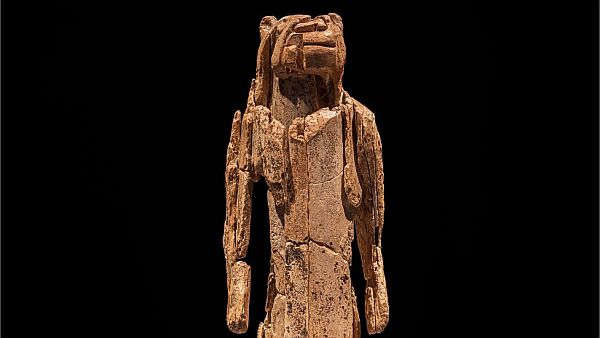
We begin, so to speak, at the beginning with the Lion Man, the oldest known human-animal image, created 40,000 years ago from mammoth ivory, and discovered in a cave in southern Germany in 1939 but not pieced together until after the war, when further discoveries were made, including a smaller Lion Man. The Lion Man is a solid figure, an imagined creature. But ephemeral elements also come into play – light, water and fire, constantly changing – to be examined commemorated, depicted, worshipped.


The spirits of the ancestors inhabit many places; shamans from various cultures communicate with these spirits, negotiate with them, ask for protection. In other ways, the spirits of the dead have to be cared for, and there are objects associated with a huge array of beliefs about the worlds beyond the senses, the underworld, hell and heaven.
Buildings are made for the gods: the oldest known are in South-East Turkey built by hunter-gatherers about 11,000 years ago. In Mesopotamia (now Iraq) Sumerian peoples ritualised communal worship some 6,000 years ago in structures usually made of stone, with stone statues depicting the human form. Ancient Hinduism has temples, rituals, sacrifices and a huge pantheon of gods. Greeks and Romans also had sacrifices and temples, and gods made overtly in man’s image, only on a larger scale, polygamous, squabbling, petty and power-crazed. More recently, only several millennia ago, the three great monotheist religions – Judaism, Christianity and Islam – shared some prophets and preachers, and structure time each with their own characteristics: some with music, all with prayers, fasting, communal meals, dietary suggestions and the like. There are portable creations to aid such worship – rosaries and prayer beads, and many great buildings. Buddhism, more a way of life, has its prayer wheels, mantras, prayer flags. There are festivals and processions, each with costumes, statues, vehicles to carry statues and representations of deities, bonding social occasions.
It is the stimulating mission of this marvellous book – which draws no conclusions, asking questions rather than providing answers – to draw our attention to all the man-made things that attempt to portray visions of the invisible world, and how humans interact with their imaginings. The objects may be stable and solid, from the smallest coins – and even American dollars are adduced for their religious phrases – to vast temples, but human reactions are anything but. There are no solutions to the human quest here, but myriad embodiments of varied hopes, expectations and journeys.


Neil MacGregor: Living with the Gods review - focuses of belief.  By Marina Vaizey. The Arts Desk ,  September 23,  2018 


Neil MacGregor has chosen to open his new book with a statement of what it is not. Living with the Gods, he writes, is neither a history of religion, nor an argument in favour of faith, nor a defence of any one belief. Rather, it is an attempt to define the nature of belief, the way it influences people and the countries they inhabit, and to show how fundamental it is in explaining who we are and where we came from. For, as he says, it is in deciding how we live with the gods that we decide how to live with each other.
MacGregor has spent many years using art and artefacts as a means of looking at the past, and once again his new book has been accompanied by a radio series and an exhibition. Most of the objects he describes come from the riches of the British Museum, of which he was director for 13 years. Scrolls, pots, fragments of cloth, hair, icons, coins, statues, cuneiform texts and inscribed vessels act as triggers for short essays designed to show how societies have imagined and inhabited their place in the world. Though much of the modern world lives far from its dead, the British Museum is full of their spirits. This scholarly, elegantly written book is a reminder of how seldom, when visiting a museum, most of us take the time to inquire into what lies behind the objects we look at. Living with the Gods is a celebration of curiosity.
The Enlightenment thinkers believed that if you could separate organised religion from the state, there would be no more wars. It was, MacGregor writes, to ignore a crucial element in the human psyche: the need to belong and to have a story, a narrative, not only as an individual but as a community, complete with legends and myths; and it was ever thus. At Göbekli Tepe in south-eastern Turkey, 6,000 years before Stonehenge was built, hunter-gatherers were already cooperating in the making of a shared site for religious ceremonies. It suggests, MacGregor notes, that “we lived with the gods before we lived at close quarters with each other”. Analysing, one by one, objects from every corner of the world and every moment in history, he describes the way that humans have used places, as well as objects that can be touched and felt, to make connections with the divine. It is this interweaving of history and the links between time and place that make his book so enjoyable and so impressive.
Every so often, after the public has left, the cleaners in the British Museum come across little offerings laid at the foot of statues, most often Hindu ones. The cases of exhibits themselves are full of these propitiating gifts, whether in clay, silver, gold, wax or metal. A 19th-century Japanese picture of a shrine, found in an agricultural community, has a pedestal, decorated with three foxes; visitors to the shrine regularly brought tofu with which to feed them. In the north of what is now Colombia, the Muisca, who lived between 600 and the 1530s, were skilled gold makers, to judge by a rare piece that has survived. Having made their delicate, exquisite objects, they threw them into a lake as offerings to the gods, to ensure a peaceful equilibrium between heaven and earth. It took the arrival of Europeans, who dredged the lake and plundered everything they found, to put an end to such gracious selflessness.


While most of MacGregor’s book concentrates on the peaceable aspects of faith, from pilgrimages to shrines, household gods to shared deities, he does not avoid the acts of violence committed in the name of religion, especially where religion and state act as one; or where, as in revolutionary France and Russia, rulers set out to replace religion with reason and wound up with murder. The current religious turmoil of the Middle East finds its place in Living with the Gods, but a jubba, a beggar’s tunic, worn by the followers of the messianic Islamic Mahdi in Sudan and now in the British Museum, gives MacGregor the opportunity to describe the slaughter of 12,000 of the Mahdi’s followers by the British under Kitchener at Omdurman in 1898. Behind many of MacGregor’s objects lie stories of considerable violence.
Living with the Gods, with its sections on everything from French laïcité to the Yup’ik people of Alaska, who believe that the soul resides in the bladder of seals, ends with an unexpected message. Far from shrinking away, organised religion appears to be spreading. In Japan, one of the most secular countries in the world, young pregnant women are once again choosing to wear specially propitious sashes and taking offerings to the temples, in the name of children they have lost or aborted. In India, the numbers of Hindu pilgrims attending the Kumbh Mela festival to celebrate the virtues of detachment and compassion have now reached 100 million, making it the largest religious event in the world. Faith is providing cohesion and reassurance.
However, as MacGregor admits, everywhere from Pakistan to Israel, Myanmar to Nigeria, religion is increasingly shaping national identity and politics, and driving territorial disputes. It is also hard not to feel, at the end of this fascinating book, that with our battery farms, exploitation of resources, pollution and the hunting of animals and birds to extinction, the interrelationship between humans and the living world is seriously out of kilter. We have a very long way to go before we live properly either with the gods or with each other.

Living with the Gods by Neil MacGregor review – the nature of belief. By Caroline Moorehead. The Guardian , October 15 , 2018


In the middle of “The Simpsons Movie” (2007), news of an impending apocalypse reaches the citizens of Springfield. The congregants gathered for church immediately flee to Moe’s Bar for some strong drink. On the way, though, they encounter the bar’s patrons stampeding in the opposite direction in order to pray. The scene raises a question or two. What is it that religion provides us that nothing else can? And what can’t religion give us that might be supplied elsewhere?
Neil MacGregor’s “Living With the Gods” helps us think about these matters from the widest possible perspective. A former director of the British Museum, Mr. MacGregor is best known for “A History of the World in 100 Objects” (2010), which used museum artifacts—everything from a 13,000-year old spear to a latter-day Visa card—to fashion a history of our species. In “Living With the Gods,” Mr. MacGregor draws on this same engaging technique, marshaling physical objects both within and beyond the museum’s walls to tell the sweeping story of human religious belief.
He begins by taking us back, in a way reminiscent of the theological scholar Mircea Eliade (1907-86), to the stirrings of religion in early man’s attempts to come to grips with the four great natural forces: the sun, the rain, the fire of forge and hearth, and the waters of rivers and lakes. Physically, of course, this quartet displays a pattern, the sun being the celestial version of earthly fire and rain being the heavenly variant of terrestrial streams and ponds. But Mr. MacGregor’s discussion brings out a deeper symmetry in the way each laid a cornerstone of religious practice.
The harvest rain’s principal contribution to the origins of religion was to spawn a priestly class—diviners and shamans—to forecast or summon it. In Egypt, as Mr. MacGregor shows, priests fashioned earthen figurines of the agriculture god Osiris, implanting them with seeds and burying them after each harvest to sprout new corn. Beyond the capacity of priests to control or even predict, rain infused in early clergy an attitude of humility, Mr. MacGregor says, as they mediated with the gods on behalf of their flock.

The terrestrial waters of rivers and lakes, by contrast, were both controllable via aqueducts and dikes and predictable in their flooding or receding. They assumed a different role in the religious world, begetting rituals that the laity could perform for itself, such as the cleansing of sins. Here Mr. MacGregor presents us with a gouache of the goddess Ganga, whom Hinduism millennia ago deemed to be the source of the Ganges River. Each fall to this day, when the river recedes, a sandbank emerges that can accommodate a pop-up city for millions of believers. Bathing in the Ganges brings them into direct physical contact with heaven.
For the early peoples of the Northern Hemisphere, the sun induced anxiety because its path through space and time, though beyond human control, was all too heartbreakingly predictable: It would move south each year, leaving behind months of cold and darkness. And so across Eurasia, priests turned to ancient astronomers and engineers to construct versions of Ireland’s Newgrange. A massive stone edifice, Newgrange contains a small aperture though which—at exactly 8.58 a.m. each Dec. 21—a beam of sunlight flows, reassuring all assembled that the sun is returning. Roughly 5,000 years old, Newgrange symbolizes, as Mr. MacGregor notes, primordial religion’s sponsorship of technological expertise.

Earthly fire, meanwhile, is under human control to summon, yet if not well tended risks an unpredictable path through space and time. In ancient Rome, accordingly, fire fell under the management of skilled domestic craftspeople, tool makers and food preparers. It furnished them with religious roles, inspiring deities such as Vulcan, god of the forge, and Vesta, goddess of the hearth. The vestal virgins, whose images appear on coins and friezes in Mr. MacGregor’s pages, held the high responsibility of keeping the Roman national hearth alight.

The artifacts in “Living With the Gods” link the natural elements, each with its own degree of controllability and predictability, to the origins of human religious order, in which priests, laity, experts and craftsmen all found a place. Indeed, this is Mr. MacGregor’s main thesis: that religion, above all, produces community. It unifies a people through ceremony and ritual. Émile Durkheim, the pioneering French sociologist, argued the same thing.
And there’s much truth to it. Yet as Mr. MacGregor moves forward in time to the major living religions, principally Christianity, Hinduism, Islam and Judaism, his objects begin to suggest something different. What strikes the reader is not so much the cohesion of unified belief communities as the development of divisions within each: orthodoxy versus revisionism, fundamentalism versus liberalism, God’s singularity versus his plurality.

Take two of Mr. MacGregor’s images: an Eastern Orthodox icon of Mary with Jesus and—this one he relates through an anecdote rather than showing it—an Orthodox Jew being “given a bust of the composer Rossini, and in the Orthodox spirit of not keeping images of the human body, [knocking] off his nose.” Together these depictions remind us that orthodoxy divides some faiths more than others. Unlike Hinduism and Islam, which today are composed of much the same sects that existed at their origins, Christianity’s current divisions—such as the 11th-century schism between Rome and Constantinople—came later in its history, as did Judaism’s: Its Reform and Conservative branches, for example, evolved in the 19th century. It’s not surprising, then, that Mr. MacGregor’s imagery calls to mind that both Christianity and Judaism have distinctive trajectories that designate themselves “orthodox.” It’s a term used by some to signify that other co-religionists have departed from a longstanding path.


If orthodoxy is a rejection of innovation within the faith, fundamentalism is a reaction to the world outside the faith, whether the supposed error of other religions or of the secular world. Fundamentalism is a trait shared most prominently by proselytizing movements within Christianity and Islam, both holding a well-elaborated belief in hell. Mr. MacGregor’s only art portraying soldiers of faith in battle comes from those two religions.
Christianity also shares a certain kind of internal division with Hinduism, over whether and in what ways the godhead is unitary or multiple. Mr. MacGregor shows us a golden reliquary containing remains of the Three Kings, which recalls the Christian trinity, a doctrine that holds the divinity to be at once one and three. And we see a photograph of a market stall in northern India containing statuary of the Hindu gods, around whom competing denominations organize, content with divine multiplicity. No comparable artifacts from Judaism or Islam appear in the book. Those faiths unite in deeming God indivisible.


Mr. MacGregor takes us to up the present, leaving us wondering what messages his matchless collection of objects, fashioned by human beings to celebrate a God-created world, might carry for our future. Do they have anything to say, for example, to the scientific visionaries who tout our coming capacity, through virtual reality, to create our own worlds? And what about the idea that artificial intelligence will soon allow us to upload our minds onto super-computers, where we ourselves will supposedly live forever as hyper-intelligent “gods,” as the philosopher John Gray puts it?
In these respects, Mr. MacGregor’s images sound a cautionary note. Virtual worlds of our own devising might be appealing fantasies. But a world created by God—or even, if one so believes, a universe that sprang from no conscious entity at all—is a thing richer than fantasy: It’s a mystery. Just take one glance at Mr. MacGregor’s image of William Blake’s stunning print “Ancient of Days,” in which an awesome God creates the cosmos, and compare it with even the most lavish, fully immersive universes that we ourselves might fashion through virtual reality. However much the human ingenuity reflected in virtual worlds might transport and delight us, only the godly genesis depicted by Blake can transcend and deliver us.
What about eternal life as a god-like digital being? My favorite, among Mr. MacGregor’s images, is that Indian stall hawking figurines of the Hindu gods. In its midst there stands a bespectacled man in a business suit. He is, Mr. MacGregor tells us, B.R. Ambedkar, one of the authors of the Indian constitution who worked tirelessly to abolish the caste system. While we use the term “mythical” to describe the accomplishments of the gods around him, we use a different term—“legendary”—for Ambedkar’s, and for all great human achievements in which we wrestle agonizingly with the upper limits of our capacities. It’s far more stirring, this image reminds us, to be the stuff of legend than of myth. As artificial intelligences, we might accomplish godlike mental feats without experiencing pain or struggle. As digital algorithms, as far as we know, we would be conscious of nothing at all.
All of which brings us back to Moe’s Bar in Springfield. In a way, Moe’s libations are simply a homelier version of our promised techno-future. They offer the obliteration of pain, or even of consciousness, just as does the prospect of our becoming digital gods. Or they promise elation, even a kind of psychedelic consciousness, just as virtual worlds do. In response, the objects in Mr. MacGregor’s book quietly offer the most potent of replies. They remind us of why Moe’s Bar is empty when the churchgoers arrive.

‘Living With the Gods’ Review: The Gang’s All Here. By Andrew Stark. The Wall Street Journal , November 16, 2018.