Showing posts with label Great Britain. Show all posts

31/12/2023

Paul Hanley on Buzzcocks


Man of letters and drummer (The Fall, House Of All) Paul Hanley has written a book on Buzzcocks called Sixteen Again. A limited edition hardback is available from publishers Route now and a paperback will be available in April 2024.

Sixteen Again: How Pete Shelley & Buzzcocks Changed Manchester Music (And Me), to give it its full title, mixes together biography, interview, critique and social history to create a full picture of the legendary Manchester group, equally beloved of fans of punk, post punk and indie.

Route – who have also published Hanley's Leave The Capital: A History Of Manchester Music In 13 Recordings and the masterful Have A Bleedin Guess: The Story Of Hex Enduction Hour – have the following to say: "Paul Hanley's obsession with Buzzcocks peaked between the ages of 14 and 16, exactly the age when ‘favourite band’ actually means something important. An essential part of the charm of Buzzcocks to him were their proximity and approachability."

Taking a break from his current duties as one half of the drumming duo who power recent tQ Album Of The Year folk, House Of All, and co-host of the Oh! Brother podcast with kin Steve Hanley, Paul submitted to some quick fire questions about the book, Buzzcocks and OBOGFRS (other bits of general Fall-related stuff).

What really went on there? We only have this excerpt:

Why did you choose Buzzcocks?

Paul Hanley: Well, there’s the cultural significance of them bringing the Sex Pistols to Manchester twice, and kick starting indie music. Then there is the fact that Pete Shelley was a song writing genius who could say more in a three minute pop song than most writers could say in a whole album. But most importantly they were my favourite band between the ages of 14 and 16, which is about the only time in your life when it’s OK to have a favourite band.

What do you think of the Tony McGartland book, Buzzcocks: The Complete History and Pete and Louis Shelley's Ever Fallen In Love: The Lost Buzzcocks Tapes? I think they are the only other Buzzcocks books right?

PH: Yes, apart from Steve Diggle’s book [The Buzzcocks: Harmony In My Head]. I used all three in writing this, unsurprisingly. But there is a definite lack of books about Pete Shelley and Buzzcocks, certainly compared to The Clash and the Sex Pistols, which seems criminal to me. Hopefully this book is different from all the others. I wanted to combine telling the story with getting across just how much Buzzcocks meant to me

Did you perceive of some misconceptions about the band you were keen to tackle?

PH: Yes. There’s this slightly snide dismissal of Pete’s songs as ‘just love songs’ which they’re definitely not.

In that sense is their closest comparison The Undertones? Or can they be compared to anyone else?

PH: There’s definitely a lineage between Buzzcocks and The Undertones in their ability to convey the thrills and spills of youthful yearning over driving melody. I think The Undertones would happily acknowledge an influence. But Undertones aside I think a lot of bands influenced by Buzzcocks kind of missed the point.

Care to elaborate?

PH: Ok. Specifically, bands like Green Day. There’s a big difference between speaking to youth and just being childish.

Do you cover Shelley's solo albums?

PH: Yes. Not in as much detail but Pete’s journey away from Buzzcocks’ sound and then how he got back to it is fascinating.

Did you get to interview everyone you wanted for the book?

PH: Yes pretty much. I deliberately chose not to speak to Steve Diggle as I wanted to avoid getting too close and have it affect the story I wanted to tell. And I couldn’t speak to Pete obviously so it wouldn’t have been fair! I think the story of the Buzzcocks is the story of Steve and Pete; the story of how they maintained that relationship despite being very different characters is pretty key I think.

Were relations between The Fall and The Buzzcocks always cordial?

PH: Buzzcocks and Richard Boon were very supportive of The Fall in the early days, as they were with lots of Manchester acts. I think Mark certainly respected Pete even if he was a bit sniffy about Buzzcocks music.

Was Shelley's bisexuality ever a problem for the band?

PH: No I don’t think they cared. His lyrics were always gender fluid, and his sexuality was never part of the act, it was just who he was. He was years ahead of his time in that respect.

What are the unheralded songs you love that aren't on Singles Going Steady?

PH: 'Money'; 'Who’ll Help Me To Forget?'

You've completely changed in the last few years haven't you? Three books published and an English Literature degree completed since 2017. It's very impressive but are your friends and family surprised by it?

PH: Well I hope they’re not too surprised! They’ve been very supportive. The degree was a dream. I loved it. And I really got the bug for writing. When you’re doing a degree you always have a piece of writing on the go, so I just carried on!

How are you enjoying The House Of All?

PH: The gigs have been great actually. We seem to be going down very well and the footfall is very gratifying. It’s a real shame Pete [Greenway] wasn’t able to join us but Phil [Lewis] has done a great job.

 Do you feel at all Irish? Obviously Steve [Hanley] was born in Dublin. How long after his birth did your parents move to Manchester?

Paul: I do feel Irish in many ways. We were a fairly Irish household growing up. But I feel far more Dublinian – if that’s a word – than just generally Irish, in the same way I feel Mancunian rather than English. I think he was about a year old.

Sixteen Again: How Pete Shelley & Buzzcocks Changed Manchester Music (And Me) is available to buy from Route now

The Fall's Paul Hanley On Buzzcocks Book. By  Francisco Scaramanga. The Quietus, December  18, 2023.


Paul Hanley in conversation with John Robb at Louder Than Words Festival in Manchester, 11th November 2023.  Paul is discussing his book Sixteen Again: How Pete Shelley & Buzzcocks Changed Manchester Music (and me).

Route TV, November 18, 2023.


Route


Gelesen: 27. – 28.12.2023 (netto 267 Seiten, in Englisch – wird wohl ehr nicht auf Deutsch erscheinen)

#bookcollectorsarepreteniousarseholes – Ich habe mir für einen ordentlichen Batzen Geld eine “Advance Edition” geleistet: Signed, limited und vor dem Erscheinen im April 2024 pünktlich zu Weihnachten hier. Mit einem collen Badge (in alter Buzzcocks Tradition). Post-Brexit Porto und Zoll sind mehr als der Buchpreis, Danke Merkel!

2021 ist ja bereits ein Buch über Pete erschienen, daneben hatte Steve Diggle bereits 2002 eine “Biographie” von einem Journalisten schreiben lassen (die habe ich damals nach kurzem Querlesen nicht gekauft). Ansonsten gibt es kaum etwas, ehr als Abfallprodukt der Arbeiten von Malcolm Garrett, der mit seinen Designs für die Buzzcocks ja Plattencover, Poster und Badges für die Ewigkeit erschaffen hat.

Paul Hanley, der Autor, ist sowohl Fan als auch Kenner der Musik-Szene Nordenglands, er spielte 1980 bis 1985 bei The Fall. Und er schreibt dieses Buch aus der Sicht eines informierten Fans…


Und weil es aus der Fan Perspektive geschrieben ist fußt es aus O-Tönen, die er aus allen möglichen Quellen zusammengetragen hat (87 insgesamt, alle im Anhang verzeichnet). Und dabei zeichnet er ein ziemlich realistisches Bild einer Band, die früh dabei war (1976) und wie viele andere ebenso früh fertig war (mit sich, mit der Musik).

Spannende Fußnote: Fertig waren sie in der Markthalle, Hamburg, 23.01.1981. Danach war Schicht im Schacht – erstmal. Und Steve Diggle und Pete Shelley hatten sich erstmal 8 Jahre nix zu sagen.


Durch den Mix aus O-Tönen und dem kundigen Kommentar bzw. der persönlichen Einordnung ließt sich das Buch extrem gut, ich habe es mehr oder weniger verschlungen. Auch weil ich Fan geblieben bin.

Da Hanley selber Musiker ist (auch wenn er bei einer weniger Ohrenschmeichelnden Band) kann er das musikalische auch richtig verorten. Downstrokes galore!


Was er aber auch offen und ehrlich rüberbringt ist, wie die Band im Grunde verglüht ist und sowohl Pete (der mit mehr elektronischer Musik zumindest ein klein wenig Erfolg hatte) als auch Steve nutzen nach den Buzzcocks das immer noch ein wenig hereinkommende Geld um Soloideen nachzugehen. Die anderen beiden (John Maher, Steve Garvey) setzten sich in ein erfolgreiches und normales Berufsleben ab.

Und ab hier wird das Buch dann schonungslos ehrlich, die Reunion war wohl ehr dem Geld geschuldet (aber das daraus entstandene Konstrukt von Pete/Steve plus Tony/Phil gab es dann satte 13 Jahre und damit etliche Jahre mehr als die erste erfolgreiche Inkarnation.


Es war am Ende dann doch ein Beruf, bei dem es um regelmäßiges Einkommen ging. Privat wollte man nix mit den Kollegen zu tun haben.


Das es am Ende vor allem für Steve vor allem um Ego, Einkommenund Versorgung mit Champagner ging wurde spätestens 2019 klar: Die Buzzcocks hatten eine “40 Years of Singles Going Steady” show in der Royal Albert Hall geplant – der Herzinfakt von Pete kam im Dezember 2018 dazwischen. Steve nutzte den Termin dann für ordentlich Egopolitur:


Klasse Buch: Vergötterung wo erforderlich, Kritik wo angebracht. Mit viel detailliertem Fachwissen (eg. Petes Liebelieder kammen immer ohne mänlichen oder weiblichen Bezug aus, mit Absicht. Steve konnte oder wollte das nicht und durchbrach das in einem seiner Songs für die Buzzcocks).

 Und immer mit dem Blickwinkel der Working Class (die übrigens Spiral Scratch möglich gemacht hat, das nur am Rande). Und in Summe ein klarer Blick auf was Erfolg aus einem machen kann. Manchmal gutes. Manchmal schlechtes.

Soundtrack dazu: Buzzcocks – Singles Going Steady, immer noch – was sonst?

PS: Der Buchtitel löst natürlich wieder eine Träne – Sixteen Again war die ganz hervorragende Buzzocks Cover-Band von Helge (RIP).

PPS: #bookcollectorsarepretentiousarseholes #75/300 (um 2 falsch, Danke Merkel!)

Buch kann hier bestellt werden! Der Autor hat auch einen historischen (endet 2020) Blog mit (in eigenen Worten) Ruminations, accusations, felicitations, and that


Bücher, schnell gelesen: 1.676. By Dirty Old Sod.  Gehkacken, December 2023.


The conversation is usually the same. Regarding the UK, the best and most important acts of the first wave of punk are Sex Pistols and The Clash. Of course, everyone is entitled to their own opinion, but it seems a travesty that the discussion regularly forgets the band who were, in my mind, the finest of the lot, Buzzcocks.

Arguably the most boundary-pushing act of the first wave of British punk, from their music to setting up one of the first independent record labels, and even their instrumental role in bringing the Sex Pistols to Manchester – a night credited with kicking off the city’s musical boom – many aspects bolster this argument. Without Buzzcocks, punk and broader alternative music today, would lack some defining factors. This indicates just how important Buzzcocks were.

Buzzcocks were officially formed in February 1976 by college friends Howard Devoto and Pete Shelley. This pair travelled down to London to see the buzziest band of the day, Sex Pistols, and organise for them to play at Manchester’s Lesser Free Trade Hall in June 1976, one of the most consequential nights in modern British culture. They also intended to perform at this show, but Devoto and Shelley’s bandmates dropped out.

The band eventually got their wishes, and after recruiting bassist Steve Diggle and drummer John Maher, they made their debut performance opening for Sex Pistols when they returned to Manchester for their second show in the city in July. Things moved quickly, and Buzzcocks were now vital to a burgeoning movement. In September 1976, the group trekked to London to perform at the two-day bonanza, the 100 Club Punk Festival, organised by Sex Pistols manager Malcolm McLaren. The festival was the moment punk crystallised itself as a genuine cultural force, with other performers including Sex Pistols, The Clash, The Damned, Siouxsie and the Banshees, and Subway Sect.

By the end of 1976, Buzzcocks had found their rhythm, and they recorded the four-track EP Spiral Scratch, which arrived in January the following year. Produced by future Factory Records alumnus Martin Hannett, it arrived on Buzzcocks’ New Hormones label, meaning they were one of the first punk groups to establish an independent record label, second only to The Saints and Fatal Records, created to release ‘(I’m) Stranded’. This also saw the group insert themselves further into the story of punk, with the song ‘Boredom’ coherently explaining the movement’s rebellion against the man. Additionally, the band demonstrated their genuinely artistic edge on the record, with the minimalism of the two-note solo in ‘Boredom’ the pinnacle of this, averting the established tradition of this guitar part. Clearly then, even at this early point in their career, Buzzcocks had made history on numerous occasions.

Despite these triumphs, Devoto quit the group only a few months later, citing his displeasure at punk’s direction. He said in a statement: “I don’t like movements. What was once unhealthily fresh is now a clean old hat”. He returned to college for a year and then formed the widely influential post-punk outfit, Magazine. They became one of the key players in the genre that would shine a light on all of first-wave punk’s flaws and start to make real artistic progress by casting aside the barriers of labels.

Devoto leaving Buzzcocks also proved to be a significant moment for the band. It saw a sea change occur, after which they would enter a more distinctive and essential area, pushing the confines of punk to the absolute limit. Pete Shelley took on the vocal duties, with his high-pitched, melodic vocals presenting a stark contrast to the gruff delivery many punks employed due to their origins in the blues-influenced pub rock. With Shelley taking over vocals and continuing to play guitar, Diggle switched over to the six-string from the bass, with Garth Davies, the original bassist rejoining. Steve Garvey eventually replaced him the following year, a four-string hero who would give the quartet the busy undercurrent needed for their increasingly dynamic sound.

Despite the undoubted importance of Spiral Scratch, after Devoto left, Buzzcocks took things up a level. Over the rest of their first chapter, which ended in 1981, they pushed back against social and punk mores, writing music for the future well ahead of its era. Arguably, it was more in line with what their heroes, The Stooges and The Velvet Underground had done, with there also taboo-busting similarities to the work of David Bowie.

When Shelley, bandmate Steve Diggle and manager Richard Boon sat down at the British Library in June 2016 to discuss their career, they explained how bands like The Velvet Underground and The Stooges inspired their iconoclasm. Shelley said: “Myself and Howard (Devoto), we were listening to… well, separately, but we had a mutual interest, things like The Velvet Underground, The Stooges, Can, I mean, a lot of the German… yeah Neu! I mean things that, really, when you put on you can clear a room.”

He continued: “In those days, it was a whole different country. It was music which nobody liked at all. Everybody was into sort of like heavy metal, but it wasn’t as widdly-widdly… I mean, things like Black Sabbath and Deep Purple, there was a lot of blues, and it was all to do with how many notes you could fit into your 20-minute guitar solo. Where, I liked the things which were more on the noisy side, but were funny as well. So that’s basically what we tried to do… In fact, we were making the most uncommercial form of music that we thought possible… We even had swearing in it. Nobody did that.”

It was a much different, more creative space to that of their most prominent punk peers, Sex Pistols and The Clash, after Devoto left. Mainly inspired by the innovation of The Stooges and more experimental acts such as The Velvet Underground and Can, Shelley’s lyrics had much greater depth than almost everyone’s. A wholesale affront to the machismo of punk, he showed it to be futile, as he discussed personal feelings, sex and homosexuality in a wickedly comedic way, a complete departure from the immediate moves of Sex Pistols.

Much of this separation from the punk scene was due to Shelley. An open bisexual, his discussions of love, sex, and other taboo issues pushed back against punk’s standards and that of the mainstream. His lyrics set an example by sticking a stout middle finger up to tradition and providing solace for listeners hiding their true selves from the public. This significance cannot be overstated; 1970s Britain was a completely different time to our own. It was a much less welcoming place for anyone who dared to veer off the beaten track.

Early singles such as ‘Orgasm Addict’, ‘What Do I Get?’ and the iconic ‘Ever Fallen in Love (With Someone You Shouldn’t’ve)’ remain highlights of this approach. While the first wave of punk was mostly concerned with external issues, Shelley was an adept songwriter who could fuse the personal with outside forces such as the political, going far beyond that of other punk songwriters, including The Clash’s Joe Strummer, someone credited with addressing the most important issues of his day.

Shelley said more in one song than many of his contemporaries managed to do in their whole career; that’s how incisive his prose was. ‘Everybody’s Happy Nowadays’, ‘Autonomy’, ‘Lipstick’ and ‘Whatever Happened To…?’ are four more examples of the frontman’s lyrical flair. He was afraid of no issue, and had a knack for combining the mundane and severe, something his heroes Iggy Pop and Lou Reed were masters at that.

Of course, Buzzcocks’ music was much more impactful than their peers’ too. The guitars were more muscular, the melodies were more prominent, and the band did exciting things with their songwriting. This isn’t to say bands like The Clash and Siouxsie and the Banshees didn’t; I just think that what they were doing had more weight for the time. The likes of ‘Why Can’t I Touch It?’ with its unbelievably groovy bassline and the power pop of ‘Promises’ are two further examples of Buzzcocks’ scope. To use a football analogy, they were well-ingratiated in the men’s team when their peers were still languishing in the academy.

Musically, Shelley and Buzzcocks augmented the punk formula. They didn’t confine themselves to playing just three power chords, and because of this, it wouldn’t be excessive to label them more art-rock than punk. Ironically, there’s room for them to be described as the first post-punk band, as they were railing against the genre even when they were deeply embedded within it. Following this, there are more parallels between them and Magazine, XTC and Squeeze than with the likes of Sex Pistols and The Clash. It also says everything that many subsequent alternative heroes such as The Smiths, Nirvana, Pixies, Pearl Jam and Green Day cite as them an influence due to their creative prowess. There was real depth to Buzzcocks, and that was always their power.  

Hear Me Out: Why Buzzcocks are the best first-wave punk band. By Arun Starkey. Far Out Magazine, July 20, 2023. 


In January 1977 a young punk band called Buzzcocks walked into the Manchester branch of Virgin with a box of singles they wanted to sell. They had set up a label called New Hormones and paid for the records themselves with an early form of crowdfunding – borrowing £500 from a couple of friends and the guitarist’s dad – and their only ambition was to sell enough of the 1,000 copies they had pressed to be able to repay the loans. The Spiral Scratch EP ended up selling 16,000 copies and reaching the top 40 – there was no problem with the loans. More importantly, though, it proved that it was possible for artists to be in complete control of their music, from production to distribution, and in the process invented indie.

These days, there’s nothing unusual about bypassing the record industry. Chance the Rapper self-released his music and has become a breakout star and Barack Obama’s guest at the White House. In 1977, though, Spiral Scratch was game-changing. In its wake came a wave of British independent labels and a distribution network that meant that, as Rough Trade founder Geoff Travis puts it, “anyone could compete with the big boys, but that only happened because it was an undeniably great record”.

Few who saw the first Buzzcocks show on 1 April 1976 would have felt they were in the presence of people who were about to reshape pop. Peter McNeish and Howard Trafford (who would become Pete Shelley and Howard Devoto) fronted a makeshift version of the band at Bolton Institute of Technology’s students’ union – they were studying there – and managed to annoy not just the venue, but their bandmates, too.

After the venue pulled the plug, their drummer – who had never rehearsed with them before – laid into Shelley and Devoto. “He said: ‘I’m at this level’ – and held his hands very high,” Shelley, remembers, “‘and you’re down there.’”

Shelley and Devoto had been inspired to form Buzzcocks seven weeks earlier, when they read a live review in NME that would transform their lives. The headline, “Don’t look over your shoulder, but the Sex Pistols are coming!”, was enough to convince them to borrow a little Renault and drive 200 miles to High Wycombe in Buckinghamshire to see the Pistols support Screaming Lord Sutch on 21 February.


“Seeing the Pistols changed everything,” Devoto says. “We started to realise what songs we ourselves could write.”

At this point, the Pistols were some way from becoming the band who outraged a nation. They were so short of bookings that their manager, Malcolm McLaren, agreed to the offer Shelley and Devoto put to him: they would put his charges on in Manchester, if they could be the support band.

 The problem was, the pair didn’t have a band. And when the night of the gig at the Lesser Free Trade Hall arrived – 4 June 1976, with Shelley and Devoto having paid £32 to rent the room – they still lacked a permanent bassist and drummer and had to drop off the bill. But they quickly recruited bassist Steve Diggle and drummer John Maher, who joined while doing his O-levels as a way of avoiding “aggro” from his neighbours, and when the Pistols returned to the Lesser Free Trade Hall on 20 July, Buzzcocks were ready.

“I thought if I could join a band, I could get the drum kit out of the house,” Maher says. “How was I to know that my first gig would be supporting the Sex Pistols?”

Shelley, who was 22, remembers the show for its “complete lack of adult supervision. We were literally doing it ourselves. McLaren said: ‘If Buzzcocks aren’t onstage in 10 minutes, you’re not going on.’ But he was shrewd enough to bring music journalists.” When the journalists’ reviews appeared, Buzzcocks were catapulted to national attention.

Initially, they had no plans to make a record, but after the Pistols’ appearance on Thames TV’s Today show – swearing at the host, Bill Grundy – landed them on tabloid front pages and major labels started signing punk bands, Buzzcocks realised they had to make their mark or risk being passed by.

“Record company scouts just didn’t venture up to Manchester,” says Richard Boon, their manager. “The place felt like the tide had gone out.” But what other options were there? To Shelley, the idea of manufacturing a record themselves felt “as unfeasible as making a computer in your front room”.

There were already British independents: the Damned’s New Rose had been released on Stiff, but that label had the advantage of being run by people with lots of experience in the music business, and the contacts that came with that experience. It was a rather different matter for a pair of students whose only experience of records was buying them and listening to them. “The Drones told us: ‘Don’t do it!’” Shelley says. “Because they’d gone the vanity publishing route in a previous incarnation and ended up with boxes of records in the garage.”

However, the band’s new booking agent, Martin Hannett, wanted to become a producer and saw an opportunity in Buzzcocks. Boon started investigating pressing plants, to see whether they really could make a record, and as things started moving, Shelley began to think: “We can actually do this.”

It helped that by now they had a set of songs that matched those of any London punk band, led by Boredom (“You know me – I’m acting dumb / The scene is very humdrum / Boredom! Boredom!” Devoto sings, while Shelley picks out a two-note solo). Devoto wrote the lyrics during night shifts at a tile factory, and Shelley wrote the tunes on his Woolworth’s guitar.

 “We were chalk and cheese,” Shelley remembers. “I said to him, ‘I never get around to things. I live in a straight line,’ That ended up in Boredom.” Shelly’s’s famous guitar solo – seen as the epitome of punk’s rejection of musicianship, and later resurrected by Edwyn Collins for Orange Juice’s Rip It Up – came “out of the blue and seemed to fit. After we’d finished it, we fell about laughing.”

Boredom, Breakdown, Time’s Up and Friends of Mine were recorded in 30 minutes just before Christmas 1976, with Hannett at the controls. Spiral Scratch launched his career, too, and he would go on to produce Joy Division and New Order, the Psychedelic Furs, U2, Happy Mondays and many more – including Buzzcocks after Devoto left, and Devoto’s next group, Magazine.

 “My impression was that Martin didn’t know what he was doing,” Maher says. “But neither did we.” Devoto says of Spiral Scratch’s ramshackle, lo-fi sound: “As amateurs even we found it a bit amateurish sounding.”


Boon thinks the amateurishness is all part of the EP’s charm: Buzzcocks were the anti-Fleetwood Mac, the antithesis of big-budget music. He took Spiral Scratch’s cover photo of the band on a Polaroid instant camera and the band assembled at Devoto’s shared flat in Lower Broughton to slide 1,000 singles into their budget picture sleeves.

The first shop to take copies was Virgin in Manchester, which accepted 25 copies and sold them for 99p each (of which 60p went to the band). In London, Travis had just opened his Rough Trade shop. He took an initial 50, then ordered 200 more just two days later. “I knew I could sell them,” he says. “It was a sensational record.”

Boon didn’t have the money to press more copies, so Jon Webster, the manager of the Manchester branch of Virgin, lent him £600 from the shop’s sales of coach tickets to a Status Quo gig. “So indirectly, the first British independent success story was financed by the Quo,” Boon says, laughing. Webster remembers those pioneering punk days as “the best time of my life”, and notes that, back then, a record shop could be a catalyst for spreading new music. “Because there was no distribution, almost no shops had these records,” he says. “When we handed out a photocopied list of all our punk singles at the [venue] Electric Circus, we were deluged with people from all over the north.”

Soon enough, a copy of Spiral Scratch reached John Peel, who duly played it; it became single of the week in the music papers, and sales exploded via mail order. After Mancunian photographer Kevin Cummins gave Marc Bolan a copy and photographed him holding it, Boon’s landline started “ringing off the hook”.

Spiral Scratch provided evidence that punk was having an effect nationwide, that it wasn’t just confined to a small coterie in London. The cultural historian Jon Savage had just started his first fanzine when it was released, and it made him think Manchester punk “seemed more interesting than London punk, which was full of people with leather jackets and cocaine habits”. Just as important, the means of Spiral Scratch’s release epitomised liberation through DIY. “Suddenly the gap between wanting to do something and actually doing it seemed small,” Savage says.

Devoto’s idea of providing recording details on the sleeve – “Breakdown, third take, no overdubs” and so on – further demystified the process of making records, making it seem accessible to scores of young groups. Two months after Spiral Scratch was released, the Desperate Bicycles formed, and released a first single with a sleevenote that read: “The Desperate Bicycles were formed in March 1977 specifically for the purpose of recording and releasing a single on their own label.” That note inspired Green Gartside of Scritti Politti to form his own band and release a debut single on which he itemised the costs of production and manufacturing. Buzzcocks had started something that couldn’t be stopped.

Indie labels began to spring up nationwide: in 1978, ZigZag magazine published a list of 120 labels that had punk acts on their roster; the vast majority of them were from outside London. Alongside the labels came a new breed of band: Webster remembers Ian Curtis coming into Virgin and declaring: “I’ve formed a band!” Then Rough Trade set up the indie distribution network that gave these new labels and bands some of the muscle their counterparts on the major labels had previously monopolised. “You could have a No 1 record and have nothing to do with the record industry,” he says. “It was tremendously empowering.”


Buzzcocks Mk 1 didn’t survive their own earthquake. Devoto returned to college, and later formed Magazine. The new lineup of Buzzcocks, with Shelley singing, signed to United Artists and produced some of the best loved-music of the punk era. Forty years on, although there have been breaks along the way, Shelley and Diggle continue to lead Buzzcocks, and celebrated the band’s 40th anniversary with a world tour.

And all these years on, there are young bands doing exactly what Buzzcocks did. “I recently met the grime act Tough Squad, who told me how they press up 200 records, take them to shops and then go back for the money,” Boon says. “Just like we did.”

“It just shows what can happen if you’re stupid enough to believe that you can do something,” Shelley adds. “History is made by those who turn up.”

 Spiral Scratch (40th anniversary reissue) is released on Domino on 27 January. Time’s Up, an album of 1976 demos, is being reissued on 24 February.


How Buzzcocks invented indie (with help from the Sex Pistols, a Renault and the Quo). By  Dave Simpson. The Guardian,  January 12, 2017. 


Pete Shelley and his band Buzzcocks became indelibly linked to the UK’s punk movement when they played their first gig supporting the Sex Pistols at the Lesser Free Trade Hall in Manchester in July 1976, but they never conformed to any of punk’s cliches about rage, anarchy and rebellion. Shelley, who has died of a heart attack aged 63, proved to be a songwriter of wit and subtlety, able to probe the angst and confusion of adolescent love and lust with shrewd insight.

He was innovative musically as well as lyrically, taking inspiration from David Bowie, Brian Eno, Roxy Music and the Velvet Underground, as well as from German bands such as Neu and Can. While the music of many of the punk bands remains firmly of its time, Buzzcocks’ best songs still sound fresh and inventive, mixing dense guitar patterns with infectious melodies. Their influence can be heard on bands from Primal Scream and the Jesus and Mary Chain to REM and Nirvana. Gary Kemp of Spandau Ballet said: “Pete was one of Britain’s best pure pop writers, up there with Ray Davies.”

Buzzcocks achieved success with their first recording, the Spiral Scratch EP, which was released on their own label, New Hormones, in January 1977 (the band having supported the Sex Pistols on their Anarchy tour in late 1976). It was one of the first independent releases of the punk era, and to the band’s surprise sold its first thousand copies in four days. “We made quite a bit of money from Spiral Scratch,” Shelley recalled. “It ended up selling about 16,000 copies and we were able to buy some new equipment.”

They then signed to United Artists. Their first single, Orgasm Addict, was released in November 1977 but the BBC declined to play it because of its subject matter and it did not make the charts. The follow-up, What Do I Get, released in February 1978, reached 37, and their debut album, Another Music in a Different Kitchen (1978) climbed to 15. Their second album, Love Bites, which came out later that year, contained what remains their best-known hit, the zingingly propulsive Ever Fallen In Love (With Someone You Shouldn’t’ve), which made No 12. Shelley borrowed the title from a line in the musical Guys and Dolls. The 1979 album A Different Kind of Tension reached 26 in the UK.

Continued singles success came with Promises (20), Everybody’s Happy Nowadays (29) and Harmony in My Head (32). However, growing tensions in the band coupled with friction with EMI, which had purchased United Artists, prompted Shelley to break up Buzzcocks in 1981.

He was born Peter McNeish in Leigh, Lancashire. His father, John, was a fitter at Astley Green colliery, and his mother, Margaret, a former mill worker. Peter began writing songs while still at Leigh grammar school, and while studying for an HND in electronics at Bolton Institute of Technology he bought a Tandberg four-track reel-to-reel tape recorder and began making recordings of his own songs. (“I think of my career in music more as a songwriting career than anything else,” he said in 1983.) He formed a group called Jets of Air, the name inspired by a college lecture on Newtonian physics, and while “we played only about six gigs in three years”, Shelley built up a stockpile of songs.

He then dabbled in a project called Sky, where he experimented with electronic music and recorded the album Sky Yen, released later, in 1980, on his own label, Groovy Records. He subsequently tried making “heavier, more rhythmic” music with Smash, which he described as “a non-existent group”, but which supplied more raw material for Buzzcocks.

The band came about when Shelley spotted an advertisement on a college noticeboard from Howard Devoto (real name Howard Trafford), wanting to form a band in the vein of the Stooges and the Velvet Underground. “That was much in line with the Smash idea, so I phoned him up straight away,” said Shelley. Buzzcocks originally planned to make their debut at the first Sex Pistols concert at the Lesser Free Trade Hall in June 1976, but the bass player and drummer pulled out.

For their eventual appearance the following month, Shelley and Devoto were joined by the drummer John Maher and the bassist Steve Diggle. When Devoto quit after the release of Spiral Scratch and went on to form Magazine, Shelley became lead vocalist, Diggle switched to guitar and the original bass player, Garth Smith, rejoined temporarily, later replaced by Steve Garvey.

In 1981 Shelley launched his solo career with the single Homosapien, from the album of the same name, produced by the Buzzcocks producer Martin Rushent (who was about to help make Human League’s electropop epic Dare). Shelley had returned to his earlier fondness for electronica, and found himself in controversial waters when the BBC banned Homosapien for its “explicit reference to gay sex”. In 2002 Shelley commented that his sexuality “tends to change as much as the weather”. The track reached 14 on the US dance chart.

 In 1983 his second solo album, XL1, brought him a minor hit single with Telephone Operator. In 1987 he contributed the song Do Anything to the soundtrack of the John Hughes movie Some Kind of Wonderful.

In 1989 Buzzcocks reformed and toured the US, and released Trade Test Transmissions (1993), the first of a series of albums, the most recent of which was The Way (2014). In 2002, Shelley reunited with Devoto to record the album Buzzkunst. “Devoto is not the life and soul of the party or a born raconteur, but he sees things as funny and I think that’s how we hit it off with each other,” Shelley observed drily. “I always had this idea that me and Devoto were like Gilbert and George. As long as you approach it from that angle you can do anything you want, and you just call it art.”

In 2005, following the death of the DJ John Peel, Shelley recorded a tribute version of Ever Fallen In Love with a multi-platinum lineup of stars including Elton John, Robert Plant, David Gilmour and Roger Daltrey.

In 2012 he moved to Tallinn, Estonia, with his second wife, Greta. She survives him, as do his younger brother, Gary, and a son from his first marriage.

 Pete Shelley (Peter Campbell McNeish), musician, singer and songwriter, born 17 April 1955; died 6 December 2018.

Pete Shelley obituary. By Adam Sweeting. The Guardian, December 7, 2018. 


Buzzcocks' Pete Shelley – a life in pictures. The Guardian, December 7, 2018. 


11/02/2022

The Imprisonment of Refugees from the Nazis on the Isle of Man During World War II


Hilde Marchant, star reporter for the Daily Express, heard the story from a sailor. At first she didn’t believe it. Two nights earlier, the sailor explained, he had been standing on the deck of a ship loaded with British nationals headed to England, and watched as a confetti of parachutes drifted into Rotterdam harbour. Dangling from each silhouetted disc, the sailor insisted, were German soldiers dressed, not in Nazi uniforms, but skirts and blouses. Each carried a submachine gun. When the disguised paratroopers landed, another witness claimed, men and women working as cleaners and servants emerged from basements and back doors wearing German uniforms. These traitorous individuals, the witness said, had come to Holland claiming to be refugees from Nazi oppression, sleeper agents posing as asylum seekers.
 
On 13 May 1940, three days after the invasion of the Netherlands began, the Daily Express published Marchant’s story under the headline “Germans dropped women parachutists as decoys”. Peppered throughout Marchant’s story was the term “fifth columnist” – one that, a short time before, would have been unrecognisable to most readers. Marchant was one of the first people to adopt the phrase, coined during the 1936 Spanish civil war as shorthand for traitors poised to support an enemy invasion from within. British newspapers had begun to refer to fifth columnists after the German invasion of Norway in early April 1940, when reports circulated that spies had been installed in the country to aid the German invasion. By the time Marchant’s story ran, there wasn’t a reader in Britain unaware of the term, or the notion that a similar network of duplicitous immigrants might lurk in their own towns and villages.
 
 
The story’s claims of treachery were, it would later transpire, exaggerated. But the image of the double-crossing immigrant proved indelible, and not only among the readers of newspapers. The British envoy to the Dutch government, Sir Nevile Bland, had also witnessed the landings of the German paratroopers just before he escaped via ship. When Bland reached London the day after the Express story ran, he drafted an eyewitness report. The account, titled Fifth Column Menace, was vivid and fearful. No matter how “superficially charming and devoted” they appear, Bland wrote, every German or Austrian in Britain is “a real and grave menace”. When the signal is given to invade Britain, Bland continued, “there will be satellites of the monster all over the country who will at once embark on widespread sabotage and attacks on civilians”. Britain, Bland concluded, “cannot afford to take this risk. ALL Germans and Austrians, at least, ought to be interned at once.”
 
Bland’s feverish report was widely distributed in Whitehall. A copy reached King George VI, who summoned the home secretary, Sir John Anderson, for a meeting at Buckingham Palace. “You must take immediate action against political fifth columnists and other enemies of the state,” he told Anderson. “Men and women.” When the report’s claims were broadcast by the BBC, they had an immediate and transformative effect on the British public’s attitude towards refugees, and Jews in particular, which until now had been broadly characterised by fragile tolerance.
 
Before May 1940, not a single person interviewed by the polling group Mass Observation suspected refugees to Britain of espionage, or suggested that they should be interned. Up until then, only 569 individuals had been interned, either through MI5’s initial roundups or as the result of mandatory tribunals where senior judges had tested the loyalties of tens of thousands of asylum seekers. Some critics had always maintained that the home secretary’s policy had been too feeble. In April 1940, after the German occupation of Norway made an invasion of Britain seem possible, Col Henry Burton, Conservative member for Sudbury, asked members of the House of Commons if it would not be “far better to intern all the lot and then pick out the good ones”. This view had spread through the Conservative back benches and now, with the news from the Netherlands, the newspapers carried the clarion call for mass internment.
 
“Act! Act! Act! Do It Now!” blared a Daily Mail article by G Ward Price, on 24 May. “All refugees … should be drafted without delay to a remote part of the country and kept under strict supervision.” “You fail to realise,” Price wrote, “that every German is an agent.” A widespread ignorance of the true numbers of foreigners to whom Britain had offered asylum hastened the change in public attitudes. A poll asked British citizens to estimate the number of refugees who had come to Britain from Nazi Germany in the previous six years. Respondents put the number at anywhere between 2 and 4 million. The true figure was just 73,500.
 
Hysteria had overcome logic. Most refugees spoke thickly accented English, were unaccustomed to British social norms and would make ineffectual spies. Fifth columnists, if they existed, were far likelier to come from the ranks of British fascists. (On 23 May police arrested Oswald Mosley, leader of the British Union of Fascists, and about 35 of his followers, individuals who would have likely supported Hitler’s invasion of Britain from within.) As the Labour politician Herbert Delaunay Hughes wrote, pseudonymously, at the time: “It is lamentable how quickly people seem to have forgotten who exactly the refugees are and how it is that they came to this country.” Most British citizens acknowledged the injustice inherent in mass internment, but felt that it was nevertheless an appropriate, justifiable measure. “You can’t say which is good and which bad,” said one respondent to a May poll in which half of those interviewed favoured the internment of all enemy aliens. “Some of them is very nice people, but it’s safest to pull them all in.”
 
In the early hours of 5 July 1940, the British police came for Peter Fleischmann, a young German Jewish refugee. He had narrowly avoided the Gestapo’s moonlit roundups in Berlin two years earlier. At that time a kindly police officer had knocked on the gates of the orphanage that was Fleischmann’s home, and warned that the Nazis were coming for him. When he was three, Fleischmann’s parents had drowned in an accident while driving by the Wannsee lake. The couple had been writers for an anti-fascist newspaper. Fleischmann later learned the car’s steering had been tampered with – their deaths apparently an act of political sabotage.
 
Now it seemed the Gestapo wanted to wipe him out, too. Fleischmann fled to the south of the city and hid in the basement of his family’s former housekeeper. When the first Kindertransport was arranged to bring children out of Germany, Fleischmann – a few weeks shy of his 17th birthday – just qualified for rescue. On 1 December 1938, alongside a brood of the city’s Jewish orphans, he embarked the train at the Anhalter Bahnhof railway station, watched by orphanage staff and a few Gestapo officers, who had come to observe the children, with their unpatriotic dark hair and brown eyes, making their pioneering journey.


In Britain, Fleischmann, who dreamed of becoming a professional artist, was taken in by the owners of a Manchester business that specialised in colouring old photographs of young soldiers who had died in the first world war. They provided him with employment and a room in their home in Prestwich. The hours were long, and the conditions – a basement filled with rats and shadows – insalubrious. But the work might, he reasoned, provide the experience he needed to return to art school.
 
In Whitehall, however, ongoing discussions soon derailed Fleischmann’s humble plans. Starting in November 1939, the government had established nationwide tribunals to test the loyalties of foreign passport-holders living in Britain. More than 50,000 individuals, including Fleischmann, had been classified, as a result, as refugees from Nazi oppression. After the invasion of Holland, however, the state began to debate whether these displaced men and women, many of whom had lost their livelihoods, homes and possessions, should be imprisoned anyway, without trial.
 
Winston Churchill, during his first cabinet meeting as prime minister, agreed to the internment of all male “enemy aliens” between the ages of 16 and 60 currently living in coastal counties in Britain. This “protected area” was where, in the event of Nazi invasion, a spy could cause most harm. Men were to be interned regardless of the refugee status bestowed on them several months earlier. The following day, on Sunday 12 May 1940, Scotland Yard’s fleet of motorcars roared out of police headquarters. Many of the officers dispatched to make the day’s arrests had been unaware of their task until they arrived at work that morning. By the end of this first mass roundup, around 2,000 refugees had been taken into custody and handed to the military authorities for internment.
 
Anderson, the home secretary, was opposed to mass internment, a position that he hoped to hold “unless the war begins to go badly”. Earlier in the year he wrote to his father of the danger posed to justice by national paranoia: “In wartime … people are easily worked up; a spy scare can be started at any time as a ‘stunt’.” Now with German troops in France, the threat of enemy invasion looming, and newspapers stewing with reports of fifth columnists (even the Manchester Guardian had added its voice to the chorus calling for mass internment, stating: “No half measures will do”), he was forced to concede that there were “various bodies and groups of persons in this country against whom action would need to be taken”, including refugees. Throughout May, the protected area expanded from coastal counties inland, until no one in Britain was safe from the threat of immediate arrest and indefinite internment based on their nationality, ethnicity, religion or political beliefs.
 
Internment was in the best interest of the internee, Churchill argued, since “public temper in this country would be such that such persons would be in great danger if left at liberty”. This argument precisely echoed that made by the Nazi officials to justify the arrest of the party’s political opponents. In a speech delivered in March 1933, shortly after the opening of Dachau, the first Nazi concentration camp, Heinrich Himmler reasoned: “I felt compelled [to make these arrests] because in many parts of the city there has been so much agitation that it has been impossible for me to guarantee the safety of those particular individuals who have provoked it.” The Nazis used a euphemism for this category of arrest – Schutzhaft, or protective custody – a term that could now be applied to Britain’s own policy towards Jews. For those individuals who had survived and fled the Nazi concentration camps at Dachau and Buchenwald, now interned by their supposed liberators, it was a befuddling injustice. When Hitler learned of Churchill’s internment policy, he reportedly gloated: “The enemies of Germany are now the enemies of Britain, too. Where are those much-vaunted democratic liberties of which the English boast?”
 
Having allowed the popular press to whip up jingoism and hatred, instead of taking an enlightened lead, the government now used “public opinion” as justification for strict measures. Among Londoners “some sort of neurosis had taken grip”, the art historian Klaus Hinrichsen noted. “Anyone who was German was considered a Nazi.” On Sunday 4 June 1940, Churchill, who had been prime minister for less than a month, addressed the House of Commons to announce the government’s new powers of arrest – “the powers to put down fifth column activities with a strong hand”. Churchill acknowledged that the orders would affect “a great many people … who are the passionate enemies of Nazi Germany”. There was, he said, nothing to be done. “I am very sorry for them,” he added, “but we cannot … draw all the distinctions which we should like to do.”


Status and class, those twin armaments of privilege, provided no protection. Nazism had pushed a wave of luminaries toward Britain. Now these Oxbridge dons, surgeons, dentists, lawyers and celebrated artists were taken into custody. The police arrested Emil Goldmann, a 67-year-old professor from the University of Vienna, in the grounds of Eton College, Britain’s most elite school. At Cambridge University, dozens of staff and students were detained in the Guildhall, including Friedrich Hohenzollern, also known as Prince Frederick of Prussia, a grandson of Queen Victoria (who, while interned, received food packages from Fortnum & Mason allegedly paid for by the royal family). That year’s Cambridge law finals nearly had to be cancelled because one of the interned professors had locked away the exam papers, and taken the key.
 
In the early hours of 5 July, a black maria pulled up at the Prestwich home of Albert and Gertrude Ripkin, who had taken in Peter Fleischmann and given him work. Fleischmann awoke to the sound of knocking. Albert was not yet up, so Fleischmann opened the door. The officer’s instruction was curt and urgent. “Get your clothes. Come with us.” Neither soldier nor criminal, Fleischmann, one of 90 aliens and refugees arrested by Salford police that morning, was denied the civil rights that even convicts enjoy: no charge, no trial, no bail.
 
None of his story mattered: not the fact he had been orphaned and made homeless by the Nazi regime, nor the fact that he had been brought to England as a destitute child, nor that he had been carefully interviewed by one of the most senior judges in the land and deemed to pose no security risk to his adoptive country. In this new reality, subject to the British government’s panicked measures, only Fleischmann’s nationality – the same nationality that the Nazis hoped to strip from all German and Austrian Jews – mattered. Buffeted along a twisted road by the winds of history, Fleischmann was, once again, rootless, unwelcome, homeless.
 
Across the country, internees were sent to various transit camps to await dispatch to more permanent camps. Fleischmann, like most of those arrested in north-west England, was sent to Warth Mills, a massive, decaying, derelict cotton mill that cast a brutish silhouette on the Lancashire horizon. Its proprietors had been forced by recession to abandon the premises a few years earlier. The site had been abandoned in haste: the floor, a mixture of cobbles and wood, was viscid and slippery with old machine oil, the smell of which mixed with the acrid stench of the canal that ran alongside the building, and stuck in the throat. Transmission belts hung like nooses from rafters. Crankshafts, partly dismounted, dangled at Damoclean angles. Clumps of rotting, mouldy cotton decorated the floor. Spiders ruled the shadows. A series of cast-iron columns crowned with intricate Corinthian capitals, high up in the vaulted murk, supported a glass roof, the sole source of light inside the building, which was pocked with broken panes that let the drizzle in.
 
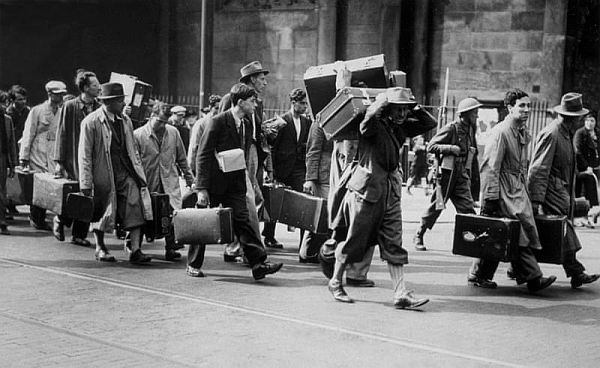
The building, three storeys tall at one section, had sat empty and dampening until the British army moved in on 5 June 1940. The first internees arrived seven days later. They’d had ample time to take in their new home’s thuggish frontage. From Bury station they had been marched the four miles or so along Manchester Road towards the mill. It was a walk of shame; hostile onlookers watched as they were paraded in front of the public as prisoners.
 
“To be marched like a bloody prisoner of war, with people watching … that really hurt,” recalled Peter Katz, a pastor in his mid-50s, who had been one of the first arrivals. “I felt degraded.” By the time Fleischmann arrived, the place was packed. Inside, a phalanx of British soldiers under the command of a retired officer, Maj Alfred Braybrook, sat behind a row of tables, ready to check the men’s belongings. The internees lined up behind ropes. Each man smelled the stench of disinfectant and listened to the sounds of captive men while he waited to be called forward. When Fleischmann’s turn came, he approached, and a private grabbed his bag and tipped the contents on to a table. As the soldier sifted Fleischmann’s belongings, a seated officer thumbed through his wallet. Fleischmann assumed the men were searching for any items that might be used as weapons, but it soon became clear that anything of value was in danger of confiscation. Just as the Nazis had systematically robbed many of these men of their valuables, so the British officers now took chocolate, cigarettes, writing paper and typewriters, distributing these items among themselves in full view of their prisoners.


The confiscation of razor blades was justifiable, and a case could possibly be made for the seizure of gold sovereigns to preclude black-market trading. Other choices seemed indefensible: watches, books, medicine. One soldier took insulin from a diabetic. For some internees, this was a familiar experience. Many had passed through holding camps at Ascot and Kempton Park, also overseen by Braybrook. At Kempton Park, a young tailor, Kurt Treitel, lost his watch and all his money to larcenous soldiers.
 
The breach of privacy revealed not only what each internee had considered sufficiently important to bring with him during the harried moments of his arrest, but also the range of vocations represented among the captives. Doctors watched, bewildered, as the soldiers pocketed their stethoscopes. Academics argued that they should be allowed to keep their textbooks. Artists pleaded to keep their drawing paper. For many of the men, this ransacking crowned a brief period that had devastatingly transformed their view of Britain, and their place within it. “[We] went around breathing injustice and feeling very sore about all kinds of things,” wrote Hirsch Uri, who was arrested alongside a number of other young Orthodox Jews, most of whom had come to England via the Kindertransport. “Since gloom only serves to increase one’s loquacity, [we] soon became unbearable to ourselves.”
 
Some men at Warth Mills had already experienced great drama in their escapes to England. Two days after the outbreak of war, Gotfried Huelsmann had successfully crossed the Germany-Netherlands border disguised as a greengrocer, driving a van filled with vegetables. To be interned by the country he considered an ally, after such acts of derring-do, was hurtful; to be robbed by those in whom these men had staked their trust, unthinkable. “I remember very clearly – and this was the dominating thought – the feeling of insult,” noted Claus Moser, who later became chair of the Royal Opera House. “The whole operation was panicky and cruel.”
 
In Warth Mills, 2,000 internees shared a single bath, and 18 water taps – a limitation that quickly forced almost every man to give up on shaving, and encouraged some to rise as early as 4am to avoid the mass hustle for the facilities. Laundry could be washed in an empty room, but, without soap or drying facilities, clothes and blankets often emerged as dirty as before. There was no sewerage system, and the lavatories amounted to 60 buckets housed outside, beneath an oblong tent. As the day progressed, the stench became unbearable. The latrines became so choked that, towards the end of the day, men would simply relieve themselves in a quiet corner.
 
Conditions in the camp were considered, by the numerous German doctors among the inmates, to be a liability for the spread of disease. They wrote and co-signed a memorandum of complaint to Braybrook. Simon Isaac, a former professor at the University of Frankfurt who had overseen makeshift hospitals on the Russian Front, wrote that he had never seen a place less fit for the accommodation of human beings. To be imprisoned in a building “not even fit for beasts”, as another internee wrote, had a profound effect on the men’s view of the country that had offered them sanctuary. “Many [have] ceased to believe in the British spirit of humanity which before they had acclaimed,” he continued.
 
The indignities of isolation from friends and relatives, meagre food rations, wet straw mattresses, lice and inadequate sanitary arrangements led many internees to draw parallels between the mill and the Nazi concentration camps from which they had fled. A former member of the German Foreign Office, held in the mill, claimed conditions were much worse than those of the notorious French prisoner of war reprisal camps he had seen in the first world war, where captured men were kept in cold, brutal conditions and subject to epidemics of typhoid and cholera. According to an official Ministry of Information report, two men, both of whom had previously been incarcerated in Nazi concentration camps, died by suicide.
 
After a week spent at Warth Mills, Fleischmann was transported to one of the more permanent camps, 10 of which were situated on the Isle of Man, where women and children were also interned. When he reached the island, Fleischmann’s home was “P” Camp, or “Hutchinson”, where about 1,200 internees were billeted in requisitioned boarding houses that bordered a picturesque square, with views leading down to Douglas harbour. After the indignities of Warth Mills, Hutchinson had a bucolic quality, which, depending on an individual’s temperament, at times felt like something akin to a holiday camp.
 
Rather than squander their time in detention, the men worked to turn the camp into a cultural centre. Professional actors staged productions of A Midsummer Night’s Dream and Of Mice and Men. Feted musicians performed concerts on the lawn. Oxbridge academics delivered lectures on a vast range of subjects, while the many celebrated artists in the camp produced and exhibited works of art in various disciplines. The journalists and editors published a fortnightly camp newspaper, featuring news, articles, fiction and illustrations. Thanks to the efforts of campaigners such as the MP Eleanor Rathbone, and the Quaker Bertha Bracey, chair of the Central Department for Interned Refugees, the internees were provided with books to open an impromptu library (Lewis Carroll’s Alice’s Adventures in Wonderland and Daphne du Maurier’s Rebecca proved to be the most borrowed titles), a table tennis table, and, in time, a shop where they could buy supplies, and even alcohol.


Their captors allowed the internees to establish a hierarchy of governance, a trick developed by the British army to facilitate the colonisation of indigenous groups. Still, Hutchinson’s commandant, a former advertising executive named Hubert Daniel, was a benevolent overseer. At the urging of his wife, a frustrated artist, Daniel provided materials and studio space for the artists in the camp, and even hired a grand piano for an outdoor matinee performance by the interned musician Marjan Rawicz. The artists soon established a semi-exclusive artists’ cafe, housed in a laundry room extension, with food provided by an interned Austrian pastry chef. With its whitewashed walls and bubbling paint, water taps and washboards, the venue lacked the sophistication of the continental cafes the men were used to, but the room was sizable and, when some trestle tables, chairs and stools had been arranged inside, provided a relatively comfortable space for afternoon meetings, conversation and performances by, among others, the famed Kurt Schwitters, the most famous of Hutchinson’s artist internees, who recited his dadaist poetry.
 
For Fleischmann, who had no ties to the outside world, Hutchinson provided the artistic education that had been cut short by the Nazis. Schwitters taught him life-drawing and how to mix paint from ground brick powder. The sculptors Paul Hamann and Georg Ehrlich showed him how to dig clay while out on an escorted walk in the local hills and smuggle it back into the camp. The sculptor Ernst Müller-Blensdorf showed Fleischmann how to carve blocks of firewood.
 
In later years, everything of which Fleischmann had dreamed since he was a young aspiring artist at the orphanage would come true. Under his adopted name, Peter Midgley, he would be accepted into the Royal College of Art. He would graduate with first-class honours, the top fine art student in his year, rewarded with the RCA’s prestigious Rome scholarship. He would become a professional artist, securing commissions to create works for a number of British government departments, universities and the Royal Navy. Nothing bettered the training he received at Hutchinson, however. “Everything thereafter,” he later said, “was just a recap.”
 
Despite the cultural experience, depression was rife throughout the camp, as the men waited for news of their loved ones, worried about their businesses and obsessed over freedom. “Lest this all sounds too rosy a situation,” Klaus Hinrichsen, the art historian, who was secretary of the Hutchinson Camp University, later noted, “let me assure you that all these frantic activities were entered into as a means of distraction from the ever-present anger at the injustice of being interned … the constant worry about wives and children left without a provider and under almost nightly bombardment in London and other towns … from the lack of communication and, of course suffering from the cramped living conditions and the lack of freedom of movement.”
 
In the autumn of 1940, the British government released a white paper outlining several categories under which internees could apply for release. Those who were too young or too old, too infirm, or who already had permits to work in positions of national importance could apply to be freed. Artists, writers and musicians were not included until later revisions, and had to prove they had achieved distinction in their chosen field. (As Helen Roeder, secretary of the Artists’ Refugee Committee, put it to the director of the National Gallery: “Do you think [the criteria could] be stretched to include the poor souls who have been too busy being hunted to achieve distinction in the arts?”)
 
With hindsight, many internees recognised that they had been relatively comfortable and safe and, apart from the criminal abuse experienced at Warth Mills, their treatment was fair. For most, internment was a near-constant misery that, as the Oxford academic Paul Jacobsthal wrote, caused a “trauma”. At least 56 internees died in internment on the Isle of Man, many to suicide. And while Peter Midgley’s life was transformed by the people he met during internment, the episode also triggered feelings of rejection and abandonment that haunted his dreams. Once or twice a year he would experience the same recurring nightmare: he was back in the camp; everyone around him was released until, finally, he was the last one there, permanently forsaken.
 
Every government must balance its humanitarian obligations with the need to uphold national security. To categorise refugees from Nazi oppression as “enemy aliens”, however, was to invite populist scorn and hatred upon those in most need of compassion in wartime, and represented a moral failing on a national scale. Few went as far as Tristan Busch, a former internee who described the British policy as a “war crime” in his memoir, but it is indisputable that the hasty measures heaped unhappiness and anguish upon thousands of people already enduring the ordeal of fleeing their previous lives. Only a single sentence spoken by John Anderson in the House of Commons on 22 August 1940, months before most of Hutchinson’s internees were freed, provided something approaching an apology: “Regrettable and deplorable things have happened,” he said, as if the cruelties of internment had been the result of natural phenomena, and not a series of deliberate choices.
 
In May 2021, the Canadian prime minister, Justin Trudeau, issued a formal apology to the more than 30,000 Italian Canadians declared “enemy aliens” during the second world war – 600 of whom were sent to internment camps. There has been no equivalent attempt to repair the damage by the British authorities in failing to distinguish between refugees and “enemy aliens” – a dehumanising term that, in 2021, the US government pledged never again to use. The battle between a nation’s responsibility to help those in need and to maintain national security persists in every age, every generation. The notion of the refugee who is not who he or she claims to be is an enduring story that can be easily used to justify institutional cruelty or overreach. While the context and detail shifts, the debate remains the same, as does the potential for history to repeat itself. Each successive generation must answer the same question: how far can we go in the rightful defence of our values without abandoning them along the way?
 
This is an edited extract from The Island of Extraordinary Captives by Simon Parkin, published by Sceptre on 3 February and available from guardianbookshop.com
 
 
‘I remember the feeling of insult’: when Britain imprisoned its wartime refugees. By Simon Parkin. The Guardian, February 1, 2022.


British journalist and author Simon Parkin gave this talk to coincide with the publication of his new book.

 
The police came for Peter Fleischmann in the early hours. It reminded the teenager of the Gestapo’s moonlit roundups that he had narrowly avoided at home in Berlin. Now having endured a perilous journey to reach England –– hiding from the rampaging Nazi thugs at his orphanage, boarding a kinder transport to safety –– here the aspiring artist was on a ship bound for the Isle of Man, suspected of being a Nazi spy. What had gone wrong?
 
In May 1940 faced with a country gripped by paranoia Prime Minister Winston Churchill ordered the internment of all German and Austrian citizens living in Britain. Most, like Peter, were refugees who had come to the country to escape Nazi oppression. Now they were imprisoned by the very country in which they had staked their trust.
 
Join British journalist and author Simon Parkin for a talk to coincide with the publication of his new book. Painstakingly researched from dozens of unpublished first-hand accounts and previously classified documents, The Island of Extraordinary Captives: A True Story of an Artist, a Spy and a Wartime Scandal tells the story of Hutchinson Camp in Douglas on the Isle of Man, history’s most astonishing internment camp, and of how a group of world-renowned artists, musicians, and academics came to be seen as enemy aliens.
 
It is the story of a battle between fear and compassion at a time of national crisis. It reveals how Britain’s treatment of refugees during the Second World War led to one of the nation's most shameful missteps, and how hope and creativity can flourish in even the most challenging circumstances.
 
Simon Parkin: The Island of Extraordinary Captives.  Insiders Outsiders. February 8, 2022.


The previously unknown subject of a Kurt Schwitters painting has been identified as Ludwig Warschauer, the subject of one of MI5’s very first anti-spy operations, who was sent to Britain to spy for the Gestapo.

 
Simon Parkin made the discovery while researching his book The Island of Extraordinary Captives, a history of Hutchinson Camp, a second world war prison camp on the Isle of Man. Opened on 13 July 1940, the camp was home to around 1,200 Germans and Austrians who had fled to Britain to escape Nazism when war broke out. Its creation was part of the British government’s policy of mass internment of the so-called “enemy aliens” they had previously welcomed to the country – with prisoners including Schwitters, the celebrated German Dadaist, along with a host of other artists.
 
Schwitters, said Parkin, produced “dozens” of portraits while interned, “either as favours to his friends, or to sell them as mementoes to eminent internees - £3 for a head and shoulders; £4 for head, shoulders and arms; £5 for a half figure”.
 
Many of the portraits are well-known, but while Parkin was writing the book, he was sent a document showing thumbnails of all known Schwitters portraits by Dr Isabel Schulz, curator of the Kurt Schwitters archive at the Sprengel Museum in Hanover. One of them bore a “striking resemblance” to a photograph he had seen of Warschauer in MI5’s security files.
 
Warschauer was a German national who fled to Britain shortly before war broke out. He claimed to be the inventor of the Tefifon, a recording device that functioned like a Dictaphone, and had powerful British allies, including the Conservative MP Herbert Williams, who was chairman of the company financing the Tefifon’s development, and the home secretary John Anderson, who came to his home to watch a demonstration. But MI5 agents suspected he had come to Britain as a Gestapo plant, and he became the subject of a long-running investigation. He went on to confess and was deported to Germany after the war ended.
 
Warschauer had helped Elisabeth Kohsen and her children flee Nazi Germany shortly before the outbreak of war, in exchange for her hand in marriage. Parkin managed to contact her daughter, Monica Schubert, to ask if she recognised the man in the portrait.
 
 “She told me that not only did she recognise the man as Warschauer, but she also personally knew the painting itself: it had hung in the living room of the family home after the war,” said Parkin. “Her mother had only relinquished the portrait when, after the war Warschauer – whom she had by now divorced, because of his lies – requested the portrait be returned to him in Germany.”
 
The portrait had been offered for auction at Horster Auktionshaus in March 2007 by an “anonymous artist”, but was withdrawn after the seller learned that it was a painting by Kurt Schwitters. A year later, it was offered again, but not sold, and its whereabouts are currently unknown.
 
“To have the identity of a sitter in a Kurt Schwitters portrait was a tremendous high. When I passed all this information to Dr Schulz, she updated Schwitters’ catalogue raisonné,” said Parkin. “It only remains now to find out the current whereabouts of the portrait. I was already convinced the individual in the portrait was Warschauer before his stepdaughter confirmed the fact to me … The likeness is uncanny – even if the portrait gives the more flattering likeness.”
 
Kurt Schwitters’ unknown portrait sitter identified as wartime German spy. By  Alison Flood. The Guardian, February 8, 2022.


Despite prostrate Germany’s need for the return of its men, in Britain we didn’t release our prisoners of war until 1948. In Russia — for those who survived — freedom came even later, in the 1950s; an apparent lack of moral equivalence saw the subject conveniently ignored until recently. Likewise, in a country that thrives on retelling wartime tales of derring-do, Britain has been slow to examine the complex story behind its internment of ‘enemy aliens’, the vast majority of whom were Jewish refugees. The horror of the Nazi concentration camps helped contribute to the silence on the subject post-1945, but, as Simon Parkin argues in The Island of Extraordinary Captives, that is no reason to avoid it.

 
The author made his name with A Game of Birds and Wolves, recasting the Battle of the Atlantic through the heroics of a retired captain and a team of Wrens in an onshore tactical unit based in Liverpool. His new book is equally rewarding.
 
Just 75,500 German and Austrian refugees were allowed into Britain before war was declared — and how we lauded our national effort to save them. Who hasn’t read a touching Kindertransport story? I’ve met several veterans who trained on the Isle of Man and recall no-go zones full of morbid-looking foreign men, but I’d never challenged myself to join up the dots until Parkin came along with his inimitable capacity to find the human pulse in the underbelly of Britain’s war.
 
There are heroes aplenty in The Island of Extraordinary Captives, which focuses on Hutchinson, one of Britain’s many internment camps on the Isle of Man, chock full of artists, musicians and intellectuals. With his eye for quirky detail, Parkin infuses the better known pre-war context with characters and incidents large and small, so that when war breaks out the reader is fully invested in his main protagonist Peter Fleischmann. He was an orphaned Jewish boy from Berlin with aspirations to become an artist until the Nazis got in the way. Cue Kindertransport to Britain; but, aged 17 and no longer little enough to be lovable, he was soon rounded up as posing a danger to the very state lauded for saving him.
 
Our wartime administration’s hamfisted response to fifth columnist fears makes for uncomfortable reading. Panic and unpreparedness are the hallmarks of poor governance, and Britain’s cruel knee-jerk response in 1940 to possible enemy invasion, the internment of thousands of mainly Jewish foreign nationals, was a case in point. That year The Spectator remarked: ‘Injustices have been committed that can never be repaired.’ As this book frequently underlines, for many of Hutchinson’s inmates the experience was darkly reminiscent of their expulsion from Germany.
 
Parkin is a good writer, but the strength of the history he has stitched together renders his more high-flown prose superfluous; the rich cast of characters speak for themselves. Fleischmann was surrounded by everyday heroes, many of them artists — and only one Jewish-German spy. Living up to his reputation as an investigative journalist, Parkin establishes that the spy was Ludwig Warchauer, a morally complicated character whose previous life had crossed paths with Fleischmann’s in Berlin.
 
It was a small world on the Isle of Man. The contacts Fleischmann forged there and the artistic talents he developed within a luminous coterie of internees saw the young man successfully broker a new life on release. A happy ending of sorts pivots the narrative arch back on itself: yes, indefinite incarceration was bad, but not in Fleischmann’s case. As Parkin observes, older prisoners felt the indignity and lack of certainty most acutely. After all, they had more invested in the outside world.
 
The Island of Extraordinary Captives is multi-layered and perhaps too long, but is definitely worth the deep dive into Britain’s inglorious war, when desperate men and women were disregarded, abused and left to fester in a humiliating no man’s land. It’s a reminder that conflict has always been a convenient mask behind which thuggery and xenophobia thrive. Yet, despite the stark injustice it describes, it is a curiously exhilarating read: an example of how individuals can find joy and meaning in the absurd and mundane. Peter Fleischmann did just that, and thankfully survived to tell his story.
 
The Island of Extraordinary Captives: A True Story of an Artist, a Spy and a Wartime Scandal / Simon Parkin. Sceptre, 2022.
 
Why did Britain lock up so many innocent refugees in 1940? By Tessa Dunlop. The Spectator, February 12, 2022.