Showing posts with label British art. Show all posts

29/05/2025

Ithell Colquhoun, Painter, Occultist, Poet and Author


 Radical, esoteric, and defiantly independent, Ithell Colquhoun (1906–1988) remains one of the most enigmatic figures in British surrealism. A painter, poet, and occultist, her practice dissolved the boundaries between gender, sexuality, and spiritual inquiry, positioning her as a visionary far ahead of her time. Having debuted at Tate St Ives in February 2025, Ithell Colquhoun: Between Worlds comes to Tate Britain from June and promises to be the largest exhibition of her work ever staged, featuring over 170 works, including rare archival material and pieces never before displayed publicly.

Below, in the lead-up to this major exhibition coming to Tate Britain, we delve into the life and work of Colquhoun to explore some of the facets of her legacy that make her such an intriguing figure.

 Rewriting the myth: Queer Feminism in Colquhoun’s Surrealism

 In 1927, Colquhoun enrolled at the Slade School of Fine Art, where she developed her distinctive approach to symbolism and composition. She was awarded joint first prize in the Summer Composition Competition for “Judith Showing the Head of Holofernes”, an early highlight in the exhibition’s curatorial journey. Reimagining the biblical tale of Judith – the widow who seduces and beheads the Assyrian general Holofernes to protect her people – Colquhoun renders feminist vengeance through a surrealist lens. 


 Dreamlike fragmentation liberates Judith from the constraints of passive femininity, transforming her into an archetype of mystical, embodied power. As in many of Colquhoun’s early works, the female figures are imbued with a striking masculinity – more muscular and heroic than their male counterparts, their bold, fleshy limbs and austere stances confronting the viewer with authority rather than subservience. Her reworkings of myth often centre the sacred androgynous body, eroticism between women, and archetypes that resist binary structures – offering an ecstatic, visionary model of queer embodiment that feels startlingly contemporary.

 Esoteric Foundations : Occult Influences and the Surrealist Rift

From an early age, Colquhoun was drawn to the esoteric. In 1928, she joined the Quest Society, founded by George Robert Stow Mead, former secretary to Helena Blavatsky of the Theosophical Society. The Society aimed to synthesise religion, philosophy, and science through esoteric traditions, and it laid the foundations for Colquhoun’s lifelong spiritual inquiries.

She later affiliated herself with other occultist groups such as the Hermetic Order of the Golden Dawn and the Ordo Templi Orientis (OTO), drawing deeply from ceremonial magic, alchemy, and mystical symbolism. During her time at the Académie Colarossi in Paris, she was also exposed to the work of Salvador Dalí and other surrealists, expanding her interest in automatism and psychoanalytic theories of the unconscious. Colquhoun frequently corresponded with surrealist André Breton and remained deeply engaged with surrealist thought, even as her own practice increasingly veered toward mystical and feminist territory beyond the movement’s patriarchal centre.

Though aligned with British surrealism until 1940, Colquhoun eventually broke away from the movement, finding its increasingly orthodox politics incompatible with her pluralistic worldview. Her estrangement marked a decisive shift away from British modernism and toward a mystical, deeply personal exploration of inner and outer landscapes. “Symbolic scenes of ‘mind pictures’ may be dredged up from the depths of fantasy life,” she wrote, viewing her artistic practice not only as a creative technique but as a mode of divination – capable of accessing realms beyond temporal or bodily experience.


 Mysticism of the Land: Cornwall and the Sacred Feminine

In 1958, amid a growing sense of estrangement from the artistic mainstream, Ithell Colquhoun relocated to the remote village of Paul in West Penwith, Cornwall – a landscape she had long regarded as sacred. Steeped in myth and mysticism, the region’s ancient wells, megalithic stones, druidic relics, and carved crosses became more than just motifs in her work; they formed the living architecture of her spiritual imagination. Here, she devoted herself to painting, writing, and esoteric study, weaving together Celtic history, poetic vision, and occult philosophy. For Colquhoun, the Cornish landscape functioned as both psychic terrain and spiritual archive – a liminal space where her artistic, mystical, and intellectual pursuits could converge.

For Colquhoun, myth was not merely inherited – it was alive, continually generated by the unconscious in dialogue with land and archetype. She often invoked sacred geography in her art. Works such as Dance of the Nine Maidens (1940) and Dance of the Nine Opals (1942) depict local rock formations as sentient, mythic figures. The Cornish stones are anthropomorphised, dancing, dreaming, almost breathing – inviting the viewer into a dreamtime where history, magic, and geology converge. Her sketch of Dance of the Nine Opals reveals a meticulous sensitivity to the energetic webs that pulse beneath the surface – currents invisible to the untrained eye yet charged with historical, folkloric, and mystical significance. 


The Alchemical Body : Eroticism, Energy an the Feminine

Throughout her career, Colquhoun sought to map the hidden correspondences between plants, planets, body parts, and sacred geometry. Her work is charged with symbolic energy – merging anatomical forms with botanical structures, sexual imagery with cosmic diagrams.


 In “Attributes of the Moon” (1947) Colquhoun conjures the landscape not as passive but as generative, and feminine, expressing a vision of the feminine as protean and plural – a living system of symbols in continual metamorphosis. In “The Anatomy” (1942), a yonic work that evokes the enfolding architecture of caves, Colquhoun draws on the elemental symbolism of the earth as womb – simultaneously a site of concealment, transformation, and power. The image recalls the myth of Daphne, metamorphosed into a laurel tree by her father, a river god, to escape the sexual pursuit of Apollo. “The Anatomy” not only asserts the generative force of the feminine, but also reframes retreat and metamorphosis as acts of self-preservation and agency.

Archives of Magic : Colquhoun’s Library of the Occult

A pivotal starting point for the 2025 exhibition was Tate’s acquisition of Colquhoun’s personal archive from the National Trust in 2019. Comprising over 5,000 items, including sketches, writings, and unpublished diagrams, the collection reveals the extent of her devotion to the mystical arts.


 Her personal library – now housed in the Tate Archives – includes over 300 volumes on Greek mythology, alchemy, surrealism, Kabbalah, and ceremonial magic. Among them are The Golden Dawn (1937), The Kabbalah Unveiled (1887), Liber 777 by Aleister Crowley (1909), Dreams and Dream Stories by Anna Kingsford (1888), and Witchcraft Today by Gerald Gardner (1954). Together, they trace a lineage of esoteric thought through which Colquhoun developed her own queer, visionary cosmology.

A Radical Legacy

Colquhoun’s work dissolves conventional frameworks of gender, art, science, and spirit. She crafted a language in which imagination was not fantasy but a form of knowledge; where women could be both warriors and mystics; where eroticism was a divine force; and where the land itself was alive with memory and myth.

In our current cultural moment – one increasingly attuned to questions of fluid identity, ecological consciousness, and spiritual resurgence – Colquhoun’s legacy feels not only relevant but radical.

 Ithell Colquhoun: A queer, occultist artist who created between worlds. By Isabella Greenwood. Dazed, May 27, 2025.


 Tate 


Excellent long read.

Ithell Colquhoun: Mantic Stains, Sex & Surrealism by Andy Wilson. The Traveller in the Evening, March 7, 2025.
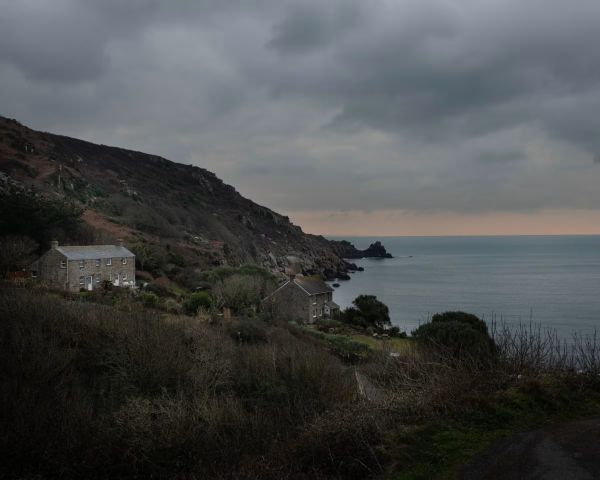


On a hillside not far from Land’s End, at the boundary of four parishes, stands the Mên Scryfa: perhaps Britain’s most resilient standing stone.

It is a slab of granite about six feet tall, likely first erected in the Bronze Age, and now set in the middle of a field (where it has served as a scratching post for itchy cows). Draw closer and you see a faint Latin inscription on its surface: “Rialobranus, son of Cunovalus”. The writing is a later addition from the 5th-6th century AD: two figures unknown, likely of noble blood. Run your fingers across the wonky lettering — feel the grooves in the granite, rough-textured as an oyster shell — and you almost sense an uncertainty in the scribe, recording the names in this novel Roman script.

By the 18th century Mên Scryfa had fallen down. It was re-erected in 1825, toppled again by treasure hunters in 1862 and put right again soon after. In June 2023, vandals set the stone ablaze with petrol and dug a ditch in a bid to topple it a third time (without success). On my visit last month, the lichen lost to the fire had started to return. The scorch marks were gone.

The Cornish hedgerows were thin on my visit to Mên Scryfa, the winter air sharp and clear, and so there were sightlines to other prehistoric monuments nearby: ancient barrows, quoits — and megaliths on the horizon that you had to fix your gaze upon a while to be sure they were not figures watching the Atlantic sunset, but cold sightless stones present there for thousands of years.

Here you understand a truth likely evident to Rialobranus, Cunovalus or their scribe. That Cornish granite is a stubborn material: hard to displace and prone to remembering the names of those etched into its grain after they have passed. Perhaps father and son expected a record of their dynasty would perish in parchment, but might endure for eternity if carved into a Bronze Age standing stone.

Penwith (meaning “the headland at the end”) marks the southwestern tip of the British mainland: a hook-shaped peninsula buttressed against the Atlantic by its steep granite cliffs. It counts as one of Europe’s densest prehistoric landscapes: filled with relics from the Neolithic, Bronze Age and Iron Age past. In antiquity this area was a centre for mining: gold and tin were exported through prehistoric seaways. Cornish tin is found in the Nebra sky disc: an Early Bronze Age artefact, discovered in Germany in 1999, that is perhaps humanity’s oldest depiction of the night sky.

For much of winter the peninsula is besieged by gales. For much of summer it is braced against a headwind of mass tourism from the opposite direction. Crowds rush down the A30 to visit the tourist attraction at Land’s End: to watch 4D films, enjoy the Wallace and Gromit experience and take a selfie with the famous sign. For charity cyclists, Penwith flashes by in a flood of endorphins as they begin the long ride north to John O’Groats in Scotland.

I had visited on a beach holiday in August, but exploring its prehistoric sites in midwinter I was in another country. Holiday cottages were untenanted and unlit. Little drifts of storm-blown sand lay unshovelled by front doors. In one, a model boat placed in the window had cobwebs for rigging.

The roads were silent too. Rather than hunting for expensive beachfront parking, my quarry was potholed lay-bys on country lanes. Rather than scrumming through bank holiday crowds, I knocked on farmhouse doors, looking for someone, anyone to direct me to an obscure megalith I had spied on an OS map. Mostly I was alone with the stones — without company but for starling murmurations roused from the hedgerows when a five-bar gate clanged shut behind me.

There was another reason I was here. Tate St Ives has just opened the first major exhibition of Ithell Colquhoun — a painter and writer, much of whose creative output was inspired by Penwith’s ancient landscapes. Born in the hills of Assam in 1906, Colquhoun was a colourful figure. She had studied at the Slade, saw Dali lecture in London and was photographed by Man Ray holding a sheaf of wheat in Paris. She was ostracised by other figures in British surrealism because of her involvement in the occult, but hers was the life of a spiritual seeker.


Countless artists had come to St Ives for its famous light: many sought pastoral visions in Penwith’s fishing villages. Colquhoun came here to paint something beyond the visible: currents of mysterious energy she perceived flowing between ancient sites, cryptic stone circles whose meaning she sought to decode. In her 1957 book The Living Stones, she wrote of “stones that whisper, stones that dance, that play on pipe or fiddle, that tremble at cockcrow, that eat and drink, stones that march as an army — these unhewn slabs of granite hold the secret of the country’s inner life.” This new exhibition was seen by some as being a risky move for Tate: even 36 years after her death there was concern her art might seem too “woo-woo” for Anglo-Saxon sensibilities. But then, strike out beyond the gallery, drive west down the narrowing lanes of Penwith, and you soon remember this is no Anglo-Saxon land.

To cross the River Tamar into Cornwall is to cross a boundary whose subtleties maps don’t represent. In the minds of Penwith locals, a second threshold — the River Hayle — separates their own peninsula from the rest of the county. Penwith was reputedly home to the last native speakers of the Cornish language, and is where Cornwall’s granite backbone breaks out from beneath sedimentary rocks to reach the surface. Here — like Iona, Bardsey, Finistère — there is the sense that Celtic blood runs thickest where the last land succumbs to the sea.

Ithell Colquhoun understood this distinction when she came here in the 1940s. Boarding a Penzance-bound train at Paddington, she was escaping a bombed-out capital, a failed marriage and an unfulfilled love with a woman she had met in a hotel in Mykonos. In Penwith she immediately sensed a change: a “tingling magnetism” and “a balsamic quality of the air that never fails to bring healing”. She had found her cure.

She rented a corrugated iron studio in Lamorna, on Penwith’s southern coast. Where much of the peninsula is moorland dotted with hawthorn and blackthorn, the valley at Lamorna is jungly and — even on my winter visit — faintly tropical. There were bamboo groves and palm fronds rustling in the breeze. Colquhoun wrote of the Penzance dragon trees and other exotic species sustained by the Gulf Stream. Her studio had neither electricity nor a loo but she set to work: painting to the morning song of turtle doves in the valley. Lying in bed after dark, she felt the wings of bats from the attic touching her forehead. To her mind the peninsula was an enchanted land: both Atlantis and Avalon, its “Druidic” temples and Celtic saints manifestations of a deeper power in the granite bedrock. Where others considered it peripheral or at the end of the world, Colquhoun envisaged it a sacred centre of the planet.

Today her former studio — Vow Cave — is a private holiday home. Skylights have been fitted where the bats roosted. The retreat evoked in The Living Stones seems distant, but the prehistoric sites she painted nearby are unchanged. One afternoon I set out to explore some of them in the company of Matthew Shaw and Lally MacBeth, a couple who are the founders of Stone Club, a Cornwall-based organisation celebrating prehistoric landmarks. They first bonded over a shared love of Colquhoun’s work.

We stopped at the Merry Maidens: a late Neolithic to early Bronze Age stone circle that Colquhoun portrayed in Dance of the Nine Opals (1942). We drove down the single-track lane depicted in “Landscape with Antiquities (Lamorna)” (1950). We stopped for lunch at The Kings Arms in Paul — the village where Colquhoun later lived, before passing away in a nearby nursing home in 1988. A group of pagans were sitting at the next table, whispering plans for an evening ritual at a nearby site. “So we do three clockwise perambulations . . . ” 


 Ritual practices also continue at Penwith’s strangest prehistoric landmark: Mên-an-Tol. The centrepiece of this roughly 3,000-year-old site is a stone with a hole, depicted in Colquhoun’s painting “Sunset Birth” (1942). Folklore tells that women who crawl through it naked will be healed of infertility — early drafts of Sunset Birth show a feminine figure levitating in the circle. “You occasionally see half-dressed people hiding in the bushes,” Lally told me. “Some Cornish women even talk about having their own ‘Mên-an-Tol baby’.”

 Ancient sites like Mên-an-Tol were launch pads for Colquhoun’s imagination: prompts for deep time dreams. Her paintings are testament to how objects of such unfathomable antiquity invite a perspective that transcends ordinary sight. But exploring the St Ives exhibition, you sense there is also something unspoken. At the time Colquhoun was working, ley lines and earth energies were a novel idea — they are now universally regarded as pseudoscience. Her interpretation of stone circles as abodes of the divine feminine was once a fashionable one — it is also without evidence.

The function and meaning of those prehistoric sites she painted is uncertain, dating as it does to an unrecorded past. The esoteric, tantric and classical allusions in her art and writing are visionary, but they are also only projections. In one sense Colquhoun was radical. In another, she belonged to a long-established tradition: an outsider in Cornwall, in love with a half-imaginary land. 
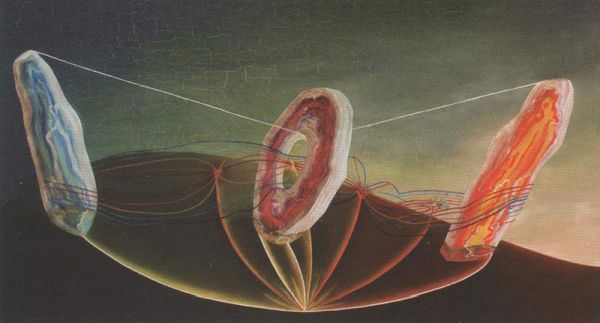


In the 1980s, encampments of new age travellers were often pitched up by the stone circles of Penwith. Now they are gone but at the centre of the peninsula I tracked down Palden Jenkins, a self-described “aged hippy”. He had lived in Glastonbury and been an activist in Palestine before moving in his sixties to take up residence in a caravan near the Penwith village of Sancreed, with its granite 15th-century church and even older holy well, where pilgrims still come to tie cloth offerings to the trees.

Jenkins runs Ancient Penwith (ancientpenwith.org), a project to map what he described as a “landscape temple”, the network of ancient sites relaying energy in the manner of a “circuit board”. He instinctively understood Colquhoun’s paintings: he too felt the difference when he stepped on to the granite west of Penzance. Palden had been given a terminal bone marrow cancer diagnosis in 2019. He had been a champion fell runner in his youth: now it entailed a similar effort to walk to the Bronze Age barrows on nearby farmland, to have a smoke, reflect and heal.

“Strictly speaking I shouldn’t be alive now,” he told me. “I can’t put that down solely to visiting ancient sites. But they do have an effect on me: like an energy bath. Healing doesn’t always mean getting better, but helping you deal with the situation you have. You have to make peace with your death.”

A stone jetty extends out into a Cornish cove at dusk Lamorna Cove at dusk I drove a final lap around the peninsula. I passed the Mên Scryfa, guarding the boundary of four parishes, and the green valley at Lamorna, of which Colquhoun had written: “here, to exist here was enough.” Lastly, a couple of miles inland from Sennen Cove, I climbed Chapel Carn Brea, Penwith’s most southwesterly hill and itself supposedly a point of convergence for energy lines.

It was a bright, blustery morning. The Isles of Scilly were visible across a shining sea. Even a sceptic could discern energy flows from the summit. Above were the crooked vapour trails of planes changing course as they entered UK airspace. Below, undersea cables relayed power and information across the ocean, out of sight. But most perceptible was the Gulf Stream wind, making landfall after crossing endless leagues of open ocean. And the action of the waves all along that granite peninsula — crashing on the first and last rocks of England. Which, of course, were not quite England at all.

Cornwall’s mystical far west — in the footsteps of Ithell Colquhoun. By Oliver Smith. Financial Times, February 12, 2025.


Lamorna is a small village on the Cornish coast, in the far southwest of Britain. The expansive skies and landscapes of the area have long been a draw for artists, most famously painters associated with the Newlyn school such as Laura Knight, Alfred Munnings and Lamorna Birch. Less well known are the ground-breaking queer artists who set down roots in the village: Marlow Moss, Gluck and Ithell Colquhoun. In this film, we tell their story, and the story of the Cornwall where they lived and loved: a place of international modernism, Celtic spiritualism and the queer avant-garde.

Queer Cornwall: Marlow Moss, Gluck and Ithell Colquhoun in Lamorna. Tate, October 29, 2021.


  Ithell Colquhoun’s reputation as a Surrealist artist, writer and occultist has been surging in recent years. Most know her through her quirky travelogues of Ireland and Cornwall Crying of the Wind: Ireland(1955) and The Living Stones: Cornwall (1957), her Surrealist occult novel Goose of Hermogenes (1961), or perhaps her idiosyncratic account of the history of the Golden Dawn, The Sword of Wisdom (1975). Her visual art has been less accessible until recently, but is becoming more widely known with recent, beautifully illustrated publications featuring her Taro (tarot) deck and her color study of the Sephiroth of the Tree of Life, The Decad of Intelligence. Her genius is evident, yet so much about this brilliant and eccentric figure remains elusive. As I eagerly await the publication of my own biography of Colquhoun, Genius of the Fern Loved Gully (coming soon from Strange Attractor Preess), I thought I might delight you all with a topic I don’t address in the book in any great depth: Colquhoun seemed to have a weird thing about exploring base bodily functions with some delight. We don’t see this in just a few isolated literary incidents, urination and defecation are deliberate themes, explored sometimes with a strange intimate aside, and sometimes in rather perplexing detail.


 Now, it should be noted that Colquhoun wasn’t ever one to shy away from bold and socially prohibited imagery, particularly when it came to sex and bodies. In the 1930s and early 1940s her paintings went from somewhat suggestive studies of plants to vulvic tree trunks and full-frontal male nudes. Her private erotic studies also spared no detail. In her writings, Colquhoun’s treatment of bodily functions was not limited to urination and defecation. Her vignettes and prose poems referred to excreta on a number of occasions, however elimination appears in rather distinctive contexts. In various short pieces, Colquhoun writes of menstruation, skin conditions, scabs, open sores, and some weird brown fluid that seeped out of her navel at some stage which fascinated her. It is clear that she wishes to confront her audience with images that are in many ways completely ordinary yet rarely acknowledged in polite company. These explicit depictions are even more radical coming from a woman writer, when women are, even to this day, generally expected to keep our bodily fluids well out of sight and out of mind. Part of Colquhoun’s approach may have been a Surrealist exercise. Surrealism was and is disruptive to its very core, seeking to unlock the unconscious and to display taboo, dismemberment and horror, often with a generally Freudian sensibility. Yet while Colquhoun’s work can occasionally be macabre, and certainly shocking, she generally does not focus on the overtly morbid (although there are some exceptions). While there is no doubt that some of her prose was meant to shock, the clinical way in which she writes of things that drip and ooze itself is oddly alienating.

Colquhoun’s writing style in general leans toward cold observation, and this is true of even her most Surrealist writings. Although she uses thick description with respect to color and setting and her imagery is consistently rich, even the most bizarre activities in Colquhoun’s writings, including, sex, magic, incest and cannibalism, are depicted quite dispassionately. Colquhoun’s unpublished autobiography Until Twelve, likely written in the 1940s, would have us believe that keen observation was a trait she admired in herself from a very young age. Although her writings about her childhood observations are clearly filtered through an adult lens, she didn’t flinch from honest, seemingly detached reporting of her youthful encounters with sex, menstruation and the pubescent development of young bodies. Her short prose poems from the 1940s and 1950s retain an icy, objective flavor, reading as field notes from an anthropological expedition even when describing edgy subjects such as the prostitutes she carefully observed in her short prose poem titled Sligo Street, 1939. However, her depictions of waste elimination, while also taboo, offer different challenges to the viewer, and perhaps also some opportunities.

Although Colquhoun’s depictions of bodily waste were often matter of fact, they were also ironically tinged with the wider grasping of the ultimate which marked her life’s work. Despite the somewhat clinical treatment, Colquhoun juxtaposes urination and defecation with moments of wonder and transcendence, placing the sacred and profane in proximity, forcing the reader to accept the holy nature of the physical body. In one short prose poem, “Alchemical Text” the physics of urination encourage a meditation upon gender equality and embodiment:


 “He said, quoting a sage, that every girl had her roots in earth. I said, where does every boy have his roots? He answered “In the sphere where fireworks explode”. I understood by this the polarity of alchemical earth and air, but wondered if it were valid. For if this distinction was, as it must have been, based upon different methods of making water, then certainly a girl’s water goes directly downwards into the earth; but a boy’s also must eventually return there, and for all its rocket like soaring, is bound at last for earth. “[1]

Another short piece “Images of Joy”, likely written in the 1940s or possibly late 1930s is a short recollection, likely from her time in Greece in the early 1930s, where Colquhoun has an uncommonly aesthetic response to the fecal remains of a wandering peasant:

“I was sitting on a rock between mountains and sea and the sun was blazing down on the aloes, and I thought I was alone. But presently I heard a step and a peasant came along who thought he was alone and let down his pants and had a good shit. It was done in a minute with complete simplicity; he pulled them up again, not wiping his arsehole with so much as a leaf, fastened his belt and walked away.

I went forward to look at what he had done; it was beautiful, three concentric rings of golden brown, decorated like a cake with olive stones and shreds of tomato peel. The topmost ring ended in a little point aiming at the sky. I think the whole lot must have come away clean without leaving a trace; perhaps the intestine had come out a little way like an animal’s to form a funnel, though maybe there was a small stain on his trousers all the same. “[2]

 In two of Colquhoun’s longer form writings she juxtaposes urination with sacred sites and landscape. In, The Blue Anoubis, her unpublished 1966 travelogue about Egypt, she describes hiking up her skirts to pee behind a pyramid.[3] In her slightly earlier Surrealist novel I Saw Water, about an order of parthenogenic nuns existing in a shadowy afterlife, Colquhoun much more irreverently counterpoints the body and the altar as sites of sacred activity. The central character of the story, a postulant at the nunnery, finds herself exploring the convent church, when, at one of the altars in a side chapel, she lifts the top off the altar to find it covering a cistern. Overtaken by the urge to urinate she relieves herself in it, wiping herself with letters she finds in her pockets. She only gives the incident the briefest thought when a priest arrives, appearing to not have noticed or cared. Is the implication one of sacrilege, as she uses the altar in a way clearly unintended, or was the altar actually covering up a toilet? The sacred and the profane blur, or perhaps they were always one and the same. [4]


It is likely that Colquhoun was working to prompt a spiritual shift in the reader by elevating the debased and by making no one thing greater than any other. A key may lie in comment she makes in another short essay “Hexentanz”, which details sticky bodily fluids and the taste of ear wax: “Life is not beautiful but it is rich: All must be accepted.” [5] A lifelong animist with an interest in Tantra, Colquhoun wished to confront generally accepted standards of sacrality by uplifting and acknowledging that which is most degraded. While still quite young, at the age of 24, she delivered a paper to the Search Society, a group of occult writers and thinkers led by her distant cousin Edward Garstin, titled “The Connection Between Mysticism and Blasphemy”. Here she challenges standard conventions of blasphemy by arguing that the blasphemous creates the conditions for divine encounters:

“Thus, though the blasphemer may be said to lower the divine, while the mystic raises himself to meet his Lord, yet in fact both perform the same process, that of bringing the divine and the human into contact. Since any vehicle cannot be unworthy of divinity, the doctrine of the Incarnate God and the whole train of sacramental teaching that follows in its wake is in this sense blasphemous...”[6]

By collapsing the categories of the sacred and the blasphemous one can reach an experience where nothing can be destroyed. She states “Where there is nothing, there is God.” “And if all can be destroyed, why, let there be destruction.” During the late 1920s and early 1930s Colquhoun also encountered Hindu Tantra, a tradition with which she felt some affinity due to her birth in the north of India, through the writings of John Woodroffe (Arthur Avalon) and those of her cousin Edward Garstin. It seems quite possible that as she developed as a writer and artist that she extended her ideas about blasphemy into breaking taboos as a way of experiencing enlightenment and non-attachment as part of a Tantrically inspired esoteric framework.


Were Colquhoun’s literary scatological episodes a Surrealist exercise in shattering taboos? Simple juxtaposition of opposing images? Tantrically inspired sacramental meditations? Regardless of intent, she was likely considering some aspect of spiritual refinement, hoping to bring her audience along with her, changing our perspectives and cultivating a new way of seeing. Can’t exactly say that this tendency endeared her to publishers, but I don’t think she ever believed that her work was for the masses anyway.

Notes

Images © Samaritans, Noise Abatement Society and Spire Healthcare.

1. “Alchemical Text” in Shillitoe, Richard (ed). Medea’s Charms: Selected Shorter Writings of Ithell Colquhoun. (London: Peter Owen Publishers, 2019) p. 116.

2. “Images of Joy” ibid. pp. 132–133, and in the Tate Hyman Kreitman Archives at TGA 929/2/1/52/38.

3. Colquhoun, Ithell, The Blue Anoubis unpublished mss, c. 1967. Tate Hyman Kreitman Archives, TGA 929/2/1/6/8

4. Colquhoun, Ithell, (eds.) Richard Shillitoe and Mark Morrison, I Saw Water: An Occult Novel and Other Selected Writings (University Park, Penn State University Press, 2014). Kindle edition, location 1435.

5. “Hexentanz” exists in several versions. This quote was from the mss. TGA 929/2/1/52/56

5. Colquhoun, Ithell “The Connection Between Mysticism and Blasphemy” c. 1928/1929 unpublished mss. Tate Hyman Kreitman Archives, TGA 929/2/3/2


Ithell Colquhoun’s Peculiar Scatological Proclivities. By Amy Hale. Medium, May 4, 2020


 Writer and researcher Dr. Richard Shillitoe discusses the life and work of British artist, writer and occultist Ithell Colquhoun. As the talk sets out to show, she took her inspiration from the spiritual world as much as she did from the natural world, making extensive use of automatic drawing and painting methods as well as the contents of her dreams.

Ithell Colquhoun (1906-1988) is one of the 20th century’s most significant British surrealist artists. The daughter of a senior civil servant in India, she studied at the Slade School of Fine Art (1927-31) and had an award-winning painting exhibited in 1931 at the Royal Academy. She travelled widely in Mediterranean countries and lived in London before spending the greater part of her adult life in Cornwall where she painted, wrote and pursued extensive occult research. In 1940 she was ejected from the London Surrealist Group for refusing to compromise her occult interests. Her paintings have appeared in solo exhibitions as well as being shown in major art galleries. A significant body of Colquhoun’s artworks and archives were acquired by Tate in 2019, gifted by the National Trust. Her fame as a writer is largely based on a hermetic novel, Goose of Hermogenes, and two highly personal travelogues The Crying of the Wind: Ireland and The Living Stones: Cornwall. She also published Sword of Wisdom, the authoritative biography of MacGregor Mathers, the founder of the Hermetic Order of the Golden Dawn. She died in Cornwall in 1988.

Dr Richard Shillitoe is an independent researcher. His book Ithell Colquhoun: Magician Born of Nature (2010) includes an extensive catalogue of Colquhoun’s artwork. He co-edited the first publication of Colquhoun’s novel I Saw Water (2014) and edited the illustrated edition of her first novel Goose of Hermogenes (2018). He has recently published Medea’s Charms (2019), a volume of Colquhoun’s poems, essays and short stories. He maintains the website www.ithellcolquhoun.co.uk

  
Magician Born of Nature: the Life and Work of Ithell Colquhoun. Drawing Room, October 13, 2020


11/06/2023

“Every Image of the Past That Is Not Recognized by the Present As One of its Own Concerns Threatens to Disappear Irretrievably.” On the Rehang Tate Britain


Tate Britain’s rehang, unveiled last month, aims ‘to show a broader, more complex picture of British art history’. Its historical galleries, arranged in chronological order from 1500 to the present day, present a fresh selection of artworks, with more women painters and a greater focus on ‘people and stories that have often been overlooked’. The contextual information has been rewritten, too, with an emphasis on the social and political conditions in which the art was made. Empire, inequality and the transatlantic slave trade all feature heavily.
 
To further draw out these connections, the Tate has invited guest curators to place historical artefacts and contemporary artworks among the displays – to ‘bring to light a story that isn’t visible or encourage us to think differently about the art on display.’ In the gallery entitled ‘Exiles and Dynasties 1545-1640’, for instance, portraits of early modern aristocrats – many painted by emigré artists – overlook Mona Hatoum’s Exodus II (2000), a pair of mid 20th-century leather suitcases, joined together by strands of human hair. In ‘Court v. Parliament 1640-1720’, Nils Norman has surrounded John James Baker’s The Whig Junto (1710) – a group portrait of the early 18th century’s dominant politicians – with images of radical pamphlets from the English civil wars half a century earlier.
 
At least one of the contemporary additions is missing, however. The historian Marcus Rediker, much of whose work focuses on resistance to slavery and exploitation, was invited to respond to the Tate’s Turner displays. He proposed a set of exhibits that would commemorate mutinies, unfree labour and rebellions at sea, but withdrew suddenly last autumn.
 
The sticking point was a proposal for Turner’s A Disaster At Sea (c.1835), which shows people clinging to the wreckage of a ship in stormy waters. The identity of the ship is disputed but one theory is that it’s the Amphitrite, which left London for New South Wales in 1833 carrying 108 women convicts and twelve of their children. When the ship ran into difficulty near Boulogne, the captain refused help from rescuers, worried that it would encourage the prisoners to escape. All but three passengers drowned. Tate Britain sits on the site of Millbank prison, where women convicts were held before transportation to Australia.
 
Rediker told me he wanted to display one of the black wooden ‘punishment boxes’ used to discipline women convicts on prison ships. He proposed either showing an original (one survives in a museum in Tasmania) or a replica alongside Turner’s painting, to ‘declare solidarity’ with the women and pay tribute to their rebelliousness. It was important, he said, to show visitors the life-size object: being confronted with a tool of state violence would draw out the themes of protest in Turner’s work.
 
Although Tate Britain initially seemed open to the idea, last autumn the gallery told Rediker he couldn’t show the box. A replica would seem too much like a theatrical prop, the Tate said, and its ‘domineering presence’ would put visitors off rather than encourage them to engage with the themes in Turner’s work. They couldn’t in any case be confident about the connection between the box and the painting, since recent scholarship has questioned the identity of the ship portrayed in A Disaster at Sea. But the gallery also worried that an object associated with such violence would be ‘triggering, even traumatising’ for some visitors – and, given ‘the intense media interest in this country at present with exhibition interpretation in museums’, a row about the exhibit might overshadow the whole rehang.
 
According to Alex Farquharson, Tate Britain’s director, it simply wasn’t possible to fulfil this part of Rediker’s plan. ‘Sadly one aspect of his proposal – to build an interactive replica of a torture device – was neither an artwork nor historic artefact, and would have presented a number of insurmountable practical problems for an art museum,’ he told me. Rediker, on the other hand, believes a toned-down display would have undermined its political impact. Showing a photograph of the box – a compromise suggested by the Tate – would have ‘flattened out the radical juxtaposition with the painting, deadening or sapping the art of its power,’ he told me.
 
It isn’t easy to find a balance when representing violence in museums. It should, at least on some level, disturb people – otherwise what’s the point? But the fact that concerns about public and media responses weighed on the Tate’s reasoning is an indicator of the pressures that UK cultural institutions have come under in recent years, as demands to acknowledge more fully the violent aspects of British history have been met with a right-wing backlash.
 
Tate Britain, both a custodian of the nation’s art history and a major global tourist attraction, has moved cautiously through this territory. In 2019, the Tate galleries issued a statement clarifying the connections between the wealth of their founder, the sugar merchant Henry Tate, and the transatlantic slave trade. (Tate was too young to have profited directly from slavery, but the industry on which he built his wealth clearly did.) This year’s rehang is a fairly restrained effort to make such historical connections more visible, though it hasn’t stopped the right having a go: ‘BLM moves in under Tate Britain’s “inclusive” rehang,’ the Daily Telegraph complained last month. The paper’s columnists have frequently portrayed Black Lives Matter as a Marxist plot.
 
It’s a shame the gallery wasn’t a bit bolder with the contemporary commissions, since the most successful ones are the most disruptive. In ‘Metropolis 1720-60’, a room devoted to paintings of London as a hub of 18th-century trade and commerce, parts of a Georgian-style chair lie splayed on the floor, resembling a broken body. Sonia Barrett says she made Chair No. 35 (2013) as a response to the deaths by drowning of refugees in the Mediterranean but it’s also a reference to the mahogany furniture produced by enslaved people in the Caribbean as London’s wealth grew. In ‘Troubled Glamour 1760-1830’, which features the elite lifestyles portrayed by Gainsborough, Reynolds and others, Keith Piper’s Lost Vitrines (2007) contain imagined toolkits and guidebooks on how to smash and burn plantation machinery, or spit in your masters’ food and drink.
 
Some reviewers have criticised the rehang for focusing too much on the history and not enough on the art. But these are parts of our history that have been suppressed. It’s good to see the Tate acknowledge them – even if their form of acknowledgment has its limits.
 
Comments, 10 June 2023 at 12:52pm


Peterson_the man with no name says:

Last autumn I visited Manchester Art Gallery, which was going through a similar process of problematising its exhibits. In practice this meant putting up boards in each room apologising for the fact that most of the exhibits were by white men, and little notices by each work tying them, often rather tenuously, to one of the usual causes. (For instance, a light-hearted 19th-century engraving showing people flying on home-made wings was accompanied by a note about carbon emissions from Manchester Airport. "The reality of flying is very different", the note pompously informed us, as if we might really have thought that we could just go to our local airport, hire some wings and fly off.)
 
However worthy the idea of publicising ignored history, there's something depressingly smug about the way it's often done. Is art of no value unless we can enlist it to signal our allegiance in the culture wars? Is the past now merely something to be condemned for not being sufficiently like the present?
 
In any case this kind of basic awareness raising often feels futile: anyone still unaware of the history of slavery or the existence of climate change probably isn't the kind of person who visits art galleries.
 
It's hard not to conclude that "challenging" exhibits about the history of empire are popular at present precisely because they are *not* challenging, at least to the people who commission them. It's the unwashed who are meant to have their prejudices challenged, not the enlightened folk.
 
The suspicion endures that this is one of those games that is played because it suits both sides. For privileged lefties, denouncing injustices from centuries ago is an easy way to burnish their radical credentials at no risk to their careers; for right-wingers, it's just one more thing to keep people angry about.
 
At Tate Britain. By  Daniel Trilling. London Review Of Books, June 9, 2023.


There are many forking paths, in life as in art, through the social and political construct that is Britain. At Tate Britain, a rehang of the biggest collection of the nation’s cultural patrimony, from the Tudor period to the present, unfolds chronologically across thirty-nine rooms. Divided by the three-hundred-foot-long Duveen Galleries (which are always devoted to temporary commissions or displays), rooms to the west, whose walls are sumptuously colored in hues of deep blue, mahogany, emerald, purple, scarlet, indigo, span from 1545 to 1940. To the east, art from 1940 to today is set against cool shades of gray and white. You can walk any which way, as you could through former director Penelope Curtis’s likewise chronological 2013 rehang, but if you start at the beginning, as I did, three overarching themes are writ large, literally, on the gold-hued entrance wall in white script: “Britain & the World,” “Art & Society,” and “History & the Present.”
 
Overseen by Alex Farquharson, who was appointed director of Tate Britain in 2015, and director of exhibitions and displays Andrea Schlieker (with whom Farquharson curated the sixth edition of the quinquennial British Art Show in 2005–2006), the rehang was collaboratively undertaken by the institution’s team, with curators working solo or in pairs across suites of thematically organized rooms. Eight years in the making, it is, Farquharson stresses, a collective enterprise, one invested in offering “an account of British art within its historic context, rather than some hermetically sealed, detached offering.” The display, which includes over 800 works by more than 350 artists, renounces the museum’s formerly minimal interpretive style for an emphasis on “storytelling”—about why and how art was made, and how and by whom it was paid for. This is often, predictably (it’s Britain), a tale of commerce and wealth, inequality and exploitation, empire and war; but it is also a complicated long durée of technology, industry, travel, migration, accessibility, education, entertainment, protest, and critique.


Each of the forty spaces is given a title and a set of dates, e.g., “Exiles and Dynasties, 1545–1640,” “Troubled Glamour, 1760–1830,” “Modern Times, 1910–1920,” “In Full Colour, 1960–1970.” Opening rooms make new attempts to foreground the deep-rooted diversity of the nation’s artists and subjects. The recently acquired Portrait of an Unknown Lady, 1650–55, a luminous full-length depiction of a woman in a landscape by Joan Carlile, one of the earliest professional female artists to work in Britain, neighbors two soft, sensuous likenesses by Mary Beale (including one of her husband, Charles, who managed her studio and accounts), another distaff painter of the seventeenth century who found success as a portraitist. Amid familiar elevated subjects, allegories, and history paintings by Gainsborough, Copley, Turner, and Constable, we find portraits of working-class women like Emma Hart (though in his ca. 1782 painting, George Romney casts her as Circe); and Black cultural figures like Francis Barber, the freed Jamaican slave who became Samuel Johnson’s assistant and heir, and Ira Aldridge, the famous African American tragedian who was the first Black Shakespearean actor to perform in Britain. Tellingly, these latter works bear uncertain provenance: manner of Joshua Reynolds, Portrait of a Man, probably Francis Barber, 1723–92, and John Simpson, Head of a Man, probably Ira Aldridge, exhibited 1827.


In several rooms, contemporary artworks have been curated to highlight histories otherwise invisible within the collection. While some are unfortunately a little on the nose (suitcases linked with human tresses as a reminder of migration, a bashed-up Georgian chair as a critique of Georgian-era empire), others afford artful levity and insouciance, even when pointing to matters of hardship and suffering. Pablo Bronstein’s Molly House, 2023, a colorful, openly homoerotic reimagining of the clandestine eighteenth-century gathering spots for gay men, hangs with Hogarth’s paintings and etchings that wickedly satirize the same era. Surrounded by images of wealthy plantation owners in lavish, spectacularly rendered dress, Keith Piper’s Lost Vitrines, 2007, imagines handbooks, manuals, and resistance toolkits for slaves of the Georgian era. Ruth Ewan’s We could have been anything we wanted to be (red version), 2011, an analogue clock modified to follow the French Republican calendar (ten hours a day, 100 minutes an hour, 100 seconds a minute) ticks above biting, comical prints by James Gillray that lampoon both the Tories and the Whigs of late 1700s for their failure to quash revolutionary sympathies in Britain.


Alongside Pre-Raphaelite Brotherhood favorites by John Everett Millais and Dante Gabriel Rossetti (John William Waterhouse’s The Lady of Shalott, 1888, is on loan to Falmouth Art Gallery for an upcoming exhibition about Arthurian legend), other favorites old and new(ish) are on display: Sickert, Whistler, Sargent, Moore, Hepworth, Bomberg, Epstein, Freud, Bacon, Hockney, Riley. Victorian bangers The Derby Day, 1856–58, by William Powell Frith, and the bizarre and extraordinary The Great Day of His Wrath, 1851–53, by John Martin, remind us that the exhibition was once a major purveyor of mass entertainment. The former occasioned queues round the block, a protective barrier, and a police presence when shown at the Royal Academy in 1858, and the latter toured England and America to much acclaim.
 
Tastes change (Martin’s apocalyptic painting, part of a triptych, fell out of favor and was sold in 1935 for £7) and are, above all, always idiosyncratic. For me, the most profound moments with the collection were found in quiet configurations of works with tantalizing connections at once cultural, aesthetic, and biographical. Jeremy Deller’s installation, in the Pre-Raphaelite room (“Beauty as Protest, 1845–1905”), of William Morris family materials, including his socialist pamphlets and Honeysuckle embroidery, 1880, an elaborate floral pattern in silk thread on linen, made with his wife, Jane, and daughter Jenny. Aubrey Beardsley’s delicious, bawdy 1894 drawings placed near postcards of the Canadian dancer Maud Allen dressed as Oscar Wilde’s Salome, a performance that prompted the MP Noel Pemberton Billing to accuse her, in an article titled “The Cult of the Clitoris,” of being a lesbian spy for the Germans (she sued him for libel and lost, her career in ruins). The defiantly drab impressionism of The Chintz Couch, ca. 1910–11, by Ethel Sands, facing Nina Hamnett’s severe and tightly framed The Landlady, 1918 (on loan from a private collection). Large, vivid canvases by Pauline Boty and Frank Bowling hung close together as they might have been at the Royal College of Art, where the two painters studied in the late 1950s and early ’60s.


As the collection marches toward the present, works of art are no less rich and poignant, but the displays are less deftly curated. Does proximity heighten the vastness of a time—explode the myth of an “era” as a coherent span?—making it aesthetically jagged, wild, uncontainable? The last half of the twentieth century exhibited is sometimes awkward and artless in its arrangement, more like flipping through a book (written by someone with an extreme distaste for film and video art) than walking through a considered physical space. Nonetheless, solo displays of Richard Hamilton, Aubrey Williams, Hamad Butt, and Zineb Sedira give an exciting sense of the heterogeneity that underpins contemporary British art. A room devoted to “Creation and Destruction, 1960–66” foregrounds artists involved in Gustav Metzger’s 1966 Destruction in Art Symposium along with kinetic sculpture and the legacy of Signals gallery (cofounded by Metzger, Guy Brett, Paul Keeler, David Medalla, Marcello Salvadori). An exhibition of this anarchic set of practices (wonderful to see work here by Liliane Lijn and Takis) is long overdue. Likewise, varieties of conceptual photography, collage, and assemblage from the 1960s to ’80s—Rose Finn-Kelcey, Stephen Willats, John Latham and the Artists Placement Group, Cecilia Vicuña, Jo Spence, Linder, Ingrid Pollard, and Susan Hiller—suggest new and surprising ways of thinking about decades frequently dominated by other modes and markets.


No rehang at Tate, even before its 2000 bifurcation into (the not mutually exclusive) Britain and Modern, has been without controversy. The place of the modern and the international; the creation and championing of a uniquely British canon, the art of the colonies; the role of contemporary politics; questions historiographical, genealogical, and thematic—to avoid or embrace the “MoMA idiom,” developed under Alfred H. Barr Jr.!!—have been argued over at various turns. Walking through display after display—many of which are rather English affairs­—I wondered if today’s ongoing anxieties and arguments about national identity in the UK, its fractured uncertainty and combative self-consciousness, has to do with the fact that Britain also colonized itself, honing its methods on domestic populations before exporting them abroad. As Walter Benjamin wrote in On the Concept of History, “every image of the past that is not recognized by the present as one of its own concerns threatens to disappear irretrievably.” A smattering of reviews, both positive and negative, of the newly curated collection affirm general truths about culture, identity, nationhood, and history in contemporary Britain, as elsewhere: You can see what you want, or you can open your eyes.
 
For those displeased to see the YBAs afforded only half of a room entitled “End of a Century, 1990–2000,” ­there’s a Sarah Lucas retrospective in September. Others will be refreshed and moved to see relatively recent acquisitions like Sutapa Biswas’s tender partial nude of her sister, To Touch Stone, 1989–90, and Mona Hatoum’s Present Tense, 1996, a floor sculpture of olive oil soap squares embedded with red glass beads that map the 1993 Oslo Peace Accord–defined territories to be returned by Israel to the Palestinian people, sitting next to Chris Offili’s No Woman, No Cry, 1998. Offili’s portrait of Doreen Lawrence has not lost its devastating power as she and her husband Neville continue to campaign, in memory of their son Stephen, against enduring structural racism within the Metropolitan and wider British police forces.


Curatorially, the wheels come off in “The State We’re In, 2000–Now”—where exciting new acquisitions are arranged in a lumbering, open-ended display seemingly unmoored from history. Mike Nelson’s hulking industrial-relic The Asset Strippers (Elephant), 2019, is denuded without its phalanx of counterparts that stretched so arrestingly through his Duveen gallery commission of 2019; it also dwarfs quieter works nearby, including Lynette Yiadom-Boakye’s joyous portrait of an imagined woman in a black-ruffed shirt, Razorbill, 2020, and Mohammed Sami’s Electric Chair, a spare 2020 painting of Saddam Hussein’s gilded throne empty of its sitter (a haunting nod to Warhol’s wry “Death and Disaster” series). For some gallerygoers, these works will be familiar from exhibitions at (predominantly London-based) public spaces over the past decade; for others, this might be a first encounter in which the collective center fails to hold. It’s hard to think of a framework that might give useful shape to a room tasked with reflecting 2000 to “now” (growing later by the second), but “recent acquisitions” doesn’t quite do it.
 
Is it possible to make sense of the discombobulated present as it unfolds in real time? I can think of worse things for Britain (the recent £125 million cost-of-living-crisis coronation comes to mind) than the sense of reckoning that nonetheless underpins some of the strongest works in this final room. In one corner, The State We’re In, A, 2015, a huge photograph of the Atlantic Ocean by Wolfgang Tillmans, hangs next to Lubaina Himid’s H.M.S. Calcutta, 2021, a reimagining of James Tissot’s 1876 painting of the same name. Himid replaces Tissot’s three white figures with two black women in colorful modern dress, the waves beyond them choppy and rough, like those that dominate Tillmans’s inkjet print, with just a slim horizontal of gray sky visible above the dark waters. In both works, the vastness of the sea, its long horizon, beckons, overwhelms, terrifies, dazzles, promises—what? Something we’re looking for, something we still can’t see. A country fluid and in flux, an island nation defined in so many ways by the tides, real and conceptual, that ebb and flow around it.


Millbank, where Tate Britain stands, is so named for the Westminster Abbey–owned watermill that once stood on the marshy site. Later, it was a Cromwellian internment camp for Royalists waiting to be sold as slaves to merchant traders; the first modern prison, adapted from Jeremy Bentham’s failed panopticon design; and a holding place for convicts being sent to Australia. When it was destroyed, the penitentiary’s bricks were used to construct the Arts & Crafts Millbank Estate, one of London’s earliest social housing schemes, with its sixteen buildings named after significant artists: Hogarth, Turner, Gainsborough, Rossetti, et al. In 1928, 1953, and 1967, the Thames, T. S. Eliot’s “strong brown god,” breached its banks and flooded the basement and ground-floor galleries of Tate Britain. The barrier has since been shored up, but (après moi, le déluge) we still live by the river.
 
Pride of Place  By Emily LaBarge. Artforum, June 9, 2023.


There has been a certain amount of criticism launched at the Tate Britain rehang – the museum’s first in 10 years. While the Sunday Times’ Waldemar Januszczak hailed it as, ‘finally, a gallery rehang that works’, the majority of verdicts have been negative – from Jonathan Jones calling it ‘the museum where art goes to sleep’ in the Guardian, to Alastair Sooke of the Telegraph accusing it of being ‘a hectoring history lesson’. All of which has been accompanied by a low rumble of muttering that has attempted to turn it into another battlefield in the culture wars: an attack on art itself in the holy name of inclusivity. The truth is that it is not very good, but not for any of the reasons that have been suggested.
 
As far as ideological objections go, the criticisms all seems a bit ginned up. It is true that the new labels and displays make repeated reference to colonialism, slavery and various other forms of exploitation; there are, too, ongoing references to the fact that migration, displacement and war are not uniquely 21st-century phenomena. But the results are hardly hectoring, and nor do they reduce all art to ‘a cipher for social history,’ as J.J. Charlesworth writes in Art Review. The truth is that all gallery labels are, by their very nature, broad-brush simplifications, and these are neither exceptionally nor exceptionably so. Nineteenth-century artists did, as the labels have it, ‘often overlook, caricature or romanticise the experiences of women, people of colour, workers or those living in poverty’; their crowd scenes do tend to ‘reflect the perspectives and prejudices of middle-class viewers’. Is art so fragile that it can’t stand up to these ideas? If your capacity to appreciate an object wilts at the merest contact with reality, then you should consider the possibility that perhaps you’re not capable of aesthetic appreciation at all.
 
To be fair to the critics, the inclusivity side is a mixed bag. More room has been made – as it should – for works of and by women, people of colour and others from under-represented groups. Bringing hitherto neglected works to the walls is exactly what a rehang should do. And yet, it is not well executed. The dedication of a whole room to the painter Annie Swynnerton, meanwhile, feels almost like trolling. The fact that she was historically interesting – a suffragist who was in 1922 elected the first female Associate Royal Academician since the 18th century – cannot rescue work that is, well, dreadful. She and we both would have been better served by letting her penetrating Portrait of Susan Isabel Dacre (1880) stand singly for her reputation, rather than surrounding her with a heinously saccharine crop of apple-cheeked infants. The idea of having contemporary works intervene in historical rooms, meanwhile, is undermined by a feeling of bittiness and tokenism. What exactly Exodus II (2002) by Mona Hatoum, a pair of suitcases linked by locks of hair, has to say to a group of Tudor portraits is unclear – even if you buy that these latter are somehow about migration.


The failures, though, are not actually about the ideology at play, but the execution. The Swynnerton experience is made all the more disappointing by following on from one of the places where the curators have got it right: the Woolf-inspired ‘A Room of One’s Own’. Featuring Sylvia Pankhurst’s Suffragette tea set (1909) surrounded by paintings of interiors and domestic portraits, the room makes a case for exactly the kind of socio-historical context found next door – but with the bonus of good art. From the well-known – Ennui (1914) by Walter Sickert – to the obscure and no less wonderful – Chintz Couch (c. 1910–11) by Ethel Sands – it brings out the best in the Tate’s collection.
 
There are high points elsewhere, too. Rooms 13 and 15 – ‘In Modern Times’ and ‘International Modern’ – are hung with an eye for detail that neatly sets the politics of the times against the achievements of artists such as Ben and Winifred Nicholson, David Bomberg and Jacob Epstein. Bomberg’s In the Hold (1913–14) bursts with energy in a display that manages simultaneously to make an ample case for lower-key treasures, such as the serene Hampstead Garden Suburb from Willifield Way (c. 1914) by William Ratcliffe.


Elsewhere, though, it is the precisely the basics that fail: poorly-grouped works on poorly-coloured walls in poorly-lit rooms. In Room 23, acres of bare grey emulsion sap the life from masterpieces by Francis Bacon – paintings that are already struggling to survive the hulking presence of the Henry Moore sculptures they have been forced to cohabit with. In Room 8 – housing Carnation, Lily, Lily, Rose (1885–86) by John Singer Sargent – the paintings have been hung unnaturally low. In Room 2, William Dobson’s outrageously good portrait of Endymion Porter (c. 1642–45) is placed in something that feels rather like the children’s section of a local library; the painting’s tale of radicalism and civil war is undermined by a cartoonish display of enlarged Civil War pamphlets and benches modelled on tiny buildings. As for the lighting, perhaps it was beyond the curatorial remit – but if so, it shouldn’t have been. A near-perfect facsimile of the worst kind of winter’s day, it flattens the pictures to a quite astonishing degree, especially in the contemporary sections. Under its malign glower, A Bigger Splash (1967) by David Hockney – placed in a room titled ‘In Full Colour’ – looks less like a celebration of Californian sun than an Instagram post of Brockwell Lido.
 
Cumulatively, it adds up to something that is not an outrage but a disappointment: a menu of poor curatorial choices that have nothing to do with ideology, and everything to do with the basic job of displaying art so it looks good. As I emerged blinking into the sunlight, I felt, as the old saying goes, not angry but disappointed.
 
Don’t blame the culture wars for Tate Britain’s disappointing rehang. By Tim Smith-Laing. Apollo, May 30, 2023.


Everyone has a favourite. For some it might be John Singer Sargent’s luminous 1885-6 image of two young girls hanging paper lanterns in a summer evening garden. Well, don’t worry, despite all the fuss about Tate Britain’s radical reorganisation, that pretty painting is still on the wall of the popular London art gallery.
 
Detractors of the big new rehang, such as the Guardian art critic Jonathan Jones, are accusing the gallery of instructing art lovers what to think, while others, in contrast, are praising curators for shaking up conventional views of British art and what it can show us.
 
One thing is certain, though: a collection built up on the wealth of a colonial sugar merchant, and with a low proportion of women artists on show, had to find a fresh story to tell. So now, while Singer Sargent’s well-to-do girls in their white summer dresses are still there, another striking lantern picture has joined the parade. Marianne Stokes’s 1899 work, A Fisher Girl’s Light (A Pilgrim of Volendam Returning from Kevelaer), depicts a workaday scene in a poor girl’s life from a female artist’s perspective. What is more, the gallery is now boasting that, overall, half the contemporary works on show are by women.


The Tate rehang is one of a wave of important changes going on inside European and American art galleries and museums, as the heritage world shifts to reflect a wider range of contributors and address the glaring prejudices of the past. At the Metropolitan Museum of Art in New York, focus has moved over from Spanish master Diego Velázquez to the work of his enslaved Afro-Hispanic assistant, Juan de Pareja, an artist until now known largely only for the portrait painted of him. “The Met’s purchase of Velázquez’s painting in 1971 made headlines at the time, but scholars and the press said practically nothing about the man depicted,” said David Pullins, associate curator in the museum’s department of European paintings, when the show opened last month.
 
And at the Hunterian, the London surgical museum, a recent rethink has altered its displays of anatomical oddities. The notorious Irish Giant, the huge skeleton of Charles Byrne, has been removed after 200 years, and is now only glimpsed in the background of a portrait of Hunter, the man who bestowed the collection. From this autumn the museum is also to run a string of “Hunterian Provocations” designed “to explore issues around the display of human remains and the acquisition of specimens during British colonial expansion”.
 
Major museum rehangs, together with swings in emphasis, have always been staged periodically of course, sometimes controversially, but the decisions being taken now are inevitably seen in the light of the “culture wars”: the new ethical battles being waged even though no one claims to want to fight them.
 
The Financial Times welcomed the rehang of the Tate’s free-to-view collection, but noted that the result “defiantly claims art as primarily social and political history”. And among gallery visitors the debate also seems to centre on how blunt the social arguments should be. For Joy Francis, executive director of Words of Colour and co-curator at the Museum of Colour, a direct approach is a good thing. “Any attempt to redress inequity in arts and culture will get my attention,” she said. “I’m glad Tate Britain has taken the steps to reflect artists of colour in its rehang and hope they will continue to step into the future embracing the reality of intersectionality.
 
“But it’s also about what happens beyond the exhibition space in terms of Tate’s culture, approach to curation, commissioning and acquisition, which I hope will undergo its own radical revisioning and internal interrogation, so we hear different, bolder and less apologetic conversations about who is and isn’t being represented in the art world.”
 
Perhaps the most arresting changes at the Tate are the mini-interventions. Works by living artists have been dotted among the paintings from the 16th, 17th and 18th centuries, to highlight particular ideas and connections. A sculpture by Mona Hatoum points up the contribution of migrant and refugee artists in Tudor Britain, while a drawing by Pablo Bronstein deliberately “resurfaces” the existence of queer communities in Georgian London.
 
For Jones, writing last week, the Tate’s “worthy” efforts flow from the right set of principles but are “predictable and dull”. “To try to pretend it still matters, Tate Britain ostentatiously ‘rehangs’ its collection every few years,” he wrote. “Not a single such rehang has ever made a convincing, coherent case for British art – and the latest is no exception. Maybe it doesn’t want to promote British art, for it seems to disapprove of much of it.”
 
The use of Bronstein’s modern treatment of molly houses to set a new context for Georgian work is a clear abuse for Jones: “What, for instance, has Tate Britain got against William Hogarth’s pungent 18th-century satires that it has to ‘correct’ them with a contemporary piece by Pablo Bronstein celebrating Georgian London’s molly houses?” he asked.


It was, however, Hogarth’s 1748 painting, O the Roast Beef of Old England, which still held the attention of renowned historian and television presenter Simon Schama at a preview last week. Reserving judgment on the whole rehang, he pointed out the resonant nationalist politics on display in the famous image of The Gate of Calais, with its traditional side of beef apparently at the mercy of hungry Frenchmen and sympathisers, while Hogarth himself looks on.
 
Politics is always in the texture of art, whether overtly or in the choice of subject and style. But Jones is concerned that artists with something blatantly political to say are now being preferred to those with more oblique attitudes. He argues the newly included work of British women’s rights campaigner Annie Swynnerton, while laudable, is not groundbreaking art.
 
Any rehang questions the purpose of a gallery: is it most important to offer challenging perspectives, to accurately represent the world, or to showcase freewheeling talent? Such rival priorities are contested as much within the art world as by gallery-goers and probably always will be.
 
What we do get in the Tate rehang is a clear chronology. Not just in the progression of British art, but in an explicit timeline high on the wall of one gallery. The Grenadian uprising against British rule is marked up, nine years before the Battle of Trafalgar and 11 before the 1807 British ban on the trading of enslaved people.
 
Tim Marlow, chief executive of the Design Museum, is a fan of the Tate’s latest exhibitions and regards it as natural that the same criteria apply to the permanent collection.
 
“The passion and shrillness of some of the responses just shows that people do still care,” he said. “But looking at the past through the eyes of the present is a perfectly reasonable thing to do. Some inclusions may jar, but anything that makes you look again seems an intelligent thing to do.
 
“The suggestion that it’s hectoring or that the labels are intrusive? Well, not at all. It’s a broadly chronological look and there’s a fluidity in the framework anyway that means that later sections can be added to or taken away from in the future.”
 
The challenge of rehangs: galleries wrestle with changing politics of art. By Vanessa Thorpe. The Guardian, May 28, 2023. 


The gallery’s first rehang in 10 years reveals a deeper problem: it doesn’t really know if it’s relevant to anyone anymore
 
You might think that a national public gallery’s rehang of its collection of historical art would be uncontroversial: a refresh and reshuffle, to accommodate new works acquired, to bring out older works that were once overlooked by curators, and deserve to be seen again, or simply because there is always more in the stores than can ever be shown to the public at any one time.
 
But that was before the art museum became another battlefield in the current culture wars, in which old art has become the subject of rapidly shifting social and political preoccupations of a new generation of curators and museum directors. With its new rehang of its collection (the first in a decade, and the third since Tate Britain became home for historical British art while Tate Modern took all the international contemporary stuff), Tate Britain shows that it’s fully signed up to re-reading British history through the optics of particular social issues: of postcolonialism, slavery and race; of the place of women; of the presence of queer and LGBTQ subjects; and of migrants and migration.


The experience is something like being hurried through an abbreviated PowerPoint history of Britain by an impatient art history lecturer who seems more bothered about making sure we get that the art ‘reflects’ moments in British social history, while sermonising about its various injustices and calamities, than with whether the paintings (and it’s mostly paintings, at least until you get to the postwar galleries) are worth looking at for any other reason.
 
This new arrangement modifies the previous display, instituted by Tate Britain’s former director Penelope Curtis, whose 2013 arrangement ordered works in strict chronology so that works might be seen in relation and contrast to their immediate contemporaries, and with minimal contextualising notes. Here the chronological approach is retained, but in order to thematise significant periods of Britain’s social and political past, framed in the buzz-phrases of the present. So from the courts of Henry VIII and Charles I (1545­-1640) we’re told that ‘the grand portraits in this room tell stories of migration and power’, and a Mona Hatoum sculpture Exodus II, 2007, of two battered suitcases linked by coils of human hair, sits in the centre of the gallery – presumably to tell a story of migration and power (or lack thereof), but certainly to connect everything quickly to contemporary concerns about migration.


Or take the room Troubled Glamour 1760-1830 which, while presenting a ‘glamourous image of 18th-century society’, nevertheless shows us that ‘the lives and places pictured give clues to the underlying tensions of the time’ – which is to say that while you’re looking at portraits of stiff, opulently dressed, chinless aristocrats and corpulent gentry, the wall texts want to alert you to how these are neck-deep in Empire, the slave trade and the exploitation of the working classes. The subject of George Romney’s Mr and Mrs William Lindow (1772), we learn, ‘was a prominent transatlantic merchant in Lancaster and participated in the trade of enslaved people’; Thomas Gainsborough’s ingratiatingly delicate The Baillie Family (c.1784) ‘amassed [their wealth] through Atlantic trade and plantations in Grenada and British Guiana’; the peasant subjects of George Stubbs’s idyllically pristine Haymakers (1765) may look happy, but, we’re warned, ‘such idealised images of labour rarely depict its harsh realities, whether in Britain or abroad’.


There is nothing inherently wrong with offering viewers social and historical context that allows us to better appreciate an artwork’s significance in the time it was made. This is after all, how the ‘new art history’ was promoted by radical left-wing and feminist art historians in the 1970s and 80s, and which has become the established norm in art history departments. But Tate Britain’s rehang narrows that art historical approach to only a few hot-button issues, reducing British history to a set of contentious episodes of injustice and oppression, while ignoring almost completely any sense of whether anything good – socially, culturally – has come out of any of this. This harnessing of history to topical controversies also means that crappy works take up space just to make a point: in the section Revolution and Reform 1776–1833, covering the period of European and American revolutions, John Singleton Copley’s dull and conventional The Death of Major Peirson, 6 January 1781 (1783), depicting a minor British victory over the French, seems to appear here solely because it includes a Black rifleman among the British forces. Opposite, the truly graceful and luminous Portrait of a Man, probably Francis Barber (artist unknown, undated) presents the once enslaved Barber – a Jamaican who became Samuel Johnson’s assistant and eventual inheritor – with gravitas and individuality, even while the caption sourly insists that ‘the many versions of this portrait may suggest that, as a Black man, he was treated as an artistic subject rather than as an individual’.


Such contemporary obsessions, regardless of whether you think they’re important, become a problem once they sideline any attention to the purpose artists gave to their own activities throughout history: come away from Tate Britain and you’d be forgiven for thinking that all artists ever did was ‘respond to’ or ‘reflect’ whatever was going on in Britain, rather than be concerned with making things that have their own criteria of value, or their own histories of ideas. So when an out-of-fashion art term like ‘beauty’ pops up, it has to be quickly harnessed to politics – as in the Beauty as Protest room dedicated to the pre-Raphaelites, as if their backward-looking neo-medievalist kitsch was the last word in radicalism.
 
Nor is this zombie social art history contained to the old stuff; it tramples its way through the postwar and contemporary galleries too. Construction 1955–1965 tells us that the neo-Constructivist British artists, influenced by prewar avant-garde Dutch and Russian constructivists (some shown in the previous room, International Modern), are somehow relating strongly to postwar reconstruction and the Welfare State. The Pop Art and abstract works in In Full Colour 1960–1970 tell us of an artistic moment that ‘celebrates and reflects’ the ‘new consumerism’, rather than much about, say, British painters’ responses to the legacies of abstraction.


This insistence on turning art into a cipher for social history, into illustrations for a contemporary version of what Britain might have been about, reveals Tate Britain’s real problem: it doesn’t really know if it’s relevant to anyone anymore – after all, who cares about old British art, or even the idea of Britain? In response, it seems to have doubled-down on trying to be relevant, compressing centuries of art into easy-to-digest nuggets which (it believes) might appeal to new audiences (it thinks are) defined by the contemporary politics of identity. Time passes, more art is made, and there’s simply no more room in this old building, no space to see any one artist in any depth or multiple and competing movements in relation to each other – and so British art ends up being whatever contemporary curators say it is. The dead make history, but it’s the living who (re)write it.
 
Tate Britain’s Rehang: A Zombie Social Art History. By J.J. Charlesworth. ArtReview, May 25, 2023. 


Once the provocative home of artistic sensation, the gallery is now vacuous, worthy and fundamentally dull. It even seems to disapprove of the very British art it used to promote

 
What happened to Tate Britain? How did it become the kindly killer of everything that was once exciting and dangerous in British art? In the 1990s, this neoclassical building, then just the Tate, was a stage for the new, the home of sensations, a place where provocative art punched you in the face. That era is currently memorialised in the gaping Duveen space in the middle of the museum, where Vong Phaophanit’s eerily beautiful Neon Rice Field, a long dreamy array of rice divided by strips of pink light, points the way to Rachel Whiteread’s towering cast of the underneath of a double staircase. Whiteread and Phaophanit were both nominated for the 1993 Turner prize: the first Turner that had to be seen, in the same way that back then the latest Martin Amis had to be read.
 
But today’s Tate Britain is where art goes to sleep. That’s largely because it is committed to a worthy view of art. It isn’t the ideals I object to but rather the stultifying fact that when you insist on art’s moral value, you make it predictable and dull. To try to pretend it still matters, Tate Britain ostentatiously “rehangs” its collection every few years. Not a single such rehang has ever made a convincing, coherent case for British art – and the latest is no exception. Maybe it doesn’t want to promote British art, for it seems to disapprove of much of it.
 
All that excitement about Young British Art back in the 90s is scornfully shrunk into a sin bin called End of a Century, with one work each by the likes of Gillian Wearing, Damien Hirst and Sarah Lucas. Not only are these living artists reduced to dry little eyebites, they’re relegated to the past, along with Lucian Freud. It’s a miserable room – but the one that follows is worse. Here, a painting whose sloppy futility could have been slapped together as easily 40 years ago; there, a photograph of the sea by Wolfgang Tillmans; here, a chunk of heavy machinery; there, a few more so-so paintings botched together to show the current condition of art and the country. The pompous room title, The State We’re In, promises deep sociopolitical diagnosis. Instead, it’s just a scrappy selection of disconnected stuff. Or perhaps they’re saying that, as a nation, we’re as vacuous, timid and fundamentally dull as this display.


The novelty of this rehang is to impose a veneer of current concerns with slavery, empire, sexual identity and gender on to displays that are otherwise quite familiar. The results are glib, patronising, belittling. What, for instance, has Tate Britain got against William Hogarth’s pungent 18th-century satires that it has to “correct” them with a contemporary piece by Pablo Bronstein celebrating Georgian London’s Molly houses? I’ve been fascinated by these subversive social spaces ever since reading Alan Bray’s pioneering 1982 book Homosexuality in Renaissance England, but I don’t see how Bronstein’s cutely stylish work helps us look at Hogarth. It feels as if the scabrous painter is being called out for his failure to set his scenes of sexual dalliance and social corruption in Molly houses rather than brothels and asylums. But if you look carefully at Hogarth’s A Scene from the Beggar’s Opera you might spot a lesbian encounter. Give 18th-century satire a chance.


Another room chastises baroque painters: how dare William Dobson portray the toff Endymion Porter when he should have been painting the Levellers who tried to overturn the social order during the English civil war? Ranter pamphlets and other radical prints fill a mural by contemporary artist Nils Norman, to put the likes of Dobson, a young British genius who died in his 30s, in their place. A sculpture of two suitcases by Mona Hatoum connects migration today with continental European painters who worked in Tudor Britain. But what exactly is the connection? And how should it change the way I see Marcus Gheeraerts II’s 1594 portrait of Captain Thomas Lee flaunting his fine bare legs?
 
The problem with these “interventions” is not just that they are historically naive, but that they fundamentally misunderstand the way we use museums. What does Tate Britain think – that we’ll read every text, follow every argument, see every painting and even British history itself through the curators’ eyes? When you explore a gallery, you make your own connections, think your own thoughts. One work will draw you, another won’t. And it probably won’t be for the reasons the curators have hung it.
 
I was drawn to William Hodges’s 1782 painting Tomb and Distant View of Rajmahal Hills and to Richard Wilson’s 1774 Llyn-y-Cau, Cader Idris because they’re both light-filled visions of empty space, great sublime voids of landscapes. But I don’t think you can draw any simple political message from the way Hodges paints India any more than Wilson can be modernised into a Welsh nationalist. In fact, the social history is larded on so much, with so many boxes to tick, that it all becomes too much to take in and you have no choice but to enjoy the art for its own sake. Is that big painting of a battle by Philip James de Loutherbourg nationalist, or anti-war, or what? I dunno, but the clouds lit up by cannonfire look great.


It would be much more effective to dedicate rooms to specific historical themes. A proper display on slavery would be truly worthwhile. Instead, it is one more theme to conjure with, alongside rural poverty, the Industrial Revolution and all the other history the curators can remember. Here’s a Gainsborough portrait of the slave-owning Baillie family, while Emma Soyer’s 1831 painting Two Children With a Book is a sensitive portrayal of Black people clearly intended as emancipatory. Next to it is a portrait by Thomas Lawrence of a seated rich white guy, so let’s read his crimes on the placard – but it turns out he was an abolitionist! A goody, then? It’s all a bit superficial and pointless, a kind of historical titillation.
 
You wouldn’t want to be judged a baddy in this highly moralising account. Gilbert and George only get one small early video into the displays, while their outrageous pictures of skinheads and sordidness have been buried in the Tate stores. The wicked Francis Bacon’s great Triptych August 1972 is hung in a room of Henry Moores, as if to crush it under bronze. David Hockney and Frank Auerbach get bit parts, while those who supposedly played a more radical role are given their own rooms.
 
One such space announces that it “celebrates Annie Swynnerton’s trailblazing work as a painter and campaigner for women’s rights”. Her portrait of Count Zubov from 1908-9 is kind of catchy, like a music hall tune, but “trailblazing” this and her other paintings are not. Why is this sentimental portraitist given nine works in the displays while Bridget Riley only gets one?
 
Sorry Bridget, you should have been a suffragette if you wanted to be taken seriously.
 
Tate Britain rehang review – this is now the museum where art goes to sleep. By Jonathan Jones. The Guardian, May 23, 2023.


For the first time in a decade, Tate Britain is rehanging its collection displays. At the world-renowned Millbank gallery, it’s all change for 800 artworks spanning five centuries of history from the Tudor period to the present day. Old favourites such as JMW Turner, Dante Gabriel Rossetti and Henry Moore will remain in pride of place, but the reshuffle will also introduce recent discoveries and newly commissioned contemporary works, giving visitors a fresh perspective on the most comprehensive collection of British art in the world.

 
Tate Britain’s free-to-visit fixed display includes the work of 350 artists. Not only does it present a chance to widen the canon, but the opportunity to tell the nation’s story from a more considered, modern perspective. There are rooms dedicated to the Pre-Raphaelites and Henry Moore, and 100 works by JMW Turner are featured, but the collection is also brought bang up to date, with over 200 works that have been acquired since 2000, and 70 from the last five years. Over half of the contemporary artists are now women, but another new addition is a portrait by Joan Carlile dating from between 1650 to 1655; she is thought to be the first woman in Britain to work as a professional oil painter. The youngest artist featured is Rene Matić, born in 1997.
 
So far, most of the coverage about the project has focused on the increased representation of female artists. Yet, this barely scratches the surface of what Tate Britain is attempting: nothing less than a complete overhaul of 500 years of art history. It is a vast and complex project, director of Tate Britain Alex Farquharson tells me a week before the new displays open to the public. As he explains, “there’s always a lot at stake” when you have responsibility for what he describes as “the most amazing collection of its kind”. “The better profiling of British women artists throughout the rehang across different periods is really significant,” he says. “What we’ve been keeping a bit under wraps is really the overall approach.”
 
Now, however, the closely guarded secrets can begin to be revealed. More than anything, the rehang stems from Tate Britain’s ambition to expand the canon and diversify British art history. “The approach we’ve taken is to relate art to its social and cultural context, throughout the whole history that we’re responsible for here,” Farquharson tells me. “So from the Tudors, to now.” What is being kept is chronology, but every room will now also be curated according to a different set of themes – “hopefully ones that resonate now,” Farquharson says. “We’re trying to look at art from the outside in,” he continues, “to show how art is absolutely entangled with these larger social, cultural, political contexts”. Each room is an invitation to think about art in relation to society in its largest sense – covering industrialisation, the long road to democracy and women’s rights, LGBT+ and black experiences, and histories of empire and the environment.
 
The first room covers the Tudors and early Jacobean period. “It’s about dynasties, which you might expect. Powerful families. Lineages. It’s about portraiture,” Farquharson says. “But it’s also about the fact that so many artists came from elsewhere. So, it’s Exiles and Dynasty. It’s a story of migration.” There’s a post-war room called Fear and Freedom, which grapples with “a world that’s lost a lot of its beliefs and moorings, and the beginning of a whole new geopolitics – of Cold War and The Bomb.” But it also explores freedom, as that changing world leads people to break with conformity, and colonised nations fight to dismantle the British empire. Art and society are inseparable, Farquharson seems to be saying.
 
Even in works that are ostensibly domestic, history and politics surge in. A space named A Room of One’s Own, after the famous proto-feminist essay by Virginia Woolf, for example, is dedicated to early 20th-century interiors, often by women artists. Included are a couple of paintings by the renowned women’s rights campaigner Sylvia Pankhurst, which were made during her 1907 tour of industrial working environments. “She wanted these images to help improve conditions and pay for women in her lifetime,” Carol Jacobi, curator of British Art, 1850–1915, says of Pankhurst’s paintings, “but they also have a place in historic British art as rare portraits of working-class women.” Alongside her paintings, there is also a tea set designed by the preeminent suffragette, which is “quite a radical modern piece”, Farquharson declares – “to the degree you can make a tea set radical and modern”.
 
The radical and modern truly erupts in a room called In Full Colour – a realm of technicolour, television and the buoyant, abstract artworks being made in New York and London in the years post-war when pop culture infiltrated art, and when art itself became Pop. “There’s a great moment in this room,” Farquharson says eagerly. “Pauline Boty was a really significant figure, but she was largely forgotten for 30 years. We have one of our great paintings of hers, The Only Blonde in The World, which is a self-portrait of herself as Marilyn Monroe. Nearby is a work by Peter Blake, a contemporary of Boty’s at the Royal College of Art, “presenting himself, in a self-portrait, as a fan of Elvis”. Essentially then, in the rehang, each room is like a curated exhibition. “But they all relate to each other,” Farquharson stresses, “and together they offer this complex portrait of different eras.”
 
There are also a few surprises in store. Visitors will find that “some things that are deliberately out of place”, Farquharson tells me. “One of the things I think we all found really interesting is when you relate arts and society, how do you do it when historic artworks were much more closely tied to the elite?” The answer, Farquharson says, was to enlist the help, support, and work of contemporary artists, to stage what Tate describes as “interventions”. These will bring the past and the present into direct dialogue, mining and making visible histories that the Tate’s collection has previously omitted – radical social histories, women’s history, and histories of the working classes in particular.
 
By way of an example, he describes the second room visitors will enter. “It’s going to be called Court versus Parliament,” Farquharson says. “And you’re surrounded by these Baroque portraits of the great and the good – thankfully, including portraits by women artists now as well. But you’re looking around, and you’re thinking what’s the big story here? Of course, the biggest story of all is the civil war. The first civil war of any advanced nation, resulting in a commonwealth, the republic, regicide, the whole world turned upside down. Where is this?” This, in his view, is one of the clearest examples of how the collection, and art history in general, resists its historical context. “There are violent gaps, huge gaps.” This is where an intervention by the contemporary artist Nils Norman comes in. “He’s designed wallpaper,” Farquharson explains, “where he’s researched and reproduced pamphlets from the 1640s – a time, during the civil war, that relates to all these radical utopian movements.” What this shows, that the Baroque paintings do not, is that this was a time of social and political fervour, with groups like the Levellers and Diggers dreaming of a world where everything was held in common.


The same principle applies in the third room, which will be called Metropolis. “Basically, London in the Age of Hogarth,” Farquharson explains. There visitors will find a watercolour by contemporary Argentinian artist Pablo Bronstein, titled Mrs Clap’s Molly House – named after Margaret Clap who ran a coffee house that served as a club for the underground homosexual community in the 1700s. “Bronstein imagines this as a fully out, extravagant molly house,” Farquharson says, “which looks a bit like a facade of a modern-day cinema, and it’s full of iconography from art history that is as homoerotic as you can get, ending with an aubergine and a banana emoji.”
 
Even more than radical or working-class histories, LGBT+ histories are particularly hard to visualise in Tate’s collection, for the simple fact that for much of history queer people were persecuted, oppressed, and driven underground. Farquharson hopes that these interventions make possible what the collection doesn’t or can’t. “They’re sort of saying, ‘I’m with you. I’m 2023, we’re travelling together’.”
 
Within this remarkable journey across time, however, there is also space for close focus on individual artists. “Most rooms are group displays,” Farquharson says, “but they’re also interspersed with a number of solo rooms.” For returning Tate visitors, many of these will be familiar. There are seven rooms dedicated to Turner, one to John Constable, and two to Henry Moore – although one of these will also introduce works by Francis Bacon; a pairing that was shown to work exceptionally well in a major exhibition at Oxford’s Ashmolean Museum in 2013. There are other shifts of focus too. “We’re moving William Blake onto the main floor of the gallery,” Farquharson says excitedly. “So he is in his own time as this kind of radical visionary.” The 20th century will begin with Richard Hamilton’s Pop Art work, and there is also a room for abstract expressionist painter Aubrey Williams, who emigrated to the UK from Guyana in 1952 at the height of the independence movement, and, along with a group of London-based Caribbean artists and intellectuals, founded the Caribbean Artists Movement in the mid-Sixties.


During his lifetime Williams had limited critical success, but has gained greater recognition in recent years, as the work of Caribbean artists has finally started to receive representation and attention in galleries around the world. “In his paintings, Williams engaged with international developments in abstraction by exploring his enduring connection to ecology and forms inspired by the pre-colonial cultures of his native Guyana,” Elena Crippa, senior curator of Modern and Contemporary British Art, tells me. He was also particularly inspired by the music of Shostakovich, and made over 30 paintings in response to his orchestral works. “Williams sensed an apocalyptic quality within the music and felt his work reflected similar anxieties about the fate of the world,” Crippa suggests. Yet, she also highlights his 1981 painting Shostakovich 3rd Symphony Opus 20. “Shostakovich said that, while his music mostly spoke of human struggle, his 3rd Symphony expressed the festive spirit of construction,” Crippa notes. “This might be reflected in Williams’s painting – its bold colours, luminosity and sense of explosive energy.”
 
In relating arts, society, and the larger British context, Farquharson stresses that the rehang will tell “very much a global as well as a national story”. Indeed, as Williams’s personal history indicates, separating the two is impossible, due to the profound and complex legacy of empire. As Farquharson puts it, “British history, perhaps more than any other history, is profoundly global.” This understanding is laced through the entire rehang – “hence Exiles and Dynasty being the first theme,” Farquharson notes – but comes into greatest focus in the post-war period. “I think the stories we’re telling are really enriched by the decolonising context,” he says. “The representation of artists of colour begins in depth in that post-war moment and gets stronger and stronger.” Yet he is also keen to emphasise that this won’t mean reducing these artists’ work solely to issues of identity. “I would say it’s more about the fact that artists – through being of identities that have been historically marginalised – bring with them perspectives that enable us to see mediums and genres in art that have a very established history, whether it’s portraiture or abstract painting or documentary photography, in a whole new way.”
 
Farquharson points to Lynette Yiadom-Boakye, who was the focus of a major exhibition at the gallery earlier this year, as a great example of this. “Her work resonates over time in terms of the history of portraiture,” he says, and suggests that “partly through her own lived experience, she’s able to just reinvent what that can mean”.


This attention to reinvention and the ways contemporary artists are simultaneously deconstructing and enlarging traditional art history, is also evident with one of the Tate’s most recent acquisitions – a film by Zineb Sedira, evocatively titled Dreams Have No Titles, which will be shown for the first time at Tate as part of the rehang. Sedira made the film for the 2022 Venice Biennale, where she represented France on the 60th anniversary of Algerian independence from French occupation. In it, she references the 1966 film The Battle of Algiers, and at the same time tells the story of her family and community life in Brixton, south London. “Dreams Have No Titles questions the very idea of national identity,” Dominique Heyse-Moore, senior curator of Contemporary British Art, tells me. “Her family and friends play key roles in an ode to resistance and the anti-colonial ideas in 1960s-70s Algerian cinema. The film is warm and joyful, concluding with a call to ‘dance to the tempo of life’.”
 
It strikes me that the entire rehang may be calling for something similar – that it might be attempting to encourage visitors to understand the entire history of British art as a dance with life as its tempo; not separate from society and politics but intimately entwined with them; moving together, cheek to cheek. “I really hope it makes for a rich, multifaceted experience through time that is as engaging as it can possibly be,” Farquharson says. “Both really welcoming people to what British art can be, in its most relevant, dynamic sense, and also really innovative for people who know this art history well – seeing it in a whole new light and juxtaposed with things they don’t expect to be juxtaposed.”
 
Ultimately, he hopes the rehang will inspire interest and curiosity in all visitors “to cross the historic floor, through these themes that act as waves that keep resurfacing, but also through the incorporation of a contemporary artist’s work in a historic realm.” It’s certainly no small feat, but Farquharson hopes Tate’s “ideal viewer, whether they’re new to it or they’re experienced, will want to take it all in”.
 
How Tate Britain overhauled 500 years of art history with its first rehang in a decade.  The most comprehensive collection of British art in the world is having a reshuffle. Tate Britain director Alex Farquharson tells Eloise Hendy about how the gallery’s ‘interventions’ will expand and diversify the canon. By Eloise Hendy. The Independent, May 22, 2023.