Showing posts with label English literature. Show all posts

17/06/2024

Oscar Wilde in Hollywood


Hollywood is haunted by the ghost of playwright and novelist Oscar Wilde. But how did Wilde, who died over a decade before the first feature film, help to make the movies? 

Join Kate Hext, associate professor of English literature at the University of Exeter and author of the new book "Wilde in the Dream Factory: Decadence and the American Movies", for a lively discussion about Oscar Wilde’s hitherto unknown influence on US cinema. This conversation is hosted by Andrew Rimby, host and director of The Ivory Tower Boiler Room. 

In the decades after his imprisonment for his sexuality, the playwright and raconteur Oscar Wilde helped to make Hollywood movies racy and queer. His quips and style inspired the new screenwriters and directors, offering a way to put sex in the air in an era of increasing restrictions on what could be shown onscreen. Set within the rich, evolving history of the American screen, this salon reveals Wilde’s influence on Hollywood from the silent movies to screwball comedies – and changes forever how we understand both Wilde’s afterlife and cinema’s beginnings.

Wilde in Hollywood, or How the Golden Age Got Naughty with Kate Hext and Andrew Rimby

Interintellect , May 8, 2024


Dark Room - Kate Hext -- Wilde in the Dream Factory

Kate Hext of the University of Exeter joins us to talk about the tremendous influence of Oscar Wilde in the first days of Hollywood cinema.

Art of Darkness, March 23, 2024


Hollywood is haunted by the ghost of playwright and novelist Oscar Wilde. This is the story of his haunting, told for the first time. Set within the rich evolving context of how the American entertainment industry became cinema, and how cinema become the movies, it reveals how Wilde helped to shape Hollywood in the early twentieth century.

It begins with his 1882 American tour, and traces the ongoing popularity of his plays and novel in the early twentieth century, after his ignominious death. Following the early filmmakers, writers and actors as they headed West in the Hollywood boom, it uncovers how and why they took Wilde's spirit with them. There, in Hollywood, in the early days of silent cinema, Wilde's works were adapted. They were also beginning to define a new kind of style -- a 'Wilde-ish spirit', as Ernst Lubitsch called it -- filtering into the imaginations of Lubitsch himself, as well as Alla Nazimova, Ben Hecht, Samuel Hoffenstein and many others. These were the people who translated Wilde's queer playfulness into the creation of screwball comedies, gangster movies, B-movie horrors, and films noir. There, Wilde and his style embodied a spirit of rebellion and naughtiness, providing a blue-print for the charismatic cinematic criminal and screwball talk onscreen.

Discussing films including Bringing Up Baby, Underworld, and Laura, alongside definitive adaptations of Wilde's works, including, The Picture of Dorian Gray, Lady Windermere's Fan, and Salome, Wilde in the Dream Factory revises how we understand both Wilde's afterlife and cinema's beginnings.


After Wilde’s visit to the US in 1882, his philosophy of life became an inspiration to early filmmakers in their revolt against corporate America, Wall Street and provincial pettiness

The Importance of Being Earnest was NBC’s first coast-to-coast broadcast of a play in 1929. It was ideal for radio, partly because Oscar Wilde’s crisp dialogue obviated any need of facial expressions or gestures. Epigrammatic speech, as Noël Coward found, was a signifier of modernity in the 1920s. Beyond that, as Kate Hext shows, the America of Calvin Coolidge and Herbert Hoover had a sinewy and hardy sympathy for the Anglo-French fin-de-siècle literary mode of the 1890s known as Decadence.

For too long, Hext argues, historians have focused on the American Dream as a mercenary business, concerned with the optimisation of personal wealth, sociopathic ambition, competitive ruthlessness, grinding long hours of work, mass production, cultural uniformity, winners and losers and he-men and patsies. Yet, she continues, Wilde, shorn of his sexual deviance and disassociated from pretty boys, offered a philosophy of life that was an antidote to corporate America, Wall Street, provincial pettiness and meddlesome neighbours. His state of mind gave a sort of subversive hope to men and women – especially those in the Midwest and West – who hankered to live more for pleasure than profit. Putting the sexual history aside, Wilde’s writings were a gallant and inspiriting counter to killjoys and the insatiable demands of wage slavery. Wilde satisfied a yearning for non-monetary fulfilment and recreational rapture.

The Picture of Dorian Gray, says Hext, is the story of a habitual criminal. In pursuit of his ideal of perfect beauty and voluptuous living, Gray steals, blackmails, uses opium, visits dens of iniquity, performs illegal sexual acts, learns the tricks of coiners and commits murder. He becomes, in Wilde’s depiction, a dandy criminal performing acts of fabulous duplicity. As such, Gray is a harbinger of that dominant 20th-century phenomenon, the cinematic crime thriller.

Some gay American men were drawn to Wilde by his sexual history and public tragedy. Vincente Minnelli, a descendant of Sicilian revolutionaries who grew up in Delaware, Ohio, was enthralled by Wilde while working as a teenage window-dresser in Chicago. He became a set designer, then a theatre director, always touched by the visual inflexions of the Decadents. After 1940, as ‘the Oscar Wilde of the camera’, he directed the greatest Hollywood musicals at the apogee of their fashion.

Wilde’s subversive strains also appealed to men of conventional sexual habits. Although H. L. Mencken disliked the idea of buggery, he admired Wilde’s baiting of puritans and emulated his aphoristic put-downs of women. Wilde’s work was readily adaptable to the tastes of vaudeville audiences who whooped and whistled at drag artists. There were similar frissons, no doubt, in the Nickelodeon film Salome, or the Dance of the Seven Veils (1908) and spin-offs such as If You Had a Wife Like This (1909).

Hext gives a rich and fulfilling account of the Hollywood screenwriter and crypto-Wilde, Ben Hecht. Born into a Yiddish-speaking family which ran a small store in Racine, Wisconsin, he was heterosexual. But his sympathy always lay with miscreants, anti-bourgeois dandies, dissidents, unsuccessful smart alecs and no-hopers. While a reporter on the Chicago Daily News in 1914-23, he modelled himself on Baudelaire, and read Verlaine and Mallarmé. The decadence of Dorian Gray and of Huysmans’s À rebours delighted him.

The Front Page (1928), the boisterous comedy about a Chicago newsroom which Hecht co-wrote, depicts hard-bitten hacks reading Huysmans, Gautier, Arthur Symons, Walter Pater and other Decadent writers. Hecht’s snappy film-scripts lift lines and sentiments from A Woman of No Importance and Lady Windermere’s Fan. In Crime Without Passion (1934), the male lead recites verses from Swinburne’s sadomasochistic poem ‘Dolores’ (1866). In Mad Love (1935), Peter Lorre, playing the murderous Dr Gogol, declaims ‘The Ballad of Reading Gaol’ at the film’s homicidal climax.

Hecht’s gangster aesthetes dominate his scripts for such classic films as Underworld (1927), Little Caesar (1931) and Scarface (1932). The he-men in these films are rash, hypersensitive and perfectionist in their wishes and nihilistic in practice. They have a self-harming need of excitement, regardless of the price. One of Hecht’s narrators says that they ‘lie, quibble, cheat, steal, four-flush and kill, each and all inspired by the solacing mono-mania that every one of their words and gestures is a credible variant of perfection’. Their exacting taste drives them to the merciless, inhuman pursuit of precious objects. In the expectation of an early death, they want immediate gratification, not deferred pleasures. They prefer sudden exhilaration to stability. A cinematic culmination of Wilde’s gangster aesthetes is Edward G. Robinson taking the lead role in a Hollywood adaptation of one of Wilde’s stories, ‘Lord Arthur Savile’s Crime’.

The thesis of Wilde in the Dream Factory invites scoffing before one reads it. But Hext is a subtle, observant, lively and persuasive writer. She knows her stuff and never takes it too solemnly. Her book is a winner.

The curious influence of Oscar Wilde on Hollywood. By Richard Davenport-Hines. The Spectator, March 23, 2024.


On New Year’s Eve, 1922, a most unusual film premiered at the Criterion Theatre, one of the new “picture palaces” on Broadway. Though there was no red carpet, perhaps a sense of expectation filled the chilly December air. Inside the 600-seat movie theatre was at capacity. As the screen titles appeared the Wurlitzer organ stopped playing. This was a silent picture to be played in a completely silent auditorium.

The film was Salome, and Alla Nazimova – so famous she used only her surname – was its star, scenario writer and producer. She had overseen every aspect of this picture, the final act in modernism’s annus mirabilis, a late entry on the roster of artworks that sought to “make it new” in a year that redefined literature and the arts. But Salome turned out to be a failure, and Nazimova’s disappointed ambition put paid to her career, if not her legend.

She was born in Yalta in 1875 and first made her name as a leading actress in the Moscow Art Theatre. When she arrived in Hollywood, via New York, as “The Great Nazimova”, she played opposite Rudolph Valentino in Camille (1921). Hollywood’s studios were expanding, the moving pictures were becoming the movies and the culture seemed to welcome female-led production companies. Nazimova Pictures was one of these “Her-Own Companies”, and Salome mattered to its boss. She fought to realize her vision of it at every turn: from filming at night to get just the right lighting effects, and dealing with the threat of censorship, to negotiating on endless delays in nationwide distribution and organising the publicity.

It was based on the 1891 play by Oscar Wilde, originally published with illustrations by Aubrey Beardsley. After a false start in America – Richard Strauss’s 1907 opera Salome closed after one performance at the Metropolitan Opera – Wilde’s heroine became an underground sensation. Maud Allan started it all with her touring Salome show. The papers called it “Salomania”. Filtered through vaudeville, the story of a young woman who performs the Dance of the Seven Veils for King Herod in return for the head of Jokanaan (which she longs to kiss) was irresistible. America’s Salome became orientalised, voluptuous, up for it. Imitators proliferated. Theda “The Vamp” Bara played her in the first feature-length film adaptation; Irving Berlin wrote a song about her; Roscoe “Fatty” Arbuckle did a cross-dressed Salome skit in which he kissed a head of lettuce.

When Nazimova’s Salome appeared on screen, though, the audience gasped at an adaptation that looked very different: avant-garde and queer as America’s Salome had rarely been. The distinction between avant-garde cinema and the movies may have been blurred in the early 1920s. Even so, this was outlandish. The court of King Herod was multiracial, some actors cross-dressed and reportedly all were gay. Narraboth and the Page, two of Salome’s admirers, appeared in peacock-feathered leggings and canonical pom-pom wigs, teamed with over-sized pearl necklaces on their bare chests.

The mise en scène took up the extravagant curved lines of Beardsley’s boldest two-tone patterns for a design that quivered into camp. However, the designer, Natacha Rambova, replaced the original illustrator’s phallic symbolism – candelabra, swords, erect plant stems – with yonic symbols of circles, archways and veiled entrances. The entry to Jokanaan’s cistern was reimagined as a gilded cage, over which Salome draped herself. A contemporary review reassured its readers that “only the highest of the highbrows will perceive … unwholesome aspects”. For those highbrows, features such as the arched and gilded cage were an artistic coup – a mons veneris at the centre of the set.

This was a promising, if singular, start. Sex was in vogue in 1922, the year in which Hollywood’s decadence reached a climax: Arbuckle went on trial twice for the manslaughter of the starlet Virginia Rappe at an orgy; Cecil B. DeMille filmed the first lesbian kiss in Manslaughter; and Universal released Erich Von Stroheim’s Foolish Wives, the first film to cost more than a million dollars (and almost bankrupt a studio), much of it spent on shooting 60 hours of erotic encounters with a cast of thousands. In the same year the anonymously published polemic Sins of Hollywood: An exposé of movie vice! salivated over the way the movie world made “the scarlet sins of Sodom and Babylon, of Rome and Pompeii fade into a pale yellow”.

In this sensational kind of view Nazimova was a key figure in Hollywood’s immorality. She was an original member of Los Angeles’s “Sewing Circle”, the society of lesbian and bisexual women that later included Greta Garbo. The Sewers met under the palm trees at Nazimova’s palatial home, 8080 Sunset Boulevard, surrounded by an orange grove, an aviary, a rose garden and tropical flowers. The pool was in the shape of the Black Sea, with underwater lighting. On the terraces she chatted with a changing cast of starlets, including Norma Talmadge, Jean Acker and Pola Negri. The Sunday-afternoon parties were all-female affairs, with masquerade games creating an environment ripe for sexual conquest. On other occasions Nazimova gathered together her Russian émigré friends: Sergei Prokofiev recalled how, in 1921, they still sang “God Save the Tsar” to welcome in the Russian New Year.

The “scarlet sins” of Hollywood were good box office. Had Nazimova stuck to those, she might have had a long career at the top. Anyone can forgive a good-time girl. Or, in another possible universe, the Beardsleyesque design of her film could have been rolled into the carnivalesque momentum of a surreal comedy. In the event, however, Nazimova’s Salome showed little interest in the uninhibited pleasures associated with the Sewing Circle or contemporary Hollywood. It was – to borrow T. S. Eliot’s words to Virginia Woolf – “trying something harder”, and that was the problem. Wilde had been the first writer or artist to endow Salome with an inner life, and now Nazimova sought to express this on the silent screen.

We first see Salome on screen turning from Herod’s advances and flouncing off in a sparkling minidress. Then, slowly, she comes to life as a three-dimensional figure: not a Jazz Age femme fatale, but a determined, vulnerable woman. The camera lingers on her as she gazes through kohl-rimmed eyes, and the audience sees that she has lost herself in desirous longing; looking at Jokanaan, but beyond him, too, to something intangible. Narraboth watches her and the Page watches him, each desiring another in vain, their androgynous bodies playing with the possibility of same-sex desire.

Salome’s inner life had never before been explored so tenderly. It had rarely been noticed at all among the more obvious visual delights of Salomania. The photographer Charles Van Enger experiments with new close-up and continuity editing techniques to create a visual grammar of desire that burns with eros and pain. Wilde’s words and a score would only have distracted. For Nazimova understood that it is the feelings we cannot articulate that haunt us. Seen through a lens that attends to such feelings more than to Salome’s body, we see that she is too fragile to withstand Herod’s desires, never mind her own.

This all makes for an unusual Dance of the Seven Veils, because it’s missing an essential ingredient: eroticism. In the filmed performance, flapperesque in a tight white miniskirt (a screen first) Salome begins, motionless, holding her translucent veils to her face. She is gamine, not curvaceous; and 43 years old, no teenager. Eschewing the orientalized moves of earlier Salome dances, Nazimova turns to ballet, the dance form of her Russian roots. In slippers with toes turned out, she half-chassés self-consciously, hiding behind her veils. Salome should be audacious, but she is anxious, a reluctant sex object. As she gathers momentum her movement turns to desperation and she whirls about – eyes wide and wild – before falling to the ground.

Kenneth Anger, arch mythologizer of silent Hollywood and its sexual mores, was unimpressed. “In Nazimova’s version of Salome’s Dance”, he later wrote, “old Herod didn’t get his money’s worth!” Perhaps not, but that was hardly Nazimova’s aim. As the camera cuts from Salome to Herod, laughing, panting with satisfaction, the king is shown to be ridiculous: a parody of desire measured against Salome’s vicissitudes of longing. The kiss, when it comes, is an anticlimax, taken unseen beneath Salome’s cloak. For Nazimova knows the truth of Wilde’s quip in Lady Windermere’s Fan, the play he finished alongside Salome: “There are only two tragedies. One is not getting what one wants, and the other is getting it.”

Salome put female subjectivity at its centre to make desire new, or to try. It wasn’t really a failure at all. It was an artistic triumph. Still, with the hindsight of a century, it’s clear that it was an outlier in the entertainment industry. Film moguls may have taken refuge in literary adaptations and half longed for the artistic cachet of Europe, but they were also businessmen. Unfulfilled desires and indecorously emotional women were far from ideal. Salome’s distributors were also concerned that the film would fall foul of morality regulations set down in 1922 by the Motion Picture Producers and Distributors of America. They needn’t have worried. Salome’s transgressions were too obscure for the censors; those of her auteur-creator were not. Still, despite enthusiastic reviews after the Criterion premiere, a larger release was delayed well into 1923, and when it came it was limited. Hollywood wanted sex, but nothing too highbrow or queer. The only thing less tolerable than an emotional woman was a pretentious one. When studio heads drew up a list of 117 film stars whose private lives made them morally “unsafe”, the list included Nazimova – and her career as a screen star was effectively over.

Within a few years Nazimova was forced by financial difficulties to rent a villa in the grounds of the hotel that had once been her home, now renamed The Garden of Allah. She’d spent her fortune on Salome. The poolside bar became popular with writers and stars, including Charlie Chaplin, Errol Flynn, Ernest Hemingway and Dorothy Parker. Nazimova revived her Broadway career, most famously starring as Mrs Alving in Henrik Ibsen’s Ghosts. There were bit parts in Hollywood too. The party, though, was over. In 1959 the Garden of Allah was demolished, its loss allegedly one of the inspirations for Joni Mitchell’s “Big Yellow Taxi”.

Salome was not quite the end of Nazimova’s life on screen. Billy Wilder’s Sunset Boulevard (1950) begins with a struggling screenwriter, Joe Gillis (William Holden), stumbling upon a decaying mansion. Inside 10086 Sunset Boulevard, Norma Desmond (Gloria Swanson), once the greatest star of silent cinema, is planning a triumphant comeback. She has written a screenplay and intends to star in it. “It’s the story of Salome,” she declares. “I think I’ll have DeMille direct it.” Franz Waxman’s score quotes Strauss, while Norma’s white peacock feathers are borrowed from Rambova’s costuming. Sunset Boulevard pivots around Norma’s vision of her Salome movie, as she emotionally blackmails Joe to help with the screenplay. The role is far too young for her, as it was for Nazimova; her ambition will destroy them both.

Nazimova did not live to see Sunset Boulevard. She died at the Garden of Allah in 1945. Wilder’s movie is an ambivalent tribute, neither a version of her story nor a fair mythical substitute. Was she, like Norma, destructive and delusional? No, that narrative has been corrected by scholars of early cinema. Does she deserve a place in accounts of how art was made new in 1922? Yes, but that omission has not been made good. Perhaps she is just too close to pop culture for avant-garde-focused modernism, just as she was too avant-garde for Hollywood. In spring 1923, as she battled to get her film into cinemas, she was philosophical about its legacy. “If we have made something fine, something lasting, it is enough”, she told an interviewer, her characteristic verve giving way to a sense of weary resignation with which – 100 years after Salome’s premiere – many women will still identify.

Seven veils, no sex. A pioneering Hollywood production of Salome that baffled the film studio. By Karen Hext. The Times Literary Supplement, December 23/30, 2022.


13/09/2023

Thinking Through Clothing, Bloomsbury and Fashion


To celebrate the launch of 'Bring No Clothes', Charlie Porter unpacks how London's Bloomsbury group still influence young designers.

 Imagine you are not able to express yourself. But wait: maybe, right now, you feel unable to express yourself. What can you do about it? Could clothing help you change?

 This was the experience of the Bloomsbury group, a loose collective of writers, artists and thinkers, which formed in London over a century ago. Recently, members of Bloomsbury have inspired a number of 21st century fashion designers, such as Kim Jones at both Dior Men and Fendi, Comme des Garçons and S.S. Daley. What influences these designers isn’t so much a Bloomsbury look. What matters are their ideas, and what they can mean to us today.

 Core members of the Bloomsbury group were queer, such as writer Virginia Woolf and artist Duncan Grant. Together with their allies, such as Woolf’s sister and artist in her own right Vanessa Bell, they tried to forge new ways of living and loving.

 Virginia and Vanessa had escaped abuse and psychological control of their lives, where they were expected to dress pretty and suffer in silence well into their twenties. As they revolutionised their lives, they revolutionised their clothing, creating their own vocabulary of loose, long-line, non-restrictive garments. Suddenly, they had agency.

 To change our future, we must understand our past. It’s why I’ve written a book, and curated an exhibition at Charleston in Lewes, about what we can learn from the clothing of the Bloomsbury group. It’s called Bring No Clothes, words Woolf used to say to guests: we reject tradition and the conventions that trapped us. The phrase “bring no clothes” are also an invitation to us today: can we shed preconceptions about what we wear, to construct new forms of living and being?

 Crucially, Woolf was not able to fully express herself. It’s known that she self-censored queer narratives from her novels, particularly her debut novel The Voyage Out, published in 1915. But also, the language did not yet exist for her to describe her style. In her diary, she described herself as “badly dressed”, words which since been taken literally, and used to mock her.

 Around fifty years after she wrote those words, bad taste became the powerful fashion weapon that we know today. It happened in the seventies with punk in New York and London, with John Waters and his friends such as Divine in Baltimore, and the Cockettes, such as Sylvester, in San Francisco. i-D itself was born in 1980 to champion London club cultures that revelled in good taste/bad taste.

 Today, bad taste is an understood and even sophisticated part of luxury fashion. Miuccia Prada’s work is regularly described as ugly, which is meant as a compliment. Glenn Martens gleefully pushes at taste for his work at Y Project and Diesel. We know that bad can be very, very good.

 In Virginia Woolf’s time, she had no way to express this, or even recognise herself her actions. Today, we are so saturated by fashion that we can feel jaded, like there’s nothing more to learn. But what if, right now, we’re in a similar state – that we don’t even realise there are other ways we can express ourselves.


 As I was writing the book, I started to make my own clothes. It was because of Vanessa Bell, who made what she wore throughout her life. I’d never tried it before, even though I’ve written about fashion for over 20 years. I presumed it was going to be impossible, but if I was going to try and understand Bell, I thought I should give it a go.

It was easy. From the beginning, I had no interest in finishing what I made properly, because Bell didn’t either. She was said to finish her pieces with safety pins, just like Jawara Alleyne, the London-based designer from Jamaica and the Cayman Islands, who has made new works in response to Vanessa Bell for my exhibition. If you free yourself from thinking you have to finish garments like they were made for a shop, you open up the possibility of intuitive design, rather than just following a pattern.

 The first piece I made was a linen T-shirt with a tail like a frock coat, its collar ribbed and crewneck. The front is grey, the back in yellow check. I accidentally sewed the shoulder seams inside out. Who cares? It set my way of working, where imperfections became part of the plan. I made it over a year ago, and still wear it today.

 I made other versions of the top, and kept all the scraps. Once I had enough, I patchworked them to make another, where the tail is more like entrails. I now love scraps. After I made some deadstock denim joggers, I patchworked the scraps to make an angular top, which has a protrusion like a shelf from out the back of the neck. I made no pattern, just trusted my eye. It fits me just how I like it: close but not tight, slightly awkward, a bit like it shouldn’t exist.

 This is the thing: if I went into most shops and asked for something that looks “a bit like it shouldn’t exist”, I’m not sure I’d get very far. What I’m wearing only exists because I’ve actively chosen to make it. I’ve no interest in starting a fashion label. I don’t want to dress others. What matters to me right now is being in communication with myself.

 For the first time in my life, my relationship with my clothing is elemental. By writing the book, it’s been like breathing sudden clear air. Fashion has often made me feel at a remove, even though I’ve worked within the industry for much of my adult life. It made me think about that cliché of fashion, the sense of je ne sais quoi. It implies that a key quality of being fashionable is something that can’t be known.

 This not-knowing has long been a tool of consumerism: we keep buying more in the hope that the next thing will finally give us, too, that je ne sais quoi. But what if all the mystery of fashion is just an illusion. What if we can know, and have agency over what we wear.

 This led me to find another way of looking at fashion, other than the usual cycle of seasons which create their own remove, because fashion seems perpetually one step ahead. Instead, at the end of the book, I suggest a new philosophy of fashion based around the tension that is inherent in every single garment.

 It’s the tension that’s built into garments through the weave of the fabric, the way it’s cut and constructed. But then it’s also the tensions that we feel: interpersonal tension, sexual tension, the societal tension of if we fit in or stand out. There’s class tension, socio-political tension, environmental tension. All of these tensions are within the garments that we wear, yet they mostly go unnoticed. It’s the same as Woolf, not even knowing that being badly dressed could be a very good thing.

 If we can begin to understand these tensions, maybe we can break free from preconceptions about what we wear, bring no clothes, and begin to feel more able to fully express ourselves.

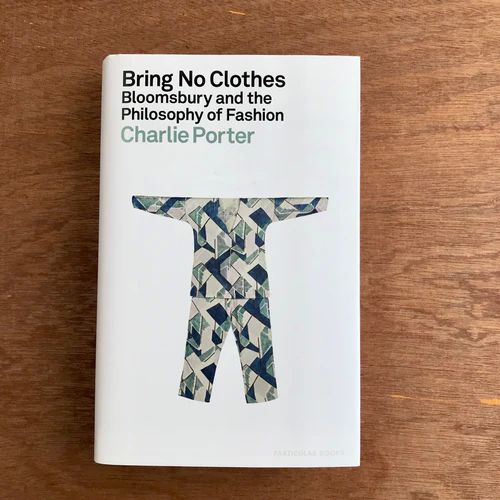
Bring No Clothes: Bloomsbury and the Philosophy of Fashion will be available from Dover Street Market and all good bookstores on September 7; Bring No Clothes: Bloomsbury and Fashion will open at Charleston Lewes on September 13.

 How Virginia Woolf changed the philosophy of fashion. By Charlie Porter.  i-D September 5, 2023. 


Ahead of his upcoming exhibition and book Bring No Clothes, Charlie Porter delves into the clothing of the Bloomsbury Set, unpacking questions of class, Empire and queerness in the process.
 
Since time immemorial, the Bloomsbury Group has held court as one of Britain’s most cited movements in art, design and literature. But aside from hogging undergraduate reading lists, the bohemian circle that lived in squares and loved in triangles has undergone a major runway resurgence.
 
Indeed, fashion seems to cite the queer aristocrats more than any other discipline. Kim Jones, for example, made his ode to Virginia Woolf’s Orlando novel at Fendi couture Spring/Summer 2021, later recreating the Bloomsbury Set’s countryside escape, Charleston house, for Dior Men’s S/S23 show set. SS Daley, another Bloomsbury buff, nodded to EM Forster’s Maurice for S/S22 and one of Woolf’s lovers, Vita Sackville-West, for S/S23. Even as early as Burberry’s A/W14 collection, the languid daubing of Bloomsbury artists Duncan Grant and Vanessa Bell (Woolf’s sister) were colouring trench coats and frocks alike.
 
Of course, no one knows this better than fashion journo-turned-bestselling author Charlie Porter, who has spent the past few years scrupulously researching Bloomsbury for his upcoming exhibition and book of the same name, Bring No Clothes. Homing in on six key members – Woolf, Bell, Grant, Forster, economist John Maynard Keynes and arts patron Lady Ottoline Morrell – and their lived experiences of clothing as both a tool of repression and liberation, Porter unpacks questions of class, Empire and queerness, revising a well-told story with the good, bad and ugly.
 
In the lead-up to the launch of the book, Charlie Porter joins me in his local park to discuss more about the book. We order a coffee, find a dry bench and dive straight in.


Joe Bobowicz: Did the exhibition or the book come first?
 
Charlie Porter: I was asked to do an exhibition on Bloomsbury and fashion in the summer of 2021 and loved the idea because it wasn’t just the clothes of Bloomsbury, but also 21st-century designers’ responses to Bloomsbury. Pretty quickly, I thought that it could be a book, too.
 
JB: In the book, it becomes clear that Virginia Woolf’s experiences of high society and her half-brother George Duckworth’s abuse had made clothing a source of pain for her.
 
CP: So, the clothes have been talked about before, but they’ve never been looked at in this way. In Woolf’s lifetime and 30 to 40 years afterwards, most stuff written about her didn’t take the abuse seriously. Her sister Vanessa Bell talks about the same psychological abuse. They lived in a rigidly constructed Victorian house and lifestyle, their mother had died, and their dad really didn’t care about them. So, Duckworth used them as walkers to accompany him into society events, forcing them to wear torture-like corsets and scrub their bodies every day. They were expected to sit and stay silent with no agency. The clothing is crucial to understanding what it was they escaped from in forming the Bloomsbury Group.
 
JB: You don’t hide from the Bloomsbury Set’s privilege or shameful aspects of their past.
 
CP: Yeah. They used anti-Semitic and racist language, and in 1910, they were involved in what became known as the Dreadnought hoax, where a group of six put on blackface and wore clothing pretending to be the princes of Abyssinia [now Ethiopia]. You have to hold them to account [in order] to find things out about colonisation and dressing up. The changes in clothing that were happening to them are the basis of how we dress today. When I was facing up to the Dreadnought hoax, I thought, “If they were alive today, would they have done this?” I don’t think they would. Although that doesn’t excuse them, I do think that allows it to be scrutinised.
 
JB: One of the parallels you draw is between the deconstruction that Vanessa Bell used in her clothing and the deconstruction seen in Comme Des Garçons collections. You describe it as “thinking through clothing”.
 
CP: Bell was an artist and made her own clothes. Like Woolf, she had some education but not comparative to her male contemporaries, who studied philosophy at Cambridge. I’ve got a photo in the book where she looks like a comedy version of My Fair Lady in this ridiculous hat, all trussed up. And then two years later, there’s a photo of her at an easel painting in a smock, and she looks so alive. You can see that clothing was a lived philosophy. That is, making your own clothes can be part of a holistic way of living, which includes creative acts, different ways of being, attempting to live and love in novel ways that fit with how you feel yourself to be, rather than censoring yourself.
 
We know from family folklore that Bell didn’t care about the finish of clothing; she would just pin stuff. It unlocked things for me because I’ve always thought with handmaking – if you get a pattern or watch a YouTube video – you end up with a version that’s not as good as the one you buy in a shop. It hasn’t got the snap that you get when you buy fashion. I came to realise that it’s because I’m not a machine. If you just make clothes without caring, you can be expressive. I think that’s what Bell was doing.


JB: During the research, you started to make your own clothes as part of grieving your own family loss.
 
CP: It’s been pivotal in helping me. When I started the book, I had no idea about the things I was about to experience. I lost my mum in the summer of 2022, and then towards the end of editing the book, I unexpectedly lost my dad. When I set out thinking about the philosophy of fashion and lived philosophies, I had no idea I was about to live through this. I found if I can move beyond being scared of it, I can just grieve. That’s what making did: it allowed me to just be active in my thinking. It’s meditative; you’re doing a repeated action. Like this cuff here. [Porter gestures to his sleeve.]. It took an hour maybe, all by hand. In that time, my brain can go off and think.
 
JB: John Maynard Keynes and Duncan Grant had a sexual relationship, and clothing played a role in this. How did you notice this?
 
CP: I wanted to look at women and men in Bloomsbury. Duncan Grant is an obvious one because he looks great, but his clothes are about the clothes coming off. He didn’t care about clothes. They were shambolic, shabby, always falling off him because he loved sex and naked bodies. But there were these Bloomsbury figures who wore suits, and their suits never changed. Suits aren’t talked about because the people who wear them say, “Why would you want to talk about my suit?”, in this opinion of: “I’m wearing a suit; therefore you don’t need to question me,” which is patriarchal power.
 
At that time, it was illegal to be a gay male, punishable with jail time. Keynes loved sex – he had a relentless sex drive – and he always wore a suit. Eventually, as he became more famous, he got married to a ballerina, and everyone always says, “And he never slept with a man again.” It’s like, “Because he stopped making lists of who he slept with!” Anyway, there are letters between Grant and Keynes in the British Library. Anyone can read them. They’re so oppressive and heavy because of the imbalance in the relationship. Clearly, Keynes is super needy, and Grant doesn’t really care. Keynes is fascinating because he wears a suit all his life, but his posture breaks the line of the suit. He shoves his hand in his pocket and pushes his crotch forward. It’s intransigent of the line of the suit, which is meant to cover everything as this patriarchal mask. So, he uses his sex to gain power in power dynamics.


JB: In the book and exhibition, you compare Bloomsbury to contemporary designers, like Jawara Alleyne. Was it important to do this?
 
CP: Yeah. I’m not an academic, so there’s no point in just looking at the past without understanding it in the future. I was just with Jawara in his studio, and he was showing me his collection for Fashion East. I was beginning my research into Vanessa Bell, trying to find a source about her use of safety pins – it was really on my mind. Jawara uses safety pins in his work, both to fasten garments and as decoration. If he wanted, he could run up the most exquisite traditional gown, but he chooses not to. It opened up what Vanessa Bell was doing and made me see her as if I was with her. With Woolf, too – they didn’t have the language to understand what it was they were doing – but I think what they were doing was anti-fashion: something that looks so wrong, it’s right. At the moment, [it’s] what Glenn Martens is doing at Diesel. That’s what Mrs Prada does. It’s an understood part of fashion today, but it wasn’t then. Woolf says in her diaries, “I am resigned to my station among the badly dressed.” People take this at face value. I think she’s saying she just doesn’t fit with traditional fashion.
 
Bring No Clothes: Bloomsbury and the Philosophy of Fashion will be available from Dover Street Market and all good bookstores on 7 September 2023. Bring No Clothes: Bloomsbury and Fashion runs at Charleston in Lewes from 13 September 2023 – 7 January 2024.


How Virginia Woolf and the Bloomsbury Group Changed Fashion Forever. By  Joe Bobowicz. Another Magazine, September 6, 2023.


The famous literary circle – composed of creatives such as Woolf, her artist sister Vanessa Bell and novelist EM Forster – has taken on a somewhat dowdy image in our cultural conscience, writes Patrick Sproull. But a revealing new book and exhibition unearth deeper meanings to their sartorial choices.
 
When Dorothy Parker described the Bloomsbury Group as having “lived in squares, painted in circles, and loved in triangles”, she didn’t say anything about how they dressed. There’s a good reason for that. When most people think of the Bloomsbury Group, the informal assemblage of artists, poets and writers established in the early 1900s, we think of their art, their cultural clout, their influence, their incestuousness. What they wore has seldom featured prominently in their legacy. The acclaimed fashion journalist Charlie Porter, though, is eager to rectify that with his excellent new book Bring No Clothes: Bloomsbury and the Philosophy of Fashion.
 
Among the Group’s numbers were Virginia Woolf, her sister Vanessa Bell, author EM Forster as well as economist John Maynard Keynes and the painter Duncan Grant. Their heady existence in the early 1900s is an early example of an enviably cosmopolitan literary social scene that was popularised in the latter half of the century by American writers like Truman Capote and James Baldwin. Their clubhouse was the East Sussex farmhouse, Charleston, and in conjunction with Porter’s book, an exhibition, Bring No Clothes: Bloomsbury and Fashion, opens this month at Charleston’s new gallery in Lewes. The exhibition will draw together original items worn by its members as well as pieces inspired by the Group from contemporary fashion houses, such as Commes des Garcons and Dior.
 
The more famous members of the group, authors Woolf and Forster, have taken on somewhat dowdy images in our cultural conscience, arising from a presumption that because they were so dexterous with words, they couldn’t have a similar command of their wardrobe. Porter, admittedly, is not out to claim that someone like Virginia Woolf was actually a Coco Chanel-esque style maven. But her clothes shouldn’t be dismissed; instead, they are simply another avenue to explore her well-documented complicated genius.
 
“The thing with clothes is that it allows you to get close to an individual and it allows you to get close to their experience,” Porter says. “By looking at their clothes, in particular their actions and what they did at the point where Bloomsbury formed, what emerges is this sense of queer humans and their allies attempting to live life.”
 
That sense of the Bloomsbury Group as a coterie of queer (and queer adjacent) artists forms the main, most vital artery of Bring No Clothes. Porter’s generous, empathetic eye feels like a corrective for the more salacious historical depictions of the Group’s affairs.
 
 “Because they’re upper class it’s [seen as possessing] this poshness or eccentricity, and as soon as something becomes titillation it casts queer people as purely people whose lives are there for entertainment value,” Porter says. “By starting with their clothes, it allows you to be with them and talk about them in non-prurient ways.”
 
As children, Woolf and Bell experienced abuse from their father and half-brother, and they were repressed, like so many women of the time, by constrictive Victorian attire, cinched and pulled and tightened into submission. In adulthood, they found freedom in more liberating clothes: flowing summer dresses, outsized knitted cardigans, long, loose overcoats.
 
They experimented with pattern and colour, and Bell even made her own clothes, often using safety pins to secure garments. Safety pins have now become an enduring staple in contemporary fashion, used by Vivienne Westwood, Jean Paul Gaultier and John Galliano. When safety pins first gained prominence under Westwood, they were a sign of punkish rebellion. That’s precisely how Bell used them at the time; breaking conventions on how fashion operates and telegraphing her own queerness.


Porter dedicates considerable time to the men of the Bloomsbury Group and what their fashion tells us. Having written mostly about menswear, he notes that the vast majority of fashion journalism focuses on women’s clothing. “If there are any stories on the clothes that men wear, it’s normally mocking,” he says. Like when Barack Obama wore a tan-coloured suit and had Fox News enraged for weeks. Or when Emmanuel Macron was photographed with his shirt unbuttoned to reveal his chest hair.
 
 “What that actually covers up is that the patriarchal hold of tailoring is so strong, you’re not meant to question it,” he says. “It never changes. It’s a language of power that’s so entrenched that those in power who wear suits see it as facile to even talk about what they’re wearing. If you question it, it starts to chip away at their patriarchal power.”
 
Porter is a queer man, and his empathy for the Bloomsbury Group’s men makes for the book’s strongest passages. Within the confines of men’s clothing – simple, rigid, unforgiving – the painter Duncan Grant found ways to display his true self; he would wear a vest top hanging off one shoulder, exposing his nipple in an undoubtedly feminising gesture. On other occasions, he would wear a shirt and tie knotted into a messy, unkempt stub, thumbing his nose at the refined presentation expected from men. Sometimes Grant would simply wear nothing at all, as he was frequently photographed naked.
 
If Grant is an example of a queer man completely unburdened by societal expectations, his obverse is EM Forster, the author known for Howards End and A Room with a View. There was a man whose body was for no one but himself, tightly hidden under cotton and wool suits. Forster’s entire life was constrained by homophobia; his greatest, queerest work, the gay love story Maurice, was written between 1913 and 1914 but not published until 1971. Forster’s presentation, in the model of the neat, prim English gentleman, was a tourniquet for his queer identity, much like any inhibitive corset.
 
Porter’s treatise on the clothes of the Bloomsbury Group feels like it doesn’t just introduce a new frame of thinking, it adds a fresh layer of humanity to the collective. He approaches them like peers, offering theories and speculation he admits could be wrong, but his level of thoughtfulness and care would have you believe it all. Porter is aware that fashion can often serve as a distraction – he comments on a shallow reading of the Group that he finds “completely uninteresting”, that of the so-called “Bloomsbury look”, an imprecise, gift shop-ready understanding of their aesthetic. “Anyone can look at a photo and copy it,” he says. “It’s not interesting.”
 
It’s not just the Group that has fallen victim to reductionism – think of Frida Kahlo socks, Van Gogh magnets or Sylvia Plath tote bags. Yes, it’s entirely possible to patronise an artist’s talent through their clothes, but only if you lack the capability to understand that clothes are an essential part of their identity and offer more than mere aesthetic value. I mention to Porter a recent profile of Zadie Smith in Vogue, where the novelist was vividly photographed wearing Alexander McQueen and Maison Margiela. Allowing Smith the opportunity to express herself away from the page doesn’t diminish her writing, and clothes can often be as important a way to access a person’s complexities as their art or writing.


“I think their clothes allow you to look at their literature or art or political and economic thinking with honesty and clear, fresh eyes, rather than layers of academic thinking,” Porter says. “For me, it’s expansive, not reductive.”
 
‘Bring No Clothes: Bloomsbury and the Philosophy of Fashion’ by Charlie Porter is out now. Bring No Clothes: Bloomsbury and Fashion is at Charleston in Lewes from 13 September
 
Loved in triangles, dressed for liberation: The queer fashion secrets of Virginia Woolf and the Bloomsbury Group.  By Patrick Sproull. The Independent, September 11, 2023. 


When Virginia Woolf invited TS Eliot down for a country weekend in 1920 she concluded with “Please bring no clothes”. This was not a suggestion that “Tom” should arrive in East Sussex naked. Such a possibility was unlikely anyway since at this point the poet was still working as a buttoned-up clerk at Lloyds Bank. Eliot was famously wedded to his three-piece suit to the point where, Woolf joked, he would have worn a four-piece one if such a thing existed. What she meant by “bring no clothes” was that at Monk’s House they did not dress for dinner, change for church (there was no church), or worry about getting their best clothes grubby in the garden. This was Bloomsbury, albeit a rural version, and the clothing conventions to which the rest of upper-middle-class society had returned after the first world war had no place there.

 
Fashion journalist Charlie Porter is spot-on with his suggestion that the way the circle thought about clothes was part of a wider revolt against the late-Victorian society in which its members had been raised (Woolf was born in 1882, Eliot six years later). Choosing not to wear black tie for dinner or gloves “in town” was all part of the code that also involved refusing to take up arms against the Germans, or follow the usual rules about who could sleep with whom, or adhere to inherited artistic forms – linear narrative in fiction, mimesis in painting – in favour of something more impressionistic.
 
According to Porter’s analysis of Bloomsbury’s style preferences, Woolf swapping the pinched-in Edwardian corsetry of her youth for of a loose, flowing silhouette was the precondition of her sexual experimentation with Vita Sackville-West. Likewise, this sartorial undoing enabled her to experiment typographically at the Hogarth Press, co-founded with husband Leonard, which published Eliot’s form-busting The Waste Land in 1923. Similarly, Duncan Grant’s near-constant nudity was of a piece with his capacity to be both a lover of men and a steady partner to Woolf’s sister Vanessa, who was officially still married to Clive Bell.
 
Thanks to his access to the contents of several Bloomsbury wardrobes, together with a trove of previously unseen photographs, Porter is able to provide a detailed illustration of how “Make it new” – the cry of modernists everywhere – played out on the material level. He shows us Lady Ottoline Morrell’s frocks, which are a form of Elizabethan cosplay with their puffed-up shoulders (useful for balancing out Lady O’s 6ft frame), while Vanessa Bell knocked up pyjamas out of the abstractly patterned cloth that she had originally designed for sofas.
 
There was another type of Bloomsbury dressing, more Eliot than Grant. The obvious figure here is EM Forster, who continued with the formal suit as a defensive armour against his yearning for male bodies. The novelist did not lose his virginity until he was 38, and even then he kept on with high-table manners. Porter includes plenty of photographs of the novelist sweating in the noonday sun while standing alongside the many lovely young men in dhotis or fezzes that he encountered on his travels. The only time Forster looked unambiguously happy was when photographed in “Indian court dress”, which resembles nothing so much as a tea gown that Vanessa Bell might have repurposed with kitchen scissors.
 
Less deft is Porter’s attempt to urge a clothing revolution for our own times. Suggesting we should all be a bit more Bloomsbury in order to break out of the endless churn of fast fashion misses the point that Woolf’s and Grant’s anti-fashion stance was just that – a style that had been consciously crafted and refined with a view to public performance. In doing so they were actually echoing their parents and grandparents, who had been keen exponents of the Arts and Crafts look of the 1880s (Julia Margaret Cameron, the photographer of all those droopily dressed maidens, was Virginia and Vanessa’s great-aunt). The history of dress is packed with such anti-fashion moments, and to suggest that emulating Bloomsbury’s version would somehow allow us to “forge new ways of being” seems a little naive.
 
 Bring No Clothes: Bloomsbury and the Philosophy of Fashion by Charlie Porter is published by Particular (£20).
 
Bring No Clothes: Bloomsbury and the Philosophy of Fashion by Charlie Porter review – style revolution. By Kathryn Hughes. The Guardian, September 6, 2023.


 From Virginia Woolf and her circle to Kate Moss’s Vogue shoot, the unconventional Sussex farmhouse has captured imaginations across the decades

 The most fashionable house in England isn’t on an elegant London street or in a chocolate-box Cotswolds village, but at the end of a long, narrow, often muddy country lane riven deep in a fold of the Sussex Downs. Inside, there is not a single midcentury cocktail cabinet, rainforest shower or Italian designer sofa to be found. Instead, Charleston is a thickset farmhouse of doughty 17th-century stone, scrambled with roses, dormer windows nosing from a slope of weathered tile.

 
The layout is warren-like rather than open plan, the floors unevenly boarded. As is the way with country houses that were built to keep out the chill, the windows are on the small side, the light a little gloomy. But every room is decorated by hand, in dizzying detail – sponge-painted diamonds on wood panelling, a still life of hollyhocks and poppies on a wooden door, nude figures either side of a fireplace encrusted with colourful tiles – so that the house sings with colour and with life.
 
The fashion world is as in love with Charleston now as the Bloomsbury set were from the moment in 1916 when Virginia Woolf stumbled across the house and wrote to her sister, Vanessa Bell, that “it has a charming garden, with a pond, and fruit trees, and vegetables, all now rather run wild, but you could make it lovely”.
 
Bell, the painter Duncan Grant and a tangle of family, lovers and friends made the house their home and studio for six decades; after Grant’s death in 1978, it opened to the public in 1986. In Paris last June, a scale model of the house was built as a stage set for a Dior menswear catwalk show, which included prints drawn from Duncan Grant paintings. A year earlier, Kate Moss was photographed for British Vogue on one of the house’s faded sofas wearing only a pair of Fendi couture high-heeled boots, embroidered all over with pearls and sequins, and Bell’s own straw sunhat. Next month, Charleston’s new gallery space in nearby Lewes will stage Bring No Clothes: Bloomsbury and Fashion, curated by Charlie Porter, the first major exhibition to explore the Bloomsbury influence on style.
 
The Charleston look has spread from the catwalk to our homes. The naive vibrancy that is the most distinctive feature of Charleston’s interiors is, right now, piled high in high-street homeware stores. Brightly painted plates and bowls borrow from the cheerful bohemia of Duncan Grant’s pottery. Rugs have scalloped edges, water glasses are daubed with swirls, lampstands fashioned from towers of bobbins. Lemon-print aprons by La DoubleJ and ladybirds on leaf platters by Bordallo Pinheiro bring to life the informal, communal spirit of a house where the dining table, chairs and fireplaces were all lovingly painted. Ella Joel, homeware buyer at Matches, is seeing fashion-conscious customers drawn to colourful rustic wicker placemats by Cabana, heart-daubed plates by Summerill & Bishop and shell-painted ones by Ginori 1735.
 
The irony of Charleston being fashionable is that the Bloomsbury set – who “lived in squares, painted in circles, and loved in triangles”, as Dorothy Parker put it – had little time for fashion. Bring No Clothes, the title of the upcoming exhibition and Porter’s accompanying book, takes its name from an instruction Virginia Woolf gave to house guests. (“Please bring no clothes: we live in a state of utmost simplicity,” she wrote to TS Eliot, inviting him to stay in 1920.)
 
But the instruction is nothing if not a fashion statement. The disdain for dress codes, the irreverent self-expression of painting directly on to fireplaces and door frames, and the famously unconventional cat’s cradle of relationships between Vanessa Bell, Duncan Grant and Grant’s lover David Garnett, all flower from the same free-thinking root. To stand in one of Charleston’s exuberantly painted rooms is to feel how much the inhabitants loved and celebrated the world of ideas; to be invigorated by their robust interrogation of tradition. And there is something very modern about the way the Charlestonians remade their home in their own image, painting directly on to wardrobes and headboards without boundaries between art and life. The house is, in a way, a giant – and gloriously unfiltered – Bloomsbury group selfie.
 
More than a century later, Charleston resonates with audiences who find more to relate to here than in the more conventional British stately homes, with their four-posters and gleaming silver cabinets. “A lot of people, perhaps especially from the LGBTQ+ community, are drawn to how the Bloomsbury group created an alternative vision of a chosen family,” says Nathaniel Hepburn, director of Charleston. Dotted with portraits of children, the house is imbued with a vibrant spirit of family and love. The fashion designer Susie Cave spoke at the recent Charleston festival of the kinship she feels between the house and the chosen family of creatives who make up her Vampire’s Wife design team.
 
Charleston’s lack of grand ballrooms or ghosts of liveried butlers has given it fresh charm for a generation of visitors who, in the cost of living crisis, have cooled on Downton Abbey nostalgia. “It is the antithesis of a great house,” says Hepburn. “It is a very modest house which was transformed, with very simple means but an extraordinary aesthetic and hard work, over 60 years. They made things, bought furniture from flea markets.”
 
There is, for all the decorative touches, a bracing sense of frugality in the bones of the place. “I know that many of our visitors take ideas home with them, and not just about stencil work around a fireplace,” he says. “The house shakes your perception of how different objects can fit together.”


Charleston has blue-blooded fashion pedigree. Annie Leibovitz shot Nicole Kidman and Vanessa Redgrave in the house in the 1990s. In the 2000s, Christopher Bailey landgrabbed Bloomsbury as a keystone reference for his revamped vision not just of Burberry but of Britishness itself, one rooted in hedgerows and country lanes and cups of tea but championing the artisanal and the outsider, where once Burberry had stood fast for umbrellas and stiff upper lips. Burberry’s autumn 2014 collection zoomed in on Charlestonian detail, silk dresses heavy with soft painterly scallops and petals.
 
Yet Charleston was in danger of closing in 2020, when lockdown wiped out ticket sales. Launching an emergency crowdfunding appeal to raise £400,000, Hepburn warned that with “no reserves and no endowment” to fall back on, the situation was dire. That Charleston now finds itself on an upswing owes something to influential British fashion designer Kim Jones, designer of both Dior menswear and Fendi womenswear and a student and collector of Bloomsbury books and paintings.
 
Jones first visited Charleston aged 14, on a trip with his school from nearby Lewes, and felt a kinship with “a group of outsiders, just as the fashion world is full of outsiders”. As a teenager, he sketched in the garden; these days, his extensive private collection includes both Vita Sackville-West’s and Vanessa Bell’s personal copies of Woolf’s Orlando, paintings by Duncan Grant, a shell necklace owned by Woolf, and a teapot painted as a birthday present by Vanessa Bell for her sister Virginia. Bloomsbury is no passing whim for Jones, who is fascinated by these people born in Victorian England who reacted against their time. Dior are bringing glamour and financial support, sponsoring the Bring No Clothes exhibition. “Kim has real knowledge and respect for the work,” says Hepburn. “This is not a pastiche. He is really thoughtful about the ideas behind the visuals.”


Scholars will roll their eyes at the reductiveness of the Bloomsbury name being bandied about for squiggles on a mass-produced painted plate, but there is no denying that the focus on Charleston plays into a style pendulum swing away from Scandi minimalism. The richly decorated aesthetic is yang to the yin of the uncluttered minimalism that has become the default setting of modern good taste.
 
Bloomsbury style, according to Porter “is absolutely not about the deification of clothing, which is the familiar narrative of fashion, and I hope that visitors will use the exhibition to reconsider their own relationship with clothing”. The wildly decorated rooms at Charleston are delicious in their rampant details – an eye and a heart here, a bug and a rose there – but their soul is in their DIY ethos. “When you see the wardrobe that Vanessa Bell painted, it makes you think about what you could do yourself. There is a sense of possibility about Charleston that makes it a very alive place to be,” says Porter. “It is ironic, really, that Charleston inspires stuff that gets mass-produced, because what the house asks you to do, always, is to think for yourself.”
 
 Bring No Clothes: Bloomsbury and Fashion is at Charleston in Lewes from 13 September


‘The house sings with colour and with life’: how the fashion world fell for Charleston, the Bloomsbury set’s country home. By Jess Cartner-Morley. The Guardian, August 12, 2023. 


The circle of artists, writers and intellectuals, which formed in the first half of the 20th century, continues to captivate designers.
 
At Dior Men’s spring 2023 show last June, the brand’s artistic director, Kim Jones, sent out models in sweaters printed with Post-Impressionist works by the early 20th-century painter Duncan Grant, a member of the constellation of British artists and intellectuals known as the Bloomsbury Group. As a teenager, Jones had moved with his family to the East Sussex village of Lewes, not far from Charleston, the 16th-century farmhouse Grant leased with Vanessa Bell, also a painter. Now a museum, the house was a gathering place for the endlessly mythologized Bloomsberries, that loose collective of friends and creative conspirators who “lived in squares, painted in circles and loved in triangles,” as an observer once famously noted, and which included Bell’s sister Virginia Woolf, the fellow writers E.M. Forster and Lytton Strachey, the economist John Maynard Keynes and the art critics Roger Fry and Clive Bell.


For his presentation, Jones commissioned a large replica of Charleston, where he used to spend time sketching. It wasn’t his first homage to the Bloomsbury set; the dresses from his spring 2021 haute couture debut for Fendi, hand-embroidered with organza flowers and crystal beads, were based on Woolf’s 1928 novel, “Orlando,” a gender-transgressive love story that’s recently been adapted into a stage production on London’s West End.
 
Like other British designers before him — among them Erdem’s Erdem Moralioglu, and Christopher Bailey, when he was at Burberry — Jones keeps finding fresh inspiration in Grant and his cohort: their dishabille and their rejection of Victorian England’s conservative values. The curator Darren Clarke, who recently mounted a show at Charleston of Grant’s previously unseen homoerotic drawings from the late 1940s and ’50s, was attracted to the artist’s tender but also explicit and humorous celebration of gay love. With Bloomsbury, “it feels like everything has been written about them,” he says. “But then it always surprises you that something else comes along.”


Steven Stokey-Daley, the Liverpudlian founder of the sustainable men’s wear line S.S. Daley, channels that period by offering his own queer take on elite British dress codes. “As a visual person, and as someone who enjoys the romanticism of literature, I find Bloomsbury so exciting to unpick and explore,” says the LVMH Prize winner, whose 2020 graduate collection — which included white wool tennis coats, voluminous toile de Jouy trousers and wide-brimmed boaters — alluded to Forster’s gay coming-of-age novel, “Maurice” (published posthumously in 1971).


This fall, Jones and Stokey-Daley will join Comme des Garçons’ Rei Kawakubo and other designers in contributing pieces to an exhibition at Charleston titled “Bring No Clothes: Bloomsbury & Fashion.” The name derives from a letter Woolf sent T.S. Eliot in 1920, encouraging the Modernist poet and essayist to visit her home in Rodmell, East Sussex. “Please bring no clothes,” she wrote. “We live in a state of the greatest simplicity.” Today, Bloomsbury is often associated with the group’s personal aesthetics, but that simple statement captures their true spirit. As Charlie Porter, the show’s curator, says, “It wasn’t about a look at all.”
 
 
Why  Fashion Can’t Get Enough of the Bloomsbury Group. By  Kin Woo. The New York Times, February 23, 2023.