Preston
Sturges died in August 1959, when Donald Trump was thirteen years old. So it’s
not his fault that the uses to which the grandiose Mar-a-Lago estate in Palm
Beach has more recently been put include the development of a club of which
Jeffrey Epstein was briefly a member, as well as an impromptu storage facility
for state secrets. But he did rather like the atmosphere of the place. Eleanor
Hutton, his second wife, was the daughter of the food magnate Marjorie
Merriweather Post, who built this ‘seventy-bedroom cottage on the sea’, as he
called it, in the late 1920s. The weeks Sturges spent as Eleanor’s house guest
at Mar-a-Lago supplied him with abundant material when he came to write and direct
The Palm Beach Story (1942), which exemplifies his approach to film in the
challenge it poses to Hollywood decorum through riotous alternations of
slapstick and salty dialogue. ‘Millionaires are funny’ was the lesson he drew
from the experience. The millionaires in The Palm Beach Story are funny both in
the sense that their customary exemption from everyday rough-and-tumble renders
them particularly susceptible to humiliation by pratfall and in the sense that
their vast wealth has by this account equipped them – contrary to popular
prejudice – with an unquenchable desire to help out those less fortunate than
themselves. Sturges certainly possessed a soft spot for the super-rich. It’s
idiosyncrasies of this kind which ensure that his films, while unapologetically
straight off the studio production line, are never bland.
Sturges
came late to writing, later to writing for film, and later yet to directing
what he had written. Judging by his autobiography – a text ‘adapted and edited’
by his fourth wife, Sandy, from the mass of memoirs he left at his death – he
had no wish to be famous for being famous. It takes him until page 292 (out of
340) to get to his debut as writer-director. Some debut it proved, too. The
Great McGinty (1940) didn’t just make his name. It scooped the inaugural
Academy Award for Best Original Screenplay. The six further comedies he went on
to write and direct for Paramount, from Christmas in July (1940) to Hail the
Conquering Hero (1944), enjoyed consistent critical and commercial success. At
least two of them, The Lady Eve (1941) and Sullivan’s Travels (1941), have
since achieved classic status in accounts of Hollywood comedy.
But
there is something else that demands acknowledgment, something woven into the
pell-mell seriality of a life in which career opportunities, like wives and
children, came and went: artist, store manager, airman, stockbroker, private
secretary (fired on his first day), gigolo (declined), inventor, industrial
magnate, playwright, script doctor, film director. Sturges was a born
overreacher. You don’t get very far into any of his films before the sound of
breaking glass announces the consequence of yet another false step or expansive
gesture. But these are, for all their amplified vehemence, the blithest of
shatterings. Sturges liked the idea of being able to act with impunity. ‘I am,
always was, and always will be violently optimistic. I knew at twenty that I
was going to be a millionaire. I know it today. In between times, I have been.’
The violent optimism arose from the life. It sets the tone of the
autobiography, and of the films.
Sturges
was born in August 1898 in Chicago. His biological mother and father soon
separated. The place of the nuclear family in his upbringing was to be taken by
an eerily symmetrical ad hoc quasi-parental quartet: two mothers (one
biological, the other surrogate), two fathers (both surrogate). In January
1901, Mary Biden, née Dempsey, set off for Paris to study for the stage, with
the infant Preston in tow. A woman of inexhaustible enterprise, she was always
going to land on her feet. To help things along, she now called herself Mary
d’Este, on the grounds that Dempsey had always been a crude anglicisation
obscuring noble (if distant) Italian ancestry. When she gave the cosmetics
business she subsequently established the name Maison d’Este, the noble
Italians objected, and she had to revert to Desti. She had barely set foot in
Paris before becoming best friends with Isadora Duncan, then cutting a swathe
through the more bohemian reaches of the avant-garde with her lyrical
interpretations of dance. A good deal of Sturges’s life until the age of
fifteen was lived as a junior member of Duncan’s entourage. His biographer
Diane Jacobs regards these two ‘complex women’ as the ‘crucial influences’ on
Sturges both as a person and as a filmmaker. The optimism they instilled in him
was made possible by their excess of talent, beauty and charm. ‘I have never
waited to do as I wished,’ Isadora was to declare. The attitude evidently
rubbed off on Mary, who also knew that she was, as Jacobs puts it, ‘among the
world’s elite’, and thus ‘entitled to do as she pleased’.
In
September 1901, Mary took the three-year-old Preston back to America, where she
proceeded to marry Solomon Sturges, a well-to-do stockbroker from a prominent
Chicago family. This was his first encounter with a kind of entitlement drawn
not from late Romantic aesthetic ideology, but from an inheritance of power and
prestige accumulated over generations. The two kinds, it appeared, could co-exist.
Solomon promptly agreed that his wife and adopted son should henceforth spend
six months of the year in Chicago, and six in Europe. The arrangement came to
an end in 1907, after a violent quarrel during which Preston first learned that
Solomon was not his biological father. Solomon, however, remained a much loved
surrogate, even – or especially – after his separation from Mary. For one
thing, his kind of entitlement generated helpful displays of largesse. ‘Father
always put up the money for everything.’ In 1909, the quasi-parental quartet
was completed by the arrival of Duncan’s new lover, Paris Singer, heir to the
sewing machine millions, who made an immediate, lasting impression. When Singer
was in town, Sturges later recalled, ‘I became a temporary millionaire and went
every place.’ It was Singer who introduced him to Palm Beach. There can be no
doubt about the enduring influence exerted on Sturges by his two surrogate
fathers. ‘He was conservative in politics,’ Stuart Klawans observes, ‘after the
fashion of moneyed people who resent paying taxes, and proudly cynical.’
Although
scarcely definitive as an account of the life, the autobiography does establish
and maintain a revealing tone. Facetiousness – a form of wit which is less a
statement about the world than an indirect expression of character by means of
sheer nagging insistence – came naturally to Sturges. He sometimes caught
himself at it. ‘Money? My God, I earned so much money, so much that it seemed
unimportant to me and I came to pooh-pooh it ... the last thing in the world
one should pooh-pooh.’ Money was not the only thing to receive a pooh-poohing.
In 1918, Sturges trained as a pilot. He was just getting the hang of the
appropriate Top Gun manoeuvres ‘when a terrible disaster overtook us all: on 11
November 1918, the war ended.’ It’s understandable that he should have been
eager to ‘take some shots at some Germans’; and that he subsequently came to
regret his bravado. But the autobiography’s recantation still has the ring of a
classic non-apology apology. ‘Much time has passed since that war, and my
feelings about the end of it are now quite correct.’ Facetiousness flows from
the violent optimism bred by entitlement.
In
January 1927, Sturges’s first wife, Estelle de Wolfe Mudge, an heiress, like
Eleanor Hutton though on a less lavish scale, walked out on him. He fled to
Chicago, and the care of his adoptive father. This seems to have been a low
point. Eventually, however, violent optimism kicked in again, and over the next
few years he made a new career for himself, first on Broadway, where the
success of Strictly Dishonourable (1929) was followed by a string of failures,
and then in Hollywood. In 1933, he sold The Power and the Glory, an original
screenplay based on the life of Hutton’s grandfather, C.W. Post, to Jesse
Lasky, who had just joined Fox as a producer. Lasky expected a brief treatment;
what he got instead was the ‘most perfect script’ he had ever seen. ‘I felt
that proceeding sans director and sans teammates,’ Sturges said later, ‘gave me
an opportunity to show how I thought it should be done.’ He was soon rubbing
shoulders with some of his new teammates on the Fox lot. He couldn’t get over
the superb condescension unfailingly displayed by the studio’s star directors.
‘They were all princes of the blood.’ The metaphor is telling. Here, at last,
was an elite worth joining.
Klawans
makes it clear that his approach to Sturges’s major films will ‘veer’ from
‘biographical-psychological’ interpretation. Instead he means to follow Stanley
Cavell in demonstrating that these films, like many others produced in the
studio era, ‘can be understood to unfold like reasoned arguments about subjects
of real concern. That is to say, they can be read’ – literally so, in fact,
since we’ve long been able to draw on two hefty volumes of screenplays superbly
edited by Brian Henderson. What I have described as idiosyncrasies, Klawans
would probably regard as complications intended to reinvigorate well-worn comic
formulae. He doesn’t by any means underestimate the strength of the contempt
for ‘simple-minded convention’ that Sturges acquired at a young age through his
exposure to ‘boulevardier sophistication and bohemian élan’. But his aim is to
identify in the films a counteracting ‘democratic impulse’: a belief that the
‘gaiety of invention’ afforded by language can serve as a vital resource for
those who have to ‘get by in a world that on average is absurd and at worst
feels like a trap’.
There
is a moral, social and perhaps even political point to the gaiety. The
complication Klawans has mined to greatest effect is the sense of foreboding
that lies just below the surface even of films as jocular as The Lady Eve, a
whip-smart variation on the Genesis myth which merits a chapter in Cavell’s
widely influential study of screwball, Pursuits of Happiness (1981).
Multimillionaire Charles ‘Hopsy’ Pike (Henry Fonda) is beguiled twice over by a
temptress (Barbara Stanwyck) whom he encounters for the first time as Jean, a
con artist working a cruise ship, and then as Lady Eve Sidwich, guest of honour
at a party thrown in the Pike family mansion in Connecticut. Sturges, familiar
as few other Hollywood directors were with such establishments, loaned the
production his own silverware. Klawans is particularly good at identifying the
mean streak in Hopsy which complicates another of Sturges’s characteristic
happy-ever-after (or is it?) endings. Where such pursuits of bleakness are
concerned, however, the place to start is Sullivan’s Travels, still his
best-known film, and one which explicitly addresses the plight of those for
whom the world feels like a trap.
The
screenplay for Sullivan’s Travels was the first Sturges had written in the full
knowledge that he would also direct, and the film wastes no time in announcing
itself as a de luxe production. The camera pulls back from the Paramount logo
to reveal that it is in fact the seal on a large package. A woman’s hands enter
the frame. She removes the wrapping from the package. Inside is a large,
gilt-edged book. Sullivan’s Travels, we read, ‘by Preston Sturges’. The woman’s
hand turns the pages of a credits sequence which concludes with a high-flown
dedication to ‘the memory of those who made us laugh: the motley mountebanks,
the clowns, the buffoons, in all times and in all nations, whose efforts have
lightened our burden a little’. This pronouncement, too, must surely be ‘by
Preston Sturges’. Who else?
Enter
our hero, John L. Sullivan (Joel McCrea), acclaimed director of hit comedies
and musicals, who’s about to tell the studio bosses that he’s done with the
motley mountebank malarkey. He wants instead to make a film of a grittily
realist social protest novel titled O Brother, Where Art Thou?, by Sinclair Beckstein
(Sinclair Lewis meets John Steinbeck). When the bosses point out that he has no
relevant personal experience on which to base such an adaptation, he declares
that he will go on the tramp until he does.
It’s an
intriguing premise. Hollywood’s standard three-act structure requires that
Sullivan’s odyssey should unfold in stages. In Act 1, the bosses, knowing a
publicity coup when they see one, equip him with a tramp’s outfit and a back-up
‘land yacht’ crammed with studio personnel. Escaping the clutches of the land
yacht, he enjoys an adventure or two before ending up back in Hollywood, where
a woman he meets in a diner buys him a cup of coffee. In Act 2, the woman,
known simply as The Girl (Veronica Lake), insists on accompanying him – ‘I know
fifty times as much about trouble as you ever will’ – on his next, somewhat
steeper, descent into the lower depths. In Act 3, Sullivan, concluding that he
will never witness enough poverty to be able to make a decent film about it,
returns alone to shantytown to distribute compensatory five-dollar bills, and
is duly mugged. Assorted further mishaps earn him a spell on a brutal prison
farm during which an audience’s response to a Disney cartoon teaches him the
value of shared laughter. Engineering his own release from the prison farm in a
further gratifying blaze of publicity, he announces to his bosses and The Girl
that he no longer has any intention of making the ‘tragedy’ they now expect him
to make. Turns out that ‘there’s a lot to be said for making people laugh. Did
you know that’s all some people have?’ His final word, over a montage of
laughing faces, is a limp ‘Boy!’
Klawans
readily acknowledges the feebleness of this ending. There surely has to be more
to the film than that. But what, exactly, if not social realism? Disobligingly,
Sturges doubled down on Sullivan’s underwhelming ‘Boy!’ in the autobiography.
‘After I saw a couple of pictures put out by some of my fellow comedy-directors
which seemed to have abandoned the fun in favour of the message, I wrote
Sullivan’s Travels to satisfy an urge to tell them that they were getting a
little too deep-dish; to leave the preaching to the preachers.’ If it looks
like a duck, swims like a duck and quacks like a duck, then it probably is a
duck.
The real
problem, for a film that champions art over life (or at least Walt Disney over
Sinclair Lewis and John Steinbeck), is that its comic scenes are, as Klawans
also acknowledges, so much worse than its ventures into documentary realism. So
bad are the three knockabout sequences which chronicle the first stage of
Sullivan’s travels, in fact, that he can only describe them as parodies of the
comic genres which would have been the stock-in-trade of a successful
journeyman director like Sullivan. Unhappy at being trailed by the land yacht,
Sullivan hops a ride with a farm boy in a makeshift hot rod. A headlong pursuit
ensues, as Sturges cuts frenziedly back and forth between the hot rod and three
separate interiors within the wildly bucketing vehicle chasing him. Six separate
shots show the Black chef on board (Charles Moore) flung violently from one end
of the galley to the other – eggs fly off the tray he totes – and on one
occasion through its roof. A seventh finds him on the floor, as though in some
other, oddly restful space and time, cradling a bowl of pancake batter which
has apparently mixed itself in the interim without any indication of spillage.
There he sits, having just removed his head from the bowl, an apparition in
whiteface. And there he stands, a few minutes later, after the yacht has come
to a halt, as the crew assembles to wave Sullivan off on his henceforth solo
adventure. It’s clear from the last and significantly closer shot in which the
chef features in this scene that the batter has been reapplied, since it now
drips from his nose and chin. Sturges has junked the logic of the pursuit
sequence in order to shoehorn in a conceit. Is this parody? Or did his
facetiousness get the better of him?
In Acts
2 and 3, Sturges goes out of his way to broaden Sullivan’s horizons. Before
Sullivan can ‘embrace his identity as a privileged director of comedies’,
Klawans remarks, he will have to experience as well as witness extreme
deprivation, and learn that he can’t end it. On the prison farm he gets a
beating, and is confined to a coffin-like sweatbox for a day. But he’s allowed
to accompany the rest of the convicts when they’re taken to a nearby church to
join its African American congregation for a showing of a Disney cartoon
featuring Pluto the dog. The minister (Jess Lee Brooks) exhorts his congregants
to welcome the ‘guests’ who will shortly join them, guests ‘less fortunate than
ourselves’. He then leads them in a rendition of ‘Go Down, Moses’ as the
convicts shuffle in. During the film show, Sullivan is gradually, reluctantly,
caught up in the waves of laughter which surround him on all sides. The
function of this rite of passage, which takes place in a liminal space set
apart from life as it is customarily lived (by Hollywood’s mostly white
audience), is to reassert a common human bond by dissolving social, cultural
and racial identity.
The
result, as Klawans rightly remarks, is ‘a scene of Black church life so
dignified and respectful’ as to be ‘almost unassimilable’ within classical
American cinema: respectful enough, in fact, to merit an immediate thank-you
letter on the film’s release from Walter F. White, executive secretary of the
National Association for the Advancement of Coloured People. We need to pause
here. The letter isn’t quite the anti-racism kitemark it has sometimes been
taken to be. White, who developed a lively interest in Hollywood’s
representation of African American culture, was at that point in the middle of
a charm offensive (a method he much preferred to protest or boycotts). He was
soon to champion The Ox-Bow Incident (1943), a Western which also features an
eloquent Black pastor, on account of its condemnation of lynching. Sturges may
have got lucky. When White left the country to take up a post as a foreign
correspondent, the role of chief Hollywood inquisitor was assumed by the more
combative Julia Elizabeth Baxter. Ellen Scott’s researches in the NAACP archive
have revealed that Baxter paid greater attention than White had to the racial
caricature latent in cinema’s visual and verbal detail. It would be interesting
to know what she made of the whiteface gag.
Still,
the scene in the church is strangely compelling – right up until the moment
when Sullivan starts to laugh at Pluto along with everyone else, and we realise
that the entire elaborate event has been staged so that this charmless halfwit
can give himself permission to re-embrace his identity as ‘a privileged
director of comedies’. Klawans offers a more generous interpretation. Sullivan,
he says, ‘sits in the church not as a victim but as a witness’, at long last
‘one among the multitudes’. Maybe. But the underlying question remains. Why has
Sturges had to outsource the hard work of Sullivan’s moral transformation to an
initiative taken by an African American preacher?
The
reason, I think, is that in Act 2 his comic invention fails him. Sturges the
writer has supplied Sullivan with a female companion whom Sturges the director
allows to go to waste. The screenplay proposes Charlie Chaplin’s The Gold Rush
(1925) as one of the films that could possibly be shown in the church. Chaplin
apparently refused permission. But he left his imprint on the film. The heroine
of The Gold Rush, like the heroine of Sullivan’s Travels, is known only as The
Girl. Sturges was determined, despite strong opposition from the studio, to
cast Veronica Lake in the role. He liked the fact that Lake stood five foot two
inches in her socks. The key exhibit is the lengthy interview she gave to Life
magazine in May 1943. Sturges, she said, had ‘analysed’ her size, explaining to
her that, like Chaplin (5’4”) and Mary Pickford (5’1”), she belonged to a
‘motion-picture race of Little People’ whose members for some reason assume a
sort of luminous vivacity in front of the camera. In Act 2, clothed in
loose-fitting jacket and baggy trousers (she was in any case pregnant at the
time), Lake becomes Charlie the Tramp’s blonde female reincarnation. It could
be that Sturges wanted at once to allude to and to channel a filmmaker who –
even (or especially) in his depictions of poverty – knew how to make people
laugh and move them at the same time. If so, he failed. The Girl, for all her
claim to know more about trouble than Sullivan does, is never a figure to be
reckoned with. In Act 3, she disappears from the film altogether, to re-emerge
at its end as simpering arm candy. Sullivan’s Travels voices intelligent
disquiet about Hollywood hustle, without being able to envisage anything
better.
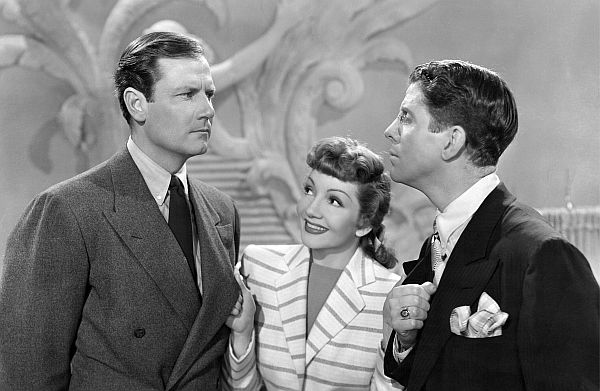
Sturges,
at any rate, reverted to a strict adherence to genre. The Palm Beach Story, a
screwball comedy, was apparently conceived as an illustration of his theory of
‘the aristocracy of beauty’. A woman leaves the dull and ineffectual husband
she is still strongly attracted to because, as Klawans puts it a little drily,
she ‘feels that her abilities are greater than the economic value assigned to
her by marriage’. ‘You have no idea,’ Gerry Jeffers (Claudette Colbert)
declares to her husband, Tom (Joel McCrea), ‘what a long-legged gal can do
without doing anything.’ The film’s original title, swiftly rejected by the
censors, had been ‘Is Marriage Necessary?’ The things Gerry wishes to do
without doing anything are to be done in the millionaires’ playground of Palm
Beach. Like those precursor aristocrats of beauty, Mary Desti and Isadora
Duncan, Gerry will need to find some amenable sponsors if she is to sustain her
bid for freedom. Fortunately, the Wienie King (Robert Dudley), a lugubrious
sausage magnate, is on hand to clear the improvident couple of debt; and the
journey from New York to Palm Beach yields a multi-purpose Florida meal ticket
in the shape of the unimaginably rich John D. Hackensacker III (Rudy Vallée).
Arriving
penniless at Penn Station, Gerry blags her way onto the train by enticing the
elderly millionaires of the Ale and Quail Club to adopt her as their ‘mascot’.
The Ale and Quailers have hired a whole carriage, with a view to a gigantic
piss-up. Sturges is certainly pleased to see them, because they waste no time
at all in supplying the film with its quota of broken glass. A pair of boobies
take aim with their shotguns at a handful of crackers tossed for them by the
Black barman (Charles Moore, once again), and succeed only in blowing out
several windows. This is perhaps the blithest of all Sturges’s blithe
shatterings. Hell, they own the joint for the duration of the journey and they
can do whatever they bloody well like with the furniture. The barman dives for
cover as they turn their fire on the rows of bottles behind him.
Klawans
doesn’t quite know what to make of such concentrations of violent optimism. The
tone of his argument falters noticeably as he gets to grips with what happens
next. ‘Then again, maybe some viewers, perhaps including Sturges himself, felt
the rumpus at this point was still funny but had taken an ugly turn. All I know
is that Gerry is soon fleeing in fear from the club’s members, who eventually
reconstitute themselves as a drunken posse and pursue her with shotguns and
baying dogs.’ He’s exaggerating, I think. For one thing, it would be hard to
imagine less priapic pursuers than this sorry bunch (Sturges cut from the
script most of the only scene in which any of them even goes so far as to flirt
mildly with her). When they do track Gerry down to a Pullman car, it’s their
dogs who cause the trouble by barking up the wrong tree: the bunk occupied by
John D. Hackensacker III. Rather than frightening her, the Ale and Quailers
make her realise how much she misses Tom. Klawans, however, has found something
a good deal uglier still in their boorishness. The posse, he suggests, could be
understood as a ‘parody of a lynch mob’. Immaculate doe-eyed Claudette Colbert
as a species of strange fruit? It might be kinder to Sturges to suppose that he
never meant to go there. I’d be inclined to say that he found too much to enjoy
in displays of entitlement, however boorish, to call a halt to the mayhem.
The Palm
Beach Story was released in December 1942. The previous August, American forces
had launched their first major offensive action of the war at Guadalcanal, the
largest of the Solomon Islands. The action dragged on until February 1943, with
the Marine Corps taking heavy casualties throughout. In May, Sturges began work
on the screenplay for what would become Hail the Conquering Hero, which
features a detachment of marines on home leave from Guadalcanal. In a
waterfront saloon in San Diego, the marines encounter Woodrow Truesmith (Eddie
Bracken), who buys them a drink. Assessed as unfit for military service on
account of his chronic hayfever, Woodrow cannot bring himself to return to the
small town of Oakridge where his mother still lives. The marines resolve to
escort him home; they will equip him with the rack of medals necessary to
ensure a hero’s welcome, and fake some rousing eyewitness testimony to feats of
derring-do.
The
frenzy of the welcome creates a perfect storm of complicity: everyone, marines
included, wants to believe in Woodrow’s heroism. Except for Woodrow. The drama
lies in his mounting embarrassment, regret, rage and terror at the role he has
been chosen to play. For this is a film explicitly about entitlement – or the
lack of it. It succeeds because Guadalcanal has forced Sturges to think more
incisively about the perception of war than he ever did about the perception of
poverty. Bugsy, a marine whose behaviour shows clear signs of PTSD, ‘is
startling in a film of 1944’, Brian Henderson remarks, ‘and remarkable in a
comedy at any time’. Bugsy is played by a boxer called Freddie Steele. Klawans
points out that there is a significant gap between Steele’s affectless delivery
and the performances of the other actors, who find ways fully to inhabit the
words they speak.
In this
respect, Hail the Conquering Hero bears comparison with William Wyler’s
magnificent The Best Years of Our Lives (1946). Wyler, a close friend of
Sturges, cast a wounded veteran, Harold Russell, in the role of a returning
amputee. But this demand for authenticity doesn’t make for an updated version –
O Brother Marine, Where Art Thou? – of the book Sullivan had once set out to
film. Instead, it produces a new and more complex narrative rhythm. Sturges had
never much favoured the kind of establishing long shot which creates context.
Here, he moves the camera yet further forward into scenes thronged with
characters whose complex interrelationship becomes, as Henderson puts it, the
film’s mise-en-scène. The pace is breakneck, even by his standards. But it
nonetheless allows for the stasis abruptly induced by the sort of stand-off in
which neither side yields an inch, and for digression. We might think that the
deftly understated scene in which the town’s blowhard mayor drafts a speech
celebrating his imminent re-election has little or nothing to do with Woodrow’s
travails; except that he, too, is laying claim to a title he hasn’t earned. In
Hail the Conquering Hero, the film Sturges thought had ‘less wrong with it’
than any of his others, no one gets to embrace privilege. It took him a long
time to write for film, and longer to direct what he had written; and yet
longer still to get over himself. But he did.
An Elite
Worth Joining. By David Trotter. London Review Of Books, April 13, 2023
One
advantage to writing a book about Preston Sturges is that you have lots of
great quotes to choose from for a title. Stuart Klawans picked one from The
Lady Eve (1941) for Crooked, but Never Common: The Films of Preston Sturges,
his incisive, compelling, and spirited analysis of the screwball maestro’s life
and oeuvre. He also uses one for every chapter heading (for The Lady Eve, his
favorite film by the director, he goes with “I’m Not a Poet, I’m an
Ophiologist”). As he acknowledges in the book’s introduction, “The good news
when you write about Sturges: your book is full of marvelous lines. The bad
news: they’re all his.” The modesty is unwarranted — that line is worthy of his
subject.
But
Sturges’s “universally admired” penchant for dialogue, Klawans contends, can be
a distraction from his full accomplishment as “the first person in Hollywood’s
sound era to direct movies, great ones, from scripts he’d written himself.”
Orson Welles comes in second as his debut Citizen Kane (1941) was released in
the year following Sturges’s first feature, The Great McGinty (1940). And like
Welles, Klawans contends, Sturges’s accomplishment was not limited to words.
His vision was fully cinematic; he was, to use a word Sturges disparaged almost
to the end, an artist.
To make
his case Klawans analyzes 10 of Sturges’s films, some of which are among the
greatest romantic comedies of all time. With thorough but blithely applied
research he traces their development and their connections to Sturges’s life,
arguing that his subject is not just a master of madcap comedy, but also a
filmmaker who confronted profound themes. These include, according to Klawans,
“Cynicism about social and political
arrangements, yearning for and disillusionment with romantic love, defiance of
prudery, enthusiasm for self-invention (especially by women who have little
other choice), and horror at the thought of living out a perpetual, unvarying
cycle.”
Take The
Great McGinty, which is discussed in the chapter “Ya Can’t Get Away from
Arithmetic,” the title coming from a line barked out by a corrupt ward healer
about payments for repeat voting (residents of The Villages take note).
Following the circular structure that would become a mainstay of his style, the
film begins in a South American dive where a burly barkeep, Dan McGinty (if
that’s his real name), tells the story of his life.
He
starts out as a tramp on a breadline and through the intercession of “The Boss”
(Akim Tamiroff), a genially bullying mob kingpin, rises through the corrupt
political ranks to become governor. But a bogus marriage of convenience (or
inconvenience — the first of many in Sturges’s canon) turns into true love and
ill-considered idealism, resulting in his downfall. This cockeyed version of
the American dream with a low-rent Gatsby would recur in several of Sturges’s
films — sometimes in female form.
McGinty
and The Boss themselves return for the frenetic opening frame tale of The
Miracle of Morgan’s Creek (1944) as the grifting governor and his arm-twisting
aide are called in to bend the rules for a worthy cause. Set in a sleepy
snake-pit of a small town, the film follows the misadventures of one of
Sturges’s many flawed, feisty, and indomitable female protagonists, teenager
Trudy Kockenlocker (Betty Hutton). As the name suggests, Sturges indulges here
in his penchant for outlandish nomenclature. For some viewers, a little of this
goes a long way, but as for me, when the tongue-tied Norval Jones (Eddie
Bracken) applies for a marriage certificate under the assumed name of Private
Ignatz Ratzkiwatzki and identifies his place of residence as “Camp Sm-Smum,” I
laughed so hard it frightened my cat.
The
reason for this imposture, a crime that snowballs into others including
attempted bank robbery, is to protect the honor of Trudy, who had returned from
a dance for departing GIs amnesiac, possibly married, and, as it turns out,
pregnant. But the titular “miracle” saves them, a Yuletide surprise (James Agee
calls it “Bethlemayhem” in his review) and a twist that Sturges could only have
intended sardonically. As Klawans observes, “True to its allusions to the
Nativity, the film is a redemption narrative, in which a handful of people are
freed from the deformations that have been worked into them by living in a
tightly packed version of America.”
Judging
from this assessment, could Sturges have been a progressive in the mode of his
“funhouse double” (as Klawans calls him) Orson Welles? Was he perhaps even one
of Hollywood’s pioneering feminists? As Klawans writes, he “invent[ed] some of
the smartest, strongest-willed, most cheerfully dishonest heroines in screen
history.” And was he indeed an artist?
In fact,
though, he was at best apolitical and at heart an anti-New Deal, conservative
elitist. Furthermore, in his private life he was a notorious womanizer and a
wife-beater. And, of course, he recoiled from any suggestion that he was an
artist. But in his last Hollywood film. Unfaithfully Yours (1948) he confronted
the latter two truths about himself — it is his most autobiographically faithful.
[Spoilers forthcoming] In it an orchestra conductor played by Rex Harrison does
not beat his wife, whom he suspects of adultery, though he comes close to it.
Instead
he fantasizes about murdering her while conducting the overture to Rossini’s
Semiramide. When that proves unsatisfying (though Harrison wields a razor with
convincing glee as he slashes her throat) he fantasizes about humiliating her
and buying her off with a $100,000 check to the tune of Wagner’s Tannhäuser
overture. That doesn’t do the trick so he daydreams about playing Russian
roulette (the music he is conducting is Tchaikovsky’s Francesca da Rimini) with
her suspected paramour, again to no avail.
After
the concert he returns home and decides to enact, for real, the clever
Hitchcockian scheme conjured up in the first fantasy. It does not go well and
degenerates into repeated pratfalls and encounters with perverse physical
objects until, at last, his murderous misogyny self-destructs.
So did
the fortunes of the movie. In a bitter twist, just before it was to come out,
an actress with whom Harrison was adulterously involved committed suicide. The
studio waited several months to release the film to avoid a scandal, but it
flopped anyway. Nonetheless Klawans sees it as one of Sturges’s best (I agree)
and compares it to Hitchcock’s Vertigo (1958). “All this,” he writes of the two
films, “to lay bare the anxieties and fantasies, the desire for control and
rage at lack of control, of an artist behind the camera who needs to confess
his feelings about women.”
Book
Review: Film Director Preston Sturges — The Reluctant Auteur. By Peter
Keough. The Arts Fuse, February 6, 2023.
“While
Klawans routinely sings the praises of Sturges, he also expresses an evenhanded
awareness of certain shortcomings, making this critical analysis from Columbia
University Press a perceptive, exceptionally well-composed and earnest
evaluation.”
Lest
there be any doubt about Stuart Klawans’s regard for the subject of his book
Crooked, but Never Common: The Films of Preston Sturges, the longtime critic
opens his introduction by boldly stating the esteemed writer/director “changed
film history, as the first person in Hollywood’s sound era to direct movies,
great ones, from scripts he’d written himself.” But while Klawans routinely
sings the praises of Sturges, voicing his pleasantly unabashed admiration for
the filmmaker within detailed dissections of ten specific films from 1939 to
1948, he also expresses an evenhanded awareness of certain shortcomings, making
this critical analysis from Columbia University Press a perceptive,
exceptionally well-composed and earnest evaluation of “a dazzling figure who
promised to bring the movies into a new era of sophistication.”
Klawans
notes, for instance, Sturges’s singularity within the constructs of the classic
American film industry, where a team of screenwriters on any given picture was
the norm. For Klawans, Sturges broke this mold and it was with the director’s
1940 debut, The Great McGinty, that “a Hollywood studio produced a movie
dreamed up from scratch and committed to celluloid by a single person, with the
attendant possibility of the artist’s feelings being expressed, disguised, or
concealed.” To this end, however, this notion of auteurist individuality and
creative articulation, Klawans promises his text will “veer from the
‘biographical-psychological interpretation’ of his films,” citing a term by
editor Brian Henderson. Still, although he early on promotes the works of
prominent Sturges biographers, pointing the reader to more conventional
assessments of Sturges’s life story, Klawans does provide background
biographical information throughout his own text, doing so with remarkable
judgement, only when necessary to the illuminating breakdown of a given film.
And this Klawans manages quite capably, juxtaposing the personal and the
professional and the work at hand. The balance not only pertains to Sturges
himself, but to the broad and corresponding historical context Klawans also
provides, interwoven with a judicious allotment and researching depression-era
politics and the maneuverings and intricacies of the studio system.
Klawans
delves into Sturges’s early failures and does not gloss over the more
lackluster building blocks that shaped the director’s personality and later
work, nor does he ignore Sturges’s eventual downfall. He explores Sturges’s
working process and shifting styles, at one point dividing up his acclaimed
comedies into subcategories from slapstick and “small-town comedy” to “romantic
adventure on the road,” providing, with each chronological step, a shrewd
understanding of external forces at play; for example how World War II affected
Sturges personally and primed his subsequent work. “So far in this zigzag
through Sturges’s films,” Klawans writes near the end of Crooked, but Never
Common, “I have dodged the clutches of psycho-biography.” This is a debatable
argument, as Sturges’s psychology and biography have surely informed much of
the subject matter to this point, but when arriving at 1947’s The Sin of Harold
Diddlebock, Klawans states he is “in the grasp” of such an inclination. Of this
film, a curiosity in Sturges’s filmography (conceived as something of a
comeback vehicle for silent comedian Harold Llyod, Klawans reveals Sturges
initially planned to revive the career of D.W. Griffith!), Klawans says he must
“yield to the superior critic” Manny Farber by similarly questioning Sturges’s
faculty for “coherence,” something Klawans has otherwise promoted so vigorously
and compellingly before, emphasizing Sturges’s preparation and meticulous
creative technique (allowing for some nevertheless evident spontaneity and
perhaps even improvisation).
With each
film discussed, and ultimately as one cohesive study, Klawans delves into
several central themes interconnected throughout Sturges’s work, noting how
these essential elements expanded and developed as his career progressed,
beginning with the “comedies of success” that did a large part to apprise the
public and historical perception of Sturges. Klawans draws plot and character
parallels while avoiding the more obvious tendency to recount a film’s entire
scenario in one segmented portion of a respective feature’s analysis. He breaks
up the summary with a review of such repeated characteristics as Sturges’s
structural control (a hallmark of his films and a defining feature of Crooked,
but Never Common), guided by earlier provisions and guiding each succeeding
chapter. Again, though, alongside the laudatory, Klawans also permits equitable
criticism, not letting Sturges completely off the hook for what the author
notes are occasionally questionable narrative devices or excuses of contrived
complications.
All the
same, merging plot dissection with formal consideration and the inevitable
historical context, alternating back and forth between these and other points
of argument, Klawans crafts a fascinating survey that agreeably defies a
straightforward directorial appraisal. When he says later in his book, during a
typically fluctuating discussion of Hail the Conquering Hero (1944), “I’ve
cheated a little by jumping ahead,” this should not be considered an admission
of guilt. On the contrary; it is hardly a cheat. This unique approach is one of
the more appealing features of the book, a creative and engaging way in which
to consider each film.

Klawans
notes in his introduction, as a parenthetical aside, that the “good news when
you write about Sturges” is “your book is full of marvelous lines. The bad
news: they’re all his.” And to be sure, Klawans allocates rightful attention to
Sturges’s dialogue and his knack for clever repartee (downplaying his own witty
way with words). But he also highlights the less often remarked upon visual
expression of Sturges’s films, noting with Unfaithfully Yours (1948), for
example, how Sturges “takes greater delight in visual storytelling and parody
than ever before.” The actors integral to the realization of Sturges’s vision
are likewise considered, not only the panoply of stars but the multifaceted
stock characters who populate his world and are often advanced beyond the
standards of their type. Klawans acknowledges prior interpretations of
Sturges’s work, common areas of analogy like the Biblical overtones of The Lady
Eve (1941), while questioning preconceived notions and allowing justified
readings to stand on their own. But if there is a minor objection to Klawans’s
otherwise measured assumptions and assessments, it’s his infrequent doubting of
public acuity. Praising Sturges’s “impeccable” management of time with The
Miracle of Morgan’s Creek (1944) and commenting on the breakneck pacing of The
Palm Beach Story (1942), which unfolds in “the blink of an eye–the standard
Preston Sturges unit of time,” Klawans seems to suggest that only the attuned
critic or scholar could appreciate such hectic dramatics, dismissing the common
viewer’s understanding and awareness and writing, “They will have neither the
capacity nor the inclination to look back and assess everything that’s happened
so far.”
According
to Klawans, Sturges dedicated his “best-known film,” 1941’s Sullivans Travels,
“to the notion that movies are a form of popular entertainment and should not
pretend to be anything else” — this opposed to preachy message movies. At the
same time, the “principal deception” of Sullivans Travels “is the pretense of self-revelation,”
another key theme of Crooked, but Never Common. In this idea of a film’s true
purpose and how it reflects a director’s individual disclosure, Frank Capra is
an understandably recurrent figure of comparison and contrast, but he is not the
only filmmaker Klawans connects to Sturges. In fact, more than anyone, there
are recurring links to Orson Welles, whom Klawans dubs Sturges’s “funhouse
double,” setting up a relationship that is certainly appropriate and
unexpectedly insightful. Klawans concludes his text by connecting Sturges to
contemporary filmmakers, asking is “anyone today able to approximate a Sturges
film?” It’s an interesting exercise, canvasing but largely rejecting the Coen
brothers, David Mamet, Alexander Payne and others before asserting that, of all
people, Charlie Kaufman “comes the closest to Sturges’s inventiveness with
language and his daring in narrative construction.” Perhaps, but if one thing
is clear by the end of Crooked, but Never Common, it’s that Preston Sturges is
surely in a class by himself, a uncommon filmmaker, particularly for his era,
who is given his due in Klawans’s enthusiastic and knowledgeable examination.
An
Ardent Appreciation – Crooked, but Never Common: The Films of Preston Sturges
A Book
Review by Jeremy Carr. FilmInt., January 21, 2023.
There is
a haunting photograph near the end of the new book “Preston Sturges: The Last
Years of Hollywood’s First Writer-Director,” by Nick Smedley and the
filmmaker’s youngest son, Tom. It’s a picture of the then-3-year-old,
grief-stricken and sitting in the backyard of his family’s Los Angeles house
with his hands covering his face.
“There
was a lot of debate about whether to include that picture,” Sturges, now 63,
said recently. “You see that picture and you’re like, ‘What is this?’”
The
photo is explained two pages later; it was taken by his mother, Sandy, after
she told him his father had died. “She tried to explain to him that daddy was
in heaven now, watching down on his family and with them every day, but never
to be seen again,” Smedley writes in the book.
“It
makes me sad now,” Tom Sturges, a former music executive, said with a wistful
tone in his voice.
He had
not seen his father, who won an Oscar for the screenplay for his 1940
directorial debut, “The Great McGinty,” since he was a year old. The family was
living in Paris when his mother took him and his older brother, Preston Jr.,
back to Los Angeles in 1957.
“I
remember getting cards,” said Sturges. “My mom filled my head with stories
about who he was and what he was like. I pursued the myths. I imagined that he
would have been a great dad and loving guy. We would’ve sailed boats and played
baseball and all that stuff. As I got to find out who he was, that probably
wasn’t going to happen.”
Brilliant
filmmaker
Preston
Sturges was a brilliant writer-director. Before “The Great McGinty,” he wrote
the scripts for such classics as William Wyler’s “The Good Fairy” in 1935, the
1937 screwball comedy “Easy Living” and the haunting 1940 holiday film
“Remember the Night.”
But his
output at Paramount from 1940-44 was perhaps the most extraordinary in film
history. Besides “The Great McGinty,” he wrote and directed such comedic
masterpieces — sophisticated, fast-talking satires of American manners — as
1940’s “Christmas in July,” 1941’s “The Lady Eve,” 1942’s “Sullivan’s Travels,”
1942’s “The Palm Beach Story,” 1944’s “The Miracle of Morgan’s Creek” and
1944’s “Hail the Conquering Hero.”
After he
left Paramount in 1944, Sturges would make only four more films before his
death at age 60 in 1959. All were box office failures, though 1948’s
“Unfaithfully Yours” has gained in reputation and popularity over the decades.
“When he
was on top, it must have been the greatest 10 years you could possibly have,”
said Tom Sturges. “First of all, the creative freedom he figured out and
culminates to me with ‘Miracle of Morgan’s Creek,’ where he’s only finished 50
pages of the script when Paramount says, ‘Go.’ So, he’s writing at night and
shooting in the day, always about 40 to 50 pages a day. He’s running a
restaurant and an engineering company, building a boat and falling in love
every other day, I’m sure.”
Sturges
is thrilled that people are still talking about his father’s films nearly eight
decades after they were made. He notes that those movies were ahead of their
time when it came to feminism.
“The
reason for this is because if you look at the roles he gave to these women —
Barbara Stanwyck in ‘The Lady Eve’ and ‘Remember the Night,’ Jean Arthur in
‘Easy Living,’ Claudette Colbert in ‘The Palm Beach Story’ — these are woman
who have taken control and made it their own,” Sturges said. “Whether they are
making millions or swindling somebody or whatever, they are smart, funny and
sexy women.”
Sturges
is definitely the keeper of his father’s flame. His older brother, who is a
writer, “still believes he will eclipse my dad,” he says. “I, on the other
hand, have accepted the fact that my dad is uneclipsible.”
Preston
Sturges was his own worst enemy. He drank heavily. He was married four times
and often cheated on his spouses, including Sandy. He spent money like it would
last forever.
Sturges
recalled asking his mom, “‘What was the hardest thing about living with Daddy?’
What do you think the answer was? Jealousy. She said if a waiter made her laugh
when they were at the restaurant, he could sink into a black rage that could
last for days.”
Origins
of book
It was
Smedley who reached out to Tom Sturges about doing the book. “I said, ‘I think
there’s 15 or 17 books on my dad, it’s covered,’” he noted. However, when his
mother died in 2006 at age 79, Sturges found a treasure trove of letters,
diaries and even his father’s canceled checks.
“I said,
‘If you want to write a book about the last 10 years, I’m all in,’” said
Sturges. “He’s the historian. I said to him, ‘What I am going to do is write
every memory I have that’s come to me via my mom.’”
Preston
Sturges was riding high at Paramount in 1944 when he left, after the studio
re-edited “The Great Moment,” a dramatic film starring Joel McCrea about a
Boston dentist who discovered the use of ether as general anesthesia. The
picture was not a hit with critics or audiences.
“This is
when you start to see the stubbornness,” said Tom Sturges.
No one
could talk his father out of an option in his contract that stated he could
exit the studio within 30 days of the release of a movie. His father “left the
sanctity of the womb of Paramount where he had been,” Sturges said. “Nobody
could control him.”
As
Sturges described it, his dad left “this beautiful aquarium, jumps into a shark
tank and ends up with Howard Hughes. When they formed their picture company,
[it was] 51% Howard Hughes, 49% my dad. Bad decision No. 1, holding on to that
clause. Bad decision No. 2, 51/49 with Howard Hughes.”
Preston
Sturges knew the eccentric millionaire because he frequented the filmmaker’s
famed Sunset Boulevard restaurant the Players Club. “Howard would come to the
restaurant,” Tom Sturges said. “They were just like two moguls, drinking too
much, smoking too much, chasing broads.”
Their
collaboration, 1947’s “The Sin of Harold Diddlebock,” starring silent comic
legend Harold Lloyd, was a bust on release. Hughes took it out of circulation,
reshot scenes, re-edited it and released it in 1950 as “Mad Wednesday.” No one
was mad for it.
Darryl
F. Zanuck then hired the filmmaker, giving him a hefty salary. “This is
terrible, terrible decision No. 3,” noted Tom Sturges. “Darryl Zanuck said, ‘I
want you to make your own movies. But I also want all the other people [at the
studio] to be able to talk to you about their films.’ In other words, a mentor.
And my dad goes, ‘No, I only want to do movies.’ I wish there was a positive
word for it, but I think it’s a sort of arrogance.”
Preston
Sturges’ career was basically over with the release of the 1949 Betty Grable
bomb “The Beautiful Blonde From Bashful Bend,” the writer-director’s only movie
shot in color.
The
Players Club was also losing money. So, instead of selling it, Sturges rebuilt
it. “He puts a circular stage on top,” lamented his son. “He’s losing money
because the menu is so broad. So, he cut down to one [type] of meal per night.
Thursday is chicken. Friday it’s fish.”
The club
closed in 1953 when the IRS put a lien on it and sold off the contents to pay
back taxes.
Sturges
married Sandy, who was 30 years his junior, in 1951. They welcomed Preston Jr.
in 1953 and Tom, who was born in 1956 in Paris, where the family was then
living. There were opportunities, but Sturges Sr. seemed to sabotage them,
including doing a movie based on George Bernard Shaw’s “The Millionairess,”
starring Katharine Hepburn.
“Apparently,
she smelled alcohol,” said his son. “That turned her off. He had a beautiful
thing going and had too much to drink.”
He wrote
a lot of scripts; deals fell apart. Preston Sturges did manage to write and
direct one last film, “The French, They Are a Funny Race,” which was released
in the U.S. in 1957 to bad reviews. “It’s not a good movie,” said his son. His
father also had a small role as an actor in the lightweight 1958 Bob Hope
comedy “Paris Holiday.”
He tried
his luck with the theater, but he ran into difficulties directing the Broadway
play “The Golden Fleecing” in 1959. “The production was already falling apart
under Sturges’ insensitive and inept supervision,” Smedley writes. “He had
fallen out with his lead even before rehearsals had started. He had alienated
the author with sarcastic references, he had argued with his producers.”
Sturges
and Sandy never saw each other again after she left in 1957, though they never
fell out of love — even when he cheated on her — and constantly wrote letters.
“Once
they were gone, Sturges never had enough money to bring them back, nor to go
over himself on visits,” Smedley writes of the filmmaker’s family. “Even when
he was in New York, it was still too costly to engineer a family reunion.”
Sandy
Sturges wrote a letter in 1958 begging her husband to return to Los Angeles.
“Come home and have another baby,” noted Tom Sturges. “Let’s have another
child. You can name him anything you like.”
Preston
Sturges was writing his autobiography at the Algonquin Hotel in New York City
when he died of a heart attack. Sandy Sturges took his unfinished work and
edited it as “Preston Sturges by Preston Sturges.”
After
completing his book, Tom Sturges noted that the lifelong search for his father
was over. “I’m done,” he said. “I called my wife when I was getting ready to
come home the other day and said, ‘I have learned everything I could possible
learn.”’
The son
of famed director Preston Sturges searches for the dad he never knew. By Susan
King. Los Angeles Times, October 18, 2019.
In a
revealing new biography, Tom Sturges looks back on the life of his
writer-director father despite barely knowing him.
“If ever
a plot needed a twist, this one does.” That’s one of the most arch, and
celebrated lines in Preston Sturges’ Sullivan’s Travels. It’s a great comic
story that’s both about storytelling, and about comedy itself – that precious
quality of laughter, which “isn’t much, but it’s better than nothing in this
cockeyed caravan”. Recently, Tom Sturges, the writer-director’s youngest son,
discovered that his own father’s life story was in need of a plot twist. The
result is a new book, co-authored by Tom, called Preston Sturges: The Last
Years of Hollywood’s First Writer-Director.
Preston
is best known now for the dazzling, witty and astute films that he wrote and
directed in the early 1940s, including the wonderful Sullivan’s Travels, which
satirises Hollywood at the same time as dredging the hardships of the Great
Depression, and two ultra-sophisticated screwball comedies, The Lady Eve and
The Palm Beach Story. But there was far more to his career, and his relentless
inventiveness, than that. After his mother died in 2006, Tom discovered that
she had kept all her correspondence with his father, as well as his papers,
journals and diaries. The notebooks are fascinating: full of story scenarios,
often just a line long, and ideas for inventions wise and wacky, from nicotine
tablets to help smokers quit to tiny TV screens attached to spectacles.
It led
to Tom collaborating on a book with Nick Smedley, a British author. Smedley has
written a biography that concentrates, in revelatory detail, on Preston’s
latter years, and Tom has included a glimpse of those notebooks, and
descriptive “interludes” that explain a little more about his father’s personal
life. These are often breathtakingly raw. “There’s no point in hiding anything.
It’s not like he pretended to be somebody else,” he says. There’s jealousy and
alcoholism in this story, but also an undimmed ambition, and the same chutzpah
that had carried him through the early successes of his career.
Preston
made an explosively successful start in pictures. “He was a playwright in 1929.
Movies were barely talking, but he jumped into the new technology. ‘I’m going
to Hollywood, this is gonna be great,’” says his son. In Hollywood, his first
solo credited screenplay was The Power and the Glory in 1933, a melodrama
starring Spencer Tracy that tells the tragic life story of a great
industrialist in flashback – which is often cited as an inspiration for Citizen
Kane. Preston became one of Hollywood’s top screenwriters in the 1930s, but he
wanted to direct as well as write. So he took a script he had written called The
Biography of a Bum and presented it to his bosses at Paramount.
“He
said: ‘Listen, I wrote the script on my own at home. So it’s not yours. But
I’ll sell it to you for $1 if you let me direct it.’ And Paramount came back
and said: ‘You know what? $1 just doesn’t sound right. How about $10?’” That
script became 1940’s The Great McGinty, his directorial debut, about a tramp
dragged into a voter fraud racket, casting his ballot 37 times in one day, who
ends up being elected the state governor.
As a
writer-director, Preston embodied what we think of now as an auteur. But the
control he sought over his films was sometimes extraordinary. As Tom recalls,
he demanded a clause in his contracts that said he could opt out 30 days after
the release of his films. “He insisted on this because he didn’t like the way
they marketed one of his films. And he wanted to be able to enforce this if
they didn’t live up to his standards.”
Many of
Preston’s films deal with the rise and fall of fortune, as well as great
extremes of wealth and poverty. By 1948, he was on a winning streak, the third
highest-paid person in America, but he had always had run-ins with both the
studios and the censors. In 1949 he released a flop, The Beautiful Blonde from
Bashful Bend, and it looked as if his film career was all but over. “When he
was on his ass, and he’s trying to forge a comeback, he sees TV is the future,”
Tom says. After another decade spent fighting to get more films, TV shows and
plays made, and only occasionally succeeding, he died in 1959, aged 60. Tom,
the youngest of his three sons, was only three years old.
“I spent
my whole life trying to figure out who my dad is, you know, with very few
clues,” says Tom. “It’s hard to get parental information from Sullivan’s
Travels. But I tried to glean from his work what his thoughts were. Part of
this whole adventure is my search for my dad. For me, I got a lot of those
answers in this book.”
As the
book reveals, Preston’s life was anything but conventional, right from his
childhood, although it doesn’t take a great leap of imagination to see the
influence of his early years on his career. Preston was only educated up to the
eighth grade, and he was raised mostly by his mother, whose great friend was
the modernist dancer Isadora Duncan. They met in a pharmacy in Paris, just
before the turn of the century, when he was a baby and ill with pneumonia.
“Duncan’s
right there in the pharmacy and she goes: ‘I know what to do: give him a
spoonful of champagne every hour,’” recalls Tom. “And sure enough, within five
or six hours, five or six spoonfuls of champagne, he was feeling much, much
better.” After that, the two women were inseparable. Painfully, in 1914, his
mother left Preston in America to follow Duncan back to Europe. As Tom tells
it, Duncan was taking the German girls in her troupe back home and the family
were waving her off at the docks, when she called to Preston’s mother and said:
“You must come with us.”
Tom
continues: “My father said: ‘Don’t tell me you’re thinking of getting on. You
have no money. You have no luggage. I’m 16 and there’s a war going on.’ She
says: ‘You’ll be fine,’ and runs up the gangplank.” He didn’t see her for two
years.
“If you
look at most of the films, the central character is a woman: smart, funny,
quick on her feet, able to change things around at the last second,” says Tom.
“Look at Barbara Stanwyck in The Lady Eve. She’s the locomotive. All the men
are jumping on and off, but it’s all about her. The same with The Palm Beach
Story … I think all those ladies are his mother.” Years later, in the late
1950s, Preston would make a similar choice, staying behind in Paris when his
wife took his children home to the US. The marriage soon ended, and Tom never
saw his father again.
“There’s
a letter from two weeks before my dad died,” says Tom. “My mom is saying: ‘Come
back to us, your sons want a little brother, and you can name them anything you
like. You can come here, where your name still means something.’” Why didn’t he
get on that plane? “Maybe it was his absolute stubbornness, which was very good
early in his career. But when you get older, and you need to compromise, it
doesn’t work as well.”
The
book, and Tom’s memories of his father, go a long way to explaining what made
Preston’s films so unusual. Between their sophisticated use of language, and
their acute sense of tearing apart a world just to build it back up again, they
always demand repeat viewings. “To be a great storyteller,” says Tom, “you have
to be able to see the great story as it unfolds before you. He took reality as
he knew it and tried to turn that into the story that he wanted to tell.
“There’s
not one joke in a Preston Sturges film,” says Tom. “They were just people
speaking their
truth.
His belief as I understood it was that the truth is funnier than anything
else.”
'Truth
is funnier than anything': the life of Preston Sturges told by his son. By
Pamela Hutchinson. The Guardian, September 18, 2019
It was a
sprint worthy of his greatest farces: between 1937 and 1944, Preston Sturges
made some of the funniest films Hollywood ever produced, including The Great
McGinty, The Lady Eve, Sullivan’s Travels, The Palm Beach Story, The Miracle of
Morgan’s Creek, and Hail the Conquering Hero. Then suddenly, as if his frantic,
frenzied comedies had exhausted not only himself but his form, Sturges ran out
of steam. Blending the comical and serious, farcical and cerebral, high and
low, Sturges found catalytic energy in mixing formulas like a madcap scientist;
as if he had released actual kinetic energy, he went ricocheting through
Hollywood cinema, until he fell to earth with a thud. Happily, the BFI season
celebrating Sturges offers audiences the chance to rediscover golden-era
Hollywood’s minister of misrule.
Amid a
generation of the finest writers in screen history, including Ben Hecht, George
S Kaufman, Charles Brackett, Billy Wilder and Anita Loos, Sturges was
distinguished by his willingness to push the story, or the joke, as far as it
needed to go, and the fun he had shuffling through genres and registers, like a
cardsharp riffling the deck. Taking comic language seriously, Sturges was a
master of exposition, using what he called “hooks” in dialogue to give his
character, “like a trapeze artist, something to swing from on his way to
another point of view”. The pendulum swing between perspectives was Sturges’s
specialty, resulting in a volatile density of language, reminding us that
“ludic” and “ludicrous” share the same root. His comedy relies less on
one-liners than on the cumulative effect of repartee, and the accelerating
sense that everything might go entirely off the rails, a mounting unease
entangled with his films’ satirical sense of mischief.
Genre
conventions safeguard the viewer, who stays confident the hero will survive,
right will prevail, rules will be followed. Sturges offers no such assurances.
His films often begin with endings. They also resist endings – or, put another
way, gleefully carry on ending, piling up closures. One of his last films, The
Sin of Harold Diddlebock (1947), opens with a re-edit of the final reel from
Harold Lloyd’s 1925 silent film The Freshman before turning into its sequel.
Easy Living is surely one of the few films to introduce its heroine by dropping
a fur coat on her head; and at the end of the film, the same coat is dropped on
a different girl’s head, as Sturges breezily implies he could have told a
different story. The Palm Beach Story ends by refusing to explain its opening
sequence; the hero simply declares: “Of course, that’s another plot entirely.”
Arbitrariness is one of Sturges’s favourite themes, equally shaping his
characters, plots and the boundaries of his films.
Always
ahead of his time, Sturges anticipated the games of cinematic postmodernism
before modernism had even found its feet, while his satirical targets remain as
current as ever: economic and political corruption, the contingency of success,
the delusions of meritocracy, the jaundiced sense that the US is a lottery
that’s either rigged or random. In Christmas in July (1940), about a working
man who mistakenly believes he has won a big-ticket contest, Sturges offers an
acidic jibe at false consciousness: “I’m not a failure,” insists a corporate
middle manager. “I’m a success … No system could be right where only half of 1%
were successes and all the rest were failures.” Preoccupied by questions of
inequality, success, power, money, chance and luck, Sturges’s films could not
be more timely.
Summoned
to Hollywood in the wake of a hit play, Sturges commanded astronomical fees in
an age when most scriptwriters were treated like hacks. Always fighting to
control his own scripts, he eventually became Hollywood’s first
writer-director. His debut independently written feature was The Power and the
Glory (1933), a dark little fable about ambition and betrayal, using narrative
voiceover to bind discontinuous chronology and competing perspectives, breaking
the rules from the start. Orson Welles said part of his preparation for making
Citizen Kane was intently studying The Power and the Glory, a film also
likened, not unjustly, to the work of Eugene O’Neill, if O’Neill had ever
written anything so concise.
It was
1937 before Sturges wrote his first full-length comedy, Easy Living, finding
his metier in an acerbic satire of the filthy rich. After the fur coat lands on
her head, our heroine turns around and, seeing a man in a turban behind her,
demands an explanation: “Say, what’s the big idea?” Looking up from his book,
he solemnly replies: “Kismet.” With that joke, Sturges announced that his
comedies would play with big ideas: Easy Living is indeed about kismet,
spinning the wheel of fortune to skewer the Puritan work ethic, sending up the
myths that discern morality in the caprices of American society. Easy Living is
an archetypal screwball comedy, a genre that flourished in Hollywood from 1934
to 1944 and derived its energy from setting oppositions (male-female, rich‑poor, fast-slow, honest-crooked, innocent-experienced, and many more)
into conflict. Embracing speed like a religion, screwball found in Sturges, who
loved the exhilaration of movement, its greatest practitioner. He would never
make a film without some element of screwball again. His next major feature was
the underrated Remember the Night (1940), an eccentric mix of screwball and
melodrama starring Barbara Stanwyck, whom Sturges liked so much he wrote The
Lady Eve for her a year later. Somewhat resembling It’s a Wonderful Life,
Remember the Night offers a similar blend of redemptive Christmas-time
Americana grounded in a darker story about moral relativism. It was, Sturges
said, a film in which “love reformed her and corrupted him, which gave us the
finely balanced moral that one man’s meat is another man’s poison”. Unlike most
American film-makers, Sturges never confused morality with moralising.

Easy
Living is about kismet, spinning the wheel of fortune to skewer the Puritan
work ethic. After
years of lobbying to direct, he agreed to forego his usual hefty fee in order
to direct his next film, The Great McGinty. In it, a bum joins forces with a
corrupt boss and eventually becomes a state governor. When he tries to go
straight for love, his life is ruined; if he had stayed crooked, he would still
have been governor. The film, which won Sturges the first Academy Award for an
original screenplay, shows why André Bazin called him the “anti-Capra”. Mr
Smith Goes to Washington had recently promised that Washington could be
redeemed by one honest man. The Great McGinty burlesqued that very idea,
declaring the entire political system unconditionally rotten. McGinty was also
the first film to establish Sturges’s unofficial stock troupe, a group of
character actors with whom he worked repeatedly, giving continuity and texture
to his filmic world, while also creating the possibility of traversing it, as
the governor and the boss from The Great McGinty reappear later in The Miracle
of Morgan’s Creek. The borders of Sturges’s films are always porous.
Sturges’s
annus mirabilis was 1941, the year of both The Lady Eve and Sullivan’s Travels,
his two finest films. In The Lady Eve, Sturges enjoyed the most formidable
screen pairing of his career with Stanwyck and Henry Fonda, matched with his
most sophisticated, layered, hilarious script. Lampooning original sin, The
Lady Eve flung a defence of sexual maturity in the teeth of the Hays Code of
censorship. Riffing on the Garden of Eden, Sturges reverses the morality of the
fall: the puritanical character played by Fonda falls for Stanwyck’s con
artist, figuratively and literally. Fonda takes one pratfall after another
(Sturges refused stuntmen), until his character finally grows up, accepting the
shady past of the woman he loves. Like most plots revolving around masquerade,
the story’s resolution entails the symbolic acceptance of a lover’s true self,
but love is never an answer in Sturges; at best it is a good question.
Ten
months later, in Sullivan’s Travels, Sturges made his generic versatility the
moral of the story. Careering wildly between screwball and melodrama, satire
and social protest, even language and silence, the film mocks Hollywood’s
sentimentality about suffering. Although its title might seem a throwaway gag
about Gulliver’s Travels, Sullivan’s Travels asks Swiftian questions about whether
power derives from physical force or moral rectitude, as a giant (in this case
a film director) finds himself among the little people, who manage to capture
him. By the film’s end, Sturges has linked comedy with freedom, offering a
remarkable defence of escapism and a robust celebration of the ameliorative
powers of comedy. The film director John L Sullivan begins his adventures by
demanding, “What’s the matter with Capra?”; by the end, Sturges has suggested
several answers, including Capra’s faith in naïveté. Sturges never assumes the
ordinary guy is morally superior; the poor are just as likely to be venal as
the rich, who are in turn perfectly capable of virtue. And there are always
jokes on the edge of the frame: in one extraordinary shot, Sully and the girl
he encounters, who have been drifting as tramps through the grim reality of
depression-era America in a 10-minute silent montage, are walking down a
moonlit road. Suddenly in the frame behind them is a pair of hanging legs,
dangling from one of the trees. Is it a suicide? (Later plot twists might
suggest a lynching.) The film keeps moving; the characters don’t notice the
body, and neither have most of Sturges’s viewers. The moment has garnered
almost no commentary, a moonlit scene with a body dangling from a tree in the
background is the purest gallows humour.

After defending
escapism, Sturges threw himself into it with an effervescent comedy, The Palm
Beach Story, in which Claudette Colbert and Joel McCrea play Tom and Gerry (get
it?), a couple who fight, separate and reunite, thanks to a Shakespearean
solution set up by the opening credits, an extraordinary sequence that again
Sturges refuses to explain. Both The Miracle of Morgan’s Creek and Hail the
Conquering Hero, his last great films, released in 1944, lambast the false
pieties of patriotic wartime. Essentially one long elaborate setup for a single
punchline (the eponymous miracle, which causes Hitler to demand a recount),
Morgan’s Creek is one of the most subversive films produced during the heyday
of the Hays Code, satirising attitudes towards unwed motherhood, teen
pregnancy, patriotism, the glorification of war, and small-town America. Then
came Hail the Conquering Hero, another sweeping broadside at the sacred cows of
heroism, civic pride and the nobility of war. Both were huge hits, nominated
for Oscars, and then Sturges suffered a series of abrupt reversals of fortune
worthy of his own plots. His next film, The Great Moment, edited against his
wishes, was his first pratfall. Several failures followed; Sturges made one
last notable but problematic film, Unfaithfully Yours (1948), structured around
a conductor whose fantasies of murdering his wife are shaped by the musical
pieces he is performing. The film effectively ended his career.
In his
unfinished 1959 autobiography (provisionally entitled The Events Leading Up to
My Death), Sturges wrote: “I know that my life, even in these disagreeably
trying times, is complete … Is it because my hopes and disappointments and
renewed hopes and ideas and inventions go all the way, the full swing of the
pendulum?” The full swing of the pendulum would always be as close as Sturges
came to completion. After remarking that his reflections, along with his
dinner, have given him indigestion, Sturges says he’ll “ingest a little Maalox
… and hope to God I don’t croak.” Sturges died of a heart attack 20 minutes
later. It’s a grimly satisfying joke – the king of acidic comedy felled by
antacid – and no one would have appreciated it more than Sturges.
Preston
Sturges: how a master of daftness conquered Hollywood. By Sarah Churchwell. The Guardian, February 12, 2016
Of all
the stupid vanities in a business that specializes in stupid vanities, the
possessory credit takes the cake. That credit is the one that appears at the
top of a film saying, “A film by _______,” the blank then implausibly being
filled by the name of a single person, the director.
Let’s
not get into how many other people—starting with the writer and continuing in
essential ways through the cast, cinematographer, editor, and
composer—influence the quality of a film. (Try to imagine the original choice
of Shirley Temple instead of Judy Garland in The Wizard of Oz or Mae West
rather than Gloria Swanson as Norma Desmond in Sunset Boulevard to understand
how dependent a film’s tone is on the contributions of all its elements.)
The
possessory credit is silly for all kinds of reasons, not the least of which is
that it’s redundant: we’ll see whom the film is by when we get to the other
credits. But if anyone deserves this credit, it would have to be someone who
has created a world in which the speech and actions and people, in which the
tone and tenor of events, are as obviously the creation of one artist as a
passage of Twain’s is obviously a passage of Twain’s and not of Charlotte
Brontë’s, as a Renoir is never confused with a Picasso.
It is
safe to say that no one ever mistook a film by Preston Sturges for a film by
anyone else. This is not something you can say of most directors, including
many fine ones: George Cukor, William Wyler, John Huston. While one might
expect that it was George Cukor who directed Roman Holiday instead of William
Wyler, one could never imagine anyone but Sturges behind any of the manic yet
buttery pictures that bear his name.
Though
the events in his films often border on the unreal, ironically his world
resembles ours more than most movies do, because the Sturges universe is so
ungentrified. The characters in a Sturges film are slickers and hicks, frantic,
contemplative, melancholy, literate, sub-intelligent, vain, self-doubting,
sentimental, cynical, hushed, and shouting. A hallmark of most artists is the
consistency of their world—one thinks of the delicacy in René Clair’s work, the
droll, intoxicating understatement of Lubitsch, the painful clamor of Jerry
Lewis. But the Sturges world seems the product of a multiple-personality
disorder. (Sturges used to dictate his scripts aloud to a secretary as he wrote
them, and when he did, he convincingly played all the parts.) I can think of no
other artist who keeps the delicate and the explosive so close together.
This
collision of tones perhaps took its cue from his life. He was born in Chicago
at the end of the 19th century. His mother, Mary, divorced Preston’s father
when Preston was not quite three and moved with her son to Paris. On her first
day there she met the celebrated dancer Isadora Duncan. Though Sturges would at
times resent his mother’s fast friendship with Duncan, he owed the Duncan
family an enormous debt. Almost as soon as they arrived in Paris, Sturges,
always susceptible to respiratory trouble, came down with a pneumonia that no
doctor could tame. Isadora Duncan’s mother arrived with a bottle of champagne,
from which she fed him lifesaving spoonfuls until he was restored. “Champagne
and Pneumonia”—it could be the title of a Sturges movie. It also aptly calls up
the conflicting elements at work in his films: the effervescent and the
feverish.
He did
not come to Hollywood the way people come to Hollywood today, fresh out of film
school, eager to crib shots they like from other movies. According to his
biographer Diane Jacobs, he’d been a stage manager, a flier in the air service,
a songwriter, and the manager of his mother’s cosmetics concern, where he
invented a highly successful kissproof lipstick. (“Kissproof” also sounds like
a Sturges title.) He’d written a Broadway hit, Strictly Dishonorable, followed
by three flops. By the time he came to Hollywood, in the 30s, he had a good
sense of himself and was quickly under contract as a writer at Universal,
making a thousand dollars a week. One of his films, The Power and the Glory,
had a structure and subject that were reproduced a few years later by Orson
Welles in Citizen Kane. (If you had to have your ideas lifted, there was no
finer pickpocket than Orson Welles.) It may have been his success in business,
or his age, or the example of independence set by his mother, but by the end of
the 30s he had gotten himself a job directing his own script, becoming one of the
first credited writer-directors of the talking age. He did this with either the
shrewdness of a businessman or the desperation of a writer: he sold Paramount
his script of The Vagrant for $10 with the stipulation that he direct it.
The film
became The Great McGinty, a more positive title than The Vagrant, until you see
the movie and learn the irony of it. It launched Sturges’s remarkable run of
seven pictures in four years, the others being: Christmas in July, The Lady
Eve, Sullivan’s Travels, The Palm Beach Story, The Miracle of Morgan’s Creek,
and Hail the Conquering Hero. (There was a flop in there, too, something called
The Great Moment, about the discovery of anesthesia. It sounds like the kind of
serious picture Sullivan wants to make in Sullivan’s Travels.)
These
are the touchstones of the Sturges reputation, and if you watch them close
together, as I did recently, you may be struck by something I’d never noticed
when I saw the pictures in isolation. His films, with all their excesses
(possibly because of their excesses), offer a truer idea of American life than
the films of any other director of his time. Each of the seven films stands as
an insouciant rebuke to the mythic America of John Ford, the inspirational
America of Frank Capra, and the cozy America of MGM’s Andy Hardy series. If
those movies were a warm hug to their audience, the Sturges pictures were a jab
in the ribs, a sexy joke whispered in church—a wink, a kiss, and a hiccup. His
pictures of life in this country are a lot like life in this country: messy,
noisy, sometimes tough to take, sometimes hard to beat.
While he
does examine issues that are important to what it means to be an
American—giving comic (and other) consideration to questions of ambition,
money, heroism, and morality—he examines them with a flashing wit and a poet’s
gift for slang that offers American English at its most entertaining.
Not only
is his dialogue spoken, as Henry Higgins says so nicely in My Fair Lady, with
the speed of summer lightning, but, under his direction, the actors weave in
and out of each other’s lines with such fluid ease that the spoken word
achieves the euphonious quality of the sung. His Girl Friday—Howard Hawks’s
film of Ben Hecht and Charles MacArthur’s The Front Page—is often cited as the
nonpareil of this sort of rapid overtalking. But the speed of His Girl Friday
is dictated by the events of the story, a hyper newspaper comedy. In Sturges’s
world, it seems to be merely a reflection of human nature: husbands interrupt
their wives, children talk over their parents, secretaries sass their bosses,
and every workingperson—cabdriver, bartender, switchboard operator—has an
opinion about what’s going on, and they say it. Because the Sturges films are
not sentimental about America, free speech is dealt with as it is in real
American life: people ignore it, make fun of it, or talk over it, and then get
back to trying to make a buck.
The
dialogue, with its melting pot of malapropisms, slang, and pretension, links
the films inextricably with America. While The Philadelphia Story, for example,
could just as easily have been set in London and played by Vivien Leigh and
David Niven, none of the Sturges Seven could be imagined beyond our borders.
Having lived abroad, Sturges may have had a sharper ear for what makes American
English unique, but because he was American he didn’t have to sweat to make it
work. Unlike émigré writers like Billy Wilder, where the effort to avoid any
tinge of the foreign led to a heavy reliance on contemporary American slang,
Sturges wasn’t afraid to have his characters sound either comically grandiose—the
priceless Raymond Walburn as Mayor Everett D. Noble (that perfectly placed D!)
in Hail the Conquering Hero or earlier as Dr. Maxford in Christmas in July—or
faux poetic (Joel McCrea in Sullivan’s Travels). There is ample use of slang in
his pictures, but it’s only one arrow in his quiver.
Though
he had been a playwright, his scripts have none of the speechy dust of the
theater. He could be epigrammatic: “Nothing is permanent in this world, except
Roosevelt,” says Mary Astor in The Palm Beach Story. Later in the movie, her
brother, played with endearing delicacy by Rudy Vallee, ruefully states a fact
known to all meek men: “One of the tragedies of this life [is] that the men who
are most in need of beating up are always enormous.”
Sometimes
the jokes are not delicate but are funny instead for their bluntness, as when
an exasperated William Demarest says to his teenage daughter (wryly played by
Diana Lynn) in The Miracle of Morgan’s Creek, “Listen, zipper-puss! Some day
they’re just gonna find your hair-ribbon and an axe someplace.” In Sullivan’s
Travels there is this exchange between Sullivan, the movie director, and a
studio executive, who is urging him to think of the moviegoer in Pittsburgh as
he contemplates his choice of material:
sullivan:
Aw, what do they know in Pittsburgh …
executive:
They know what they like.
sullivan:
If they knew what they liked, they wouldn’t live in Pittsburgh!
But more
than the language, the most persuasively American quality of his movies is his
use of foreigners. His leads were played by stars who would have fit in any
number of mainstream Hollywood movies: Henry Fonda, Claudette Colbert, Barbara
Stanwyck, Joel McCrea. But he created a unique stock company of supporting
players who proved what is so often said but little shown about America: that
we are a country of immigrants. His stories are filled not merely with
Hollywood’s idea of ethnic characters—the black cook and the English butler—but
with people from every corner of the world, including Jews who do the
unheard-of thing and sound like Jews. The range of accents in his films sounds
like the dining room at the U.N. Without ever directly preaching the glories of
American values, Sturges offers us a screen full of Jews and Germans, English
and Irish, Russians and Italians, bantering, flirting, sniping or swiping at
each other; this said something about America that beat the message of any
war-bond rally.
But his
America is no shining city on a hill, no chorus of dissonant voices who find
harmony when singing as one. It is shown for what we know it to be: a carnival
of bull and glory, with a bag full of money or a broken neck waiting just
around the corner. Virtue is punished (The Great McGinty) as often as it is
rewarded (Hail the Conquering Hero), and a passionate belief in one’s ideas
(Christmas in July) doesn’t help as much as blind good luck.
Amazingly,
he presented this satiric idea of an imperfect America at what may have been
the peak of the nation’s patriotism. Other movies of the era made buffoonish
Germans, Italians, or Japanese the butt of their jokes. But at a time when the
free world was under the gravest assault and America stood apart as a saving
hope, Sturges made fun of the major American institutions of the day: the
press, politics, and the military. American audiences, no doubt grateful to a
filmmaker who knew that laughing at their country didn’t preclude loving it,
lapped the films up.
Was the
popularity of this counter-thinking an astute reading of the national mood or,
like many a Sturges plot turn, just a bit of sunny luck? Whatever it was, it
didn’t hold. By turns manic and morose himself, Sturges could be contemptuous
of people he deemed less gifted than himself—this largely involved the
executive ranks, but he could take down actors too. He could be imperious and
autocratic on the set. He would, if he had to, reduce his actors to tears until
he achieved what he wanted. At one point, he so aggravated Eddie Bracken, who
despite his screen image as a nebbish was an accomplished amateur boxer, that
Bracken almost attacked him. (Sturges relented.) But the actors, as a rule,
admired and forgave him. For all their reputations as temperamental and needy,
actors are glad to be pushed if the results show up on the screen.
Studio
executives, for all their reputations as cold-blooded businessmen, can be
infinitely more thin-skinned and vain than their stars. They nurse their
grudges and remember every slight. Those were, after all, the years of the
Dream Factory, and we know how factory owners treat their workers. And for all
his success, to the bosses at Paramount, Sturges was just another man on the
assembly line. He chafed under their constant stream of memos and suggestions.
There were endless complaints about cost and arguments over casting, and the
films were sometimes recut against his wishes.
His main
adversary was the executive Buddy DeSylva. DeSylva may have felt even more
entitled than the normal executive to challenge Sturges’s creative decisions
because DeSylva himself was a writer: he had been a highly successful
songwriter in the 20s and 30s. Good News, the quintessential 20s show, was his,
and he wrote several hit songs like “You’re the Cream in My Coffee” and “Button
Up Your Overcoat.” With Johnny Mercer and Glenn Wallichs, he co-founded Capital
Records. He questioned Sturges’s every instinct. When Sturges wanted Veronica
Lake for Sullivan’s Travels, DeSylva was against it. (Sturges fought him and
won; Lake has never been better.) When Sturges wanted Rudy Vallee for The Palm
Beach Story, DeSylva said no. (Sturges fought him and won; Vallee gives a
performance of imperishable charm.) So when Sturges wanted to cast the nearly
unknown Ella Raines in Hail the Conquering Hero, once again DeSylva said no.
Given DeSylva’s track record, this almost served as proof of Ella Raines’s
talent.
Yet, for
once it seemed Sturges’s instinct had failed him: the early footage of Raines,
by all accounts including her own, was worrying. She was stiff and ill at ease.
She later confessed that she just froze. Sturges didn’t lose faith, but DeSylva
pounced.
This
time, however, DeSylva didn’t do the dirty work himself. He sent an executive
named Henry Ginsberg, known, according to Diane Jacobs, as Paramount’s “hatchet
man,” though, even with the economies of wartime, I can’t believe Paramount
limited itself to just one. Either way, on the fourth day of shooting, Mr.
Ginsberg told Sturges that Ella Raines was being replaced by a contract player.
As
usual, Sturges fought, and as usual, he won—Raines remained in the picture. Her
performance, if not star-making, has a winning quality of quiet confusion,
warmed with a humorous intelligence. But this time being right didn’t make
matters right. “Whatever [Sturges] said that day [during their fight] was so
traumatic that it in effect ended Preston’s career at Paramount,” Jacobs
writes. The executives resented what they saw as his ungracious intransigence,
and he resented their undermining lack of faith. It was a Mutual Aggravation
Society. So at the height of his success, Sturges left Paramount, in search of
a freer and more welcoming home base.
He never
found it. Whatever combination of alchemy, talent, and luck had existed to make
those years so fruitful, the next 16 would be a series of humiliating setbacks.
His public fell off and the critics found valleys where once they’d seen only
peaks. His confidence was shaken. And a style like his cannot survive
self-doubt: the success of the work is tied to his ability to sustain a tone,
so much trickier than merely sustaining a plot.
And
sustaining a tone was difficult for him even at the top of his game. It must be
said that even the seven wonders of the Sturges canon have their problems, and
the problems can always be traced to an instability of tone. Not one of these
movies is a perfect picture, the way The Shop Around the Corner is perfect, or
The Wizard of Oz or Zelig or The Godfather is perfect. Each of those films
clears its throat and sings its song, and there is never a moment when you tilt
your head and wonder, What was that?
But
there is always that moment in a Sturges movie. It comes when the champagne of
his dialogue is flattened by the pneumonia of his slapstick.
Sometimes
his slapstick doesn’t work because of poor execution or a lack of convincing
motivation (Joel McCrea and Veronica Lake and then the butlers falling into the
pool in Sullivan’s Travels). Sometimes the heavy-handed way he frames and
shoots these sequences, often at odds with his otherwise flowing and graceful
photography, kills the fun. Other times, our laughter dies from a sense that
the slapstick isn’t true: there are times when someone falls too fast, as if
the film is sped up (Henry Fonda going over the couch in The Lady Eve). His
slapstick lacks the loopy inevitability of Lucy’s getting drunk on
Vitameatavegamin or the hypnotizingly hilarious boxing match in City Lights.
A fact
worth repeating: he made seven films in four years. Perhaps the race to get
them done explains the sometimes jarring tonal shifts. One wonders, had he
spent a little more time on each film, if they might have achieved a more
balanced and integrated tone. And yet, who knows if it wasn’t the speed with
which the films were made that infused them with their appealing pep and lack
of pretension? God knows, I’d rather see The Lady Eve twice than Vincente
Minnelli’s labored The Pirate once. Sturges had much more time to write and
prepare Unfaithfully Yours, a later comedy, and it has all the usual merits and
flaws.
Sturges
was an American original, which is a dangerous thing to be. While America
itself is an original idea, and while America claims always to value the
individual over the state, what America likes best is something that can be
reproduced the maximum number of times as cheaply as possible with the least
amount of interference from its creator. It is a commercial culture above all
else, and nothing threatens it more than an individual who is irreplaceable.
And so
he was replaced. In less than a decade, he went from being the
third-highest-paid person in the United States to a state of near bankruptcy.
Betty Hutton, from whom he got the performance of her career in Miracle of
Morgan’s Creek and who became a star because of it, wouldn’t appear in his new film
unless her husband, a choreographer, directed it. (Paramount refused and the
film died.) He looked for creative and financial independence and found what
many find when they look for those things: a very deep, dark hole.
But he
did not give up. He worked on plays and television ideas and new filmscripts.
He married for the fourth time and had two more boys to go with his son from
another marriage. It looked like his luck was going to change. But in a jarring
breach of tone that matched the ones from his films, just as things seemed to
be turning around, he had a heart attack in his room at the Algonquin Hotel.
Doctors tried to revive him with a shot of adrenaline, but they could not.
After
all the original and amusing entertainment he gave us, one wishes a better
ending for him, a Sturges ending, where the implausible becomes fact. If that
had happened, the doctor who came would not have had a syringe and adrenaline
but a silver spoon and a bottle of champagne. And all through the nursing of
the patient he would have said droll and snappy things—in English but with an
accent from somewhere else.
The Seven
Wonders of Preston Sturges. By Donald McGrath. Vanity Fair, April 1 2010.
More here : Sturges, Preston. By Jonas Varsted
Kirkegaard. Great Directors, Senses of Cinema, July 2004


