Jeremy
Bentham was born in Houndsditch, London – not far from the present-day Aldgate
underground station – on February 15, 1748 and died at his home in Queen’s
Square Place, Westminster (the site of his enormous garden is now occupied by
the Ministry of Justice) on June 6, 1832. He grew up in the Age of Enlightenment,
lived through the American and French Revolutions, witnessed the beginning of
the Industrial Revolution, and died at the height of the Romantic period. He
spent most of his life in London, though for two-and-a-half years in the late
1780s he stayed with his younger brother and naval engineer Samuel at Krichëv
in Russia, had summer retreats at farms in Hendon and Oxted, and in 1813–17
rented the idyllic Ford(e) Abbey, Devon (now Somerset). Bentham’s father
Jeremiah was a successful lawyer, who accumulated a large property portfolio,
including the house and garden in Queen’s Square Place which Jeremy inherited
in 1792. His mother Alicia Whitehorn, the
daughter of a mercer from
Andover, died in 1759, having borne seven children, of whom only Jeremy and
Samuel survived. Jeremy was learning Latin and Greek before his fifth birthday,
was sent, aged seven, as a lodger to Westminster School, and such was his
precociousness that in 1760, at the age of twelve, he began his studies at
Queen’s College, Oxford. He took his BA degree in 1764, aged sixteen, reputedly
the youngest person up to that time to graduate, and was admitted to the bar on
his twenty-first birthday in 1769. His father had ear-marked him for a career
in law, hoping that he would rise to the summit of the legal profession as Lord
Chancellor of England. Bentham decided, however, that such was the absurdity of
English law, rather than practising it, his vocation lay in reforming it.
Having been born into a politically conservative and religiously orthodox
upwardly mobile middle-class metropolitan family – his step-brother (his father
re-married) Charles Abbot distinguished himself as Speaker of the House of
Commons and was raised to the peerage as Baron Colchester – Bentham became one
of the most severe critics of Britain’s political, legal and religious
establishments that the country has ever known.
It was
again in 1769, in what he termed “a most interesting year”, that Bentham
formulated the ethical doctrine we now know as classical utilitarianism. A
theological version of the doctrine was
first expounded in 1731 by John Gay, a Cambridge don, and eventually received
its most popular statement in William Paley’s Principles of Moral and Political
Philosophy (1785). According to the theological utilitarians, it was God’s will
that we should promote the happiness of his creatures, and if we did so, we
would be rewarded with the pleasures of heaven, but if we inflicted pain and
misery, we would be punished by the pains of hell. According to Bentham, who
developed his secular utilitarianism independently, the right and proper action
was that which promoted “the greatest happiness of the greatest number”, with
happiness being understood as a balance of pleasure over pain, and conversely
misery or suffering as a balance of pain over pleasure. Terms such as “right”
and “wrong” and “good” and “evil” only made sense when they were related to
pleasure and pain: the only good was pleasure and the only evil was pain.
Taking into account all its consequences, an action was right when it led to a
preponderance of pleasure and wrong when it led to a preponderance of pain. In
Bentham’s hands, the principle of utility was a critical standard by which
institutions, laws and practices could be examined and, if found wanting,
reformed.
Bentham’s
secularism was a product of a religious scepticism that was evident by the time
he took his degree. He was required to subscribe to the Thirty-nine Articles of
the Church of England. He was reluctant to do so. The dilemma he faced was
between compromising his intellectual integrity and disappointing his father.
He subscribed, but resented it for the rest of his life – a resentment that
eventually bore fruit in his scathing Church-of-Englandism and its Catechism
Examined (1818), which was ostensibly a call to divorce the provision of
education from any religious test, but which exposed the corrupt practices of
the established Church and made mockery of its doctrine. A major influence, who
drove Bentham towards his radical secularism, was Epicurus, or rather modern
writers in the Epicurean tradition – and particularly writers associated with
the materialist wing of the French Enlightenment. He took two crucial lessons
from the Epicureans: first, all that mattered was reducible to pleasure and
pain; and second, our senses had access to nothing beyond the physical world.
Given that our knowledge was founded on sense-experience – in other words, our
perceptions of the physical world – we could know of nothing beyond that
physical world. All talk of the supernatural, whether of angels, devils, or
God, was either fantasy or nonsense. Bentham was not an atheist insofar as that
implied a belief that there was no God. The proper basis for belief was
evidence – faith was belief without evidence – but there could be no evidence
to claim that God either existed or did not exist. Underlying Bentham’s
utilitarianism, therefore, was a materialist ontology. For a proposition to
make sense, it had ultimately to be related to “real entities”, that is to
objects existing in the physical world. Bentham invented the technique of
“paraphrasis” in order to make sense of propositions that included abstract
terms, such as right, obligation and power, and which as such did not represent
a real entity. To say that a person had a legal right to a service meant that
another person lay under an obligation to provide that service, and to lie
under an obligation meant that one faced the prospect of suffering a pain
imposed by a legislator. Hence, talk about legal rights made sense because such
propositions could be translated into other propositions referring to such real
entities as persons, objects and sensations. The problem with “natural rights”
as instanced in the French Declaration of Rights of 1791 was that they were, at
best, wishful thinking, since no legislator had created them: hence, “Natural
rights is simple nonsense: natural and imprescriptible rights, rhetorical
nonsense, nonsense upon stilts”.

Bentham’s
career through to the outbreak of the French Revolution in 1789 was dominated
by his efforts to draw up a complete penal code based on his utilitarian
science of legislation. In 1764 he had returned to Oxford to listen to the
lectures of William Blackstone, which would be published as the famous Commentaries
on the Laws of England (1765–9). Bentham was far from impressed by Blackstone’s
celebration of the English common law, which, in his view, was characterized by
“[f]iction, tautology, technicality, circuity, irregularity, [and]
inconsistency”. Made up by judges, the common law was “dog law” – equivalent to
a man beating his dog in his yard for doing something of which he disapproved,
and then expecting all the other dogs in the neighbourhood to know that they
would be beaten if they did the same thing. Bentham advocated a codified
system, enacted in a publicly accessible way by the legislator, the only proper
source of legal authority. Certain states, such as Prussia, and later France
under Napoleon, had introduced law codes, but, according to Bentham, these
schemes were no more than consolidation, where, instead of the law consisting
of several little piles of rubbish, it was heaped up into one big pile. In
contrast, the legislator should proceed logically, beginning with the general
principle that no action should be designated an offence, and thereby subjected
to punishment, unless it caused harm. Such harm could be caused to one’s self,
to a particular individual, to a part of the community, or to the community as
a whole. In the case of the individual, he or she might be harmed in person,
property, reputation, or condition in life (status); and in the case of person,
in mind or body; and if in body by corporal injury, restraint or compulsion,
banishment or confinement, and homicide; and so on. The result of such a
classification would be a “map of Jurisprudence”. If an action did not find a
place on the map, then it was no offence and people should be left at liberty
to perform it. Bentham devised a detailed set of recommendations for the
organization of a complete code of laws, explaining, for instance, the
distinction and relationship between civil, penal, constitutional and
procedural law in a form radically different to that accepted by Blackstone and
other English lawyers of the time. Bentham’s basic approach was that the law
should be “cognoscible” and justice accessible. Make it easy for everyone to
know the relevant law and give everyone easy access to a judge whenever they
needed it.
Bentham
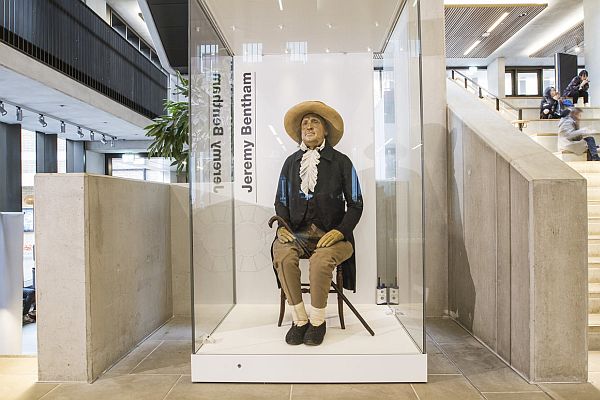
is perhaps best known now as the promoter of the panopticon prison scheme and
for his “auto-icon”, the combination of skeleton, stuffing, clothes and wax
head that for many years resided in a pair of wooden boxes in the South
Cloisters of University College London, but has recently been moved to a glass
case in the University’s new Student Centre. He would have approved of the
openness and transparency of his new lodgings, for these were features he
incorporated into the design of the panopticon, a circular or polygonal
building in which a central inspector could supervise the activities of those
on the periphery. Samuel Bentham invented the idea, or at least first applied
it to practice, in workshops in Russia. When Jeremy visited, he realized that
it could be adapted to any institution that would benefit from central
inspection, whether a factory, hospital, school, or prison. At the time Bentham
was writing, building national penitentiaries for male and female prisoners was
on the government’s agenda, since some alternative to transportation to
America, which had been curtailed by the War of Independence, had to be found.
The government did find an alternative destination – in 1787 the First Fleet
sailed to Botany Bay – but the colony could not cope with large numbers of
convicts, while others were not liable to be transported. To meet the demand
for a penitentiary, Bentham proposed his panopticon, which led to the passing
of the Penitentiary Act of 1794 authorizing its construction. Having suffered a
series of rebuttals and delays, Bentham was put in possession of a site at
Millbank, but was eventually informed by government in 1803 that the panopticon
would not be built. When a penitentiary was eventually constructed at Millbank
and opened in 1816, it was a confusing, dark labyrinth made up of six
interconnected pentagons, rather than the open and light-filled iron and glass
circular structure that Bentham had envisaged. Bitterly disappointed, Bentham
felt that a decade of his life had been wasted. He had made one last determined
effort in 1802–3 to save the panopticon. Drawing on his general position that
colonies produced expense, war, corruption and bad government, he argued that
the penal colony in Australia was objectionable not only on the grounds that it
was a colony, but also because it could not achieve any of the proper ends of
punishment – example, reformation, deterrence, compensation and economy – that
would be achieved by the panopticon.
One of
the effects of the failure of the panopticon scheme, and perhaps of the
government’s refusal to listen to various other schemes that Bentham proposed
in the 1790s and early 1800s – including the housing of the nation’s poor in a
network of pauper panopticons and measures of financial reform – was to drive
Bentham to political radicalism. The political system was dominated by the
monarchy and aristocracy, though there had been increasingly vocal demands
since the American War of Independence for a widening of the franchise. In 1809
Bentham began writing in favour of “democratic ascendancy”, whereby effective
power would be placed in a House of Commons elected annually by universal male
suffrage (though Bentham had advocated for women’s suffrage as early as 1789,
he saw no prospect of achieving it until other reforms had been implemented),
and from around 1818 committed himself to republicanism. His “Constitutional
Code”, the major endeavour of the final decade of his life, was a detailed
blueprint for a representative democracy. Rejecting the standard doctrine of a
separation of powers between executive, legislative and judiciary, Bentham
insisted on the primacy of the electorate – “[t]he sovereignty is in the
people” – to whom the legislative power, vested in a single assembly, would be
subordinate, while the executive and judicial powers would each be subordinate to
the legislative. Early in his career, Bentham had accepted that rulers wished
to promote the well-being or interests of their subjects, but lacked the
relevant legislative science to understand how to do this effectively. He had
intended to present a penal code to a monarch such as Catherine the Great of
Russia, who would recognize its merit and order its adoption. His experience
with the panopticon prison scheme drew him to the conclusion that rulers did
not want to further the interests of their subjects, but their own interests.
This opposition of interests between rulers and subjects could be resolved by a
democratic system of government, organized in such a way that rulers could
promote their own interests only by promoting the interests of the community as
a whole. In this respect, the eighteenth-century Bentham of the Enlightenment
made the transition to the nineteenth-century Bentham of political radicalism,
and thereby made Enlightenment values relevant to the democratic age.
Less
acceptable to the Victorians, had they known much about them, however, would
have been Bentham’s writings on religion and sexual morality. The typical
attitude towards homosexuality had been expounded by Blackstone: “the crime
against nature” had received its divine condemnation in the destruction of
Sodom and Gomorrah, and was rightly punished by death. As early as his first
major published work A Fragment on Government (1776), Bentham had argued that
consensual sex between men should be decriminalized, on the grounds that the
law should only prohibit and punish practices that caused harm overall (and not
always then), but that there was no harm in consensual sexual activity. People
engaged in it because they expected pleasure. He developed these ideas in
detail in essays written in 1785 and again in the mid-1810s. Bentham argued
that the dominant attitude, whereby all sexual activity apart from that between
one man and one woman within the confines of marriage for the procreation of
children was condemned, had its origin in the Mosaic Law and the teachings of
St Paul. Bentham’s strategy was to draw a distinction between the teachings of
Jesus and those of Paul – while the latter was an adherent of asceticism
(favouring pain over pleasure or at least the denial of pleasure), since it
furthered his purpose of gaining control of the followers of the nascent
Christian religion, Jesus himself was a proto-utilitarian. Bentham suggested
that Christians, if they were seriously committed to their religion, should
adhere to Jesus’s acts and teachings, and reject the contrary injunctions of
Paul. There was evidence in the Gospels that Jesus was not an asexual being, as
the orthodox portrayed him, but was bisexual, given the presence of many women
as well as “the disciple whom Jesus loved” among his followers. There was,
moreover, he maintained, “the stripling clad in loose attire” who stayed with
Jesus in the Garden of Gethsemane after all the disciples had fled (Mark
14:51–2). He appeared to be a male prostitute, and may have been Jesus’s lover.
As for Sodom and Gomorrah, if any crime had been condemned by their
destruction, it was not sex between men, but gang rape.
There is
much more besides in Bentham’s corpus awaiting our discovery. We are still far
from being able to offer a definitive account of Bentham’s thought because the
authoritative edition of his works is still in progress. An incomplete and
poorly edited version of The Works of Jeremy Bentham, issued between 1838 and
1843 “under the superintendence” of Bentham’s literary executor John Bowring,
has traditionally been the main resource for Bentham scholars, at least for
those who go beyond the opening chapters of his best-known work An Introduction
to the Principles of Morals and Legislation (1789). Bentham himself printed or
published around fifty works, ranging from short pamphlets to the massive 2,500
page Rationale of Judicial Evidence (1827), edited by the young John Stuart
Mill. When Bentham printed or published a text, he usually destroyed the
manuscripts on which it was based. Nevertheless, there survives an archive of
around 100,000 pages of his writings, divided between the larger collection in
University College London Library and the smaller in the British Library. While
some of this material consists of correspondence and family papers, the bulk of
it is related to works that Bentham did not publish or only partially
published. UCL’s Bentham Project (of which I am Director) was established in
1959 in order to produce a new authoritative edition of Bentham’s works and
correspondence under the generic title of The Collected Works of Jeremy
Bentham. To date, thirty-four volumes have been published, but it will take
around eighty to bring the edition to completion. There is no other comparable
project of its size and philosophical importance in the Western world, with the
possible exception of the Marx–Engels edition in Germany. Transcribe Bentham,
an online scholarly crowdsourcing initiative, is an attempt to accelerate the production of the
Collected Works. Volunteers select a manuscript image, enter the text into a
transcription box, and submit it to the Bentham Project, where it is checked
and added to an online digital repository. Since 2010, members of the general
public have transcribed over 23,000 pages of Bentham’s manuscripts, but there
remain tens of thousands of pages still to do. If you happen to have a little
bit of time on your hands, the Bentham Project would welcome your involvement.
Philip
Schofield is Professor of the History of Legal and Political Thought, Director
of the Bentham Project, and General Editor of The Collected Works of Jeremy
Bentham, in the Faculty of Laws, University College London.
The
philosopher Jeremy Bentham famously requested in his will that his body be
dissected and put on public display. This came to pass, and his skeleton now
sits in a glass case at University College London, adorned with a wax head,
waistcoat and jacket and sat on a wooden stool, staring out at students from
its glass case.
Bentham
was regarded as the founder of utilitarianism and a leading advocate of the
separation of church and state, freedom of expression and individual legal
rights. And now, from beyond the grave, his cadaver contains a webcam that
records the movements of its spectators and broadcasts them live online, part
of UCL’s PanoptiCam project which tests, amonst other things, surveillance
algorithms. As I write this, a young couple are walking across the corridor,
his hand pressed against the small of her back.
Prof
Melissa Terras, director of the UCL Centre for Digital Humanities, tells me
that the camera is used to learn the best way “to identify and count different
people in still images, accurately.” UCL are hoping that it will spark
discussion around contemporary surveillance, but it isn’t a coincidence that
this webcam is attached to Bentham’s box. The PanoptiCam project is a pun on
the “panopticon”, a type of institutional building that has long dominated
Bentham’s legacy.
As a
work of architecture, the panopticon allows a watchman to observe occupants
without the occupants knowing whether or not they are being watched. As a
metaphor, the panopticon was commandeered in the latter half of the 20th
century as a way to trace the surveillance tendencies of disciplinarian
societies. Is it still a useful way to think about surveillance in an age of
NSA and GCHQ?
The
basic setup of Bentham’s panopticon is this: there is a central tower
surrounded by cells. In the central tower is the watchman. In the cells are
prisoners – or workers, or children, depending on the use of the building. The
tower shines bright light so that the watchman is able to see everyone in the
cells. The people in the cells, however, aren’t able to see the watchman, and
therefore have to assume that they are always under observation.
“The
panopticon wasn’t originally Bentham’s idea. It was his brother’s,” says Philip
Schofield, professor of the History of Legal and Political Thought and Director
of the Bentham Project at UCL.
“His
brother Samuel was working in Russia on the estate in Krichev and he had a
relatively unskilled workforce, so he sat himself in the middle of this factory
and arranged his workforce in a circle around his central desk so he could keep
an eye on what everyone was doing.”
Bentham
went to visit his brother in the late 1780s, saw what he was doing, and decided
the centralised arrangement could be applied to all sorts of different
situations - not just prisons but factories, schools and hospitals.
Bentham
managed to persuade the prime minister, William Pitt the Younger, to fund a
panopticon National Penitentiary, but a stream of problems eventually meant the
project was abandoned. Bentham never saw a panopticon built during his
lifetime. A number of prisons have since incorporated panopticon elements into
their design but it wasn’t until the 1920s that the closest thing to a
panopticon prison was built – the Presidio Modelo complex in Cuba, infamous for
corruption and cruelty, now abandoned.
The
French philosopher Michel Foucault revitalised interest in the panopticon in
his 1975 book Discipline and Punish. Foucault used the panopticon as a way to
illustrate the proclivity of disciplinary societies subjugate its citizens.
He
describes the prisoner of a panopticon as being at the receiving end of
asymmetrical surveillance: “He is seen, but he does not see; he is an object of
information, never a subject in communication.”
As a
consequence, the inmate polices himself for fear of punishment.
“The
principle is central inspection,” Schofield tells me. “You can do central
inspection by CCTV. You don’t need a round building to do it. Monitoring
electronic communications from a central location, that is panoptic. The real
heart of Bentham’s panoptic idea is that there are certain activities which are
better conducted when they are supervised.”
In many
ways, the watchtower at the heart of the panopticon is a precursor to the
cameras fastened to our buildings – purposely visible machines with human eyes
hidden from view.
The
parallels between the panopticon and CCTV may be obvious, but what happens when
you step into the world of digital surveillance and data capture? Are we still
“objects of information” as we swipe between cells on our smartphone screens?
Jake
Goldenfein, researcher at the Centre for Media and Communications Law,
University of Melbourne, tells me it’s important to remember the corrective
purposes of Bentham’s panopticon when considering it as a metaphor for modern
surveillance.
“The
relevance of the panopticon as a metaphor begins to wither when we start
thinking about whether contemporary types of visuality (effectively digital and
data-driven) are analogous to the central tower concept. For example, whether
this type of visuality is as asymmetrical, and – I think more importantly –
being co-opted for the same political exercise. Does the fact that we don’t
know we’re being watched mean we are being normalised in the way the panopticon
was intended to correct behaviour?”
As
Goldenfein suggests, the asymmetrical exposure of inmates in Bentham’s building
is of a different order to how government bodies such as GCHQ conduct
surveillance. In the panopticon the occupants are constantly aware of the
threat of being watched – this is the whole point – but state surveillance on the
internet is invisible; there is no looming tower, no dead-eye lens staring at
you every time you enter a URL.
It
wasn’t until the Snowden leaks that the scale of NSA and GCHQ operations became
known. This arguably makes the system more panoptic post-Snowden, when we are
aware of it, but it hasn’t been the official rhetoric. The original emphasis,
and still the emphasis today, hasn’t been on correcting behaviour but on
providing security, namely from terrorists.
Another
important difference is the relative intangibility of data surveillance. With
Bentham’s panopticon, and to some extent CCTV, there is a physical sense of
exposure in the face of authority.
In the
private space of my personal browsing I do not feel exposed – I do not feel
that my body of data is under surveillance because I do not know where that
body begins or ends. We live so much of our lives online, share so much data,
but feel nowhere near as much attachment for our data as we do for our bodies.
Without physical ownership and without an explicit sense of exposure I do not
normalise my actions. If anything, the supposed anonymity of the internet means
I do the opposite.
My data,
however, is under surveillance, not only by my government but also by
corporations that make enormous amounts of money capitalising on it. Not only
that, but the amount of data on offer to governments and corporations is about
to go through the roof, and as it does the panopticon may emerge as a model
once more. Why? Because our bodies are about to be brought back into the mix.
The
looming interconnectivity between objects in our homes, cars and cities,
generally referred to as the internet of things, will change digital
surveillance substantially. With the advent of wider networked systems,
heralded by the likes of Google’s Brillo and Apple’s HomeKit, everything from
washing machines to sex toys will soon be able to communicate, creating a vast
amount of data about our lives. And this deluge of data won’t only be passed
back and forth between objects but will most likely wind its way towards
corporate and government reservoirs.
With
everything from heart-rate monitors in smartwatches to GPS footwear, a bright
light is once again being thrown on our bodies. Will we feel exposed under the
gaze of a central tower? Perhaps not, but with habits and physical stats
charted against the norm, we will feel scrutinised nevertheless. Much of the
justification of this is the alleged benefits to health and wellbeing. “Morals
reformed – health preserved – industry invigorated” – not Apple marketing
material but Bentham’s words on the panopticon.
There
may not be a central tower, but there will be communicating sensors in our most
intimate objects.
Bentham
didn’t want the panopticon to be a tool for oppression, and in fact its failure
eventually led him to develop a type of anti-panopticon later in life – where a
minister sits in an exposed room and is surrounded by members of the public who
listen and ask questions.
The idea
is that this transparency holds power to account, because the most dangerous
people in society can be rulers. It is important that they, as well as
prisoners, workers and children, feel watched.
It is
difficult not to think of that audience chamber when you stare at Bentham in
his box, a skeleton on a stool, an object of information posed for all to see.
What
does the panopticon mean in the age of digital surveillance? The parallel
between Jeremy Bentham’s panopticon and CCTV may be clear, but what happens
when you step into the world of data capture?
As he
lay dying in the spring of 1832, the great philosopher Jeremy Bentham left
detailed directions for the preservation of his corpse. First, it was to be
publicly dissected in front of an invited audience. Then, the preserved head
and skeleton were to be reassembled, clothed, and displayed "in the
attitude in which I am sitting when engaged in thought and writing". His
desire to be preserved forever was a political statement. As the foremost
secular thinker of his time, he wanted to use his body, as he had his mind, to
defy religious superstitions and advance real, scientific knowledge. Almost 200
years later, Bentham's "auto-icon" still sits, staring off into
space, in the cloisters of University College London.
Nowadays
Bentham is hardly a household name. Yet his ideas have proved extraordinarily
influential in law, economics, philosophy and politics. Among other things, he
was the inventor of the modern doctrine of utilitarianism, the foundational
theorist of legal positivism, and the first exponent of cost-benefit analysis.
If you've ever weighed up the pros and cons of doing something, you're treading
in his footsteps.
In his
own time he was celebrated around the globe. Countless practical efforts at
social and political reform drew inspiration from him and his disciples (the
most famous of whom was John Stuart Mill). From the 1790s on, in Britain,
France, Spain, Portugal, Greece and across Latin America, liberal governments
and politicians sought his advice and assistance. He was made an honorary
citizen of revolutionary France, while the Guatemalan leader José del Valle
acclaimed him as "the legislator of the world". Never before or since
has the English-speaking world produced a more politically engaged and
internationally influential thinker across such a broad range of subjects. The
first constitutions of the independent republic of Colombia owed as much to
Bentham as do modern theories of animal rights.
After
his death, the keepers of his memory invariably sought to portray him as a man
whose intellect and concern for the public good were so all‑consuming that there had been no place for sexual passion in his life.
As Mill put it, "knowing so little of human feelings, he knew still less
of the influences by which those feelings are formed": even in his 80s,
"he was a boy". Leslie Stephen thought him "all his life both a
philosopher and a child … he was not only never in love, but looks as if he
never talked to any woman except his cook and housemaid".
This was
a travesty of the truth. In his 20s, Bentham fell deeply in love with Polly
Dunkley, the orphaned daughter of an Essex doctor. He wanted to marry her, but
because she didn't have enough money, his rich and overbearing father prevented
it, and after several years their relationship came to an end. Later in life,
after his father's death had made him independently wealthy, Bentham loved and
proposed marriage to the clever and radical young aristocrat Caroline Fox,
niece of the Whig leader Charles James Fox. When the vivacious Irish painter
Amelia Curran, a friend of the Shelleys, came to paint Bentham in the early
1810s, the two of them appear to have had some kind of entanglement. And among
his surviving manuscripts are some remarkable notes on sexual techniques, toys
and positions whose explicitness would have made Mill blush.
Bodily
passion was not just a part of Bentham's life: it was fundamental to his
thought. After all, the maximisation of pleasure was the central aim of
utilitarian ethics. In place of the traditional Christian stress on bodily
restraint and discipline, Bentham sought, like many other 18th-century
philosophers, to promote the benefits of economic consumption, the enjoyment of
worldly appetites and the liberty of natural passions. This modern, enlightened
view of the purpose of life spawned a revolution in sexual attitudes, and no
European scholar of the time pursued its implications as thoroughly as Bentham.
To think about sex, he noted in 1785, was to consider "the greatest, and
perhaps the only real pleasures of mankind": it must therefore be
"the subject of greatest interest to mortal men". Throughout his
adult life, from the 1770s to the 1820s, he returned again and again to the
topic. Over many hundreds of pages of private notes and treatises, he tried to
strip away all the irrational and religious prohibitions that surrounded sexual
activity.
Of all
enjoyments, Bentham reasoned, sex was the most universal, the most easily
accessible, the most intense, and the most copious – nothing was more conducive
to happiness. An "all-comprehensive liberty for all modes of sexual
gratification" would therefore be a huge, permanent benefit to humankind:
if consenting adults were freed to do whatever they liked with their own
bodies, "what calculation shall compute the aggregate mass of pleasure that
may be brought into existence?"

The main
impetus for Bentham's obsession with sexual freedom was his society's harsh
persecution of homosexual men. Since about 1700, the increasing permissiveness
towards what was seen as "natural" sex had led to a sharpened
abhorrence across the western world of supposedly "unnatural" acts.
Throughout Bentham's lifetime, homosexuals were regularly executed in England,
or had their lives ruined by the pillory, exile or public disgrace. He was
appalled at this horrible prejudice. Sodomy, he argued, was not just harmless
but evidently pleasurable to its participants. The mere fact that the custom
was abhorrent to the majority of the community no more justified the
persecution of sodomites than it did the killing of Jews, heretics, smokers, or
people who ate oysters – "to destroy a man there should certainly be some
better reason than mere dislike to his Taste, let that dislike be ever so
strong".
Though
ultimately he never published his detailed arguments for sexual liberty for
fear of the odium they would bring on his general philosophy, Bentham felt
compelled to think them through in detail, to write about them repeatedly and
to discuss them with his acquaintances. In one surviving letter to a friend, he
joked that his rereading of the Bible had finally revealed that the sin for
which God had punished the inhabitants of Sodom and Gomorrah was not in fact
buggery, but the taking of snuff. He and his secretary had consequently taken a
solemn oath to hide their snuff-pouches and nevermore to indulge "that
anti-Christian and really unnatural practice" in front of one another.
Meanwhile, they were now both happily free to enjoy "the liberty of taking
in the churchyard or in the market place, or in any more or less public or retired
spot with Man, Woman or Beast, the amusement till now supposed to be so
unrighteous, but now discovered to be a matter of indifference". Among
those with whom Bentham discussed his arguments for sexual toleration were such
influential thinkers and activists as William Godwin, Francis Place and James
Mill (John Stuart Mill's father). Bentham's ultimate hope, "for the sake
of the interests of humanity", was that his private elaboration and
advocacy of these views might contribute to their eventual free discussion and
general acceptance. "At any rate," he once explained, even if his
writings could not be published in his own lifetime, "when I am dead
mankind will be the better for it".
Yet
after Bentham's death his voluminous manuscripts on sex disappeared. His
Victorian editor hid them from the public. Even after his papers were deposited
at UCL, and a huge project was begun to publish a modern edition of his works,
his sexual writings remained unknown. In 1931, the polymath CK Ogden printed
some brief extracts, and in the 1970s and 1980s, Louis Crompton, an American
scholar of gay history, and Lea Campos Boralevi, an Italian feminist who wrote
the first major study of Bentham's views on women and sex, both published books
that showed how radical his views were. But the official Bentham Project
largely ignored this aspect of his thinking. That neglect is all the more
surprising given that for many years the project's director was the philosopher
HLA Hart, a noted advocate for the decriminalisation of homosexuality. Had
Bentham's arguments been published under his editorship in the 1960s, they
might have made a real contribution to current political and legal debates. These
days, by contrast, they are mainly of historical interest.
Unfortunately
this volume makes only a partial start on the work that is really needed. Only
three of Bentham's documents from the 1810s are printed, and none of his many
other texts on the subject is included or even cross‑referenced, so
that the development and full range of his thoughts on sex are impossible to
trace. Beyond a few general remarks we are left in the dark about the
significance and originality of Bentham's sexual ideas, and their relationship
to the intellectual currents of his time. Still, it is a notable event. Bentham
was the first major English philosopher of sexual liberty, and it's about time
we celebrated that. "If there be one idea more ridiculous than
another," he once wrote about the sexual prohibitions of his day, it was
that "of a legislator who, when a man and a woman are agreed about a
business of this sort, thrusts himself in between them, examining situations,
regulating times, and prescribing modes and postures". Today we are all
the heirs of this once revolutionary way of thinking. So, the next time you try
out any new modes or postures in the privacy of your bedroom, do take a moment
to salute him.
Of
Sexual Irregularities by Jeremy Bentham – review : Jeremy Bentham's revolutionary views on sex
have been kept hidden for too long.
Jeremy
Bentham is not unlike an aging British
rock star: The older he gets, the more tours he seems to go on. Sometimes
Bentham’s severed, mummified head accompanies the rest of him. Other times it’s
kept in a climate-controlled room at University College London for safekeeping.
After every trip, until its most recent one, the English philosopher’s
remains—most of them, anyway—have been returned to a box within a box in a side
corridor at the college.
In
February, the “auto-icon”—Bentham’s skeleton, cocooned in stuffing and the
clothes he wore when he was alive—made one of the shorter, albeit more
permanent, moves in its 188-year history. Bentham was deconstructed, removed
from the wooden boxes that’ve been home to his remains since World War II, and
shepherded into a new glass case in UCL’s new student center.
“At the
moment, UCL is in the middle of a big refurbishment program,” says Hannah
Cornish, a science curator at UCL who helped supervise the cross-campus
commute. “[A]s part of that we had to move the auto-icon. We’ve taken the
opportunity to look at the best way to preserve it.”
Since
Bentham’s death, in 1832, his auto-icon has traveled across England, Germany,
and, just last year, the Atlantic, to New York City’s Metropolitan Museum of
Art. But after every trip since it was evacuated from London during the second
World War, it’s always returned to the wooden boxes in UCL’s Wilkins Building.
Inquisitive students and curious tourists could find the dead philosopher’s wax
replacement head gazing beyond them, toward nothing in particular. That same
glassy stare persists today, only through a new, modernized container.
“What we
were looking for is somewhere we could rely on the light, temperature, and
humidity conditions,” Cornish says. “It brings the auto-icon into the center of
the student body—and Bentham was a big advocate of education for all,
regardless of things like class, race, and gender.”
Bentham’s
resurrection as an auto-icon was inscribed in the late philosopher’s will,
which requested that a number of fixtures be put in place to preserve his
remains, that they be dressed in the clothes he wore in life, and that they
occasionally be brought into meetings involving his still-living friends, so
that what’s left of Bentham might enjoy their company.
“It’s
very hard to describe it to people because there aren’t any other auto-icons,”
Cornish says. “[Bentham] thought it’d catch on.”
The
auto-icon’s existence is a peculiar addendum to the life of one of England’s
most radical philosophers of the 19th century. Bentham was a champion of utilitarianism,
which posits that what does the most good for the most people is what’s best.
He knew he wanted to donate his body to science after he died, in line with his
ethical code—that people should be useful in life and in death. But he also
wanted his remains preserved, in part to spite the church, which he frequently
criticized.
Due to a
combination of bureaucratic mismanagement and crude taxidermy, Bentham’s head
became unsuitable for public display—it became too ugly, in other words—and his
organs were separated from the rest of his remains. But the skeleton remains
the literal backbone of the auto-icon.
The
recent bump-up from two wooden boxes to a novel glass case has caused a stir in
the UCL community, as students and faculty alike have weighed in on the
aesthetic and practical utility of the move. Many have brought up one question:
What would Jeremy Bentham do?
“For
Bentham, assessing the move of the auto-icon—as indeed for anything else—would
be a utility calculation,” says Tim Causer, a senior research associate with
the UCL-based Bentham Project, an initiative to produce a new edition of
Bentham’s life works and correspondence. “Does the auto-icon’s new location
make people happy or not—that would be the only thing that matters.”
This isn’t
the first time the auto-icon’s location has drawn criticism. In 1857, when it
was just 25 years young, its creator (and Bentham’s longtime friend), the
physician Thomas Southwood-Smith, lamented UCL’s placement of the remains.
“No
publicity is given to the fact that Bentham reposes there in some back room,”
he wrote. “The authorities seem to be afraid or ashamed of their own
possession.”
The
auto-icon bounced around quite a bit—from Southwood-Smith’s charge to the UCL
Anatomy Museum to the UCL Library to Stanstead Bury and back to UCL—but by the
2010s, its longtime mahogany-box home had become a haven for pests like carpet
beetles and clothes moths, eager to take a bite out of the early 19th-century
garb that clothes the stuffing-encased skeleton. That, combined with the
Wilkins Building’s imminent renovations, made now an ideal time to find the
auto-icon a new home.
So it
was unboxed, dismantled, and shepherded through UCL’s Japanese garden, on a
choreographed route to minimize the risk of what Cornish calls
“birdstrikes”—pigeons confusing the stuffed person for a privy and defecating
on it.
“It was
wrapped in plastic, because we [took] the whole thing outside,” Cornish says.
“It was a rainy day, so we wanted to make sure Bentham stayed dry.”
Once in
the new student center, the auto-icon took the elevator down to its new case,
where it was reconstituted in the image of Jeremy Bentham.
Soon
afterward, concerns began to proliferate on social media. Some are upset that
Bentham isn’t in his original box. (Only one of the older wood boxes—the
smaller one—may be original. The larger wooden one dates to the 1940s.) Others
have called out discrepancies between the wishes outlined in Bentham’s will and
his new case.
Causer,
however, notes that these wishes were bungled pretty much from the outset. Nor
were the old boxes perfect. “There was a typescript label on the inner wooden
box, stating Bentham’s name, dates of birth and decease, and wrongly claiming
that Bentham founded UCL,” he says. “I’ve wanted to rip that label off for
years, as that’s one of the myths about Bentham that refuses to die.”
Others
have expressed concern that the auto-icon is merely on public display, rather
than tastefully sequestered until a proper “Bentham commemoration event” comes
along.
Treating
Bentham’s remains in the manner requested in his will and ensuring that the
objects remain preserved in perpetuity is “quite a difficult balance” to
strike, Cornish says. “The way we looked at it is that the auto-icon is now a
museum object that we’re responsible for. We’ve taken the approach that our
duty of care is to preserve this unique object.”
There
are also those who feel that the glass casing is too modernist, and is
aesthetically dissonant with the traditional trappings of the dead philosopher
(one Twitter critic likens the case to a “department store clothing display”).
But
Causer says that some of Bentham’s own ideas run counter to this line of
thinking. “While I have some sympathy with the view that the relocation seems
to go against tradition and doesn’t look right,” she says, “Bentham himself
would have had no truck with that argument. In his Book of Fallacies, Bentham
discussed what he called the ‘Ancestor-Worshippers’ Fallacy’—that is, the
argument that since something had always been done one way, it should always be
done that way. Bentham spent most of his life, after all, taking that attitude
to task in trying to reform the British establishment.”
One
thing is inarguable : Bentham’s new location makes the auto-icon more visible
and accessible—the UCL student center is located in the heart of London—and
improves the conditions of its preservation.
“The
auto-icon is undoubtedly a weird thing,” Causer says, “and Bentham evidently
had a sense of high self-regard that he would ask for his body to be preserved
in this way. But I would hope that the move might encourage visitors not to
dismiss the auto-icon as a macabre curio, the final wish of a strange old man,
or something ghoulish or creepy.”
Perhaps,
as Bentham hoped, it can be wheeled out for events that he would have enjoyed
in life: a good party or a lively debate, its presence spurring conversations
about—and perhaps actions toward—the greater good. The move has already sparked
discussions about what’s best for the remains themselves.
“People
are very fond of the auto-icon,” says Cornish. “We hesitate to call him a
mascot, because the auto-icon contains human remains. We treat it with a bit
more respect. I hope more people will see him in the student center.”
Currently,
the auto-icon sits next to a large panel that describes Bentham and his work in
a couple of pithy paragraphs. Cornish says that a booth with more information
and context, as well as a touch screen, are on order, and will soon supplement
the auto-icon’s new home.
As
eerily vacant as that glassy gaze may be, says Causer, Bentham, an atheist, is
making a point from beyond the grave, vis-à-vis the auto-icon—his final
refutation of religion and life after death.
“Even
though to a visitor the auto-icon and its benign waxy smile gives the
impression that Bentham is present,” he says, “it is not him any more, and is a
reminder that Bentham the human is—like we all will one day become—‘senseless
matter.’ And that what matters is to make the most of the life we have, and to
promote the greatest happiness during that time.”
Why a
272-Year-Old Philosopher Just Got Carted Across a College Quad : A new home for Jeremy Bentham’s old bones is
prompting a philosophical debate.
One day
toward the beginning of March, an unusual object arrived at a New York City
airport. Carefully encased in a foam-padded, specially built wooden chair and
strapped in with a bright-blue sash, it was the stuffed skeleton of one of
Britain's most famous philosophers—transported not for burial, but for
exhibition.
"We
all refer to him as he, but the curator has corrected me. I need to keep
referring to it," says University College London conservator Emilia
Kingham, who prepared the item for its transatlantic voyage.
The
stuffed skeleton belongs to the philosopher Jeremy Bentham, who died in 1832.
But for well over a century, his "auto-icon"—an assemblage including
his articulated skeleton surrounded by padding and topped with a wax head—has
been on display in the south cloisters of University College London. Starting
March 21, it will be featured in The Met Breuer exhibition "Like Life:
Sculpture, Color, and the Body (1300–Now)," marking its first appearance
in America.
While
the auto-icon has sometimes been seen as an absurd vanity project or memento
mori, according to Tim Causer, it's best understood as a product of Bentham's
trailblazing work. "I would tend to ask people to reckon with the
auto-icon not as macabre curio or the weird final wish of a strange old
man," says the senior research associate at UCL's Bentham Project, which
is charged with producing a new edition of the philosopher's collected works.
Instead, "[we should] accept it in the manner in which Bentham intended
it, as a sort of physical manifestation of his philosophy and generosity of
spirit."
Bentham
is best known as the founder of utilitarianism, a philosophy that evaluates
actions and institutions based on their consequences—particularly whether those
consequences cause happiness. A man frequently ahead of his time, he believed
in a world based on rational analysis, not custom or religion, and advocated
for legal and penal reform, freedom of speech, animal rights, and the
decriminalization of homosexuality.
His
then-unconventional ideas extended to his own body. At the time Bentham died,
death was largely the province of the Church of England, which Bentham thought
was "irredeemably corrupt," according to Causer. Instead of paying
burial fees to the Church and letting his body rot underground, Bentham wanted
to put his corpse to public use.
In this
he was influenced by his friend and protégé Dr. Thomas Southwood Smith, who had
published an article called "Use of the dead to the living" in 1824.
Smith argued that medical knowledge suffered from the limited number of bodies
then available for dissection—the Crown supplied only a handful of hanged
criminals each year—and that the pool of available corpses had to be expanded
to allow surgeons more practice material, lest they begin "practicing"
on the living.
From his
earliest will, Bentham left his body to science. (Some scholars think he may
have been the first person to do so.) But he also went one step further. His
last essay, written shortly before his death, was entitled "Auto-icon; or,
farther uses of the dead to the living." In it, Bentham lambasts "our
dead relations" as a source of both disease and debt. He had a better
idea: Just as "instruction has been given to make 'every man his own
broker,' or 'every man his own lawyer': so now may every man be his own
statue."
Bentham
envisioned a future in which weatherproofed auto-icons would be interspersed
with trees on ancestral estates, employed as "actors" in historical
theatre and debates, or simply kept as decoration. The point, he felt, was to
treat the body in terms of its utility, rather than being bound by superstition
or fear.
"It
was a very courageous thing to do in the 1830s, to ask yourself to be dissected
and reassembled," Causer says. "The auto-icon is his final attack on
organized religion, specifically the Church of England. Because Bentham thought
the church had a pernicious influence on society."
There
was only one man Bentham trusted with carrying out his last wishes: Smith.
After a public dissection attended by eminent scientific men, the devoted
doctor cleaned Bentham's bones and articulated the skeleton with copper wiring,
surrounding them with straw, cotton wool, fragrant herbs, and other materials.
He encased the whole thing in one of Bentham's black suits, with the ruffles of
a white shirt peeking out at the breast. He even propped Bentham's favorite
walking stick, which the philosopher had nicknamed "Dapple," in
between his legs, and sat him on one of his usual chairs—all just as Bentham
had asked for.
But not
everything went quite according to plan. The philosopher had asked to have his
head preserved in the "style of the New Zealanders," which Smith
attempted by placing the head over some sulfuric acid and under an air pump.
The result was ghastly: desiccated, dark, and leathery, even as the glass eyes
Bentham had picked out for it during life gleamed from the brow.
Seeing
as how the results "would not do for exhibition," as Smith wrote to a
friend, the doctor hired a noted French artist, Jacques Talrich, to sculpt a
head out of wax based on busts and paintings made of Bentham while alive. Smith
called his efforts "one of the most admirable likenesses ever seen"—a
far more suitable topper for the auto-icon than the real, shriveled head, which
was reportedly stuffed into the chest cavity and not rediscovered until World
War II.
Smith
kept the auto-icon at his consulting rooms until 1850, when he donated it to
University College London, where Bentham is often seen as a spiritual
forefather. It has been there ever since, inside a special mahogany case,
despite rumors that students from Kings College—UCL's bitter rival—once stole
the head and used it as a football.
"His
head has never been stolen by another university," Kingham confirms.
Causer says there is reason to believe the wax head was stolen by King's
College in the 1990s, but never the real head. The football part of the story
is particularly easy to dismiss, he notes: "We all have human heads, and
kicking them doesn't do them much good, particularly 180-year-old human heads.
If anybody kicked that, it would disintegrate on impact, I think."
(Kingham also notes that the real head is not decomposing, as is sometimes
claimed: "It's actually quite stable, it just doesn't look like a
real-life person anymore. The skin is all shrunken.")
Another
beloved myth has it that the auto-icon regularly attends UCL council meetings,
where he's entered into the record as "present but not voting."
Causer says that's not true either, although fiction became reality after the
auto-icon graced the council meetings marking the 100th and 150th anniversary
of the college's founding as a nod to the legend; it also attended the final
council meeting of the school's retiring provost, Malcolm Grant.
Bentham
always wanted to visit America; Causer says he was "a big admirer of the
American political system" as the one most likely to promote the greatest
happiness for its citizens. But before he could accomplish in death what he
failed to do in life, UCL had to mount a careful conservation operation.
The
first step: a spring cleaning. The conservation team at UCL removed each item
of clothing on the auto-icon piece by piece, holding carefully to the delicate
areas, like a loose left shoulder and wrist, where they knew from previous
x-rays that the wiring was imperfect. After a detailed condition report and an
inspection for pest damage (thankfully absent), the team surface-cleaned
everything.
"The
clothes were quite grubby because the box that he's sitting in, it's actually
not very airtight," Kingham says. A vacuum with a brush attachment took
care of surface dirt and dust, but the inner items required a more thorough
clean. "We determined that his linen shirt and also his underwear could do
with the wash, so we actually washed those in water. It was quite exciting
saying I've been able to wash Jeremy Bentham's undies." The wax head was
cleaned with water and cotton swabs, and occasionally a little spit, which
Kingham says is a common cleaning technique for painted surfaces.
Kingham's
team rearranged the stuffing around the skeleton, plumping the fibers as you
would a pillow. The stuffing around the arms, in particular, had started to
sag, so Kingham used a piece of stockinette fabric to bind the area around the
biceps—making them look more like arms, she says, but also reducing some of the
strain against the jacket, which threatened the stitching.
But the
most labor-intensive part of the preparation, according to Kingham, was
devising a customized padded chair for the auto-icon's transport. Their final
creation included a wooden boarded seat covered in soft foam that had been
sculpted to hold the auto-icon lying on its back, knees bent at a 90-degree
angle to minimize stress on the pelvis—another weak point. The auto-icon was
bound to the chair with soft bandages, and the whole thing inserted into a
travel case. The wax head was also set inside a foam pad within a special
handling crate (the real head will stay at UCL, where it is currently on
display), while Bentham's regular chair, hat, and walking stick got their own
crates.
‘’ We had
originally joked that it might be just easier to buy him a seat on the plane
and just wheel him in on a wheelchair," Kingham says, laughing.
Luke
Syson, the co-curator of "Like Life," says it was touching to watch
the stick and hat emerge from their travel boxes, even if the auto-icon's
special chair did look a bit "like how you would transport a lunatic
around 1910—or indeed 1830."
Reached
by phone just after he had finished installing the auto-icon, Syson says he
wanted to include the item as part of the show's emphasis on works of art made
to persuade the viewer that life is present. "This piece really sums up so
many of the themes that the rest of the show looks at, so the use of wax, for
example, as a substitute for flesh, the employment of real clothes … And then,
above all of course, the use of body parts." And the auto-icon isn't the
only item in the show to include human remains—when we spoke to Syson, he was
looking at the auto-icon, Marc Quinn's "Self" (a self-portrait in
frozen blood), and a medieval reliquary head made for a fragment of Saint
Juliana's skull, all of which are installed in the same corner of the museum.
Syson
says he was initially worried the auto-icon might not "read" as a
piece of art—worries that were dispelled as soon as he installed the wax head.
"The modeling of the face is so fine," he says. "The observation
and expression, the sense of changing personality … there's a lovely jowliness
underneath his chin, the wrinkles around his eyes are really speaking, and the
kind of quizzical eyebrows, and so on, all make him really amazingly
present."
And
unlike at UCL, where the auto-icon sits in a case, viewers at the Met are able
to see him on three sides, including his back. "He sort of springs to
attention on his chair, he's not sort of slumped, which you couldn't see in the
box [at UCL]."
Those
who have worked with Bentham's auto-icon say it encourages a kind of intimacy.
Taking the auto-icon apart, Kingham says, "you really do feel a closeness
to Jeremy Bentham, because you looked in such detail at his clothes, and his
bones, and his skeleton." The wax head, she says, is particularly
lifelike. "People who knew him have said that it's a very, very good
realistic likeness of him," she notes, which made it both eerie and
special to handle so closely.
"This
is both the representation and the person," Syson says. "We've been
calling him 'Jeremy' these last few months, and he's sort of here, and it's not
just that something's here, he's here. So that's an amazing thing."
Nearly
200 years later and across an ocean, Jeremy Bentham's auto-icon has arrived to
serve another public good: delighting a whole new set of fans.
How
Jeremy Bentham Finally Came to America, Nearly 200 Years After His Death. By
Bess Lovejoy. Mental Floss , March 19, 2018.
Also interesting :
''Bentham
and the Arts'' is a collection of essays which consider the implications of
Bentham’s radical utilitarian approach for our understanding of the history and
contemporary nature of art, literature, and aesthetics more generally. UCL Press, June 2020. Free download
Bentham
Project : this website gives information on Jeremy Bentham and about the work
of the Bentham Project.