Showing posts with label fashion photography. Show all posts

31/07/2020

Helmut Newton : The Bad and the Beautiful


Helmut Newton’s work has been variously described as erotic, voyeuristic, shocking, or even feminist. He was “the King of Kink.” Gero von Boehm’s new documentary Helmut Newton: The Bad and the Beautiful focuses on the sexually provocative photographer, who became famous in the ’70s for his innovative fashion campaigns and magazine spreads. The film features home videos and other never-before-seen footage of Newton’s life, along with interviews with the likes of Anna Wintour, Isabella Rossellini, Claudia Schiffer, Grace Jones, Charlotte Rampling, and his wife June Newton (who photographs under the name Alice Springs).

 Newton once claimed, “If a photographer says he is not a voyeur, he is an idiot.” Though he is known for stark, dark, often erotic photographs of women, the documentary also highlights his sense of humor and playful energy. When asked to photograph a chicken for Vogue, he responded, “I’ve always wanted to photograph a chicken wearing high heels,” and did just that. Hyperallergic spoke to von Boehm over email about perusing Newton’s archives and what made his images so striking.

 Hyperallergic: Can you describe your relationship with Helmut Newton and how you first saw his photographs?

 Gero von Boehm: I met him in 1997 at dinner in Paris. We liked each other immediately, and over the years, a friendship developed. But it took years to convince him to be filmed. June also had to be convinced; she was very protective of him. But then they agreed that I could film him at shoots and in private situations in Monte Carlo, Paris, and Los Angeles. But the most important scenes were shot in Berlin. He loved the city where he was born, and he went back quite often — a great and generous gesture for someone who had to flee the Nazis.

 I first saw his photos in the early 1970s, when I was 16 or 17. I was fascinated by the way they told fragments of stories, sometimes quite mysterious ones, and how they inspired my own fantasies. It was up to you to imagine what had happened before and after the moments the photos showed.

 H: Can you explain why you put Newton’s upbringing in the middle of the movie instead of the beginning?

 GvB:  It came naturally. I always go with the flow, never work with a fixed script. In the first part of the film, Helmut unfolds his personality, and you learn about his way of working and seeing the world. And then you want to know the roots of all of that. This is why the film has this structure. I never intended to do a chronological biopic, because I think that’s rather boring.

 H: What was it like going through his archives? Did you work with June or any other family members?

 GvB: It was absolutely exciting to work with the Helmut Newton Foundation in Berlin, where the whole archive is now. There are hundreds of thousands of pictures, contact sheets, and notes. I had full access to all of that, and June let me use her own footage she took at shoots and in private situations. It was a great blessing.

 H: In their time, Newton’s images were controversial. If he emerged today, do you think he would be widely accepted by the commercial fashion industry, or would he be limited to gallery shows?

 GvB: It was extraordinary that Helmut was accepted by the industry, because he was much more dangerous and ambiguous than Richard Avedon or Irving Penn. One has to see the photographs, especially the nudes, in the context of the late ’60s and early ’70s. The Sexual Revolution had just happened, and the naked body was no longer a taboo. And everybody was waiting for a revolution in fashion photography. There were marvelous pictures by Avedon, Penn, and others, but they were icons of beauty and loveliness — what Anna Wintour calls “stoppers in the magazine.”

 Then there was Helmut, who was a provocateur, even sometimes an anarchist. His way of showing women revolutionized fashion photography. There is this famous diptych series by him [Dressed and Naked]. In the first photograph of each piece, you see the model dressed in haute couture, and in the second photo, it’s the same girl in the same pose, but totally naked, as if a magician had taken off her clothes. What does this tell us? Strong women are strong even without haute couture. They don’t need it. And then there is the groundbreaking picture of a naked woman and one dressed in a Yves Saint Laurent tuxedo, on a deserted Paris street at night — there is a strange kind of sexual suspense there.

 I think that today, no magazine would commission a photographer to take pictures like that. We live in rather prudish times. There’s a certain danger in the freedom of art and expression.


 The Documentarian Who Secured Rare Footage of Helmut Newton at Work. By Deana Bianco. Hyperallergic , July 23, 2020.


Over the last few years, we've increasingly and very publicly questioned our behaviors, our politics, our history, our heroes, our statues, and our art. It's only reasonable that we question our photography idols. Where do Helmut Newton's hyper-erotic photography and his ruminations on power fit into our new world?

 (A bit of a disclaimer, I am a long-time fan of Newton; in fact, I first fell in love with photography through his imposing images.)

 Gero von Boehm's new documentary, Helmut Newton: The Bad and the Beautiful, has something for those who are interested in the cultural aspects of Newton's work and for those interested in his creative process.

 Von Boehm takes no time in getting to the crux of the matter. While Newton's work certainly changed the very nature of editorial and fashion photography, he did so while pushing the bounds of how power dynamics and the erotic friction within those dynamics were represented in photography. For many in the mainstream, he often went too far.

 With most theaters still closed, you can find the film now streaming through a variety of local theaters. Check out the following link for more info.

 Although von Boehm's work is too subtle to mention it, he seems to be asking how Newton's work might fare in light of the #metoo era.

 Early, and often, von Boehm sets up the ongoing debate. On the one side, Newton is a creative genius, a provocateur, as Isabella Rossellini calls him, responsible for bringing controversy and conversation to fashion and editorial photography. He elevated fashion and editorial photography to a form of cultural analysis. On the other, Susan Sontag calls him an outright misogynist to his face. Newton defends himself as a lover of women, a feminist even. Sontag holds her ground and retorts that all masters adore their slaves. Where, then, do Newton and his work fit?

I'll leave you to von Boehm's film to watch the nuances of the debate for yourself. It's interesting to see that many of his female contemporaries view Newton as a genius and collaborator. Anna Wintour points out that women were the driving force in Newton's photography. And, more so, not just women, but strong women, women in charge. As Grace Jones calls them: unattainable women. When talking about Newton's images, it's mentioned again and again that the women he photographed are often looking down on the viewer or on the men present. When men are present, they are typically nothing more than accessories in the scene, not that much different than the handbags or jewelry he was paid to photograph


 Newton's work inspires debate. Did he do this intentionally? Asked by June Newton if he is nothing more than a naughty boy, Newton responds that he's also a bit of an anarchist. He was the provocateur that he set out to be. Newton himself claims the old saying "the more enemies, the more honor" as a kind of mantra. His goal was to shake up the system, to force his audience to rethink the roles, relationships, and power dynamics they took for granted.

 Despite the inherent problems at the confluence of the male gaze and the female body, the film manages to tell a story of a photographer whose images have sparked wide-spread public debate about eroticism, power, sexuality, and gender relations unlike any other.

 Later in the film, Wintour dismisses the criticism of Newton's work by pointing out that making thought-provoking work means that you're eventually going to upset someone. There is no way to push widely-accepted community boundaries without rubbing someone the wrong way.

 In the end, it's the conversation with Grace Jones that helps me understand not only my own appreciation of his work but why his work may never fall out of step with current culture. Jones explains that she got along well with Newton because "[h]e was a little bit perverted, but so am I." I can't help but think that Newton's popularity comes from the fact that we all are, at least a little.

 Outside of the cultural conversation, von Boehm's film also provides a look behind the curtain of Newton's process. Having photographed long before the advent of the current BTS craze, this peeks into Newton's world is gold.

 There are print evaluations and pages from notebooks that show just how detail-oriented Newton was, how dedicated he was to the worlds he created. Even more interesting is the use of Newton's contact sheets to introduce each photograph that the film focuses on. Here, we get to see what images made the cut and what didn't. Last, we're given a bit of true BTS when we get to see Newton interact with a few of his subjects. It's quite interesting to hear him provide direction. Not just the typical physical direction that you can find in any run of the mill BTS mind you; Newton provides emotional direction as well. My favorite might be:

 ‘’There’s a kindness in your look… which is the last thing I want’’

 Fitting for a photographer who was driven to explore his themes, regardless of the criticism.

 What do you think of Newton? Is his work the product of the male gaze or, is it more than that, a rumination on power and the erotic?

 The Bad and the Beautiful: Where Does Helmut Newton Fit Into Our New World? By Mark Dunsmuir. F Stoppers. July 24, 2020. 


Nicknamed “the king of kink,” it’s surprising that the first posthumous documentary exploring the work of the wildly famous photographer Helmut Newton, who died in 2004, was only released last week. Helmut Newton: The Bad and the Beautiful by Gero von Boehm, a close friend of Newton’s, unpacks the man behind the controversial fashion photography, who would have been 100 this year. Now streaming via Film Forum and Kino Marquee, the documentary includes interviews from some of his favorite subjects like Grace Jones, Claudia Schiffer and Isabella Rossellini, along with Anna Wintour and his wife and creative partner June Newton (also a photographer, who exhibited her work under the pseudonym Alice Springs).

 A controversial figure who’s hyper-erotic photography was called misogynistic by some and empowering by others, the film is a testament to his ability to be a provocateur. While undeniably treating the women he photographed as sexual objects through the male gaze and extensions of a vision of machismo, the film explores his ability to spark public debate about power, eroticism and sexuality. Here’s what it taught us about one of the 20th century’s masters of photography.

 As a German Jew who escaped to Singapore then Australia in 1938, we hear archived footage of Newton himself acknowledging the influence his work has from growing up around nazi propaganda. His biggest influence was Leni Riefenstahl, the German director hired to create highly stylized Nazi propaganda that idealized white, blonde, athletic German bodies. It’s not hard to draw comparisons to the mostly white work from Newton who, like Riefenstahl, never shot somebody who wasn’t traditionally “beautiful” for the time. Though the film only touches on this at the midway point, it provides much-needed perspective for how his work explores power. It leaves us to develop our own takeaways about the connection between beauty and violence in his work, through the lens of grappling with an aesthetic influence that was used to oppress Newton and his family.

 In the film, Isabella Rossellini credits him with being responsible for bringing controversy and conversation to fashion and editorial photography. Provoking cultural analysis in the fashion world, Grace Jones notes in her interview that “He was a little bit perverted, but so am I.” While Newton made a name for himself exploring the female form, his work was always subject to criticism, which the film suggests he thoroughly enjoyed. Anna Wintour notes that he always loved hearing feedback from readers letters, “the worse they were the better,” positing that his work was more than just a representation of macho culture, rather that he loved the debate around how he presented women. On the other hand, we hear American writer and activist Susan Sontag call him a misogynist on camera, to which he counters: “I love women.”

 One of the more interesting topics that the film explores is the assumptions that were made about Helmut because of his work. While his photography was rooted in male fantasy and often violence, we hear model after model give testament to him being respectful to work with, even while asking the male models to grab their asses on camera. While Grace Jones also says his work with her never felt racist, when recalling a story from her early modelling days with Newton, it’s clear the photographer did approach the models with an emphasis on their bodies: “He loved my legs, and he is actually the one who got me to like them. Also he was asking me to come regularly to castings. Every time I came, he told me, ‘Oh it’s true: I forgot you have no boobs.’” Aside from a few cringe-worthy moments, in the film Newton comes across as much less controversial than his work in person, touching on the idea that someone can create, work that is problematic for many, without those involved in the process feeling disrespected (according to the interviews in the film).

 ‘’His photography wouldn’t be possible at all today,” says director von Boehm. “It was a revolution at the time: a revolution really needed because there was Richard Avedon and Irving Penn but it was just loveliness.” While the film presents Newton’s work as something that refreshed fashion photography in the ’60s and ’70s, it’s also evident that there’s no need for the same particular exploration today. Anna Wintour described Helmut’s women as “powerful,” but also as almost always being blonde and tall. While watching, it’s clear his work was a mirror to a society and fashion industry that has evolved and, therefore, his white-washed depictions of conventional, hypersexualized beauty standards for women are less engaging today as they were perceived as being at the time. This, along with his work exploring a macho culture that touches on the edges of loving and also hating women,  makes the film an interesting exploration of one specific pivotal moment in photography. While watching, there’s an awareness of the many voices that were not only being left out of his work but also being left out of the wider fashion industry conversation during that time and today: BIPOC, queer voices, and the representation of “powerful bodies” that aren’t a size 0.


Helmut Newton’s Controversial Fashion Photographs Are Reevaluated in a New Documentary. By Laura Pitcher. The Observer , July 28, 2020.


When you look at the photographs of Helmut Newton, with their spectacularly cold and severe Amazon-women-on-the-moon erotic shock value, and you try to imagine the man behind the camera (it’s sort of hard not to), you tend to picture him as a figure every bit as kinky and forbidding as the outrageous things he’s photographing. There’s a famous shot of Newton: the clowning-around photograph of him wearing high heels (pictured above), which only enhanced his image as a Eurotrash decadent who turned his fantasies into flesh.

 But in “Helmut Newton: The Bad and the Beautiful,” an engaging and surprisingly playful documentary about the man who was arguably the most transgressive photographer to emerge from the 1960s and ’70s (and that’s saying something, since this was the grungy golden age of Larry Clark and Nan Goldin), Newton emerges as friendlier and more “normal” than you’d expect — though he does have a mischievous twinkle that suggests a lot.

 The documentary was shot when Newton was in his early 80s, and he’s disarmingly ageless, with floppy thick hair and circular glasses setting off a face that grins easily in a rubbery Teutonic Leslie Nielsen sort of way. The Newton we meet is casual, funny, and direct. During a night photo shoot on the roof of the Chateau Marmont in L.A., he addresses a naked model by saying things like “There’s a kindness in your look…which is the last thing I want” and “Now don’t look poverty-stricken…look incredible!”

 There’s an ambivalence — a fantastic double vision — that runs through the work of Helmut Newton, and “The Bad and the Beautiful” dives into it with captivating zeal. In the ’70s, Newton, who started out as a fashion photographer (and never stopped being one), turned commercial magazine art into a form of rough trade. He made his models into dominatrix vamp goddesses, diamond-hard and demonic in their icy surreal glamour, and in doing so he created one of the paradigmatic contemporary expressions of the male gaze.

 And yet…

 Even as Newton controlled every aspect of his centerfold-from-hell visions, the true subject of his photographs, as rooted as they were in male fantasy, was the awesomeness of feminine power. You might say that he pushed the allure of the femme fatale to the nth degree.


 In the documentary, Isabella Rossellini, who was captured by Newton in the ’80s in a haunting shot with her then-partner David Lynch (the one where he’s holding her head as if she were a puppet), describes the effect of his pictures perfectly when she says that they’re really touching the depths of a certain male fear. The photographs, she says, are saying: “I like you, damn you! I shouldn’t like you, because you’re a weapon!” Grace Jones tells a story about how Newton posed her, naked, holding a knife, and how he waited until the sunlight hit her just so, silhouetting her with prison bars, and that what he was really doing was telling a story — and then we see the image, and indeed, as brutal as it is, it’s like a still from a movie that sets the imagination on fire.

 “Helmut Newton: The Bad and the Beautiful” is content, for much of its 89 minutes, to be a meditation on Newton’s work, and on that score it both reveals and celebrates him as an artist who hated “art” and “good taste,” and who pushed the envelope of a culture that was still reeling from the sexual revolution. There’s a clip of him appearing on a late-’70s French talk show along with Susan Sontag, who though clearly charmed by the man himself insists that his work is “misogynist.” At times (images of a woman wearing a saddle or being consumed by an alligator), there’s no question that it was.

 Yet even as Sontag condemned his work, you could make a case that in teasing out the culture’s darker undercurrents, Newton created images that were progressive in their very danger. He revealed the lower depths of what was out there. Charlotte Rampling, who collaborated with him on a stunning series of hotel-room shots in 1973, says, “It’s great to be a provocateur. It’s what the world needs — because it stimulates thoughts, it stimulates ideas, and it stimulates all sorts of conversations.” Anna Wintour, who gave Newton a platform at Vogue, defends him as someone who bracingly undercut the rules of beauty.

 The director, Gero von Boehm, interviews many of the stars and models who Newton turned into icons, and he makes catchy use of songs like Steve Harley’s “Make Me Smile” and the Cure’s “Pictures of You” (“I’ve been looking so long at these pictures of you/That I almost believe that they’re real”). Mostly, he allows us to hang out with Newton at the Chateau Marmont, where he lived during the four months he spent every year in Los Angeles — and where, in 2004, he died in an automobile accident, when his car sped out of control on Sunset Boulevard just after departing the Chateau.

 Though based on footage shot nearly 20 years ago, “The Bad and the Beautiful” is a very present-tense documentary. Ultimately, though, it goes back into Newton’s life, and what it finds there is the source of his perversity as well as what you might call his perverse morality. Born in Berlin in 1920, he was Jewish, which meant that when Hitler came to power Newton’s days in Germany were numbered. But before his family fled, in 1938, he apprenticed himself to Yva, the dream-vision photographer who become one of the world’s first fashion shutterbugs. (She died in a concentration camp in 1942.) Newton learned his craft from her, and also from studying the work of Leni Riefenstahl — especially “Olympiad,” in which Riefenstahl was arguably the first film artist to treat the human body as a piece of sculpture.

 You could say that Newton’s obsession with tall strapping valkyrie “perfection” descended from his Teutonic background, even as he infused it with a dissolute kind of cover-girl porno chic. Yet his experience growing up also shaped him to be deadly serious about his provocations. He married his wife, June, in 1948, and in the last third of the documentary she comes into the picture, and we see what an extraordinary figure she is: a partner who was his model, muse, mother, boss, and aesthetic collaborator. Their relationship is a love duel of equals. In her highhanded way, she kept him honest. And when you see how devoted he was to her, it casts his photographs in a different light. Yes, they were his fantasies, but not in some overgrown-dirty-schoolboy way. They were who he was inside. And maybe they were a little bit of all of us too.

 ‘Helmut Newton: The Bad and the Beautiful’: Film Review. By Owen Gleiberman. Variety ,  July 21, 2020


In celebration of the reissue of Newton’s famed Sumo exhibition, AnOther talks to three of his assistants about working with the legendary photographer

 In 1995, German publisher Benedikt Taschen approached the legendary photographer Helmut Newton with the idea of collaborating on a vast art book. Armed with a model of what the gargantuan tome would look like, replete with five pages of Newton’s images that showed off the exceptionally high quality of the digital printing techniques he would employ, Taschen convinced Newton to embark on this monumental task. The resulting book, titled Sumo and published in 1999, was limited to 10,000 editions, each signed and presented on a sleek, specially designed metal stand by Philippe Starck. It was received to widespread acclaim, an instantly coveted collector’s item. In 2009, 10 years after its publication, and five years after Newton’s death, his widow June suggested the book be presented as an exhibition at the Helmut Newton Foundation in Berlin, with all 464 framed pages hung side by side in rows in the order of their appearance in the book. Now, to mark Sumo’s 20th anniversary, the exhibition is back – a wonderful opportunity to marvel over Newton’s indelible legacy, as well as this iconic publishing feat, all over again.

 Sumo includes many of Newton’s most beloved works – from a nude Pina Bausch, half consumed by a crocodile, to his inimitable campaign for Yves Saint Laurent’s Le Smoking suit, as well as his various, brilliantly characterful celebrity portraits. It spans Newton’s entire career until 1999, taking us from his native Berlin to Paris to Australia to Hollywood – where, from the early 80s onwards, he would capture some of his most celebrated fashion imagery and powerful nude studies. It was in California that Newton encountered the three bright young photography students – Mark Arbeit, George Holz and Just Loomis (dubbed by June, the “three boys from Pasadena”) – who would come to assist him with much of his work over the following years, forging close friendships along the way. Here, in celebration of the latest edition of the Sumo exhibition, which runs alongside three smaller exhibits of Arbeit’s, Holz’s and Loomis’ own works, the former assistants share with us their memories of the singular image-maker and the invaluable lessons he instilled in them at the dawning of their own careers.

 George Holz

 “Mark, Just and I first met Helmut back in 1978. We were students at the Art Center College of Design in Pasadena. Mark knew that Helmut was coming to a store to pick up a cheque from a mutual client, who’d told us that if we waited, we’d see him. We waited in the store’s basement all day and finally Helmut showed up and we introduced ourselves. We told him we’d love to assist him some time and he said, ‘OK, come by the Beverly Hills Hotel tomorrow’. So we did. We knocked on his door and June stuck her head out and said, ‘He’s busy boys’. But we sat outside the door and waited like stalkers, and then we knocked again. She looked out again and said, ‘Helmut they’re still here!’ Then Helmut appeared and told us to meet him at the Polo Lounge later. When we met we said, ‘We’ll be your drivers, your assistants, anything...’

 “A few weeks later he called us to do our first job with him in Los Angeles. I remember I had this old beat up American car that he loved riding in – when we pulled up to the Beverly Hills Hotel everyone would have their Maseratis and Rolls Royces and we’d be in my old muscle car. He loved everything camp and American! He seemed very excited about our enthusiasm; I think he liked that youthful energy. And I just learned so many things from him. The biggest lesson was how he dealt with people – whether it was a celebrity or a model, editors, make-up artists. He could talk people into doing anything he wanted, because they had so much respect for him. They trusted him, and that was something he instilled in me: the importance of winning the trust of your subjects and clients.”


 Mark Arbeit

 “Helmut never put himself on a pedestal. He talked to us like he talked to anyone else, even though we were just the little students and he was the grand master. But when it came to work everything was serious. He was Dr Jekyll and Mr Hyde. He required very deep concentration from you – the lighting had to be perfect, everything had to be right. It was a good lesson for us to learn. I loved Helmut’s spirit about the business, especially his approach to fashion. He would always say to me, ‘Never forget why you’re there. You’re there to show the clothes.’ And it’s so true – you think he’s doing these out-there, wild shots but if you look at his pictures, you can see every button.

 “I moved to Italy after I finished school and every time Helmut was in Italy, he’d call me to help on jobs – ‘I’m going to Rome to shoot for Valentino, want to come?’ – or hang out. Then after Italy, I moved to Paris and again, when we were both in the same city we saw each other. One of my favourite memories was assisting him in Paris when he was shooting the cover for his film, Frames from the Edge. I took some great pictures of Helmut and June after the shoot, really intimate ones of them looking over the Polaroids. She was his editor. She’d always say, ‘Try this,’ or, ‘Push it a little more that way...’ Of course she was a brilliant photographer in her own right – and they were an amazing couple, personally and professionally.”

 Just Loomis

 “Helmut had a very strong influence on me when I was young. At photography school I learnt how to be a commercial photographer but working with Helmut was so different. It was much more intellectual – thinking out the photograph – and technically it was so freeing because he worked so simply: one camera, one lens, very little lighting, a lot of daylight. I was also so in awe of the choices that he made: the models, the locations, the make-up, the hair, the clothes. I tried so hard to absorb that – he’d mention a movie or a book or a location in Europe, a bridge or something, and I’d go off and try to find it – but of course I could never absorb it all because it was a personal, highly developed, very cultured sense of taste.

 “One of my favourite anecdotes was going shopping with him to style latex sex dolls for a shoot I helped on in 2003, the year before he passed away. It was a job for Playboy at a factory in California that manufactured these life-sized dolls. Because they were the ‘models’, there was no make-up or styling so we went to Target together and he chose all the elements for the shoot himself. I’m walking around with him and he’s picking up purple lacy underwear here, a pair of shorts there! He styled the whole thing – it took about 45 minutes and it was wonderful. Everything Helmut did was so hands on; he did things himself – no need for five assistants, a big studio – and that was part of his ability to create such a unique look. He would have a complete vision in his head beforehand, and on set it was about pinning that down, and getting it completely right.”

 Helmut Newton, Sumo; Arbeit, Holz, Loomis: Three Boys from Pasadena and the Photo Collection of Helmut and June are at The Helmut Newton Foundation until November 10, 2019.


Helmut Newton, as Remembered by Three of His Assistants. By Daisy Woodward. Another Magazine,  June 7 , 2019. 


 It’s a joy to contemplate the photography of June Newton, a.k.a. Alice Springs. The Australian-born Springs is the 95-year-old widow of the provocative fashion photographer Helmut Newton, but that’s the least interesting thing about her.

 Under Springs’s gaze, world-famous actresses like Catherine Deneuve, Charlotte Rampling, and Audrey Hepburn look like people, not icons — conversational, intent, their eyes telegraphing depths beneath. Springs respects their beauty, but doesn’t accept it as a mask. There are shadows beneath Deneuve’s perfect features; Hepburn looks gorgeous, but her age.

 Vivid personalities leap from Springs’s portraits, which depict not just her subjects but her dialogue with them. Early on, Springs decided to forgo studio portraits and photograph people on their own territory, peeling back the protective facades that prominent people — especially the famous and beautiful — often construct.

 “She quickly realized that photographing people in situ, their situ, was more revealing than bringing them into the studio,” says her longtime agent, Tiggy Maconochie. The resultant photos, while artful, convey a feeling of frank exchange. “[Alice] does not use any tricks,” her husband Helmut wrote.

 Springs’s earlier career as an actress in her native Australia surely informed her sensitivity to character and personality, but it was Helmut who introduced her to photography. The couple met in Melbourne in 1947, when Springs was 23, and were married a year later. She followed his career, first to London, then Paris for 20 years, and later Los Angeles and Monte Carlo, where she lives to this day.

 It was in Paris that Springs launched her own photographic career, on a day in 1970 when Helmut was too sick with the flu to shoot a Gitanes cigarette ad. Perhaps sensing an opportunity, Springs convinced him to let her go in his place — and after a quick tutorial in how to operate his camera and light meter, she went off.

 As it turned out, she was a natural. The photos Springs took that day, of a model smoking, launched her decades-long career in both commercial photography and portraiture. She adopted the professional pseudonym Alice Springs after a town in Australia (chosen by randomly sticking a pin into a map of her home country).

 Throughout the ’70s, ’80s, and ’90s, Spring’s work documented the heady world she shared with Helmut: the upper reaches of European art, fashion, society, even royalty. Under her gaze, though, these iconic, powerful, and often gorgeous people look human and approachable.

 Springs captured the “shock” of the individual — that electric current you feel when you really connect with someone. And she invited us to share those connections. Look at her portrait of Yves Saint Laurent model and muse Loulou de la Falaise and Nicole Wisniak, publisher of the magazine Egoiste, both lounging on a beach in white robes.

 Loulou looks glamorous even in terrycloth, with stacked bangles, dark manicure, and cigarette. Nicole, hand covering her face (in keeping with her more “behind-the-scenes” profession), looks toward Loulou, and a third figure forms the triangle’s apex — the bottom half of a man wearing a similar beach robe. He strides toward Nicole, whose head moves toward Loulou, who gazes toward us. The circuit of energy moves through them, then out, inviting us to sit down in the sand.

 Such a pattern occurs also in Springs’s portrait of the designer Kenzo, leaning lovingly toward his look-alike mother who gazes outward with similar warmth — affection streaming from son to mother, through Springs, to us. We see an oddly similar dynamic with artist Anna Mahler, who mirrors the downward gaze of her own sculpture (a giant face) which hangs above her.

 Springs was especially sensitive to artists’ hands. Bella Freud stands resolute, hands clasped on hips with an odd intensity that punctuates her defiance. Betty Jackson holds a cane in one hand, while the other makes a fist–balancing fragility with strength. Sonia Rykiel’s graceful fingers cast shadows echoing the sculptural planes of her cheekbones. Diana Vreeland’s fascinating hands wrap around the complicated wrap she’s wearing. And a regal Vivienne Westwood has one black-and-white glove on, and clasps its mate upward, as if holding a third, ghostly hand.

 Most startling are Spring’s unsentimental portraits of mothers and children, which upend expectations by refusing any trace of a beatified Madonna-and-Child motif. These women and children are fully separate, distinct beings.
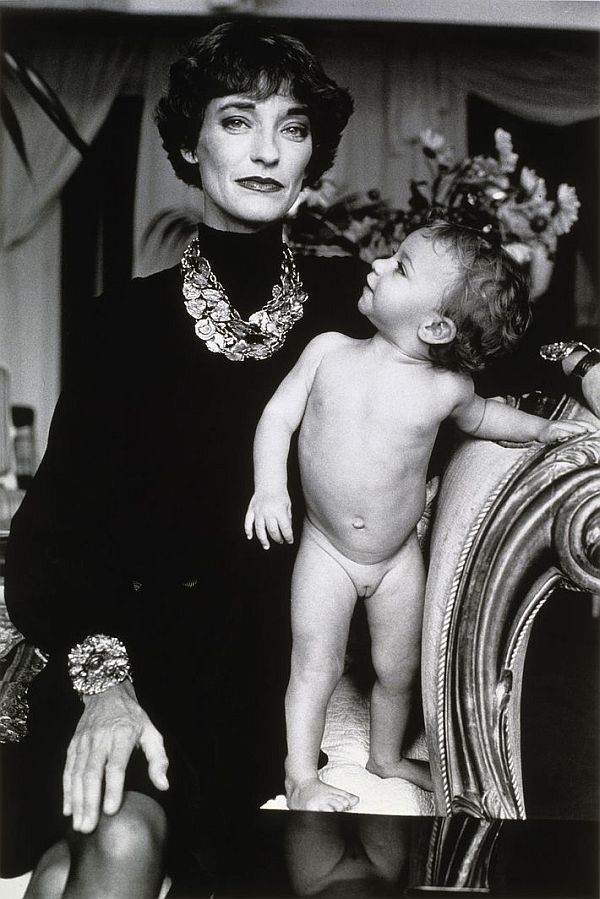


 Model and actress Brigitte Nielsen, in glamazon, not maternal mode, stares impassively, peculiarly hoisting her limp, sleeping infant to shoulder-height. Princess Caroline’s toddler son twists away from her as she stares straight ahead.

 Some portraits are quite witty: Margot Werts, owner of the trend-setting L.A. boutique American Rag, holds her baby who looks like a miniature drunken sailor, cap askew. Artist Mirène Le Floch’s infant might be performing a modern dance contraction. And Tiziana Zanecla’s tiny son resembles a Hollywood gangster — with spiked hair and tough-guy stare.

 A similar wit runs through Spring’s socialite portraits — Mica Ertegun merges into the painting behind her, to odd Surrealist effect. Judy Peabody holds up her pampered brown dachshunds breast-high, before a painting that depicts … a brown hunting dog.

 Springs never sought the limelight, content to let her husband be the famous half of their couple. But right now seems like a perfect time to shine new light on her work. With a wave of American women flooding into the political arena at all levels, Hilma af Klint at the Guggenheim, and a Frida Kahlo exhibit opening at the Brooklyn Museum, we seem surrounded lately with striking examples of women’s talents and power. What better way to keep up this momentum than by drawing inspiration from Springs’s humane and insightful portraits of these complex, gifted, and grown-up women.

 The Electric Intimacy of Alice Springs.  By Rhonda Garelick. The Cut , February 5, 2019. 


15/05/2019

Haunted Beauty : Photographer Deborah Turbeville


An exhibition of collages by Deborah Turbeville (American, 1932-2013) is on view at Deborah Bell Photographs through Saturday, June 29. This is the first exhibition devoted solely to Turbeville’s collages.


Turbeville is known for her iconoclastic fashion photographs, elaborate tableaux that depict brooding, introspective models wearing haute-couture clothing and posed in barren, desolate settings. Her pictures were widely published in the editorial pages of Vogue, Harper’s Bazaar, Essence, Nova, Mirabella, The New York Times Magazine, and other major publications.

Advertising clients included Comme des Garçons, Ralph Lauren, Valentino and Calvin Klein; and department stores such as Barney’s, Bloomingdale’s and Saks Fifth Avenue.

A former fashion editor for the The Ladies Home Journal, Harper’s Bazaar and Mademoiselle, Turbeville began taking photographs in the 1960s; however, she had no formal training until 1966 when she enrolled in a six-month photography workshop given by Richard Avedon and the art director Marvin Israel. As Turbeville told The New York Times in 1981, “If it hadn’t been for the two of them, I wouldn’t have taken my photography seriously.” Another mentor was Gösta Peterson, whose free-form approach with animated models greatly inspired Turbeville. She also acknowledged the influence of European films of the 1970s, especially those by Bertolucci and Antonioni.
Turbeville began to create books and exhibitions of her prints and collages in the late 1970s. Her first book, Wallflower, was designed by Marvin Israel and published in 1978. Shortly before this, in the spring of 1977, Turbeville was beginning to exhibit her photographs at Sonnabend Gallery in New York. Israel’s considerable influence on Turbeville’s work, and his layout of her pictures in Wallflower, led Turbeville to proclaim, in later years, “Marvin Israel made me.” He encouraged her to use tape and t-pins in assembling her collages, and to treat her prints as anything but precious. She re-assembled contact sheets and used masking tape around the 35mm frames to identify her preferred exposures. Sometimes two pictures are layered or overlapping in a collage, as if it were a work in progress. Turbeville’s acute attention to the mood of a place, the nuance of facial expression and body language, and her innovative cropping of the image she saw through her camera, are all accentuated in the serial imagery of her collages.


Turbeville was not only prolific and internationally published as an image-maker, but was also a maverick printmaker. She used unusual papers, experimented with toning and alternative processes, and intentionally scratched her negatives, striving to imbue her prints and collages with a sense of decay and timelessness.

Variants of some of the collages reproduced in Wallflower will be on view in the exhibition, such as those utilizing images from “stories” now referred to as Dummy Factory (1974), Glass House (1978), and Women in the Woods (1978). Of special note is a collage of rare photographs that Turbeville took in Kenya in 1992 while on assignment for Mirabella with the renowned fashion editor Jade Hobson, in which Turbeville’s pictures of Hobson are juxtaposed with portraits of the wildlife photographer Carol Cawthra Hopcraft and scenes of the people, animals, and daily life on Hopcraft’s ranch.
Turbeville describes her philosophy in the introduction to Wallflower:

“Through a series of vignettes in stills, I wish to use the medium of photography to explain a group of rather eccentric people – sometimes one or two, sometimes many – placed in settings that help describe them. These people perform like a repertory company, often reappearing in different roles. … My pictures walk a tightrope. They never know. … I am one of the very few “enfants terrible” still claiming to take fashion photography. I am not a fashion photographer, I am not a photo-journalist, I am not a portraitist.”

Throughout her career Turbeville traveled widely and concentrated on many themes in addition to fashion. In addition to Wallflower, the many books she published from her oeuvre include Women on Women (1979); Unseen Versailles (1982); Les amoureuses du temps passé (1987); Newport Remembered with Louis Auchincloss (1994); Studio St. Petersburg (1997); Le passé imparfait (2009); Casa No Name (2009); and Deborah Turbeville: The Fashion Pictures (2011). Turbeville’s photographs have been acquired by institutions worldwide including The Museum of Modern Art, New York; Whitney Museum of American Art, New York; Addison Gallery of American Art, Phillips Academy, Andover, MA; and the Victoria and Albert Museum, London.

This exhibition is presented in association with Staley-Wise Gallery, New York.

Deborah Turbeville : Collages. The Eye of Photography ,  May 7, 2019


Seeing a woman eerily moving down a staircase in darkness perhaps invokes more Ingmar Bergman than Italian Vogue, but that sort of moodiness is what fashion photographer Deborah Turbeville was known for. In the world of 1970s fashion, when images that highly sexualized women were de rigeur, Turbeville entered with an anti-fashion sensibility. Instead of suggestive shots of sexy women in gorgeous clothes, Turbeville’s works were dark, emotive landscapes that just happened to feature fine attire.

Though Turbeville had worked in fashion for decades by the time she became a photographer — she started out as designer Claire McCardell’s assistant and fit model, then became an editor at places like Harper’s Bazaar, Ladies’ Home Journal, and the now-defunct Mademoiselle — she despised the fashion world. “It’s seeing all those people who you’ve seen for years, who’ve spent fifty years of their lives just looking at clothes,” she said, according to Michael Gross’s 2016 fashion photography tome Focus. “I mean, I’ve got nothing against them. It’s not really a feminist point; it’s just that I don’t want to be there.”


Turbeville picked up a camera in the first place because, as a fashion editor, she was having trouble finding someone to execute the visions she hoped for. Mentored by fashion photography luminaries like Richard Avedon and Bob Richardson, Turbeville soon began shooting her own work full time, leaving the editorial world behind. Rejecting the glossy, sexualized, and female-commodifying style of popular ’70s photographers like Guy Bourdin and Helmut Newton, Turbeville’s work instead turned inward. “It is the psychological tone and mood that I work for,” she says in Gross’s book. This began with her game-changing “Bathhouse” series for American Vogue in 1975, in which thin, wan women lean moodily against the spare, cracked walls of an abandoned bathhouse. This series established the ideal Turbeville woman to be mysterious yet romantically isolated, almost like a Brontë heroine, walking with a vulnerable power across decayed, derelict settings. There is a sullen glamour, a weightiness and sadness to these subjects that purposely counters Newton’s or Bourdin’s fantasies. Turbeville showed herself to be a woman who sees women as they are — and often in their darkest moments — not as others dream or desire them to be. A selection of these images are now on view in Staley-Wise Gallery’s exhibition, Deborah Turbeville: Photographs 1977–1981.

This show includes selections from Turbeville’s shoots for Italian Vogue, American Vogue, and others, as well as projects for Valentino, Rochas, and Comme des Garçons. The latter is particularly interesting because the Metropolitan Museum of Art is concurrently hosting its Rei Kawakubo/Comme des Garçons: Art of the In-Between exhibition through the Costume Institute, and much of the language in that exhibition’s literature, used to describe Kawakubo and her designs, could also be applied to Turbeville. Kawakubo has, the Met writes, “an aesthetic sensibility that establishes an unsettling zone of visual ambiguity and elusiveness,” and “she upends conventional notions of beauty and disrupts accepted characteristics of the fashionable body.” These ideas are present in Turbeville’s work as well, and the magnetism of their pairing is evident in the images the photographer shot of the designer’s work throughout the 1980s.

Turbeville’s images featuring Comme des Garçons attire from the 1980 Passage Vivienne series are particularly representative of Turbeville and Kawakubo’s overlapping ideals. One photograph shows models cloaked in black, one with a dark veil atop her head, staring blankly, bleakly into the distance while hovering on an elegant yet aged and battered staircase. Another casts them in shadow as a blast of light beams behind them. Vignetting creeps darkness into the corners of the images, separating the scene into pockets of light. The clothing is just barely visible, the photos purposely grainy and unfocused. For Turbeville as much as Kawakubo, these images are not about capital-F Fashion, but about cultivating a particular mood, tone, and ambiguity. It’s not just fashion photography, but storytelling: There’s something brewing, brooding there.


These same feelings are present throughout the show, whether the photographs on display were completed in 1977 or 2011, two years before Turbeville died. A shot from her first “Women in the Woods” series for Italian Vogue in 1977 features a woman in a forest wearing a lightly colored pleated dress in perfect contrast to the background, staring into the greenery’s oblivion, softly clasping her hands together while other women stand behind, none interacting with the other. In a color series for Vogue from 1984, even in clothes of ravishingly bright emeralds, fuchsias, and mustards, the women have secrets, something keeping them at a distance. In these images, as in all of her work, Turbeville pulls the characters from the inside out so the body is not just a hanger, as it had been in fashion photography for so long (and, arguably, still is today). Looking at Turbeville’s women, it’s clear that their attire and appearance is secondary. The power of the images is that they evoke the desire to understand what’s happening in the subjects’ minds.


The Work of a Fashion Photographer Who Despised the Fashion World. By Elyssa Goodman. Hyperallergic , May 25, 2017


How is it that a photograph of two women wearing two plain white frocks, standing in a winter wood and barely visible amid clouds of ghostly smoke, could serve as such a profound inspiration, a clarion call to the disaffected foot soldiers of the fashion army? “In my pictures, you never know, that’s the mystery. It’s just a suggestion and you leave it to the audience to put what they want on it. It’s fashion in disguise,” the late photographer Deborah Turbeville, creator of this disturbing image, once said.
This picture, and many others from Turbeville’s Comme des Garçons and Women in the Woods photo shoots, are on display through June 10 at the Staley-Wise Gallery in Soho, timed to align the Met’s current Comme retrospective. “I have an instinct for finding the odd location, the dismissed face, the eerie atmosphere, the oppressed mood,” Turbeville explained, and this talent is everywhere stunningly apparent. In one photo, putative children of the damned sport straw boaters; in another, a veiled wraith descends a sepulchral staircase in a Galerie Vivienne passage.
When these images were first published, they represented a radical break in the world of fashion photography, which at the time was pretty much stuck in two trenches: an obsession with sexiness verging on the semi-pornographic, and a sunny inane cheerfulness. Turbeville chose a third path—a haunting hyper-realism, a notion of fashion photography that relied on the mere suggestion of clothing.


Born in 1932, Turbeville was raised in a wealthy, eccentric household in Massachusetts. She came to New York at 20, worked as a house model and general assistant to the iconic American designer Claire McCardell, whom she described as “kind of the Coco Chanel of the State of New York.” Turbeville eventually became an editor at Harper’s Bazaar but it didn’t stick; by the 1970s she was exploring her distinctive vision with her own pictures.
Her life was as distinctive as her art. Etheleen Staley, one of the founders of the gallery that has represented Turbeville’s work for decades, describes her as quiet and intellectual, a reader of obscure books and a seeker of avant-garde films, someone who “didn’t suffer fools.” Her apartment at the Ansonia on the Upper West Side featured one big room that transported you back in time. “You thought you were in Russia planning the Revolution—it looked like a salon in Moscow at the turn of the century,” Staley recalls.
But if that room was perfect, Turbeville’s art was emphatically, deliberately not. “A lot of times there were big mistakes,” she once said, “. . . there would be a strange cropping or one girl in focus and three out or a blur. But I would end up liking the mistakes and incorporating them into my work. And I became known for it.”

Known for it, and beloved for it.

Celebrating the Haunted Beauty of Deborah Turbeville and Comme des Garçons. By Lynn Yaeger.  Vogue. May 12 , 2017.


I first met Deborah about 30 years ago when I was working at Lei magazine. It was a very successful youth-oriented title. I was trying to do a different take on fashion and style using younger photographers such as Paolo Roversi, Peter Lindbergh, Steven Meisel and Mario Testino, all of whom I later brought to Vogue with me. I saw these pictures she did of girls in an old school house and in a dancing school. Just so atmospheric and beautiful.
I loved Deborah's work because it was original yet recognisable. She had a style, a signature. I wanted her in the mix because she was so individual and her style was timeless, even though it was black and white. She was all about atmosphere. Even when the backdrops were not beautiful, which was often the case, she transformed them and made the decay of old buildings seem dream-like. Sometimes an art director would say that her shots were out of focus, but that was her way of making the world seem otherworldly.
Deborah never really had the recognition or the success she deserved. She knew Richard Avedon and Helmut Newton, but she did not get their recognition. People in the fashion world like more commercial photographers and she never cared to become commercial. Plus, she had to like what she was doing for the passion to be there. If she ended up on a shoot she didn't like, I have to say, you heard about it. It was, "I don't like this place. I don't like this model." She would complain for hours.
Deborah was utterly individual, both in her work and her life. She was stylish, not fashionable: tall, slim, elegant. She wore simple things – dark pants, a T-shirt. There was a little bit of the hippy about her, too. She had a beautiful house on New York's Upper West Side and another in Mexico, and they were shabby-beautiful. She lived in her own world a little bit and you had to meet her there. She never said too much about what she was going to do when you commissioned her, but it was always her.


People assumed from her name that she was French, but she wasn't. (She was born in Massachusetts.) I didn't know much about her personal life. I know she had relationships and that she never married, but she was very private. Very few people knew about her life, and that is how she wanted it. She was friendly, but in a very selective way. Everyone who worked with her loved her because she was so sweet and so passionate.
Deborah was quite independent and liked to be a little mysterious. She loved Russia, the old Russia, and spent a lot of time in St Petersburg. I think, though I may be wrong, that she was a former model, but she was not of the trendy world of fashion. In fact, she was the opposite. She did not follow; she did her own thing. She never called herself an artist and when others did, she would say: "I'm a photographer."
For me, though, she was an artist. She led a kind of revolution in fashion photography with her early work, with the atmosphere and locations, but she was not a fashion photographer. The term is too confining for what she did. She made these beautiful books about places and buildings, like her Versailles book (Unseen Versailles), but I do think her fashion photographs worked against her in the art world. She was always somehow in the middle – between the worlds of art and fashion. She never really fitted into either.
It was great that Valentino used her in his campaigns until about two years ago. I was so glad about that. And a few days before she died, we agreed to do a book together around her pictures of the great aristocratic Italian families. It is a beautiful and sad thing to be doing now that she is not here, but I am very happy and proud to be doing it. For me, she is among the greatest photographers. She could have done so much more, but she was not prepared to compromise. That is the way of the true artist.

Deborah Turbeville remembered by Franca Sozzani. The Guardian ,  December 15, 2013.


  Deborah Turbeville : her work in pictures. The Guardian,  October 31 , 2013.