Showing posts with label drugs. Show all posts

24/12/2023

Why The Wars On Terror, Drugs And Migration Never Succeed


War rhetoric is everywhere in our volatile politics: from Ukraine to the resurrection of the war on terror in Gaza, from the ‘wars’ on human smugglers, drugs and crime, through to more metaphorical culture wars, ‘war on motorists’, on a virus – even on climate change. Keir Starmer accuses Rishi Sunak of prosecuting a ‘one-man war on reality’ while ‘anti-woke’ campaigners decry a war on Christmas. Some of these wars are spurious (last time we looked, Christmas is still happening). Others are all too real.

What’s clear is that war rhetoric is attractive either to rally one’s troops or to smear one’s opponents. No surprise: war mobilises. If a politician were to proclaim ‘a mild push on climate change’ or ‘a moderately important attempt to curtail migration,’ they’d get few plaudits from the ranks. But, as my colleague Ruben Andersson and I found in our book Wreckonomics, our addiction to waging (or announcing) war on everything has brought underhand benefits for politicians and massive problems for the rest of us.

For a start, politicians frequently use the spectacle of war to direct attention away from their deeper failures. Israel’s Gaza onslaught, after major security failings, may be a notable example. In the more metaphorical war on smugglers, we might think of Sunak’s renewed noises over small boats in face of record immigration figures. Diversionary tactics abound. Just two weeks after 9/11, Donald Rumsfeld suggested: ‘Look, as part of the war on terrorism, should we be getting something going in another area, other than Afghanistan, so that success or failure and progress isn’t measured just by Afghanistan?’ The Iraq invasion followed, with New Labour support. Amid the subsequent quagmire, one former Foreign Office worker told me of pressure to ensure things were seen to be working in Afghanistan so as to provide a distraction from things going so badly in Iraq.

Another problem rears its head here: war – whether in rhetoric or practice – tends to create more enemies. When politicians sought to frame measures against Covid-19 as a just war of sorts, opponents reacted and belligerence grew. As for real war, figures from the Global Terrorism Index show that in the context of the multi-trillion dollar global war on terror, the number of terrorist attacks rose rapidly: from around 3,300 in 2000 to almost 30,000 by 2015. Israel would do well to heed the warning.

War creates rich opportunities for those who want to game it for purposes of their own. The classic case is Vietnam, where American General William Corson observed that the South Vietnamese government’s power was ‘based on the US presence, and since that in turn is based on the level of violence it is to their advantage to orchestrate the war at the appropriate level.’ More recently, regimes from Syria to Sri Lanka and China have used the idea of a ‘war on terror’ as convenient cover for repressing their own populations. Meanwhile, from Gaddafi’s Libya to Turkey and Niger, ‘partner states’ have been able to use the threat of mass migration to leverage aid money and to carve out immunity for repression.

To these perverse incentives, we can add one more: the ease with which its costs can be exported to others. In 1935, another US general, Smedley Butler, denounced war as a racket ‘in which the profits are reckoned in dollars and the losses in lives.’ Consider the war on drugs, which in the words of one report, has generated ‘mass incarceration in the US, highly repressive policies in Asia, vast corruption and political destabilisation in Afghanistan and West Africa, immense violence in Latin America, an HIV epidemic in Russia, an acute global shortage of pain medication and the propagation of systematic human rights abuses around the world.’ And all this at huge expense to the public purse.

War ushers in a self-righteousness that quashes dissent and constrains debate over its real costs. For years, the staggering failure in Afghanistan and Iraq was effectively hidden away. ‘We didn’t have the foggiest notion of what we were undertaking,’ admitted Douglas Lute, the Afghan war czar under the Bush and Obama administrations. For too long, no one dared call the emperor naked while he was leading his troops into battle. We see a similar pattern in rhetorical wars too – including in the fight against Covid-19 via lockdowns, whose highly unequal distribution of costs worldwide was frequently seen as beyond the scope of civilised discussion. ‘Net zero’ risks reproducing this, fuelling an unsavoury politics of grievance. Both those on the left and right would do well to dial down their righteousness and listen.

More insidious than the quashing of dissent is the manipulation of the information environment that war invites. In the war on terror, beating Isis became a ‘win’ – even though Isis owed its existence to the war itself. In the war on drugs, policymakers reel off metrics on narcotics intercepted and smugglers arrested, but the trade keeps growing. At the borders, each crackdown (at Calais, in the Mediterranean) promises a political pay-off but also stores up future trouble (the small boats, the Atlantic crossing). When wars are declared, politicians need to point so a ‘win’, but all too often this means we frequently end up in a hall of mirrors where underlying problems are renewed and where failure becomes a peculiar kind of success.

In all the war talk lurks the danger, too, of crying wolf. When a real war happens, whether in Ukraine or the Middle East, we may not fully recognise it for what it is — not least when it comes to the dangers of escalation and the quashing of dissent.

We must wean ourselves off the war fix. By opening our eyes to the real costs and ill-gotten benefits from both rhetorical and real wars, we have a chance to ditch the addiction. That will help us to focus on the more peaceful solutions that only emerge when dissent and debate are allowed a proper place in politics. 

Wreckonomics: Why It’s Time to End the War on Everything, by Ruben Andersson and David Keen, is out now

Why are politicians fixated with declaring war? By David Keen. The Spectator December 22, 2023. 


Just like the war on drugs and the war on terror, efforts at stopping population movement by force often just fuel the problem. But for many claiming to confront the perceived threat, that suits all too well

Look at the business of tackling the migration crisis in Europe, and you will find evidence not of some one-off failure to plan ahead, or a policy initiative gone wrong through unexpected circumstances. Rather, you face something akin to a complex crime scene where the damage, the ostensible “mistakes”, and the cover-ups have all been systematic. The perverse outcomes of the war on smuggling – including thousands of border deaths, escalating political brinkmanship and the professionalisation of the human smuggling business itself – are more than a blip or an anomaly. When policies persistently fail, we need to look not only at “what went wrong” but also at “what went right”– and at who is benefiting from the wreckage.

 The habit of waging “war” on everything has spread from the early days of the war on communism and the war on drugs to “fights” against crime, terrorism, irregular migration and many more complex political problems. These wars never seem to be won and often have disastrous results, yet politicians continue to declare them. What keeps such disastrous interventions and policies ticking over? What renders them acceptable? Why do they get reinvented from one era to another? And why do we never seem to learn? Using our backgrounds in anthropology (Ruben Andersson) and history/sociology (David Keen), over recent years, we have sought to get to the bottom of these questions. Nowhere illustrates the failure of “the war on everything” approach better than the fight against migration.

In 2010, when Ruben first arrived in Senegal to study migration to Europe, he was struck by something people kept telling him. Four years earlier, in one of Europe’s earlier “migration crises”, 30,000 west-African migrants had arrived at the Spanish Canary Islands in wooden fishing boats, sparking a large-scale deportation campaign. On the outskirts of Dakar, the capital of Senegal, one of those deported from the Canaries told Ruben that he was, as an anthropologist studying migration, part of a system that was profiting from the migrants’ misery. “There’s lots of money in illegal migration,” said the deportee, pointing out, on long walks through his seaside neighbourhood, all those who fed off this system: academics, journalists, NGOs and European and Senegalese maritime forces stationed just beyond this fishing community.

At the time, the word on the street was that Senegalese politicians, both locally and nationally, were using Spanish aid money – meant to ensure Senegal’s collaboration in deportations and border patrols – for their own private or political gain. In coming years, the pattern would be replicated as major partners in European immigration control – such as Libya, Turkey and Sudan – leveraged their promised cooperation, not just for a windfall of aid, but also for wider strategic and economic ends.

Seeing this system in action, we developed an analysis of the political economy of war and of security operations such as deportation and border patrols – asking the old question “Cui bono” (Who gains?), as well as “In whose wider interests are the operations staged?” There was an intriguing, if disturbing, challenge of joining the dots between various disastrous interventions, from the wars on drugs and smugglers to the war on terror, where we had observed a very similar pattern. In a variety of war-like interventions, regional powers have been gaming ostensible attempts to eliminate a perceived threat, carving out impunity and making a profit. At the same time, pursuing these various wars and fights has routinely fuelled – or simply displaced – the problem. For a wide range of actors who claim to confront the perceived threat, things keep going wrong in the right way.

Escalating the fights, escalating the demands

One of the most important gamers was Libya’s Col Muammar Gaddafi. By the early 2000s, he had already discovered that he sat on a prize possession. Amid the international arms embargo, the Brotherly Leader had turned his eyes to his African neighbours: sleeping in a great Bedouin tent in New York before the UN general assembly was all of a piece with his newfound role as chief spokesperson for downtrodden African nations breaking free from old colonial shackles. He had established close business links with states in the Sahel and invited African workers into Libya’s booming economy.

 As Italy and its northern neighbours anxiously began considering the Mediterranean for signs of migrant boats, however, Gaddafi started seeing his country’s African workers as a double asset. On the one hand, workers could still be exploited; on the other, they could be weaponised. By 2008, a Friendship Treaty had been struck between Gaddafi and Italy’s Silvio Berlusconi, which was worth $5bn over 20 years. Supposedly aimed at addressing colonial wrongs, it smoothed the path for outsourced border patrols in the central Mediterranean. Even so, Gaddafi, who had by now fully grown into Reagan’s caricature of him as the “mad dog of the Middle East”, escalated the rhetoric and threatened that Europe would “turn black” unless more favours were forthcoming. And come they did: Libya emerged from the international cold thanks in no small part to Gaddafi’s migration manoeuvres. He also succeeded in presenting himself as someone who could help in the “war on terror” – not least because of his role in stirring up terror.


Then came war. Amid the Arab spring, Nato and assorted Middle Eastern countries intervened militarily in the scramble for power in Libya. The violent removal of Gaddafi and the conflict that followed led to a cascade of displacement and migration; it also escalated the gaming and brinkmanship. Nato missiles had ended his previously cosy relationship with European leaders, but Gaddafi did not give up on his threats and cajoling in the dying days of his regime – quite the opposite. Europe would be “invaded” by migrants, he said, unless Nato backed down; his troops tried to make good on his threat, forcing African workers to board unseaworthy vessels at gunpoint.

In the following years, assorted warlords have kept up this tradition by simultaneously combating and facilitating migration, taking handsome rewards while threatening Europe with further “invasions”. In one notable episode, one militia leader in the north-western Libyan city of Zawiya, known as Al Bija, was found by journalists to be managing the smuggling market by taking a substantial cut from any departing boats before promptly “rescuing” those who had not paid, towing them back to land and imprisoning them in brutal detention centres run by his own tribe. The double game of migration control – extracting cash and impunity by issuing threats, while simultaneously offering to remedy them – was, by the time of Libya’s conflict, a high-stakes scramble for profit and power.

Gaming Europe’s migration fixation

The stakes were to rise higher still. In 2015, Turkey’s Recep Tayyip Erdoğan was in a tight spot: he had called snap elections and was under siege from all sides. But Erdoğan held the trump card: migration. Though the details were to remain murky, by spring 2016 it was becoming clear that threatening to turn on the tap of onward migration was an important tactic for the Turkish leadership. (Questions still remain over Russia’s role in fomenting the crisis as part of its Syria manoeuvres.) The 2015-16 border crisis would strengthen Erdoğan’s grip on power as he extracted promises from the EU – only partially met, but that did not particularly matter for short-term electoral purposes – on visa-free travel for Turkish citizens and billions of euros of financial support for Turkey’s refugee operations.

Selling yourself as an unreliable bulwark against migration had by 2015 become big business. “Weapons of mass migration” is how one scholar, Kelly Greenhill, has labelled this use of migrants as a geopolitical tool. Whatever we call this gaming of migration and forced displacement, it is a remarkably effective way for less powerful states to exert pressure on their stronger counterparts. One further example comes from Morocco, which in 2022 managed finally to shift Spain’s policy on occupied Western Sahara in its favour in exchange for further migration enforcement – halting, at least temporarily, the brinkmanship that had fomented politically motivated “border crises” at the Spanish enclaves of Ceuta and Melilla, as well as in the strait of Gibraltar, over previous decades. The costs of this bargaining were regularly borne by migrants; for instance, in June 2022 at least 37 migrants died between the Spanish and Moroccan fences at Melilla, where they had been trapped and teargassed in a security operation subsequently covered up by both sides.


In her study, Greenhill argues that certain features of liberal democracies – including respect for rights and open democratic debate – make them particularly vulnerable to being played. However, we have seen in Libya and Turkey how the illiberal tendency of treating migration as a threat has been a key part of the game. Once fighting migration has come to be seen as a paramount political objective in destination states, and once huge resources are being spent on this endeavour, buffer states will spot vulnerabilities and opportunities to play on this perceived existential threat, selectively closing and opening the gates.

UNHCR figures as of 2023 confirm a broader trend: 83% of refugees worldwide are hosted by low- and middle-income countries, and 72% by countries neighbouring conflict zones. Turkey, topping the list of global refugee hosts, can reasonably argue that it has done its “fair share” in hosting more than 3.6 million refugees, mostly from neighbouring Syria. When larger refugee hosts leverage human displacement, they are using the “weapons of the weak”, to use anthropologist James Scott’s term, against a more powerful counterpart. While border security has spectacularly failed to address international migration (and has generated a raft of destructive consequences), it has nevertheless “succeeded” in keeping refugees away from the protection that might have been provided by the richest states, at least for some time. Yet this is far from the only shortsighted gain for destination states. Another comes from the potent politics of distraction and drama that border control provides.

The burgeoning business of border security

It is worth reflecting on how swiftly borders became bulwarks against unwanted migration. The end of the cold war once promised, to optimistic liberal thinkers, a borderless world; instead, it gifted us an increasingly globalised border business. Not only are more and more partner states being enrolled in border security, but many countries are also instigating their own border security fixations. Barriers are today separating neighbours not just in the west but far beyond. While there were 15 walls at nation-state borders around the world at the end of the cold war, the total had risen to more than 70 barely three decades later. Unlike older border fortifications, the new ones are not built to keep state enemies away (or to keep citizens in, as in the case of the Berlin Wall): they are aimed at keeping people out.

Calls for “security” and “border protection” justify not just the building of walls but also a wider architecture of control, separation and surveillance at national borders, and well beyond them. Drones have been repurposed from the “war on terror” for border surveillance in the US and the Mediterranean; complex offshore detention and sea patrolling agreements have been rolled out from Australia to the Atlantic; advanced radar equipment and satellite surveillance have proven a boon for Europe’s defence industry; and in the increasing number of border security “expos”, security firms have presented their customers with ever more intrusive technologies– heartbeat scanners, oxygen detectors, ground sensors, online surveillance – in a market that, according to one estimate, will soon be worth more than $65bn. Meanwhile, the budget of the EU border and coast guard agency, Frontex, shot up from €19m in 2006 to more than €750m by 2022, a year in which it was facing mounting scandal over support for illegal Greek “pushbacks” at sea.


The US, as so often, has led the way in this trend while actively heating the global border security market – with the budget of the US Border Patrol increasing almost tenfold in the past three decades, from $363m in 1993 to nearly $4.9bn by 2021. While these sums are still small relative to military expenditure, the remarkable growth rate of the US Border Patrol’s budget is strongly related to the wider security marketplace, with great scope for synergies, “dual-use” technology, seed funding and more, across civilian policing and military sectors. At the heart of this complex sits the vast Department for Homeland Security bureaucracy.

Besides the escalating border security investments, politicians have put huge amounts of time, money and effort into the complicated business of getting tough on migration – and being seen to get tough.

Yet this has massively backfired on a practical level. Douglas Massey, a leading migration scholar, has found that, since the 1980s, vast expenditure on border security has gone hand in hand with a large growth of undocumented migration within the US.

The reason is remarkably simple: as it became much harder for seasonal migrant workers to circulate back “home”, owing to harsh border controls and barriers, people stayed. So why, if border controls were backfiring so spectacularly, were successive administrations so committed to them?

The political profits of fighting migration

The gap between rhetoric and reality in migration policy has been especially notable when it comes to fighting migration. The political gains from a strong stance on borders are clear, even when politicians fail to achieve the outcomes they seek. Some years ago in the US, the political scientist Peter Andreas described this as a “border game” with various layers: from the spectacle – and distraction – of border enforcement on the political level, to the institutional funding game, through to the cat-and-mouse game at the border itself.

Racism came to play a prominent role here, reflecting a longer history of racial exclusion, fed by a fear-based narrative. In 1985, President Ronald Reagan said undocumented migration was “a threat to national security”, with “terrorists and subversives ... just two days’ driving time” from the Texas border, and communist agents ready “to feed on the anger and frustration of recent Central and South American immigrants”. Massey is among those who have pointed out how, over the decades that followed, a racialised “Latino threat narrative was manufactured and sustained by an expanding set of self-interested actors who benefited from the perpetuation of an immigration crisis”. This new migration pattern also had clear winners within the wider economy, as an undocumented and deportable labour force was even more exploitable than its legal predecessors.


A large part of the incentive to keep escalating the fight, in the US and Europe, concerned the gains to be had from fixating on and fighting illegal migration. Especially in the US, border closures have brought economic gains in rendering the cross-border labour force increasingly exploitable. Meanwhile, the political gains are twofold. On the one hand, a tough nationalist message attracts voters; on the other, it provides a distraction from problems that governments cannot or do not want to solve, including inequality, economic insecurity and environmental catastrophe. Irregular migration by land and sea was a boon for this kind of politics in Europe. Yet the numbers have in general been relatively small, 2015 excluded. Most irregular migration in Europe occurs when people overstay their visas, as the European Commission itself acknowledges, while regular immigration dwarfs land and sea arrivals.

Governments and interior ministries have seen fit, for their own political and institutional reasons, to treat some human movement as a security problem to be solved with force. Instead of looking at the complex drivers of migration – including persistent demand for workers – all politicians had to do was to be seen to address the arrivals. Meanwhile, new actors spotted an opportunity.

How the war on migration feeds the smuggling business

European leaders have been keen to frame their border security efforts as a war on smugglers, especially since 2015, when smugglers (frequently mislabelled as mafia or traffickers) were conveniently assigned the blame for a set of horrific shipwrecks near the Italian and Maltese coasts. Of course, we shouldn’t paint smugglers in a rosy light; theirs is usually a cut-throat business. Yet it is a business that has grown larger and more violent on the back of border enforcement, not just in Europe but worldwide.

In north Africa and the Sahel, the small-scale smuggling of earlier years, often run by migrants themselves, has increasingly given way to organised criminal gangs. In Libya, smugglers have held migrants and refugees hostage and even tortured them until their families pay release fees. The taller the barriers, the more captive your market, as “customers” have nowhere left to turn except into the hands of professional criminal organisations.

We can put this in economic terms, as Customs and Border Protection (CBP) officials in the US are keen to do themselves. In presentations, CBP economists have asserted, like their European counterparts, that the aim of enforcement is to destroy the smugglers’ business model. This involves increasing the cost of smuggling to the point where revenue takes a hit, making it a less attractive business. Yet what this does in practice is favour smuggling economies of scale. A systemic view, if officials had wished to consider it, would tell them that the fight against migration and the war on smugglers would produce more of precisely that which they said they wanted to curtail: more dangerous migration scenarios and stronger criminal smuggling operations.

This is precisely what happened in Libya, after the fall of Gaddafi. As one report noted in 2017, “The coastguard, detention centres and key branches of the fragile Libyan state’s security apparatus are largely run by militias, some deeply involved in the illicit economy,” with these militias “creating a protection market around human smuggling before eventually taking over the business directly”. The political and economic games around European – especially Italian – relationships with the militias have been complex and murky. However, it was becoming clear around this time that external involvement and encouragement were strengthening the power of the militias, who, like many border guards, could play the dual role of poacher and gamekeeper along Libya’s coasts. The strengthening of militias and the ensuing turf battles among them were contributing to Libyan instability.

 In impoverished Mali and Niger, various political leaders have sent clear signals that unless they receive the required political support and economic capital, a migratory crisis will ensue. States such as Morocco and Turkey regularly turn on and off the migratory tap to strengthen their hand in negotiations with the EU. In all these cases, authoritarian leaders, interior ministries, and abusive security forces have been the big winners in the fight against migration – gaining power, recognition and money. Those who have suffered most have been migrants and citizens in these countries, while regional stability has been weakened.

In 2020, President Alexander Lukashenko of Belarus – despite his regime’s incipient working arrangement with the Frontex border agency – was channelling refugees to a frontier no-man’s-land where Polish guards fought them back. By this stage, EU leaders and the European Commission had cottoned on to what they called the “instrumentalisation” of migration. Their argument, probably quite correct, was that Lukashenko was seeking to destabilise the EU through uncontrollable migration flows. Yet instead of accounting for its own role in the blatant gaming at the borders, the EU used this incident to propose what amounted to pushbacks in cases where migration was being “instrumentalised”.

On the central Mediterranean migration route, it is not only Gaddafi’s successors who have continued to instrumentalise migration. So have Italian politicians, who have used these threats at face value to ramp up anti-migration rhetoric, to rally the voter base, and to put blame on the EU – and human smugglers – for the debacle.

This kind of crisis politics has been accompanied by a growing tendency to shift blame on to rescue initiatives on the open sea, with repeated shipwrecks and deaths as a result. On the southern border of the US, while Mexico has often been less willing to stoke the problem in the way Europe’s neighbours have done, this has in no way dented the political appetite in Washington DC for manipulating border crises and finding new groups to blame. A wide range of wars and fights – whether in relation to migration, terrorism, drugs or crime – has created perverse incentives. One is tempted to say that failure has become the new success.

This is an edited extract from Wreckonomics: Why It’s Time to End the War on Everything, published by Oxford University Press, 2023.

‘Weapons of mass migration’: how states exploit the failure of migration policies. By Ruben Andersson and David Keen. The Guardian, December 14, 2023. 


Oxford University Press


Oxford Academic


Security is one of the most important and challenging issues in the 21st century. It is the ability to protect and promote the well-being and dignity of people and communities, and to prevent and resolve conflicts and threats. But what does security really mean? And how can we achieve it in a complex and uncertain world? In this article, we will review the book Wreckonomics: Why It’s Time to End the War on Everything by Ruben Andersson and David Keen, two professors of international development and experts on conflict and security. The book is a critical and provocative analysis of why various wars and security interventions have persisted and prospered despite their disastrous failures and costs, and how we can end the war on everything and create a more peaceful and prosperous world.

If you want to learn more about security and development, and how to challenge and change the destructive policies and practices that fuel the war on everything, you should read this book. It will give you a new and holistic perspective on security and development, and help you find effective and ethical ways to address the complex and interrelated challenges and opportunities that we face in the world.

Recommendation

War is hell, the saying goes. For professors Ruben Andersson and David Keen, the truism evokes a different kind of hellscape. In this insightful analysis, they dissect the “war on everything,” by which they mean misguided fights against problems like terror, illicit drugs and illegal immigration. In every case, the warriors oversimplify the threat, use bogus metrics to measure their progress and then duly claim victory where none exists. Andersson and Keen focus not just on the hypocrisy of political leaders but also on the unintended victims of these wars. You’ll find that their thought-provoking work casts many of society’s issues in a new light.

Take-Aways

“Wreckonomics” is a perverse process by which a misguided policy targets an intractable problem.

Wreckonomics policies consist of five parts that describe the process.

The Cold War set the stage for decades of unwarranted wars.

The War on Terror played on fears while botching the broader mission.

Wreckonomics policies create their own destructive momentum.

The fight against illegal immigration contains echoes of the other wars.

The War on Drugs is the longest of the wreckonomics misadventures.

Four strategies can help make wreckonomics policies less devastating.


Summary

“Wreckonomics” is a perverse process by which a misguided policy targets an intractable problem.

In recent decades, Western governments have embarked on a variety of well-funded fights against various scourges. There was a War on Drugs and a War on Terror, along with fights against illegal immigration. But the cures proved worse than the diseases. These wars created unintended consequences without fixing the underlying problems. Despite the obvious failures of these wars, politicians keep fighting them and finding new enemies. Indeed, politics in the United States seem to be dominated by a never-ending search for new foes and a demand from the warriors that everyone become more indignant.

“This habit of waging ‘war on everything’ has spread from the early days of the war on Communism and the war on drugs to ‘fights’ against crime, terrorism, migration and many more complex political problems.”

One theme in these wars is that they underestimate the complexity of the challenge at hand. Politicians view themselves as crime scene investigators – they’re looking for the single culprit responsible for the problem. That mindset led to the manhunts for Osama bin Laden and Saddam Hussein. In wreckonomics, the good guys need one evil actor to blame, even if the underlying issue has many protagonists. In truth, any social issue is multifaceted and difficult to fix.

“One way of summing up this habit of wreck-and-fix is the old saying ‘If you have a hammer, everything looks like a nail’.”

That leads to another common theme: Wreckonomics policies often are championed by right-wing politicians. While conservatives aren’t entirely to blame for wreckonomics policies, the right has specialized in simplifying and weaponizing complicated issues.


Wreckonomics policies consist of five parts that describe the process.

The wreckonomics ethos can be summed up with the acronym WRECK:

W is for “war fix” – Warriors sell the miracle of the kill shot. In every wreckonomics policy, an ill-conceived notion that the targeted threat is simple and can be remedied through force dominates. Hitting the problem with a magic bullet will neutralize the threat, the warriors promise. Wreckonomics also provides a fix in that the misguided actions soon become addictive. Once the war starts, stopping it is nearly impossible.

R is for rigged – Wreckonomics policies are gamed to benefit certain players. In the war on everything, the fix is always in. No one ever comes out and says it, of course, but those crucial players speaking most loudly against the threat at hand are the ones who benefit most from the focus on it.

E is for externalization – Wreckonomics policies are expensive in terms of blood and treasure, but the interventions never hit the powerful as hard as they hit everyone else.

C is for cascade – The first three letters of WRECK set the stage for unexpected, unpredictable results. Just as an avalanche starts small and escalates quickly, the wreckonomics cascade is a result of the unacknowledged complexity of the task at hand. Costs quickly balloon, as do the opportunities for players to further corrupt the process.

K is for “knowledge fix” – Once the war is under way, its proponents set about twisting the truth: Any victories are exaggerated, any setbacks are downplayed. The distortions include overlooking the true costs of the intervention, and ignoring failures and unintended consequences.


The Cold War set the stage for decades of unwarranted wars.


The Cold War wrote the script for the wreckonomics policies that followed. The globe’s two great powers were embroiled in nonshooting wars against the other. Gaming became endemic. In the United States, huge sums flowed to defense contractors. The Soviet Union also ramped up its own armaments industry. Like all wreckonomics policies, the Cold War launched with a real conflict and sincere intentions: Two great powers aimed to spread their divergent ideologies. However, things quickly spiraled. Over the decades, the Cold War turned hot in proxy wars, perhaps most notably in Vietnam, but also in El Salvador, Indonesia and Angola. The specter of colonialism loomed over many of these hot spots, adding complexity to the system. What’s more, the architects of the Cold War lived in Washington, DC, and Moscow, places unburdened with the high body counts that were racked up in shooting wars in the developing world. One US infantry officer wrote the memoir Kill Everything That Moves, a title that summed up how a poor person living in Vietnam experienced the Cold War.

“Seen as a whole, the Cold War involved a very particular – and very skewed – distribution of costs”

As the Cold War sprawled across the globe, propaganda took over. Neither side gave an honest accounting of its victories and defeats; instead, both turned to spin and obfuscation. What’s more, America and the USSR assembled allies who were gaming the Cold War agenda not out of ideological purity but for their own advantage. The end of the Cold War underscored the addictive nature of wreckonomics: Optimists hoped for a “peace dividend” in the 1990s as the huge sums funneled toward arms, soldiers and spies could be redirected to schools and health care. Instead, the United States and Europe continued to spend heavily on their militaries, with the argument that cutting defense budgets amounted to a surrender to global threats.


The War on Terror played on fears while botching the broader mission.

The post-September 11, 2001, fight against global terrorism quickly devolved into a particularly effective version of wreckonomics. A defining feature of this policy was its appeal to emotion, particularly fear. Terror warriors became adept at manipulating public emotions to get what they wanted. The emotional appeal serves as an inoculation against uncomfortable questions – if the war pits good versus evil, then no right-minded person would question how it’s being waged or how widely it’s proliferating. The US War on Terror turned into an all-encompassing effort, as evidenced by the creation of the Department of Homeland Security, a bureaucracy that fought not just terror but also drug trafficking and border security.

“In our wars and fights, strong emotions have also effectively been stirred up and manipulated by political and security actors.”

 The Cold War created the prime conditions for the War on Terror that followed. A hot war in Afghanistan sowed the seeds of future insurgency. Then, when the Cold War ended and communism faded as an enemy, terrorism moved into the role. Terrorism didn’t become Public Enemy No. 1 until the 9/11 attacks. Then, the war machine sprang into action, with the United States invading Afghanistan and then Iraq.


Wreckonomics policies create their own destructive momentum.

Neither invasion was clearly supported, but both illustrated a reality of wreckonomics: The wars perpetuate themselves. A clear goal of the 9/11 terrorists was to provoke the United States into a heavy-handed response, which then served as evidence that America really was the iron-fisted power that the terrorists had portrayed all along. Afghanistan and Iraq, meanwhile, saw spikes in terror attacks after US troops arrived, acts that only seemed to reinforce the rationale for the American invasion and ongoing presence. As Democratic presidential candidate John Kerry said of George W. Bush, “Iraq was not even close to the center of the War on Terror before the president invaded it.”

“Many of the state actors we have considered – in Washington, Moscow, Damascus and Colombo – can cynically claim their wars have been ‘won’.”

As billions flowed into Afghanistan, the country remained unstable. A task force headed by General David Petraeus estimated $360 million in US aid had wound up in the pockets of the Taliban or Afghani criminals. To the credit of the terror warriors in the United States, one goal has been achieved: No attacks have occurred on US soil since 2001. But to hold up this fact as the only measure of success is to miss the broader failures. These include massive spending and a globally disruptive wave of violence not just in Afghanistan and Iraq but in Syria, Sri Lanka and elsewhere.


The fight against illegal immigration contains echoes of the other wars.

For decades, the United States had been trying to stem illegal immigration across the Mexican border. Brazen incursions across the frontier near San Diego in the 1990s led American authorities to build fences, which then pushed migration paths into more remote, hazardous terrain. Similarly, in the 2000s, an influx of illegal migrants into Spain led that country to build more fences. The migrants in turn took even more circuitous and dangerous routes to Europe. In true wreckonomics fashion, developing nations bordering wealthy powers figured out how to make money from their geographic position. Mexico partnered with the United States to crack down on illegal entries through Mexico’s southern border. Mauritania accepted investments from Spain, while Libya partnered up with Italy.

“Libya emerged from the international cold thanks in no small part to Gaddafi’s migration maneuvers.”

For opportunists south of the border, the fight against immigration is a lucrative leverage point. Libyan strongman Muammar Gaddafi grasped Europe’s fears of African migrants streaming in, and he threatened to allow Europe to “turn black” unless he received compensation. The gambit worked. Libya received billions in European aid. One scholar even labeled the strategy “weapons of mass migration.” As the Arab Spring and the Syrian war spurred a crisis, the wreckonomics playbook was in full force. Conservative policymakers embraced overly simplistic solutions that were doomed to fall short. Meanwhile, shrewd actors in the developing world figured out how to make the wreckonomics policies work for them. In Libya, for instance, a militia leader exacted a toll from each boat heading north. Those who declined to pay would be “rescued” at sea – and the boat’s occupants sent to prison camps. The spoils weren’t just for strongmen. Frontex, Europe’s border patrol agency, saw its annual budget soar, going from less than $22 million in 2006 to more than$750 million by 2022.


The War on Drugs is the longest of the wreckonomics misadventures.

In wreckonomics, the protagonists of the misguided policy invariably focus on the wrong measurements of success. In the Vietnam War, the US military leadership concentrated on body counts. In the drug war, the short-sighted focus is on arrest numbers. In both cases, the putative leaders of the policy initiatives are like gambling addicts pulling the lever over and over on a slot machine that’s rigged against them: They believe they’re on the verge of victory, even as the defeats pile up. In other words, the drug warriors themselves are addicted – not to narcotics but to the never-ending cycle of fighting a losing war. The Philippines provides an especially macabre version of the drug war. In 2016, President Rodrigo Duterte urged his citizens to kill drug addicts. In Duterte’s first six months in office, Amnesty International estimated, his regime killed some 7,000 people for drug offenses. In a bizarre twist, Duterte himself was addicted to fentanyl.

“The incentives of the environment in which the drug warriors operate keep pushing them toward compulsive behavior.”

Duterte upped the ante, claiming he wanted to unleash a holocaust that would kill millions of addicts. He paid bounties to police officers who murdered drug users. In a bromance between strongmen, US president Donald Trump praised Duterte’s “unbelievable job.” Duterte’s simplistic, brutal fight took a page from the early days of the drug war in the United States. Policymakers and law enforcement made no effort to understand why some people became addicted or why others entered the drug trade. Instead, they focused on mass arrests and heavy-handed tactics, often racially tinged. It was Richard Nixon who coined the phrase “War on Drugs” in 1971, a thinly disguised jab at his predecessor Lyndon Johnson’s War on Poverty. A decade later, Ronald Reagan doubled down. The result was soaring levels of incarceration, particularly for Black Americans. The uneven penalties for crack cocaine, seen as a drug favored by Black users, were clearly racist.


Four strategies can help make wreckonomics policies less devastating.

The wars on everything are costly. Here’s how to mitigate the damage:

Encourage dissent – A society on a war footing has a clear enemy, and no space for dialogue nor room for debate. But in the war on everything, the enemy is never clear-cut. That’s why it’s crucial that warriors make way for dissenting voices. Policy debates shouldn’t be stifled by an environment that mimics martial law.

Honestly assess the true costs – Those who fight wars on everything relish confusion and obfuscation. The “hall-of-mirrors” effect makes it difficult to tell how the war is progressing. To combat this syndrome, societies need robust and honest analyses of who’s really winning and losing in any given war.

Broaden the inputs – In Colombia, policymakers have shifted that nation’s costly war on drugs only after decades of experience and a willingness to listen to various voices, ranging from drug users and coca producers to academics and intellectuals. Groupthink and willful ignorance are part of wreckonomics; bipartisan solutions are a way to create “coalitions against complicity.”

Acknowledge complexity – As part of its rhetoric, every misguided policy war boils down the enemy to one overly simplistic factor. Never mind that drug addiction and mass migration are complicated, systemic issues. The warriors want to make it simple and then ignore every factor outside their narrow view.

About the Authors

Ruben Andersson is a professor of social anthropology at the University of Oxford. He is the author of No Go World and Illegality, Inc. David Keen is a professor of conflict studies at the London School of Economics and Political Science. He is the author of The Benefits of Famine and Useful Enemies.

Genres

Nonfiction, Politics, International Relations, Security, Development, Sociology, Economics, History, Philosophy, Ethics


Review

The book Wreckonomics is a critical and provocative analysis of why various wars and security interventions have persisted and prospered despite their disastrous failures and costs. The authors, Ruben Andersson and David Keen, are both professors of international development and experts on conflict and security.

They examine four cases of long-running and futile wars and fights: the Cold War, the war on terror, the fight against migration, and the war on drugs and crime. They argue that these wars and fights are not only ineffective and harmful, but also profitable and advantageous for various actors and interests, such as politicians, corporations, media, NGOs, and even criminals and terrorists.

They show how these actors and interests have exploited and manipulated the fears, emotions, and incentives of the public and the policymakers, and have created a system of feedback loops, distortions, and games that sustain and justify the wars and fights.

They also show how these wars and fights have eroded the values and principles of democracy, human rights, and justice, and have undermined the prospects of peace and development. They call for a radical change in the way we think and act about security, and propose a four-step approach to end the war on everything: 1) recognizing the costs and benefits of the wars and fights, 2) breaking the cycles of fixation and gaming, 3) creating space for dissent and dialogue, and 4) building alternative coalitions and solutions.

Wreckonomics is an insightful and compelling book that covers a wide range of topics related to security and development. The authors write in a clear and engaging style, using anecdotes, examples, and metaphors to illustrate their points and make them relevant and relatable to the reader. They also write in a balanced and nuanced manner, acknowledging the complexity and diversity of security and development issues, and avoiding simplistic or prescriptive solutions.

 The book is well-organized and well-researched, with references, notes, and a glossary at the end. The book is not only a valuable and authoritative source of information, but also a motivating and empowering story of how we can challenge and change the destructive policies and practices that fuel the war on everything.

The book is suitable for anyone who is interested in learning more about security and development, whether they are students, professionals, or curious readers. The book is also a useful resource for anyone who wants to understand the broader social and economic issues and trends that affect and shape security and development.


Summary: Wreckonomics: Why It’s Time to End the War on Everything by Ruben Andersson and David Keen. By Alex Lim. Paminy December 2, 2023. 


Wreckonomics, a study by two academics, argues that vested interests need ‘forever wars’. That may be true, but is there a solution?

Almost five years ago, it was reported that, according to some metrics, the United States of America had been at peace for only 17 years since 1776. It had thus, at that point, been at war for 93.5 per cent of its existence. What constitutes war – whether there must be nation-states on opposing sides; whether it includes covert or non-military operations – has long been a source of debate, but perpetual war is today the reality. One sobering indicator is the fact that, for several years now, a child born on September 11 2001 has been eligible to enlist in the “war on terror” that ensued. The latter is one of many ill-defined and catastrophic wars being waged in perpetuity around the world.

The human and financial cost of these wars, which are not limited to armed conflicts, is the subject of a new book by Ruben Andersson, a professor of social anthropology at Oxford, and David Keen, a professor of conflict studies at the London School of Economics. Wreckonomics is a deeply-researched and wide-ranging account of how, despite manifest failings, the wars on terror, drugs and migration are entrenched in Western policy as a kind of perma-crisis for which its principal architects are never held responsible.

The invasion of Afghanistan by the United States, where the war on terror and the war on drugs have converged, was a failure on a remarkable scale. The authors steadfastly demonstrate how the war on terror has done nothing but foment what it ostensibly sought to combat: the number of global terrorist attacks ballooned from a reported total of 3,300 so far in 2000 to almost 30,000 by 2015 – despite the spending of nearly $8 trillion dollars between 2001 and 2021.

Central to Wreckonomics is the question of identifying exactly who benefits from these wars going poorly. Beyond arms manufacturers wanting orders and bellicose senators wanting publicity, this includes aid groups and local authorities, whose under-scrutinised flow of funding depends on conflict and instability. To stay with Afghanistan, Andersson and Keen point, in relation to the war on drugs, to the example of poppy-growing areas under the protection of local warlords, in which the job of police chief could be sold for $100,000 despite paying $60 a month. If you then consider a recent UN report stating that since the Taliban declared a drug ban in April 2022, opium cultivation in Afghanistan has declined by 95 per cent, you’re left with two equally damning conclusions: either the US-led intervention into the drug trade was ineffectual, or it was never a true priority.

Time and again, this pattern repeats around the world, wherever local governments are disincentivised from bringing conflict to an end. In Mali and Sudan, foreign aid is tied to fighting Islamic insurgents, who are in fact working in concert with the military to prolong the discord and keep the money flowing. Through the example of the civil war in Sri Lanka, the authors show that even when a conflict ends, the spending may not: rather than demobilising, the army recruited 50,000 more soldiers, in large part to protect a system of kickbacks from arms contracts.

The Covid-19 pandemic – another “battle” the world had to win – provides a telling counterpoint. As early as May 2020, the IMF estimated that $9 trillion worldwide had been allocated to the fight. But as we enter the northern winter of 2023, governments have long since lost their appetite for spending in this area. One of the conditions of perpetual war, suggest Andersson and Keen, is that its active theatres, the locales where the death and turmoil are most keenly felt, must be at a remove from the nation waging them. Think of Turkey and Mauritania as chosen bulwarks against migration to Europe. By contrast, it was impossible to outsource the suffering of Covid-19 – which created a real desire to bring that crisis to an end.

Wreckonomics’s desire to present its subject as systematic and somewhat cyclical does, at times, hit a limit. For instance, the recent series of coups in west African nations would have benefited from a more nuanced, regional-specific approach. While it’s true, per the authors, that in some of those nations, there has been a change in leadership rather than a change in regime, in the likes of Burkina Faso, led by 35-year-old firebrand Ibrahim Traoré, something more radical may be afoot.

Andersson and Keen close a little quixotically, suggesting some steps towards ending the state of affairs they bemoan. They point to the need for strong dissenting voices, dialogue, and proper cost-and-benefit analyses before actors engage in new wars; they call for coalitions against the kind of complicity that makes war profitable, and stress the need to “unfix” the issues that originate them: overly simplistic (and often false) understandings of conflict that become the fixed terms of debate. It’s hard to disagree with any of these proposals – though it’ll remain much harder, you feel, to have such a dialogue over the roar of exploding bombs.

Why the wars on terror, drugs and migration may never succeed. By Samuel Rutter. The Telegraph, December 1, 2023.




28/05/2023

Self-Experimentation With Drugs And The Discovery Of The Modern Mind


Nullius in Verba—Nothing on authority. In 1660, on the eve of its founding, The Royal Society of London took this defiant Latin phrase as its motto. For the United Kingdom’s main scientific body, it announced a new way of thinking that came to dominate the scientific revolution: Classical and scholastic authority could prove apocryphal. Only direct evidence, generated by experiment and first-person observation, revealed scientific truth.
 
Evidence was everything, and leading scientists of the era, including Isaac Newton and Robert Boyle, developed a system for classifying it. Qualities such as size, shape, or weight, which were directly measurable, were referred to as “primary” evidence. Texture, taste, or feelings that described human sensations and responses were considered “secondary.” While primary evidence was easier to collect and test, sensation and perception were considered legitimate fields of inquiry, and certain classes of data could only be demonstrated by self-experiment.
 
In a famous and graphic example, when Isaac Newton wished to establish whether a change in the curvature of the eye would present a distorted image to the perceiver, he took a large needle, or bodkin, and stuck it as far into his eye as he could. He then described in detail the colored circles that appeared to him. It was not possible to present direct evidence for these shapes, since they only existed in Newton’s mind, yet his fellow philosophers were not obliged simply to accept  Newton’s word for them. The experiment was described in such a way that any skeptic, if they so wished, could try it out on themselves.
 
This was also the case for drugs that acted on the mind. Like the circles in Newton’s vision, the changes in thought, mood, sensation, or perception they produced were secondary qualities, but this did not mean they were delusions. There was no correct or perfect way to present them, yet they offered unique insights into mental functioning. The language that offered itself most plausibly for describing them was that of medicine, in which the physician could only report the patient’s sensations and state of mind at second hand, but could add judicious glosses and interpretations suggested by their professional learning and experience of similar cases.
 
Robert Hooke, curator of experiments at the Royal Society, provided some of the earliest testimony, describing in detail the effects of the many drugs he used for overlapping purposes: verifying medical claims, managing his pain and moods, and “refreshing” himself during social and business meetings in the coffee houses he frequented in the afternoons. Hooke documented impressions not just of alcohol, chocolate, tea, coffee, and tobacco, but also of cannabis. On Dec. 18, 1689, as part of a lecture he delivered at the Royal Society entitled “An Account of the Plant, Call’d Bengue,” or cannabis, Hooke detailed his own experience with the drug, in the third person:
 
“This Powder being chewed and swallowed, or washed down, by a small Cup of Water, doth, in a short Time, quite take away the Memory & Understanding; so that the Patient understands not, nor remembereth any Thing that he seeth, heareth, or doth, in that Extasie, but becomes, as it were, a mere Natural, being unable to speak a Word of Sense; yet is he very merry, and laughs, and sings, and speaks Words without any Coherence, not knowing what he saith or doth; yet is he not giddy, or drunk, but walks and dances and sheweth many odd Tricks; after a little Time he falls asleep, and sleepeth very soundly and quietly; and when he wakes, he finds himself mightily refresh’d, and exceeding hungry …”
 
Such perceptual and bodily experiences—of the kind elicited by doctors with the question “how do you feel?”—were not able to produce the kind of replicable results generated by vacuum pumps or thermometers. But in its place an informal criterion of expertise emerged, dubbed by the historian of science Simon Schaffer “the Cartesianism of the genteel”: the assumption that trained or educated observers were capable of using their minds to assess the evidence of their bodies—or, in the terms established by the philosophy of John Locke, of separating the intellect from the passions. As in Hooke’s case, it became the convention to relay such evidence in the third person or passive voice favored by physicians, with the confessional first person confined to diaries and private records.
 
As pharmacology developed through the 18th century, this language of quasi-medical reportage became firmly entrenched. Self-experiment with drugs was common practice, for ethical as well as practical reasons: Physicians were obligated to treat the sick according to the Hippocratic oath, doing no harm, and experimenting on them was the mark of an unscrupulous quack.
 
Practicing physicians were also aware that responses to drugs could vary widely between individuals. The growth of physical observation and measurement revealed that mind and body influenced each other in mysterious ways, and that even directly experienced phenomena could be proven false. One famous example was the committee set up in 1784 by the French Royal Academies of Science and Medicine, under the aegis of Benjamin Franklin, to investigate Anton Mesmer’s theory of animal magnetism or mesmerism. “There is no proof of the existence of the Animal Magnetic fluid,” the committee’s report concluded. The lesson for self-experimenters was that hypervigilance to one’s own sensations could overinterpret the evidence of the body or generate symptoms based solely on expectation.
 
For the generation that followed, however, subjectivity was the new frontier of scientific knowledge. The inward turn emerged from the philosophy of Immanuel Kant, whose treatise of 1781, Critique of Pure Reason, made a primary distinction between the “phenomenal” world—reality as revealed by sensation and perception—and a “noumenal” world of ideas and categories, including God, that existed prior to and independently of human experience. According to Kant’s distinction, the world as received via the senses was not the accurate reflection of an external reality but a construct, shaped by the human senses and limited by the parameters of the human mind.
 
This theory was strikingly corroborated in a series of drug experiments by the young chemist Humphry Davy. In 1799, at the age of 20, Davy was hired as the chemical assistant at the Medical Pneumatic Institution in Bristol, an experimental project initiated by the pioneering physician Thomas Beddoes for synthesizing and testing gasses in the treatment of lung conditions. One of the first compounds Davy created in the laboratory was nitrous oxide, a recently discovered gas that was believed to be highly toxic. Davy suspected this belief resulted from a confusion with a related compound, nitric oxide, a red-brown gas that was a powerful irritant. “I made a discovery yesterday which proves how necessary it is to repeat experiments,” he wrote to his and Beddoes’s friend Davies Giddy in April 1799; “The gaseous oxide of azote [nitrous oxide] is perfectly respirable when pure.”
 
Excited to have established a virgin field of inquiry, Davy and Beddoes heated ammonium nitrate crystals in an alembic and collected the escaping gas in an air holder, from which Davy inhaled through a breathing tube. As he filled his lungs, he noticed an unexpected sensation, “a highly pleasurable thrilling in the chest and extremities.” As he continued, “the objects around me became dazzling and my hearing more acute,” and the sensations built toward a climax in which “the sense of muscular power became greater, and at last an irresistible propensity to action was indulged in.”
 
Beddoes recorded that Davy leapt violently around the laboratory shouting for joy. For his own part, Davy retained only vague recollections of these ecstatic moments, and were it not for the scrawled notes he discovered the following morning, “I should even have doubted their reality.”
 
Unlike the speculative animal fluids of Mesmer, there was no doubt about the material cause of this paroxysm of pleasure. Nitrous oxide—first isolated by Joseph Priestley, who had named it “dephlogisticated nitrous air”—was a chemical substance with a known synthesis, and the experiment could be replicated and verified in any home laboratory. The effects of the gas, however, could only be captured in first-person testimony.
 
Davy was quick to elicit such testimony, and was perfectly placed to do so. The Pneumatic Institution was a hub for Bristol’s freethinking writers, philosophers, and physicians, and over the summer of 1799 dozens of them came to visit and experience the gas which the poet Robert Southey, the first of his friends to whom Davy had offered it, described as “the wonder-working air of delight.” After his first dose, Southey wrote to his brother that “Davy has actually invented a new pleasure for which language has no name.” Exploring it further was an invitation and a challenge that the keenest minds of Bristol were eager to accept.
 
As the experiments progressed, Davy realized that a new “language of feeling,” as he called it, was required to describe the effects of the gas. The standard question of medical description, “How do you feel?,” was tested to its limits by a torrent of sensations that encompassed dizziness, tingling, a sense of mental exhilaration, and onrushing cosmic epiphany that rapidly dissolved into incoherence and, frequently, hysterical laughter with no obvious cause. Davy and Beddoes attempted a few trials on patients with lung diseases; one responded to the question with, “I do not know, but very queer.” Another responded, obliquely but suggestively, “I feel like the sound of a harp.”
 
During the evenings they experimented further on healthy volunteer subjects. When Davy set the chemical reaction bubbling and offered a new subject a green silk bag of the gas, he often began by giving them a dose of ordinary air to rule out any elements of suggestion or expectation. Once they had recovered from a lungful of the real thing, he asked them to write a brief description of their experience. As one of the volunteers, the surgeon Thomas Hammick, wrote after his intoxication, “We must either invent new terms to express these new and peculiar sensations, or attach new ideas to old ones, before we can communicate intelligibly with one another on the operations of this extraordinary gas.”
 
Nitrous oxide, for Davy and his circle, collapsed the distinction between the intellect and the passions: It stimulated both, with equal intensity. It was a profoundly embodied experience, susceptible to external measurements—for example, the amount of gas that was inhaled, or had dissolved into the bloodstream—but not reducible to them. It asked profound questions about the relation between mind and body: How could inhaling an artificially created chemical affect not merely the breathing and the pulse, but the emotions, the sense of wonder, and the imagination?


Davy’s ground-breaking report on the experiments, Researches Chemical and Philosophical, Chiefly Concerning Nitrous Oxide and its Respiration (1800), yoked body and mind, intellect and passion together with a structure that ascended from the chemical to the medical to the sublime. Its opening section was a description of nitrous oxide’s chemistry and synthesis; the next was a precise account of its physiological action, and it concluded with the subjective reports of over 30 volunteer subjects. Davy’s own contribution, after absorbing as much gas as humanly possible by enclosing himself in an airtight box filled with it for an hour and a quarter, gave the language of feeling full rein:
 
 “I heard every distinct sound in the room and was perfectly aware of my situation. By degrees as the pleasurable sensations increased, I lost all touch with external things; trains of vivid and visible images rapidly passed through my mind and were connected with words in such a manner, as to produce perceptions perfectly novel. I existed in a world of newly connected and modified ideas. I theorised; I imagined I made discoveries … As I recovered my former state of mind, I felt an inclination to communicate the discoveries I had made during the experiment. I endeavoured to recall the ideas, they were feeble and indistinct; one collection of terms, however, presented itself … Nothing exists but thoughts! The universe is composed of impressions, ideas, pleasure and pains!”
 
Davy’s scientific ambition demanded that he push his experiments to the limit and experience the effects of the drug at their most intense. This in turn required a break with the impersonal conventions of medical reportage in favor of a first-person testimony that fused the roles of observer and experimental subject. He developed his “language of feeling” in parallel with that of the young poets among his volunteers, Robert Southey and Samuel Taylor Coleridge, who were also seeking a novel and introspective language to capture feelings and states of mind never previously described.
 
Davy aspired to be a hero of science, comparing himself in his youthful notebooks to Sir Isaac Newton, but his version of science took on the qualities of the dawning Romantic age and of its most exalted quality, genius. In theory, there was no role for genius in experimental science, since data was replicable and detachable from individual personality; but self-experiment, in Davy’s hands, had produced results inseparable from the dazzling mind of its subject. Subjective visions could in theory be confirmed by other researchers; but Davy represented a new breed of experimenter, both rigorous mechanic and inspired genius, prepared to take scientific discovery to heroic limits.
 
Excerpted from Psychonauts: Drugs and the Making of the Modern Mind, by Mike Jay. Yale University Press, 2023.
 
The 19th-Century Trippers Who Probed the Mind. By Mike Jay. Nautilus, May 10, 2023. 


Those who sipped or sniffed ether and chloroform in the 19th century experienced a range of effects from these repurposed anaesthetics, including preternatural mental clarity, psychological hauntings, and slippages of space and time. Mike Jay explores how the powerful solvents shaped the writings of Guy de Maupassant and Jean Lorrain — psychonauts who opened the door to an invisible dimension of mind and suffered Promethean consequences.
 
First routinely employed as surgical anaesthetics in the 1840s, diethyl ether and chloroform were no longer confined to operating theatres by the century’s close. Now widely available in pharmacies, these powerful solvents were inhaled as soothing vapours for chest and lung conditions, as an analgesic for aches and pains, and as fast-acting tranquillisers for panic attacks and other nervous conditions. Doctors and journalists commented disapprovingly on chloroform’s “luxurious” use in tea rooms, and on the occasional public sightings of groups of young women giggling and swooning under its influence. At the same time it developed a sinister reputation, thanks to a handful of sensational criminal cases such as that of Henry Howard Holmes, who used it in the murders of an unknown number of people in Chicago during the World’s Fair of 1893. By the late 1890s it was conjoined in yellow journalism and the popular imagination with addiction, suicide, rape, and murder, and with the enduring misconception that a chloroform-soaked rag held over a victim’s face produces an instant loss of consciousness (in reality, this requires continued deep breathing).
 
The strands of medicine, consciousness expansion, intoxication, addiction, and crime were tightly entangled in fin-de-siècle Paris, where ether and chloroform circulated among bohemian demi-mondaines alongside morphine, opium, cocaine, hashish, and wormwood-infused absinthe. These solvents were often carried in small glass vials and medicine bottles by the asthmatic, tubercular, and neurasthenic, added to patent tonics and syrups, and, on occasion, to cocktails: an ether-soaked strawberry floating in champagne produced a heady rush, the fruit preventing the volatile liquid from evaporating too quickly. Literary references to ether abounded, either as a signifier of decadence or as a literary prop to shift a realistic narrative into the landscape of dreams and symbols, where its dissociative qualities became a portal to strange mental states, psychological hauntings, uncanny doublings, and slippages of space and time.


Ether was the subject of Guy de Maupassant’s 1882 short story “Dreams”, in which a group of jaded and neurasthenic diners lament the ennui that consumes their days and the insomnia and bad dreams that ruin their nights. The doctor among them assures them that “real dreaming”, which is “the sweetest experience in the world”, is in the gift of modern medicine. His fellow diners assume he is referring to opium or hashish, which they have already tried; one replies wearily: “I have read Baudelaire, and I even tasted the famous drug, which made me very sick.” But the doctor is speaking of ether, which he first tried to soothe his neuralgia, “and which I have since then, perhaps, slightly abused”. Lying down with an ether bottle and inhaling slowly, he recalls, his body:
 
“became light, as light as if the flesh and the bones had been melted and only the skin was left, the skin necessary to enable me to realize the sweetness of living, of bathing in this sensation of well-being. Then I perceived that I was no longer suffering. The pain had gone, melted away, evaporated. And I heard voices, four voices, two dialogues, without understanding what was said.”
 
Unlike hashish dreams or the “somewhat sickly” visions of opium, the state that followed was one of heightened mental clarity:
 
“I reasoned with the utmost clearness and depth, with extraordinary energy and intellectual pleasure, with a singular intoxication arising from this separation of my mental faculties . . . It seemed to me that I had tasted the Tree of Knowledge, that all the mysteries were unveiled, so much did I find myself under the sway of a new, strange and irrefutable logic. And arguments, reasonings, proofs rose up in a heap before my brain only to be immediately displaced by some stronger proof, reasoning, argument. My head had, in fact, become a battleground of ideas. I was a superior being, armed with invincible intelligence, and I experienced a huge delight at the manifestation of my power.”
 
The doctor continued inhaling from his bottle for an eternity, carried away in his cerebral reveries, until he looked down and saw that it was empty. Maupassant’s own ether use combined the medical, the sensual, and the philosophical in similar ways. He first tried it as a remedy for his catalogue of persistent medical and neurological conditions, which included migraines, rheumatism, partial blindness, internal bleeding, and fevers; his physicians offered conflicting opinions on their cause, most of which have been retrospectively connected to his eventual deterioration and death from syphilis. The regular use of ether affected him strangely: he described to friends seeing little red men sitting in armchairs, feeling his soul separating from his body and, more than once, walking into his house and seeing himself sitting on his sofa.


Through the 1890s, as his condition worsened, Maupassant’s hallucinations and psychotic episodes grew more intense, whether from degenerative brain disease or the overuse of ether and other drugs. Ether’s imprint is discernible in the auditory hallucinations he describes, which commence as a ringing in the ears, mount towards a crescendo, and resolve during the ensuing reverie into voices, their words often inaudible or nonsensical but the character and tone of the speaker sharply defined. Disembodied voices were often described in both the medical and the spiritual literature, and were experienced and interpreted in various ways. The British doctor Ernest Dunbar described hearing them on chloroform in a report to the Society for Psychical Research:
 
“It seemed to me that deep down somewhere in my consciousness voices were wrangling and quarrelling . . . This sort of conversation would commence: “So you see we’ve got you again”. Then I would think, “Oh! won’t you leave me alone? I want to rest”, and the answer would come, “We’ll have the last word”, and with that would ensue a muttering and a grumbling, which occasionally rose to a whining complaint from these voices. I have never inhaled chloroform without hearing these voices.”
 
Where psychic researchers heard telepathic communications, the spirits of the deceased, or the voices of angels, Maupassant tended to interpret them as doublings or splittings of his own mind. In his final years, however, he was unable to dismiss the possibility that they were intimations of something beyond the self: not necessarily spirits or demons as traditionally conceived, but evidence for a disembodied presence that was stalking the modern world. His most sustained fictional exploration of this possibility was his 1887 short story “The Horla”, which abandons the elegant naturalism of his earlier work for a fractured, ambivalent, and perverse narrative in which the rug is constantly pulled from under the narrator’s feet. In a series of ever more harrowing diary entries, the protagonist documents a double consciousness or self-haunting, in which objects in his locked room are interfered with. “I must be the plaything of my enervated imagination”, he decides; or perhaps he has become an amnesiac or a sleepwalker; “or I have been brought under the power of one of those influences — hypnotic suggestion, for example — which are known to exist, but have hitherto been inexplicable”. But if he is mad, how can he be so clear-headed and rational?
 
“Some unknown disturbance must have been excited in my brain, one of those disturbances which physiologists of the present day try to note and fix precisely, and that disturbance must have caused a profound gulf in my mind and in the order and logic of my ideas.”
 
As under ether, arguments and proofs construct themselves with ever greater ingenuity, only to be replaced by others. The anomalies persist and intensify, the gulf widens; before long he is speculating that “Somebody possesses my soul and governs it!” The idea takes hold that the scientific investigators have unleashed an entity that feeds on the conscious mind, and over which they have no control:
 
“Mesmer divined him, and ten years ago physicians accurately discovered the nature of his power, even before He exercised it himself. They played with that weapon of their new Lord, the sway of a mysterious will over the human soul, which had become enslaved. They call it mesmerism, hypnotism, suggestion . . . A new being! Why not? It was assuredly bound to come! Why should we be the last?”


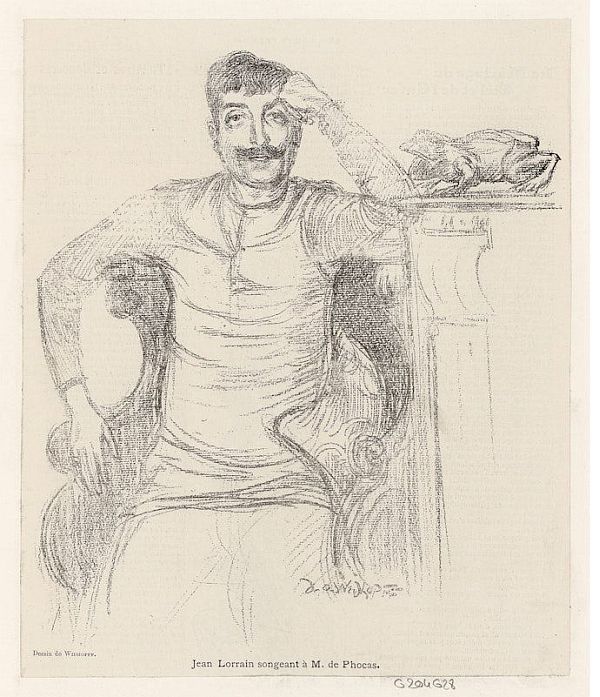
The literary figure most closely associated with ether in fin-de-siècle France was the novelist, poet, journalist, and short-story writer Jean Lorrain (1855–1906), whose collection of dark and sardonic tales was published in 1895 under the title Nightmares of an Ether-Drinker. Lorrain was an extreme figure even in decadent Paris: a powdered and bejewelled dandy, scandalous gossip-monger, bohemian, dabbling Satanist, denizen of the city’s criminalised and violent gay underworld, and at the same time its most highly paid writer. “What is a vice?” he shrugged. “Merely a taste you don’t share.” His brazen self-advertisement as the Thomas De Quincey of ether was entirely in character, although the stories in the volume tend to mention the drug only obliquely and he never describes his experiences with it as directly as Maupassant did in “Dreams”. Its presence is diffuse, tearing at the veil of reality and punctuating it with surreal juxtapositions and flashes of preternatural clarity. It sets the scene and the mood for stories such as “An Uncanny Crime”, which its narrator begins:
 
“It was two years ago, when my nervous troubles were at their worst. I had recovered from the ether, but not from the morbid phenomena to which it had given birth: hearing things, seeing things, nocturnal panic-attacks and nightmares. Sulphonal and bromide had begun to alleviate the worst symptoms, but my distress continued in spite of medication. These phenomena were at their worst in the apartment on the other side of the river, in the Rue St Guillaume, which I had shared with them for so long. Their presence seemed to have impregnated the walls and fittings, by means of some pernicious sympathetic magic . . . There were bizarre shadows huddling in the corners, suggestive folds in the curtains at the windows, while the door curtains would suddenly be animated by some frightful and nameless semblance of life.”
 
Lorrain first used ether medicinally, as symptomatic relief for his chronic tuberculosis — similar to his rival Maupassant, who once challenged him to a duel for plagiarism. His illness, and his self-medication with ether, were both woven into his highly cultivated public persona. A close friend of Joris-Karl Huysmans, whose À Rebours (1884) established itself as the decadents’ bible, Lorrain’s writing career straddled the worlds of high aestheticism, well-paid journalism, commercial pulp sensation, and unprintable perversion. Like Huysmans’ masterpiece, many of his stories are not so much narratives as vignettes, mood pieces, or studies of mental states, unfolding in interior monologues that anticipate the modernists’ stream of consciousness. À Rebours includes a lengthy digression on scent, and the transports and associations that can be summoned by it; ether in the writing of Maupassant and particularly Lorrain can be seen as an outgrowth of this obsession amplified to madness. In the salons and cafés, it was often said that you could smell Lorrain’s presence in the room before you saw him. In his fiction, ether’s odour and its dream logic pervade throughout, bringing with them a confusion of associations: the hospital waiting room, the boudoir, the agony of the lungs, the gentle dissociation from reality, the sudden awakening from a nightmare — and, ultimately, the pain of the gastric ulcers that his habit inflicted on him with growing severity.
 
 
Although his ether tales are profoundly haunted, Lorrain was no believer in ghosts or spirits; as he might have said, quoting Samuel Taylor Coleridge, “I have seen far too many myself.” Like Huysmans, he investigated Satanism: the pair were habitués of the Chat Noir café, Montmartre’s bohemian hub where the disciples of Jules Michelet discussed witchcraft and sought out secret rites in basements and catacombs, and rumours of secret covens and occult rituals swirl in the background of his tales. In the end, however, neither science nor the supernatural, nor indeed ether, offered sufficient explanation. “Oh, don’t blame it on the ether!” replies the protagonist in the short story “The Possessed” to a friend trying to make sense of his terrifying obsessions:
 
“Nevertheless, I do have to go away. I’d be sure to fall ill again as soon as November arrives, when Paris becomes fantastically haunted. You see, the strangeness of my case is that I no longer fear the invisible, I’m terrified by reality.”


Lorrain’s perverse and shocking novel Monsieur de Phocas (1901) marked the scandalous high-water mark of his career, and the ne plus ultra of French decadent literature. Bankrupted by lawsuits for plagiarism and obscenity, he fell from fashion in the new century and in 1906 suffered an ignominious death of peritonitis after perforating his colon with an enema while attempting to relieve his ether-induced intestinal ulcers. The drug had, like De Quincey’s opium, become his talisman, his trademark, and his curse. It opened the door to an invisible dimension of mind that hypnotism and the mind-doctors were no more capable of explaining than mediums or exorcists. As another of his overwrought protagonists exclaims in the 1891 vignette “Magic Lantern”: “Never has the Fantastic flourished, so sinister and so terrifying, as in modern life!”
 
This essay has been excerpted and adapted from Mike Jay, Psychonauts: Drugs and the Making of the Modern Mind (Yale University Press, 2023).
 
The Ether Dreams of Fin-de-Siècle Paris. By Mike Jay. The Public Domain Review ,May 3, 2023.


This long-lost account of one man's attempt to engineer the perfect balance of intoxicants in the British colonies of South Asia stands alone in drug literature, says Mike Jay.
 
Until I first held a copy of The Underworld of the East in the British Library sometime in the late nineties, I had my doubts about its existence. I knew it only from an extract in a collection of drug writings from a New York underground press (The Drug User: Documents 1840-1960, 1991) where it was included alongside the usual suspects – Charles Baudelaire, Henri Michaux, Anais Nin, Aldous Huxley – and introduced with a short and scabrous rant against the War on Drugs by William Burroughs. Though the extract was presented as the memoir of a British mining engineer in the South Asian colonies in the 1890s and 1900s, it read suspiciously like a modern pastiche. As various aficionados of the genre had pointed out, its plain and amateurish prose was quite unlike the better-known examples of fin-de-siècle drug-literature; its progressive social attitudes towards non-Europeans, as well as its gung-ho frankness about drugtaking, seemed incongruously modern; and it was odd that nothing seemed to be known about Lee in real life. Some observed knowingly that ‘Lee’ was the maiden name of Burroughs’s mother, and his nom de plume for the first edition of Junky in 1954.
 
Any suspicion that it was a modern forgery was convincingly rebutted by the frayed and faded cloth jacket and yellowed, foxed pages of the British Library’s copy. When I opened the covers, James Lee had me at the title page: The Underworld of the East: Being Eighteen Years’ Actual Experiences of the Underworlds, Drug Haunts and Jungles of India, China and the Malay Archipelago. It was dated 1935, twenty years after the end of the episodes it related, and it was essentially a travel memoir, offering some of the armchair thrills expected by readers of the genre: a village in the Indian jungle stalked by a man-eating tiger; close encounters with murderous Thugs and dacoits; adventures on one of the first motorcycles in Calcutta in 1903. But its distinctive theme, most unusual for its strait-laced times, was Lee’s voracious drug experimentation. ‘A man deeply learned in every kind of narcotic drugs…among them being opium, hashish, morphia, cocaine, bhang, ganja and many others’, the dust jacket blurb announced, ‘For eighteen years he travelled the world investigating the drug habit and the underworld…the strange effects produced are intimately described’.
 
In the book’s short opening chapter, ‘About Drugs’, Lee sets out his stall: ‘The life of a drug taker can be a happy one; far surpassing any other, or it can be one of suffering and misery; it depends on the user’s knowledge’. I had recently been commissioned to edit an anthology of drug literature and had been working my way through reams of flowery, decadent 19th-century prose without ever coming across this obvious statement of fact. The doyen of the genre, Thomas De Quincey, had famously insisted that the pleasures of drugs were inseparable from their exquisite pains; his great admirer and translator Charles Baudelaire declared that drugs were a ‘forbidden game’ in which base instincts for self-gratification would always triumph over noble ambitions of self-transcendence. Publishers embraced this trope, which allowed them to sell immorality while absolving them of the charge of promoting it, and De Quincey and Baudelaire’s legion of successors and imitators were happy to encourage the conceit that the ecstatic pleasures they described were only accessible to the elite few who were equally prepared to plumb the depths of hell.
 
By James Lee’s time, these tropes had hardened into the clichés that still define the tabloid ‘My Drug Hell’ narrative: what goes up must come down; anybody who thinks they have their habit under control is deceiving themselves; drugs are a one-way street to perdition. But Lee, from the opening pages of his book, was having none of it – perhaps because he hadn’t read any of it. He was born in Redcar to a family of colliers and iron merchants and employed in factories from the age of seventeen; his writing makes no reference to the canon of drug literature, or indeed any literature. His style is precise but artless: short, factual sentences, eccentrically punctuated, the work of someone more used to turning out structural engineering reports. His turn of mind is restlessly practical: the proper use of drugs is a problem to be solved. Their pleasures can, with careful attention to doses and combinations, be wonderfully intensified; their pains, with knowledge and self-discipline, can be more or less eliminated.


By the 1890s, when Lee began his drug career, a chorus of expert medical opinion had ready diagnoses for the new figure of the ‘drug addict’ or ‘narcomaniac’. The condition might be hereditary; the subject might be a criminal ‘type’, a neurasthenic or mental defective, or someone who had acquired by social contagion the ‘degenerate habits’ of ‘inferior races’. Lee would presumably be an example of this last category, since he was introduced to drugs through contact with Asian cultures, but he explained his motives in simpler terms. ‘I was getting fed up with life in England’, he wrote, ‘where one had to do just as the next fellow did…to wear the same kind of clothes, with a collar and tie, and talk about football or horse-racing or be considered no sport’. He took up drugs for the same reason that he exchanged his early career as a draughtsman in the steelworks of Sheffield and Teesside for a post as a teaching assistant in London, and then applied for a job as a mining foreman in Assam: to have a more interesting life.
 
This first overseas assignment took him to a small settlement in India’s remote north-east frontier, where British influence gave way to the territory of the Naga hill tribes. The mine for which he was responsible was a tunnel through solid coal, which was hacked into tubs and barrels by the male workers and carried away by the women on their heads. He noted with interest that the workers chewed betel nut and were often high on bhang, or "Indian hemp", and was curious to learn more. (It would become his habit to seek out solitary postings where he could immerse himself in local society and avoid his fellow Europeans, who distanced themselves from the natives, "affecting to consider them as inferiors".) One day, speaking to one of the female workers, he learned that she had fled an arranged marriage in the Central Provinces for a life of hard labour in this remote outpost. Her name was Mulki; they eventually married, and she accompanied him to England on his visits home.
 
Before long, he found himself suffering the chills and fevers of the endemic malaria and paid a visit to the local doctor, a ‘fat and jolly’ character whom he refers to as ‘Dr. Babu’. The doctor had a remedy to hand: an injection of morphine that left Lee ‘simply purring with content’. Dr. Babu sent him home with a syringe kit and a tube of morphine tablets, and he took to spending the heat of the day luxuriating with his new ‘hobby’ and ‘dreaming rosy dreams’. After a while he noticed that he was chronically constipated and decided to quit the habit, but he found it harder than he expected. So this was ‘addiction’: in most drug literature the inevitable destination, but in Lee’s narrative only the beginning of the journey. ‘Sir’, Dr. Babu informed him, ‘morphia is a very strange medicine…it is very difficult to give up but it can be done’. So saying, he injected Lee with half a grain (about 30mg) of cocaine. The new drug dealt promptly with the constipation and removed the morphine craving, but it gave him insomnia in exchange. The ever-resourceful Dr. Babu had a solution for this too: ‘perhaps because I treated him differently from the way most Europeans treated the educated Indian’, Lee was invited back to his home to smoke a few pipes of opium, which ‘procured a profound and refreshing sleep’.


Lee embarked on a systematic process of self-experiment to rid himself of his inadvertent habit. He reduced his intake of morphine and cocaine in turn with carefully calibrated doses, and developed a detox regime that he spells out in detail, grain by grain. ‘These two drugs’, he discovered, ‘are in a certain way antidote to each other’: each could be used to reduce the cravings for the other, and both gradually watered down. He took to using this cure on his return trips to England: the six weeks of the voyage was just enough to allow him to step off the ship at Portsmouth healthy and drug-free. The broader insight to which this led him was that ‘one drug alone spells disaster’: only with combinations of different drugs, interspersed with periods of abstinence, could their desirable effects be maintained.
 
More assignments across India, then Sumatra and China, turned up more drugs, which generated ever more interesting experiences. ‘I was now able to use large quantities of any particular drug for a time without harming my health in the slightest’, he wrote, ‘in fact I seemed to benefit by it in every way’. He added bhang and hashish to his repertoire, and found he could produce ‘strange waking dreams’ by eating hashish and injecting cocaine through the night. With this combination his reveries materialised before his eyes in visionary trances lasting for many hours, in which he was surrounded by spirits and saw the future evolution of humanity spread out before him in a vast panorama.
 
On his travels he took to asking the locals about medicinal and magical plants, and offering to pay for any samples. During a long assignment in Sumatra, where he supervised the construction of a goods railhead on the jungle coast, he discovered two which he believed to be unknown to western science. ‘Drug No. 1’, as he called it, produced not inner visions but true hallucinations, in which his wooden hut became an enormous space populated by ‘spirit-like faces and forms of many nations’, many in the advanced stages of leprosy, which hovered around him, along with ‘faintly luminous globes, which some instinct told me were the souls of unborn children’. ‘Drug No. 2’ was in its way even more remarkable: it restored him swiftly to perfect sobriety and health from even the most extreme intoxication, and was a panacea for any minor ailment. He reduced the plant to a concentrated brown powder that he took to carrying it with him everywhere on his travels, and referred to it as ‘The Elixir of Life’.
 
 After my visit to the British Library I sourced my own battered copy of Underworld online and mined it for passages to include in my anthology (Artificial Paradises: A Drugs Reader, Penguin 1999). In the process I established that any copyright for the text had been lost over the decades through a succession of publishing mergers, and I found a small press who were prepared to reprint it (Green Magic, 2000). This cost me my prized copy of the book, which had to be chopped up for scanning, but I found another one quickly enough, better and slightly cheaper. The reprint generated a small but interesting postbag. A death certificate turned up, revealing that James Sidney Lee had made it to the age of 77, succumbing to liver carcinoma in Dulwich Hospital in 1951; with this I was able to locate his will, which left his modest estate to his sister in Redcar. I was contacted by a surviving relative, his great-nephew, whose mother dimly remembered him from her childhood in the 1930s, though his reputation for drugs and ‘living in sin’ meant he was rarely invited to family gatherings.


The publisher also received a letter from an elderly gentleman named James Gilman who had spent many years on Lee’s trail, and specifically on the hunt for Drugs No. 1 and 2. He had, apparently, joined a botanical expedition to Sumatra in the 1980s where he had found the spot where Lee had stayed, located the overgrown remains of his railhead in the jungle and spoken to an old man who remembered him from his childhood (‘the Dutchman’, he called him, as all Europeans were known to that generation of Indonesians). James had collected plant samples, and believed he had identified Drug No. 2, but it had either rotted in transit or been purloined by other botanists. His files and records from the expedition were stored in a garage somewhere that he was now too old and frail to dig through.
 
James did, however, come through with one astonishing document: the coroner’s report into the death of Mulki, in London in 1915. Lee mentions this in the book, in a curiously vague aside: ‘Poor girl, she died suddenly in London, while we were staying at a small private hotel in Bow Lane, Cheapside, from an overdose of some drug, I think morphia’. The coroner’s report, which includes Lee’s testimony, is much more specific. The couple had just arrived in London, where the wartime Defence of the Realm Act had recently prohibited the sale of morphine and cocaine; Lee had nonetheless managed to acquire some from one of his old haunts, a pharmacy named Ray’s in Holborn. He returned to the hotel, where he and Mulki both took a normal dose, but she suddenly lost consciousness. He rushed her to Bart’s Hospital where, to his horror, the duty doctor injected her with further shots of morphine and cocaine. In his deposition Lee testified that Mulki was ‘alive and breathing’ at this point, but ‘after that the doctor said she was dead’, The doctor, however, recorded her death as misadventure, and its cause as ‘heart failure – her habit of injection of these drugs cocaine and morphine would quite account for it’. I found a short report in The Times of the following day that repeated this verdict, adding: ‘Like nearly all Indians, she was in the habit of taking drugs’. Even twenty years later, Lee was evidently unwilling to re-litigate the incident in print.
 
A while later I was contacted by a small French publisher who wanted to put out a French translation and asked me to write an introduction. This was a chance to assemble an outline of Lee’s life, and to include the tragic story of Mulki’s death. After its publication (Les Tribulations d’un Opiomane, 2009) I received a courteous email from New York from a most unexpected source, the writer Nick Tosches. I was aware of his interest in the subject – his longform feature piece, ‘Confessions of an Opium Seeker’, was published in Vanity Fair in 2000 to wide acclaim – but had no idea that his search for the vanished world of opium dens had set him on Lee’s trail.


We exchanged notes, and Nick kept me scrupulously updated on his findings. Witnessing him at work was a privilege and an education. He was resolutely old-school in his methods, with a home reference library that seemed to cover everything (the Liddell & Scott English-Greek lexicon was always at his elbow) and a mastery of official records, from 19th-century parish registers in Middlesbrough to turning Lee’s name up on ships’ passenger lists. He used Mulki’s full name on the coroner’s report to deduce her family origins and their caste profession (cattle herders) and somehow, without leaving Lower Manhattan, identified her unmarked grave in Manor Park cemetery on the edge of Epping Forest. He traced Lee’s family back through two generations of iron and coal workers in North Yorkshire and Teesside; as he worked you could feel the industrial grit and grandeur of the Victorian north-east rising into existence as vividly as the 1930s Steubenville, Ohio from which Dean Martin emerged in the unforgettable early chapters of his Dino (1992).
 
We met once in person, in 2012, when he visited London. He was staying at the Dorchester Hotel on a confidential assignment, and was in a wry and elegiac mood about the publishing business. Sleuthing after James Lee was, in his mind, what real writing was all about; but gone were the days when he could simply follow his nose on an absorbing story, moored to his publisher only by an annual lunch with a trusted editor. He refused to pitch glib book proposals to ignorant sales and marketing departments, and had no interest in the digital future: as he wrote later, ‘Nothing good will come of this vapid, postliterate new tweet-text-twaddle world’. He recalled ‘the wondrous vanished bookshops that brought us such discoveries and made us what we were!…Over, all of it, over the hills, dying or dead. But so be it. Onwards in the dark of night like tomb-robbers of the XXth Dynasty into the Valley of the Kings.’
 
The following year Nick sent a final dossier, closing the case. He had filled in the background to James Lee’s world in often staggering detail, but the man himself had left no personal traces that could anchor his book to the rest of his life. ‘Attempts to locate letters, papers, notebooks, and diaries of Lee, often retracing the trails of the indefatigable James Gilman, have proven futile’, he wrote. The minor errors of date, place and fact he had found throughout Underworld suggested that Lee wrote it from memory rather than referring to notebooks or journals. Alleged photos had failed to materialise, and no surviving relatives had an old suitcase in their attic containing dusty vials of powder labelled ‘Drug No. 2’. There were still a few official records to chase down – passport applications, perhaps a military service number? – but these seemed unlikely to change the big picture. James Lee was real beyond doubt, and his travels had certainly taken place, but the private man was lost to history.
 
In 2019 I was visiting New York and picked up the thread. Nick was keen to meet despite grumbles about his health, but the week before I arrived his email went dark, and his death was announced a few days later. I crossed his path at that time in the vaulted art deco reading rooms of the New York Public Library, where I had ordered up from the William Burroughs archive the box containing Burroughs’s fragmentary writings on James Lee from the early 1970s. The paper slip on which previous requests were scribbled in pencil contained a single word, ‘Tosches’. The typewritten pages included a filthy, proto-Wild Boys routine about a polymorphous orgy in a Chinese opium den, and an unpublished preface to Underworld of the East, which had clearly lulled the ‘hard man of hip’ into an unusually genial and unguarded register. Lee’s book, Burroughs wrote, was ‘conjured from the unpolluted air of the 19th century’, when drugs were pure and legal and the Elixir of Life was on hand to negate any ill effects. ‘And so we leave James Lee’, he concluded, ‘in his quiet bungalow after a day’s work in the open air, judiciously selecting and rotating his drugs. A happy and nostalgic book’.
 
Despite its hard core of admirers, The Underworld of the East seems destined to remain, at best, a minor pulp classic. Lee doesn’t really fit with the current vogue for psychedelics in exotic cultures: he was too interested in white powders and needles, too unsentimental and too dismissive of spiritual flim-flam. In an era where film and TV reboots of Sherlock Holmes are still obliged to find ironic and non-threatening substitutes for his cocaine injecting, I’m not holding my breath for a James Lee movie. Yet his solitary book retains a peculiar power. It may be no great work of literature, but there’s a world inside it that can’t be accessed from anywhere else, and still has plenty of secrets to give up.
 
Orient Excess: James S Lee’s Drug Memoir Underworld Of The East. By Mike Jay. The Quietus, January 17, 2022. 


It’s remarkable how fast psychedelics have gone mainstream. It’s not just the craze for microdosing or the enthusiasm for mushroom grow kits. After years of shunning this research, major universities are now racing to set up their own psychedelic institutes, with psilocybin and MDMA being touted as the most promising treatments for depression and PTSD in decades.
 
But this is not the first time psychoactive drugs have been hailed as miracle cures. Over the past two centuries, morphine, heroin, and cocaine were also considered wonder drugs until doctors discovered their addictive properties. Today, what’s striking is how the public conversation about psychedelics tends to ignore this deeper history of psychoactive drugs.
 
Historian Mike Jay is out to challenge this narrative of psychedelic exceptionalism. Through a series of books on the history of intoxicants, he’s traced the lineage of various drug cultures. His new book, Psychonauts: Drugs and the Making of the Modern Mind, focuses on the 19th century’s rich history of psychoactive experiences, spanning the worlds of science and literature. In some ways, this era had a more expansive and nuanced view of drugs and the exploration of consciousness than we do today, where the medical model dominates the public discourse on psychedelics.
 
Jay is upfront about his own psychedelic experiences. “I’ve experimented thoroughly with all these drugs over a long period of time now,” he said when I reached him in Cornwall. His tripping led him to recalibrate his own image of reality, but he doesn’t gloss over how challenging these experiences can be. In his earlier book on the history of mescaline, he writes about one encounter with the psychoactive cactus San Pedro: “As pleasure and discomfort mingled and intensified, it was easy to understand how some subjects feel themselves transported to the realms of the divine while others retire miserably to their sickbeds.”
 
Jay also wades into the contentious question of whether the scientists and doctors studying psychedelics should talk openly about their own experiences. “The analogy I use is travel writing,” he says. “You could write a book about Venice without going there because you can read all the other books about Venice, but it’s hard to argue that your book wouldn’t be better if you had actually been to Venice yourself.”
 
We seem to be at a crossroads in how to think about psychedelics. There’s a strong push to medicalize these substances, but psychoactive experiences have always been unpredictable and wild. What do you make of the current psychedelic moment?
 
MJ : I think what we might call drugs—or more specifically, psychedelics—sit on a kind of cultural fault line that we’ve inherited from the 20th century. There are two words that emerged during the 20th century. The first is “drugs” in the sense that we’re using it. That word is a product of the Progressive Era in the early 20th century. From the very beginning, it had a whole bunch of negative connotations baked into it. There were dangerous drugs, addictive drugs, criminally illicit drugs. Think of “the war on drugs.” When I was growing up, I assumed it had been going on forever, so it was surprising to discover that it’s actually a creation of the 20th century. Then in the mid-20th century, there was much more interest in mystical experience and the possibility of using drugs for personal growth or healing. That was the point at which the word “psychedelics” emerged.


The psychiatrist Humphry Osmond coined this word because he didn’t like the word “drugs.” The literal meaning of psychedelic is “mind-revealing,” which has a much more positive ring to it.
 
MJ : Osmond and Aldous Huxley came up with that term together. They were really talking about LSD and mescaline then. Huxley was very keen that it should be connected to mystical experience and higher consciousness. I think one reason the word “drugs” became so handy at the beginning of the 20th century was to separate substances into good and bad. The good you would get in your pharmacy or from a doctor; the bad you’d have to get from the street, from criminals. That distinction has broken down in the 21st century, when cannabis is for sale everywhere and the potential for psychedelics has only gotten stronger.
 
Weren’t many drugs that we now consider dangerous, like heroin and cocaine, once easily obtained?
 
MJ : That’s right. It’s why our modern category of drugs wouldn’t have made any sense in the 19th century because they just sat on the shelves alongside other stimulants and sedatives and analgesics that we now call drugs. One thing that fascinates me about this period is how widely drugs were used in science and medicine, and how interested people were in the experiences they produced. There’s a rich literature back then because doctors in the 19th century were very good at describing things. You had to be. There were no tick-box diagnoses. If somebody had a cough, you couldn’t just say they had a cough. There might be 50 adjectives to describe that cough.
 
Another reason doctors and scientists were so good at describing these experiences is they often took the drugs themselves.
 
MJ : Yes, and I’ve taken that as the central theme of my book. If you’re studying a drug which affects the mind and alters consciousness, the experience itself is really what you’re looking at. And if that’s the focus of your investigation, why wouldn’t you start by experiencing it yourself?
 
 
The word “psychonaut” is often used to describe people who take hallucinogens for self-exploration. The word was coined in 1949 by the German writer Ernst Junger, who is a fascinating and problematic figure. He was the mentor of Albert Hofmann, who synthesized LSD, but Junger was once a Nazi sympathizer.
 
MJ : He later resisted Nazi efforts to recruit him, but he also refused to submit to de-Nazification in postwar American-occupied Germany. During that time, he wrote a futuristic novel called Heliopolis, in which a cadre of scientists synthesize new psychoactive drugs and use them to explore their consciousness. These scientists are called psychonauts. Junger was the great hero and mentor to Albert Hofmann, and through Hofmann, the word psychonaut made its way into the psychedelic counterculture. It meant someone who was a rebel or renegade or was working outside of science. Because in our modern era, institutional scientists don’t self-experiment with their drugs.
 
At least they don’t talk about it publicly. I’d bet that most scientists who study psychedelics have tripped themselves, even though it’s usually illegal. I mean, can you actually understand these experiences if you haven’t had them?
 
MJ : I think it’s enormously valuable to have direct personal experience because what we’re studying is a sensation that’s only available to the subject. Otherwise, you’re just studying its correlates. I wanted to reclaim the word “psychonauts” and take it back into the 19th century, where it describes not only renegades and rebels, but also establishment scientists, doctors, and pillars of the literary establishment. The word that was used at the time was “self-experimenter.”
 
There is no perfect or correct way to do self-experimentation. Part of you is an observer and part of you is a subject, and you’re trying to find the right point between objective data and a fuller sense of the subjective experience. So maybe you end up with a hybrid of science and literature. If you look at the psychedelic literature today, most of it is composed of very dry papers on neuroscience and receptor chemistry, but then you look at the towering bestseller of the psychedelic renaissance, Michael Pollan’s book How to Change Your Mind, and he’s using lots of metaphors about our minds getting stuck in ruts and psychedelics connecting different areas of the brain. But I think what really attracted people to his book were his descriptions of his self-experiments. What does it feel like? What might it do for me?
 
You can see this cross-fertilization between science and literature at the beginning of the 19th century, when the English chemist Humphry Davy discovered the mind-blowing properties of nitrous oxide and then recruited some of his poet friends to join in these experiments.
 
MJ : Humphry Davy went on to become the president of the Royal Society and the great scientific hero of his generation. When he was 20, he was one of the first scientists to synthesize nitrous oxide, which was believed to be toxic. But in the heroic self-experimental tradition, he found out that not only was it not toxic, but it produced a wave of euphoria. He inhaled a bit more and eventually found himself in this disembodied universe composed of thoughts and ideas, and he came back absolutely fascinated.
 
He was very fortunate to have a group of friends in Bristol who were ideally suited as volunteers, including the young Romantic poets Samuel Taylor Coleridge and Robert Southey. Davy was looking for a language of feeling, but it’s incredibly hard to find words for it. In a way, it was rather like the Romantic poets’ own project of finding words to describe new feelings and sensations. So from this point on, the study of drugs was still about pharmacy and chemistry, but it also became about poetry and philosophy.


One of Coleridge’s protégés, the Romantic poet Thomas De Quincey, later wrote his own book, Confessions of an English Opium-Eater. What was distinctive about this book?
 
MJ : He was doing something very original. The book is not actually about opium. It’s about the opium eater. So he’s using opium to open up a new form of autobiography. He writes about how he takes opium and wanders around London at night, losing himself in the theater crowds and having reveries. And suddenly these childhood memories will pop up that he hasn’t thought of for ages. Extraordinary dreams will appear, and he has the sense that on opium he can wander the labyrinth of his mind and connect all these different visions and memories and sensations.
 
By the mid-19th century, many people were using psychoactive substances. Can you tell me about the French physician Jacques-Joseph Moreau?
 
MJ : Moreau was what we would now call a psychiatrist. He often accompanied his wealthy patients on rest tours, so he went to Egypt, where he was fascinated by the absence of alcohol and the prevalence of hashish. People who took hashish would talk about their dreams and visions and their encounters with jinn and other supernatural entities. He got fascinated enough to take large oral doses of hashish and was unable to move or speak for hours.
 
As a psychiatrist, he believes in walking as far as you can in your patients’ shoes, but the one place where we can’t accompany our patients is over the threshold into madness. But with hashish he noticed in himself so many of the phenomena that he was treating in his patients—hallucinations, deliriums, and paranoid ideation. And just as Humphry Davy had done with the Romantic poets, Moreau started a literary hashish salon in Paris. Many of the great figures of mid-19th century French literary culture—like Balzac, Dumas, Flaubert, and Baudelaire—passed through its doors.
 
One of the most intriguing cases of self-experimentation was Sigmund Freud, who became obsessed with cocaine early in his career. Why did he think cocaine was so promising?
 
MJ : The great disease of the late 19th century was neurasthenia. It’s not a term we use anymore, but when we’re talking about anxiety or depression or autoimmune conditions, these would often have been diagnosed as neurasthenia. There was a feeling that society had started to run on the rapid time of the machine, and a lot of people were having nervous breakdowns or suffering what we’d now call burnout. So everybody was looking for a stimulant that could magically provide more energy, and Freud thought cocaine might be the thing that would bring us up to speed with modern life. In the mid-1880s, he was often referred to as the world’s leading medical expert on cocaine.
 
Did he take much cocaine himself?
 
MJ : It’s often assumed that he took huge quantities, but my feeling is that the opposite is the case. He was a sober and cautious fellow, and he took it in very small doses. I think the problem with his self-experimentation was that he only ever took a small dose, usually dissolved in water. So a few years later, when people discovered that you could inject enormous quantities of cocaine and then almost immediately go into manic states of collapse and nervous breakdown, Freud was blindsided by this. It wasn’t that he’d taken too much cocaine. He’d taken too little. It was around this time that our modern medical notion of addiction was coming into focus.
 
Didn’t Freud then try to erase his early work on cocaine from the historical record?
 
MJ : There’s maybe one sentence about it in his short autobiography, but when his collected works were finally reprinted, the cocaine papers weren’t in it. And his first biographer, Ernest Jones, minimized it and described it as the “cocaine episode.” He just dismissed it as a juvenile aberration, and that’s the line that his followers have tended to follow ever since.
 
 
William James was another late 19th-century psychologist who self-experimented. Why did he take nitrous oxide?
 
MJ : Like Freud, he diagnosed himself as neurasthenic. He took nitrous oxide in the early 1880s, and I think it was an experience that really stuck with him because he’d always been interested in mystical experience, but he’d never really had one himself, and he’d felt that he was kind of a cold, rational soul who was never going to have one. So James’ nitrous oxide experience was a revelation for him personally as well as professionally. He saw introspection as central to the study of the mind. He was in a world, as we are now, where the mainstream science of the mind was very positivist. James thought the mind was much more complicated than that. He described it as a “blooming buzzing confusion.” He was trying to find ways of exploring the mind in broader terms that verged on literature and philosophy within a paradigm that was becoming more and more rigid.


Why did drugs become so stigmatized in the early 20th century?
 
MJ : I think there are many components to it. If you look at the word “drugs” that emerged at that time, you can see there are medical concerns that drugs are addictive and bad for your health and should only be used under the supervision of a doctor. This is also the Progressive Era, when all kinds of grassroots campaigns were starting to increase the scope of government, leading up to alcohol prohibition. At this time, alcohol is regarded as the most problematic substance. How can we possibly have a civilized society in the 20th century where people are allowed to get drunk all the time? Psychology itself is moving away from introspection. This is the beginning of behaviorism, so we’re going to be more productive running our laboratory rats through mazes than listening to people pontificating about their drug experiences.
 
What can this long history of psychoactive drugs tell us about our current psychedelic renaissance?
 
MJ : It gives us a very different way of thinking about where we are now. The prevailing assumption is that this kind of drug experience suddenly emerged in the 1950s and 1960s and was summarily squashed by mainstream science and medicine, and we’re now just beginning to recover it. But the story I’m telling about the 19th century shows a rather different picture. It suggests that the things we’re interested in today—the power of drugs to be therapeutic and to open up dimensions of thought and experience that we wouldn’t otherwise discover—go all the way back to the Scientific Revolution. Many of the questions we’re asking now are exactly what scientists and writers and doctors were asking in the 19th century, but they weren’t using DMT and ketamine. They were using ether or nitrous oxide or hashish. What happens when we take drugs that disembody us and take us into realms of pure experience? Is it simply white noise produced by a drug-addled brain? Or do these experiences connect us to other dimensions of mind that we can’t normally access?
 
Where do you hope the current psychedelic movement will go from here?
 
MJ : I would like to see a thousand flowers bloom. A lot of people who are now interested in psychedelics would use them privately. You might describe that as self-medication or recreational or spiritual. Some people will want to have shamanic or mindfulness guides for this experience; others will doubtless want state-approved clinical psychotherapists. It seems to me the entire conversation at the moment is on this very tricky question of how the medical profession manages and licenses this.
 
All those questions are important, but I’d like to see more attention being paid to the fact that there are other models beyond the medical and beyond the therapeutic. We’re starting to see this with the first steps of decriminalization of plant psychedelics in Oregon and Colorado, what I might call a bottom-up model, which I hope might complement the top-down medical model.
 
Why Scientists Need to Get High. By Steve Paulson. Nautilus, May 23, 2023. 


   Mike Jay's  latest book, Psychonauts, is published today by Yale. Here he talks to John Doran about what we can learn by studying the pre-60s history of drugs, followed by an extract on the early 19th century nitrous oxide craze.
 
Sexual intercourse began
In nineteen sixty-three
(which was rather late for me) –
Between the end of the 'Chatterley' ban
And the Beatles' first LP.”
Philip Larkin – ‘Annus Mirabilis’
 
The flavour of Philip Larkin’s ironic ode to the sexual revolution of the sixties is triggered synesthetically by the subject matter in Mike Jay’s excellent new book Psychonauts, way before it turns up as an actual literary reference in the closing chapters. Such is the deathless, bony grip of the boomer on the public imagination – still – that it’s hard to even consider the modern history of narcotics without subconsciously arriving directly at the period where the beatnik counterculture of the 1950s gives way to the hippie counterculture of the 1960s. And this is understandable. Despite the stories of the rise and fall (and more recently the rise again) of mescaline, psilocybin and LSD, to name but three psychoactive substances, being retold to the point of feeling slightly threadbare, there is actually still much to say on the subject.
 
Recently, I have enjoyed and gained much from Michael Pollan’s How To Change Your Mind: What The New Science Of Psychedelics Teaches Us About Consciousness, Dying, Addiction, Depression, And Transcendence – especially in its clear-headed, engaging summary of how LSD actually works via the Default Mode Network – and Matthew Ingram’s Retreat, an incredible piece of research showing how the counterculture essentially paved the way for the billion dollar wellness industry of today. Both books are great, yet still represent a kind of reboot of the head books a lot of us came of age with… Aldous Huxley’s The Doors Of Perception, Jay Stevens’ Storming Heaven: LSD And The American Dream, and so on.
 
Psychonauts, published this week by Yale, offers a vigorous corrective to the casually accepted vibe that “drugs began” in 1963. A science and history writer by trade, Mike Jay has written original-research-heavy titles about such varied topics as schizophrenia and military history in the past but has notable form when it comes to drugs and is responsible for the excellent Mescaline: A Global History Of The First Psychedelic among other titles. There is a sense, however, of this being his ‘greatest hits’ – pun intended – and possibly represents him drawing a fat line – you feel me? – under his documentation of the subject. In short, he takes us on a whistle-stop tour of the early discovery/synthesis/industrialised refinement of such various substances as cocaine, nitrous oxide and ether, injecting – I’ll stop now – a wealth of well-sketched anecdotes into proceedings.
 
What we are presented with is the portrait of an age where scientists were keen to experiment upon themselves and how these experiments sometimes led to flashpoint moments of advancement in science, philosophy and art; and at other times led to accident, illness and early death. And in these descriptions of travelling medicine shows, rowdy music hall acts, 19th century laboratories, the birth of psychoanalysis, the advent of modernism, the uncharted frontier of analgesia and anaesthesia and the demi-monde of Paris, we sense times which were in many ways wilder, more exciting and more revolutionary than the 1960s.
 
The book, of course, has one laser eye trained on the landscape of 2023, and is organised in a way that allows the reader to easily draw useful links between, say, the convoluted origins of nitrous oxide as an aid to dentistry and the current ‘hippie crack’ driver of red top newspaper sales. (Although we have to infer how Jay feels about Cocaine Bear.) It is structured around many of the questions we ask ourselves today, so one section deals with the idea of cognitive enhancement, while another concerns the journey to the outer edges of consciousness, which suggests that some who use DMT and ketamine today are perhaps not so different to those who used nitrous oxide and chloroform generations earlier.
 
The term “psychonaut” was initially coined by the German writer Ernst Jünger in his work of speculative fiction, Heliopolis (1949). That Jünger survived World War 2 to write the book is surprising given his ambivalence to the Third Reich. While stationed in Paris, he befriended Picasso and Cocteau and passed some intelligence to the resistance – and his relative proximity to the Stauffenberg bomb plot. In his novel set in a future city state in the Mediterranean he describes a cadre of scientists – psychonauts – who synthesise new drugs and experiment upon themselves in order to investigate the hidden recesses of the mind. Jay, who is speaking to me from his home in Cornwall, laughs: “It’s handy, as that’s pretty much what my book is about, it’s just that these real characters I’m writing about existed many decades earlier.”
 
Jay says that he first encountered the term in relation to the psychedelic counterculture, a tag that tended to be awarded in a process of self-identification. “It was always loaded with this assumption that the person [saw themselves as] a rebel, a renegade or an edge lord, working far away from institutional science,” he explains.
 
“I wanted to reclaim the word. So if you go back before the 20th century, then yes, these characters were still rebels and renegades and all of that, but they were also institutional scientists, doctors, and pillars of the establishment. And pretty much everyone was a self experimenter, as this was an age when scientists used to self experiment with everything. They passed massive electric shocks through their bodies, or inhaled toxic gases. Drugs were the least of it, really.”


I bring up Larkin’s ‘Annus Mirabilis’ with him, specifically the idea that the ‘auspicious years’ of this story are 1882 (William James’ intoxication with nitrous oxide) and 1846 (William Morton’s first forays into using ether as anaesthetic) rather than 1963, and Jay agrees that Psychonauts is, to some degree, a corrective to received wisdom:
 
“Like most people, I grew up with the vague assumption that drugs appeared in the 1960s,” he begins. “And that comes with another assumption that before the 1960s they'd always been banned, and they'd always been illegal. It took me a while to realise that what we think of now as the war on drugs – drugs being outlawed and demonised – was something that didn’t really happen until the 20th century.
 
“In fact the word drugs itself, in the sense we’re using it now, didn’t really exist until the 20th century either. Before that we were talking about a range of things that might include herbal medicine, research substances, anaesthetics, or simply items you could buy from the pharmacy, because, of course, cocaine, heroin and cannabis were all on their shelves along with all the other analgesics and stimulants and sedatives.”
 
Jay points to Thomas De Quincey, the author of Confessions Of An English Opium Eater (1821) as being an “early to the game” psychonaut. His most famous piece of writing describes the mechanisms of addiction and withdrawal before some doctors even understood what these things even were. Despite coming out of a period of romanticism, he was already pointing ahead towards the modern age, suggesting stubborn, hard to access subliminal depths to the human psyche. “He didn't use the word ‘unconscious’ but that's what he was writing about,” Jay continues.
 
One of the big shifts in the book happens in the second half of the 19th Century, in the run up to the rupture of modernism. One of the hallmarks of this movement in art, literature and philosophy was the shock of the new, a desire for novelty and new experiences that mirrored the ever changing, industrialised pace of life. Changes in attitudes towards drugs in this period were happening at a very rapid pace simultaneously with all of these other changes.
 
“The stakes change. The costs and the benefits both get ramped up at the end of the 19th century,” Jay explains. On the one hand, it's a great era of discovery when it comes to the mind, but in another sense, the production of drugs becomes industrialised. They are pumped out in unprecedented volumes, they become more concentrated and there is the introduction of the hypodermic needle; plus they are now sold by pharmaceutical corporations. At this point they are products of big pharma.
 
“All of the anxieties about modernity come into play when people are thinking about what the role of drugs in society should be. There’s a new process regarding psychology and access of the unconscious and the subliminal mind and how you can get to it very directly. William James, through his experiences with nitrous oxide, shows this, and this brings in a kind of pluralism. As he says, in Varieties Of Religious Experience, our waking consciousness is only one particular type of consciousness – there are all these other types of consciousness which can be accessed if you huff some gas, or take a snort of this powder, or have a smoke of that herb. And these are different worlds where our sensations and perceptions are altered and things look very different.”
 
He goes on to say he thinks drugs played into "that specifically modernist sense of wanting to break the frames of time and space”, or “the way that things are normally presented.” This affected everything from cinema to art: "The idea that you can take a single moment and freeze it and break it down to nothing or show it from multiple perspectives all at once. I think those are the kind of ideas that emerged from the investigation of drugs in the late 19th century that feed into modernism.”
 
One of the very problematic aspects of modernism is its worship of power and the susceptibility some of its adherents had for looking for a strong leader to solve their problems. Modernism wasn’t fundamentally or explicitly fascist but it loaned itself quite easily to a fascination with totalitarianism. Right across the board from DH Lawrence to Ezra Pound via TS Eliot, Wyndham Lewis and HG Wells, this urge was undeniable, and as a group tenet it can be seen as much in the work of the futurists who fell in step with fascism as in the constructivists who fell in step with communism.


Another hallmark of modernism was the desire for a clean break with the immediate past, meaning this generation of artists and writers had a different relationship to the idea of drugs than the preceding generation of romantics. He explains: “Many modernists set themselves up against the decadent individualism of the 19th century. They would look at these drug experimenters [such as Baudelaire and Nerval] and say that their world had died in the 1890s. The days of huffing ether and eating hashish were over.
 
“[Filippo Tommaso] Marinetti of the futurists was obsessed with speed and became a fighter ace in the second world war – there was no problematic hidden, deeper self as far as he was concerned, just his ego intensified. And for people like this new drugs came along like cocaine and amphetamines which were more compatible with how they saw the world.”
 
It is during the modernist period that the progressive age begins, and the idea of the bohemian drug user becomes less important and at the same time psychology becomes less about introspection and more about measurement and behaviourism and the idea of social control. “The work of drug literature that really captures this era is Brave New World because Huxley’s soma is a product of a big pharma industrial process,” Jay explains. “And it's given out to the masses to keep them sedated and stupefied in order to stop them from thinking too much. And that becomes the public image of drugs in the early 20th century.”
 
The book has a clear view of the current landscape and there are numerous ways in which we can see how contemporary attitudes, approaches and fears are either at odds with how things were 200 years ago or remain as part of a cultural continuum. The chequered history of laughing gas especially should be of great interest to many readers today: “There were popular nitrous oxide scenes in the 19th century, with the idea of everybody getting together, huffing balloons and looning around. There’s a curious thing about nitrous oxide to do with economics though. It’s hard to synthesise so it wasn’t a thing that people did at home. But if you were a showman you could run a nitrous oxide event at a carnival or in a theatre, and once you had laid out the money for a tank to hold the gas in as well as the process of synthesis, you could then make a lot of money selling individual balloons.
 
“It didn't actually spread in the 1960s despite the hippies, the bands like the Grateful Dead who travelled round with canisters of it, and despite various Hollywood poolside parties. It wasn’t until we developed those little canisters they have today [for the catering profession] that it became easily transmissible. It became democratised. But the balloon isn’t new. The drug has returned to its roots. [The chemist] Humphry Davy was huffing from a balloon over 200 years ago.”
 
As something of a thought experiment I typed “nitrous oxide” into the search function on my podcast app and listened to the first two listed results in preparation for this interview. The first was an episode of Dr Suzi Gage’s Say Why To Drugs – a short podcast with a relatively sober yet casual approach which said that, in the greater scheme of things, the gas is relatively safe to use, if taken with certain precautions. The second was produced by ITV and could have been talking about an entirely different substance. The Hieronymus Bosch-like mental image being created was one of Amsterdam hospitals overflowing with teenage stroke victims, avoidable deaths by heart attack and young amputees. It felt – if you were of the mind to accept the findings of the first podcast as more reasonable and more truthful – like nothing short of a return to the age of Reefer Madness scare-mongering.
 
I ask Jay if much has actually changed on this score. “It's a lot easier to find a spectrum of opinion than it used to be when I was young,” he begins. “With nitrous oxide, I think the discourse around it at the moment is very shallow. It's a bit like vaping – both of them are relatively harmless. And I’m only saying relatively compared to the things they’re replacing – they’re not entirely risk free of course.
 
“In the case of vaping it’s smoking cigarettes that is being replaced and in the case of nitrous oxide it’s glue and solvents. These are sensible harm reduction alternatives, but they’re both public nuisances and very visible; and it seems to me that’s what a lot of the conversion is actually about. Older people don’t like seeing younger people blowing out huge clouds of vape smoke, and they don't like having to step over empty nitrous canisters on the pavement.”
 
It’s one thing drawing links from the drugs culture of 150 years ago to the drugs culture of today, but what about the things that lie around the corner? We’re in a time of great flux at the moment as regards substance use. Psychedelics are in danger of gaining a veneer of respectability, but to what end? Hedonism, the treatment of trauma or the user becoming a more efficient worker? And how is this brave new world stacking up for people of colour and the precariat/working classes, or the masses currently incarcerated worldwide for personal possession of drugs? If we follow in the massive wake left by America, we can expect some kind of soft legalisation to happen in this country over the next decade: how do we prepare for it?
 
Jay says there are notional lessons to be learned about what happens next from the characters who populate Psychonauts but says they would have been of greatest benefit to “the legislators, the bureaucrats, the statisticians and social scientists of the early 20th century who created the idea of ‘good drugs’ and ‘bad drugs’”.it is the framework of “drugs” itself which needs to be dismantled.
 
“If we could get rid of that [umbrella term] then maybe we could start talking about stimulants, for example, as a category,” he muses. “However, that would be a category which would include Adderall, a cup of tea and methamphetamines. Are we ready for that? But let’s look across all of the different categories, and try and raise general understanding; and then it’s time for an evidence-led process of trying to minimise harm to users and to also reduce those government policies which create harm.”


Extract follows below
 
Psychonauts: An Extract
 
Nitrous oxide’s enduring nickname, ‘laughing gas’, was in use by 1824, when it featured on the poster for a variety evening at London’s Adelphi Theatre offering ‘Uncommon Illusions, Wonderful Metamorphoses, Experimental Chemistry, Animated Paintings etc.’. The conventions of the popular nitrous oxide show were rapidly established. A master of ceremonies, usually adopting the persona of a scientific educator, would present the laboratory equipment, describe the chemical properties of the gas and ask for volunteers to inhale it. Often the first pick would be a collaborator who would scoff loudly before submitting himself (women were not permitted) to a lungful of gas and proceeding to behave outrageously – pirouetting, spouting poetry, spoiling for a fight – to the delight of the audience. More volunteers would follow, each attempting to outperform the last.
 
The effects of the gas proved far more spectacular on stage than in the laboratory. The first recorded nitrous show in the United States took place in Philadelphia in 1814 and was described by a local printer and pamphleteer, Moses Thomas, who gives a vivid sense of the proceedings. The experiment was part of a weekly lecture series, and the stage that evening was blocked off from both the laboratory equipment and the audience, heightening expectations of the unexpected. It opened with a doctor discoursing on ‘the nature and properties of nitrous oxide’ and demonstrating ‘a number of unimportant experiments, to which very little attention is paid by his auditors’ before he launched into the promised spectacle. The first volunteer, a young man of fifteen, was presented with ‘a large bladder’ filled with ‘the exhilarating gas’, which he inhaled, and then
 
“…suddenly threw away the bag, with an air of triumphant disdain, and began to march about the inclosure with theatric strides, until coming up close to the front row, he perceived that one of the persons sat there held a cane athwart to defend himself from his too near approach. This offended his pride – he instantly burst into a paroxysm of rage: ‘That tyrant’, says he, ‘has seized my cane – deliver it to me – this – instant – or I’ll be the death of you!’ At the same moment jumping over the desk, and grappling with the man who had the cane, he overturned every thing that stood in his way, and it required the united efforts of four or five men to hold him down, till the effect of the gas ceased, and he turned round to the company with an air of good-humoured hilarity.”
 
More volunteers followed, and exhibited ‘different degrees of animation, or ferocity, dancing, kicking, jumping, fencing, and occasionally boxing anyone that stood in their way.’ The gas allowed the conscious mind to escape from the shackles of the body, but in so doing it left behind a body at the whims of unpredictable or automatic forces. These often seemed to release a second and hidden personality, which the popular lecture format mined for entertainment in a manner similar to the stage hypnotism shows of today. On stage, the subject’s inner experience on the gas was incidental; the setting was constructed to make the most of its external manifestations. The moment of return to waking consciousness was not interrogated for mystical revelation, but held up for confused hilarity.
 
Nitrous oxide was ideally suited to the travelling carnival-show circuit that expanded across the wide and sparsely populated interior of antebellum North America and Canada. It could be presented as both a miracle of modern science and a raucous entertainment, a novelty, both mind-boggling and edifying, that could play out every night for years in front of a fresh and astonished crowd. The gas tank, tubes and breathing bags required a capital outlay that placed the entertainment beyond the reach of private individuals, but thereafter the profits per dose of gas were considerable. The poet Robert Southey’s line comparing the gas to ‘the atmosphere of heaven’ was the perfect advertising slogan, frequently blazoned across marquees and posters. Entrepreneurs, innovators, medicine men, hucksters, grifters, mountebanks and frontier individualists of all stripes turned their hands to it. In 1832 the eighteen-year-old Samuel Colt toured a nitrous oxide show from Canada to Maryland, complete with mobile laboratory, under his old family name of ‘Coult’: he dosed an estimated 20,000 volunteers at 25 cents a time, using his takings to fund trials and prototypes of his repeating revolver pistol.
 
The Wild Frontier: Mike Jay On Psychonauts & The History Of Drugs. By John Doran. The Quietus, May 9 2023.


A provocative and original history of the scientists and writers, artists and philosophers who took drugs to explore the hidden regions of the mind.
 
Until the twentieth century, scientists investigating the effects of drugs on the mind did so by experimenting on themselves. Vivid descriptions of drug experiences sparked insights across the mind sciences, pharmacology, medicine, and philosophy. Accounts in journals and literary fiction inspired a fascinated public to make their own experiments—in scientific demonstrations, on exotic travels, at literary salons, and in occult rituals.
 
But after 1900 drugs were increasingly viewed as a social problem, and the long tradition of self-experimentation began to disappear.
 
From Sigmund Freud's experiments with cocaine to William James's epiphany on nitrous oxide, Mike Jay brilliantly recovers a lost intellectual tradition of drug-taking that fed the birth of psychology, the discovery of the unconscious, and the emergence of modernism. Today, as we embrace novel cognitive enhancers and psychedelics, the experiments of the original psychonauts reveal the deep influence of mind-altering drugs on Western science, philosophy, and culture.
 
Mike Jay Interview on Psychonauts: Drugs and the Making of the Modern Mind.  Kinokuniya, May 2, 2023. 


"You do it to yourself" sang Radiohead.  Well that was certainly true of some of the subjects of this episode.
 
Historian of the mind Mike Jay returns to the Bureau to tell of the intrepid scientists, artists, writers and thinkers who were experimenting with psychoactive substances and recording their experiences in the Victorian age and onwards.   But the notion that researchers might partake of drugs if they were going to have something valuable to say about them became unacceptable.
 
And we hear about the first British psychedelic experiences of Aleister Crowley, W B Yeats, Havelock Ellis and Maude Gone along with some of the lesser known London Psychonauts huffing ether, chloroform and nitrous oxide in the pursuit of knowledge during the 19th century counterculture.
 
The London Psychonauts. By Stephen Coats. Bureau of Lost Culture, April 30, 2023. 


Mike Jay's Psychonauts: Drugs and the Making of the Modern Mind (Yale UP, 2023) is a provocative and original history of the scientists and writers, artists and philosophers who took drugs to explore the hidden regions of the mind.

Until the twentieth century, scientists investigating the effects of drugs on the mind did so by experimenting on themselves. Vivid descriptions of drug experiences sparked insights across the mind sciences, pharmacology, medicine, and philosophy. Accounts in journals and literary fiction inspired a fascinated public to make their own experiments--in scientific demonstrations, on exotic travels, at literary salons, and in occult rituals. But after 1900 drugs were increasingly viewed as a social problem, and the long tradition of self-experimentation began to disappear. From Sigmund Freud's experiments with cocaine to William James's epiphany on nitrous oxide, Mike Jay brilliantly recovers a lost intellectual tradition of drug-taking that fed the birth of psychology, the discovery of the unconscious, and the emergence of modernism. Today, as we embrace novel cognitive enhancers and psychedelics, the experiments of the original psychonauts reveal the deep influence of mind-altering drugs on Western science, philosophy, and culture. 

Mike Jay talks with Claire Clark,  a medical educator, historian of medicine, and associate professor in the University of Kentucky’s College of Medicine.

Psychonauts : Drugs and the Making of the Modern Mind. Yale University Press, 2023.  

New Books Network, April 2, 2023. 


More than fifty years before it was isolated as a drug, Samuel Taylor Coleridge dreamed up cocaine. In the early years of the nineteenth century, the poet was increasingly dependent on opium, a “free-agency-annihilating Poison,” as he called it, which sapped his will and made him despondent. “A Gymnastic Medicine is wanting,” he wrote in his notebook during the winter of 1808-09, “a system of forcing the Will & motive faculties into action.” The medicine he envisaged would be a kind of anti-opium, a tonic to kick-start the nerves, restore the mind’s athletic powers, and repair the broken link between volition and accomplishment. It would be a second, health-giving “poison” to work on the first.
 
Coleridge’s hope was a characteristic expression of the drug culture he belonged to. He was intimately acquainted with how drugs shaped his inner life, and his habit of self-interrogation, the minute attention he paid to his states of mind, was shared by his friends and collaborators. Thomas De Quincey, his former secretary, turned his own, unconquerable opium addiction into a wildly popular autobiography, “Confessions of an English Opium-Eater” (1821), in which he mapped the buried palaces of the mind. The young chemist Humphry Davy, whom Coleridge befriended, experimented with the psychoactive properties of nitrous oxide, administering it to willing subjects and logging their descriptions of heightened imaginative capacities. And Charles Lamb, the poet’s former schoolmate, placed alcoholism under the microscope in “Confessions of a Drunkard” (1822), an essay in which he considered, under the guise of his alter ego, Elia, the perverse dependence of his reasoning abilities on intoxication. In each case, drugs figured not only as sensory agents, sources of pleasure or pain, but as a kind of education: tools you could think with, or try to think against.
 
Mind-altering substances were available in the West long before De Quincey’s opium voyages or Davy’s gas experiments. During the sixteenth century, the stimulants that arrived in Europe from other continents—coffee, tea, chocolate, tobacco—were valued chiefly for their physiological virtues: tea was believed to remove headaches, coffee to help the circulation of fluids. (Not everyone was convinced: a London pamphlet published in 1674, purporting to speak for “several Thousands of Buxome Good-Women,” complained that coffee, by “Drying up the Radical Moisture” of the body, had “Eunucht” their husbands.) But drugs were also known to affect the workings of the mind. In 1608, the philosopher Francis Bacon took purgative pills to address “a symptom of melancholy”; the scientist Robert Hooke, who, as the scholar Lisa Jardine has argued, developed a “regimen of regular drug-taking” to manage stress, observed in his diary how particular substances seemed to influence his intellect. (“Took Childs vomit [. . .] Slept little at night. My fantcy very cleer.”) Drugs with psychoactive properties were part of a larger quest to fine-tune the human condition, making the business of living more pleasurable or more bearable.
 
In “Psychonauts: Drugs and the Making of the Modern Mind” (Yale), the cultural historian Mike Jay argues that the post-1800 use of mind-altering drugs was nonetheless qualitatively different from the experiments of previous centuries. What set someone like De Quincey apart, Jay writes, was that he used opium “as a device for exploring the hidden recesses of his mind,” dosing not merely to self-medicate, or to escape the world, but to access mental spaces unreachable without it. De Quincey was a “psychonaut,” plumbing the depths of his consciousness, embarking on fantastic inner quests. His work, like Davy’s, “marked the beginning of the modern understanding of the drug experience”: a pattern of pioneering inquiry into novel states of mind and the limits of “objective” truth.
 
Jay is a leading expert on the history of Western drug use, and “Psychonauts” is the latest in a series of excellent studies in which he has investigated the roots of a kind of psychoactive exploration that we tend to associate with the nineteen-fifties and sixties. The upstarts of the counterculture, Jay notes in “Emperors of Dreams: Drugs in the Nineteenth Century” (2000), had their reasons for claiming to be “the first generation to discover drugs.” But, in doing so, they obscured a culture of psychological, philosophical, and aesthetic experimentation that predated the emergence of “drugs” as a problematic category, and of the “drug addict” as a pathologized type. Recovering that culture requires venturing inside the worlds that each substance opened up. When a psychonaut breathed ether or injected cocaine, where was he hoping to travel?
 
The technology of nineteenth-century drug exploration, in both professional scientific circles and amateur intellectual ones, was the self-experiment. Since the seventeenth century, scientists had considered this the best method to understand substances that affected moods and perceptions: trying them on other human subjects was a risk, and animal experiments could provide only external indications of mental changes. By the end of the eighteenth century, when Davy inhaled his first dose of nitrous oxide, the self-experiment was an established practice, with its own protocols and reporting conventions. Its Achilles’ heel, for some, was the way it mixed competing kinds of observation. As the young Sigmund Freud, investigating cocaine as a medical student in the eighteen-eighties, realized, it involved a self-splitting, an impossible assertion of two types of truth at once—that of the researcher and that of the experimental subject.
 
This tension defined the psychonauts’ project. Davy experimented under the aegis of Thomas Beddoes, a physician who believed that the new science of pneumatic chemistry—the study of gases—could supply a revolutionary cure for lung diseases such as tuberculosis. At Beddoes’s Pneumatic Institution, in Bristol, the pair administered nitrous oxide to consumptives and palsy sufferers, assessing the miraculous way in which one patient, who had been unable to walk without crutches, responded to the surging “muscular pressure” that the drug seemed to supply. But their experiments soon took a less therapeutic turn. Davy’s “highly pleasurable” experience of the gas, coupled with Beddoes’s own—under its influence, he felt “bathed all over with a bucket of good humour”— indicated that it might benefit healthy subjects as much as ill ones. It produced ecstatic sensations, but also seemed to stimulate the intellect and the imagination.
 
The team began to study healthy volunteers, among them Coleridge and the poet Robert Southey, who described their intoxications in a richly metaphorical style: a “language of feeling,” as Davy put it. One subject, a local doctor, compared the gas’s revelations to “reading a sublime passage in poetry when circumstances contribute to awaken the finest sympathies of the soul.” Davy himself enjoyed walking alone beside the river on summer nights, “sipping away” at a bag of nitrous oxide and occasionally losing consciousness. In late 1799, having exposed himself to huge quantities of the gas in an airtight chamber, he reported that he “lost all connection with external things,” which had ceased to possess their own reality. “Nothing exists but thoughts!” he blurted out, coming down from his high. In the chamber, for a brief moment, the gas had transported him to a place that was constructed entirely by his individual consciousness.
 
Such revelations, impossible to communicate, were easily mockable. In the early decades of the nineteenth century, Davy and his circle were satirized as a bunch of dreamy, self-important metaphysicians, “blown up” with their own pomposity. By mid-century, the mind-altering properties of nitrous oxide had been mostly forgotten; along with ether, a volatile compound with similar effects, it was firmly entrenched in the sphere of medicine, as a path to painless surgeries. Meanwhile, a fresh generation of scientists had begun to challenge the practice of self-experimentation, which they considered an unreliable, romantic approach to the study of the mind. “Subjective experience was being pushed to the margins,” Jay writes: the new, “objectivist” science distrusted personal observation. A true study of drugs, its exponents believed, would require precision instruments, stress the analysis of external data—dosage, symptoms, times of onset—and record the results exclusively in notebooks, not essays or poems. It would thereby avoid “introspection,” which, as Jay writes, risked shaping “mental phenomena into narratives pleasing to the self-observer.” Such creativity might inspire great art, but it produced bad science.


To a stubborn handful of psychonauts, though, the most “objective” data about drugs were precisely those culled from experience. Jay foregrounds Jacques-Joseph Moreau, a mid-nineteenth-century French psychiatrist who encountered hashish—the concentrated, hallucinogenic extract of the cannabis plant—while travelling in the Middle East. Hashish was then known to Westerners mostly secondhand, its effects filtered through the lens of fictions such as “The Arabian Nights.” When Moreau took a strong dose in 1840, however, he found that it was uniquely educative in the psychiatric context. Each of the effects he experienced could be read as a symptom of mental illness: the nervous excitement, the distortion of space and time, the hallucinatory perceptions. Hashish took him to a place that looked and felt like insanity, then led him, temporarily, inside it. It allowed him to understand his patients with greater nuance: he could now recognize what “the ravings of a madman” were like, having “raved himself.” “Personal experience,” he wrote, “is the criterion of truth here.”
 
The science of private experience inspired explorations beyond hashish. Benjamin Paul Blood, an American philosopher and mystic, observed that the revelations he received while on ether were impossible to achieve in the “normal sanity” of the mind. Like Moreau’s heightened grasp of mental illness, their profundity depended on a certain derangement. The Harvard philosopher William James, who read Blood’s work, was prompted to self-experiment with nitrous oxide in 1882, recording an “intense metaphysical illumination” akin to Blood’s own. The truth of this illumination, James believed, lay in its incommunicability. Like the mystical states of mind he described in his landmark study “The Varieties of Religious Experience” (1902), it had to be “directly experienced,” and this was what made it significant. That the rational mind could not access it proved that human consciousness was not singular but shifting, multiple, many-layered. “Rational consciousness is but one special type of consciousness, whilst all about it, parted from it by the filmiest of screens, there lie potential forms of consciousness entirely different,” James wrote. He called this vision of reality the “multiverse.”
 
Moreau was careful to clarify that hashish, by generating the symptoms of mental illness, had not really driven him mad. During his intoxication, he had remained aware of himself and where he was, finding that he could “observe calmly,” Jay writes, “as a procession of impossible phenomena marched through his mind.” Other hashish users reported a similar feeling of self-splitting, of being both absorbed in the drug’s visions and conscious of their unreality. In his Middle Eastern travelogue “The Lands of the Saracen” (1855), the American writer Bayard Taylor recounted being transported, in his imagination, to the Great Pyramid of Cheops, which was constructed of “huge, square plugs of Cavendish tobacco.” Even at the height of the drug’s influence, Taylor wrote, he knew he was “really” in a Damascus hotel. Moreau called this form of double consciousness an état mixte, a strange commingling of waking life and dream. Using hashish to treat his mentally ill patients, he theorized that it might enable a form of constructive therapy, in which hallucinations could be understood in the light of reason.
 
This idea helped reframe the psychonaut as a rational, composed observer, not merely exploring new worlds but ferrying some benefit home. Later in the century, those associated with the occult revival sought to instrumentalize drug use in a different way. In 1855, the French mystic Louis-Alphonse Cahagnet, who maintained that hashish could act as a portal to parallel worlds, passed his secrets to a travelling American, Paschal Beverly Randolph: a “Black Rosicrucian sex magician,” Jay writes, who specialized in “marital problems,” and who found in hashish his “defining magical aid.” “Cahagnet, myself, and others, have been enabled to pass through eternal doors, forever closed to the embodied man save by this celestial key,” Randolph enthused. He believed that the drug’s état mixte allowed for insights that would “leap the world’s barriers.” He also believed that such insights could be bottled and sold. In 1862, when he returned to the U.S., he created a range of hashish-based elixirs promising clairvoyant powers, which he priced at four dollars each.
 
Spiritualists saw other possibilities in a drug-induced double consciousness. The London-based Society for Psychical Research, with which James was affiliated, was founded in 1882 to study questions “outside the boundaries of recognised science”: apparitions, mystical experiences, life after death. Two of its members, Edmund Gurney and Frederick Myers, developed theories of multiple consciousness related to James’s, proposing the existence of the “secondary self,” or “subliminal self”—buried strata of being that could be harnessed via hypnosis, séance, or drugs. Their fellow-spiritualist George Wyld, a physician, described inhaling chloroform for pain relief, only to see his soul, “clothed,” “standing about two yards” away. Wyld theorized that anesthetics eliminated pain by literally expelling the soul from the body. (In H. G. Wells’s short story “Under the Knife,” from 1896, a chloroformed patient feels his spirit drawn upward and outward, soaring into the stratosphere.) Maud Gonne, who undertook occult experiments with the poet W. B. Yeats, sought similar effects in hashish, hoping to free her spirit and have it travel, “quick as thought,” into astral dimensions.
 
Gonne, at the start of one trip, visualized a “tall shadow” at the foot of her bed. The apparition instructed her to go where she wished, but to remember the way back: “You must always keep the thought of your body as a thread by which to return.” Among psychonauts, getting back—holding on to the thread that connected them to the world—mattered because it was what separated the voluntary hallucinations of drug use from the involuntary ones of madness. The British poet Arthur Symons, a prodigious hashish user, published his major critical work, “The Symbolist Movement in Literature,” in 1899. Five of the French poets he discussed—Gérard de Nerval, Théophile Gautier, Charles Baudelaire, Arthur Rimbaud, and Paul Verlaine—were hashishins, and he used their work to sketch a vision of literature as numinous, immaterial, gesturing toward an “unseen reality apprehended by the consciousness.” De Nerval had eventually lapsed into madness, and Symons argued that this was because he had let go of the thread that anchored him: “Leaving the concrete world on these brief voyages, the fear is that we may not have the strength to return, or that we may lose the way back.”


In the last decades of the century, using mind-altering drugs wasn’t always about trying to escape the world. Sometimes it was a matter of adaptation, calibrating the brain to cope better with reality’s demands. Freud’s experiments with cocaine in the eighteen-eighties—first on himself, then on volunteers—centered on the possibility of a cure for neurasthenia, an increasingly diagnosed condition whose symptoms included headaches, anxiety, brain fog, and chronic fatigue. According to the disease’s first theorist, the American neurologist George Miller Beard, neurasthenia was a distinctively modern ailment, its effects caused by civilization itself: the rapid growth of business and industry, the punctuality demanded by pocket watches and train timetables.
 
Freud, who self-diagnosed as a neurasthenic, had been struck by the medical literature on coca, the South American plant from which cocaine had been isolated, in 1860. Early reports suggested that it might boost the nervous system’s energetic capacity; Paolo Mantegazza, an Italian neurologist who had consumed the drug, noted a sense of being “drenche[d]” in a “new strength,” “as a sponge soaks itself with water.” Freud began to take small doses, and reported feeling “more vigorous and capable of work.” (The tone of his accounts, Jay writes, flitted between fervid reflection and restrained appraisal: a “carefully modulated solution to the paradoxes of self-experiment.”) Cocaine, Freud thought, was a miracle drug that would help the mind keep pace with the world’s accelerations. Under its influence, neurasthenics might continue being neurasthenic, working harder and faster than was healthy, but with fewer obvious symptoms of breakdown.
 
And yet breakdown was increasingly apparent. Cocaine was soon available in pharmacies, and new, more efficient methods of consumption, such as subcutaneous injection, led to high-profile reports of wild behavior, excess, and dangerous metamorphosis. In 1887, the American neurologist William Hammond described injecting himself with a large dose of cocaine, “becoming an irresponsible agent,” and waking up to find his library trashed. (The year before, Robert Louis Stevenson had published “The Strange Case of Dr. Jekyll and Mr. Hyde,” in which a mysterious white powder prompts a monstrous transformation.) In 1884, Freud prescribed a cocaine regimen to Ernst von Fleischl-Marxow, one of his senior colleagues at the Institute of Physiology in Vienna. Fleischl-Marxow was in the grip of an advanced morphine addiction; Freud hoped that the new drug would act as an antidote, lessening withdrawal symptoms. Within weeks, Fleischl-Marxow had a cocaine addiction to match his morphine one, developing insomnia and paranoia. He began using the drug self-destructively, lying to his friends, trying to hide his habit. It was as if, Jay writes, he “had been taken over by a second self, an alien or demonic force.”
 
The process by which drugs were stigmatized, at the end of the nineteenth century, is the subject of Jay’s final chapters. In his telling, it is a story of loss. In the eighteen-eighties, when Fleischl-Marxow was suffering, drug addiction was a new concept. The Society for the Study and Cure of Inebriety, led by members of the British medical profession, was founded in 1884; in 1885, cocaine addiction was identified as a novel condition. Gradually, even milder psychoactives were placed under the now ominous category of “drugs,” and assumptions about the people who used them hardened into orthodoxy. Drugs were reconceived as antisocial—a means by which egotists avoided shared responsibilities—or as the preserve of those believed to lack self-control: the poor, the “mentally unfit,” the criminal classes. Between 1914 and 1916, new laws were passed in the U.S., Britain, and France to ban or restrict the drug trade, turning psychonauts into delinquents, voyagers beyond the bounds of civil society.
 
If their work endures, it’s because it had less to do with substances than with the self. In the nineteen-fifties and sixties, the rediscovery of psychoactive experimentation involved new drugs and techniques, but it drew on older stories about human consciousness. William Burroughs praised the British engineer James Lee’s writings on morphine and cocaine, describing them as “conjured from the unpolluted air of the nineteenth century.” Both Aldous Huxley (experimenting with mescaline) and Robert Graves (mushrooms) quoted Wordsworth’s poetry to convey the tenor of their experiences. In one sense, their imitative approach echoed their predecessors’. Psychonauting, from Davy’s science of the sublime to Symons’s numinous readings, had always been referential, metaphorically framed. The quest was for narratives of self-actualization, rather than for scientific models. “From fountain to fountain I danced in graceful mazes with inimitable houris, whose foreheads were bound with fillets of jasmine,” the twenty-one-year-old American Fitz Hugh Ludlow wrote in 1857, weaving his hashish dreams into the familiar tapestry of “The Arabian Nights.” Telling their stories was partly what brought the psychonauts back down to earth.
 
Published in the print edition of the April 24 & May 1, 2023, issue, with the headline “High Achievers.”
 
The Forgotten Drug Trips of the Nineteenth Century.  By Clare Bucknell. The New Yorker, April 17, 2023


Before writing this review, I got hold of some tiny canisters of nitrous oxide, filled a balloon or two and, watched by my bemused wife, breathed in the gas. It gave me no more of a buzz than smoking a cigarette. I must have been doing it wrong because, according to Mike Jay’s compelling history of narcotic self-exploration, it was when the chemist Humphry Davy began inhaling this newly discovered gas in Bristol in 1799, sometimes in the company of the poet Samuel Taylor Coleridge, that he started a revolution. While high, Davy declared that “Nothing exists but thoughts!”
 
This insight wasn’t new, of course. Bishop Berkeley had made it the cornerstone of his philosophy. Yet for Davy, it felt transformative. Another laughing gas lover, the psychologist William James, later observed that there are two types of people: the once-born and the twice-born. The once-born accept the world as it is and get on with it. The twice-born have a life-changing insight or vision. Some become questing, drug-ingesting “psychonauts” as a result – and it is they who form the focus of this fascinating book.
 
The medical applications of drugs have sometimes become clear only after their use in less formal settings. After Davy’s experiments, for instance, nitrous oxide first became a staple of vaudeville turns. Volunteers would breathe the gas, then caper about, while onlookers tittered. Then in Connecticut in 1844, a dentist named Horace Wells, who happened to be in one of these audiences, saw a participant injure himself but experience no pain. Wells introduced nitrous oxide into his work and thereby helped inaugurate a new era in anaesthetics. Similarly, after Sigmund Freud’s self-experimentation with cocaine in Austria in the 1880s, one of his colleagues adopted the drug as a numbing agent in eye surgery.
 
The reputation of drugs and their ability to shock has ebbed and flowed. Jay smartly signals one of the sea changes with reference to Sherlock Holmes. In the 1890s, Arthur Conan Doyle presented his detective’s cocaine habit as the exotic eccentricity of a bohemian. Then, in 1904, he said primly that Watson had “weaned” the great man from his “drug mania”. One reason for the shift in tone was that Collier’s, the company publishing Conan Doyle’s stories in the United States, was in the midst of an anti-drugs crusade. Broadly, Jay presents the 19th century as “the age of the individual”, in which almost everyone had a jolly time trying out new substances, and the 20th century as “the progressive era”, when things got serious.
 
Jay also believes that drug experimentation facilitated the birth of “the modern mind”. But there’s no rigorous analysis of what this might mean. Jean Lorrain’s ether-fuelled stories in the 1890s, we’re told, “anticipate” the stream of consciousness approach to fiction. Cubism and surrealism arose within a generation. But was this coincidence or influence? Certainly, Jay can name artists who were inspired by drug-taking. Many, of course, weren’t. Later he asserts: “The modernist art and culture of the generation to come, with its fractured and unfamiliar perspectives, dedicated itself to breaking through the veil of everyday reality to a world of pure experience.” But this wasn’t all modernists tried to do, nor did all modernism try to do it.
 
Nevertheless, the author’s central point, that the history of experimentation is more venerable and complex than many assume, is clearly right and not something you get taught at school. The complexities continue: the UK government recently announced its intention to criminalise possession of nitrous oxide. On the other hand, recent research into various drugs traditionally seen as illicit shows their promise in treating a range of mental-health conditions. Some even talk of a “psychedelic renaissance”. If that’s so, it won’t only be the psychonauts who have been twice-born, but the drugs themselves.
 
Psychonauts by Mike Jay review – the drug-takers who changed history. By Thomas W. Hodgkinson. The Guardian, May 10, 2023.