Showing posts with label Austria. Show all posts

11/02/2022

The Imprisonment of Refugees from the Nazis on the Isle of Man During World War II


Hilde Marchant, star reporter for the Daily Express, heard the story from a sailor. At first she didn’t believe it. Two nights earlier, the sailor explained, he had been standing on the deck of a ship loaded with British nationals headed to England, and watched as a confetti of parachutes drifted into Rotterdam harbour. Dangling from each silhouetted disc, the sailor insisted, were German soldiers dressed, not in Nazi uniforms, but skirts and blouses. Each carried a submachine gun. When the disguised paratroopers landed, another witness claimed, men and women working as cleaners and servants emerged from basements and back doors wearing German uniforms. These traitorous individuals, the witness said, had come to Holland claiming to be refugees from Nazi oppression, sleeper agents posing as asylum seekers.
 
On 13 May 1940, three days after the invasion of the Netherlands began, the Daily Express published Marchant’s story under the headline “Germans dropped women parachutists as decoys”. Peppered throughout Marchant’s story was the term “fifth columnist” – one that, a short time before, would have been unrecognisable to most readers. Marchant was one of the first people to adopt the phrase, coined during the 1936 Spanish civil war as shorthand for traitors poised to support an enemy invasion from within. British newspapers had begun to refer to fifth columnists after the German invasion of Norway in early April 1940, when reports circulated that spies had been installed in the country to aid the German invasion. By the time Marchant’s story ran, there wasn’t a reader in Britain unaware of the term, or the notion that a similar network of duplicitous immigrants might lurk in their own towns and villages.
 
 
The story’s claims of treachery were, it would later transpire, exaggerated. But the image of the double-crossing immigrant proved indelible, and not only among the readers of newspapers. The British envoy to the Dutch government, Sir Nevile Bland, had also witnessed the landings of the German paratroopers just before he escaped via ship. When Bland reached London the day after the Express story ran, he drafted an eyewitness report. The account, titled Fifth Column Menace, was vivid and fearful. No matter how “superficially charming and devoted” they appear, Bland wrote, every German or Austrian in Britain is “a real and grave menace”. When the signal is given to invade Britain, Bland continued, “there will be satellites of the monster all over the country who will at once embark on widespread sabotage and attacks on civilians”. Britain, Bland concluded, “cannot afford to take this risk. ALL Germans and Austrians, at least, ought to be interned at once.”
 
Bland’s feverish report was widely distributed in Whitehall. A copy reached King George VI, who summoned the home secretary, Sir John Anderson, for a meeting at Buckingham Palace. “You must take immediate action against political fifth columnists and other enemies of the state,” he told Anderson. “Men and women.” When the report’s claims were broadcast by the BBC, they had an immediate and transformative effect on the British public’s attitude towards refugees, and Jews in particular, which until now had been broadly characterised by fragile tolerance.
 
Before May 1940, not a single person interviewed by the polling group Mass Observation suspected refugees to Britain of espionage, or suggested that they should be interned. Up until then, only 569 individuals had been interned, either through MI5’s initial roundups or as the result of mandatory tribunals where senior judges had tested the loyalties of tens of thousands of asylum seekers. Some critics had always maintained that the home secretary’s policy had been too feeble. In April 1940, after the German occupation of Norway made an invasion of Britain seem possible, Col Henry Burton, Conservative member for Sudbury, asked members of the House of Commons if it would not be “far better to intern all the lot and then pick out the good ones”. This view had spread through the Conservative back benches and now, with the news from the Netherlands, the newspapers carried the clarion call for mass internment.
 
“Act! Act! Act! Do It Now!” blared a Daily Mail article by G Ward Price, on 24 May. “All refugees … should be drafted without delay to a remote part of the country and kept under strict supervision.” “You fail to realise,” Price wrote, “that every German is an agent.” A widespread ignorance of the true numbers of foreigners to whom Britain had offered asylum hastened the change in public attitudes. A poll asked British citizens to estimate the number of refugees who had come to Britain from Nazi Germany in the previous six years. Respondents put the number at anywhere between 2 and 4 million. The true figure was just 73,500.
 
Hysteria had overcome logic. Most refugees spoke thickly accented English, were unaccustomed to British social norms and would make ineffectual spies. Fifth columnists, if they existed, were far likelier to come from the ranks of British fascists. (On 23 May police arrested Oswald Mosley, leader of the British Union of Fascists, and about 35 of his followers, individuals who would have likely supported Hitler’s invasion of Britain from within.) As the Labour politician Herbert Delaunay Hughes wrote, pseudonymously, at the time: “It is lamentable how quickly people seem to have forgotten who exactly the refugees are and how it is that they came to this country.” Most British citizens acknowledged the injustice inherent in mass internment, but felt that it was nevertheless an appropriate, justifiable measure. “You can’t say which is good and which bad,” said one respondent to a May poll in which half of those interviewed favoured the internment of all enemy aliens. “Some of them is very nice people, but it’s safest to pull them all in.”
 
In the early hours of 5 July 1940, the British police came for Peter Fleischmann, a young German Jewish refugee. He had narrowly avoided the Gestapo’s moonlit roundups in Berlin two years earlier. At that time a kindly police officer had knocked on the gates of the orphanage that was Fleischmann’s home, and warned that the Nazis were coming for him. When he was three, Fleischmann’s parents had drowned in an accident while driving by the Wannsee lake. The couple had been writers for an anti-fascist newspaper. Fleischmann later learned the car’s steering had been tampered with – their deaths apparently an act of political sabotage.
 
Now it seemed the Gestapo wanted to wipe him out, too. Fleischmann fled to the south of the city and hid in the basement of his family’s former housekeeper. When the first Kindertransport was arranged to bring children out of Germany, Fleischmann – a few weeks shy of his 17th birthday – just qualified for rescue. On 1 December 1938, alongside a brood of the city’s Jewish orphans, he embarked the train at the Anhalter Bahnhof railway station, watched by orphanage staff and a few Gestapo officers, who had come to observe the children, with their unpatriotic dark hair and brown eyes, making their pioneering journey.


In Britain, Fleischmann, who dreamed of becoming a professional artist, was taken in by the owners of a Manchester business that specialised in colouring old photographs of young soldiers who had died in the first world war. They provided him with employment and a room in their home in Prestwich. The hours were long, and the conditions – a basement filled with rats and shadows – insalubrious. But the work might, he reasoned, provide the experience he needed to return to art school.
 
In Whitehall, however, ongoing discussions soon derailed Fleischmann’s humble plans. Starting in November 1939, the government had established nationwide tribunals to test the loyalties of foreign passport-holders living in Britain. More than 50,000 individuals, including Fleischmann, had been classified, as a result, as refugees from Nazi oppression. After the invasion of Holland, however, the state began to debate whether these displaced men and women, many of whom had lost their livelihoods, homes and possessions, should be imprisoned anyway, without trial.
 
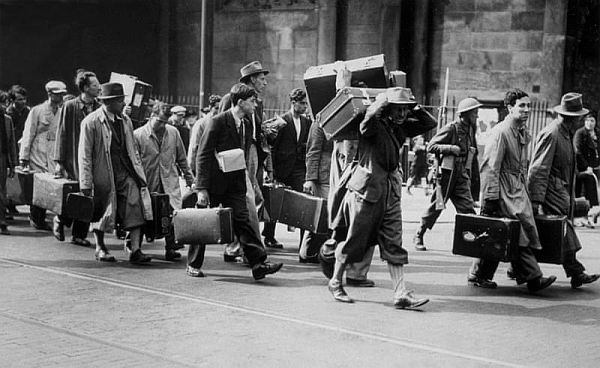
Winston Churchill, during his first cabinet meeting as prime minister, agreed to the internment of all male “enemy aliens” between the ages of 16 and 60 currently living in coastal counties in Britain. This “protected area” was where, in the event of Nazi invasion, a spy could cause most harm. Men were to be interned regardless of the refugee status bestowed on them several months earlier. The following day, on Sunday 12 May 1940, Scotland Yard’s fleet of motorcars roared out of police headquarters. Many of the officers dispatched to make the day’s arrests had been unaware of their task until they arrived at work that morning. By the end of this first mass roundup, around 2,000 refugees had been taken into custody and handed to the military authorities for internment.
 
Anderson, the home secretary, was opposed to mass internment, a position that he hoped to hold “unless the war begins to go badly”. Earlier in the year he wrote to his father of the danger posed to justice by national paranoia: “In wartime … people are easily worked up; a spy scare can be started at any time as a ‘stunt’.” Now with German troops in France, the threat of enemy invasion looming, and newspapers stewing with reports of fifth columnists (even the Manchester Guardian had added its voice to the chorus calling for mass internment, stating: “No half measures will do”), he was forced to concede that there were “various bodies and groups of persons in this country against whom action would need to be taken”, including refugees. Throughout May, the protected area expanded from coastal counties inland, until no one in Britain was safe from the threat of immediate arrest and indefinite internment based on their nationality, ethnicity, religion or political beliefs.
 
Internment was in the best interest of the internee, Churchill argued, since “public temper in this country would be such that such persons would be in great danger if left at liberty”. This argument precisely echoed that made by the Nazi officials to justify the arrest of the party’s political opponents. In a speech delivered in March 1933, shortly after the opening of Dachau, the first Nazi concentration camp, Heinrich Himmler reasoned: “I felt compelled [to make these arrests] because in many parts of the city there has been so much agitation that it has been impossible for me to guarantee the safety of those particular individuals who have provoked it.” The Nazis used a euphemism for this category of arrest – Schutzhaft, or protective custody – a term that could now be applied to Britain’s own policy towards Jews. For those individuals who had survived and fled the Nazi concentration camps at Dachau and Buchenwald, now interned by their supposed liberators, it was a befuddling injustice. When Hitler learned of Churchill’s internment policy, he reportedly gloated: “The enemies of Germany are now the enemies of Britain, too. Where are those much-vaunted democratic liberties of which the English boast?”
 
Having allowed the popular press to whip up jingoism and hatred, instead of taking an enlightened lead, the government now used “public opinion” as justification for strict measures. Among Londoners “some sort of neurosis had taken grip”, the art historian Klaus Hinrichsen noted. “Anyone who was German was considered a Nazi.” On Sunday 4 June 1940, Churchill, who had been prime minister for less than a month, addressed the House of Commons to announce the government’s new powers of arrest – “the powers to put down fifth column activities with a strong hand”. Churchill acknowledged that the orders would affect “a great many people … who are the passionate enemies of Nazi Germany”. There was, he said, nothing to be done. “I am very sorry for them,” he added, “but we cannot … draw all the distinctions which we should like to do.”


Status and class, those twin armaments of privilege, provided no protection. Nazism had pushed a wave of luminaries toward Britain. Now these Oxbridge dons, surgeons, dentists, lawyers and celebrated artists were taken into custody. The police arrested Emil Goldmann, a 67-year-old professor from the University of Vienna, in the grounds of Eton College, Britain’s most elite school. At Cambridge University, dozens of staff and students were detained in the Guildhall, including Friedrich Hohenzollern, also known as Prince Frederick of Prussia, a grandson of Queen Victoria (who, while interned, received food packages from Fortnum & Mason allegedly paid for by the royal family). That year’s Cambridge law finals nearly had to be cancelled because one of the interned professors had locked away the exam papers, and taken the key.
 
In the early hours of 5 July, a black maria pulled up at the Prestwich home of Albert and Gertrude Ripkin, who had taken in Peter Fleischmann and given him work. Fleischmann awoke to the sound of knocking. Albert was not yet up, so Fleischmann opened the door. The officer’s instruction was curt and urgent. “Get your clothes. Come with us.” Neither soldier nor criminal, Fleischmann, one of 90 aliens and refugees arrested by Salford police that morning, was denied the civil rights that even convicts enjoy: no charge, no trial, no bail.
 
None of his story mattered: not the fact he had been orphaned and made homeless by the Nazi regime, nor the fact that he had been brought to England as a destitute child, nor that he had been carefully interviewed by one of the most senior judges in the land and deemed to pose no security risk to his adoptive country. In this new reality, subject to the British government’s panicked measures, only Fleischmann’s nationality – the same nationality that the Nazis hoped to strip from all German and Austrian Jews – mattered. Buffeted along a twisted road by the winds of history, Fleischmann was, once again, rootless, unwelcome, homeless.
 
Across the country, internees were sent to various transit camps to await dispatch to more permanent camps. Fleischmann, like most of those arrested in north-west England, was sent to Warth Mills, a massive, decaying, derelict cotton mill that cast a brutish silhouette on the Lancashire horizon. Its proprietors had been forced by recession to abandon the premises a few years earlier. The site had been abandoned in haste: the floor, a mixture of cobbles and wood, was viscid and slippery with old machine oil, the smell of which mixed with the acrid stench of the canal that ran alongside the building, and stuck in the throat. Transmission belts hung like nooses from rafters. Crankshafts, partly dismounted, dangled at Damoclean angles. Clumps of rotting, mouldy cotton decorated the floor. Spiders ruled the shadows. A series of cast-iron columns crowned with intricate Corinthian capitals, high up in the vaulted murk, supported a glass roof, the sole source of light inside the building, which was pocked with broken panes that let the drizzle in.
 
The building, three storeys tall at one section, had sat empty and dampening until the British army moved in on 5 June 1940. The first internees arrived seven days later. They’d had ample time to take in their new home’s thuggish frontage. From Bury station they had been marched the four miles or so along Manchester Road towards the mill. It was a walk of shame; hostile onlookers watched as they were paraded in front of the public as prisoners.
 
“To be marched like a bloody prisoner of war, with people watching … that really hurt,” recalled Peter Katz, a pastor in his mid-50s, who had been one of the first arrivals. “I felt degraded.” By the time Fleischmann arrived, the place was packed. Inside, a phalanx of British soldiers under the command of a retired officer, Maj Alfred Braybrook, sat behind a row of tables, ready to check the men’s belongings. The internees lined up behind ropes. Each man smelled the stench of disinfectant and listened to the sounds of captive men while he waited to be called forward. When Fleischmann’s turn came, he approached, and a private grabbed his bag and tipped the contents on to a table. As the soldier sifted Fleischmann’s belongings, a seated officer thumbed through his wallet. Fleischmann assumed the men were searching for any items that might be used as weapons, but it soon became clear that anything of value was in danger of confiscation. Just as the Nazis had systematically robbed many of these men of their valuables, so the British officers now took chocolate, cigarettes, writing paper and typewriters, distributing these items among themselves in full view of their prisoners.


The confiscation of razor blades was justifiable, and a case could possibly be made for the seizure of gold sovereigns to preclude black-market trading. Other choices seemed indefensible: watches, books, medicine. One soldier took insulin from a diabetic. For some internees, this was a familiar experience. Many had passed through holding camps at Ascot and Kempton Park, also overseen by Braybrook. At Kempton Park, a young tailor, Kurt Treitel, lost his watch and all his money to larcenous soldiers.
 
The breach of privacy revealed not only what each internee had considered sufficiently important to bring with him during the harried moments of his arrest, but also the range of vocations represented among the captives. Doctors watched, bewildered, as the soldiers pocketed their stethoscopes. Academics argued that they should be allowed to keep their textbooks. Artists pleaded to keep their drawing paper. For many of the men, this ransacking crowned a brief period that had devastatingly transformed their view of Britain, and their place within it. “[We] went around breathing injustice and feeling very sore about all kinds of things,” wrote Hirsch Uri, who was arrested alongside a number of other young Orthodox Jews, most of whom had come to England via the Kindertransport. “Since gloom only serves to increase one’s loquacity, [we] soon became unbearable to ourselves.”
 
Some men at Warth Mills had already experienced great drama in their escapes to England. Two days after the outbreak of war, Gotfried Huelsmann had successfully crossed the Germany-Netherlands border disguised as a greengrocer, driving a van filled with vegetables. To be interned by the country he considered an ally, after such acts of derring-do, was hurtful; to be robbed by those in whom these men had staked their trust, unthinkable. “I remember very clearly – and this was the dominating thought – the feeling of insult,” noted Claus Moser, who later became chair of the Royal Opera House. “The whole operation was panicky and cruel.”
 
In Warth Mills, 2,000 internees shared a single bath, and 18 water taps – a limitation that quickly forced almost every man to give up on shaving, and encouraged some to rise as early as 4am to avoid the mass hustle for the facilities. Laundry could be washed in an empty room, but, without soap or drying facilities, clothes and blankets often emerged as dirty as before. There was no sewerage system, and the lavatories amounted to 60 buckets housed outside, beneath an oblong tent. As the day progressed, the stench became unbearable. The latrines became so choked that, towards the end of the day, men would simply relieve themselves in a quiet corner.
 
Conditions in the camp were considered, by the numerous German doctors among the inmates, to be a liability for the spread of disease. They wrote and co-signed a memorandum of complaint to Braybrook. Simon Isaac, a former professor at the University of Frankfurt who had overseen makeshift hospitals on the Russian Front, wrote that he had never seen a place less fit for the accommodation of human beings. To be imprisoned in a building “not even fit for beasts”, as another internee wrote, had a profound effect on the men’s view of the country that had offered them sanctuary. “Many [have] ceased to believe in the British spirit of humanity which before they had acclaimed,” he continued.
 
The indignities of isolation from friends and relatives, meagre food rations, wet straw mattresses, lice and inadequate sanitary arrangements led many internees to draw parallels between the mill and the Nazi concentration camps from which they had fled. A former member of the German Foreign Office, held in the mill, claimed conditions were much worse than those of the notorious French prisoner of war reprisal camps he had seen in the first world war, where captured men were kept in cold, brutal conditions and subject to epidemics of typhoid and cholera. According to an official Ministry of Information report, two men, both of whom had previously been incarcerated in Nazi concentration camps, died by suicide.
 
After a week spent at Warth Mills, Fleischmann was transported to one of the more permanent camps, 10 of which were situated on the Isle of Man, where women and children were also interned. When he reached the island, Fleischmann’s home was “P” Camp, or “Hutchinson”, where about 1,200 internees were billeted in requisitioned boarding houses that bordered a picturesque square, with views leading down to Douglas harbour. After the indignities of Warth Mills, Hutchinson had a bucolic quality, which, depending on an individual’s temperament, at times felt like something akin to a holiday camp.
 
Rather than squander their time in detention, the men worked to turn the camp into a cultural centre. Professional actors staged productions of A Midsummer Night’s Dream and Of Mice and Men. Feted musicians performed concerts on the lawn. Oxbridge academics delivered lectures on a vast range of subjects, while the many celebrated artists in the camp produced and exhibited works of art in various disciplines. The journalists and editors published a fortnightly camp newspaper, featuring news, articles, fiction and illustrations. Thanks to the efforts of campaigners such as the MP Eleanor Rathbone, and the Quaker Bertha Bracey, chair of the Central Department for Interned Refugees, the internees were provided with books to open an impromptu library (Lewis Carroll’s Alice’s Adventures in Wonderland and Daphne du Maurier’s Rebecca proved to be the most borrowed titles), a table tennis table, and, in time, a shop where they could buy supplies, and even alcohol.


Their captors allowed the internees to establish a hierarchy of governance, a trick developed by the British army to facilitate the colonisation of indigenous groups. Still, Hutchinson’s commandant, a former advertising executive named Hubert Daniel, was a benevolent overseer. At the urging of his wife, a frustrated artist, Daniel provided materials and studio space for the artists in the camp, and even hired a grand piano for an outdoor matinee performance by the interned musician Marjan Rawicz. The artists soon established a semi-exclusive artists’ cafe, housed in a laundry room extension, with food provided by an interned Austrian pastry chef. With its whitewashed walls and bubbling paint, water taps and washboards, the venue lacked the sophistication of the continental cafes the men were used to, but the room was sizable and, when some trestle tables, chairs and stools had been arranged inside, provided a relatively comfortable space for afternoon meetings, conversation and performances by, among others, the famed Kurt Schwitters, the most famous of Hutchinson’s artist internees, who recited his dadaist poetry.
 
For Fleischmann, who had no ties to the outside world, Hutchinson provided the artistic education that had been cut short by the Nazis. Schwitters taught him life-drawing and how to mix paint from ground brick powder. The sculptors Paul Hamann and Georg Ehrlich showed him how to dig clay while out on an escorted walk in the local hills and smuggle it back into the camp. The sculptor Ernst Müller-Blensdorf showed Fleischmann how to carve blocks of firewood.
 
In later years, everything of which Fleischmann had dreamed since he was a young aspiring artist at the orphanage would come true. Under his adopted name, Peter Midgley, he would be accepted into the Royal College of Art. He would graduate with first-class honours, the top fine art student in his year, rewarded with the RCA’s prestigious Rome scholarship. He would become a professional artist, securing commissions to create works for a number of British government departments, universities and the Royal Navy. Nothing bettered the training he received at Hutchinson, however. “Everything thereafter,” he later said, “was just a recap.”
 
Despite the cultural experience, depression was rife throughout the camp, as the men waited for news of their loved ones, worried about their businesses and obsessed over freedom. “Lest this all sounds too rosy a situation,” Klaus Hinrichsen, the art historian, who was secretary of the Hutchinson Camp University, later noted, “let me assure you that all these frantic activities were entered into as a means of distraction from the ever-present anger at the injustice of being interned … the constant worry about wives and children left without a provider and under almost nightly bombardment in London and other towns … from the lack of communication and, of course suffering from the cramped living conditions and the lack of freedom of movement.”
 
In the autumn of 1940, the British government released a white paper outlining several categories under which internees could apply for release. Those who were too young or too old, too infirm, or who already had permits to work in positions of national importance could apply to be freed. Artists, writers and musicians were not included until later revisions, and had to prove they had achieved distinction in their chosen field. (As Helen Roeder, secretary of the Artists’ Refugee Committee, put it to the director of the National Gallery: “Do you think [the criteria could] be stretched to include the poor souls who have been too busy being hunted to achieve distinction in the arts?”)
 
With hindsight, many internees recognised that they had been relatively comfortable and safe and, apart from the criminal abuse experienced at Warth Mills, their treatment was fair. For most, internment was a near-constant misery that, as the Oxford academic Paul Jacobsthal wrote, caused a “trauma”. At least 56 internees died in internment on the Isle of Man, many to suicide. And while Peter Midgley’s life was transformed by the people he met during internment, the episode also triggered feelings of rejection and abandonment that haunted his dreams. Once or twice a year he would experience the same recurring nightmare: he was back in the camp; everyone around him was released until, finally, he was the last one there, permanently forsaken.
 
Every government must balance its humanitarian obligations with the need to uphold national security. To categorise refugees from Nazi oppression as “enemy aliens”, however, was to invite populist scorn and hatred upon those in most need of compassion in wartime, and represented a moral failing on a national scale. Few went as far as Tristan Busch, a former internee who described the British policy as a “war crime” in his memoir, but it is indisputable that the hasty measures heaped unhappiness and anguish upon thousands of people already enduring the ordeal of fleeing their previous lives. Only a single sentence spoken by John Anderson in the House of Commons on 22 August 1940, months before most of Hutchinson’s internees were freed, provided something approaching an apology: “Regrettable and deplorable things have happened,” he said, as if the cruelties of internment had been the result of natural phenomena, and not a series of deliberate choices.
 
In May 2021, the Canadian prime minister, Justin Trudeau, issued a formal apology to the more than 30,000 Italian Canadians declared “enemy aliens” during the second world war – 600 of whom were sent to internment camps. There has been no equivalent attempt to repair the damage by the British authorities in failing to distinguish between refugees and “enemy aliens” – a dehumanising term that, in 2021, the US government pledged never again to use. The battle between a nation’s responsibility to help those in need and to maintain national security persists in every age, every generation. The notion of the refugee who is not who he or she claims to be is an enduring story that can be easily used to justify institutional cruelty or overreach. While the context and detail shifts, the debate remains the same, as does the potential for history to repeat itself. Each successive generation must answer the same question: how far can we go in the rightful defence of our values without abandoning them along the way?
 
This is an edited extract from The Island of Extraordinary Captives by Simon Parkin, published by Sceptre on 3 February and available from guardianbookshop.com
 
 
‘I remember the feeling of insult’: when Britain imprisoned its wartime refugees. By Simon Parkin. The Guardian, February 1, 2022.


British journalist and author Simon Parkin gave this talk to coincide with the publication of his new book.

 
The police came for Peter Fleischmann in the early hours. It reminded the teenager of the Gestapo’s moonlit roundups that he had narrowly avoided at home in Berlin. Now having endured a perilous journey to reach England –– hiding from the rampaging Nazi thugs at his orphanage, boarding a kinder transport to safety –– here the aspiring artist was on a ship bound for the Isle of Man, suspected of being a Nazi spy. What had gone wrong?
 
In May 1940 faced with a country gripped by paranoia Prime Minister Winston Churchill ordered the internment of all German and Austrian citizens living in Britain. Most, like Peter, were refugees who had come to the country to escape Nazi oppression. Now they were imprisoned by the very country in which they had staked their trust.
 
Join British journalist and author Simon Parkin for a talk to coincide with the publication of his new book. Painstakingly researched from dozens of unpublished first-hand accounts and previously classified documents, The Island of Extraordinary Captives: A True Story of an Artist, a Spy and a Wartime Scandal tells the story of Hutchinson Camp in Douglas on the Isle of Man, history’s most astonishing internment camp, and of how a group of world-renowned artists, musicians, and academics came to be seen as enemy aliens.
 
It is the story of a battle between fear and compassion at a time of national crisis. It reveals how Britain’s treatment of refugees during the Second World War led to one of the nation's most shameful missteps, and how hope and creativity can flourish in even the most challenging circumstances.
 
Simon Parkin: The Island of Extraordinary Captives.  Insiders Outsiders. February 8, 2022.


The previously unknown subject of a Kurt Schwitters painting has been identified as Ludwig Warschauer, the subject of one of MI5’s very first anti-spy operations, who was sent to Britain to spy for the Gestapo.

 
Simon Parkin made the discovery while researching his book The Island of Extraordinary Captives, a history of Hutchinson Camp, a second world war prison camp on the Isle of Man. Opened on 13 July 1940, the camp was home to around 1,200 Germans and Austrians who had fled to Britain to escape Nazism when war broke out. Its creation was part of the British government’s policy of mass internment of the so-called “enemy aliens” they had previously welcomed to the country – with prisoners including Schwitters, the celebrated German Dadaist, along with a host of other artists.
 
Schwitters, said Parkin, produced “dozens” of portraits while interned, “either as favours to his friends, or to sell them as mementoes to eminent internees - £3 for a head and shoulders; £4 for head, shoulders and arms; £5 for a half figure”.
 
Many of the portraits are well-known, but while Parkin was writing the book, he was sent a document showing thumbnails of all known Schwitters portraits by Dr Isabel Schulz, curator of the Kurt Schwitters archive at the Sprengel Museum in Hanover. One of them bore a “striking resemblance” to a photograph he had seen of Warschauer in MI5’s security files.
 
Warschauer was a German national who fled to Britain shortly before war broke out. He claimed to be the inventor of the Tefifon, a recording device that functioned like a Dictaphone, and had powerful British allies, including the Conservative MP Herbert Williams, who was chairman of the company financing the Tefifon’s development, and the home secretary John Anderson, who came to his home to watch a demonstration. But MI5 agents suspected he had come to Britain as a Gestapo plant, and he became the subject of a long-running investigation. He went on to confess and was deported to Germany after the war ended.
 
Warschauer had helped Elisabeth Kohsen and her children flee Nazi Germany shortly before the outbreak of war, in exchange for her hand in marriage. Parkin managed to contact her daughter, Monica Schubert, to ask if she recognised the man in the portrait.
 
 “She told me that not only did she recognise the man as Warschauer, but she also personally knew the painting itself: it had hung in the living room of the family home after the war,” said Parkin. “Her mother had only relinquished the portrait when, after the war Warschauer – whom she had by now divorced, because of his lies – requested the portrait be returned to him in Germany.”
 
The portrait had been offered for auction at Horster Auktionshaus in March 2007 by an “anonymous artist”, but was withdrawn after the seller learned that it was a painting by Kurt Schwitters. A year later, it was offered again, but not sold, and its whereabouts are currently unknown.
 
“To have the identity of a sitter in a Kurt Schwitters portrait was a tremendous high. When I passed all this information to Dr Schulz, she updated Schwitters’ catalogue raisonné,” said Parkin. “It only remains now to find out the current whereabouts of the portrait. I was already convinced the individual in the portrait was Warschauer before his stepdaughter confirmed the fact to me … The likeness is uncanny – even if the portrait gives the more flattering likeness.”
 
Kurt Schwitters’ unknown portrait sitter identified as wartime German spy. By  Alison Flood. The Guardian, February 8, 2022.


Despite prostrate Germany’s need for the return of its men, in Britain we didn’t release our prisoners of war until 1948. In Russia — for those who survived — freedom came even later, in the 1950s; an apparent lack of moral equivalence saw the subject conveniently ignored until recently. Likewise, in a country that thrives on retelling wartime tales of derring-do, Britain has been slow to examine the complex story behind its internment of ‘enemy aliens’, the vast majority of whom were Jewish refugees. The horror of the Nazi concentration camps helped contribute to the silence on the subject post-1945, but, as Simon Parkin argues in The Island of Extraordinary Captives, that is no reason to avoid it.

 
The author made his name with A Game of Birds and Wolves, recasting the Battle of the Atlantic through the heroics of a retired captain and a team of Wrens in an onshore tactical unit based in Liverpool. His new book is equally rewarding.
 
Just 75,500 German and Austrian refugees were allowed into Britain before war was declared — and how we lauded our national effort to save them. Who hasn’t read a touching Kindertransport story? I’ve met several veterans who trained on the Isle of Man and recall no-go zones full of morbid-looking foreign men, but I’d never challenged myself to join up the dots until Parkin came along with his inimitable capacity to find the human pulse in the underbelly of Britain’s war.
 
There are heroes aplenty in The Island of Extraordinary Captives, which focuses on Hutchinson, one of Britain’s many internment camps on the Isle of Man, chock full of artists, musicians and intellectuals. With his eye for quirky detail, Parkin infuses the better known pre-war context with characters and incidents large and small, so that when war breaks out the reader is fully invested in his main protagonist Peter Fleischmann. He was an orphaned Jewish boy from Berlin with aspirations to become an artist until the Nazis got in the way. Cue Kindertransport to Britain; but, aged 17 and no longer little enough to be lovable, he was soon rounded up as posing a danger to the very state lauded for saving him.
 
Our wartime administration’s hamfisted response to fifth columnist fears makes for uncomfortable reading. Panic and unpreparedness are the hallmarks of poor governance, and Britain’s cruel knee-jerk response in 1940 to possible enemy invasion, the internment of thousands of mainly Jewish foreign nationals, was a case in point. That year The Spectator remarked: ‘Injustices have been committed that can never be repaired.’ As this book frequently underlines, for many of Hutchinson’s inmates the experience was darkly reminiscent of their expulsion from Germany.
 
Parkin is a good writer, but the strength of the history he has stitched together renders his more high-flown prose superfluous; the rich cast of characters speak for themselves. Fleischmann was surrounded by everyday heroes, many of them artists — and only one Jewish-German spy. Living up to his reputation as an investigative journalist, Parkin establishes that the spy was Ludwig Warchauer, a morally complicated character whose previous life had crossed paths with Fleischmann’s in Berlin.
 
It was a small world on the Isle of Man. The contacts Fleischmann forged there and the artistic talents he developed within a luminous coterie of internees saw the young man successfully broker a new life on release. A happy ending of sorts pivots the narrative arch back on itself: yes, indefinite incarceration was bad, but not in Fleischmann’s case. As Parkin observes, older prisoners felt the indignity and lack of certainty most acutely. After all, they had more invested in the outside world.
 
The Island of Extraordinary Captives is multi-layered and perhaps too long, but is definitely worth the deep dive into Britain’s inglorious war, when desperate men and women were disregarded, abused and left to fester in a humiliating no man’s land. It’s a reminder that conflict has always been a convenient mask behind which thuggery and xenophobia thrive. Yet, despite the stark injustice it describes, it is a curiously exhilarating read: an example of how individuals can find joy and meaning in the absurd and mundane. Peter Fleischmann did just that, and thankfully survived to tell his story.
 
The Island of Extraordinary Captives: A True Story of an Artist, a Spy and a Wartime Scandal / Simon Parkin. Sceptre, 2022.
 
Why did Britain lock up so many innocent refugees in 1940? By Tessa Dunlop. The Spectator, February 12, 2022.


22/09/2019

Alma Mahler, Muse and Mistress of Fin-de-siècle Vienna


When Alma Mahler walked into a room, heads turned. Her magnetic presence and charismatic allure were like “an electric charge” in any gathering. She was a femme fatale who commanded fascination, adoration, and love and could enchant people in seconds. At the age of nineteen, with clear skin, an enigmatic smile, lustrous, flowing hair, and piercing, watchful blue eyes, Alma was called “the most beautiful girl in Vienna.” Her personality was mercurial; one minute she was the grande dame—imposing, regal, exuding authority—the next she was jolly and good humored, revealing “the Viennese soft femininity [which] even in her most awful moments, made it difficult to really dislike her.” Some likened her to a demigoddess to whom her admirers and devotees brought gifts. Others loathed her.

Alma was a modern woman who lived out of her time. With an independent will, an intelligent mind of her own, and a strong sense of her own worth, she harbored ambitions that were completely at odds with the behavior expected of young women in late nineteenth-century Viennese society. Her freedom mattered as she challenged the constraints imposed on her.

Alma was deeply romantic. She needed to be loved fiercely and also to feel love with a passion that fired her being. Only superior creative talents inspired her love. She was irresistibly and erotically attracted to a series of extraordinary men of glittering talent and genius, each of whom would make his distinctive mark on the European cultural landscape.

Her first infatuation was with the painter Gustav Klimt, though he never made a golden portrait of her and did not become her lover. Composer Gustav Mahler was her first husband, and, after he died in 1911, the wild expressionist painter Oskar Kokoschka openly became her lover. Her second husband, the architect Walter Gropius (with whom she had had an affair while married to Mahler), founded the modernist Bauhaus movement; her third was the then widely read novelist and poet Franz Werfel. Several other writers, composers, and artists who worshiped her praised her for her “unique gift,” her “profound, uncanny understanding of what creative men tried to achieve, and her capacity to persuade them that they could do what they aimed at, and that she, Alma, understood what it was,” as one associate described it.

Alma had not anticipated this. At eighteen, music was her passion. Her consuming aspiration was to be a composer, an extremely ambitious goal for a young woman. Nothing moved her as much as her usual twice-weekly visits to the opera, which left her enraptured and her imagination overwhelmed by its beauty and grandeur. But women composers were almost nonexistent. Girls were taught the piano not to encourage their creativity but to burnish their accomplishments as elegant and cultured wives. Women were still barred from studying at the music and art academies. Their capacity for creativity was deemed, then and later, to be limited, parochial, “domestic,” and their creative vision, by their very nature, far inferior to that of men. If, as happened to Alma, a work revealed remarkable talent, its merits were belittled or attributed to the influence or direct intervention of another—male—composer.

The adverse climate did not dim Alma’s ambition. For she was compelled to create music, driven by the spirit that flows from mysterious sources. Her belief in her innately superior pedigree, descended as she was from a painter father, Emil Jakob Schindler, whom she was convinced was a genius, gave her an unshakeable confidence in her own worth. From him came her profound conviction that the pursuit of artistic excellence was the only truly worthwhile goal and that only a person of exceptional creative talent was worthy of eliciting her love or capturing her soul.

But, when she was twenty-one, Alma was faced with a dreadful dilemma. She had to choose between her passion for a genius nearly twice her age, Gustav Mahler, and the pursuit of her own precious goal, her music. She chose the genius. Why? She had become persuaded of the nobility of giving herself entirely to a superior being who would “give my life meaning,” she explained. It was a capitulation of her inner being to the prevailing view of the role of the wife, and it happened, despite her stubborn nature and her modern ideas, because of the overwhelming intensity of her love.

Although the loss of her own music left a lasting wound, music would remain her source of strength during a life of passion and high drama, shadowed by tragedy with the premature loss of her first husband and the deaths of three of her four children. Love was the core of her existence and the wellspring of the power that this restless and irrepressible woman would from then on exercise over those in her orbit.

Born in 1879, Alma Schindler was brought up as a child in the bohemian artistic circles to which her parents, Emil and Anna Schindler, belonged, and, as an adolescent at the busy hub of the influential Viennese avant-garde, the Secession movement cofounded by her stepfather, the artist Carl Moll. She was a young woman of exceptional vitality and intellectual curiosity, eager and open, like a flower to the sun, to life and new experience.

The milieu of her self-discovery was fin-de-siècle Vienna, the magnet for talent and enterprise from across the sprawling Austro-Hungarian (or Habsburg) empire and the crucible for innovation and new ideas in every sphere of culture and intellectual thought. Artists, composers, writers, dramatists, architects, and scientists of the psyche all sought to express the new soul and spirit of modern man and woman, their condition of uncertainty and nervous anxiety, their rejection of ossified principles, and their search for inner truth through emotional and psychological introspection. In so doing they shaped the intellectual currents that defined the twentieth century.

Yet underlying the city’s buoyant cultural energy was an ominous sense of unease. The multinational empire of Austria-Hungary, which for three centuries had held together a kaleidoscope of nationalities and ethnic minorities covering much of central Europe, had begun to fragment. Demands by minorities for greater autonomy and increased rights to control their own languages and territory were opening up fissures that threatened the empire’s cohesion and stability. Faced with these intractable problems, the Viennese zeitgeist turned increasingly toward the unifying and exuberant balms of art and culture, in which pursuit the city could still lay claim to be the capital of Europe.

Within this atmosphere of cultural ferment, the guide, mentor, and polestar of the young Alma’s existence was her father, the painter Emil Jakob Schindler. She would spend many hours in his studio, watching him paint, “standing and staring at the revelations of the hand that led the brush,” and through this she acquired an intuitive sense of the process and struggle of artistic creation. Such intense involvement with the artist she loved unreservedly nurtured in her young imagination fantasies of patronage: “I dreamed of wealth merely in order to smooth the paths of creative personalities. I wished for a great Italian garden filled by many white studios; I wished to invite many outstanding men there—to live for their art alone, without mundane worries—and never to show myself,” she wrote.

Alma’s love of music dated back to her childhood when her “profoundly musical” father sang beautifully his favorite Schumann lieder and her mother, Anna, a trained singer, joined in. Emil Schindler took his intelligent, growing daughter seriously. His conversation was “fascinating and never commonplace,” she recalled. When she was eight, he led Alma and her sister, Gretl, into his studio to tell them the story of Goethe’s Faust: “We wept, not knowing why. When we were all enraptured, he gave us the book. ‘This is the most beautiful book in the world,’ he said. ‘Read it. Keep it.'” Her furious mother thought it unsuitable reading for small children and removed it. As her parents argued, Alma and Gretl listened behind closed doors with bated breath. Their mother won: “But in my mind a fixed idea remained: I had to get the Faust back!” Alma wrote.

Her unwavering devotion to Goethe spawned a burgeoning interest in literature and, later, philosophy. But her education was otherwise patchy. Though Alma appears to have attended school for a short period, she and Gretl, in common with other bourgeois Viennese girls, were taught at home by tutors. Alma’s tutors were either “nasty” and were dismissed, or they were nice and taught them nothing. Girls had been admitted to secondary school in Vienna since 1868, but until 1892, when Alma was thirteen, they were still barred from the gymnasium— the grammar school—and access to universities was still impossible. The education of girls, including Alma, tended to focus on social skills—French, dress making, and piano, rather than the philosophy and literature that inspired her.

Alma remembered herself as “a nervous child, fairly bright, with the typical hop-skip-and jump brains of precocity I could not think anything through, and was never able to keep a date in mind, and took no interest in anything but music.” Later she railed loudly against this neglect of girls’ education: “Why are boys taught to use their brains, but not girls? I can see it in my own case. My mind has not been schooled, which is why I have such frightful difficulty with everything. Sometimes I really try, force myself to think, but my thoughts vanish into thin air. And I really want to use my mind. I really do. Why do they make everything so terribly difficult for girls?”

However, she had acquired through her father a deep appreciation of painting and of the arts. Schindler, though influenced by plein air painters like Jean-Baptiste-Camille Corot, Théodore Rousseau, and Charles-François Daubigny, had developed his own vision of landscape known as poetic realism—atmospheric paintings saturated with feeling, which convey a strong sense of transience in images that are both aesthetic and subjective. He focused not on the heroic panorama of landscape but on the mundane and everyday—the vegetable garden, the mill and stream near their house, the poplar tree avenue—which he transformed with fluent brushstrokes in different light and atmospheric conditions into statements of poetic truth. Although rooted in the Viennese tradition, his style reflected the new understanding of nature that was spreading across Europe. In Alma’s eyes, he was the true prophet of the Austrian landscape.

In complete contrast, Alma’s expansive imagination was also fired by the opulent spectacles of her father’s friend and associate, Hans Makart, the most fashionable artist of the era. His dramatic, ornate representations of allegorical, historical, and classical motifs decorated Vienna’s public buildings and private neo-Renaissance palaces, and he was the dominant influence on painting, fashion, and interior design: Makart hats and Makart red were all the rage, along with the Makart bouquets—bunches of dried flowers, ostrich feathers, and grasses that decorated the salons of the bourgeoisie.

Alma fell under Makart’s spell for a time: “I loved trailing velvet gowns, and I wanted to be rowed in gondolas with velvet draperies floating astern,” she wrote. She was entranced by stories of his legendary parties, when “the loveliest women were dressed in genuine Renaissance costumes, rose garlands trailed from ballroom ceilings, Franz Liszt played through the nights, the choicest wines flowed, velvet-clad pages stood behind every chair, and so forth to the limits of splendor and imagination.”


Alongside this romantic extravagance there was in Alma a practical young woman with a sense of the difficulties and hardships of life. For her family’s comparatively comfortable existence had been only recently earned.

Excerpted from Passionate Spirit: The Life of Alma Mahler by Cate Haste


On Alma Mahler, Muse and Mistress of Fin-de-Siecle Vienna. By Cate Haste. LitHub, September 16, 2019.


Muses still exist — today, we call them star f*****s — but their glory days are past. A handful continue to cast their spell: Lou Andreas-Salomé (Nietzsche and Rilke); Cosima Liszt (Wagner); Dora Maar (Picasso); Beatrice (Dante). And then, of course, there’s Alma.

To say that Alma Mahler liked men — the composer was the first of her three bewitched and tormented husbands — is a bit like saying that Popeye was keen on spinach. Alma, however, was more discriminating in what she devoured: only genius would do. “All I love in a man is his achievement,” she announced. “The greater his achievement the more I love him.” She also loved sex, a point made a trifle more coyly by Alma’s latest biographer, Cate Haste, (she was “eager and open, like a flower to the sun, to life and new experience”) than by Alma herself. “My sensuality knows no bounds,” a girlish Alma confided to her diary after eyeing the exciting bulge in an admirer’s trousers. “I simply must get married.”

The 22-year old Viennese beauty was three months pregnant in March 1902 when she married the middle-aged Gustav Mahler. Alma’s racially sensitive family — they would later support the Nazis — were enraged by her choice of “an elderly degenerate”. But Alma, enraptured by Mahler’s skills as a conductor — she disliked his compositions — even more than by his pearly white teeth and gratifying ardour, defied them. “I felt that only he could shape my life,” she declared. At her husband’s request, she renounced a career as a composer of lieder — no great loss, judging by the handful that survive — to star in the twin roles of muse and mother.

Mahler was an egotistical and demanding husband, but Alma remained unexpectedly faithful until the summer of 1910, when a handsome young architect, Walter Gropius, took her by storm, disclosed his adulterous passion to the thunderstruck composer and invaded the couple’s home. More precisely, a surprisingly naive Mahler found the lovestruck Gropius skulking under a nearby bridge and invited him in.

The ups and downs of the following year — Mahler died in 1911, causing a lull in Gropius’s campaign of cuckoldry — were mere ripples beside the tempest of Alma’s next love affair. The man in question was the expressionist artist Oskar Kokoschka, whose “flaming and fluctuating passion” (in Haste’s memorably odd description) was evinced in a gift of “flaming red” pyjamas which became the Austrian-born artist’s own preferred loungewear. Alma, despite noticing “something hopelessly proletarian in his structure”, was smitten again. “This wonderful human being once belonged to ME”, she would sigh after a chance encounter with Kokoschka in later years. Kokoschka had meanwhile found consolation in the arms of a life-sized Alma doll, which, after various social outings, was thrown away. Police, advised of the discovery of a headless corpse, liberally soused with red wine and sprawled upon a garden lawn, took no action.

Idiotic though Alma often sounds — Haste is unwise to rely so heavily upon her subject’s comically gushing diaries — she performed well in the great crises of her life. The devastating loss of her first child, little Maria Mahler, had been followed by the premature death of Mahler himself and Alma’s subsequent guilt about two-timing Gropius with Kokoschka. In 1918, Alma was off again. “I feel NO REGRET!” she declared, sweeping aside the fact that Gropius was still her husband. Her child by the poet Franz Werfel died the following year.


 Alma’s gutsiness was most admirably displayed during a nightmarish departure in 1938 from Vienna — where she was booed for refusing to display a swastika on her car — and a perilous journey through Europe to the safety (Werfel was a Jew) of America. Here, Werfel’s publication of The Song of Bernadette — inspired by the couple’s 1938 unplanned detour to Lourdes — became a lucrative bestseller. Alma’s last phase as a much sought-after New York widow (a friend nicknamed her “La Grande veuve”) was not troubled by poverty.

Lively, well illustrated and enjoyably juicy (we learn that one besotted admirer liked to kiss any chairseat that betrayed a lingering imprint of Alma’s bottom), Haste’s genial romp through Alma’s follies lacks only the rich historical context and shrewd insights of Oliver Hilmes’ fine biography of Alma (2015), a book which still awaits a British publisher.


Passionate Spirit — the juicy exploits of Alma Mahler. By Miranda Seymour. The Financial Times,  June 27, 2019. 


Alma tell us,
    All modern women are jealous,
    Which of your magical wands
    Got you Gustav and Walter and Franz?

So runs the chorus of Tom Lehrer’s witty 1965 ballad about Alma Mahler, widow of three artistic luminaries (the composer Gustav Mahler, the architect Walter Gropius and the writer Franz Werfel) and the lover of several more. Lehrer’s song was inspired by chancing upon ‘the juiciest, spiciest, raciest obituary it has ever been my pleasure to read’ not long after Alma’s death in New York in December 1964 at the age of eighty-five. Her Upper East Side apartment was a shrine to a century of Austro-German culture, crammed with books, paintings and manuscript scores given to her by her famous husbands, lovers and friends.

Lehrer’s facetiousness about Alma’s sex life is generous in comparison with much of the writing about her. The Gustav Mahler industry, in particular, is vicious in its representation of Alma as a self-serving narcissist who exaggerated her own role in the life of the great man, massaged the facts and was even, on account of her affair with Gropius, responsible for his death at the age of fifty. She was, the legend goes, an artistic gold-digger in whose eyes a man’s sexual attractiveness increased in proportion to his artistic ‘greatness’. But in this, as in so many other matters, Alma didn’t help: during a three-year affair with Oskar Kokoschka, which became darker and stranger as time went on, she told him that she would marry him only when he had created a masterpiece (she never did). And why at the end of her life, after marrying three well-known artists, did she revert to the name of the first? Was it because she reckoned that Mahler was the most important, the ‘greatest’ of the three?

Against this backdrop, it’s rather welcome, and unexpected, to read Cate Haste admit in the foreword of her new biography, ‘I like Alma’. This book, which she has called Passionate Spirit, presents a more sympathetic portrait than we are used to, but it is, for sure, not a straightforward case for the defence. The evidence is incontrovertible that Alma’s flaws were legion and became more pronounced as she got older, and Haste does not attempt to varnish these. Alma was, undoubtedly, obsessed with her own allure. She was also indiscreet in recording her famous lovers’ sexual performance and proclivities: Mahler’s erectile dysfunction, Kokoschka’s sadomasochism, Werfel’s fantasies about having sex with disabled people – did the world need to know? She was a manipulative and inconsistent parent to her only surviving daughter and she could be ruthless when she wanted to finish a relationship, as was the case with Gropius.

Alma’s most damning flaw was her anti-Semitism, which was sometimes casual and sometimes aimed with devastating precision, and which she harboured despite having two Jewish husbands, several Jewish lovers and many Jewish friends in the intellectual communities around her in Vienna and later in Los Angeles and New York. All the contextualising in the world can’t take away the cold horror of the politically conservative Alma’s 1936 confession in her diary following a disagreement over the Spanish Civil War with Anna, the left-leaning daughter she had with Gustav, that ‘it is such a sorrow for me to have given birth to a 150% Jew.’

But if, as Haste proposes, Alma defined her life through love, this book does a good job in helping us understand why so many people, men and women, found something to love in her, right to the end of her long life. Alma grew up at the heart of the cultural hothouse of turn-of-the-century Vienna. Her father was the painter Emil Schindler and, following his death, her mother married the painter Carl Moll. The Moll household became a meeting place for artists of the newly formed Secession, and young Alma’s startling beauty and sharp intelligence shone brightly in these gatherings.

Alma documented her life at this time in breathless style in her diaries. It included a chaste love affair with Gustav Klimt and a less chaste one with the composer Alexander von Zemlinsky. She wrote in her diaries with equal passion about her rich cultural life: going to the opera and the theatre, reading Spinoza, Goethe, Rilke, Byron and Zola and, most of all, making music. Alma was an accomplished pianist, capable of playing through entire Wagner operas. In time, she began to compose music herself. She worked hard and the songs that survive from this period show genuine originality and promise.

When in 1901 Gustav Mahler, nineteen years her senior and director of the Vienna State Opera, proposed marriage, with the added condition that she should give up all ambitions to be a composer in order to be ‘the loving partner, the sympathetic comrade’ to him, the 22-year-old Alma was shocked. But, having slept on it, she agreed. Her most trenchant critics cite the fact that she so readily chose to marry an important man rather than pursue her own musical career as evidence that she had neither the talent nor the commitment to be an artist herself. But Haste reminds us that, without a single other woman to look up to among the eminent artists who surrounded her, even the spirited Alma may have felt that this was her only option. And this sacrifice cost her dearly: ‘I feel as if a cold hand has torn the heart from my breast,’ she wrote in her diary.

And so Alma’s path as wife, lover and muse to a series of male artists, rather than artist herself, was set. She described carrying her own songs around inside her ‘as if in a coffin’. We can’t know for certain if this renunciation of her artistic self contributed to her subsequent bouts of depression and her alcoholism, but there were many more trials to come: Mahler’s illness and early death, the deaths of three of her four children and the deprivations and dangers of two world wars.

In the first part of the book, Haste is clearly intoxicated by Alma’s early diaries, and other voices are crowded out, including her own. But Haste’s writing comes into its own when she zooms out, particularly when dealing with the years leading up to the Second World War, when Alma found herself caught up in world events. Alma,  by then in her sixties, showed stoicism and altruism as she accompanied Werfel and other Jewish and anti-Nazi intellectuals into hiding in the South of France. After a scramble on foot over the Pyrenees into Spain, they eventually reached safety in the United States. Alma and Werfel set up house in Beverly Hills among famous other émigrés, including Thomas Mann, Arnold Schoenberg and Marlene Dietrich.

Passionate Spirit does not answer all of the questions about this complex, flawed and contradictory character. But it is a welcome and engaging narrative of a life that, surely, has not yet been fully explored.

Not Your Average Muse. By Gillian Moore. Literary Review, July 2019.


On the second page of “Passionate Spirit,” the English biographer Cate Haste runs up her flag: “I like Alma Mahler, ” she declares. This statement places the author in direct contradiction to three famous husbands, numerous lovers and most of Alma’s acquaintance. A femme fatale who proclaimed herself a muse to genius, Alma Mahler aroused lust in her youth and gossip-seekers into her 80s. But not many people who knew her liked her very much, or for very long. I clearly remember her daughter, Anna Mahler, telling me that at no time in her long life did her mother ever have a devoted female friend.

The ditty that Tom Lehrer sang on her death in 1964—“The loveliest girl in Vienna / Was Alma, the smartest as well. / Once you picked her up on your antenna, / You’d never be free of her spell”—still rings true. Alma used her beauty and her wit to get the men she wanted. By marrying three big names, she achieved immortality by proxy. Her own legacy to our cultural heritage consists of a clutch of drawing-room songs and two published memoirs, the former unimpressive and the latter largely untruthful.

These caveats aside, there is something appealing about Ms. Haste’s attempt to retell a well-trodden life story from a 21st-century, egalitarian perspective. “I particularly like the modern young woman who emerges from the pages of her early diaries,” explains Ms. Haste, “when she was untrammeled by convention and bent on realizing herself and her talents despite the odds against her as a woman.”

The odds against her were, in fact, greater than her sex. Born in Vienna in 1879, the child of a painter, Emil Jakob Schindler, and his opera-singer wife, Alma was raised in bohemian squalor and make-do morality. Schindler was ineffectual, possibly gay. In his absence his wife slept with the landlord to make the rent, conceiving an illegitimate child. She later took her husband’s pupil, Carl Moll, as a live-in lover.

The family fortunes were transformed by the sudden patronage of Crown Prince Rudolf, who commissioned Schindler to paint landscapes of Austrian lands. Even so, Alma grew up with a sense of foreboding, trusting no one. Her need for self-reliance turned critical when her father died of a burst appendix just before her 13th birthday.

Alma, who called Schindler “my Führer,” never recovered from the loss, always reaching out to men of artistic potential who bore some resemblance to Emil. Her mother, meanwhile, swiftly married the capable Moll, setting up a cultural salon in Vienna’s fashionable Hohe Warte district, overlooking the city.

Alma conducted her early experiments in love with Gustav Klimt, the leader of Vienna’s variant of the Art Nouveau movement, and with Alexander von Zemlinsky, her piano teacher. Neither passion reached physical consummation, apparently, though it was a close-run thing when she played “Tristan and Isolde” with Zemlinsky at the piano and they were unable to keep her hands off each other (if Alma’s diaries are to be believed). Eventually she went looking for another man old enough to be her father and alighted on Gustav Mahler, director of the Vienna Opera and the most talked-about man in the city.

Mahler was 41, mother-fixated, Jewish, sexually inert and fearful that he might not live long. He was low-hanging fruit. Alma, 22, plucked him in 1901, elevating herself to the status of Frau Direktor and, to echo Tom Lehrer, the most desirable woman in Vienna. The downside of the deal, according to Alma, was that Mahler prohibited her from composing, saying that one composer was enough in the family (we have only Alma’s word for this ban).

In the decade of her marriage to Mahler, she flirted with the composer Hans Pfitzner, the pianist Ossip Gabrilowitsch and various others while Mahler slaved in a forest hut composing one symphony after another. She also had two children, one dying of scarlet fever at the age of 5. In 1910, the last summer of his life, Mahler discovered her affair with the rising architect Walter Gropius. Mahler consulted Sigmund Freud, who advised him, in the interest of saving the marriage, to let Alma indulge her desires.

Gropius, a man her own age, was in the throes of founding the Bauhaus movement, his own style featuring, as Ms. Haste puts it, the “concept of a building as a total work, a rational and functioning entity.” Frustrated by his inattention, Alma waged a passionate affair with Oskar Kokoschka, a gritty painter whose most coveted work, “Die Windsbraut” (“The Bride of the Wind”), shows a couple lying together as a storm swirls around them, the half-draped female figure being “clearly Alma,” as Ms. Haste notes. Kokoschka’s obsession with Alma’s naked body ultimately terrified her. She married Gropius in 1915. While he was away at war, she seduced a 20-something Jewish poet from Prague, Franz Werfel, a tubby youth she sought to mold.

Alma, pushing 40, was no longer beautiful. “She looked like a laundry sack,” her daughter said. But she had only to enter a room to command total attention and could still arouse desire. Werfel, locked into a deteriorating sado-masochistic marriage, wrote his romantic Catholic best seller “The Song of Bernadette” at Alma’s behest (or so she said).

The problem with Alma’s version of events is that you never know what to believe. She doctored the truth in her published memoirs and, while her diaries were not intended for alien eyes, Ms. Haste is rather too prone to take Alma at her own inflated estimation. “Although famous for her attraction to creative geniuses,” Ms. Haste concludes, “throughout her life it was not the men who were her saviors. Composing, playing or experiencing music in different forms was her crystalline core. . . . And music was the voice through which she could express her passionate spirit. Her own music is her lasting, and living, legacy.”

This is, frankly, nonsense. I have studied the songs of Alma Mahler without ever being convinced of their originality, or even their authorship. Composed in a turn-of-the-century, late-romantic mood-swing, they owe much to the hands of Zemlinsky and the fashions of the day. If composing was Alma’s life force, as Ms. Haste maintains, one has to wonder why the urge was confined to two brief spells—with Zemlinsky and shortly after Mahler’s death, when she might have felt liberated to write a symphony. In the diaries, Alma records her doubt that she has any talent at all.

Composing was never her primary motivation. Alma’s life was a work of art, a pursuit of love on her own terms. Her main interest was the capture of men through whom she could find consolation for the loss of her father and, through their response to her, a vicarious immortality. She was neither feminist, nor heroine nor likable. After Werfel’s death, she was seen out shopping in Beverly Hills. Asked if she was not going to her third husband’s funeral, Alma said: “I never go to those things.”

‘Passionate Spirit’ Review: Songs in the Key of Me. By Norman Lebrecht.  The  Wall Street Journal, September 9, 2019.