Showing posts with label book history. Show all posts

29/01/2025

How French Modernists Used Newspapers As Literary Laboratories


In the 1860s, Charles Baudelaire bemoaned what we might now call doomscrolling:

“Every newspaper, from the first line to the last, is nothing but a tissue of horrors. Wars, crimes, thefts, licentiousness, torture, crimes of princes, crimes of nations, individual crimes, an intoxicating spree of universal atrocity.
And it’s this disgusting aperitif that the civilised man consumes at breakfast each morning … I do not understand how a pure hand can touch a newspaper without a convulsion of disgust.”

The poet’s revulsion was widely shared in 19th-century France. Amid rapid increases in circulation, newspapers were depicted as a virus or narcotic responsible for collective neurosis, overexcitement and lowered productivity. Criminality was blamed on the suggestive effects of lurid crime reports. And many writers concluded that the newspaper would soon kill off the book and imaginative literature altogether.


These dismal appraisals yielded a series of fiercely pessimistic novels of journalism by authors such as Honoré de Balzac, the Goncourt brothers and Guy de Maupassant. Each portrayed the press as a corrupt and corrupting behemoth that was devouring art and culture within its predatory maw. ‘Newspapers are an evil,’ as one world-weary author remarks in Balzac’s Lost Illusions (1837-43). Another describes newspaper offices as ‘whorehouses of thought’, anticipating the degradation of the hero, Lucien de Rubempré, from idealistic young poet to unscrupulous hack as he falls for a glamorous courtesan.

But French writers’ loathing of journalism was underlain by a fundamental tension: those who criticised the press most vehemently were themselves journalists, and their novels of journalism were typically published in the same newspapers they excoriated. Journalism and literature were so deeply entwined that newspapers became ‘the laboratory of literature’ throughout the long 19th century, generating new literary forms, such as prose poetry and the serial novel.

Novels, short stories, poetry and criticism, along with much whimsical blather, filled up pages largely devoid of hard political news (due to extensive censorship) and proved an ideal means of attracting readers. Since books and theatre seldom earned a decent income, most writers reluctantly turned to the burgeoning marketplace of newspapers and magazines. That fraught relationship is summed up in a quip from Gustave Flaubert’s posthumously published compendium of contemporary fatuity, the Dictionary of Received Ideas (1910): ‘Newspapers – Can’t live without them, but thunder against.’ Writer-journalists such as Balzac and Maupassant railed against the world from whence they came.

Their fictional denunciations of journalistic skullduggery and philistinism were hardly without basis. For the French press was sustained by wholesale bribery. One leading editor even declared that he was not happy unless every line of his newspaper had been bought and paid for. Novels of journalism shed murky light on that otherwise hidden world of venality (which reporters and editorialists were naturally loath to confront).

But the repetitive, self-pitying trope, inaugurated by Balzac, equating journalism with prostitution itself obscured the complexities of literary-journalistic exchange. Newspapers were at once a meretricious medium and a forum for creative innovation. During the second half of the 19th century, some modernist writers began to reckon with that duality, toning down the anti-journalistic thunder and taking a more nuanced and self-conscious approach to the rise of mass press. As we, in turn, struggle to come to terms with the tumultuous proliferation of new media, that spirit of ambivalent openness offers timely lessons. The French modernists show us how to carve out space for artistic expression within dominant media without being dominated by them.

Despite fulminating against the sadistic intoxication dispensed by newspapers, Baudelaire was among the first to celebrate journalism’s artistic capacities. In an 1863 essay for Le Figaro, then a biweekly literary newspaper and the ancestor of today’s conservative broadsheet, he delivered a rapturous ode to the newspaper sketch artist Constantin Guys, dubbing him ‘the painter of modern life’. For Baudelaire, Guys embodied a perpetually elusive, volatile feature of existence that the poet – reaching for a then-novel, usually pejorative term circulating in the press – called ‘modernity’.

Alternately described as ‘the eternal within the transitory’ and as ‘the transitory’ itself, modernity never acquires a consistent definition in Baudelaire’s essay. But amid that conceptual uncertainty, his enthusiasm for Guys’s endeavours stands out with resounding clarity. What inspired Baudelaire was not so much the formal qualities of Guys’s now largely forgotten illustrations of Parisian streetlife, fashionable clothing and the Crimean War as the intrepid hustle underlying them. Complementing his quasi-heretical salute to modernity, Baudelaire elevated the newspaperman above traditional studio artists, whom he dismissed as ‘hamlet brains’ chained to their palettes.

His valorisation of journalism parallels his vacillations about modernity. For the medium of the newspaper is eternally caught up in a quest for an uncertain, ever-changing commodity – the news – that loses its novelty and value almost as soon as it is apprehended, whereupon the whole cycle begins again. Like Baudelaire’s painter of modern life, the whole journalistic enterprise is animated less by the goal of creating an enduring body of work than by the relentless dynamism of the process itself. And yet the newspaper also represents a locus of stability and collective identity that condenses the life of the city, the nation and the world into a few unbound pages. At once ephemeral and eternal, the newspaper is not just the conceptual crucible of modernity but also its most palpable metonym.

As Baudelaire’s modernist successors – who included Stéphane Mallarmé, Guillaume Apollinaire and Marcel Proust – found themselves caught up in the modern condition of constant impermanence, they, too, recognised that the press had become an inescapable feature of their world. Rather than seek an unobtainable refuge, these ‘hustlers in the ivory tower’ (as I have called them in a recent book) duly struggled to harness that medium to their own creative and commercial ends.

Underlying that shift towards a more flexible aesthetic outlook was the continuing expansion of ‘newspaper civilization’, which reached its apogee under the Third Republic that was founded in 1870 amid humiliating defeat in the Franco-Prussian War. The abolition of most forms of censorship, declining paper costs, railway expansion and universal primary education triggered a newspaper boom that saw total daily circulation rise from around 1.5 million in 1870 to nearly 10 million by 1914. What had been a relatively expensive item, mostly consumed by a metropolitan elite, became a massified industrial product, as cheap and ubiquitous as bread and wine, that penetrated every aspect of political and cultural life.

With the elimination of restrictions on news reporting, many writers now became alarmed that a new, Americanised, information-driven journalistic culture was driving them out of the press. In 1886, Mallarmé lamented that writing was being swallowed up by the crude, utilitarian rhythms of ‘universal reportage’, which he portrayed as the antithesis of literature. Mallarmé was, in turn, frequently ridiculed in the press for the obscurity of his work, which departs from semantic and syntactical convention to create dream-like musical and painterly effects. For the poet’s young acolytes – loosely known as Symbolists – that opposition became an article of faith. Following Mallarmé’s death in 1898, one of them, Charles Morice, commemorated his mentor as a paragon of artistic purity who had ‘always refused to participate in that cold, hard lie, the so-called literary newspaper’.

That image of austere detachment from literary-journalistic commerce is belied by Mallarmé’s extensive involvement with the press. In 1874, he founded and edited a short-lived fashion magazine, writing all the articles himself under a variety of pseudonyms. And despite his later broadside against ‘universal reportage’, the poet went on to publish work in daily newspapers. He also portrayed the newspaper as the site of a nascent poetic revolution – the ‘modern popular Poem’ – that would be embraced by a vastly expanded reading public in an atmosphere of festive, democratic celebration.

The ‘modern popular Poem’ formed part of a broader vision of literary-journalistic hybridity that would bring together newspaper and book, combining the most dynamic properties of both media within a new form. Mallarmé projected that this mysterious ‘Book’ or ‘Great Work’ would form the basis for a new civic religion grounded in poetry that would fill the spiritual vacuum he perceived at the heart of the Third Republic. Though he never brought that utopian and doubtless unrealisable endeavour to completion, Mallarmé’s final masterpiece, A Throw of the Dice Never Will Abolish Chance (1897), offers a glimpse of his transcendent ambitions.


With its elegant textual gradations sweeping across the pages, the poem has the feel of an abstract painting or a musical score. The scattered layout, in which some words are printed in large, bold type, also points to Mallarmé’s fascination with newspaper typography. Like the front page of a newspaper that compels us to pay attention to crises and disasters, A Throw of the Dice is haunted by a sense of swirling upheaval. And its central motif – a shipwreck (‘naufrage’) – could be a piece of news-in-brief, an otherwise minor slice of ‘universal reportage’ that acquires richly enigmatic metaphorical significance when embedded within the cosmic drama of the poem. What had been wrecked was the cohesion of literary culture in the face of newspaper civilisation. Mallarmé’s response was to unite high art with a devalued product of mass culture, thereby making a seminal contribution to what was later dubbed ‘intermediality’.

The poem’s genesis exemplified that aesthetic outlook. A Throw of the Dice was published – for the first and only time during the author’s lifetime – in the May 1897 edition of Cosmopolis, a large-circulation, commercially oriented magazine that had solicited his contribution, offering the tidy sum of 40 francs per page of verse (around $200 in today’s money). It seems probable that the poem had not been written (or at the very least completed) prior to Mallarmé receiving the magazine’s proposal. His single most esoteric and revolutionary work was forged through a lucrative transaction with the mass press.

Mallarmé was also a nimble self-publicist, always ready with a lapidary phrase for interviewers while maintaining a Delphic aura. Asked for his reaction to a bomb attack on the Chamber of Deputies, he offered a single line: ‘I know of no other bomb, than a book.’ In 1894, after publishing a front-page article in Le Figaro advocating public subsidy for writers, Mallarmé encouraged his acolyte Morice to undertake a survey of other authors on the subject for the same newspaper, further boosting his profile. That discreetly cultivated fame was confirmed two years later when Le Figaro, by then a leading political and cultural daily, celebrated his election as ‘prince of poets’ (following a survey of his peers conducted by the literary magazine La Plume).

While Mallarmé’s vision of literary-journalistic hybridity found few echoes in the work of his Symbolist followers, the later poets clustered around Apollinaire embraced an aesthetic of playful intermediality that owed much to the precedent of A Throw of the Dice. Apollinaire set the tone in the provocative, kaleidoscopic overture of his poem ‘Zone’ (1912):

Tu lis les prospectus les catalogues les affiches qui chantent tout haut
Voilà la poésie ce matin et pour la prose il y a les journaux
Il y a les livraisons à 25 centimes pleines d’aventures policières
Portraits des grands hommes et mille titres divers
[You read the handbills catalogues posters that sing out loud
That’s poetry this morning and for prose there’s the newspapers
There are five-penny serials full of crime and adventure
Pictures of great men and a thousand sundry headlines]

Even if poetry is identified here with advertising rather than newspapers, the image of a Parisian newspaper kiosk with its riot of competing headlines and illustrations adds a splash of journalistic colour to the poem itself. Like newspaper headlines, ‘Zone’ is devoid of punctuation. Apollinaire’s free verse thereby assimilates the visual immediacy of newspaper typography. Yet that burst of innovation is balanced by frequent use of the ‘noble’ classical metre of the 12-syllable alexandrine. Mallarmé similarly abandoned conventional versification in A Throw of the Dice while discreetly structuring his poem around the denominator 12. As Jean-Paul Sartre once quipped of Baudelaire, both Mallarmé and Apollinaire were moving forward while looking in the rear-view mirror.

Apollinaire would continue to navigate between past and present in his later visual poetry, where the text is arranged in patterns forming an image and combined with iconography culled from other media. Among these so-called calligrammes is ‘Voyage’ (1914), which transports the mythical-religious allegory of Dante’s Inferno into the era of the railway, newspaper civilisation and mass communications. Alongside a chain of free verse in the shape of a steam train, the poem includes a graphic of a telegraph pole that Apollinaire had taken from the masthead of the newspaper Le Matin, much as his friends Georges Braque and Pablo Picasso used strips cut from newspapers in their papiers collés. For all three, the newspaper’s raw facticity and ubiquity made it an indispensable symbol of modernity.
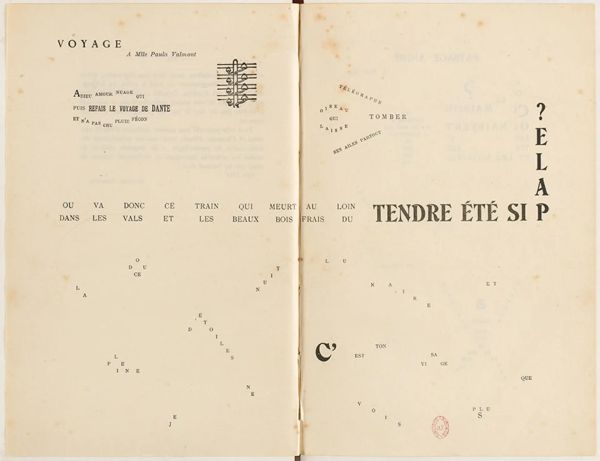


Underlying the striking inter-medial collage of ‘Voyage’ was Apollinaire’s own journalism. For, as an art critic, he had become the leading defender of Cubism, a concept he helped define and popularise. His enthusiasm for modernist art even got him sacked from one reactionary newspaper. Such misadventures were typical of Apollinaire’s journalistic career, which saw him bounce from one publication to another, get caught up in a series of public feuds, and churn out countless stock-market reports while earning little more than $1,000 per month in today’s money. His activities as an art critic even led to the poet being imprisoned under suspicion of having stolen the Mona Lisa. Yet Apollinaire continually found inspiration in the rough-and-tumble of newspaper civilisation, transforming the detritus of his journalistic life into an oeuvre whose boisterous éclat recalls Mallarmé’s joyous vision of the ‘modern popular Poem’.

Proust, who benefitted from substantial inherited wealth, never had to scratch out a living from journalism. He, too, nonetheless frequently wrote for the press during the early phase of his career. Proust then reused material from these articles in his multivolume novel, In Search of Lost Time (1913-27), where culture, politics, society gossip and war are all mediated through newspapers, which the characters read and discuss obsessively.

The centrality of journalism to that semi-autobiographical portrait of the writer as an unfocused young man can be gauged from the fact that the sole piece of writing visibly completed by Proust’s Narrator is a newspaper article. Early in the novel, he jots down a description of some church steeples, which was adapted from an article about an automobile journey across Normandy that Proust had published on the front page of Le Figaro in November 1907 (to coincide with the Paris Motor Show). Having submitted this ‘little fragment’ to the same newspaper, Le Figaro, the Narrator then repeatedly scours its pages in frustration, searching for an article that seems destined never to see the light of day, until one morning – some 2,000 pages later – his mother brings him his post, including Le Figaro, which has finally published his article.

Initial excitement gives way to disillusionment as the Narrator meditates on the tensions between journalism and literature. While offering a qualified salute to journalistic ‘beauty’, he ultimately disavows journalistic publication because it is too dependent on the approbation of its readers, and therefore in conflict with the principle of art for art’s sake. That realisation helps to catalyse the Narrator’s artistic vocation, leading him to vow to write a work that will recover lost time, not for the sake of pleasing others, but to understand the self.


Even as he disclaimed journalism, Proust drew attention to how that devalued medium had shaped his writing and accepted his ties to the press as a fundamental part of the fabric of his work and self. He both used the press as a literary laboratory and made those genetic connections to the press a central theme of his novel. Predecessors such as Balzac and Maupassant had, by contrast, passed over their own creative debts to journalism as they heaped anathema on the ‘whorehouse of thought’. After a century of evasion and resentment, Proust finally settled accounts by at once acknowledging and resisting the aesthetic hold of newspaper civilization.

Like Mallarmé and Apollinaire, Proust also proved adept at exploiting the promotional power of the press. In collaboration with his publishers, he orchestrated extensive publicity campaigns on behalf of his books, using his contacts to obtain favorable reviews. Unappreciative critics would receive aggrieved letters from the author, sometimes accompanied by invitations to dinner at the Ritz (belying his hermitic reputation, Proust maintained an active social life until his death from pneumonia in 1922 at the age of 51). Proust even bribed newspapers to publish unsigned, self-authored puff pieces.

Flaubert had declared that artists should seal themselves off from worldly preoccupations:

“One must, leaving aside material things and independently of humanity, which rejects us, live for one’s vocation, climb into one’s ivory tower and remain there, like a bayadere enveloped in her incense, alone amidst our dreams.”

His successors shared his commitment to maintaining the ivory tower of artistic independence. But Mallarmé, Apollinaire and Proust did not heed Flaubert’s call to retreat into splendid isolation. Rather, they hustled to create an audience for their work and brought the dynamism of newspaper civilisation into the ivory tower itself.

What would it mean to be a hustler in the ivory tower today? The internet and its associated gadgets stir reactions remarkably like those once directed at the press. In some quarters, futurist technophilia; more commonly, alarm at the social, political and cultural impact of these innovations, combined with neurotic dependence upon them. If Flaubert were writing his Dictionary of Received Ideas today, ‘Can’t live without it, but thunder against’ could very well be the entry for ‘iPhone’. The challenge for writers as well as readers remains that of trying to come to terms with destabilising media without being dominated by them. How, in other words, can imaginative literature navigate an ocean of online text and exploit the creative potential of digital technologies?

Contemporary writers who have wrestled with versions of this question might be divided into two camps: ironic traditionalists and digital modernists. The former make the chaos of the digital era into a central theme of their writing while remaining loyal to the codex and the classic form of the comic novel. The latter write works of electronic or digital literature that are designed to be read on screens, incorporate interactive features (most commonly hypertext) and often defy conventional categorization.

Ironic traditionalists include Gary Shteyngart, Patricia Lockwood and Lauren Oyler, who have all authored ‘internet novels’ that at once epitomise and deplore the frantic, degenerative rhythms of lives lived extremely online. Wholly or partly written in parodies of fragmented internet language, these fictional journeys into the depths of digital civilisation are characterised by searing albeit jocular pessimism about the possibility of generating any spark of enlightenment within that abyss. In Shteyngart’s techtopian allegory, Super Sad True Love Story (2010), and in Lockwood’s portrait of internet addiction, No One Is Talking About This (2021), redemption can be achieved only offline – respectively by reading ‘bound, printed, nonstreaming Media artifact[s]’ and by taking responsibility for the suffering of others. Oyler’s caustic bildungsroman of Brooklyn and Berlin literati, Fake Accounts (2021), similarly suggests that inventing a persona in real life can provide a creative antidote to the toxicity of online deception. All three depict digital media as an unsalvageable wasteland and invite us to tear ourselves away from our screens. Notwithstanding its antic, self-aware flourishes, the internet novel is pervaded by the same sense of moral nostalgia that we find in 19th-century novels of journalism such as Balzac’s Lost Illusions.

Digital modernists – operating in the spirit of Kranzberg’s first law of technology, which states it is neither good nor bad; nor is it neutral – conversely approach digital media as a forum for playful experimentation. Just as earlier modernists adopted techniques from journalism and visual art, these authors use digital media, as Jessica Pressman puts it in Digital Modernism (2014), ‘to reform and refashion older literary practices in ways that produce new art’. Recent examples include Joanna Walsh’s Seed (2017), a coming-of-age story structured around a series of non-linear ‘vines’ that we navigate on our screens, and Kate Pullinger’s Breathe (2018), which merges data harvested from the reader’s phone into a classic ghost story, an eerie device that provides an oblique commentary on online surveillance. But the laconic, mysterious tone of such works is far removed from the all-encompassing technopessimism of the internet novel. In contrast to ironic traditionalists, digital modernists tend to resist Big Tech without rejecting its innovations. Both Seed and Breathe are published by an offshoot of Google’s Creative Lab, Editions at Play, which proclaims that these books are ‘powered by the magic of the internet’.

The instability of that ‘magic’ creates a long-term problem of technical autonomy. Many early works of digital literature from the 1980s and ’90s, composed using now-obsolete operating systems, have effectively become inaccessible. Tying a piece of writing to a computer or phone also makes it hostage to the relentless distractions of any networked device – a vastly more intrusive medium than the 19th-century newspaper. The terseness of Breathe, which can be read in under half an hour, renders that problem less acute. But it is hard to see how longer works of digital literature can overcome the steep barriers to immersive deep reading currently inherent within the form.

It might be tempting to conclude that the traditional book simply remains a superior and unimprovable medium. The basic form of the codex – bound, ink-covered pages – has proved remarkably resilient for two millennia. Despite the proliferation of e-readers and other digital supports, print continues to account for the overwhelming majority of book sales.

That picture is complicated by abundant evidence that reading is a declining pastime, especially among the young. According to the American Time Use Survey, Americans aged over 15 spent, on average, a mere 16 minutes per day reading for pleasure in 2022, down from 23 minutes in 2004. More than a third of UK adults report having stopped reading for pleasure, with a quarter of these ‘lapsed readers’ citing social media as a reason for having abandoned books. Sales of literary fiction in the UK have also plummeted since the late 2000s, in tandem with the growth of smartphone use. We may be consuming and indeed producing more text than ever before, but the aesthetic dimension of that experience has atrophied.

Books, as Maël Renouard puts it in Fragments of an Infinite Memory (2021), could well end up like horses, as ‘objects of aesthetic worship’ for a residual cultivated elite.

To check the book’s decline into genteel desuetude, we should consider drawing inspiration from the unfinished intermedial ambitions of French modernism to reimagine the form of the object itself. Faced with the rise of the newspaper, Mallarmé sought to integrate its voracious popular energy within the stable, harmonising medium of the book. In his poetry and that of his successors, that project was in practice focused on the form of the text – thence the visual echoes of newspaper headlines in A Throw of the Dice and the journalistic iconography found in Apollinaire’s calligrammes – rather than its underlying material support. Mallarmé envisioned a more extensive physical hybrid of book and newspaper. But it is, in truth, difficult to imagine how those two objects could be amalgamated into an aesthetically cohesive form.

Digital technology, by contrast, offers the potential for a genuine material transformation of the codex. Rather than viewing print and digital media as irreconcilable rivals, we could explore how they might be combined within new hybrid forms devised in the spirit of Mallarmé’s vision.

The starting point for that endeavour should be an appreciation of the codex’s enduring technological attributes. Print is not just a more aesthetically pleasing medium. Because printed books and periodicals organise text within physical space, they also have a more efficient and memorable interface. Flipping through pages is a simpler, faster and more intuitive than scrolling down a screen. And yet, throughout the internet era, innovation has been a one-way street that runs from page to screen, transforming information from analogue into digital form and thereby sacrificing the advantages of the codex – durability, beauty, flexibility, enhanced concentration – for the sake of convenience and miniaturisation.

Why not preserve those virtues within an enhanced or (in Renouard’s phrase) ‘augmented’ book that imports digital technology into the codex itself? In the mid-2000s, the Greek engineer Manolis Kelaidis developed prototypes of a networked book – originally called the blueBook – that use conductive ink to create hyperlinks allowing users to access digital content on other devices by touching the pages. Advances in printed electronics have since expanded the concept’s technical possibilities. An autonomous digitally enhanced codex could incorporate hyperlinks that activate built-in micro-speakers and light up parts of the text. Other conceivable features include the ability to trigger shifting colour patterns and perhaps even moving images on the pages.

Such innovations would provide those who now seem lost to the dopamine-addled ‘Twittering Machine’ with a compelling enticement to put down their phones and enter a new fictional universe that incorporates some digital stimuli while distancing them from the neurotic distractions of the online world. And all this could be done using a sustainable, recyclable material: paper.

The prospect of paper-based augmented books also holds out the possibility of revolutionary combinations of text, image and sound that would recast the boundaries of literary art. The innovative thrust of digital modernism could be redirected towards reimagining literature’s original medium, one more hospitable than screen-based digital media to extended works of fiction and poetry and less dependent on the fickle hold of Big Tech. By combining the analogue with the digital, writers could sublimate the discombobulating modernity of the internet age into a material framework rooted in cultural antiquity, just as the French modernists channelled journalism’s unruly dynamism into the traditional structures of poetry and the novel.

‘Everything,’ wrote Mallarmé, ‘exists to end up as a book.’ The book itself should be opened up to the disorientating technologies that increasingly make up our world.

With thanks to Manolis Kelaidis for a conversation about his designs and to Maya Kulukundis for introducing me to his work.


Elegance and hustle : How French modernists from Proust to Mallarmé were alarmed and inspired by the voracious dynamism of the newspaper world. By Max McGuinness. Aeon, January 16, 2025. 


14/10/2022

Hypnerotomachia Poliphili by Francesco Colonna


With its otherworldly woodcuts and ornate descriptions of imagined architecture, Hypnerotomachia Poliphili brims with an obsessive and erotic fixation on form. Demetra Vogiatzaki accompanies the hero as he wanders the pages of this quattrocento marvel, at once a story of lost love and a fever dream of antiquity.


                     After falling asleep on the couch, Poliphilo finds himself on a broad and wild plain. Seeking shelter, he                                       grows drowsy once again, and enters a dream within the dream


Poliphilo’s eyelids finally close as the sun rises. His memory is tormented by Polia, whom he first glimpsed through a window in Treviso. Her chastity is non-negotiable: in a time of plague, she has sought spiritual purity. Yet Polia’s resistance only makes her suitor more desperate. On May Day, 1467, exhausted and heartbroken, Poliphilo finally gives in to a dream — the only space of requite. With its conjured worlds and strange architectural landscapes, few visions in Western literature have been scrutinized more than the vision Poliphilo had on that morning.
 
We know about this dream thanks to a manuscript that landed in the hands of Leonardo Crasso, a jurist of Verona who saw it fit to make the story public. Hypnerotomachia Poliphili — or, as the book came to be known in English, “Poliphilo’s Strife of Love in a Dream” — was eventually published by the renowned Venetian press of Aldus Manutius in 1499. It was the first fully illustrated book produced by Aldus, a printer whose reputation stemmed from his vast humanist erudition and devotion to classical literature. Structured as a “dream within a dream”, the narrative weaves together mythological, biblical, and occult references to construct a universe filled with ruinous landscapes and orgiastic celebrations. No cost was spared by Crasso; Poliphilo’s dream is visualized across 234 folio-sized pages, which feature nearly two hundred woodcut illustrations of unparalleled mastery for their era. In Redmond Burke’s words, the editio princeps was “the most beautiful incunabulum ever printed”. Yet Hypnerotomachia did not fit comfortably on Aldus’ august shelves. Its licentious content quickly turned into a matter of controversy, stirring speculation on the conditions and purpose of the incunabulum’s production.


On the right, The Worship of Priapus, featuring nineteen women and five men. In the foreground, priestesses sacrifice                    an ass beneath the phallic god’s herma —


            A fountain of the “little Priapus”, featuring a weight-sensitive step that, when depressed, “raises the child’s instrument”,             spraying Poliphilo’s face with cold water


For all that we know, the original “dreamer” remains unidentified. Written in an idiosyncratic hybrid language fusing Italian, Latin, and Greek, and replete with inauthentic Egyptian hieroglyphs and an abundance of architectural and botanical jargon, the rambling text of Hypnerotomachia does little to dispel the mystery of its authorship, even though it does mirror with remarkable accuracy the composite, winding nature of its contents. An acrostic formed by the first letter of each chapter, reading “Poliam Frater Franciscus Columna Peramavit" (Brother Francesco Colonna greatly loved Polia) led scholars to identify a Dominican monk from Treviso as the author of the book. Nevertheless, the polymathy of Poliphilo — along with the cryptic and playful nature of the work as a whole — has raised doubts regarding the plausibility of this hypothesis, with some critics suggesting that “Colonna” could be a pseudonym.
 
Hypnerotomachia has been described as a “tableau of rich inventions”, “a romantic version of an encyclopedia”, and a “treasure house of aesthetic descriptions”. The name “Poliphilo” translates both as “lover of Polia” and as “lover of many”. And it is indeed an erotic curiosity that spills over from his pursuit of Polia, sublimated into an almost amatory infatuation with many forms of architecture. The dream follows Poliphilo’s meandering footsteps as he wrestles with mythical creatures and his own impulses in a series of fantastical worlds. His eyes alight on imagined monuments, statues, and follies. Myriad species of plants, growing silently in these chasmous structures, dissolve into blossoming orchards and forests populated by dragons, nymphs, and carnivorous wolves. From magic lamps to ornate corals, everything is meticulously recounted by Poliphilo, as his insatiable curiosity becomes the primary force that propels him into action, fixing together the disjointed scenes of his journey.


A terrified Poliphilus fleeing from the dragon


A colossal bronze horse upon a pedestal, featuring sculpted genii unable to grip the steed due to its “great speed                          and   hard jolting”


Designed to draw its reader into the seductive delirium of Poliphilo’s odyssey, Hypnerotomachia is perhaps the first secular iteration of an immersive virtual world to be granted a comprehensive and consistent architectural presentation. Throughout the book, the figurative rhetoric of chivalric love is brought into a playful union with the visual conventions of fifteenth-century architectural treatises. Important here is not only the attention given by the author to the architectural staging of a literary dream, but the way in which the dream, in turn, seems to infiltrate and overtake the design of this outlandish scenery.
 
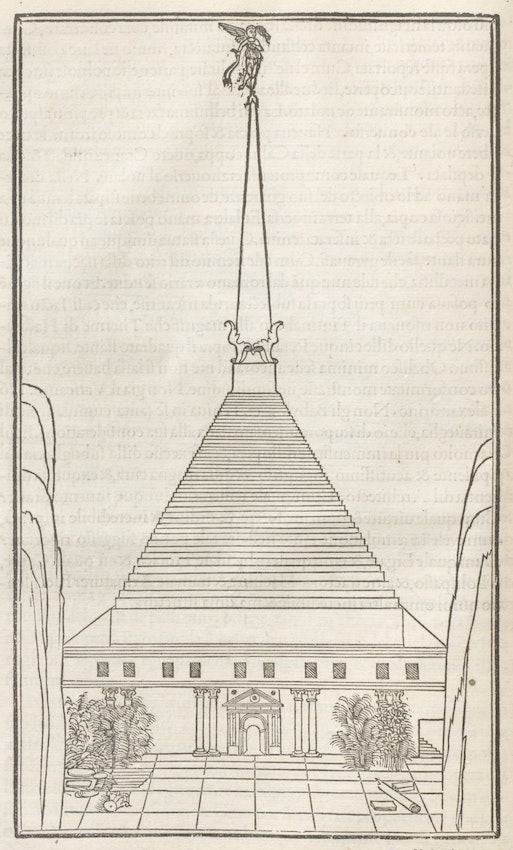
The bewildering shapes of the various structures encountered by Poliphilo along his journey — colossal statues, pyramidal temples, and elaborate fountains, among other edifices — depart radically from the principles of composition found in canonical historiography, calling to mind a number of mythical antiquities that haunted the dreams of architects at the time. For the historian Liane Lefaivre, this association between composite architecture and the recombinant imagination is best illustrated by the Temple of the Sun, a jumble of unrelated parts that are stacked to create a monument of unthinkable dimensions.


The Temple of the Sun, constructed of white Parian marble, with 1410 steps and a                                                                         cornucopia-clutching winged figure


   “Considered vertically, the building is an unlikely compilation of elements. On top of the temple is a plinth, and on top of the plinth is a pyramid, and on top of the pyramid is a monolithic stone cube and on top of the monolithic stone cube is an obelisk and on top of the obelisk is a bronze statue of a nymph holding an inverted cornucopia. Poised on one leg with the other elevated in arabesque, she pirouettes on a pivot with every shift of the wind, emitting a deafening shriek with every turn. “”
 
Hypnerotomachia abounds with similar piles ranging in size from massive to miniscule. See, for example, how the principle of the obsessive piling in the “Temple of the Sun” is repeated in the idiosyncratic formulation of the “admirable Coral Bush” and the “Perpetual Fountain”; two among the countless “miraculous” objects encountered and assiduously described by Poliphilo in his narrative. Organic and inorganic elements are here arranged vertically without any discrimination in terms of their materials, shape, or strength, producing ornamental ensembles of obscure aspiration. It is interesting to note, however, that in the Aldine edition of Hypnerotomachia, woodcuts flatten the voluminous splendor of these objects into linear compositions. The result conveys a paradoxical feeling of surface and depth that not only matches the symbolic nature of dreaming, but also the various undecipherable inscriptions and pseudo-hieroglyphs that the protagonist discovers along his journey.


Left: an ornate vessel decorated with “marvelous artificial foliage, such as is not made in our times” and surmounted by a cubit-high coral tree, which is nested in a hillock “studded with incomparable gems”. Right: a perpetual fountain with harpies, scintillating emerald leaves, and a golden pomegranate tree with coral flowers containing “calyxes full of golden bees”


                An ivory sarcophagus, containing two perfectly preserved corpses, decorated with so-called Egyptian hieroglyphs. Poliphilo interprets the sequence of emblems as follows: “To the blessed shades. Death spurns all life’s contrary and rapid things. It gives, it takes, it consumes, it dissolves. Here it has sweetly united two dead ones who loved mutually, strictly, and ardently.” 


The origins and meaning of these runes have been traced in the contours of ancient and modern dream theories, from Artemidorus’ Oneirocritica all the way to the Freudian Dream-work, where repressed drives are organized by the unconscious into condensed, encrypted representations able to evade the censorship of waking reason. Extending this premise, critics see the monuments encountered by Poliphilo as the agonizing embodiments of his elusive beloved — or, architectural ideal. Yet it is perilous to assume a direct affinity between form and cognition. In the case of Hypnerotomachia, this would reduce architecture and dreams to their faint, distorted replicas: the dream, in the words of Michel Foucault, to “a mere rhapsody of images”, and architecture to a decontextualized play of forms.


Poliphilo surrounded by remains of classical antiquity. A ferocious wolf eyes him with its jaws agape

 
 Hypneromachia’s illustrations of architectural and ornamental objects appeared during the period when printing presses were replacing the handcraft aesthetic of illuminated manuscripts. An unprecedented exactitude of images, achieved by innovations in printing techniques during the second half of the fifteenth century, brought forth a new visual culture in which knowledge could be recorded and transmitted in a format that remained identical from copy to copy.10 Through the skillful orchestration of type, text, and image, Poliphilo’s dreamworld expands and contracts continuously, pulsating between the fragile solidity of architectural stereography and the planar mechanics of the printing press.
 
Although in most cases the woodcut technology’s abstraction is able to delineate the features of these admirable structures, in other cases, such as that of the Temple of Venus Physizoa, the descriptive texture in Poliphilo’s ekphrastic frenzy far exceeds the representational refinement of wooden block reliefs:
 
“The huge dome displayed the greatest evidence of workmanship more nearly divine than human; but if it were human, it aroused astonishment that human ingenuity should make such an ambitious attempt in the founder's craft: for I judged that its great vastness had been made in a single solid fusion and casting of metal. I was astonished and overwhelmed by what I deemed to be impossible. Be that as it may, this bronze work consisted wholly of a vine sprouting from beautiful vases of the same material that were ranged perpendicularly above the columns. Thence they spread out branches, sprouts or shoots, and tendrils of dizzying intricacy, perfectly fitting the convex curve of the dome and all of the appropriate thickness. There were leaves, bunches of grapes, infants climbing and plucking them, flying birds, lizards and snakes, all modelled exactly from nature; and in between it was all transparent.””
 
Poliphilo’s description unfolds through a marvelous enhancement of his perceptual abilities. As his (inner and outer) vision sharpens, the interior of the temple dissolves into an infinite array of details, organized in continuously magnified pictorial scenes. Despite its virtuosity — and impressive awareness of contemporary artistic conventions — the orthogonal section of the Temple of Venus fails to convey the edifice’s complexity. A complexity that seems to transcend not only the limits of representation, but also those of human comprehension.


Section and ground-plan of the Temple of Venus Physizoa, whose spire is capped by a bronze crescent                                         moon and an eagle with its wings akimbo


In the centuries that followed its enigmatic appearance, Hypnerotomachia came to represent a type of architectural and artistic invention that derives its sensuous, eccentric qualities from the cryptic world of dreams, rather than from the orderly forms usually associated with Renaissance aesthetics. Yet, besides its multiple references to and deviations from architectural rules, the world in which Hypnerotomachia unfolds presents astounding continuities with the broader religious, civic, and cultural context of Venice at the time. The ruination of the world in which Poliphilo wanders coexists with the marvelous monuments he encounters in a way that is reminiscent of the double function of Christian icons in this period. For Hans Belting, the icon’s intentional fragmentation of pictorial space pointed to a transcendental world that remained intact. Accordingly, the kind of memory that these artworks heralded had “both a retrospective and, curious as it sounds, a prospective character”. The icon was not only a trace of something from the past but also something that was promised in the future. A similar dynamic is at play in Hypnerotomachia, against the backdrop of the Venetian art scene and the work of Vittore Carpaccio in particular.
 
Investigating the various strategies mobilized by fifteenth-century Venetian artists to represent the past, Patricia Fortini Brown observes the imaginative re-creation of a sensuous Arcadian antiquity in works like Hypnerotomachia. This was not merely an echo of the paradisiacal travel reports from the Aegean islands to which Venice had privileged maritime access. It also reflected a peculiar quality shared by architectural and religious drawings at the time, namely the simultaneous invocation of multiple temporalities.


Vittore Carpaccio, Dead Christ, ca. 1520


Detail from Vittore Carpaccio, Dead Christ, ca. 1520


In Carpaccio’s Dead Christ (ca. 1520), for example, a landscape reminiscent of Hypnerotomachia unfolds around the body of the slain savior. Almost Byzantine in its execution, the scenery is rocky and desolate, with opened graves, skulls, broken tombstones, columns and slabs: fragments of what would have been seen as pagan ruins. In the background of the image, however, appear two figures in Quattrocento attire and pastoral attitude, happily playing musical instruments. Like Poliphilo and Polia, these figures function as “time travelers”, contemporizing antiquity for the beholder, while intruding into a past that will be forever unattainable. In the pages of the Renaissance architectural treatise, the “downward movement of imitation”, bringing the present back into the past, and the “upward motion of invention”, in which the past serves as a model for the future, are also merged in a similar “chiasm”, argues Anne-Marie Sankovitch. The latter creates uncanny structures built on the logic of dreams — like images drawn from one's memories to project a yet-to-be-realized reality.


Poliphilo looking through a bower at Polia, who approaches from a distance. “She had such a presence and charming elegance that perhaps even amorous Idalia did not appear thus to warlike Mars, nor the handsome shepherd Adonis to her, nor the delicate Ganymede to almighty and inflamed Jupiter, nor beautiful Psyche to ardent Cupid”


                        From left to right: a weathercock, with genius blowing the trumpet; a box tree pruned into the shape of a man, whose feet rest on vases, and arms support an ornament of towers and arch; another box tree, this one pruned in the shape of a centrepiece; and the decorative crowning of the Temple of the Sun


Under the guise of the dream, Hypnerotomachia seems to present a new symbolic universe in which the complicated relationship between ancient and modern space could be redefined. In his influential book, Unearthing the Past, Leonard Barkan showed how the pace at which antiquities were being unearthed in the late Quattrocento brought forth a sea change in historical, political, and aesthetic thought. These resurfaced objects didn’t just challenge established views on the past. They also generated new kinds of artistic expression and appreciation, including the production and circulation of drawings and ekphrastic narratives, the first private collections of antique fragments, and new forms of theory and practice that embraced architecture’s inventive as well as restorative potential.
 
Yet Hypnerotomachia is much more than an architectural manifesto. These intricate negotiations also seem to emerge through the orchestration of Poliphilo’s and Polia’s triste. Almost halfway through his dream, Poliphilo encounters the beloved and embarks with her on a journey to celebrate their union. The dreamworld appears to have diminished Polia’s resistance; receptive to Poliphilo’s advances, the woman sets off to explain her former hesitations and recent change of mind.


A sequence from Polia’s narrative: “a furious goddess crowned with a wreath of agnus castus, with an unstrung bow and empty quiver, who turned a frightful countenance on me, burning with the desire to wreak cruel vengeance”


By honoring the vow she took during the plague that ravaged her hometown, Polia dutifully safeguarded her emotional and bodily boundaries against a courtship that she saw as a risk to her life. “No sooner did I see him before me”, she describes of a meeting with Poliphilo, “than I felt polluted [contaminata]”. Hiding alternatingly in the shrine of Diana’s temple and in the privacy of her bedchamber, Polia almost succeeds in avoiding her suitor’s pursuit. It is only after experiencing a revelatory vision of her own that she begins to doubt her resistance. She dreams about a graphic, supernatural violation of body and soul — a Cupid-like winged boy playing the dismembering executioner — representing the societal violence that awaits should she continue to reject the company of a male companion. Rarely acknowledged by scholarship, the author’s decision to give Polia a voice and dream of her own remains one of the most daring propositions of the book.


Polia witnesses maidens “whipped incessantly by a winged youngster” who then murders them with an iron sword “without the slightest indulgence or pity”


Much like Nausicaa’s visitation by the goddess Athena in the opening of the Odyssey’s sixth rhapsody, Polia’s vision at the closing of Hypnerotomachia reaffirms the primacy of a patriarchal, civic order over the sovereignty of a female body. Unlike Nausicaa, however, who was chastised for the messiness hidden behind the ornate doors of her bedroom, Polia is forced to give up idealistic purity and embrace the disturbing disorder of Poliphilo’s world. This reversal becomes all the more pronounced considering how the tactility of Nausicaa’s messy trousseau gives way to fully fledged architectural pandemonium in Hypnerotomachia.
 
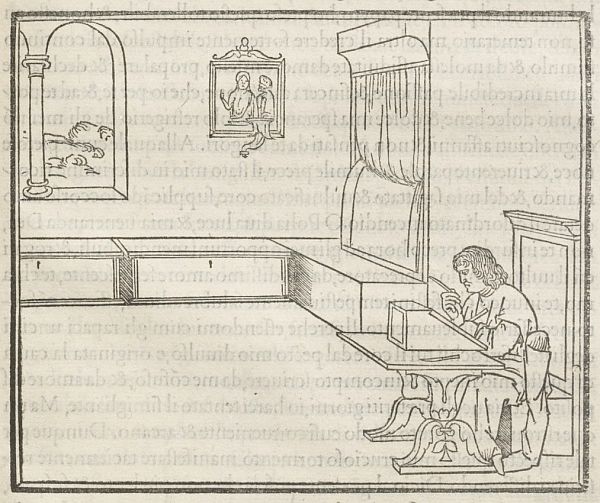
As the protagonist digresses in the warped space-time of dreaming, Polia’s narrative comes to fold the creative potential of Poliphilo’s imagination back to the source of its departure: a mundane room in fifteenth-century Treviso. And when Poliphilo finally awakens, he is alone. Polia has vanished, along with the architectural fantasies that populated his dream. Her ultimate disappearance signals the most radical gesture in a book that wrestles with the enigma of its own creation.


Poliphilus alone, writing to his beloved Polia


Hypnerotomachia Poliphili and the Architecture of Dreams. By Demetra Vogiatzaki. The Public Domain Review, September 28, 2022.


“Reader, if you wish to hear briefly what is contained in this work, know that Poliphilo tells that he saw remarkable things in a dream, hence he calls the work in Greek words ‘the strife of love in a dream’. He represents himself as having seen many ancient things worthy of memory, and everything that he says he has seen, he describes point by point in the appropriate terms and in an elegant style: pyramids, obelisks, huge ruins of buildings.” With these words, Francesco Colonna introduces his Hypnerotomachia Poliphili in 1499, at the closing of the age of the incunabulum. A Dominican friar living in Venice, he waited for thirty years before his manuscript, completed in 1467, was published by Aldus Manutius. This was partially due to the cost of the undertaking, for the volume, together with its 174 woodcuts by an anonymous artist, was one of the most extravagant publishing ventures of its day. English readers have had to wait a lot longer, until this 1999 edition that appears exactly 500 years after the entry of Hypnerotomachia Poliphili into the Renaissance literary canon.
 
Often mentioned as one of the most handsomely produced books in the Renaissance, the first edition of Hypnerotomachia Poliphili is exceedingly rare. Many surviving copies have been mutilated by readers wishing to possess some of its opulently designed woodcuts. It is, therefore, all the more rewarding that the present publication attempts to convey the beauty of the original by adhering to its size, as well as to the layout of the text and the images. Adding to the appeal of this English edition for bibliophiles is its typeface, favored by Aldus Manutius and known by modern printers as “Poliphilus.”
 
Indispensable to any study of the Renaissance obsession with the lost world of Antiquity, Hypnerotomachia Poliphili is more admired than actually read. Part of the reason for this is the notorious difficulty of the original language, a fanciful linguistic idiom based on Latin vocabulary and Italian morphology and syntax, challenging even for Colonna’s contemporaries. A labor of love for Joscelyn Godwin, this translation follows his earlier forays in the intellectual history of the early modern world, most notably his publications on the seventeenth-century philosophers Robert Fludd and Athanasius Kircher.
 
The story—ostensibly a retelling of a long and involved dream that takes Poliphilo through a landscape filled with ruins, tablets with inscriptions and hieroglyphs, and other magnificent or curious remnants of Antiquity—is both autobiographical and allegorical. Like Dante and his Beatrice, or Petrarch and his Laura, Poliphilo pursues an ideal lover, a nymph by the name of Polia. And, like these illustrious examples, he is doomed to lose her at the moment of their closest embrace, as her body disappears into the air, ending both his dream and his book. While the exact meaning of this symbolic account is as elusive as Poliphilo’s pursuit, the author hints at his allegorical intent throughout, beginning with the names of the two main protagonists. That Poliphilo (literally “the lover of Polia”) is his alter-ego, is suggested by the closing words of the nymph in which she calls him a “column of her life” (Italian “Colonna”). Polia’s own name, deriving from the Greek term for “old age” or "antiquity, " is generally understood as a hermeneutical key to the overall theme of this dream-book.
 
Like its language, the literary genre of Hypnerotomachia Poliphili is truly a hybrid one, combining the conventions of romance, travelogue, and antiquarian treatise in an ever-changing narrative. To follow Poliphilo’s descriptions of the temples and monuments encountered on his imagined journey is to delve into an assemblage of favorite Renaissance topoi. At the same time, this learned fabric is interwoven with passages detailing his desire for Polia, whose undisguised eroticism brings to mind the popular contemporary literature of a more lascivious bent. In this manner, as stressed in the dedicatory preface to the 1499 edition, he fashioned a book for many audiences, a cornucopia of knowledge that could rival the work of the ancients, and be presented with a pleasing grace and novelty.
 
Notwithstanding its textual eccentricity, Hypnerotomachia Poliphili has had a rich pictorial and literary legacy. Mantegna, Titian, Lotto and Bernini, to name but a few of the artists it inspired, eagerly drew upon its opulent, often enigmatic imagery. Equally important was the impact of this volume on emblem books, the principal vehicle for the dissemination of visual and poetic tropes in the seventeenth century. From Alciatus and Valeriano, to lesser known authors such as the Antwerp poet Jan van der Noot, Hypnerotomachia Poliphili was a favorite sourcebook of Renaissance commonplaces.
 
Though its publishing history prior to 1999 includes a number of translations, most of them are abbreviated versions of the original. Notable among them, at least in terms of the wider circulation of the text in Europe in the century following its writing, was the 1546 French edition: Hypnerotomachia, ou, Discours du Songe de Poliphile. The first and only attempt to translate this work into English before Godwin was made in 1592, as Hypnerotomachia The Strife of Love in a Dreame (London, Simon Waterson). Thwarted by the scope of the undertaking, the translator R.D. (usually identified as Sir Robert Dallington, a courtier and man of letters), stopped about two fifths into the text, leaving the English readers for the next few centuries with a little more than a foretaste of Colonna’s fertile imagination.
 
In the brief and excellent introduction to the present edition, Godwin notes that his translation project would have been a lot more difficult without the critical edition of Hypnerotomachia Poliphili by Giovanni Pozzi and Lucia A. Ciapponi (Padua: Editrice Antenore, 1968, reprinted in 1980 with a new Preface and Bibliography). Unlike that scholarly volume, he intended this translation for a more general audience interested in the culture of the Renaissance. As he observes further, while he tried to preserve the spirit of Colonna’s literary style, he knew that by rendering it in plain, standard English, he would inevitably lose some of its linguistic wit.
 
Notwithstanding this recognition of the limits of any translation, Godwin proves himself a skillful interpreter of Colonna’s eccentric language. Thus, when Poliphilo ventures to describe the physical charms of Polia, his words resonate with the Renaissance poetics of praise of beautiful women, sensitively captured in Godwin’s translation. Polia’s tresses are “filaments of gold with a changeable lustre” ( subtilissimi fili d’oro inconstantemente rutilanti), her “festive and radiant eyesπ are fit to turn Jupiter into a rain of gold” (festevoli et radiosi ochii, da fundere Iove in piogia d’oro), while her cheeks, “fresh roses gathered at dawn and placed in vases of purest Cypriot crystal” (fresche rose alla surgente aurora collecte, et dopoi tra vasi di mundissimo crystalo de Cypri) (145).
 
This rhetoric of desire is even more pronounced in the author’s accounts of ancient ruins, each one a document of the continuous struggle between Culture and the implacable forces of Nature. Standing at a “great ruin of walls and enclosures” (vastitate magna di muri o vero parieti) Poliphilo observes fissures filled with “salt-loving littoral cock’s crestπsaltwort and fragrant sea-wormwoodπ” (alcuni lochi vidi il literale cachile et molto kali et lo odoroso abscynthio marino) (236). At another such edifice, he marvels at “the fragments of holy antiquity” (gli fragmenti dilla sancta antiquitate) and wonders what their effects would be “were they whole” (quanto farebbe la sua integritate) (59).
 
To render Hypnerotomachia Poliphili in an English version approximating the hermetic density of the language of the original would have required philological acrobatics of doubtful merit for readers. Godwin illustrates this point by comparing two passages, the first of which is a “more faithful” translation of Colonna’s description of a Fury: “In this horrid and cuspidinous littoral and most miserable site of the algent and fetorific lake stood saevious Tisiphone, efferal and cruel with her viperine capillament, her meschine and miserable soul, implacably furibund.” As we turn to the “plain” English of the actual translation, we find a welcome respite whose deviance from the original is more a blessing than a loss: “On this horrid and sharp-stoned shore, in this miserable region of the icy and foetid lake, stood fell Tisiphone, wild and cruel with her vipered locks and implacably angry” (249).
 
Godwin may have sacrificed some of Colonna’s linguistic craftsmanship, but he has certainly shown a great sensitivity towards Colonna’s imagination and mastery of tropes. In page after page of this expansive and convoluted dreamscape, he succeeds in imparting the poetic exuberance of the original to the modern reader. Even if Godwin intended this translation for a number of different readers, it will undoubtedly rekindle the interest of art historians in this famous, if still insufficiently explored monument to the Renaissance infatuation with Antiquity.
 
Hypnerotomachia Poliphili: The Strife of Love in a Dream. By Aneta Georgievska-Shine. CCA.Reviews, June 16, 2000.


The Project Gutenberg EBook of Hypnerotomachia, by Francesco Colonna. Translated by  Robert Dallington, 1969.