Showing posts with label fascism. Show all posts

28/03/2025

The Rise Of The National Conservative Right Under Giorgia Meloni


Italy ​ is often thought of as a political laboratory, anticipating events in other countries: fascism in the 1920s; the showman-businessman turned politician in the 1990s; populism in the 2010s. Great significance has been attributed to the government of Giorgia Meloni, who became prime minister in 2022. For some, it signals the return of fascism in a novel form; for the majority of pundits and, increasingly, politicians, it suggests that the far right can become more moderate when in power. Both views are misleading. While Meloni has proved to be shrewd on the national and the international stage, she is also operating in a country where the normalisation of the far right has been advancing for decades.

Italy after the Second World War had a unique political landscape. It was home to both the most powerful communist party in Western Europe and the most successful right-wing parties that openly identified with a fascist forebear. Communists were always excluded from power at national level, but the Movimento Sociale Italiano (MSI), formed in 1946, was also outside the arco costituzionale. (In fact, a capacious reading of the 1948 constitution, which prohibited the refounding of the Fascist Party, could have resulted in the MSI being banned.) It brought together Italians nostalgic for fascism – whether for the early days of fighting or the paternalist modernisation drives of the 1930s – as well as those mourning the abolition of the monarchy following a referendum in 1946. The party’s flame symbol was widely understood as referring to the eternal fiamma above Mussolini’s sarcophagus in his home town of Predappio. The letters MSI could be read as M for Mussolini followed by ‘sì!’, as an abbreviation of his name, or as an allusion to the puppet regime set up by the Nazis after 1943 and nominally led by him: the Repubblica Sociale Italiana, better known as the Republic of Salò. The MSI’s founder, Giorgio Almirante, was a veteran of Salò and editorial secretary of Difesa della Razza during the ventennio, the twenty dark years of fascism.

In the 1950s MSI leaders, pursuing the strategy of inserimento, tried to present the movement as a legitimate partner for other parties. The Christian Democrats, who were in government continuously from 1948 until the early 1990s, relied on its support only once, in 1960, prompting widespread protests that forced the resignation of the prime minister, Fernando Tambroni. The postwar anti-fascist consensus seemed to hold across the major political divides, but the Tangentopoli corruption scandals of the early 1990s led to the collapse of what is now called the First Republic. The only parties left untainted were those that had been excluded from government: the MSI and the successors to the Communist Party, which had been dissolved in 1991. By that time, a dapper young man, Gianfranco Fini, had replaced Almirante as leader of the MSI. Fini promised to rejuvenate ‘fascism for the year 2000’, which didn’t stop Berlusconi from endorsing him when he ran for mayor of Rome in 1993. This was the first and, in retrospect, decisive stage in the normalisation of the Italian far right. Berlusconi soon decided to form his own party, Forza Italia, conceived by his companies’ marketing departments and modelled on a football supporters’ club – a move motivated, above all, by his desire to use public office to keep himself out of prison.

An unlikely alliance brought Berlusconi to power in 1994. In the north he partnered with the secessionist Lega Nord, whose founder, Umberto Bossi, said that it was ‘the party of those seeking to continue the partisans’ struggle of liberation against the partitocracy. Never with the fascists!’ In the south he partnered with the MSI, the fascists Bossi condemned. Berlusconi’s government lasted just eight months, but the missini had been brought into the system for good. In 1995 they renamed themselves the Alleanza Nazionale. The AN’s strategy was to distance itself from the ventennio while simultaneously trying to discredit the postwar anti-fascist consensus (as so often, the right portrayed itself as a victim – in this instance of self-righteous communists, or what Meloni today calls the ‘anti-Italian left’). Fini was still prone to making occasional statements such as ‘Berlusconi will have to work hard to prove that he can make history like Mussolini.’ But he stopped addressing people as camerata and announced that his party was not neofascist, but post-fascist – like all Italians, he said, since fascism constituted their collective heritage.

Fini’s gestures towards moderation culminated in a 2003 visit to Yad Vashem, the Holocaust memorial centre in Jerusalem, where, wearing a kippa, he declared that fascism had been an ‘absolute evil’. That same year he floated the idea of giving voting rights to immigrants. For hardliners this was too much; Alessandra Mussolini claimed that Fini was betraying her grandfather’s legacy and left the party. In another sign of his new-found respectability, Fini became president of the Chamber of Deputies, the lower house, in 2008. The next year the AN was absorbed into the Popolo della Libertà (PdL), co-founded by Fini and Berlusconi. Soon after the merger, Fini accused Berlusconi of having moved too far to the right and founded a new party, Futuro e Libertà per l’Italia (FLI), which failed miserably at the polls. Berlusconi used the power of his media empire to hound Fini out of politics. Fini had hoped that the PdL’s most talented young politician would follow him into FLI. But Giorgia Meloni stuck with Berlusconi.

Meloni was born in a bourgeois neighbourhood in Rome in 1977. Her mother was on the right; her father had left-wing sympathies. He abandoned the family when Meloni was one, an experience she credits with making her tough. A few years later, according to a much repeated story, she and her sister accidentally set fire to the family apartment, forcing her mother to sell up and move to the working-class neighbourhood of Garbatella. Meloni has made much of the hardships of her youth. (Her autobiography, Io sono Giorgia, sold 150,000 copies in its first year, an unusually large number for an Italian politician.) As a teenager she was bullied for being overweight. While her mother made a living by churning out more than a hundred romanzi rosa under the pseudonym ‘Josie Bell’, Meloni took on jobs from babysitting to working behind the bar at the Rome nightclub Piper. She studied languages at a tourism school, setting her up for her assured appearances on the international stage: perfect, impassioned Spanish when giving a speech against LGBTQ rights in Marbella; perfect, nuanced English when paying tribute to the political philosophy of self-declared Burkean ‘national conservatives’.

At fifteen, Meloni joined the Fronte della Gioventù, the MSI’s youth organisation. She became leader of the AN’s student wing four years later. These youth organisations were more radical than the mother parties, more open in their worship of Mussolini, and didn’t shy away from violence – they were also themselves subject to violence from the left, which created martyrs still celebrated today. A French TV report on the 1996 election shows Meloni organising a group of young activists, almost all men, in Garbatella. Wearing a black leather jacket, she tells the reporter in passable French that Mussolini had been a good politician because everything he did had been for Italy. Later in the clip, she appears under a poster declaring Mussolini ‘uomo del popolo’. Two years later she was elected as a councillor in Rome; that same year she founded the Atreju Festival, named after one of the heroes in Michael Ende’s fantasy novel The Neverending Story, an enduring influence alongside Tolkien (MSI activists had set up a Camp Hobbit in 1977). The festival continues to be held, featuring international stars of the far right from Steve Bannon to Viktor Orbán and inevitably – or so it feels nowadays – Elon Musk.

By 2004 Meloni had been elected president of the AN’s youth wing, the first woman to lead any such political organisation in Italy. She entered parliament two years later and was soon appointed vice president of the Chamber of Deputies; she also joined Berlusconi’s cabinet as minister for youth, making her the youngest minister in Italian history. When a clearly fading Berlusconi cancelled the PdL primaries and declared himself prime ministerial candidate in the 2013 election, Meloni quit the party alongside Ignazio La Russa, an MSI veteran. They founded Fratelli d’Italia (FdI), taking its name from the beginning of the Italian national anthem. The party won 2 per cent of votes in the election, ending up with nine deputies.

The following year Meloni took over the leadership of the party from La Russa (today he is president of the Senate and occasionally boasts about the Mussolini busts in his living room). She was re-elected in 2017 by delegates to the party congress, without a vote from FdI members. As the political scientists Salvatore Vassallo and Rinaldo Vignati stress in their illuminating book, which was called Fratelli di Giorgia in the Italian edition, the FdI is extraordinarily centralised, and its rules about internal democracy – fairly weak in any case, given the absence of a proper law on political parties in Italy – are mostly ignored. Key positions are held by figures who joined the MSI in the early 1990s; there are no real factions or infighting.

The guest of honour at the 2014 party congress where Meloni became leader was Almirante’s widow, Assunta. Meloni herself insisted at the congress that she would ‘never presume to be on the same level as Giorgio Almirante’. Soon afterwards the FdI obtained the rights to use the MSI’s flame, which had appeared in the AN’s logo but not the PdL’s. ‘The flame remains to recall our genesis,’ Meloni declared, ‘but with an eye on the future.’ Yet, as Vassallo and Vignati write, at first the party’s programme didn’t diverge greatly from Berlusconi’s (it even included elements of Catholic social thought, the legacy of the once dominant Christian Democrats having been scattered across the political landscape). It wasn’t long, however, before Meloni made a decisive turn to far-right populism, with its predictable features: nativism, Euroscepticism and an identitarian view of Christianity (as she writes in Io sono Giorgia, ‘the Christian identity can be secular rather than religious’). In other respects, the ideological mix was less conventional. At the party’s 2013 gathering in Rome, images of John Paul II, Thatcher, Gandhi and Mother Teresa were projected beside those of bona fide fathers of fascism such as D’Annunzio and Marinetti. The 2022 congress displayed cardboard cut-outs of Hannah Arendt, the Fellini collaborator Ennio Flaiano and Pasolini, whom the FdI has claimed as a conservative. The official line became that the party wasn’t post-fascist, but afascist – another not so subtle distancing from the anti-fascism of the First Republic.

The FdI doubled its vote share in the 2018 election but was overshadowed by the triumph of Matteo Salvini’s Lega (which had dropped the ‘Nord’) as well as the strong showing of the Five Star Movement (M5S). Salvini had abandoned Bossi’s secessionist agenda and even apologised for the Lega’s comments about southerners. He was appointed interior minister of an incongruous coalition between what were often described as right-wing populists and left-wing populists, headed by an independent, Giuseppe Conte. Salvini’s draconian measures against migrants ended up dominating the headlines. In the summer of 2019, with the Lega leading the polls, he overplayed his hand by leaving the coalition. He had intended to trigger an election; instead, President Sergio Mattarella brokered a coalition between the M5S and the centre-left, followed in 2021 by a coalition of almost all the parties, headed by Mario Draghi, the former president of the European Central Bank.

Vassallo and Vignati argue that conventional accounts of FdI’s success in the 2022 election need to be treated with caution. It was in 2019, they point out, that the Fratelli began rising in the polls. Still, some of the commonly cited factors were surely relevant. Meloni followed the path beaten by Berlusconi when her fiery speech at a rally for ‘Italian pride’ in 2019 – ‘I am a woman, a mother, an Italian and a Christian ... you won’t take it away from me!’ – was turned into a techno song. What had been intended as an attack on her became a wildly popular meme. Far more important, the Fratelli was the only party that didn’t join Draghi’s coalition in 2021 (Meloni said that ‘North Korean conditions’ had to be resisted). As the only source of opposition, she was well placed to capitalise on discontent with anti-Covid measures, which were especially tough in Italy after the traumatic experiences of places such as Bergamo.

Also significant was Meloni’s decision to tone down her anti-EU rhetoric in the run-up to the 2022 election. In 2017 the FdI had called for a ‘controlled abandonment of the Eurozone’ and for Southern Europe to be compensated for its suffering during the Eurocrisis. But following the agreement in 2021 of a €191 billion package for Italy as part of Brussels’s post-pandemic Recovery and Resilience Facility, it was clear that maintaining a hostile stance towards the EU would be political suicide. Meloni, in other words, profited from what is now often called ‘anti-incumbency’ sentiment and then, once in power, from access to the money her predecessors had negotiated (never mind that Italy might not have the administrative capacity to spend it all).

When the Fratelli first entered the European Parliament, they joined the European Conservatives and Reformists (in part because the Lega was already in another far-right grouping). The ECR had been the creature of the Tories since David Cameron turned his back on the mainstream conservative European Peoples Party (EPP), historically the driving force of European integration. But Brexit meant that the Conservatives didn’t contest the 2019 European election. This was another stroke of luck for Meloni: a savvy member of the FdI positioned her as the new leader of the group, which helped her appear to be centre-right – even if far-right parties such as Poland’s Law and Justice, Spain’s Vox and the Sweden Democrats are ECR members. She has often said that were she British, she’d be a Tory.


Her victory in 2022 led to warnings about a ‘rebirth of fascism’, but Meloni didn’t have to do much to prove the pundits and left-wing politicians wrong. In contrast to Salvini, who has a long history of pro-Putin statements, she supported Ukraine. She also made overtures to Ursula von der Leyen about working together on migration, a strategy that has resulted in the EU’s paying €255 million to Tunisia’s authoritarian, openly racist president, Kais Saied. While the number of people entering Italy actually increased during Meloni’s first year in office, it fell by more than half in 2024. Tweaks to the law have made it more difficult for NGOs to operate in the Mediterranean: they can carry out only one rescue operation before they must return to port, and are only allowed to use ports in the north. Italian judges blocked Meloni’s plan, backed by von der Leyen, to ship asylum seekers to Albania, where Italy has built detention centres that can hold up to three thousand; she responded by removing the case from the jurisdiction of the judges, and in January an Italian navy vessel transported 49 migrants to the centres.

The story of the FdI tends to be subsumed by the conventional wisdom that a ‘wave of populism’ is washing over Europe. But the strategy of doubling down on far-right rhetoric originated with Berlusconi. By 2022, the EPP leader, Manfred Weber, was appealing to Berlusconi as a reliable centre-right leader who would rein in the post-fascist upstarts; few seemed to recall that in the late 1990s the EPP had refused to admit Forza Italia because it was clearly a right-wing populist party. Berlusconi was also the first prime minister to include in his cabinet a veteran of Salò, Mirko Tremaglia, euphemistically referred to as ‘l’ultimo ragazzo di Salò’. What looks like a dramatic win for the post-fascists has in fact been a result of major movement within the right-wing bloc: the right as a whole won a greater share of votes in the 2008 general election than in 2022. The simple fact is that the Italian right, unlike the left, has always managed to come together for elections, with the exception of 1996. At the same time, competition between parties has provided an incentive to push ever further right within the bloc: when a reporter suggested to Meloni that Salvini was more right-wing than she was, she responded that ‘no one is further right than me.’

Vassallo​  and Vignati concede that the FdI is characterised by nativism and populism, and recognise that it is now the ‘third party of the flame’ (after the MSI and the AN). Yet they reject the ‘fascist’ label. In their view, the FdI is Italy’s first genuinely ‘national conservative’ party. It’s true that the kind of culture war Meloni has been waging is no longer alien to the centre-right. She vilifies the ‘LGBTQ lobby’ and has passed a law making it illegal to have a child through surrogacy outside the country (it has never been legal inside Italy). She also keeps insinuating that the ‘armed left’ is in cahoots with the multinationals and the grande finanza whose agenda is to destroy all local identities. According to one of Meloni’s ministers – who happens to be the former partner of her sister, Arianna, the party secretary – the aim is nothing less than the ‘ethnic substitution’ of real Italians. (This is where Atreju comes in: the hero of The Neverending Story fought against the forces of the Nothing, shorthand for the eradication of identity.) Meloni says she opposes abortion because her mother came close to having one when pregnant with her; she has claimed that the multinational forces of the ‘indistinct’ have as their ‘real, unstated, goal ... the disappearance of women as mothers’. This rhetoric is all the more charged because the leader of the opposition, the Democratic Party’s Elly Schlein, has a female partner. (‘I am a woman,’ Schlein shot back, ‘I love another woman, and I am not a mother. But that does not make me any less of a woman.’)


Italy is 87th in the global rankings for gender equality. The few women in Meloni’s cabinet have posts traditionally associated with women, such as the renamed ministra per la famiglia, la natalità e le pari opportunità. Meloni has also made a point of being addressed with the male article as ‘il presidente del consiglio’. She dismisses feminism as ‘a left-wing ideology harmful to women because it advocates for gender quotas in candidate selection and the introduction of gender ideology into schools’. Her government has increased support for working mothers and, in the vein of other natalists like Orbán, tax relief for large families. Yet despite the incessant invocations of ‘Dio-Patria-Famiglia’, the birth rate has fallen to a historic low.

Meanwhile, pro-market rhetoric and calls for lower taxes – so far, all talk and no action – have been combined with unashamed clientelism. The balneari, who hold ludicrously cheap concessions to operate twelve thousand lidos along the eight thousand kilometres of Italy’s coastline, have been sheltered from EU attempts to create more competition. The signature legislation of the M5S, the reddito di cittadinanza, has been repealed. Sometimes mischaracterised as basic income, it was essentially a modest social benefit of €750 per month for the worst-off – four million people in total, two-thirds of them in the south. Meloni claimed it had mostly gone to migrants or was ‘pocket money’ that kept healthy 25-year-olds from getting a job.

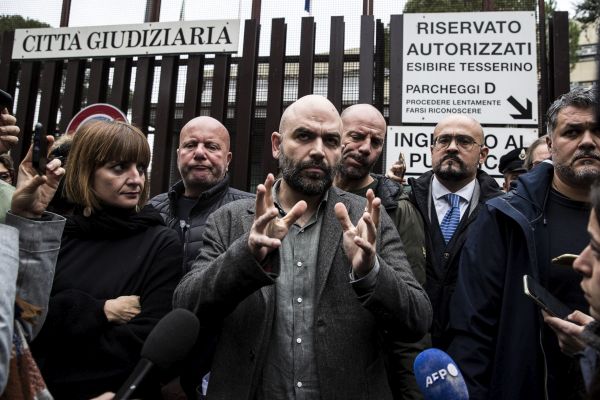
When economic miracles don’t happen, the right resorts to culture war. Previous governments tried to place partisans in cultural institutions; it was the former Democratic Party prime minister Matteo Renzi, a populist manqué, who gave the government the power to appoint the head of RAI, the public broadcaster. But changes at RAI have been so rapid and thorough that it’s now derided as ‘TeleMeloni’; RAI journalists went on strike last year over the government’s ‘suffocating control’. Even more ominous, Meloni sued Roberto Saviano, the author of Gomorrah, for libel after he called her and Salvini ‘bastards’ following the sinking of a boat of migrants. He was found guilty in 2023 and ordered to pay a fine. Meloni and her lieutenants have also tried to claim large chunks of traditional Italian culture: her former culture minister, Gennaro Sangiuliano, hailed Dante as the father of right-wing thought.


Since coming to power Meloni has made aggressive use of decrees and votes of confidence to keep members of her coalition in line. But she has also promoted a long-standing goal of the MSI and the AN: the introduction of a presidential system. (At present the president is a nominally neutral figurehead appointed by parliament.) She isn’t the first person to point out that it’s dysfunctional to have two legislative chambers with equal power. But her solution is for the prime minister to be elected by a direct vote. Such a system has only been tried once before, in Israel from 1996 to 2001. No one considers that experiment a success.

Under Meloni’s proposals, which were approved by the Senate last June, the coalition that backed the winning candidate would also automatically obtain 55 per cent of seats in parliament. It’s unclear whether these changes will happen. If the bill fails to get a two-thirds majority in both chambers, as seems likely, the reform will have to be put to a referendum; such votes often become occasions to voice discontent with the sitting government. It’s equally unclear how far Meloni will go in resisting EU regulations in Italy. She is promising to follow the model of the Polish far right by having the judiciary determine whether regulations are compatible with ‘principles of sovereignty and democracy’. Such national checks would be the end of the EU as a supranational enterprise.

For a while, Meloni looked like she might become a de facto leader of that enterprise: close to Trump and especially Elon Musk (to whose Starlink system she has been trying to commit Italy), the only European head of government at the inauguration, she promised to be the bridge between Europe and the second Trump administration. Speaking at the American far right’s major annual gathering, CPAC, in February, she implored her audience not to consider Europe ‘lost’ and to defend the ‘West’ from the ‘globalist’ left that hates freedom and distrusts its own people – echoing J.D. Vance’s incendiary rhetoric at the Munich Security Conference. But she also sent a message to Trump, stressing the need for a ‘just and lasting peace for Ukraine’ and warning of ‘trade clashes’ that would play into the hands of non-Western powers.

Trump’s apparent realignment with Putin has made her transatlantic balancing act much more precarious. Salvini, seeing an opening to reassert himself, has come out blazing for MAGA geopolitics; meanwhile, Meloni has stuck with her support for Ukraine, but also made it clear that there will be no Italian troops on the ground there (Italy’s military spending is far below the 2 per cent of GDP to which Nato members are officially committed). Her calls to keep the West together now sound desperate; she has had to cede the European stage to Starmer and Macron.

In retrospect, the 2022 election may have marked the end of a period of exceptional electoral volatility, during which a tripolar political system seemed to be emerging. It was Salvini who brought voters with populist inclinations back from the M5S to the right, while the M5S itself has moved to the left (while refusing that label), restoring a bipolar system. Interestingly, there is no longer any real north-south divide within the FdI electorate – a significant difference with the MSI, which was always much more popular below the Gothic Line.

Does that mean Vassallo and Vignati are right to see the Fratelli d’Italia as a genuinely national and more or less normal conservative party? It depends on whether one finds it normal that the leader of the party tweets about Soros being a ‘usurer’, that the party’s youth wing enthusiastically read the works of the interwar fascist philosopher Julius Evola, and that, every so often, someone in the party brings up the spectre of ‘ethnic substitution’. But for many on the centre-right in Western Europe today, such things are no longer abnormal.


No One Is Further Right Than Me. By Jan-Werner Müller.  London Review of Books, March 20, 2025.


24/09/2023

Women Who Rallied to the Republican Cause in Spain


The first thing I ever knew about the poet, journalist, and activist Nancy Cunard was a commanding broadsheet she dispatched in the summer of 1937, containing the challenge that, decades later, would spark the questions that prompted my book, Tomorrow Perhaps the Future. She addressed it to many of the most important writers of Britain and Ireland, sometimes sending multiple copies with the idea that they’d pass them on. It made its way to George Bernard Shaw and Evelyn Waugh; to T. S. Eliot, James Joyce, Samuel Beckett; to Rebecca West, Rose Macaulay and the Woolfs; to Cecil Day-Lewis, Stephen Spender, Louis MacNeice and W. H. Auden. It reached Aldous Huxley and George Orwell; Vita Sackville-West and Sylvia Pankhurst. It went to Vera Brittain and H. G. Wells; to Rosamond Lehmann and her brother, John; to Sylvia Townsend Warner and her partner, Valentine Ackland.
 
Nancy printed her missive in black and red and addressed it, broadly and grandly, to ‘the Writers and Poets of England, Scotland, Ireland and Wales’. Large type announced: THE QUESTION. Along the left-hand side of the sheet was added, vertically: SPAIN.
 
The Question (though technically there were two) appeared perfectly straightforward. ‘Are you for, or against, the legal Government and the People of Republican Spain? Are you for, or against, Franco and Fascism?’
 
Nancy assured her writers that she would publish the answers they chose to send, by which she meant: you are asked to state a position publicly. As far as she was concerned, not taking a position was impossible.
 
The project centered around her fundamental and appealingly simple belief in the value of taking sides, and on an arresting proposition: that history will sometimes present moments when convictions have to be decided upon, when lines are drawn that must be acknowledged.
 
The Spanish Civil War began in July 1936 when a group of disaffected generals – including Francisco Franco, who would emerge as their leader – attempted to launch a coup against their country’s elected government. Fascist Italy and Nazi Germany offered decisive material support to Franco’s side (the nationalists) while the Republican government received from its fellow democracies in France, the United States, and Great Britain only a queasy refusal to intervene. As the Republic battled to survive this well-resourced attack, relying on a tenacious popular resistance to the military takeover and on arms from Soviet Russia and Mexico, many observers understood the war as an opportunity to halt the global advance of fascism: one that their own governments seemed loath to take up.
 
Almost a year into the war, Nancy Cunard was framing things like this: ‘It is clear to many of us throughout the whole world that now, as certainly never before, we are determined or compelled, to take sides. The equivocal attitude, the Ivory Tower, the paradoxical, the ironic detachment, will no longer do.’
 
These were the questions I had in response: what happens when the stakes of political life have become so high that people no longer feel neutrality is an option? Can the mere act of declaring a ‘side’ be of any value? And do writers really have any particular responsibility – or, indeed, any special right – to weigh in on the causes of the day? By the time I finished the book, many writers around the world had been asking themselves that final question. Just last year, PEN America held an ‘Emergency World Voices Congress of Writers’ in response to Russia’s invasion of Ukraine, yet the crises deemed relevant to practitioners of literature went beyond the war. ‘In this moment of chaos and violence,’ the chief executive, Suzanne Nossel, said, ‘we can address what the role of the writer is, as we face down the rise of authoritarianism, disinformation run amok, social fissures that are widening here in this country, and a surge in book banning and threats against free speech.’ In the late 1930s, writers were mobilizing to address very similar trends, but not all of them agreed that it was their place to do so.
 
When the idea of a pamphlet announcing the partisanship of Britain and Ireland’s most eminent writers and intellectuals occurred to Nancy Cunard – who had already spent months in Spain as a journalist in 1936, and would return in 1937 and 1938 – she assembled twelve additional signatories (all of them male) to the questionnaire, but later claimed it solely as her own. It was she who drafted the questions, arranged for them to be printed in Paris, and came up with a list of recipients. Names kept on occurring to her, until she had mailed out over two hundred copies. The cooperation of the other signatories was in fact of little significance. ‘Had every one of them said “No”,’ she told a scholar in the sixties, ‘I should have made the little work all the same – and how! You see in those days there did exist ENTHUSIASM for what was felt to be good and right and true.’
 
Her enthusiasm, it turned out, was matched by others. The pamphlet eventually consisted of 148 replies, but at least twenty-five were left out for space, which implies that a great proportion of Nancy’s dispatches hit home. In London, the Left Review agreed to publish it. They printed 3,000 copies of Authors Take Sides on the Spanish War and immediately sold out.
 
Nancy had not limited her outreach to writers she knew or to those she assumed would agree with her, but she was convinced that the results would overwhelmingly favour the Republic, and she was right. Of the printed responses, only sixteen chose neutrality, and just five were against the Spanish government. (The responses left out for space were all pro-Republican.) In Paris, she had sorted the answers herself, categorising them as ‘For’ the Republic, ‘Against’ or ‘Neutral?’ without adhering to any particularly discernible method, just as her basis for approaching respondents had hardly been scientific. Some of those who ignored her commands and chose to equivocate were overruled and placed in the ‘For’ pile, when perhaps they intended to be ‘Neutral’. On the other hand, there were statements published under ‘Neutral’ that could convincingly have been designated as ‘For’. And at least Nancy did allow for Neutral. The phrasing of her questions had been unashamedly leading. The point of the questionnaire was not to achieve a balance of opinion. The intention was to publish a declaration.
 
‘It is to be hoped that some methodical person has made a collection of the various manifestos and questionnaires issued . . . during the years 1936–7,’ Virginia Woolf later remarked, taking a very dim view of the ‘inquisition’ to which she felt herself subjected in those days. ‘Private people of no political training were invited to sign appeals asking their own and foreign governments to change their policy; artists were asked to fill up forms stating the proper relations of the artist to the State, to religion, to morality . . .’
 
Some of the hostile responders assumed that Nancy was asking them to choose between fascism and communism, which she wasn’t; others assumed she would leave out anything unfavourable to her pro-Republican position (their responses duly appeared in the pamphlet). Not everyone was convinced that the simple act of declaring themselves could be of much use. Rebecca West, sending hers in, worried that ‘six lines is terribly little and it sounds very trite and boring’. E. M. Forster could not share Nancy’s conviction ‘that manifestos by writers carry any weight whatever’.
 
Nancy’s questionnaire was in a sense asking too much and asking too little. It is all too easy to sit down in some quiet place, compose a few lines, and settle back satisfied in the fulfilment of a civic duty. ‘To scribble a name on a sheet of paper is easy,’ Woolf pointed out in the book she was writing that summer, but an expression of opinion was not ‘positive help’. On the other hand, it’s easy to imagine intellectuals baulking at nailing their colours to the mast as publicly – or as simplistically – as Nancy wanted. A war in someone else’s country was surely more complicated than she was prepared to allow.
 
 
Yet it’s not difficult to see why Nancy thought the project important. At the League of Nations in Geneva, she had witnessed the Republic’s fellow democracies still refusing to confront Germany or Italy over their ‘invasion’ of Spain. ‘While the powers pass resolutions,’ she had reminded her readers, ‘international Fascism kills.’ With so much relying on changing the narrative outside of the country, harnessing the opinions of articulate public figures – the publishers listed forty of them down the front cover – and having them sound the alarm in their cumulative authority was a sensible, even inspired, contribution. Her pamphlet was a signal that what was happening in Spain was a matter of gravity and relevance. The following year, Donald Ogden Stewart took up the idea and canvassed American authors in Writers Take Sides: Letters About the War in Spain from 418 American Authors. John Steinbeck and William Faulkner were among those who put their opposition to Franco on record.


Nancy wasn’t asking her respondents to merely lament ‘how wicked it all is’, as George Orwell would accuse her, but, in stating a side, to do something more difficult: to forsake such unimpeachable generalisations in favour of specifics. But in the pamphlet that emerged, the particularity of Spain – its history and traditions; the nature of its political scene – often fell by the wayside. Many took Nancy’s cue in using it as an opportunity to voice their suspicion of the fascist powers in Europe. Nancy had set up a symbol that allowed her correspondents to continue their own debates. To read the pamphlet is to see a cohort of writers pondering their place in the world.
 
When Nancy asked James Joyce for a response to the pamphlet, she received a strident telling-off. Joyce would provide no such thing, she later told his biographer, ‘because it [was] “politics”’. ‘Politics’ was ‘getting into everything’. T. S. Eliot replied to her request with the opinion that ‘at least a few men of letters should remain isolated’, claiming a special position for writers – a place above the fray. The author and traveller Norman Douglas, one of her closest friends, boasted, ‘If Fascists annoy me, I hop it. If Communists annoy me, I hop it,’ turning neutrality into merely the good fortune of having options.
 
But Nancy’s exhortation to writers was more than just a statement of faith in their influence. She also saw in fascism an implacable enemy of the arts. Most of her responders regarded fascism – particularly as demonstrated in the regimes of Hitler and Mussolini – as not just hostile to intellectuals and repressive of artistic freedom but antithetical to culture: mere ‘barbarism’, as Leonard Woolf and others put it. (As it happened, ‘barbarism’ was also how Franco described socialism.)
 
The poet Valentine Ackland expected both ‘reason and tenacious courage’ from artists: attributes required for making a stand. After all, the deployment of reason alongside the imagination helps us to make sense of phenomena confronting us. Writers, whether identifying as intellectuals or artists, are dealers in trust. They have to be able to convince, on some level at least, if they want their creations to move and engage. This, I think, is why Nancy saw writers endowed with a special responsibility towards truth, why they were the natural enemies of fascist movements that warped and suppressed it.
 
As any censor knows and fears, in the arts there are secret languages which can encode, and thus protect, independence; that can entrench dissent in realms where it is difficult to identify and impossible to root out. ‘A press is very dangerous!’ Nancy once wrote of her time as a publisher in the 1920s. ‘It means the dissemination of ideas.’ Responding to her questionnaire, Cyril Connolly, the editor of Horizon magazine, pointed out that the aggressive aims of fascist states required a populace that was ‘rendered both warlike and servile’ – the ‘stultifying’, in other words, ‘of the human race’. When a system relies on the prevention of independent thought, the use of the intellect (the dissemination of ideas) becomes a primary form of resistance.
 
Adapted from Sarah Watling’s new book, Tomorrow Perhaps the Future: Writers, Outsiders, and the Spanish Civil War, published by Knopf


Sometimes Writers Have to Take Sides. By Sarah Watling. Time, July 13, 2023.


The Spanish war began in July 1936 when a group of disaffected generals—including Francisco Franco, who would emerge as their leader— attempted to launch a coup against their country’s elected government. The reaction of foreign powers was significant from the start.

 
Fascist Italy and Nazi Germany offered decisive material support to Franco’s side (the nationalists) while the Republican government received from its fellow democracies in France, the United States and Great Britain only a queasy refusal to intervene.
 
As the Republic battled to survive this well-resourced attack, relying on a tenacious popular resistance to the military takeover and on arms from Soviet Russia and Mexico, many observers understood the war as an opportunity to halt the global advance of fascism: one that their own governments seemed loath to take up.
 
Some months in, Nancy Cunard challenged her fellow writers to make public statements on the war in an urgent call that framed things like this:
 
”It is clear to many of us throughout the whole world that now, as certainly never before, we are determined or compelled, to take sides. The equivocal attitude, the Ivory Tower, the paradoxical, the ironic detachment, will no longer do.”
 
This was where the Spanish Civil War began to matter to me. It happened that, when I first found this eye-catching statement, I was living through an era of national and international upheaval that made Nancy’s 80-year-old challenge snatch up my attention.
 
It was possible, in her day, to see democracy as a teetering edifice, a system that had outlived, even failed, its potential. Alternatives vied for dominance. The Great Depression in America, that “citadel of capitalism,” had not only destabilized economies around the world but shaken faith in the capitalist system itself—proving, to some minds, the validity of the Marxist theory that had predicted its collapse.
 
The twenties and early thirties had seen military dictators or  non-democratic forms of government gain the upper hand in a raft of countries: Hungary, Poland, Yugoslavia, Romania, Japan, Portugal, Austria, Bulgaria, Greece and, of course, even earlier, Russia. By 1936, Germany and Italy had been governed by fascists for years. Their regimes found plenty of sympathizers in countries shaken by the First World War and ensuing Depression.
 
The British Union of Fascists, for instance, was already almost four years old. Nor was fascist aggression on the international stage something new. Italy had invaded Ethiopia in 1935; Germany was openly remilitarizing—something forbidden by the terms of the peace imposed at the end of the First World War. For some, the great dichotomy of the 1930s was provided by fascism and communism. For many others (including those who weren’t convinced of a meaningful difference between the two), Spain was perhaps simpler still: fascism or opposition to fascism.
 
By my day it had become fairly common to hear people drawing dark parallels with the 1930s: that decade in which Mussolini and Hitler crushed opposition and raised their armies, and Franco took over Spain, and “Blackshirts” marched in the streets of London. We thought we knew these facts, but it seemed they were losing their power to terrify or forewarn; that acknowledging them belonged to an old tyranny of decency and truth that others were ready to throw off.
 
It’s an absurd kind of grandiosity, in a way, to relate the darkest past to your own moment and its preoccupations. Yet I felt many of the things I had taken for granted dropping away around the time I first started reading about Nancy Cunard. Democratic processes, mechanisms of justice, truth itself: all were under renewed threat.
 
My country seemed a less moderate, less peaceful place than I was used to, and newly emboldened extremists were taking eagerly to the public stage. Inequalities of wealth and opportunity were widening. The urgency of the climate crisis felt increasingly clamorous. It was difficult not to simply feel hopeless; pinioned into a narrow space of outraged despair.
 
And yet, it was quite convenient to have so much out in the open. It was something to respond to. It gave Nancy’s uncompromising position a certain appeal—even offered, perhaps, a kind of permission. I kept remembering a feminist demonstration I had taken part in years before, when I was 21. Meeting friends in a park afterwards, one of them had punctured our exultant mood: the turn-out I’d bragged of was more or less meaningless, he opined, an act of preaching to the choir. What was the point when everyone on the march was already persuaded?


By 2019—a year in which, though abortion rights had just been extended in Ireland, the UN Deputy High Commissioner for Human Rights could describe US policy on abortion as “gender-based violence against women, no question” and the anti-feminist, far-right Vox party made unprecedented gains in Spain, raising the uncomfortable specter of  Franco—the response I should have made was becoming clearer to me. My 21-year-old self had marched to give notice of her resistance. There was nothing to be gained by trying to understand the point of view we were protesting (that the way women dressed could provoke rape), but much to be risked from letting that idea exist in the world unchallenged.
 
Nancy’s “taking sides” has an air of immaturity about it, perhaps precisely because of the playground training most of us receive in it. So much prudence and fairness is signified by resisting these easy allegiances, by seeing “two sides to every story”—a terminology that tends to imply that truth or moral superiority can only ever exist in not choosing either one. And it was becoming clear that polarization serves the extremes best of all.
 
But something about Nancy’s construction spoke to me. It suggested that there is power in the act of taking a side; that there are moments on which history rests, when nuance or hesitation (perhaps or tomorrow) will prove fatal, when it is vital to  know—and to acknowledge—which side you are on.
 
The worst times can take on an appearance of simplicity and war is exactly the kind of aberration that removes options, leaving the single choice of one side or another in its place. Yet when Nancy and thousands of other foreigners to Spain acted voluntarily in support of the Spanish Republic, they made their beliefs public. Their actions proposed the worst times as periods of opportunity, too: invitations to reclaim principles from the privacy of our thoughts and conversations and ballot boxes, and make them decisive factors in the way we live and act.
 
This is why my book is not about the Spanish experience of the war, but rather about the people who had the option not to involve themselves and decided otherwise.
 
Writers are good for thinking through. I was interested in the question of critical  distance—whether it is always possible or even, as I’d instinctively assumed, always   desirable—and I could think of no better individual to shed light on this than a writer (or intellectual) in war-time.
 
But people from all walks of life understood the Spanish war as a question, a provocation that demanded an answer. Thousands from across the world volunteered on behalf of the Republic, going so far as to travel to the country as combatants and auxiliaries. Others declared themselves through campaigning and fundraising. Martha Gellhorn defined herself as “an onlooker”: I wanted to explore, too, the experience of people whose commitment drew them closer to the action.
 
Alongside her in this book are the British Communist Nan Green and her husband, George, who wrenched themselves from their children to volunteer with medical and military units in Republican Spain. There is a young African American nurse named Salaria Kea who saw her service there as a calling. There is one of the boldest photographers to contribute to the memory of the war: Gerda Taro, a refugee from Germany for whom the fight against fascism was personal.
 
They left their own accounts of the conflict, whether through images or text, and following their stories taught me much about how historical narratives are formed in the first place; why leaving a record can be one of the most instinctive, and contested, human impulses.
 
They went because, as Martha Gellhorn put it, “We knew, we just knew that Spain was the place to stop Fascism.”
 
When I went looking for Salaria Kea, the negotiations and challenges her story had undergone became as interesting to me as the missing pieces. A woman of color deemed a political radical, a nurse and not a writer: hers was a voice that rarely received a welcome hearing. My book voices many of my questions, but with Salaria so much was unclear that I realized I could only tell her story by narrating the pursuit and leaving the questions open.
 
“Rebels,” like Franco, turn military might against the government they’re meant to serve. But I found that all the people I chose to follow fulfilled the word’s other definition, of those who “resist authority, control, or convention.” I wanted to know why they believed that the moment had come, with Spain, for taking sides.
 
Or, rather, I wanted to know how they recognized the Spanish war as the moment for doing something about the way their present was heading, and what “taking sides” had meant in practice. I wanted to know whether Nancy really thought the mere act of declaring a side could make a difference, as she suggested when she put out that urgent call. I wanted to know why she had addressed it specifically to “Writers and Poets.”
 
The Spanish war is often remembered for, and through, its  writers—and notably writers from outside the country. Of all the defeats in history, perhaps only Troy has been as well served by literature as Republican Spain was during and after the ascension of Franco, who would eventually rule in Spain for almost forty years. Countless novels and memoirs, a handful of them the greatest books by the greatest writers of their generation; reams of poetry, both brilliant and pedestrian, have preserved the memory of its cause.
 
As I read, I began to think that their authors’ position had something to say about the nature of writing itself. It seemed significant that each of the writers in this book saw themselves, whether at home or abroad, as an outsider. If not belonging was a fundamental part of that identity, taking sides on Spain only crystallized a series of pressing questions about the purpose and privileges of writers.
 
The 1930s was a decade of art colliding with politics, of artists determining to marry the two. Presented with the trauma of the Great Depression, the unavoidable phenomenon of Soviet Russia and the spread of fascism, there were journalists and poets alike who sought new modes and new material. Writers questioned their obligations to society, asked what art could achieve; they interrogated the intellectual life to expose its value and its limitations.
 
The list of foreigners who spent time in Spain during the war reads like a roll call of the most celebrated voices of the era: think of the Spanish war and I imagine you think of Ernest Hemingway and George Orwell, perhaps Stephen Spender, John Dos Passos, W. H. Auden. Delve a little further and you will find a far greater array of authors, including writers who were female, writers of color, writers who did not write in English (though the wealth of Spanish-language literature falls beyond the scope of a book interested in the outsiderness of writers).
 
They went because, as Martha Gellhorn put it, “We knew, we just knew that Spain was the place to stop Fascism,” or because they believed in the liberal project of the Republic and wanted to raise awareness of its plight, or because they wanted to observe, or even participate in, the cause célèbre of the moment. They saw history coming and went out to meet it.
 
__________________________________


From Tomorrow Perhaps the Future by Sarah Watling. By Sarah Watling. Excerpted by permission of Alfred A. Knopf, a division of Penguin Random House LLC.
 
Why the Spanish Civil War Mattered to Writers on Distant Shores. By Sarah Watling.LitHub, May 15, 2023.


In early 1935, the novelist Josephine Herbst arrived in Cuba under false pretenses, traveling with accreditation from moderate magazines like the American Mercury that she wouldn’t be writing for, intending to reach the resistance. But the whole point of an underground resistance is that it isn’t easy to find.

 
The pose was lady journalist researching the island’s sugar industry. The reality was a commission from the Marxist-aligned New Masses to report on dissent against the harsh regime overseen by Fulgencio Batista. At the time, Herbst was a fearless short story writer and novelist of growing reputation, a woman who compulsively fictionalized the traumas and grievances of her life and background in novels such as Pity Is Not Enough and The Executioner Waits, and who had just begun to distinguish herself as an intrepid, politically committed, as-far-left-as-you-can-go journalist. If only the world weren’t so clamorous, Herbst could have gotten back to the novels she was meant to be writing. But she also believed that, without the clamor of the world, there would be no novels.
 
It took her weeks to gain the trust of the Cuban underground in 1935, weeks she spent interviewing local politicians and American businessmen, compiling a portrait of a country at the mercy of the United States’ business interests. All the while, she was seeking a way up into the mountains, where peasant rebels in a region called Realengo 18 were said to be holding out against sugar companies’ attempts to seize their land. At first, her contacts would only take her as far as Santiago, where the scarred bodies of the activists she met were explanation enough for their caution. Then, finally, there was a five-day journey on horseback up to what she described as “the secret mountainsides of ‘Realengo 18.’”
 
The area was so remote that she was the first foreign journalist ever to meet the people there, yet, armed and friendly, they expressed no sense of their isolation: Instead, she believed, they saw their struggle as part of a worldwide movement for change. “The district of Realengo is small in comparison to Cuba, and Cuba is only a tiny island,” she wrote in one of her articles, “but no one in Realengo feels alone in the fight for freedom. They talk too much of what is going on in the world. They know too much to be alone.”
 
This knowledge and these connections were important to Herbst. Over the previous few years, while covering the Great Depression-era radical organizing of American farmers, she had remarked on surprising collaborations. What made a white man from an old farming family find common cause with an impoverished Black sharecropper from Alabama? “Nothing except the conviction that their struggle against mass ruin is the same,” she once declared. Within the right kinds of alliances, Herbst believed, and with the willingness to struggle, was a solution not just to economic inequality but to imperialism and racial prejudice, too.


By the time Herbst got back to Havana from the mountains, everything had escalated. A general strike called in opposition to Batista’s repression triggered a violent clampdown. She was in a theater when a bomb went off outside. Most people stayed where they were; Herbst dashed out to find pools of blood on the pavement. She wrote up her articles while gunfire spat in the streets, then had them smuggled out of the country when the authorities restricted the mail. She soon followed, unable to do anything more while her contacts were being hunted down and disappearing.
 
Fortunately, it was not far from Cuba to an old friend’s bolthole in Key West, Florida. She spent a few days recuperating with Ernest Hemingway, then it was onward to New York, where she was due to speak at a writers’ conference in April.
 
Onstage at the Mecca Temple, she knew why she’d been asked—last-minute panic. The event was a great gathering of progressive American writers, and they’d forgotten to arrange a female speaker for the opening night. This was typical of the various communist productions she’d appeared at; they wanted her for her profile more than for her opinions. In 1935, she was, in the words of biographer Elinor Langer, “a leading lady” of the country’s radical left. That was partly due to her own work and reputation, and partly because her estranged husband, John Herrmann, had shifted his focus from literature to communist organizing.
 
As the fascist threat in Europe, and Joseph Stalin’s wary eye on it, prompted a new mood of broad leftist cooperation—often heralded as a “popular front”—Herbst’s political connections were bringing her to larger audiences. Yet she hated the “smuggies” of the left’s “New York political elite,” who went around giving stirring speeches to strikers on lives they knew nothing about. “Don’t get me wrong,” she would write years later, when such things were dangerous to admit, “I went as far left as you can go,” but she never counted herself among those she called “the Faithful” (and there’s no evidence that she ever actually joined the Communist Party). Perhaps her skepticism showed: A sketch of the conference speakers has the 43-year-old grim-faced beneath a wide, unlovely hat.


But one thing that did convince her was the fascist threat in Europe, and her mind quickly turned to the next subject for her foreign reporting. She had lived in Berlin briefly in the 1920s, ashamed of the affluence her American dollars brought her in the inflation-stricken city, and she knew that much had changed in the hungry, unsettled capital she had known.
 
Since Adolf Hitler had come to power in Germany in 1933, voices of domestic opposition had been falling ominously silent. By 1935, the National Socialist German Workers’ Party was the only party allowed by law; Dachau, the Nazis’ first concentration camp for political prisoners, was already two years old. The Nuremberg Laws would be instituted that September, stripping German Jews of basic rights. It was said that the Nazis had wiped out their opponents entirely, and if there was no one standing up to Hitler at home, there seemed to be little appetite for confronting him internationally, either. Herbst negotiated an assignment from the New York Post and headed for Berlin.
 
Berlin was a risk. It could be dangerous to go there, and there was no guarantee she’d find anything to report. Exiles had furnished her with contacts, but these came with warnings attached: People might have disappeared, or her drawing attention could cause them to.
 
In Germany, it was summertime, and everything was now as neat and orderly as the world had been led to believe. Yet Herbst sensed “a changed and sick country,” a smothered one. Describing attributes that supposedly give dictatorships their appeal, she also confronted the costs at which they are achieved. “On the surface, things appear cheerful,” she reported. “Boys bicycle on country roads. Who sees a concentration camp? Yet silence is over the very countryside. … Talk does not bubble up anymore.”
 
Fear stalked her in Berlin, just as it had done in Cuba and would, for a time, in Spain, where she traveled the following year to witness the country being bombed by German and Italian planes during its civil war. The courage it took to find these stories came not from the absence of fear but the unceasing struggle with it. From Germany, she sent a letter to her old friend Katherine Anne Porter, knowing it was risky to write too freely, trying to psych herself into courage: “Everything very quiet, muzzled in fact, but no more of that until I see you again. I felt dreadfully depressed at first, did even this morning with a kind of horror of being alone that goes to the very bone. I’m not sure I can pull off the business here and am not going to be frightened if I don’t. I am not going to be terrified of failing for the moment.”


Herbst had gone to Germany intending to lay her ear to the ground and listen for the sound of resistance; eventually, at a whisper, she heard it. She set up secret meetings and was told about suppressed strikes and workers who defiantly attended the funerals of murdered comrades; she began to pick up jokes that expressed discontent with the regime and learned of opposition leaflets cascading from waterspouts into the street with the rain. She managed to uncover a hidden reality of opposition to the Nazis—not from the conservative aristocrats who would be commemorated for their belated intervention against Hitler, but from housewives on buses, industrial workers, brave leaflet circulators and slogan painters. She wrote a report that ran over five consecutive days on the New York Post front page, called “Behind the Swastika.” Long before many others realized the danger, she urged her readers to look behind the facade and question the image the dictatorship wanted the world to see, producing an outsider’s portrait of Germany under the Nazis that now stands as a warning against the dismantling of democracy.
 
Disillusionment, poverty and the hostilities of the McCarthy era would later do much to silence Herbst, but to the end of her life in 1969, she remained proud of her work before World War II. In 1942, she was removed from her job on the German desk of the war propaganda agency in Washington. Two investigators took her through a long list of accusations. (She was cleared of wrongdoing but never got her job back.) “There were a good many of these charges, linked to the events of the ’30s and the role I had played in connection with each,” she would later recall, “and given them in bulk, I was impressed by the record.”
 
Adapted from Tomorrow Perhaps the Future: Writers, Outsiders and the Spanish Civil War by Sarah Watling. Published by Knopf, 2023.
 
How Josephine Herbst, ‘Leading Lady’ of the Left, Chronicled the Rise of Fascism. By Sarah Watling. Smithsonian Magazine, May 8, 2023.  


There is a photograph taken by Gerda Taro in August 1936 that shows a woman kneeling on the sand of a beach outside Barcelona, holding a handgun. She is leaning forward, aiming directly out of the square frame of the shot, the barrel of the gun in a line with her mouth. The overalls she is wearing are baggy and a little rumpled, but the lines and angles her form creates are bold. The photo is taken from low down – I imagine Taro lying flat on the sand, facing her subject from the side – so that small stones by the woman’s bent leg stand out more sharply than the buildings smudged into the distance. The overcast sky and its gathering clouds, gives the picture a momentous feeling.
 
The photograph was first published in the French magazine Vu and it represents something of what felt, to contemporary observers, most revolutionary and most worth fighting for in the embattled Spanish Republic. Only a few weeks before it was taken, a group of military generals had attempted a coup to overthrow Spain’s elected government. Sufficient forces rallied to the defence of the government to prevent the coup from succeeding immediately, despite the fact that the rebels soon had substantial support from Nazi Germany and Fascist Italy. Instead, a civil war erupted, unleashing, in Catalonia, a simultaneous social revolution – one of the features of which was new liberties for women. The woman aiming a gun on the beach was a recruit for the militias being formed to defend the Republic. For the rest of the world, this was something shocking – something newsworthy – which is no doubt why Taro chose to capture the scene on her first wartime visit to Spain.
 
Taro was an antifascist and a refugee from Nazi Germany; the Republican cause mattered to her on a personal level. I think the subject of this picture would have excited her too. She was far from the only female press person to travel to Spain to cover the war (among photographers, the Hungarian-born Kati Horna springs to mind) and some of them – Taro perhaps most of all – took enormous risks to cover the conflict. One of the notable characteristics of the Spanish Civil War was the new way in which it was covered: technological advances gave photojournalists smaller, lighter cameras that could get them closer to the frontlines. Taro took the beachfront photo using a Rolleiflex with film that could be changed quickly and that focused quickly; she later switched to a Leica.

 
A photograph taken by Robert Capa in 1936 gives us a glimpse of the conditions. Capa and Taro had met in Paris, where they had both gone into exile, and soon lived and worked together. (It was in Paris that they put aside their birthnames of Gerta Pohorylle and Endre Friedmann for the new professional identities of Capa and Taro.) Capa’s photograph shows that not all of Taro’s pictures were taken from the safety of training sessions. This is an action shot. It shows Taro taking cover on the Cordoba front, crouching behind a Republican soldier. She looks up, eyes wide with anticipation – perhaps even fear – alert for danger overhead, her throat bared to the camera like an expression of her vulnerability. It’s all the more haunting when you know what followed: her mortal injury the following year, as she covered the chaotic Republican retreat from Brunete. She is thought to be the first female war photographer to have died in the field.
 
The romanticism of Taro’s picture of the militiawoman is, to me, powerful, but also troubling. War is not beautiful, yet the photograph is. There is something unseemly about viewing, for example, Taro’s photographs of refugees in Almería in a gallery setting – in admiring the excellence of the composition. This was never Taro’s intention. She saw herself as a journalist rather than an artist, calling on France, Britain and the United States to recognise what was being done to Spanish people by Franco and his allies, and to protest against it.
 
Taro’s reputation diminished after the war, at least partly because she was overshadowed by Capa’s fame, but a number of discoveries in recent years have helped to revise the picture. Taro’s biographer Irme Schaber has done much to illuminate the facts of her life, and when collections of Capa and Taro’s negatives from Spain emerged in the 2000s, many photographs that had been previously attributed to Capa were found to have been taken by Taro, helping to secure her reputation as one of the most interesting photographers to cover the conflict. The pictures she took in Spain chronicle moments of exhilarating possibility and of appalling tragedy – which also makes them a fitting chronicle of Taro’s life.
 
Tomorrow Perhaps the Future: Following Writers and Rebels in the Spanish Civil War by Sarah Watling will be published by Jonathan Cape in February.
 
The unflinching gaze of Gerda Taro. By Sarah Watland. Apollo Magazine, January 26, 2023. 


The most famous chroniclers of the Spanish Civil War may have been male writers such as George Orwell and Ernest Hemingway. But a new book reveals the contributions made by a band of brave and brilliant women. These include everyone from the maverick poet and activist Nancy Cunard to journalist Martha Gellhorn and the young Jewish photographer Gerda Taro.
 
Guest: Sarah Watling - journalist and author of of ‘Tomorrow Perhaps The Future: Following Writers and Rebels in the Spanish Civil War’ (Penguin)
 
Women writers and rebels in the Spanish Civil War.  Credits:  Sarah Dingle, Presenter; Julie Street, Producer
 
Australian Broadcasting Corporation, May 18, 2023.


‘We English,’ the prime minister Stanley Baldwin allegedly remarked following the outbreak of the Spanish Civil War in July 1936, ‘hate fascism, but we loathe bolshevism as much. So if there is somewhere where fascists and bolsheviks can kill each other off, so much the better.’
 
Initially, many in Britain probably agreed with Baldwin, seeing no reason to be drawn into another country’s civil war. But a sizeable minority thought very differently, believing that the conflict was not just a civil war but part of an ongoing struggle between democracy and fascism. To them, Spain became a rallying cry, and over the course of the war many thousands from around the world volunteered to join it. Most fought in the communist-controlled International Brigades, but others went to report on the conflict as part of ‘fact-finding missions’, or simply to show their support for the Spanish government’s cause.
 
The experiences of a number of these visitors, witnesses and reporters are described in Tomorrow Perhaps the Future (the title taken from W.H. Auden’s poem ‘Spain’), by Sarah Watling, the author of Noble Savages, the prize-winning biography of the bohemian Olivier sisters. Its characters are not the familiar ones of Auden, Ernest Hemingway, John Dos Passos and George Orwell. Instead, Watling’s study marks her determination to write women into the history books.
 
This is not to say, of course, that women have been invisible in the literature of the Spanish Civil War, particularly not this celebrity cohort, which includes the heiress to the Cunard shipping empire, the daughter of a baron, and a number of prominent writers. Nevertheless, as Virginia Woolf (one of the book’s subjects) remarked, war is generally a male affair, and women’s roles often get downplayed or glossed over. Watling points out that the German photojournalist Gerda Taro and the American war correspondent Martha Gellhorn were for many years overshadowed by Robert Capa and Hemingway, their more famous partners; and I suspect that few are aware that the first British volunteer to be killed in Spain was Felicia Browne, a sculptor from Slade School of Art.
 
Like almost all of those who went to Spain in the 1930s, the women portrayed in this book ‘had a choice not to involve themselves, and decided otherwise’. While Woolf’s inclination was to ‘fight intellectually’ (she tried unsuccessfully to dissuade her nephew Julian Bell from volunteering), others became more emotionally and practically immersed in the Spanish Republic’s struggle. They included Gellhorn, every bit as determined a supporter of the cause as Hemingway. Just as strong-minded was the eccentric Nancy Cunard, who, like Gellhorn, personally witnessed the war’s appalling realities. She frantically tried to spur others into feeling the same outrage, sending out an infamous questionnaire to 200 writers, demanding that they take sides. The overwhelming majority did, even if Orwell, scarred by his experiences of fighting in Spain and irritated by what he saw as Cunard’s simplistic, presumptuous questions, responded: ‘Will you please stop sending me this bloody rubbish.’
 
Given Orwell’s outrage over the partisan nature of the foreign media’s coverage of the war, it’s not surprising that many believed strongly that no one could really understand what was happening in Spain if they hadn’t been there. Watling quotes Josephine Herbst, an American novelist turned campaigning left-wing journalist, who explained: ‘I didn’t even want to go to Spain. I had to. Because.’ The radical lesbian and devout communist Sylvia Townsend Warner felt the same way, attending a congress of writers in Republican Spain alongside her partner Valentine Ackland. The couple discovered in revolutionary Barcelona the liberty to live their lives together in a way denied them at home.
 
Yet if going to Spain allowed some women freedoms and opportunities formerly forbidden them, it also presented familiar problems. There was not only a constant risk of unwelcome sexual attention, but also the fact that ‘closed doors could be found in the most open male minds’. The British communist Nan Green followed her husband George to the war, having reluctantly taken the heart-rending decision to leave their two children behind. Her sacrifice was rewarded by a vicious campaign against her by one of the most senior British communists in Spain, who falsely accused her of Trotskyism. Similarly depressing is the account of Salaria Kea, ‘the only female African-American nurse to volunteer in Spain’. The prejudice she suffered before, during and after her time there was shocking – though, as Watling dryly notes, ‘probably not very shocking to a black woman living in 1930s America’.
 
These are interesting and colourful characters, and Watling seems to have chosen them because they were all outsiders – individuals who ‘resisted in some way the lives they had been offered’ (though this could be said about most who volunteered.) She readily admits to ‘a weakness for people with an instinct for rebellion’; but while her portrayals are sympathetic, they are not uncritical.
 
She has researched her subjects carefully, and this is a serious, scholarly work, which also brings her group of writers, poets and activists vividly to life. As she explains: ‘I wanted to know what it had meant to take a side, and how it had been done, and I wanted to know what writing had to do with it.’ Many – and not just writers – will feel that these are questions well worth asking.
 
The women who rallied to the Republican cause in Spain.  By Richard Baxell. The Spectator, February 25, 2023. 


‘Me, I am going to Spain with the boys,’ Martha Gellhorn famously told a friend in 1937 as she boarded a ship sailing from New York to France. ‘I don’t know who the boys are, but I am going with them.’ She knew perfectly well with whom she was going: Ernest Hemingway, who was on the point of abandoning his second wife for her. They were off to cover the Spanish Civil War, where Franco’s Nationalists were making steady gains against the army of the legitimate republic. But it is the women, not the boys, about whom Sarah Watling writes here: the reporters, photographers and authors for whom the Spanish conflict became, in the later words of the American novelist Josephine Herbst, the most important event ‘in the life of the world’, a ghastly, menacing foreshadowing of the war to come.
 
Along with Herbst, fresh from writing about Batista in Cuba, and Gellhorn, now twenty-eight and the author of a much-praised book about the Depression, The Trouble I’ve Seen, there was Nancy Cunard, the daughter of an American heiress and an English peer; thin-lipped, with a small head, cropped hair and outlandish clothes, she went to Spain as correspondent for the Associated Negro Press. There were also a 22-year-old black American nurse, Salaria Kea, who had been working in a hospital in Harlem and fighting her own battles with racism; the bestselling novelist Sylvia Townsend Warner, ‘quick, dark and lean; bespectacled and frizzy of hair’, a lesbian and a communist with a ‘flair for heckling’, who travelled with her partner, Valentine; and Nan Green, who had run a second-hand bookshop in the Caledonian Market in London and whose husband was serving as an ambulance driver. And, in this war in which the picture was as important as the word, with magazines on both sides of the Atlantic giving considerable space to illustrations, there was the tiny – barely five foot – photographer Gerda Taro, who looked like a boy and had red-blonde hair. Taro, who had spent time in a prison in Leipzig for distributing anti-Nazi leaflets, travelled to Spain as the companion of the more famous Robert Capa. All of them, Watling writes, ‘saw history coming and went out to meet it’.
 
What drew Watling to these women was that they chose not to be dispassionate but to take sides, rejecting what Gellhorn dismissed as ‘all this objectivity shit’ in their support for the Republicans. Only Virginia Cowles, a secondary character here, whose book Looking for Trouble is one of the best memoirs of war reporting ever written, tried to cover both sides, which made her universally suspect. The rest of them filed stories and pictures about horrors and atrocities perpetrated by the Nationalists, of which there were many, and turned a blind eye to the cruelty of the Republicans, whose deep divisions (and many acronyms) left them confused. All extolled participation, along with the need to take note of and not run from what was happening in Spain.
 
In 1937, Cunard, who believed passionately in the power of the arts, sent a message to over two hundred well-known writers with a question: were they for or against the legal Republican government of Spain? Their answers, published as a pamphlet, Authors Take Sides on the Spanish War, were as positive as she had expected: only five of the 148 whose responses were printed declared themselves against it. ‘Every man to his battle,’ she wrote. ‘This is yours.’
 
Another of Watling’s characters is Virginia Woolf, not long back from driving with her pet marmoset through Germany, where she had become caught up in a deeply alarming rally welcoming Hermann Göring. Woolf did not go to Spain but thought about it obsessively. She filled her notebooks with clippings relating to the war, while mourning her nephew Julian Bell, killed driving an ambulance for the Republicans, and railing against the brutal, masculine culture that had nurtured war.
 
The women Watling has chosen to describe were brave. They made heroic efforts to get themselves to the front and sent back anguished reports of refugees strafed by Nazi bombers, small children killed as they played in the streets and liberated prisons where they had discovered evidence of torture. Herbst had trouble finding a niche for herself among the cliquish foreign reporters who gathered around Hemingway in the Hotel Florida in Madrid, where celebrities were revered and animosities simmered. When she finally reached the front line she found the earth often ‘streaked with the slime of dead things’. The intrepid, reckless Taro was killed when a tank collided with the car to which she was clinging. She was a remarkable photographer, though her true talent did not come to light until the 1990s, when a cache of her negatives was discovered.
 
Group biographies are notoriously hard to write. But Watling knits together with considerable skill the details of her characters’ lives and adventures in Spain, bringing them alongside each other in set pieces, then following them individually as they move through the war, file their stories, leave and return. She also intersperses her narrative with perceptive commentary. Each of these women, as she shows, battled with her own demons. Gellhorn fretted about getting old and not being able to write; Nan Green struggled with the loss of her husband, killed on the last day of the war; the extraordinary Cunard constantly feared that she might not be able to ‘tell the truth’ and wondered how to raise money for the defeated Republicans, many of whom crossed over the border into an unwelcoming France and later died in concentration camps.
 
Each of these women, too, in her own way, was sustained by a desire, in the words of Gellhorn, to make ‘an angry sound against injustice’. As Josephine Herbst would write, with wry hindsight, ‘People cared. It was a decade when people believed in the possibility of their own powers.’

Welcome to the Hotel Florida. By Caroline Moorehead. Literary Review, February 2023. 


Nigel Townson’s history of modern Spain begins with disaster – or, more specifically, with the Disaster. When an ignominious defeat in the 1898 Spanish-American war lost the country its last major colonies, a crisis of confidence followed, and the ‘Generation of 1898’ set about trying to diagnose Spain’s problem. Since the scope of Townson’s book runs from that year to ‘the present’ (roughly the spring of 2022), there are plenty of crises to cover.
 
Spain has been unfortunate in its governments. The Penguin History of Modern Spain is a chronicle of ineffectiveness and corruption at the highest levels, and of failures to implement reform. As such, it sometimes reads like a history of missed opportunities. The monarchical Restoration regime proved unable to rise to the challenges of the years after 1898 and was overthrown by General Miguel Primo de Rivera’s coup of 1923, returning the army to its position of ‘political protagonism’.
 
Authoritarianism gave way to the Second Republic and a ‘wave of euphoria’ in 1931 (sending Alfonso XIII into exile), only for those great hopes to degenerate into civil war five years later. Decades of the repressive Franco regime followed the Republic’s defeat in 1939, ending only with the dictator’s death in 1975. Even the triumphant return of democracy has been marked by economic turmoil, political scandal and violence (the rise of ETA is covered in detail).
 
But as Townson, who teaches at Complutense University of Madrid, is at pains to point out, this hardly sets Spain apart from the rest of Europe. Violence, political chaos, corruption and economic suffering may have been features of the country’s 20th century, but they were not uniquely Spanish. Townson diagnoses a widespread tendency to view the country as an anomaly within Europe. As he puts it: ‘Spaniards’ long-standing sense of failure was the product not only of comparisons with other nations but also of an awareness of the way in which foreigners viewed them.’ He takes foreign historians to task for their obsession with the Spanish Civil War (this reviewer may be implicated as the author of a recent book about people obsessed with it), and aims to provide instead a synthesis of the ground breaking work done by Spanish historians since Francoist censorship came to an end – much of which has yet to be translated into English. These historians are, it seems, less burdened by a conviction of national failure.
 
If, chapter after chapter, the point begins to feel somewhat laboured, treating Spain ‘in relation to the much broader reality of Europe’ is illuminating. A comparison of the country’s economy with that of other southern European nations reveals ‘the narrative of economic failure’ to be a myth. Setting the arrival of the Second Republic within the context of a Europe in which most of the new republics of the 1920s had already been ‘swept aside by a tsunami of right-wing authoritarianism’ is a useful reminder of just how vast the challenges facing it were both at home and abroad.
 
Indeed, Townson’s placing of Spain’s history in a wider setting exposes the fact that all too often when we talk about ‘Europe’, what we mean are France, Germany and Great Britain. (At other times, as when comparing the ‘far greater autonomy of the Spanish Church’ under Franco to its counterparts in the communist dictatorships of Eastern Europe, a divergence that is hardly surprising, the comparison feels less relevant.) Townson bludgeons the narrative that ‘Spain is different’ – as the 1960s tourist campaigns put it – so relentlessly that occasionally one feels an urge to whisper, asa mother to a child in a school competition: ‘but you are special!’
 
The book offers a detailed survey of political, economic and social history, illuminating many of the trends, tensions and power players that have influenced the course of Spain’s modern era. The Catholic Church, Catalan and Basque nationalism, a legacy of clientelism, an endlessly fractured left and frequently embattled middle ground, and the peaks and troughs of working-class activism all receive space. Townson’s attention to economic, political and structural developments means that he sacrifices some of the pleasures of narrative and character: there are too few individual portraits and little scene-setting. This can result in sudden leaps: Primo de Rivera, for instance, who ruled Spain between 1923 and 1930, is gone in a sentence. It’s clear why he was forced to resign, but readers might be interested to know what actually happened.
 
On the other hand, Townson has made an effort to look for Spanish women – easily disregarded in a patriarchal society – and finds them in observers, protestors and historical actors. He describes, for example, the women in Madrid in 1917 who blocked the city’s tram tracks with telegraph poles (and, where necessary, their own children) during a strike, without, according to a bewildered police agent, ‘letting a single man join their groups’; and the efforts of the nationalist Sección Femenina during the Civil War. He does not assume that the effects of any given phenomenon on Spanish men is the same as their effects on Spanish society, but broadens the picture (if only by sex) on numerous occasions.
 
Any vestiges of romance lingering over the Spanish Civil War are stripped away. Townson emphasises the Republican government’s failure ‘to uphold law and order or to govern in a democratic manner’ prior to the Nationalist coup (though the generals attacking it could hardly be seen as democracy’s saviours). Franco’s regime did not merely undo the progressive reforms the Republic had accomplished, thus returning the country to the 1920s, but represented ‘a political rupture that was far deeper than that of Primo de Rivera’ in its assault on ‘Spain’s constitutional, parliamentary and electoral traditions’ (not to mention its suppression of civil society itself).
 
Even so, Townson argues, rather than taking Spain out of step with Europe, this was more a kind of catching up with all the other lost democracies of the late 1930s. By the time the Allied victory in the second world war did make the Francoist repression (and Axis connections) look incompatible with the prevailing mood in western Europe, the Cold War allowed for Franco’s rebranding as a friendly fellow anti-communist, and for a corresponding ‘global integration’ for Spain, crowned by its entry to the UN in 1955. 
 
Even where Spain has been seen as a positive model for the world (as with its swift and relatively peaceful transition to the present democracy), Townson’s conclusion that it ‘fits well into the pattern of European democratisation’ may read a little deflatingly for what most would consider a remarkable achievement – though he is willing to admit that Spain’s transition was ‘sui generis’. In fact, the oversimplified view of an uneven and imperilled process as one of straightforward success, he implies, underplays the victory of Spaniards in preserving a democracy that they had overwhelmingly wanted.
 
The book’s conclusion is perhaps inevitably sombre, covering the 2008 recession, corruption scandals, 2017’s ‘far-reaching crisis’ in Catalonia, and Covid, not to mention a newly ‘fragmented political landscape’, from which both Podemos and Vox have emerged. That said, there have also been moments when Spaniards have, once again, provided a model of political engagement for outsiders. The ‘15-M’ youth protests of 2011 tapped into a disillusionment and outrage that was widespread internationally; their initiative of occupying sites in major cities was seized upon elsewhere, most famously in the Occupy Wall Street movement.
 
The ‘new era of hung parliaments and coalition governments’ may be alarming to anyone with an eye on history – Townson points out that Podemos and the PSOE’s coalition government, formed after the November 2019 election, is the first in Spain since the 1930s – but the country’s hard-won democracy is on firmer ground than it has ever been. Townson’s boast for Spain is that it is now a lot ‘like all other European democracies’ – which may not be a dazzling accolade, but is a success surely worth a little conformity.
 
The Penguin History of Modern Spain: 1898 to the Present/ Nigel Townson. Allen Lane, pp. 400, £30
 
The Spanish Civil War still dominates our perception of modern Spain. By Sarah Watling. The Spectator, April 8, 2023.