Showing posts with label syphilis. Show all posts

25/09/2020

Harlots, Prostitution in London in the 18th Century


In 1757, Samuel Derrick, a penniless and homeless poet, created The Harris’s List of Covent Garden Ladies, a compendium of information about London’s prostitutes. Historian Hallie Rubenhold, author of a book investigating the handbook of the '18th-century pimp', found it revealed much about the situation of the courtesans of the Georgian period…
 
It has often been claimed that the story of history’s underclass is a difficult one to tell as so few details of the lives of these individuals have been documented. However, in the second half of the 18th century, one astute observer left a remarkable and colourful record of London’s working women. In 1757, Samuel Derrick, a penniless and homeless poet, created The Harris’s List of Covent Garden Ladies, a compendium of information about London’s prostitutes. Designed as a necessary accessory for the Georgian “man of pleasure”, the guidebook became an annual publication for the next 38 years. For 2s 6d, men like James Boswell could purchase this small leather-bound volume and read about the physical appearances and personal histories of London’s “votaries of Venus”.
 
As its name suggests, The Harris’s List was not entirely the invention of Samuel Derrick. For several years prior to its publication it existed in handwritten form as the sole possession of the self-proclaimed “Pimp-General of all England”, Jack Harris. Harris (whose real name was John Harrison) served as the head waiter at Covent Garden’s emporium of drink and sin, the Shakespear’s Head Tavern. Having gained a reputation for “making introductions” between patrons and ladies of the town, Harris fell back on the tradition of documenting his business by maintaining a ledger of prostitutes. As Covent Garden, with its theatres, bath houses, taverns, and coffee houses, was considered to be London’s centre of entertainment, Harris and his “ladies” did a booming trade. At the height of his dominion, in the late 1750s, it was rumoured that Harris’s handwritten list bulged with no less than 400 names. The head waiter of the Shakespear’s Head had also grown wealthy by his well-managed enterprise, claiming to have earned, “four or five thousand pounds in a half dozen years”; roughly £500,000 by today’s standards.
 
While prostitution and the “procuring of women” was illegal in 18th-century London, the law made few significant attempts to apprehend men like Jack Harris, its primary perpetrators. Sex was a profitable industry for the capital’s brothel-keepers, pimps, procuresses and courtesans, many of whom, like Moll King, the keeper of Tom King’s Coffee House, were able to retire to a comfortable existence with a fortune of thousands. It was natural, therefore, that those who found themselves in financial need often looked to the flesh trade for assistance.
 
Samuel Derrick was in just such a position when he alighted upon the idea of creating his own version of Harris’s list. Born into a family of Dublin linen drapers in 1724, Derrick had always fostered ambitions of becoming “a poet of the first rank”. This was never to be. Derrick set out for London around 1751 and attempted to establish himself, trying his hand as both a dramatist and actor. Although he managed to secure a meagre living as a literary translator and a Grub Street author, Sam chose to squander his money on the pleasures of Covent Garden. While his literary friends like Tobias Smollet occasionally offered him shelter and “slipt a guinea into his hand” at the worst of times Derrick was forced to sleep rough on the streets of London. In 1757 the author’s irresponsible spending finally got the better of him. Unable to pay his bills he was apprehended by the bailiffs and imprisoned in a “sponging house”, a privately operated lock-up for debtors. It was from these confines that Derrick concocted a money-spinning scheme designed to regain him his liberty.


Years of merry-making in the company of London’s prostitutes meant that Derrick knew the women of Covent Garden as well as Jack Harris. His version of The Harris’s List is not merely a record of those whose services were available, but a witty and journalistic chronicle of the area’s female characters. As a publication, its intention was to entertain Covent Garden’s regular crowd of “bucks and bloods” as much as it was to advertise the women listed within it. Derrick’s hastily scribbled manuscript was snapped up by the elusive Fleet Street publisher of obscenity, H Ranger, who was said to have paid “a handsome sum” for it, which “thereby secured Derrick his freedom”.
 
The Harris’s List of Covent Garden Ladies became an instant sensation. It has been suggested that approximately 8,000 copies of it were sold yearly, though it is likely that these numbers are slightly exaggerated. Nevertheless, its production became an enduring enterprise. After Sam Derrick’s death in 1769, The List continued to appear on booksellers’ shelves, though the names of its ensuing editors are unknown. Increasingly, its succeeding authors were not as interested in documenting the area’s colourful personalities as they were in creating bawdy advertisements for the listees. By the time the publication was stamped out in 1795, the work was little more than a guidebook of names and addresses featuring reprinted stories from earlier editions.
 
Today, only a handful of The Harris’s Lists (those from 1761, 1764, 1773, 1774, 1779, 1788–90 and 1793) remain in public collections. When examined alongside additional material from the period, such as diaries, newspaper articles and popular literature, they assist in painting a picture of the lives of poor and lower-middle class Georgian women.
 
In 1758, shortly after the first edition of The Harris’s List came into print, the magistrate and moral reformer Saunders Welch estimated that of a population of 675,000, London was home to approximately 3,000 prostitutes. Although Welch suggested that the majority of these women came from a class of “industrious poor”, a level just above the truly impoverished, there is much to suggest that their backgrounds were more wide-ranging than this. Among those names that appear on The Harris’s Lists are those who had previously worked as trained milliners, glove makers and seamstresses, in addition to domestic servants, shop-keepers, actresses, singers and married women. Women are often described as being literate or “having received a tolerable education”.
 
Information gleaned from The Lists also provides an insight into these women’s daily existences, and in particular their living arrangements. As each woman’s listing is accompanied by her address, it is possible to gain a picture of the demographic distribution of prostitution across London’s west end. Prostitutes were not geographically confined to “red light districts” during the 18th century. Instead they lived cheek-by-jowl with their more respectable neighbours and businesses, not only in and around Covent Garden but in Soho, St James, Piccadilly, Mayfair, Bloomsbury, Fitzrovia and Marylebone. Rather than facing ostracism from within these communities, many trades-people let out lodgings to prostitutes. Sally Forman, for example lived “At a Chandler’s Shop, in Fleet Market”, while Sally Straton, could be found “at a Grocer’s in Little Wild Street”.
 
Similarly, not every prostitute worked out of a brothel. Many shared accommodation with fellow ladies of the town, like the notorious duo Miss Townsend and Miss Charlton of 12 Gress Street, who not only lived under the same roof but also shared the expenses of their own carriage. Others, like Becky Lefevre of Frith Street, who were fortunate enough to be placed in “high keeping” by a wealthy admirer, frequently let out spare rooms in their own houses to other members of “the sisterhood”.
 
As might be imagined, the experience of prostitution in Georgian London varied immensely. The Harris’s Lists contain an array of women’s stories, from that of the celebrated beauty Emily Coulthurst, who resided in splendour at Mrs Mitchell’s King’s Place “nunnery”, to the tragic Kitty Atchison who “more than once endeavored to extricate herself” from the grasp of her profession. The entries also reveal that the capital’s “legions of Venus” were a far from homogenous group. A surprisingly diverse population of continental and eastern European as well as American and West Indian women swelled its ranks. Some, like Madam Dafloz, came to London to escape from French revolutionaries. Others, like the Sells sisters, were the daughters of immigrants. It is their previously unheard tales that make The Harris’s Lists such a unique and fascinating set of documents.
 
A closer look at the ‘Ladies’ of Harris’s Lists
 
The following are extracts from later editions of the List, which was constantly updated to keep up with the changing fortunes of London’s ‘votaries of Venus’
 
Miss Wilkins
 
“What an angelic face! – but what a form!” This lady very lately resided in Princes Street, Bloomsbury, at a midwife’s. She is not above twenty, and has a very engaging countenance, with fine, dark, melting eyes, and very regular teeth. Her person does not entirely correspond; she is short and very crooked; but she has a certain latent charm that more than compensates for any deformity of body. In a word, take her all in all, she is a very good piece; and, if you can forget she is hunch-backed, she is a little Venus. (1773)
 
Mrs Horton, No 3, Beauclerc’s Buildings
 
“Ah! La jolie de petite Bourgeoise” Keeps a shop and sells gloves, garters, &c. and drives on a very capital trade, considering she has no shop-woman to assist her; her customers are but few, yet they are good ones, and always pay ready money; she is short and plump, has a good dark eye, and is full-breasted; her legs are remarkably well made, and she is reputed a most excellent bed-fellow. In trying on a glove she will create desire; and in selling her garters, she will commend that pattern which she wears herself, and will make no scruple of showing her legs; she has great good nature, and we do not recollect any woman who is better qualified as a shop-keeper; her age is twenty-six. (1779)
 
Lucy Bradley, Silver Street, Cheapside
 
Alow, square built lass, with a good complexion, void of art; her face is round, and her features regular; her hair is dark, and her eyes hazel. She lived as a nursery maid with a foreign practitioner of physic, near Soho, who took first possession of her, not without some force. She gets up small linen and works well with her needle; has some good sense, and honest principles. Necessity first compelled her to see company, and she seems conscious of its not being right. (1761)
 
‘The Abbesses’ of King’s Place
 
During the 18th century, King’s Place, a passage that ran between King’s Street and Pall Mall, was home to England’s most exclusive brothels or “nunneries”. It was patronised by the aristocracy and royalty. Prostitutes who plied their trade there included these two colourful figures:
 
Harriot Lewis
 
Born in Guinea, Harriott Lewis (or “Black Harriott”, as she was known) began life as a slave on a plantation of Captain William Lewis, who brought her to London as his mistress in 1766. The death of her lover left Harriott alone in the capital. With the help of John Montague, the Earl of Sandwich, she opened a brothel on King’s Place. Her business prospered until 1778, when her servants robbed her. Unable to recover financially, Harriott was committed to debtor’s prison where she died shortly thereafter.
 
Charlotte Hayes
 
The daughter of courtesan and brothel keeper Elizabeth Ward, Charlotte was born into a life of prostitution in 1725. Called “Santa Charlotta of King’s Place”, she was renowned for her “unaffected charm” and honesty. It was these qualities that inspired Samuel Derrick (her one-time lover) to bequeath the profits of his List to her. Charlotte, however, was a calculating business-woman. Despite a period imprisoned for debt, by 1769 she and her partner Dennis O’Kelly had built an empire around horse racing and brothel-keeping said to be worth at least £40,000.
 
The real Harlots: Hallie Rubenhold on Covent Garden’s courtesans. By Hallie Rubenhold.  History Extra, August 10, 2020.


In 1760s London, sex was big business. There were brothels on almost every street corner, and thousands of enterprising women collecting their share of the massive wealth that poured through the city.

 
Most people's views of sex workers in Georgian times are limited to a few glimpses of courtesans in paintings, or the occasional character on TV. However new show Harlots (which is now airing on BBC Two) follows the fortunes of women selling sex in the 18th century, giving us an intriguing insight into their everyday lives – and there are some surprising similarities with the sex we have today...
 
18th-century sex workers had client review websites (kind of)
 
In 2020, sex workers can post adverts online to market their services, and on some sites clients can even leave comments and reviews. The Georgian version of this was a book called Harris’s List of Covent Garden Ladies. A bestseller in its day, it effectively functioned as a Who's Who of Covent Garden sex workers, telling potential punters where the best brothels were, who to ask for, which services could be procured and – of course – the price.
 
But as well as the headlines, Harris's List also contained intriguing snippets of back story, often explaining how the women came to be working in the city. Miss Le__ of Soho was a "tall and genteel" lady who was caught one day "with a certain naughty book". After being whipped by her governess, she ran away and was eventually taken in by a city merchant who was himself "fond of the rod". This submissive suitor helped Miss Le__ find her feet.
 
Sex work in Georgian times was big business
 
How big? Estimates vary but historian Dan Cruickshank, in his book The Secret History Of Georgian London, posits that the sex trade in London at the time had an annual turnover of around £20 million. That's close to £1.5 billion in today's money.
 
Why so much money? Well, back in Georgian times there were far more women working in the sex trade – it wasn't just the quickest route to riches, it was one of the few ways women really could earn money. As historian Dr. Kate Lister explains on her blog Whores of Yore, there were far fewer options than there are for women today: “Historically, men have always held the money and the power and there was only three ways a woman could access some of that for herself; she could inherit it, she could marry it, or she could shag it.”
 
Sex could cost anywhere from a few pennies to £9,000
As a Georgian sex worker, how much you could charge depended on a number of factors. Your Harris review would certainly make a difference, but so would the reputation of the brothel you were working in. Apparently, the average cost was just under one guinea (about £1), although haggling wasn't unheard of. Harris's List explains of one woman:
 
“Her price is one pound one, but, like many others of the fraternity, she will not turn her back on a less sum, she will rather accept of half a guinea, than her friend should return home with his burthen.”
 
More genteel establishments could command much higher prices, though. It is estimated that a night at one of the most fashionable and successful brothels in Soho – with an emphasis on well-groomed women and high-class clientele – could cost up to £2,000 in today's money.
 
Special services cost even more. Many would charge huge sums – up to £50 (£9,000 in today's money) – to people who wanted to buy a woman's virginity. Naturally, there was big money to be made, as a savvy businesswoman could sell her 'virginity' many times over.
 
Some rose to the status of major celebrity
 
Kitty Fisher, a real-life sex worker, was such a celebrity in her day that she even attracted the Georgian equivalent of paparazzi: newspapers and ballad-writers mocked her for falling off her horse one day, playing on the notion of the 'fallen woman'. Her portrait – by one of the most prominent painters of the time – hangs in the National Portrait Gallery in London.


They used condoms (though not as we know them)
 
Long before the invention of latex there was... sheep intestine. Condoms in Georgian times were made from washed-out sheep guts, tied at the end to stop leaks, and sewn at the other end with ribbon. The resulting condom could be tied on to the penis before sex and rinsed out afterwards.
 
The Georgians were as keen on porn as we are
 
The more you look at the sex lives of the Georgians, the easier it is to spot similarities between the sex industry of the time and what we have today. Though our tech might be a little better – porn sites, webcams, nude selfies and the like – Georgians weren't limited to using their imagination. One of the reasons Harris's List was a bestseller was because it wasn't just used as review material, it also served as the Georgian equivalent of porn. People would buy it purely for the titillating reviews inside.
 
Like the review of Miss S__tt of Cavendish Square, who was “amorous to the greatest degree, and has courage enough not to be afraid of the largest and the strongest man that ever drew weapon in the cause of love.” Or Miss Fra___r, who “enjoys the sport with all the vigorous ardour that may be expected from a girl of one and twenty.” Or Miss H__y: “very active and nimble, and not a little clever in the performance of the art of friction.”
 
What Life Was Like As A Sex Worker In The 1700s. By Girl on the Net. Refinery , August 5, 2020


"The year is 1763. One woman in five makes a living selling sex.” So opens ITV Encore’s latest period drama; Harlots (Hulu in the US). Created by Alison Newman and Moira Buffini and directed by Coky Giedroyc, the eight-part drama follows the rising fortunes of London bawd, Margaret Wells (Samantha Morton) and her daughters, Charlotte (Jessica Brown Findlay) and Lucy (Eloise Smyth). Harlots has gone beyond simply dusting off the tit crushing corsets and has deftly woven historical facts into the warp and weft of this bloomer dropping, gin swilling, cinematic trupenny upright, and I love it. But, I'm not here to tell you how much fun the show is (and it really is!) I'm here for the history. Harlots tells a hell of a story, but there is more to consider here than a corseted dose of how’s your father in a sepia filter. That Harlots so clearly uses historical truth to embellish the show is what really piques my interest.

 Numbers


​We’ll start with that statistic “The year is 1763. One woman in five makes a living selling sex.” The simple truth is that we do not have accurate estimates for the numbers of sex workers in eighteenth-century Britain (or anywhere else) for several reasons. Sex workers were, and still are, a marginalised, criminalised community and ran the risk of being publicly shamed, punished and even deported if identified; subsequently, few people were open enough about selling sex to collect accurate data. The eighteenth century lexicon did not include words such as ‘sex worker’, but rather used words such as whore, harlot, strumpet or lewd woman. The definition of each of these terms covered women selling sex to those who had sex outside of marriage, or lived with a man they were not married too; so when number of whores are being recorded, it does not necessarily men someone who sold sex for a living. Quantitative data analysis around sex work in the eighteenth century was far closer to what we could politely call ‘guess work’, than anything that would pass peer review today. However, this did not stop people from having a damn good guess.

 In 1758, Saunders Welch, a Justice of the Peace for both the County of Middlesex and the City and Liberty of Westminster, published A Proposal to render effectual a Plan, To remove the Nuisance of Common Prostitutes from the Streets of this Metropolis and conservatively estimated there were some 3000 women who made their living selling sex in the capital. When Johann Wilhelm von Archenholz visited London in 1789, he estimated there were 30,000 ladies of pleasure living in the district of Marylebone alone (Archenholz, 1789). Michael Ryan, author of Prostitution in London (1839), estimated that by 1802 there were 80,000 sex workers and some 5000 brothels in London (Ryan, 1839). In 1795, police magistrate Patrick Colquhorn calculated there were 50,000 sex workers in London – which had a population of around 730,000. Viewing Colquhorn's data as the most reliable, modern historian Dan Cruickshank suggests that sexually active women will account for around 250,000 of that figure, which roughly equates to one in five women selling sex in Georgian London (Cruickshank, 2010).


 As you can see, estimates differ wildly and really the only thing we can say with some certainty is there were more than a few women on the game in eighteenth-century London. But, it shouldn’t come as any kind of surprise that so many women sold sex to earn a crust. Historically, men have always held the money and the power and there was only three ways a woman could access some of that for herself; she could inherit it, she could marry it, or she could shag it. Far from being a last desperate resort, as perilous as it was, sex work could offer a decent income, independence and social advancement in a deeply patriarchal world that barred women from positions of power. Of course, women could try to earn an income as a seamstress or some kind of domestic worker, but this was a long time before Destiny’s Child asked independent women to ‘throw their hands up’; working in the eighteenth century (especially for women) was damn tough. The eighteenth-century wage gap was not so much a gap as a vast, unforgiving ravine with horny sharks at the bottom; and the only kind of employment rights on offer was the right to work yourself to death (preferably quietly and without making a mess.) But, a sex worker could make serious cash, and there were many honeys makin' money.


 If a lowly female domestic servant could expect a wage of around £2 - 4 a year (with accommodation and food), a sex worker could earn that in one night (Oldbaileyonline.org, 2017). Of course, there was no standard charge for sexual services, and there were kept mistresses who could wouldn't get into bed for less than a hundred guineas (Casonova recorded that Kitty Fisher once ate a thousand guinea note on a slice of bread and butter). But, there were also many destitute people who would exchange sex for food. In 1762, James Boswell walked through London and recorded in his diary that he was "surrounded with numbers of free-hearted ladies of all kinds: from the splendid Madam at fifty guineas a night, down to the civil nymph with white-thread stockings tramps along the Strand and will resign her engaging person to Honour for a pint of wine and a shilling’ (Boswell, 1762).

 The amount charged by the sex workers featured in Harris’s List varies, but averages at around one guinea per customer, which is slightly over £1 (12 pence to the shilling, 20 shillings to the pound and a guineas was worth 21 shillings.) Despite significant risks to health and well-being, many people sought out sex work and the wealth it promised.

 The eighteenth-century literary blockbuster, Harris’s List (1757 to 1795) is featured in the opening scenes of Harlots. Harris’s List was an annual almanac of London sex workers. A forerunner to TripAdvisor, the list detailed the appearance, skills, and prices of up to two hundred women selling sex in the capital. One source I heartily recommmend if you want to learn more about the list is Matthew Sangster's research project for "Romantic London". Sangster has created an incredible resource in an online map of Harris's List, using the addresses provided in the 1788 edition here. You can see exactly where these women lived in London, as well as read their description in the list; it's fabulous.

 The list seems to have been the result of a collaboration between an Irish Grub Street hack and poet, Sam Derrick, and London Pimp, Jack Harris. Only nine known volumes of the list survived today (1761, 1764, 1773, 1774, 1779, 1788, 1789, 1790 and 1793), and they are scattered throughout various archives around the world. There have been a handful of reprints, but until 2005, if you wanted to see the list, an appointment at an archive and a pair of white gloves would have been required. It wasn’t until historian Hallie Rubenhold undertook the herculean task of researching and editing the list in her publication The Covent Garden Ladies: Pimp General Jack and the extraordinary story of "Harris' List" (2005), that the list was dusted off and shown to the public anew. Rubenhold and her work remain the leading authority in the study of the list, and this article is likewise indebted; so, thanks Hallie!

 As you may well imagine, Harris’s List was a hugely popular work. As well as being a practical resource, the list also provided titilation. As Delinger notes, the list functions in two ways: ‘names, addresses, and prices all point to their practical use, while the lush descriptions of women also function as soft-core pornography’ (Denlinger, 2002). The list itself straddles the boundaries of fact and fiction; and we will never be able to attest to its accuracy; were Betsy Miles’s breasts ‘of immense size’? Was Nelly Anderson truly a ‘squat, swarthy round faced wench’? Were Miss Simms ‘low countries’ like ‘a well-made boot’? (Rubenhold, 2005). We will never know.


Episode one of Harlots opens with an excited group of young women anxiously awaiting their reviews, and with good reason; Harris’s List could make or break the fortune of London’s sex workers. In episode one, Emily Lacey’s favourable review as ‘young votary of Venus’ allows her to leave Covent Garden and approach an elite brothel in Golden Square to seek a better position. Like every profession, sex work was (and still is) densely layered, and a favourable review would allow a girl to command more money, richer clients and go up in the world. A bad review, or an accusation of carrying the pox (like Miss Young of Cumberland Court, who is described as spreading ‘her contaminated carcass on the town’), would see business dry up quicker than sawdust on sick.

 Despite Jack Harris’s narrative style of a cheeky scamp about town, sampling the delights of the city at random, the selection process was highly competitive; Harris knew the marketing value of his list. The memoirs of Fanny Murray, one of the most celebrated eighteenth-century courtesans, provides valuable insight into the processes. Fanny had to apply to Harris to have her name ‘enrolled upon his parchment list’. She then had to be interviewed, submit to a medical examination, agree give Harris a fifth of the money she earned and sign a contract that stipulated she must forfeit £20 to Harris if she is found to have lied about her health during the examination (Memoirs, 1759). Expensive this certainly may have been, but it could be a worthwhile investment, Harris’s List helped to launch the careers of several London’s top courtesans; Fanny Murray, Lucy Cooper and Charlotte Hayes.

 Cast of Characters

 Harlots has an impressive cast of characters and whilst the plot is fiction, many of the characters are impressions and composites of real lives lived on the fringes of the Georgian underworld. In an interview with The Radio Times, Alison Newman is quoted as saying when they ‘were dreaming up Charlotte Wells (Jessica Brown Findlay), they were thinking about Kitty Fisher’ (Griffiths, 2017). Whilst Kitty Fisher is a fascinating character (you can read more about her here), Charlotte Wells is clearly based on one of the most notorious and successful eighteenth-century courtesans turned madam, Charlotte Hayes. Charlotte Hayes is favourably described in the 1761 edition of Harris’s List.


 "Were we to enter into an exact description of this celebrated Thais; that is, were we to describe each limb and feature a party, they would not appear so well as taken altogether, in which we must acknowledge her very pleasing; and in our eye (and sure nobody can better tell what is what) she is as desirable as ever". (Harris, 1761)

 Despite a single entry in the list, a much fuller account of Charlotte’s life is found in another eighteenth-century text, Nocturnal Revels (1779), which you can read at this link. The most comprehensive studies of Charlotte’s life are to be found in Rubenhold’s The Covent Garden Ladies (2005), Dan Cruickshank’s A Secret History of Georgian London (2010) and Fergus Linnane’s Madams: Bawds and Brothel Keepers of London (2011). But, it is Rubenhold's biography of Charlotte that is most clearly expressed in Harlots.

 Charlotte clawed her way up from desperate poverty to become one the most successful bawds in London, and Madam of the King’s Place brothel. When she died in 1813, she had amassed a fortune of over £20,000, achieved celebrity status and hobnobbed with royalty; not bad for a girl from the gutter. Rubenhold’s biography of Charlotte suggests she was the daughter of another London bawd, Elizabeth Ward (who is on record in 1754, accusing Ann Smith of stealing clothing from her.) Rubenhold’s details how Elizabeth Ward bred Charlotte up for a life on the town and eventually auctioned off her daughter’s virginity to the highest bidder, which would have proved ‘one of her mother’s greatest business transactions’ (Rubenhold, 2005). This narrative is certainly played out by Harlots, where Charlotte’s mother, Margaret Wells, is shown taking ‘sealed bids’ for her youngest daughter’s virginity (which she sells twice), just as she did for Charlotte’s some years earlier (Harlots, 2017). Alas, I do not have access to the sources that confirms Elizabeth Ward was Charlotte Hayes’ mother. Nocturnal Revels seems to suggest that Ward was Charlotte’s madam, rather than mother, and ‘initiated her all the mysteries of a Tally-Women’ (Revels, 1779). But, Nocturnal Revels provides explicit details about the selling of virginity several times over, and quotes Charlotte herself as saying a virginity is ‘as easily made as a pudding’ (Revels, 1779). However, rather than her mother selling her virginity, here Charlotte reveals she had sold her own ‘thousands of times’ (Revels, 1779).

 Whomever Charlotte’s mother was, she managed to secure herself a very rich ‘keeper’ in Robert 'Beau' Tracy. Just like in Harlots, Charlotte financially drained her patron and was ‘notoriously unfaithful to him’ (Revels, 1779). When Tracey died Charlotte ended up in debtor’s prison. It was here that she met and fell in love with an Irish sedan-chairman, Dennis O’Kelly (Daniel Marney in Harlots). According to O’Kelly’s memoirs, before he met Charlotte, he had earned additional income by having sex with wealthy women who hired his chair, also seen in Harlots (O'Kelly, 1788). And it seems that whilst in prison together, Charlotte also called upon Mr O’Kelly’s services. She was soon ‘devoted to him’, and he in turn was ‘devoted not only to her person, but to her purse’ (O’Kelly, 1788). Whilst I do not know how this will play out in the show, the various historical texts tell is that the real life Charlotte’s patronage allowed O’Kelly to quit his job as a bar tender and sedan chair carrier and become a kept man. O’Kelly began calling himself ‘Count’ and after Charlotte had liquidated his debts, he became the owner of the most famous racehorse in Britain, Eclipse. He and Charlotte went on to open the exclusive brothel, King’s Place. A satirical list of services and prices available at Kings are given in Revels, and it gives some idea of just how lucrative this business could be.

 Mary Cooper, who is found dying of the pox in an alleyway in episode two of Harlots, seems to be based on Lucy Cooper, a courtesan who really did blaze her way through the ranks and beds of the London elite. Lucy’s life is detailed alongside Charlotte’s in Nocturnal Revels, and a description of both Lucy and Charlotte is found in the 1761 edition of Harris’s List; both women achieved fame and fortune, but Lucy did not have the business acumen of Charlotte and failed to save for the inevitable rainy day. In Harlots, Mary Cooper is celebrated for her sexual prowess, street smarts and dazzling beauty.

 "Mary Cooper, Mary Cooper. 

She's had every Lord and Trooper

Mary Cooper, Mary Cooper

Leaves her lovers in a stupor 

Ridin' high, no man can dupe her 

London's Venus, Mary Cooper!"


 The real Lucy Cooper also had a reputation for debauchery and songs were sung about her too.


 "Must Lucy Cooper bear the bell

And give herself all the airs?

Must that damnation bitch of hell

Be hough’d by Knights and Squires?

Has she a better cunt than I

Of nut brown hairs more full?

That all mankind with do her lye

Whilst I have scarce a cull?"

(The Gentleman's bottle companion, 1768)

 Whilst Mary Cooper dies of syphilis in Harlots, Lucy Cooper lived a life of excess and saw her wealthy, elderly protectors die one by one. Finding herself grog blossomed, partied out and the wrong side of thirty-five, Lucy was unable to replace them. Having set nothing aside from her heyday, Lucy could not meet her debts and soon found herself destitute and in debtor’s jail. She died in squalid poverty in 1772, just four years after being immortalised in song as the woman who ‘all mankind’ wanted to lie with. 

Nancy Birch, the bawd who birches her culls bloody in Harlots also has a real life counterpart in Ms Nancy Burroughs of Drury Lane, who appears in the 1789 edition of Harris’s List. This Nancy was said to use ‘more birch rods in a week than Westminster school in a twelvemonth’ (Harris’s List, 1789). Other women specialising in BDSM that appear in the list include Miss Lee of Soho who is ‘constantly visited of amateurs of birch discipline’, and Mrs Macatney who birches young girls for the amusing of her paying customers, both of whom appear in the 1793 edition.

 Harriet Lennox (Pippa Bennett-Warner) and Violet Cross (Rosalind Eleazar) are both black sex workers in Harlots and both have real life counterparts. Moira Buffini revelled that Violet was based on a thief who appears in the Old Bailey records, a black woman called Ann Duck who was hung for highway robbery in 1744; “we sort of based Violet on her" (Griffiths, 2017). Harriet bears more than a striking resemblance to the real life story of ‘Black Harriot’. Harriot was brought to Jamaica as a slave, where British born plantation owner, William Lewis, fell in love with her and they married. Upon moving back to England, Harriot learnt all the airs and graces of high society, but when Lewis suddenly died, she found herself in a desperate situation. However, Harriot decided to take this lying down – quite literally; she turned to sex work and eventually opened her own establishment, becoming the only black madam in London (Arnold, 2010).

Trade in Virgins

 Sex work is a highly complex experience that resists simple stereotypes; sex work in the eighteenth century was no different. There was a dark side and for all the celebrated grande horizontals, when there is that much money at stake, many people were chewed up and spat out by the cities’ never ending demand for flesh. Harlots depicts the eighteenth-century sexual obsession with virgins; as Lady Repton quips in episode one at the auctioning of Lucy Wells’s virginity, ‘my husband loves a hymen’. In Nocturnal Revels, Charlotte Hayes discusses how easy it is to fake a virginity, we also see this trick in Fanny Hill where Fanny is instructed in how to fake a maidenhead;

 "In each of the head bed-posts, just above where the bedsteads are inserted into them, there was a small drawer, so artfully adapted to the mouldings of the timber-work, that it might have escaped even the most curious search: which drawers were easily opened or shut by the touch of a spring, and were fitted each with a shallow glass tumbler, full of a prepared fluid blood, in which lay soaked, for ready use, a sponge, that required no more than gently reaching the hand to it, taking it out and properly squeezing between the thighs, when it yelded a great deal more of the red liquid than would save a girl's honour". (Cleland, 1749)

 This tells us two things; firstly, women have been faking things in the bedroom for a long time; secondly, there was such a demand for virgins, knowing how to pass yourself off as an innocent was a staple of any self-respecting harlot’s repertoire. But, for every virginity faked, there were real girls offered up for sale.


 William Hogarth’s 1732 A Harlot's Progress (a series of engravings) depicts a young Moll Hackabout who arrives in London fresh from the country, only to be tricked into prostitution by the cunning bawd, Elizabeth Needham. (In 1731 Mother Needham was convicted of keeping a disorderly house and sentenced to be pilloried, she did not survive the experience.) The madam seeking out young girls and tricking them is also seen in Harlots when Lydia Quigley stalks registry offices and stage coaches to find virgins to offer up to well-paying clients.

 Nocturnal Revels details how Charlotte Hayes procured an endless supply of new ‘nuns’ for her ‘cloister’. Just as Lydia Quigley did in Harlots, Charlotte would dress in a ‘plain and simple manner’ and approach employment offices, searching for any young girl who was seeking domestic work. Charlotte would then tell her she required a maid for her mistress and offer ‘very handsome’ wages. The unsuspecting victim would be taken to a house, plied with drink and be put to bed, only to wake in the night being raped by whomever had paid Charlotte for a virgin. Revels tells us after such a traumatic experience, the victim would be given a few guineas and removed to the ‘nunnery’ in King’s Place ‘in order to make room for a new victim, who is to be sacrificed in the like manner’ (Revels, 1779). When victims could not be procured in this way, Charlotte and other bawds placed advertisements, like the one opposite, in newspapers to bring the girls to them.


 Hellfire Clubs

 In Harlots, Lydia Quigley is supplying virgins to an anonymous, but aristocratic and powerful group of men; it is later revealed these men are murdering these girls. The eighteenth century saw the rise of the Hellfire Clubs across Britain and Ireland. These were exclusive, secretive clubs for wealthy libertines who met to engage in ‘the most impious and blasphemous Manner, insult the most sacred Principles of Holy Religion, affront Almighty God himself, and corrupt the Minds and Morals of one another’ (Gordon, 1721). The clubs were shrouded in mystery and historians have long tried to understand exactly what happened there. Rumours about Satanic abuse of women, devil worship and debauched behaviour circulated around the clubs from the beginning. Did these rich men really deflower virgins and worship the devil, or was it simply as case of, as Evelyn Lord suggests, ‘wealthy men with too much time and licence on their hands, wanting to assert their masculinity’ (Lord, 2010). The most notorious club was formed in 1746 by Sir Francis Dashwood with the motto "Fais ce que tu voudrais" (Do as you will). Lord Sandwich, Lord Bute, the Duke of Queensbury, the Prince of Wales and even Benjamin Franklin were all rumoured to be members (Arnold, 2010). Whist we will probably never know exactly what happened there, the public have always been willing to believe the very worst of them; including the kidnap and rape of virgins. It seems the secretive world of the Hellfire Clubs provided inspiration for the elite group of aristocrats seeking out and murdering virgins in Harlots.

 Harlots is a delicious peep up the skirt of the eighteenth-century sex trade. Far from being a make believe world, here fact and fiction lie side by side in a sweaty bed, smoking a post-coital cigarette and asking ‘how was it for you?’ The lives held up here are nods to history, but we must remember that the lives of the infamous, people like Charlotte Hayes, Black Harriot and Lucy Cooper, have always been subject to sensationalism. What we know about them is left to us through a series of texts that were designed to inflame the senses and have us clutching our pearls whilst eagerly turning the page for more. For me, the most fun part of Harlots are the background details; the reusable condoms, the women squatting over basins to wash themselves between clients, the perils of pregnancy, butter as lubrication, and the Foundling Hospital - all documented facts about sex in the eighteenth century. (If you would like to read more about birth control and abortion in the eighteenth century, you can read another article I wrote here.) I would urge you to enjoy Harlots for the fantastic romp in the hay it is, and view its reference to historical facts as the delicious sprinkles on top. But, remember a little history can be a dangerous thing and must not be understood to be the full picture. If you want to learn more about sex work in the eighteenth century, I cannot recommend Dan Cruickshank’s Secret History, or Rubenhold’s Covent Garden Ladies enough. And once you have read that, please read about current sex workers and sex worker rights. Historical sex work can be bawdy fun because it allows us to look at a distance and to tell fun stories, but always remember this is the history and heritage of sex work today, and that such stories really do matter to the people fighting the same systems today.

 ‘’I am Sunk in Lust and Lechery ‘’ : The History behind ITV’s Encore ‘’Harlots’’. By Kate Lister.   Whores of Yore, May 24, 2017.


People think I’m obsessed with syphilis, and maybe I am. But it’s only because of my recent indoctrination into 18th-century history by aficionados of the period, such as Lucy Inglis, Adrian Teal and Rob Lucas.  I can’t read 10 pages of a medical casebook without coming across a reference to lues venerea. By the end of the century, London was literally crawling with the pox.

 And it’s no surprise. Sexual promiscuity was as much a part of Georgian England as were powdered wigs and opium. For a few pennies, a gentleman could pick up Harris’s List of Covent Garden Ladies, or Man of Pleasure’s Kalendar—a pocket guide to London’s prostitutes published annually starting in 1771—and peruse it as he might do a fine wine list.

 For three guineas, a man could partake in the pleasures provided by Miss L—st—r at No. 6 Union Street, whose ‘neighbouring hills [are] full ripe for manual pressure, firm, and elastic, and heave at every touch.’  If three guineas were too much, one could always spend a third of that for a night with Miss H—ll—nd at No. 2 York Street, who, ‘tho’ only seventeen and short, is very fat and corpulent…a luscious treat to the voluptuary.’   And for those who fancied a woman ‘rather above the common height’, they could visit Miss S—ms at No. 82 Queen Ann’s Street East, who frequently attracted lovers of a ‘diminutive size’ who loved ‘surmounting such a fine, tall woman.’

The guidebook wasn’t all slap and tickle, though. Hidden within these pages were warnings about the dangers of sleeping with diseased prostitutes.  Military men were cautioned against Matilda Johnson, since ‘it is thought by some experienced officers, that her citadel is in danger, on account of a quantity of fiery combustible matter which is lodged in the covered way.’ Some warnings were not so subtle (or hilarious). The guidebook alerts its readers to Miss Young, who had ‘very lately had the folly and wickedness to leave a certain hospital, before the cure for a certain distemper which she had was completed.’ The book ominously adds that she has ‘thrown her contaminated carcass on the town again.’

 Yes, syphilis was ubiquitous in 18th-century London. Aside from abstaining or entering into a monogamous relationship with a healthy partner, there was very little one could do to protect oneself from the pox. Condoms, though available during this period, were rarely employed. When used, they were frequently reused multiple times, defeating their purpose as safeguards against contamination.

 That said, the telltale signs of the disease could often be seen on those suffering from the pox, allowing the astute observer to steer clear of infected persons. In this wax moulage  by the talented artist, Nicole Antebi, you can see the effects of the disease on the face and mouth. Blemishes such as these came to be associated with prostitution. Georgian women went to great lengths to cover these marks with ‘beauty spots’ made of fine black velvet, or mouse skin.

 Those who suffered from the pox often turned to surgeons for help. Before the discovery of penicillin, syphilis was an incurable (and ultimately fatal) disease. The longer it went on, the worse the symptoms became. In addition to unsightly skin ulcers like the ones mentioned above, sufferers could experience paralysis, blindness, dementia and ‘saddle nose‘, a grotesque deformity which occurs when the bridge of the nose caves into the face.

 Many treatments involved the use of mercury, which could be administered in the form of calomel (mercury chloride), an ointment, a steam bath or pill. Unfortunately, the side effects could be as painful and terrifying as the disease itself (see illustration, right, of patient suffering from over-exposure to mercury). Many patients who underwent such treatments suffered from extensive tooth loss, ulcerations and neurological damage. In many cases, people died from mercury poisoning. Indeed, it’s hard to fault Miss Young for throwing her ‘contaminated carcass on the town again’ after refusing to continue treatment that most likely included mercury.

 Prostitutes bore the brunt of it when it came to syphilis in Georgian London. Yet despite the dangers, women entered into the profession at an astonishing rate. An estimated 1 in 5 women were ‘Ladies of the Night’ during this period. Some entered the sex trade as young as 12 years of age; and many could expect to make as much as £400 per year.

 Still, the financial advantages of prostitution meant little if one contracted the deadly disease. The two syphilitic women mentioned above did not appear in later editions of Harris’s List. Their fates were sealed once their secrets had been exposed. No doubt countless other women suffered the same future after they became infected, losing not only their livelihoods, but also their lives to this dreadful epidemic.

 Am I obsessed with syphilis? Yes. But for good reason!.  

The Syphilitic Whores of Georgian London. By Lindsey Fitzharris.  Dr. Lindsey Fitzharris , March 3, 2014. 


In the late 18th century, one in five Londoners contracted syphilis by their mid-30s, according to a fascinating (if you enjoy reading about the history of medicine, as I do) paper published online this week in the journal Economic History Review.

 Using data painstakingly collected from the archived admission records of London’s hospitals and workhouse infirmaries, the paper’s authors — historians Simon Szreter of Cambridge University in the U.K. and Kevin Seina of Trent University in Canada — estimate that 2,807 Londoners were being treated annually for syphilis in the “foul” (venereal disease) wards of those facilities in the 1770s.

 That’s twice as many people as were being treated for syphilis in the much smaller English city of Chester during that period and about 25 times more than as were being treated in rural areas of England and Wales.

 Based on those 2,807 cases, Szreter and Seina estimate (conservatively) that 20 percent of Londoners during the Georgian era could expect to have at least one bout of syphilis by their 35th birthday.

 Yet syphilis was just part of the considerable venereal disease problem in 18th-century London. “A far greater number would have contracted gonorrhea or chlamydia than contracted syphilis in this period,” the historians point out.

 No one who has read the surviving diaries of James Boswell (1740-1795), the biographer of the great English writer and wit Samuel Johnson, will be surprised by the findings in this paper. In his diaries, Boswell recounts no less than 19 episodes of venereal disease between 1760 (when he was 20) and 1786.

 “Our findings suggest that Boswell’s London fully deserves its historical reputation,” says Szreter in a released statement. “The city had an astonishingly high incidence of STIs at that time. It no longer seems unreasonable to suggest that a majority of those living in London while young adults in this period contracted an STI at some point in their lives.”

 “In an age before prophylaxis or effective treatments, here was a fast-growing city with a continuous influx of young adults, many struggling financially,” he adds. “Georgian London was extremely vulnerable to epidemic STI infections rates on this scale.”

 Georgians called syphilis “the pox,” while gonorrhea was known as “the clap.” Both tended to be lumped together as a single disease: “venereal distemper.” The first effective treatment for syphilis was not discovered until 1910, so Georgians who developed the disease had no real hope of recovery, although they didn’t know that at the time, as Szreter and Siena explain:

 ‘’On experiencing initial signs of discomfort, such as a rash or pain in urination, most hoped it was just ‘the clap’ and would have begun by self-medicating for many weeks with various pills and potions — there was certainly a large market for these.

 However, a substantial proportion would find that this failed to alleviate symptoms, which worsened, because the delayed secondary stage of syphilitic infection, when it arrives, typically produces debilitating pain and fevers lasting weeks and even months, which could not be ignored. Although they cursed their luck for getting the pox, most contemporaries believed that there was available to them a reliable, permanent cure. This was to submit to the rigours of mercury salivation treatment.’’

 The idea behind the mercury treatment was to get the patient to excessively salivate, which was thought to help get rid of the impurities causing the disease. The initial administration of the mercury often occurred in a hospital, where patients typically stayed for a minimum of five weeks. Mercury, however, is a poison, so the treatment led to severe side effects, including painful mouth ulcers, loss of teeth, kidney failure and often death.

 Despite doing more harm than healing, mercury treatments were administered for weeks, months and years, a factor reflected in a well-known Georgian saying: “A night with Venus, and a lifetime with mercury.”

 As Szreter and Seina emphasize, the incidence of syphilis and other STIs in 18th-century London was particularly high among “young, impoverished, mostly unmarried women, either using commercial sex to support themselves financially or in situations that rendered them vulnerable to sexual predation and assault like domestic service.”

 Indeed, Boswell’s STIs were the result of frequent encounters with London’s sex workers.

 It’s not surprising, therefore, that financially established men like Boswell also had a high incidence of STIs. The other group of men with a high incident rate were young, unmarried laborers who had migrated to London from other areas of Britain and who lived on the margins of the city’s economy.

 Both men and women who could not afford treatments could usually get them for free at London’s specialist hospitals and infirmaries, Szreter and Siena point out.

 This look at syphilis in the 18th century has ramifications beyond simple historical curiosity.

 “Syphilis and other STIs can have a very significant effect on morbidity and mortality and also on fertility,” says Szreter. “So infection rates represent a serious gap in our historical knowledge, with significant implications for health, for demography and therefore for economic history.”

 “Understanding infection rates is also a crucial way to access one of the most private, and therefore historically hidden, of human activities, sexual practices and behaviours,” he adds.

 One in five Londoners had syphilis by age 35 in the late 18th century, historians estimate. By Susan Perry.  Minnpost , July 8, 2020.


Further reading :  One in five Georgian Londoners had syphilis by their mid-30s. Science Daily, July 6, 2020. 


04/10/2019

In Search of Hysteria


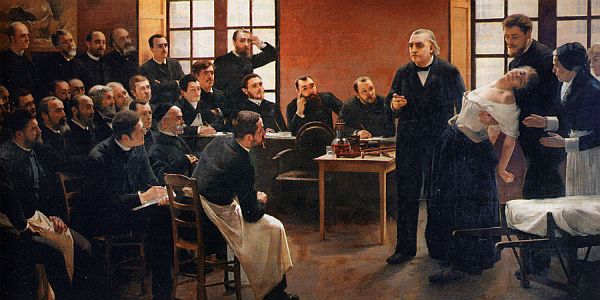
Jean-Martin Charcot, a man ruled by habit, passed through the gates of the Salpêtrière in a coach at exactly the same time every morning. At the end of the day, he departed, also as if by clockwork. The days and weeks and months unfolded according to an unwavering schedule—lectures on Tuesdays, demonstrations on Fridays, outpatient clinics, inpatient visits, meetings, conferences, private time for writing—everything hinged on the comings and goings of the Master. His schedule was rounded out by soirees on Tuesdays held at his impressive art-filled home on the Boulevard Saint-Germain. Writers, artists, politicians, and physicians attended the salon-style evenings. Eventually even young Sigmund Freud, a perpetually miserable and down-at-the-heels student, would be invited.

Despite his charismatic reputation, J.M. Charcot was taciturn, slow of movement and gesture, and almost silent during clinical exams. His students would wait patiently for his pronouncements, usually to be disappointed. Freud idolized Charcot, but found him to be difficult, somewhat remote and inscrutable, his methods opaque. He either could not or would not say how he reached his conclusions, merely that after observing something long enough the nature of it would become clear. According to Pierre Marie (sitting third to Charcot’s right in Andre Brouillet’s painting, above): “More than once his closest pupils heard him answer to their ‘Why?’ or to their ‘How?’ sometimes impatiently, because of his inability to better satisfy them: ‘Oh, why? I cannot tell you, but I know it is this disease, I can sense it.’”

He was not a natural orator. Each week Charcot gave carefully prepared lectures, memorized in full and delivered with faultless diction but almost no theatricality or bravado. He was deliberate, highly organized, and obsessed with classification and description. This obsession extended to his uncanny ability to mimic almost any disorder of speech, posture, tremor, or gait. His entire research enterprise came to revolve around the idea of re-creation. As another assistant, Pierre Janet, recalled, “Everything in his lectures was designed to attract attention and to capture the audience by means of visual and auditory impressions.”

Charcot hired the artist-physician Paul Richer (first on his right in the painting, with a pencil and paper) to reproduce the poses of afflicted patients. Charcot also built a photography studio on the premises and hired the medical photographer Albert Londe (seated on the far left of the painting, wearing an apron and cap) to document exemplary cases. The resulting publication, in three volumes, the Iconographie Photographique de la Salpêtrière, may have greater claims to art than to science, but it was a major breakthrough in the classification and understanding of mental illness.

It is not entirely clear whether the man who inspired the loyalty of students and gratitude of patients was in fact cold and aloof. But the man portrayed in Brouillet’s A Clinical Lesson appears to be more concerned with symptoms than with people, as his reputation would suggest. Charcot is the only man in the painting who is facing away from the patient, the only one who seems more interested in what he is saying than in what is happening behind him. His assistant Joseph Babinski, with his matinee-idol looks, stands center stage, ready to catch the swooning Blanche. Georges Gilles de la Tourette, an odd-looking duck by his own admission, is mercifully rendered in profile. Gilles’s look-alike, Charles Féré, who had just completed an exhaustive study of animal magnetism, sits in rapt attention by the window. Charcot’s son Jean-Baptiste, then a medical student, stands at the rear.

Then there is Charcot himself. He stands with his right hand extended in an odd gesture, probably drawn from life, of thumb and forefinger held out as if indicating a measurement of a few centimeters. According to a contemporary, Félix Platel, “There is something mystical in his gaze, astonishing in a materialist. His gaze is oblique—which is surprising in a mask of Bonaparte. The Roman nose is solid and well defined. It is like the tip of the prow of a Roman galley, destined to cleave the waves, despite wind and tide.” It could also be the gaze of a man beginning to doubt what he is saying.

In the decade of his astounding series of discoveries in neurology, Charcot had become well known in scientific circles, but not beyond. This would change. His decision to tackle hysteria, to lend his considerable reputation to it, brought his fame to another level. He was taking on not just one of the biggest unanswered questions in medicine, but perhaps one of the most intriguing and unsettling aspects of human existence: What makes us who we are, and what can cause us to forget who we are?

Today, epilepsy has a set of diagnostic criteria backed by the technology of electroencephalograms, yet hysteria has only a generic and vague profile. In 1870, hysteria drove diagnosticians to distraction. One physician called it a “mockingbird of nosology” because of its tendency to run the gamut from migraine to paralysis, numbness, fainting, sweats, difficulty in breathing, insomnia, and even nymphomania. No one could say whether it was real or imagined, structural or functional, all in the head or lurking in damaged tissue. Charcot decided to find out. At the end of a decade-long investigation involving scores of patients, he was ready to publish.

In a report of 1878, he rejected the idea of a purely psychological basis for all forms of hysteria. Even though he could not find any anatomical basis for his conclusions, he isolated an extreme form of hysteria as a “physiological disturbance,” or a névrose: a general affliction of the nervous system. Not only was it a true disease, he said, but hysterical attacks had a classic identifying profile consisting of four distinct phases.

In phase one, the so-called tonic phase, the subject exhibits all the signs of a grand mal epileptic seizure: muscle spasms and jerks, then muscle contractures, eyes rolled upward, rapid breathing, and possibly the loss of consciousness. Phase two, the clonic phase, brought on contortions and postures, culminating in a backward arcing of the entire body, with only the feet and head touching the ground. This is the arc-en-circle depicted by Paul Richer in the diagram mounted on the easel behind the last row of viewers in A Clinical Lesson.

The third phase consisted of a series of “attitudes passionnelles,” essentially a range of highly charged emotional states, including ecstasy and even religious rapture, bracketed by sexually suggestive poses. In the final phase, the subject drifted into a languid, sleepy delirium. The phases occurred spontaneously. They were not induced. They could be observed on the ward.

The contractures of the tonic-clonic phases were difficult to distinguish from real epileptic seizures, but Charcot accomplished this by measuring subtle differences in heart rate, body temperature, and other clinical features. Once he had isolated it, he called it la grande hystérie, or grand hysteria. Where others saw feigning, malingering, or attention getting, Charcot insisted he discovered a true disease, one with distinct and recognizable stages. He then set out to see whether he could produce them on command.

Charcot introduced hypnosis in 1878, a year after Blanche’s arrival at the Salpêtrière. His peers were mystified. Charcot seemed to be reviving mesmerism. Bad enough that he had elevated a low-priority condition to the status of a disease. Now he wanted to resurrect a discredited technique invented by a crackpot and adopt it as a clinical tool. Only Charcot could have gotten away with it, and he did, with the instrumental help of Blanche Wittman.

Up to that point, Blanche’s behavior had been intolerable and uncontrollable. Charcot’s assistants diagnosed her with epilepsy, then with hystero-epilepsy, then with grand hysteria. To relieve her convulsions, they tried ovarian compression in the belief that the ovaries were hysterogenic zones. That didn’t work. They tried occupational therapy. She improved. Then they tried hypnotism. Whether it was a survival skill, or due to some sly coaching behind Charcot’s back, Blanche emerged as the ideal hypnotic subject. She became cooperative and responsive, and while under hypnosis could reliably recapitulate the stages of what Charcot decided to call “artificial hysteria.”

At the Salpêtrière, artificial hysteria—hysteria induced by hypnosis, as opposed to natural hysteria—unfolded in three distinct acts. Brouillet’s painting depicts the opening of Act One, the onset of catalepsy, or the maintenance of unnatural  postures. Charcot’s assistant Joseph Babinski, the man supporting Blanche, has just put her into a hypnotic trance, possibly with a gong. Her left fist is clenched and bent into an awkward state of contracture, indicating that she is not merely swooning. In this stage, Babinski will arrange her limbs in various poses, and Blanche will hold those postures indefinitely. She will also become impervious to pain, to the extent that a needle can and will be passed through her arm or hand, eliciting no reaction. In the second stage, lethargy, her body will become limp and fall as though lifeless until Babinski induces muscle contractures, rendering her rigid, as though in a state of rigor mortis.


When posed, Blanche could maintain awkward positions well beyond the ability of a skilled acrobat. The demonstration will reach a climax in the final stage, called somnambulism. This is what the audiences came to see. In a state of extreme suggestibility, Blanche will be induced to act out scenes requiring a full gamut of emotions. She might be told she is being threatened by a dog or a snake, and she will cower, or that she is a general marshaling her troops on the front line of a battle, and she will bark commands. In one demonstration, she was asked to kiss the plaster bust of Franz Joseph Gall, the inventor of phrenology. Upon awakening, she will have no memory of these playacted scenarios and will deny having done them. Yet she will retain some unconscious memories. In one instance, under hypnosis, she was shown a picture of a donkey and told it was a nude photo of her. It shocked her so much that she later smashed the picture when she came across it, even though she professed to have no memory of the hypnotic suggestion.

The crowd appeal of these demonstrations is obvious—they played heavily upon sexual innuendo. Similar demonstrations took place all over Paris in music halls, advertised as hypnotism “à la Charcot.” Some former patients of the Salpêtrière starred in these shows, borrowing heavily from Blanche’s performances. Medical men decried the lay practitioners as irresponsible and dangerous, but it was a case of the pot and the kettle. Charcot wanted to show the extent of a subject’s malleability under hypnosis, but more than that, he claimed to be demonstrating genuine medical pathology.

Not only was hysteria a disease of the body, but so was the susceptibility to hypnotic suggestion. In other words, according to Charcot, only true hysterics could attain the postures and maintain the poses of artificial hysteria. These could not be faked, so they had to be a pathological sign connected to real hysteria, even diagnostic of it. He called it le grand hypnotisme.

In 1882, Charcot presented this theory to the French Academy of Sciences as part of his bid for membership. The academy had already accepted his claim for the status of hysteria as a true disease on the strength of his reputation, although without much enthusiasm. They also signed off on his description of grand hypnotism, despite widespread skepticism. The idea had almost no support outside of Paris. According to Charcot’s critics, his four stages of hysteria and three-act demonstrations of hypnosis could be observed only at the Salpêtrière, or in patients who had lived there and had learned the choreography. Moreover, as Hippolyte Bernheim of the Nancy School argued, there was nothing special about susceptibility to hypnosis. Almost anyone could be hypnotized. Yet Charcot pressed on, buoyed by the success of his public demonstrations.

Why did Charcot medicalize hysteria and hypnosis? There is good evidence that he wanted to demystify all phenomena touted by the church as miracles. He hoped to substitute neurological explanations for religious ones. Auras, visions, imperviousness to pain, miracle cures (especially curing the blind): he wrote all of these off as hysterical symptoms. Epiphanies, the ecstasies of the saints, if not the resurrection itself, could be explained neurologically. Accounts of such religious phenomena, catalogued extensively by Charcot and reenacted onstage by Blanche and other hysterics as attitudes passionnelles, peddled a not-so-subtle form of anticlerical materialism to a hungry audience.

None of this fell too far beyond the pale until Charcot began to lay on a theoretical framework. He had proposed two ideas for which he had no real evidence—grand hysteria and grand hypnotism. Absent an anatomical lesion in the brain to explain them, he fell back on something he called a “dynamic lesion” of the nervous system, a transient and undetectable disruption of brain function. The whole enterprise was poised to fall under the weight of its own improbability. Brouillet’s painting depicts the moment when the public demonstrations became untethered from the clinical practice of medicine.

The first sign of trouble appeared when Alfred Binet, an unpaid intern, quit his post in 1890 and publicly denounced Charcot’s theory. Binet and Charles Féré had recently published an exhaustive history of hypnotism, going back to Mesmer, in which they had summarized and defended both la grande hystérie and le grand hypnotisme. Binet then had a crisis of conscience. The public demonstrations were not genuine, he confessed. The theory of a pathological basis of hysteria could not stand up to facts in evidence. Since the birth of his daughters in 1887, Binet had become increasingly disenchanted with the hijinks perpetrated by the hypnotizers at the Salpêtrière.

In one instance, they tried to induce a somnambulizing Blanche to take off her clothes and imitate taking a bath. According to Georges Gilles de la Tourette, the chief of Charcot’s lab, “When it came time to take off her corset, her entire body stiffened, and we barely had time to intervene in order to avoid an attack of hysteria, which in her case always begins in this fashion.” Binet abandoned neurology in favor of developmental psychology. (He would go on to develop the first intelligence test, the direct progenitor of the Stanford-Binet Intelligence Scale still in use today.)

The end came three years later, in 1893, when Charcot died suddenly on a trip to Nièvre, France, at the age of 67. It was a shock to his colleagues, but not to Charcot himself. A lifelong smoker who did no exercise of any kind, he had already diagnosed his own heart problem, and when stricken he knew exactly what was happening. But he did not know what would happen next. At the announcement of his death, the Paris School he had founded ceased to exist. The theory of la grande hystérie was shelved, the Tuesday and Friday clinics came to an end, and most tellingly, Blanche Wittman never again had a hysterical attack.

This last point, noted by Babinski, settled the matter. At first diagnosed as epileptic, then as hysterical, then treated with hypnosis, electrotherapy, and massage by a team of physicians over a 15-year period, Blanche was finally cured by the departure of the only audience she cared about. She had lost her Svengali.

Jane Avril, the most famous dancer at the Moulin Rouge and a favorite model for Henri Toulouse-Lautrec, wrote a memoir of her 18-month stay in the hysteria ward at the Salpêtrière, among the “stars of hysteria,” as she called them.

             “There were those deranged girls whose ailments named Hysteria consisted, above all, in simulation of it . . . . How much trouble they used to go to in order to capture attention and gain stardom . . . . In my tiny brain, I was astonished  every time to see how such eminent savants could be duped in that way, when I, as insignificant as I was, saw through the farces. I have said to myself since that the great Charcot was aware of what was happening.”

He was, but he had his reasons to keep the show going. Gilles de la Tourette and Babinski did not. With Charcot gone and with the hospital now trying to disassociate itself from his theories, his two senior assistants had an extremely difficult time. Both lost all academic support and were denied chairs in medicine at the Salpêtrière. Gilles de la Tourette continued to defend Charcot’s legacy, but Babinski backed down and conceded the purely psychological basis for all hysterical phenomena. He renamed the condition pithiatisme, from the Greek, meaning curable through persuasion (the name never caught on). Babinski later discovered a curious hardwiring of the human nervous system: the stroking of the sole of the foot in someone with even subtle brain damage causes the big toe to extend upward while the other toes fan out. This is called the Babinski sign and it is performed thousands of times every day as an obligatory part of any neurological examination. No other neurological sign has had its durability or provided such a degree of certainty concerning damage to the nervous system. It made Babinski one of the most famous eponyms in medicine.

Toward the end, even Charcot had privately begun to acknowledge his mistake. Le grand hypnotisme, he conceded, was not a true disorder or even a syndrome. Hypnosis, it was becoming increasingly clear, was a universal susceptibility. Under pressure from almost every corner of the research community, he also backed down from his claims about hysteria as a disease of the body, at least in private. In 1891, he admitted that it was, “for the most part, a mental illness.” But Charcot never openly conceded defeat. The painting shows why. His skepticism did not extend to the handful of star hysterics who packed audiences into his amphitheater each week. The standout was Blanche.

Throughout the 1880s, dancers, magicians’ assistants, models, opera divas, and stage actresses traipsed over to the Salpêtrière to see the one person who embodied the fullest range of emotive performance on the Continent. When Sarah Bernhardt, the on-again, off-again darling of the European theater scene, wished to recapture her popularity upon her return to the Paris stage in 1881, she too headed to the Salpêtrière to see Blanche perform. Jules Claretie, the director of the Théâtre Français, writing for Le Temps in 1884, put it bluntly: “Never has an actor or painter, never a Rachel or a Sarah Bernhardt, Rubens or Raphael, arrived at such a powerful expression. This young girl enacted a series of tableaux that surpassed in its brilliance and power the most sublime efforts by art. One could not dream of a more astonishing model.”

Nonetheless, Blanche Wittman lived at the Salpêtrière as an institutionalized mental patient. She was given menial tasks to perform, including laundry and other cleaning, and she was of course called upon to participate in Charcot’s weekly demonstrations. By all accounts, she was one of the greatest improvisational actors of all time. In her final years, Blanche’s insistence on the legitimacy of her role-playing never waned. After Charcot’s death, she went to work in the Salpêtrière’s photo lab, and soon was transferred to the new radiation lab. Like Marie Curie, completely unaware of the dangers, she was exposed to repeated X-rays. Within a few years she began to undergo a series of necessary amputations, first of digits, then of limbs. As she succumbed to radiation poisoning, she refused to repudiate any aspect of grand hysteria. In her mind, it had been as real as epilepsy.

She died in 1913 at the age of 54, and to the end she defended Charcot. In her final year, Blanche agreed to speak to a reporter about her stint as the Queen of the Hysterics. She claimed to have feigned nothing, arguing that no one could have fooled the great Charcot. “If we were put to sleep, if we had fits, it was because it was impossible for us to do otherwise. Besides, it’s not as though it was pleasant!” When asked if there had been any simulation, she replied sharply, “Simulation! Do you think that it would have been easy to fool Monsieur Charcot? Oh yes, there were certainly some jokers who tried! He would look them straight in the eye and say, ‘Be still!’ ”

The Salon of 1887 ended after two months. The French government bought Un Leçon Clinique and shipped it off to Nice, where it went on display for a number of years before being consigned to storage. It was later cleaned and hung in a neurological hospital in Lyon, out of sight, but not out of mind. In 1887, Eugène Pirodon made an engraving of the painting, and this small reproduction sold very well. It brought the image to the attention of millions. Sigmund Freud purchased a copy and hung it in his examination room in Vienna, and later, after relocating to London, he did the same. Either the painting or the engraving has become the stock image of a quaint form of medical credulity, on par with phrenological heads and orgone boxes. Unfortunately for medical science and for the man himself, it is how Charcot is remembered. He didn’t live long enough to ward off that impression.

The meaning of any work of art changes over time. Standing in front of Brouillet’s painting today, one finds it difficult to appreciate what it meant to viewers when it debuted. Charcot saw psychiatry and neurology as cooperative specialties. They should, he wrote, “philosophically speaking remain associated with each other by insoluble ties.” The painting marks the moment when that hope was dashed, and the two fell apart in the most confounding way, partly because of Charcot himself—his role in creating the very scene Brouillet depicted—and in a small yet significant way, partly because Brouillet chose to depict it at all. He unwittingly immortalized a catastrophic failure.

Charcot believed he could separate mind and brain by treating the human subject as an automaton, as a sensorimotor machine. Instead of visiting his patients on the wards, he had them brought to his office. Instead of interviewing them, he examined their bodies in silence. Instead of interacting with them, he let his assistants do it. Onstage, he treated them like servants, speaking freely as if they were not present and could not hear. Charcot thought he was removing any potential bias this way, and in doing so, he seems to have overlooked the mind entirely. Blanche Wittman and his other subjects heard everything, unconsciously processed it, and fed it back in a finely tuned performance.

Hypnosis does work as a short-term intervention. Hardly anyone uses it anymore in a hospital setting because it is paternalistic and exposes a subject’s vulnerability, although it remains popular in alternative medicine. People undergo hypnosis today for the same reasons therapists used it a century ago. It can help people break habits they may or may not be aware of. It makes use of the subject’s suggestibility, which exists along a spectrum of personality types. Had Charcot used it strictly for the purpose of artificially producing symptoms of hysteria and epilepsy, had he not invested himself in what most of his contemporaries viewed as sideshow antics, he would command greater respect today.

But Brouillet’s painting, perhaps more than anything Charcot himself ever did, exposed him in flagrante, duping himself in front of a double audience—the one portrayed in the painting and the one viewing it. Had it been an isolated incident of a great scientist exceeding the bounds of the scientific method, the painting might not merit all that much attention. But there is more to be found in it, facts unknown to the viewers of 1887, and a crowning irony even Charcot overlooked. A real neurological disease did indeed lurk behind many of the hysterical symptoms he so painstakingly observed, and he missed it, even though all along it was right there under his Napoleonic nose.


From  : How the Brain Lost Its Mind by Allan H. Ropper, MD and Brian David Burrell, published by Avery, an imprint of Penguin Random House, 2019.


In Search of Hysteria: The Man Who Thought He Could Define Madness. By  By Allan H. Ropper and Brian Burrell. LitHub, September 20, 2019.


  Most of us have heard of Anton Mesmer and Jean Charcot. They were some of the first to dabble in the “mind cure” using hypnosis and the power of suggestion. But what role did syphilis play in the development of psychology?  Michael A. Britt talks with  Dr. Allan Ropper and Brian David Burrell about their new book called “How the Brain Lost Its Mind”.


Ep 332,  The Psych Files , September 3, 2019


Penguin Random House


Neurology and psychiatry both struggle to engage with disorders that elude neat classification. Neurologists deal with well-characterized biological conditions such as Huntington’s disease. But they also treat ‘in-between’ disorders such as Tourette’s syndrome (characterized by involuntary vocalizations or movements), and see people with physical symptoms that are ultimately revealed as strictly psychological. Most psychiatrists, for their part, work with the conviction that all mental illness has a biological basis. Yet they insist that the content of mental suffering matters, and that their task is to heal minds, not just fix brains.

These disciplines might seem to have a great deal to say to one another. Instead, they labour mostly in isolation. How did that happen, and what are the consequences? In their thoughtful and engaging book, How the Brain Lost its Mind, neurologist Allan Ropper and writer–mathematician Brian Burrell tackle that question in an original way: by exploring two medical histories that are generally told separately.

One concerns neurosyphilis, a late-stage form of the sexually transmitted disease syphilis. The other centres on hysteria, a disorder in which psychological stresses are expressed through a range of physical symptoms.

In the nineteenth century, neurosyphilis was one of the most ubiquitous and fatal forms of degenerative mental illness known to psychiatry. Termed general paralysis of the insane, it was widely supposed by early practitioners to be caused by bad heredity, ‘weak character’ or moral turpitude. That changed in 1913, when Japanese bacteriologist Hideyo Noguchi, working at Rockefeller University in New York City, found traces of Treponema pallidum — the spiral-shaped bacterium responsible for syphilis — in the brains of deceased people with general paralysis. At the time, as many as one-third of patients in mental hospitals had symptoms that could now be clearly traced back to syphilis.

Hysteria, originally thought to be a gynaecological condition affecting only women, was recast as neurological in part through the efforts of distinguished nineteenth-century French neurologist Jean-Martin Charcot. The symptoms he saw in his patients — partial paralysis, convulsions, vision problems and tics — certainly looked neurological. By the final years of the century, however, critics of Charcot and even some of his former loyal students (including Joseph Babinski, who discovered the ‘Babinski reflex’ in infants) had concluded that the condition was a kind of fraud — a psychological disorder masquerading as a neurological one. Babinski even proposed that neurology abandon the term hysteria altogether and replace it with the term ‘pithiatism’: a condition produced through persuasive suggestion and eliminated in the same way. As the authors note, hysteria turned out to be “a profound mind problem that makes the sufferer act as if he or she were diseased”. Neurosyphilis, meanwhile, was a “brain disease that can produce a simulacrum of mental illness”.


According to How the Brain Lost its Mind, the unmasking of hysteria as psychological gave us Sigmund Freud and his new field of psychoanalysis. It also led, eventually, to the post-war neo-Freudian conceit that problematic behaviours with no associated disease should nevertheless be treated as medical. But while psychological understanding of hysteria transformed psychiatry, neurologists still struggled to help patients with symptoms that a previous generation would have called hysterical. As many as 30% of the cases seen in neurology departments elude organic explanation even today, the authors tell us. And the field does not seem much better equipped to make sense of such cases than it was in Charcot’s time.

Meanwhile, the discovery that general paralysis was a symptom of a sexually transmitted disease galvanized subsequent generations of psychiatrists. They embarked on a quest, still largely unfulfilled, to find biological foundations for other mental disorders, especially grave conditions such as schizophrenia. Only later would it become clear, as the authors point out, that neurosyphilis is “an unsuitable model for anything clearly unrelated to infection or inflammation in the frontal and temporal lobe regions”.

Although the histories of these two conditions are normally seen as separate, Ropper and Burrell make clear that they interacted in a range of ways. Early on, both conditions were widely recognized as tricksters or “imitators” of other maladies, including each other. Some cases of syphilis were almost certainly misdiagnosed as hysteria, and vice versa. But even more significantly, sex — and profound anxieties about it — had a deep role in patients’ experience of both disorders.

Ropper and Burrell suggest that this was no coincidence. The age of Freud was also the age of syphilis. Freud, and psychoanalysis more generally, focused on suppressed sexual fantasies and traumas because, for patients then, the shameful and terrifying spectre of syphilis hung over every sexual encounter like “the sword of Damocles” .

Ultimately, the authors insist, these tangled tales left behind a two-fold legacy. The history of neurosyphilis bequeathed a tendency to indulge in excessive reductionism. That of hysteria encouraged a tendency to indulge in excessive psychologism. And both psychiatry and neurology were left the poorer. As the authors argue, the majority of patients seen by practitioners in both fields are afflicted with what they call “in-between states” — forms of distress informed by both biology and biography. The book is in this sense a plea for neurology and psychiatry to repair ruptures, join forces and do justice to the experiences of their patients.

How the Brain Lost its Mind offers a historical narrative that is mostly nuanced and often moving. Particularly notable is its focus on patient experience, and how people with syphilis talked about their suffering. There are occasional slips into historical clichés that are inaccurate. At one point, the authors claim that people with mental illnesses were “assumed to be possessed by evil spirits” right into the nineteenth century, “when medical science chased away the spirits”. In fact, medical understandings of mental disorders routinely coexisted with religious, moral and supernatural ones as early as the sixteenth century. (Medical theories in that era drew on humoral theory, which attributed both physical and mental illnesses to imbalances in the four bodily ‘humours’.)

Ropper and Burrell are powerfully focused on giving neurosyphilis its due as psychiatry’s original “calling card, the core of its legitimacy”, and rightfully so. I did feel, however, that they were sometimes tempted to overstate its importance in the birth of biological thinking in psychiatry. Neurosyphilis mattered, but there were other intellectual factors and forces — anatomical research, reflex physiology, evolutionary theory, toxicology and biochemistry — that drove psychiatry’s biological hopes over the years as well.

These small points aside, How the Brain Lost its Mind is a rich, compassionate and passionate book that deserves a wide audience. Sceptical of the excesses of both psychological and biological reductionism, it is a refreshing call for an intellectual reset and disciplinary rapprochement. I hope it inspires much-needed cross-disciplinary debates and conversations.

A tale of two disorders: syphilis, hysteria and the struggle to treat mental illness. By Anne Harrington. Nature, August  19, 2019.


Also of interest : 


From the mid-19th century until the 1950s, when the advent of antibiotics revolutionized tuberculosis treatment, the primary treatment for the disease was the Luft-Liegekur, or open-air rest cure. It was in the sanatorium, according to the German physician Hermann Brehmer, that a strict regimen of diet, light exercise, outdoor exposure, and rest could successfully cure TB infection.

Both furniture makers and physicians capitalized on this “cure,” seeking numerous patents for improvements and variations upon the adjustable chaise-longue, a reclining chair with a long seat, and the schlafsofa, a sleep sofa that was a fixture of sanatoria throughout Europe and the U.S. and eventually became a medical icon throughout the West. As a physician who trained during a period when TB was a leading medical scourge, Sigmund Freud would have been steeped in the culture of the sanatorium and the Luft-Liegekur.

It’s no surprise, then, that along with hypnosis, Freud’s early forays into psychological medicine included the practice of treatments that sought to import ideals of comfort and healthy relaxation derived from the long dominance of the open-air rest cure. Among other practices, he employed massage and cutaneous electrotherapy, including the use of the faradic brush, an electric brush used to stimulate the skin.

In “An Autobiographical Study,” Freud writes candidly that at the start of his clinical career, “My therapeutic arsenal contained only two weapons, electrotherapy and hypnotism, for prescribing a visit to a hydropathic establishment after a single consultation was an inadequate source of income.” He adds that his knowledge of electrotherapy was derived from neurologist Wilhelm Erb’s “Handbuch der Electrotherapie,” a work cited three times in the “Standard Edition of the Complete Psychological Works of Sigmund Freud.” In an 1888 encyclopedia article on “hysteria,” meanwhile, Freud enthusiastically endorses the rest cure, consisting, as he describes it, of “isolation in absolute quiet with a systematic application of massage and general faradizations.”

Hydrotherapy and phototherapy, too, were traditional, asylum-based treatments for hysteria and other mental maladies that Freud, like all practitioners of his generation, was well aware of. The latter, which made use of ultraviolet irradiation, was considered an effective treatment for hysteria, epilepsy, neurasthenia, migraine, melancholia, mania, insomnia, and a wide variety of other psychiatric, neurological, and general medical disorders.

19th-century asylum keepers, psychologists, and university-based psychiatrists employed a host of somatic and suggestive therapies to treat these conditions. These therapies included hypnosis, hydrotherapy, cutaneous electrotherapy, phototherapy, diet and rest cures, massage, and, with the introduction of chemically prepared (as opposed to plant-derived) sedatives such as chloral hydrate in 1869, some early efforts at modern psychopharmacology. Since these treatment modalities (with the exception of psychopharmacology) usually required recumbent posture, it seems reasonable to infer that their popularity promoted an association in the minds of patients and practitioners alike between recumbence and cure. It would be glib to speak simply of submission to medical authority when many of these treatments sought to import ideals of domestic ease and comfort into the psychiatric setting.

Trance states were initially construed to be a form of “neurohypnotism” or “nervous sleep,” so it made sense for practitioners to have furniture suitable for reclining, sleeping, swooning, or becoming entranced while recumbent. During his 1885–1886 sojourn in Paris at the Salpêtrière Hospital, Freud learned about hypnosis in the treatment of hysteria from the world-famous neurologist Jean-Martin Charcot. Upon his return to Vienna, as he embarked upon the private practice of clinical neurology specializing in the treatment of nervous and mental disorders, Freud settled into a 10-year dalliance with hypnosis. At the height of Charcot’s rivalry with Hippolyte Bernheim in the 1880s and 1890s over suggestibility and the nature of hypnosis, Freud translated both men’s work into German and wrote prefaces to the three volumes of their writings he translated. Bernheim and his followers in the Nancy school of hypnotists, including August Forel, Leopold Löwenfeld, Oskar Vogt, and Otto Wetterstrand, emphasized the need for a calm, quiet environment for their treatments and encouraged patients to fall asleep during hypnotic sessions.

The private practice of German hypnosis doctors, among them some of the leading contributors to the Zeitschrift für Hypnotismus (Journal of Hypnotism), was dominated by this approach. This development coincided with the rise of office-based private practice in Germany and Austria, and the emergence of the tradition of the reserved office hour. Freud’s early practice of hypnosis was, in fact, modeled upon the Nancy school’s emphasis on recumbence and sleep.

Thus, the use of recumbent posture in psychoanalysis evolved in part from these traditions of sanatorium- and asylum-based somatic therapies as well as from the broader cultural backdrop of changing notions of comfort and interiority, eventuating in what I call the medicalization of comfort. The illustration above nicely illustrates this point. In this image, published in Harper’s Magazine in 1878, the hospitalized patient is seen resting comfortably in a recliner that closely resembles the standard chaise-longue of the TB sanatorium. His concerned family members attend him in seated comfort, one of them in what appears to be a rocking chair. The scene is one of institutionalized domesticity. At least for the private patient, some trappings of the comforts of home accompany him during his hospital stay. His recumbent posture signifies how, by the time Freud began to develop his ideas about the optimal treatment setting for psychoanalysis, notions of healing and comfort had thoroughly melded.

This article is an adaptation from the book :  On the Couch: A Repressed History of the Analytic Couch from Plato to Freud. By Nathan Karvis, published by The MIT Press, September 1, 2017

 Of Freud, 19th-Century Therapeutics, and Recumbent Posture. By  Nathan Kravis.  The MIT Press Reader,  September 23, 2019. 


Although the term “hysteria” isn’t used in medical diagnoses today, it was once applied to an astonishingly wide range of mental and physical symptoms, primarily in women. Even the disorder’s name is strongly gendered: “hysteria” is derived from the ancient Greek word for “uterus”; medical texts of that period attributed the affliction to a displaced, or “wandering,” womb.

Hysteria has a long history in medicine, surfacing in different cultures at different times. Its study was widely popularized in the late 19th century, especially in France, where the neurologist Jean-Martin Charcot set up a clinic for hysterics at La Salpêtrière hospital in Paris. Although little known today, Charcot’s experiments with young “hysterical” women became a touchstone both for Sigmund Freud’s early work and, later, for the founding principles of the Surrealist movement.

Hysteria was considered to be a highly complex condition: It was generally thought of as a mental disorder accompanied by physical symptoms such as fits. Historian Lisa Appignanesi writes in her 2007 book Mad, Bad and Sad: A History of Women and the Mind Doctors that in Charcot’s France, the term “described a sexualized madness full of contradictions, one which could play all feminine parts and take on a dizzying variety of symptoms, though none of them had any real detectable base in the body.” (Charcot admitted that men also suffered from hysteria, but he argued that these cases were generally caused by traumatic accidents, rather than by a gendered predisposition.)

Charcot’s research was made famous through the ailing individuals who lived at La Salpêtrière and whose symptoms were displayed and analyzed in sessions open to members of the public. Charcot became a celebrity doctor, turning his semi-staged diagnostic sessions into spectacles for (masculine) public consumption. The methods of diagnosis and treatment at La Salpêtrière were all highly visual, creating a sort of theater of hysteria, in which the often young and pretty “hysterics” acted out their symptoms as if by rote.

One of Charcot’s innovations was to set up a photography studio at La Salpêtrière in order to document the physical symptoms of his patients, such as the dramatic and beautiful Augustine. These images were then widely disseminated in Paul Regnard and Désiré Bourneville’s Iconographie Photographique de La Salpêtrière (1876–80), an influential book of medical photography. Presented as a scientifically accurate visual document, the book had a twofold effect: For male readers, it provided a visual record of the attractive and often scantily clad hysterics, while for some female consumers, it became a manual of hysteria and its symptoms to be mimicked, reinforcing the stereotypes associated with the condition.

In the photographs, the camera takes the position of a detached voyeur, with the subjects only looking at the lens and engaging directly with the image-making when they are photographed in their “normal” or “sane” moments. When engaged in the throes of a hysterical attack, the women are apparently oblivious of the camera’s presence, revealing parts of their body that Victorian decency would otherwise hide from view.

In a photograph depicting the arc de cercle, or the “arch of hysteria,” which was believed to show the anguish of the condition—and which Louise Bourgeois would later famously subvert in bronze with a masculine form—the woman contorts her body so that she is resting on her feet and shoulders. Her head is hidden, but her shapely legs and feet are almost completely revealed. The relative distance of the camera and the profiling of the subject suggest that this photograph is taken to give the impression of scientific “truth,” but also simultaneously to place the viewer at a voyeuristic remove, for both scientific study and visual titillation.

Freud was a student of Charcot, and achieved renown for his Studies in Hysteria (1893–95). Charcot’s hysterics, Freud’s work, and the Salpêtrière photographs together provided a wealth of cultural materials to inform the work of Surrealist artists. In 1928, French writers André Breton and Louis Aragon published an article in the journal La Révolution Surréaliste that contained photographs of Salpêtrière hysteric Augustine and expressed the desire “to celebrate here the quinquagenary of hysteria, the greatest poetic discovery of the end of the nineteenth century.” Breton and Aragon continue, praising “youthful hysterics” and the “delightful” Augustine. “Hysteria is not a pathological phenomenon and can be considered in every respect a supreme means of expression,” they conclude. An excerpt from Breton’s novel Nadja, published that year, appears in the same issue of La Révolution Surréaliste. In this book, Breton famously wrote “Beauty will be CONVULSIVE or it will not be,” suggesting that the throes of a hysterical attack happen in a state of sexualized, uninhibited passion.


Breton’s advocation of the “convulsive” was taken as a guiding principle for Surrealist art. Espousing the madness and “paranoiac” sensibilities he believed were embodied by hysteria, Salvador Dalí took up the visual tropes of the Salpêtrière photographs in a number of his works.


The Phenomenon of Ecstasy (1933) is a photo collage depicting the faces of “hysterical” women in the grip of what looks more like erotic pleasure than pain. His paintings and drawings—such as Invisible Lion, Horse, Sleeping Woman (1930)—also repeatedly present women arching their bodies in a way that resembles the arc de cercle demonstrated by Charcot’s hysterics. In one drawing, Poems Secrets Nude with Snail (1967), a female subject with her face partially hidden arches her back to catch the milk from her lactating breasts in her mouth. With mutilated bodies, exaggerated sexual features, and closed eyes, Dalí’s women are vulnerable to the viewer’s gaze, disempowered by their apparent enslavement to their uncontrollable gendered characteristics.

The fascination with hysteria lasted throughout the key period of the Surrealists’ success. The invitation to the opening event of the 1938 Exposition Internationale du Surréalisme (overseen by Marcel Duchamp) promised visitors a night of l’hysterie. During the evening, the experimental collaborative exhibition was used as a stage for a performance by the actress Hélène Vanel, trained for the occasion by Dalí and Wolfgang Paalen. She jumped from a pile of pillows, naked and chained, before splashing in a puddle and eventually recreating a hysterical attack on a bed, linking the notion of the submissive female body with mental instability and dependency.

The Surrealists saw hysteria as a state in which poetic expression could run free, at the expense of women who were not given a voice, but instead objectified. Decades later, in 1980, hysteria was finally removed from the third edition of the Diagnostic and Statistical Manual of Mental Disorders. But for a significant period of time, this now-supposedly-defunct disease of the mind was explained away as a fundamental condition of being female, and exploited by scientists and artists alike.

The Dark Side of Surrealism That Exploited Women’s “Hysteria”.  By Anna Soutter. Artsy, January 18, 2019.