In an
excerpt from Plaster Magazine, Harley Weir talks about her love of Nobuyoshi
Araki and the Pre-Raphaelites, and that time she nearly interned for a female
pornographer
This
excerpt is taken from the fifth issue of Plaster Magazine.
The
first time I spoke with Harley Weir on the phone, she had just been caught in a
giant hailstorm. It was the middle of July, and she was in awe of the size of
the hailstones. Eager for me to see, she picked a few off the ground and took a
quick iPhone photo of her clutching a collection of them. However, what struck
me from the photo she sent to me wasn’t the hugeness of the golfball-sized
hail, but how beautiful the image was. I could not figure out how she had
managed to take something so simple and turn it into something so ethereal, so
recognisably her, when the photos most people take on an iPhone look as if they
have been captured on a drunken night out.
But,
then again, she is one of the world’s most in-demand photographers, and that is
what great photographers do: whether they are equipped with the best camera or
just an iPhone, they are capable of translating their perspective of the world
through an image. Harley has made a career that people twice her age couldn’t
dream of, all because of her unique viewpoint of the world. She brings to life
the intimacy of her subject, whether it is a giant piece of hail or an
editorial for a leading fashion publication.


The
photographer has published her first ever self-portrait series – here, she
discusses the otherworldly allure of sex dolls, being enlightened by porn, and
why she chose to turn the camera on herself.
Harley
Weir has been on Instagram for around a decade – but she’s never posted a
selfie before now. “I just never wanted people to judge me before they judge my
work,” she says, explaining the aversion to sharing photos of herself over the
phone from New York, where she’s recovered from jetlag just in time for the
start of fashion week. “I’m not necessarily a purist but I wanted my work to
speak for itself, and not for my image to speak for itself.” In her new Beauty
Papers photobook, however, the two are unavoidably intertwined, as the
photographer turns the camera on herself for the first time.
Of
course, flicking through a book from one of fashion’s foremost photographers –
whose personal work often exists at the borderlines of the sensual and the
grotesque – is a far cry from scrolling down your social media feeds. For one,
Weir herself is often hidden behind a hyperreal rubber mask, an uncanny second
skin, or layers of make-up that achieve a similar effect, smoothing out her
features to a Barbie-like sheen. In other images, meanwhile, sex dolls take her
place in front of the camera, dead-eyed or dripping with fake tears (the book
itself is dedicated to “all the dolls in the world”).
These
contrasting images – the real versus the fake, the comic versus the erotic,
“pantomime feminine” forms versus “real” bodies with fat rolls and loose tampon
strings – are all a part of modern-day beauty, explains Weir. To illustrate the
point she sends a quote over text, by the late French philosopher George
Batailles: “I believe that truth has only one face: that of a violent
contradiction.”
“It’s
very confusing,” Weir continues. “Because at once I don’t agree with the
oversexualisation, the overbeautification, the artificial elements of current
day beauty, but I still follow that trend in a way. If you go on social media a
lot, it’s very hard to move away from those wants and desires.” You only have
to scroll down Instagram a few minutes, she adds, and you’ll come across
hundreds of women (and increasingly men) whose appearances are altered in
Photoshop or via cosmetic surgeries – sculpting the homogenised look that Jia
Tolentino dubbed “Instagram face” back in 2019, with figures such as Kim
Kardashian as the blueprint. Even if you recognise the idealised veneer, it’s
hard not to compare yourself against this constant stream of images.


Harley
Weir Beauty Papers is published by Beauty Papers and distributed by IDEA. Take
a closer look in the gallery above.
Harley Weir’s uncanny nudes explore beauty in the age of Instagram. By Thom Waite. Dazed, September 13, 2022.


As her
new solo show Sins of a Daughter opens in London, Harley Weir talks about
womanhood, vaginas and the “painterly” qualities of cum.
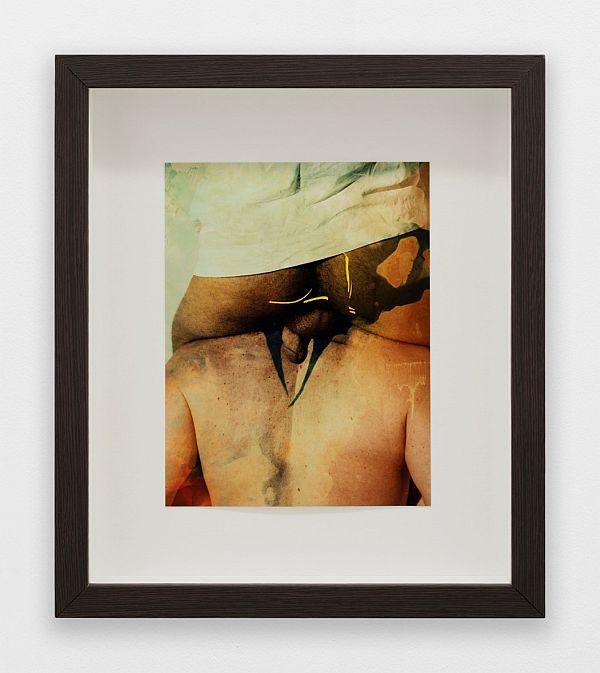
“There’s no designer vagina,” says London-based photographer Harley Weir, who is discussing a series of intimate images in her new solo exhibition, Sins of a Daughter, at Hannah Barry Gallery in Peckham. “They all look so different and they’re all beautiful in different ways.” Gathering together 30 of her photographs old and new – some of which have been abstracted and collaged over with household products and bodily fluids like cum, spit, pee and blood – these frenetic, highly emotional images draw on themes of inherited family trauma, sexuality, shame, motherhood and the knotty topic of desire.
Weir is responsible for era-defining fashion images that include Young Thug in a Molly Goddard dress for Dazed, or Klara Kristin’s much-debated ‘up-skirted’ Calvin Klein campaign shot, but this exhibition shows an artist running amok, unfettered by budgets and collaboration. “It’s difficult when you’re working with people,” she explains. “In my personal work, I can get closer to the truth.”
Dear mother – a darkly-lit image of a woman with her legs splayed apart – recalls Gustave Courbet’s controversial 1886 painting L'Origine du monde, but Weir zooms in further, giving an almost microscopic view of the vulva. These vagina pictures hang next to images of a lactating nipple and a breastfeeding baby, throwing the very notion of the Madonna-Whore complex into disarray. Elsewhere, pop culture icons like Avril Lavigne and Kylie Jenner appear subtly in the work; “[they’re] the girls of this generation,” says Weir, citing the dulling effect of constantly being on social media. “There is beauty in everything, and everyone does have a beautiful side and a grotesque side,” she says. “We only see that one side, that beautiful side – especially with social media.”
Here, Weir talks about the line between pornography and art, why we must learn to love our vaginas, and the reality of working in the fashion and art industries as a woman.
Violet Conroy: How did the idea for the show come about?
Harley Weir: I was thinking about bloodlines, the inherited weight of gender, things that get passed down from your family like trauma, illnesses, or general upbringing. The title Sins of a Daughter comes from the saying ‘sins of the father’, which stems back to a previous book I made called Father, which was a series of male nudes exploring the female gaze and desire.
VC: Do you think of yourself as a fashion photographer first and an artist second, or is there no distinction between the two?
HW: I dislike labels, they hold us back from doing what we want. I feel very fluid, but there’s not really a good definition for such things. I’m comfortable though with whatever people want to call me at this point.
“There’s no designer vagina,” says London-based photographer Harley Weir, who is discussing a series of intimate images in her new solo exhibition, Sins of a Daughter, at Hannah Barry Gallery in Peckham. “They all look so different and they’re all beautiful in different ways.” Gathering together 30 of her photographs old and new – some of which have been abstracted and collaged over with household products and bodily fluids like cum, spit, pee and blood – these frenetic, highly emotional images draw on themes of inherited family trauma, sexuality, shame, motherhood and the knotty topic of desire.
Weir is responsible for era-defining fashion images that include Young Thug in a Molly Goddard dress for Dazed, or Klara Kristin’s much-debated ‘up-skirted’ Calvin Klein campaign shot, but this exhibition shows an artist running amok, unfettered by budgets and collaboration. “It’s difficult when you’re working with people,” she explains. “In my personal work, I can get closer to the truth.”
Dear mother – a darkly-lit image of a woman with her legs splayed apart – recalls Gustave Courbet’s controversial 1886 painting L'Origine du monde, but Weir zooms in further, giving an almost microscopic view of the vulva. These vagina pictures hang next to images of a lactating nipple and a breastfeeding baby, throwing the very notion of the Madonna-Whore complex into disarray. Elsewhere, pop culture icons like Avril Lavigne and Kylie Jenner appear subtly in the work; “[they’re] the girls of this generation,” says Weir, citing the dulling effect of constantly being on social media. “There is beauty in everything, and everyone does have a beautiful side and a grotesque side,” she says. “We only see that one side, that beautiful side – especially with social media.”
Here, Weir talks about the line between pornography and art, why we must learn to love our vaginas, and the reality of working in the fashion and art industries as a woman.
Violet Conroy: How did the idea for the show come about?
Harley Weir: I was thinking about bloodlines, the inherited weight of gender, things that get passed down from your family like trauma, illnesses, or general upbringing. The title Sins of a Daughter comes from the saying ‘sins of the father’, which stems back to a previous book I made called Father, which was a series of male nudes exploring the female gaze and desire.
VC: Do you think of yourself as a fashion photographer first and an artist second, or is there no distinction between the two?
HW: I dislike labels, they hold us back from doing what we want. I feel very fluid, but there’s not really a good definition for such things. I’m comfortable though with whatever people want to call me at this point.

VC: Do you approach the two modes of working in the same way? Or does your personal work allow you to tackle themes that maybe your fashion stuff doesn’t?
HW: It’s always a huge collaboration when you’re doing a fashion project. There are hundreds of people on set – you’re not alone. With fashion, it doesn’t really feel [like it’s] my own, because I wouldn’t necessarily share my inner thoughts with people I don’t know very well.
My personal work feels quite different. Often it’s abstract and without people, because I don’t feel 100 per cent that anything is fully mine if it’s a picture of someone else – that’s a collaboration. It’s difficult when you’re working with people; it’s important to respect them. I don’t want to make anyone feel bad about the way they look in an image, [but] that’s not the truth. In my personal work, I can get closer to the truth.
VC: Some of the pieces seem to tackle sexuality and shame. Has making these images allowed you to work through your thoughts about these things?
HW: Yes, it has. I overlay or paste on a lot of the images; they’re hardly visible in the finals, and are almost like secret, cathartic symbols of such thinking. I almost find it like art therapy. There’s alchemy in the darkroom, it’s completely black and I’m experimenting with waste products, whether it’s bodily fluids or wasted beauty products I take from my bathroom cabinet. It’s very physical in the dark, and there can be a real abstract feeling. When you have no other senses, your mind can really unravel. I get really heightened emotions when I’m in there.
We have so much stimulation constantly, social media is always in our faces. We’ve always got our phone to pacify ourselves. When you’re completely in the dark, your mind has time to run wild. I feel like a lot of thoughts and things like that will come out when I’m doing those things, and I think they really look like that feeling when I see the final result afterwards.

VC: What inspired you to use bodily fluids?
HW: It felt quite natural to start experimenting. Originally, I wanted to see what cum looked like on photo paper if it was left. That was the first one I did, when I made the book Father. I was trying to make a cover for the book, and I wanted it to be bodily fluids, then I put it into the processor and I realised it stained it in a very painterly way.
VC: What about the vagina images?
HW: When I looked back at the vagina images, I thought, ‘Oh god, how expected of me to do vaginas again!’ But I still think that we don’t see them enough, because they’re so internal. As a girl you must use a mirror to even look at your own. We see the beautiful mound in art and plastered everywhere – but [the] open [part] is still quite unseen. I remember having to turn to porn when I was a kid to really see one.
When I took those images, it had a big effect on me because I’d never seen anyone’s vagina properly before. It was quite important for me to do that. I’m so thankful for the girls that allowed me to do it because it was really eye-opening and it made me realise that everyone is so different. There’s no designer vagina, we’re all so different and they’re all beautiful in different ways. And we must learn to love them.

VC: Do you think there’s a world in which pictures of vaginas, like the ones you took, will not be read as pornographic by people?
HW: It’s tricky. A lot of the girls who came to have their picture taken were very well-groomed, and I had hoped they might be a bit more realistic. I did wonder, ‘Oh, are these vaginas too beautiful?’ because I don’t want to give people the wrong impression. These people knew they were going to have photos taken of their vagina, so a lot of them were waxed or shaved, which could give them a more porno feeling.
VC: I loved the vagina picture with Avril Lavigne’s face superimposed on top.
HW: [Laughs.]. My first assistant Alexa was helping me late to print those, and we were looking through old images to overlay with the vaginas, and she was like, ‘How about Avril?’ I was like, ‘Hell yes!’.
VC: You’ve got these pop culture icons in the work, like Avril Lavigne and Kylie Jenner – what compelled you to include them?
HW: I go through old images I’ve collected, weekly newspapers, and make little piles with images that sing to me at the time, and those happened to be in there. I feel like they [Lavigne and Jenner] are the girls of this generation, I see their faces so often they are almost like a motif. It’s subconscious almost, but there’s also a fair amount of intent in there. Since I do it all in the dark and don’t use any glue, what sticks is almost like a tarot card reading.
VC: A lot of the work is about motherhood, with the breastfeeding images. What about this concept interests you?
HW: I mixed those images on the wall with images of vaginas because I was thinking of the idea of function, and those parts being functional rather than sexual. I thought, ‘Oh gosh, is someone going to feel uncomfortable that a vagina is next to an image of a breastfeeding boob,’ but I thought: no, it makes perfect sense. That’s what they were created for. We shouldn’t even really have to think about that, but we do.
VC: Is beauty something you’re still looking for in your work?
HW: Beauty, for me, is what draws people to an image and helps them listen. I would love for things to be less beautiful, but when you’re working with people it’s really hard. If you’re photographing people, it’s important to make them feel comfortable, or at least I think so. I love the work of photographers who really show the truth in all its grotesqueness, and I feel like I hold back from that because I care about the people that I photograph. I don’t want them to be disappointed or feel ugly.
If it was a better world, we wouldn’t mind about those things. There is beauty in everything, and everyone does have a beautiful side and a grotesque side. We only see that one side, that beautiful side – especially with social media. It’s complicated. Beauty is a big topic.
VC: What’s it like being a woman in the fashion and art industries now, and has it changed since you first started out as a photographer?
HW: It’s changed a lot. I definitely felt very embarrassed about being a girl when I was younger. I feel very comfortable being a girl now. I felt like I was disrespected, or that people didn’t or wouldn’t give me the respect I wanted as a girl sometimes. I feel like it’s changed a lot in a good way, and that’s really exciting.
“It’s Like Art Therapy”: Harley Weir on Her Provocative New Exhibition. By Violet Conroy. Another Magazine, April 21, 2022.

Fashion
photographer Harley Weir first got a hold of a camera when she was eight
years-old. “My mum used to give me a disposable camera to take with me on
school trips. I loved using it,” she tells me. “I think the first pictures I
took were of some pigs that were having sex at a farm we visited. I have a
vivid memory of it. The disposable was like my social media then.”
If you
haven’t heard of Weir, you’ve at least seen her work. The Southwest London
native has lensed the likes of Young Thug, Bjork, and Rihanna for Dazed, Greta
Thunberg’s famous i-D cover, Bella Hadid for LOVE, and Pharrell for Humanrace.
That’s just a selection of the 30 year-old photographer’s heavy-hitting
portfolio; Jacquemus, Helmut Lang, Charlotte Knowles, Stella McCartney, and Calvin
Klein have also enrolled her to snap their campaigns, and most recently, Gucci
x Balenciaga.
Sins of
a daughter, which opened on April 9 at London’s Hannah Barry Gallery, is Weir’s
first solo exhibition since the Covid-19 outbreak. “It’s interesting to go back
into that mindset of where I was two and a half years ago and revisit those
feelings and thoughts,” she says. It’s nearing 10 o’clock at night for Weir,
who’s busy with the finishing touches of her show ahead of its opening. “I’ve
been doing last minute printing, some things didn’t fit into frames properly,
the usual. So manic.”
Showing
almost 30 new collages and archival images, Sins of a daughter is a revealing
look into Weir’s most intimate and private photographic experiments. The
featured archive dates back to 2008, when teenager Weir first started taking
photos of her friends and sisters. “They’re quite abstract images. Some of them
come from a previous project called Father, a book I made with a series of male
nudes. There’s also a series of vaginas in the show, very close up and
personal, quite intense. It was very much about my desire as a woman, like,
‘What do I desire?’ I wanted to figure that out, so a lot of it is coming from
that angle.”
In a
late night interview, the artist walks us through her creation process, her
obsession with the body, and what she does want as a woman, for now.
What can
we expect to see from Sins of a daughter?
HW : Photographic
collages. They were made originally by experimenting with body fluids. I put
the fluids on photo paper, which is then left to cook. It changes the chemistry
of the paper and brings out certain colors or removes things, darkens things,
almost like a form of painting, but with alchemy. Strangely, everything I have
used from then on is a waste product of something. I use a lot of outdated
beauty products or health foods, for example. Ingredients are things like
perfumes, contact lens solution, ingrown hair solution, moringa powder,
spirulina.
When you
say body fluids, what kind do you mean exactly?
HW : Spit,
pee, cum, blood. But they go through processes and become properly cleaned and
fixed so only the marks remain. I didn’t use any body fluid since lockdown
because it felt weird, since everyone was hyper aware of cleanliness and things
like that. It changed the direction a little bit, and I ended up working with
things like super foods, which is interesting because they do have a super odd
effect on the paper. It feels very prehistoric experimenting with alchemy in
the way that I do. like when people were exploring the natural world for ways
of doing things, like octopus ink for writing. Usually I will start with an
analogue image or collage of different images on the same photo paper. I do it
all in the dark, so I don’t know exactly what I’m doing. Very much like a witch
[doing] a ritual in the dark with these potions.


Spit, Pee, Cum & Blood: a Glimpse into Harley Weir’s Most Sinful Desires. By Elaine YJ Lee. Highsnobiety, April 18, 2022.