Showing posts with label having children. Show all posts

29/05/2020

Three Conversations with Jenny Saville


An exhibition  at the Foundling Museum in London looked closely at 500 years of portraiture to explore how pregnancy was depicted — and not depicted — from the Tudors to today. Portraying Pregnancy: From Holbein to Social Media ran from January 24 to April 26, 2020.

A giant new work by Jenny Saville, Electra, 2012-2019, was especially made for the show and was being presented to the public for the first time.


SALLY MANN Is it true that you paint at night?

JENNY SAVILLE Yes, I often work at night. There’s a different atmosphere in the studio at night, more dreamy, and I often take risks in the work at night, so I like to use that time. My studio is a five-minute bicycle ride from my house in Oxford. So I tend to cycle back past all the colleges and drunken students.

SM  I’m sure I would once have been one of them. Well, I feel like I should mention that while I’ve been the subject of interviews, this is the first time I’ve ever asked the questions. So this should be interesting for us both [laughs]. Have you ever asked the questions?

JS No [laughs]. But I do feel that even though we don’t know each other very well, we actually have quite a bit in common. There are some surprising connections in terms of subject matter if you look through the work. And also Cy Twombly is such a pivotal character for us both.

SM I don’t know how many times I’ve sat having a coffee or a drink with someone and I’ve endlessly pestered them with my gadfly—too personal—questions. And now I have permission to freely ask. For starters, I’m curious to know if you’ve ever visited the back country of the American South.

JS Well, not specifically. Apart from driving south to New Orleans, the farthest south I’ve stayed for any reasonable length of time is Cincinnati [when I was a student].

SM That doesn’t quite count [laughs].

JS The first time I ever went to America it was quite a shock. I flew the day the first Gulf War started. There were yellow ribbons around all the trees. It was a real culture change, and an exciting time.

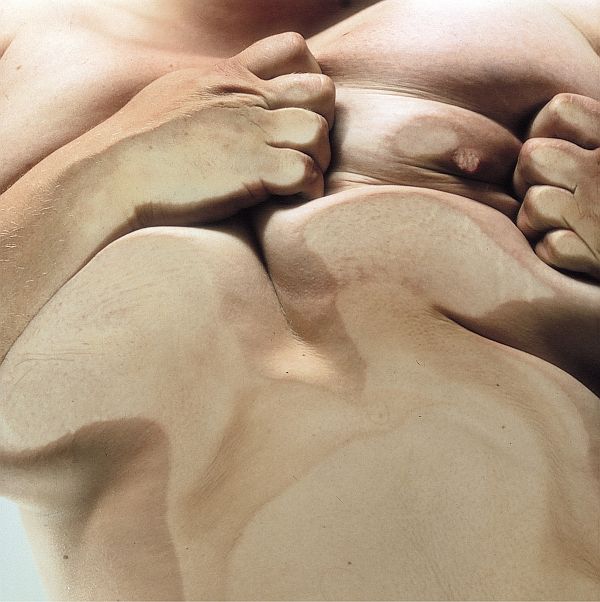
I definitely became more interested in fleshy figures from being in America. I loved watching bodies in malls and at carnival parks. I was shocked at how big people were and how frequently you would see big bodies. I was fascinated: I could watch the way flesh moved around for hours.

SM  Me too. That’s what Cy used to do as well. He would sit out in front of Walmart and was unabashed about appreciating the size of people.

JS I was learning to paint bodies at the time, really getting to grips with how beautiful and fleshy paint can be. Seeing fleshy bodies heightened that sense.

SM Well, that discussion of oil paint and flesh has been part of the dialogue around your work since the beginning. Was it you who said it felt like the paint actually became the flesh?

JS There’s something playful and fun in painting. I get a simple kick out of seeing one color running through another, or making forms appear—out of making something from nothing. I feel the same thrill in that process that I did as a kid.

SM A natural marriage. You’re lucky. Do you ever paint with your hands?

JS Yes, sure. Maybe not in such a free way as Cy. Once I’d seen his work, he helped reinforce those feelings of freedom. I was painting figures, working out how to do that, and then I’d go and see Cy’s latest paintings, and they would blow me over with their confidence and tactility.

SM He was so physical and gestural.

JS One moment with Cy that I remember fondly was being on a plane with him and ripping pages out from a magazine because we both thought the colors were just so exciting. I just found an easy relationship with him, because our conversation slipped seamlessly between high art and everyday things. I recognized the way Cy had an interest in the simplest things, and that gave me tremendous confidence as an artist.

SM That’s interesting about tearing out the pages, because he really was kind of a magpie; like a bird picking up shiny, attractive things, Cy would find these oddball images, tear them out, and stick them to his walls. Do you pillage information the same way?

JS Oh yes, sure. I have collections of images of stains and shadows, war photography, graffiti, bits of material, paint swatches. The iPhone has made collecting visuals so easy. I don’t know how much explicitly goes into the work, but these things nudge me in the right direction.

SM Is that scavenging in fact related to how you work? Do you take pictures of everything—from sculptures in a museum to a piece of gum on the bottom of your shoe?

JS I take a lot of pictures, yes. I like to work in that kind of suggestive visual atmosphere. I work with a lot of images around me on the floor, because you see forms upside down and I find interesting compositions that way. Everything I do becomes a part of me and feeds into making my work. And my children have really opened me up to new things and have given me back an enormous amount of freedom. I admire their openness so deeply and I want very much to be able to put that back into my work.

I grew up in quite a bohemian family: my parents were well educated, and I had this farm where I could just wander around all day with a knife in my pocket. And now I realize that my level of creativity, the confidence that I have in my own ability to create, is something they gave me, which at the time I didn’t understand or think of as important. But now that I’ve got my own children, I realize now what my parents gave me, and I actually realize how important that was.


SM You were quite young when you were first celebrated as an artist, you sort of catapulted to celebrity at such a young age. Did that have any downsides? Was that problematic in any way?

JS I can’t say it was problematic, or even [that there was] a dramatic difference. The best thing it did was make me value the things that have kept me steady in terms of making the work. I’ve tended to move studios after big shows, and that’s helped. After the Saatchi show, Young British Artists III, in 1994, I moved to America; after my second New York show, in 2003, I moved to Palermo [Italy], so that was fortunate, because I kept my eye firmly on the work. I guess it depends what you need as an artist at a particular moment. Time is everything for me; I’m always yearning for more time.

You also received a lot of attention and controversy as a young artist with your pictures in Immediate Family. I so admire the openness and Arcadian spirit in those pictures, but was that controversy difficult to navigate? Especially because they were your children?

SM Yes, but I had removed myself completely from the art world when I was making that work. I was living so far outside of it, I was more or less able to tune out the controversy. To this day, I don’t particularly read art magazines; I barely read the newspaper. I’m like you, I just work. Sometimes it seems to me that other artists create their work with less effort, whereas it always feels onerous to me. But I suppose that’s not really true.

Do you paint your children at all?

JS Yes, of course. Having children had the most profound impact on the way I make art and see the world. Making flesh in my body, and the animalistic nature of giving birth, affected my view of nature. The simultaneous realities I’ve been trying to generate in my work over the past few years, the strata and layering, came about through the drawings I made after having children. It opened out a new way for me to create space and movement. What I enjoy about my children so much is their freedom. They move their bodies without care or judgment, and that’s a precious moment in life.

SM I know, that’s the way my children felt about it too. It’s a shame that society has a way of inflicting its censorious views, and when children feel that, it gradually undercuts their convictions and confidence. I was lucky because my children were very strong.

JS Was there a moment when they didn’t want to be photographed or where you decided not to photograph them anymore?

SM It was more about a shift in the work. I’d photographed them for ten years and I wanted to move on to something else. They never asked me not to photograph them—at ages nine and ten, your children are probably still pretty open-minded and free to work with. But there’s an age where I didn’t even want to ask them anymore. They were always happy to do it, but we had all just moved on, I suppose.

JS I made drawings after my son was born, when he just didn’t stop moving. He was this whirlwind of limbs and slipping torso as I carried him, which was so exciting. A drawing of a singular body just didn’t seem enough to communicate this torrent of human movement, and I wanted to get to the unsentimental truth of those childhood years. But when I first showed my drawings it was suggested to me that they could be controversial because they were images of children, and that was a little bit of a shock to me, because I didn’t see them like that at all. Was that the same for you when you were making those pictures?

SM Oh yes, exactly. Exactly the same thing. And people thought I was being disingenuous when I would say, “I can’t imagine what you’re seeing in these pictures.” It’s ridiculous how innocent I was at the time, how unaware I was about the cultural environment. And a lot of that had to do with my isolation, which was not unlike the distance that you seem to be enjoying yourself at the moment.

JS Do you always work in series? For instance, I love those pictures of Cy’s studio, but they happened over many years, and you were presumably photographing lots of other projects at the same time.

SM In the case of Cy’s studio, those photographs are unique in that they were free flowing, they weren’t made with any greater project in mind. That’s not my normal practice. I would just briefly alight in his studio every once in a while and take some pictures, but I was always working on something else. I never thought of the pictures in Cy’s studio as a body of work, at least not while I was making them. They were just casual gestures of friendship when they started. Early on, he asked me to take a few pictures, not in any professional way, just in a “Why don’t you come on in and take some pictures” kind of way. And over time it grew to be habitual. Every so often I’d stick my head into his studio if I had a camera in the car, or if I had some color film, or if I had a new funky lens. It’s funny how the less emphasis you put on a project, the less you worry about it, the less handwringing you do, the more spontaneous and vital and fun it becomes.

JS Yes, it rises naturally, doesn’t it? I find if I work very hard and force myself onto the work, it can feel like an arduous trek and [like] the paint is too heavy. But I think it’s necessary for me to go through this process and show myself what I can’t do or what I don’t actually like, so I end up releasing the reins a bit and my next piece comes quite easily. I like the feeling when my wrist opens up and goes floppy; then I know I’m painting with some kind of fluidity. It’s a sort of fitness or nimbleness. What’s tricky is to keep at the same pitch in the next painting when the going’s good. Maybe it’s just one of those things you just have to go through.

SM I know that exact syndrome. It is so true. Actually, my syndrome works like this: my first one is often really easy, and then with the next one I’m a little more self-conscious about it. But it doesn’t sound like that’s how it happens with you.

JS Well, it depends where I am with a body of work. I think that’s the way ideas arise for new groups of paintings. My weakness is that I can sometimes contrive paintings too much, and they run the risk of being mannered. That’s not my intention at all but a risk that I know I have to go through to try and do something in figuration. So most of the time I make paintings that show me what I can’t do, and that’s annoying but inevitable. Then, in a body of work, once I’ve got through this novel and heavy phase, sometimes I get the chance to make some good paintings. I have to keep going. I’ve learned that spontaneity is important when working with models, especially groups of bodies, because when people interact they create forms that I couldn’t imagine before they arrive in my studio.

SM That sounds very similar to what you just described about watching your children.

JS Yes, just appreciating your instincts. That confidence has grown over time—just doing it and building up a language, a vocabulary.

SM Well, as you know, I’m not a painter, and what I do is so completely different and so technical that I don’t get to do that kind of graceful, physical movement that painters do. I’m so jealous.

JS That technical side of photography would just nag at me too much. Most of what I like in painting is through mistakes or the unintentional: an oil stain on newspaper that has such presence, a mix of paint on my palette rather than on the painting. With photography don’t you have to be so well behaved?

SM Well, yes, but that’s not always true, and experimentation is actually one of the greatest joys for me. A good example is my wet-plate-collodion work, because you can allow these serendipitous accidents to happen, and it completely transforms—

JS Yes, of course, that’s much more like a painting, isn’t it?

SM Oh, much more. But some people move straight into the serendipity, or so it seems, and they don’t do their 10,000 hours of technical work first. I think it was Malcolm Gladwell who once suggested that 10,000 hours of practice is what it takes to get good at something. Well, I’ve put in my 10,000 hours of hard, technical work. And that’s one of the things I most admire about your work: it is clear that you’ve put in that time as well.


JS Well, if you do 10,000 hours of paint splattering, you would get pretty skilled at that, like Pollock did. I don’t know, I’ve had conversations about this before—whether you can go in, you know, at late Picasso, where he puts just dots of paint in for eyes and it seems almost cartoonlike, but there’s an absolute precision in where those dots go. That dot has hours and hours of painting behind it. It’s the same when you look at Rembrandt—you can see this incredible abstract move of the wrist with the right amount of pressure and ink, but of course it isn’t that simple—that move of his wrist has all the other marks he’s ever made in his life behind it. It takes a lifetime to get to that level of loose precision.

SM I agree completely. I spent decades learning how to take a perfect photograph, and then I was able to completely forget that and take any kind of picture I wanted, because I’d put my time in.

JS And that structure is behind you, isn’t it? It’s the backbone that you’ve got, right?

SM Exactly.

JS It depends what you want to do as an artist. We’re lucky that we’re living in an era with a lot of different areas of artmaking. I had quite an academic training as an artist, looking back, and I was able to use that process as well as kick against it. I have always aimed to make painting that deals with the realism of our time rather than being nostalgic or academic. It’s not so easy to eke out new possibilities if you work figuratively, because most of human history has worked figuratively.

SM Of course. Can we circle back to becoming a mother? Did you photograph yourself giving birth?

JS I did, I asked a good friend to photograph me. I loved all the incredible colors and the intensity of that miracle moment. I was shocked by how much beauty and violence there was—it was very primal. I have an impulse to record all sorts of moments in my life, even something like the death of my father. When my father died, I sat and watched life literally drain away from his body. I was shocked, in grief, but at the same time was conscious of how beautiful he looked, and felt compelled to want to hold that moment visually, because there was so much life in that moment. I think that impulse to look and record has probably been the backbone of my work.

SM Well, yeah, and that brings me to this other issue, which is that there seems to be a movement now that suggests that artists who depict suffering in a beautiful or aestheticized way are actually harming the subjects. That it’s an ethical violation to make a photograph or a painting of suffering, even if the result is actually also a beautiful work of art. Perhaps Sebastião Salgado is the perfect example of that. People are asking whether or not artists have the right to look at and depict other people’s pain. I guess I’m just wondering whether you have any feelings about that, because God knows we’ve both done that.

JS When I’ve worked with dead bodies, part of the interest for me was that I didn’t know anything about that individual’s narrative. I found images in medical books and made portraits from those. If you spend six months or more on a painting, you develop an incredible intimacy by looking at the face of someone again and again and working out their particular structure, from the turn of an earlobe to the bones of their nose. It takes time and study to differentiate between the specific colors and tones, and the colors were just incredibly beautiful and related to nature, like in a sunset, but I was looking at bruised flesh or a gunshot wound.

SM I know all about that.

JS But the beauty of it is dumbfounding. The beauty just knocks me over, and I saw paint in that moment. I imagined what colors I would mix and how I could merge them. I didn’t want to ignore that impulse to make paintings like that, because it was so powerful. It’s similar to how we see war photography that’s incredibly beautiful. You can’t deny its beauty. In Robert Capa’s pictures, the blurriness of those soldiers’ landings on the beach in France: the blurring is what makes not just the beauty but the tension. I wouldn’t want that picture not to exist. That’s too puritanical for me, because the beauty of it helps us accept our collective humanity, in all its shapes. Imagine not having Goya in the world because he’d self-censored?

SM I know, I’ve photographed a lot of dead bodies. And actually, when my father died, I was with him at his very last heartbeat and I saw a perceptible change in the color of his flesh. It was, as you described, very powerful and evocative and provocative.

JS Exactly, it’s a cycle, isn’t it? And you don’t want to deny looking at that, because that’s powerful about your life. Like those pictures that you did at the FBI death farm . . .

SM Yes.

JS It must have been so powerful to be there and to see that, and similar in a way, because you didn’t have a narrative for their lives, either. It’s like being a pathologist, but from an artistic point of view.

SM Exactly. But there’s a question—I remember it being raised with Joel-Peter Witkin’s work. As I recall—and I may be mistaken about this—he went to a morgue in Mexico, rented a corpse, and photographed it. The family of the dead man were outraged and upset to find a relative in a publicly displayed photograph. And I can see both sides of that.

JS That’s a difficult situation, because those bodies were in a private context: it sounds like they hadn’t been given to science.

SM It is. Nobody in modern society wants this sort of raw scrutiny of our human vulnerability. Because it’s something I’ve never been particularly afraid of, I haven’t had too much hesitation about taking those kinds of pictures, until, I guess, I get confronted by people who say, “You can’t appropriate our suffering.” In my mind, I’m an artist. That’s what artists do. We speak to these things.

JS You have to work with yourself, don’t you? You have to just follow your instinct and navigate that. I think that’s the only guide you’ve got. I always feel that I have so much work to do. My studio is a vital place for me; it’s a universe of trying things out and experimenting. Wherever I’ve worked in the world, I’ve basically created a similar space and developed routines and rhythms around the work. I have the very annoying habit of listening to the same music over and over when I’m working on a particular piece. I enjoy these repetitive routines.

SM I’m the same way. I really like a routine. I like the quotidian. I need to know exactly how my day is going to be laid out. And I lay it out pretty much the same way every day—I mean, right down to the food I eat.

JS That’s so true. If there’s too much noise going on, I can’t process information. When I’m in New York, Paris, or Athens, I love wandering around, seeing shows, looking at what’s being made, watching people. I gather things up but I don’t effectively process them until I’m back into an ordinary rhythm.

SM So in a certain sense, you harvest stuff and then bring it home.

JS Yes, exactly.


In Conversation : Sally Mann and Jenny Saville. Gagosian, Spring 2019. 


On February 9, 2019, SFAI's Painting Department hosted renowned British artist Jenny Saville in conversation with Claudia Schmuckli, Curator-in-Charge of Contemporary Art and Programming at the Fine Arts Museums of San Francisco.

Known for her monumental paintings of flesh from a feminist perspective, Saville has continually redefined the body politic in painting for the past 25 years. In addition, panel discussions will be delivered on a range of subjects by artists and professors in art practice and history, submitting their distinct perceptions about the dynamic state of figurative painting.

The painting symposium was organized by artist Brett Reichman, Associate Professor of Painting at San Francisco Art Institute, and generously sponsored by XL Catlin and The Broad.


Jenny Saville in conversation with Claudia Schmuckli. San Francisco Art Institute,  October 17, 2019. 


British artist Jenny Saville (1970), one of the Young British Artists, deconstructs the stereotypes of beauty and eroticism of the female body as seen through art and through men, and then broadens them. She experiments with obese women and changes in the body, but above all she uses her own body as a model and means of reflection. She reveals the natural beauty of the individuality of the women she paints, and her own. Through the  body, she  expresses states of sensibility that bind us to our existence: uneasy, anguished, painful fleshiness... This defines her artistic language as much as her traditional pictorial technique. Figures are the sole focus of attention of her huge canvasses, which often cannot contain the whole figure in the same way that our selves cannot control our bodies. Her painting and her skill at drawing spawn a multiplicity of realities that build movement.

We begin our conversation in London surrounded by her latest drawings.

Elena Cué: Your art is based in the exploration of the human body. This bodies experience anxiety, strangeness, sorrow... Do you recognize yourself in your multiple representations?

Jenny Savile: I think you are in everything that you make, to be honest. But I like to include everything, even to show sadness and violence. I want to encompass the whole world when I make art, I don’t want to exclude anything. The best work I’ve ever made has been through my instinct. When I try to be too clever or too analytical, it doesn’t work. I don’t ask myself too many questions during the making of the work because I follow my instinct. It holds a truth which is greater than the truth that I’m trying to get at through over-analyzing something. That was a lesson to me quite early on - that there’s something within that truth; that there are truths greater than knowledge. And if there’s a knowledge, sometimes you have to let go and follow your instinct to get to that greater truth. If you over-analyze or over-critique something, there’s almost no point in doing it. There’s no risk involved. I like the risk and the change and the transformation that’s possible in the making, and for me, that gets you to a greater art. It’s beyond reason. That’s what you’re trying to get... truth beyond reason. Because if you could write it down or you could speak about it, you wouldn’t need to make it.


The figures in your drawings overlap as a plurality of identities. Your face is present in most of your portraits. Is identity an important subject for you?

It’s not really my identity... I lend my body to myself, that’s the way I’ve always looked at it. But sometimes people aren’t prepared to put themselves into as painful a position as my body is prepared to be in. I’ve been conscious - since I was very young - that one day I’m going to be under the ground, I’m going to be dust, I’m going to be nothing. So what’s the risk? There’s no real risk. What could it be? Judgment? That I have a different body? That I don’t have an ugly body? I don’t care about that. I care about trying to use my capacity as a human. How far can I go as a human to make something that’s interesting? It’s not really about whether it’s my identity or not. It’s about a human identity. If you look at the Velázquez dwarf paintings, there’s an identity that goes across all of humanity. Or a great Rembrandt portrait - it covers everybody. I’m not an old woman in a Rembrandt painting; I don’t know what it’s like to be a seventy year old woman, but I feel the humanity when I look at that painting, so that’s the way I’ve looked at it.

If my body can offer me the ability to get to something interesting, then I use my own body. If I can’t, then I work with somebody else. So it’s not about this endless self portrait, it’s just that I’m available and it’s the ability to use my body to say something or to get to the emotion that I’m trying to get at in the work.

Where does your interest or fascination for imperfect, violated, wounded or operated on bodies come from?

I don’t really know. It’s something I’ve had since I was a child. If someone fell over, I wanted to see what had happened. It’s curiosity; I just have a curiosity for that. It’s also an aesthetic interest. I mean, I’m not so interested in a kind of surface beauty, I think there’s a certain humility to getting underneath the surface of something or being prepared to show the reality of something. There’s a humility involved in it that I find in the work that I like. If you look at ancient Greek theatre or Greek tragedy, and you’re harrowed by the emotions on stage and the extreme violence, somehow that gives you a humility in who you are as a human being in the face of gods, or in the face of the universe. You’re so small and nothing. I think that’s the drive, because that’s the kind of art I like across the board - whether it’s in film or music - it’s the art that touches that part of us.

You spoke earlier about the influence that clasical artists from the past have had on your work. There is also a carnal tradition on Western painting. What is your opinion on art from other eras?

I’ve naturally always looked at older art. Especially because if you paint the figure when you’re young and you’re trying to learn, you’re going to look at figurative painting. So I learned by looking at Titian, Velázquez, Rembrandt, Leonardo, Michelangelo... I was very lucky as I had an uncle who, from when I was eight, really taught me to look. Also, if you want to have a hero to look at, choose a really great artist, because that’s your measure. You can think that you’re great in the time that you live in, but you only have to look at really great artists and you’re a long way from that level. I’ve held that very dear to me, it’s become the backbone for the way that I work. However much I try, I’m never going to get to that. It’s a long journey to try and reach anything like that. And then I have had an interest that has switched or moved around... I mean, I have a team of players around me who I’m in constant dialogue with - artists like Picasso, Velázquez, Michelangelo, Leonardo, Titian, Tintoretto, Rubens - and then I have other art which is ancient Greek sculpture that I love, fertility goddesses from the ancient world, all of those. After I had children, I wanted to find an art that felt like the rawness of giving birth. I lived in Sicily for a long time, so being in Palermo around those myths and ancient history really linked me to that and the myths of the ancient Greek world... gods and goddesses and the power of fertility. So that seeped into my work a lot then and it’s a big driving force in my work now, especially in the drawings. A kind of creative urge. I’m much more interested in what the life force is of a creative urge, or how to make something and destroy it and bring it back. Through that cycle, which is basically a cycle of nature, you get to a greater truth, or a more interesting area of the work. I only really managed to do that through looking at ancient art.


You also had a dialog, this time through an exhibition, with Egon Schiele at the Kunsthaus Zürich last year. What held the most significance to you from that experience?

The whole experience was an amazing journey. As a teenager, I absolutely loved his drawings... the honesty and the brutality of his drawings, of both himself and the females that he was drawing. My aesthetic interest led me to Egon Schiele at a very young age, so when I was asked to do a show together with his work, it was a dream. It was an incredible dialogue.


In that exhibition, the Schiele paintings were imbued with a strong eroticism. Is this also an important subject for you, do you think it is implied in your work?

It has become more and more important, I would say. Instead of erotic in a sexual sense, I would say erotic in a life force or drive. That’s really vital to my work, especially in the drawings, because of the way that I work now. It’s almost like a performance when I’m working, so I do sessions of working for four hours for example, where I draw lots of figures and they start to collapse and then I build them back up again. And through that whole physical process, like a game, new forms start to emerge from the nature of the drawing. So it is a sort of game where you get lost, and through it, you’re almost sculpting out a reality from the process of that moment. It’s almost like a dance or something; you create things that you didn’t know were in you.

Instead of one thing that represents what it is, when you multiply you get closer to a greater nature. That’s become very interesting for me and I’ve only really developed that in drawing because I can change so much and have several toes interlocking, or a male body over the top of a female body and that suddenly become a hermaphrodite. But I’m not drawing a hermaphrodite. I’m drawing many bodies together so that the gender becomes fluid. So parts of the male body become the female body, and that becomes really exciting because it almost represents more what we’re like as humans, rather than these separate sexes. We’re made up of masculinity and femininity, so those are the things that become interesting by layering them up.

Do you feel that you have a body or that you are a body?

Some artists like Michelangelo worked almost with God working through him; he was doing God’s work and there was a kind of divinity involved in it. God has been slipping away for most of us, but when we make work, I’m interested in what the drive is. When I’m working in the middle of the night and I’m trying to get to something, am I working with a wager on God’s existence? I don’t make work for an audience. I don’t make work thinking that I’m going to show this to an audience. But it’s definitely a form of communication. So it’s almost as though there is a third person involved, whether it’s God or whatever. That drives me to go further in the work, and I don’t know what that is.

Are you interested in the outside world?

Landscape is hugely interesting to me. Especially the sea... I spend hours looking at the water. I look at the way the light moves on the water. I get up early so that I can see the sun come up. But I don’t want to paint landscape paintings. I’m interested in all of those things. But I’ve never wanted to paint those directly, like I have with the body. And actually, the older that I get, the more closely related to nature I feel, or the more interested I am in depicting that. My mediation is through the body. All of my work really has been a sort of landscape; it’s the landscape of the body, or the architecture of the body in nature, or the nature of flesh, or the way that light affects a body.

What is art to you? What is your definition of art?

I would say the ability to have freedom. That’s fundamental. I really believe in imagination and inventiveness. It’s a combination of factors including humility, incredible hard work - it’s going to take a long time to have any kind of mastery in this - plus being brave enough to take a risk. When, in the work, if I’ve made something look really good and I sit back and think that it is looking good, that’s the moment that I try to destroy it, whereas before I’d polish it off. Now I’ll say well, that was easy access, or an easy journey to get there. Where else can you go? If you’re prepared to do it, you can get somewhere far greater. That takes a lot of hours and a lot of risk, but you’ve got nothing to lose. Why not try to invent something? I have learned through Picasso that the really good art lies in the ability of not knowing how to do something. And the journey of trying to articulate something you don’t know how to do is where the art is. If you know the journey that you’re walking, in a way there’s not much point in walking that journey. It’s in the struggle of trying to articulate something that almost seems impossible, but you’ve got a hint in your initiative to do it, or an instinct, and you follow it. That struggle to articulate it is really where you can find something interesting and Picasso is the artist I’ve found who can do that, so he’s really been a guide for me in the last few years.


Interview With Jenny Saville. By Elena Cué. Huffington Post, June 8, 2016. 


Also  interesting :

How to be an artist, according to Jenny Saville. By Lexi Manatakis. Dazed , November 16, 2018. 


About Jenny Saville.  Gagosian 


15/03/2020

Is it Still OK to Have Children?


Given what we know about the future of the planet, is having children a matter of consumer choice, of political conviction, or something an authority will eventually decide for us? Meehan Crist explores the debate about the ethics of childbearing in the age of climate crisis. She addresses the relationship between BP and the British Museum, the implications of culture-washing, and the logic of cultural divestment initiative. Lecture, February 26, 2020.


Is it OK to have children?  By Meehan Crist. London Review of Books,  March 5, 2020. 

Also on YouTube


On a bleak winter’s day in early 1975 — just after my 32nd birthday — I made the most radical and feminist decision of my life. I arranged to have an operation that would leave me sterilized. To get my “tubes tied.” While I shared this with a few close friends at the time I soon learned to avoid discussing it because it was so defiant of social expectations. Unnatural in a world that defined giving birth and motherhood as the most natural act. After all, I was raised during an era of patriarchal culture that saw little value in women until they became mothers and ergo assumed every woman wanted babies. Even my fellow radical feminist collaborators were shocked. I never told my mother.
So, it is with great curiosity and concern that I have learned about the decisions of increasing numbers of young women and couples of child-bearing age to forego having kids. Even in southern Mexico, my young local Spanish teacher explains that his friends are discussing this question.

The driving factor today in this conversation and decision is the climate crisis.

This spring (2019) there was hardly a webzine or publication that did not publish a thoughtful article on the subject of whether to have kids given the catastrophe that looms in the very immediate future triggered by the climate and toxicity crisis. Whether it’s the species collapse, glacier meltdowns, extreme temperatures and storms, catastrophic floods and forest fires, or the prediction that modern agriculture will not be sustainable within a few decades, all of the doomsday scenarios seem to be speeding up. Added to this are concerns about the rising tide of plastic contamination of our oceans, landfills and bloodstreams along with increasing chemical poisons leaching into our food and water.

The crisis of consciousness for women of child-bearing age was ratcheted to panic level by the UN report released in November 2018 (referred to as the IPCC report — Intergovernmental Panel on Climate Change — made famous by Greta Thunberg) that predicted serious threats to civilization caused by ecological collapse within the next two decades unless we can reduce carbon emissions enough to restrict global warming to less than 1.5 degrees Celsius. Achieving this goal will require a revolution in behavior — political, economic and personal. Otherwise, a child born in 2019 could, given climate crisis predictions, be faced with an untenable planet by the time they reach their twenties.

Although the environmentally conscious have been thinking about this issue for a few years, it was Representative Alexandria Ocasio-Cortez who catapulted the question in February, 2019, when she live-streamed on her Instagram account to her 2.5 million followers that “There’s scientific consensus that the lives of children are going to be very difficult. And it does lead young people to have a legitimate question: Is it OK to still have children?” (my emphasis)

Predictably, the backlash from the Christian Republican Right was immediate. Utah Senator Mike Lee spoke on the Senate floor that the solution to climate change was to “fall in love, get married and have some kids.”

But, for increasing numbers of young adults from over-developed countries, the answer to AOC’s question is torturous. Organizations have formed to pursue the ethical conversations surrounding decisions to forego giving birth to children. In the UK, BirthStrike was founded by a 31 year-old musician and environmental activist, Blythe Pepino. In a poignant portrait of Pepino in Buzz Feed (July 2019), reporter Ash Sanders learns that after Pepino volunteered with Syrian refugees in Calais France — “refugees fleeing failed harvests in Syria” — and attended meetings of a new radical climate group, Extinction Rebellion, she began to torment over her desire to have a child.


Acknowledging that this ecological disaster is “altering the way our generation is imagining the future…” BirthStrike’s manifesto reads:

“We, the undersigned, declare our decision not to bear children due to the severity of the ecological crisis and the current inaction of governing forces in the face if this existential threat. “
Birthstrike emphasizes that they are not making judgements about people who decide to have children. Instead, they “stand in compassionate solidarity with all parents,” honoring the difficult choice to have children at our historical moment.

In the U.S. Meghan Kallman and Josephine Ferorelli founded Conceivable Future as a forum for women and couples to discuss the ethics of child-bearing while looking down the dark tunnel of this existential threat. The organization promotes “house parties,” where those without children as well as those who are expecting or already have kids can come together to tell their stories. Their website contains testimonials from women who have decided against giving birth. Meghan Hoskins, a 23-year-old who wants kids reveals her fears:

“I am afraid that they will eventually have to live in a world where there is no fresh water and that is increasingly full of dangerous and toxic chemicals.”

Younger kids, still in high school or college are pledging publicly to forego having children until leaders take action. Like Canadian teen, Emma Lim, who told CBS News on September 19, 2019, the day before the big worldwide high school climate crisis strike, that she made the decision not to have children because of the ecological dangers ahead. Lim and a friend created a website — No Future, No Children — where others can also take the pledge of childlessness.

As of November 9, 2019, No Future, No Children had 5337 pledges.

Despite all this organizing around the excruciating dilemma of whether to give birth, contemporary environmental organizations shy away from “population control” as a critical solution to our planetary predicament. This is a revolutionary change from their early roots.

Population Control and a Modern Movement

“Population control” was a passionate argument during the 1960s and early 70s when the modern ecology movement erupted. I know this as more than a reporter. I was a convert to this new movement by 1967 when the full impact of Rachel Carson’s Silent Spring, aroused the hearts and minds of a generation already agitated by the Vietnam War and expanded by psilocybin.


Carson warned of the dangers of synthetic pesticides, especially DDT, on bird life and insects. Hence her evocative image of a silent spring when all the birds and insects are gone. Humans were not spared the cancer-causing effects of these chemicals either. Her 1962 book angered the chemical companies, while igniting a grass roots environmental movement that eventually led to the forming of the Environmental Protection Agency and legislation banning DDT.

If Carson’s best seller cracked our skulls about the toxicity of our chemical universe another book arrived like a hand grenade. Paul Ehrlich’s 1968 The Population Bomb sold even more copies than Silent Spring. Ehrlich then founded Zero Population Growth, an organization which, like the book, argued that at current population growth levels there would be a world famine by the 1970s and drastic action was needed.

Many early editions of The Population Bomb began:

The battle to feed all of humanity is over. In the 1970s hundreds of millions of people will starve to death in spite of any crash programs embarked upon now…

Like the 18th Century theorist, Thomas Malthus, Ehrlich argued that population growth would outpace agricultural growth. Since 1930 the population of the world had doubled within one generation from 2 billion to nearly 4 billion. Ehrlich warned that it was about to double again. Unlike Malthus, who didn’t propose extreme solutions, Ehrlich saw a crisis looming that required radical action. He proposed cutting off aid, especially food, to countries that refused to implement population control, or forcing sterilization on men and women who had more than three children. He was particularly focused on India.

Preservationists and conservationists, like The Sierra Club, that had been around since the late 1800s, along with Planned Parenthood, jumped onto Ehrlich’s bandwagon warning about the dangers ahead without population control.

In 1969 Stephanie Mills delivered a graduation speech at Mills College in California, entitled “The Future is a Cruel Hoax,” that brought her to national attention. Mills had absorbed the warnings of Ehrlich “I am terribly saddened by the fact that the most humane thing for me to do is to have no children at all.” Did her pronouncement seep into my consciousness? I don’t have recollections about this, although I do remember many other factors influencing my choice.

By the late sixties, however, the environmental movement was already divided into two rivers of thought. While one strong current championed “population control” as vital to creating a sustainable planet, another branch espoused a different flow of ideas labelled New Leftist. We New Lefty environmentalists critiqued population control theories as severely tainted by forced sterilization campaigns against poor Puerto Rican, Native American and African American women smacking of class and race prejudices. Beginning in the 1930s, the U.S had enthusiastically conducted “eugenical sterilizations” in most states targeting the poor, the disabled, the mentally ill, criminals, but most rigorously people of color. The Nazis were inspired by the program in California in particular.


New Leftist environmentalists, more influenced by Rachel Carson’s emphasis on toxicity and ecology, insisted that the redistribution of wealth was essential while tackling problems of polluted rivers and air and toxic pesticides. In 1969, while attending university in St Louis, I worked for Environment Magazine whose Executive Editor was Barry Commoner, another pillar in the birth of the modern environmental movement. Commoner, a cellular biologist, ran the Center for the study of Biological Systems at Washington University. His image was on Time Magazine in February,1970.

Commoner argued that poverty was the main cause of the population boom, that population declines with development. Until that point poor people saw children as an economic buffer. India, Ehrlich’s obsession, was an example of where family planning failed to reduce the birth rate. Commoner reasoned that if wealthy nations helped poorer ones develop, declining birthrates would follow.

On the first Earth Day, April 22, 1970, when twenty million mostly young people rallied for teach-ins across the country, I was on campus handing out leaflets about the polluted Great Lakes. But my passions were divided. April and May, 1970 were some of the most explosive months in the anti-Vietnam War movement across the country in response to the news that the U.S. had been secretly bombing Cambodia. After four student protesters at Kent State were killed by National Guardsmen, on May 4, 1970, I watched as the ROTC building at Washington University was burnt down. More were torched on campuses across the country.

Ten days later two African American students were killed by police on the campus of Jackson State College in Mississippi, as part of a conflict between some local whites and this primarily black college. Campuses across the country erupted and a nationwide student strike followed. Several strains of our activist lives wove together at this historical moment.
After that first Earth Day, the New Leftist perspective failed to influence organizations then poised to dominate the environmental movement. Population control was central to their agenda. And this position reached well beyond the U.S. In 1972, the UK’s leading environmental journal, The Ecologist, published the Blueprint for Survival, supported by distinguished biologists, ecologists, and economists. With regard to population, the Blueprint stated:

“First, governments must acknowledge the problem and declare their commitment to ending population growth; this commitment should also include an end to immigration.” (my emphasis)


How did immigration become a focus? The answer lies in the dropping fertility rates in the U.S. and in other developed countries. The birth control pill along with increased availability of abortion fueled the growing women’s liberation movement of the 60s and 70s. More women were pursuing higher education and joining the workforce, which often meant delaying marriage and childbirth. By 1976 the fertility rate had reached an all-time low of (1.7). Zero population growth!

Yet, U.S. population was expanding rapidly. In 1965, immigration laws had changed leading to a surge of immigrants from Asia and Latin America. U.S. population soared by nearly 70 million between 1970 and 1998. Zero Population Growth launched a nationwide campaign to generate public support for “sharp curbs on both legal and illegal immigration to the U.S.”

By 1998, however, nobody in the environmental movement was talking about “population control” anymore. Why? The attack on immigration by Zero Population Growth didn’t survive accusations of racism and xenophobia.

What had been a grass roots movement, by the 1990s was now led by lawyers and lobbyists in Washington, D.C. Furthermore, the environmental movement — so dominated by the preservationists, conservationists and population control folks — was increasingly criticized for being largely white and elite.


While radical confrontational environmentalists co-existed, like tree-sitters in the West and Green Peace on the seas, along with counter-movements like deep ecology, social ecology and feminist ecology camped in academia, these groups were still dominated by whites.

Investigative journalist, Mark Dowie, in his 1996 book, Losing Ground, argued that the U.S. environmental movement had turned its energies to expensive litigation and legislation, links with corporations and foundations that were too focused on compromise and now dependent upon experts. In contrast, Dowie called for “environmental justice” that would embrace everyone’s landscape — in cities, in the home and on the job. The environmental movement that re-ignited in the 2000s began emphasizing health and justice. Population control has rarely been mentioned.

International gatherings on population now emphasize “women’s empowerment,” not “population control,” picking up on both theories of the feminist and New Left movements, that with development and opportunity, women would have fewer babies.

Where does this history connect with the current debate about whether to have kids midst our existential crisis? By the 2000s scientists and environmentalists turned their focus to the catastrophe mounting with global warming caused by carbon emissions and our carbon producing way of life rooted in fossil fuels. Carbon emissions had been measured since the late fifties, but not until the 2000s did the dramatic increase in those measurements trigger alarms. Lisa Hymans, in a 2010 article, linked her decision to be childless to concerns about carbon emissions for a child born in the U.S. Today, the sirens warning of destruction are deafening.

How to Act Morally in a Crisis?

The current arguments for why not to have a child, or another child, revolve around two beliefs and concerns. One is that potential parents cannot guarantee the safety or health for a child born now given the uncertainty looming. They fear for a child in a toxic world where violence, even wars, could break out over shrinking resources.

Secondly, they believe that the greatest action, the most ethical action, to help mitigate the catastrophe ahead is to not deliver another carbon producing, resource guzzling person into that world. Another child will make the climate crisis worse. They are talking about the rich over-developed world here.

Even though the fertility rates are falling, the U.S. per-capita carbon footprint is one of the highest in the world. A 2017 study found that one fewer child in a developed country can save 58.6 tonnes (metric tonne = 1,000 kilograms) of greenhouse gases a year. Compared to giving up a car for a year (2.4 tonnes) or giving up one jet transatlantic jet flight (1.6).

Niger, on the other hand, has the world’s highest birth rate, with an average of seven children born to every woman in 2016. But the country also has some of the lowest carbon emissions per person, almost at zero.

Calculations are made differently in different studies, but this focus on measuring carbon footprint will be an area of increasing scrutiny in the years ahead.


Given the imbalance in carbon footprints between rich and poor countries, is it morally wrong to have a child in a rich country?
That’s the conclusion of philosopher, Gerald K. Harrison writing in a 2019 issue of the journal, Essays in Philosophy where the issue is clustered under the question “Is Procreation Immoral?” Each philosopher links our duties and obligations regarding carbon emission reduction to limiting procreation. One article is entitled “Obligation to Abort” while another explores the ideas of co-parenting and multi-parenting.

For Sarah Conly, who edited this essay collection, the issue of the ethics of procreation is “the most pressing question of our time.”

In her 2016 book, One Child: Do We Have a Right to More? Conly argues that population control may be needed to enforce a one-child policy:

“I’m going to argue here that we don’t have a right to more than one biological child…Given the numbers we have now, it’s just not an acceptable option. We are threatened with more population than the planet can bear…”


Remember Western reactions to China’s One Child Policy? That program was initiated in 1979 as part of Deng Xiao Peng’s economic development program to lift China out of years of a stagnant economy and rationed resources. China’s population had almost doubled in two decades since the 1949 CCP victory. With the opening to the West in the late 70s, Chinese scholars now had access to Western scholarship and policy papers like the UK’s 1972 Blueprint for Survival. Population control, the Chinese Communist Party experts argued, would foster economic development and put less strain on agricultural resources. Toxicity of the environment was not a burning consideration.

China’s One Child Policy along with the economic boom of the 90s and 2000s, dependent upon fossil fuels, included an explosive rise in urban populations and rising consumer demands which led to frightening levels of pollution and toxicity. And a steadily increasing per-capita carbon footprint. But, by 2016 China reached zero population growth. Contradictions.

Grief vs. Hope

It is unbearably depressing to make a decision about whether to have a child based on per-capita carbon footprints. But grief is everywhere in the contemporary environmental movement. Mother Jones recently published an article outlining the grief experienced by scientists who study the planetary meltdown while witnessing climate change denial and lethargic action by governments. There are counseling groups especially designed for climate scientists.

And how about young activists? Grief and rage were palpable in the barely controlled voice of Greta Thunberg when she confronted the U.N. and U.S. Congress this fall. One friend told me that her teenage daughter came home and spent the night sobbing over the predictions of imminent environmental collapse. One of my physicians, a 30-year-old, admitted she felt such profound despair and anxiety that she, too, was considering not having children.

According to the founders of BirthStrike and Conceivable Future even parents who decide to have kids feel desperate.


For some, however, having a child is a form of hope.

Gracy Olmstead’s opinion piece in the New York Times appeared on September 20, 2019, the day of world-wide protest by high school kids demanding action by governments on the planetary crisis. She outlines two key reasons why having kids at this time is hopeful. Both involve activism.

One reason to justify having a kid is that parents will work harder as activists to try to change the future — to protect their children. Secondly, their new born children carry the hope that they too will tackle the challenges of the climate crisis through political activism or inventing technological solutions. Those who make this claim point to the recent mass protests by high school students.


Mothers Out Front, an activist organization beamed at the climate crisis, sprung from Boston and has spread across the country. Comprised of mothers, grannies and caregivers, it touts itself as an inclusive organization that focuses on local and national actions to address the looming ecological catastrophe. They have demonstrated against gas pipeline extensions, gas fueled school buses and powerplants while promoting ideas about environmentally sustainable life-style changes.

Founders of these organizations, (BirthStrike, Conceivable Future, Mothers Out Front) acknowledge that ending our reliance on fossil fuels is the first priority. Pepino, of BirthStrike, tells Elle Hunt in The Guardian (May 2019) “Even with drastic, draconian, eugenic policies of population reduction — which are completely immoral — we wouldn’t save ourselves. We have to change the way we live.” (my emphasis)


Changing the Way We Live — the Personal vs. the Political

Framing the argument as a tension between grief vs hope, might also be posed as individual life-style changes and choices vs. public political protest aimed at government policy change. The personal vs. the political. But even this isn’t so clear.
Birth strikers have been referred to as nihilists. Yet, they seem to be driven by a powerful sense of meaning and purpose. Potential birth strikers might ask if they are making a negative choice on child-bearing for themselves or positive decision for children already among us, or for society at large. On the other hand, you can’t assume just because a couple is having a baby that they’re optimists.

Nor, I might add, can we assume that grass roots efforts will be successful in changing the economic development model based on fossil fuels, that has largely created our unsustainable world. Neither parents nor the new fierce environmental movement represented by Extinction Rebellion, 350.org and dozens of other international, community and indigenous organizations. This will be a tough battle. The resistance against change is enormous if suicidal.


Falling Birth Rates and Existential Threat

Meanwhile, birthrates in the over-developed countries keep falling. One in five women who reach the end of their fertile years is childless in the U.S. Business Insider reports that 57% of U.S. households are childless. The climate crisis is only one factor in this reality. Toxicity and stress have contributed to fertility problems among couples who desperately want to conceive. Job and relationship instability, along with lack of child care and health concerns have taken their toll on marriages and families. Women for whom educational and career aspirations have expanded since the 1960s, often direct their energies to long working hours and age out of the relationship-finding, baby-having time of their lives. Social arrangements and gender fluidity have complicated the mix.

Domestic  violence and sexual abuse can also leave their mark on women’s desires and attitudes. A stack of new books reveals that some women simply do not want to have a baby.


The environmental crisis is also not the first existential threat to confront fertile women and parents with decisions about whether to bring a child into the world. Childbirth rates dropped during the Great Depression and during the two world wars. After WWII, during the Cold War, the threat of nuclear annihilation led to young people’s anxieties about the future for a child and — as Mary Annaise Heglar argues in Medium, black people in the United States, especially in the Southern states, have struggled with the profound ethical decision of whether to deliver children into a brutal and violent society.

“I’ll grant that we’ve never seen an existential threat to all of humankind before. It’s true that the planet itself has never become hostile to our collective existence. But history is littered with targeted — but no less deadly — existential threats for specific populations.”

I am reminded of the powerful true story that inspired Toni Morrison’s Beloved. A run-away slave, when she was caught, decided to kill her baby and infant children rather than have them grow up in slavery. It is a horrifying moment of human decision-making for us to reflect upon. To remember.

Heglar, who works with the Natural Resources Defense Council, reminds us of the “crippling fear of humiliation, rape, torture and murder — in a word terrorism” that continued after slavery into the 20th century. She also emphasizes how much we have to learn in the climate crisis movement from the survivors of Jim Crow. They brilliantly and courageously built a movement to challenge this “deadly machine.” Seeking hope through activism.

Evaporating Activism, Losing Hope, My Choice

While it is difficult to reconstruct my mind and soul, reasoning and emotions leading to my decision forty-five years ago to have a “tubal ligation,” I have the benefit of letters I wrote to an ex-lover that year which have helped spark memories of my mental torpor at that bleak moment. Many concerns rattled my soul in 1975, leading to an overriding feeling of despair.

To begin with, my love relationship prospects looked dismal. I couldn’t see a horizon. Then, I was grieving profoundly for the loss of activism in the anti-war, feminist, and New Left movements — shared values, ideals, a communal enterprise, dreams of Utopia. When the Vietnam War ended and the women’s liberation movement headed to academia, my focus stumbled.

The economic recession that erupted in 1973 meant I — and many of my activist friends — couldn’t find paid work. Fresh aspirations sparked by ideals of collectivism, skills honed in alternative structures, were no longer sustaining. Then there was the issue of contraceptives. Huh? Read on.


Activism and community

From the late 60s through to the early 70s, I was a foot soldier in the anti-war movement, landing in jail twice for civil disobedience. Besides being a convert to the new environmental consciousness, I was also an enthusiastic disciple in the socialist-feminist wing of the new Women’s Movement — who took seriously the critique of patriarchy and its unfair discrimination, expectations, sacrifices, burdens and dangers for all women, regardless of class, race or sexual identity.

We white radicals were also re-acting to the voices of Black Power and reeling with horror in a decade when leaders of the Civil Rights and Black Power movements were killed along with a President and Presidential contender. Then there was Kent State and Jackson State. We felt like the country would explode again like it did after Martin Luther King was assassinated. It is difficult to describe that era of disgust, anger and trauma. For me it unleashed righteous anger and energy to learn totally new skills — how to organize meetings and demonstrations, speak publicly, make flyers, write feisty articles in the alternative press and learn radio production skills at a community radio station.

With an exaltation of feminists, in 1970, I produced a radical feminist soap opera for a community radio station in St Louis, dealing with class differences and racial frictions in this conservative mid-western city. At about the same time, I also co-taught the first women’s studies class with two other students at Washington University.

Off campus, I participated in all kinds of women’s movement activities, including leading a posse to demonstrate in Missouri’s state capitol for legal abortion. On weekends I cleaned lead paint out of apartments housing poor single moms. I wrote for and helped layout our local underground newspaper — the St Louis Outlaw. Then on Friday nights I delivered it to bookstores up the Mississippi River. Back on campus I watched the ROTC building burn to the ground.

Working Class Roots and The Pill

It was all a far cry from my conservative working-class roots in 1950s Victoria, Canada. Despite scholarships I dropped out of university after my first year and left my mother’s house. I suppose it had a lot to do with sexual desire.

I moved to Vancouver on the mainland, it was 1962. In the typing pool at a huge pulp and paper company, I learned about the New Pill. Taking these little pills every day for a monthly cycle was spurring a revolution in sexual behavior and offered up a world where women could make sexual choices for themselves. It is difficult now to conjure the terror by which teenage girls like me lived during the 1950s — the fear and shame of pregnancy under the tyranny of virginity. Boys played by different rules. With “the pill’ came a new promiscuous after-work life in cities. I was energized by it all. Who wouldn’t be on the volume of estrogen that was pulsing through our bloodstreams? We didn’t understand this yet.

Whether it was my restlessness and curiosity or all those hormones in 1964, after dropping out of university again, I was bouncing toward San Francisco on a Grey Hound bus. I immediately landed a job as a secretary. My secretarial skills would continue to keep me afloat for the rest of the sixties even after I returned to university.

The Bay Area was home to multiple revolutions — from the political to the cultural, from the spiritual to the chemical — and I was absorbing them all. From Human Be-Ins to the United Farmworkers’ Grape Boycott, from Peace marches to Black Power. After meeting a radical professor at a Black Panther Party fundraiser in Oakland, I was soon following him to his first teaching gig at Washington University in St Louis. 1968. That’s when I returned to university and became a rebel.

Dreams of Utopia

In St Louis, our lives feverish with activism, we were convinced we could jumpstart a different future. Peaceful. Egalitarian. Non-racist. Feminist. Environmentally toxic free. Communal. And joyful. Our process — participatory democracy. Intellectually we knew it was magical thinking to believe in such a Utopia. It was the process of striving for those ideals that counted. Still, our dreams were always about that idealistic future.

By 1972 I had been on the pill for almost a decade and had developed a breast lump — fortunately benign — and had it removed. That same year, Barbara Seaman’s book, The Pill, appeared warning of the dangers of the high dosages of estrogen in that first decade of pills. Women were developing alarming levels of breast and uterine cancer. I began to question the pill, went off of it, and immediately got pregnant.

My boyfriend, Carl, and I were too engaged in work, study and activism which included dodging FBI agents and informants who had infiltrated St Louis organizations, to consider having a child. In the Bay Area that summer where abortion was legal sometime between working with a posse of women on the first feminist news program (all volunteer) at KPFA (Pacifica radio) and researching the effects of pesticides on California peaches for Environment magazine, I had an abortion.

There was hardly time or space to reflect upon that decision, although I remember a generalized sadness. In addition, after four intense years, my relationship with Carl was unraveling. It was not an atmosphere for a child to enter our lives. Shortly after that abortion, I moved out.

I may have gone back on the pill but unhappily. Yet the alternative forms of contraception were no more attractive. The serious health issues caused by IUDs, the awkwardness of the diaphragm. None of it appealed to me. And I didn’t trust men to take the lead in contraception. This too contributed to my decision.

The War Ends with Economic Recession

In 1973 with an MA in Sociology, I moved to Boston to teach “Creating a Feminist Media” at an alternative graduate school, Cambridge-Godard, and to work with The Red Tape Collective at a commercial progressive FM station. We produced the first feminist radio hour broadcast on a commercial station in the U.S. I earned about $2,000 that year teaching and an occasional $45 co-producing an hour of radio every week on feminist issues like child care and secretaries organizing. I rustled up extra dollars by typing dissertations for Iranian PhD students at MIT.


The drawn out ending of the Vietnam war — from Peace Treaties to official departure — created a huge vacuum for so many of us who had defined much of our lives in opposition to it. The sense of communal purpose, of shared values, of belonging to something that was so much larger than our individual selves, the risk-taking, the simple output of energy, all that was collapsing.


Adding to that period of the war ending, the country sank into a serious economic recession that scourged on through the 70s. Heavy government spending on the War, sky-rocketing gas prices caused by the “Arab oil boycott” that sparked an energy crisis, along with a Wall Street stock crash in 1973 — all contributed to the downturn.

Suddenly, our non-careerist collective sensibilities were being eroded by the need to scramble for paid work in a collapsing economy. Since I bailed on a PhD program, I now didn’t have the qualifications to teach at a university. I knew what I didn’t want — to return to the secretarial pool. My imagination and aspirations had been charged by learning how to produce radio documentaries, by experimenting with the New Journalism, by learning photography and a new technology — video — that had been developed during the Vietnam War. When I went to high school and started university I had no idea these were skills I could learn. Writers. Producers. Photographers. That was the world of men. In fact, white men pretty much dominated and controlled everything in those days — from universities to the press, from radio stations to businesses including restaurants where I now sought jobs.

By the end of 1974 my mental health was stressed by poverty. I was a woman in a world not yet ready to offer me an equal place at the table. Since I had spent so much time critiquing the “corporate owned, male defined media” I was largely uninterested in jobs there. I had been shaped by a profoundly moral and idealistic movement. I had built an identity around creatively produced radio documentaries that revealed a world under-reported or untouched by mainstream media. Giving voice to the voiceless, we used to chant. Only alternative settings would share that ethos. But those institutions expected us to work for nothing.

I had also helped start the first women’s public affairs TV show at a local Boston station — for free — continuing a centuries long tradition of women’s volunteer work! Meanwhile, the male deciders at the commercial radio station cancelled our Women’s Hour. All of these layers of the political and economic substrata fostered my decision.

It was also a despairing winter — exacerbated by living in a basement room of a row house with a shared bathroom and hotplate. Columbus Avenue in those days was considered part of “the ghetto” in Boston, now all gentrified. There was a funeral parlor next door and I watched them bring the bodies in the back door unceremoniously, stiff lumps on a gurney. And then looked on as expensive coffins emerged from the front door. Ominous five-gallon glass bottles, emptied of their embalming fluid, stacked up in the back alley. In that basement with that view, I made my decision.

It was a brutal winter. Sirens wailed at night as fires erupted in the rooming houses on our frozen street. Without heat, poor tenants were using electric or gas heaters that could ignite a curtain. I watched one night as an elderly woman and her infant grandchild jumped to their deaths. That winter, in that bone-chilling, impoverished reality, I made my decision.

Living on Columbus Avenue, I sometimes popped into a tiny jazz club at the end of my block late at night. For the price of a beer I could listen to jazz students from the Berkeley School of Music practice. There I met black hookers warming up before heading out into the frigid winds. They explained that they ended up on the streets because of the racism in the girlie clubs downtown. I began interviewing them, following them to court and meeting the judge. I turned it into a radio documentary about de-criminalizing prostitution. It took me a month to produce. The station agreed to air it. I earned something like $50.

With the wolf at my door, I kept pushing away the sorry prospect of the subservience of secretarial work or smiling for tips, as a waitress. Not sure I could even find that work in this economic malaise.

People familiar with this period could ask, why didn’t you live in a collective like many others? In Boston I initially lived with two other women, but one of them began to consume my identity and life, even dating the same men I did. I couldn’t wait to escape. Besides, as an only child, I had always been fiercely independent with a strong sense of privacy. Collective work, yes. Collective living. Tough for me.

I couldn’t qualify for unemployment. I had no medical insurance. I applied for welfare benefits — $80 a month with food stamps. Although I learned a great deal about how that system treated people, I felt guilty collecting and stopped after a few months when I landed a waitress job. While on welfare, with access to Medicaid, I made my decision.

What’s Love Got to Do with It?

My decision finally came from a deep imaginative failure to envision a future in a long-lasting love relationship so that a father would be around for child rearing. My thoughts were shaped by my mother’s experience. She left a psychologically abusive relationship with my father when I was two. I watched her struggle as a single working mom, yet I was thrilled to live with my grandparents and uncles. She wasn’t. She wanted a guy to make sure we could afford to live in a neighborhood with good schools. She remarried someone who wasn’t kind to me, and who, much to my relief, died when I was fifteen. Although my mum always worked whether single or married, I did not want to be alone raising a child or feel that I had to marry an iffy prospect in order to launch a child into the world. I didn’t have the heart for it. I didn’t crave an identity as mother. I was too depressed.

I felt like the bottom had fallen out. That’s when I made that decision. I don’t remember environmental concerns being part of it.

Why History Matters?

“History…does not refer principally to the past. On the contrary, the great force of history comes from the fact that we carry it within us, are unconsciously controlled by it in many ways, and history is literally present in everything we do.” James Baldwin

What I learned from reflecting upon my personal and political history related here is that my grief over the loss of political or community engagement — and love — over the failure to imagine either in my future, can be debilitating, and lead to feeling lost, isolated and hopeless. It can also lead to individual decisions about bringing a child into the world.

Today, given our existential threat, whether young people decide to limit the number of children they have or have none at all, it is the commitment to work with others to confront government policy and change the way we live, that will bring hope.

In her article Heglar insists that African Americans have much to teach us all about building such a movement, about courage, about survival:
“You don’t fight something like that because you think you will win. You fight it because you have to. Because surrendering dooms so much more than yourself, but everything that comes after you. Acquiescence, in this case, is what James Baldwin called “the sickness unto death.”

Is it OK to Have Kids? By Gail Pellett. Medium ,  November 13, 2019.

Gail Pellett is a director, producer of documentary films for PBS, features for NPR, author "Forbidden Fruit - 1980 Beijing," articles for Washington Post, Mother Jones, & more


Alexandria Ocasio-Cortez, freshman congresswoman and social media sensation, has taken time out from baiting Donald Trump and establishment members of her own party to raise a profound moral question for us all: in light of the escalating climate emergency, should we still be having children?

During a recent Q&A live-streamed on Instagram, apparently shot while she was pottering in her kitchen, the rising star of the Democratic party – and one of the few frontline politicians to get the scale of the environmental emergency – pulled no punches in telling viewers that unless we take urgent, radical action on emissions, there is no hope for the future. “It is basically a scientific consensus that the lives of our children are going to be very difficult, and it does lead young people to have a legitimate question: is it OK to still have children?”

With this one question put to her 2.5 million Instagram followers, Ocasio-Cortez has stumbled into a highly contentious area. Population has long been a controversial factor in the climate change debate; one recent study said the most effective thing individuals can do to address the crisis was to have one less child.

However, critics insist we should focus instead on overconsumption, and that putting the onus on individuals to address climate change obscures the systematic nature of the crisis. Crucially, they say, it lets the real culprits – fossil fuel corporations and successive global governments’ inaction – off the hook.

And even if you accept the premise that having fewer children will tackle climate change, there is also the thorny question of exactly who should be having fewer kids: an American is responsible for 40 times the emissions produced by a Bangladeshi, but often those who advocate population reduction focus on women in the developing world.


Ocasio-Cortez is not encouraging people stop having children. And as the leading advocate of the Green New Deal plan – which aims to radically transform the US economy by 2030 – she is one of the few politicians to be working on a plan that might just offer a way to avoid the worst impacts of this crisis.

But perhaps she is raising a more profound issue. Faced with a future of social and political breakdown, flooding, deadly heatwaves and food shortages – and a world full of politicians in various states of denial – why shouldn’t young people question whether bringing children in the world is a good idea?

The answer is one we must all grapple with. But it is worth remembering that throughout history – even in the most horrific circumstances – people have continued to have children. It is a profoundly human act.

And the thousands of young people who took to the streets to voice their concern around the climate crisis in recent months are a reminder that often – far from being the problem – children embody a profound hope for the future.


Is Alexandria Ocasio-Cortez right to ask if the climate means we should have fewer children? By Matthew Taylor.  The Guardian , February  27, 2019. 


Having kids is bad for the environment.

Or is it the deficit? Or wait, no, it’s selfish because the world has gone to hell. Whichever one you choose, the important thing to remember is that, according to a growing number of liberals, reproducing the species is the equivalent of buying a McMansion and running the A/C with all the windows open.

Or maybe having babies is more like, say, pouring the concrete on an illegal Israeli settlement? “The egoism of child-bearing is like the egoism of colonizing a country,” says the narrator of Sheila Heti’s critically acclaimed novel Motherhood. “How assaulted I feel when I hear that a person has had three children, four, five, more. . . . It feels greedy, overbearing, rude.”

In the Guardian alone, the past two years have seen headlines such as “Would you give up having children to save the planet? Meet the couples who have”; “Want to fight climate change? Have fewer children”; “‘It’s the breaking of a taboo’: the parents who regret having children,” “Want to save your marriage? Don’t have kids.” In the New York Times, “No Children Because of Climate Change? Some People Are Considering It.” At Business Insider, “7 reasons people shouldn’t have children, according to science.” And this new logic is quickly making its way through liberal culture writ large: “Feminist funnywoman Caitlin Moran says the planet doesn’t need your babies.”

It’s hard not to get the message. Yet it seems to be falling on deaf ears.

According to a recent CDC study, the gap between the number of children American women want to have and the number they’re likely to have “has risen to the highest level in forty years.” The number of women who want a child in the future has only increased since 2002. And the only age group that’s seen a slight uptick in fertility rates are women between forty and forty-four.

“Americans are improving their ability to avoid unwanted pregnancies far faster than they are improving the ability to achieve desired pregnancy,” as the New York Times put it. With the most expensive health care in the world (and tens of millions still uninsured), decades of stagnant wages, and skyrocketing education and housing costs, having kids has never been so expensive. The Department of Agriculture estimates that it’ll cost an average of $233,000 to raise a child born in 2015 through her seventeenth birthday — and that doesn’t even include college tuition, another uniquely American exorbitance. More and more, bringing a child into the world is a dream many simply can’t afford.

It’s here in this misanthropic anti-natalism that liberalism finds an ally in conservatism. The Brookings Institute put deferring parenthood as one of their “Three Simple Rules Poor Teens Should Follow to Join the Middle Class.” It’s a line no different than what we’ve heard from conservatives like George Will for decades now: you’re poor because of the immoral choices you’ve made.

It recalls the unabashedly racist mid-1990s campaign when both Republicans and the Clinton administration joined together to denounce the scourge of “unwed teen mothers” as a mortal threat to children’s health and family values — “a bedrock issue of character and personal responsibility,” as Clinton’s own 1994 proposal put it. At the time, another set of Democrats went even further and attempted to include a provision that denied all food stamp benefits and Aid to Families with Dependent Children to unwed mothers (and their children) under age twenty-one.

Despite the fearmongering over these supposedly shameful and selfish young mothers, these women were in fact making the best decisions for their families. Dr Arline T. Geronimus has argued that, contra both conservative and liberal shaming of “poor teen moms,” the choice of low-income women to have children at a young age represents a logical decision when faced with the constraints of being poor in America:

          ‘If she finds employment, the wages and benefits she can command may not offset the costs of being a working mother. She cannot expect maternity leave; nor is accessible or affordable day care available that would free her from reliance on kin for childcare once she does return to work . . . her greatest chance of long-term labor force attachment will be if her children’s pre-school years coincide with her years of peak access to social and practical support provided by relatively healthy kin.’


With this enormous gap between the desires of women and the grueling realities of being a working-class mother in America, what could possibly explain so many liberals’ strange new anti-natalism?

Even in France, long known for their generous natalist welfare state, their new thirty-five-year-old minister for gender equality is signaling a willingness to rewrite commitments to mothers down to threadbare American levels. “I always notice the energy and the volunteerism that exist in America,” France’s Marlène Schiappa recently told the New Yorker. “Regarding the place of women, the reflex in France is to say, ‘What’s the state going to do for me?’” Quelle horreur!

Diminished horizons, lowered expectations, and doing more with less — this is the twenty-first-century liberal program for the toiling masses. In other words, it’s a continuation of liberalism’s forty-year program of austerity, a result of its total abandonment of the trade union movement. A decent living, a home of your own, and a comfy retirement — a meager share in our society’s immense collective wealth — are all long-abandoned promises. Now, apparently, so is having kids.

More and more, liberalism finds itself unable to imagine any way out of the hell of life on the margins in 2018. Instead, they’ve begun to see their role as something like moral sentinels: piously observing and managing the collapse. It’s a liberal-left that no longer believes it can change the world and instead, in the words of Adolph Reed, finds its most important mission in simply “bearing witness to suffering.” They either believe a mass political challenge to capital and climate collapse is impossible, or simply undesirable. Either way, their answer is the same — not a revived labor movement but a new moralism of austerity and self-sacrifice.


That inevitably means asking women to adapt to the logic of raising children under the dictates of the market instead of challenging those strictures. “Lean In” and call it victory.

It’s an attitude that would have bewildered men and women alike in East Germany. Women in the German Democratic Republic (GDR) had both a robust welfare state to help them raise children — free daycare started just weeks after a child’s birth and included breakfast and lunch — as well as a much higher workforce participation rate. Abortion was legalized in 1972, years before West Germany. For women in the East, divorce too was quick, easy, and cost nothing. They were also more likely to feel confident in their physical appearance and reported higher rates of sexual satisfaction than their cousins in the West. For all its political authoritarianism, the ability to raise kids in the GDR didn’t hinge on the ability to keep a nuclear family together.

Now, in a unified Germany, daycare openings are expensive and competitive, with a national shortage of 120,000 nursery workers — all low-paid work, of course. In the East, birth rates plunged immediately after the fall of the Berlin Wall. Yet today, women in the eastern half of the country still have children significantly younger than their western sisters and boast a smaller pay gap between men — in the western half of the country, that gap is comparable to ours in the United States.

Today, the only nations that come close to East Germany’s commitment to providing women this kind of freedom are the countries where the organized working classes have made successful incursions against capitalism’s imperatives. Dutch women — not “Lean In” American women — are, according to studies, the happiest in the world. And hardly any of them work full time. Thanks to trade union mobilization, their working class won the ability to prioritize their freedom over any “duty” to the job market or husbands.

Here, then, we have the root of liberalism’s newfound anti-natalism — the very logic of capital. Capitalism needs new workers and consumers; it just doesn’t want to pay for their upbringing. Those costs, in the logic of capital, should be passed off onto the individual and the household.

Which is why today in the United States, the FBI and ICE are called in to prevent baby formula theft — locking it behind glass cases in the grocery store is preferable to simply socializing it and distributing it for free. Instead of the state providing collectively for the upbringing of children, our police literally chase down biological fathers to collect child support. In this view, it’s better to coerce a nuclear family into staying together than for the state to collectively provide childcare, education, and health care services to parents and their children. It’s shotgun marriage as public policy.

We’ve gone from the conservative postwar view of women as dutiful baby-factories, to telling them that they should delay pregnancy as long as it takes for them to get a career off the ground and build their brand — possibly forever. While reproductive medicine is currently making enormous strides, in vitro fertilization (IVF), ovulation-enhancing medicines, egg storage, and artificial insemination are prohibitively expensive. Without a truly universal health care system, these scientific advances will always be reserved for the affluent.

Asking women to wait to have kids until they have launched a career and saved up enough money is just the obverse of commanding women to stay at home and make babies for their husbands. Both ask women to defer not to their desires, but to an all-powerful abstraction: the market, the environment, patriarchy, or even a twisted faux feminism.

It’s important for those of us in the professional classes to remember that, for the vast majority of working people, the labor market is not a potential site of self-realization and never will be. Instead, it’s a brutal arena where you’re forced to trade a third of your life in order to survive. In 2018, a “do what you love” career is far out of reach for all but the affluent. What the professional classes will never understand — both conservatives who shame young single mothers or liberals who demand that women defer parenthood until they can afford Baby Bjorn — is just how rewarding child-rearing is for those who are under no delusions that capitalism will ever provide validation.

How can we ever win a program that socializes the costs of bringing children into the world if so many liberals still see the desire to have kids as something like a timeshare in Vegas — a costly, foolish, and tacky investment mostly for the rubes? Instead of parroting this gross and misanthropic politics, we should demand that capital stop shirking off the costs of childhood onto workers and instead socialize them — free Finnish baby boxes and a Medicare for All program that covers not only all prenatal and pediatric care, but that makes IVF a right and not a luxury. A program that hires and trains hundreds of thousands to work in high-quality state day cares. The only way we’re going to get any of this is through a revived labor movement — not creepy (and inevitably racist) “population control” thinkpieces.

Why shouldn’t a twenty-something be able to have a kid and still have the freedom to embark on a career? Why shouldn’t a young single mother be able to go to college while leaving her child safely in the care of the state? And why should she need to find or “keep” a relationship with a man just to be able to provide for her kids?

A true freedom for women would mean the ability to walk away from the false choice of “babies, education, or career?” altogether. Right now, however, only the affluent can truly have it all.

That’s anything but just.

It’s Okay to Have Children. By Connor Kilpatrick.  Jacobin Magazine , August 22, 2018.


The greatest impact individuals can have in fighting climate change is to have one fewer child, according to a new study that identifies the most effective ways people can cut their carbon emissions.


The next best actions are selling your car, avoiding long flights, and eating a vegetarian diet. These reduce emissions many times more than common green activities, such as recycling, using low energy light bulbs or drying washing on a line. However, the high impact actions are rarely mentioned in government advice and school textbooks, researchers found.

Carbon emissions must fall to two tonnes of CO2 per person by 2050 to avoid severe global warming, but in the US and Australia emissions are currently 16 tonnes per person and in the UK seven tonnes. “That’s obviously a really big change and we wanted to show that individuals have an opportunity to be a part of that,” said Kimberly Nicholas, at Lund University in Sweden and one of the research team.

The new study, published in Environmental Research Letters, sets out the impact of different actions on a comparable basis. By far the biggest ultimate impact is having one fewer child, which the researchers calculated equated to a reduction of 58 tonnes of CO2 for each year of a parent’s life.

The figure was calculated by totting up the emissions of the child and all their descendants, then dividing this total by the parent’s lifespan. Each parent was ascribed 50% of the child’s emissions, 25% of their grandchildren’s emissions and so on.

“We recognise these are deeply personal choices. But we can’t ignore the climate effect our lifestyle actually has,” said Nicholas. “It is our job as scientists to honestly report the data. Like a doctor who sees the patient is in poor health and might not like the message ‘smoking is bad for you’, we are forced to confront the fact that current emission levels are really bad for the planet and human society.”

“In life, there are many values on which people make decisions and carbon is only one of them,” she added. “I don’t have children, but it is a choice I am considering and discussing with my fiance. Because we care so much about climate change that will certainly be one factor we consider in the decision, but it won’t be the only one.”

Overpopulation has been a controversial factor in the climate change debate, with some pointing out that an American is responsible for 40 times the emissions produced by a Bangladeshi and that overconsumption is the crucial issue. The new research comes a day after researchers blamed overpopulation and overconsumption on the “biological annihilation” of wildlife which has started a mass extinction of species on the planet.

Nicholas said that many of the choices had positive effects as well, such as a healthier diet, as meat consumption in developed countries is about five times higher than recommended by health authorities. Cleaner transport also cuts air pollution, and walking and cycling can reduce obesity. “It is not a sacrifice message,” she said. “It is trying to find ways to live a good life in a way that leaves a good atmosphere for the planet. I’ve found it really positive to make many of these changes.”

The researchers analysed dozens of sources from Europe, North America and Japan to calculate the carbon savings individuals in richer nations can make. They found getting rid of a car saved 2.4 tonnes a year, avoiding a return transatlantic flight saved 1.6 tonnes and becoming vegetarian saved 0.8 tonnes a year.

These actions saved the same carbon whichever country an individual lived in, but others varied. The savings from switching to an electric car depend on how green electricity generation is, meaning big savings can be made in Australia but the savings in Belgium are six times lower. Switching your home energy supplier to a green energy company also varied, depending on whether the green energy displaces fossil fuel energy or not.

Nicholas said the low-impact actions, such as recycling, were still worth doing: “All of those are good things to do. But they are more of a beginning than an end. They are certainly not sufficient to tackle the scale of the climate challenge that we face.”

The researchers found that government advice in the US, Canada, EU and Australia rarely mentioned the high impact actions, with only the EU citing eating less meat and only Australia citing living without a car. None mentioned having one fewer child. In an analysis of school textbooks on Canada only 4% of the recommendations were high impact.

Chris Goodall, an author on low carbon living and energy, said: “The paper usefully reminds us what matters in the fight against global warming. But in some ways it will just reinforce the suspicion of the political right that the threat of climate change is simply a cover for reducing people’s freedom to live as they want.

“Population reduction would probably reduce carbon emissions but we have many other tools for getting global warming under control,” he said. “Perhaps more importantly, cutting the number of people on the planet will take hundreds of years. Emissions reduction needs to start now.”

Want to fight climate change? Have fewer children. By Damian Carrington. The Guardian , July 12, 2017.