Showing posts with label German art. Show all posts

13/05/2022

At Last : A George Grosz Museum in Berlin


“The ducks had to go,” dealer and collector Juerg Judin told me, pointing at the small, now duck-free pond he had installed in the backyard of his old Berlin residence, a repurposed gas station from the 1950s. His former private home, which also became the habitat of a few exotic geese, ducks, and birds, has been recently handed over to a nonprofit association that will run an institution there over the next five years, the new Kleine Grosz Museum.
 
This privately funded venue, which opens to the public on Saturday, May 14, will be dedicated to the Berlin-born political artist George Grosz, a fixture of modern art history in Germany.
 
The name, which translates to the Little Grosz Museum, is a pun—Grosz sounds like the German word for big. It’s also a cheeky reference to the intimacy of the space, which is spread across two small levels of the revamped Shell station.
 
Despite the size, the modernist location has been expertly outfitted to provide museum-standard climate conditions. “That’s a must if we ever want to exhibit loans from institutional collections,” curator Pay Matthias Karstens said. (That’s also the reason why the exotic fauna had to be relocated.) Until the museum establishes a two-year backlog of climate control with which to approach institutions to obtain loans, the works on view will all stem from private collections—including Judin’s—and from the holdings of the Grosz estate.
 
Through painting and drawing, Grosz, who was active in the early 1900s until his death in 1959, captured the social realities of Berlin without euphemism. His caricature-like figuration has established him as one of the German capital’s most well-known artists from that last century; and yet, the Kleine Grosz Museum is the first institution dedicated to his oeuvre. This private initiative probably would not have happened if it weren’t for Ralph Jentsch, the managing director of the estate and the editor of Grosz’s forthcoming catalogue raisonné. The museum’s future beyond its initial five-year run will depend on its success in drawing in visitors and accruing financial support from additional funders.
 
Georg Before George; Gross Before Grosz


The museum’s ground floor houses a permanent collection that provides a chronological overview of the artist’s career, highlighting major periods of work during the Weimar years as well as his time in the U.S. It outlines a narrative that not only follows the sharp-eyed artist and draftsman’s sensibilities but also the horrors of the first half of the 20th century and the economic boom of the post-war years.
 
In 1928, Grosz created the stage set and costume design for Erwin Piscator’s staging of the dark comedic story Soldat Schwejk, and the watercolors he created as studies are a wonderful highlight of the exhibition in Berlin. Like much of the museum, it conjures a Berliner story: The German theater director’s famed Piscator-Bühne was just around the corner from where the museum is located, in the neighborhood of Schöneberg.
 
The upper level of the museum is dedicated to changing exhibitions; there will be two per year, ten in total for the museum’s already-secured duration. The first one, titled “Gross Before Grosz,” focuses on the artist’s very early years: already as a teenager, the young country boy named Georg Ehrenfried Gross exhibited a great talent as an illustrator. After the current show closes in September, the second exhibition set to open in November will explore Grosz’s 1922 travels to Soviet Russia where he met Lenin.
 
A selection of drawings from the current exhibition dating to 1904, when the artist was only 11 years old, are the first works visitors will encounter here. One drawing on a torn piece of paper features four anthropomorphized frogs. “You see very early on that someone is trying to master the technique, who has the ambition to become a real artist,” Karstens, the show curator, said. “Many of the motifs we see later are already present here.”
 
This early work is prominently signed G. Gross. Key to the artist’s ambition was to be recognizable, successful, and a brand—to do that, his birth name was simply too common in Germany at the time. In 1906, aged only 13, he already began experimenting with signing his creations under the name Grosz. It is only much later on during World War I that the artist became politicized and radicalized, developing anti-German sentiments that prompted him to change his first name as well to its anglicized version, George.
 
Grosz, the Great Observer
 
Alongside works created as a student in Dresden, the temporary exhibition also includes works from his early years in Berlin. Interestingly, these show a certain fear of the big city and its colorful characters. Human figures suddenly begin to appear in works such as Nächtlicher Überfall (translated: nighttime robbery) and Selbstmord (the German world for suicide), or a drawing of a derelict bar (all from 1912), which show scenes of violence and despair. “Moving in the city by day and night, he drew what he saw,” Jentsch said. “Grosz is not a caricaturist, he’s an observer.”
 
The artist’s canny observations, which Grosz is most well-known for, continue in the permanent exhibition on the ground level. Works in the chronological show include output from the 1950s, after Grosz and his family had moved back to Germany from the U.S. Never having reached the financial success he had hoped for on the other side of the Atlantic, a self-portrait shows the artist in his studio, bitter and defeated. The canvases around him are in disarray, and are punctured by a bean-shaped hollow that also features on the artist’s forehead. In his later years, George Grosz, one of the artists most closely associated with Berlin’s history, considered himself a failure.
 
Despite his tumultuous career, what he depicted ended up being occasionally prophetic. A watercolor from 1934, done when Grosz was already living in the U.S., called the Menace, shows Hitler as a murderous monster. “Created three years before Guernica,” Jentsch pointed out, “the work already anticipates what Hitler would soon become responsible for.”
 
A Former Gas Station in Berlin Has Been Revamped Into a Museum Dedicated to the Celebrated Weimar Artist George Grosz. By Hili Perlson. ArtNet News, May 11, 2022.


Filled with lustful murderers, dishevelled streetwalkers and hollow-eyed wartime amputees, George Grosz’s jagged sketches of Berlin street life during the Weimar Republic never sought to capture the German metropolis at its most beautiful.
 
Only fitting, then, that Berlin’s first museum dedicated solely to its master chronicler should not be in the gilded neoclassical halls of the German capital’s Museum Island but a seedier part of the city in which the satirist and Dada artist was born and died.
 
The Little Grosz Museum opens on Friday inside a former petrol station on the dusty Bülowstraße thoroughfare, overlooked by a noisy elevated metro track, and a stone’s throw from the German capital’s red-light strip around Nollendorfplatz.
 
It began as a privately funded initiative started seven years ago by Ralph Jentsch, the managing director of Grosz’s estate. It does not have its own collection but will present works loaned from other galleries over two compact gallery floors.
 
“George Grosz is an artist of worldwide renown, yet there is no museum on this globe that permanently shows more than two of his paintings,” Jentsch told the Guardian.
 
This is in part because his work was spread far and wide in the tumult of 1920s and 30s Germany, and in some cases destroyed. Subject to several court cases during the Weimar years – over defamation of the German army, blasphemy and “attacks on public morals” – about 300 of Grosz’s works were seized, then sold or burned as degenerate art by the Nazis after he emigrated to the US in 1933. “Plans for a Grosz museum were long hampered by that dispersal,” said Jentsch.
 
The small museum, which cannot hold more than 60 people at a time, serves up a reminder of the relevance of an uncompromising artist politicised by the horrors of war – while also correcting some of the myths about its hero along the way. In spite of his pacifist inclinations, Grosz volunteered to join the army in November 1914, in the hope of preempting conscription and avoiding being sent to the front.
 
One commonly told story, fed in part by the artist’s own vague descriptions of his wartime activity, is that the violence he witnessed in the first world war fired up the violent imagination of his later works and alienated him so radically from Germany that he decided to anglicise his name from Gross to Grosz to make a political statement.
 
The curators of “Please write Grosz instead of Gross”, the museum’s first exhibition, say that tells only half the story. After tracking down Grosz’s military medical records, they say it is likely the dadaist never experienced any frontline action first-hand. While his regiment fought trench warfare in Flanders in February 1915, Grosz was recovering at Berlin’s Charité hospital, having fallen ill with sinusitis on the way to the front. How closely to the front the artist was when he collected impressions that would result in a series of four sketches with titles such as Battlefield, is unclear.
 
When being redrafted into the reserve army two years later, Grosz had a mental breakdown, with officers finding him naked from the waist down on his first night. After the then 23-year-old tried to attack a medical officer with a knife, he was sent to a specialist hospital for patients with nervous system disorders where he spent the rest of the war.
 
“Grosz saw the flipside of wartime heroism, but mainly from within hospitals, in the company of those spat out by the front,” said Pay Karstens, the exhibition’s curator.


Digging through Grosz’s archive of early works, Karstens discovered that the artist’s change of surname took place years before the war, making a purely political motive unlikely. Born Georg Ehrenfried Gross, he signed his first work “Grosz” in 1906, aged 13, when an anti-nationalist sentiment was unlikely to have been held as a principled belief.
 
“Grosz wanted to become a successful illustrator for satirical magazines at the time, and he needed a brand name,” said Karstens. “Gross was too much of an everyday name for that.”
 
The anglicisation of his first name, by contrast, was a deliberately provocative act, at a time when other artists and poets celebrated their hatred of the wartime enemy, England.
 
“After witnessing this year of war, I am no longer such a strong friend of my fatherland,” he wrote to a friend in June 1916. Pictures such as 1917’s German Men, piled with grotesquely fat men in uniforms, show an artist thoroughly disgusted with his country of birth. From 1917, the letters he sent from his hospital bed were signed “George Grosz”.
 
Unlike his Dada jester-in-arms Helmut Herzfelde, who anglicised his name to John Heartfield around the same time, Grosz never sought to change his name officially by deed poll after the end of the war.
 
Instead he voted with his feet and left for New York, and later Huntington, shortly after the Nazi party emerged as the biggest political force in the 1932 elections. One of the planned exhibitions at the Little Grosz Museum will focus on the works he produced in the US, a country in which he felt enough at home to opt for naturalisation, but where his new work was often ignored in favour of his sketches of Weimar Berlin.
 
Other shows will focus on Grosz’s pioneering photo collages and his 1922 trip to the Soviet Union, which included an audience with Lenin.
 
With a total of 10 six-month temporary exhibitions planned, the museum’s lifespan is likely to be limited to five years. “If Berlin still wants to have a Grosz museum after that, it needs to cough up,” said Juerg Judin, the Swiss art collector who turned the converted Shell petrol station into his home 10 years ago and has temporarily offered it to the curators.
 
 
George Grosz: museum dedicated to city’s master chronicler opens in Berlin.  By Philip Oltermann. The Guardian. May 11, 2022. 


Tankstelle wird Grosz-Museum In der Berliner Bülowstraße kann man bald einen besonderen Kraftstoff tanken, nämlich Kunst. Eine Tankstelle wird dort zu einem Museum für Werke des Malers George Grosz.


Tankstelle wird Grosz-Museum.  Von Christhard Läpple. ZDF, May 5, 2022. 


1  He was a master of disguise
 
George Grosz was born Georg Gross in Berlin in 1893. No accepted explanation has been given as to why, in his twenties, he changed his name, other than that he loved the art of disguise. In public he often pretended to be a cowboy or a Dutch businessman, while in private he occasionally greeted first-time visitors to his home by saying he was Herr Grosz’s butler and apologising for his master’s absence. He also adopted a range of pseudonyms throughout his life: from Count Bessler-Orffyre and George Leboeuf to Dr William King Thomas.
 
2 No matter how many times Grosz left Berlin, something kept drawing him back
 
Grosz was born in Berlin but grew up in Stolp, a small town in Eastern Pomerania, not far from the Baltic. He returned to Berlin in 1910 to study at the School of Arts and Crafts, becoming a regular at the Café des Westens where the German Expressionists gathered. Arguably an even more important artistic influence on the young Grosz, however, was Futurism. The dynamic angularity of the jostling forms in his two breakthrough paintings, The Funeral: Dedicated to Oskar Panizza (1917-18) and Germany, A Winter's Tale (1918), shows a clear debt to the movement.


3  He joined the army twice during the First World War — and twice was discharged
 
War broke out while Grosz was still a student. He reluctantly signed up for the Deustches Heer in November 1914, only to be invalided out of the conflict with a sinus infection months later. Recalled to the front in 1917, he soon suffered a breakdown and was admitted to a field hospital, and then a military mental asylum, where doctors declared him unfit for service on grounds of insanity. The experience prompted a number of rapidly sketched drawings — featuring, in the artist's own words, ‘the beastly faces of comrades, arrogant officers and lecherous nurses’.


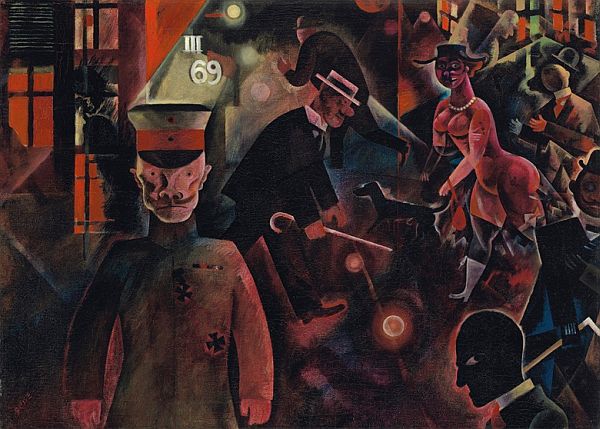
Gefährliche Straße  (above) captures Berlin’s descent into moral and physical chaos. It is one of a series of around 20 paintings — roughly half of which are now lost — that Grosz made of the city at night between spring 1917 and November 1918.
 
Peace would be signed with the Allies on 11 November 1918, two days after Kaiser Wilhelm II abdicated as Emperor. In the wake of Germany’s defeat, Grosz said he ‘was disappointed not because the war had been lost, but because the people had suffered for so long without heeding the few voices raised against the mass slaughter’.
 
 
4  He became a key figure of the Dada movement
 
Starting in Zurich, before spreading to other European cities as war came to an end, Dada was rooted in disbelief that a conflict as absurdly long and devastating as World War I could have been fought in the name of progress. Dadaists concluded that the world had gone mad and that received values must be turned on their head.
 
In a defeated, demoralised Berlin, this included provocative stage performances — such as an obscene tap-dance routine with which Grosz made a name for himself. He also helped pioneer the technique of photomontage, which involved assembling fragments of photographs to create a synthetic new image — a reflection of the fractured Europe that was being unconvincingly pieced back together in the wake of the Treaty of Versailles.


5   Grosz was the pre-eminent chronicler of Berlin in the Twenties
 
Between the collapse of Germany's monarchy in 1918 and the rise to power of Adolf Hitler in 1933, Berlin gained a reputation for being the bawdiest, most licentious city in Europe. Its cabaret acts were outrageously explicit, and its brothels were infamous. It is said that cocaine could be bought in the city's nightclubs for half the price of a decent dinner. ‘Barbarism prevailed... the times were mad,’ wrote Grosz in his autobiography, A Little Yes and a Big No. His best-known works are visions of the seamy side of German metropolitan life at this time, which, along with Christopher Isherwood's ‘Berlin’ stories about Mr Norris and Sally Bowles, have indelibly shaped our picture of what the German capital was like in the Weimar years. They give off a heavy whiff of social decadence and political corruption. Take, for instance, Grosz’s 1922 watercolour Orgie, depicting a dingy bar in which a grotesque, cigar-chomping drunk spews wine through his teeth, while other patrons defecate and copulate around him.


6    He was sued on various occasions
 
In his drawing collections such as The Face of the Ruling Class and Ecce Homo — as well as in his work for journals and broadsheets — Grosz depicted greedy capitalists, smug bourgeoisie and nouveaux riches hags, among other social groups. Blessed with a razor-sharp wit, he was a social satirist who saw himself continuing in the tradition of William Hogarth.
 
As the German philosopher Hannah Arendt observed years later, however, Grosz's cartoons ‘seemed to us not satire so much as realistic reportage. We recognised these types, they were all around us’.
 
Pimps and prostitutes abound in Ecce Homo, a book that caused such a furore that Grosz felt compelled to apply for a pistol license on the grounds of self-defence. He was also taken to court on charges that 52 of the book’s 100 images were pornographic. Grosz was tried in February 1924 and was fined 6,000 marks. Numerous plates from the publication were confiscated and banned. This was the first of three separate occasions on which Grosz was successfully sued for producing offensive artwork.
 
These events may have led to his extended trip to France in 1924, and a further stay in Paris from June to October in 1925. The Dingo American Bar was opened in 1923 and quickly gained notoriety among English-speaking artists and writers, not least because it was one of the few drinking-houses that was open all night. Ernest Hemingway first met F. Scott Fitzgerald there in April 1925, two weeks after the publication of The Great Gatsby and a few months before Grosz executed a study of the bar.


7     He briefly became a Communist
 
Grosz's work often expressed sympathy for poor, downtrodden workers suffering at the hands of rich, fat-cat bosses. ‘To show the oppressed the true face of their masters is the purpose of my work,’ he once said.
 
For a while, he was a member of the Communist Party, even receiving his membership card personally from Rosa Luxemburg (though over time, and after an underwhelming meeting with Lenin in the Soviet Union in 1922, his party loyalties waned).
 
Grosz felt that the fall of the Kaiser removed few of the inequalities that had long existed in German society. In 1930, he found an outlet for his frustrations by designing the costumes for Carl Sternheim’s adaptation of Flaubert’s political satire, The Candidate. Updated from 19th-century France to contemporary Berlin, it follows an ambitious candidate for the Reichstag who is courted by three different political party leaders — and who ultimately gives up his own wife to one of them to win the election.
 
8    His work was included in the Nazis' exhibition of ‘Degenerate Art’
 
After a brief, enjoyable spell spent teaching in New York, Grosz returned to the US on what turned out to be a long-term basis in 1933, just a week before Hitler became German chancellor. (He would remain in America for more than two decades.) Grosz’s subject matter was highly objectionable to the Nazis: they labelled him ‘Cultural Bolshevist Number One’, destroyed many of the works he’d left behind and included another 15 in their Entartete Kunst exhibition of ‘degenerate art’ in Munich in 1937.
 
By this point, however, Grosz was revelling in life across the Atlantic: as an artist he largely split his efforts between street scenes of Manhattan and windswept landscapes of Cape Cod. For the former, he roamed New York by day, sketchbook in hand, creating finished versions of his scenes by night — a typical result of this process being Quick Lunch, which shows customers of all socio-economic backgrounds crowding around a fast-food counter.
 
9   He became an American citizen
 
In 1938, having been stripped of his German citizenship, Grosz legally became an American. His style softened in these years, although there was still the occasional, apocalyptic painting of hell-fire on earth, which suggests the repression of freedoms back in his birth country were never far from his mind.
 
More than a hint of poignancy can be found in certain works on paper, too, such as the ink drawing titled Refugees, a self-portrait with his two sons. During the Second World War, his mother (who hadn't emigrated to the US with him) was killed in a bombing raid.
 
10   Grosz returned to Berlin six weeks before his death
 
By the 1950s, Grosz had started to drink heavily, and his wife Eva hoped that a change of surroundings — namely a return to post-Nazi Germany — would help him kick the habit. In May 1958 they moved into her parents’ old flat in West Berlin; but in July, after falling down a flight of stairs during a heavy night’s drinking, Grosz died. He was 65.
 
 
10 things to know about George Grosz. By Alastair Smart. Christie’s, January 9, 2020.


A new exhibition of work by the German artist George Grosz is staged, this autumn by Richard Nagy in London.  This major display will be the first in the UK since the Royal Academy’s retrospective almost 20 years ago. Some 50 works by the titan of German satirical art have been assembled from leading private and public collections around the world.

 
The works in this exhibition include savage caricatures and nightmarish visions that articulate Grosz’s sharp contempt for all aspects of bourgeois life in Germany. His childhood distrust of authority figures found its outlet after the catastrophic events of the First World War. Later in life he would describe his experiences in the trenches as ‘wholly negative’ and his caricatures of military generals in works such as Vor der Kaserne (In front of the Barracks) (1918) exude his hatred for the empty bluster of German militarism.
 
In the years following its humiliating defeat, Germany was cast into political disarray. Grosz established a reputation as a formidable satirist, producing bloodcurdling images such as Nieder mit Liebknecht (Down with Liebknecht) (1918) and encapsulating the cynical humour of Berlin’s Dada Movement with his wry illustrations for Die Pleite. Grosz became particularly fascinated by the decadent side of cosmopolitan
 
Berlin in the 1920s. In his art he fought against the base preoccupations of bourgeois society by uncovering a shadowy world of crime, murder and erotic license. Lustmord (Sexual Murder) is a prominent motif in his work, in which the combination of sexuality and violence is presented as a ritualization of the human quest for power, exemplified by political practice.
 
A highlight of the exhibition is an important work that was recently discovered in a private collection and has never been shown outside of Germany. The work is an earlier watercolour version of what Grosz claimed to be his greatest oil painting, Deutschland, Ein Wintermärchen (Germany, a Winter’s Tale) (1918), which was likely destroyed in the early 1930s. The title harks back to a classic of German literature, a satirical poem by Heinrich Heine, but the object of Grosz’s contempt is decidedly contemporary. In the centre of the image a well-fed bourgeois nationalist (Biedermann) sits at a dinner table with an upright knife and fork as though ready to start carving. In the chaos around him the viewer can distinguish brothels, factories and tenement buildings, while figures symbolising the pillars of society – the Church, the Military, and Education – turn a blind eye and loom in the foreground.
 
Several striking watercolours from Grosz’s famous series Ecce Homo (1923) are also on display. Dämmerung (The Gloaming) (1922) shows the day ending and nightlife awaking in the twilight of the big metropolis. A pimp with a cigar in his mouth watches over his harlots roaming the streets, while a neatly dressed businessman can be seen next to a prostitute who is wearing a striking red hat. A blind man at a house corner is selling matches. In the far distance one can detect a suspicious man walking towards the onlooker. A policeman, the so-called Schupo (Schutzpolizei), watches the scene from the corner of his eye, ready to intervene at his discretion.
 
At the root of Grosz’s political message is a moral imperative. As he wrote in 1921, ‘You can’t be indifferent about your position in this activity, about your attitude towards the problem of the masses… Are you on the side of the exploiters or on the side of the masses?’ For this reason, Richard Nagy is pleased to announce that the show will serve to benefit Global Witness, a charity dedicated to protecting communities and their environments from the abuses that result from natural resource- related conflict and corruption. Patrick Alley, Director of Global Witness comments: ‘We are delighted that Global Witness will share a platform with this fascinating and timely George Grosz exhibition. Being so savagely critical of corruption and injustice, his work resonates strongly with our campaigns to tackle the international systems, and political, financial and economic norms which exacerbate these problems.’
 
George Grosz (1893-1959) was born Georg Ehrenfried Groß in Berlin, Germany, though he spent most of his childhood in the Pomeranian town of Stolp. At the age of 15 he was dismissed from high school for striking one of his disciplinarian teachers. Fortunately Grosz had demonstrated artistic talent and he was encouraged to apply to the Dresden Academy of Art. In 1909, at the age of 16, he began a two-year course of study for his art diploma and was accepted into the Berlin Academy in 1911. The outbreak of the First World War in 1914 delayed his ambitions to be an artist and illustrator, but he was eventually released from service on medical grounds. Back in Berlin, he published artwork in Franz Pfemfer’s leftist journal, Die Aktion, and soon became a prominent member of the anti-establishment Dada Movement.
 
Grosz’s artworks quickly attracted the notice of the authorities and in 1921 he was charged with defaming the German army. He would be charged twice more prior to his departure for the United States in the early thirties. During the Third Reich, hundreds of his paintings and drawings were confiscated and many destroyed. In the latter part of his career he tried to establish himself as a pure painter of landscapes and still life, but also continued to produce compositions of an apocalyptic and deeply pessimistic kind. He returned to Berlin in 1958, where he died a few months later.
 
 
George Grosz Exhibition Explores Berlin Prostitutes, Politicians And Profiteers Between The Wars. Artlyst, July 26, 2013.


George Grosz in Germany, on view at the New York Studio School Gallery, offers a rich overview of Grosz’s development as an artist and dissident. The works on paper, all from the Louis-Dreyfus Family Collection, featured in the show from 1913–1925 could be considered collectively like a piece of documentary, a primary source for visualizing life in Berlin during the Weimar Republic. It is the portrait of a war victim coming to grips with the underlying horror of everyday reality.
 
Much of his early work, before 1920, fits well into more traditional forms of graphic art like newspaper illustrations, political cartoons, and one work that echoes the lines of Durer’s engravings. Grosz’s pen and ink drawings like “Das Ende,” Chaos,” and “Untitled (Man Walking His Dog),” are less typical for being unapologetically raw and impulsively drawn. They might be Grosz at his best and most disturbed, truly “degenerate.”
 
In the aftermath of World War I, Grosz’s loose, almost painterly approach is more soberly inflected. Grosz’s drawings from this period are described as caricature, in that they serve as a caustic remark upon the Weimar Republic, however, his message is not explicit, in fact, Grosz’s use of cartoon-like imagery and its perceived inferiority in the hierarchy of the arts only sublimates his askance glance at German society. In works like, “Bar Montmartre,” “Berlin Cafe,” and “Portraits,” Grosz offers a gadfly on the wall view of Bourgeois Berliners in situ: on the streets, in cafés, nightclubs, bars, and brothels. His slice of life portraits are immediately nerve wracking, asking the viewer to look for whatever it is that’s awry.
 
Grosz’s deranged yet graceful pen work might first appear as the aping of primitive or outsider art, but it is not merely an artistic affection. His cross-sectional surveying of a scene, marked by intersecting lines, suggests a sustained observation of a subject over time; despite looking like cartoons, they are not imaginary. Grosz’s fluid composition has added fluency in the era of the moving picture — his work unfolds across the paper. Harsh variance in line thickness, suggesting a depth-of-field, further emphasizes a cinematic perspective. In many works Grosz’s seemingly inexpert handling of facial features, the eyes and mouth in particular, gives each subject a distinct personality; however, his rendering of hands is most telling of all.


The gnarled hand featured in detail on the cover of the exhibition’s catalogue hints at what lurks within each work. They recall the contorted appearance of barbed wire, the impact of mustard gas on the nervous system, or the jittering recoil of a machine gun: suggestions of World War I’s lingering trauma. While an entire generation of men was lost or physically wounded, a tell-tale sign of the war’s immediate impact, the psychological toll was more easily repressed. Shell shock, what we now know as PTSD, was disregarded by prominent doctors at the time because it was viewed as a sign of weak will and no conclusive test could prevent anyone from claiming it. However, in extreme cases, PTSD did produce a physiological response, caught on film for the first time and shown in news reels — psychological trauma made indisputable.
 
While Grosz’s military service was brief — he was discharged after a month of service — it had a profound influence on his work. The catalogue text for the recent Dada exhibition at Museum of Modern Art mentions that Grosz “may have suffered shell shock.” After some internet sleuthing, I found that he did, in fact, suffer from shell shock towards the end of the war in 1917.
 
Grosz’s own words describing the mental turmoil he suffered on the battlefield:
 
““My nerves broke down, this time before I could even get near the front and see rotting corpses and barbed wire … Nerves, down to the tiniest fiber, nausea, revolt — pathological, maybe —anyway, a total breakdown, even in the face of omnipotent regulations”
 
 
As Grosz’s experience suggests, shell shock is much more than a temporary condition caused by exposure to shock waves from bomb blasts. Shell shock, or PTSD, is a lasting impression left by any sort of exposure to the grotesqueries of war. PTSD is a suitable condition to ascribe to Germany itself post-WWI, made all the more relevant by the fact that Hitler’s experience with the disorder is suggested to have led to his radicalization. Unfortunately for the world, Hitler did not recover through cathartic mark-making like Grosz.


Caricature serves as perfect metaphor for a mind off-kilter, Grosz reduces Weimar society to a few discernible lines, and each stroke provides him a platform for airing his grievances. His restraint is at once raw and elegant, a calculated vacillation between astute draftsmanship and unrestrained gesture, offering a level of psychological insight we risk losing with increasing dependence on computer intervention between the artist and object. Grosz’s pen and ink on paper drawings provide indelible intimacy with a mind maimed by war.
 
George Grosz in Germany, curated by Karen Wilkin, is on view at the New York Studio School Gallery (8 West 8th Street, Greenwich Village, Manhattan) until January 4.
 
The Shock and Awe of George Grosz. By  Robert Cicetti. Hyperallergic, December 12, 2013.


The heirs of German artist George Grosz are demanding the return of works that were stolen during the Nazi era and now hang in museums. They want to exhibit the works in a Grosz museum, but their legal status is murky.

 A rear apartment building in Berlin's Wilmersdorf neighborhood; a studio on the top floor; a journey to the past: Art historian Ralph Jentsch holds photos that are more than 90 years old. "Unbelievable," he says. The radiator is still the same, and so is the door. "This is the way it looked when George Grosz painted in this room."

 It was in this studio where Grosz, the great expressionist, Dadaist and social critic, created the art that made him world-famous -- paintings and drawings of fat speculators, cynical military officials and extravagant prostitutes, of the maimed victims of war and the emaciated poor. Until 1932, Grosz painted in the studio, with its five-meter (16-foot) ceilings, where an artist from Moscow paints today.

 When stormtroopers broke down the door of Grosz's live-in studio on Jan. 31, 1933, the day after the Nazis came to power, the artist and his family were already in New York. "I very much doubt I would have made it out of there alive," he later wrote.

 Grosz had consigned most of his paintings and drawings to his art dealer. But the dealer, who was Jewish, also had to flee the Nazis and took only some of the works out of the country. In connection with their campaign against so-called "degenerate art," the Nazis confiscated 285 of Grosz's works in museums, some of which they sold. (Most were burned.) About 70 paintings vanished without a trace. Ralph Jentsch, visibly moved as he looks around in Grosz's former studio, is the managing director of the painter's estate. He wants to "make up for the injustice" that the Nazis inflicted on the artist. He says: "They plunged him into misery."

 When Grosz learned that the Nazis had burned a large share of his life's work, his wife Eva wrote after the war, "there was a complete collapse," and he began to suffer from "anxiety, particularly nightmares" and "to drink without moderation." In July 1959, shortly after his return to Berlin, Grosz was found in a stairwell one morning, unconscious from a drinking binge. He died a short time later.

 Of course, it's impossible to make up for Grosz's tragedy half a century later. Jentsch knows this. He has spent 20 years assembling a catalog of Grosz's works, a compilation of about 14,000 photos and seemingly endless lists. "At least the stolen pictures should be returned to his family," says Jentsch.

 Grosz was a prolific artist. He created about 450 paintings and more than 15,000 works on paper. Pictures from his Berlin days are worth millions today, and Jentsch has traced some of them to prestigious museums in New York, Vienna, Tokyo and Bremen. But their directors are opposed to returning the works to Grosz's heirs. They see themselves as the rightful owners.


 This claim, however, is at least up for debate. Since the 1998 Washington Conference on Holocaust-Era Assets, there has been international agreement that works of art stolen or "confiscated as a result of persecution" during the Nazi years should be returned to their former owners. In the Grosz case, this would be his son Marty, 78, who lives in Philadelphia, and his sister-in-law Lillian, in Princeton, New Jersey. The Grosz heirs agree that they do not want to place restituted works on the market. Instead, they hope to exhibit the paintings and drawings confiscated in the Nazi era at a George Grosz museum, and they are considering Berlin as a possible location.

 Grosz has undoubtedly earned a museum of his own -- particularly since not a single art collection in the world contains more than two of the Berlin native's works. This is ironic, because Georg Ehrenfried Groß, as his name appears on his birth certificate, was one of the most prominent German representatives of modernism. His first solo exhibit, in Munich in April 1920, provoked angry criticism. The Bayerischer Kurier newspaper warned against the "witch's cauldron from which this mad, caterwauling brew emerges, in rutting ecstasies of wild, unbridled instincts." It didn't take long before the public prosecutor's office began charging Grosz, a Dadaist and radical provocateur, with insulting the Army of the Reich, disseminating obscene writings and blasphemy.


Not Jewish, but Persecuted

 In 1926, Grosz signed a contract with gallery owner Alfred Flechtheim, the most influential art dealer in the Weimar Republic, who also represented Pablo Picasso, Paul Klee and Ernst Barlach. Their business relationship ended when the art market collapsed during the Great Depression, and Flechtheim cancelled the contract in 1931. It was a heavy blow to Grosz. Though museums were buying his paintings, he was chronically broke and depended on Flechtheim's advances. The situation was "grim, at least as far as the (German) mark is concerned," Grosz concluded. "My source of income is gone."

 His socially critical art made Grosz, a leftist and pacific, a hated figure of the right. An officer shot at him in a restaurant, but hit a waiter instead. He received anonymous threats on a regular basis, and he once found an iron pipe in his studio with the following note attached: "This is what you'll get, you old Jewish pig, if you continue what you're doing."

 Unlike Grosz, Flechtheim, the art dealer, was Jewish. So he was also at risk when the Nazis came into power, and when he fled to Paris in 1933, Flechtheim left at least 70 paintings by Grosz and many more watercolors and drawings in Berlin. Before an insolvency administrator could take over the company, Flechtheim managed to move about half of the Grosz works to Paris, where he tried, unsuccessfully, to sell them.

 In a secret "Census of Leading Men of the System Era" compiled by the SS, Grosz was described as "one of the most despicable representatives of degenerate art, who works in an anti-German fashion." The document notes that he was "deprived of citizenship on March 8, 1933." Meanwhile, a despondent Grosz was in New York and didn't know what had happened to the paintings and drawings that had remained in Berlin. The loss made him "sad and angry," says his son Marty.


 In late 1952, however, Grosz discovered his painting titled "The Poet Max Herrmann-Neisse" at the Museum of Modern Art (MoMA) in New York, which the MoMA was proudly presenting as a new acquisition. Grosz wrote to his brother-in-law in Berlin: "The Modern Museum exhibited a painting stolen from me (am powerless to do anything about it). They bought it from someone who stole it."

 When estate administrator Jentsch and the family's attorney recently negotiated with the MoMA over a possible return of the painting, its attorney coolly noted that the museum considered itself the painting's rightful owner.

 David Rowland, a lawyer who specializes in restitution, successfully negotiated the controversial return of the painting "Berlin Street Scene," by Ernst Ludwig Kirchner, one of Grosz's contemporaries. Rowland has proposed declaring the Grosz painting shared property of the heirs and the museum for three years. If the MoMA could not substantiate its property rights within this period, he argued, the painting should go to the heirs. The museum has recently rejected the proposal.

 Through painstaking detective work, though, Jentsch managed to trace much of the portrait's adventurous path to New York. After Grosz emigrated it was still at the Flechtheim Gallery in Berlin. In 1937, an art historian named Charlotte Weidler said she had inherited it from Flechtheim. But before he died in exile in London in March 1937, Flechtheim had designated his nephew as his sole heir.

 Weidler immigrated to the United States. In 1952 she sold the "Portrait of Max Herrmann-Neisse" to the MoMA through an agent. The museum paid $850 for the work. Today, that's dirt cheap. But before World War II, other Grosz works were unloaded for a fraction of this amount. In 1936 Flechtheim consigned more than two dozen works to Carel van Lier, an Amsterdam art dealer. After Flechtheim's death, van Lier contacted neither his wife in Berlin nor Georg Grosz in the United States, but held an auction instead.

 The auction was rigged in advance, and 24 paintings sold for an average of 15 reichmarks apiece -- about €150 ($203) today. Van Lier bought five of the most important paintings himself and re-sold them later for a substantial profit.

 The Kunsthalle Museum in Bremen has two of Grosz's works today: the painting "Pompe funèbre," one of the works sold off in the rigged Amsterdam auction, and "Still Life with Okarina," which was seized in Berlin.

 Six years ago, Jentsch wrote to Wulf Herzogenrath, the director of Kunsthalle Museum. Herzogenrath still argues today that the paintings were bought at auction in Amsterdam "during peacetime." "Besides," he continues, "they no longer belonged to Grosz, but to Flechtheim."

 Strong Resistance

 Other Grosz paintings were dispatched around the world from Amsterdam along similarly serpentine and legally contested paths. "Promenade" is on display at the Bridgestone Museum in Tokyo, and Vienna's Museum of Modern Art insists that it is the rightful owner of the painting "Keepsake -- The Alliance."

 Private collectors have proved to be more understanding than, for example, the restitution advisory panel of the Austrian Ministry of Culture. An American brought the painting "Ideas of the Time," which had been hawked in Amsterdam, to the Sotheby's auction house in New York. After Jentsch told the owner of the painting about its history, he returned it for a finder's fee. A similar arrangement is being negotiated with a German-American family that owns the painting "Still Life with Pipe and Okarina."

 But Marty Grosz continues to meet strong resistance at museums. "In theory, the Washington declaration on the return of art stolen in the Nazi era is very good," says the painter's son, but in practice, he adds, things are "pretty unfair." And the heirs lack the necessary funds to sue the museums for the return of Grosz's works.

 Marty Grosz is becoming increasingly skeptical over whether his dream of a Georg Grosz museum will ever become reality. "Suing would take forever," he says. "By the time the courts decide, I'll be long dead."


Re-Collecting George Grosz's Art. By Michael Sontheimer. Der Spiegel, March 26, 2009.


Further info here


05/11/2021

Lotte Laserstein : A Name We Need To Know.


Meret Becker on Lotte Laserstein

 
Meret Becker is convinced that she has already lived in another time - as a figure in a work by Lotte Laserstein. She takes a look back at the artist's life in Berlin in the 1920s and 1930s, the years before Laserstein was exiled.  Meret Becker is convinced that she has already lived in another time - as a figure in a work by Lotte Laserstein. She takes a look back at the artist's life in Berlin in the 1920s and 1930s, the years before Laserstein was exiled.  
 
UP CLOSE: In this series of short films, nine actors each look at one of the artists from the exhibition “CLOSE-UP”. Approaching the subject, they share their impressions in their own way and in their own words. The result, in each case, is a very personal portrait of the artist that says as much about the speaker as about the subject.
 
Fondation Beyeler, September 18, 2021


Lotte Laserstein's painting entitled Self Portrait with a Cat (1928) may be regarded as exposing a range of information about its creator, even for the casual observer. When creating this realist painting, the German-Swedish artist captured not only a detailed likeness of herself but carefully constructed the work to express much about her stance in life, in addition to her role as an artist.

 
The self-portrait was intended, of course, as a form of representation to project meaning on character, identity and status. For women particularly, creating images of themselves in the genre of painting has been a historically arduous task, as gendered assumptions and cultural limitations had to be ingeniously surmounted.
 
Yet, in her self-portrait Laserstein boldly confronts expectations. While both capturing and captivating the viewer with her direct gaze, her portrait was not a simple echo of the self but offered a challenge to perceptions of both 'the female artist' and womanhood itself. The work, in turn, was indicative of Laserstein's approach to the expression of her art and in her life more generally.
 
Born in Preussich-Holland in Prussia during 1898 into a family of part Jewish heritage, Laserstein lost her father at the age of just four years old. The death caused the family to relocate into the home of the artist's maternal grandmother. Here Laserstein's mother was known to paint ceramics and it can be presumed the young Lotte was influenced by such artistic endeavours.
 
After the family moved again in later years to Berlin, Laserstein began her adult education in such areas as the history of art and philosophy, while also taking lessons in painting. Her entrance into the city's College of Fine Arts during 1921 was a bold move for the young artist in the first years of the school allowing entrance to female students. Her later completion of studies at the United State School of Liberal and Applied Art enabled Laserstein an excellent foundation for a career in art. The economic woes of the country in an era of high inflation, however, took a toll on the family's finances and the young artist was forced to work in such areas as industrial design.
 
Nevertheless, Laserstein's promise in her chosen field of fine art was soon recognised by the school, who viewed her work as amongst the best at the academy and she was honoured by the Prussian Ministry of Science, Art and Education. Opening her own art studio in 1927 while supporting herself by giving painting lessons, the artist soon began creating her work in earnest. It was here, in the following year, that Laserstein created her self-portrait with the addition of her feline companion.
Laserstein began to be included in many exhibitions, and her work became more widely acknowledged as a result. Her prominent role within the Association of Berlin Women Artists further aided her career. The painter's art was centred on figurative reflections and portraiture in an age of post-expressionism, amidst the growing popularity of a movement known as New Objectivism. The artistic focus was being removed from the emotive outpourings of the previously favoured expressionist painters and had become fixed on an unsentimental realism.
 
The realistic work Laserstein produced during the late 1920s and early 1930s, often featuring her favoured female models, certainly caught the mood of the age. This era known as the Weimar Republic, encompassed a German renaissance in cultural terms despite the economic and political turmoil, as the Berlin bars bustled with artists and intellectuals within a flourishing bohemian scene.


Laserstein's portraits reflected not only the lives surrounding her but also the mood of the era. The painting Woman in a Café, a commission featuring the wife of a well-known lawyer, presents the subject as a fashionably attired woman of the age. The seated figure is featured alone with her cocktail, indicative of the growing independent spirit of women and is posed confidently as she leans forward to engage with the world she inhabits.
 
Another of Laserstein's paintings, The Yellow Parasol (1935), is reflective of a looser painting style for the artist and presents a young woman holding the object of the title. While a common theme in Western art since the nineteenth century, Laserstein added a twist to the familiar formula which avoids the contrived depictions of femininity common in the work of artists such as Renoir.
 
Here Laserstein presents her female subject as rather androgynously dressed, thus countering the cliches of the theme. This was an age of daring exploration after all, in which French artist Claude Cahun was toying with ideas of gender and German-born actress Marlene Dietrich was kissing women on screen dressed in a tuxedo. The model who posed for Laserstein's painting was known as Traute Rose, a close friend of the artist who featured in many of her artworks and played a significant role in the painter's life.
 
Despite her increasing achievements with each new show and painting, Laserstein's artistic career was soon to be interrupted. The rise of Nazi anti-Semitism created a toxic atmosphere in which artists of Jewish heritage, like Laserstein, were excluded from exhibiting. Unable to purchase art materials easily and discharged from her role in art associations, the painter was forced to develop a plan of escape. In order to leave her homeland, emigrate to Sweden and gain citizenship, Laserstein married a Swedish man. However, she did not cohabit with her new husband and set up a new life independently in Stockholm.
 
Her efforts to save her mother, who remained in Germany, tragically failed and Meta Laserstein died at the hands of Hitler's regime in Ravensbrück concentration camp. The painter's loyal friend Traute, however, did manage to smuggle Laserstein's artworks out of Germany, avoiding their theft or destruction under Nazi rule. Living out her life in the Swedish capital, here Laserstein joined the Swedish Academy of Arts and continued to work particularly in the field of portraiture.
 
Understanding Laserstein's view of herself and her work is enabled by revisiting her Self Portrait with a Cat to decipher the codes instilled within oil on canvas. The significance of the setting is particularly relevant. The artist's studio, communicated by the centrality of the painter's tools in the background, connects the figure to her work and creativity. Meanwhile, the easel, canvas and hovering paintbrush in hand all highlight the act of painting as Laserstein flaunts her professional abilities to the viewer. The subject is reflected in suitable attire for the job, reflective of a practical approach to her work which purposely ignores gendered conventions on female appearance. In addition, the subject's hair is short, and she wears no make-up, or indeed, any sign of expected feminine costume. While enjoying the soft textures of the cotton overall and feline fur, the painter presents herself as particularly rigid and her gaze is strong, while her slightly raised eyebrow seems to question the viewer's assumptions.
 
Undoubtedly painted while looking into a mirror, the painter conveys an assured self-reflection buoyed by her burgeoning success. Also, by utilising a pose reminiscent of the self-aggrandising statements of male painters throughout history, Laserstein makes a carefully considered declaration of her own.


As is the case for so many women in the arts, Laserstein's work generally went into relative post-war obscurity and was only rediscovered in the last years of her life. An exhibition of her work was held in the late 1980s which showcased many of her paintings to a new generation. This included work featuring her notable male subjects also, such as Nobel Prize-winning biochemist Sir Ernst Chain in a 1945 portrait conveyed in Laserstein's typical realist style. The exhibition was attended by both the artist and her ever-present muse Traute, who appeared in many intimate artworks by the artist.
 
Laserstein died in 1993 as her paintings were finally receiving the international recognition they deserved. Her legacy, in turn, is one of presenting the world with a beguiling body of work which encompasses an obvious understanding of her subjects, perhaps no more so than in the portrait with a fearless female gaze.
 
Lotte Laserstein: the German realist who challenged expectations. By P.L. Henderson. Art UK , February 15, 2021.


Die lange vergessene Malerin Lotte Laserstein bekommt auch in ihrer ehemaligen Heimatstadt einen Erinnerungsort. An ihrem Wohnhaus im Bayerischen Viertel in Berlin hängt nun eine Gedenktafel für die Kunst-Pionierin der Weimarer Republik

 
In Berlin erinnert jetzt eine Gedenktafel an die deutsch-schwedische Malerin Lotte Laserstein (1898-1993), die für viele Menschen eine der großen Kunst-Wiederentdeckungen der vergangenen Jahre ist. Die Tafel wurde in dieser Woche an ihrem ehemaligen Wohnhaus in der Jenaer Straße 3 im Stadtteil Wilmersdorf angebracht, wie die Senatsverwaltung für Kultur mitteilte. Eine feierliche Enthüllung gab es wegen der Corona-Pandemie nicht.
 
Laserstein-Ausstellungen waren kürzlich in der Berlinischen Galerie und im Städel Museum in Frankfurt/Main zu sehen. Die Malerin gilt heute als eine der wichtigsten Künstlerinnen der Weimarer Republik. Sie war eine der ersten Frauen, die in den 20er-Jahren an der Kunstakademie in Berlin studierte und 1937 vor den Nationalsozialisten nach Schweden floh, wo sie eine Malschule gründete. Lotte Laserstein war zu Lebzeiten durchaus bekannt und erfolgreich, vor allem mit ihren sinnlichen Darstellungen von selbstbewussten Frauen. Erst mit den Ausstellungen der vergangenen Jahre wurde jedoch ihre Rolle in der Kunstgeschichte angemessen gewürdigt und ihr Werk einem größeren Publikum bekannt. Inzwischen befinden sich zwei wichtige Werke in Sammlungen ihrer ehemaligen Heimatstadt Berlin. Die Berlinische Galerie kaufte 2019 das Porträt "Dame mit roter Baskenmütze" von ca. 1931, das monumentale Gemälde "Abend über Potsdam" gehört der Neuen Nationalgalerie.
 
Gedenktafel für Lotte Laserstein,  Späte Ehre. Monopol Magazin, June 25, 2020.


In 1929, the German daily Berliner Tageblatt featured an art review that alerted readers: “Lotte Laserstein – a name we need to know.” The works of Laserstein, then 31 years old, were among those featured at the show under review. “The artist is one of the best among the young generation of painters. We will have cause to continue watching her shining ascent,” the newspaper promised.
 
In the next few years, Laserstein fulfilled some of those expectations. Her paintings were displayed at some 20 exhibitions in the German capital and she also received a number of awards – but due to her Jewish roots on her father’s side, her promising career was cut short with the rise of the Nazi regime in 1933.
 
After her work was barred from being shown, Laserstein fled to Sweden where she continued to paint, although she had difficulty replicating her budding career as an artist there. She died in Kalmar, Sweden in 1993. It was only in the latter years of her life that there was a revived interest in the work of the woman who had showed such promise in the waning years of Germany’s Weimar Republic.
 
“Face to Face,” now on at the Berlinsche Galerie museum of modern art through August 12, is an impressive, comprehensive exhibition of Laserstein’s paintings, curated by Annelie Lütgens. It brings the artist’s work back to the city where her career first blossomed – a city whose residents during that era feature in many of her paintings.
 
Acclaimed by the German media, “Face to Face” challenges viewers because it’s difficult to define Laserstein’s work as belonging to any discrete aesthetic category. The paintings on show are from the interwar period, when the artistic landscape in Germany was characterized by a multiplicity of avant-garde styles and trends. Laserstein excelled particularly in her warm and empathetic portraits, many of which featured modern, liberated women, but even when addressing innovative ideas in her paintings, she maintained a meticulous realistic style that was unusual in her day.
 
The prime example of this is her best-known painting, a large work from 1930 entitled “Evening Over Potsdam,” portraying five people deep in thought, sitting around with a table on a rooftop terrace, with a dog. In the background is the city skyline at twilight, overshadowed by dark clouds. Despite its realistic style – and the fact that it is somewhat reminiscent of Da Vinci’s “Last Supper” and Johannes Vermeer’s “The Milkmaid” – the painting conveys an aura of unease and sorrow, which appears to be an accurate reflection of the era in which it was created, in the late 1920s, when economic and political crises shook Germany and ultimately led to the rise of Nazism.
 
“Evening Over Potsdam” and a good number of other paintings by Laserstein are proof that the artistic spectrum during the Weimar years was broader than generally thought, says German art historian Dr. Anna-Carola Krausse. About 15 years ago Krausse produced a groundbreaking, comprehensive study of Laserstein’s work and curated an exhibit of her work that marked the beginning of renewed interest in the artist, in Germany.


Laserstein combined the 19th-century academic style in which she was trained with contemporary subjects, says Krausee, thereby allowing us to expand the significance of the concept of artistic modernism. And although her work was undoubtedly modern, it also shows how figurative and not just abstract painting can capture the spirit of an era.
 
The Berlinische Galerie show features about 60 of Laserstein’s works, most from the early years of her career in Berlin, although some are from her time in exile in Sweden. Also on display are the palette she used, as well as photographs and documents that offer insight into her life.
 
Discovering Rose
 
Lotte Laserstein was born in a small town in East Prussia in 1898; her mother who was a pianist and a father who was a pharmacist and died when she was very young. She moved with her mother and sister to Danzig (now the Polish city of Gdansk). As a girl, she studied painting with her aunt, who was also an artist.
 
The family moved to Berlin before World War I, and thereafter Laserstein studied philosophy and art history at the city’s Friedrich Wilhelm University. She was then accepted at the Berlin Art Academy, which had just opened its doors to women a few years beforehand. One of her primary instructors there was the German-Jewish painter Erich Wolfsfeld.
 
In 1925, by chance, Laserstein met a salesclerk named Traute Rose, whom she asked to be a model for her paintings. The two became close and Rose, who went on to be an actress and singer, features in many of the artist’s works. On more than one occasion, Rose appeared next to the artist in them, and was considered to be an equal partner in the composition – as opposed to the usual artist-model hierarchical perception.   


As with other women whom Laserstein painted, Rose fit the image of the “new woman” of the Weimar period, a time when women were gaining increasing independence. Along with the right to vote, they were taking jobs that had been previously seen as men’s work and in some instances, even adopted a male or androgynous appearance.
 
During a tour of the current show, art historian Krausse draws particular attention to Laserstein’s portraits of women, including “Tennis Player” (1929), depicting a sport that was becoming popular at the time in Germany; “Girl Lying on Blue” (1931), which was selected as the exhibition poster; and “Self-Portrait with a Cat” (1928), in which the artist sought to demonstrate her professional capabilities, toying with the tradition of self-portraiture, according to Krausse.
 
In the painting the cat represents femininity and the artist is dressed like a man and has a man’s haircut. The viewer will note that the canvas near her in the painting is blank: It’s the painting that she is about to create, while still sitting and peering into the mirror. Here, as with other works, Laserstein was trying to understand perspective, allowing us to see together with her rather than seeing through her, says Krausse.
 
Not a ‘party girl’
 
Another major work from Laserstein’s early years is “Russian Girl with Compact” (1928), which depicts a young woman from Russian émigré circles in Berlin – which didn’t keep Laserstein from winning a prize in a competition of portraits of German women, sponsored by a cosmetics firm. The way in which the artists presented the émigrée as a young, up-to-date urban woman who is meticulous about her appearance, suited the growing discourse at the time about the importance of fashion and grooming in exhibitionist Western society.
 
Krausse stresses that, “In Laserstein’s portraits of women, as opposed to portraits created by male artists of the time, the model is not perceived as an object, but rather as a subject. She presents them as women with natural self-confidence, without provocations or eroticism, and also without a perception of ‘sweet’ femininity, as can be found in other female painters of the time. There is no difference in the way she paints men and women.”
 
An example of this is one of her important paintings, “In the Tavern” (1927), which portrays two women, each sitting alone in a café. The painting, which is not included in the present exhibition, was originally acquired by the Berlin municipality and later confiscated by the Nazis, who described it as “degenerate art.”
 
That work is also exceptional among Laserstein’s oeuvre because it focuses on the new and vibrant urban culture of the early 20th century – a subject that preoccupied many artists during her time but for the most part did not arouse her curiosity. Krausse explains that Laserstein was not involved in the Bohemian cultural scene in Weimar Berlin.


“She wasn’t a ‘party girl’ and didn’t spend time with the great artists of the period at the Romanisches Café or other places in the city where they would go,” says the historian. “Moreover, avant-garde was not her natural milieu, and when she began her independent career in the late 1920s, Expressionism, Dada and Surrealism were in any case no longer in vogue. She worked parallel to the artists of the New Objectivity movement, including Max Beckmann, Otto Dix, George Grosz and Christian Schad, and she really resembles some of them in her post-Expressionist style and her return to naturalistic painting. But as opposed to them, her work does not contain scathing political and social criticism.”
 
During her most productive years Laserstein received a prize from the Prussian Ministry of Art, joined the association of women artists in Berlin and had a solo exhibition at the highly regarded gallery of Berlin art dealer Fritz Gurlitt. But shortly after Hitler’s government took over, she was banned from participating in shows and her studio was closed.
 
Laserstein earned a living as an art teacher at a Jewish school in Berlin and in 1937, after being invited to mount an exhibition in Stockholm, took advantage of the opportunity in order to flee, taking a selection of her paintings with her. In Sweden she made a living mainly from selling work on consignment. She tried unsuccessfully to help relatives who remained behind in Germany: Her sister survived in hiding in Berlin during the Holocaust, but their mother was arrested and died in the Ravensbruck concentration camp.
 
After the war Laserstein visited Germany and renewed her relationship with her friend Rosa, but she never returned to live in the country. She lived in the Swedish city of Kalmar and although she continued to paint and exhibit from time to time, she found it difficult to revive her reputation – both because of her style, which didn’t suit the new trends in European art, and because of her distance from the centers of the European art scene.
 
Before Laserstein died in 1993, however, she did witness the rediscovery of her work, which began in 1987 with an exhibition in London. It continued with greater momentum after her death and since the beginning of the millennium, her paintings have aroused great curiosity among curators, art scholars and collectors alike. Their prices have also been rising steadily in the past decade: “In the Tavern” was sold at public auction for 110,000 euros, and “Evening over Potsdam” was acquired by the New National Gallery in Berlin for 350,000 pounds sterling (about $435,800).
 
Among art-lovers in Israel Laserstein is still not very well known – although “Evening Over Potsdam” was one of the prominent works in the German art exhibition “Twilight Over Berlin,” held about four years ago at the Israel Museum in Jerusalem. The artist and the painting were also represented in a charming literary form in the 2018 Hebrew novel “The Modern Dance” by Michal Sapir, where they come to life in a story inspired by the writings of Jewish philosopher Walter Benjamin, which takes place in Berlin during the twilight of the Weimar Republic.
 
“We were guests with a group of friends at an evening meal in the home of painter Lotte … in Potsdam,” writes Sapir, in the voice of the main protagonist, who is looking at the city spread out before his eyes beneath a cloudy and murky sky. “Dora was wearing her sleeveless yellow summer dress. The air breathed heavily in the oppressive heat of late summer. On the table leftover bread from the meal and a few pale apples and pears were scattered. I stood there on the balcony permeated with a feeling of endless exile …
 
“Lotte poured milk into the coffee cups. Erwin Kraft [another character] still had a half-full glass of beer in his hand … I returned to the table and looked at my friends who were sitting immersed in a soft twilight melancholy, averting their pensive glances from one another. I imagined them, each one of them, replacing their facial expressions with the numbers on the face of an alarm clock, which rang for 60 seconds every minute.”
 
Work of a Nazi-banished Artist Is Back in Focus in Berlin. By Avner Shapira. Haaretz, July 25, 2019. 


‘Face to Face’ is an apt title for this comprehensive survey of the work of Lotte Laserstein (1889–1993). Throughout her life, Laserstein was preoccupied with the enigma and confrontation of the returned stare, her own emerging as the most constant and profound of all. It is the portraits, specifically the self-portraits in which Laserstein’s dark eyes look back at us under hooded lids, with an almost haughty upward tilt of her top lip, that make an indelible impression. A ‘face-to-face’ suggests a deeper level of communication and, with this on offer, we have an obligation to return the gaze squarely, with eyes and mind open.

 
The vivid portraits of the new women and modern men of the Weimar Era for which she is celebrated are carefully complemented in this show (which has travelled from the Städel Museum) with landscapes and later works made after Laserstein emigrated to Sweden in 1937. If these works lack the edge of those from the Berlin years, they reflect how, in enduring the mental schism of forced exile, her relationship to her talent became complicated. She took on commissions to earn a living, but in 1946 felt ‘wretched that after nine years in Sweden one is no further on than at the beginning’. Gothenburg Harbour (1943), a nocturne drawing inspiration from Old Masters as much as lens-based innovations of the age, enriches our understanding of what Laserstein could do with paint, but the later works also question the idea that suffering begets ‘great art’. Classified ‘three quarters Jewish’ under the Nazi dictatorship, Laserstein had been banned from participating in German cultural life after 1933. In 1943, she learned that her mother had been murdered at Ravensbrück concentration camp.
 
 
Laserstein’s bravura skill as a draughtswoman reaches its peak in her masterpiece Evening Over Potsdam (1930). Here, the looming political nightmare seems to descend over a group of weary moderns engaged in a secular version of The Last Supper. This skill was, perhaps, a sort of albatross in the era of the ‘New Objectivity’, with contemporaries such as Christian Schad and Jeanne Mammen pursuing a more obviously avant-garde agenda. But how might she have warped her line to greater effect? What did it mean to possess such pure illustrative technique, when everything about your identity could be deemed ‘warped’?


The exhibition texts avoid comment on Laserstein’s sexuality, erring towards the idea that ‘if anything, it is painting itself that comes across as the erotic act for Laserstein’. As a queer viewer, it is not that you demand an absolute position on the artist’s sexuality, rather that the conversation shouldn’t always lean towards a heteronormative viewpoint; one that regularly assumes the potential sexual relationship between a male artist and his muse, but ignores or neutralises what is on display here. Laserstein’s portraits of her ‘friend’ Traute Rose are laced with same-sex intimacy. It is widely agreed that Laserstein’s great power is her ability to communicate psychological states between characters or, indeed, the characters and ourselves. It therefore seems odd, blind even, to turn away from Laserstein’s sexuality.
 
In I and my Model (1929/30), the artist works at her easel, her face turned to confront the viewer, her eyebrows arched knowingly. Traute, not classically nude, but in a domestic state of undress, observes close behind, her hand on Laserstein’s shoulder where a patch of light beneath electrifies the gesture. It is a radical take on the gendered power-play of the artist and model, feminist in its depiction of care and interdependence, while glinting with delight and provocation. Its erotic charge is picked up in a series of quick, tender sketches of Traute sleeping naked in bed, executed on pages from a small sketchpad that might have been kept by the bedside and reached for upon waking. In the At the Mirror (1930/31), the naked Traute grapples with a mirror. Her back is to the viewer, so that her reflected stare is the only clearly visible face in a composition that hints at The Three Graces. Traute meets her own determined, sensual expression as Laserstein stands braced in front of her easel in a dingy workman’s coat, energetically squeezing paint on to her palette. Traute, the mirror, and the edge of Laserstein’s canvas as it slices back into the picture plane, are luminous elements in the painting, framing Laserstein, as she so often depicted herself, at work.
 
Is it time to take Lotte Laserstein at face value? By Phoebe Blatton. Apollo Magazine, June 20, 2019. 


Emily May speaks to the curator of Face to Face, a retrospective on the work of the portrait painter Lotte Laserstein.
 
“The Golden Twenties” hold a special allure for many people. During this time cities all around the world were overcome with raucous parties and artistic innovation, but none as much as Berlin. Funded by American loans, and under the leadership of the newly formed democratic Weimar Republic, the post-war German capital enjoyed a new era of decadent nightlife and nurtured the beginning of a plethora of decade-defining artistic movements, all whilst living in the shadow of political turmoil and the horrors that were yet to come. 100 years since the Weimar Republic was formed, and with the centenary of the beginning of this culturally rich decade a year away, it is unsurprising that there are a plethora of exhibitions and events paying homage to the artists who made the roaring twenties so special.
 
One such exhibition is Face to Face, an upcoming retrospective at the Berlinische Gallery (produced in collaboration with the Städel Museum, Frankfurt) which explores the work of the portrait painter Lotte Laserstein. Opening on 5th April and running through to 8th December 2019, Face to Face will shine a light on a largely forgotten Weimar artist. We spoke to the exhibition’s curator, Annelie Lütgens ahead of the opening to find out more about why Laserstein, and female painters and thinkers in general, are enjoying new-found attention in 2019.
 
​“I [first] became interested in the art of the Weimar Republic during my studies in the late 1970s, when contemporary art turned [towards] realism and a critical view towards… society” says Lütgens, who is the head of the department of prints and drawings at the Berlinische Gallery. “Out of this I discovered women artists of the twenties and started to make research” she continues, saying that she is not only inspired by painters and drafts people, but also women writers of the period such as Irmgard Keun, Djuna Barnes, and Annemarie Schwarzenbach. “All these people tried out, suffered, and finally made their own independent lives as women and artists” says Lütgens. “They are… models still for today.”
 
The paintings of Lotte Laserstein capture the emergence of such strong female personalities. Whilst she depicted subjects from all areas of society, she is particularly renowned for her portrayal of the newly liberated women of the era. “The New Woman, as she was known in the 1920s, wore practical clothes and cut her hair short” Lütgens describes. “Lotte Laserstein repeatedly returns to this contemporary type [in her painting] and she also embodied it herself” she continues. “In her self-portraits, Lotte Laserstein reflects visually on her identity as an artist and as a woman. Like many artists, she uses the genre to convey how she sees and wishes to be seen.”
 
Laserstein’s status as a “New Woman” herself give a different feel to her work in comparison to that of contemporary portrait painters such as George Grosz and Otto Dix, the latter of whom also depicted famous women from Weimar society, such as the cabaret dancer Anita Berber and the journalist Sylvia von Harden. Lütgens cites Laserstein’s double portraits of herself and her sitter Traute Rose as perfect examples of how the artist’s female gaze sets her apart from her male contemporaries. “These intimate double portraits challenge the conventional motif of male artist and muse, replacing the traditional hierarchy with sympathetic collaboration,” she says, stating that “Laserstein depicts the painter and sitter as equal partners.”
 
Despite the innovative nature of Laserstein’s work, her name is less familiar to the public than those of Dix and Grosz, who are consistently prominent in exhibitions about the period. Take the recent Aftermath: Art and War in the Wake of World War One display at London’s Tate Modern as an example, which focused largely on male artists. “The rediscovering of women from the Weimar period started later [than that of] painters like Dix and Grosz” Lügtens laments, yet she does admit that even “they too were forgotten in the first decades after World War Two when abstract art was the favorite style.” Although there has been a rise in the number of retrospectives in the past few years to shine light on the work of forgotten female Weimar artists, Lütgens asserts that “women painters should be part of exhibitions as a matter of cause.”
 
One such recent female-focused retrospective was Jeanne Mammen: The Observer, which was also curated by Lütgens, and came to the Berlinische almost exactly one year before Face to Face. Whilst one might think that Mammen and Laserstein’s works are very similar, due to their joint focus on the archetype of “the New Woman” and the fact that they pursued “an independent artistic life without being part of a married couple or having children”, Lütgens informs us that there are in fact many points of contrast between their artistic styles. “Jeanne Mammen trained as an artist in France and Belgium,” say Lütgens. “She had another background as – you could say – a European big city girl, and she had a left-wing political opinion. She was more of a draftsperson than a pure painter, even in her paintings of the Twenties. Mammen’s style is based on French art, like [that of] Toulouse Lautrec or Steinlen” she continues. Conversely, “Laserstein’s painting is based on German art of the late 19th Century, which is more traditional” Lütgens explains, citing artists Max Liebermann, Wilhelm Leibl and Karl Schuch as influences on her work. But despite these conservative beginnings, Laserstein’s approach did transform over time. “[Her] way of painting became more open in the 1930s. She developed a sensual painterly style which could be compared for example to the French painter Emile Bonnard.”


The development of Laserstein’s style could be seen as a result of her to her move to Stockholm from Berlin in 1937, where she sought refuge from the Nazi party who had forbidden her to participate in public cultural life in Germany due to her Jewish heritage. This change of artistic base also provides another point of comparison between Laserstein and Mammen. “While Mammen did not emigrate and developed her art of resistance in Berlin, Laserstein had to leave her boundaries, and because of that… struggled for her artistic identity” asserts Lütgens. Upon first moving to Sweden, “her portraits of elegant women… seem to pick up where they left off in Berlin. But as time passed, she found the pressure to earn a living from commissioned portraits wearisome and not very inspiring” the exhibition curator informs us. “She seized every opportunity to tackle new artistic challenges including murals for private and public buildings, [but] her struggle to cater for prevailing tastes in art without giving rein to her true talents plunged her into deep resignation”.
 
The Face to Face exhibition in Berlin will feature artwork from both the artists’ Berlin and Swedish periods to allow comparison, and perhaps to make people wonder how the painter’s style would have developed if her unfortunate position as a person of Jewish heritage in 1930s Berlin had not diverted her course. Whilst Lütgens states that she cannot imagine how Laserstein’s artistic career would have developed if she had been able to stay in Berlin, she does posit that “her traditional style of painting could have been favorable in the Nazi era, but her images of women would definitely not.”
 
It’s a feeling that can’t be more removed from today when images of strong women from history are celebrated in the market. Take the rediscovery of Renaissance artist Artemisia Gentileschi for example, whose paintings of strong, powerful women attracted waves of market interest, so much so that her Lucretia sold for more than double its high estimate last October, realizing €1.88 million ($2 million). Lütgens seems confident that Face to Face will receive a positive reception. “I hope people will take away moments of happy awareness having been introduced to one of the most gifted artists of the Weimar era” she states. “I am sure the audience will love Lotte Laserstein’s work.”


The Exhibition Rediscovering One of the Weimar Era's 'Most Gifted Artists'. By Emily May. Mutual Art, March 25, 2019.


Lotte Laserstein was a rising star of Weimar Berlin, forced to leave her country and abandon her artistic aspirations, but with this exhibition of highlights from her peak, there is hope that her name may yet not be forgotten
 
Face to face. An appropriate title for an exhibition so largely comprised of portraits – among them a large proportion of self-portraits. For, surrounded by these canvases of Lotte Laserstein (1898-1993), one feels beset by myriad pairs of eyes. She is usually categorised as an artist of Neue Sachlichkeit (New Objectivity), alongside her male contemporaries Otto Dix, George Grosz and Christian Schad, but her style is really quite different from theirs – devoid of political satire and containing far more empathy, intimacy, and, dare I say it at the risk of sounding disingenuous, femininity.
 
Laserstein grew up in a very female environment, with her mother, her sister, Käte, and her aunt and grandmother, following the death of her father in 1902. Fortunately, there was enough family money for both daughters to study and Laserstein was one of the first generation of women accepted into the Berlin Art Academy, in 1921 – two large charcoal drawings of male nudes evidence that she also attended life classes while there. Bear in mind that she was painting at the same time as, for example, the artists of the expressionist group, Die Brücke, and her style might seem a little old fashioned and venerating of art history – “more academy than avant garde”, as Kolja Reichert wrote in the Frankfurter Allgemeine Sonntagszeitung (23 September 2018). One hypothesis put forward by the exhibition texts is that, belonging to this first generation of educated female artists, she lacked the rebellious streak of many of her male contemporaries, wishing instead to prove her technical ability. Vermeer, for example, was one artist she openly declared to be a great influence on her, and aspects of the Dutch master’s style can be detected, especially, perhaps, in her choice of palette.
 
Nevertheless, Laserstein was not prosaic in her choice of subject, frequently depicting the “new woman”, androgynous and with short-cropped hair. Her close friend and favourite muse, Gertrud Rose, known as Traute, who modelled for 90% of Laserstein’s nudes, embodies this “type”. There has been repeated speculation over a lesbian relationship between the two women, but this seems, on the whole, to be unfounded – as well as somewhat irrelevant and an example of our contemporary classifications muddying those of the past. Not only was Traute happily married, but Laserstein’s sister, Käte, was in an openly lesbian relationship, so it seems unlikely that Laserstein should have remained in the closet, were this the case.


As well as paintings of Traute, there are, as mentioned, a great number of self-portraits on display, as well as paintings in which Laserstein appears in the background, frequently wearing her painting shirt, as a kind of attribute. For example, In meinem Atelier (In my Studio) (1928) depicts Traute in a classical reclining Venus pose, set against the snowy rooftops of Wilmersdorf, Berlin. Between the foreground and background, the artist is present, standing – and working – at her easel. This is, in fact, an impossible composition, since, from the position in which Laserstein is standing, Traute would have had to appear in reverse. Additionally, while the painting itself is oil on board, in the picture, Laserstein is painting on canvas. Still, who is to deny a little artistic licence?
 
  
This mirroring is, in fact, something Laserstein plays with in a number of her works, including also a later self-portrait in which she stands – somewhat poignantly, as will soon become clear – before her masterpiece Abend über Potsdam (Evening over Potsdam) (1930). In this example with Venus, however, the artist’s presence acts further to prevent the viewer from laying claim in his or her mind to the passive female (albeit androgynous) nude – since she is already “possessed”. By “possessed”, however, I don’t mean to suggest any sense of hierarchy or object-subject relationship – there is far more a sense of equality between the artist and her model, as also captured in Zwei Mädchen (Two Girls) (1927), which, with its close crop and studious but young and carefree poses, is my favourite work in the show.
 
Laserstein worked mainly with four basic sets of green-brown colours, and painted alla prima, largely with just one layer. Nevertheless, she was able to successfully create a convincing illusion of different materials, including, for example, leather and metal in Der Motorradfahrer (The Motorcyclist) (1929).
 
The hypnotic Russisches Mädchen mit Puderdose (Russian Girl with Compact) (1928), with its luxuriously rich crimson red, was one of the 25 finalists in a competition run by the cosmetics company Elida to find the most beautiful portrait of a woman in 1928. The model was the daughter of Laserstein’s Russian lodgers. In fact, she found many models among Russian exiles, following the 1917 revolution. This work and the later Junge mit Kasper-Puppe (Wolfgang Karger) (Boy with Kasper Puppet (Wolfgang Karger)) (1933) were both recently acquired by the Städel Museum, and it was around these that this long overdue exhibition was conceived.


This is the first time in Germany – outside Berlin – that Laserstein has been recognised with a proper retrospective. This comes as little surprise, however, given that she emigrated to Sweden in 1937, having been forbidden to work or exhibit in her own country, following the introduction of the Nuremberg race laws in 1935. Although a baptised Protestant, Laserstein had three Jewish grandparents, and was accordingly declared “three-quarter Jew” by the authorities when she turned to them for help. Cleverly – and luckily – Laserstein organised an exhibition in Stockholm, comprising much of her work, and, travelling there to “take it down”, simply stayed. Six months later, she married a Swede, so as to obtain citizenship, and she never returned to Berlin.
 
This exhibition comprises 40 paintings and drawings, primarily from the Weimar period of the late-20s and early 30s. Laserstein’s life’s work as a whole comprises about 10,000 pieces, but many of these – with examples being the somewhat kitsch portraits of children on white backgrounds on display in the final space – were produced for clients in Sweden so as to earn a living, and weren’t what she would have wanted to be producing, either in terms of style or subject matter. “I can’t develop any further artistically,” she declared during this period. Accordingly – and, I believe, rightly – the curators have chosen to largely overlook these later works, excepting a few self-portraits, painted purely for herself, and thus enabling some element of continued experimentation.
 
Laserstein’s key work is generally considered to be Abend über Potsdam (Evening over Potsdam) (1930), which has been likened by one of the curators, Elena Schroll, to a depiction of the Last Supper. Certainly there is a sense of impending depression (this was painted, quite literally, on the eve of the Depression), and the excitement of the “roaring 20s” has been replaced by an overt sense of melancholy. The five friends (painted after real-life friends of the artist, with Traute on the left-hand side – although the woman on the right, less of a patient model, actually has the legs of Traute beneath her own head and torso, and the dog, the least patient model of them all, was largely painted from a fur Laserstein had in her studio) seem no longer to know what to say to one another.


The logistics of producing the work were impressive, not just in terms of improvisation and problem-solving when it came to the models, but the one-metre-high by two-metres-wide canvas was transported by S-Bahn (overground train) from Berlin to a friend’s house with a roof terrace in Potsdam, and then back again to Berlin to be finished in Laserstein’s studio. Deservedly, that same year, Das Berliner Tageblatt declared: “Lotte Laserstein – this is a name to watch. The artist is one of the very best of the young generation of painters, her glittering path to success will be one to follow!”1 Schroll similarly describes Laserstein as a “rising star”, but she was sadly a rising star who had to flee her homeland and abandon her achievements long before reaching her zenith. With this presentation of highlights from her peak, there is hope that she might yet not be forgotten.
 
Lotte Laserstein : Face to Face. By Anna McNay. Studio International, November 19, 2018.