Showing posts with label journalism. Show all posts

29/01/2025

How French Modernists Used Newspapers As Literary Laboratories


In the 1860s, Charles Baudelaire bemoaned what we might now call doomscrolling:

“Every newspaper, from the first line to the last, is nothing but a tissue of horrors. Wars, crimes, thefts, licentiousness, torture, crimes of princes, crimes of nations, individual crimes, an intoxicating spree of universal atrocity.
And it’s this disgusting aperitif that the civilised man consumes at breakfast each morning … I do not understand how a pure hand can touch a newspaper without a convulsion of disgust.”

The poet’s revulsion was widely shared in 19th-century France. Amid rapid increases in circulation, newspapers were depicted as a virus or narcotic responsible for collective neurosis, overexcitement and lowered productivity. Criminality was blamed on the suggestive effects of lurid crime reports. And many writers concluded that the newspaper would soon kill off the book and imaginative literature altogether.


These dismal appraisals yielded a series of fiercely pessimistic novels of journalism by authors such as Honoré de Balzac, the Goncourt brothers and Guy de Maupassant. Each portrayed the press as a corrupt and corrupting behemoth that was devouring art and culture within its predatory maw. ‘Newspapers are an evil,’ as one world-weary author remarks in Balzac’s Lost Illusions (1837-43). Another describes newspaper offices as ‘whorehouses of thought’, anticipating the degradation of the hero, Lucien de Rubempré, from idealistic young poet to unscrupulous hack as he falls for a glamorous courtesan.

But French writers’ loathing of journalism was underlain by a fundamental tension: those who criticised the press most vehemently were themselves journalists, and their novels of journalism were typically published in the same newspapers they excoriated. Journalism and literature were so deeply entwined that newspapers became ‘the laboratory of literature’ throughout the long 19th century, generating new literary forms, such as prose poetry and the serial novel.

Novels, short stories, poetry and criticism, along with much whimsical blather, filled up pages largely devoid of hard political news (due to extensive censorship) and proved an ideal means of attracting readers. Since books and theatre seldom earned a decent income, most writers reluctantly turned to the burgeoning marketplace of newspapers and magazines. That fraught relationship is summed up in a quip from Gustave Flaubert’s posthumously published compendium of contemporary fatuity, the Dictionary of Received Ideas (1910): ‘Newspapers – Can’t live without them, but thunder against.’ Writer-journalists such as Balzac and Maupassant railed against the world from whence they came.

Their fictional denunciations of journalistic skullduggery and philistinism were hardly without basis. For the French press was sustained by wholesale bribery. One leading editor even declared that he was not happy unless every line of his newspaper had been bought and paid for. Novels of journalism shed murky light on that otherwise hidden world of venality (which reporters and editorialists were naturally loath to confront).

But the repetitive, self-pitying trope, inaugurated by Balzac, equating journalism with prostitution itself obscured the complexities of literary-journalistic exchange. Newspapers were at once a meretricious medium and a forum for creative innovation. During the second half of the 19th century, some modernist writers began to reckon with that duality, toning down the anti-journalistic thunder and taking a more nuanced and self-conscious approach to the rise of mass press. As we, in turn, struggle to come to terms with the tumultuous proliferation of new media, that spirit of ambivalent openness offers timely lessons. The French modernists show us how to carve out space for artistic expression within dominant media without being dominated by them.

Despite fulminating against the sadistic intoxication dispensed by newspapers, Baudelaire was among the first to celebrate journalism’s artistic capacities. In an 1863 essay for Le Figaro, then a biweekly literary newspaper and the ancestor of today’s conservative broadsheet, he delivered a rapturous ode to the newspaper sketch artist Constantin Guys, dubbing him ‘the painter of modern life’. For Baudelaire, Guys embodied a perpetually elusive, volatile feature of existence that the poet – reaching for a then-novel, usually pejorative term circulating in the press – called ‘modernity’.

Alternately described as ‘the eternal within the transitory’ and as ‘the transitory’ itself, modernity never acquires a consistent definition in Baudelaire’s essay. But amid that conceptual uncertainty, his enthusiasm for Guys’s endeavours stands out with resounding clarity. What inspired Baudelaire was not so much the formal qualities of Guys’s now largely forgotten illustrations of Parisian streetlife, fashionable clothing and the Crimean War as the intrepid hustle underlying them. Complementing his quasi-heretical salute to modernity, Baudelaire elevated the newspaperman above traditional studio artists, whom he dismissed as ‘hamlet brains’ chained to their palettes.

His valorisation of journalism parallels his vacillations about modernity. For the medium of the newspaper is eternally caught up in a quest for an uncertain, ever-changing commodity – the news – that loses its novelty and value almost as soon as it is apprehended, whereupon the whole cycle begins again. Like Baudelaire’s painter of modern life, the whole journalistic enterprise is animated less by the goal of creating an enduring body of work than by the relentless dynamism of the process itself. And yet the newspaper also represents a locus of stability and collective identity that condenses the life of the city, the nation and the world into a few unbound pages. At once ephemeral and eternal, the newspaper is not just the conceptual crucible of modernity but also its most palpable metonym.

As Baudelaire’s modernist successors – who included Stéphane Mallarmé, Guillaume Apollinaire and Marcel Proust – found themselves caught up in the modern condition of constant impermanence, they, too, recognised that the press had become an inescapable feature of their world. Rather than seek an unobtainable refuge, these ‘hustlers in the ivory tower’ (as I have called them in a recent book) duly struggled to harness that medium to their own creative and commercial ends.

Underlying that shift towards a more flexible aesthetic outlook was the continuing expansion of ‘newspaper civilization’, which reached its apogee under the Third Republic that was founded in 1870 amid humiliating defeat in the Franco-Prussian War. The abolition of most forms of censorship, declining paper costs, railway expansion and universal primary education triggered a newspaper boom that saw total daily circulation rise from around 1.5 million in 1870 to nearly 10 million by 1914. What had been a relatively expensive item, mostly consumed by a metropolitan elite, became a massified industrial product, as cheap and ubiquitous as bread and wine, that penetrated every aspect of political and cultural life.

With the elimination of restrictions on news reporting, many writers now became alarmed that a new, Americanised, information-driven journalistic culture was driving them out of the press. In 1886, Mallarmé lamented that writing was being swallowed up by the crude, utilitarian rhythms of ‘universal reportage’, which he portrayed as the antithesis of literature. Mallarmé was, in turn, frequently ridiculed in the press for the obscurity of his work, which departs from semantic and syntactical convention to create dream-like musical and painterly effects. For the poet’s young acolytes – loosely known as Symbolists – that opposition became an article of faith. Following Mallarmé’s death in 1898, one of them, Charles Morice, commemorated his mentor as a paragon of artistic purity who had ‘always refused to participate in that cold, hard lie, the so-called literary newspaper’.

That image of austere detachment from literary-journalistic commerce is belied by Mallarmé’s extensive involvement with the press. In 1874, he founded and edited a short-lived fashion magazine, writing all the articles himself under a variety of pseudonyms. And despite his later broadside against ‘universal reportage’, the poet went on to publish work in daily newspapers. He also portrayed the newspaper as the site of a nascent poetic revolution – the ‘modern popular Poem’ – that would be embraced by a vastly expanded reading public in an atmosphere of festive, democratic celebration.

The ‘modern popular Poem’ formed part of a broader vision of literary-journalistic hybridity that would bring together newspaper and book, combining the most dynamic properties of both media within a new form. Mallarmé projected that this mysterious ‘Book’ or ‘Great Work’ would form the basis for a new civic religion grounded in poetry that would fill the spiritual vacuum he perceived at the heart of the Third Republic. Though he never brought that utopian and doubtless unrealisable endeavour to completion, Mallarmé’s final masterpiece, A Throw of the Dice Never Will Abolish Chance (1897), offers a glimpse of his transcendent ambitions.


With its elegant textual gradations sweeping across the pages, the poem has the feel of an abstract painting or a musical score. The scattered layout, in which some words are printed in large, bold type, also points to Mallarmé’s fascination with newspaper typography. Like the front page of a newspaper that compels us to pay attention to crises and disasters, A Throw of the Dice is haunted by a sense of swirling upheaval. And its central motif – a shipwreck (‘naufrage’) – could be a piece of news-in-brief, an otherwise minor slice of ‘universal reportage’ that acquires richly enigmatic metaphorical significance when embedded within the cosmic drama of the poem. What had been wrecked was the cohesion of literary culture in the face of newspaper civilisation. Mallarmé’s response was to unite high art with a devalued product of mass culture, thereby making a seminal contribution to what was later dubbed ‘intermediality’.

The poem’s genesis exemplified that aesthetic outlook. A Throw of the Dice was published – for the first and only time during the author’s lifetime – in the May 1897 edition of Cosmopolis, a large-circulation, commercially oriented magazine that had solicited his contribution, offering the tidy sum of 40 francs per page of verse (around $200 in today’s money). It seems probable that the poem had not been written (or at the very least completed) prior to Mallarmé receiving the magazine’s proposal. His single most esoteric and revolutionary work was forged through a lucrative transaction with the mass press.

Mallarmé was also a nimble self-publicist, always ready with a lapidary phrase for interviewers while maintaining a Delphic aura. Asked for his reaction to a bomb attack on the Chamber of Deputies, he offered a single line: ‘I know of no other bomb, than a book.’ In 1894, after publishing a front-page article in Le Figaro advocating public subsidy for writers, Mallarmé encouraged his acolyte Morice to undertake a survey of other authors on the subject for the same newspaper, further boosting his profile. That discreetly cultivated fame was confirmed two years later when Le Figaro, by then a leading political and cultural daily, celebrated his election as ‘prince of poets’ (following a survey of his peers conducted by the literary magazine La Plume).

While Mallarmé’s vision of literary-journalistic hybridity found few echoes in the work of his Symbolist followers, the later poets clustered around Apollinaire embraced an aesthetic of playful intermediality that owed much to the precedent of A Throw of the Dice. Apollinaire set the tone in the provocative, kaleidoscopic overture of his poem ‘Zone’ (1912):

Tu lis les prospectus les catalogues les affiches qui chantent tout haut
Voilà la poésie ce matin et pour la prose il y a les journaux
Il y a les livraisons à 25 centimes pleines d’aventures policières
Portraits des grands hommes et mille titres divers
[You read the handbills catalogues posters that sing out loud
That’s poetry this morning and for prose there’s the newspapers
There are five-penny serials full of crime and adventure
Pictures of great men and a thousand sundry headlines]

Even if poetry is identified here with advertising rather than newspapers, the image of a Parisian newspaper kiosk with its riot of competing headlines and illustrations adds a splash of journalistic colour to the poem itself. Like newspaper headlines, ‘Zone’ is devoid of punctuation. Apollinaire’s free verse thereby assimilates the visual immediacy of newspaper typography. Yet that burst of innovation is balanced by frequent use of the ‘noble’ classical metre of the 12-syllable alexandrine. Mallarmé similarly abandoned conventional versification in A Throw of the Dice while discreetly structuring his poem around the denominator 12. As Jean-Paul Sartre once quipped of Baudelaire, both Mallarmé and Apollinaire were moving forward while looking in the rear-view mirror.

Apollinaire would continue to navigate between past and present in his later visual poetry, where the text is arranged in patterns forming an image and combined with iconography culled from other media. Among these so-called calligrammes is ‘Voyage’ (1914), which transports the mythical-religious allegory of Dante’s Inferno into the era of the railway, newspaper civilisation and mass communications. Alongside a chain of free verse in the shape of a steam train, the poem includes a graphic of a telegraph pole that Apollinaire had taken from the masthead of the newspaper Le Matin, much as his friends Georges Braque and Pablo Picasso used strips cut from newspapers in their papiers collés. For all three, the newspaper’s raw facticity and ubiquity made it an indispensable symbol of modernity.
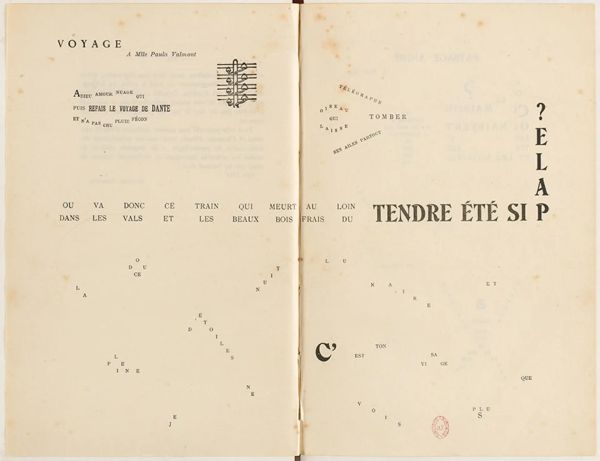


Underlying the striking inter-medial collage of ‘Voyage’ was Apollinaire’s own journalism. For, as an art critic, he had become the leading defender of Cubism, a concept he helped define and popularise. His enthusiasm for modernist art even got him sacked from one reactionary newspaper. Such misadventures were typical of Apollinaire’s journalistic career, which saw him bounce from one publication to another, get caught up in a series of public feuds, and churn out countless stock-market reports while earning little more than $1,000 per month in today’s money. His activities as an art critic even led to the poet being imprisoned under suspicion of having stolen the Mona Lisa. Yet Apollinaire continually found inspiration in the rough-and-tumble of newspaper civilisation, transforming the detritus of his journalistic life into an oeuvre whose boisterous éclat recalls Mallarmé’s joyous vision of the ‘modern popular Poem’.

Proust, who benefitted from substantial inherited wealth, never had to scratch out a living from journalism. He, too, nonetheless frequently wrote for the press during the early phase of his career. Proust then reused material from these articles in his multivolume novel, In Search of Lost Time (1913-27), where culture, politics, society gossip and war are all mediated through newspapers, which the characters read and discuss obsessively.

The centrality of journalism to that semi-autobiographical portrait of the writer as an unfocused young man can be gauged from the fact that the sole piece of writing visibly completed by Proust’s Narrator is a newspaper article. Early in the novel, he jots down a description of some church steeples, which was adapted from an article about an automobile journey across Normandy that Proust had published on the front page of Le Figaro in November 1907 (to coincide with the Paris Motor Show). Having submitted this ‘little fragment’ to the same newspaper, Le Figaro, the Narrator then repeatedly scours its pages in frustration, searching for an article that seems destined never to see the light of day, until one morning – some 2,000 pages later – his mother brings him his post, including Le Figaro, which has finally published his article.

Initial excitement gives way to disillusionment as the Narrator meditates on the tensions between journalism and literature. While offering a qualified salute to journalistic ‘beauty’, he ultimately disavows journalistic publication because it is too dependent on the approbation of its readers, and therefore in conflict with the principle of art for art’s sake. That realisation helps to catalyse the Narrator’s artistic vocation, leading him to vow to write a work that will recover lost time, not for the sake of pleasing others, but to understand the self.


Even as he disclaimed journalism, Proust drew attention to how that devalued medium had shaped his writing and accepted his ties to the press as a fundamental part of the fabric of his work and self. He both used the press as a literary laboratory and made those genetic connections to the press a central theme of his novel. Predecessors such as Balzac and Maupassant had, by contrast, passed over their own creative debts to journalism as they heaped anathema on the ‘whorehouse of thought’. After a century of evasion and resentment, Proust finally settled accounts by at once acknowledging and resisting the aesthetic hold of newspaper civilization.

Like Mallarmé and Apollinaire, Proust also proved adept at exploiting the promotional power of the press. In collaboration with his publishers, he orchestrated extensive publicity campaigns on behalf of his books, using his contacts to obtain favorable reviews. Unappreciative critics would receive aggrieved letters from the author, sometimes accompanied by invitations to dinner at the Ritz (belying his hermitic reputation, Proust maintained an active social life until his death from pneumonia in 1922 at the age of 51). Proust even bribed newspapers to publish unsigned, self-authored puff pieces.

Flaubert had declared that artists should seal themselves off from worldly preoccupations:

“One must, leaving aside material things and independently of humanity, which rejects us, live for one’s vocation, climb into one’s ivory tower and remain there, like a bayadere enveloped in her incense, alone amidst our dreams.”

His successors shared his commitment to maintaining the ivory tower of artistic independence. But Mallarmé, Apollinaire and Proust did not heed Flaubert’s call to retreat into splendid isolation. Rather, they hustled to create an audience for their work and brought the dynamism of newspaper civilisation into the ivory tower itself.

What would it mean to be a hustler in the ivory tower today? The internet and its associated gadgets stir reactions remarkably like those once directed at the press. In some quarters, futurist technophilia; more commonly, alarm at the social, political and cultural impact of these innovations, combined with neurotic dependence upon them. If Flaubert were writing his Dictionary of Received Ideas today, ‘Can’t live without it, but thunder against’ could very well be the entry for ‘iPhone’. The challenge for writers as well as readers remains that of trying to come to terms with destabilising media without being dominated by them. How, in other words, can imaginative literature navigate an ocean of online text and exploit the creative potential of digital technologies?

Contemporary writers who have wrestled with versions of this question might be divided into two camps: ironic traditionalists and digital modernists. The former make the chaos of the digital era into a central theme of their writing while remaining loyal to the codex and the classic form of the comic novel. The latter write works of electronic or digital literature that are designed to be read on screens, incorporate interactive features (most commonly hypertext) and often defy conventional categorization.

Ironic traditionalists include Gary Shteyngart, Patricia Lockwood and Lauren Oyler, who have all authored ‘internet novels’ that at once epitomise and deplore the frantic, degenerative rhythms of lives lived extremely online. Wholly or partly written in parodies of fragmented internet language, these fictional journeys into the depths of digital civilisation are characterised by searing albeit jocular pessimism about the possibility of generating any spark of enlightenment within that abyss. In Shteyngart’s techtopian allegory, Super Sad True Love Story (2010), and in Lockwood’s portrait of internet addiction, No One Is Talking About This (2021), redemption can be achieved only offline – respectively by reading ‘bound, printed, nonstreaming Media artifact[s]’ and by taking responsibility for the suffering of others. Oyler’s caustic bildungsroman of Brooklyn and Berlin literati, Fake Accounts (2021), similarly suggests that inventing a persona in real life can provide a creative antidote to the toxicity of online deception. All three depict digital media as an unsalvageable wasteland and invite us to tear ourselves away from our screens. Notwithstanding its antic, self-aware flourishes, the internet novel is pervaded by the same sense of moral nostalgia that we find in 19th-century novels of journalism such as Balzac’s Lost Illusions.

Digital modernists – operating in the spirit of Kranzberg’s first law of technology, which states it is neither good nor bad; nor is it neutral – conversely approach digital media as a forum for playful experimentation. Just as earlier modernists adopted techniques from journalism and visual art, these authors use digital media, as Jessica Pressman puts it in Digital Modernism (2014), ‘to reform and refashion older literary practices in ways that produce new art’. Recent examples include Joanna Walsh’s Seed (2017), a coming-of-age story structured around a series of non-linear ‘vines’ that we navigate on our screens, and Kate Pullinger’s Breathe (2018), which merges data harvested from the reader’s phone into a classic ghost story, an eerie device that provides an oblique commentary on online surveillance. But the laconic, mysterious tone of such works is far removed from the all-encompassing technopessimism of the internet novel. In contrast to ironic traditionalists, digital modernists tend to resist Big Tech without rejecting its innovations. Both Seed and Breathe are published by an offshoot of Google’s Creative Lab, Editions at Play, which proclaims that these books are ‘powered by the magic of the internet’.

The instability of that ‘magic’ creates a long-term problem of technical autonomy. Many early works of digital literature from the 1980s and ’90s, composed using now-obsolete operating systems, have effectively become inaccessible. Tying a piece of writing to a computer or phone also makes it hostage to the relentless distractions of any networked device – a vastly more intrusive medium than the 19th-century newspaper. The terseness of Breathe, which can be read in under half an hour, renders that problem less acute. But it is hard to see how longer works of digital literature can overcome the steep barriers to immersive deep reading currently inherent within the form.

It might be tempting to conclude that the traditional book simply remains a superior and unimprovable medium. The basic form of the codex – bound, ink-covered pages – has proved remarkably resilient for two millennia. Despite the proliferation of e-readers and other digital supports, print continues to account for the overwhelming majority of book sales.

That picture is complicated by abundant evidence that reading is a declining pastime, especially among the young. According to the American Time Use Survey, Americans aged over 15 spent, on average, a mere 16 minutes per day reading for pleasure in 2022, down from 23 minutes in 2004. More than a third of UK adults report having stopped reading for pleasure, with a quarter of these ‘lapsed readers’ citing social media as a reason for having abandoned books. Sales of literary fiction in the UK have also plummeted since the late 2000s, in tandem with the growth of smartphone use. We may be consuming and indeed producing more text than ever before, but the aesthetic dimension of that experience has atrophied.

Books, as Maël Renouard puts it in Fragments of an Infinite Memory (2021), could well end up like horses, as ‘objects of aesthetic worship’ for a residual cultivated elite.

To check the book’s decline into genteel desuetude, we should consider drawing inspiration from the unfinished intermedial ambitions of French modernism to reimagine the form of the object itself. Faced with the rise of the newspaper, Mallarmé sought to integrate its voracious popular energy within the stable, harmonising medium of the book. In his poetry and that of his successors, that project was in practice focused on the form of the text – thence the visual echoes of newspaper headlines in A Throw of the Dice and the journalistic iconography found in Apollinaire’s calligrammes – rather than its underlying material support. Mallarmé envisioned a more extensive physical hybrid of book and newspaper. But it is, in truth, difficult to imagine how those two objects could be amalgamated into an aesthetically cohesive form.

Digital technology, by contrast, offers the potential for a genuine material transformation of the codex. Rather than viewing print and digital media as irreconcilable rivals, we could explore how they might be combined within new hybrid forms devised in the spirit of Mallarmé’s vision.

The starting point for that endeavour should be an appreciation of the codex’s enduring technological attributes. Print is not just a more aesthetically pleasing medium. Because printed books and periodicals organise text within physical space, they also have a more efficient and memorable interface. Flipping through pages is a simpler, faster and more intuitive than scrolling down a screen. And yet, throughout the internet era, innovation has been a one-way street that runs from page to screen, transforming information from analogue into digital form and thereby sacrificing the advantages of the codex – durability, beauty, flexibility, enhanced concentration – for the sake of convenience and miniaturisation.

Why not preserve those virtues within an enhanced or (in Renouard’s phrase) ‘augmented’ book that imports digital technology into the codex itself? In the mid-2000s, the Greek engineer Manolis Kelaidis developed prototypes of a networked book – originally called the blueBook – that use conductive ink to create hyperlinks allowing users to access digital content on other devices by touching the pages. Advances in printed electronics have since expanded the concept’s technical possibilities. An autonomous digitally enhanced codex could incorporate hyperlinks that activate built-in micro-speakers and light up parts of the text. Other conceivable features include the ability to trigger shifting colour patterns and perhaps even moving images on the pages.

Such innovations would provide those who now seem lost to the dopamine-addled ‘Twittering Machine’ with a compelling enticement to put down their phones and enter a new fictional universe that incorporates some digital stimuli while distancing them from the neurotic distractions of the online world. And all this could be done using a sustainable, recyclable material: paper.

The prospect of paper-based augmented books also holds out the possibility of revolutionary combinations of text, image and sound that would recast the boundaries of literary art. The innovative thrust of digital modernism could be redirected towards reimagining literature’s original medium, one more hospitable than screen-based digital media to extended works of fiction and poetry and less dependent on the fickle hold of Big Tech. By combining the analogue with the digital, writers could sublimate the discombobulating modernity of the internet age into a material framework rooted in cultural antiquity, just as the French modernists channelled journalism’s unruly dynamism into the traditional structures of poetry and the novel.

‘Everything,’ wrote Mallarmé, ‘exists to end up as a book.’ The book itself should be opened up to the disorientating technologies that increasingly make up our world.

With thanks to Manolis Kelaidis for a conversation about his designs and to Maya Kulukundis for introducing me to his work.


Elegance and hustle : How French modernists from Proust to Mallarmé were alarmed and inspired by the voracious dynamism of the newspaper world. By Max McGuinness. Aeon, January 16, 2025. 


07/06/2021

Billy Wilder, His Years in Berlin and Vienna


Freda: I loved reading the book. I thought your introduction is fantastically informative about Billy Wilder, situating his life within the context of Weimar Berlin and 1920s culture too, really fascinating. I was struck by the language in these pieces.
 
Isenberg: There we really need to thank Shelley Frisch. She translates with such extraordinary aplomb, it’s amazing. Translating is so hard. I’ve done it and I’m not terribly skilled at it and Shelley is just a wizard. And we owe her a great deal in making these texts accessible to people who don’t otherwise have the German language skills to read them. That was the impetus for this collection: I’d worked with [these texts] over the years, I happen to have done my graduate training in German, so I had the access and I was grateful for it, but I was also equally upset and kind of miffed, perplexed, and even borderline depressed that my Anglo-American comrades couldn’t have access to these texts. These are jaunty pieces. There’s a certain liveliness to them, and that comes across in the German, and thanks to Shelley Frisch, it really comes across in her rendering of it in English. The snappiness of Wilder’s language – a snappiness that will ultimately make it into his American screenplays and be translated into the screen, is definitely on the page in these early articles of his.
 
Freda: Yes, I love your word “jaunty.” It leads to this broader issue of language and description and style. There’s that wonderful quote from [Charlotte] Chandler’s [biography] Nobody’s Perfect, of Wilder saying that “to know me, you have to know Vienna of 1906. This was a world of whipped cream and cream cakes.” That nostalgia for the Austro-Hungarian monarchy and Berlin of the 1920s. In that milieu, it was language all the time. It was café culture, when people actually read newspapers and spoke to each other. He was a writer, his creativity in terms of these little pieces – feuilletons, cultural essays. It’s such a lovely genre, kind of like Roland Barthes, Susan Sontag. Little daily flashes of imagery, not pre-directorial in any specific training, but a jaunty orientation to reality.
 
Isenberg: Yes, that combined with acute observation – the powers of keen observation of people in his midst. And likening it to Susan Sontag or Joan Didion or Roland Barthes is maybe not all that wide of the mark. Here is someone who is enormously perceptive but also enormously playful. Because he’s Wilder and is someone who likes to add a little mischief to whatever he’s doing, you do have a bit of poetic license.
 
During the time that he’s writing there is what’s known in Weimar Germany as Neue Sachlichkeit, The New Objectivity, with the best-known example being Berlin: Symphony of a Great City (1927), this great Soviet-inspired montage of Berlin. The whole point of the New Objectivity was to present the facts, whether on the screen or on the page. Obviously what Wilder’s doing isn’t exactly that, you have those acute or keen observations but you also have someone who’s having a good time, spinning a yarn, telling a good story. That is one criticism of the New Objectivity phase in visual arts and culture: there was a certain coldness to it. And you don’t have that in Wilder’s writings at all. Exactly the opposite: they radiate warmth and there is a personal voice that’s often there. In some cases it’s Wilder’s voice, and in some cases it’s an invented voice. There’s that piece (“Wanted: Perfect Optimist”) when he takes on the persona of being a hardboiled New York tabloid journalist writing on the person who’s hired to smile all day for that marmalade company. He’s just having a good time.
 
Freda [laughing]: That’s a wonderful piece.
 
Isenberg: It is. And it reminds me of the “Shouts & Murmurs” column in the New Yorker where sometimes you’ll see there’s a single line that’s ripped from a tabloid piece, and then an author will create a humorous story out of that. I don’t know whether young “Billie” caught a notice of this story somewhere and then made it into his own, but it does seem to have that sort of “Shouts and Murmurs” style to it.
 
Freda: He has an attitude, he’s not an intellectual, and maybe that’s where my analogy went wrong; he’s not even really an essayist. Although I love “The Art of Little Ruses,” which is about him complaining why aren’t people taught to dissemble and lie – because this is the most important thing you need to learn. This goes back to this issue of language and description. It starts out, “I don’t want to come right out and insist that, starting this very day, schools teach the art of lying, by which I mean using postures and facial expressions, gestures and inflections of the voice to convey the opposite of truth with sweeping powers of persuasion and achieve smashing success.”
 
Isenberg: You’re saying that he’s not an intellectual, which is so true, and he would never want to have any of the stuffiness of an intellectual. He’s a born entertainer so that’s his objective in these pieces… I love the piece that you mentioned, “The Art of Little Ruses” which I think is in some ways a nod to Oscar Wilde, or at least has a certain Wilderian (if you’ll pardon the pun) feel to it. “The Decay of Lying” by Wilde and “The Art of the of the Little Ruses by Wilder” – so we’ve got Wilde and Wilder.
 
There’s another one, “Anything but Objectivity,” which may in fact be viewed as a little bit of a barbed critique of intellectual culture at that time. He clearly knows these philosophers and sociologists and other thinkers and artists who were prominent at that point in time in Weimar Berlin and Vienna between the wars – [Sigmund] Freud and his colleague [Alfred] Adler and Richard Strauss and Arthur Schnitzler – he claimed to have interviewed all four of them in a single day. That was one of the more audacious claims by young Billie. I think he just figured that there’s no way that anybody could ever verify whether [he had]. There are no extant articles, no interviews. So I think that was Wilder being Wilder, or being Wilder than Wilder perhaps. I’ll stop.
 
Freda: Wasn’t it in a later interview when he said “Well, Freud kicked me out, but at least I got kicked out by Freud. That was the status symbol.”
 
Isenberg: There’s this profile of the French playwright Claude Anet, and Wilder’s adaptation of Anet’s Ariane, jeune fille russe (Ariane, a Russian Girl) is what forms the basis of Love in the Afternoon. I’m almost obsessed with the idea of Wilder as a young journalist in Vienna between the wars and in Weimar Berlin laying the foundation for a lot of the work that he would do as a screenwriter in Hollywood. You can’t see everything that he would later do in these early texts but there’s a lot that’s there.
 
I was doing an interview for a journalist at the Observer in the UK who wanted to know some of the examples, and I [mentioned] a sort of alienation in the big city, that struggling to get by and being a little bit of a schlemiel – an architect of one’s own misfortune. There’s a direct line between that and C.C. Baxter, Jack Lemmon’s character in The Apartment. I thought I was going out on a limb, and maybe I was, but then I saw a recent short documentary on Wilder, and the German filmmaker Volker Schlöndorff is interviewed in it and he makes exactly that same claim, so I felt vindicated by Schlöndorff.
 
Freda: It’s flawed, but in Trespassing Bergman [(2013)] you have all of these directors and it’s quite fascinating, even the most more obnoxious ones. It would be interesting to have a series of filmmakers speak about Wilder.
 
Isenberg: It’s a recent documentary it came out maybe two years ago and it’s called Never Be Boring, which I suspect is probably a line from Wilder. I can’t actually find proper attribution.
 
Freda: Not as easy as Nobody’s Perfect.
 
Isenberg: The epitaph on his tombstone is “I’m a writer, but [then] nobody’s perfect.” Schlöndorff interviewed Wilder at length and did this documentary [with Gisela Grischow] in the 1980s called [for its English release] Billy Wilder Speaks, and it’s the German biographer Hellmuth Karasek who was interviewing Wilder for the German language biography that came out a little bit after that so Schlöndorff tagged along so he’s on screen a lot in that earlier documentary. It’s in the later one that I just referenced, where he says [that with] CC Baxter you can really trace the line back to Wilder’s Weimar Berlin writings as a young freelance journalist. That’s from maybe 2018 or so. You can stream it free on Amazon Prime.
 
Freda: I will, because for anybody writing about or teaching Wilder this is fascinating stuff. As you so beautifully observe here and in the book, it’s that kind of observation, that kind of orientation – the jauntiness, the way of seeing, the color of his language and how that translates in his films, which are notoriously variegated in terms of topic and genre. He really has a range as a director that, I think, you see even in these pieces, in the range of who it is that he’s interviewing — Vanderbilt, and then the Prince of Wales…
 
Isenberg: …Asta Nielsen. He’s just as promiscuous as a journalist as he is as a screenwriter and director, I would say. There is this promiscuity that drives him, and I mean that in all senses of the term.
 
Freda: And in a positive way.
 
Isenberg: Definitely very sex-positive! That variegated, as you said, number of topics and genres that he would later take up as a writer-director, you see that here in the range of a relatively small collection. Back to the extraordinary award-winning translator Shelley Frisch, when we were doing this together – me and my capacity as editor and she in her capacity as translator – there were certain texts that we decided just didn’t really fit, or wouldn’t really speak to an Anglo-American reader or just didn’t work well in translation. Sometimes you face that…But in this representative selection, you can get that sense you seem to just have noted yourself of the breadth, the range of somebody who’s really interested in so many different things. And that jauntiness comes across as he’s just flitting about, as he was known to do his whole life, you know this inveterate pacer, just sort of taking in everything that he can.
 
The point that you made moments ago about trying to think of his writing as a feuilletonist, as someone who’s trafficking in the sort of cultural reportage, in the feuilleton, and the writings of Roland Barthes or Susan Sontag… There are definitely affinities and I think it’s certainly worth making those references when thinking about Wilder’s journalism. The key difference is the element of play. And that mordant wit that is palpable on every single page of the book. In terms of style, he’s very interested, I think, not only in the sartorial habits of the Prince of Wales and of fashioning himself as a sort of elegant, natty dresser, but also in the style of writing, the form, achieving an elegance on the page. I think that he’s aspiring to that elegance already at a 19 [year old] and then early 20-something.
 
Freda: When you speak about humor, that’s present throughout [the book], but where he really goes to town is the [piece published in Harper’s] and again where I see the beauty of the translation because of the word choices…
 
I wanted to ask you about your great observation about [the New Objectivity] and his mediation of that tendency at that time. Either he states it in the first person or he’s quoting somebody: “Ignore the Neue Sachlichkeit,, except for…”. You mentioned Walter Ruttmann’s Berlin: Symphony of a Great City, which is really kind of brutish. It’s always interesting to compare that film’s realism, with a Vertov – much softer, playful.


Isenberg: I think that the real comparison – and it says a lot about Wilder – comparing Ruttman’s Berlin: Symphony of a Great City from ’27 to the production that Billy Wilder was involved in in the summer of 1929 and that was released in February of ’30, People on Sunday, which is such a love letter to Weimar Berlin. And the author of that love letter is Billy Wilder.
 
You’re absolutely right about comparing Vertov and Ruttman, for sure, but in People on Sunday it’s even more extreme because the film really presaged, I think, Neo-realism and also Jean Vigo and Paul Fejos, those sort of sun-dappled landscapes. It’s a very different feel and a very different aesthetic than that sort of steel-like, harsh imagery that you have in Ruttman’s film. To a certain extent, you see some of it in Man with a Movie Camera, but I think that if it’s not a love letter, it is definitely a kind of passionate interpretation of the joys and the art of filmmaking. You don’t see that in Berlin: Symphony of a Great City.
 
Freda: We don’t want to draw Wilder into everything, but he is this personality. He’s not only, of course, Jewish and had the terrible tragedy of his family during the Holocaust, but that personality, where he comes from in Vienna, his orientation, this sort of joyful playful quintessential beauty of German culture at this time. I think that you’re right with the film People on Sunday, where you get these beautiful studies at this precipice in world history. Every time I see that film I can’t help thinking, right around the corner from this beauty is…
 
Isenberg: I don’t know whether you saw [2017-2020 TV series] Babylon Berlin, but there’s a couple of scenes from People on Sunday that are actually cut into an episode, and of course you’re anticipating even more the rise of Hitler. In People on Sunday, there are a couple of points where you can get at least a vague sense of the storm that is brewing. There’s the scene for instance of that older man in the Tiergarten who’s sitting there and saluting the statues of these Prussians, the days of glory, and you can sense a sort of worship of Germany’s militarist past. But otherwise you’re absolutely right, that’s what’s so kind of haunting about the movie is that it’s made and there is something so joyful – they’re really just trying to squeeze as much as they possibly can out of a single day in the life of Weimar Berlin and these four people out on a double date.
 
But there is an element [in People on Sunday] of that so-called [New Objectivity] and that comes on the beach. Eugen Schüfftan was the cameraman on the film, and Fred Zinnemann worked as his assistant. You have those kind of almost August Sander-like photos that are taken on the beach, and that has a certain nod to that dominant trend of New Objectivity. But otherwise the film is much of a departure from it. There really isn’t any of that coldness or that sort of hyper-detailed focus on capturing the facts and nothing but the fact, so to speak – the facts stripped of the emotional content effect. I don’t mean to make the New Objectivity into our straw man, but I do think it’s a pretty stark departure from that and People on Sunday.
 
Freda: And going back to his writings, he brings all of this again to his second entrance into American culture, the Hollywood exile experience – exiled in paradise, to quote the book. Like so many others his adaptation is extraordinary. There are some really interesting pieces for film historians; his [piece on] Asta Nielsen I really want to give to my class if I’m showing a German Expressionist film. Thinking of the [New Objectivity] again it’s the acute observation, and then we leave the coldness for warmth, which is like a Vigo versus a Ruttmann.
 
Isenberg: People on Sunday is much more Vigo than Ruttmann. Again I don’t mean to make these false dichotomies, but I think you can see it. You know Pabst’s film Joyless Street, that’s a good one to teach with the Asta Nielsen profile by Wilder.
 
Freda: It’s a good one to teach but it’s grim.
 
Isenberg: But a nice counterbalance if you want more warmth and less grim is then to teach Vicki Baum’s novel Grand Hotel, which appeared just a couple of years later, and would become the source novel for Edmund Goulding’s Academy Award-winning film with [Greta] Garbo and [Joan] Crawford and the Barrymore brothers.
 
Freda: Pandora’s Box, of course, as well. All of these great films that are surrounding Wilder at this time. It’s interesting that he’s not this avid filmgoer that you would expect. I know he did write movie reviews.
 
Isenberg: Capsule reviews.

Freda: I guess he couldn’t find the forum to write other pieces like the one [he wrote on Erich von] Stroheim. That’s a long piece and it’s very interesting and his perspective on Greed (1924) – that’s exactly what he’s not interested in, in terms of aesthetics and reality and megalomania.
 
Isenberg: No, that’s not Wilder!
 
Freda: I want to bring up [another] piece I just adore, “Why Don’t Matches Smell That Way Anymore?”, in terms of what you were discussing about Wilder being [so] keenly observant. “Well, it was like this: a match whooshed gently across the striking surface, and light blazed up. And silently, eerily, the blue spirits’ flame arose…Oh, blessed fragrance from the sun-kissed leather cushions of a carriage!” I’ve just got everything underlined. I was thinking of where one trains one’s camera, how one composes a narrative, and what is that filmic frame.


I want to refer to Wilder’s return to Berlin with A Foreign Affair (1948), a film I discovered a number of years ago and fell in love with, a great example of Wilder weirdly being able to [craft] what seems like a kind of schizoid narrative of bombing and destruction, and the way he works with Dietrich and the experience of Germans in Berlin, that’s also a romantic comedy.
 
Isenberg: Where he comes to terms with his own personal loss. Mother, stepfather, extended family. In US servicemen’s uniform he returned to Berlin in 1944 and together with Hanuš Burger who’s a Czech filmmaker they did a documentary called Die Todesmühlen (Death Mills, 1945), which you can stream on YouTube. It’s just unrelenting footage of these piles of dead bodies from the camps and Wilder makes that documentary with Burger and then somehow a mere three years later is able to have fun, so to speak, with A Foreign Affair.
 
You could see that kind of acerbic wit in a lot of Wilder production, but here he is returning to a Berlin in ruins and dealing with the incomplete denazification process that hadn’t even really fully begun. You’ll see flashes of that in One, Two, Three (1961) as well. In an interview late in life when someone was asking him about his past, Wilder says, you know there are optimists and pessimists; the optimists died in the gas chambers, the pessimists have swimming pools in their backyards in Beverly Hills. If you extrapolate from that anecdote –I’m not gonna put him on the couch, but I think there is a certain degree of survivor guilt and yet he’s coming to terms with it by way of comedy. And Marlene Dietrich, as she so often is, is marvelous in that film.
 
I need to make a plug for a dear friend and colleague of mine and I’ve been indebted to this work as well, and in my own writings on Wilder, and that’s a book that took the title of that film, it’s called A Foreign Affair: Billy Wilder’s American Films (Berghan, 2008), by Gerd Gemünden who teaches at Dartmouth College.
 
Freda: I have it! It’s really great.
 
Isenberg: It is really great and in fact I give him a little shout-out in the editor’s introduction.
 
Freda: I was just thinking about this realism and attentiveness to detail and then humor, and we’re getting to Wilder’s return to Berlin. I was also thinking of [Wolfgang] Schivelbusch’s In a Cold Crater, that fascinating book about Berlin at that time.
 
Isenberg: There’s another good book by a guy named Robert Schandley called Rubble Films that I think you may find interesting.
 
Freda: I read it too. I like to [teach] that and Schivelbusch with the trilogy Murderers Among Us (1946) and Germany Year Zero (1948) and A Foreign Affair – three radically different ways of negotiating that [history]. But Wilder’s is the most powerful in some ways.
 
Isenberg: I agree, and I’m a big fan of Murders Among Us, but I agree about A Foreign Affair. You’ll get no argument from me.
 
Freda: Thank you for editing this book. I’ve already of course told my mother to read it.
 
Isenberg: It’s those people I want to reach, that I care about. Your mom, my mom. Those people in film, if they can learn something from this, fabulous. But it’s those ever-elusive general readers – they’re the target audience for this book. And the reception has been like a warm bath. They have embraced this; it’s really lovely.
 
Freda: That’s beautiful; that’s how it should be. And it’s because of the way that it’s framed, the way that you’ve edited it, its readability, the chapter segmentation, the translation, the font…It was a real pleasure to read, and to discuss with you.
 
Isenberg: Thank you, the pleasure was mine. Great chatting. Nice kaffeeklasch and you take care.
 
Freda: All right, you too.
 
Something Wilder: Noah Isenberg and Isabelle Freda in conversation on ‘Billy Wilder on Assignment’.  New Revue of Film & Television Studies, Spring (May)  2021.


It takes a certain kind of perfection to end a movie with the line “nobody’s perfect.” And that’s why “Some Like It Hot” remains a classic more than 60 years after its 1959 release.

 
But what you probably didn’t know is how an iconic scene from that film was likely imprinted on its director’s mind at a Vienna train station 33 years earlier, when he was there as a 20-year-old reporter on a deadline, grabbing quotes from a troupe of leggy British dancers.
 
Many film buffs have known that writer-director Billy Wilder, whose other masterpieces include “Double Indemnity,” “Sunset Blvd.,” “The Apartment,” and many more, got his career going as a late teen writing for tabloid newspapers, first in Vienna, then in Berlin.
  
But very few living people had actually read these pieces. Now Noah Isenberg, Department Chair and Professor of Radio-Film-Television at the University of Texas at Austin, working with Princeton University Press, has righted this wrong.
 
Isenberg — whose other books have covered the making of “Casablanca” and the life of director (and Wilder associate) Edgar G. Ulmer — is currently eyebrows-deep in research on his next book, about “Some Like It Hot.” Along the way he realized there was an audience for these short-form pieces almost lost to history.
 
 “Billy Wilder on Assignment: Dispatches from Weimar Berlin and Interwar Vienna,” is, as my colleague, TIME Magazine film critic Stephanie Zacharek kvelled to me in an email, “the little book you didn’t know you needed.” These are fast-paced stories, meant to be read on a racing streetcar, or while sipping a drink at a coffeehouse while you wait for your guest.
 
Written from 1925 through 1930, the book contains profiles of celebrities, like American jazz bandleader Paul Whiteman, industrialist Cornelius Vanderbilt Jr., or a beloved Swiss clown named Grock. But there are also average people, like the woman who hawks the papers Wilder writes for, or a “chameleon” with a forgettable face named Erwin.
 
There are dashed-off musings (“why don’t matches smell like they used to anymore?”) and capsule movie reviews (as one who used to pump these out at a New York City tabloid for years, this hit home.) There are also some first-person essays, including one about the great footnote in Wilder’s life, how he was a “taxi dancer” in his late teens. (More on this in a moment.) All of the pieces have Wilder’s trademark wit.
 
Wilder enthusiasts have long looked to the silent films he co-wrote in Germany before fleeing Nazism, but in this book you can find even deeper roots. I had the good fortune to jaw with Isenberg, the book’s editor who also wrote a historical introduction, about this splendid project. The following interview has been edited.
 
The Times of Israel: I’ve known Billy Wilder started off as a tabloid journalist, but, naturally, had never read any of this stuff until now. Could I have?
 
Noah Isenberg: Absolutely not. At least, not in English. For that, we must thank the translator Shelly Frisch, who does such an incredible job of rendering Wilder’s very animated and peppy prose style.
 
TTOI : I flew through the book in two sittings, dashing through it like I was on a streetcar.
 
NI : I think that’s how it should be read. Prior to now, there were just a few stray translations, like an excerpt of the dancer-for-hire piece, the longest piece, in one of the books on Weimar Germany from the University of California Press. There have been collections in German, in two slim volumes from the 1990s, one of the Berlin work, the other of the Viennese work, both from small publishers and now out of print. And that’s it.
 
TTOI : You open big, with “Waiter, a Dancer, Please!” Either from the Cameron Crowe book “Conversations With Wilder” or perhaps just from Wilder’s lore I already knew he was a paid dancer in a hotel. But I always, maybe lasciviously, thought that was code, that he really did more than just dance with these women. But the piece, which is hilarious, details all the dancing he did.
 
NI :
He describes dutifully what happens “on screen” so to speak. We don’t really know what happened beyond that. Late in life he did like to say he worked “as a gigolo,” but whether this was true we don’t know. You should figure that, as was the case with the Production Code, a lot that was written then was by way of suggestion, rather than explicit depiction.
 
TTOI : It’s still a great story if you take it at face value. Standing at the back of the ballroom eating pie, waiting for the manager to direct you to which older woman or which chaperoned 16-year-old to dance with.
 
NI :  He finally gets fed! He’s near destitute as a freelancer and sees his old friend who gets him the job, and they eat steak and drink cognac. I picture it like the banquet scene in Murnau’s “The Last Laugh.” Now he has his literal meal ticket, dancing with older ladies.
 
TTOI : Part of what makes this book click for me is how you organize the pieces. You go from this really rich dancer story into a 250-word restaurant review. And it feels like he was friends with the owner!
 
NI : Was he friends with the owner? Who knows? He took on the moniker of the “racing reporter,” there’s even that little caricature of him in the book. The man about town.
 
TTOI : So even though this was never translated into English, it’s possible that some of the German-speakers in Hollywood remembered this work.

NI : Absolutely. These were prominent papers. The Berliner-Zeitung was very widely read, as was the perfectly named magazine Tempo.


So any transplants in Hollywood would have had some familiarity. Even those from elsewhere in Middle Europe, especially Jews. Hungarian Jews, Czech Jews, anywhere from the Austro-Hungarian Empire, the German language was known.
 
TTOI : Tempo specifically was known for, how do you put it, the “Jewish rush”?
 
NI : Jewish haste.
 
TTOI : So for the average Viennese or Berliner reading, how many would have known that Wilder was Jewish? Because it never comes up at all.
 
NI : Well the BZ was part of Ullstein, which was a Jewish publishing concern. This is where Vicki Baum worked, a contemporary of Wilder’s who also began as a journalist then wrote the novel that became the film “Grand Hotel.”
 
Earlier, in Vienna, Wilder wrote for the tabloids owned by the Hungarian Imré Békessy, and another writer was Hugo Bettauer, who wrote the satirical novel “City Without Jews,” a best-seller that poked holes at antisemitism. It shows a fantasy city that dispels its Jews and the whole society falls apart.
 
TTOI : And Bettauer was killed by a proto-Nazi, right?
 
NI : Yes, exactly. At a dentist’s office, if I am not mistaken. So if Wilder is contributing to papers where proto-Nazis are angry at how Jewish they are, it stands to reason people had awareness.
 
Later, of course, his mother and other members of his family were killed in the Holocaust. He had a famous line “the optimists died in the gas chambers, the pessimists have pools in Beverly Hills.”
 
But in this early work, you are right, his Judaism is never referenced. The only time anything slightly related comes up, and it is so short, is the capsule review of the 1928 Zionist film “Springtime in Palestine,” in which he does seem taken with the images on the screen, as well as commenting on the enthusiasm of the audience.
 
TTOI : It is funny that so much of his early work was movie reviews, and also reporting from movie sets.
 
NI : He’s basically double-dipping by reporting from the set of “People on Sunday” [an independent film production co-directed by Robert Siodmak and Edgar G. Ulmer from a Wilder screenplay]. He’s reporting but also being the press agent. And it’s a film similar to what Wilder was writing about.
 
TTOI : So you think he had an eye toward filmmaking for a while, then?
 
NI : Understand that Weimar Berlin was under a tremendous influence of American culture — an unbridled and boundless love for anything American. Wilder definitely fashioned himself in the American mold.
 
This is around the time that others like Ben Hecht were making the transition from newspaper reporter to working with movie studios. And there’s a very short piece in here about Ernst Lubitsch, one of his heroes, and also about Erich von Stroheim, though a little cheeky about how he writes about him as an artist.
 
TTOI : He also never misses an opportunity to kiss up to Charlie Chaplin.
 
NI : The adoration of Chaplin at that time in Europe can not be overstated. Even philosophers like Walter Benjamin and Theodor Adorno are writing about Chaplin.
 
TTOI : But when he gets to Hollywood, there’s no more sophisticated filmmaker than Billy Wilder.
 
NI : And he didn’t wear it on his sleeve.
 
TTOI : You don’t think of him as a slick visualist —
 
NI : A few iconic images.
 
TTOI : Good point. Okay, so, other than the most famous image in all of movies, he’s mostly known for his language, his storytelling. And he always had a co-writer, correct?
 
NI : Either Charles Brackett in those early years, or I.A.L. Diamond in the final stretch, there was always someone else, and always an American-born, or at least American-raised collaborator. Wilder used to say that “Brackett taught me English, and I taught him comedy.”
 
There was also the unhappy partnership with Raymond Chandler for “Double Indemnity” — Brackett felt the material was just too dark and pulled out. And Chandler was trying his best to stay sober, and Wilder would mix his late afternoon martinis and pace, so it didn’t really work. Also with Ernest Lehman (on “Sabrina”), but always an American, even though Diamond was technically born in Romania. Someone without Wilder’s thick accent.
 
TTOI : But then Wilder would weaponize that accent — that Mitteleuropa — when he needed it. Think of Willam Holden’s voiceover in “Sunset Blvd.” saying out of nowhere, “He was hard at work at Bel-Air making with the golf sticks.” Baffling to a lot of the audience, I’m sure, but those in the know could recognize the immigrant phraseology prevalent in Hollywood.
 
NI ; Or in “The Apartment,” where the character Dr. Dreyfuss says, “Be a mensch!”
 
There’s a great story in Otto Friedrich’s “City of Nets: A Portrait of Hollywood in the 1940s” that Otto Preminger is at a craps table or something and there are a bunch of Hungarians there jabbering away. So he turns to them and barks, “Don’t you know you are in Hollywood? Speak German!”


Director Billy Wilder’s pre-WWII European journalism is revealed – and revealing. By Jordan Hoffman. The Times of Israel, May 15, 2021.


Of all the artists who washed up in Hollywood during the great wave of refugees from Nazism in the 1930s, it was Billy Wilder, more than any other, who not only made Hollywood his own but helped to remake it. The films of the writer-director—Double Indemnity (1944), Sunset Blvd. (1950), and Some Like It Hot (1959), to limit the list to save space—are as well-known and oft-referenced as any in the motion picture canon, their signature scenes still worshipfully cited and routinely ripped off by his descendants.
 
Off-screen, Wilder’s presence looms nearly as large as a sage and wit. After retiring from active filmmaking in 1981, the old pro gave advice to aspiring screenwriters, aphorisms that came to take on the authority of Holy Writ (“If your second act curtain doesn’t work, your film doesn’t work”). Earlier, actually as soon as he mastered enough English to crack wise, he was famous around town for utterances as quotable as anything he put into the mouths of his actors. (Personal favorite: While working for the OWI in postwar Germany, Wilder responded to an ex-Nazi actor who wanted to play Christ in a production of The Passion Play with a counteroffer: “Only if we can use real nails.”)
 
Yet Wilder’s place in the American film canon has not always been so obvious, even to committed cineastes. In The American Cinema: Directors and Directions 1929-1968, the go-to sourcebook for Hollywood cinema before the arrival of digital tomato and popcorn icons, film critic Andrew Sarris consigned Billy Wilder to his “less than meets the eye” category, the artistic dungeon reserved for auteur wannabes whose “reputations [are] in excess of their inspirations” and whose “personal signatures” are “written with invisible ink.” Wilder was a poseur “too cynical to believe his own cynicism” and so vapid he was “hardly likely to make a coherent film on the human condition.” Sarris later recanted his bone-headed judgment.
 
Wilder’s incisive wit, acerbic vision, and commitment to sturdy dramatic scaffolding were already part of his creative portfolio when, in 1934, his fellow exile, the great Ufa director Joe May, first drove him down Sunset Boulevard. The proof is reprinted in Billy Wilder on Assignment, an irresistible collection of articles, profiles, and reviews from Wilder’s salad-und-bratwurst days in Berlin, where he worked as a roving journalist, critic, and scene-maker between 1926 and 1930. Culled from two comprehensive volumes of Wilder’s journalism published in Germany, edited by Noah Isenberg and translated by Shelley Frisch, the volume flashes back to the days when the byline was Billie not Billy, the language German, and the voice, even then, unmistakable.
 
Wilder was always fortunate in his collaborators, and even posthumously his luck still holds. Both the editor and translator have extensive experience prowling the precincts of Weimar Berlin: Film historian Isenberg (We’ll Always Have Casablanca: The Life, Legend, and Afterlife of America’s Most Beloved Movie) is an expert guide to the Berlin-to-Hollywood axis, and Frisch is a veteran translator of German language biographies, most recently Karin Wieland’s 2011 Dietrich & Riefenstahl: Hollywood, Berlin, and a Century in Two Lives (Wilder hung out with Dietrich back in the day but not, alas, with Riefenstahl, so we lack a Wilder witticism on the woman who became Hitler’s favorite filmmaker). Isenberg and Frisch are also unabashed fans. “Affinities between Wilder’s Weimar-era writings and his later film world abound,” remarks Isenberg, and, inevitably, one reads the dispatches from the Weimar Wilder with an eye to the Hollywood Wilder.


Wilder’s all-America first name—Billie, bestowed by a mother smitten with Buffalo Bill—can perhaps be read too easily as predestination. Born in 1906 in the Galician backwater of Sucha, he moved with his family to Vienna at an early age, and, like many transplants, adopted the more fashionable address for his origin story. At 18, he hustled a gig with a local paper, Die Bühne, and was off and typing, composing everything from crossword puzzles to character sketches. Wilder’s format of choice, Isenberg helpfully explains, was the feuilleton, or cultural essay, a kind of New Journalist mix of “reportage and descriptive musings,” that thrived in Central Europe in the late 19th and early 20th centuries. First in Vienna, then in Berlin, he spent the last half of Die goldenen zwanziger Jahre—the golden ’20s—chronicling the sweet life as an enthusiastic participant-observer.
 
 The opening—and best—tale is Wilder’s account of a career interlude that the teller would richly embroider in years to come. While down on his luck in Berlin, Wilder worked as a dancer-for-hire in the ballroom of the swank Hotel Eden, 5 marks a night, plus tips. Young Billie was an unlikely paid escort—Richard Gere he ain’t—but the nattily dressed and cologne-scented charmer was, at least as he told it, a favorite on the treadmill. “I wasn’t the best dancer,” he recalled, “but I had the best dialogue.” If you want to think he did more than the foxtrot with his partners, he will not disabuse you of the notion. “The dancer’s First Commandment is: there can be no wallflowers!” proclaims Wilder’s dance hall monitor, before delivering a line that Hollywood-period Wilder might have penned to bait the Breen office: “He needs to pluck them because that is what he is getting paid for!”
 
The other gold nuggets in the first section are two pieces on the making of People on Sunday (1930), the film produced from Wilder’s first screenplay, an early masterpiece of handmade indie cinema (today it would be shot on iPhone). The lackadaisical neorealist portrait of a quartet of carefree German youth on a day off, swimming and sunbathing, flirting and quarrelling, was a smack in the face to the artsy pretensions of mainstream German cinema—no Expressionist sets or noirish lighting, but plenty of moving camera work. Besides the novice screenwriter, People on Sunday was a training ground for future Hollywood luminaries Robert and Curt Siodmak, Edgar G. Ulmer, Fred Zinnemann, and the brilliant cameraman Eugen Schüfftan, the most experienced member of the tyro crew. Under the stateside radar for decades, the film was revived and restored for a Wilder retrospective at the Museum of Modern Art in 1964.
 
Shilling shamelessly for the project, Wilder tracks the genesis of People on Sunday as a spontaneous notion among five friends spinning out ideas at a coffeehouse. “It has to be a simple documentary film,” he insists. “A film about Berlin, about its people, about the everyday things we know so well.” The amateurs secure funding, scrounge film stock, and recruit photogenic non-pros to play versions of themselves (the family of Brigette Borchert, who plays the fetching record seller in the film, “thinks we’re sex traffickers”). Everyone chips in regardless of job description (Wilder schlepped the camera equipment and held the light reflectors), all in the service of “shooting a few truths, we consider important, for a laughably small sum of money.” Wilder relates the backstory with utter sincerity and boyish exuberance, without a trace of cynicism.
 
The matrons on the dance floor of the Hotel Eden weren’t alone in being charmed by the young Billie Wilder. In 1926, Paul Whiteman, dubbed “the King of Jazz” by Caucasians innocent of Duke Ellington or Louis Armstrong, visited Europe with his orchestral version of the African American art form. In Vienna, the voluble, pear-shaped conductor invited Wilder to tag along with the band for the Berlin dates. It was Wilder’s introduction to big-time American showbiz and he was hooked.
 
Compared to the real deal, Whiteman’s scored jazz stylings seem like elevator music, but the Germans had never heard anything like it and went gaga. On the playlist was a piece Whiteman debuted in 1924, George Gershwin’s “Rhapsody in Blue,” an “experiment in exploiting the rhythms of American folk music,” which “created quite a stir over in the States,” Wilder reports. He also likes it hot, and predicts American jazz will inspire “an essential regeneration of Europe’s calcified blood.”


Wilder’s character sketches and interviews are now more interesting for their insights into the mind of the journalist than for the comments by his little-remembered subjects. He comes away from a chat with Cornelius Vanderbilt Jr. puzzled that a guy with that much money has such bad dental work; he is star-struck talking backstage with the Danish actress Asta Nielsen (“and now she is standing in front me, quite close, so close that I feel her warm breath”); and, while trailing after the Tiller Girls, a popular British dance troupe, he confesses to stealing a “harmless, unerotic, friendly, cousinly, for God’s sake obligation-free, forgotten the next minute” kiss from at least one of the 16 members. Years later, Wilder claimed to have interviewed—in one morning—the psychoanalysts Sigmund Freud and Alfred Adler; the novelist Arthur Schnitzler; and the composer Richard Strauss. “There may not be any extant articles to corroborate such audacious claims,” Isenberg deadpans.
 
Of course, the film reviews are most apt to be scrutinized for a future payoff in Wilder’s Hollywood work. The best-remembered film classic he discusses is Erich von Stroheim’s 14-reel endurance test, Greed (1924), which he calls a “cruelly naturalistic depiction of the depths to which human beings can sink,” a description that American critics applied to Wilder’s own films (think Ace in the Hole [1951]). Again, a flash-forward is inevitable: Von Stroheim will next appear in Wilder’s field of vision as Field Marshall Erwin Rommel in Five Graves to Cairo (1943) and then as the ghostly waxwork Max in Sunset Blvd.
 
When not sitting in darkened motion picture palaces like the Palast am Zoo and the Gloria Palast, Wilder liked to hang around the shop floors of the movie studios to soak up material and get a free education. On the set of the first German talkie, A Day in Film (1928), he was fascinated by the emergence of sound technology and describes the new Tri-Ergon sound system with the precision of a tech geek. (“The camera records the images and sounds on a rolling celluloid tape in parallel strips—incorporating the sounds by electrically converting sound waves into light oscillations to make the image and sound form a complete unit.”) One imagines him wandering the early soundstages, eyes and ears on high alert, scoping out the equipment, already sensing not a newspaper story but a career opportunity.
 
Two topics very much in the Berlin air—and on the streets—in the late 1920s are missing from Wilder’s Weimar datelines: Jews and Nazis. Reviewing Josef Gale Ezer’s Springtime in Palestine (1928), a three-reel Zionist documentary on the transformation of “a barren desert with noxious swamps” into the modern metropolis of Tel Aviv (“the future seaside resort of the Orient”), Wilder is an admiring but curiously detached observer. “This film is a unique cultural document, a paean to willpower and work,” he comments, without saying whose willpower and work it was. “Wilder never showed much interest in Zionism,” Isenberg notes. Fair enough, but to review a film about Palestine without typing the word Jew seems an act of willful repression. And if Wilder heard the sound of jackboots rumbling in the distance, he did not record it.
 
Throughout, Isenberg is careful not to disrupt the flow of Wilder’s prose with parenthetical intrusions, but a bit more orientation, perhaps via explanatory footnotes, would have been useful. For example, in reviewing Greed, Wilder notes that eruptions of outrage forced the film “to be cancelled abruptly after its premiere in Berlin.” He was referring to an odd incident that occurred during its original booking in May 1926 at the Ufa Palast am Zoo. About a reel and a half into the second screening, whistling and catcalls rang out from the audience. “Take it off, enough, enough!” yelled the crowd. The frightened management turned up the lights, announced the screening would be stopped, and told customers their money would be refunded. The pre-arranged demonstration had been launched by an organized claque in the audience. Nazi brownshirts? Probably not, but the outburst was not without nationalistic overtones. Famous Players and MGM had recently bought a controlling interest in Ufa, the flagship German film studio, a takeover which resulted in the loss of 400 German jobs. No wonder the locals were angry.
 
By 1930, Wilder had left the grind of deadline journalism to devote himself to the more lucrative screenwriting trade. As the Weimar Republic wheezed, he prospered. According to biographer Maurice Zolotow, he lived the life of a “decadent Berliner,” tooling around town in a Graham-Paige convertible and residing in an art moderne flat with Mies van der Rohe furniture.
 
The first-act curtain came down on Jan. 30, 1933, but Wilder’s luck was still solid: He got a cable from Hollywood with the invitation that every Jew in the German film industry was hoping for. On Jan. 22, 1934, he walked up the gangplank of the Aquitania, on route to New York, his steamer trunk packed with phrase books and novels by Ernest Hemingway, Sinclair Lewis, and Thomas Wolfe, to learn the language that would make him famous, and that he would enliven immeasurably. To better master the vernacular, he made a point of dancing with and chatting up the American lady passengers on board, putting an old skill to good use. From now on, he knew, the dialogue would be in English.
 
 
Billy Wilder in Weimar Berlin. By Thomas Doherty.  Tablet , April 26, 2021. 


I’m a writer, but then, nobody’s perfect.” These are the words inscribed on the gravestone of one of Hollywood’s most respected and beloved craftsmen: Billy Wilder, perhaps the most versatile writer/director of all time, winning Oscars for writing and directing films that span decades and multiple genres. From the dark corners of film noir in Double Indemnity (1944) and Ace in the Hole (1951) to the groundbreaking comedies Some Like It Hot (1959) and The Apartment (1960), Wilder impressed audiences and critics alike. He always identified himself as a writer, even though he is most frequently celebrated as a director on the level of Alfred Hitchcock and John Ford. Wilder’s daring critique of Hollywood, Sunset Boulevard (1950), features a doomed protagonist who is a struggling screenwriter; it’s the writer and aging actress, not the director (Cecil B. DeMille playing himself), that Wilder identifies with in this Hollywood nightmare.
 
Wilder cut his teeth as a journalist in Europe before moving to the United States, but his pre-Hollywood writing has long been unavailable to anyone not fluent in German. Wilder’s sharp and witty journalism is now available for English-speaking audiences in Billy Wilder on Assignment: Dispatches from Weimar Berlin and Interwar Vienna. The collection has been edited by the great film historian Noah Isenberg and translated by the brilliant Shelley Frisch. Wilder’s writings in this compilation include work published between September 1925 and November 1930, from a range of newspapers he worked for prior to leaving Europe.
 
Isenberg sets up the collection by exploring the Wilder family’s early years. Billy Wilder was born in 1906 near Kraków, Poland, as Samuel Wilder. The name came from his grandfather, but his mother, Eugenia, preferred the name Billie. After all, Billy’s brother Wilhelm was already nicknamed Willie, so Billie and Willie had a nice ring to it. In addition, Eugenia had memories of traveling as a young girl to New York City, where she saw Buffalo Bill’s Wild West show. She always loved the nickname, which seemed foreign and exotic to her. (Wilder is credited as Billie in this collection but I will refer to him as Billy to avoid confusion.)
 
Billy’s father, Max, ran a chain of restaurants along the Vienna-to-Lemberg railway line. The family moved to Vienna, “where assimilated Jews of their ilk could better pursue their dreams of upward mobility.” After World War I, the Wilders tried to get Austrian citizenship, to no avail, and they would remain “subjects of Poland.” During this time, Billy went to school across the street from a hotel popular for its hourly rates. Channeling his creative mind, Billy would dream up humorous tales about the patrons revolving in and out of the seedy establishment. After school, Billy discovered his love of film when he began to “spend long hours in the dark catching matinees at the Urania, the Rotenturm Kino, and other cherished Viennese movie houses.” While his father wanted him to pursue law, Billy was drawn to popular culture and journalism.
 
By the end of 1924, Billy found the courage to write to the local newspaper, Die Bühne. The aspiring writer offered to serve as a foreign correspondent, hoping it would be his crack at a trip to the United States. The only problem was that he didn’t speak English. Billy continued to visit the office and, with his “outsize gift of gab,” eventually talked his way into a post. One story Billy fondly told involved him walking in on the paper’s theater critic having sex with his secretary. He was quickly offered a promotion to stay quiet. In what sounds like something out of one of Wilder’s films, Billy was soon chatting with major talent such as actor Peter Lorre, then known as László Löwenstein. Between strokes of luck and aided by his native wit, Wilder became a real journalist, writing crossword puzzles, small features, film and theater reviews, and other popular profiles.
 
Wilder also got his first taste of fear as a journalist when Die Stunde’s prominent writer Hugo Bettauer (best known for the 1922 novel The City Without Jews) was shot dead by a “proto-Nazi thug.” Wilder never had an issue speaking truth to power, nor did he fear the political ramifications of his writing. Such thick skin served him well when he hammered Hollywood with Sunset Boulevard, a film that exposes the industry’s careless attitude toward its aging stars and struggling writers. In Cameron Crowe’s excellent 1999 book Conversations with Wilder, the director told a story of the first Hollywood screening of the classic noir film, when MGM studio chief Louis B. Mayer was heard kvetching to notorious fixer Eddie Mannix and executive Joe Cohen, “That Wilder! He bites the hand that feeds him.” When Wilder overheard the comment, he introduced himself and said, “[W]hy don’t you go fuck yourself.”
 
Looking back at his years chasing ledes, Wilder said that he was “brash, bursting with assertiveness, had a talent for exaggeration, and was convinced that in the shortest span of time [he]’d learn to ask shameless questions without restraint.” Anyone familiar with Wilder’s work in Hollywood knows that these skills served him well behind the typewriter and in the director’s chair. One assignment Wilder got as a budding reporter was to interview bandleader Paul Whiteman, who responded to Wilder’s enthusiasm by paying for him to travel with the band. Wilder composed his article from Germany, where he saw the band premiere Gershwin’s “Rhapsody in Blue,” and then joined a new paper in Berlin.
 
Wilder’s profile of Whiteman gives us a glimpse into the future filmmaker’s eye for detail and his ability to channel humor through the seemingly mundane. For example, it was not Whiteman’s music that Wilder found most compelling; it was the composer’s mustache. According to Wilder, “If you add these things together — the most amusing mustache you could imagine, a truly charming little double chin, two gentle, childlike eyes in a nice broad face, a burly, graceful, tall man, dressed casually and unobtrusively — you get Paul Whiteman.” Wilder also learned that Whiteman was the United States’s second most popular celebrity, according to the Chicago Tribune, behind Charlie Chaplin and ahead of Jack Dempsey. Wilder continues:
 
“There’s that mustache of his again, a splendid, peerless, divine, superb mustache. It alone would have made Paul famous, without a doubt. It is cut quite short and twirled up in the middle, the two ends extend out quite far, and it points upward toward his nostrils at a sharp angle; the tips have a bit of pomade, which adds an aromatic element to our visual pleasure. That is the mustache of the future. Copyright by Paul Whiteman.”
 
If anyone could make a facial fashion statement the backbone of a print profile of a world-famous composer, it was Billy Wilder.
 
Wilder’s affinity for the United States burgeoned while he was in Berlin. He even served as a tour guide for Hollywood director Allan Dwan, who was in Germany for his honeymoon. As Isenberg notes,
    ‘’Berlin in the mid-1920s had a certain New World waft to it. A cresting wave of Amerikanismus — a seemingly bottomless love of dancing the Charleston, of cocktail bars and race cars, and a world-renowned nightlife that glimmered amid a sea of neon advertisements — had swept across the city and pervaded its urban air.’’
 
It was in this climate that Wilder was able to fully embrace his love of popular culture and, most specifically, his admiration for American movies.
 
In Berlin, Wilder worked under the mentorship of Egon Erwin Kisch, whose reporting Wilder described as being “built like a good movie script. It was classically organized in three acts and was never boring for the reader.” Wilder also landed a job at Tempo, a tabloid perfectly suited for his cultural curiosities and acerbic wit, where he would begin writing about cinema. After introducing readers to Filmstudio 1929, an independent film company, Wilder eventually wrote a screenplay for a 1929 film, Der Teufelsreporter (A Hell of a Reporter), a blend of autobiography and hyperbole that, as Isenberg observes, served as an excellent primer for the journalists in Wilder’s future films.


In his essay “How We Shot Our Studio Film,” Wilder chronicles the journey to complete a film without money or studio support. People on Sunday (1930) was a collaboration between Moriz Seeler, Eugen Schüfftan, Robert Siodmak, Edgar G. Ulmer, and Wilder. The film began as scattered notes scribbled on coffeehouse napkins; the group had an idea and a camera, but that was it. Yet they managed to finish a screenplay, focusing all of their feelings about Berlin on the events of a single Sunday, and pitched it to an investor. Wilder writes that “three percent of [the investor’s] motivation was his belief in our abilities; 97 percent came from his interest in getting his hands on an incredibly cheap film.” Between weather problems and actors quitting, the men managed to complete the movie. Distribution was another hurdle; after they screened the film at a major studio, “[t]he head of the company tells us that after thirty years in the business he’d be willing to give up his job if this film ever somehow makes it as far as a showing, not to mention a success.” People on Sunday was eventually screened at UFA and would premiere at the U. T. Kurfürstendamm. One wonders if Wilder ever followed up with the executive willing to quit his job if the film saw the light of day.


Wilder also interviewed American billionaire Cornelius Vanderbilt Jr. and couldn’t help but notice his subject’s crooked teeth. Speaking of himself in the third person, Wilder writes, “Why doesn’t he go to the dentist? The interviewer wonders. He finally gets the answer half an hour later: Mr. Vanderbilt has no time for dentists; he has to work, work hard and always.” Throughout their conversation, Wilder also gave Vanderbilt a fun ultimatum — did he prefer Charlie Chaplin or Buster Keaton? — and he picked Chaplin. Continuing his knack for seeking out intriguing subjects, Wilder also found himself interviewing a woman who openly practiced witchcraft. His curiosity and awe shine through every sentence. Wilder’s takeaway: “I think it’s worth noting, for cultural and historical reasons, that a witch was able to establish herself in 1927 and do well enough in her profession to live more than comfortably. Her clothing was definitely from a top-notch boutique.” Profiles such as these offer colorful examples of Wilder’s skills at observation and his penchant for the uncanny.
 
By 1929, Austrian director Erich von Stroheim had become a scourge to the Hollywood studio system, and Wilder knew it. Most famously, Stroheim’s first cut of Greed (1924) ran nearly nine hours; finding a print of the lengthy first cut has been an archivist’s dream for nearly a century. In a profile of the director he wrote in 1929, entitled “Stroheim, the Man We Love to Hate,” Wilder mused that “every child in Hollywood knows who ‘Von’ is,” though they pronounced it like “one” — the reason being that “every company can shoot only one film with him, then it goes broke.” Beneath von Stroheim’s megalomaniacal methods was a talented director who impressed many who worked with him. Wilder reports that von Stroheim’s convention-shattering work was steps beyond other major filmmakers. He also notes that von Stroheim was dismissed from the film Queen Kelly (1929), starring Gloria Swanson, when he refused to film sound inserts as the studio demanded (since the industry was transitioning away from silent films). As fate would have it, Wilder himself would pair von Stroheim and Swanson again in Sunset Boulevard, and scenes from Queen Kelly are seen in that movie when Swanson’s character, Norma Desmond, screens them for down-on-his-luck writer Joe Gillis (played by William Holden).


In another essay, Wilder details a day he spent at a German film studio. The director was filming with the Tri-Ergon system, a sound-on-film application similar to what would eventually take over from the sound-on-disk system then prevalent in Hollywood. Wilder writes as someone interested in and optimistic about the advent of sound film. The studio’s attention to detail and concerns about avoiding unnecessary noise were evident when Wilder arrived to find that he couldn’t get in because the set was locked down: “Imagine you’ve been invited to be a guest at a house and you show up on time but find the doors locked.” He was there to watch Max Mack shoot Ein Tag Film (A Day in Film [1928]), which revolves around an actress’s struggles on a film set. In this absorbing piece, Wilder is deeply curious about the significance of movies transitioning to talkies, and clearly in full command of the various implications.
 
The selections in Billy Wilder on Assignment show Wilder carefully honing his skills at splashy prose and erudite analysis. Reading these essays gives us a better understanding of the filmmaker’s first profession, which served him so well in Hollywood. The book concludes during the time Wilder was involved with Menschen am Sonntag (People on Sunday), by which point he had used the career he’d cultivated in journalism to begin working actively on films. Times were not always great, however, as Wilder would soon transition from being a screenwriter at UFA to a refugee in Paris, after the Nazis rose to power in Germany. Eventually he came to the United States on a British ocean liner in January 1934, with $20 in his pocket and a minimal command of English.
 
Billy Wilder on Assignment is full of glorious turns of phrase, entertaining narratives, and quirky characters. Shelley Frisch, this book’s superb translator, observes that “Wilder’s prose is, well … wilder than I usually get to render in my translations.” She continues, “Where else do I get to write about ‘witless wastrels,’ about an Englishman ‘blessed with hearing like a congested walrus,’ about a performer with ‘gasometer lungs,’ or a smoker who can ‘make his pipe saunter from one corner of his mouth to the other’?” Frisch is a serious Wilder fan who safely assumes that we all love Some Like It Hot.

 
Thumbing through Wilder’s essays from the 1920s will make you feel as if you are enjoying yourself at a German coffeehouse, catching up on popular culture, and planning your next weekend adventure in the Weimar Republic. Isenberg and Frisch have done a great service for film historians and fans of classic Hollywood. There are very few filmmakers of Hollywood’s Golden Age whose formative years are worthy of such a deep exploration. With Billy Wilder on Assignment, we get to take a fascinating and entertaining journey with the best narrator of his day.

 Billy Wilder’s “Amerikanismus”. By Chris Yogerst. Los Angeles Review of Books, April 28, 2021.


In an arresting scene from one of director Billy Wilder’s most famous films, Some Like It Hot, Marilyn Monroe sashays along a Chicago railway station platform in a figure-hugging outfit, leaving Jack Lemmon and Tony Curtis gobsmacked.
 
Until now, few have made the connection between this scene and some of Wilder’s own experiences as a young Austrian journalist in the 1920s. This month, the first major collection of Wilder’s journalism ever published will reveal the way his early writings shaped and influenced memorable scenes, characters and plots from films he later wrote and directed, including Sunset Boulevard and The Apartment.
 
In Billy Wilder on Assignment, Wilder’s German-language journalism from both Austrian and German publications is collected together in one volume and translated into English for the first time.
 
The all-female musical troupe in Some Like It Hot appears, for example, to have much in common with the Tiller Girls, a famous British dance troupe Wilder wrote about for an Austrian tabloid in 1926. “This morning 34 of the most enticing legs emerged from the Berlin express train when it arrived at Westbahnhof station,” he writes, aged 19, in a paragraph that could have been lifted straight out of the movie’s script. “Those figures, those legs…”
 
Another of Wilder’s articles from the collection, which was first published in a German literary magazine in 1929, is a highly critical profile of the spendthrift behaviour of the silent movie director Erich von Stroheim. He highlights the actress Gloria Swanson’s performance in von Stroheim’s movie Queen Kelly, and describes von Stroheim as “the man we love to hate”.
 
Later, Wilder casts both Swanson and Von Stroheim in Sunset Boulevard – Swanson as a bitter, forgotten silent film star and Von Stroheim as a formerly successful silent film director who is now working as a butler. At one point, the audience sees Swanson watch the film Queen Kelly.
 
“In a lot of these early pieces, I think you can see the germs for a lot of later ideas,” said Noah Isenberg, professor of film at the University of Texas at Austin and editor of Billy Wilder on Assignment, which will be published on 27 April in the US and on 1 June in the UK. “And beyond that, you can see a lot of what we come to expect from a Billy Wilder movie: the dramas and the comedies, all that sparkling wit, that charm, that mordant humour and sarcasm. A lot of that is on full display in these articles that he wrote from the tender age of 19 into his 20s.”
 
His journalism demonstrates that he was a “born entertainer”, Isenberg says. “You can see, even in the very short pieces that he wrote, there is this desire to entertain and even to dazzle his reader.”
 
For the collection’s translator, Shelley Frisch, the articles feel like new Wilder films she has discovered: “So much of what we see in the Wilder films seem to be very visually based,” she said. “But strip that away and all of it, including the amazing ability he had to make characters come alive as full-blooded, three-dimensional people, is right there in his journalism.
 
“You see in these pieces the journalist Billy Wilder studying the human condition from all possible angles and then when you see him make films, he’s studying the human condition all over again – and building on the observations he made in these early journalism pieces. It’s clear to me that he carried his articles around in his head as ideas he wanted to build on.”
 
In one of his most successful observational pieces, ‘Waiter, A Dancer, Please!’, the personal experience Wilder relays could be a plot from one of his films. He writes: “My trousers aren’t ironed, my face is badly shaved… my stomach is so empty that it’s hurting and my nerves are shot. Behind every knock on the door the venomous face of the landlady, shrieking, with the bill in her hands.” Walking along Potsdamer Platz in Berlin, he meets a friend who takes him out for lunch and somehow persuades him to hire himself out as a dancer, despite being unable to dance.
 
The next morning, at an audition, he is asked: “So, where have you danced?” “Nowhere,” he confesses. “I see. Amateur. Got it,” is the hilarious reply. He is hired on the spot and immediately taken to a hotel ballroom to dance with elderly ladies and other men’s wives, at which point he discovers that he hates dancing – and is trapped.
 
“The one with the long neck has asked for my name, letting me know that she plans to come often, now that I’m a dancer here,” he writes.


In this way, “like CC Baxter in The Apartment, he’s a bit of a schlemiel, to use the Yiddish term,” said Isenberg. “He’s the architect of his own misfortune.” He is also exploring, with subtle humour in his journalism, the tension between the haves and the have-nots that he later conveys with great comic effect in his films.
 
During this period, Wilder would sometimes have to pawn his typewriter so he could eat while he was waiting to get paid for a freelance commission. “Clearly, he was getting by on very little,” said Isenberg. Living hand to mouth as a journalist in this way may have influenced his decisions as a film-maker later on: it taught him that “sex sells”, and that “if he could entertain an audience, he could sell a piece”.
 
Like CC Baxter and other characters in his films, he knew what it was like to “try to claw his way through a sometimes unforgiving world”.
 
Billy Wilder: from poor Austrian journalist to Hollywood superstar. The Guardian, April 18, 2021.