
One often
hears today that gender is a social construct. The idea is sometimes credited
to the book Gender Trouble, published in 1990 by a handsome young philosopher
named Judith Butler. In fact, sociologists began thinking of gender as a social
achievement distinct from sex as early as the 1960s. What Butler proposed was
more radical: that the repeated citation of gender norms — things like wearing
heels or drinking Scotch — produced the illusion of a biological sex just
waiting to be infused with meaning. For Butler, gender was performative, a term
they borrowed from the philosophy of language, where it referred to sentences
that seem to do things: “I promise,” for instance, a phrase that literally
makes a promise. Gender, too, was a kind of promise — “It’s a girl” — one that,
because it was not anchored in biological sex, had to be constantly reaffirmed
through performative acts, thus allowing the dominant norms to be renegotiated
or even subverted. Butler’s example was drag performance, which, by
exaggerating the normal rules of gender, acted as an allegory for the way
everyone performed gender every day.
These ideas
were tremendously influential in the formation of gender studies. But two
principal criticisms of Butler soon arose. The first was that they had
effectively denied the reality of biological sex; after all, there was a big
difference between a drag queen and your average woman. The second was that
Butler had made gender sound like something you could voluntarily opt into.
Butler would spend the better part of their career trying to acknowledge the
materiality of sex — even as they downplayed its relevance — while fending off
the idea that gender could be assumed through a spontaneous act of will. It was
not as if, they wrote, one simply “woke in the morning, perused the closet or
some more open space for the gender of choice, donned that gender for the day,
and then restored the garment to its place at night.”
What Butler
could not have anticipated is that, some 30 years later, people really would be
waking up one morning and choosing a new gender. At least this is the
impression one gets from the “debate” now raging in this country over the
rights of transgender youth — a rapidly accelerating campaign that has united
the far right, the liberal center, and certain feminists on the left. Last year
— the worst so far — Republicans introduced hundreds of bills that would ban
gender-affirming health care for minors, restrict the participation of trans
kids in sports, and force schools to out students to their parents. (They are
increasingly turning their sights on adults.) Around half of all transgender
youth — some 140,000 kids and teens — now live in a state where minors have, or
may soon have, no legal access to gender-affirming care. To whom should they
turn? The New York Times regularly runs stories playing up the perils of youth
gender medicine; the author of Harry Potter is anxiously projecting her fears
of sexual assault onto them from across the sea. The public increasingly
believes that what the kids call gender is really just trouble: depression,
anxiety, autism, family dysfunction, peer pressure, or social media, any of
which — not to mention the universal awkwardness of puberty itself — are better
explanations for why a child might question their identity.
The left
must reckon with its part in this. It has hung trans rights on the thin peg of
gender identity, a concept clumsily adapted from psychiatry and strongly
influenced by both gender studies and the born-this-way tactics of the campaign
for marriage equality. This has won us modest gains at the level of social
acceptance. But we have largely failed to form a coherent moral account of why
someone’s gender identity should justify the actual biological interventions
that make up gender-affirming care. If gender really is an all-encompassing
structure of social norms that produces the illusion of sex, critics ask, why
would the affirmation of someone’s gender identity entail a change to their
biology? As a result, advocates have fallen back on the clinical diagnosis of
gender dysphoria, known until about a decade ago as gender identity disorder,
defined as the distress felt at the incongruence of gender identity and
biological sex. The idea that trans people fundamentally suffer from a mental
illness has long been used by psychiatrists to decide who “qualifies” for
transition-related care and who does not. By insisting on the medical validity
of the diagnosis, progressives have reduced the question of justice to a
question of who has the appropriate disease. In so doing, they have given the
anti-trans movement a powerful tool for systematically pathologizing trans
kids.
How to
respond to all this? Butler’s new book, Who’s Afraid of Gender?, is one
attempt, and it promises to ignite another round of public conversation about
trans rights when published later this month. They write well of the global
panic over “gender ideology” and acknowledge that the theory of gender
performativity seems “questionable” in light of subsequent criticisms. But they
continue to treat gender as the more promising terrain for political struggle.
One suspects that, even after all these years, Butler is still afraid of sex.
They are not alone: Many trans advocates worry that if they concede the
significance of biological sex — as opponents of trans rights demand they do —
this will thwart their political claims. The focus on gender, given its
substantial psychic and social components, appears to be a more plausible
ground for self-determination. But this fear has left a vast swath of political
territory open to the anti-trans movement, which now hides its repressive goals
behind the rhetoric of neutral biological fact.
It seems to
me that this is a fear we can no longer afford. To confront the reality of
biological sex is not, by definition, to swear fealty to that reality; no one
knows this better than a child who wishes to have their biological sex changed.
We must be able to defend this desire clearly, directly, and — crucially —
without depending on the idea of gender. Back in the 1970s, sociologists
hypothesized that the withering away of gender roles in a liberal society would
lead to a decline in the number of people who wanted to change their sex. We
may now say this hypothesis was wrong: An increase in gender freedom has
coincided with a rise in the number of people wishing to change their sex. For
these people, sex itself is becoming a site of freedom. This freedom is not
unprecedented: Many Americans, though they may not realize it, already enjoy a
limited version of the freedom to alter their sexual biology. What is new is
the idea that this freedom can be asserted as a universal right by a group as
politically disenfranchised as the young. This is why the anti-trans movement
is so desperate: It is afraid of what sex might become.
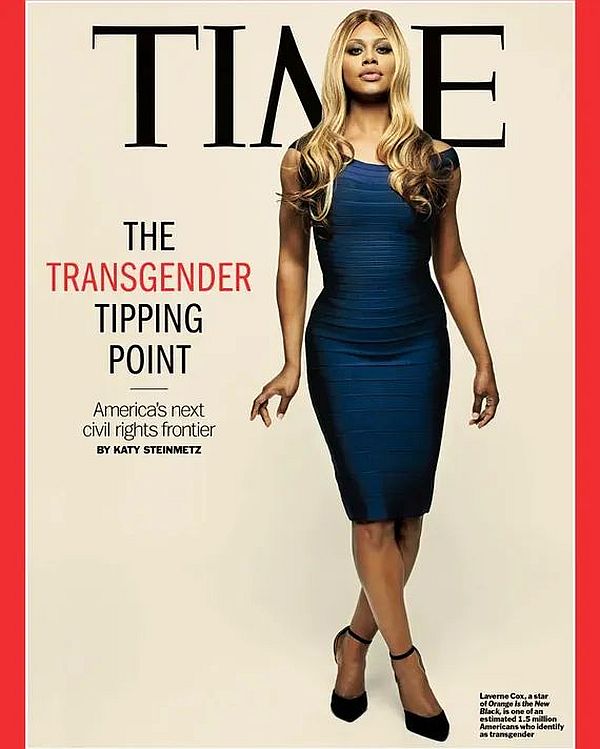
A decade
ago, when Time magazine memorably declared the arrival of the “transgender
tipping point,” the public was dimly prepared to accept that trans people were
like gay people — that is, safe, legal, and rare. The successful corporate
boycott of North Carolina over its 2016 law restricting trans people’s use of
public restrooms seemed to bear this out; even candidate Trump considered
bathroom bills a losing issue. But the nation’s first pangs of dutiful charity
have rapidly subsided — in no small part because the focus has shifted from adults
to children. In 2018, The Atlantic published a long cover story by the reporter
Jesse Singal called “When Children Say They’re Trans,” focusing on the clinical
disagreements over how to treat gender-questioning youth. The story provided a
template for the coverage that would follow it. First, it took what was
threatening to become a social issue, hence a question of rights, and turned it
back into a medical issue, hence a question of evidence; it then quietly
suggested that since the evidence was debatable, so were the rights. This
tactic has been successful: The political center has moved significantly on
trans issues. The public now appears to favor protections for trans people from
discrimination in employment, housing, and public spaces in line with the
Supreme Court’s 2020 ruling in Bostock v. Clayton County. But a growing
majority of Americans also believe gender is determined by sex at birth, and
even more (almost 70 percent) oppose puberty blockers for trans kids.
Three main
tendencies compose the anti-trans bloc in America today. The first, and most
obvious, is the religious right, a principally Christian movement that holds
that trans people are an abomination and that “gender ideology” is part of a
broader leftist conspiracy to corrupt the youth. The second tendency is also
obvious, if smaller: gender-critical feminists, better known as TERFs. This
group has its roots in the lesbian feminism of the ’70s; today, the polemical
acronym, which originally stood for “trans-exclusionary radical feminist,” is
used to describe any feminist who justifies her anti-trans views by citing
women’s rights. These views include the idea that gender must be smashed rather
than affirmed; that women constitute a “sex class” on the basis of their shared
biology; and that the trans-rights framework exposes natal women to sexual
violence at the hands of trans women, who are imagined as predatory males.
(Most TERFism in the U.S. is imported: TERFs have their strongest foothold in
the U.K.)
But the
most insidious source of the anti-trans movement in this country is, quite
simply, liberals. Butler, in their survey of the political landscape, misses
the liberal faction altogether. I suspect this is because the anti-trans
liberal sees himself as a concerned citizen, not an ideologue. He is neither
radical nor a feminist; he is not so much trans-exclusionary as he is broadly
skeptical of all social-justice movements. He is a trans-agnostic reactionary
liberal — a TARL. The TARL’s primary concern, to hear him tell it, lies in
protecting free speech and civil society from the illiberal forces of the woke
left, which, by forcing the orthodoxy of gender down the public’s throat and
viciously attacking anyone who dares to ask questions, is trafficking in
censorship, intimidation, and quasi-religious fanaticism. On trans people
themselves, the TARL claims to take no position other than to voice his general
empathy for anyone suffering from psychological distress or civil-rights
violations.
The leading
voice for such ideas in the United States is the Times. In the past several
years, the paper has vigorously normalized the idea that sustained public
debate over the rights of trans kids is not only justified but urgent. In 2022
alone, it devoted more than 28,000 words to the topic of trans youth, including
a lengthy New York Times Magazine piece by staff writer Emily Bazelon on the
“unexplained rise in trans-identified teenagers.” The paper paints a consistent
picture. Genuine transgender people, its reporters suggest, are a very small
clinical population of adults with a verified mental illness whose persistent
distress entitles them to gender-affirming care like hormone therapy and
transition-related surgeries. Trans-identified youth — whose numbers, we are
told, are “small but growing” — are beset by comorbidities like depression or
autism spectrum disorder that stymie clear diagnosis, yet they are being rushed
into life-changing treatments that many of them may later regret, as evidenced
by the cautionary tales of people who detransition later in life. To make
matters worse, the “overheated political moment,” inflamed by both right-wing
backlash and the strident tactics of trans activists, is preventing the medical
Establishment, which is trusted implicitly, from coming to a sober consensus.
At the same
time, the paper consistently refuses to treat transition-related care the way
it would any other health-care matter. Last year, the Times ran a story on a
small Missouri gender clinic that had been overwhelmed by an “unrelenting surge
in demand.” But the paper did not present this as an issue of access, as it has
done with the national shortage in affordable home care or the inundation of
abortion clinics with out-of-state patients post-Dobbs. Rather, the demand
itself was suspect, a result of poorly explained psychological and social
forces that had “bewildered” experts, whose warnings were as usual being
drowned out by activists. Indeed, the average Times-reading liberal is left
with the impression that, because politics obstructs the slow work of
scientific consensus-building, trans people’s best shot at receiving health
care is to stop asking for it.
The Times
is not alone; it is one of many respectable publications, including The
Atlantic and The Economist, engaged in sanitizing the ideas promoted by TARLs
in the more reactionary corners of the media landscape. Here one finds
journalists like Singal, Matthew Yglesias, Matt Taibbi, Andrew Sullivan, Helen
Lewis, Meghan Daum, and, of course, former Times staffer Bari Weiss. Many of
these writers live in self-imposed exile on Substack, the newsletter platform,
where they present themselves as brave survivors of cancellation by the woke
elites. But they are not a marginal force. (It was Weiss’s media company that
first broke the story about the clinic in Missouri.) These writers are far more
likely to be militants than their counterparts at the Times; they are
especially preoccupied with the “science denial” of radical activists, who have
put wokeness before rational standards of care. In the words of one TARL,
“Biology has been canceled.” Of particular note here is Singal, who has often
accused trans activists of mounting an Orwellian campaign to discount “the
relevance of biological sex.” It would be “profoundly unfair,” he wrote last
year, if a “large male” like himself were to suddenly demand that others see
him as a woman. (It did not occur to him that this is precisely why trans
girls, who are well aware of their biology, are asking for puberty blockers: so
that they do not grow up to look like Jesse Singal.)
Trans
skeptics have seized on the idea of “rapid-onset gender dysphoria,” a term
proposed by the public-health researcher Lisa Littman in 2018 to describe
children with no history of gender variance who suddenly developed gender
dysphoria as a result of “social influences and maladaptive coping mechanisms.”
The study was a sham. It surveyed parents, not kids, whom it recruited from
trans-skeptical communities online, and it assumed that clusters of trans kids
were proof of social contagion as opposed to, say, self-selection. The idea
that children were being unduly influenced by the internet was especially rich
coming from participants harvested from a private Facebook group. But the
general notion that trans kids have confounding diagnoses and high rates of
desistance (the natural fading of symptoms with age) has proliferated
throughout the anti-trans movement.
Now, to be
clear, the TARL will typically acknowledge the existence of a group of fully
developed adults whose medically verified gender dysphoria is so persistent and
distressing that the argument for compassionate care outweighs the Hippocratic
prohibition on harming a perfectly healthy body. The basic strategy here is to
create a kind of intake form with exactly two boxes on it. Every
trans-identified person is either a participant in a craze or certifiably
crazy. (Checking both boxes is permitted.) There is a touch of genius to this
approach. It draws a bright line between the kids who say they are trans and
the kids who really are while pathologizing all of them as either delusional or
dysphoric. This line is as old as gender medicine itself, which for decades was
careful to distinguish impersonators and fetishists from the “true
transsexual.” So in most cases of gender variance, the TARL informs parents
that it is perfectly healthy for boys to wear dresses and for girls to climb
trees regardless of their biological sex, which need not be altered after all.
He reassures them that the risk of suicide among trans-identified youth has
been inflated by cynical activists trying to blackmail the public; what he
means by this is that he does not think most kids are suicidal enough to be
trans. In those rare instances of true misery, he advises the practice of
“watchful waiting,” preferring to see the patient through the
often-irreversible changes of puberty to adulthood, when her childhood
experience of gender incongruence will finally acquire the weight of medical
evidence. If only she had said something sooner!
This is
obviously not a vision of justice; it is a response plan for an epidemic. This
should not surprise us. The very simple fact is that many people believe
transgender is something no one in their right mind would ever want to be. The
anti-trans bloc has in general targeted children because Americans tend to
imagine children both as a font of pure, unadulterated humanity and as ignorant
dependents incapable of rational thought or political agency. This has allowed
the movement to infantilize not just kids but all trans people, whom it only
wishes to shepherd through the ravages of mental illness and the recklessness
of youth. If the liberal skeptic will not assert in mixed company that there
should be fewer trans people, he still expects us to agree on basic
humanitarian grounds that at least there should not be more. It is quite
possible, for instance, to believe that cancer patients should have access to
aggressive treatments with potentially life-altering effects while also
sincerely believing that, in a perfect world, no one would have cancer.
We will
never be able to defend the rights of transgender kids until we understand them
purely on their own terms: as full members of society who would like to change
their sex. It does not matter where this desire comes from. When the TARL
insinuates again and again that the sudden increase of trans-identified youth
is “unexplained,” he is trying to bait us into thinking trans rights lie just
on the other side of a good explanation. But any model of where trans people
“come from” — any at all — is a model that by default calls into question the
care of anyone who does not meet its etiological profile. This is as true of
the old psychiatric hypothesis that transsexuality resulted from in utero
exposure to maternal sex hormones as it is of the well-meaning but misguided
search for the genes that “cause” gender incongruence. It is most certainly
true of the current model of gender identity as “consistent, insistent, and
persistent,” as LGBTQ+ advocates like to say. At best, these theories give us a
brief respite from the hail of delegitimizing attacks; they will never save us.
We must be prepared to defend the idea that, in principle, everyone should have
access to sex-changing medical care, regardless of age, gender identity, social
environment, or psychiatric history. This may strike you as a vertiginous task.
The good news is that millions of people already believe it.

In October
1958, a young woman appeared at the UCLA department of psychiatry with an unusual
complaint. Agnes, as she is known today, had supple breasts, smooth skin, and a
narrow waist. She also had, much to the consternation of her boyfriend, a
typical set of male genitalia. In interviews with the psychiatrist Robert J.
Stoller, Agnes related how she had been raised as a boy but had always believed
she was a girl — a belief confirmed at puberty, when she naturally began
developing breasts. Testing showed that Agnes lacked a uterus or ovaries but
that her testes were producing high levels of estrogen. Satisfied, the doctors
surgically replaced her genitals with a vagina constructed from penile and
scrotal tissue. Stoller, who had become quite fond of Agnes, saw evidence for
his theory that the endocrine system had a strong determining role in a
person’s conscious or unconscious awareness of their biological sex. (He and
his colleagues in Los Angeles had taken to calling this “gender identity.”)
Years later, Agnes casually divulged the truth: At age 12, disturbed by the
onset of perfectly typical male puberty, she had begun taking her mother’s
estrogen pills. “She is not an example of a ‘biological force’ that subtly and
inevitably influences gender identity, as I had reported,” Stoller admitted in
his 1967 book, Sex and Gender. “She is a transsexual.”
Agnes had
simply told the doctors what they wanted to hear. But why did her mother have
estrogen pills in the first place? In passing, Stoller noted that the latter
had been prescribed a synthetic estrogen following a total hysterectomy that
included her ovaries; in other words, she was one of the millions of
20th-century women who would be prescribed estrogen for treating symptoms of
menopause. In his 1966 best seller Feminine Forever, the gynecologist Robert A.
Wilson argued that menopause was basically a hormone deficiency, like diabetes,
that could safely be treated through estrogen therapy. He claimed his patients
were part of a new sexual revolution: They had supple breasts, smooth skin, and
legs that looked good in a tennis skirt. After Wilson’s death, it would come
out that he had been receiving payments from the makers of Premarin, an
estrogen medication derived from the urine of pregnant mares. Nevertheless,
many women really did find hormone therapy effective for a wide range of
menopausal symptoms, from hot flashes to vaginal atrophy, and in 1992, Premarin
was the most prescribed drug in America. “Women, after all, have the right to
remain women,” Wilson had written. “They should not have to live as sexual
neuters for half their lives.”
So when
Agnes visited UCLA, she did not need to prove that a right to female biology
existed. She was simply trying to convince the doctors that this right also
applied to her. In fact, the vast majority of Americans have long believed
everyone has a right to keep their biological sex. The prospect of forcible sex
change is the stuff of horror movies. In 1997, the Times ran a front-page story
about an anonymous man, later identified as David Reimer, who was raised as a
girl after a botched circumcision destroyed his genitals. His care was overseen
by controversial psychologist John Money, Stoller’s colleague, who gave Reimer
estrogen to induce breast growth and allegedly had him perform sex acts with
his twin brother. After learning the truth as a teenager, Reimer started
testosterone, had his breasts removed, and received phalloplasty. That this was
something of a small national tragedy went without saying. The Times compared
his struggle to the travails of Oedipus or King Lear; when he committed suicide
in 2004, the paper ran his obituary. Reimer’s story is popular in the
anti-trans literature because, alongside the general depravity of the affair,
it appears to prove that gender has an inescapable basis in biological sex:
Reimer knew he wasn’t a girl, no matter what the doctors did to him. He told
Oprah Winfrey he had never fit in as a girl, preferring to climb trees and play
with trucks even as his mother tried to convince him that he was simply a
“tomboy.”

This is, of
course, the exact conversation many trans kids are having with their parents
today. What Reimer’s story actually illustrates is that we are perfectly
comfortable with sex changing when we understand it as changing back. This
happens more often than one might think. The historian Jules Gill-Peterson has
shown that the earliest treatments in the field of gender medicine were
developed to “correct” intersex children by bringing their ambiguous biology
within the range of what society considered normal. Even when these treatments
were later charily extended to “transsexuals,” it was often on the assumption
that some original biological sex, perhaps endocrine in nature, was being
excavated. (This was why Stoller was so excited by the idea that Agnes’s testes
were producing so much estrogen.) But as the medical understanding of sex
ballooned to include things like gonad development and hormone activity, so did
the risk of losing one’s sex as a result of age, heredity, disease, physical
trauma, or the side effects of medical treatment. This was the cleverness of
Agnes’s plan. She presented herself as a person who, just like her mother,
needed to become female again. In fact, following the removal of her testes,
she cannily discontinued her secret estrogen pills, leading to mood swings and
hot flashes. The doctors promptly diagnosed her with — what else? — menopause
and placed her on the same estrogen therapy that would be enjoyed by millions.
So what we
today call gender-affirming care is part of a larger history of sex-affirming
care governed by strong normative ideas of health, productivity, and moral
worth. Many of the treatments in this field are broadly uncontroversial today:
breast reconstruction following cancer, vasodilators for erectile dysfunction,
antiandrogens for hair loss and hirsutism. In 2023, The New York Times Magazine
ran a long, sympathetic essay on the “reassuring” evidence base for menopausal
hormone therapy, which the writer called “a lost opportunity to improve women’s
lives.” A few years earlier, the Times hailed the first successful transplant
of a penis, scrotum, and the surrounding abdominal wall — the result of
Pentagon-funded research aimed at restoring the dignity of soldiers whose
genitals were damaged or destroyed by improvised explosives. (The donor’s
family sent the patient a message: “We are all very proud that our loved one
was able to help a young man that served this country.”) Even the recent rush
on the part of the Alabama GOP to enshrine the legality of IVF treatments
endangered by a surprise state supreme court ruling is an excellent reminder
that many religious conservatives support significant medical interventions in
biological sex — gonadotropins to stimulate follicle production, GnRH agonists
to prevent the unplanned release of eggs, not to mention the whole business
with the test tube — when the payoff is a human infant.
The real
question is which sex can be affirmed — and why. It so happens, for instance,
that GnRH agonists like those used in fertility treatments are also used to
delay puberty in trans kids. This means your average Alabama Republican now
ostensibly believes it should be a felony to give a child the same hormone
blockers his mother may have used to conceive him. Our politician may rightly
protest that the same drug is being used for very different purposes. But this
is the point: It is the purpose of sex change, and not the change itself, which
determines its acceptability. This is why sex-affirming care has historically
entailed both the withholding of sex change from some and enforcement of it for
others. Like most fields of medicine, it has a bloody underbelly of coercion:
the vaginal surgeries tested on enslaved women in 1840s Alabama; the testicular
transplants performed on gay men in Nazi Germany; and the surgical modification
of infants with atypical genitalia, which continues today. Even Wilson was clearly
preoccupied with keeping women perky and lubricated for their husbands. In
Feminine Forever, he drolly recalled a man who laid his .32 automatic on the
desk and declared that if the doctor could not “cure” his wife of her harridan
ways, he would surely kill her himself.
Most people
are not being made to change their sex at gunpoint. But it should be clear by
now that when members of the anti-trans movement argue that sex cannot change,
what they really mean is that sex shouldn’t change except in accordance with
social norms. Butler has written a great deal on this subject; a robust theory
of normativity is arguably their life’s work. For Butler, a social norm is not
a belief or a cultural attitude. It is a deep structure of power that makes
one’s sense of self possible. Norms precede us, form us, and act as our
“constitutive constraints”; at the same time, since they depend on being
constantly reiterated, they never capture us fully and can be reinterpreted.
(They have called this “working the weakness in the norm.”) Butler tends to
think of gender norms in terms of meaning; in fact, they often assume that
gender itself is the symbolic structure through which sex comes to matter at
all. This is part of their broader political strategy: to show first that
something is saturated with social meaning in order to make it politically
questionable.
But it is
not enough to know what sex means; we will have to understand what it does.
Obviously, gender norms do not issue directly from the organs. One imagines that,
even after her hysterectomy, Agnes’s mother was still expected to be nurturing
and emotionally available. Yet to speak only of norms is to lose sight of the
role of biological sex within a larger system of material relations. It is
difficult to explain why the above gender norm would exist in the first place
if it were not for the actual fact of reproduction, which at this point in the
descent of man still requires very specific biological conditions in order to
occur, including the presence of at least one of each gamete type (sperm and
ova), a well-functioning uterus, and a reasonably sound endocrine system. This
is sex as biological capacity; in this sense, it is no less of a material
resource than water or wheat. Every human society invested in perpetuating
itself — which is to say, every society — has regulated the production,
distribution, and use of biological sex. This is more than the sex-based
division of labor (hunter-gatherers and all that). It is the actual division of
sex.
It may
sound as if I am saying sex is more real than gender — a proposition gender
studies has abhorred since its inception. I do not think that sex is more real.
But I am not terribly bothered by saying that the division of sex determines
gender norms, so long as we remember that it never remotely finishes
determining them. There is always a wide, shifting, and irregular gap between
the two. One finds a brutal example of this in the antebellum South. As
Hortense Spillers has written, the genteel system of southern patrimony was
bluntly waived when it came to the rape of enslaved Black women by white slave
owners, who could effectively produce new assets — that is, new enslaved people
— in the form of their own disavowed children. Gender alone cannot explain such
an arrangement; it cannot speak to how sex functions as a kind of material
base, as the Marxist feminists might put it: a source of labor, wealth, and
power from which the elaborate superstructure of gender continually emerges,
breaks off, and reforms in unintended ways. (An old-fashioned name for such an
arrangement is sex-gender system, coined by the anthropologist Gayle Rubin in
1975.)
No wonder
“gender identity,” understood by well-meaning LGBTQ+ advocates as an abstract
feeling, has done such a poor job of justifying sex change. If biological sex
is part of a material structure of value, then society has a concrete interest
in any potential gains or losses that may result, feelings be damned.
Gill-Peterson tells the story of Robert Stonestreet, a 10-year-old boy who was
brought to the Johns Hopkins Hospital for a rare urethral defect in 1915. When
the doctors informed his father that the boy had ovaries and should be
reassigned as a girl, the man refused, explaining that he already had six girls
at home and his son was a great help around the family farm. Of course,
Stonestreet was prepubescent. Whatever biological advantage he had over his
sisters was the natural spoils of working daily on a farm. The point is that
his father’s social validation of his gender was the basically incidental
result of an economic calculation about his sex. Twenty-one years later,
Stonestreet asked the same doctors to certify him as male so he could wed his
fiancée. They refused — one suspects because a marriage with no reproductive potential
struck them as dead in the water, especially with the national birth rate at an
all-time low. Three days later, Stonestreet committed suicide — the victim of a
society that could not make up its mind on how best to make sense of his gender
while also extracting value from his sex.
This is the
larger historical reason why the anti-trans movement does not want transgender
people to receive sex-altering care. It is not clear how, if at all, such
people will fit into the division of sex in America. The TERF does not, after
all, fear being assaulted by a Y chromosome in a women’s restroom. Her paranoid
fantasy is of a large testosterone-fueled body wielding a penis — an organ to
which, as Butler points out, the TERF attributes almost magical powers of violence.
(TERFs often seem to reject the idea that trans women are women on the basis
that they are not sufficiently rapeable, when in fact trans women face much
higher rates of sexual assault.) Liberals, meanwhile, object to trans girls’
participation in sports not because sperm swim faster than eggs but because
trans girls, they suppose, will swim faster than their own little girls, who
may then be deprived of athletic scholarships or other opportunities. Even
Singal admits this is ultimately an issue of “competing rights claims,” not
biological fact. Widespread discomfort at the largely fantastical idea that
trans girls will always dominate in their chosen sports reflects a basic
patriarchal belief that the physical advantages of being male are perfectly acceptable
so long as they are possessed by men. (In this sense, sex division in sport is
meant to enshrine inequality, not to mitigate it.)
The
anti-trans bloc does not care about what sex is in some bloodless, positivistic
sense. It cares about what sex does — or what it might not do, in the event
that transition-related care becomes widely available. One of the greatest
fears of the anti-trans movement concerns a shift in the population of trans
kids seeking care, who by some counts are now predominantly female-assigned.
(The accuracy of this claim has been disputed.) This idea was popularized by
Abigail Shrier’s 2020 book, Irreversible Damage: The Transgender Craze Seducing
Our Daughters, which hysterically claimed that an epidemic of anxiety and
depression is leading “a generation of girls” to confuse the tribulations of
female puberty with true gender dysphoria. Shrier wrote that the cost of this
epidemic was “a pound of flesh,” and it was no secret which pound she meant.
The book’s cover features an illustration of a girl with a physical hole — you
can put your finger through it — where her uterus should be. The specter of
mass infertility cannot be underestimated. I do not think it is an exaggeration
to say that the anti-trans movement is driven by a deep, unconscious dread that
society will not have enough working female biology to support the
deteriorating nuclear family — and, with it, the entire division of sex itself.
This
probably will not happen. Sex-altering care can indeed affect one’s fertility
but not always irreversibly, and the trans population is still far too small to
bring about that sort of demographic apocalypse. What we are witnessing is a
potential reconfiguration of the division of sex — one that is highly
disturbing to anyone with an instinctive loyalty to the status quo but that is
no more inherently revolutionary than, say, the contraceptive Pill. The Pill
was, after all, one of the most important advancements in sex-changing medicine
of the 20th century. It had a dramatic effect on women’s sexual freedom and
economic independence, but it did not bring about women’s liberation. On the
contrary, it became an essential part of a new regime of rational management
within the division of sex known as “family planning.” One can likewise imagine
a marginally more benevolent society integrating hormone therapy and puberty
blockers into its own division of sex without accidentally abolishing the
family or smashing the patriarchy. True political change we must bring about
ourselves. Sex-affirming care has always served someone’s moral vision for
society. There is no reason it cannot serve ours.

What if we
make freedom into the air we together breathe?” Butler asks at the end of Who’s
Afraid of Gender? It is a beautiful thought. It would not mean the abolition of
social norms — an impossible task — but rather a collective reimagining of them
through alliances forged across our many differences. Butler argues that the
struggle for trans rights cannot be merely cultural but instead must be connected
to the fight for “the basic rights to housing, food, non-toxic environments,
unpayable debt, and health care.” They are entirely right. But their principled
commitment to coalition building can lead them toward a needlessly conciliatory
position. It is hardly clear, for instance, that “trans rights to
self-determination take no one else’s rights away.” This may be technically
true, if one means trans people can be granted social recognition and legal
equality without spoiling anyone else’s claim to the same. But if sex really is
a biological resource, then there can be no remaking of the division of sex
without real material losses — this would be like saying that socialism does
not take away the rights of the wealthy. Such is the limitation of a social analysis
like Butler’s. It imagines the anti-trans movement as consisting primarily of
religious zealots and scheming politicians, and it does not consider that many
might have a material interest in opposing what we should rightly call the
redistribution of sex.
We need a
stronger demand. Butler argues that it would be “counterproductive and wrong”
to chalk up the existence of oppressive systems to biology. But why? I am of
the opinion that any comprehensive movement for trans rights must be able to
make political demands at the level of biology itself. This is an old
radical-feminist idea, most famously found in Shulamith Firestone’s 1970
classic The Dialectic of Sex. Suppose women’s oppression really is a product of
their biology, Firestone wrote. What follows? Only that feminists must work to
change biological reality. The genius of this gambit was to refuse the idea
that biological facts had some kind of intrinsic moral value that social or
cultural facts did not. Biology could not justify the exploitation of human
beings; indeed, it could not even justify biology, which was just as capable of
perpetuating injustice as any society. When Firestone wrote of women as a “sex
class,” she — unlike the TERFs who followed her — had in mind the Marxist dream
of a classless society, something that could be achieved only by freeing
humanity from the “tyranny of its biology.” For her, this meant a
“revolutionary ecological programme” of fertility control, artificial
reproduction, and the full automation of labor. That may sound unrealistic. But
this is the point: Justice is always an attempt to change reality.
Sex is
real. So is global warming. To believe in their reality is an indispensable
precondition for making normative claims about them, as we know from climate activism.
But the belief that we have a moral duty to accept reality just because it is
real is, I think, a fine definition of nihilism. What trans kids are saying is
this: The right to change sex that has been enjoyed for decades by their
parents, friends, teachers, coaches, doctors, and representatives, especially
if those people are white and affluent — this right belongs to them, too. We
should understand this right as flowing not from a revanchist allegiance to an
existing social order on the perpetual verge of collapse but from a broader
ideal of biological justice, from which there also flows the right to abortion,
the right to nutritious food and clean water, and, crucially, the right to
health care.
I am
speaking here of a universal birthright: the freedom of sex. This freedom
consists of two principal rights: the right to change one’s biological sex
without appealing to gender and the right to assume a gender that is not
determined by one’s sexual biology. One might exercise both of these rights toward
a common goal — transition, for instance — but neither can be collapsed into
the other. I am put in mind of a bicameral system. Each chamber has its own
prerogatives, but neither the exclusive upper chamber (sex) nor the boisterous
lower one (gender) has the ultimate power to overrule the other. (Not all trans
people wish to change their sex; some trans people are also
gender-nonconforming.) By asserting the freedom of sex, we may stop relying on
the increasingly metaphysical concept of gender identity to justify
sex-changing care, as if such care were only permissible when one’s biological
sex does not match the serial number engraved on one’s soul. The same goes for
“sex assigned at birth,” which unhelpfully obscures the very biological
processes that many people have a right to change. In general, we must rid
ourselves of the idea that any necessary relationship exists between sex and
gender; this prepares us to claim that the freedom to bring sex and gender into
whatever relation one chooses is a basic human right.
What does
this freedom look like in practice? Let anyone change their sex. Let anyone
change their gender. Let anyone change their sex again. Let trans girls play
sports, regardless of their sex status. If they excel, this means only that some
girls are better at sports than others. Let people use the gender-segregated
facilities of their choice; desegregate whenever possible. Do not out children
to their parents. Do not force anyone to change their sex or their gender. Give
everyone health care. The anti-trans movement has collected the public’s rising
awareness of the staggering injustice of the American health-care system and
directed it, like a syringe full of air, at a small population of children. The
effect is to make it appear as if trans people do not want good health care or
trustworthy providers, when the truth is that trans people face health
disparities across the board, including higher reported rates of disability,
asthma, and heart disease. No single federal program would benefit trans people
more than Medicare for All. As for transition-related care itself, the right to
change sex includes the right to receive counseling, to understand the risks,
or to be treated for comorbidities; in fact, society has a duty to make these resources
freely and widely accessible to trans kids. But these are practical options,
not obligations. To make “thoughtfulness” a requirement of any universal right
is to taper that right into an exclusive privilege. That trans kids’ access to
care will in most cases be mediated by parents or legal guardians is an
inescapable fact of the way our society regards children, rightly or not. For
now, parents must learn to treat their kids as what they are: human beings
capable of freedom.
The freedom
of sex does not promise happiness. Nor should it. It is good and right for
advocates to fight back against the liberal fixation on the health risks of
sex-changing care or the looming possibility of detransition. But it is also
true that where there is freedom, there will always be regret. In fact, there
cannot be regret without freedom. Regret is freedom projected into the past. So
it is one thing to regret the outcome of a decision, but it is a very different
thing to regret the freedom to decide, which most people would not trade for
the world. If we are to recognize the rights of trans kids, we will also have
to accept that, like us, they have a right to the hazards of their own free
will. This does not mean shooting testosterone into every toddler who looks at
a football. But if children are too young to consent to puberty blockers, then
they are definitely too young to consent to puberty, which is a drastic
biological upheaval in its own right. Yet we let this happen every day — and
not without casualties. I am not speaking of suicide; I am speaking of the many
opponents of trans rights who observe with horror that they too might have
transitioned given the chance, so intensely did they hate being teenage girls.
I do not know if they regret their biology today. I do suspect they regret that
they never got to choose it.
A choice!
The thought is impossible. Yet we have no difficulty believing that 300,000
trans kids can choose to stop being trans. Freedom is easy to imagine when it
is the freedom to do as you’re told. What we cannot conceive is why they are
making all this gender trouble in the first place. They do not owe us an
explanation. They are busy taking charge of their own creation. They may not
change the world, but they will certainly change themselves. “Possibility,”
Butler once wrote, “is not a luxury; it is as crucial as bread.” We have not
yet begun to understand the courage of the child who says she is a girl for the
first time without any biological “proof” to back this up. This is especially
true if she lives in one of the many states that are working to ensure that
saying so is all that trans kids like her will ever have. But still she speaks.
The sentence “I am a girl” is performative speech in the classic sense: It
performs an action. She is not only declaring her intent to exercise her
freedom of sex in the future; she is, by uttering these words, already
exercising it. She is working the weakness in the norm. She is not afraid of
sex — she is against it. That is not nothing. There is, in fact, a very
important population of Americans who do want trans kids to exist. I am
told they are small but growing.
Freedom of
Sex The moral case for letting trans kids change their bodies. By Andrea Long
Chu. New York Magazine, March 11, 2024.


