Showing posts with label woman's body. Show all posts

22/03/2023

Roman Charity


The young woman’s sumptuous crimson dress is unbuttoned. Her exposed breasts, painted in gleaming, creamy flesh tones, invite caress: they are the focal point of the painting, magnetising our gaze. Even if we manage to look away, how can we ever unsee the grey-bearded man, his mouth greedily attached to one breast, his eyes fixed on the rosy nipple of the other?
 
Roman Charity is an image of voluptuary horror. Twisting her face away from what is being done to her, the young woman gazes desperately beyond the frame, her body tensing. There is no bliss here, no reciprocity, no pleasure, no air. Is she signalling for help, or just desperate that nobody witness her entrapment? But there are witnesses of course. I am one, you are another. There have been innumerable others since 1625 when Peter Paul Rubens painted this scene with all the sinuous carnality for which he is renowned.
 
This suckling man, naked except for the black cloth draped across his groin, is marked as virile. There is an erect nipple on display on his bare chest. His sinewy arms are strong. He could still wield a sword, except that his hands, twisted behind him, are manacled, chained to the wall. It is only when one follows the gleaming links through the shadows that one sees the metal grille, behind which men leer at this abject spectacle. They are helmeted – soldiers or guards.
 
This is a public prison not a domestic one. And though the man is shackled, it is the woman, swathed in her ocean of red silk, who is unable to escape. Even as she averts her eyes from the sight of this awful, shameful, inescapable suckling, she rests one hand on the old man’s shoulder. Here tenderness, pity, perversity, fear and love compete. Hers are invisible bonds.
 
This scene of disorientating and regressive perversity, of a woman trapped – her body in service to nurture without limit – feels shockingly familiar. I feel it in the young woman’s body language, a silent scream of ‘Get me out of here!’ What would she say to me, I wonder, if she could use a language other than the language of the body and its fluids?
 
What women say and don’t say was in the forefront of my mind when I first saw this strange painting in 2016. At the time, I was drafting a manifesto for women writers for the free-speech organisation PEN International, so I had the following questions in mind: why is women’s creative legacy so easily lost to the canon? Why is the authority of women – our self-authorship – so difficult to establish, then pass on to our future daughters? Why do we hear silence when we know there are words? How are women disappeared? This disturbing painting embodied a psychic truth about the intimate politics of patriarchal relations between men and women that I needed to metabolise.
 
I could not see this sinuous Baroque painting as a classical allegory, the way a wealthy Florentine or Flemish bishop or merchant or nobleman would, the better to evade the censors. All I saw was a stricken young woman with an old man battened like a tick onto her body. I could not look at her without thinking of the countless women who have been feasted on and silenced by men, for whom women’s bodies feed and sustain their sense of power, authority and invincibility.
 
I have learned enough from Sigmund Freud and Michel Foucault to know that history can clarify things, which is why I went in search of the origins of Roman Charity, but I could find very little. The only full-length monograph on the subject is Jutta Gisela Sperling’s book Roman Charity: Queer Lactations in Early Modern Visual Culture (2016). Her investigations were prompted by a similar response to mine – a confusing repulsion-attraction that made it impossible for her, as for me, to look away from this perverse image. Sperling, a cultural historian of the early modern period, gives a marvellously fecund and subversive account of the image, replete with its unstable and shifting meanings – its queering of social and sexual relations. She looks at how these often eroticised and disturbing images of lactation conjure other (often repressed) relations of power, desire and matrilineal connection that disrupted and troubled the patriarchal system of kinship being established in the early modern period. I am indebted to Sperling’s wide scope and detailed analysis of Roman Charity as it relates, in particular, to the legal and social world that produced these images. But I’m also interested in looking at them from my own second-wave feminist vantage point in the present. Roman Charity reveals something fundamental about the troubled gender relations of the present. I have not wanted to lose the feeling of shock and recognition I felt on first encountering these paintings: the elision of the distance between sexuality and food.
 
The first record of Caritas Romana is a written account of a daughter breastfeeding her impoverished and imprisoned mother. Valerius Maximus, a 1st-century Roman historian, tells us that:
 
   “A plebeian woman of low position who had just given birth to a child, had permission to visit her mother, who had been shut up in prison as a punishment, and was always searched in advance by the doorkeeper to prevent her carrying in any food. She was detected giving her mother sustenance from her own breasts. In consequence of this marvel, the daughter’s pious affection was rewarded by the mother’s release, and both were awarded maintenance for life.”
 
It was a delight to have care – that form of embodied love, almost always performed by women, almost always made invisible – presented as a rebel daughter’s radical act. But there’s an undercurrent in the story of prurient patriarchal unease. The guards, Valerius Maximus tells us, at first wondered aloud if they had witnessed a titillating act that went ‘against nature’. Only after lengthy discussion do they decide that what they’d seen was not an act of incestuous lesbianism, but a demonstration of a dutiful Roman daughter obeying the first law of nature: to love her parents. Pliny the Elder records that a temple dedicated to the goddess of Piety was built in these two women’s honour where the prison once stood. It was at this site that freelance Roman wetnurses went to sell their milk services – a reminder that milk was both an extrafamilial commodity and a fluid that created different kinds of lines of connection to blood. No classical depictions of this law-defying act of daughter-mother nurture have been found – and there are vanishingly few in the Common Era. There are, however, many images on coins and frescoes that show a daughter feeding her father.


With a narrative speed that is striking, the mother-daughter couple is pushed aside, and Maximus swiftly moves on to tell a different, patriarchal version of this tale of filial devotion, in which the couple are named Pero, the dutiful daughter, and Cimon, the suckling father incarcerated for an unspecified crime and condemned to death by starvation. This was the story that was to become dominant in terms of visual representation: the father usurped the mother’s place. But this is not a like-for-like parental substitution. The relationship between a mother and her children, part of the law of nature, was not codified in Roman inheritance law, which meant that a mother could not leave anything to her daughter. A woman’s children were not hers. Meanwhile, a father’s relation with his children was codified in civil law: they could inherit from him. They were also, in effect, his property. The paterfamilias had all rights, including the right of life and death, over the members of his household. For the daughter, this defines the meaning of her giving and her father’s receiving.
 
Where the daughter could feed her mother as an act of freedom or rebellion, feeding her father is imbued with the relation of fealty.
 
I had a flash of body-memory when I read Sperling’s claim that Maximus’s twin anecdotes ‘participate in [a] visual and religious universe in which the depiction of breastfeeding stresses ritual or symbolic, not biological, maternity.’ It reminded me that the domesticated art of breastfeeding was once a promiscuous business. Milk leaks outside of and dissolves the closed lineages of blood-relations. I have fed three of my own children, but I have also fed another woman’s desperately hungry son. My friend went out and left her baby in my care. The tiny boy began to wail. So, to soothe him, I lifted up my top, stepping into one of the most ancient roles – that of wetnurse. He latched on, drinking what I had until then thought of as my birth-daughter’s milk. It surprised me at the time how natural – that complicated word for things we think of as being outside of culture – to allow a hungry but unrelated creature to feed from my body. I have thought of him as a kind of son ever since.
 
It is tempting to speculate that the original mother-daughter vision of Caritas Romana gives us a glimpse of a kinship system defined by milk lines rather than the blood lines of agnatic, or paternal, kinship. This tale that harks back to older goddess-centred cults and religions reminds me that Caritas Romana is not the only Roman tale of a life saved by the milk of its not-mother, the best-known being that of Romulus and Remus, the founders of Rome: twin sons of the god Mars and the mortal Rhea Silvia, who were suckled by a she-wolf. There are also lactation tales that imbue the recipient with divine powers, demonstrating ancient beliefs in the magical power of breastmilk. One is writ so large that it has given the most spectacular feature of the night sky its name: the Milky Way. Tintoretto’s The Origin of the Milky Way (c1575) shows the infant Heracles being surreptitiously latched on to the goddess Hera while she sleeps. Heracles, the son of a mortal woman, apparently sucked so hard he woke the goddess who dashed him from her breast. Hera’s divine milk, which afforded him the immortality of the gods, then sprayed across the heavens and formed the Milky Way.


The abundance of milk is present in images of phantasmagorical plenitude and eroticism. Suckling nymphs and multibreasted mermaids and goddesses abound, portraying an extravagant delight in this extralinguistic world of flesh and bodily satisfaction. Images like Giulio Romano’s fantastically tailed mer-mother and her mer-babies give the slip to the realities of sexual reproduction and the constraints of family and of species.


The pagan breasts of powerful goddesses, their magic and their healing power, were assimilated into Christian beliefs and imagery, and so the veneration of lactating goddesses lived on in Catholicism. The scene of filial piety described in the original version of Roman Charity became linked to the Christian virtue of charity, which was customarily represented as a breastfeeding woman. The Madonna nursing the infant Jesus, the ur-image of maternal-divine care, became central to representations of the Roman Catholic Church. There was even a tradition of adult breastfeeding as a cure, evidence of the ancient beliefs in the magical power of breastmilk. Pope Innocent VIII was prescribed a young woman whom he suckled in the time before his death in 1492.


Renderings of the Madonna Lactans, or Nursing Madonna, in which one of Mary’s breasts is exposed, her milk standing in for the spiritual succour of the Church, became ubiquitous during the medieval period. Perhaps one of the most beautiful images of the pure, healing breasts of the mother of God, the intercessionary mother, is Leonardo da Vinci’s Madonna Litta (1490-91), in which he combines an exquisitely natural depiction of an ordinary mother feeding her infant with an evocation of the divine.


For a time, a parity of fluids – the Virgin’s milk and the blood of Christ – were entwined in religious imagery, in worship, and as a means of accessing the divine. The erotic masochism – the pierced, tortured, leaking Christ, whose blood nourishes his followers, as Madonna’s milk nourishes those she suckles – was a staple of medieval and Renaissance Christian imagery. In Quirizio da Murano’s painting The Redeemer and the Nun (1475), the Christ figure offers his wound/breast to a nun, his fingers in a V shape around his nipple in the classical pose of a woman breastfeeding.


The beautiful Madonna Lactans – one ripe breast fully exposed – was a popular subject, but the holy and the erotic made for uneasy bedfellows, especially with the increased realism of these paintings. In the Virgin and Child with Angels (c1452), Jean Fouquet is said to have painted Agnès Sorel, mistress of Charles VII of France, as the Madonna. This disguised portrait marks the blurring of, if not a transition from, the symbolic holy breast to the erotic breast of a powerful man’s lover.


A century later, as the Reformation gathered pace, the German brothers Barthel and Sebald Beham produced several lascivious renditions of Roman Charity, one of them openly pornographic. The Behams repudiated the hypocrisy of representing titillating subject matter through veiled classical subjects. In one image, while Cimon is clothed, with hands shackled behind his back, a breastfeeding Pero stands seemingly naked, her pubis shaved and everything on show through a piece of cloth so transparent as to satirise the very conventions that enabled this display of thinly disguised classical figures. Here, Pero is as upright and erect as any dominatrix, while she pushes her pointy nipple into the eagerly submissive Cimon’s mouth. The sexual is palpable in the Behams’ images – and the truth of illicit desire, and of incest, is undeniable. The brothers Beham paid for their honesty by being jailed for atheism.


The trouble between the ecclesiastical authorities and the provocative Beham brothers presaged the religious conflict that exploded with the reforming zeal of the Protestant Reformation. This prompted the Catholic Counter-Reformation – and Baroque art, dating from the early 1600s, was part of the pushback against Protestantism. A populist and sensational form of ecclesiastical art, it was intended to appeal directly to the senses. The aim was to attract congregants, lured away by the reforming fervour of the newly formed Protestant churches, back into the Catholic fold. The Baroque style is defined by vivid images – dense, loaded, crowded, full of movement, and Caritas Romana – the Latin title fig-leafing the creepy made-you-look voluptuousness of this image – became a very popular subject during this period.


Perhaps the greatest Baroque painter was Caravaggio, and he was commissioned to do an altar piece, The Seven Works of Mercy (c1607), for a church in Naples, in which he included a depiction of Roman Charity. Caravaggio’s famed use of chiaroscuro, or contrasting light and dark, gives an intense sense of drama to his paintings, but in his version, unlike that of Rubens or most other painters at the time, Pero stands in the street and feeds her father through the bars of his prison while crowds swirl around her. This makes Pero’s law-breaking gift of sustenance both defiant and subversive, transforming a private act of charity, suffused with eroticism and shame in most depictions, into a civic act of solidarity.


The increasingly naturalistic depictions of bodies in classical subjects give the Baroque paintings of Roman Charity a pronounced sexual frisson, dissolving the increasingly faint lines that separated the sensual from the sacred. In Gaspar de Crayer’s rendition, the expression on Pero’s face as she performs the abject act of suckling her seated father is complex. Shame and entrapment, duty and love, as she approximates that intentional stillness that mothers learn to adopt in order to facilitate the milk flow. His expression is one of satiated bliss. For me there is a reckoning with this image, churning up my own discomfit with my father’s increasing dependence as he ages, and throwing into sharp relief the impossibility of both giving succour and of eliding that giving, so that the illusion of masculinity’s omnipotence can be maintained.


The Dutch painter Hendrick ter Brugghen has Pero kneeling before her father. She is in the position of supplicant and of the sexually dominant woman, which the Beham brothers parodied. In this painting, the daughter’s indentured care-labour, filial duty and the erotic are entwined. The composition of the painting draws one’s gaze to this illuminated young beauty’s bare shoulders, her rich brocade sleeves tumbled to her elbows. Only then does the viewer’s eye travel to her feasted-upon breast. The suckling old man is swaddled in velvety crimson. As is typical of the Baroque, the illuminated couple is set against a dramatically dark background, so it takes a while to discern the shadowy figure of a man staring at this furtive scene. The two guards of the original account have become a single voyeur who watches the pair as the viewer – we – watch them from the other side of the canvas.
 
In both these paintings, as with the Rubens, the daughter’s breast, nurturing and erotic, distracts us from patriarchy’s blind spot: male need, dependence, vulnerability. There is the explicit danger that Pero might be caught breaking the law by feeding Cimon, but to save her father she must break an unwritten law. This taboo is not the prohibition against incest. It is the prohibition of an elemental truth of patriarchy: that for this familial, social and cultural system of power and dominance to function, there has to be a denial of the dependence of men on the care given to them by women – that dependence, as the psychoanalyst Donald Winnicott wrote, is the origin of men’s fear of women.
 
What, I wondered, did women painters, contemporaries of these men who had little truck with female autonomy and even less with female creativity, make of Caritas Romana? To find answers, I turned to the contemporary of these men, Artemisia Gentileschi. Taught to paint by her father, she had a successful and lucrative career that afforded her considerable independence. But this stellar career was scaffolded on great personal courage. Aged 17, Gentileschi was raped by the painter Agostini Tassi, a friend of her father. Tassi was charged and Gentileschi’s testimony ensured that he was convicted, at a cost of being tortured in court to verify the truth of her account.


Gentileschi made female rage and power a theme in her richly coloured, intense renderings of classical subjects. Her work is fascinating because of the autobiographical elements that represent classical myths from a violated woman’s point of view. Her painting Judith Slaying Holofernes (c1612-13) allegedly depicts Gentileschi killing Tassi, her rapist. She understood only too well the power of the male gaze to strip a female subject of more than her clothes. In her painting Susanna and the Elders (c1610), Gentileschi chillingly depicts the bathing Susanna’s experience of the predatory male gaze and the collusion between two men, so like the leering guards in Rubens and ter Brugghen’s Caritas Romana, spying on a woman in a deeply private, intimate moment.


Gentileschi’s Roman Charity is different. Pero, large, protective and clad in the regal blue of the Madonna, calmly scans the darkness surrounding them, while her chained old father, naked from the waist up, feeds. The artist has banished the voyeur-guards, so brilliantly rendered in Susanna and the Elders, from the scene. Instead, there is urgency and defiance in this woman giving a life-saving and subversive gift to her father, and Pero is not ashamed. Like Gentileschi’s Judith, Pero is in charge of what she is doing. Like Judith, she holds the power of life and death over a man – but, in this scene, she gives life, not death. To save him, Pero gives of her own body, but for him to live he must regress to the position of infant. Emasculation is the price of his salvation. Gentileschi’s Cimon is aware of his vulnerability, his indebtedness and his dependence. It is this knowledge, perhaps, that makes Gentileschi’s rendition so moving. She reclaims the heroic aspect of caring for another. Her painting allows us to glimpse a counternarrative to the reductive functionalism that collapses a woman’s entire identity into her feeding role, inducting us into a system of kinship based on reciprocity, rather than extractive servitude. Her painting seems to demonstrate, not so much what the daughter’s debt might be to her father – something that she must avert her eyes from – but, rather, what the father’s debt might be to his daughter.
 
With the changing ideologies of the Church, the state, the family and its sustenance, not to mention the new restraint of neoclassicism, Caritas Romana receded from view, as did wetnursing. In the second half of the 18th century, ancient patterns of wetnursing – nonmaternal breastfeeding and the open-ended forms of kinship made possible by connection via the flow of milk – came under sustained ideological attack. Jean-Jacques Rousseau argued vociferously against wetnursing, writing in Émile (1762) that the first duty of a mother is to feed her own infants. Milk production was being privatised and brought within the domestic confines of the bourgeois patriarchal household.
 
As breastfeeding became increasingly hidden from view, so renditions of Roman Charity were rarer. Tantalisingly, the Swiss history painter Angelica Kauffmann – a founding member of the Royal Academy in London – painted one in 1794 but, apart from an anodyne sketch from around 1765, which has echoes of Caravaggio, it has been lost.
 
Then I chanced on Barbara Krafft’s Count Franz de Paula Graf von Hartigand his wife Eleanore as Caritas Romana (1797) – a painting I can view only through the lenses of psychoanalysis and pornography.


Krafft distils and surfaces the claustrophobic horrors of the patriarchal bourgeois family that shackles a woman, body, mind and soul. All pretence at the mythic or the allegorical has been dropped, except in the title. This version of Caritas Romana reveals the truth of bourgeois marital arrangements – that the daughter/wife is there to feed and succour her father/husband. The ageing count with his claw-like hands protruding from the sleeves of his striped dressing gown, a tea tray on the table beside him, is propped up like an invalid on plump green cushions, his face turned to us.
 
The voyeuristic guards are gone. We, the viewers of this ghastly scene, have taken their place and are gawping at the female prison that is the domestic sphere. This uncanny tableau exposes what is usually hidden behind the walls of a home where, in the patriarchal family romance, the daughter and her equivalents service the insatiable, hidden needs of the father. The perversity – a skin-crawling creepiness – exudes from the visual inversion of patriarchal hierarchies of sex/gender and power/dominance. The young daughter/wife, whose full breasts are exposed presumably on her husband/father’s instruction, looks out at us, as does he. He is smug, replete – has he just fed off her? But she looks sick as she stares at us with an expression of defeat, shame and humiliation that is almost unbearable. All of Eleanore’s – all of a woman’s – milk, personhood and dignity have been appropriated.
 
Here, Krafft has depicted a kind of neoclassical revenge porn in which the nakedness of the woman is put on display at the behest of the man who owns her. This Pero has the blank-eyed stare of a woman who, because she cannot escape, has absented herself. A hostage-housewife, she looks straight to camera, unable even to plead her part. Her ageing husband/father smiles out at us, utterly shameless, while her whole body is freighted with shame. And shame is what has kept so many women silent down the years. It is enforced silence that maintains the patriarchal status quo.
 
This unsettling painting is layered with future history, but it is also a record of its time. Perhaps Krafft had read Mary Wollstonecraft’s A Vindication of the Rights of Woman (1792), published five years before this painting was completed. Surely, Krafft had heard of The Declaration of the Rights of Woman and of the Female Citizen (1791) by Olympe de Gouges. ‘Women have the right to mount the scaffold,’ declared Gouges. ‘They should likewise have the right to mount the rostrum.’ Krafft would likewise have known that Gouges was sent to the guillotine in 1793, in part because of her insistence on a woman’s right to public speech. Something that Eleanore, wife of Count Franz de Paula Graf von Hartig, did not have.
 
My historical quest for traceries of Roman Charity achieved its mercenary apotheosis in the late 18th century, when the gendered domestic extraction of female care shifts to the colonial canvas to represent the extraction of resources from colonised subjects. Nowhere is this more evident than in Jean-Michel Moreau’s version of Roman Charity from 1777. Depicted with a colonised subject performing the filial act, Moreau’s image demonstrates the versatility and political resonance of the ancient allegory. A Spanish priest, Bartolomé de las Casas, is cast in the role of the languishing Cimon, who becomes a bedridden invalid, rather than a starved convict. An unnamed woman (whom Sperling in her book calls an ‘Amerindian princess’) is placed at the centre of the composition, near-naked – suggesting that she will play the role of Pero and suckle this sickly man. The painting underwrites the colonial entitlement to the bodies of others, while shifting Caritas Romana’s gendered domestic extraction of female care and labour to the extraction of resources from the colonised world.


This is an image of how gendered extraction without limit and the violence of colonial subjugation are merged and made domestic, intimate, natural. This impossible relation must be kept hidden in the most private spheres – a sphere that, under patriarchal arrangements of the home and the body, is outside of regulation.
 
And then Roman Charity as a subject of painting disappeared. It took more than 200 years before it burst back, waking like some kind of malignant Sleeping Beauty, onto the visual landscape that is the movie Mad Max: Fury Road (2015). In this eco-apocalyptic world, ruled over by brutal tyrants, Earth has become a man-made desert. Almost all women have been subjugated. There is virtually no water, and nothing grows, so the only food is breastmilk. Because the warlords depend on breastmilk, the women are captive, forced into pregnancy and then, after they give birth, they are hooked up to machines that milk them as dairy cows are milked.


The rebellion against this patriarchal terror is led by a warrior woman, Imperator Furiosa (played by Charlize Theron). Her fight for survival becomes a war between the sexes when she protects a group of escaped women who have miraculously saved the seeds of once-abundant plants. This is the food that will save humanity and liberate women from reproductive enslavement, if only Furiosa can succeed and vanquish Roman Charity forever, freeing Pero from her parasitic father. Once again, Caritas Romana pops up as shorthand for ongoing gendered inequality. We should keep a close watch for its reappearance in the cultural landscape if we want to rethink the politics of filial duty, care and the use-value of women’s bodies.


Milk, Pity and Power. Since antiquity, artists have depicted a perverse scene of a daughter breastfeeding her aged father. What does it mean? By Margie Orford. Aeon, March 17, 2023.


The last time you saw your mother alive, she helped you heal from your C-section. It wasn’t what you planned, with your careful study of the benefits of natural childbirth, your doula, your pelvic carriage the midwife called beautiful. Your own mother’s births had been natural, her milk abundant. She always said that being a mother was the one thing she did right, even if she didn’t always do it well. At first, you’d asked her not to come after the baby was born. You didn’t want the interference or the fights. Now you think about how lucky it was that you needed her then. Now you can remember how she jumped out of the car and held your son before she hugged you. How immediate and consuming her love could be. How unfailing and stupid and true. She forgave you every time you let her down, but you can’t forgive yourself. Then you might forget how, when the tide of hormones changed in your body, your mother held you down with blankets until the shaking stopped. When your son spit up bloody milk, she rubbed lanolin on the scabs on your breasts. She swaddled your son and sang to him while you cried.

 §

 In ancient Rome, those in need could visit the Columna Lactaria in the market. There, wet nurses would feed your baby for a fee. You could also hire a wet nurse to live with you and take care of all your child’s feedings. In the first century AD, Sonarus recommended a wet nurse’s breasts be unwrinkled, soft, of medium size. The nipples couldn’t be too big or too small, neither too compact nor too porous, but soft and smooth. The Goldilocks ideal of breasts, the Pythagorean ideal. The wet nurse herself was required to be self-controlled, sympathetic, tidy. And Greek. Her traits would be transferred to the baby upon nursing. In the milk, that calm. In the milk, that moral cleanliness.

 §

 You wonder what you’ve already given your son—fear, awe, worry, exhaustion, a few ounces of your own blood. You’ve often been a disappointment as a daughter and hope you won’t fall short as a mother, too. At least you were not the first to harm him. The surgeon cut a millimeter too deep and split his flesh. Thank God it wasn’t his face, your mother says as you kiss the sliced and tender foot. He was breech, unwilling to roll down headfirst, stubborn as your own need. You were cut by the same scalpel he was, though your wound is deeper. The gauze keeps reddening. The clear glue holding the edges of you together barely seems like enough to keep you from coming apart. Maybe that is what you’ve given him—shared scar, shared history, same healing. Your mother prays for you, but you don’t know which Christ is coming for you—the one that’s a lamb, or the lion.

 §

 Scholars have translated the Greek word for lion to mean five different things in the Bible. You don’t understand how language could fail this abundantly. A single ferocious mammal could come to mean everything. Your mother doesn’t understand how you can stop going to church and still win Bible trivia every year at Christmas, as though attendance and curiosity were mutually exclusive. You remind her that you’ve been saved more times that you can count. It had become a source of rapture for you and embarrassment for her, that call to the altar and your reliable surrender. It just felt so good to know God wanted you each week without fail. And so you explain to your mother that you only did what God wanted of you, and when God went quiet, you went in search of him in quieter ways. You began to dissect words to discover their histories. You found the red words of Jesus. You found the lion. You began to find a lion in every book.

 Your mother thinks God wouldn’t let himself be misinterpreted. He says what he means. In one out of five cases, she is right. One lion is, naturally, a giant cat named by Adam. Dear hunter who was surely a tame vegetarian until God found Abel’s bones rotting in the midden. Ruler of the pride. King of the beasts. The Lord who will lap the blood from your hip, that bone curve of sex and cradle.

 §

 In the story of the founding of Rome, the twin heroes Romulus and Remus are abandoned by their mother and nursed by a wolf. This may not shock you. Children have often been given goat’s milk or cow’s milk for nourishment, and interspecies nursing can go both ways. For several centuries, women nursed puppies to ease engorged breasts and to drink the colostrum. That first milk you’d been taught to call nutritional gold was once suspected of being tainted. When Mary Wollstonecraft lay dying of puerperal fever, her doctor ordered puppies to nurse from her breasts, believing it could help her uterus contract and expel the infected placenta that was poisoning her.

 §

 Your friend calls it vampiric, the hunger with which your son attaches to you, but you enjoy it. When you were wheeled into the recovery room after you’d been stitched shut, you saw your husband, shirtless, your newborn gumming him from collarbone to shoulder. He crossed your husband’s empty chest, dressing him with spit and instinct. When he was laid on your chest, your body knew. His mouth seizing your nipple was a familiar sensation, even though you’d never nursed before. It was a need you understood, a need you could meet—at least at first.

 On the third day, when your son tries and tries and fails to latch, the lactation consultant comes in and shows you different holds and techniques. When these all fail, she attaches a double pump that tugs your nipples with regular compressed air cycles that simulate a child’s suck and gulp. This is how you learned one side was dry. Your son was frustrated and hungry because you kept trying to offer him the half of yourself that had nothing to give.

 The lactation consultant consoles you. This happens, she says. It can still come in. They did, after all, have a milk bank at the hospital if it came to that. She is patient, untroubled, wise in the knowledge of the body and how it can nourish. And you know it was the mythical figure Philosophia-Sapientia, the personification of wisdom, who suckled philosophers. The breast was the site of such wisdom, such virtue. Even the Virgin Mary’s milk was equated with Christ blood. A picture from the Day of Judgment in the Hereford Mappa Mundi shows the Virgin displaying her breasts and making her plea for humanity. Christ intercedes before God by showing his wounds. Maybe blood and milk are both miraculous. Pilgrims flocked to Walsingham and Chartres to venerate the Virgin’s milk, allegedly contained in phials there as relics. Medieval mystics would meditate on the image of milk as a metaphor for the nourishment of the Christian soul, like a pearl foundering in cream. In the twelfth century, Bernard of Clairvaux had a vision of drinking from the Virgin’s breast. His offering was devotion. Her milk, the reward.

And then it happens. It arrives as promised. That weight in your chest descends. Your own milk is the reward of biology and a patient lactation consultant. There was no pilgrimage, meditation, or vision, but you thank God anyway. You’ve always had a talent for offering God that which he has no use for.

 §

 The Roman goddess of filial piety, Pietas, conducted her sacrifices by fire and altar. Unlike other virtues, putting parents and country before self was not a gift from the gods, but an inborn desire. Or at least it should be. Children who failed to honor their parents needed to perform diaculum, expiatory rites, for the infraction. Usually the expiation involved an animal sacrifice upon an altar. Blood has always been such an easy symbol of atonement, as if it were your own you were shedding.

 You always struggled with apologies, even when you knew you were wrong. Like every time you valued honesty over kindness. But your mother was the one who taught you this—to confess to crimes no one had discovered yet, to admit your own thoughts as if the cruelties of imagination needed to confess themselves to an audience. You secretly felt that the person to win an argument should be the stronger one. And in the contest between you and your mother, that person would always be you. You hated her need for words, for those two words in particular. In fact, some days you hated her need in general. You’d rather make it up to her by slitting a pig’s neck and letting it bleed out on a stone.

 §

 Your mother has always loved Job. His patient suffering. His enduring faithfulness. You’ve always detested his compliance, the easy way he accepted another set of children to replace the ones God allowed to die. But you have to admire how he argues. Some scholars say Job proves his faithfulness because he wins the argument with his friends about God by simply being more poetic. His metaphors are better than theirs. The lion in God is the snake in God is the whirlwind swayed by an image. No one could deny God’s power in the face of Job’s suffering and how he rendered that suffering into language.

 In this way you realize you and your mother do have something in common. You admire Job, too. Not his faith, but the quality of his verse, his deft allegories. It’s about time you realized God cares about rhetoric. Your own sentence depends on it.

 §

 You didn’t argue with your mother but accepted right away that she wanted to dress your three-day-old infant in little costumes for pictures. Tiny elf. Sweet pea. Topped with a bow like an early gift. You congratulated yourself on this accommodation of her desires, her perennial insistence on showing her love through images. How she framed your son in photos. How she re-wrapped all your presents under the tree. You love beauty too, so for once, you were grateful. You were finally kind.

 Though you noticed your mother had a hard time breathing as she helped you clean your sutures, you won’t really start to worry until the second time she’s in the emergency room. You have been too focused on sleeping, nursing, sleeping, eating, nursing, trying to unhook your snarled hair from the brush. You take your son on walk after walk as the ground thaws and you think about your mother. Why she’s vomiting. Why she’s weak. Why blood tests show nothing.

 §

 Like so many miraculous things, breast milk was thought to be a curative. Queen Isabella’s pharmacist stocked human milk as a restorative for when the queen was ill. Pope Innocent VII prescribed himself breast milk for his various ailments. Even you dabbed milk on the corners of your son’s eyes when they started to seal shut, thinking: Maybe it will work. And it did.

 §

 The Columna Lactaria in Rome was also a place babies could be abandoned. It was presumed that a wet nurse would see the forsaken child and take pity upon it. A friend tells you that when her daughter was three months old, she tried to sell her baby on the internet. Before your son was born, you would not have understood this. But now between your sleepless worry about how many ounces he is drinking and how you can get more than three hours of sleep and how your mother told your uncle that she didn’t think she was going to make it—and it took a minute before you understood what she meant by make it, and your hands shook, and your son would not stop crying—and you knew that you, too, would have to abandon one love or another. And your son was still so new. Your history together only contained kicks and then cries. Surely there was someone else out there who was better prepared, or stronger, or had a mother with a strong heart the next town over.

 God tried to show you what to do, but you are no Ruth. You would not stay by your mother’s side no matter what. You would not go where she would go. Her people were not your people. Her God was not your God. There was no way on God’s green earth you’d pick up discarded threshings like it was charity, no way you’d lay yourself at Boaz’s feet. You had a life to live. You embraced your freedom like a son.

 It’s about time you learned that the quality of mercy is as weak as the tendons in your knees. Even the dark comes when you name it. So does the lion when you call it king. Gift-burdened, he rides with two wise friends under a rare star to drink the milk leaking on your shirt.

 §

 Your husband jerks back and looks down at your body with surprise. Mmm, he says. What? you ask, and he says, Milk. You look down at the watery white pearl that buds on your left nipple before rolling off. You both thought you were done with this. Dry. He thought your breasts belonged to him again, but then this wet reminder of your son in the next room. Your body a geography of nourishment, pleasure, and comfort shared between father and son. What does it taste like? you want to know. I don’t know, he says, and then more quietly: Sweet.

 §

 Romans could also go to the Columna Lactaria to hire a woman for erotic nursing. Those who felt undeniable lactophilia could resume the relationship they began with breasts when they were minutes old. In this, the breast could be a source of nourishment, of pleasure, of power. Nearby, in the temple of Pietas, was a painting of an old motif—Roman Charity. The woman in the painting is a daughter, just like you used to be. Remembered for her actions, she is nameless now. But her mother gave her one, even if history has forgotten it, two syllables plucked from the air. Pretty, that’s what all mothers hope for. A pretty name they’ll never want to say in anger.

§

 If the lion is Christ, then he is also the lamb, or you are the lamb, or you are the woman in the painting baring the whites of her eyes to heaven while she feeds her father. This rare, obscene mercy. This way only a daughter can save. In the background are Roman guards who will discover her act and pardon her starved father, awed he was honored like that.

 §

 Before your sister phones and you hear code blue, code blue repeating on the hospital intercom, you were examining the Book of Luke, that doctor among fishermen. You’d been arguing with a friend about Christ’s last words, but you were both right. The gospels couldn’t keep their stories straight. Luke and John in their late remembered testimonies said Jesus cried: It is finished. Or, Father, into your hands I commend my spirit. Darling son. Dear trust. It was Matthew and Mark who wrote that it ended with Eloi, Eloi, lama sabacthani. They say the sky went dark because God could not watch his only son die, and his son wanted to know My God, my God, why have you forsaken me? But Mary watched, as perhaps only a mother can. And when the Roman soldiers took Christ down, she held him. She cleaned his body. She prepared it for burial.

 In the last letter your mother wrote you, she said: Will write more soon. You ask your sister what your mother’s last words were, and your sister says the last time she saw your mother alive she just kept shaking her head. I think she was too weak to talk. Stop worrying about whether or not your last words were kind. That’s not where you failed.

 §

 Your sister says it was good you sent your Mother’s Day present early. You’d shopped weeks before, laid fabrics across your wrists to test their softness, judged the rose patterns against one another. You’d sent them express to make sure they arrived in plenty of time, thinking your mom might like some new pajamas in the hospital, a way to feel pretty in the starched and stiff bed. Your sister gave them to your mother the day before, and your mother said she couldn’t wait to wear them. You decide to bury her in them.

 §

 Though your mother left a list of objects that should belong to you, all you want are a few photos and her old pajamas. Even though the smell of her fades, you wear her red pajamas every night, refusing to sew a new button where she’d clipped a safety pin, the thin, cold metal resting against your breastbone at night. Your sister said the hospital gowns were what your mom hated most in her last days. She complained about them to a nurse who told her to get over it. No one cared. They saw naked bodies every day. That did not console your mother. She didn’t see why illness and privacy could not coincide.

 Your mother was shy about her body. In Brazil she grew up thinking she was half man, half woman because puberty was so slow to arrive. She said other girls would tease her, and she would run into the jungle after school almost every day and pray that God would finish making her a woman. Even after he did, he made her modest, too. She would refuse to change in front of you, and your easy way with your body shocked her. You liked that. Shocking her. Both because you liked making people uncomfortable and because you thought she could learn from you, you who knew what it was to be brave.

 But one day she said she wanted to surprise you. One bright Florida afternoon, she showed you her breasts in the bathroom mirror. It stunned you. You didn’t believe you had inherited this particular beauty or this particular courage. The most beautiful part of your body is the scar you’ll never show your son, red grimace whitening between your hip bones like a scythe, and he the reaping. Pain’s cruel reminder: alive, alive, you’re alive. He doesn’t know you cry when he naps, cry as you push the stroller, cry when you think about the mercy that should’ve been yours. Even now, you’d give anything, like the woman in the painting holding her father’s mouth to her breast.

 §

 Your mother used to talk about her death when you were a child, describing how to remember her, down to the last floral detail, as if she already knew the absence she was preparing. Sometimes in her last few years she would seek it, that kind of pain that could knock her out, gift her with numbness. You could hear her on the other end of the phone, not her voice, but her body’s thump thump thump against the wall as if she had the courage or will to beat herself hard enough for that blissful black fog to find her. Thump, she tries. Thump—the whole force of her body launched at the wall—thump—as if one quick pain could help her escape the rest of it. Thump. You called for help from six states away while your sister put herself between your mother’s body and the wall, and you knew your mother’s walls were green, her bed was probably unmade, that she put on makeup before she cried. When the police arrived, she would be embarrassed. Not at the extremity of sadness or the dents in the wall, but the messiness of her house, the unbeautiful way her mascara leaked down her undammed cheeks.

§

 By now you know God’s not much of a talker. When your mother died you had milk to give and no way to reach her, but that’s not why you’re guilty. Her death hurt you. Her suffering never did. If the lion is also the devil, unbutton your shirt and feed him.


Roman Charity. By Traci Brimhall. Image Journal, issue 90.


19/02/2021

A Short History of the Corset


For decades, the corset was a reigning symbol of patriarchal oppression—thought to be a ghastly and restrictive device that rendered women immobile, passive, and prone to fainting spells, with a factor of their social worth dependent on the circumference of their waists. That the corset was no longer customary or fashionable for women was largely considered a feminist victory of the 20th century. After the spread of second-wave feminism in the ’60s, the modern eye viewed the corset, “as one of the quintessential Victorian social horrors,” as art historian David Kunzle writes in Fashion and Fetishism, “the forcing of young females into narrow corsets being regarded as morally and hygienically on a par with the forcing of small boys into narrow chimneys.”
 
I first witnessed this attitude in a scene from the early aughts classic and a childhood favorite of mine, Pirates of the Caribbean. Kiera Knightley’s character faints, falls off a cliff, and sinks to the ocean floor below (all while a suitor proposes marriage to her, ignorant of her distress). She is rescued from imminent drowning, her waterlogged silk gown removed in the process, but she returns to consciousness only after her stays, the 18th-century version of a corset, are ripped off. The tightly laced stays were, of course, the cause of this near-death accident.
 
Scenes like this one appear over and over again in film, literature, and television. Most recently, in the opening sequence of Netflix’s new period drama Bridgerton, a young woman winces through a vicious tightlacing in preparation for her debut in early 19th century London society. Despite Bridgerton’s renewal of the corset-as-torture trope, the show has been credited as the force behind a boom in corset sales, with Etsy searches for the garment up 91% in the past three months, compared to the same time period last year.
 
While Bridgerton’s massive popularity (Netflix’s biggest show ever) accounts in part for the re-entry of the corset into mainstream fashion and conversation, boned bodices have been creeping their way into more cutting-edge closets for the past few years. Their pre-Bridgerton trajectory is easily traced through the ascension of the mother of all contemporary corsetry: the archival Vivienne Westwood corset. Called “the most popular vintage piece of 2019” by Vogue, the Westwood corset has only elevated in status since—becoming the ultimate grail of the Depop generation.
 
The current corset trend is about maximum visibility—Gen Z is not quite as interested in the garment’s original function as a tool of invisible shaping as they are in wearing it in plain sight with a pair of low-rise jeans. Westwood began experimenting with this idea—underwear-as-outerwear—in the ’70s and was one of the first designers to bring the concept to the runway when she debuted a reinvented corset in her Harris Tweed collection in 1987. Westwood’s interpretation of the corset was thoroughly innovative—it took the conical shape of 18th century stays, but with stretchy lycra paneling on the sides and a zipper down the back. It was designed to be loudly visible and worn on its own, with later iterations printed with sumptuous scenes from 18th-century European paintings.
 
At the time, Westwood’s redesigned stays were totally subversive, introducing the idea that the corset, long thought to be wretched and oppressive, could actually be something that women chose to wear to look and feel sexy. Fashion historian Valerie Steele believes Westwood’s revival of the corset “may be one of her most important contributions to late twentieth-century fashion.”
 
It makes sense that the Vivienne Westwood corset is now the platonic ideal for Gen Z. Everything from their preferred styling of the garment as a statement piece to the reasons they find it so compelling echoes the sentiments put forward by Westwood’s initial rebrand of the corset. Like Westwood, Gen Z is interested in creating their own interpretations of historicized femininity. Their obsession with corsets, or at least tops that kind of look like them, represents their larger reexamination of traditional and exaggerated forms of femininity, evident in concurrent trends like New Age Bimboism. In many ways, the modern equivalent of the wasp-waist Victorian woman is the early 2000s bimbo—both embody the ultra-feminine beauty ideal of their respective times, and both came to represent the reprehensible excess and fatalistic vanity that is assigned to such women (by men).
 
Westwood was the first to give the misunderstood corseted waist a chance to really speak for itself, and now young women are giving the same treatment to more recent yet similarly complicated symbols of feminine sexuality, whether it be fake boobs, platinum blonde hair, or even a ditsy voice. It’s unclear what’s at the end of the postmodern femininity rabbit hole, but for now at least, it looks pretty.
 
A short history of the corset, from patriarchal symbol to postmodern grail piece. By  Biz Sherbert. Document , February 18, 2021.


Breathe in… the corset – a garment that is never far from a revival in fashion circles – has been attracting a far wider audience recently. Online searches for the body-sculpting garment have soared, along with demand for four-poster beds and wisteria, an interest in all things Regency sparked by the period romance TV series Bridgerton.
 
Set in high-society England of 1813, the bodice-ripping show has attracted record audiences for Netflix – 82 million households streamed it in its first month on air – making it the network's biggest series debut. Bridgerton has even spawned its own buzzword, "Regencycore": think sumptuous dresses, satin elbow-length gloves, pearl-encrusted headbands and, of course, corsets – vital to the eye-catching decolletages that feature prominently in the show.
 
Corsets are in focus from the first episode of the series. In one comical scene, Prudence, the eldest daughter of social-climbing Lady Featherington, is being "tight-laced" into a corset by a maid to be slimmer for her presentation to Queen Charlotte. The laces are yanked until she can barely breathe, as her unsympathetic mother looks on, saying that when she was Prudence's age, her waist had been "the size of an orange and a half".
 
Fashion experts have since pointed out that liberties may have been taken with historical facts – that being whippet thin wasn't in vogue at the time, and the empire-line dresses of the day flowed freely below the bust. "A corset of the Bridgerton era would typically have been high-waisted not waist-pinching," Valerie Steele, director of the museum at New York's Fashion Institute of Technology, tells BBC Culture. But she concedes that tight-lacing does "look good on film".


The corset scene does drive home a truth – that women such as the unmarried Bridgertons and Featheringtons did what they had to (or were told to), when "climbing socially and marrying well" was their best chance of improving their lot. "A blossoming of the bosom," was the effect costume designer, Ellen Mirojnick, sought to create for the Bridgerton's female cast, from the young lead, Daphne, to the more mature Lady Danbury.
 
"That was the emphasis of the woman's body at the time, your eye went directly to the top of her décolletage," says Mirojnick. In creating the "1813 silhouette", the corsets were key. For the job, they hired Mr Pearl, whose name is sacrosanct in corsetry. On hearing she had him on her team of more than 200 artisans, Mirojnick says she "almost fainted. It was a gift from the gods. [Mr Pearl] is the foremost corset maker in the world today".
 
Mr Pearl (born Mark Erskine-Pullin) has worked with UK performance artist Leigh Bowery at London's Royal Opera House, and with fashion designer Thierry Mugler. He also made Kylie Minogue's dazzling corset costume from a John Galliano design for her 2006 Showgirl tour.
 
One of his high-profile clients is burlesque performer Dita von Teese, who wore a Mr Pearl corset under her Vivienne Westwood gown when she got married in 2005. A corset connoisseur of 30 years' standing, Von Teese has her own lingerie line and works with Dark Garden, founded in 1989 by Autumn Adamme; the company, based in San Francisco, produce the Dita, a 10-panelled corset named after her.
 
Von Teese has conceded the garment is not for everyone, saying it is a bit like high-heel wearing – "it's not necessarily easy". However, a bespoke model will nearly always be more comfortable than one bought off the rack as" our bodies are all shaped differently and the places where we want to be compressed can change". In recent years the notion of waist-training, the practice of using a corset or elasticated belt with the aim of  modifying the body shape, has gained popularity. But Von Teese says in her experience it is not possible to permanently alter your shape in this way.


While there is evidence of corset-like garments being used in the Minoan culture and Bronze Age ancient Crete, the first corset is said to have originated in the 16th Century, initially in Italy, then in France, introduced by Catherine de Medici. In Elizabethan times, the corset moulded the torso into a cylindrical shape rather than the hourglass shape that was sought after by Victorians. Early corsets stiffened with metal, ivory or whalebone no doubt contributed to an enduring belief that the garment is health-threatening, or even an instrument of torture.


Karolina Laskowska is a British lingerie designer who has been creating hand-made corsets since 2012. Her bespoke pieces cost from £1,000 –  but they do involve more than 100 hours' work each. She dismisses the idea of the corset as a torture instrument as "a lazy trope –  one that harks back to men deciding what women should and shouldn't wear". She refers to Dr Warner who "decided corsets were bad for women, and invented his own 'health corset' [1873], to give women the 'perfect' shape –  and made him a fortune by doing so." In her opinion, a well-fitting corset can "take the strain off the shoulders and ribcage, thus being more comfortable than a bra. In fact I've had clients say putting on a bespoke corset feels like having a wonderful hug."
 
While researching her book The Corset: A Cultural History, Valerie Steele worked with a doctor "to try to figure out to what extent the corset could have caused disease. But [we concluded] it didn't cause curvature of the spine, in fact it has often helped to correct it. Perhaps a few women fainted, or felt the fabric chafed their skin, but the corset didn't cause your liver to be split in two or the many things it's been blamed for".
 
Among the most memorable corset "moments" of the past 100 years are Horst P Horst's famous photograph Mainbocher Corset, Paris in 1939; Sophia Loren's black satin hourglass number in The Millionaire, 1960 and the more recent Wonder Woman 1984, with its moulded metal corset-armour. All have attracted criticism as well as appreciation. Decades after the release of Gone with the Wind, US feminist writer Gloria Steinem described Scarlett O'Hara being laced into a corset to achieve a 17-in waist in order to seduce Ashley as a "perfect illustration of female bondage, Southern style".


Steele has heard the disempowering argument many times but says "It's a mistake to patronise women, to suggest they were all stupid victims for, say 400 years," she says. Laskowska agrees: "A corset can be a beautiful thing you wear just for yourself, not for any man. I do that, and I feel empowered by it."
 
While the corset can today be seen as "a sexy, kind of cheeky garment," adds Steele, "for four centuries to wear one was to be respectable and conformist – to be 'straight-laced' was literally to be upstanding". The turning point came in the 1970s and punk fashion led by Vivienne Westwood, "when corsets came back, initially as a fetish-style garment, one that was rebellious and highly sexualised," says Steele. It carried through with Madonna in conical-breasted corsets by Jean-Paul Gaultier on her 1990 Blonde Ambition tour, "when she seemed to say 'I'm not oppressed, I'm a sexually liberated woman'".
 
Westwood's corset designs may be "one of her most important contributions to 20th-Century fashion" according to Steele. They are indeed highly prized collectors' items: her corset design printed with a detail from the 1743 François Boucher painting Daphnis and Chloe resides in the V&A. Fans of her Boucher corsets include the model Bella Hadid, and pop stars Miley Cyrus and FKA Twigs. Twigs modelled some of her extensive vintage Westwood collection for her digital zine Avantgarden.
 
As a second series of Bridgerton prepares to start filming in the spring, Mirojnick reflects on the role the show is playing for an ever-growing audience: "It allows our imagination to flourish –  and transports you into a place that's fun to watch, especially given the bleak times we're living in." Corsets and all.
 
The controversial garment that never goes out of fashion. By Beverley D'Silva
BBC, February 18, 2021


In the opening scene of the steamy Netflix period drama “Bridgerton,” Prudence Featherington, one of the eligible daughters of the social-climbing Lady Featherington, is dressing to be presented to the queen of England. Prudence doubles over, gasping for breath, as a maid yanks the laces of her corset tighter.
 
“I was able to squeeze my waist into the size of an orange-and-a-half when I was Prudence’s age,” Lady Featherington says.
 
Many movies, historical as well as fantastical, have a similar scene. Think of Gone With the Wind’s Scarlett O’Hara death-gripping a bedpost; Elizabeth Swann in Pirates of the Caribbean laced so tightly into her corset that she can barely breathe; Titanic’s Rose in a nearly identical scene; Emma Watson, playing Belle in Disney’s live-action remake of Beauty and the Beast, declaring that her character is too independent to wear a corset.
 
One other element shared by some of these scenes, among many others? None of the characters suffering through the pain have control over their own lives; in each scene, an authority figure (Prudence’s and Rose’s mothers, Elizabeth’s father) tells them what they must do. It’s a pretty on-the-nose metaphor, says Alden O’Brien, the curator of costume and textiles at the Daughters of the American Revolution Museum in Washington, D.C.
 
“To have a scene in which they’re saying, ‘tighter, tighter,’ it’s obviously a stand-in for … women’s restricted roles in society,” O’Brien says.
 
 
The trouble is that nearly all of these depictions are exaggerated, or just plain wrong. This is not to say “Bridgerton” showrunner Shonda Rhimes erred in her portrayal of women’s rights during the early 19th-century Regency era—they were indeed severely restricted, but their undergarments weren’t to blame.
 
“It’s less about the corset and more about the psychology of the scene,” says Kass McGann, a clothing historian who has consulted for museums, TV shows and theater productions around the world and who founded and owns the blog/historical costuming shop Reconstructing History, in an email.
 
Over four centuries of uncountable changes in fashion, women’s undergarments went through wide variations in name, style and shape. But for those whose understanding of costume dramas comes solely from shows and movies like “Bridgerton,” these different garments are all just lumped together erroneously as corsets.
 
If one does define a corset as “a structured undergarment for a woman’s torso,” says Hilary Davidson, a dress historian and the author of Dress in the Age of Jane Austen, the first corsets appeared in the 16th century in response to women’s fashion becoming stiffer and more “geometric.” The corset, stiffened with whalebone, reeds or even sometimes wood, did somewhat shape women’s bodies into the inverted cone shape that was in fashion, but women weren’t necessarily pulling their corsets tight enough to achieve that shape. Instead, they used pads or hoops to give themselves a wider shape below the waist (kind of like Elizabethan-era booty pads), which, in turn, made the waist look narrower.


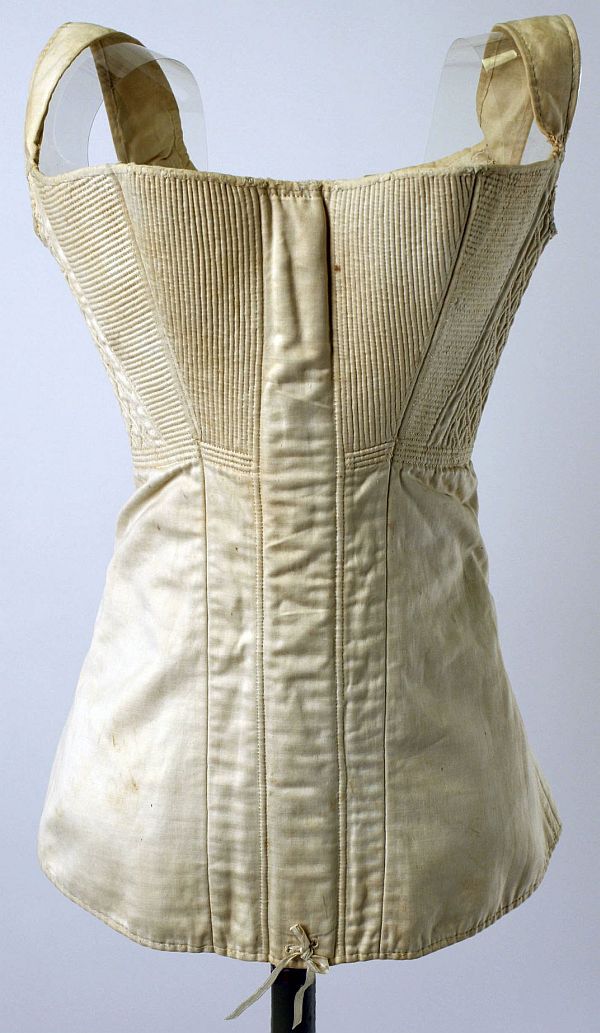
This shape more or less persisted until the Regency era of the early 1800s, when there was “all sorts of invention and change and messing about” with fashion, Davidson says. During that 20-year period, women had options: They could wear stays, boned, structured garments that most resemble today’s conception of a corset; jumps, very soft, quilted, but still supportive undergarments; or corsets, which were somewhere in between. O’Brien says the corsets of the Regency period were made of soft cotton (“imagine blue jeans, and turn them white”) with stiffer cotton cording for support, and occasionally channels in the back for boning, and a slot in the front for a metal or wooden support called a busk. (Remember, though, these supports were made to fit an individual’s body and would gently hug her curves.) Eventually, the term corset (from the French for “little body”) is the one that won out in English, and the shape gelled into the hourglass shape we think of today.
 
But all along, these undergarments were just “normal pieces of clothing,” Davidson says. Women would have a range, just like today’s women “have a spectrum of possibilities, from the sports bra to the Wonderbra.” Those simply hanging around the house would wear their more comfortable corsets, while others going to a ball might “wear something that gives a nicer line.” Even working women would wear some sort of laced, supportive garment like these—giving lie to the idea that putting on a corset immediately induced faintness. For Davidson, the myth that women “walked around in these uncomfortable things that they couldn’t take off, because patriarchy,” truly rankles. “And they put up with it for 400 years? Women are not that stupid,” she says.
 
These garments were comfortable, Davidson adds, not just by the standards of the time—women started wearing some sort of supportive bodiced garment when they were young girls, so they were accustomed to them by adulthood—but by modern standards as well. O’Brien concurs: “To have something that goes further down your bust … I’d really like to have that, because it would do a better job of distributing the support.”
 
By the Victorian period, after “Bridgerton,” corsets had evolved to a more hourglass shape—the shape many people imagine when they think of an uncomfortable, organ-squishing, body-deforming corset. But again, modern perceptions of the past shape how we think of these undergarments. Davidson says skirts were bigger during this time—“the wider the skirt, the smaller the waist looks.” Museums often display corsets in their collections on mannequins as if their edges meet. In reality, they would likely have been worn with their edges an inch or two apart, or even looser, if a woman chose.
 
McGann suggests that one of the reasons corsets are associated with pain is because actresses talk about their discomfort wearing an uncomfortable corset for a role. “In many cases, the corsets are not made for the actress but rather a corset in her general size is used for expediency,” McGann says. “This means they are wearing corsets that don't fit them properly, and when laced tightly, that can hurt!”


So, in the Regency era and in other periods, did women tighten the laces of their corsets beyond what was comfortable—or healthy—in service of achieving a more fashionably narrow waist? Sure, some did, when they had someone to impress (and in fact, Davidson gives the Gone With the Wind corset scene high marks for accuracy, since Scarlett O’Hara is young, unmarried, and trying to make an impression). In “Bridgerton,” social striver Lady Featherington’s insistence on her daughters’ narrow waists similarly seems logical. Except…in the Regency period, where dresses fall from the bust, what would be the point of having a narrow waist? “The whole idea of tightlacing is completely pointless…irrelevant for the fashion,” Davidson says.
 
“There is no way that period corset is going to [narrow her waist], and it’s not trying to do that,” O’Brien adds.
 
Davidson has another quibble with the undergarment fashion choices of “Bridgerton” (at least the first episode, which she watched at Smithsonian magazine’s request). Corsets and stays of the Regency period were designed less to create the cleavage that modern audiences find attractive, and more to lift up and separate the breasts like “two round globes,” Davidson says. She finds the corsets in “Bridgerton” too flat in the front.
 
In an interview with Vogue, “Bridgerton” costume designer Ellen Mirojnick laid out her philosophy on the series' apparel: “This show is sexy, fun and far more accessible than your average, restrained period drama, and it’s important for the openness of the necklines to reflect that. When you go into a close-up, there’s so much skin. It exudes beauty.” But, Davidson says, “while they sought sexiness and cleavage and maximum exposure, the way they’ve cut the garments actually flattens everyone’s busts. If they’d gone back to the Regency [style of corset] you would have gotten a whole lot more bosom. You would have had boobs for days.”
 
 
“Bridgerton” does, however, get a lot right about the status of women in the early-19th century. Marriage was one of the only options for women who didn’t want to reside with their relatives for the rest of their lives, so the series’ focus on making “good matches” in matrimony holds true. Once wed, a married woman legally became her husband’s property. She couldn’t sign contracts or write a will without her husband’s consent.
 
By the mid-19th century, women had made significant gains in being able to own property or obtain a divorce. It wouldn’t be until 1918 in England or 1920 in the United States, however, that (some) women could vote. Around the same time, corsets were falling out of fashion, and many writers of the time saw a connection between liberation from the corset and women’s liberation.


O’Brien says that looking back now, that conclusion doesn’t hold up. “You have all these writers saying, ‘Oh, we’re so much more liberated than those dreadful, hypocritical, repressed Victorians, and we’ve thrown away the corset.’ Well, I’m sorry, but if you look at shapewear in the 1920s, they’re doing the exact same thing, which is using undergarments to create the current fashionable shape,” which in the Roaring Twenties meant using “elasticized” girdles and bust-binders to “completely clamp down on a woman’s natural shape.
 
“Society always has a body ideal that will be impossible for many women to reach, and every woman will choose how far to go in the pursuit of that ideal, and there will always be a few who take it to a life-threatening extreme,” O’Brien adds
 
O’Brien and Davidson hope people stop thinking of corsets as oppressive tools of the patriarchy, or as painful reminders of women’s obsession with fashion. That attitude “takes away female agency,” O’Brien says. “We’re allowing fashion’s whims to act upon us, rather than choosing to do something.”
 
Wearing a corset was “as oppressive as wearing a bra, and who forces people into a bra in the morning?” (Some women in 2021, after months of Zoom meetings and teleworking, may be asking themselves that exact question right now.) “We all make individual choices,” Davidson says, “about how much we modify ourselves and our body to fit within the social groups in which we live.”
 
It’s easier to think of corsets as “strange and unusual and in the past,” Davidson says. To think of a corset as an oppressive tool of the past patriarchy implies that we modern women are more enlightened. But, Davidson adds, “We don’t wear corsets because we’ve internalized them. You can now wear whatever you like, but why does all the Internet advertising say ‘8 weird tricks to a slim waist’? We do Pilates. Wearing a corset is much less sweat and effort than going to Pilates.”
 
What ‘Bridgerton’ Gets Wrong About Corsets. By Rachel Kaufman. Smithsonian Mag,  January 8, 2021.


For centuries, women would grace the streets in elaborate attire and flaunt these designs with drastically contoured waists. The corset — a structural garment that molds the torso — allowed women to achieve this quintessential, curved silhouette.
 
The origin of the corset mainly derives from Western society during the 15th century, although corset-like garments date back to the Minoan civilization in ancient Greece.
 
During the Renaissance era, Catherine de’ Medici influenced corseted fashion by banning “thick waists” within her court. The elite women of Western society frequently wore these stiffened garments to attain a slender waist, with lacing from both the back and front and a “stomacher” to conceal these laces. Rather than mask these corsets under layers of fabric, Renaissance fashion showcased these decorative, structural adornments cinching womens’ figures. In the end, this era of “rebirth” defined this continual desire for a slimmer stature, including the eventual hourglass figure of the 1800s and the “S-bend” silhoutte of the 1900s.
 
Despite its controversial history of restraining the female body, the corset remains a prominent garment within fashion. Here, V recalls the evolution of the corset throughout 20th century fashion into modern day society.


Corsets of the Edwardian Era formed an “S-bend” curve to achieve this puffed-out demeanor, often referred to as the “Porter Pigeon.” The straight-front and curved backside of both long and short bodices emphasized the proportions of the female body, creating an arched back and enhanced monobosoms.
 
Skilled corsètieres were in high demand during the early 20th century as idealized fashion attire became publicized through postcards and cigarette cards. Actors and other refined female figures were depicted on these commercial outlets, illustrating the fashion trends of that era. The Gibson Girl was the most notable portayal of this ideal womanhood, and signified “The New Woman” through her tiny waist and elongated figure.


During the First World War (1914-1918), women who entered the workforce shifted the fashion trend of contouring the female body to supporting it instead. This latest progression in women’s fashion remained a favored design entering the 1920s, signaling the change for a more active lifestyle. With the introduction of elastic, sports corsets provided women mobility through looser construction and flexibility.
 
The La Garçonne look became well-renowned postwar, emphasizing a boyish, pre-pubescent style that required a more column-like figure. Corsets in the 1920s were designed to slim the hips and create this youthful stature; the additions of garters were included to attach stockings. Flapper girls in particular needed this freedom of movement to dance, so corsetry veered towards cylindrical, elastic corsets to support this latest activity.


The desirability for a fitted, slender silhouette emerged during the 1930s. While women still exhibited slimmer hips from the previous decade, their waistlines were enhanced with laced and featherlight boned corsets. Beauty became associated with health, leading to this figure-hugging bodice seen within corsets and shaped brassieres; a shapely frame alluded to a robust physique.
 
With the Great Depression and World War II, utilitarian attire stressed the need for boxier cuts and hanging silhouettes during this period of repression. However, those who rejected this modernistic fashion turned towards neo-Victorianism. This aesthetic favored ornamentation and extravagance, and often provided audiences a form of escapism during the Great Depression. Period pieces in the '30s such as Gone with the Wind and Little Women depicted these elegant gowns and corseted imagery, while designers such as Norman Hartnell fabricated ensembles with thin, modeled waistlines (i.e. Neo-Georgian Ball Gown).
 
Following World War II, utilitarian undergarments were gradually superseded by delicate designs that exuded femininity. This was especially featured in Christian Dior’s “New Look” in 1947. A billowed skirt and cinched waist were emphasized within his haute couture collection, returning to a period of finesse.


The introduction of nylon in fashion provided a more light-weight, constructed bodice that became known as the girdle. The girdle was often made of nylon and latex rubber, and offered women a flattened posterior in comparison to the corset. Many women still wore constricted waspies, consisting of a boned bodice fastened by lace and/or hooks that narrowed down the female waistline. While these women retained the more restricting components of traditional corsets, younger generations usually preferred the girdle’s structure. Conical cups were an additional feature used for girdles and brassieres, achieving this pointed breast shape that was epitomized in the ‘50s.


Fashion witnessed the gradual decline of corsets as sporty, healthier lifestyles became prominent during the 1960s and 1970s. Rather than confine their figures underneath tight-fitting garments, women often focused on their diet and exercise regimens to acquire this silhouette.
 
With the emergence of the punk aesthetic, however, designers resurrected the corset during this contemporary revival of Victorian-esque styles. Acclaimed fashion designers such as Vivienne Westwood and Jean Paul Gaultier experimented with corseted silhouettes during the 1970s and 1980s. As an aficionado of historical punk, Westwood re-interpreted the corset as a symbol of empowerment rather than the suppression of women. In regards to Gaultier, his pink satin corset worn by Madonna circa 1990 is perceived as one of the most iconic designs in fashion.
 
Yves Saint Laurent, Tom Ford, and Thierry Mugler also incorporated corseted designs into multiple collections throughout these decades, most of which led to the trend of underwear as outerwear.


Corsets for a time were primarily reserved for costume design and seductive lingerie. However, this classical garment is once again appearing on fashion runways and pop culture, revitalizing the trend of corsets as outerwear. Moschino’s FW20 show consisted of eclectic ensembles reminscent of Marie Antoinette and French fashion. Models wore an array of artistic designs that embodied the iconic quote, “Let them eat cake,” and featured contoured torsos.
 
Celebrities and fashion influencers have also integrated corsets into their street style, including Bella Hadid, Kim Kardashian, and Rihanna. This iconic garment of feminine sexuality is still a traditional component within the history of fashion.
 
 
From Then ‘Til Now : History of the Corset. By Michaela Zee. V Magazine, March 19, 2020.  


From Jean Paul Gaultier, Thierry Mugler and Vivienne Westwood to Sinéad O’Dwyer, we chart the history of fashion’s most controversial garment.

 It’s 48 hours before the Met Gala and Kim Kardashian-West is being strapped into the final fitting of her Thierry Mugler wet-look dress. And I’m using “strapped in” quite literally, here. As she speaks to Vogue’s cameras about the inspiration behind the look (“[Mugler] is, like, the king of camp”), she’s being laced into a corset by three -- count them, three -- people. And she looks visibly uncomfortable -- eyes glazing over a little bit, letting out vocalized sighs, you can see her mind buffering as she speaks, she’s leaving ellipses between words. “If I don’t sit down for dinner, now you know why,” she tells Vogue, leaning crookedly against the edge of a chair. “I’ll be walking around mingling, talking, but I can hardly sit”. Two months after the gala, WSJ Magazine asked Kim about the infamous wasp-waisted dress. “I’ve never felt pain like that in my entire life,” she answered.


 “The corset is probably the most controversial garment in the entire history of fashion,” writes fashion historian -- and the world’s foremost corset scholar -- Valerie Steele in The Corset: A Cultural History. The garment -- a rigid bodice that’s laced to shape the torso -- has a tumultuous legacy, to say the least. Perhaps the most polysemous garment of all time, the corset is both adornment and armour, it elicits desire, signifies restraint and performs fashion’s greatest magic trick, the transformation of the body; it’s been both sculpting and forming itself to female ideals of beauty since the 1500s. Throughout its history, the corset has been reviled as an “instrument of torture” by 16th century doctors and 20th century feminists alike (and many in between), for the ways it’s deformed the body and impeded upon women’s personal freedoms. Despite this, the garment has emerged as one of spring/summer 20’s most ubiquitous trends. Why?

 The corset, as we know it now, emerged in the 1500s, though iterations -- made from soft canvas and iron, even -- date back to antiquity. These 16th century corsets, also known as “stays,” are the familiar boned bodices seen in a Shakespeare adaption or, perhaps, a Keira Knightley costume drama, laced up the back, and crafted from rigid materials like horn, buckram and most famously, whalesbone. Discipline -- both mental and physical -- was a virtue to members of the era’s European elite; bodily control manifested in the form of the corset, which was worn by women (and some men) to hold the body erect, to improve posture but also, to posture. To the nobility, corsets were meant to be constricting: after all, their class valued self-control above all.


 Most evidently, women wore corsets to meet the beauty standards du jour. In the 16th century, the look was an elongated, conical torso, with the stays extending to the hips. The 1700s favored short, hourglass silhouettes. And in the 19th century, tight bodices pushed the breasts up and out, to form an S-shape. The common denominator was a small, pinched waist. And women suffered for it. The stylish Georgiana Duchess of Devonshire described the discomfort of a corset in the 1778 novel The Sylph: “my poor arms are absolutely sore with them; and my sides so pinched! But it is the ‘ton’; and pride feels no pain.” In the same century, poet Elizabeth Ham referred to them as “very nearly purgatory.” It’s true that corsets deformed the ribs and misaligned the spines of their wearers. In the 16th century, surgeons alleged that stays could cause respiratory disease, suffocation and sudden death. And while these claims, along with myths of women having ribs surgically removed to achieve a thinner waist, are false, even moderately tight corsets restrict respiration, leading to palpitations, shortness of breath and fainting.

 Not surprisingly, advancements in women’s emancipation lead to the undergarment’s demise. French couturier -- and famous corset hater -- Paul Poiret proclaimed the fall of the corset (in the name of Liberty) at the beginning of the 20th century. By the event of World War I, as women entered the workforce, the garment fell out of favour, for good. Well, almost.


 In 1987, British designer Vivienne Westwood revived and revolutionized the corset, turning the garment inside out -- literally. In true Westwood parody, the anarchical designer’s autumn/winter 87 “Harris Tweed” collection poked fun at the frumpy prudishness of British nobility, transforming their stuffy, traditional textiles (Harris Tweed) and garments (corsets) into glamorous garb. Westwood named the collection’s corsets -- which would become her signature piece -- the “Stature of Liberty,” and liberating they were. Unlike the body-modifying, rib-crushing bodices of yore, Westwood’s confections were purely decorative in nature, constructed with lycra panels and zippered backs. They raised the bosom, but let the wearer breathe. More importantly, they were the first corsets to be worn as outerwear. Suddenly, what was once a symbol of female oppression became the uniform of third-wave feminism, a cheeky symbol of women embracing and owning their sexuality. Of the corsets, the designer told L’Officiel, “[They look] great flat-chested or with your dumplings boiling over.”

 The corset, for Madonna, was a similar type of power move. On the first night of her 1990 Blond Ambition tour, during the concert’s opening number, the singer ripped open a zoot-y pinstriped blazer to reveal that cone-breasted satin corset -- you know the one. It was a move that echoed, cementing Madonna’s legacy as the foremost pop star, and as a pop culture icon. But how did one garment cause such a shockwave? Unlike Dame Westwood’s busty designs, the Jean Paul Gaultier-designed bodice weaponized the female form, transforming its sinuous curves into spikes that seemed to prick. The look was assertive, intimidating; it symbolized a woman in complete control of her sexuality, and dominant, even. Wearing the JPG corset (over a pair of pants, I might add), Madge danced, simulated masturbation, and thrusted her hips as she sang, “You’ve got to make him express himself.”

 By the time the mid-90s rolled around, the corset had taken over the runways of Europe. Think early John Galliano, famous for his history-plundering designs, who used the corset to tell the lush, fantastical fashion narratives that would define his career. The British designer’s spring/summer 93 collection, titled “Olivia the Filibuster”, told a tale of shipwrecked swashbucklers; models swaggered and swayed down the catwalk in corseted leather jackets and striped bustiers. For his autumn/winter 93 collection, about a runaway 19th century Russian princess, Galliano sent Kate Moss tearing down the runway in a billowing hooped skirt and corset to match.


 And, of course, think Mugler. What was the 20th century corset renaissance without the king of camp, the master of catwalk showmanship, French couturier Thierry Mugler? He’s responsible for not only some of the 90s most iconic runway moments, but some of the most audacious looks of all time. And nowhere is this embodied more, perhaps, than look 101 of his autumn/winter 95 couture spectacular. Like an Arthurian knight from the future (or a cyborg from the past), German super Nadja Auermann stepped out in a golden hard-bodied corset dripped in rhinestones, and with matching articulated sleeves. And although the legendary designer officially retired in 2002, his extreme designs -- and extreme corsets -- live on into the now, under the creative directorship of Casey Caddawaller. The newly-appointed Mugler designer has resurrected his predecessor’s predilection for the waist-snatching garment into some of the zeitgeist’s most memorable fashion moments. Bella Hadid opened the house’s spring/summer 20 show in one of the season’s sexiest and most viral looks: a mesh corset, styled with a teensy blazer and no pants.

 Perhaps more subversive a statement than even Madonna’s Gaultier cone bra, the 21st century’s most iconic corset moment arrived on June 1, 2015. Caitlyn Jenner appeared on the cover of Vanity Fair, in true covergirl fashion, mane tousled, head coyly cocked to the side, and wearing a sumptuous silk satin bodice. The look was an ode to the pin-ups of yore -- namely Playboy’s first cover star, Marilyn Monroe, herself -- and a powerful way for the trans trailblazer to claim space and express her new gender identity.


 But no one living today knows the corset as intimately as Keira Knightley. The actress, herself, has become synonymous with the period drama, the type of historical film in which you might spot a stay or two. The genre, itself, is both the largest proponent and detractor of the corset. Think Kirsten Dunst in Sophia Coppola’s Marie Antoinette, her cleavage iced, like one of her three-tier cakes, in pale yellow silk, pink ribbons, and ruffles and ruffles of lace. Likewise, seeing Glenn Close’s buoyant boobs in Dangerous Liaisons might make us want to strap into one of the near-lethal undergarments, ourselves. Nearly -- because what’s a great period drama without a boudoir scene to shatter the illusion. Who can forget the image of Viven Leigh as Scarlett O’Hara, elbows around a bedpost, being laced into her stays. Or Knightley as Elizabeth Swann, gasping, as two chamber maids tighten her laces. A few scenes later, out of breath and feeling faint, she plummets from a castle turret into the gnashing sea below. Knightley has donned a corset on the sets of nine different films. A corset connoisseur, her review of the garment: “positively awful.”

 While many credit Prada’s autumn/winter 16 collection -- its centerpiece a half-laced white canvas body -- for the most recent resurgence of the garment, it was Sydney-based indie label Daisy who ushered in the corset’s most recent renaissance. A millennial riff on the milkmaid fantasy, the mark’s spring/summer 15, “Pure Country” collection, offered a selection of broderie anglaise dresses, laced from sweetheart-neckline to hem, alongside leather underbust corsets and other down-home-hot bustiers, printed in gingham or crafted from calf-hair. The look, according to the label, was everyday eroticism, a bubbly, quotidian sexy that demonstrated the quintessential it girl fit could transcend ripped jeans and a band T-shirt. The movement went viral, with the zeitgeist’s batch of Insta-girls -- from Kendall Jenner and Bella Hadid to Petra Collins -- decked in corseted, micro-mini prairie dresses, all laced loosely, effortlessly up the front.

 The corset disappeared from women’s wardrobes in the 20th century, but the ideals it spawned -- damaging or not -- live on. In place of a boned bodice, women have internalized the corset through diet, exercise, cosmetic surgery, digital retouching, flat tummy tea. The list goes on. It’s really no surprise that into the 2010s, the corset -- in its true, functional form -- has made a return. In the era of instant gratification -- movies and music at a single click, the ability to transform your (digital) body with a few flicks of the Facetune app -- why wait for the months-long pay off of a workout regiment? Emblems of this Insta-era, the Kardashians began peddling waist trainers -- corset-like devices that promise to whittle the waist to a perfect hourglass -- as far back as 2014. Since then, health experts have cautioned against the harmful garment, which, at best, rests on unfounded claims and, at worst, causes long-term structural issues. Despite these warnings, the trend has blown up: one model of the waist-shaper has over 3,000 reviews on Amazon. Ironically (or not), the product’s copy leads with the question “Want a sexy figure like Kim Kardashian?”

 Two new labels that are bringing corsets back for SS20 are Australian mark all is a gentle spring and Brooklyn designer Kristin Mallison. Following in the footsteps of Daisy, both brands approach the body-cinching piece with a whimsical nostalgia. all is a gentle spring’s signature pastoral corset is printed in a Toile de Jouy pattern, which depicts idyllic scenes from the era of the garment itself. Same goes for Mallison and her viral iterations, pieced together from vintage tapestries and upholstery fabrics, embroidered with elaborate tableaux of 18th century courtship and folly. Both labels, who gained their followings equally through affiliations with already-iconic boutique Café Forgot and the power of social media, have brought the antiquated garment into the digital age, where it thrives. Instagram is all about the flex and the fantasy, and the corset -- with its extreme look -- brings it, on both fronts.


 To some new designers, the corset can be a means of protection, against the barbs of the world’s current political climate. The duo behind British label Charlotte Knowles titled their SS20 collection “Venom”; it’s an offering of what they call “militarized corsetry.” Instead of laces and eyelets, Knowles’ bodies fasten with Velcro and press-studs, like tactical vests; traditional whalesbone and steel rods are replaced with flexible silicone, for combat-ready ease of movement. “Our woman is fighting for her place in the world,” Knowles’ designer partner Alexandre Arsenault told Vogue, “She is tough and dangerous.” Similarly, fellow Londonite Dilara Findikoglu -- known for her goth-y, historical garb -- dressed Madonna in what she called an ‘armour corset’, in the style of Joan of Arc, for Madge’s 2019 Eurovision performance. After all, a corset’s not that far off from a breastplate.

 Of all the designers reviving the corset this season, none are doing it quite like Sinéad O’Dwyer. Cast in silicone, moulded from lifecasts of her muses and friends, O’Dwyer’s bodices actually share very little in common with the traditional garment, save for lacing, the focus on the female form. Whereas historic corsets were meant to eradicate the ‘natural’ body, O’Dwyer embraces it -- sagging breasts, cellulite, ‘fupa’ and all. Her designs are a response to today’s narrow ideals of beauty, the very ones that have been shaped by the corset since the 1500s; they’re about opening up a space within fashion for all body shapes and sizes. “My work is a sort of ‘fuck you’, and a declaration of pride in your body. I think it conveys the power that comes from women deciding that they don’t have to accept the status quo,” she explains. “You shouldn’t have to feel compelled to live up to an externally set, arbitrary standard. You should have the control.”

 How corsets took over the world. By Zoë Kendall.  i-D , May 25, 2020.