Showing posts with label lesbian subculture. Show all posts

28/06/2023

Lesbian Magazines in Weimar Berlin


Berlin in the 1920s was ablaze with sexual and gender freedom. Magazines at newsstands boasted covers featuring people who were transgender and clad scantily. Their headlines touted stories on “Homosexual Women and the Upcoming Legislative Elections,” and offered, on occasion, homoerotic fiction inside its pages.

Publications like Die Freundin (The Girlfriend); Frauenliebe (Women Love, which later became Garçonne); and Das 3. Geschlecht (The Third Sex, which included writers who might identify as transgender today), found dedicated audiences who read their takes on culture and nightlife as well as the social and political issues of the day. The relaxed censorship rules under the Weimar Republic enabled gay women writers to establish themselves professionally while also giving them an opportunity to legitimize an identity that only a few years later would be under threat.

 “Reading stories about other queer women was such a powerful way that women came to terms with their own queerness,” Laurie Marhoefer, a professor of history at the University of Washington, told me. “That was super important for women more than for men because men would just have more opportunities to find other queer people.” Marhoefer, who first learned of these publications as a graduate student in Berlin in the 2000s, is part of a growing group of academics focusing on this oft-forgotten moment in German history.

Such research is part of a wider interest in the Weimar Republic, bolstered by recent TV shows like Transparent (which drew connections between the 1920s and modern-day queer identity) and the gritty Babylon Berlin, whose characters include a female sex worker who spends her days as a detective. Benjamin Tallis described the appeal of these depictions in New Perspectives: “The visceral thrill of watching 1920s Berlin as a creative, decadent socio-cultural mecca, beset by suffering, and haunted by myriad ghosts yet alive with possibility, is tempered by the knowledge of the political abyss that awaits.”

Although these fictional tales tend to romanticize this interwar period, the primary source documents that miraculously survived the period of the Third Reich and subsequent and repressive Cold War years provide a richer and more complicated picture.

There were some twenty-five to thirty queer publications in Berlin between 1919 and 1933, most of which published around eight pages of articles on a bi-weekly basis. Of these, at least six were specifically oriented toward lesbians. What made them unique is the space they made for queer women, who had traditionally been marginalized on account of both gender and sexuality, to grapple with their role in a rapidly changing society. (The concept of the “new,” albeit straight, woman in the Weimar Republic has been researched broadly, including by Rüdiger Graf in Central European History, who writes that it reflected a crisis of masculinity following defeat in the First World War as well fears over the country’s future when women were putting off getting married and having children.)


In these interwar years in Germany, queer and transgender identity became more accepted, in large part thanks to the work of Magnus Hirschfeld, a Jewish doctor whose Institut für Sexualwissenschaft focused on issues of gender, sex, and sexuality. At the same time, women in Germany were making strides toward greater independence and equity; they gained the right to vote in 1918, and feminist organizations like Bund Deutscher Frauenvereine cultivated space for women in public spheres, encouraging their advancement in politics. As Sara Ann Sewell writes in the journal Central European History, the German Communist Party created the Red Women and Girls’ League in 1925 to attract more women and working-class people, particularly through organizing factory workers.

More generally, German women were becoming increasingly empowered. Queer people—including women—rallied around the abolishment of contemporary sodomy laws. This struggle “created a wider climate of publication, activism, and social organization that was much more embracing of different types of queer and trans lives,” according to Katie Sutton, an associate professor of German and gender studies at the Australian National University.

Like Marhoefer, Sutton came upon the Weimar-era lesbian publications in Berlin and was surprised that there wasn’t more engagement with these magazines or with the queer history of the Weimar Republic more broadly on the part of academics in the English-speaking world. Exceptions included the notable work of historian Claudia Schoppmann and her 1996 Days of Masquerade and Heike Schader’s 2004 Virile, Vamps, und wilde Veilchen (Virility, Vamps, and Wild Violets). The latter focused on the queer tropes that proliferated in lesbian magazine fiction of the time, and their creation, according to Sutton, of “codes of lesbian desire and lesbian eroticism” through color, flora, smells, and body parts, notably mouths, lips, hands, and breasts.

For its part, magazine fiction of the time challenged some of the restrictions of class and race in its love stories. A 1932 issue of Die Freundin, for instance, includes a story about a relationship between the German Töpsdrill and the Moroccan Benorina. Exoticizing of the “other” was common; Sutton points to another piece of fiction published in Ledige Frauen (Single Women) in 1928 about Helga, a German coffee importer, who falls for Nuela, a servant from Java. Notwithstanding the white, sometimes racist perspectives of the narrators, such stories offered compelling renderings of women-centered utopias.

Outside of fantasy, these publications also created a space for readers to assert themselves in the real world through personal ads and event listings. There included cream puff eating contests, ladies and trans balls, and lake excursions on paddle steamers. In fact, aspects of lesbian culture also seeped into the mainstream, particularly when it came to fashion, with a rise in the popularity of short haircuts, straight skirts, and pantsuits. There was little difference between the imagery in mainstream fashion magazines and the masculinized aesthetic eroticized in the queer ones. The “hint of queerness” in the mainstream, Sutton said, was “sexy and fascinating, but also a bit scary and potentially off putting.” A popular element in lesbian publications, the monocle was similarly charged, and, Sutton says, “a queerly coded, quite masculine symbol of owning the gaze.”


Such sartorial choices were in keeping with debates in the lesbian magazines of the time around the “extent that masculinity might be seen as hierarchically superior to that of the feminine lesbian women,” according to Sutton. Moreover, these debates foreshadowed the butch/femme debates of the 1980s and 1990s and the border wars of the late ‘90s and early 2000s.

Style was particularly significant for trans women and men who in the Weimar Republic defined themselves with a variety of terms: both as transvestites and masculine women who wore men’s clothes but identified as women. Trans people were given space in both their own magazines and even in some of the lesbian ones, highlighting a sense of cross-identity camaraderie. Die Freundin had a regular trans supplement highlighting these voices.

 In a 1929 issue, a writer named Elly R criticized the treatment of trans people in mainstream media, referencing sensational coverage of men wearing their wives’ wedding dresses. “Everywhere in nature we find transitional forms, in the physical and chemical bodies, in the plants and the animals,” she wrote. “Everywhere one form passes into another, and everywhere there is a connection. Nowhere in nature is there a delimited, fixed type. Is it only in man that this transition should be missing? As there is no fixed form in nature, a strict separation between the sexes is also impossible.”


These magazines were resilient, a testament to the strength of the communities they served. Still, they faced challenges. The 1926 Harmful Publications Act was intended to impose moral censorship on the widespread pulp literature sold at kiosks and newsstands, including the queer publications, which often featured nude photographs.

The Catholic and Protestant Churches as well as public morality organizations and conservative politicians led the fight against what they called “trash and filth literature.” As Klaus Petersen explains in a German Studies Review article, the list of materials, which included at least seventy works on sexology and “filth literature,” could still be sold, just not to those under age eighteen. While “the instrument was blunt and [its] impact minimal,” the restriction was boosted by members of religious and youth groups that checked up on newsstands to see what material was visible or advertised to children. (This is not a far cry from the Nazi book burnings that would occur just a few years later.) But the law also spurred a counter-campaign by writers, publishers, intellectuals, and leftist political activists who objected to these limitations, as Petersen explains.

“This coalition of protest groups against infringements of the freedom of expression considered the Index a simplistic and entirely ineffective means to avoid an honest discussion of the fast change in social attitudes and moral values and campaigned against it as an unconstitutional instrument of suppression.”

Despite their relative progressivism, these publications also represented a rather narrow, bourgeois segment of the German population. Even if women had greater access to education and publishing opportunities, the women who enjoyed this greater access were largely urban elites. Little if no space was given to proletarian struggles. “Middle-class values of respectability and citizenship shaped the political agenda, with contributors drawing on the powerful language of national inclusion in formulating their demands of legal and social acceptance,” wrote Sutton in an article in German Studies Review.

It’s also important to note that whatever sexual liberation the LGBTQ+ community enjoyed was at the discretion of the state, whose goal was to control its members. This was seen in the Transvestitenscheine (“transvestite certificates”) handed out by the German police to protect against the arrest of those cross-dressing in public. Between 1908-1933, dozens of such passes were distributed. They also guarded against arrests for sodomy law violations and played a role in a 1927 battle over legalizing prostitution, largely aimed at preventing the spread of venereal diseases.

That said, the plight of sex workers was largely excluded from consideration in the publications in question, and mentions of their readers’ privilege were few and far between. Still, a 1929 Die Freunden article cautioned readers: “Don’t go to your entertainments while thousands of our sisters mourn their lives in gloomy despair.”

More notably, these magazines gave precious little foresight into what was to come in Germany: the attempted extermination of all who did not fit the Aryan ideal. That, of course, included lesbians, some of whom perhaps took steps to save their own skin. Ruth Roellig, who wrote for Frauenliebe and published Berlins lesbische Frauen (Berlin’s Lesbian Women) in 1928, a first-of-its-kind travel guide to queer Berlin, published a second book in 1937. Soldaten, Tod, Tänzerin (Soldiers, Death, Dancer), an anti-Semitic screed, proved to be Roellig’s last book, though she lived until 1969. Selli Engler, a lesbian editor who founded the magazine Die BIF – Blätter Idealer Frauenfreundschaften (Papers on Ideal Women Friendships), wrote Heil Hitler, a play she sent directly to the führer.

As feminist and queer activism grew in Germany in the 1970s, so too did interest in the Weimar period. In 1973, Homosexual Action West Berlin began to collect flyers, posters, and press releases in an effort to create a comprehensive archive of lesbian history. The group eventually morphed into Spinnboden, Europe’s largest and oldest lesbian archive, with more than 50 thousand items in its holdings, magazines among them. Katja Koblitz, who runs the archive, says the existence of these lesbian periodicals is invaluable.

“These magazines were in one part a sign of the blossoming and of the richness of the lesbian subculture in these days,” she said. “Reading these magazines was a form of reassurance: Here we are, we exist.”

Publishing Queer Berlin. By  Hannah Steinkopf-Frank.   JSTOR Daily, June 7, 2023.


Each year, Lesbian Visibility Day on April 26 gives prominence to an often unseen minority. In Weimar Berlin, before the Nazis seized power, writer Ruth Roellig put same-sex female desire on the map for the first time.

It was 1928 and Berlin was undergoing a revolution. Poverty, insecurity and political polarization were everywhere. Yet at the same time, the German capital was enjoying a taste of freedom that had once seemed utopian. The storm of fascism had not arrived yet, and women and sexual minorities were eager to claim their place in society.

"The Weimar Republic was, especially in Berlin, in eruption," Sabine Balke, managing director of the Digital German Women's Archive, told DW. "Everything was possible."

Or so it seemed. Even though female emancipation was making day-to-day strides, crossdressers could still be arrested on the streets, and homosexual relations were criminalized.

Lesbians, often considered the most invisible group within what we today call the LGBTQ community, also had a glimpse of how the world could be if its rules were different. What we know about that today is to a great extent due to the work of a woman who drew the map of same-sex female love and desire in that era.

Heady times

Ruth Roellig (1878-1969) began writing just after finishing school. Hers was a male, straight world, yet she soon managed to publish fiction and travel journals. But it was the Weimar Republic and the relative press freedom that came with it that paved the way for some of her most remarkable works, at least from a contemporary perspective.

"For lesbians, the more relaxed censorship under the Republic was important. Many new lesbian magazines appeared," historian Laurie Marhoefer told DW. Garçonne, Die Freundin or Frauenliebe were some of the publications that gave homosexual and bisexual women a place not just to tell their own stories but also to discover safe spaces and leisure activities that did not force them to hide their sexual orientation.

 "One could go to the clubs and meet similar people, other lesbian women, to dance, to make music," Balke says. It was the time when cabaret queen Claire Waldoff's - also openly homosexual - rebel voice was played in the radios all over the country.


Pioneering work and historic document

Through her articles in Frauenliebe, Roellig became a prominent figure in the lesbian scene of Weimar Berlin. Publishing those pieces also meant outing herself, but it did not seem to be a great danger at the time. As it often does, progress must have felt irreversible.

Nonetheless, it wasn't until 1928 that her greatest contribution to the lesbian history in Germany was published. In Berlins lesbische Frauen (Berlin's Lesbian Women), she extensively depicted the German capital's network of bars, cafés and clubs aimed at this public. It was much more than a pioneering queer city guide.

"It's very important because it's evidence of what was there," Sabine Balke underlines. Also the head of Spinnboden, Berlin's lesbian archive, Balke is aware of the historical importance of such a document: "In the 70s, when women started to fight for a more open sexuality or against the abortion ban, they did not know that there had been something similar in the 1920s."


The backlash

The rise of the Nazis to power in 1933 also meant the end of this brief period of sexual emancipation. The magazines and venues that in the previous decade had become so important for sexual minorities were shut down. Roellig's life also changed forever. "She had exposed herself," says Balke. "She could not write as a lesbian woman anymore. She had to quickly make sure that everything disappeared."

Yet it was not the end of her writing career. Ruth Roellig did publish another novel in 1937: Soldaten, Tod, Tänzerin ("Soldiers, Death, Dancer"). With its anti-Semitic content, this book left a disturbing legacy. Within a few years, around six million Jews would be killed in the Holocaust. Roellig never wrote again.

Historian Laurie Marhoefer insists on the need to underline the controversial part of this pioneer in lesbian activism: "Every time we mention her, we also have to consider this part of her legacy. She was no 'bystander' in the Nazi period."


No black and white

Balke agrees, but also thinks it's important to go beyond that. "It was a question of survival. That's why we today cannot just say: She was a Nazi." After having openly maintained a lifestyle hated by the regime, Ruth Roellig was in complete danger. "But it could also be that she found that all right and was genuinely anti-Semitic," she adds.

"I think this shows us that people do not have only one story, and that they're not only good, or only bad" – a concept that, as Balke points out, Hannah Arendt underscored in her work.

 Whether Roellig was truly anti-Semitic or not is a question we cannot answer nowadays, Balke believes: "It's very hard to judge." By the time she died in Berlin, in 1969, she no longer held openly anti-Semitic views nor was she openly lesbian. What remain are her books and articles, the controversial legacy of the woman who made lesbians visible in Berlin decades before the Stonewall riots and the first gay pride marches.

At the time, however, Roellig was probably unaware of the importance of Berlins lesbische Frauen, Balke believes. The book was lost for many years and re-edited in the 1970s under the title Lila Nächte (Purple Nights). And for Balke, thanks to that book, "Ruth Roellig lives in our history."

 The woman who gave birth to lesbian Berlin. By Enrique Anarte. Deutsche Welle,  April 26, 2019. 


I came across these magazines when researching the topic of my most recent written assessment. By now, I have carried an intense fascination with the sexual socio-political climate of the Weimar Republic for a couple of years. On the course ‘Reassembling Modernism: Artists’ Networks in Europe 1909-1960’ as an undergraduate, I was introduced to Weimar culture when we examined the Neue Frau in the Berlin of the 1920s. It was a text by Maria Makela entitled ‘New women, new men, new objectivity’, however, that truly peaked my interest in the subject.

This year, I revisited the Neue Frau and explored her myth and ideological potential whilst considering her as a phenomenon of cosmopolitanism—in relation to class, gender and violence in the city. Makela’s essay was my starting point, and these magazines gave me an example of how the Neue Frau’s multi-faceted identity was utilised to develop a progressive symbol of gender subversion. The Neue Frau/neue frauen is the German adaptation of the New Woman. The New Woman was a female figure, a new gender type, who emerged in modern society towards the end of the nineteenth century, becoming a popularised construct in the first half of the twentieth century.


The Neue Frau was a fashionable woman who adopted traditionally heteronormative, ‘masculine’ traits within her dress identity to disassociate herself from the pre-WWI woman. Her image epitomised modern femininity, but it also effectively mirrored how interwar Germany perceived itself to be under cultural threat from the masculinisation of a ‘New’ generation of emancipated women. In the pages of queer publications, however, the Neue Frau’s image was represented without ridicule or cynicism. It was interesting to reconfigure my own perception of her image after months of aligning it with the caricatured parody that male, Neue Sachlichkeit artists had painted her to be.


In the case of the women depicted in Liebende Frauen (1927-1930), the tensions felt nationwide between opposing genders are made redundant. At the time of the1929/30 issue, Liebende Frauen was one of two lesbian magazines in Berlin; the other, the more widely-known Die Freundin (The Girlfriend: Journal for Ideal Friendship between Women) had been in circulation since 1924. Art historian Heike Schader notes that Liebende Frauen is most likely a reprint of the magazine Frauenliebe (Women Love); which in turn was renamed Garçonne in 1930.


In the above image, a cover dated 1929, the female subject sports a bubikopf—a haircut strongly associated with the Neue Frau, which translates directly to ‘boy’s head’ and was reconfigured into numerous variations, such as the shortened and smoothed ‘Eton crop’, similar to that of Louise Brooks’ Lulu in Pandora’s Box. The overlapping strings of pearl necklaces that decorate her neck, the draped cut of her neckline and way in which her face is coquettishly turned from the camera’s gaze tells the reader that this Neue Frau, like Brooks’ Lulu—will not apologise for claiming her own sexuality. This cover presents allure and a conscious play on the provocation of desires, celebrating the figure of the New Woman by virtue of her dress and demeanour.

These covers are truly wonderful examples of how the New Woman, specifically the homosexual New Woman, found alternative means of how her image could be disseminated in popular culture via ways less damaging to her personhood. Each cover is a portal into an important history for women, and they each contribute to the Neue Frau as a social construct: one that was repeatedly well-documented until the Weimar Republic’s fall. 

To see more of these wonderful covers, go to the Spinnboden Lesbenarchiv und Bibliothek, Berlin’s online archives: www.meta-katalog.eu

Additionally, there are lots of many interesting texts covering the Neue Frau’s image, such as:
Women in the Metropolis: Gender and Modernity in Weimar Culture by Katherina von Ankum
Women in German History: From Bourgeois Emancipation to Sexual Liberation by Ute Frevert
Women in Weimar Fashion: Discourses in German Culture, 1918-1933 by Mila Ganeva
The New Woman International by Elizabeth Otto and Vanessa Rocco
Visions of the “Neue Frau”: Women and the Visual Arts in Weimar Germany by Marsha Meskimmon
The Masculine Woman in Weimar Germany by Katie Sutton
 
Sources
Maria Makela, “New Women, New Men, New Objectivity” in New Objectivity: Modern German Art in the Weimar Republic 1919-1933
Heike Schader, ‘Liebende Frauen’
Katie Sutton, ‘The Masculinisation of Woman’ in The Masculine Woman in Weimar Germany
 
In her image: the documentation of the Neue Frau in German Weimar-era lesbian magazines. By Kathryn Reed. The Courtauld,  February 26, 2019. 


Before World War I, Berlin was known for its large male homosexual subculture. After the war, however, the sudden emergence of a visible lesbian subculture was unprecedented and remarkable because, previously, lesbianism had been thought to be rare. The development of modern mass culture coincided with the rise of homosexual subculture, facilitating the formation of lesbian identities. However, as will be suggested first, these identities also had their roots in medical discourse and the homosexual emancipation movement, which looked to medical research to support its demands for homosexual rights. Also, lesbian clubs and nightclubs, as well as lesbian magazines, were closely linked to the homosexual emancipation movement, and they were the sites which brought women together and which facilitated lesbian identification. Therefore, this paper will explore the production of these identities by examining the subcultural network and, in particular, the lesbian magazine Die Freundin, as a mass cultural publication in which science, mass culture, and subculture intersected. This will highlight the constructed, unstable and ambiguous nature of Weimar lesbian identities, which were varied and overlapping.

Scholars of sexual cultures and gender relations in Germany have tended to overlook Weimar lesbian identities, confining their interest to the subculture itself, rather than to the role it played in the development and elaboration of homosexual identities more generally. For example, in relation to lesbians, the works of Lillian Faderman and Brigitte Eriksson, Ilse Kokula, Adele Meyer and Claudia Schoppmann have provided valuable documentation of the Imperial, Weimar and Nazi periods. More specifically, both Richard Dyer and Ruby Rich have examined homosexual cinema in Weimar,while Katharina Vogel and Petra Schlierkamp have documented the history of the lesbian magazines Die Freundin and Garçonne respectively. One recent scholar, Christiane von Langerke, has investigated the numerous historical designations for lesbians in order to prevent these women from being subsumed under the male-identified label of ‘homosexual.’  All of this work is invaluable as a foundation for further scholarship.

However, as Patrice Petro’s study of female spectatorship and textual practice in Weimar Germany has powerfully illustrated, gender is of paramount importance to representation and ways of looking. That is, Petro has shown “the existence of a female spectator, and the function of representation for mobilizing her desires and unconscious fantasies.” Like the women’s magazines in Petro’s study, lesbian magazines such as Die Freundin made a direct address to women, articulating their desires and offering them ‘modern’ new conceptions – and choices – for gender roles, sexuality, relationships and, hence, possibilities for identification.

This suggests that a study which builds on the inroads made by Gudrun Schwarz and Geertje Mak, and specifically considers the nature and production of lesbian sexual identities, is needed. Both von Lengerke and Faderman have illuminated the changes and continuities of woman-centred relationships across time, but such an approach has a tendency to imply an essential lesbian identity, which is constant and, despite the variations they discuss, well-defined. For example, Faderman encapsulates lesbian behaviour under a single rubric of “romantic friendships” that spans countries and centuries. In contrast, this paper will situate lesbianism within a specific historical and cultural context. In the same way that Denise Riley has disrupted the idea of ‘woman’ as a discrete category,[ this paper will highlight the constructed and unstable nature of Weimar lesbian identities.

In the late nineteenth century, as scientists increasingly turned their attention to sexuality, a growing body of medical literature was produced. In 1886, Richard Krafft-Ebing’s book, Psycopathia Sexualis, asserted that homosexuality was an abnormal congenital manifestation. The physicians Magnus Hirschfeld and Iwan Bloch both expanded on this discourse, arguing that true homosexuals were biologically predisposed to members of the same sex. Conversely, they believed that pseudohomosexuals – usually women – were the creation of external circumstances, such as the absence of male sexual partners in prisons and schools.

As European sexologists described and explained other sexual ‘anomalies,’ the list of medical identifications grew. As one Weimar transvestite explained, “when sexual science began to concern itself with the sexual orientation of humans, it searched for words with which to designate the different variations. That is how names like sadist, masochist, fetishist, exhibitionist, bisexual, transvestite, homosexual, and so on originated.” Similarly, the labels for lesbians expanded to include ‘masculine lesbian,’ ‘feminine lesbian,’ ‘transvestite,’ ‘Mannweib’ (literally, ‘Man-Woman’ but suggesting a masculine woman), ‘Männin’ (‘Butch’), and ‘gleichgeschlechtlichliebende Frau’ (‘same-sex loving woman’). The variety of names for women suggests the instability of lesbian identity and the expansion of the discourse.

Medical ‘science’ was integral to conceptions of sexuality and underpinned the homosexual emancipation movement. Hirschfeld in particular argued that since homosexuality was inborn, it was natural and should not be persecuted, and in 1897 he founded Germany’s first homosexual organization, the Scientific-Humanitarian Committee. After the First World War, Hirschfeld founded the Institute for Sexual Science in Berlin (1919) and, in 1923, the League for Human Rights, a group dedicated to homosexual emancipation.

At the same time, the manifold growth of mass culture, particularly in Berlin, brought homosexuals together and facilitated identification. There were mutually reinforcing relationships between the organized homosexual rights movement, the large number of public leisure and entertainment venues (like clubs and nightclubs), and the extensive publications of the homosexual press. Indeed, one reader of Die Freundin, a male transvestite, stated that after he read the books of Iwan Bloch and Otto Weininger, as well as others, he had the greatest longing to go to Berlin and spend time with people who were his like.

 A 1931 Berlin travel guide highlighting the city’s sexual attractions claimed that there were at least 160 bars and clubs for male and female homosexuals. With the (temporary) abolition of censorship, films dealing directly with male and female homosexuality were shown in Berlin’s 300 cinemas. A large quantity of lesbian popular fiction, newspapers, and magazines also appeared. The German Friendship Association added community-building activities to this entertainment scene, and to the political activities of the Scientific-Humanitarian Committee, by holding dances and weekly meetings and publishing a weekly newspaper, Die Freundschaft.

The first guide to the homosexual club scene, Ruth Roellig’s Berlins lesbische Frauen (Berlin’s Lesbian Women), was published in 1928 with a foreword by Magnus Hirschfeld. This guide purported to educate and enlighten homosexuals and the public,but it also served to alert and connect women to the wider lesbian community. One woman recalled that Berlin’s Toppkeller Club was “so exciting that women from all walks of life came, even actresses. It was always so crowded, and on Fridays you could hardly get in at all.”

One of the most popular ladies’ clubs was the Damenklub Violetta, led by Lotte Hahm, a well-known figure in the homosexual rights movement .The Violetta hosted many dances, such as the “Calling-Card Ladies’ Ball” (Damenball mit Saalpost) and the “Dance Roulette” (Roulette-Tanz), and also auto tours of the Spreewald and fashion shows for masculine women and transvestites. One of the most popular activities was the “Moonlight Steamship Party” (Mondschein-Dampferpartie), in which a ship carried passengers from Spittelmarkt to Mugelsee, where they disembarked at the Inselhotel, enjoyed orchestra, cabaret, and tombola, and danced until 5 or 6 a.m., after which they returned to the ship for a quick sunrise photograph before sailing back.

Such clubs could also be found in other German-speaking cities, including Zurich, Hamburg, Cologne, Frankfurt, Leipzig and Breslau, and the League for Human Rights encouraged women across Germany, Switzerland and Austria to start and join clubs in their own towns and regions. This helped to expand the subculture and the homosexual rights movement itself.

In creating a sense of community through common experience, clubs informally politicized lesbians, linking the social scene to the homosexual rights movement. For instance, at Violetta, women sang “Das Lila-Lied” (The Purple Song), which declared lesbians’ difference and eventual liberation.Lotte Hahm also reminded women that “Not only dance and social events can bring you equality, but rather struggle is also necessary.”

Lesbian magazines, of which there were at least five, were available at newsstands or by subscription, and together they circulated to more than one million readers across the German-speaking countries. The magazines’ centrality in facilitating the growth of subculture and identification can be illustrated by examining the most popular publication, Die Freundin (The Girlfriend), which appeared monthly, and later weekly, with some interruptions from 1924 to March 1933.

Die Freundin was closely affiliated with the League for Human Rights through the group’s chairman, Friedrich Radszuweit, who also published the magazine. Given this overlap of the publisher’s interests, it is not surprising that through its editorials, Die Freundin politicized homosexuals by highlighting the League’s concerns, such as the repeal of Paragraph 175, the law criminalizing male homosexuality. Die Freundin accepted only advertisements from members of the League for Human Rights, and it exhorted its readers to patronize only those clubs sanctioned by the publication. The need for club owners to hold League memberships also undoubtedly benefited the homosexual rights movement by increasing the organization’s size.

Die Freundin also played a significant role in fostering the growth of the subculture by publicizing homosexual films, clubs, nightclubs and books available from the Berlin publishing house Radszuweit, which published both non-fiction, including medical books on sexuality,and fictional works, such as Grete von Urbanitzki’s Der wilde Garten (The Wild Garden), Anne Elisabeth Weirauch’s trilogy Der Skorpion, the German translation of Radclyffe Hall’s Well of Loneliness (Quell der Einsamkeit) and even novels that presented a less flattering image of lesbians, such as Alfred Döblin’s Die beiden Freundinnen und ihr Giftmord (The Two Girlfriends and their Murder by Poisoning). These kinds of publications facilitated lesbian self-identification. As one lonely and isolated woman living in a small town explained, she “had only one joy..., the book The Scorpion. I love it. With it, I feel that I belong to you, that no one can tear the innate feeling of happiness out of the heart.”

Clearly, physical and psychological isolation were major problems for both lesbians and transvestites. Personal advertisements helped overcome this, bringing together readers from as far away as Amsterdam. “Nuremberg. Lonely woman seeks same, educated but modern thinking girlfriend.”

In the impersonal city, Die Freundin could also be used to signal one’s identity to others ‘in the know.’ Several articles in the magazine depicted scenarios in which women reading or purchasing the magazine met like-minded women who had noted their choice of reading material. For example, one story told how a transvestite reading Die Freundin in a café attracted the notice of another woman. Another story began with two strangers meeting accidentally at the newspaper vendor where they had both just purchased Die Freundin.

Through Die Freundin lesbians discovered other women who “yearned for a great love,” but who, as the fictional character Lotte explained, “could not like any man.” Lesbians found both capable and career-minded women who reflected their own aspirations, as well as women who embodied the ‘feminine’ ideals to the extent that they were comfortable only in the company of other women. If women felt comfortable in men’s clothing, or if they embraced the modern styles, they also found like-minded women in the magazine – and the magazine gave them a name. One lesbian, Charlotte Falk, explained, “Through my indifference, through the style of my clothes, which are sporty but completely normal, my shoes, I... became a Mannweib... I had absolutely no idea that so many women love as I do...”

If the small advertisement section of Die Freundin provided a way for women (and men) in even the remotest German-speaking towns to find and make contact with one another and to psychologically, if not literally, expand their community, the readers of Die Freundin also developed a real sense of fellowship. A letter sent to Die Freundin about another reader’s contribution on the issue of cross-dressing and marriage began warmly with “Dear sister Willina!” and closed with “It would be a great pleasure for me to hear more from you and also from your wife herself. Warmest greetings. Your Georgette.”

 Yet it was not only a sense of fellowship that facilitated identification. Die Freundin’s representations and image were instrumental in the production of sexual identities. However, few articles in Die Freundin programmatically outlined female homosexual identities. Instead, they were elaborated implicitly through its fiction, non-fiction and/or medical articles.

In a classification scheme that invoked the heterosexual gender paradigm, lesbians were often differentiated as either ‘virile’ or ‘feminine.’ As with their heterosexual counterparts, these traits were thought to be manifested both physically and psychologically.The feminine woman was “echt weiblich” (“genuinely feminine”). She was dependent and had a clingy character, but was also a very skilled “housewife,” whereas the ‘virile’ woman had no affinity for housework, was independent and career-minded. This kind of male-female complementarity was seen and reinforced at the Klub Monbijou in the Bell-Dance, in which only the ‘young lads’ or ‘Bubis’ would hold bells, which they used to ring for their ‘gals’ or ‘Mädis.’

However, in the magazine’s fiction, the virile ‘type’ tended to be more common, probably owing to the notion that lesbianism was an inverted sexuality in which a woman was masculinized. For example, one novel serialized in Die Freundin described the lesbian Olga as a cigar-smoker and as having dreams in which she rode horses in the dark of night . In addition:

    “She felt herself to be a man and believed that she felt better in such surroundings. Even her rooms appeared to be furnished according to a rather masculine taste. She had a drawing room with an escritoire. She possessed a smoking room and a gaming room. Her bedroom gave the impression of being austere and cold. One found no vanity table or attractive Biedermeier armchair of the kind that women usually love. The walls were decorated with female figures, portraits, nude studies – the only objects to lend the rooms a certain warmth.”


Lesbian and transvestite “marriages” also reflected male-female role division, and most male transvestites seemed to accept and regard housework as a logical extension of their gender role. Indeed, an affinity for either a masculine or a feminine profession seemed to validate what was believed to be one’s “true” gender.

Visible manifestations of lesbian sexual identities were also to be found on the covers of Die Freundin. Most often, the images featured women as objects of sexual desire, which, indeed, they were. Very early on, readers expressed their sexual longings by requesting more nude photos. Over time these depictions expanded to include exotic ‘orientals’ , ‘natural’ women , New Women , masculine women (who were usually celebrities), and transvestites . Although photographs of bare-breasted women were the norm and many images were reused – not just once or twice, but many times over the years – the array of representations suggests that the lesbian community was comprised of a great variety of women and that over time lesbian identities became increasingly complex.


Other representations, particularly those associated with “modern” women, also interested Die Freundin’s readers. For instance, the incidence of smoking among women around the world was discussed in the article “Rauchende Frauen” (“Smoking Women”).] There were also articles on a possible tax on the Bubikopf (pageboy hairstyle) and on the British Lords’ opinions of short hair. Meinungsaustausch Fragen (“Exchange-of-opinion Questions”) even asked for readers’ views on the Bubikopf.  In one response, Irene von Behlau came out strongly in support of the Bubikopf and urged all lesbian women to embrace the fashion.

As this accounting suggests, readers actively participated in shaping their own identities. They sent Die Freundin literary contributions, as well as their personal experiences, insights and opinions on “Questions of the Day” (“Tagesfragen”) and “Fashion Questions” (“Modefragen”). Regarding the latter, a transvestite named Ellen van Derk complained that men who did not want to shave their beards should not wear women’s clothing and that, moreover, too many transvestites wore jewellery with artificial pearls.

I will return to the issue of transvestites, but what should be clear at this point is that lesbians were not part of a singular, discrete, uniform category, whose identity was the expression of a singular and innately fixed disposition. As will be shown below, their identities were varied, ambiguous and contested. Clearly, one reader was aware of the constructed nature of sexual identities when s/he asserted that “the norm is not something given by nature, but rather is determined by us, created from our own minds.”

Lesbians reappropriated and rearticulated their identities from medical and popular discourses and countered the dominant discourses that labelled them “sick” and “unnatural.” For example, Die Freundin’s editors asserted homosexual morality by pointing to heterosexual depravity as the cause of the high incidence of children and youth infected with venereal disease by their fathers or through prostitution.

Lesbians also referred to the philosopher and theorist Otto Weininger’s unfortunately but indicatively influential book Sex and Character and invoked the existence of a sexual continuum to assert that their sexuality (which was linked to gender) was a natural variation, a transitional form (“Übergangsform”) found between the masculine and feminine poles of gender. Contributors to Die Freundin argued that: “Nowhere in nature does a fixed and demarcated type exist... Just as there is no firmly delimited form in nature, a strict distinction between the sexes can be ruled out.”The concept of ‘natural variation’ confirmed lesbians’ belief that their identity was an essential trait rather than an acquired vice. They refuted accusations of degeneracy by arguing that homosexuals had existed throughout history, from Sappho, to Leonardo da Vinci and Michelangelo.

Die Freundin’s inclusion of male and heterosexual transvestites, along with lesbian transvestites, who really combined two identities, complicates the question of lesbian identification. Pictures and regular articles about male transvestites reinforced the message that the community of “Girlfriends” was not limited to the female sex but also included those with female “natures.” Even after the Human Rights League created a special magazine for them, transvestites continued to read, write to, and advertise in Die Freundin, suggesting their identification with lesbians.


Geertje Mak has shown that within the discourse of sexual science elaborated by Magnus Hirschfeld in Die Transvestiten (Transvestites) (1910), a man’s internal drive to wear female clothes was considered a natural sexual variation that did not automatically make him a homosexual. Mak argues that women were not included in this concept of transvestitism and, as a consequence, their sexuality remained linked to their gender, defining them as “inverted.” However, the editors of Die Freundin applied the concept of natural sexual variation broadly to both males and females. This explains why the line between transvestitism and lesbianism was so unclear. The magazine actually offered two competing discourses: the concept of the “inverted, masculine woman”  and the notion of “sexual variation in nature” . While much of the magazine’s fiction and photographs offered up images of ‘masculine’ women such as “Charly and Boy,” it did this alongside of articles that insisted that: “There are only bisexual variations.”


The ambiguity was compounded by the fact that the definition of a transvestite seems itself to have been in a state of flux. The term ‘the third sex’ was used by Hirschfeld until about 1910 to denote all homosexuals, but after the war, Radszuweit Publishing Company used it in the book Das 3. Geschlecht (The Third Sex) to refer specifically to transvestites. Still, men and women moved fluidly back and forth between the two identities of ‘transvestite’ and ‘lesbian.’ The ambiguity – indeed, the overlap – of lesbian and transvestite identities is illustrated by one reader of Die Freundin, Hans Irmgard Markus, who wrote that where she lived she had few opportunities to meet a girlfriend and that she had been forced by her uncle to marry a man. Gradually, however, Markus achieved her husband’s conversion into a woman, by inducing him to dress in women’s clothing and perform housework. She, on the other hand, had assumed a male role, dressing as a man and becoming a city councillor. In this way, Markus testified, their relationship became “like one that usually occurs between girlfriends.” Yet this configuration, which was in effect a simple reversal of heterosexual gender roles, indicates the ambiguities in a system that tried to transcend the traditional gender paradigm (one that fixed sexuality and behaviour to gender), but which was nevertheless beholden to it.

In theory, what constituted a ‘true’ lesbian was a congenital disposition, but Die Freundin also implicitly made the distinction that, unlike pseudo-homosexuals, true lesbians were indifferent to, or had an aversion to, men. One story, “How Hannelore Fell in Love with a Man,” vigorously illustrates this belief. This short story describes a romantic tryst that occurred one afternoon between Hannelore and a ‘man’ whom she met by chance at a café. The author emphasizes the confusion felt by Hannelore, whose indifference and distaste for men was normally so great that even taking a seat near one was to be avoided. When eventually the new boyfriend removed ‘his’ male disguise to reveal that ‘he’ was, in fact, a woman, the message was clear: true lesbians are only ever attracted to other women. Moreover, the story suggests that this attraction was such a strongly ingrained biological affinity that it transcended the deceptive outward appearance of male clothing.

Bisexuality, on the other hand, was another matter. Despite its characterization in Die Freundin as a variation of transvestitism, it was largely treated as a form of pseudo-homosexuality. Indeed, after a reader complained to the publication that one could not speak freely in it on the topic of bisexuality without encountering disapproval, another reader pointedly replied that a person could not serve two masters and that such women, i.e. bisexuals, were not true homosexuals.

More delicately, Roellig labelled prostitutes “a special category” because she believed they only entered homosexual relationships to try to find happiness and salvage what remained of their humanity. Although congenital homosexuality was in doubt in the case of prostitutes, as with bisexuality, having sexual relationships with men called the authenticity of a homosexual identity into question.

 The question of prostitution also reflects the mutability of lesbian identification. In 1924 considerable concern was expressed in Die Freundin over the problem of Mädchenhandel (white female slavery)  Over time, however, this changed. Editorials defensively asserted the moral rectitude of homosexuals and distanced lesbians from prostitution, thereby suggesting once again the shifting nature of sexual identities.


In conclusion, the homosexual cultural network, exemplified by Die Freundin, was the site at which science, subculture, and mass culture intersected to produce new and constantly shifting identities. The variety of often conflicting discourses present within the subculture also produced overlapping and sometimes contradictory identities. Nevertheless, if the behaviours and desires of women (and men) did not conform to gender norms , homosexual subculture linked them to a new community and new possibilities for identification. As one reader stated: “As so often [happens] in the world, it was through chance that I came into the possession of Die Freundin and Das 3. Geschlecht. It was through them that I received valuable enlightenment about my own nature and also learned that I am not, by any means, unique in the world.”


“I feel that I belong to you”: Subculture, Die Freundin and Lesbian Identities in Weimar Germany. By Angeles Espinaco-Virseda.  York University, April 1, 2004.


Under the Nazi regime, there was no official law or policy prohibiting sexual relations between women. Nonetheless, beginning in 1933, the Nazi regime harassed and destroyed lesbian communities and networks that had developed during the Weimar Republic (1918–1933). This created a climate of restriction and fear for many lesbians.

Lesbians under the Nazi Regime.  United States Holocaust Memorial Museum.


22/11/2020

The Liberating Experience of Lesbian Pulp Fiction


When the world is good and normal, one of my not-so-guilty pleasures is the pulp fiction bin at my local comic shop. Located in the literal basement of a building owned by a jazzercise studio, what more could you possibly ask for when it comes to a location for finding cheap books and trashy stories? The real joy, however, is when my guy gets a stack of old erotica. I’m not talking about the Fabio romance covers from the 1990s where there’s a bit of side-boob and a hunky himbo embracing her in a very, “yeah, we’re gonna definitely do straight sex stuff” way. I’m not even really talking about the types of books you’d probably find in your grandpa’s boxes tucked way back in the basement with true gems of cover lines like “She rode high, wide and wicked on a merry-go-round of sex” (an actual tagline courtesy of Any Man Will Do by Greg Hamilton, 1963. I can’t make this up).

 
No, I’m talking about the pulp erotica that swung in the literal opposite direction for a change, and gave sapphic pulp fans — the majority of whom were likely still woefully in the closet — a chance to explore a side of themselves that was otherwise deemed lurid and distasteful. But, with so many of the novels ending in women realizing that they just hadn’t found the right man or were just indulging in a silly, shameful flight of fancy, it begs the question of what truly represents what we now know as lesbian pulp erotica.     
 
The roots of lesbian pulp are pretty deep, digging down to the bare bones of publishing of cheap fictions that really took hold in the mid-19th century. In the early 1800s, cheap tabloids called “penny presses” began publishing fiction pieces, including serialized stories, that had readers begging for more. Paper isn’t cheap though — especially when you’re providing a one-stop imagination rag to a bunch of stuffy “manifest destiny” believers — and by the end of the Civil War, production costs got to the point where “story papers” were just too much to handle.
 
With the quick development of groundwood paper some few decades down the line — produced by reducing logs into wood fibers that could be refined, mixed with water, and pressed into paper — the mass market paperback took off like a rocket. It seems only reasonable then that the publication of paperback fiction would continue moving forward in the form of pulp magazines (and later pulp novels) as well; clearly stealing its name from its cheap manufacturing method. And when the target audience of “adolescents, soldiers, laborers, and even factory girls” can get over one hundred pages of genre fiction (science fiction, horror, western, romance, or mystery) for a nickel, a dime, or a quarter, then you know that you’re in the right place.


Cheap pulp paperbacks become a staple of many readers’ and soldiers pockets through the Second World War featuring “dirty” topics such as murder, gangs, drug use, and male homosexuality, but outwardly and specifically lesbian fiction wasn’t introduced to America until the early 1950s — something that prompted a sharp spike in sales figures from their respective publishing houses according to contemporary records. Author Tereska Torrés came on the scene in 1950 with Women’s Barracks — one of the first, if not *the* first, paperback novels featuring obviously lesbian characters and based loosely on her own experiences fighting with the Free French Forces in WWII. With a description touting the illicit affairs of butch military officers and their femme subordinates, it’s not surprise that it was placed inside the top 250 best-selling novels in the U.S. for a full quarter century after its release. In the world of a writer in the New York Times in 1965, “readers get two immoral women for the price of one!” Again — who could resist that kind of deal, I ask you.

 
It’s no coincidence that, around the time that Dr. Alfred Kinsey — the famed biologist whose extensive research into sexual behavior, gender, and reproduction changed how many Americans viewed non-heterosexual relationships at the time — had published Sexual Behavior in the Human Male and, in quick succession, Sexual Behavior in the Human Female, a whole new nationwide, public interest picked up significantly in… well… what exactly these gays were up to when they were getting busy. Especially women.
 
For many women in the 1950’s and 60’s whose curiosities leaned towards the sapphic nature, even the trashiest or most offensive novels by today’s reading standards, were a glimpse into a life of knowing that they weren’t alone despite the main audience. Especially when so many women — including famed pulp author Ann Bannon — were unable to come out of the closet as lesbian or bisexual, instead opting to remain in heterosexual marriages and hide their curiosities and desires under a gauze of heterosexual normatively. And who could blame them? Despite being an otherworldly-level cultural phenomenon that challenged the idea of queer women as immoral, and femininity as something of a spectrum rather than nothing but high heels and domesticity, the themes often pandered to the straight narrative — even when written by lesbian authors later in the era — to sell to their biggest customer: straight men. Nevertheless, lining up at the drugstore or magazine rack to pull a 35 cent book with two women in compromising scenarios on the cover became a liberating experience for many curious women, who could use being seen holding such a story as a form of “coming out” publicly, without the repercussions of publicly and audibly announcing their queerness that existed in the era: institutionalization, lobotomy, shock therapy — you know, the standard.
 
Unfortunately for those burgeoning lesbians and bisexuals hoping to be affirmed that they weren’t alone in their desires — affirmation only really available in the early publishing of lesbian stories— the United States Congress actually moved to ban lesbian themes from fiction shortly thereafter, citing that publishers must adhere to stricter moral standards. Where there’s a will, there’s a way, however, and publishers were quick to find loopholes in the morality ruling. With these creative solutions, though, came the awful price of having to compromise the happiness — and often the safety — of the characters that they were selling the stories of. In order to escape the idea of characters fully portraying the “lesbian experience” (see also: “proselytizing homosexuality”), the so-called “straying women” would often meet a grim fate at the end of the novel, or instead find herself the right man who would whisk her away from her sinful thoughts, giving way to the still unfortunately popular “Bury your gays” (previously known as the “Dead Lesbian Syndrome”) trope — in which queer character must either die or receive an unhappy ending because of their sexuality — in LGBTQIA+ inclusive fiction.


One of the most well-known of these compromised books is Spring Fire published by Gold Medal Books and written by the comparable Marijane Meaker (published under the pseudonym Vin Packer), which marks the first true lesbian paperback novel involving two female main characters. Despite telling the story of two college girls whose love leads to a lesbian affair, the book ends with them being caught by their sorority sisters, a drunken car crash, and a mental breakdown that is obviously caused by the overwhelming madness of lesbian love.
 
Obviously.
 
Ann Bannon — remember her? — however, refused to give her characters their expected tragic endings in any of the six Beebo Brinker Chronicles books she wrote between 1957 and 1962, with Beebo later becoming the prime archetype for butch lesbians. Ending happily and with lesbian or bisexual women being portrayed as average rather than the stereotypical view of queer women being frigid, psychotic, and immature, Bannon paved the way for not only lesbian authorship in erotica past the pulp fiction era, but for the societal view of lesbian and bisexual relationships for women as a whole.

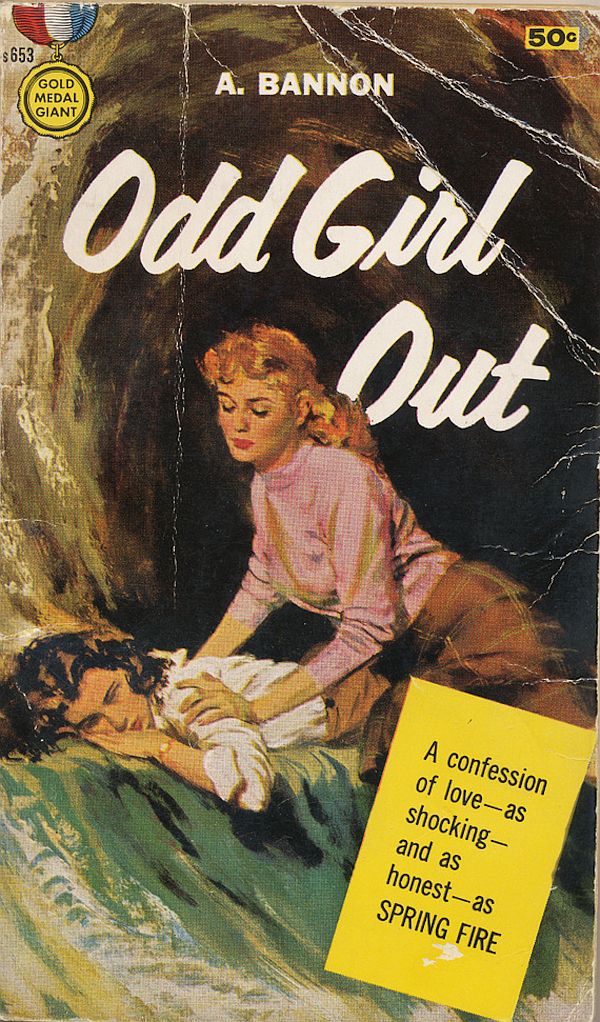
A good of example of this is one Bannon’s Beebo Brinker novel Odd Girl Out  — rated “objectionable” by the National Organization for Decent Literature, I might add — where Bannon has sorority girl Laura falling in love with her suite mate Beth, and ultimately finds herself caught in a bisexual love triangle with Beth and a boy named Charlie. The problems of heterosexual love are balanced between the new idea of what homosexual love can be, and both are present in equal measure despite the story ending with one of the girls in a straight relationship. But! A glimpse of light — the other remains a lesbian and still gets to live. (What a treat!)


While it can be argued that in retrospective, Bannon had a penchant for pandering to the overwhelmingly heterosexual audience, the idea of a surviving queer character at the end of a story was something that carried enough weight to be called “survival literature”. Lesbian author, activist, and historian Joan Nestle said it best, calling the books as such and explaining that, “In whatever town or cities these books were read, they were spreading the information that meant a new hope for trapped and isolated women”.
 
Though Bannon was one of the many lesbian authors who succeeded in bringing a sympathetic voice to the white lesbian experience of the time, her take on the subject was something extraordinarily taboo, and extremely rare; preceded only by Patricia Highsmith’s The Price of Salt in 1952. In fact, for the most part the majority of these pulp novels were written by cisgender, straight men with only 40-50 of the overall lesbian publishing between 1950 and 1960 being written by queer women. The line between the two is one that gets pretty skewed to the average reader, however, because while many of the more wholesome lesbian novels written boy lesbian authors during that period are still staple in the formation of many a white queer woman’s identity,  they were still not necessarily written for the women who needed them most.
 
Books like Sorority Sin by author E.S. Seeley or Lesbos Jungle by Peter Willow are great examples of this, in which the books act as saucy soft-core erotica involving two women who don’t end up with one another and a butch/femme girl gang force a straight man into doing things he would never do in a weird “Cinemax does West Side Story” sort of scenario. In both cases, lesbianism is either treated like a sexual treat for a woman to explore (not even making mention of the frequent “love triangle” theme that is woefully common among the stories from male authors), or like a threat to masculinity and the “natural” way of American life.
 
Several novels even pushed that boundary further, using lesbianism and the “insatiable insanity of their minds” as an excuse for women to be raped by other women, or to be raped by a female sibling; not only for taboo kinks held by probable male readers, but for claiming that sexual assault and incest are the only true ways a woman would “give herself” to another woman. Novels like Rebel Woman by Harry Whittington — as well as Seeley’s Sorority Sin mentioned above — went so far as to make sure that the relationship has a bisexual element that allows a straight men to “reform” the poor, warped mind of  the young woman with lesbian curiosities. This is, let’s be honest, the 1960s equivalent of the “you just haven’t tried the right penis yet” line we hear from men today and is somehow just as exhausting.
 
An often overlooked, and unfortunate, truth of lesbian pulp from this era is that it was written and marketed primarily to white queer women. As is the case for much of queer history, pre-Stonewall pulp was about as diverse as a 2020 Trump rally, with most persons of color (most often Black women) used as props for the experiementing white lesbian. Even the exceptions to the rule such as Rea Michaels’ How Dark My Love — which openly acknowledges and supports the civil rights movement and the pain of its Black characters — end on a note of making sure it’s clear that interracial relationships are a thing of immorality, maybe even moreso than homosexuality. For young women of color of this era, the solace of being seen was likely something even further of a dream than it was for the white queer women who made up the assumed majority pulp audience.


At the end of all of this discussion, it’s still fairly easy to ask, “What is lesbian pulp”? By one definition, we can look at queer historians who are happy to tell us that it’s any book published between the 1950s and the mid 1960s with clearly identified lesbian characters or subject matter, and a book cover that consists of a sensationalisted image allowing readers to recognize it as lesbian fiction. Sure, yes, we can definitely roll with that.
 
More importantly, though — despite many people’s attempts to thwart it from being the case — I think that lesbian pulp can be any book in that period that made the queer women feel seen. Sure, the covers are great ,and yes we as queer readers can look back and go “oh my god this is so trashy” for shits and giggles. Even the sleaziest, most cautionary, most demeaning, and most misogynistic story was something treasured that many queer women kept stashed in the back of their sock drawer, however, knowing that it was a piece of them in the world, and that was at least a really good start.
 
No Adam for Eve: The Quiet History of Lesbian Pulp Fiction. By Chloe Maeval. Autostraddle, November 19, 2020.


Growing up I was obsessed with monsters.

 
I was obsessed, specifically, with becoming one. When my friends and I were younger we would terrorize everyone into leaving us alone; we would growl on the playground, eat tanbark while crawling on the ground on all fours. When I went to sleep I would dream about changing, and I dutifully made sure this dream-change would be reflected somehow the next day: I dressed up in paper fur, I made my own claws. I would get upset, and instead of restraining myself I would immediately let it out on my surroundings — my parents patiently but fruitlessly dealt with broken furniture, with torn up rugs. I was uncontrollable.
 
When I was eleven my friends began to nervously apply makeup, go to dances, tentatively care about looking pretty. I, on the other hand, began to look monstrous to myself in a way that made me feel ill. I started to stare long and hard in full-length mirrors, my body roiling in a way that felt malicious. I stopped being feared, and instead, I was watched. My peers watched me, my parents watched me, and finally, I watched and watched as my feelings and my body escaped from my control.
 
I was uncontrollably angry, but not in a way that felt victorious. I got angry in the way that would end with me in tears. When I was eleven, I started to wear bigger shirts. I started to hide. I went from screaming my head off at anything that upset me to intensely quiet. And more importantly, I started to make more frequent trips to the library.
 
This is where I was, the summer before I would start 7th grade, bored as dirt, mindlessly flipping through the 50 cents bin in the library, when I saw Spring Fire by Vin Packer. The cover had the two female leads, scantily clad and falling demurely into each other’s chests.
 
I wasn’t clueless about the source of my feelings. I was old enough to understand the very fundamental binary: I wasn’t feeling any attraction towards boys, and I heavily valued my friendships with girls, arguably more than they did. I was an outcast at school. If I wasn’t one I had to be an Other.
 
The marketing for lesbian pulp fiction like Spring Fire, especially from a modern vantage point, is a horrible kind of funny. Ann Bannon, the author of Odd Girl Out and the Beebo Brinker Chronicles, tells me the covers for lesbian pulp reflect the way gay life was seen at the time: salacious and forbidden.
 
Pulp fiction revolutionized the publishing industry: printed on cheap “pulp” paper, the genre made an unprecedented amount of creative writing accessible to the public. Under-paying writers and publishing on inexpensive media meant that the genre had a low bar to entry, which allowed writers to be experimental. Science fiction covers, detective series — all had eye-catching subtitles, with portraits of pretty women, crazy monsters, and handsome men to get people to the cash registers.
 
At the start, the books were mainly targeted towards men. But there are a few reasons to believe that lesbian pulp wasn’t limited to the male gaze. For one, the books had a largely female readership, regardless of orientation. And the writers of lesbian pulp were, in fact, primarily gay women, who were able to use the genre not only to jumpstart their writing careers but to depict authentic lesbian experiences without the constraints of the more “traditional” publishing industry.
 
Many of these books were written right during or after the McCarthy Era, so while it was fully okay to capitalize on moral outrage, the books inside those salacious covers couldn’t actually validate gay life. Bannon recounts that for the lesbians in most of these stories, “In order to shut up Senator McCarthy and all of the morality cops, they had to be punished … The Post Office would not deliver the books unless one of the women had committed suicide, gone nuts, or been killed.”
 
Lesbian pulp thus became a Frankenstein genre: an imperfect, unsure vocalization of identity. Spring Fire, for example, featured two women, Leda and Mitch, who genuinely loved each other, the wakings of gay consciousness. Then, all of a sudden, the story veers off course. They are discovered, Leda goes crazy and is institutionalized, and Mitch changes her name to Susan and goes to a doctor to become heterosexual. The conclusion was very clean: being gay was monstrous, and amoral.
 
Vin Packer (real name Marijane Meaker, as I later found out) hated the imposed ending so much that she wanted the book all but buried.: “I still cringe when I think about it. I never wanted it republished. It was too embarrassing,” she states in a new 2006 introduction.

Horror and a lot of lesbian pulp bank on the same titillation: the idea of a desire that is fundamentally perverse. Like many gay women, I did not immediately understand my fascination with girls as attraction. And so before I had lesbian pulp fiction, I started to read more and more about male serial killers, and the awful things they would do to the young women they talked to on the street.
 
My friends started dating. I, on the other hand, became moody and hard to look at. As I directed my anger more pointedly within myself, I forewent loud and unnervingly ugly monsters in favor of the monsters who were observers — monsters that breathe quietly on phone receivers, monsters whose fearsomeness only comes from the fact they are never truly shown.
 
My obsession with women became just one of the long list of things that confirmed my own ugliness; I would look at girls in the corner of my eye in the locker room, I would avert my eyes too late when my friends would change in front of me; I watched women on the street from coffee shops and car windows. And when I did I would think about Ted Bundy, Andrei Chikatilo, how they hid their monstrosity deep inside.


Morality, beauty, and evilness were, to me when I was younger, very black and white. I knew that I was evil, and my parents and my friends were not. I fell in love with a girl when I was a teenager; I was watching The Descent with her on the couch, and while I realized I loved her I simultaneously fell in love with the main female antagonist, Juno, played by Natalie Mendoza. And as she was torn to pieces by crawlers, covered in blood, I kept imagining the walls pressing into me until I couldn’t breathe. When I went back home that night, I still heard the crawler’s screams, the scratching of their nails. I could imagine the surety all the girls must’ve felt in their untimely deaths.
 
It can be easy, now especially, to laugh or to pick at some of the derogatory tropes found in a lot of these books. But so many of these books were these women’s actual lived experiences —Bannon wrote Beebo Brinker Chronicles as a hopeful tribute to her “dream woman,” and
 
Spring Fire was based on Meaker’s actual life. For Meaker especially I can’t imagine what it is like, having to tack on an ending like that to a book about your life.
 
Before lesbian pulp, I thought this vulnerable, awkward, transitioning phase where I existed as a girl yet as something much worse was something only unique to me. I don’t know who I thought I was when I watched The Descent. To some degree, I was the girls in the cave, and me being torn apart by something horrible was a rightfully deserved ending for someone like me.
 
But when I shoved Spring Fire to the bottom of my bag, I felt the same way I felt watching Juno get torn apart — when I stole the book I fully expected to turn into a crawler myself, and ran down the street laughing when I got away with it.
 
As Bannon said, in the early 1950’s there was this pressure to sell lesbian pulp, but also make it adhere to a well-understood morality. Anyone who’s read Spring Fire can see where the story Meaker wanted to tell ends. The rest is a tacked-on moral, a typical horror shocker, as the two women are torn apart from each other.
 
But what I think the censors couldn’t really catch was that vulnerability and bravery that achingly real is hard to disguise. Because unlike when I watched horror movies, I was able to understand that Leda and Mitch, the characters I identified with, were not the monsters. The monster was the fear of being discovered.
 
What shocked me about lesbian pulp was this open celebration of being unsure. For many of these authors, these pulps acted as their vehicle for coming out, their tentative, and imperfect coming to terms of a potential autonomy that existed outside of what these authors have been told.
And reading the book, I realized that autonomy only seems monstrous when it is so breathtakingly unfamiliar.

I finished Spring Fire in a park two blocks from my house, with the cover dutifully taped over with red construction paper. And as I read the ending, with Leda being taken away, I felt for the first time that I was being recognized. Not just in the superficial aspects of sexuality, but by this vocalized embracing of ugliness.
 
Many of these books were treated as perverted. Not only in terms of what their content was actually about but how their expression was literally perverted or manipulated by publishers. Yet, this immediate indictment of morality and monstrosity imposed onto some of these books didn’t dishearten me. Instead, I found that there was something strangely heartwarming at the time about seeing how two characters love despite all narrative attempts to keep them apart.
 
Because as horrible as the ending may seem, there is nothing more exciting and horribly, horribly scary than finally being able to see yourself yearn in Mitch and Leda’s tender eroticism, in Leda so gently and lovingly embracing Mitch for the first time.
 
It should be said that not all lesbian pulps ended badly, or were manipulated against their will to change their manuscript; that would do a disservice to the genre. Bannon, Artemis Smith, and Valerie Taylor were prolific authors who published multiple pulp stories in which the two women were able to end up together. Meaker, after Spring Fire, published multiple books of acclaimed lesbian fiction, minus any tropes. The history of lesbian pulp fiction is hard-fought: many saw the books as disposable, so while some of the bigger titles like Women’s Barracks, Spring Fire, Odd Girl Out can be found pretty easily through most online booksellers, I had to find others through torrents or pdfs on a blog of a blog of another blog.


Much of the restoration is also done by the gay women who grew up with these pulp works. Bannon received academic acclaim decades after her career with pulp fiction ended. Forrest’s anthology, and her profuse thanks for the authors that came before her, was the closest thing to LGBT history I had when I was a teenager.
 
It was two years and thirty pulp books after I read Spring Fire alone in a park. I had just finished Forrest’s anthology, and for the first time, I realized I was scared.
 
As I read more lesbian pulps, my obsession with horror quieted. I stopped punishing my friends for nervously daydreaming about boys in our class. Instead, I obsessively turned inward, obsessing in the ways I could be seen as sick, contradictory, and more importantly vulnerable in a medium that I always saw as reflective of who I was.
 
Putting these books in context with Spring Fire, I realized that I deserved to be loved, and that I wanted to be loved in that way. And that if I were to finally accept that love, I would become a monster, in the proudest proclamation possible.
 
And sitting on my pile of hoarded books, I also realized it would take a very long time for me to finally have the bravery to become one.
 
When you are a preteen girl about to hit puberty like an SUV charging toward a brick wall at 100 mph, you dream about something either destroying you or destroying the quiet life someone else has built for you. Lesbian pulp is so divisive possibly because it manages to be both brave and embarrassing: for some, the genre may be too harsh of a reflection of shame.
 
Most of all, like many LGBT works, it thrives in contradiction, in confusion. And going beyond just sexuality, I think reading that confusion for the first time was when I started to forgive myself for a lot of my own failings.
 
Lesbian Pulp Novels Made Me Feel Normal. By Jessica Xing. Electric Literature, August 6, 2020.


We had many goals in mind with our book, but two of the most important – and ultimately most rewarding for us as authors  – were: 1) That we pack in as many cultural references as one little 280-page book could handle without stretching the framework we’d set up for ourselves (Drag Race itself), and 2) That we not fall into the trap of writing a book about cis gay men in dresses. That second one was a bit of a challenge, given Drag Race‘s own reluctance to feature or reward any queer people other than cis gay men in dresses, but it was a challenge we were eager to tackle.
 
There were a lot of moments in the writing of the book when those two goals were rewarded with little lightbulb-over-the-head moments, like when we managed to explain what Elizabeth Taylor has to do with the Werk Room or how a quote from The Great Gatsby makes perfect sense in opening a discussion about the Pit Crew.  But that moment when we realized that the Pit Crew also makes a perfect opportunity to talk about the legendary string of lesbian pulp fiction novels that got churned out in the mid-twentieth century was honestly one of our faves in the entire process of writing the book. We believe there was actual clapping involved. How these novels connect to the Speedo-clad dudes of the Pit Crew is something you’ll have to buy the book to fully understand, but suffice it to say, these novels – many of which were written by men for men, for less than intellectual reasons – were a gateway for many queer women of the early to mid-twentieth century; a door that opened them up to the desires they found difficult at best to express. Many queer women also managed to launch careers as writers and authors by getting their start penning these wistful tales of longing that were slapped with lurid covers and set out on a drugstore spinner rack for lowest-common-denominator consumption. The most notable and celebrated of the genre for this reason would be The Price of Salt, penned by “Claire Morgan,” which was a pseudonym for celebrated author Patricia Highsmith:


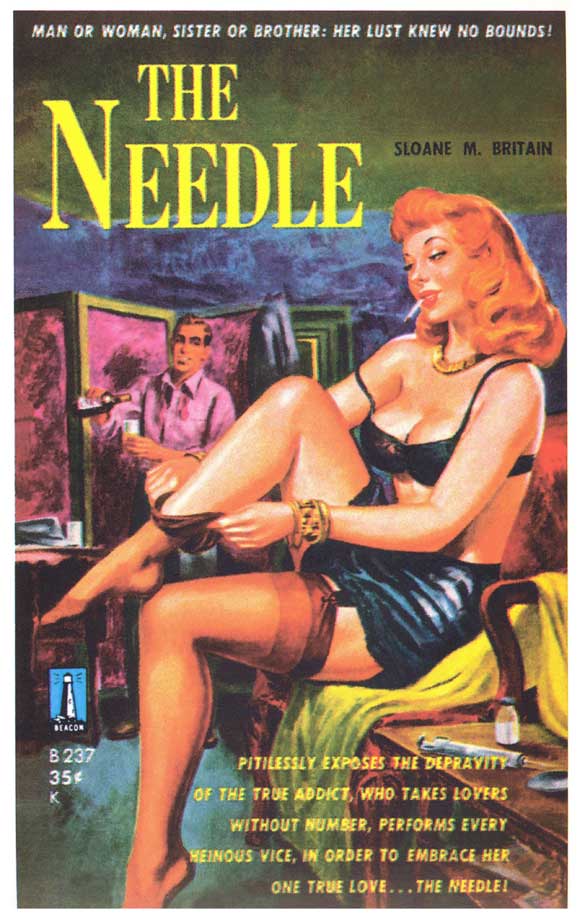
The Price of Salt would eventually travel its way from the drugstore spinner rack to prestige cinema adaptation when director Todd Haynes adapted it as Carol, starring Cate Blanchett and Rooney Mara in 2016. And while that’s a triumph for queer culture and expression, as well as a good summation of how queer desires went from underground expression to mainstream art, for today, we’re way more interested in those fabulously lurid covers, which not only defined the literary genre, but more or less served as porn for queer women of the day, who didn’t have much to turn to aside from Playboy, which wasn’t really meant for them.
 
Because these books were more or less out in the open (although not exactly displayed in the most reputable of settings), everything from the title to the cover to the story itself was meant to depict women with same-sex desires as something wicked and shameful, with publisher-dictated endings that usually left the principle characters with destroyed lives. Despite the patriarchal attempts to frame lesbian sex as both sinful and something to be performed for the entertainment of men, queer women found these books, largely because the covers failed at their primary job. Queer women of the day didn’t find these covers shameful and they didn’t care about the patriarchal undertones or the implied male gaze. Queer women bought these books in droves (and then later took over the writing of them) because these covers made lesbian life and lesbian love look HOT AS FUCK.
 
A Gallery of Legendary Lesbian Pulp Fiction Novel Covers. Tom & Lorenzo, April 7, 2020.


To the outside world, Ann Weldy was a regular 1950s housewife. Only when she wasn’t making dinner or taking care of her two young children, she was busy writing lesbian romance novels under her pseudonym, Ann Bannon. These brightly covered paperbacks were remarkable. Not only were they brilliantly written and packed with emotion, they provided a lifeline. Through reading Ann’s books, countless LGBTQI+ women saw themselves represented for the very first time, felt profoundly less alone and, inevitably, developed an almighty crush on archetypal butch heartthrob, Beebo Brinker. As a fan of the genre, and Ann’s Beebo Brinker Chronicles in particular, I couldn’t wait to talk to her and find out more about the woman behind the pulp.

 
DIVA: Do you remember the first time you discovered lesbian pulp novels existed?
 
ANN BANNON: Yes, it was very exciting! I knew there were such things as serious literature about the gay – well, it wasn’t really a community back then – but gay people generally. I had tried to access some of those books, like The Well Of Loneliness, in the university library when I was a student. They were kept in a locked cage. Literally, a cage in the library stacks. You had to have a letter from a professor explaining your reasons for wanting to see such a thing. It was so embarrassing, you gave up. I came across the lesbian pulps in a drugstore, like most people. I was fascinated.
 
DIVA : What did you make of those iconic, deliberately titillating covers?
 
AB : The publishers understood these books had to be mass-marketed. They knew the women would find them one way or another, even if they had to read the covers differently from everybody else. They were embarrassing to buy, in part because of the covers. They were very noticeable. You couldn’t miss them. The hard part was not finding them. The hard part was taking them up to the clerk, because if you lived in a small town the clerk would very likely be somebody who knew your family. Your mom and dad might get a call.
 
D: How much impact do you think these books had on lesbians and bisexual women?
 
AB : I know they saved lives. I know my books did. There was a woman who told me she was in such pain it was unbearable. On the way to jump in the river, she picked up a paperback at the drugstore, on a whim. It was one of my books. She said, “I got fascinated. I read through it. I went home and had dinner instead of jumping off the bridge.” By that she meant, “I saw a way forward, because I knew I was not the unique and totally evil human being that I was described to be by others.” You just had such a distorted notion of what it was like to be a gay person and the pulp paperbacks made a major contribution in starting to change that notion.
 
D : It seems to me you were very brave to write these stories. Did it feel dangerous at the time?
 
AB : Yes, it was a mix of emotions. I knew I was flouting convention and there could be very dubious consequences. I was a young mother with two little kids, trying to keep a rather challenging marriage going. It was a fraught event to sit down, write those books and await the consequences. It was frightening. Most of us who were writing those books were on the list of people to keep an eye on for the FBI and the government. I probably have an old FBI file gathering dust somewhere.


D : Did your mother know about your writing career?
 
AB : I didn’t want to disappoint my mother. She took it pretty well. I think it shocked her. Her only real comment was, “I’m proud of you, darling. I know it’s hard to write a book and you have written a book. So good for you. But don’t ever show this to your grandmother.” I never told my children. They found out by overhearing a conversation when they were well into their teen years. Those were very awkward things, but it all came from this marginalisation of the gay community. It was partly because people were protective of their children and they were so afraid it was contagious – “If my children get to know you, they will become contaminated.” It was appalling the way people thought about this. Even the doctors had a hand in sort of medicalising the whole thing – “Everybody be patient. This is a terrible disease, but we’re sure we’ll find the cure.” It was scary.
 
D : One of my favourite things about The Beebo Brinker Chronicles is the way you create that bygone world of Greenwich Village.
 
AB : The Village really was a charming place. Everywhere you looked were like-minded people. To see a couple of girls or boys walking down the street holding hands or with their arms around each other, it was just charming. You really did feel like Dorothy landing in Oz. The bars were seriously, no kidding, sleazy. The Mafia owned a lot of them and they didn’t care whether the place was clean or anybody tidied up the restrooms. The cops would tolerate it, because the individual patrol men got a significant financial boost from the crime guys. In return, the boss would let you run your bar for a couple of months and then there’d be a raid. They would put you in the paddy wagon and drive you down to the police station. The next morning, your name would be in the paper. Even if you’d been flying along below the radar up to that point, now everybody knew – the people at work, your family friends. It could cost you your job. It would spread like wildfire and your life might be ruined.
 
D : That sounds awful!
 
AB : But the bars were fun. You would go in and try to find out how recently they’d been raided to see if you would be ok. They were full of bright, young people. You could put a dime in the jukebox and dance. There would be bartenders, you could have drinks. It was the one place we could cut loose.
 
D : Well, that bit sounds amazing. My last question has to be: did you ever meet a real life Beebo Brinker?
 
AB : My best years kind of slipped away, but I’ll tell you, when the books began to be republished in the 1980s, 1990s, 2000s, that’s when I began to meet Beebo all over the place! My standards for her were very high, but there are some extraordinary women out there, perfectly comfortable in their skin. They were very much in charge and had a kind of serenity about them. So yes, I have.


Ann Bannon: “I know my books saved lives”. The queen of lesbian pulp on fan encounters, FBI files and the real life Beebo Brinker.  By Roxy Bourdillon.  DIVA,  May 14, 2019.


When Reva Hutkin’s friend from night school offered to lend her something to read, it must have seemed wholly innocent. It was the early 1960s, in Montreal, and Hutkin had recently married at 21. At the time, she says, marriage “was the only way a young woman could get out of her house.”
 
Her friend presented her with one salacious-looking book, then another, and another—she had “millions” of the volumes, Hutkin remembers, with the same “wonderful” covers and suggestive taglines: “twilight women,” “forbidden love,” “illicit passion.” Once Hutkin was hooked on the stories, her friend made a confession: “I think I’m like that.”
 
At first, Hutkin says, she was horrified. Then, she was bewildered. Finally, she wondered whether she might, in fact, be “like that,” too. Soon after, the two became lovers; Hutkin left her husband, and they began a new life together.
 
Not every first encounter with lesbian pulp fiction was so transformative. But for many women of the 1950s and 1960s, these slim paperbacks were pivotal, and sometimes even life-saving. Within their pages lay physical proof that they were not entirely alone in the world. “It was an era of just incredible isolation—a lot of us grew up thinking that we were the only ones,” says the writer Katherine V. Forrest, who compiled the 2005 anthology Lesbian Pulp Fiction. “The books were like water in the desert.”
 
In her introduction to the anthology, Forrest describes chancing upon Ann Bannon’s Odd Girl Out for sale in Detroit, Michigan. The year was 1957, and she was 18. “I did not need to look at the title for clues; the cover leaped out at me from the drugstore rack: a young woman with sensuous intent on her face seated on a bed, leaning over a prone woman, her hands on the other woman’s shoulders,” she writes. “Overwhelming need led me to walk a gauntlet of fear up to the cash register. Fear so intense that I remember nothing more, only that I stumbled out of the store in possession of what I knew I must have, a book as necessary to me as air.”
 
Forrest’s experience was not atypical. In a 1995 essay, Donna Allegra recounts grappling with feelings of embarrassment and shame on her way up to the front desk. But however hard she found it, she wrote, “It was absolutely necessary for me to have them. I needed them the way I needed food and shelter for survival.”
 
Women like Allegra and Forrest didn’t have to look far for their fix: America’s drug stores and airport bookstores sold lesbian pulp fiction quite openly. The novels were displayed cheek-to-jowl with stories of alien invasions and Nazi torture. Pulp novels had tawdry titles, conspicuous covers, and taglines that promised readers everything from “the sex traps of vacationing she-wolves” to a glimpse into “the intimate sex needs of America’s 900,000 young widows.”
 
Publishers likely never intended any of these books to tumble into the hands of impressionable young women, and certainly not those about lesbian love. A publishing revolution in the 1940s had put millions of inexpensive paperbacks in the pockets of soldiers—a democratic way to entertain troops that transformed the way people thought about paperback books. Pulp fiction was the end result. The books offered as many racy subgenres as there were sexual proclivities, all marketed to the men who had now come back from the war. They were cheap and disposable, designed to be read and tossed out. Yet the most successful among them sold in the hundreds of thousands or even the millions—and many of these were lesbian pulps.
 
Tereska Torrès’ 1950 novel, Women’s Barracks, is often cited as the first example in the genre, and the one that launched hundreds more. Inspired by her own experiences of the war, the novel tells the tales of torrid affairs between butch officer types and their femme subordinates. It sold some 2.5 million copies, and was the 244th best-selling novel in the United States before 1975, despite being banned for obscenity in multiple states.
 
Marijane Meaker’s Spring Fire, published two years later under her pseudonym Vin Packer, sold a similarly eye-watering 1.5 million copies, while the male novelist Jess Stearn’s The Sixth Man spent 12 weeks on the New York Times bestseller list. The potential for huge sales shone a light on these books and earned the “frothy” novels places on the review pages of even quite serious newspapers. In 1952, a male reviewer at the Times called The Price of Salt by Claire Morgan (pseudonym for thriller writer Patricia Highsmith*) “pretty unexciting”—though he was likely far from its intended readership. (It forms the inspiration for the British film Carol, released in 2015.)
 
Lesbianism was such a popular theme for pulp, one writer explained to the New York Times in September 1965, because the reader “gets two immoral women for the price of one.” For many readers, this may have been the case—certainly, a significant portion of the books were as homophobic as their covers. Set in women’s dorm rooms or prisons, a significant portion are seamy “true accounts,” written by men with women’s pseudonyms, and marketed as cheap thrills to male readers.
 
But perhaps 50 titles were written by women, for women. The scholar Yvonne Keller calls these “pro-lesbian,” as opposed to the more common “virile adventure.” The pro-lesbian novels are the ones that changed women’s lives, and in so doing, passed the test of time—the books of Marijane Meaker, Valerie Taylor, Artemis Smith, and Ann Bannon. These authors wrote for women, and it showed. “I did hope women would find them and read them,” says Bannon, a doyenne of the genre, now in her mid-eighties. “I wasn’t quite sure enough of my skill or ability to reach them, or even how widely the books were distributed, to hope that they would do some good in the world. But I certainly had that in the back of my mind.”
 
In fact, she says, she scarcely thought about her male audience, and so was blindsided by her publishers’ choice of cover illustration. The characters within were complex and three-dimensional, but those on the covers were either waifish and gamine, or pneumatic and heavy-lidded with passion. “That artwork was meant to draw in men through prurient interest,” she says—a far cry from her original intent. But if as many men had not bought them, she says, they might never have been so widely disseminated, or have fallen into the hands of the people who needed them the most.
In burgeoning lesbian communities, pulp novels were treasured and passed from person to person. The author Lee Lynch, now in her 70s, was part of a group of “gay kids” in New York, who met up and sat in Pam Pam’s, a sticky ice-cream parlor on 6th Avenue. “I just remember the milling about that took place there, of kids, of gay kids,” she says. “We were not ashamed, together. Maybe it was a folly of however many, of the multitudes, that when we were all together, even if we didn’t know each other, we could talk about the books.” They’d buy flimsy softcovers from a newspaper store and read the books until they were dog-eared and tatty—before secreting them away, far from their families’ prying eyes.
 
Lynch describes herself as hugely fortunate to have had this kind of circle, including a first girlfriend, Susie. But for those who didn’t, the books were perhaps even more valuable. In a 1983 essay in the lesbian magazine On Our Backs, Roberta Yusba writes: “The pulps also reached isolated small-town lesbians who could read them and see that they were not the only lesbians in the world.”
 
In 1983, the lesbian publisher Naiad Press reprinted a selection of the best lesbian pulp novels. Bannon’s were among them. These books were cherished not necessarily for their literary value, but as an early blueprint for lesbian life, all centered around a utopian Greenwich Village. Without older lesbians or bisexual women within their community, lesbian pulp fiction was often the only model women had. And while the books weren’t perfect, they were significantly better than the vacuum that had preceded them.
 
In the 1950s, Bannon says, homosexuality was often spoken of as a kind of pathogen: You weren’t just sick, you were contaminated and contagious—especially to the young and impressionable. “You didn’t want to have, or to acknowledge having, gay friends, or to be consorting with gay people, or defending them,” she says. “And I think at the root of that was a lot of anxiety about converting children to a gay life, because it seemed to be so seductive and fascinating that merely having contact with a gay person or reading a gay book would lead you down the wrong path.”
 
Many of the women who read these books and came out to their peers in the 1960s and 1970s never told their families, dodging questions for decades about their apparent singledom and lack of children. Though Lynch remembers prevailing feminist wisdom that said that you had a responsibility to come out to your parents, she struggled to find a way to do so that wouldn’t “basically ruin [her mother’s] life.” Her mother had, on one occasion, walked in on Lynch with Susie, that first girlfriend, but chose to ignore what she saw. “She would have thought I was going to burn in hell,” she says.
 
Even though Bannon wrote lesbian pulp fiction for lesbian and bisexual women, coming out was impossible. She had married an engineer shortly after graduating from the University of Illinois at Urbana–Champaign, then written her first book, Odd Girl Out, in her home in suburban Pennsylvania at 22. It was published under a pseudonym. (Her birth name is Ann Weldy; she chose Bannon from a list of her husband’s customers.)
 
At first, Bannon says, she hoped the books might be a launchpad into a career as a writer. “I did think I could write, and I did want to do it, and I did need to get started somewhere. I was about as ignorant as anybody could have been back then,” she says, laughing. She had read Vin Packer’s Spring Fire and wrote to its author, Marijane Meaker, who put her in touch with her editor at Gold Medal Books. Odd Girl Out would go on to be the publisher’s second best-selling title of 1957. It launched a series of six books, later known as the Beebo Brinker Chronicles, after their charismatic heroine, who shows up in New York at 18 and finds her way there as a butch lesbian.
 
Throughout this time, Bannon was living a kind of double existence, split between married life in Pennsylvania, and occasional weeklong visits to see friends in Greenwich Village. Hearing her talk about these visits, you get the sense that they were as much to research the books, as she told her husband, as they were an exploration into what could be, what alternatives she might have had.


Bannon recalls walking through the Village alone late at night—“I mean, I must have been out of my mind, but I wasn’t even afraid”—and staying in bars until two or three in the morning, talking to women for inspiration for the books. She was surrounded by people who were “young and adventurous and willing to try things” and, she says, “I was sort of pretending to be single. Those trips to the Village, I really was beginning to wonder if I’d done the right thing to get married, and trying to rethink my life a little bit.”

 Her husband never read the books, and only really reconciled himself to them when they began bringing in significant amounts of money. Bannon remembers tense evenings typing away with the children in bed, while her husband sat in the other room and watched television. Eventually, the marriage broke down, and Bannon abandoned her writing career for the good of her children, and a successful career in academia.

 But this brief foray into fiction had helped lay the ground for decades of lesbian writing, as gay and bisexual women came to realize how much they needed to be represented in print. Lynch remembers going from one section to the next in libraries and bookstores, in pursuit of some kind of literary mirror. “I was driven,” she wrote in an essay, “searching for my nourishment like a starveling, grabbing at any crumb that looked, tasted, or smelled digestible.” She read the pulps and what few other early lesbian novels there were, such as Radclyffe Hall’s 1928 The Well of Loneliness—but venturing deeper into the library yielded “crumbs” that were sometimes quite toxic. “I would go to the criminology section,” she says, “in the sociology area, because there were lesbians in those books.”
 
She remembers one rattling 45-minute subway ride back to Flushing, Queens, from the Village, with her then-girlfriend, Susie. “We were acting out, you know, being out lesbian kids in front of a carload of presumably straight people,” she says. “All of a sudden, Susie said to me, ‘You know, we’re actually juvenile delinquents. What we do is against the law.’” She pauses. “I hadn’t thought of it like that before—I actually probably didn’t even know that.” By the age of 15, she says, “Our self-image was already, ‘You’re a criminal, and sick, and rejects, you’re societal rejects.’ To find anything about ourselves was extremely exciting.”
 
The pulps weren’t like that. Their messages might have been mixed, but they acknowledged feelings these young women had without writing them off. In her introduction to Lesbian Pulp Fiction, Forrest describes the books as life-saving: In some cases, this was literally true. Bannon recalls a young woman who later became a good friend. She had reached a point of “absolute despair,” she told Bannon, and planned to cast herself off the big bridge that ran through her city. Then, on the day she resolved to do it, she passed a drugstore and saw Odd Girl Out, Bannon’s 1957 novella, on the shelves. She bought it, sat down, read the whole thing—and then went home for dinner.
 
“You hear things like that and it just turns your heart over. I don’t know how many there were who went through that, but that anyone should have gone home for dinner, instead of jumping off the bridge…” says Bannon, her voice catching. “Oh, my goodness—I mean, you never get over that.”
 
The impact of that representation was tremendous. Lesbian pulp novels appear again and again in lesbian memoirs and personal essays, always with the same mingling of pleasure and pain. In Kate Millett’s 1974 autobiography, Flying, for instance, she describes herself hoarding them, “because they were the only books where one woman kissed another, touched her, transported to read finally in a book what had been the dearest part of my experience recognized at last in print.” She hid them away in a drawer until she left the country for Japan. “Afraid the sublet might find them, I burned them before I set out.”


In the best cases, the books weren’t just proof that lesbians existed, but that they could be proud of who they were and what they wanted. Ten years before Stonewall, Artemis Smith’s 1959 novel Odd Girl, shows this confrontation with the hero, Anne, and her father:
 
       “No daughter of mine is going to be a—a lesbian!” He said the word with intense hate.
“I’m afraid you have nothing to say about that,” Anne said quietly. “I am what I am.”
“You’re a victim of this—this awful woman,” her father sputtered. “She has you hypnotized!”
“No, Dad,” Anne continued, quietly, “I have always been this way. I won’t be changed by you or anyone else. This is the first time my life has really felt right and happy.”
“You are breaking the laws of nature—” her father said.
“The law I’m breaking is against nature,” Anne returned, strongly. “The law will have to be changed.”
 
But not every book was quite so affirming, nor quite so radical. The ones by men made no real effort to reach female readers, and even women writers were at the behest of their publishers, who forced them to introduce sad endings. Readers, they said, didn’t want to see these women happy and fulfilled by their lesbian dalliances. So heroines threw themselves off high things, renounced their sexuality, or were abandoned by their lovers and went mad with grief. Even novelists with the very best intentions were not immune to these demands. By the time Bannon was writing, she says, the pressure had lessened only a little. She wasn’t required to kill off her protagonists, at least, but giving them a happy ending was virtually unfathomable.

All of this, Lynch writes, had a somewhat ambivalent effect on both her incipient pride and her self-esteem. On the one hand, the books were validating, insofar as “they acknowledged the existence of lesbians.” On the other, they left little room for hope. “The characters were more miserable than Sartre’s, and despised as well.”
 
For Hutkin, in Montreal, who had no lesbian community to speak of, the books provided a deeply depressing exemplar. They changed her life only by showing her that “another kind of me” was possible, she says. “Those books had terrible, awful endings. No lesbian ever should buy those books! They all had to be saved by some man, or some horrible tragedy befell them. I mean—they weren’t happy books, or anything. They were awful.” Even when she realized that she had feelings for her friend at night school, with whom she later spent almost a decade, “I fought with that all the way. I didn’t want to be like that.”
 
Characters’ love lives mostly played out in bars, and particularly in Greenwich Village—and so, desperate to find their people like them, Hutkin and her girlfriend traveled from Canada to the Village in search of “the lesbians.” In the books, she remembers, there was a clear binary between butches and femmes. “There seemed to be nothing in between, so we dressed appropriately.” Her girlfriend put on a dress, and Hutkin selected the most masculine outfit she owned: pants, and a red blazer. The journey took all day, but when they arrived, the lesbians were nowhere to be found.
 
“We just looked around, and didn’t see anything that looked like dykes,” she says, laughing. “We were pretty innocent, we knew nothing. We were in our early 20s and had never encountered any of this stuff, except in these books, which obviously weren’t really true to life.” From the books, she says, they assumed it would be obvious, that you could walk down the street and see bars and restaurants with “Lesbians!” lit up in lights. Instead, despite asking passers-by and taxi drivers where they were, they didn’t find the lesbians—so they spent the night in New York, and then went back to Canada.
 
Of course, there were lesbians in Greenwich Village, even if Hutkin and her partner didn’t come across them. Much of Bannon’s inspiration for the books came from little details she saw while visiting. It’s hard to acknowledge now, she says, but these darker aspects of her characters’ lives weren’t necessarily unrepresentative: It was simply very hard to exist as a gay or lesbian person at that time. Knowing how to show that wasn’t always easy.
 
“I remember learning that high school kids, for example, would come down to Greenwich Village on the weekends,” she says. “They walked around where they knew lesbians were living, and terrorized them, and threatened to come back in the night, and kill them, or kill their pets.” This discovery made its way into one of her books—in a fashion. In a perverse, alcohol-fueled attempt to win back a lover, her heroine, Beebo Brinker, brutally kills her own dog. “I have been sorry ever since,” Bannon says, “because it wouldn’t have been the woman herself. It would have been one of these gangster kids egging each other on. And even the kids would have grown up and been scandalized that they did such an ugly thing.”
 
The books, she says, are a product of their environment, and of a time when people were under colossal stress from constant marginalization—a cultural context in which straight people genuinely believed that their LGBT peers had “perversely chosen and pursued their lives” to defy the norms of those around them. “That these people were deliberately attracting attention to themselves and that whatever punishment they received they deserved.” It’s hard for the books not to reflect that context, Bannon says. “It takes a while to step out of that mindset—to get away from it.” She pictures herself looking back at the time as from the summit of some imaginary hill. “You begin to realize that you were being fed a line of nonsense because people didn’t know any better.”
 

Their re-release in the 1980s, and Bannon’s subsequent “outing” to the general public as Ann Weldy brought that tension to the fore. Some 1980s readers thought of them with tremendous affection, certainly—but others saw them as a vestige of a more unhappy time, with a roaring undercurrent of homophobia just barely out of sight. The journalist Joy Parks, in one 1980s review, describes her teeth being “set on edge” by their apoliticism, and the way these women are consistently referred to as “girls.” “These romances have a genuine, down to earth, life-in-the-raw quality, plus love scenes that appear very fresh and (I hate to say it) rather sweet in their innocence and lack of graphic detail,” she writes. “But the fringe life of the lesbian of the ‘50s and ‘60s lacks something vital: self-love, pride, dignity.”
 
The novels have two important legacies: First, they showed lesbians that hope and community were possible. And second, they helped to kick-start a rich tradition of lesbian writing. As a teenager, Lynch loved these books, writing down cherished passages on yellow note cards. (She still has them today.) As an adult, she says, they instilled in her a commitment to writing books that could inspire lesbians, in a way that she had never had. “The books were bombarding you with negative stereotypes,” she says, “but inside, I was in love with my girlfriend. We were really proud of being gay.” Today, she says, she identifies as a lesbian writer “who only wants to make lesbians happier, by reading my books. The positives came out of the negative, I think.”


Though it may have started with Beebo, Laura, Stephen, Carol, and so many other troubled heroines who were doomed to suicide, misery, the loss of a child, or marriage, the same was not true for many of their readers. Instead, these sad stories were simply a prologue to their own happy ones.
 
It was a “rocky beginning” in Detroit in the 1950s, Forrest says, but it had a happy ending. “I’ve met some wonderful women along the way, and have been very lucky to have been loved by a few of them. It’s been a good life.” Hutkin never did find the legendary lesbians of Greenwich Village, but eventually found a community of people like herself through the women’s movement. She has a daughter and a grandchild and lives with her partner of over a decade in Victoria, Canada. Lynch had a successful career as a writer and novelist and eventually married. She lives with her wife in the Pacific Northwest.
 
After Bannon’s divorce, she did not remarry and instead threw herself into her academic work. She thinks of the books almost as an alternate life she constructed for herself on the page, “bits and pieces of which I would have liked to have lived. It became sort of a satisfying outlet, where perhaps, looking back, it should have been a lived experience instead of an imagined experience. It was to some degree,” she says, “in those brief little vacations when I was up there and was fully into it. But it was also—it seemed just beyond my reach, something you could see through a window, but you couldn’t pass through. You could visit, but you couldn’t live there.”
 
The Lesbian Pulp Fiction That Saved Lives. By Nastasha Frost. Atlas Obscura,  May 22, 2018. 


When pop culture historians and critics write about the lesbian paperback pulp era in the 1950s-60s,  the same names are often use das examples: Vin Packer, Randy Salem, March Hastings, Valerie Taylor, Paula Christiansen, etc., with such classics in lesbian pulp Spring Fire, Three Women, Baby Face, Women’s Barracks,  and so on.  Seldom is the name Sloane Britain mentioned, the pen name of Midwood-Tower editor Elaine Williams, although as both a writer and editor, Williams/Britain etched her own legacy in the history of early commercial lesbian fiction.

 Williams started with Midwood in 1959, when the company first formed, acquiring and editing novels by Lawrence Block (Shekdon Lord), Donald Westlake (Alan Marshall), Robert Silverberg (Loren Beauchamp), Orrie Hitt, and Mike Avallone, among others.  It’s not clear when she left Midwood, if she did, but she committed suicide in 1964. Seems her family did not approve of her gay lifestyle and had disowned her, a matter she hinted at in her fiction.  She was 33.

 She published her first novel with Newsstand Library in 1959, a paperback house out of Chicago: First Person–Third Sex was a deeply personal account of a third grade teacher’s discovery of her “third sex” passion and desire of a “twilight woman.”  It was reprinted in 1962 by Dollar Double Books as Strumpets’ Jungle (see above pic) , back-to-back with Any Man’s Playmate by James L. Ruebel.

 Also in 1959, she published with Beacon Books, The Needle, a story about a bi-sexual heroin addict prostitute.


 Her next novels for Midwood were 1960’s Meet Marilyn and Insatiable, like The Needle, written commercially for the market; These Curious Pleasures (1961), however, has the same autobiographical, first-person narrative that her first novel does. In fact, the narrator’s name is “Sloane Britain,” perhaps Williams’ indication that this book is based on her own life, rather than the writer’s imagination. 1961 also saw That Other Hunger. Both books sported cover art by Paul Rader.

 Other titles were Ladder of Flesh plus two posthumous short novels published as Midwood Doubles: Summer of Sin and Peep Booth.  Three titles, Ladder of Flesh, That Other Hunger, and Unnatural,  were reissued in the late 1960s with new titles: Taboo and Delicate Vice.

 Both First Person–Third Sex and These Curious Pleasures break away from the genre norm of lesbian paperbacks in that they end on a gay-positive note, rather than having the protagonist meet with tragedy for her sins of the flesh or meet a male she falls head over heels with, marries, and lives forever after in heterosexual marital bliss.  Publishers such as Fawcett Gold Medal, Beacon, and Nightstand often required this so the Postal Inspector would not prosecute for mailing obscene material in the U.S. Mails — if the lesbian character meets a horrible end or goes insane over her unnatural lust, or repents from sin and finds true love in the arms of man, then the books were deemed to have social value as morality and cautionary tales; if the books ended on a positive note with women loving women, that, in the 1950s-60s, was considered perverted and sick.  Homosexuality was still considered a mental disease that could be cured with medicine, psychology, or religion…

 Lesbian paperbacks were initially marketed to male readership, often written by men under female pen names–the writing was often obvous, with the male point of view, although some men (such a Lawrence Block and Orrie Hitt) wrote so convincingly as women and lesbians that even to this, some readers have misten Block’s Jill Emerson and Hitt’s Kay Addams as being bonafide females.  On the other hand, writers such as Robert Silverberg (Marlene Longman) and Gil Fox (Kimberly Kemp, Dallas Mayo) were not as adept at capturing the lesbian voice and experience — Silverberg has stated he just relied on his fantasies and imagination whereas Fox, in an interview with Lynne Munroe, stated that he would watch romantic scenes in movies and imagine two women doing/saying the same, and would write from there.

 In his essay, “How Can You Put Your Name on Books Like That? or Make Mine a Midwood” in Paperback Parade #32, prolific author Mike Avallone reveals that Williams accepted a manuscript from him:

       ‘’a lady editor at this very new Midwood snapped up ADAM GREENE  as if Avallone was the new F. Scott Fitzgerald, expediated an advance of five hundred and fifty dollars, and asked for aother novel. (p. 50)”

 Adam Greene was an attempt at a mainstream literary novel by crime and thriller writer Avallone that he had not been able to sell for its sexual content. It was welcome at Midwood and published as All The Way.  She acquired several more books from Avallone until she suddenly vanished.

   “ I should say here that the first lady editor died under mysterious circumstances — suicide was suggested. I didn’t know, really. She was only a nice, low telephone voice to me named Evelyn [sic]. (p. 54)”

 While he never met his editor, at an office party he notes meeting “lesbian author Sloane Britain,” an attractive woman who had no interest in men but had exquisite and big “manly hands.”

 In an interview with Lynne Munroe, Gil Fox states:

    “[The] first editor was Elaine Williams, who wrote as Sloane Britain. Her family refused to accept the fact that she was a lesbian, and she committed suicide.”


 While men certainly purchased and read lesbian paperbacks for twisted entertainment, these books found an unexpected underground audience among the housewives and teen girls across the country: women with secret longings who discovered they were not alone and other “women” had similar feelings and experiences and doubts that they had.

 Perhaps some found a kindred soul in Williams/Britain’s First Person–Third Sex. The narrator, Paula, does not discover she’s gay until she’s twenty-one.  Before that, she’d had sexual encounters with men but couldn’t understand why she derived no pleasure from it, figuring she had to fall in love and get married before the true joys of sex were apparent.

 Paula does comprehend, at age 15, the allure of her body and how she can manipulate men.  Lying about her age, she gets a waitress job in a diner; the older man is always eying her and she’s aware of it, as well as the looks of customers.  She doesn’t make enough money at the job to buy all the material possessions she craves, so she tells her boss that she will let him have her but it’ll cost $30 (pretty pricey for what would have been the mid-1950s, when your common streetwalker charged $5-10 and call girls went for $20/hour or $100 a night).  Her boss is a miser and won’t do it but she continues to taunt him, not wearing a bra, bending down in front of him, so he finally gives in.  They have sex twice a week and she makes an extra $60 on top of her weekly salary of $40.

 She also carries on with the fry cook, a young Hispanic man who can’t afford the $30; she charges him $10 because he at least is young and good-looking.  She cannot, however, reach orgasm with these men, or even find pleasure in the act, as much as she tries.  It’s just a teen girl’s means to afford new clothes and jewelry and goes on for a year until her boss catches her with the cook and things get violent.

 After college, Paula roommates with Janet, also a young school teacher. They get hired at the same school and are close friends.  Janet had regular dates but Paula has no interest; she dates no and then but just to do something, not interested in having a relationship. Even when she does have sex with a man, she still feels nothing.

 In the summer, the two go off to summer jobs in different states.  Janet has a whirlwind romance while Paula is seduced by another cap counselor, Karen, who sees in Paula what Paula does not know: that she is gay.  Paula discovers orgasmic ecstasy with Karen, and is happy juts to lay in bed and talk as well.  Paula is okay with the realization of her lesbianism — she’s also possessive.  Karen is proiscuous and is carrying on with another girl at the camp, and is open for more lovers, even sharing them with Paula.

 Karen tries to subdue her jealousy, tries to act like she is a free-loving dyke, but is doesn’t bode well, and she leaves the camp with a starined ending with Karen.

 Back to rooming with Janet, Paula sees Janet in a new light: as an attractive female she’d like to have sex with.  She fights herself from making advances on Janet, afraid it might ruin their friendship.

 Later, Paula takes a trip to Manhattan to visit Karen and is introduced to life in Greenwich Village, where gay men and woman openly cavort, there are many shops catering to the lesbian fashion, as well as gay bars and clubs.  Needless to say, Paula realizes she could live here and feel free to express her sexuality in public.

 Janet meets Paula’s New York friends and notices something; she confronts Paula and asks if Karen is gay, and this is when Paula admits she is also gay, and she is okay with it, even if it does ruin their friendship.

 Janet surprises Paula not by condemning her but by taking Paula’s hand and leading her to the bedroom, saying she feels the same — Janet is more bi-sexual than strictly lesbian, and a new chapter in their relationship opens.

    “The next weeks were the happiest in my life. No longer did I have to hide my love for Janet as if it were something I should be ashamed of […] The only thing missing that would have made my happiness complete was the belief that it would last. (p. 142)”

 This presents a problem:  can they both be roommates and lovers, especially since Janet sees men and Paula has possessive issues?  Such matters of sexual and intimate jealously has been explored in Jill Emerson’s Warm and Willing –although written by a man (Lawrence Block), the novel reveals that the intricate pettiness and fallacies of lesbian relationships are no different than the heterosexual experience. Jealousy is also explored in March Hastings’ The Drifter, which may have been edited by Williams at Midwood. (It is interesting to note that March Hastings, pen name for Sally M. Singer, published a number of novels with Beacon and Newsstand Library, and then went exclusively with Midwood in 1960.  So did Singer’s lover, Randy Salem, pen name of Pat Perdue.  Did Williams, also with Beacon and Newstand, bring these women authors over?)

 
Yes at first, no later. Janet turns out to be the more possessive one, although it seems to be a ruse, for all of Janet’s insistence that they are one another’s property, Janet turns out to be the one who steps out on the relationship, with both women and men.  The revelation for Karen is deeply painful, yet almost inevitable “in the strumpet’s jungle” of the sexually active of the late 1950s.  Paula bears his soul to Janet:
 
    “…I was in love with Karen but I have a confession to make. I was attracted to you for a long time.
 
“When we decided to live together I decided that nothing could make me happier than sharing the little details of daily life with you. This summer I realized that I wanted more from our relationship.  It seems strange to say that my relationship with Karen made me love you more.  What I mean is that through her I learned how beautiful a woman could be  when she gave you her love…on all levels.” (p. 148)”
 
Still, Janet’s sexual needs outside their love ruins what they had.  They depart friends, in tears, and Paula has a hardened heart as she awaits the next woman to come into her life.  The next summer, Karen leaves to a camp again but Paula does not; she heads to New York and lives in Karen’s place for three months.
 
   “I don’t know if I expected to find someone in New York.  It didn’t matter. I was in no hurry. All I was sure of was that someday, somewhere, I would find the woman who loved me as I loved her […] I don’t know her name or what she looks like or anything about her. Only that as I write this she, too, is waiting. (p. 191)”


Is that woman Allison in These Curious Pleasures?
 
“Sloane Britain” in These Curious Pleasures works as a secretary in a New York TV producer’s office. She has a room in the Village and a number of part-time lovers; she also likes to cruise the bars, seeking one-night stands with strange women.
 
She is essentially Paula with a new name as Elaine Williams is Sloane Britain: remade in New York as a dyke in search of good sex and maybe, if the cards are right, love.
 
Sloane meets an actress that her boss hires for a new TV pilot, Allison.  There is an immediate connection between the two women; Sloane is confused but Allison says she knew Sloane was gay the first second, she has a way of telling.
 
A note on the boss: Harry “Happy” Broadman seems to be a thinly veiled rendition of Midwood Books publisher Harry Shorten — Shorten, Broadman.  Happy, as Sloane calls her boss, is unpredictable, at one moment yelling incoherently on a tirade, the next moment calm and collected.  She has learned to deal with herboss’ eccentricites.  Was Harry Shorten like this?  Descriptions of him by his authors seem to indicate this is so.
 
   “It was three in the afternoon and Happy hadn’t shown up at the office.  What a day it had been.  His numerous lad friends called frst on his private line and then, when they didn’t get an answer, they called back on the office phone. They drve me nuts with their questions. (p. 34)”
 
So how did an editor publish a novel with such a portrait of her boss within the boss’ own publishing company?  It seems that Harry Shorten never read the sex books he published, coming from a background of comics (the money he made in that field was used to start Midwood).
 
The relationship between Sloane and Allison begins slowly then goes whirlwind — Allison doesn’t want things to get serious until the pilot is shot, so her work will not be affected by romance.  Frustrated, Sloane reacts to this by going to see one of her part-time lovers, including a girl whom she has not seen in three weeks; Sloane just knocks on her apartment door, unannounced, and the girl lets Sloane in to spend the night.  Sloane’s aggressiveness almost seems…manly. She goes on a dark prowl. She is sardonic, too.  While out dancing, Allison asks Sloane why she always speak in clipped, glib sentences like a character out of a detective novel.
 
She also cruises the lesbian bars in the Village, rejecting women based on hos they dress or their taste in literature.  No one at the production company knows she’s gay — it’s not something she  hides, she just has no need to mix her private life with work, until Allison shows up.  Men — actors, directors, producers — constantly ask her out, but she politely turns them down or suggests she’s in a relationship and not available.  She wishes this were true.  Like Paula, she is searching for that one woman she can love, a woman to love her back, and she sees this future in Allison.
 
Then something bad happens.  With the pilot finished and ready to market, Happy throws a large party at his Long Island estate.  There’s a lot of drinking and some drug use going on.  An actor and the director of photography, both stoned out of their reasonable minds, corner Allison in a bedroom and rape her.  Sloane hears Allison’s cries for help and goes in the room; she tries to stop the rape but one of the men hold her back as the other assualts the woman Sloane loves. It is a moment of horror for Sloane: she has to watch Allison violated and there’s nothing she can do about it.
 
After, Sloane holds Allison and soothes her; Allison is shaking, crying, she has never really been with men, she has never experienced forced sex.
 
Sloane wants her to go to the cops and report this but Allison refuses — she is career ambitious. She’s an unknown actress and this pilot could be a career break; the two rapist are well-known and respected in the field and if she smeared their names, if she put them in jail, she would become blacklisted in the entertainment field, and the tabloids would afford her the wrong kind of publicity.  The best thing, she feels, is to recover and forget — the two men don’t even remember what they did, based on how they act the next day.
 
Although watching Allison’s rape was horrid for Sloane, it works out for her need for Allison — Allison stays with her for two weeks and Sloane nurtures the actress. Their relationship gets deeper, the sex is tender and loving.
 
Much like Paula and Janet in First Person–Third Sex, the relationship starts off good as the two live together, but it doesn’t take long for the little green monster to poke its head out of the mist of the lesbian psyche.  As Sloane and Allison interact with other lesbians in the twilight jungle, Sloane becomes jealous of the way other women look and flirt with Allison, and how Allison responds.
 
Despite all the problems and a short break-up, the novel has a happy ending — Allison gets a job on a TV show in Hollywood and has to move to California. Unable to see her life without Allison, Sloane says goodbye to her job and Greenwich Village life and goes west, young lady, with the gal she loves.
 
We kissed for a long time. Not one of those kisses where we teased each other. Just a matter of contact that would take the place of words that would say I need you, I love you, you give me strength, I want you near me always. (p. 185)
 
Both these novels are elegantly written, emotionally charged, and deeply personal — autobiographical revelations that there is a universality of love and lust’s many avenues and streets.  “She died too young,” said Midwood author Joan Ellis, talking to Lynn Munroe.
 
Indeed she did.
 
In the lesbian journal Ladder, Marion Zimmer Bradley (who wrote lesbian novels under a variety of names) examined the output of Sloane Britain and both praised and condemned her work, according to Susan Styrker in Queer Pulp (Chronicle Books, 2001).  Williams/Britain’s  First Person–Third Sex was lauded as “one of the best books” of 1959 for its honesty, as was These Curious Pleasures (“excellent writing and characterization”) but The Needle and Woman Doctor were written off as paperback trash that succumbed to genre demands of sleaze fiction.


Woman Doctor is about an unethical shrink who seduces her female patients; MZB viewed this as beneath serious lesbian literature and Britain’s earlier work.
 
A final note stated:
 
   “Sloane M. Britain died, by her own hand, in her New York apartment in early 1964.  In spite of the gradually declining and cynical characters of her later books, we feel that the literary world has lost a promising talent.  She might well have escaped the rut of hackwork, and written something well worthwhile. We’ll never know. (Queer Pulp p. 61)”
 
Talk about cynical!  But true.
 
Yet how many sleaze paperback writers actually did escape hackwork? Did MZB with her fantasy and SF?  Some will say no.  Did Lawrence Block and Robert Silverberg?  They remained genre authors.  Evan Hunter?  The Blackboard Jungle suggests so.  Some, like Gil Brewer and William Knoles, killed themselves because they were unable to make that escape and the literary break-through they hoped for.  Elaine Willaims/Sloane Britain killed herself because of the disapproval of her open twilight sexual identity — the gradual cynicism of her later books reflected such.  Her character Paula and her alter-ego Sloane may have found peace, acceptance, and love on the page, something Elaine Williams could not acquire in life.
 
The Curious Case of Sloane Britain.  By Michael Hemmingson. Those Sexy Vintage Sleaze  Books,  November 17, 2009.