
The
key to unlocking the mysterious magic of Swiss-born artist Félix Vallotton,
whose paintings and woodcuts are the subject of a major exhibition at the Royal Academy of Art in London, can be found in a
scene from a novel no one remembers: La Vie Meurtrière (or The Murderous Life),
which Vallotton wrote in 1907, when he was 42. In it, Jacques Verdier, the
narrator of this fictionalised autobiography, recalls an incident from childhood
when he and his friend Vincent were walking atop a riverside wall. Vincent was
striding in front, struggling to keep his balance on the stone wall, when
suddenly the setting sun threw Verdier’s shadow forward, startling his friend.
Vincent slipped and fell into the water, causing serious damage to his head.
Was
Verdier responsible? Vincent thought so, and before long everyone else did too.
It was, after all, some dark aspect of Verdier that had, in a sense, whether
consciously or not, lunged forward and tripped his friend up, causing his
injuries. But are we really responsible for the misdemeanours of our
silhouettes? Is the shape of our lives determined as much by the consciousness
of shadows as it is by the intentional actions we deliberately take? As the
novel unfolds, Verdier’s ill-starred shadow hangs over one suspicious incident
after another – from the death of an engraver (who accidentally stabs himself
with a copper burin when spooked by Verdier’s presence) to that of an artist’s
model, who slips when reaching for Verdier’s hand and falls fatally into a
scorching stove.
The
worlds that Vallotton conjures, whether in word or image, are invariably
defined by a conspiracy of shadows. They whisper in secret. They frame us.
Take, for example, Vallotton’s intriguing gouache-on-cardboard interior, La
Visite (The Visit) (1899) – one of the stand-out works on display in the
exhibition. At first glance, the scene seems innocuous enough, tender even: a
man and woman, dressed to the nines, are locked in close, as if reliving the
romantic embrace of the final dance they’d enjoyed earlier that evening before
returning home.
Look a
little closer, however, and an awkward stiffness in the woman’s neck is echoed
by the backwards roll of her tightening shoulders. She’s tense, scared. Her
left hand, on further inspection, is not cradled consensually in a clasp with
his right hand, but rather is restrained by it. This is no dance. It's a
prelude to an assault. He’s bracing for a struggle that he knows is inevitable,
because he’s orchestrating it. That the two are on the verge of tumbling into
an abyss of violence is most powerfully portended by the commingled spill of
their entangled shadow. Having already begun to devour her legs, their blurred
shadow bleeds out aggressively to the right, engulfing a bookcase that one
imagines is filled with Gothic tales of stranglings and poisonings he no doubt
collects. A displaced cushion on the carpeted floor, about to be swallowed by
the plush maw of the velvet sofa, which itself seems woven more from shadow
than thread, is a further clue that things are about to get troubled. To the
left, a bedroom yawns open like a cage.

“I think
enigma is what it’s about,” Ann Dumas, who conceived and curated the exhibition
Félix Vallotton: Painter of Disquiet, tells me when I ask her what underlies
the vexing narratives of Vallotton’s art. “It’s always a man and a woman
interacting in a more than slightly claustrophobic, bourgeoise interior,” she
explains. “You never quite know what the relationship is, what the transaction
is. You always get the sense it is some kind of illicit relationship.”
Vallotton
was born in the Swiss city of Lausanne in 1865 and moved to Paris when he was
16 to pursue his ambition of becoming an artist. He would live in France for
the rest of his life, becoming a citizen in 1900. Resuscitating a tradition
that had steadily declined in popularity and prominence since the Renaissance,
Vallotton first attracted attention in the early 1890s as a virtuoso maker of
woodcut prints. He shone a light on the lust, greed, hypocrisies of the middle
class in acerbic scenes characterised by their stark, black-and-white attitude
to social mores.
In one
such arresting vignette, Intimités V: L'Argent (Intimacies V: Money), created
in 1898, the year before Vallotton painted The Visit, we see the artist
experimenting with just how far shadow, as a palpable existential,
psychological and physical aspect of the human condition, can monopolise an
image. Here, a man desperately trying to explain himself to a woman whose
long-suffering soul has already checked out of the room and relationship in
which we find them, is about to be consumed entirely by an accumulating
shadowiness of Self that inundates the image from right – one that threatens to
submerge the two forever in its tsunami of asphyxiating darkness.
For a
time, Vallotton aligned his way of seeing with the short-lived mystical group
of symbolist artists known as ‘Les Nabis’ (Arabic for ‘The Prophets’), which
included Pierre Bonnard and Édouard Vuillard and disbanded in 1900. Though he
would retain the luscious brushwork he honed in the company of the Nabis,
Vallotton was never a heartfelt follower (the others called him ‘the foreign
Nabi’) and would go on to cultivate a strangeness of storytelling all his own –
one that balances a realism of figurative form with a mystery of amorphous
shadow.
“Vallotton
has never quite been given the exposure he deserves,” argues Dumas, who has
organised the first ever show in Britain to feature the artist’s paintings.
(The last show in the UK devoted to his work was over 40 years ago and it
focused almost entirely on his prints.) Why has Vallotton struggled to gain
traction outside his native Switzerland, unlike other former members of the
Nabis group? “I think he’s a tougher artist than they are,” Dumas tells me:
“he’s a strange and dark character. It may also have something to do with the
fact that he was Swiss. So many of his works ended up in Switzerland, partly
because his brother, Paul Vallotton, was an art dealer who established himself
in Lausanne. He sold a great deal of his brother’s work to Swiss museums and
private collectors, so Vallotton wasn’t in the mainstream of French art like
Bonnard and Vuillard.” In the century since his death, Vallotton has largely
fidgeted in the shadows of those two painters, as it were.
Career-spanning
in its scale, the exhibition takes visitors from the wrestlings of a young
artist struggling to find his visual voice amidst the feverish experimentations
of fin-de-siècle Paris, to one who, after achieving financial stability with
his marriage to a wealthy widow in 1898, was determined to make an indelible
mark on the unfolding story of art. “Visitors may be surprised,” Dumas tells
me, “by how much he changes over time.” She points, in particular, to how “he
becomes obsessed with the French neo-classical painter Jean-Auguste-Dominique
Ingres and develops this cold hard-edged realism”.

To my
eye, even in such hard-edged works – ones that initially appear forensically scrubbed
of the menacing shadows that dominate his earlier woodcuts – a subliminal
darkness subsumes the narrative, dislocating its superficial realism, taking us
to a place that lies below the surface of seeing. In Red Peppers, for instance,
painted in 1915 when cultural consciousness was preoccupied with the horrors of
the World War One, a sharp glisten of waxy orange, red, and green capiscums,
offered to us on a crisp white plate, is barely intruded upon by the faintest
of subtle shadows falling palely to the right.
Here,
physical shade has been superseded by a darkness of psychic intrigue that
sculpts itself instead into the black handle of the knife that lies before us.
Its blade gleams with a murderous, haemoglobin glow that cannot be attributed
to any realistic reflection of the peppers themselves. Something sinister
vibrates outside the frame. The artist’s haunting shadow never fully fades.
In
Sandbanks on the Loire (1923), one of the last paintings Vallotton undertook,
created two years before his death – a work that Dumas describes as having “a
slight unstated sense of menace to it” – the mysterious tension between object
and shadow remains on full display. A fisherman has made his way to an eerily
still inlet whose glassy water mirrors the calm summer sky. At first glance, a
softness of dry, undulating banks and the billow of trees in fullest leaf seem
the very picture of peaceful contentment.

But, as
always, the shadows tell a different story. More angular than can be accounted
for by the pillowiness of the leafy branches from which they fall, the
clapboard shadows are oddly boxy in their secret carpentry; coffin-like.
Suddenly, the small boat on which the fisherman has conveyed himself to this
curious elsewhere seems more like a casket than a skiff. The murky message is
clear: there’s no coming back from where the shadows take you.
In 1897
or 1898, Edouard Vuillard gave Félix Vallotton one of his most important
paintings. Vuillard’s Large Interior with Six Figures appears in two of
Vallotton’s paintings, hanging on the wall and reflected in a mirror. It is
quintessential early Vuillard: an intimate world ruled by women, jigsawed into
place by wallpaper, curtains and rugs, any anxiety or conflict muffled by
patterns and layers of plush. Vallotton’s interiors, by contrast, trade on
male-female tension and gaping empty spaces. The smooth blocks of saturated
colour amplify the sexual frisson. Despite their different temperaments as
artists, Vallotton and Vuillard were both reserved men who navigated the
cultural efflorescence and political turmoil of fin de siècle Paris side by
side. Vuillard is much better known, but the first major survey of Vallotton’s
work in the UK is now on display at the Royal Academy (until 29 September),
almost a century after his death.
He was
born in 1865 in Lausanne to a chemist who later became a chocolate maker. At 16
he moved to Paris, where he studied at the Académie Julian and copied paintings
in the Louvre. He became captivated by Japanese prints after visiting the
Universal Exhibition of 1889 – a key source of inspiration. With no financial
backing, he took on various jobs during the 1890s: working as an art critic for
a Swiss newspaper, helping to restore paintings for a Parisian dealer,
illustrating a wide range of books, and churning out prints for the magazines
and political papers then proliferating in Paris (his most important
collaboration was with La Revue blanche). He also wrote three novels and eight
plays, two of which were staged.
In the
early 1890s Vallotton began to attract attention for his boldly synthetic,
black and white woodcuts and in 1893 he joined the Nabis, a group of young
avant-garde artists that included Bonnard and Vuillard. The Nabis liked
nicknames, and Vallotton’s was le nabi étranger (‘the foreign Nabi’). He
volunteered to fight for his adopted country in World War One, but was too old,
at 49, to enlist. Instead, he documented its horrors in a powerful series of
prints. Such political work was rare in his ‘mature’ period. La Revue blanche
had closed down in 1903, and after his marriage in 1899 to Gabrielle
Rodrigues-Henriques, the widowed daughter of the art dealer Alexandre Bernheim,
he was financially secure enough to be able to focus on painting.
Critics
and historians have lamented this shift because Vallotton was a terrifically
innovative printmaker, largely responsible for the revival of the woodcut
(Gauguin was close on his heels). Unlike many of his French colleagues, such as
Bonnard, Vuillard and Toulouse-Lautrec, who worked with professional printers,
Vallotton carved his own blocks and pulled his own prints. He was a natural,
combining the aesthetic elegance and abstraction of Japanese models with the
experimental freedom and playful spirit of the Nabis. His prints have something
of Daumier’s comedic intuition but Vallotton’s humour was several shades
darker.
The RA
exhibition presents Vallotton as a ‘painter of disquiet’, a description best
suited to the psychological tension of his interiors and the chilled eroticism
of his nudes. The dark comedy and social charge of his street scenes need a
different noun: ‘disquiet’ tamps down Vallotton’s humour and political anger.
It also sidelines his prints, which the exhibition itself does not. He had a
brilliant pictorial wit, not just sardonic and sharp, as is often remarked, but
full of sympathy. Look for the terror-struck, corpulent bourgeois failing to
keep up with a crowd that is being chased by the police (The Demonstration,
1893); the nude holding a tiny black dog inches away from her groin (Bathing on
a Summer Evening, 1892-93); the polar bear rug staring out at us from an
adulterer’s bedroom like a startled witness (The Other’s Health, 1898); the
toddler fiendishly ripping and scattering paper on the floor (The Red Room,
Etretat, 1899); or the schoolchildren portrayed as roving, belligerent gangs.
His work
has always presented a problem of tone, and this perhaps more than anything
else – his Swiss origins, his wholesale rejection of Impressionism – has made
him a mysterious and marginal figure. The writer and publisher Octave Uzanne
called his approach to modern street life ‘vaguely ironising’, hinting at how
difficult he is to pin down. But his ambivalence resonated: Octave Mirbeau
defended Vallotton’s pessimism against charges of aggression and arbitrary
negativity, describing it as a pessimism in sincere search of the truth.
The
problem of tone is also a problem of politics. Like Seurat, Vallotton
associated with anarchists such as Félix Fénéon, but never described himself or
his work explicitly as such. (One of his most famous woodcuts, The Anarchist,
captures this ambivalence.) He was a laconic man: his early letters home are
brief, not much more than worries about money and ‘please send more chocolate.’
We know very little about his inner life. But his street scenes are alive with
political tension and his interiors poke holes in the moral façade of the
bourgeoisie.
The
rarely seen triptych The Bon Marché Department Store (1898) is a triumph of the
exhibition. In a characteristically self-critical gesture, Vallotton implicates
himself: a placard in the central panel advertising ‘Jewellery and Objets
d’Art’ addresses the viewer, the consumer of his pictures, inviting us to see
ourselves as part of the crowd and his paintings as luxury products. Zola
described the department store as a modern ‘cathedral of commerce’, a temple of
leisure, with shopping the new sacred rite. (At the Royal Academy the triptych
hangs across from Bathing on a Summer Evening, a radical reimagining of the
fountain of youth as a public swimming pool, to underscore the point.)
Vallotton makes the crowd his protagonist, but the left-hand panel depicts an
exchange between a man and a woman, presumably salesman and client. Surrounded
by soaps and perfumes, their appraisal of lipsticks is unnervingly intimate –
hands touching, heads bowed in mock-pious contemplation. A woodcut of the Bon
Marché hung nearby shows a similar scene of flirting and shopping, but in stark
black and white: a mating ritual corrupted by the drive to make a sale. The
exhibition’s arrangement emphasises the interplay between printmaking and
painting that defined Vallotton’s early career and suggests connections between
the psychosexually charged interiors and the more political urban scenes.
Vallotton
liked to position his viewers as semi-detached onlookers, even voyeurs. Uzanne
wrote that he captured the ‘bulimic curiosity’ of people in the streets, always
on the lookout for spectacles to consume. In many of his interiors, both
paintings and prints, he invites us to invade a fraught private moment, almost
always between a man and a woman: a quarrel, a disappointment, an assignation.
In others, we simply sneak up on someone from behind. This is the set-up in
Woman Searching through a Cupboard (1901) and Interior with Woman in Red
(1903), both of which show Vallotton’s wife, Gabrielle.

In Woman
Searching through a Cupboard, what appears to be a mundane domestic moment is
made mysterious by the lamp on the floor, which illuminates the nocturnal
scene. Gabrielle has crouched down to examine (to read?) something: her head is
bent and we see only her black silhouette, in contrast to the glowing lampshade
beside her, painted with colourful boats (Vallotton decorated it for her as a
gift). Only the merest hint of the object she was searching for is visible: the
edges of two boxes stacked on the cupboard floor. We are led to wonder what
secrets they contain. This was the first painting Vallotton exhibited in
London, in 1913; it is now, like much of his work, in a Swiss private
collection. It’s worth the price of admission to see this alone.
In
Interior with Woman in Red, we are positioned (again) a few feet behind
Gabrielle, watching her gaze through a series of rooms littered with discarded
clothes. This view from behind is also at play in an earlier work, The Sick
Girl (1892): we see only the girl’s neck and shoulders as she sits up in bed,
but they give us a visceral sense of her discomfort and ennui. Vallotton’s
voyeurism is distinct from Degas’s, whose scenes of women bathing or lounging
in brothels are charged with physicality. With Degas we are voyeurs of women’s
bodies, or (to put it more generously) of women unselfconsciously using and
tending to their bodies. With Vallotton, we try to know their minds. The
tremendous challenge of such an aim – especially for visual art – is the reason
mood and motivation are often unclear. Perhaps it is also the reason that his
nudes are usually disappointing, especially at large scale. They abandon
psychological subtlety for too much malformed, cold-blooded flesh. Thankfully,
there are only a few nudes in this exhibition, and at least one of them is
worthwhile: a startling remake of Manet’s Olympia entitled The White and the
Black (1913), which turns the racial tensions of the original on their head.

In 1903,
the same year the Nabis disbanded and La Revue blanche ceased publication, the
Galerie Bernheim-Jeune put on a double exhibition, Vallotton and Vuillard.
Vallotton displayed 75 paintings to Vuillard’s ten, making the most of his
familial advantage in the first major show of his career. Such a lopsided
display couldn’t have been good for their friendship, but they remained close. Vallotton
kept a diary during and after the war; it makes clear how much Vuillard’s
‘equilibrium’, ‘tenderness’ and ‘nourishing chatter’ sustained him, tempering
his self-diagnosed bitterness and neurasthenia. These late reflections read
like torrents of emotion by Vallotton’s standards, but his reserve peels away
if you look long enough at the work.
At the
Royal Academy. By Bridget Alsdorf. London Review of Books, September 26, 2019.

The Cone
sisters of Baltimore, Dr Claribel and Miss Etta, inherited a fortune stitched
from cotton, denim and mattress ticking, and chose to spend it on art. They
bought, mainly in Paris, over the first decades of the 20th century, ending up
with one of the greatest assemblies of Matisse, plus works by Picasso, Cézanne,
Van Gogh, Seurat and Gauguin. Before Dr Claribel died in 1929, she signed one
of the most manipulative wills in the history of art. Her share of the
collection would go in the first instance to her sister, with the
"suggestion, but not a direction or obligation" that after Etta's
death it pass to the local museum of art "in the event the spirit of
appreciation for modern art in Baltimore becomes improved". This wonderful
challenge from a dying woman to an entire city was coupled with the proposal,
or threat, that the Metropolitan Museum in New York should be the fallback
recipient. The next 20 years - until Miss Etta's death in 1949 - naturally
contained some major politicking from the Metropolitan, but plucky little
Baltimore eventually proved its fitness and modernity. The Cone collection is
now the main reason for visiting the Baltimore Museum of Art on the campus of
Johns Hopkins University.
When I
was teaching there a dozen years ago, I used to call in at the museum between
classes. At first, Matisse and the other big names occupied me, but over the
weeks the picture I would find myself standing most faithfully in front of was
a small, intense oil by the Swiss artist Félix Vallotton. The Lie had been
painted in 1897 and bought 30 years later by Etta Cone from Félix's art-dealing
brother Paul in Lausanne. It cost her 800 Swiss francs - little more than small
change, given that on the same day, and from the same source, she bought a
Degas pastel for 20,000 francs.
One of
my writing students handed in a story based around a mysterious lie, and so I
found myself describing the Vallotton to my class. A man and a woman sit in a
late 19th-century interior: yellow and pink striped wallpaper in the
background, blocky furniture in shades of dark red in the foreground. The
couple are entwined on a sofa, her rich scarlet curves bedded between the black
legs of his trousers. She is whispering in his ear; he has his eyes closed.
Clearly, the woman is the liar, a fact confirmed by the smiling complacency of
the man's expression and the way his left foot is cocked with the jauntiness of
the unaware. All we might wonder is which lie he is being told. The old
deceiver, "I love you"? Or does the swell of the woman's dress invite
that other favourite, "Of course the child is yours"?
At my
next class, several students reported back. One, the Canadian novelist Kate
Sterns, politely told me that my reading was diametrically wrong. For her, it
was obvious that the man was the liar, a fact confirmed by the smiling
complacency of his expression and the jauntiness of his cocked foot. His whole
posture was one of smug mendacity; the woman's that of the pliantly deceived.
All we might wonder is which lie she is being told. If not "I love
you", then perhaps that other male perennial, "Of course I'll marry
you". Other students had other ideas; one cannily suggested that the
title, rather than referring to a specific untruth, might be a broader allusion
- to that necessary lie of social convention that makes honest dealing between
the sexes impossible. Vallotton's use of colour might confirm this. On the left
are the couple in sharply contrasted hues; on the right, a scarlet armchair
blends seamlessly with a scarlet tablecloth. Furnishings can harmonise, we
might conclude; humans not.
Vallotton
(1865-1925), like compatriots as various as Liotard, Le Corbusier and Godard,
did that Swiss thing of appearing to the outside world to be French; indeed, he
went further, and a year after marrying into the Parisian art-dealing family of
Bernheim in 1899, took French citizenship. He was a member of the Nabi group
and a lifelong friend of Vuillard. Not that any of this raised his profile in
Britain. The Lie was the first Vallotton I looked at long enough to register
the name; and domestic gallery-goers needn't be embarrassed if they find it
unfamiliar. Any embarrassment better belongs to the nation's art acquirers. A
recent check with the Fondation Félix Vallotton revealed that we have only a
single painting of his in public ownership, Road at St Paul (1922). It belongs
to the Tate, but it hasn't been displayed or loaned out since 1993.
It isn't
easy tracking him down. Many of his paintings remain in private hands, and
unless you go to Switzerland, you are unlikely to come across more than a
couple hanging together. But there is another reason why he has sometimes been
bypassed and undervalued. He is a painter who, more than any other I can think
of, ranges from high quality to true awfulness. The Musée des Beaux-Arts in
Rouen, for example, has two Vallottons on display in a rather dingy and crowded
corridor. One is a theatre study, of nine tiny blackish heads peering over the
rail, made speck-like by the vast creamy-yellow bulge of the balcony front
beneath them. It has none of the busy impressionism, the shifting light and the
gilt of, say, Degas or Sickert's theatre work; it is bluntly affectless,
modern, Hopperish. But on the opposite wall of the corridor is a nude of such
turn-your-back dreadfulness that had you seen it first, you might have noted
the artist's name in order to ensure you avoided his work at all costs in the
future.
So the
opening of the biggest Vallotton show in years at the Zurich Kunsthaus set off
an anxious anticipation: what if he was one of those artists of whom the more
you see, the lower your overall opinion becomes? And how would the curators
play it? Would they dutifully show a cross-section of all his work, or merely
go for the best stuff?
The
answer, curiously, is that they have done both. They have assembled a show of
great variety and brilliance; but they have also confronted head-on the problem
of Vallotton's nudes and tried to make a new case for them. Out of 90
paintings, there are 20 or so of his most dubious and reviled works. Both
catalogue jacket and poster girl are boldly taken from this section.
My first
response to this concentrated show - which deliberately excludes preliminary
drawings, woodcuts and sculpture, let alone diverting display cases of letters
and holiday snaps - was one of relief: that Vallotton was an even better artist
than I had imagined, and over a wider range of subject matter. My second was a
realisation that, for all his nationality-taking, his absorption into the Revue
Blanche circle, his summers at Etretat and his status as "the foreign
Nabi", he was hardly a French artist at all. In 1888, after a trip to the
Netherlands, he wrote to his friend the French painter Charles Maurin: "My
hatred of Italian painting has increased, also of our French painting ... long
live the north and merde to Italy." The French Nabis were painters of the
great indoors, and even when they went outdoors they were painting interiors:
their bushes and trees might be soft furnishings, their flowers part of a
wallpaper repeat; you never feel the breeze, or much weather apart from the
sun. Vallotton was always being pulled north, towards Germany and Scandinavia,
to hard edges, to narrative, to allegory. Perhaps his last act of solidarity
with his French colleagues was when he, Bonnard and Vuillard were offered the
Légion d'Honneur at the same time. All of them turned it down.
In
Zurich, The Lie blazes out from the middle of five related paintings known as
Intimités. They date from 1898, and so from the period when he was closest to
the Nabis. They share the cut-out composition and sumptuously opposed colours
of early Vuillard; also the interior setting and (in several cases) tenebrous
lighting. But the French Nabis are - despite recent attempts to biographise and
narrativise their work - fundamentally pure, and the figures who inhabit their
spaces are aestheticised along with the furnishings. Vallotton's figures have a
life beyond the paint that depicts them; they both offer and withhold a
narrative. A brown-suited man waiting for a woman to arrive squints out of a
window while seeming to camouflage himself in the heavy brown curtains: is he
shyly hopeful or menacingly predatory? In The Visit, another man (or perhaps
the same one) greets a purple-coated woman, and the force-lines of the painting
lead you ineluctably to the open bedroom door at the back left: but who is in
charge here, who is controlling, who is paying? Critical tradition has dubbed
this series "violent interiors", but that seems to be reading too
much sexual politics into them; rather, they are paintings of deep emotional
dissonance.

They
also remind us that Vallotton was a rare artist in another respect: he had
literary ambitions. Many painters keep journals - he did, too. But he also
wrote eight plays, two of which were briefly produced, and three novels, none
of which found a publisher in his lifetime. The best of these, La Vie
Meurtrière, is a truer "violent interior": the Poe-ish story of a
lawyer turned art critic who from childhood finds that his mere presence brings
death to those around him. He is there when a childhood friend falls into a
river, when an engraver stabs himself with his burin and dies of copper
poisoning, when an artist's model falls against a stove and suffers fatal
burns. How complicit, or unwitting, is he in what happens? Is he obscurely
cursed, and if so, how can he avoid causing further deaths? Vallotton's
narrative is another organised enigma.
The
Zurich show reveals that Vallotton was a fine portraitist: there is a massively
brooding image of Gertrude Stein (also from the Cone collection). The sitter
disliked it - always a badge of honour - and took revenge by dismissing
Vallotton in her autobiography as "a Manet for the impecunious".
Given that she seems to have got the painting for free, this seems as
impertinent as it is snobbish.
He was
also an accomplished painter of still lives - formidably good at red peppers -
and an extraordinary landscapist. The landscapes, constantly surprising, are
the great wonder of this show. They contain occasional remnants of Nabism in
the use of cut-out forms and extreme colour contrast, but the sensibility is
quite different: Sunset at Villerville (1917), almost hallucinatory in its
swathes of orange, purple and black, is closer to Munch.
These
paintings - mostly from the last 15 years of Vallotton's life - also vary
technically within themselves: The Pond (1909) contains some areas rendered
impressionistically and others painted with hard-edged realism, while a stretch
of murky black water seems to mutate into a vast and sinister flatfish as you
look at it. There is often something dissonant about them; in their way, they
are as enigmatic as the Intimités. Perhaps this is because they were often
paysages composés - put-together landscapes. Vallotton would go out into
nature, make sketches and notes, then return to his studio and assemble the
picture using material from different sites: a new, technically non-existing
nature, created for the first time on canvas.
And
then, inevitably, there are the nudes. A Swiss friend of mine, looking forward
to the current exhibition, asked ruefully: "Have you ever seen a good nude
by Vallotton?" Yes, two now, both of them early. Étude de Fesses (c1884)
is a bum-shot of extraordinary realism, as careful a rendition of human flesh
as anything by Courbet or Correggio. Bathing on a Summer Evening (1892-93), in
which women of various ages and body shapes undress and take the water, has an
ethereally cross-cultural feel to it: part Japanese-y stylisation, part
Scandinavian myth, part revisiting of the old Fountain of Youth theme. When
first shown at the Salon des Indépendants, it caused a scandal, and Douanier
Rousseau, standing in front of it, said fraternally to its author: "Well,
now, Vallotton, let's walk together."
But
Vallotton was always walking along his own path, and it led to an increasing
concentration on monumental images of the female nude. He came to it through a
study of Ingres, proving that great painters, like great writers (Milton,
famously), can be pernicious influences. Vallotton revisited several of Ingres'
well-known subjects (Le Bain Turc, La Source and Roger and Angelica - the last
on show in Zurich) in a way so pointlessly inferior that you wonder he ever
showed them or sold them. This is the more frustrating because elsewhere
Vallotton showed he could update and appropriate brilliantly. La Chaste Suzanne
(1922 - not on show) is his version of Susannah and the Elders: the biblical
bath becomes an enclosing pink banquette in a plush bar or nightclub, and the
elders two sleekly bald businessmen. It is intense and menacing, yet also
enigmatic: the planned victim looking - to this eye, anyway - distinctly
calculating and up to speed. In modern times, the painting suggests, it might
well be Susannah who turns the tables and blackmails the elders.
The 20
or more nudes on display in Zurich confirm what might be called Vallotton's
law: that the fewer clothes a woman has on in his paintings, the worse the
result. There are charming early studies of his wife, Gabrielle, in a long
nightdress, and another of a model beginning to take off her chemise; next come
a couple of iffy peek-a-boo studies of women with shoulder-straps lowered; then
comes the Full Félix.
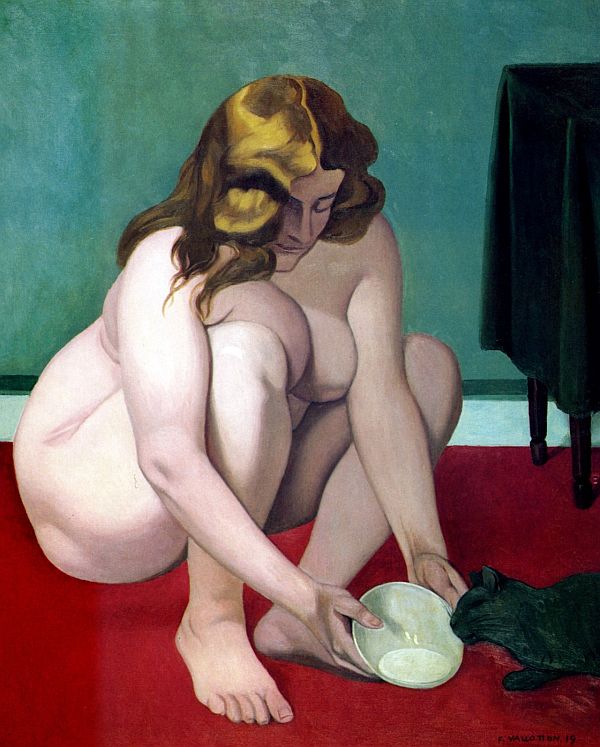
The
problem isn't the catch-all feminist objection, that these nudes - as an
American critic put it - show "the gaze of the male voyeur whose
penetrating stare violates and humiliates the object of its focus". Nor is
it that the subject of the unattended nude in a modern room reminds us how much
better it was to be done by Hopper (who could have seen some of the Swiss
painter's work during his Parisian stay of 1906-7). It is, first, that most of
these nudes are dismayingly inert; they might as well have been sculpted from
putty for all the life and breath they have in them. And second, they often do
not even convince within themselves: they might, indeed, be nus composés,
assembled from different women. Reclining Nude on a Red Carpet (1909), for
instance, looks as if the painter put his wife's head on an Ingres neck and
then attached both to a model's body.
The
monumental nudes illustrating allegorical subjects are even worse, so bad that
the critical defence now being raised is that they must, of course, be knowing,
self-aware, ironical. This strikes me as the pleading of desperation; and also
runs head-on into the problem that it is rare for an artist of mature years to
emerge into an irony about the very process of art after a career that had
never previously displayed it. Perhaps Vallotton was too consciously aiming for
immortality, forgetting that it is rarely endowed in accordance with an
artist's wishes.
At some
speed, I left the nudes behind and returned to The Lie, which held a final
surprise for me, one now emphasised by the hulking nudes. It is tiny - indeed,
the smallest painting in the entire show. If I had been asked, before going to
Zurich, how large it was, I would probably have guessed about four times its
actual area. It is strange how time and absence can do this to paintings that
you admire and think you know well: a version of going back to a place you
visited as a child and realising how different its proportions actually were.
With paintings, you tend to remember the small ones as bigger than they are,
and the big ones as smaller. I do not know why this should be the case, but am
happy to leave it - appropriately enough, in Vallotton's case - as an enigma.
· Félix
Vallotton: An Idyll at the Edge is at the Kunsthaus, Zurich, until January 18,
and at the Kunsthalle, Hamburg, from February 15 to May 18 2008
Better
with clothes on. By Julian Barnes. The Guardian, November 3, 2007.


