Showing posts with label cleanliness. Show all posts

27/03/2022

The Woman in White


On Saturday night, Kristen Stewart attended the 33rd Annual Producers Guild Awards in Los Angeles at the Fairmont Century Plaza Hotel wearing a dress from Brandon Maxwell. The strapless ivory bridal gown featured a sheer corset bodice with white ribbon boning sewn into the waist. The corset met a wide textured skirt that brushed the red carpet as Stewart posed.
 
The Spencer actress wore her hair up with curls in tendrils around her face. Her makeup was light, with pink eyeshadow for a touch of color and nude lips.
 
During the wards, Stewart presented the Darryl F. Zanuck Award for Outstanding Producer of Theatrical Motion Pictures to the team behind the drama musical film CODA. The award was accepted by the production team including Daniel Durant, Marlee Matlin, Troy Kotsur, Sian Heder, guest, Fabrice Gianfermi, Philippe Rousselet and Patrick Wachsberger. They were joined by stars Daniel Durant, Marlee Matlin, Troy Kotsur and Sian Heder.
 
The entire event was star-studded, including Serena Williams and Nick Jonas as other presenters. Other invitees on the list were Josh Brolin, Rachel Brosnahan, Daniel Durant, Alana Haim, Jude Hill, Chris Pine, Daniel Dae Kim, Emilia Jones, Marlee Matlin, Ryan Murphy, Simon Rex and Kerry Washington, as well as previously announced presenters Meryl Streep, Casey Bloys, Jamie Dornan, Michelle Yeoh, Aunjanue Ellis, Jung Ho-yeon, Linda Lavin, David Alvarez, Jessica Chastain, Denis Villeneuve, Troy Kotsur, Andrew Garfield, Lin-Manuel Miranda and Steven Spielberg.


Stewart's dress seems like a glimpse into her future—the Twilight star is recently engaged to Dylan Meyer. Stewart said that Meyer was the one to pop the question while being interviewed by Howard Stern in early November.
 
“We're marrying, we're totally gonna do it,” Stewart said. “I wanted to be proposed to, so I think I very distinctly carved out what I wanted and she nailed it. We're marrying, it's happening.”
 
Kristen Stewart Wears Sheer Bridal White Corset Dress To Producers Guild Award. By Aimée Lutkin. Elle, March 20, 2022.  


In art, spirituality and protest, a woman wearing white is a powerful symbol. Is she a goddess, a ghost, a "fallen woman" – or something else entirely, asks Beverley D'Silva.
 
She was a vision in a white dress, as she stood, or half floated, before a white curtain. She was an "apparition", enthused the artist Gustave Courbet. No, there was nothing ghostly or unearthly about her, according to the art critic Jules-Antoine Castagnary, she was "a woman after her wedding night," he said, leaving no doubt what her rosebud lips and dazzled stare evoked in him. She was "charming" felt the poet Charles Baudelaire. While art historian Paul Mantz wondered: "What does she want with her loose hair, her big eyes drowned in ecstasy, her languid attitude?"
 
The "she" invoking these notable reactions was the subject of The White Girl, a masterpiece created by artist James McNeill Whistler in 1861-2. The model, Joanna Hiffernan, was also a muse, companion and much more to the US-born artist, who was living between London and Paris when the pair met in 1860. At the time of their meeting, Hiffernan, an Irish-born Londoner, was 21. The artist was 26, smitten by her beauty, and her hair, which was "the most beautiful that you have ever seen!" he wrote. "A red not golden but copper – as Venetian as a dream!"
 
The painting, which he eventually titled Symphony in White, No 1: The White Girl, was rejected by the Royal Academy and the official Paris Salon, and accepted at the Salon des Refusés in 1863, a home – thanks to Napoleon III – for fine artists rejected elsewhere. It sealed Whistler's fate as a great international artist, and won him huge success in his own time.
 
From its first showing in a London gallery, under the title Woman in White, trading up on the popularity of Wilkie Collins's 1859 novel of that name, it caused a stir, was derided publicly and critically praised. Like the Mona Lisa centuries before her, Woman in White drew fascinated crowds, speculating about who and what she was.
 
Much conjecture focussed on the dress. A robe of such dazzling light-suffused whiteness was surely a garment worn by saints and the Virgin Mary, with further allusions to purity and innocence invoked by the white lily in her hand. But what of the flame-red hair, hanging loose, possibly indicative of her morals? And the wolfskin beneath her feet; with its links to wildness, sexuality, and the "beast" waiting to be unleashed inside her – or maybe those who gazed upon her.
 
Controversy raged around these stereotypes – goddess or "fallen" woman – and what all that whiteness could possibly symbolise: purity, virginity, morality, heaven, goodness, faith, perfection. Whistler was a "ruthlessly ambitious and hard-working artist" who was "determined to make his mark", according to Professor Margaret MacDonald, a co-curator of an exhibition at London's Royal Academy, Whistler's Woman in White, as well as co-author of the accompanying book, who is an expert on Whistler. The book examines the complex, enduring relationship between the artist and Hiffernan, and explores how the sensation around The White Girl, which stood on the threshold of modern art, secured Whistler's place in art history.
 
While relishing the publicity it attracted, the artist stayed out of the debate on its white-on-white theme, famously retorting that it "simply represents a girl dressed in white standing in front of a white curtain" – in line with the "art for art's sake" credo he subscribed to. Yet despite his apparent insouciance, he painted "Jo" – as he affectionately called her – in white at least five times, three in his symphonies series. MacDonald tells BBC Culture that, in her view,  Whistler's choice of a white dress was partly because it "contrasted splendidly with her hair", and the artist was excited by the technical challenge of painting white on white, a challenge the artist Auguste Renoir spoke later of sharing.
 
Whistler and Hiffernan's backgrounds couldn't have been more contrasting. He had a privileged childhood in New England, and grew up surrounded by wealth. Hiffernan came from a poor working-class family from Limerick in Ireland, who arrived penniless in London. She had considerable innate talents; she was (according to Whistler's biographers Elizabeth R Pennell and Joseph Pennell) of "next to no education, but of keen intelligence… [and] great charm of manner". MacDonald says that Jo and her sister Agnes (who were close) were "not quite on the streets… but it was very difficult for somebody with nothing to make a living in London. And they were beautiful, so modelling [for an artist] was certainly one option".


It was an option even if that modelling could be seen by "polite society" of her day as a fall from grace. And when Whistler first painted Hiffernan, he used vivid colours, and told his painter friend, Henri Fantin-Latour, she was like a "putain" (prostitute). Although they never married in the legal sense, their relationship would last 20 years – until her death – and she was vitally important to him.  She not only posed for his best portraits – exposing herself in the process to lead white paint that may well have contributed to her death from a lung disease at 44 – she also cared for his son from an affair for many years, and sometimes managed his estate.
 
Her part in his great fame might have mostly gone unsung. But 160 years later, a fascinating spotlight falls on Hiffernan, her personality and their life together, as revealed in the Royal Academy exhibition.
 
MacDonald and her team were thrilled to discover, using X-radiographs, images buried under layers of some of his paintings (which he'd painted over to save on canvas) depicting Hiffernan "her eyes looking devoutly upward, as if to heaven", in the guise of "a woman praying, saint or a nun" as MacDonald puts it. "All possible spiritual interpretations of the model's expression at this stage."
 
"Incandescent beings"
 
White in artworks carries "a wide spectrum of meanings," says Marina Warner, historian, art critic and author of books including Stranger Magic, and Monuments and Maidens. "If it's shining, as it is with the curtain in The White Girl, it brings a sense of being close to light, and ideas of purity and cleanliness," Warner tells BBC Culture However, "shining white is also associated with angels, which are incandescent beings – candidus is Latin for white, and light is the origin of things. If you read Dante's Commedia [later known as The Divine Comedy], as you rise to heaven, it gets brighter and brighter. So that connection of whiteness with goodness is very, very strong."


The dress in the painting is "not shiny" she points out "and in this she's less angelic than nubile. Also a strong symbolic meaning of whiteness is a threshold – if you're a candidate or a novice up to become a nun, you wear white, as you do for your first communion; and if you marry you wear white and pass across the threshold of maidenhead into the world of sexuality".
 
Warner notes the model's "red lips, and hair hanging loose, possibly a sign of availability. She looks apt to surrender without much of a struggle. A hint of dangerous sexuality in the wolfskin… even the flowers in the carpet are hinting at fruition or fertility". Indeed, the Woman in White curators believe Whistler's white-clad series may have been inspired by Jean-Baptiste Greuze's painting La Cruche Cassée (1771),"with its depiction of fair young flesh and a silky, disarrayed white dress," as MacDonald's book describes it. But as Warner says, white conveys a wide spectrum of connotations. She, like Courbet before her, finds the figure "rather spectral. I mean, in Victorian psychic photographs, ghosts are white, and there's something insubstantial, phantom-like about her. And of course, in many religions, whiteness is the colour of death".         
 
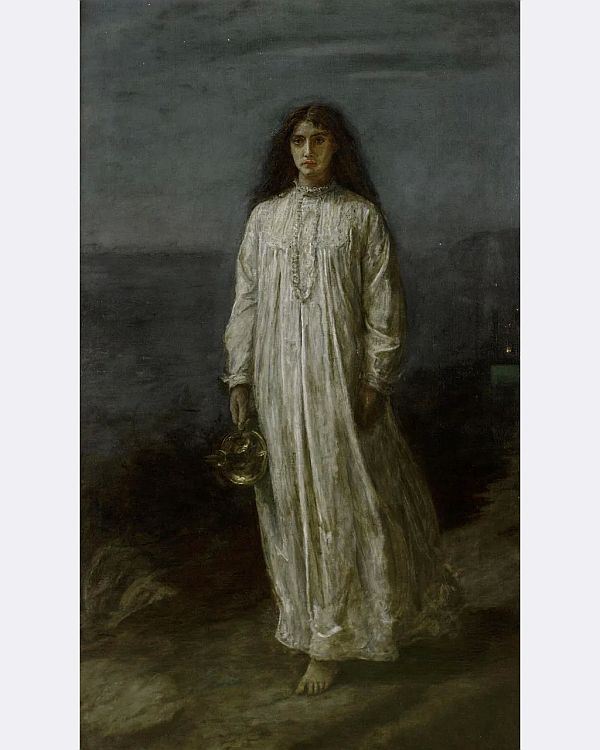
The painting's success influenced striking works of that time, such as Frederick Sandys' Gentle Spring (1865); Sir John Everett Millais' The Somnambulist (1871); The Woman in White (1871) by Frederick Walker; Gustav Klimt's Portrait of Hermine Gallia (1904); John Singer Sargent's intriguing Fumée d’Ambre Gris (1880);  and arresting portraits by Berthe Morisot, such as her The Artist's Sister at a Window (1869). MacDonald's co-author, Aileen Ribeiro, notes how Morisot "loved to depict these soft, floating, semi-transparent white morning gowns in private, informal, domestic settings". She references The Awakening Conscience by William Holman Hunt (1853), which "announces the sexual relationship between the young man and his mistress by specificity of her bedroom attire, a looser, striped white bodice over a white cotton broderie-anglaise petticoat… White then is an ambiguous colour; it can encompass a variety of meanings, from innocence to the lack of it"


Writing on the symbolism of white in relation to fashion, Ribeiro observes: "It was Wittgenstein who said that white is 'that which does away with darkness', and for this reason is often linked to virtue, purity, cleanliness and humility". She lists the white toga virilis of ancient Rome, a symbol of the common good; white worn by monarchs at their coronations to underline their duty to the state and people; white associated with faith and religious rites, such as pilgrims to Mecca. There's the fact Popes have worn white since 1566, as a symbol of purity and sacrifice, and it's worn by priests and priestesses in the Shinto religion in Japan, where white has been an auspicious colour since ancient times.
 
Of course there are countless portrayals of white-clad figures in modern art, from Whistler via Klimt's women in dresses gauzy as butterfly wings, through to Picasso's Woman in White (1923) to the vivid self-portraits by Frida Kahlo. One of Kahlo's paintings in which white plays heavily with colour symbolism is The Two Fridas (1939).  She depicts herself in two guises – one Frida in Western clothes, the other in a formal white dress with traditional Tehuana trimming, her exposed heart bleeding on to its white skirt; it's been suggested the white Frida was the life she wished to have but eluded her (children, and happiness with Diego Rivera, from whom she had recently divorced). Kahlo said the picture expressed her desperation and loneliness. Self Portrait with Thorn Necklace and Hummingbird (1940) is arguably her best-known work featuring herself: her white dress is like a crucifixion shroud, as a neckpiece of thorns, rather than a crown, pierces her skin.
 
White dresses as a tradition for weddings is not as long-held as we might think – in fact, it was Queen Victoria's choice of a white wedding dress finished in lace (to help the ailing lace industry), that inspired a public fashion for bridal white. Bridal fashion expert, Peta Hunt recently told wedding website hitched.co.uk that we will see "a lot more coloured wedding dresses – pinks, blues, blush" and a return of black wedding dresses "for high glamour and drama". Wearing white has figured as a protest tool for women since the early 1900s, notably the British and US Suffragettes. White is the colour "most associated with suffragists today," writes Erin Blakemore for National Geographic. "Long associated with youth, virginity and moral virtue, white suggested that women could be expected to vote for politicians and policies that would better society."
 
Wearing white, Emmeline Pankhurst strode out as leader of the Women's Social and Political Union, to promote votes for women at public marches, including the biggest demonstration of its time in the UK, in Hyde Park, June 1908. A long white dress, worn with purple (symbolising dignity, self-reverence and self-respect) or green (for hope and new life), became an easy-to-assemble uniform for Suffragists attending political rallies. White garments also stood out starkly against the crowds of men in dark suits – an early prototype of the clever photo op.    
 
Wearing white to highlight gender equality – and as an emblem of female empowerment – is still very much with us. In 2019, Donald Trump faced a sea of suffragette white at his State of the Union address, as female Democratic members of Congress stepped up in pristine white clothes: "We'll honour those who went before us and send a message of solidarity, we're not going back on our hard-earned rights," said Lois Frankel, of the House Democratic Women's Working Group. While Christine Holgate, former Australia Post CEO, wore a white jacket when appearing before a Senate inquiry – part of the Wear White 2 Unite campaign to encourage people to support her call for an end to workplace bullying.
 
If she were still alive today, what would Joanna Hiffernan, the original Woman in White, make of the idea of white worn by women as a political statement? She'd probably snort with laughter, and be right behind it, judging by her wry humour and pragmatism, as revealed in the book. And what if she could walk around the Royal Academy, and witness the more than 70 paintings, etchings and Japanese prints that inspired her great friend, to see that the most eagerly sought-out artworks were of herself? That her talents and contributions to Whistler's oeuvre had at last been appreciated, and that she had finally been given her moment in the sun, would be gratifying indeed.
 
Whistler's Woman in White is at the Royal Academy, London, from 26 February to 22 May 2022.
 
The Woman in White and the meanings hidden in a masterpiece. By  By Beverley D'Silva.
BBC, February 21,  2022


“Suffragette white” is proving to be a popular fashion choice for women who want to make a statement. Most recently, former Australia Post CEO Christine Holgate donned a white jacket in her appearance before a Senate inquiry into her controversial departure from the organisation.

 
Her sartorial choice formed part of the “Wear White 2 Unite” campaign, which encouraged people to sport the colour in support of Holgate and call for an end to workplace bullying.
 
In doing this, Holgate, like Brittany Higgins last month at the Canberra March4Justice, is building on a trend in which women are wearing white clothing — and often referencing suffrage history — to draw attention to gender inequity today.


Deeds not words
 
The term “suffragette” is sometimes mistakenly used to refer to all those who campaigned for women’s voting rights. But it was actually a label applied to a specific group of women — initially in a derogatory sense.
 
The women’s suffrage movement in Britain took off during the 1860s. By the turn of the 20th century, women still did not have the vote.


This led Emmeline Pankhurst to establish the Women’s Social and Political Union (WSPU) in 1903. Her group of primarily white women believed militancy was the only way they could achieve change, living by the motto “deeds not words”.
 
The British press mockingly labelled these women “suffragettes”, adding the diminutive suffix “-ette” in an attempt to de-legitimise them. But Pankhurst’s group was not deterred. It reclaimed the term, eliminating the element of ridicule and rebranding it as “a name of highest honour”.
 
 
Her group’s dramatic actions – from disrupting meetings to damaging public property – cemented their place in the history of women’s suffrage.
 
Purity, dignity and hope
 
Early 20th century suffrage campaigns relied heavily on spectacle and pageantry, using striking visual imagery and mass gatherings to garner the attention of the press and the wider public.
 
Many suffrage organisations adopted colours to symbolise their agenda. In Britain, the National Union of Women’s Suffrage Societies used red and white in their banners, later adding green. The WSPU chose white, purple and green: white for purity, purple for dignity and green for hope.
 
Suffragette white was first donned en masse in June 1908 on Women’s Sunday, the first “monster meeting” hosted by the WSPU in London’s Hyde Park. The 30,000 participants were encouraged to wear white, accessorised with touches of purple and green.
 
Ahead of the march, Emmeline Pethick-Lawrence’s newspaper Votes for Women explained:
 
“the effect will be a magnificent moving colour scheme never before seen in London’s streets.”
 
White fabric was relatively affordable, which meant women of different backgrounds could participate. The colour’s association with purity also helped those involved present themselves as respectable, dignified women.


Suffragette white became a mainstay of the WSPU’s demonstrations. In 1911, women who had been imprisoned for militancy were among those who marched in white in the Women’s Coronation Procession.
 
The Australian suffragist Vida Goldstein, wearing a white dress, famously headed the Australian contingent.
 
Goldstein later brought the WSPU’s colours to Australia in her campaigns for a parliamentary seat.
 
Two years later in 1913, members of the WSPU wore white in a funeral procession for their colleague Emily Wilding Davison, who died under the hooves of the King’s horse at the Epsom Derby.
 
American suffragists soon picked up this tactic, influenced by the British suffragettes as well as by the temperance movement’s use of white ribbons.
 
Cities like Washington D.C. witnessed similar scenes of women in white dresses marching through the streets, making striking material for photographers. Contemporary black women — who were excluded from the suffrage movement in many ways — used the colour in their protests against racial violence, too.


Feminist solidarity
 
The modern trend towards white has had particular traction in the US.
 
In 2019, Donald Trump faced a sea of suffragette white at his State of the Union address. Last year, Kamala Harris wore a white pantsuit to deliver her remarks as vice president-elect.
 
Closer to home, at the March4Justice rally in Canberra, Brittany Higgins made a surprise appearance in a white outfit, standing in contrast to the funereal black worn by attendees.


By wearing white, these women — either consciously or not — are building connections with their feminist forebears across the Anglosphere. At times this can flatten the complex history of women’s suffrage. It is important to remember it was primarily white, middle-class women who led these suffrage movements, often to the exclusion of women of colour and others.
 
In drawing on their feminist genealogy, women today need to acknowledge the limitations of feminisms past and present — and not simply celebrate and reproduce the attitudes of over a hundred years ago.
 
At the same time, wearing suffragette white is a powerful and highly symbolic gesture that reminds us just how long women have been fighting.
 
By establishing a sense of feminist solidarity across time and space, this move can also generate inspiration and energy and attract media attention. Women of colour’s choice to wear white can be read as a way of asserting their place within a movement from which they have historically been (and continue to be) excluded — and honouring women of colour who have come before them.


Like the suffragettes of the early 20th century, women today are showing the power of visual spectacle to grab the public’s attention. Whether this will, in turn, lead to real change remains to be seen.
 
What is suffragette white? The colour has a 110-year history as a protest tool. By Michelle Staff. The Conversation, April, 20, 2021.


“A wedding gown represents far more than just a dress. It is also the embodiment of a dream,” said Vera Wang.
 
For most American brides, that dream is realized in a beautiful white wedding gown. It’s a seemingly timeless tradition that is often the center point of little girls’ wedding fantasies. In 2018, about 83% of brides wore white dresses on their big day, according to a survey by Brides Magazine. Such an overwhelming statistic begs the question: Why do we associate white with wedding gowns? And how long has this tradition existed?
 
Godey’s Magazine and Lady’s Book, a leading 19th century women’s publication, addressed this in an article on the “Etiquette of Trousseau” in their August 1849 issue. “Custom, from time immemorial, has decided on white as [a wedding gown’s] proper hue, emblematic of the freshness and purity of girlhood,” they wrote.
 
While this implies a long history of bridal white, it is not true. At the time, white had only been a popular wedding dress fashion for about nine years – strictly among the well-to-do.
So when and where did the white wedding dress originate? As a curator at The Ohio State University’s Historic Costumes and Textiles Collection, I have often been asked this question, and my research included the search for an answer.
 
The practice likely traces back more than 2,000 years, with roots in the Roman Republic (509 B.C. - 27 B.C.) when brides wore a white tunic. The color white represented purity, symbolizing both a woman’s chastity and her transition to a married Roman matron. It was also associated with Vesta, the virgin goddess of hearth, home and family who was served by temple priestesses garbed in distinctive white clothing.
 
After the fall of the Roman Empire, white marriage attire fell out of fashion. From the Middle Ages to the mid-19th century, most brides simply wore their best dress or purchased a new gown that could be worn again. White was simply not a practical choice in a world without running water – or where laundry was hand-washed.
 
A royal wedding sparked the modern trend in white bridal wear. Queen Victoria chose to forgo the royal tradition of wearing coronation robes when she married Prince Albert on Feb. 10, 1840. Instead, she wore a fashionable white gown that was featured in newspapers and magazines around the world.
 
The style and color of her gown was copied across continents as women aspired to look like the young, attractive queen – much like the public emulates celebrities today. Wearing a white wedding dress became a sign of wealth and status rather than virginity. Only wealthy brides could wear a white silk gown, since they were wed in clean, elegant places that were removed from the muck and grime of life during the mid-19th century Industrial Age.
 
These gowns were actually cream or ivory, which was more flattering to the complexion. The brilliant white wedding dress would not become popular in Europe and North America until the 1930s, and would not truly become rooted in the public consciousness until World War II.
 
With U.S. wartime rations of fabric and a surge of weddings as American soldiers returned from the front, the war sparked changes in the design of wedding dresses. In 1943, while the war was still raging, the federal Limitation Order 85 dictated that only one and three-quarters yards of fabric could be used to create a dress.
 
The American Association of Bridal Manufacturers lobbiedfor an exemption, arguing that it was important to the overall morale of citizens. They asserted, after conducting a study of 2,000 brides that, “American boys are going off to war and what are they fighting for except the privilege of getting married in a traditional way? They’re fighting for our way of life, and this is part of our way of life.”
 
They were ultimately successful, and the limitation order exempted wedding gowns. But silk was difficult to find; the war with Japan had disrupted trade routes. Nylon was also in short supply, as it was being used in place of silk to manufacture parachutes. Most wedding gowns from those years were made from acetate – except for those worn in “parachute weddings.” Some soldiers, like B-29 pilot Major Claude Hensinger, kept the parachutes that saved their lives during the war and later gave the material to their betrothed to make a gown.
 
Although the first records of brides garbed in white reach far back into the annals of history, it only became standard fashion over last 80 years. With the arrival of ready-to-wear clothing, brides could order affordable, mass-produced gowns based on sample sizes that were then fitted for them: a custom-made gown at a ready-to-wear price. A large, traditional wedding with the bride outfitted in a princess-style white wedding gown became a symbol of the American dream.
 
From WWII through the end of the 20th century, the white gown symbolized prosperity, virginity and a lifetime commitment to one person. For most people today, those meanings are gone.
 
White is now the overwhelming choice for most American brides, with 4 out of 5 choosing to walk down the aisle in a white gown, a sort of bridal uniform. It has become an iconic symbol of weddings, an expected part of the celebration, and despite knowing the relatively short history of the tradition of a white wedding, it was my choice as well.
 
Why do brides wear white? By Marlise Schoeny. The Conversation, September 4, 2020. 


I imagine Meghan Markle standing before her dress the night before her wedding, considering. Instead of a white column of lace or a dramatic froth of translucent charmeuse, she touches the sleeve of a russet red gown, trimmed with mink and gold-embroidered, the skirt heavy with heirloom jewels. This is the dress she'll wear down the aisle.

 While this seems like a shocking pick today, prior to the 20th century this would have been the norm for wealthy European brides. Pristine, white, fairy-tale wedding dresses, to be worn once and then tucked away, weren't the standard until relatively recently. Before then, colored dresses were the norm for brides of all classes.

 While a few historic women wore white gowns to the altar over the centuries -- including Mary Queen of Scots in 1558 -- it wasn't until Queen Victoria debuted a white silk-spun gown at her wedding to Prince Albert in 1840 that the look really took root. Side-stepping the usual fur, gold embroidery, and rich colors that were the norm among the aristocracy at the time, Victoria stepped out of her carriage wearing a simple white dress accented with Honiton lace, and traded her crown for a wreath of orange blossoms and myrtle.

 However, when the wedding march began and the guests turned around, they found it all very underwhelming -- where was the pomp and circumstance? Royal weddings were more about wealth and political contracts than love, so families typically took the opportunity to express their affluence through their brides: Margaret of York's wedding dress from 1468 was reportedly so heavy with heirloom jewels that she had to be carried into the church; Princess Charlotte, in 1816, wore a silver lamé gown embroidered with shells and flowers, which was said to have cost £10,000 (the equivalent of about $1.3 million, adjusting for inflation). By showing up in a simple white dress, it seemed that Victoria was throwing a frugal affair.

 That was partly the point. A young Lady Regent at 20, Queen Victoria wanted to show good sense and prudence on her wedding to show her people that she would run their country much in the same way.

 But why white? The reason is layered. Knowing that her dress would be reported on around the world, Queen Victoria chose to wear a dress trimmed with handmade Honiton lace from the small village of Beer, to support the declining lace trade and give the industry a boon. White, she reasoned, was the best way to show off the lace makers' artistry.

 That's not to say that her marriage to Prince Albert was purely a show of duty: there were just as many romantic elements involved. Part of the reason Queen Victoria eschewed the heirloom jewels, heavy fabrics and rich colors was that she didn't want to make her vows to her husband as a monarch, but rather as the woman he loved.


 As predicted, her dress was reported on for months on end. News of this charmingly simple frock spread far and wide, reaching across the Atlantic to the colonies, and was syndicated in just about every newspaper column and women's magazine for months on over. In 1849, Godey's Lady's Book, the Vogue of the Victorian world, decreed: "Custom has decided, from the earliest ages, that white is the most fitting hue, whatever may be the material. It is an emblem of the purity and innocence of girlhood, and the unsullied heart she now yields to the chosen one."

 However, the white dress didn't initially catch on because it symbolized an unsullied heart. It caught on because it looked like money. At the time, most women exchanged vows in dresses they already owned, and there was only one group of people who could afford to own anything white: the leisure class. There weren't dry cleaners and laundromats around in the late 19th-century, so it took money to maintain a white outfit.

 Buying a white dress was seen as extremely impractical, especially when one considered the festivities of a wedding. Between the drinking, the dancing, and the scooping of desserts, chances were the frock would be ruined and only be worn once. No working-class woman would be able to afford that kind of frivolousness.

 In 1873, Mary Sheehan Ronan, a 20-year old American bride, wrote in her journal: "I had dreams of a white dress with a train, a bridal veil, and wreath of orange blossoms, but when the time actually came I considered conventional things inharmonious with the simplicity and unconventionality of our way of living." Instead, she wore a pearl gray dress, one of the two she and her stepmother had recently made.

 But that was the norm for brides who didn't come from money. In 1911, when a newly engaged woman wrote into Washington's Tacoma Times newspaper seeking a recommendation for a "plain wedding dress," the columnist recommended buying a frock in white wool, which could easily be dyed for another occasion. But, she asked, "Why not be married in your traveling suit?" Perhaps it seemed a touch too extravagant to buy a new dress for the occasion.

 It took until after World War II for the middle-class to begin copying the look of the wealthy, thanks to the boon in prosperity after the war. With rations gone, it became a novel idea to buy a dress just to celebrate in for a day, and when Hollywood began marching brides in white across theater screens, the quaint, chapel-like look became part of the tradition.

 That's not to say that brides have only been wearing white since. Brigitte Bardot wore a pink gingham dress, complete with lace-trimmed sleeves and a tea-length skirt, in 1959, and Elizabeth Taylor only wore white to two of her eight weddings. More recently, Keira Knightley wore a pale gray Chanel dress for her 2013 nuptials, Sarah Jessica Parker wore a black ballgown in 1997, and Julianne Moore wore lavender Prada in 2003.

 Even today, many different cultures wear different colors. In China and India, for example, red dresses are worn as a symbol of good luck and success. Traditional Nigerian brides veer towards brightly colored, elaborately accessorized dresses, and wedding dresses in Ghana vary from couple to couple, with each family uses its own intricate cloth pattern. Traditional Hungarian dresses are white with colorful floral patterns embroidered down their lengths, and Malaysian gowns usually come in purple or violet.


 Sartorially, Meghan Markle has proven herself an nontraditional future-royal, wearing her hair in messy buns (Kate Middleton prefers hair nets), and choosing cross-body bags over dainty clutches so her arms free to hug and shake hands. And although she will almost certainly keep with tradition and don a white dress on wedding day, she will walk down the aisle representing the same refreshing and unexpected spirit the white dress embodied when Queen Victoria first popularized it 179 years ago.

 She's a woman that knows her own mind, and isn't afraid to side-step protocol to start her own traditions. And history will remember her for it.


Why so many brides wear white on their wedding day. By Marlen Komar. CNN, February 8, 2019


Sun stare, don't care with my head in my hands thinking of a simpler time
Like Sun Ra, feel small, but I had it under control every time
 
When I was a waitress wearing a white dress
Look how I do this, look how I got this
I was a waitress working the night shift
You were my man, felt like I got this
Down at the Men in Music Business Conference
Down in Orlando, I was only 19
Down at the Men in Music Business Conference
I only mention it 'cause it was such a scene
And I felt seen
Mmh, mmh-mmh-mmh-mmh, mhm
 
Summer, sizzling
Listening to jazz out on the lawn
Listening to White Stripes when they were white-hot
Listening to rock, all day long
 
When I was a waitress wearing a tight dress, handling the heat
I wasn't famous, just listening to Kings of Leon to the beat
Like, look at how I got this
Look how I got this, just singing in the street
Down at the Men in Music Business Conference
I felt free 'cause I was only 19
Such a scene
 
Summer, summer's almost gone
We were talking about life, we were sitting outside 'til dawn
But I would still go back
If I could do it all again, I'd fly
Because it made me feel, made me feel like a god
'Cause it made me feel, made me feel like a god
Somehow it made me feel, made me feel like a god
 
When I was a waitress wearing a white dress
Look how I do this, look how I got this
I was a waitress working the night shift
You were my man, felt like I got this
Down at the Men in Music Business Conference
Down in Orlando, I was only 19
Down at the Men in Music Business Conference
I only mention it 'cause it was such a scene
And I felt seen
Mmh, mmh-mmh-mmh-mmh, mhm
 
When I was a waitress wearing a tight dress
Like, look how I do it, look how I got this
I was a waitress wearing a tight dress
Like, look who would do this, look who would got this
 
It made me feel, made me feel like a god
It kinda makes me feel, like maybe I was better off
'Cause it made me feel, made me feel like a god
Kinda makes me feel like maybe I was better off


Lana del Rey   /  The White Dress


13/12/2019

The Clean Body : a History of Personal Hygiene Across the Western World


The twentieth century saw a wholesale transformation in popular hygiene throughout the Western world. The very concept of cleanliness itself was redefined. Routine washing and bathing habits replaced older, more intermittent practices, and customs once shared only by the few were adopted by the many.

At the fin de siècle frequent bathing had primarily been an upper-class affair; the rest took a full bath a few times a year at best. Otherwise they merely washed those parts in greatest need whenever the need arose, and in an age of few hygienic sensibilities those moments were few as well.

Half a century later the importance of personal cleanliness had become widely accepted, a truth beyond questioning. More people than ever bathed regularly and often, and their numbers continued to grow. The Saturday bath had become a commonplace ritual and daytime hand washing — before meals and after using the toilet, after rising and before bedtime — was routine. Those who hadn’t yet adopted these customs were a vanishing species, soon to disappear. The new cleanliness had become a mass phenomenon.

The bathroom left an indelible mark on the spread of these habits for it made regular washing and bathing simple tasks. Yet those who lacked its benefits didn’t necessarily neglect their hygiene. Even without permanent fixtures and private spaces, they made do in kitchens and sculleries with buckets and basins or whatever else was available. The new concepts of cleanliness were widely accepted long before everyone could practise them in their own bathroom, furnished with up-to-date fixtures and hot water at the turn of a tap.

Bathrooms changed the ease, more than the fact, of washing and bathing. As much as the bathroom fostered cleanliness, the new hygiene promoted the diffusion of the bathroom by creating a demand for its advantages.

Still, changes like these in everyday practices are difficult to document. However remarkable they may have seemed at the time, such commonplace matters are scarcely visible in retrospect. One early study, a 1937 survey in North London, found that 80 per cent of adults took a weekly bath, while another 10 per cent bathed twice or more; rates were higher still for children and adolescents. After a wartime inquiry into British housing conditions, the British social research organization Mass Observation noted that “broadly speaking, the pattern of washing bodies is a daily washing of the face and neck and a weekly washing of the whole body.” Informed by a later postwar survey, it reported:

      “Among the middle classes, women wash more frequently than men. In frequency of handwashing they outnumber men by three to two, in bathing by two to one. The daily bath is more likely to be a feminine ritual — 12 women in every 100 bathe daily compared with only one man in 100. In fact, the majority of men have only one bath weekly.”

Men and women alike wash their faces on average between once and twice daily, but their hands at least five times during the same period.

Not knowing how these surveys were conducted, we shouldn’t assume that they reflected British practices in general, but they do suggest that national habits had changed markedly since the beginning of the century.

The French evidence is even more limited. In 1951 the fashion magazine Elle asked a group of women about their personal care practices. Having recently returned from New York and been impressed by American ways, its feminist editor Françoise Giroud was concerned about her countrywomen’s seeming hygienic neglect.

Unfortunately the report mentioned nothing at all about how those surveyed were selected, nor even their numbers, so its findings are little more than straws in the wind. Half of those interviewed replied that they performed a daily “toilette complète,” while another third did so at least once a week. Giroud didn’t specify the elements of a toilette complète and it almost certainly included some body washing, though given the scarcity of bathrooms in France at the time, the number of immersion baths must have been small.

This, at least, was the meaning accepted by Jean Maudit, who revisited the original survey in 1986 in a review of French womanhood’s hygienic progress during the intervening 35 years. His methods, alas, were no more clear than Giroud’s, but by then three-quarters of those asked performed a toilette complète daily and most of the remainder did so two or three times a week. In a much broader inquiry, three enterprising journalists mounted an ambitious survey during the early 1970s, seeking to describe the moeurs [customs] of the entire French nation at home and at work.

While their interests were as broad as their survey techniques were unsound, they too gathered information on French cleanliness, finding that 13 per cent took a daily bath or shower and 23 per cent (most of them country dwellers) never took one at all. The latter statistic seemed to confirm long-standing views that the French paid little heed to their personal care.


The Elle inquiries, like those in England, seem to have relied largely on urban middle-class informants. But whatever their shortcomings and our methodological misgivings, they point to an obvious fact: some daily routines of personal cleanliness were already widely practised in France by the 1950s and their acceptance continued to grow during the second half of the century.

What Giroud overlooked in her concern for French hygienic standards was the fact that, though her countrywomen fell well short of the postwar New York example, they took greater care of their bodies than their mothers and grandmothers ever had. Like the British, the French were changing their hygienic ways. The range of habits varied in both countries and, especially in France, rural people still clung to older customs. But new hygiene routines were on the ascendant and in time would conquer all.

Despite their long-standing reputation for cleanliness, Americans have been strangely uncurious about their own bathing behaviour. One of the very few exceptions is a 1960 study of personal hygiene in California, the state with the highest proportion of homes with full bathrooms (95 per cent) in the nation at the time. This survey of 1,000 middle-class households in Los Angeles and district found that three-quarters of family members bathed daily while almost all the remainder did so two or three times a week. Slightly more than half of them took baths rather than showers.

But urban California was not the nation and middle-class California’s habits were not those of all Americans. This study surely reflected America at its cleanest.

Elsewhere routine bathing made further progress over time. Yet another study of hygiene habits, this one in Germany during the later 1960s, revealed bathing rates higher than those in France and England but well below those in California. Half the German respondents then took a weekly bath while another third did so at least two or three times a week. The great majority also washed their hands, faces and necks every morning. Yet one in 10 never bathed at all, though most of them must have scrubbed themselves regularly, for virtually all those surveyed washed their bodies, partly or fully, every day.

Over the next two decades, German habits changed still more dramatically. By the later 1980s more than half now showered daily and over 10 per cent did so more than once a day, all this in addition to a weekly bath. Small surveys done in France and Spain at the same time revealed an even more intense devotion to clean bodies. Three-quarters of French respondents took a bath at least once a week as well as a shower once daily — at minimum. The Spanish took to the tub less often but made up the difference in their commitment to a daily shower, taken by seven in eight of them.

Apart from a few surveys, we have little more than anecdotes to tell us about the changing customs of cleanliness, and they usually offer mere glimpses of personal experience. Overall they paint a picture much like the one we’ve just seen, of growing concern for personal hygiene, and of gradually spreading bathing and washing routines. The United States led the change but there, too, standards and practices varied across the continent.


Western European communities soon followed the American example, with France and Italy at the far end of the queue. Slower to adopt the bathroom and the new sanitary technologies, they were slower to embrace the new culture of cleanliness as well.

But by the end of the twentieth century the very concept of bodily cleanliness had been transformed everywhere in the transatlantic world. A survey by the French newspaper Le Figaro in 1998 made the point abundantly clear. It found that fewer than half of French adults took a daily bath or shower at a time when 70 to 80 per cent of northern Europeans already did so.

Leaving aside the discrepancies between this and earlier studies, the importance of the comment lay in how the newspaper defined cleanliness. When condemning its countrymen as hygienic laggards it used a late-twentieth-century measure. In a climate of ever more exacting standards, the only truly clean body had become one that was fully washed once a day.

Excerpted from The Clean Body : A Modern History.  Montreal, McGill-Queen’s University Press,  2019.


Cleaning Up the Masses: When Cleanliness Became a Phenomenon.  By Peter Ward . The Star, December  1, 2019. 


A publishing tradition as old as the printed word, advice literature flourished from the later 18th century onward, spurred by the spread of literacy, the declining cost of book publishing, an expanding middle class seeking guidance on right conduct, and the increasing numbers of self-declared experts keen to profit from the market for advice.

Self-help books circulated, and at the same time reflected, a wide variety of views about appropriate behavior. Before the mid-18th century they had little to say about how to accentuate feminine beauty and preserve it from time’s certainties. Rather, they viewed a woman’s attractions in relation to her conduct, placing them in a moral sphere rather than a physical setting.

A curious novel by a Parisian doctor published in 1754, however, departed from the usual offerings of the loveliness literature. Abdeker ou l’art de conserver la beauté, by Antoine Le Camus, purported to be the translation of an Arabic manuscript from the time of Mahomet II, the Ottoman Sultan who conquered Constantinople in 1453. It was a tale of illicit love between Abdeker, a young physician to the women of the Sultan’s harem, and Fatmé, an odalisque in his seraglio and a woman of unequaled sweetness and beauty. Time and again Abdeker gained access to the darkest  mysteries of the harem, to say nothing of the forbidden charms of the lovely Fatmé, by teaching her the means of preserving her beauty while instructing her in the arts of love.

Le Camus wrote in the Orientalist tradition of the erotic exotic. He was one among many Western observers of the Ottoman world fascinated by the image of the harem, with its imagined air of perfumed sensuality and sexual licence. His book was republished at least four times over the coming decades, was translated into English and Italian, and was still in circulation when Mozart’s Die Entführung aus dem Serail and Rossini’s Il Turco in Italia and L’Italiana in Algeri used the harem to comic effect. In the visual arts, Western painters—famously Ingres in his Grande Odalisque—returned time and again to the theme of the seraglio from the late 18th century onward.

The curiosity of the book, however, came neither from its romantic plot nor from its erotic overtones but from the fact that it offered feminine beauty tips on a broad range of subjects, bathing among them. Le Camus dotted his text with bits of practical wisdom about women’s health, offering handy summaries of his major points  at the end  of each of the book’s two parts. Here was a healthcare catechism with a difference!

His advice on bathing was set in the context of Abdekar’s visit to a bath in the harem, a luxurious setting rich with the promise of voluptuous delights. But the author’s suggestions about bathing were quite prosaic. One bathed to preserve a white skin and to cleanse it of dirt, for pleasure and politeness as well as for health. Bathing offered a host of natural benefits, Le Camus declared, yet one should proceed with caution because inconsiderate use could be the cause of major ills.

With its emphasis on a suggestive world of exquisite sensuality, Le Camus’s advice left the idea of such a bath in the realm of his reader’s imagination. For all but the most privileged Europeans of the time, even the remote  possibility of actually bathing in this manner was utterly out of reach. In this respect the author’s views on how to display and preserve feminine attractiveness were out of step with those offered by most other advisers of the later 18th century. The beauty counselors of the period had little to say about washing the body and much to say about a host of other matters: cosmetics, perfumes, hair care, and dress, to name a few.

But soon after the turn of the century, some of these self-appointed advisers—most of them  male—began to pay  more  attention to the role of bathing in women’s personal care. One of the first was Auguste Caron,  whose Toilette des dames ou Encyclopédie de la beauté, published in 1806 and later translated into English  and Italian, hymned the importance of cleanliness to women’s beauty. As the English edition explained,

   “there is in the toilette of women one very essential requisite, and which constitutes  its greatest merit in the eyes of the delicate man; I mean cleanliness. Cleanliness alone, unaccompanied by any other recommendation, has a right to please, to attract the eye, to gratify the taste, to excite desire; the toilette, without cleanliness, fails in its object; it displays only idle pretentions, bad taste and low sentiments. . . .Cleanliness is that precious quality which nearly transforms a woman into a divinity, by removing from her every thing that might betray the imperfections of human nature.”

In Caron’s view, careful attention to her personal  hygiene, of her body and its clothing, was the primary  means a woman  had to display  and  preserve  her  beauty. He advocated frequent bathing in warm water—never cold, which injured feminine loveliness—and even suggested that scented soaps might be used to cleanse the skin more perfectly. The face, hands, and feet should be washed regularly if bathing was not possible. Hair, however, was quite another matter. While Caron advised the same high standards for its cleanliness, he strongly criticized washing the head with water, which produced aches of the head, ears, and teeth, as well as eye complaints. Regular combing and the occasional application of hair powders or bran would keep it clean.

The 19th-century woman addressed by these authors could only be a lady of leisure. The frequent baths proposed by an anonymous Italian  author in 1827—at least once weekly and more often in the hot  season—should  take  at  least  one and  a half  hours, an opinion shared by Mme Celnart,  another mentor generous with her advice about  matters  feminine. A generation later Auguste Debay, the prolific and widely published French author of guides to hygiene (clothes, diet, beards, vocal organs, marriage, hands and feet, to name only some), suggested that baths  should probably last longer still. Obviously the woman imagined by these authors had time on her hands.


But of far greater significance, by the early decades of the 19th century the virtues of the bath had become indisputable, and from this point on it occupied a central place in the advice directed to women. As Debay claimed in 1846, the warm bath is essential to the cleanliness of the body, to the maintenance of its flexibility and freshness; one can consider it necessary for the general health of the individual.

But  whatever support bathing could muster  from the health and beauty guides, it also had to contend with misgivings and restrictions, for modesty challenged the spread of the bath throughout much of its long history. The Greco-Roman myth of the huntress Artemis (or Diana) and Actaeon was one of its early expressions, most widely known from the Renaissance onward through Ovid’s Metamorphoses. Tired from her day’s hunt, the chaste goddess Diana was surprised while bathing in a limpid forest pool, together with her attending nymphs. The male intruder was the mortal Actaeon, a hunter like herself, who blundered alone into her sacred grove at the end of his day’s pursuits. The nymphs tried, but failed, to cover Diana’s nakedness with their own and Actaeon saw her unclothed. In shame and anger she took revenge by depriving him of speech and turning him into a stag. Transformed, he took flight, but soon his hunting dogs took up the chase and, unable to cry out, he met his death at their jaws, avenging Diana’s wronged modesty.

The myth was a recurring theme in European painting from the 16th to the 18th centuries, with Titian, Rubens, and Rembrandt among the many artists drawn to various moments in the story. Some depicted Diana quietly bathing alone, others the goddess in her grotto surrounded by her attendants. Still others—notably Titian—portrayed the dramatic moment of Actaeon’s fatal glimpse and Diana is chilling response. But the thread running through them all was a sense of diffidence and reserve that surrounded the bathing female.

Excerpted from The Clean Body : A Modern History.  Montreal, McGill-Queen’s University Press,  2019.


How Cleanliness and Beauty Became Intertwined in the 18th Century. By Peter Ward. LitHub, December 11, 2019. 


You explain in the book that what first attracted you to the subject matter was an interview you had with your grandfather in the 1970s. Why did you find now was the right time to write and publish this particular book?

 The Clean Body is a synthesis. It draws together a literature in several languages from the past 3 centuries on many aspects of the history of personal hygiene across the western world.  The synthesis is a form of writing that sums up the major findings of research on a subject and explores its primary structures or patterns, commenting on its controversies and suggesting new pathways for inquiry.  By creating benchmarks and signposts, syntheses fulfill an important function in historical writing, particularly helpful because the field has become increasingly specialized since the mid 20th century.  Syntheses thus provide an opportunity to sum up and distil the understandings we have arrived at over time. 

 They also encourage academic historians to address wider, non-specialist audiences.  Though we tend to think of our scholarly colleagues as our most attentive readers, we also have a larger potential following among the book reading public, and it’s more easily reached through syntheses than through specialized works.  Historians are members of a shrinking minority within the university community that still has the capacity to communicate with the general reader, and I think we have a responsibility to do so.  A broadly shared sense of the past is an important feature of civil society.  In addition, through publishing for a more general audience we can help to link the reading public with our universities and colleges, where much historical research occurs. 

But writing a synthesis isn’t for everyone.  It’s an activity best suited to those who’ve laboured long in the vineyards of the past. Many years ago one of my colleagues, a fine economist whose late career interests drew him to economic history, remarked to me: “the trouble with history, Peter, is you have to know so much!”  And it’s true.  Historical knowledge and understanding are cumulative; it takes a long time to master a subject to the extent needed to write a mature synthesis.
  
For these several reasons, this was the right time to write The Clean Body.  Publishing a synthesis was an attractive possibility because no one had previously attempted to do so on such a broad scale, because the subject emerged from some of my long-standing academic interests and because, approaching retirement as I was, turning a longstanding a curiosity into a book seemed more important than ever. 

You used a variety of sources in your research, including ones in English, French, German and Italian. What were a few of the “Crown Jewels” or most valuable sources that you found?

As a synthesis The Clean Body is necessarily based on the work of others, in this case many others.  In the historian’s jargon, it relies principally on secondary rather than primary sources. Of them I found some of the major work of the French historians Alain Corbin, Georges Vigarello and Jean-Pierre Goubert foundational.  First published during the mid 1980s, and each in its own way, Corbin’s The Foul and the Fragrant: Odor and the French Social Imagination, Vigarello’s Concepts of Cleanliness: Changing Attitudes in France since the Middle Ages and Goubert’s The Conquest of Water: The Advent of Health in the Industrial Age broke conceptual ground by exploring the deeper cultural meanings of popular ideas and everyday practices.

 I also drew heavily on a rich literature written in Italian that’s not well known outside Italy.  In the English-speaking world, historical understandings of modern western Europe have long been shaped primarily by the British and French experiences, and in the French instance, often through works in translation, including those by Corbin, Vigarello and Goubert just noted.  For English speakers and readers in particular, most other European national histories remain to some extent in the shadows, in part because  of limited second language skills, in part because translated studies aren’t all that common.  Though I came late to Italian and I’d like to be more fluent than I am, I now have access to an large body of scholarship that hasn’t been as effectively integrated into western European historical narratives as I believe it should be, and I’ve attempted this task in The Clean Body.  I leave it to others to decide whether or not I’ve succeeded.

Why did you find it important to focus on both Europe and North America rather than one or the other?

To put it simply, I think wholes are more important than their parts.  One of the leading features of the making of modern societies has been a gradual convergence of technologies, systems, beliefs and understandings.  Despite the many national differences in the rich world today, most nations also hold many fundamentals in common; in many respects, as well, what they share is more important than what distinguishes them from each other.  To choose an obvious example, urban transportation systems across the western world have enough similarities that it’s possible for us to find our way around cities that we’ve never visited before.  Thus, considering western Europe and North America together was a way for me to focus on the most important features of the personal hygiene transition. 

At the same time, the panoramic view also highlights important distinctions.  The pathways to contemporary body care practices varied from one country to the next, and within individual countries as well, just as general conditions of material life among them differed.  In turn, these differences influenced the direction, the shape and the timing of the new hygiene’s progress.  Though the ultimate destination was common to all, the journey varied in important ways from one community to another, and the contrasts help to highlight some of the major cultural changes experienced en route.

 The Clean Body spans a vast time range. Why did you choose the time frame of four centuries? What would you say was the biggest change from then to now?


When planning this project I faced a choice between a survey that spanned the 2 millennia from the classical era to the present and one that emphasized the modern era, broadly defined. A lively and highly enjoyable popular history of bathing from Roman times to the recent past was published in 2007, and in my view it fulfills the first need very well.  At the same time, it is anecdotal, descriptive more than explanatory, and has much more to say about clean bodies than clean clothes, limitations that I’ve tried to overcome. 

I chose the tighter time frame – the past 4 centuries – because it was long enough to explore the slow diffusion of change in personal hygiene habits, and also because it let me emphasize contrasts between 19th and 20th century practices and those of earlier times. It also allowed me to address what I saw as a major omission in much of what has been published on the subject.  To me, most previous works seemed to lose energy with the arrival of the 20th century, as if the cleanliness revolution had run its course by the eve of World War I.  But this view misses an important part of the story because the transformation of body care habits has continued to our own time.  In particular, hygiene practices were democratized during the second half of the century, becoming a mass phenomenon. Meanwhile, beauty replaced hygiene as the main social imperative behind bathing and wearing clean clothes.


In the book you discuss how the idea of cleanliness as a social ideal rose with consumerism and the influence of advertising. Do you think Western cultures would have such a high standard for cleanliness today if we did not live in societies centred around consumerism?

Probably not – though I know that historians should always be wary when answering questions about what hasn’t happened.  After all, our habits have been exposed to the language of persuasion for well over a century and it’s been highly influential. But we should also be careful not to confuse current practices with high standards of cleanliness.  Many of today’s body care practices have little to do with being clean, even though they’re conducted in the name of cleanliness. In addition, the meaning of ‘clean’ has changed substantially over the past 4 centuries, especially after World War II.  Since then the concept of cleanliness has become deeply influenced, even absorbed, by the beauty care industry and the resulting conflation of beauty with cleanliness clouds the issue.

Were there any differences in your approach to The Clean Body than your other works such as White Canada Forever: Popular Attitudes and Public Policy toward Orientals in British Columbia; Courtship, Love and Marriage in Nineteenth-Century English Canada and Birth Weight and Economic Growth: Women’s Living Standards in the Industrializing West?

My major books have differed substantially from one another, both conceptually and methodologically.  The first, White Canada Forever, was a revision and extension of my doctoral thesis. History dissertations require the author to demonstrate a mastery of archival and secondary research on a novel topic and skill in writing a sustained work of historical analysis. In this respect my thesis, and the book that it led to, were no different from most that follow this trajectory.  I was interested in exploring the Canadian response to Asian immigration as an expression of popular racial attitudes and as a set of public policies that formalized racial discrimination.  The book was also an example of historical writing from a national perspective even though it focused primarily on the westernmost province in the country.  I relied primarily on national and provincial government records and newspaper sources for this project.

  In contrast, Courtship, Love and Marriage was an attempt to examine the history of family formation in 19th century Canada.  What interested me most was the interplay between the various structuralfeatures of the marriage market (religious beliefs, legal requirements, demographic and economic factors, courting customs) and growth of romantic intimacy within couples as they moved toward marriage.  In this case most of my research was done in family papers, especially diaries and letters.

In my third book, Birth Weight and Economic Growth, I went for a walk with the econometric historians, combining quantitative techniques with the tools and sources of the social historian.  The book rests on large samples of clinical data drawn from 19th and 20th century maternity hospital records in 5 European and North American cities.  The approach employs the basic statistical methods of the social sciences and is rigorously comparative.  My goal was to use a common biological marker of maternal and infant wellbeing to assess the impact of industrialization on women, whose welfare in the past had long been largely ignored.

What surprised you the most in your research and writing process?

Looking back over the course of the project, I’m struck by the length of time over which the personal hygiene revolution unfolded.  It took the better part of 2 centuries for the transformation to reach its conclusion. There were no great discoveries or sudden turning points in this process, just a slow evolution of understandings, practices, technologies and living standards.  Initially adopted by small groups of privileged people, these customs gradually touched the lives of greater and greater numbers as beliefs about body care evolved and changing circumstances made it easier to be clean. The central theme of this story has much less to do with innovation than with diffusion, the spread of habits across social as much as national boundaries and, in the end, their central place in fashioning the modern man and woman.

What do you most want readers to take away from The Clean Body?

Two things, one historical, one personal.  First the historical.  The Clean Body is a history of habits. It’s a history of the mundane, the everyday, a history without great events, great ideas and great actors.  Its chief importance lies in the fact that it deals with some of life’s most commonplace activities.  But commonplace doesn’t mean trivial.  Time use studies from the late 20th century suggest that, everywhere in the western world, most adults now devote about an hour every day to grooming themselves.  In these same countries households spend 5% or more of their annual incomes on personal hygiene.  And, at a national level, keeping clean accounts for roughly the same proportion of GDP.  So the history of the unremarkable and the ordinary have an importance of their own, one that can easily surpass the history of greatness in any of its many forms.

As to the personal, though I suspect the idea is rather passé, I’ve always considered historical writing a form of literature and good writing an essential part of the historian’s task.  By good I don’t mean florid or elaborate or preciously obscure.  I value clear, direct and lively writing because it communicates effectively.  And at its best it can also reveal a play of language that brings the reader an aesthetic pleasure quite apart from the formal meaning of the text.  I’d be delighted if The Clean Body pleased some readers in this way as well.


The History of Personal Hygiene: An Interview with Peter Ward. By  Aleisha Smith. History News Network ,  November 17, 2019.