Showing posts with label subversive. Show all posts

11/07/2021

The Bimbo Is Back


“You’re breaking up with me because I’m too . . . blonde?” Elle Woods drives up to the Harvard campus in her Porsche convertible wearing a hot pink leather suit and a Bottega Veneta bag. Chihuahua in tow, she looks like the fever dream of all the blondes who came before her—effervescent, glitzy, charming. She is a spectacle against the muted tones of the Ivy League, and her arrival sparks mockery. Someone yells from a dorm room above, “Check out Malibu Barbie. . . . Where’s the beach honey?” Driving up to campus, she tells her dog, “Oh Bruiser it’s so exciting! Look, Harvard!” Oblivious to the bemused students who begin to gather, her perky verve is infectious as she proclaims, “This is our new house for the next three years!” Her language is dotted with exclamation points, and her resumé is perfumed.

 
In a 2001 review of Legally Blonde for the Guardian, Joe Queenan describes Elle Woods as a “nattering imbecile,” “cunningly masquerading as a person who has at least half a brain,” and “an über-bimbo who lives only for fashion, perfume, fitness . . . beautiful, wealthy and mesmerizingly stupid.” Today we read these lines with smug disgust. From our vantage point, we have moved beyond this dull misogyny—but is that true?
 
There is a lingering nastiness reserved for young women whose casual videos are taken out of context and spread across social media, especially the kind that show a day in their lives or reveal them asking wide-eyed questions about the universe. We take these young women as symbols of the worst parts of culture—empty-headed, vapid, and frivolous. Because their perceived frivolity is entwined with what they buy, we feel justified, if not gleeful, in laughing at them. The sight of young women taking photos of themselves often provokes spontaneous annoyance. This is nothing new, and an echo of what Kate Zambreno describes as “the Victorian suffragette dismissing the shopgirls as victims of consumerism for spending their paychecks on dangling earrings and silk pantyhose and jewelled cigarette cases, as if their sartorial excesses somehow set back the movement.” In contrast, a bright, scintillating era is on the rise.
 
Materialist Girl
 
The bimbo and its many iterations (himbo, thembo) are having a renaissance in the current vernacular, and specifically on TikTok, where a conversation about “Bimboism” has emerged. i-D christened 2021 the “Year of the Bimbo,” perhaps unaware that the previous “Year of the Bimbo” was 1987—the women who defined that year like Fawn Hall, Donna Rice, and Jessica Hahn, were embroiled in highly publicized scandals. These “bimbos” were attractive women caught in the crosshairs of powerful institutions and publicized in the media to their detriment. The Wall Street Journal ran a society column soon after Black Monday proclaiming that yes, the year will be remembered for the stock market crash, but “crash or no crash, it is certain that 1987 is the year of the Bimbo,” “everybody’s favorite epithet.”


This is the bimbo as she has been portrayed in film and popular culture: the image of a buxom “dumb” blonde, “an attractive but unintelligent or frivolous young woman,” as Elizabeth Knowles wrote in The Oxford Dictionary of Phrase and Fable. In contrast, this year has brought a reclamation of the term. Twitter is rife with people self-defining as bimbos, himbos, and the like. What makes the title so alluring in this present moment? There is the aesthetic glitz—jaunty shades of pink and blown-out hair; the idea of being “done up” feels fortifying after a year stuck indoors—but there must be something else.
 
Historically speaking, the archetypal bimbo is enthusiastic and good-natured. Bimboism does not necessarily require passivity; it is just not in the bimbo to be cruel. She only punches up. She pursues hyper-femininity to the extreme—at times to the point of drag. She’s glossy, voluminous, and kind. The bimbo counters the assumption that we would opt out of femininity if we could; in fact, she embraces it. Ultimately the desire to absorb the identity of the bimbo comes from the fact the bimbo is unburdened—whether or not this is a performance. Her respite is covetable, especially when the internet often feels like it lives in the grips of irascible snark. Perhaps after a year of being too online, Bimboism is the antidote.
 
While scrolling through videos under bimbo-related hashtags, young people attempt to describe or critique the codes and aesthetics of the self-proclaimed movement. Griffin Maxwell Brooks and Chrissy Chlapecka are the viral sensations to have come out of #bimbotok. In one of Brooks’s videos they reveal they’re studying mechanical engineering at Princeton, while yes, identifying as a bimbo. Wearing a midriff-bearing top and low-slung jeans, they simply say, “People can be two things!” Brooks told Rolling Stone, “The modern bimbo aesthetic is more about a state of mind and embracing, ‘I want to dress however I want and look hot and not cater to your expectations.’ . . . You’re aware of all the shit that’s going on around you, but you’re letting go of it because you want to live the life of being pretty and walking around.” The philosophy is the embodiment of the internet catchphrase “no thoughts head empty.”


In the Wink of a Lie
 
While the bimbo takes on the task of freeing hyper-femininity from its conventional shackles, the himbo is her amusing counterpart. The qualities they share are in their good natures. Primarily buff in physique, the himbo is a man who does not have any anxiety about seeming intelligent. Seeming is key here—a himbo may be smart, but the wound-up insecurities of “appearing to be” are what’s different. The himbo accepts that there are some things he does not have the answers for. To him this feels more honest than the masculine farce of pretending to know it all. The himbo is unafraid to ask questions, non-judgmental, and non-threatening. Cary Grant in Bringing up Baby and Gary Cooper in Ball of Fire play experts in their respective fields, but in matters of love they are completely naïve. Playing against Barbara Stanwyck’s street-smart nightclub singer, Cooper becomes a man who “gets drunk on a glass of buttermilk.” While the bimbo is the product of profound rituals that create hyper-femininity, the himbo is an unmade man—innocent and uncontaminated by prevailing forms of masculinity.
 
About Robert Luketic, the director of Legally Blonde, Joe Queenan complains, “[Luketic] seems to think he is breaking new ground by suggesting that if you’re a beautiful and ambitious moron, you can still find your place in the world. But we already know that if you’re an ambitious, beautiful moron you can still find your place in the world. The place is called Hollywood.”
 
But the essence of the bimbo in cinema has always been subversive. If you weren’t in on the joke, you were the butt of it. The bimbo’s humor was for a feminine audience. She often made fun of men, but they rarely noticed, distracted by the aesthetic attack of the bimbo’s physicality. As Gina Barreca writes, “you can use irony undetected by its subject but apparent to the correct audience. Girls are taught to do this very early on, blinking darkly fringed round eyes at the most boring man in the room and telling him that he is fascinating, . . . while her girlfriend stands behind the guy laughing silently.”
 
When Marilyn Monroe winks, the pretext is a sexual invitation while the subtext is look how silly he is. She weaponizes this expert humor best in the 1953 Howard Hawks film Gentlemen Prefer Blondes. Monroe plays gold digger, dumb blonde, and blueprint bimbo Lorelei Lee. The joke of the film is not that Lorelei is naïve, but that she must perform naïveté in order to achieve success. The joke’s target is never the woman, but the men watching her. In the film, Monroe’s performance of Lorelei physically enacts this duality of being both sly and innocent: “This is not a question of Lorelei/Monroe being one thing one moment and another the next, but of her being simultaneously polar opposites,” writes Richard Dyer in Stars. Monroe’s delivery makes Lorelei’s lines sound like questions, when in reality she is making demands. Visually, Monroe’s facial movements transform from authoritative to doe-eyed, often in a single moment. Critics found this dualism in the film to be incoherent; “simplicity and calculation is a clearly paradoxical phenomenon,” according to Eduard Andreas Lerperger. The humor, then relies on Lorelei being a character who is seemingly passive but “acts in response to her own desires rather than in response to the desires of men.” Barreca writes, “Learning to sound like a Good Girl, while half-concealing the text of the Bad Girl, has been the subject of a great deal of women’s humor.”
 
The most commonly cited predecessor to Monroe is Jean Harlow, whose roles in films like Dinner at Eight and Red-Headed Woman were never obviously unintelligent; rather, her characters were unlikely heroines due to their class status. Harlow’s version of bimbo was crass and unrefined but insistent on rising through the ranks to secure a better future for herself. In cinema, the gold digger, dumb blonde, and the bimbo all walk the same line, concerning themselves with sexuality, beauty, and commerce—wielding all to their advantage.
 
Excess Baggage


In criticism of this new era of Bimboism, Laura Mulvey’s theory of The Male Gaze is alluded to like scripture. The gist of it goes something like, “How can being a bimbo be liberating or radical if the bimbo’s hyper-feminine aesthetic caters to the Male Gaze?” This way of thinking has come around before on Twitter and Tumblr. As Kate Zambreno writes, “Feminist critics have swallowed some sort of narrative punishing women who are too feminine that reflects the revulsion towards the excessive that comes right out of patriarchy.” This narrative demands “that women must write, must be, empowered heroines, and if they are not, they are frivolous and should be dismissed.” To define the aesthetic choices of femininity as a trap set by men feels deceivingly easy. The Male Gaze concept interrogates how male artists present women in their work. It’s troubling that this theory is then misapplied to real world interactions that have nothing to do with representation in art. Laura Mulvey’s manifesto has been recast as an inescapable fact of life, conflating men’s artistic gaze with men’s literal gaze—the latter being painted as inherently oppressive. How long will we measure women’s every action against the Male Gaze? What is the political function of this omnipresent Gaze besides something to keep in mind when we consume media? What is its destination?
 
When we measure art by these standards it often feels too prescriptive. It becomes a formula that we must adhere to in order to seem politically good. By the time these formulas reach the mainstream, they offer nothing but a pat on the back for those who take comfort in minute progress. Hollywood adopts these formulas to do the bare minimum, in the hopes that this will silence their critics—it’s similar to the way they trot out condescending material to satisfy diversity quotas and finance stories of racial injustice specifically for the consumption of white audiences. The products are hollow and overwrought. These easy solutions prevent us from telling authentic, nuanced stories of how people live.
 
Just like Hollywood, men want women who fit into their lives neatly, without too much adjustment on their part. The bimbo, in all her glory, is a walking reminder that femininity is a process of making oneself. High maintenance and high effort. The more time a bimbo puts into her looks, the less time she spends on anyone but herself.


In a curated film series at Indiana University, the nineties film Party Girl, starring Parker Posey, is described as a bildungsroman that is “not about the accumulation of emotional or social intelligence, but instead the sublimation of a feminine intelligence to a patriarchal order.” Posey, who by way of mastering the Dewey Decimal system while working at a library, casts off her socialite life and designer closet to enter graduate school. Similarly to Elle Woods, her intelligence is not taken seriously until it is bolstered by an institution. Why do we require an official seal of approval to legitimize and substantiate the existence of these hyper-feminine characters? Must we use academic theory to explain away the existence of Anna Nicole Smith, Paris Hilton, and the like? Elle Woods, poolside in her sequined bikini, didn’t need to go to Harvard—but perhaps we needed her to.
 
The Bimbo’s Laugh. By Marlowe Granados. The Baffler, July 2021.


Cast your mind back to the year 2007. Motorola Razrs, Juicy Couture tracksuits and slogan tees were the height of aestheticism. Nuts was still on sale. Everyone still posted on Facebook. It was the year when reality TV found its footing as a cultural juggernaut, spearheaded by the supposedly ditsy Valley Girls of Laguna Beach and the dubious moralism of the Anna Nicole Smith Show. It was also the year, according to a 13-year-old New York Post headline, of the bimbo.
 
In a listicle that revels in its cruelty, the tabloid catalogued 2007’s most notorious bimbos, including Amy Winehouse (a 24-year-old “alterna-bimbo” who “they couldn’t make go to rehab”), Jamie-Lynn Spears (a “bimbo-in-training” because she became pregnant at 18 and subsequently monetised her pregnancy photos), Britney, Paris Hilton, Mischa Barton and the bimbo-prototype herself, Anna Nicole Smith. Looking back on the year, the New York Post wrote: “Whether dead, jailed, bald, knocked up, unemployable […] the year gone by was young, ditzy and out of control.”
 
This, for a long time, was how the world understood what the word bimbo meant. It was a term used to strip young women of their humanness and agency. It inferred sexual promiscuity as a sign of depravity, and a lack of intelligence. It even worked as a tactless stand-in for mental health problems (Britney Spears and Mischa Barton both experienced well-documented psychotic breaks in the mid-noughties, while Amy Winehouse and Lindsay Lohan publicly struggled with substance abuse). It was a concept used to disparage some of the most culturally powerful young women of the time. It conjured up images of big silicon boobs, big bleach blonde hair, tight clothes and heavy makeup, while communicating that all of those things were somehow inherently immoral. The term’s negative connotations are official, even (the dictionary definition of bimbo is: “a derogatory term for an attractive but frivolous woman”).
 
The mainstream backlash against bimbos in the Y2K-era and even the preceding 90s -- when it entered the political realm for the first time thanks to Monica Lewinsky -- was intense. Since then, massive cultural shifts, whether that’s the commodification of GirlBoss culture, or the #MeToo movement, have brought feminism further into mainstream discourse than ever before. Politics has shifted too; with the centrism of the late 90s and mid-00s giving way to a more fractious, violent political landscape which has birthed a generation of young people who are more politically engaged, and, generally speaking, more politically progressive, than any of their predecessors.
 
It’s perhaps inevitable then, that the past few years the lure of the bimbo, as a transgressive, feminist, radically left wing figure, has begun to creep back into our collective imagination. And, because it’s 2021, it’s obviously happening mostly on TikTok. Bimboification videos, which first began showing up on the app last year, have exploded in popularity during the pandemic, and bimboism, in the process, is being reclaimed not as a misogynistic stereotype, but instead as a mentality, an aesthetic, and a way of life.
 
  
“I have always been a self-identified bimbo, however I didn’t fully embrace it until the recent wave of new age bimbos debuted on TikTok,” says Hannah Foran, a self-confessed 23-year-old Bimbo from Bristol, Tennessee. BimboToks like “how to be a bimbo 101” (which lists tips like “worship the girls, the gays and theys” and “blackmail and manipulate old trumpee sugar daddies'' inspired Hannah to adopt the FYP niche into her everyday lifestyle. She now boasts over 56,000 followers of her own on TikTok, where she posts -- as user @parishiltonsleftitty, natch -- about everything from bimbo fashion to living as a bimbo with borderline personality disorder.


“Gen Z have redefined the meaning of bimbo,” Hannah explains. “It’s no longer a dirty word with negative connotations; it’s been restructured from its original meaning. A new age bimbo is thought of as someone who is politically active and values far left views, so in that respect the popularity of the new bimbo is definitely informed by the state of the world today. Everything happening in our world gave Gen Z the momentum to corrupt a derogatory term and resurface it with a polished new identity.” And she’s right: while bimboism is historically deeply entwined with white womanhood, in 2021’s era of bimboification, the parameters are wider.
 
Coming off the heels of the popularity of the himbo -- a sweet, uncomplicated heartthrob that emerged in 2020 as a balm to sadboi and incel modern masculinity -- 2021’s bimbo doesn’t have to be cis, white, blonde or even a woman to qualify as a member of the inclusive club. In fact, the 2021 bimbo (also known as the thembo or nimbo for non-binary bimbos) renders 2020’s himbo obsolete. 2021’s subversive bimbo defines themselves as a bimbo without adopting the original context, and as a result, they take away some of the misogynistic power with which the term was originally wielded by the patriarchy.
 
“The definition of a bimbo has expanded from the stereotypical Valley Girl blonde,” says 24-year-old New Yorker Meredith Suzuki (AKA @maeultra), another self-confessed TikTok bimbo. “Anyone of any race, gender, sexual orientation, body type or style aesthetic can become a bimbo. As a QPOC myself, rather than feeling excluded from the conversation, I wanted to set an example.” Meredith explains that bimbos of today are much more concerned with the ideology of being hot, confident and at one with yourself, rather than actually looking a certain way. “It feels powerful and liberating to know that I’m constantly challenging gender and societal norms with hotness,” she adds. “Nothing makes misogynists angrier than women choosing to be hot, appearing dumb and yet being incredibly self-aware. Bimbo is no longer a derogatory term now we’re reclaiming it for ourselves.”
 
While the bimboification community has exploded on TikTok, the renaissance of the bimbo has been simmering away in the background for the past few years. The podcast You’re Wrong About — which first launched in 2018 but exploded in popularity during lockdown — has spent hours righting the wrongs of history and reclaiming some of its most famous and maligned bimbos, from Nicole Brown and Anna Nicole Smith to Jessica Simpson and Monica Lewinsky.
 
Pre-2021, the idea of the bimbo was living in corners of the right wing internet too, where offensive memes (which have since been reclaimed by the modern TikTok bimbo) are dissected by incels. One particular viral image, of a woman turning from a mousy bookworm to a dumb, beautiful bimbo, was recently defended by its creator who claimed it was not intended as sexist propaganda, but as bimbo fetish fanart. The figure of the bimbo body in fetish and porn has also become more visible in mainstream adult media in the past few years. The Cock Destroyers’ aesthetic is heavily influenced by bimboism, and on sites like PornHub and XHamster, the bimbo hashtag rakes in hundreds of thousands of views accumulatively. A 2018 article from MEL proclaimed “the bimbo fetish is alive and well” after speaking to a number of self-confessed feminist bimbos. “The term has generally been a pejorative,” the article writes. “But in recent years some women have turned it into a fringe identity.”


Since the piece was published however, the bimboification of our world has spread further, and to think of it just as a fringe identity or view it through a purely sexual, fetishistic lens is to ignore the power of the modern day bimbo. In fact, although the bimbo is a reaction to the current unprecedented times we are living through, it’s not, as you might first expect, a smooth brained empty-headed rejection of those times, but instead a way of metabolising the daily horrors of the news and a way of radicalising our reactions to current events. In short, contrary to popular belief, modern bimbos are the absolute opposite of their smooth brain no thinky stereotype.
 
“A bimbo is a person using the radical power that comes with playing the performance of hyperfemininity as a form of anti-capitalist critique,” says Stephanie Deig, a PhD researcher specialising in feminist philosophy and gender studies at the University of Lucerne. “Bimbos are subverting the neoliberal expectation that hyperfeminine traits cannot be intellectually substantive. They embody hyperfemininity through gender performance to subvert the things which have been used historically to objectify and oppress women. A bimbo is someone who embodies the notion of hyperfemininity in a radical way. By subverting expectations they are reclaiming the power of that femininity.”
 
Stephanie’s research is particularly focused on TikTok as an intersectional leftist sphere for the Gen Z bimbos of today to radicalise each other while looking pink and fabulous. “There are so many radical political ideas circulating around in bimboification circles online,” she says, ascribing the collectivism and intersectionality of Gen Z bimboism as a reaction to the previous generation of millennial ‘girlboss’ feminism, which understands female power through a male, capitalist lens. “TikTok bimbos are anti-capitalist while at the same time recognising through this luxurious aesthetic that you can’t fully escape the bounds of capitalism as both a source of pleasure and oppression,” Stephanie explains. “They’re radical, they’re intersectional. They’ve made feminism so much more inclusive than before.”
 
Today’s radical, politically engaged bimbo makes sense when you realise that, even in the 90s and 00s, the figure of the bimbo was a transgressive one. We can look back in horror at the sexism of “The Year of the Bimbo'' article, while at the same time still see the women it talked about as the transgressive figures Gen Z are celebrating today. “In the 2000s the bimbo was a way women could reject a narrow, limiting view of what a woman should be, and to claim power from the objectification of women’s bodies,” says Stephanie. “That same logic applies now, except it’s become even more inclusive, radical and transgressive when it comes to gender performance. A lot of young queer people, for example, are using the figure of the bimbo to turn sexualisation on its head and use it as a source of power.”
 
It was easy to dismiss figures like Paris Hilton, Monica Lewinsky, and Britney Spears as vapid bimbos because to do so was to disregard the power they had to carve out reality TV empires, sell millions of records, or cause presidential crises. And while none of those spheres of influence can enact power to change the structural societal, capitalistic means of oppressing women, it doesn’t diminish the fact that they are still routes to power, however flawed. Even fictional bimbos of the past point us to TikTok’s current iteration of the radical leftist bimbo; the ultimate bimbo, Elle Woods, might have been hyperfeminine, but she was nonetheless a deeply feminist character (albeit one who upheld the problematic prison industrial complex through her work as a lawyer). And a quick look over the FYP, or your Depop, shows that it’s not just the politics of 00s bimbos that appeals to Gen Z, but the aesthetic too, whether that’s pink Juicy Couture tracksuits, slogan tees or bedazzled flip phones.


It’s this particular set of circumstances -- the resurgence of Y2K aesthetics, a video-led platform for bimbos in training to converse and grow, the information overload of a pandemic and election year, and the radicalisation of disenfranchised youth by late capitalism, like duh -- that makes 2021 the perfect time to usher in The Year of the Bimbo, 2.0. “During these times when we’re spending more time alone, we’re thinking more about our relationships with ourselves and our bodies,” Stephanie says of the perfect timing that’s led to the rise of the bimbos. “We’re thinking about how our bodies serve us. Gen Z are using TikTok to have frank conversations about how we can use our bodies, and its transmitting theory in a frank, concise way in such an open space. That feels revolutionary.”
 
Another of the TikTok bimbos puts it slightly differently. “Anyone can be a bimbo,” they say. “It’s about applying a mindset to your way of life. Women and queer people have been oppressed by the patriarchy, and being a bimbo is a rejection of all that. It’s a way of finding empowerment where you’ve been taught to feel ashamed.” And to quote one bimbo god, that’s hot.
 
 
2021 is the year of the bimbo. By Roisin Lanigan. i-D,  January 19 , 2021


The bimbo is back and Gen Z is reclaiming it with a leftist flair.
 
The modern bimbo is hyperfeminine, embraces their hotness, and rejects the capitalist mentality that they must showcase marketable skills.
 
Bimbofication isn't exclusively for cis women — everyone who aligns themselves with femininity and finds joy in being ditzy can identify as a bimbo. Above all, the modern bimbo isn't necessarily uneducated or unintelligent, but their personality doesn't revolve around their degrees and resúmé. The modern bimbo takes the male gaze that's been unavoidable since birth and creates a caricature of it by performing vanity and cluelessness.
 
Despite the derogatory origins of the word "bimbo," used to dismiss beautiful women as unintelligent, Gen Z is leading the effort to reclaim the word. Syrena, a 21-year-old self-proclaimed "intelligent bimbo" who goes by the handle fauxrich, offered a diagnosis in a recent viral TikTok.
 
"Do you not care about society's elitist view on academic intelligence? Do you support all women regardless of their job title and if they have plastic surgery or body modifications?" Syrena asks her followers in a singsong lilt, before asking if they also dream of owning dozens of shoes and idolize the late model Anna Nicole Smith. "I'm no doctor, but I think you may be a New Age bimbo!"
 
The prognosis: pink glitter and Juicy Couture velour sweatsuits.
 
The bimbo's resurgence is especially popular on TikTok, where, as Rolling Stone put it, bimbos are something of an "aspirational figure." The tag #bimbo has just over 81 million views. The tags #bimbotiktok and #bimbofication have 8.9 million views and 5.8 million views, respectively.
 
The phrase "bimbofication" gained notoriety in 2017, when an illustration of a buxom woman in a minidress picking up a book and transforming into someone more conservatively dressed went viral. Though the artist insisted that it was fetish art, not an anti-feminist condemnation of sexually confident women, the internet was outraged over the implication that women could be either hot or intelligent. In a Deviantart blog post, the artist apologized for offending people, and wrote that the image was meant to satisfy a client's kink, not make a statement.

The image took on a life of its own, and inspired memes, spin-offs, and even fanfiction that imagined the various versions of the woman as a queer book club. The meme format made a comeback in late November following Harry Styles' Vogue cover, which features the musician in a Gucci ball gown.


Personally, I began jokingly calling myself a bimbo earlier this year when the term "himbo" started trending. Himbos are known for being traditionally masculine men — the himbo is hot and dumb, but above all, he respects women. When viral discourse over the term brought the word back to TikTok, young women asked why the word "bimbo" wasn't met with the same affection. Spoiler alert: It's the same reason femininity has been belittled and dismissed for centuries.
 
The short answer: Sexism!
 
Syrena, the 21-year-old diagnosing her followers as New Age bimbos, is a college student studying health science. As a woman in a rigorous educational program, Syrena rejects the expectation that to be taken seriously in professional or academic settings she has to distance herself from hyperfemininity.
 
"I think we don't have to 'be' anything to be taken seriously, as women should be taken seriously in all spaces regardless of how they look," Syrena said over Instagram DM. "I think all-inclusive feminism includes boss babes, sluts, bimbos, PhD holders, single moms, and just ALL women in general ... The people who believe it's anti-feminist are those who believe bimbos are who they are for the male gaze, which is completely untrue."
 
Syrena added that she herself had to unlearn her own "inner male gaze" in the process of identifying as a bimbo. Diving headfirst into the hyperfeminine should not be equated to giving in to the male gaze. The TikTok creators who identify as bimbos have made it clear they're putting on the costume not to appeal to men, but to make fun of them. Kate Muir, who posts on TikTok as bimbokate, told Rolling Stone that she uses her online persona to make men uncomfortable by pairing stereotypically feminine visuals with jarring messaging.
 
"Being a self-aware bimbo is amazing," she captioned one TikTok of herself dancing in front of a mirror. "You become everything men want visually whilst also being everything they hate (self-aware, sexually empowered, politically conscious.) Reverse the fetishisation of femininity."
 
The real appeal of the term, aside from consciously choosing to lean into your inherent hotness, is rejecting the societal expectation that women must have it all. (Anyone, Syrena explained in another video, can be hot with confidence.)
 
To have some sort of value in American society, the modern woman is expected to be compassionate and maternal, but also ambitious and goal-oriented. On top of that, women are pressured to meet a constantly changing beauty standard. Juggling all of these expectations is so exhausting and instilled in women from such an early age, it's taking a psychological toll on teenage girls. In his book The Triple Bind: Saving Our Teenage Girls From Today's Pressures, University of California, Berkeley, psychology professor Stephen Hinshaw described the juggling act as excelling at "girl skills," achieving "boy goals," and being "models of female perfection." Between conflicting messaging about being both family- and career-oriented, plus immense pressure to be sexually appealing from a young age, the teenagers Hinshaw profiled in his case studies were "set up for crisis" and at higher risk for anxiety, depression, and other mental health disorders.
 
Which is why the bimbo resurgence is transgressive — by leaning into the caricature of femininity, Gen Z's New Age bimbos are turning the male gaze back on itself.
Jaime Hough teaches introductory gender studies courses at Washington State University and wrote her PhD dissertation on women's expression of sexuality. Dealing with that triple bind, as Hinshaw describes it, is an exhausting, lifelong juggle. Hough is especially enamored by the resurgence of the bimbo because it's such a middle finger to that triple bind.
 
"I think part of bimbofication is saying I'm not going to do it all," Hough said in a phone interview. "Today I'm just going to focus on being pretty, because I want to. I'm going to let go of being assertive, going to let go of caring for everyone else. I'm just going to care for myself, feel good, and look pretty. Fuck the rest of you."
 
The modern bimbo is inherently anti-capitalist too, because no matter how intelligent, accomplished, and ambitious they may be, contributing to the market is not a priority. Everyone has likely performed some form of unpaid emotional labor at some point in their lives, but women take on more of it than cis men. From waking up earlier than cis male coworkers to get ready in the mornings, to doing the bulk of household duties because men simply "aren't as good at it," to regulating their emotions to appear more approachable.
 
"In our culture, we rely on women to do almost all the emotional labor we don't teach men how to do," Hough said. "And so, women are always carrying this huge mental emotional burden of thinking not just about what I want to do, but whose feelings are going to get hurt and how can I do it in a way that their feelings don't get hurt? How can I achieve my goals without making anyone feel threatened?"
 
In addition to the triple bind young women face, all young people are expected to meet some level of productivity. If something isn't directly related to self-improvement, it's not seen as valuable in American culture. The labor and expense women put into maintaining their appearance, Hough added, isn't directly profitable, but that doesn't mean it isn't work. Being a bimbo also involves rejecting the pressure to be constantly productive.
 
"I believe that productivity is constantly fed to society as being a slave to capitalism by working or thinking about work," Syrena said. "I think productivity can be learning something random that you like."
 
Identifying as a bimbo is so enjoyable because, whether it's feminist or not, you're allowing yourself to be selfish for once. If you have to spend hours futzing with your appearance to have any value in this capitalist hellscape, why not make it your entire personality?
 
Don't confuse the New Age bimbo with girlboss second-wave feminism. The New Age bimbo is intersectional, and transcends gender or heterosexuality. Though the classic bimbo is a skinny, blonde, heterosexual white woman, TikTok's modern bimbos are queer, trans, people of all races and of any and all body types. Chrissy Chlapecka, a 20-year-old TikTok creator who wrote the "Bimbo Bibble," styles her videos as open letters to "the girls, the gays, the theys," and "anyone who, unfortunately, likes men."
 
Anyone who embraces femininity can be a bimbo; TikTok has also come up with the gender neutral term "thembo" to describe someone who's hot, dumb, and respects women. TikTok creator little_sun_boy coined the phrase "bimboy" as a spin-off of himbos. Instead of someone who's large, masculine, and ditzy, the 24-year-old creator explains that the bimboy is small, feminine, and ditzy. In an Instagram DM, little_sun_boy clarified that while the bimboy is feminine and ditzy, he isn't ditzy because he's feminine.


Ultimately, the bimbo's newfound popularity points to a shift away from the belittling of femininity. Hough noted that stereotypical hyperfeminine women in children's media, like Sharpay in High School Musical and Yzma in Emperor's New Groove were written as the movies' villains and, though it's subtle, that messaging only adds to the triple bind young women grapple with in their childhoods.
 
Nothing is black and white, though, and categorizing traits, goals, and interests into "for boys" and "for girls" is harmful for all impressionable kids. I myself was reluctant to admit my own queerness because I was so insistent that being hyperfeminine could only mean that I was heterosexual, and when I did come to terms with it, I overcompensated by getting rid of my frilly wardrobe and extensive makeup collection. But surprise! You can be two things at once! I, for one, have now leaned even further into hyperfemininity with an even more extensive makeup collection and a newfound zest for wearing over-the-top looks that I put on for my own artistic enjoyment, not for a man's.
 
Distancing from the color pink is a common experience in feminist circles. Hough and many of her peers in academia were reluctant to embrace the color that had been forced upon them since birth. A 2011 study led by Stefan Puntoni, an associate professor of marketing at the Rotterdam School of Management, concluded that the relentlessly pink, gendered marketing used in breast cancer awareness ads actually may repel the women the ads are targeting. Female participants were less likely to think they were at risk for breast cancer and ovarian cancer when they were shown pink advertisements than when they were shown colorless or neutral-toned ones. Participants were also less likely to donate to the causes when shown pink marketing materials. Puntoni hypothesized that the color pink triggered a "defense mechanism" that made some female participants unconsciously ignore or downplay the advertisement's message.
 
American culture has a habit of forcing femininity and masculinity on children from birth, so rejecting the color pink is a natural reaction to foisting bubblegum bows and flamingo-toned tutus on infant girls. But distancing yourself from femininity for the sake of distancing yourself from women is just internalized misogyny. The sexist and backhanded compliment "not like other girls" has been reborn and recirculated in different forms over the last two decades, from bimbofication fetish art to the "Bruh girl" versus "Hi girlie" tropes popularized on TikTok this year. Regardless of whether they identify as women, New Age bimbos subvert such patriarchal categorizations by reclaiming femininity without pitting women against each other, whatever their gender may be.
 
"One of the things I love about this new wave of bimbofication is that it's very anti-hierarchical, and no one's degree makes them better or smarter, that's not a thing we value," Hough said. "This new wave of bimbofication is this idea that this is about self-love and self-pleasure. Anything that gets in the way of that, like traditional educational values or capitalist values, isn't worth it."
 
But then again, expecting that anything women do must be in the name of subversion goes against the modern bimbo's hedonist principles. All you need to do to be a new bimbo is be feminine, feel pretty, and not particularly care about what men want from you.
 
Cyndi Lauper put it best in her 1983 bimbo anthem: Girls (and gays and theys) just wanna have fun.
 
Bimbos are good, actually. By Morgan Sung. Mashable , December 5,  2020.


Chrissy Chlapecka twirls in front of her mirror in a Paas-colored minidress and matching faux-fur trimmed coat, her long platinum hair pulled back into two pigtails. “Hi. Welcome to Bimbo TikTok,” she says breathily, mouth half open, a vacant stare in her impeccably made up eyes. “You’re probably wondering how you got here. Are you a leftist who likes to have your tits out? Do you like to flick off pro lifers? Then this is the place for you. Are you good at math? Are you good at reading? Well, then if you are, how?”
 
Chlapecka is one of the de facto leaders of BimboTok, a glittery island in the middle of the wasteland of TikTok’s infinite scroll, where “girls, gays, and theys,” per Chlapecka’s verbiage, engage in a collective performance of hyperfemininity. The bimbo has radically transformed since its years as a tabloid mainstay, when it was used pejoratively to describe everyone from President Bill Clinton’s paramours to Wheel of Fortune hostess Vanna White, as misogynistic shorthand for a vapid, attractive young woman. “It’s such an old school term and all of a sudden it’s become kind of a trend in a way,” says Chlapecka, a 20-year-old Chicago-based barista with more than 475,000 followers, who is leading the charge to transform the bimbo into an all-inclusive, gender-neutral leftist icon.
 
In some respects, the bimbo hasn’t changed much since the naissance of the term in the early 20th century, when it was used to describe both men and women with diminished intellectual capacities. (The male equivalents, “himbo” and “mimbo,” wouldn’t come to being in the lexicon until the late 1980s.) The bimbo speaks in a flutey, birdlike tone (think a drag queen doing an Ariana Grande impersonation) and has a predilection for push-up bras, ponytails, and copious amounts of winged eyeliner. They wear short dresses and long coats and gold hoops paired with Juicy Couture sweatsuits (which have made a comeback along with early-2000s fashion and are in high demand on the clothing reselling platform Depop) and Viktor and Rolf’s Flowerbomb (or, if you’re on a budget, Victoria’s Secret body spray). Role models include Cardi B, Anna Faris’ character in The House Bunny, porn stars-turned-viral sensations the Cock Destroyers, and the OG smart dumb blonde: Paris Hilton.
 
In recent years, the bimbo has made something of a resurgence in meme form thanks in part to the popularization of “bimbofication,” a niche erotica fetish that involves the transformation of an understated, normal-looking woman (or man) into a surgically enhanced, spray-tanned camp icon. Influencers like the Danish model and sex worker Alicia Amira, who markets herself on Instagram as the “founder of the bimbo movement,” have built sizable followings leaning into the aesthetic. Among the Gen Z creators on TikTok, however, the bimbo has evolved into an aspirational figure, acquiring something of a political iconography in itself. As defined by Chlapecka and her fellow BimboTokers, the bimbo is staunchly pro-sex work, pro-LGBTQ,  pro-BLM, and anti-straight white male; in one of her videos, among the 10 “cummandments” listed in Chlapecka’s “Bimbo Bibble” are “birth control,” “bark at straight people,” and “men stop.”
 
Perhaps most surprisingly, the Gen Z bimbo is anti-capitalist (indeed, Chlapecka hashtags many of her TikToks #ihatecapitalism). Of course, there’s more than a whiff of irony here, as the bimbo aesthetic is in many ways predicated on consumerist values: as Syrena, who goes by @fauxrich on TikTok, puts it, “it costs a lot of money to be hyperfeminine. Makeup costs a lot of money: primer, eyeliner, lashes. Then there’s the hair, the nails, the clothes. Fillers, Botox, surgeries, that costs thousands of dollars.”
 
But most bimbos will tell you that bimbofication is less about the ability to afford $40 primer at Sephora and more about a state of mind. “Even though the aesthetic is rooted in consumerism and being all about money and things, we’re trying to push it the opposite way,” says Griffin Maxwell Brooks, a 19-year-old mechanical and engineering aerospace student at Princeton University. “The modern bimbo aesthetic is more about a state of mind and embracing, ‘I want to dress however I want and look hot and not cater to your expectations.'” On TikTok, Brooks favors glittery mesh tops, jangly earrings, jewel-toned hair dye and bedazzled combat boots; with Chlapecka, they are one of the unofficial leaders of the bimbo movement on TikTok, going viral in October with a video of him summarizing the bimbo aesthetic. “The bimbo is not only blissfully and ignorant and spacey but exists at the aesthetic intersection of tackiness and luxury,” they say in the video. “To be a bimbo, one must let go of their former earthly possessions and relationships to adopt a gaudy yet lonely lifestyle.”
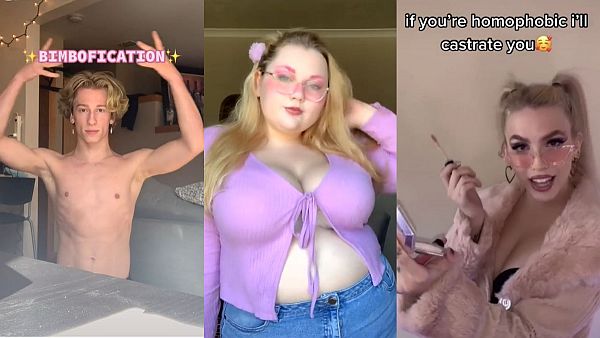


Initially, Brooks received some flak for their use of the term in the video; some assumed that they were using the trope as a way to poke fun at female stereotypes and deride women. Brooks, who identifies as non-binary, denies that was their intention. For them, bimbofication is a way to subvert traditional expectations associated with gender and sexuality. “There’s a lot of internalized homophobia in the gay community,” they say. “In adopting this very feminine aesthetic at times, one of the things I had to do was be OK with no longer fitting this mold so some gay men will not be attracted to me.” For them, bimbofication “isn’t about acting in a way that caters to what men are attracted to. it’s about looking how we want to look, and if that was initially about catering to the male gaze, we’re taking that back.”
 
“I see it as a way of tackling gender oppression and stereotyping and gender norms,” says Kate Muir, a London-based TikTok creator who goes by @bimbokate. One of her most popular videos features her preening in front of a mirror with the caption, “Being a self-aware bimbo is amazing: you become everything men want visually whilst also being everything they hate (self-aware, sexually empowered, politically conscious, etc.) Reverse the fetishisation of femininity.” Part of the goal of such content, she says, is to present a stereotypically feminine message accompanied by a caption that undercuts the visual message, thus creating a jarring cognitive dissonance and discomfort for the (straight, male) viewer. (This is, apparently, quite an effective tactic: Muir says the vast majority of her hate comments are from straight men, an experience shared by the other female-identified BimBoTok creators interviewed for this piece.) For her, BimboTok is “definitely a feminist movement.”


All of this might have the ring of familiarity. In many respects, the valorization of the bimbo mirrors what writer Ariel Levy wrote about in her 2005 book Female Chauvinist Pigs, women who had internalized the patriarchal values of Playboy and Girls Gone Wild to such an extreme degree that they willingly participated in their own objectification. And indeed, there are many — particularly feminists over the age of 30, who have lived through multiple cycles of various forms of subjugation being marketed as empowering — who balk at the term. “Officially viewing the word ‘bimbo’ as a fucked up thing to say,” viral tweet read. “I’m okay with women who have obviously been called it many times reclaiming it — but if you don’t look like a hyper sexual person and you use that word I feel like you hate women.”
 
In the midst of the endless vagaries of 2020, however, with much of Gen Z saddled with student debt and skyrocketing unemployment, leaning into bimbofication may be one of the more healthier forms of stress relief out there. “It’s not about being ignorant. You’re letting go of your consciousness in order to achieve this higher level of enlightenment,” says Brooks. “You’re aware of all the shit that’s going on around you, but you’re letting go of it because you want to live the life of being pretty and walking around.” Don’t hate them because they’re beautiful — ask yourself why you’re not.
 
 
The Bimbo is Back. Like, for Real ! By EJ Dickson. Rolling Stone, November 23, 2021.


08/09/2019

Polari, Britain's Secret Gay Language


Perhaps we should start with how Polari should sound. Many speakers had regional accents, of whom a good proportion would have had London, especially East End or Cockney, ones, as London was Polari’s spiritual home. You don’t need a Cockney accent to speak Polari, though—I interviewed speakers with strong Scouse and Glaswegian accents. And Liverpudlian Paul O’Grady, who performed as Lily Savage, knows plenty of Polari.

Speaking in a “posh” upper-class or a middle-class “received pronunciation” accent, sometimes thought of as standard English or what people say when they claim (incorrectly) to have “no accent,” isn’t great for Polari, unless you can also sound very camp. Ideally you should have a regional accent, Cockney if you can get away with it, but then overlay that with the occasional affected attempt to sound as if you’re descended from your actual royalty.

Just as the word queen was used to describe men who often came from modest backgrounds, the accents of these men also had majestic pretensions. Kenneth Williams is a good role model. He grew up above his dad’s hairdresser’s shop, but in his many Carry On film roles he acted with an upper-middle-class provenance, playing a variety of haughty doctors and professors, presenting a slightly stern posh accent when trying to impress, although slipping into Cockney when highly excited.

Kenneth’s Sandy exploits the Cockney accent in the Round the Horne sketches to insert more Polari into the dialogue. In a sketch called “Bona Homes,” where he and Julian play landscape gardeners, he opens with, “Oh hello Mr. Horne, we’re bona ’omes you see.” By dropping the h in homes, he is able to make the word sound more like omee, the Polari word for man.

Or listen to the recordings of Lee Sutton’s drag acts. Compared to Williams, who always sounds animated, Sutton has a deadpan comedic delivery—and although he’s in drag there’s scant attempt to contrive to the audience that he’s female: his voice is unapologetically gravelly. However, he sounds like he is having a good time, and that’s key to Polari. Even if your heart is breaking on the inside, you keep up the act, whether you’re in drag or out of it. A Polari queen never cried, until she got home and drew the curtains.

The “pseudo-posh” bits of Polari can come across in a variety of ways. Some Polari speakers could sound quite cosmopolitan as they threw bits of classroom French (or, less frequently, German) into their conversation. While Polari has a complicated history, picking up all sorts of linguistic influences over the decades, my guess is that use of French was more about showing off than there being a more substantial French connection.

For the average working-class Brit in the 1950s and 60s, holidays “abroad,” as the world beyond the English Channel was known, were much less common than they are now. A bit of French could imply that the speaker was a glamorous jet-setter or at least had a foreign boyfriend. However, I don’t think that most speakers were convincing anyone of this, other than the most naive chicken. Instead, use of classroom French was more parodic, based on the understanding that it is funny to pretend to be someone who thinks that speaking French is glamorous.

Attempts to speak those little bits of French in an actual French accent are therefore to be frowned upon—that would be trying too hard and indicate that the speaker really knew French as opposed to be pretending to know it (although using an exaggerated French pronunciation is acceptable). Julian and Sandy regularly made use of a set of stock French phrases, including artiste, tres passé, intimé, pas de deux, entrepreneur and nouvelle vague. And one of Kenneth Williams’s party pieces was to sing a song called “Ma Crêpe Suzette,” which consisted of a string of unrelated French phrases that have been absorbed into English, put to the tune of “Auld Lang Syne.”

The phrase gardy loo (meaning beware) is derived from the French garder l’eau (beware the water), originally used when the contents of a chamber pot were thrown out of a window onto the street below. Lily Savage has noted that some Polari words also have –ois added to them—such as in nanteois, none, and bevois, drink. This has the effect of making them appear as if they are French, introducing a further level of complexity.

Polari, when spoken naturally, can have an exaggerated intonation style. Vowel sounds can be dragged out and within longer words there can be multiple rises and falls across the different syllables. Take for example fantabulosa, which contains five syllables: fan-tab-u-los-a. If used as an exclamation, as Sandy would sometimes do, the “a” sound in the syllable “tab” would be extended while the following “u” would have a falling intonation. Then the “los” part would have an almost hysterically rising or a rise-fall intonation, along with another lengthened vowel sound, with a final, slight falling intonation on the last syllable, making the speaker appear exhausted but triumphant.

But there are numerous other combinations of rises, falls or accented syllables that can be applied to fantabulosa—try enunciating it in at least three different ways, aiming for the campest intonation you can find!

Exclamations were an essential part of speaking Polari, being associated with “stereotypically feminine” language, as they are reactive. If we say, “oh!” or “really!” or “fabulosa!,” we’re usually reacting to some sort of external event such as someone’s wig falling off or a claim about how many men someone danced with at last night’s ball. There have been claims by some feminist linguists that women carry out what has been memorably described as “shitwork” in conversations, especially with men. This shitwork involves all the little things that people do to keep a conversation running smoothly—asking questions, showing that you’re listening with little “ohs” and “ahas”, choosing topics that you know the other person will want to talk about. It’s very tiring.

Men, on the other hand, aren’t meant to even acknowledge that someone else has spoken—they just stand a little away from everyone, facing the wall in a murderous sulk, or they simply bludgeon their way into an ongoing conversation, interrupting whoever is speaking to tell them they’re wrong (usually on a subject they know nothing about), or to change the subject to sport or cars or politics. If they can get a little boast in about their sexual prowess or how much money they make, then all the better.

That’s the stereotype at least, and while it holds for a small number of men and women, some of the time, actually most of us are pretty versatile communicators and there are more similarities than differences between the sexes. Polari, then, with its exaggerated exclamations and its dears and duckies and empty adjectives (bona!), feels like a hyper-realized version of stereotypical women’s speech—a parody of how women talk taken to a hilarious extreme—a linguistic form of drag.

There are different ways to speak Polari, then, linking through to personas—the piss-elegant posh queen, the world-weary seen-it-all tired old queen, the excited, breathless young queen, the witty, caustic queen, the gossipy queen who knows everyone’s business. Each would use a different set of intonational patterns for different effects.

Polari is about drama and Polari speakers were drama queens par excellence. Another feminine stereotype—gossip—is meat and drink to Polari. Polari was essentially a social language, and many speakers lived in densely packed urban areas and had numerous friends, acquaintances, lovers, one-night-stands, exes, crushes, stalkers, rivals, enemies and frenemies. They also had a perfect recollection not only of all of their current relationships but of the status of the relationships of all of the other people that they knew, and social occasions would be spent updating one another on these relationships in great detail.

As a young and introverted man on the gay scene, I often found this volume of gossip to be dizzying and overwhelming. I’d sit in the living rooms of some new friend who’d invited me round and then three or four of his other, more long-standing friends would arrive and there they’d sit all afternoon, drinking cups of tea and talking about all the people they knew, with me a sullen presence in the corner, to the point where I was sure they were simply making up names—nobody could know that many people! There couldn’t be that many people in existence!


Gossip is one of a queen’s weapons—you never know when it’ll come in handy, and much of it is, of course, geared towards the possibility of having sex with someone at some later date. Keeping track of who has split up with who, who is rumored to have been seen down the cottage, who made a clumsy pass at who, whose wig fell off on the dance floor—these are all matters of state importance to Polari speakers.

The large number of words that relate to people indicates the importance of gossip in the Polari speaker’s world. As we’ve seen, the generic term for man, usually a heterosexual man, was omee (also omior homi), while a woman was a palone (sometimes pronounced to rhyme with omee as paloney, sometimes not). A gay man was named by combining the Polari words for man and woman together into omee-palone, whereas a lesbian was the reverse order—palone-omee. There’s a conflation of gender and sexuality here which from some later perspectives might be seen as problematic—to say that a gay man is literally a man-woman keys into negative stereotypes about gay men as effeminate or women trapped in men’s bodies.

This was the general thinking of the time, so it is hardly surprising that these ideas found their way into the Polari mindset. However, many Polari speakers were very camp and a good number were what people might nowadays call gender-creative. They dressed in women’s clothes—either by dragging up as female impersonators, or in a relatively more low-key way, by dyeing hair, wearing a touch of make-up or accessorizing with a colorful scarf.

These speakers enjoyed the aspects of their identity that were feminine and felt that they were being true to themselves when they expressed them—they may have looked and sounded like camp stereotypes but most of them didn’t view themselves or people like them negatively. Accordingly, queen keyed in to the imaginary world of Polari speakers as (female) royalty. If you are going to emulate a woman, why not be the most powerful woman in the country?

In 1981, a documentary called Lol: A Bona Queen of Fabularity was broadcast on BBC2. Starring London drag queen Lorri Lee, the documentary cuts between Lorri’s drag act at a hen night, hoovering her flat and reconstructions of her younger days coming out of national service and joining the Merchant Navy (with Lorri playing her younger self in flashbacks). Lorri waxed lyrical on the word queen, providing a lesson in the different sub-classifications:

        Well what is a queen? Well you’ve met one, that’s the drag queen, that’s me . . . There’s also the camp queen, that everyone sees in the street . . . you know, “alright duck,” that type of queen . . . There’s what you call a black market queen. Now that’s the type of queen that an ordinary everyday person, and even me, could look at it, and you’d never suss that it was a queen in a million years, but they’re the types, I don’t really admire terribly . . . that usually sort of creep up on people and then strike, you know, sort of lull them into a false sense of security and then strike, and I think they’re the ones that usually get smacked in the face because of it.

But then . . . you’ve got your blob type queen, this a queen of no account, you know, she’s a little dumpy queen, walks around, usually follows a drag queen and sort of hangs on to every word it says, hoping a bit of the glitter’s going to fall off on her and one day she’s going to wake up like Prince Charming, suddenly turn into something different . . .

  After that you’ve got . . . your cottage queens. Now a cottage queen is a queen that would get her trade from a cottage naturally . . . it means a man’s toilet. And I know queens . . . couldn’t pass a cottage dear, would have to go in, some would even take sandwiches and a flask, would spend a pleasant day.

In the Polari speaker’s world, gender was linguistically reversed—he was she and (less commonly) she became he. This practice of feminizing through language, referred to by artist and Sister of Perpetual Indulgence (Manchester branch) Jez Dolan, is referred to as “she-ing.” She-ing is one of the aspects of Polari that has survived into more recent decades, and the practice was so pervasive at a particular bar on Canal Street in Manchester’s Gay Village that a “She-box” was installed a few years ago, akin to a “Swear-box,” where patrons would have to put in a few coins if they she’d someone, with the proceeds being donated to charity.

In the Julian and Sandy sketches, she is occasionally used to refer to the (male) partner of a (butch) man. In the following exchange, from “Bona Bijou Tourettes,” the pair refer to their friend Gordon, who wears leather and rides a motorbike, bearing some of the identity markers of rough trade. Julian and Sandy discuss how Gordon had set himself up with a bar in Tangiers, although the venture has recently fallen through:

     Julian: She walked out on him.
    Sandy: Oh, that old American boiler.
    Julian: Yes.
    Sandy: Oh.
    Julian: She moved on.
    Sandy: Mm, Mm. I thought she would.
   Mr Horne: Look, erm.
   Sandy: I could tell you a thing or two there.
   Mr Horne: Yes, er, now look.
   Sandy: Make your hair curl. Don’t you talk to me ducky.


 As there are enough clues regarding Gordon’s sexuality elsewhere in the sketches, we can interpret she as referring to a male partner.

Hypothetically, almost everything can be referred to as she, including oneself. Polari speakers would routinely call one another she—normally in an affectionate, sisterly way, although if they knew that the person being spoken to didn’t identify as a queen, there would be a more confrontational aspect to the pronoun. She effectively drags up the most masculine of men, without the need for a trip to the make-up counter at Selfridges, and it also acts as an insinuation that the man being talked about may not be as fully masculine or heterosexual as he presents himself to be.

To an extent this may have been wishful thinking—for many Polari speakers the ideal partner would be a butch man who did not identify as gay, the Great Dark Man of Quentin Crisp’s fantasies. However, there was also a more spiteful side to “she-ing”—the Polari speakers would have known that such men would have found the use of feminine pronouns on them to have been very insulting, so to use them was a way of taking them down a peg or two.

This explains the large number of feminizing terms for the police, who were rightly seen as natural enemies: Betty Bracelets, Hilda Handcuffs, Jennifer Justice, orderly daughters, Lily Law. These terms indicated that Polari speakers were able to turn a threat into a joke, with the added advantage that they could act as coded warnings—uttering “Betty Bracelets!” at the local cottage would have the effect of sending queens scattering in all directions.

The gender politics behind the feminizing pronouns are complicated. When gay men use she on themselves and their friends, are they parodying women in a way that borders on offensive? Are they simply complicit in their own oppression by adopting language and labels that are used in homophobic ways, and then using that oppressive language on their enemies, knowing it will hurt them even more?

Am I over-thinking it? Polari speakers simultaneously reclaimed and weaponized she. We could argue that they were a product of their time, but after decades of Gay Liberation, she is still used by (some) gay men. I like to think of it as an affectionate word—and if it was used to hurt, then it was more about the drag queen’s uncanny ability to find a person’s weakness rather than saying anything about the speaker’s own politics.

Another pronoun, perhaps even more problematic from later perspectives, was it—which Lorri Lee uses three times in her discussion of queens quoted earlier. It was sometimes used to refer to a one-off anonymous sexual partner—signifying a form of objectification which can appear dismissive, even callous. Consider the following, from Kenneth Williams’s diary:

              I met Harry who said Tom picked up a boy in the Piano and Harry said “It’s got a huge cock so Tom is silly, with that pile and all . . . so I thought hallo!“ It certainly gets around in Tangier.


To an extent such partners appear to be reduced to their physical body parts. As mentioned, another term for a sexual partner was trade, which had a range of slightly overlapping meanings. It could refer to a potential, past or current sexual partner, and usually indicated a temporary sexual relationship, sometimes a one-off.

Trade sometimes, but not always, indicated a masculine man who might not have identified as gay and would have been likely to have taken the “inserter” role in sex. Such men who were classed as trade did not usually speak Polari and probably would not have identified as trade or talked much about their sexuality.

Trade could also literally refer to a male prostitute, or to someone who would occasionally take money for sex but might not typically be viewed as a male prostitute—sailors on shore leave, for example, or Guardsmen who traditionally cruised parks looking for well-off men. Money might exchange hands; it might not. Sometimes the money would have been nominal, a way for the trade to establish his masculine, normally heterosexual credentials.

This was in a time when some men felt that they had to engage in elaborate excuses to justify having sex with one another. However, trade could also be a station on the way towards a more established gay identity. Gardiner notes the aphorism “today’s trade is tomorrow’s competition,” which indicates a downside to the endless hunt for new partners in a finite context.

Internalized homophobia or just plain nastiness might make the trade attack their sexual partner or demand money from them, hence the term rough trade, although this term could also refer more generally to working-class casual male partners.


Quentin Crisp, despite being a camp gay man, did not really use Polari in his autobiographies, although in the televised dramatization of The Naked Civil Servant he does refer to roughs—aggressively masculine working-class men who disguised their attraction to other men through harassment: “Some roughs are really queer and some queers are really rough.” And Lee Sutton cracks, “I’ve been feeling a little rough all day,” in his drag act.

from Fabulosa!: The Story of Polari, Britain’s Secret Gay Language.

The Feints and Jabs of Polari, Britain’s Gay Slang. By Paul Baker. LitHub , August 22, 2019.


In early February, the Church of England College expressed regret that in an evening liturgy in Cambridge, God was referred to as the Duchess. The service had been advertised as a Polari evening prayer in anticipation of LGBT History Month, and was described as a liturgical experiment. So what was Polari and how did it end up in an evening prayer?

Polari is a secret language, which has now largely fallen out of use, but was historically spoken by gay men and female impersonators. My research has tracked how it grew out of the world of entertainment, stretching back from West End theatres, through to 19th-century music halls and beyond that to travelling entertainers and market-stall holders.

It developed from an earlier form of language called Parlyaree which had roots in Italian and rudimentary forms of language used for communication by sailors around the Mediterranean. Also associated with travellers, buskers, beggars and prostitutes, it found its way into Britain, especially London and port cities, and gradually became used by gay men and female impersonators, especially during the first half of the 20th century.

Polari itself had Parlyaree as a base, but once in Britain was supplemented with a wealth of slang terminology from different sources, including Cockney Rhyming Slang, backslang (pronouncing a word as if it was spelt backwards), French, Yiddish and American airforce slang.

In a period when homosexuality was illegal and heavily stigmatised, it was useful as a means of conducting conversations in public spaces, which would have alerted others to your sexuality. Many of the words allowed speakers to gossip about mutual friends or to critique the appearance of people who were in the immediate vicinity.

“Vada the naff strides on the omee ajax” meant look at the awful trousers on the man nearby. Inserting a Polari word – such as bona (good) or palone (woman) – into a sentence could act as a coded way of identifying other people who might be gay. The language itself, full of camp, irony, innuendo and sarcasm, also helped its speakers to form a resilient worldview in the face of arrest, blackmail and physical violence.

Polari speakers “christened” themselves with camp names like Scotch Flo or Diamond Lil, affording themselves alternative identities that reclaimed the representations of them as effeminate in positive ways.

In the 1990s, I based my doctoral thesis around the study of Polari, examining its varied history and complicated etymology, the ways that it resembled a language, its social functions and the reasons for its eventual decline. I interviewed speakers of the language and analysed texts, including scripts of the 1960s comedy radio series Round the Horne, which had a regular sketch voiced by Kenneth Williams and Hugh Paddick, who played Polari-speaking actors.

The version of Polari that was used in Round the Horne was necessarily simplified and toned down for the British public, and by the 1960s, there was a feeling that Polari had already overstayed its welcome. Round the Horne spoiled the secret, rendering the language less attractive to its speakers. Meanwhile the decriminalisation of homosexuality in 1967 was round the corner, making it less necessary for a secret lingo in any case.

Some younger gay men were more interested in concepts like gay pride, gay liberation and coming out and viewed Polari as a naff byproduct of a more repressive time. In the 1970s, in an early gay magazine called Lunch, activists branded Polari as ghettoising and it gradually became surplus to requirements. When I carried out a survey of 800 gay men in the year 2000, about half the respondents had never heard of it.

While few gay men today actively use Polari, in recent years it has gained a kind of latent respectability as an historic language – similar to the way Latin is seen by the Catholic faith. From a political standpoint, Polari is now recognised as historically important, an example of the perseverance of a reviled group of people who risked arrest and attack just for being true to who they were.

In 2012 a group of Manchester-based artists used Polari to highlight the lack of LGBT inclusivity in education. They created an exam in LGBT studies, getting volunteers to sit it under strict exam conditions. The language portion of the exam was about Polari.

Another group of activists called the Sisters of Perpetual Indulgence created a Polari Bible, running a Polari wordlist through a computer program on an English version of the Bible. The Bible was bound in leather and displayed in a glass case at the John Rylands Library in Manchester. This was not to mock religion but to highlight how religious practices are filtered through different cultures and societies, and that despite not always being treated well by mainstream religions, there should still be space for gay people to engage with religion.

In 2012, I participated in a group effort to carry out the longest ever Polari Bible reading which took place in a Manchester Art gallery. In a nice touch of high camp we had to wear white gloves while touching the Bible, to ensure the oils from our fingers didn’t ruin the paper. We took turns reading lines such as: “And the rib, which the Duchess Gloria had lelled from homie, made she a palone, and brought her unto the homie.” Translation: “And the rib which God had taken from man was made into a woman and brought to the man.”

The Polari Evensong at Cambridge, carried out by trainee priests, however, took place in a more official context and provoked a range of conflicting opinion. Some people think it is hilarious, some are concerned about Church of England rules being broken and disrespect for religious tradition, while others think that God should be prayed to in any language and that the Evensong was perfectly valid. As someone who has spent 20 years documenting the rise and fall of Polari, I find it fascinating that even now, it is finding new ways to cause controversy. Never has a dead language had such an interesting afterlife.


A brief history of Polari: the curious after-life of the dead language for gay men. By Paul Baker. The Conversation , February 8, 2017.


When homosexuality was illegal, a secret language brought people together. In 1960s England, Polari was a creative blend of Romani, Italian, rhyming slang, and backslang, used among the LGBT community. It could be used to communicate, or to identify someone a a member of the group. Now Polari has been lost, even as some of its words have crossed over into mainstream English. Talking to Professor Paul Baker about this lost language on this episode of Talk the Talk.


Talk theTalk, August 5, 2019. 


Imagine you’re a gay man living in the year 1950. Not unnaturally, you would like to meet another gay man. How to identify yourself to a potential partner? A confession might bring the police; dressing and carrying yourself in distinctive ways will invite ridicule or violence in the street. The solution is this: you casually remark to a stranger that the pub you are both in is ‘naff’. He looks up, and before you know it, you’re talking like this:

           ‘Pauline? Can’t swing a cat but hit a cove. She’s had nanti bully fake. Dyed her riah, her end’s a right mess.’
    ‘Nanti bona. I hope she vaggeried straight to the crimper.’
    ‘Well that’s where she’d been. The palone tried to give her an Irish. Moultee palaver.Pauline told her to shove her shyckle up her khyber.’

This is taken from Putting on the Dish, a brilliant 2015 short film recreation by ‘Brian and Karl’ of the secret speech of gay men before 1960. Known as Polari, it flourished as an initial signal between outlaws and as a method of talking intended to be unintelligible to outsiders. It is, in linguistic terms, a criminal argot, like Verlan in French; probably not quite a language, and certainly nobody ever spoke it exclusively.

Nevertheless, the ways it has reached us, in occasional performances by the now very old, don’t quite convey the extent and improvisational quality that took it well beyond a mere collection of slang terms. We know that gay men could hold long conversations in it, shaping grammar in unusual ways and creating new lexical items on the hoof. The fact is that nobody tried to describe it until it had almost died, and then most attempts amounted merely to lists of vocabulary.

It might be best not to think of it as a language, nor just as a collection of abstruse slang words, but as what linguistics calls ‘a pidgin’; a version of a language improvised for a particular functional purpose, and in time turning into a ‘creole’, or language spoken by its users from birth. Obviously this would never have happened to Polari; but just as Tok Pisin, a Papuan creole, describes the Duke of Edinburgh as ‘oldfella Pili-Pili him bilong Misis Kwin’, so an adept Polari-speaker might express ‘that woman is giving me dirty looks’ not by substituting slang for orthodox vocabulary but by reconstructing the grammar as ‘palone vadas omee-palone very cod’. There are other glimpses of grammatical innovation. ‘Nanti’ is a sort of general negative that can also be used as an imperative — ‘nanti polari’: ‘don’t say anything’ — as well as ‘nanti dinarly’: ‘I don’t have any money’, and, concisely but irrationally, ‘nanti that’: ‘forget it’, or perhaps ‘sod it’.

Where did it come from? There are elements in the preserved vocabulary that suggest connections with immigrant communities, especially Yiddish (‘shyckle’ for ‘wig’), Italian (‘omi’ for ‘man’) and Romany (‘vada’ or ‘varda’ for ‘look at’ — from ‘warda’, ‘take care’). There is a staggeringly implausible anecdote in Paul Baker’s Fabulosa! about two queens in a Roman shoe shop discussing the sexy assistant in (they thought) impenetrable Polari, only to be greeted with ‘grazie mille, signori’.

Some other elements were taken from cockney, including rhyming slang and back slang, in which words are spelt backwards. ‘Eek’ (or ‘eke’) for ‘face’ is short for the original ‘ecaf’. But where Polari begins and ends is a vexed question. A lot of its characteristic flavour comes from the use of ordinary English vocabulary with specific secret meanings, and particular, apparently orthodox, turns of phrase — such as ‘That’s your actual French’.

The facetious talk of urban gay men goes back a long way. Peter Ackroyd has drawn our attention to a trial in 1726 in which the men are reported to have said things like ‘Oh, you bold pullet, I’ll break all your eggs!’ and ‘Where have you been, you saucy queen?’. Polari, however, probably only started to emerge in the late 19th century — Dickens would surely have been interested in it had it been around much earlier. But the period of its most general use was between the second world war and the 1970s, when active persecution of gay men was at its height and the need for secrecy and coded identification at its most urgent.

Baker’s intriguing and often amusing book is the work of a writer interested in language who has been led by his subject to think about social oppression. The relationship between the argot and attempts to eradicate its speakers is inescapable, and Baker writes well about the milieux in which Polari flourished — the theatre and the merchant navy. He is especially acute on the political uses of vulgar innuendo. When the popular radio programme Round the Horne created the two chorus boys Julian and Sandy, they escaped the attentions of Mrs Whitehouse because their worst obscenities were couched in perfectly innocent English. In the sketch ‘Bona Law’, featuring them as lawyers, Julian remarks: ‘We’ve got a criminal practice that takes up most of our time.’ They certainly deserve an award for succeeding in getting a reference to the recherché sexual practice of bukakke on to the radio in the early 1960s with the innocent remark: ‘The party’s over, it’s all over my friend.’


There are glimpses of Polari elsewhere. Rodney Ackland’s fascinating 1951 Soho play Absolute Hell contains a flash of unmistakable bad-taste Polari wit when Maurice, a queen bored by a soldier talking earnestly about what he saw in Belsen, says:

     Someone minced up to me the other night and said ‘Ooh, I couldn’t sleep all night for thinking of that ghastly horror camp.’ I thought he meant Cyril Clatworthy.

(In reality, Maurice would have said ‘she’, of course.) It surfaces in some very unexpected places, including in a 1970s episode of Doctor Who, as intergalactic theatrical types chatter boldly. Baker has done well, too, to excavate some long-ago drag acts and to extract convincing accounts from reliable witnesses, of whom Paul O’Grady, the man behind Lily Savage, is one of the best.

The truth of the matter is that Round the Horne, with its huge audience, played a large part in killing off Polari. After Julian and Sandy, the man behind you on the bus might not follow exactly what you were saying but he would understand very well what you were. After the decriminalisation of homosexuality in 1967, Gay Liberation had no time for concealment and dissembling; many gay men in the 1970s took the view that it was best to behave exactly as the heterosexual world. The argot fell largely into desuetude.

Strikingly, one of the most brilliant records of the way urban gay men talked in the early 1980s, a book called Queens by ‘Pickles’, published in 1982, has hardly any use for Polari; the characters might call each other ‘she’, but almost all the classic vocabulary had by then quite disappeared.

Baker’s story takes a curious final turn. In recent years, the community has rather taken up the idea of camp as a radical gesture, and some quite serious efforts have been made to bring Polari back from the dead. Paul Burston’s gay and lesbian literary salon at the Southbank Centre is actually called Polari. People have tried to learn the language and discourse in it, much as Hebrew or Irish Gaelic were revived for reasons of political identity. Attempts have been made to broaden its application, including, astonishingly, to religious and sacramental functions. A Polari Evensong was held in Oxford in 2017, causing a terrible row, and the Bible has been rendered in it:

      And Gloria cackled, Let there be sparkle: and there was sparkle. And Gloria vardad the sparkle, that it was bona: and Gloria medzered the sparkle from the munge.

Criminal argots are always fascinating and peculiar, and this one, with its astonishing verve and lewdness, its harmless and insistent lechery, has a ludicrous charm too. Its witnesses and practitioners clearly still feel it, and Baker’s interviews radiate warmth and good humour. Even if, like me, you are exactly the wrong age to be speaking it, it’s quite possible, walking in the street, to remark to your friend, ‘Don’t fancy the one you’re getting, dear’, or to mount the occasional small-scale revival of the deathless banter in Round the Horne:

  Sandy: ‘We got it from our special charcuterie.’Mr Horne: ‘Charcuterie?’
Sandy: ‘Hm.’ Mr Horne: ‘Your butcher?’ Julian: ‘Oh, do you think so? It must be the way I’ve had my hair done.’


Polari, the secret gay argot, is making a surprising comeback.  By Philip Hensher. The Spectator  , June 22, 2019.


In the beginning Gloria created the heaven and the earth. And the earth was nanti form, and void; and munge was upon the eke of the deep. And the Fairy of Gloria trolled upon the eke of the aquas.

In the beginning was thieves cant, a criminal slang dating back to Elizabethan times. Then Molly slang, from the Georgian period, and Parlyaree, primarily spoken by peddlars and circus people, which had a strong Italian influence, thanks to an unusually high number of Italian Punch and Judy professors and organ grinders arriving in Britain in the mid nineteenth century (yes, really. Imagine what the Daily Mail would say). Polari borrowed from all these sources, adding in bits of rhyming and back slang, terms from the theatre and from Mediterranean sailors.

I first learned about polari when I was 9 or 10, listening to tapes of the radio comedy Round the Horne. The sketch show, originally broadcast in 1965, featured Kenneth Williams and Hugh Paddick playing Julian and Sandy, a polari-speaking pair of stereotypical ‘resting actors’ who embarked on a series of doomed ventures, appearing as travel agents or circus empresarios. Later, when polari phrases cropped up in songs by Morrissey (before he was Bad) and scenes in Velvet Goldmine, I felt an instant connection to a hidden lineage. Recognising the phrases meant being in the know, part of a group; for someone who was experimenting with make-up and cross dressing in a grim northern industrial town, it was a connection to something bigger, a secret history to carry inside.


‘We’ve got a criminal practice that takes up most of our time… we’ve handled the most unusual briefs’

Polari is a vocabulary of alertness, whether to beauty (‘varda the bona omi’s dolly eek’) or danger (‘gardy loo – nanti polari, charpering omi ajax’). It uses compounds which are playfully literal – spectacles become ‘oglefakes’ or fake eyes, a policeman is a ‘charpering omi’, a man who searches. Some phrases are pleasingly musical (a poorly endowed man has ‘nada to varda in the larder’), others are utterly obtuse (‘order lau your luppers on the strillers bona’ – I’ll leave that translation for later). Much of the language is functional, and physical; by Paul Baker’s estimation, around 20% of polari nouns refer to body parts, and of these, one third relate to the face, and another third to the genitals. The grammar is idiosyncratic at best, often relying on context; for example, the word ‘dowry’ is used as a magnifier. If a lattie is a house, a dowry lattie is a big house and the dowriest lattie would be a palace. It’s also not terribly precise; distances, for example, are limited to ‘ajax’ and ‘nanti ajax’.

There is a debate as to whether polari is a language at all. Baker suggests it might better be understood as an anti-language, ‘used by people who are somehow apart from mainstream society, either residing on the edge of it, perhaps frowned on in some way, or hidden away or even criminalised, with attempts from the mainstream to expel or contain them’. Anti-languages typically encode a counter-cultural or subversive attitude, with mocking words for the police, and members of ‘straight’ society. In this way, the anti-language also encodes an attitude, and a way of being, as well as a lexicon. The use of polari pre-supposes a set of shared interests and experiences, whilst also acting as a shibboleth.

While we might now see polari terms as an adornment to our speech, and focus on the wit encoded within it, it is vital to remember that it developed at least in part as a defence mechanism, a way for members of a persecuted group to communicate. Polari was most prominent in the 1950s and 60s, during which time homosexual acts between men were criminal, even in private. Although use of polari waned after the Sexual Offences Act of 1967, it was still employed by groups whose activities brought them into contact with the law after this time: for example, Jeremy Reed records the use of an evolved form of polari by male sex workers in Piccadilly during the 1970s, a time of intense police surveillance.

As previously noted, polari works to both enlighten and conceal. This is particularly notable when looking at its most famous exponents, Julian and Sandy. With an audience of millions, Julian and Sandy performed a version of counter-cultural identity for a mainstream audience. While the pair were presented as amusing rather than threatening, their portrayal is distinctly more subversive than that of, say John Inman’s Mr Humphreys in Are You Being Served. Baker notes that the pair are ‘daring in their suggestions of relationships with other men, and offer hints regarding a network of fictional gay establishments’. This is even bolder as, at the time, the BBC, and in particular Director General Hugh Greene, was under severe pressure from Mary Whitehouse, who scrutinised their output for the merest hint of indecency.

Julian and Sandy demonstrate the subversive strength of polari, using the language as a trojan horse to sneak risqué content past the likes of Whitehouse, to the (unofficial) delight of Greene. And some of their output was genuinely bold; heavily reliant of double entendre, the pair make numerous references to their illegal status. In one sketch, in which the pair are acting as solicitors, they refer to their ‘criminal practice’; in another, in which they are homeopaths, they declare that they are ‘not recognised by any doctors’. In a third, they ask literal straight man Kenneth Horne whether they can interest him in a wig; he responds ‘not me, but you might interest the chief of police’. These sorts of barbs undercut the image of camp comedians as ‘Uncle Toms’, presenting an acceptable form of sexuality for a mainstream audience. Even more surprisingly, Baker learns that the pair often improvised their dialogue, meaning that queer performers were dropping in phrases that the show’s writers didn’t understand, shaping their own presentation. While Julian and Sandy used a fairly abridged version of polari, around 40 words or phrases understandable through context, they would occasionally employ more complex language, such as Paddick telling Williams to play something nice on the piano: ‘order lau your luppers on the strillers bona’.


Round the Horne ended suddenly in 1969 after the death of Kenneth Horne, and polari itself didn’t last much longer; the passage of the Sexual Offences Act in 1967 had removed much of the imperative for using the language, and while its use was still habitual among older speakers, it fell out of step with the Gay Liberation movement. In the 1970s, camp, and by extension polari, became seen as problematic; following Susan Sontag’s definition of camp as disengaged or apolitical, the Gay Liberation Front Manifesto, published in 1971, declared that ‘those gay men and women caught up in the femme role must realise… that any security this brings is more than offset by the loss of freedom’. This was reinforced by writers such as the feminist Mary McIntosh, writing for Lunch magazine in 1972, who called camp ‘a form of minstrellisation’ and Polari ‘a product of a culture that is deeply ambivalent’. While polari had bite in the hands of some speakers, it was seen as overly defensive, while terms such as ‘omipalone’ or ‘manwoman’ to denote homosexual was criticised for portraying gay men as necessarily feminine. While the shifting political landscape, and newfound confidence of the Gay Liberation movement played a part in polari’s loss of popularity, Baker also identifies the effect of ‘cultural cringe’ – the language was seen as old hat, the preserve of fusty and out of date characters.

And when she thus had cackled, she screeched with a loud cackling fakement, Lazarus, troll forth.

One test of a language is the range of emotions and artistic ideas which they can be used to express. LL Zamenhof, the creator of Esperanto, published translations of Shakespeare as a means of promoting his language, and gaining cultural capital for it. Similarly, in recent years the playwright Ken Campbell translated Macbeth into Pidgin, as part of an effort to have it adapted as a global lingua franca. Although polari was previously known in the mainstream as a source of light entertainment in Round the Horne, and in other circles as a means of evading police, in 2003 the Manchester branch of drag activists The Sisters of Perpetual Indulgence began work on a grand scheme to elevate polari: a full translation of the King James Bible.

In the introduction to the polari bible’s first edition, Sister Matic de Bauchery notes that the King James Version ‘has become a watchword for the majesty and power of its language. Vulgarising it by translating it in to Polari would be an act of cultural vandalism akin to translation in to Scots. But good taste has never yet limited the Sisters’ activities, so we did it anyway.’ Working with a crack (addled) team of linguists and computer scientists, the Sisterhood created a program which used over 800 rules to transform the language of the KJV into something approaching that of Julian and Sandy. This required a degree of formalisation, and a certain amount of borrowing from other sources, leading to the creation of a new strain, High Polari, which is also used by the Sisters in their subversive rituals (which included the canonisation of Derek Jarman, described by Baker in one of Fabulosa’s most moving sections).
Although the Polari bible is presented with the Sisters’ trademark irreverence (the frontispiece notes that it is ‘appointed to be used in Turkish baths and discotheques’, and that it was produced in Manchester, ‘a notorious hotbed of the sin of sodom’), it also performs an important cultural function. In 2012, a bound volume of the Bible was created and displayed in John Rylands Library, alongside a 1455 Gutenberg Bible and a fragment of John’s Gospel from circa 457 CE, placing it in a continuum of holy texts. And although high polari might bear as little relation to the spoken language as Shakespeare’s soliloquies did to day-to-day Elizabethan conversation, there is beauty and sophistication in verses like ‘And Gloria screeched the sparkle journo, and the munge she screeched nochy. And the bijou nochy and the morning were the first journo’, or ‘And her name through faith in her name hath made this homie butch, whom ye varda and know: any road up, the faith which is by her hath parkered her this absolutely fantabulosa soundness in the presence of you all.’

This coincided with a wider revival of interest in polari; as a young academic, Baker published a polari dictionary, and the artist Jez Dolan used polari in a series of events in the North West, including projecting polari phrases onto Bury Town Hall. There is a long-standing LGBT literary salon names Polari, which has also given its name to a prestigious annual award, and next year the author Richard Milward is scheduled to publish a novel in polari. Baker also notes the appropriation of the language by high end fashion labels and London bars, in an unlikely reversal of fortunes for the clandestine language. That’s not to say that polari had become totally rarefied; The Polari Lounge was a welcome addition to Stoke-on-Trent’s gay scene in 2010, acting as a bar, meeting place and community hub. Although Baker’s account of his own visit there was not a happy one, it’s hard to overstate how important its presence felt in the middle of the decaying high street. Polari was proudly visible at last, its reach extended beyond the major cities and ports. As the Sisters of Perpetual Indulgence say, ‘if decades of homophobic pressure had failed to defeat camp, what chance did a mere reorganization of subcultural priorities stand?’

And Gloria vardad every fakement that she had made, and, varda, it was dowry bona. And the bijou nochy and the morning were the seyth journo.

Fabulosa attempts to bridge the gap between Baker’s academic work and a more popular approach to Polari, and largely succeeds. He is especially strong on the changing attitude towards polari within the gay community in the 70s and 80s, and on the important reclamation performed by The Sisters of Perpetual Indulgence. While the subject of Julian and Sandy is well-trodden ground, his approach feels fresh, and the personal interludes add to the narrative without being overly intrusive. Fabulosa is also an excellent primer for would-be polari speakers. To test the theory, I went to a party last weekend and tried to give a couple of doctors the basics of the language. I think the lessons went well; if your GP ever asks you to take your shirt off so they can nellyarda your thumping cheat, you know who to blame.

Fabulosa!: The Story of Polari by Paul Baker. By Thom Cuell. Minor Literature[s] , July 9, 2019.


Excerpt: Fabulosa!: The Story of Polari, Britain’s Secret Gay Language by Paul Baker.  Minor Literature[s] , July 11, 2019.