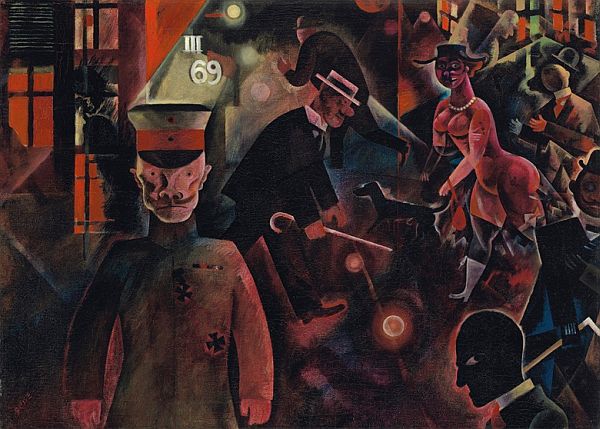
Berlin in
the 1920s was ablaze with sexual and gender freedom. Magazines at newsstands
boasted covers featuring people who were transgender and clad scantily. Their
headlines touted stories on “Homosexual Women and the Upcoming Legislative
Elections,” and offered, on occasion, homoerotic fiction inside its pages.
Publications
like Die Freundin (The Girlfriend); Frauenliebe (Women Love, which later became
Garçonne); and Das 3. Geschlecht (The Third Sex, which included writers who
might identify as transgender today), found dedicated audiences who read their
takes on culture and nightlife as well as the social and political issues of
the day. The relaxed censorship rules under the Weimar Republic enabled gay
women writers to establish themselves professionally while also giving them an
opportunity to legitimize an identity that only a few years later would be
under threat.
“Reading stories about other queer women was
such a powerful way that women came to terms with their own queerness,” Laurie
Marhoefer, a professor of history at the University of Washington, told me.
“That was super important for women more than for men because men would just
have more opportunities to find other queer people.” Marhoefer, who first
learned of these publications as a graduate student in Berlin in the 2000s, is
part of a growing group of academics focusing on this oft-forgotten moment in
German history.
Such
research is part of a wider interest in the Weimar Republic, bolstered by
recent TV shows like Transparent (which drew connections between the 1920s and
modern-day queer identity) and the gritty Babylon Berlin, whose characters
include a female sex worker who spends her days as a detective. Benjamin Tallis
described the appeal of these depictions in New Perspectives: “The visceral
thrill of watching 1920s Berlin as a creative, decadent socio-cultural mecca,
beset by suffering, and haunted by myriad ghosts yet alive with possibility, is
tempered by the knowledge of the political abyss that awaits.”
Although
these fictional tales tend to romanticize this interwar period, the primary
source documents that miraculously survived the period of the Third Reich and subsequent
and repressive Cold War years provide a richer and more complicated picture.
There were
some twenty-five to thirty queer publications in Berlin between 1919 and 1933,
most of which published around eight pages of articles on a bi-weekly basis. Of
these, at least six were specifically oriented toward lesbians. What made them
unique is the space they made for queer women, who had traditionally been
marginalized on account of both gender and sexuality, to grapple with their
role in a rapidly changing society. (The concept of the “new,” albeit straight,
woman in the Weimar Republic has been researched broadly, including by Rüdiger
Graf in Central European History, who writes that it reflected a crisis of
masculinity following defeat in the First World War as well fears over the
country’s future when women were putting off getting married and having
children.)

In these
interwar years in Germany, queer and transgender identity became more accepted,
in large part thanks to the work of Magnus Hirschfeld, a Jewish doctor whose
Institut für Sexualwissenschaft focused on issues of gender, sex, and
sexuality. At the same time, women in Germany were making strides toward
greater independence and equity; they gained the right to vote in 1918, and
feminist organizations like Bund Deutscher Frauenvereine cultivated space for
women in public spheres, encouraging their advancement in politics. As Sara Ann
Sewell writes in the journal Central European History, the German Communist
Party created the Red Women and Girls’ League in 1925 to attract more women and
working-class people, particularly through organizing factory workers.
More
generally, German women were becoming increasingly empowered. Queer
people—including women—rallied around the abolishment of contemporary sodomy
laws. This struggle “created a wider climate of publication, activism, and
social organization that was much more embracing of different types of queer
and trans lives,” according to Katie Sutton, an associate professor of German
and gender studies at the Australian National University.
Like
Marhoefer, Sutton came upon the Weimar-era lesbian publications in Berlin and
was surprised that there wasn’t more engagement with these magazines or with
the queer history of the Weimar Republic more broadly on the part of academics
in the English-speaking world. Exceptions included the notable work of
historian Claudia Schoppmann and her 1996 Days of Masquerade and Heike
Schader’s 2004 Virile, Vamps, und wilde Veilchen (Virility, Vamps, and Wild
Violets). The latter focused on the queer tropes that proliferated in lesbian
magazine fiction of the time, and their creation, according to Sutton, of
“codes of lesbian desire and lesbian eroticism” through color, flora, smells,
and body parts, notably mouths, lips, hands, and breasts.
For its
part, magazine fiction of the time challenged some of the restrictions of class
and race in its love stories. A 1932 issue of Die Freundin, for instance,
includes a story about a relationship between the German Töpsdrill and the
Moroccan Benorina. Exoticizing of the “other” was common; Sutton points to
another piece of fiction published in Ledige Frauen (Single Women) in 1928
about Helga, a German coffee importer, who falls for Nuela, a servant from
Java. Notwithstanding the white, sometimes racist perspectives of the
narrators, such stories offered compelling renderings of women-centered
utopias.
Outside of
fantasy, these publications also created a space for readers to assert themselves
in the real world through personal ads and event listings. There included cream
puff eating contests, ladies and trans balls, and lake excursions on paddle
steamers. In fact, aspects of lesbian culture also seeped into the mainstream,
particularly when it came to fashion, with a rise in the popularity of short
haircuts, straight skirts, and pantsuits. There was little difference between
the imagery in mainstream fashion magazines and the masculinized aesthetic
eroticized in the queer ones. The “hint of queerness” in the mainstream, Sutton
said, was “sexy and fascinating, but also a bit scary and potentially off
putting.” A popular element in lesbian publications, the monocle was similarly
charged, and, Sutton says, “a queerly coded, quite masculine symbol of owning
the gaze.”

Such
sartorial choices were in keeping with debates in the lesbian magazines of the
time around the “extent that masculinity might be seen as hierarchically
superior to that of the feminine lesbian women,” according to Sutton. Moreover,
these debates foreshadowed the butch/femme debates of the 1980s and 1990s and
the border wars of the late ‘90s and early 2000s.
Style was
particularly significant for trans women and men who in the Weimar Republic
defined themselves with a variety of terms: both as transvestites and masculine
women who wore men’s clothes but identified as women. Trans people were given
space in both their own magazines and even in some of the lesbian ones,
highlighting a sense of cross-identity camaraderie. Die Freundin had a regular
trans supplement highlighting these voices.

These
magazines were resilient, a testament to the strength of the communities they
served. Still, they faced challenges. The 1926 Harmful Publications Act was
intended to impose moral censorship on the widespread pulp literature sold at
kiosks and newsstands, including the queer publications, which often featured
nude photographs.
The
Catholic and Protestant Churches as well as public morality organizations and
conservative politicians led the fight against what they called “trash and
filth literature.” As Klaus Petersen explains in a German Studies Review
article, the list of materials, which included at least seventy works on
sexology and “filth literature,” could still be sold, just not to those under
age eighteen. While “the instrument was blunt and [its] impact minimal,” the
restriction was boosted by members of religious and youth groups that checked
up on newsstands to see what material was visible or advertised to children.
(This is not a far cry from the Nazi book burnings that would occur just a few
years later.) But the law also spurred a counter-campaign by writers,
publishers, intellectuals, and leftist political activists who objected to
these limitations, as Petersen explains.
“This
coalition of protest groups against infringements of the freedom of expression
considered the Index a simplistic and entirely ineffective means to avoid an
honest discussion of the fast change in social attitudes and moral values and
campaigned against it as an unconstitutional instrument of suppression.”
Despite
their relative progressivism, these publications also represented a rather
narrow, bourgeois segment of the German population. Even if women had greater
access to education and publishing opportunities, the women who enjoyed this
greater access were largely urban elites. Little if no space was given to
proletarian struggles. “Middle-class values of respectability and citizenship
shaped the political agenda, with contributors drawing on the powerful language
of national inclusion in formulating their demands of legal and social
acceptance,” wrote Sutton in an article in German Studies Review.
It’s also
important to note that whatever sexual liberation the LGBTQ+ community enjoyed
was at the discretion of the state, whose goal was to control its members. This
was seen in the Transvestitenscheine (“transvestite certificates”) handed out
by the German police to protect against the arrest of those cross-dressing in
public. Between 1908-1933, dozens of such passes were distributed. They also
guarded against arrests for sodomy law violations and played a role in a 1927
battle over legalizing prostitution, largely aimed at preventing the spread of
venereal diseases.
That said,
the plight of sex workers was largely excluded from consideration in the
publications in question, and mentions of their readers’ privilege were few and
far between. Still, a 1929 Die Freunden article cautioned readers: “Don’t go to
your entertainments while thousands of our sisters mourn their lives in gloomy
despair.”
More
notably, these magazines gave precious little foresight into what was to come
in Germany: the attempted extermination of all who did not fit the Aryan ideal.
That, of course, included lesbians, some of whom perhaps took steps to save
their own skin. Ruth Roellig, who wrote for Frauenliebe and published Berlins
lesbische Frauen (Berlin’s Lesbian Women) in 1928, a first-of-its-kind travel
guide to queer Berlin, published a second book in 1937. Soldaten, Tod, Tänzerin
(Soldiers, Death, Dancer), an anti-Semitic screed, proved to be Roellig’s last
book, though she lived until 1969. Selli Engler, a lesbian editor who founded
the magazine Die BIF – Blätter Idealer Frauenfreundschaften (Papers on Ideal
Women Friendships), wrote Heil Hitler, a play she sent directly to the führer.
As feminist
and queer activism grew in Germany in the 1970s, so too did interest in the
Weimar period. In 1973, Homosexual Action West Berlin began to collect flyers,
posters, and press releases in an effort to create a comprehensive archive of
lesbian history. The group eventually morphed into Spinnboden, Europe’s largest
and oldest lesbian archive, with more than 50 thousand items in its holdings,
magazines among them. Katja Koblitz, who runs the archive, says the existence
of these lesbian periodicals is invaluable.
“These
magazines were in one part a sign of the blossoming and of the richness of the
lesbian subculture in these days,” she said. “Reading these magazines was a
form of reassurance: Here we are, we exist.”
Publishing
Queer Berlin. By Hannah Steinkopf-Frank. JSTOR
Daily, June 7, 2023.

Each year,
Lesbian Visibility Day on April 26 gives prominence to an often unseen
minority. In Weimar Berlin, before the Nazis seized power, writer Ruth Roellig
put same-sex female desire on the map for the first time.
It was 1928
and Berlin was undergoing a revolution. Poverty, insecurity and political
polarization were everywhere. Yet at the same time, the German capital was
enjoying a taste of freedom that had once seemed utopian. The storm of fascism
had not arrived yet, and women and sexual minorities were eager to claim their
place in society.
"The
Weimar Republic was, especially in Berlin, in eruption," Sabine Balke,
managing director of the Digital German Women's Archive, told DW.
"Everything was possible."
Or so it
seemed. Even though female emancipation was making day-to-day strides,
crossdressers could still be arrested on the streets, and homosexual relations
were criminalized.
Lesbians,
often considered the most invisible group within what we today call the LGBTQ
community, also had a glimpse of how the world could be if its rules were
different. What we know about that today is to a great extent due to the work
of a woman who drew the map of same-sex female love and desire in that era.
Heady times
Ruth
Roellig (1878-1969) began writing just after finishing school. Hers was a male,
straight world, yet she soon managed to publish fiction and travel journals.
But it was the Weimar Republic and the relative press freedom that came with it
that paved the way for some of her most remarkable works, at least from a
contemporary perspective.
"For
lesbians, the more relaxed censorship under the Republic was important. Many
new lesbian magazines appeared," historian Laurie Marhoefer told DW.
Garçonne, Die Freundin or Frauenliebe were some of the publications that gave
homosexual and bisexual women a place not just to tell their own stories but
also to discover safe spaces and leisure activities that did not force them to
hide their sexual orientation.
"One could go to the clubs and meet similar people, other lesbian women, to dance, to make music," Balke says. It was the time when cabaret queen Claire Waldoff's - also openly homosexual - rebel voice was played in the radios all over the country.

Pioneering work and historic document
Through her
articles in Frauenliebe, Roellig became a prominent figure in the lesbian scene
of Weimar Berlin. Publishing those pieces also meant outing herself, but it did
not seem to be a great danger at the time. As it often does, progress must have
felt irreversible.
Nonetheless,
it wasn't until 1928 that her greatest contribution to the lesbian history in
Germany was published. In Berlins lesbische Frauen (Berlin's Lesbian Women),
she extensively depicted the German capital's network of bars, cafés and clubs
aimed at this public. It was much more than a pioneering queer city guide.
"It's
very important because it's evidence of what was there," Sabine Balke
underlines. Also the head of Spinnboden, Berlin's lesbian archive, Balke is
aware of the historical importance of such a document: "In the 70s, when
women started to fight for a more open sexuality or against the abortion ban,
they did not know that there had been something similar in the 1920s."

The backlash
The rise of
the Nazis to power in 1933 also meant the end of this brief period of sexual
emancipation. The magazines and venues that in the previous decade had become
so important for sexual minorities were shut down. Roellig's life also changed
forever. "She had exposed herself," says Balke. "She could not
write as a lesbian woman anymore. She had to quickly make sure that everything
disappeared."
Yet it was
not the end of her writing career. Ruth Roellig did publish another novel in
1937: Soldaten, Tod, Tänzerin ("Soldiers, Death, Dancer"). With its
anti-Semitic content, this book left a disturbing legacy. Within a few years,
around six million Jews would be killed in the Holocaust. Roellig never wrote
again.
Historian
Laurie Marhoefer insists on the need to underline the controversial part of
this pioneer in lesbian activism: "Every time we mention her, we also have
to consider this part of her legacy. She was no 'bystander' in the Nazi
period."

No black and white
Balke
agrees, but also thinks it's important to go beyond that. "It was a
question of survival. That's why we today cannot just say: She was a
Nazi." After having openly maintained a lifestyle hated by the regime,
Ruth Roellig was in complete danger. "But it could also be that she found
that all right and was genuinely anti-Semitic," she adds.
"I
think this shows us that people do not have only one story, and that they're
not only good, or only bad" – a concept that, as Balke points out, Hannah
Arendt underscored in her work.
Whether Roellig was truly anti-Semitic or not is a question we cannot answer nowadays, Balke believes: "It's very hard to judge." By the time she died in Berlin, in 1969, she no longer held openly anti-Semitic views nor was she openly lesbian. What remain are her books and articles, the controversial legacy of the woman who made lesbians visible in Berlin decades before the Stonewall riots and the first gay pride marches.
At the
time, however, Roellig was probably unaware of the importance of Berlins
lesbische Frauen, Balke believes. The book was lost for many years and
re-edited in the 1970s under the title Lila Nächte (Purple Nights). And for
Balke, thanks to that book, "Ruth Roellig lives in our history."
The woman who gave birth to lesbian Berlin. By Enrique Anarte. Deutsche Welle, April 26, 2019.

I came across these magazines when researching the topic of my most recent written assessment. By now, I have carried an intense fascination with the sexual socio-political climate of the Weimar Republic for a couple of years. On the course ‘Reassembling Modernism: Artists’ Networks in Europe 1909-1960’ as an undergraduate, I was introduced to Weimar culture when we examined the Neue Frau in the Berlin of the 1920s. It was a text by Maria Makela entitled ‘New women, new men, new objectivity’, however, that truly peaked my interest in the subject.


In the case of the women depicted in Liebende Frauen (1927-1930), the tensions felt nationwide between opposing genders are made redundant. At the time of the1929/30 issue, Liebende Frauen was one of two lesbian magazines in Berlin; the other, the more widely-known Die Freundin (The Girlfriend: Journal for Ideal Friendship between Women) had been in circulation since 1924. Art historian Heike Schader notes that Liebende Frauen is most likely a reprint of the magazine Frauenliebe (Women Love); which in turn was renamed Garçonne in 1930.

In the above image, a cover dated 1929, the female subject sports a bubikopf—a haircut strongly associated with the Neue Frau, which translates directly to ‘boy’s head’ and was reconfigured into numerous variations, such as the shortened and smoothed ‘Eton crop’, similar to that of Louise Brooks’ Lulu in Pandora’s Box. The overlapping strings of pearl necklaces that decorate her neck, the draped cut of her neckline and way in which her face is coquettishly turned from the camera’s gaze tells the reader that this Neue Frau, like Brooks’ Lulu—will not apologise for claiming her own sexuality. This cover presents allure and a conscious play on the provocation of desires, celebrating the figure of the New Woman by virtue of her dress and demeanour.
These covers are truly wonderful examples of how the New Woman, specifically the homosexual New Woman, found alternative means of how her image could be disseminated in popular culture via ways less damaging to her personhood. Each cover is a portal into an important history for women, and they each contribute to the Neue Frau as a social construct: one that was repeatedly well-documented until the Weimar Republic’s fall.
To see more of these wonderful covers, go to the Spinnboden Lesbenarchiv und Bibliothek, Berlin’s online archives: www.meta-katalog.eu
Additionally, there are lots of many interesting texts covering the Neue Frau’s image, such as:
Women in the Metropolis: Gender and Modernity in Weimar Culture by Katherina von Ankum
Women in German History: From Bourgeois Emancipation to Sexual Liberation by Ute Frevert
Women in Weimar Fashion: Discourses in German Culture, 1918-1933 by Mila Ganeva
The New Woman International by Elizabeth Otto and Vanessa Rocco
Visions of the “Neue Frau”: Women and the Visual Arts in Weimar Germany by Marsha Meskimmon
The Masculine Woman in Weimar Germany by Katie Sutton
Sources
Maria Makela, “New Women, New Men, New Objectivity” in New Objectivity: Modern German Art in the Weimar Republic 1919-1933
Heike Schader, ‘Liebende Frauen’
Katie Sutton, ‘The Masculinisation of Woman’ in The Masculine Woman in Weimar Germany
In her image: the documentation of the Neue Frau in German Weimar-era lesbian magazines. By Kathryn Reed. The Courtauld, February 26, 2019.

Before World War I, Berlin was known for its large male homosexual subculture. After the war, however, the sudden emergence of a visible lesbian subculture was unprecedented and remarkable because, previously, lesbianism had been thought to be rare. The development of modern mass culture coincided with the rise of homosexual subculture, facilitating the formation of lesbian identities. However, as will be suggested first, these identities also had their roots in medical discourse and the homosexual emancipation movement, which looked to medical research to support its demands for homosexual rights. Also, lesbian clubs and nightclubs, as well as lesbian magazines, were closely linked to the homosexual emancipation movement, and they were the sites which brought women together and which facilitated lesbian identification. Therefore, this paper will explore the production of these identities by examining the subcultural network and, in particular, the lesbian magazine Die Freundin, as a mass cultural publication in which science, mass culture, and subculture intersected. This will highlight the constructed, unstable and ambiguous nature of Weimar lesbian identities, which were varied and overlapping.
Scholars of
sexual cultures and gender relations in Germany have tended to overlook Weimar
lesbian identities, confining their interest to the subculture itself, rather
than to the role it played in the development and elaboration of homosexual
identities more generally. For example, in relation to lesbians, the works of
Lillian Faderman and Brigitte Eriksson, Ilse Kokula, Adele Meyer and Claudia
Schoppmann have provided valuable documentation of the Imperial, Weimar and
Nazi periods. More specifically, both Richard Dyer and Ruby Rich have examined homosexual
cinema in Weimar,while Katharina Vogel and Petra Schlierkamp have documented
the history of the lesbian magazines Die Freundin and Garçonne respectively.
One recent scholar, Christiane von Langerke, has investigated the numerous
historical designations for lesbians in order to prevent these women from being
subsumed under the male-identified label of ‘homosexual.’ All of this work is invaluable as a foundation
for further scholarship.
However, as
Patrice Petro’s study of female spectatorship and textual practice in Weimar
Germany has powerfully illustrated, gender is of paramount importance to
representation and ways of looking. That is, Petro has shown “the existence of
a female spectator, and the function of representation for mobilizing her
desires and unconscious fantasies.” Like the women’s magazines in Petro’s
study, lesbian magazines such as Die Freundin made a direct address to women,
articulating their desires and offering them ‘modern’ new conceptions – and choices
– for gender roles, sexuality, relationships and, hence, possibilities for
identification.
This
suggests that a study which builds on the inroads made by Gudrun Schwarz and
Geertje Mak, and specifically considers the nature and production of lesbian sexual
identities, is needed. Both von Lengerke and Faderman have illuminated the
changes and continuities of woman-centred relationships across time, but such
an approach has a tendency to imply an essential lesbian identity, which is
constant and, despite the variations they discuss, well-defined. For example,
Faderman encapsulates lesbian behaviour under a single rubric of “romantic
friendships” that spans countries and centuries. In contrast, this paper will
situate lesbianism within a specific historical and cultural context. In the
same way that Denise Riley has disrupted the idea of ‘woman’ as a discrete
category,[ this paper will highlight the constructed and unstable nature of
Weimar lesbian identities.
In the late
nineteenth century, as scientists increasingly turned their attention to
sexuality, a growing body of medical literature was produced. In 1886, Richard
Krafft-Ebing’s book, Psycopathia Sexualis, asserted that homosexuality was an
abnormal congenital manifestation. The physicians Magnus Hirschfeld and Iwan
Bloch both expanded on this discourse, arguing that true homosexuals were
biologically predisposed to members of the same sex. Conversely, they believed
that pseudohomosexuals – usually women – were the creation of external
circumstances, such as the absence of male sexual partners in prisons and
schools.
As European
sexologists described and explained other sexual ‘anomalies,’ the list of
medical identifications grew. As one Weimar transvestite explained, “when
sexual science began to concern itself with the sexual orientation of humans,
it searched for words with which to designate the different variations. That is
how names like sadist, masochist, fetishist, exhibitionist, bisexual,
transvestite, homosexual, and so on originated.” Similarly, the labels for
lesbians expanded to include ‘masculine lesbian,’ ‘feminine lesbian,’
‘transvestite,’ ‘Mannweib’ (literally, ‘Man-Woman’ but suggesting a masculine
woman), ‘Männin’ (‘Butch’), and ‘gleichgeschlechtlichliebende Frau’ (‘same-sex
loving woman’). The variety of names for women suggests the instability of
lesbian identity and the expansion of the discourse.
Medical
‘science’ was integral to conceptions of sexuality and underpinned the
homosexual emancipation movement. Hirschfeld in particular argued that since
homosexuality was inborn, it was natural and should not be persecuted, and in
1897 he founded Germany’s first homosexual organization, the
Scientific-Humanitarian Committee. After the First World War, Hirschfeld
founded the Institute for Sexual Science in Berlin (1919) and, in 1923, the
League for Human Rights, a group dedicated to homosexual emancipation.
At the same
time, the manifold growth of mass culture, particularly in Berlin, brought
homosexuals together and facilitated identification. There were mutually
reinforcing relationships between the organized homosexual rights movement, the
large number of public leisure and entertainment venues (like clubs and
nightclubs), and the extensive publications of the homosexual press. Indeed,
one reader of Die Freundin, a male transvestite, stated that after he read the
books of Iwan Bloch and Otto Weininger, as well as others, he had the greatest
longing to go to Berlin and spend time with people who were his like.
A 1931 Berlin travel guide highlighting the city’s sexual attractions claimed that there were at least 160 bars and clubs for male and female homosexuals. With the (temporary) abolition of censorship, films dealing directly with male and female homosexuality were shown in Berlin’s 300 cinemas. A large quantity of lesbian popular fiction, newspapers, and magazines also appeared. The German Friendship Association added community-building activities to this entertainment scene, and to the political activities of the Scientific-Humanitarian Committee, by holding dances and weekly meetings and publishing a weekly newspaper, Die Freundschaft.
The first
guide to the homosexual club scene, Ruth Roellig’s Berlins lesbische Frauen
(Berlin’s Lesbian Women), was published in 1928 with a foreword by Magnus
Hirschfeld. This guide purported to educate and enlighten homosexuals and the
public,but it also served to alert and connect women to the wider lesbian
community. One woman recalled that Berlin’s Toppkeller Club was “so exciting
that women from all walks of life came, even actresses. It was always so
crowded, and on Fridays you could hardly get in at all.”
One of the
most popular ladies’ clubs was the Damenklub Violetta, led by Lotte Hahm, a
well-known figure in the homosexual rights movement .The Violetta hosted many dances,
such as the “Calling-Card Ladies’ Ball” (Damenball mit Saalpost) and the “Dance
Roulette” (Roulette-Tanz), and also auto tours of the Spreewald and fashion
shows for masculine women and transvestites. One of the most popular activities
was the “Moonlight Steamship Party” (Mondschein-Dampferpartie), in which a ship
carried passengers from Spittelmarkt to Mugelsee, where they disembarked at the
Inselhotel, enjoyed orchestra, cabaret, and tombola, and danced until 5 or 6
a.m., after which they returned to the ship for a quick sunrise photograph
before sailing back.
Such clubs
could also be found in other German-speaking cities, including Zurich, Hamburg,
Cologne, Frankfurt, Leipzig and Breslau, and the League for Human Rights
encouraged women across Germany, Switzerland and Austria to start and join
clubs in their own towns and regions. This helped to expand the subculture and
the homosexual rights movement itself.
In creating
a sense of community through common experience, clubs informally politicized
lesbians, linking the social scene to the homosexual rights movement. For
instance, at Violetta, women sang “Das Lila-Lied” (The Purple Song), which
declared lesbians’ difference and eventual liberation.Lotte Hahm also reminded
women that “Not only dance and social events can bring you equality, but rather
struggle is also necessary.”
Lesbian
magazines, of which there were at least five, were available at newsstands or
by subscription, and together they circulated to more than one million readers
across the German-speaking countries. The magazines’ centrality in facilitating
the growth of subculture and identification can be illustrated by examining the
most popular publication, Die Freundin (The Girlfriend), which appeared monthly,
and later weekly, with some interruptions from 1924 to March 1933.
Die
Freundin was closely affiliated with the League for Human Rights through the
group’s chairman, Friedrich Radszuweit, who also published the magazine. Given
this overlap of the publisher’s interests, it is not surprising that through
its editorials, Die Freundin politicized homosexuals by highlighting the
League’s concerns, such as the repeal of Paragraph 175, the law criminalizing
male homosexuality. Die Freundin accepted only advertisements from members of
the League for Human Rights, and it exhorted its readers to patronize only
those clubs sanctioned by the publication. The need for club owners to hold
League memberships also undoubtedly benefited the homosexual rights movement by
increasing the organization’s size.
Die
Freundin also played a significant role in fostering the growth of the
subculture by publicizing homosexual films, clubs, nightclubs and books
available from the Berlin publishing house Radszuweit, which published both
non-fiction, including medical books on sexuality,and fictional works, such as
Grete von Urbanitzki’s Der wilde Garten (The Wild Garden), Anne Elisabeth
Weirauch’s trilogy Der Skorpion, the German translation of Radclyffe Hall’s
Well of Loneliness (Quell der Einsamkeit) and even novels that presented a less
flattering image of lesbians, such as Alfred Döblin’s Die beiden Freundinnen
und ihr Giftmord (The Two Girlfriends and their Murder by Poisoning). These
kinds of publications facilitated lesbian self-identification. As one lonely
and isolated woman living in a small town explained, she “had only one joy...,
the book The Scorpion. I love it. With it, I feel that I belong to you, that no
one can tear the innate feeling of happiness out of the heart.”
Clearly,
physical and psychological isolation were major problems for both lesbians and
transvestites. Personal advertisements helped overcome this, bringing together
readers from as far away as Amsterdam. “Nuremberg. Lonely woman seeks same,
educated but modern thinking girlfriend.”
In the
impersonal city, Die Freundin could also be used to signal one’s identity to
others ‘in the know.’ Several articles in the magazine depicted scenarios in
which women reading or purchasing the magazine met like-minded women who had
noted their choice of reading material. For example, one story told how a
transvestite reading Die Freundin in a café attracted the notice of another
woman. Another story began with two strangers meeting accidentally at the
newspaper vendor where they had both just purchased Die Freundin.
Through Die
Freundin lesbians discovered other women who “yearned for a great love,” but
who, as the fictional character Lotte explained, “could not like any man.”
Lesbians found both capable and career-minded women who reflected their own
aspirations, as well as women who embodied the ‘feminine’ ideals to the extent
that they were comfortable only in the company of other women. If women felt
comfortable in men’s clothing, or if they embraced the modern styles, they also
found like-minded women in the magazine – and the magazine gave them a name.
One lesbian, Charlotte Falk, explained, “Through my indifference, through the
style of my clothes, which are sporty but completely normal, my shoes, I...
became a Mannweib... I had absolutely no idea that so many women love as I
do...”
If the
small advertisement section of Die Freundin provided a way for women (and men)
in even the remotest German-speaking towns to find and make contact with one
another and to psychologically, if not literally, expand their community, the
readers of Die Freundin also developed a real sense of fellowship. A letter
sent to Die Freundin about another reader’s contribution on the issue of
cross-dressing and marriage began warmly with “Dear sister Willina!” and closed
with “It would be a great pleasure for me to hear more from you and also from
your wife herself. Warmest greetings. Your Georgette.”
Yet it was not only a sense of fellowship that facilitated identification. Die Freundin’s representations and image were instrumental in the production of sexual identities. However, few articles in Die Freundin programmatically outlined female homosexual identities. Instead, they were elaborated implicitly through its fiction, non-fiction and/or medical articles.
In a
classification scheme that invoked the heterosexual gender paradigm, lesbians
were often differentiated as either ‘virile’ or ‘feminine.’ As with their
heterosexual counterparts, these traits were thought to be manifested both physically
and psychologically.The feminine woman was “echt weiblich” (“genuinely
feminine”). She was dependent and had a clingy character, but was also a very
skilled “housewife,” whereas the ‘virile’ woman had no affinity for housework,
was independent and career-minded. This kind of male-female complementarity was
seen and reinforced at the Klub Monbijou in the Bell-Dance, in which only the
‘young lads’ or ‘Bubis’ would hold bells, which they used to ring for their
‘gals’ or ‘Mädis.’
However, in
the magazine’s fiction, the virile ‘type’ tended to be more common, probably
owing to the notion that lesbianism was an inverted sexuality in which a woman
was masculinized. For example, one novel serialized in Die Freundin described
the lesbian Olga as a cigar-smoker and as having dreams in which she rode
horses in the dark of night . In addition:
“She felt herself to be a man and believed
that she felt better in such surroundings. Even her rooms appeared to be
furnished according to a rather masculine taste. She had a drawing room with an
escritoire. She possessed a smoking room and a gaming room. Her bedroom gave
the impression of being austere and cold. One found no vanity table or
attractive Biedermeier armchair of the kind that women usually love. The walls
were decorated with female figures, portraits, nude studies – the only objects
to lend the rooms a certain warmth.”

Lesbian and
transvestite “marriages” also reflected male-female role division, and most
male transvestites seemed to accept and regard housework as a logical extension
of their gender role. Indeed, an affinity for either a masculine or a feminine
profession seemed to validate what was believed to be one’s “true” gender.
Visible
manifestations of lesbian sexual identities were also to be found on the covers
of Die Freundin. Most often, the images featured women as objects of sexual
desire, which, indeed, they were. Very early on, readers expressed their sexual
longings by requesting more nude photos. Over time these depictions expanded to
include exotic ‘orientals’ , ‘natural’ women , New Women , masculine women (who
were usually celebrities), and transvestites . Although photographs of
bare-breasted women were the norm and many images were reused – not just once
or twice, but many times over the years – the array of representations suggests
that the lesbian community was comprised of a great variety of women and that
over time lesbian identities became increasingly complex.


Other
representations, particularly those associated with “modern” women, also
interested Die Freundin’s readers. For instance, the incidence of smoking among
women around the world was discussed in the article “Rauchende Frauen”
(“Smoking Women”).] There were also articles on a possible tax on the Bubikopf
(pageboy hairstyle) and on the British Lords’ opinions of short hair. Meinungsaustausch
Fragen (“Exchange-of-opinion Questions”) even asked for readers’ views on the Bubikopf.
In one response, Irene von Behlau came
out strongly in support of the Bubikopf and urged all lesbian women to embrace
the fashion.
As this
accounting suggests, readers actively participated in shaping their own
identities. They sent Die Freundin literary contributions, as well as their
personal experiences, insights and opinions on “Questions of the Day”
(“Tagesfragen”) and “Fashion Questions” (“Modefragen”). Regarding the latter, a
transvestite named Ellen van Derk complained that men who did not want to shave
their beards should not wear women’s clothing and that, moreover, too many
transvestites wore jewellery with artificial pearls.
I will
return to the issue of transvestites, but what should be clear at this point is
that lesbians were not part of a singular, discrete, uniform category, whose
identity was the expression of a singular and innately fixed disposition. As
will be shown below, their identities were varied, ambiguous and contested.
Clearly, one reader was aware of the constructed nature of sexual identities
when s/he asserted that “the norm is not something given by nature, but rather
is determined by us, created from our own minds.”
Lesbians
reappropriated and rearticulated their identities from medical and popular
discourses and countered the dominant discourses that labelled them “sick” and
“unnatural.” For example, Die Freundin’s editors asserted homosexual morality
by pointing to heterosexual depravity as the cause of the high incidence of
children and youth infected with venereal disease by their fathers or through
prostitution.
Lesbians
also referred to the philosopher and theorist Otto Weininger’s unfortunately but
indicatively influential book Sex and Character and invoked the existence of a
sexual continuum to assert that their sexuality (which was linked to gender)
was a natural variation, a transitional form (“Übergangsform”) found between
the masculine and feminine poles of gender. Contributors to Die Freundin argued
that: “Nowhere in nature does a fixed and demarcated type exist... Just as
there is no firmly delimited form in nature, a strict distinction between the
sexes can be ruled out.”The concept of ‘natural variation’ confirmed lesbians’
belief that their identity was an essential trait rather than an acquired vice.
They refuted accusations of degeneracy by arguing that homosexuals had existed
throughout history, from Sappho, to Leonardo da Vinci and Michelangelo.
Die
Freundin’s inclusion of male and heterosexual transvestites, along with lesbian
transvestites, who really combined two identities, complicates the question of
lesbian identification. Pictures and regular articles about male transvestites
reinforced the message that the community of “Girlfriends” was not limited to
the female sex but also included those with female “natures.” Even after the
Human Rights League created a special magazine for them, transvestites continued
to read, write to, and advertise in Die Freundin, suggesting their
identification with lesbians.

Geertje Mak
has shown that within the discourse of sexual science elaborated by Magnus
Hirschfeld in Die Transvestiten (Transvestites) (1910), a man’s internal drive
to wear female clothes was considered a natural sexual variation that did not
automatically make him a homosexual. Mak argues that women were not included in
this concept of transvestitism and, as a consequence, their sexuality remained
linked to their gender, defining them as “inverted.” However, the editors of
Die Freundin applied the concept of natural sexual variation broadly to both
males and females. This explains why the line between transvestitism and
lesbianism was so unclear. The magazine actually offered two competing
discourses: the concept of the “inverted, masculine woman” and the notion of “sexual variation in nature”
. While much of the magazine’s fiction and photographs offered up images of
‘masculine’ women such as “Charly and Boy,” it did this alongside of articles
that insisted that: “There are only bisexual variations.”


The
ambiguity was compounded by the fact that the definition of a transvestite
seems itself to have been in a state of flux. The term ‘the third sex’ was used
by Hirschfeld until about 1910 to denote all homosexuals, but after the war,
Radszuweit Publishing Company used it in the book Das 3. Geschlecht (The Third
Sex) to refer specifically to transvestites. Still, men and women moved fluidly
back and forth between the two identities of ‘transvestite’ and ‘lesbian.’ The
ambiguity – indeed, the overlap – of lesbian and transvestite identities is
illustrated by one reader of Die Freundin, Hans Irmgard Markus, who wrote that
where she lived she had few opportunities to meet a girlfriend and that she had
been forced by her uncle to marry a man. Gradually, however, Markus achieved
her husband’s conversion into a woman, by inducing him to dress in women’s
clothing and perform housework. She, on the other hand, had assumed a male
role, dressing as a man and becoming a city councillor. In this way, Markus
testified, their relationship became “like one that usually occurs between
girlfriends.” Yet this configuration, which was in effect a simple reversal of
heterosexual gender roles, indicates the ambiguities in a system that tried to
transcend the traditional gender paradigm (one that fixed sexuality and
behaviour to gender), but which was nevertheless beholden to it.
In theory,
what constituted a ‘true’ lesbian was a congenital disposition, but Die
Freundin also implicitly made the distinction that, unlike pseudo-homosexuals,
true lesbians were indifferent to, or had an aversion to, men. One story, “How
Hannelore Fell in Love with a Man,” vigorously illustrates this belief. This
short story describes a romantic tryst that occurred one afternoon between
Hannelore and a ‘man’ whom she met by chance at a café. The author emphasizes
the confusion felt by Hannelore, whose indifference and distaste for men was
normally so great that even taking a seat near one was to be avoided. When
eventually the new boyfriend removed ‘his’ male disguise to reveal that ‘he’
was, in fact, a woman, the message was clear: true lesbians are only ever
attracted to other women. Moreover, the story suggests that this attraction was
such a strongly ingrained biological affinity that it transcended the deceptive
outward appearance of male clothing.
Bisexuality,
on the other hand, was another matter. Despite its characterization in Die
Freundin as a variation of transvestitism, it was largely treated as a form of
pseudo-homosexuality. Indeed, after a reader complained to the publication that
one could not speak freely in it on the topic of bisexuality without
encountering disapproval, another reader pointedly replied that a person could
not serve two masters and that such women, i.e. bisexuals, were not true
homosexuals.
More
delicately, Roellig labelled prostitutes “a special category” because she
believed they only entered homosexual relationships to try to find happiness
and salvage what remained of their humanity. Although congenital homosexuality
was in doubt in the case of prostitutes, as with bisexuality, having sexual
relationships with men called the authenticity of a homosexual identity into
question.
The question of prostitution also reflects the mutability of lesbian identification. In 1924 considerable concern was expressed in Die Freundin over the problem of Mädchenhandel (white female slavery) Over time, however, this changed. Editorials defensively asserted the moral rectitude of homosexuals and distanced lesbians from prostitution, thereby suggesting once again the shifting nature of sexual identities.


In
conclusion, the homosexual cultural network, exemplified by Die Freundin, was
the site at which science, subculture, and mass culture intersected to produce
new and constantly shifting identities. The variety of often conflicting
discourses present within the subculture also produced overlapping and
sometimes contradictory identities. Nevertheless, if the behaviours and desires
of women (and men) did not conform to gender norms , homosexual subculture
linked them to a new community and new possibilities for identification. As one
reader stated: “As so often [happens] in the world, it was through chance that
I came into the possession of Die Freundin and Das 3. Geschlecht. It was
through them that I received valuable enlightenment about my own nature and
also learned that I am not, by any means, unique in the world.”
“I feel
that I belong to you”: Subculture, Die Freundin and Lesbian Identities in
Weimar Germany. By Angeles Espinaco-Virseda.
York University, April 1, 2004.