On a
winter’s day in 1898, a stocky young man with a handlebar moustache was
hurrying along the banks of a canal in Hamburg, north Germany. Franz Karl
Bühler was in a panic, fleeing a gang of mysterious agents who had been
tormenting him for months. There was only one way to escape, he thought. He
must swim for it. So he plunged into the dark water, close to freezing at this
time of year, and struck out for the far side. When he was hauled on to the
bank, soaked and shivering, it became clear to passersby that there was
something odd about the man. There was no sign of his pursuers. He was
confused, perhaps insane. So he was taken to the nearby Friedrichsberg
“madhouse”, as it was known then, and taken inside. He would remain in the
dubious care of the German psychiatric system for the next 42 years, one of
hundreds of thousands of patients who lived near-invisible lives behind the
asylum walls.
Bühler’s
incarceration disturbed him, but it also marked the beginning of a remarkable
story, one in which he played a leading role. It reveals the debt art owes to
mental illness, and the way that connection was used to wage history’s most
destructive culture war.
Bühler
was diagnosed with schizophrenia, and as he was moved from one psychiatric
clinic to another, he devised a way to cope with his situation: he would teach
himself to draw. He began by sketching the people around him, documenting the
pointless repetitive activities of institutionalised life. Later he produced
searing self-portraits and garish creatures from his psychotic visions: demonic
dogs and death-angels. His doctors didn’t much care for his art – if, indeed, a
“madman” could create art at all – and many of his sketches languished in his
case file for two decades, until an important visitor arrived from Heidelberg.
Hans
Prinzhorn was a qualified physician, a doctor of art history, a decorated
soldier and a professionally trained baritone. But it was his work on the art
of the insane, conducted at Heidelberg university psychiatric clinic, that would
stand as his greatest achievement. Between 1919 and 1921, he amassed the
world’s most significant collection of psychiatric art, thousands of pieces of
every type, executed with every available variety of media – toilet paper,
discarded rotas, wooden parts of asylum beds – by hundreds of inpatients.
Diagnosed mostly with schizophrenia, these individuals didn’t always intend to
make “art”. They used sketches, sculpture and writing to chart aspects of their
psychotic reality, or to communicate messages from an isolated interior. The
initial idea was that this material might help with diagnosis, but Prinzhorn
soon realised its expressionistic power and artistic value.
Visitors
would remark that it “opened windows on a different reality”, or that it was as
if it had “bubbled up from the depths of the human psyche”. “Remarkable worlds
opened up before me,” one future curator of the collection would write, “drew
me into their power; open spaces took away my equilibrium and made me dizzy.”
In 1922, Prinzhorn published his conclusions about the project in a
groundbreaking volume, Artistry of the Mentally Ill, heavily illustrated with
images from the collection. His greatest find, the pick of his “schizophrenic
masters”, was Bühler.
Artistry
became an instant hit with the avant garde, who at that time were exploring
madness as a way to understand the horror they had experienced during the first
world war. As the dadaist Hans Arp put it, “Repelled by the slaughterhouses of
the world war, we turned to art.” For Hugo Ball, the co-founder of Dada,
Prinzhorn’s book represented nothing less than “the turning point of two
epochs”.
When Max
Ernst took a copy of the book to Paris, it rapidly became an essential source
for members of the new surrealist movement, including Ernst and Salvador Dalí.
At last, the surrealist-in-chief André Breton wrote, someone had given insane
artists a “presentation worthy of their talents”.
Madness
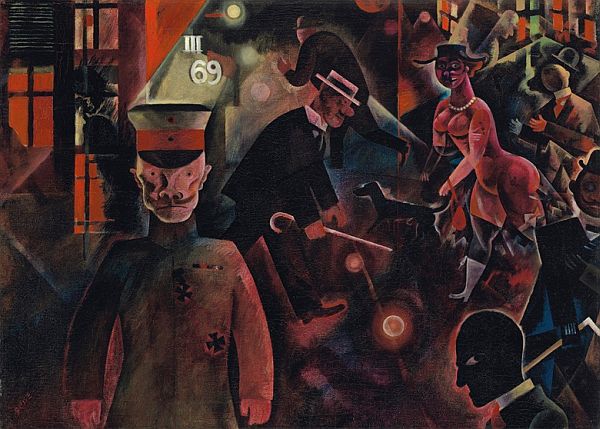
had never been in such vogue. But the Heidelberg works were never less than
controversial, and by the mid-1920s, art’s connection with insanity had come to
the attention of the extreme right.
Adolf
Hitler was, like Bühler, a self-taught artist. He was also, according to a
psychologist who examined him in 1923, “a morbid psychopath … prone to hysteria”.
After failing the entrance exam for the Academy of Fine Arts in Vienna, he had
scraped a living by copying tourist postcards in watercolours. When war broke
out in 1914, he took his brushes and paints to the front, and when he moved
into politics after the war, he took his art with him.
Art
helped him create a Nazi aesthetic, in the party emblems, badges and uniforms
he designed, the stage sets he oversaw and the propaganda he sponsored. Art
also gave Hitler a higher political purpose. Wars came and went, he liked to
say, but in millennia to come the Germans would be judged on their cultural
achievements, just as the great civilizations of the past were judged on
theirs. To restore German culture was to restore the “ethnically pure” German
Volk; to see it decline was to witness the Volk’s decline. And the insane
direction contemporary art was taking marked, for him, a decline of epic
proportions.
There is
no proof that Hitler read Prinzhorn’s book, but he would have been exposed to
its ideas through newspapers and magazines, and it could well have served as a
catalyst for his views. In Mein Kampf he railed against “half-wits” and
“scoundrels” who tried to stultify the “healthy artistic feeling” of the high
Romantic painters he loved. Modernist “nonsense” and “obviously crazy” stuff
was a cynical ploy to stave off criticism by horrified fellow citizens, while
movements such as cubism and dadaism were “the morbid excrescences of insane
and degenerate men”. As early as 1920, the party manifesto called for a struggle
against the “tendencies in the arts and literature which exercise a
disintegrating influence on the life of the people”. After 1933, that is what
they did.
It was
Goebbels’ idea, in 1937, to stage the Degenerate Art show. With 3 million
visitors, this touring exhibition remains the best attended of all time, but it
didn’t celebrate art; it pilloried it. From the second leg, in Berlin, the
propaganda directorate rifled the Heidelberg clinic for more than 100 works,
including several by Bühler, and displayed a selection of these alongside the
professional art. The idea, as the official guidebook stated, was to show that
the avant garde were even more “sick” than real “lunatics”. This was held up as
evidence of the great Jewish-Bolshevik conspiracy aimed at undermining German
culture and polluting the race with inferior blood. Cultural degeneration, the
“slowly rotting world”, as Hitler put it, prefigured biological degeneration,
which was hastening the Germans “towards the abyss”.
The
solution was simple: a “relentless war of cultural cleansing”. Modern art was
removed from German museums, to be sold off or simply destroyed, and
“degenerate” artists were hounded out of the country. But Hitler’s most
ambitious artistic project, his Gesamtkunstwerk, was to refashion Germans
themselves. To this end, in 1939 he ordered the first Nazi mass-murder
programme, Aktion T4, targeting the mentally ill.
In 1940,
Bühler was living in an asylum at Emmendingen, in Baden-Württemberg. On 5 March that year, a small convoy
of vehicles arrived at the institution, staffed by SS men in civilian clothes.
They loaded 50 patients on to the buses, including Bühler, and drove them to a
specially adapted home for disabled people at Grafeneck castle, in Swabia. The
patients were stripped and pushed into a gas chamber disguised as a shower
room, and killed with carbon monoxide. This “euthanasia” action, as the Nazis
called it, is widely seen as a precursor to the Holocaust, and when it had
achieved its targets, many of Aktion T4’s hardened veterans were reassigned to
extermination camps in the east. By the war’s end, about 200,000 psychiatric
patients would be killed by Hitler’s regime, including 30 Prinzhorn artists.
The war
did not mark the end for Prinzhorn’s collection. Miraculously, most of the
works survived, and inspired new generations of artists, including Jean
Dubuffet, the creator of art brut (“raw art”). Bühler was murdered, as were
other Prinzhorn artists, but his achievements live on. They broadened the
definition of art, and expanded the circle of permitted art-makers beyond the
elite.
How the
‘art of the insane’ inspired the surrealists – and was twisted by the Nazis. By
Charlie English. The Guardian, August 8,
2021.

In Franz
Karl Bühler’s masterpiece Der Würgengel, the artist portrayed a choking man
struggling on the ground, unable to breathe, as a blank-faced angel of death
prepares to finish him with a luminous sword. It can be read as a portrait of
the way he felt treated by the deity and by life, and as an uncanny premonition
of his death, which came as he fought for breath on the floor of Hitler’s
prototype killing plant, a doctor’s hand on the gas tap. The government’s
propaganda stated that he and his fellow victims were killed for economic
reasons, because Germany could no longer afford to keep them.
In truth
this brilliant artist, this “master of the first rank,” as Alfred Kubin
described him, was murdered in the service of another sort of art project:
Hitler’s Gesamtkunstwerk, his great and terrible design to refashion the
Germans in accordance with his artistic vision, a stew of degeneracy theory,
Wagnerian myth, late-period Romanticism, and his own furious psychopathology.
The artist-dictator had set aside his pencils and paints to work with humanity,
and at the time of Bühler’s death, this work was just beginning.
As
winter turned to spring in 1940, Hitler’s private office in Berlin, the Kanzlei
des Führers (KdF), ordered the Grafeneck killing station to ramp up its
activities. The transport squadron would be given an additional bus, which
meant it could carry seventy-five people at once, and the gas chamber was
enlarged to fit them all. Other victims were shipped in by train. At 8 am on
Thursday, March 7, a giant rail transport of 457 patients arrived at the little
station at Marbach an der Lauter. Deep snow had fallen in the Swabian Jura, and
it took the SS eight hours to unload them all. Egon Stähle, Leonardo Conti, and
Karl Brandt came to oversee the operation, taking their turns at the gas
chamber window, but there were too many to kill in a single day, so 138 women
were temporarily housed in the asylum at Zwiefalten.
They
were brought back at the start of April, when Stähle returned with a new group
of dignitaries from Berlin who wanted to see the women die. Memorable on this
occasion was a victim who screamed “We are all killed!” as the carbon monoxide
began to take effect. Stähle’s guests then observed the ovens, noting with
surprise how much smoke was produced. Over the following weeks, a sort of gas
tourism grew up in the Swabian Jura. Some visiting physicians were even invited
to take part by performing the cursory final examinations.
They
murdered 9,839 people at Grafeneck that year, including six artists of the
Prinzhorn collection, the huge and influential trove of art by inmates of
psychiatric institutions that was collected by the doctor and art historian
Hans Prinzhorn from 1919. The first of these artists was Mathäus Lorenz Seitz,
an adventurer and French Foreign Legion veteran who had lived for two years
with a pasha in Hyderabad. In 1921, Seitz was diagnosed as suffering from
“delusions” and sent to Wiesloch asylum, where he spent the next two decades.
He was killed at Grafeneck on or around February 29, 1940. Bühler was the
second Prinzhorn artist murdered there, on March 5. Ernst Bernhardt, the third,
was a former art teacher who drew an eerie self-portrait with a gallows over
his head while at the Heidelberg clinic.
After
living for much of the 1930s in the asylum at Rastatt, he was gassed at the
castle in April 1940. Konstantin Klees loved to depict his full, well-groomed
beard in yellow and green pencil and signed his designs “master baker,
confectioner, and grocer.” He was killed on or after July 24. Grafeneck’s gas
chamber took two more artists in October: Johann Faulhaber, a shoemaker whose
drawings bore a striking resemblance to work by Picasso and Kubin, and Josef
Heinrich Grebing, the former chocolate salesman who had designed the beautiful
“Air Ark” ocean liner for the skies.
As
Grafeneck scythed through the psychiatric population in south-west Germany,
Berlin expanded the “euthanasia” program across the Reich, constructing new
industrialized murder facilities based on the Swabian prototype in six
strategic locations around Germany and Austria. These new centers were referred
to by the letter codes B, Be, C, D, and E. Grafeneck took the letter A.
Killing
station B was built in a converted prison in Brandenburg an der Havel, forty miles
west of Berlin, and opened within days of Grafeneck, in January 1940. The SS
“Death’s Head” unit that staffed this plant was overseen by the ambitious young
Austrian psychiatrist Irmfried Eberl, who would later command the Treblinka
extermination camp. Nine thousand seven hundred and seventy-two patients would
be murdered at Brandenburg, according to the official count, and at times there
were so many corpses in the ovens that the flames that leapt from the top of
the chimney were sixteen feet long.
The
operation produced a horrific smell of roasting human flesh that tended to
settle over the city, but this problem was solved in the summer, when the
cremation units were moved to a shed some miles away, where the corpses were
delivered by a Reichspost van every day at 5 am. The body of the Prinzhorn
artist Paul Goesch would have been burned here. A painter of bright watercolors
with religious themes, Goesch was gassed at Brandenburg in August 1940,
although killing-center staff wrote on his death certificate that he died in
Austria in September, both to throw his relatives off and to fraudulently claim
extra money for his upkeep.
In
November, Eberl moved on to Bernburg, near Halle an der Saale, to establish
killing center Be. Bernburg was unusual in that it was built in the wing of a
functioning regional asylum whose staff had to be sworn to silence about the
murders that were taking place on the premises. The hundred or so T4 employees
who worked at Bernburg did little to ingratiate themselves with the deaconesses
who ran the asylum, partying so late and so hard that the killing center was
internally known as the Nuttenstall, or “whorehouse.” Almost nine thousand
patients would be killed at Bernburg, including the Prinzhorn artist Karl
Ahrendt, who drew intricate, psychedelic patterns and brightly colored symbols.
Ahrendt had once been a coachman and was committed in 1907 after marching
around Berlin’s Alexanderplatz in a general’s uniform. He was in his late
eighties when he was murdered, on or after March 18, 1941.
Killing
center C was at Hartheim, a medieval castle outside Hitler’s hometown of Linz,
where operations began in January 1940. Of the six murder facilities, Hartheim
killed by far the largest number, at 18,269. The victims included Alois Dallmayr,
who liked to draw androgynous figures with lots of curly hair, and was gassed
here in August or September 1940, and Anton Fuchs, a woodcarver who probably
died in February 1941.
In April
1940, Grafeneck’s expert gas doctor, Horst Schumann, was recalled to Berlin,
and his role at the castle was taken over by Ernst Baumhard, a newly graduated
medic and enthusiastic party member. Schumann was sent to Pirna-Sonnenstein,
near Dresden, where he opened killing center D. Among the 13,720 victims of
this former fortress were a half dozen Prinzhorn artists, including four women.
Gertrud Fleck and Johanna Melitta Arnold had both lived in the
Pirna-Sonnenstein asylum for more than three decades. Fleck was an amiable
patient who had a canary and loved to paint large, brightly colored flowers.
She was transferred out of Pirna in November 1939 while the T4 men installed
their equipment, and brought back a year later to be murdered. Arnold, a
creator of rich, energetic pastel drawings, lived at Pirna until 1934; she returned
to Pirna to die on July 18, 1941.
Auguste
Opel and Anna Margarete Kuskop, meanwhile, are represented in the Prinzhorn
collection by a single drawing each: Opel by a ghostly, almost imperceptible
townscape, Kuskop by a pastel portrait in which the subject’s head is tilted
slightly, eyes closed, as if absorbed in an inner retreat. This may be a
likeness of a friend she met in the asylum system, Miss Alice, to whom Kuskop
once wrote: “Above all, I ask you not to forget me.” Opel was transported to
Pirna on December 6, 1940; Kuskop on May 8, 1941. They were both gassed.
Wilhelm
Werner, the artist who drew cartoonish pictures of his own sterilization, also
died at Pirna-Sonnenstein. In theory, sterilization should have protected him
from “euthanasia” since he was already unable to pass on his allegedly
defective genes, but his care givers at Werneck were keen to be rid of him,
noting on his T4 registration form that he was a “weak-minded chatterbox” with
“a very primitive imagination.” He was taken to Pirna on October 6, 1940.
By the
end of that year, T4 had killed 35,000 psychiatric patients and disabled
children, and the decision was taken to close Grafeneck, which had far
outstripped its initial target of killing 20 per cent of psychiatric inpatients
in southwest Germany. At the start of December, young Dr. Baumhard invited his
counterpart from Zwiefalten, Dr. Martha Fauser, to a “camaraderie evening” at
Grafeneck to celebrate his unit’s departure: The evening included an invitation
to watch the gassing of a transport of women. The facility was shut down soon
afterward and Baumhard went on vacation with his staff—or most of them, anyway:
He had killed his chief nurse by shutting her in the gas chamber by accident.
In the
new year, the Grafeneck team moved en masse to Hadamar, a village conveniently
placed for the Wiesbaden-Limburg-Cologne motorway, to open station E. The gas
chamber at Hadamar would kill ten thousand people in its eight months of
operation. One of these was the Prinzhorn artist Peter Zeiher, a convicted
murderer who protested his innocence and drew elaborate reconstructions of the
crime scene to try to prove it. Another was Gustav Sievers, the artist who had
inspired Max Ernst, and who liked to draw humorous, bosomy women riding to and
fro on bicycles, or dancing with overpowered men.
Excerpted
from The Gallery of Miracles and
Madness: Insanity, Modernism, and Hitler's War on Art. By Charlie English,
2021.
Remembering
the Artists Who Were Among the Early Victims of Nazi Death Camps. By Charlie
English. LitHub, August 11, 2021.

In 1908,
Paul Klee, struggling as a painter, saw his first van Gogh canvas at a gallery
in Munich. The Dutchman’s genius was at once clear to him; so, too, and
inseparably, was his madness. ‘Pathetic to the point of being pathological,’
Klee wrote, ‘this endangered man’ has a brain ‘consumed by the fire of a star’.
Three years later, and shortly before joining them himself, Klee reviewed a
show of works produced by the Blaue Reiter group. Once again, it was the
irrational that drew his eye. ‘Neither childish behaviour nor madness are
insulting words here, as they commonly are,’ Klee enthused. ‘All this is to be
taken very seriously, more seriously than all the public galleries, when it
comes to reforming today’s art.’
A decade
later, the polymath Oskar Schlemmer, shortly to take up a teaching post at the
new Bauhaus in Weimar, went to a slide show of images of the art of the insane.
What he saw in Stuttgart that night stirred him to ecstasy. ‘For a whole day I
imagined I was going to go mad,’ an excited Schlemmer wrote to his fiancée,
‘and was even pleased at the thought, because then I would have everything I
have been wanting.’
For all
that, the young Swabian spotted a problem. ‘Klee’, he went on, ‘has seen these
things and is enthusiastic’; the work he and other moderns were making bore
‘surprising similarities’ to that of the mad – men such as the ‘schizophrenic
master’ August Klett, who thought himself Christ and, locked for decades in an
asylum, produced émaillée paintings of odd beauty with names such as Die
Republik der Hähne in der Sonne hat ohne Kostüm gegessen und getanzt (‘The
Republic of Roosters Ate and Danced in the Sun without Costumes’). But if the
art of the moderns resembled that of the insane, then the reverse was also
true. With what would turn out to be unhappy prescience, Schlemmer saw that
this resemblance would one day be used as a weapon against modernism. ‘See!’ he
went on, rhetorically to his fiancée. ‘They paint just like the insane!’
Between
Klee’s Blaue Reiter review and Schlemmer’s letter had come the First World War.
Having seen, in many cases first-hand, the insanity of the trenches,
avant-garde artists across Europe found themselves moved to paint something
more than reality. The Surrealists in Paris found their subject first in the
irrational of the Freudian pre-conscious and then in the communitarian
unconscious of Jung. In Germany, the drive was towards abstraction, so-called
non-objective art. Here, particularly, the insane had a head start. ‘The madman
lives in a realm of ideas which the sane artist tries to reach,’ Schlemmer
wrote sadly. ‘For the madman it is purer, because completely separate from
external reality.’
As he
had also realised, opposition to this view in Germany was already growing. If
modernists sought to redeem madness by owning it, a counter-tendency aimed more
simply to eradicate it. This latter movement was led by a plodding and
talentless figurative painter called Adolf Hitler. The realism ordained by
Hitler was to give rise to a kind of madness beyond the wildest schizophrenic
dreams of Klett. Officially prescribed art presented a fantasy world in which
men were universally strapping, women subservient and pink-cheeked and children
had unvarying blue eyes.
***
This
parallel shift in German thinking on art and insanity is the subject of Charlie
English’s compelling new book, The Gallery of Miracles and Madness. Its two
principal themes, the demonising of modernist art as degenerate and the murder
of the inhabitants of asylums in the so-called Aktion T4, are well enough
known. Where the particular fascination of English’s book lies is in his
discovery of an overlap between them.
By 1938,
Schlemmer’s prediction had come woefully true. In that year, the ‘Degenerate
Art’ exhibition in Munich juxtaposed a pair of self-portraits by Oskar
Kokoschka with another by a man called Georg Birnbacher. The accompanying guide
asked visitors to guess which of the works was by a supposed master, which by
‘an amateur, an inmate of a lunatic asylum’. ‘You will be surprised!’ the text
crowed. Birnbacher was a long-term resident of the psychiatric clinic at the
University of Heidelberg and a patient of Hans Prinzhorn. Prinzhorn, a
brilliant psychiatrist, had been the first to recognise the extraordinary
artistic talent of many of the inmates, particularly those diagnosed as
schizophrenic. He had carefully collected and catalogued their work and
travelled the world proselytising on its behalf. It was his slide show that
Schlemmer had seen in Stuttgart in 1920.
In
English’s narrative, the twin strands of Hitler’s thinking on art and racial
purity draw remorselessly together. The year after the ‘Degenerate Art’
exhibition, a National Socialist couple from Leipzig wrote to the Führer,
begging his permission to kill their badly disabled infant son: ‘the monster’,
as his father referred to him. In July 1939, the baby became the first victim
of a policy of state murder that would see the death of perhaps three hundred
thousand Germans deemed ‘ballast’ and ‘useless eaters’. Some seventy thousand
of these were inmates of asylums, among them many of Prinzhorn’s
artist-patients.
One was
Paul Gösch, who, as English notes, had had the unique and unenviable distinction
of having his work included in the ‘Degenerate Art’ exhibition on two counts:
as an example of professional degeneracy (at the original Munich show) and of
amateur madness (when it moved to Berlin). Unusual among Prinzhorn’s stable in
having trained as a professional painter, Gösch had first been incarcerated
with schizophrenia in 1917. In 1934 he was moved from an asylum in Göttingen
run by his brother-in-law to another, more brutal one in Teupitz. In 1940 he
was taken to the killing centre at Brandenburg an der Havel to be gassed with
carbon monoxide.
The same
fate awaited Franz Karl Bühler, whose Blakean crayon drawing Der Würgengel
(‘The Choking Angel’), used as the frontispiece to Prinzhorn’s ground-breaking
book Bildnerei der Geisteskranken in 1922, proved an appalling premonition of
his own end. Trained as a master blacksmith – his trio of Baroque gates had
been the centrepiece of the Chicago World Fair in 1893 – Bühler was taken in
March 1940 from the asylum in Emmendingen that had been his home for four
decades to the castle at Grafeneck, one of the most efficient of the Aktion T4
killing centres. There, in a scene that prefigured the killings in the gas
chambers at Auschwitz, he was herded into a room tricked out as a communal
shower and gassed with fifty-three others as an SS doctor looked on through a
spy window. Carbon monoxide kills by choking its victims. One observer at
Grafeneck recalled seeing ‘patients, naked … with their mouths terribly wide
open, their chests heaving’.
My only
cavil about English’s book is that it is too long. For all its fascination, the
awful tale it tells is in essence a micro-history, concerning at most a few
dozen people who had the great misfortune to be both talented and incarcerated
as mad. A tighter focus on these and less time spent on the tectonic shifts
that would eventually crush them might have made The Gallery of Miracles and
Madness more memorable than it already is.
Virtuosos
of the Asylum. By Charles Darwent. Literary Review, August 2021.
A scant
few pages into Charlie English’s The Gallery of Miracles and Madness, I was
reminded of a recent, strange phenomenon: several accounts cropping up on my
Twitter feed zealously devoted to “Traditionalist architecture.” Their pages
were full of photos comparing Gothic and Neoclassical buildings with what they
termed “communist Soviet-era” apartment blocks. Saturated pictures of idyllic
German farming towns were held up next to shots of dreary urban intersections.
The sentiment never varied. Take us back to before our cities were polluted.
They were sometimes accompanied by captions extolling the virtues of “beauty”
and “elegance” – values that they asserted were now irrevocably warped by
modern architectural sensibilities.
I doubt
these posters knew how dangerous and terrible the roots of their rhetoric were,
disguised under a longing for tradition. Charlie English’s The Gallery of
Miracles and Madness would do a fine job of enlightening them as to how
inextricably aesthetic, artistic and political sentiments are linked. Elegant
and exhaustively-researched, English outlines the rise of “psychiatric art” in
Weimar-era Germany, tracking its influence and eventual clash with Hitler’s
obsession with remolding the artistic character of Germany. The fact that we
all know the inevitable tragic conclusion – the mass murder and sterilization
of individuals housed in psychiatric facilities, as a “trial run” for later
concentration camps – doesn’t lessen the horror and impact of English’s careful
account. It’s upsetting, and challenging. It’s also necessary reading in our
current time, where musicians are thrown into jail over “treasonous” lyrics,
and artists are imprisoned for creating their work. To those who still ask the
perennial question – “Is art still valuable in our disastrous contemporary
moment?” – The Gallery of Madness and Miracles provides a definite,
indisputable “yes.”
The
first section of Miracles and Madness is structured around the collection of
works from the inmates of various psychiatric institutions by Hans Prinzhorn, a
doctor and art historian. Prinzhorn, despite his later tentative support of the
Nazi regime, was at that time a progressive, opposed to the popular sentiment
that “madness” was a sign of a “diseased” or “degenerate mind.” English clearly
and vividly outlines the failure of the era to understand mental illness, most
particularly schizophrenia, which was believed to carry a sentence of
“inevitable decline,” and the additional failings of the psychiatric care
available. Hospitals were a convenient storage space for “deviants,” so the
general public would be spared from dealing with them. This dehumanizing
attitude later led to forced sterilization under the Nazis, and the term
lebensunwertes Leben – “life unworthy of life,” providing the excuse for the
eventual mass murder that would claim thousands of neurodivergent lives.
Prinzhorn,
however, found the art produced by patients fascinating – and most importantly,
of genuine artistic worth. After collecting and exhibiting a vast amount of art
from dozens of patients, Prinzhorn photographed the work and published
Bildnerei der Geisteskranken (Artistry of the Mentally Ill). The book, and the
work itself, went on to heavily influence the work of many notable artists of
the time. Paul Klee, an avid fan of the Bildnerai, “appears to have taken
direct inspiration from a Prinzhorn-owned work, Circle of Ideas of a Man.”
Surrealist Max Ernst was so moved by the exhibited work that he began to
attempt to create collages that resembled hallucinations. Dalí makes direct
reference to a piece by Prinzhorn-owned artist Joseph Schneller in his essay
“The Tragic Myth of Millet’s The Angelus,” and Richard Lindner called
Prinzhorn’s collection “the most important artistic experience of my life.”
There are even claims that Picasso’s Téte de femme is a reference to work by
artist Heinrich Anton Müller, who featured in the Prinzhorn collection. Drawings
exhibited by Prinzhorn, from artist August Natterer, even influenced Koga Harue
to create one of the first works of Japanese Surrealism, Endless Flight (1930)
English’s
deeply thorough account of the influence the Bildnerai wielded reveals the
fetishization and objectification of “the insane” by artists – a sentiment that
is unfortunately alive and well. Affluent and successful artists took direct
inspiration from incarcerated patients, sometimes even copying their images and
composition, and made little effort to credit them. The Surrealists, who
English admits “romanticized mental illness,” were obsessed with the supposed
“purity” of insanity, with some artists, like Dalí, trying their best to induce
insanity, in the belief it would make their work more “raw” and “true.” André
Breton even remarked that “they [the insane] derive a great deal of
comfort…they enjoy their madness.” This parasitic relationship is at times
glossed over by English, who gives a detailed biography of several artists –
most notably a talented metalworker diagnosed with schizophrenia, Franz Bühler
– but gives only brief sketches of others. The result is that The Gallery of
Miracles and Madness often feels as if it is populated and driven by ghosts.
Their lives, “a succession of steps in an endless routine: sleeping, sitting in
bed, waiting for food, smoking, queuing for the barber’s chair,” go mostly
non-memorialized.
The
second and third sections, however, are a masterclass in biography. English’s
account of Hitler’s early life, his lack of artistic skill, and “artist-Führer”
persona, is brilliantly engaging. Hitler’s hatred of modernist art, which he
characterized as “degenerate,” is linked clearly to his deep racism and
xenophobia, with the entirety of degeneracy theory itself stemming from
Gobineau’s hateful racial hierarchy developed in France in the 1850s. In
Hitler’s mind, the mentally ill constituted an entirely different race; they
were less than human. His hatred provided “a bridge to the public,” who
misunderstood the avant-garde and regarded it as confusing and unskilled.
Modern art’s “insane direction,” Hitler argued, “was not mere coincidence, but
a deliberate plot by the Jewish-Bolshevik nexus to destroy Germany.” That
sentiment hit a nerve with the exhausted and angry German populace, and
elevated the political importance of supporting art that reflected ethnic
Germans, the Volksgemeinschaft. To that end, the Reichskulturkammer organised
twin exhibitions – one of acceptable, Aryan, faux-Classical art (Große deutsche
Kunstausstellung) and another, of “degenerate art” (Entartete Kunst), to be
shown in direct contrast to each other. English outlines these exhibitions,
highlighting their darkly comedic absurdity – thousands of people eagerly
flooding Entartete Kunst in favor of Große deutsche Kunstausstellung, Hitler
throwing tantrums over a painting of a tennis player that was too “smeared” –
without ever losing sight of the human cost of the rhetoric. “Art [was]
Germany’s social glue,” Hitler declared. Controlling it, manipulating human
expression and choking out any depiction that dissented with Nazi ideology, was
of immense importance to maintaining the power of the regime.
The
final fourth section, “Euthanasie,” is an exhausting, devastating read. English
chooses to include graphic depictions of the mass gassings of patients, which
is a decision that feels necessary in driving home the horror and reality of
what constituted the beginning of a genocide. “[I] cannot believe [the
patients] died without pain,” one observer states. Franz Bühler, as well as
eighteen other Prinzhorn-owned artists, lost their lives that way – scared,
confused, deprived of human dignity and respect. Their art was either destroyed
or committed to storage. It’s here that the injustice of the situation becomes
almost unbearable. Affluent or successful artists could escape Germany, but the
patients that they had plagiarized could not; first enduring terrible
conditions in overcrowded facilities, and then mass murder. Despite the
Surrealists’ profession of how valuable insanity was – “the great art,” as
Dubuffet said – actual individuals suffering from mental illnesses were only
ever fodder for those lucky enough to live outside of institutions. This is a
dynamic that seems to have endured to the present day: Mental illness is still
deeply misunderstood and fetishized, even in artistic communities. Many still
regard neurodivergent people as dangerous, less valuable; simply a problem for
society to solve. In other words, “degenerate.”
Despite
occasional gaps in focus – which, admittedly, is most likely informed by the
scarcity of surviving records of psychiatric patients at that time – English
does a marvelous job of creating a readable, emotional text, elevating fact to
narrative – spinning gold out of hundreds of fractured sources. With his
capable hand, history comes alive. The Gallery of Miracles and Madness is proof
that the past is closer than we think. It was barely eighty years ago that
Bühler, master metalworker and artist, one-time representative of Germany at
the Chicago World Fair, was being led to his death. We are not as far removed
from such violence as we like to believe. In that regard, Charlie English has
written something remarkable: a work of historical nonfiction that feels urgent
and overwhelmingly relevant to the world we live in.
Charlie
English’s ‘The Gallery of Miracles and Madness’ Is a Necessary Read. By Ella
Fox-Martens. The Observer, August 2,
2021.
In 1922
Hans Prinzhorn, a Heidelberg psychiatrist, published a book that set the art
world on fire. At first glance Artistry of the Mentally Ill didn’t sound as if
it was breaking new ground. Ever since the 19th century, medical men working in
asylums – “mad doctors” by another name – had pored over the drawings,
paintings and sculptures of their more nimble-fingered patients to see if they
could discern some sign or signature of madness. Was it possible to spot
schizophrenia just by looking at the way someone drew a horse or coloured in
the sky? Could you discern neurosis simply because an artist had failed to give
her figures two eyes and a mouth?
Using
art as a diagnostic tool, though, was not what Prinzhorn was about. With a PhD
in art history, his interest in the patients’ painting was aesthetic and
philosophic. When a delusional metalworker from Hamburg called Franz Bühler
produced The Choking Angel, an intense rendering of God’s messenger with a
shining crown and a blank, torturer’s face, Prinzhorn didn’t hesitate to
compare the work to Albrecht Dürer’s. Another inmate artist, seamstress Agnes
Richter, produced a subversive version of her institutional uniform, by
restitching the arms on backwards and embroidering it all over with expressions
of her plight: “I am not big”, “I miss today”, “you do not have to”. Intriguing
too was a former builder called Karl Genzel who produced wooden effigies
including one of the German field marshal Paul von Hindenburg that drew
simultaneously on the ancestor art of New Guinea and the scurrilous vernacular
of political cartooning.
This was
certainly not art to soothe the soul. But then, soothing the soul, or any of
the senses, was not what modern art was about. From the end of the previous
century, artists such as Gustav Klimt, Vincent van Gogh, Edvard Munch and Egon
Schiele had devoted themselves to describing the agony of modern selfhood. In
Van Gogh’s looming sunflowers, Munch’s horrified scream or Schiele’s warped
human forms, you could feel a rising tide of madness. And it was that “madness”,
which might be better described as a heroic refusal to fall for the easy
nostrums of “civilised” society, that Prinzhorn’s asylum artists seemed to be
able to access at will. While “sane” painters were obliged to scrape off layers
of social conditioning and academic training before they could reach those
hidden parts of themselves, asylum inmates appeared to have a shortcut to their
unconscious (Prinzhorn was a follower of Freud). Rather than being pitied or
patronised these artists of the interior were to be envied and revered.
And
copied, too. That certainly was the response of Paul Klee, then teaching
“pictorial theory of form” at the Bauhaus, who greeted the images in
Prinzhorn’s book with raptures. In these oddly shattered shapes, with their
jagged outlines, shifts in perspective and intentional incompleteness, Klee saw
an authentic response to all the fractures of the post-first world war world.
From now on he would use Prinzhorn’s book as a source of imagery whenever his
own artistic practice needed a jolt. One striking example is his 1923 work
Prophetic Woman, a primitive figure that appears to owe something to Lamb of
God, a dense geometric pen and ink drawing by Johann Knüpfer, a former baker
who was convinced he was Christ.
Among
the surrealists, too, Prinzhorn’s book was a hit. Max Ernst drew inspiration
from August Natterer, an electrical engineer from Upper Swabia who claimed to
be a direct descendant of Napoleon. Natterer’s intensely detailed, densely
coloured paintings, which he said had come to him in a vision, provided
inspiration for Ernst’s seminal 1931 collage, Oedipus. Salvador Dalí,
meanwhile, borrowed from Carl Lange, a former salesman who saw miraculous
figures in the sweat-stained insoles of his shoes. Dalí, to his credit, tried
very hard to go insane as a way of improving his painting but never quite
managed it: “The only difference between myself and a madman,” he declared, is
that “I am not mad”.
Two
years after Prinzhorn’s book was published, another self-taught artist was
sitting in a Bavarian prison. A psychologist had assessed the new inmate as “a
morbid psychopath … prone to hysteria … with an inclination toward a
magical-mystical mindset”. Although this sounds promising, the 35-year-old’s
paintings were not the kind of thing likely to interest Dr Prinzhorn. This
artist was keen on Alpine peaks and lakes with the occasional fairytale
schloss. His best works, though, were his drawings of municipal buildings, the
sort of thing a town planner might do by way of a hobby. Having twice failed
the entrance exam to Vienna’s Academy of Fine Arts in 1907, Adolf Hitler
scraped a living by copying postcards of Munich’s favourite views and selling
them in bars and cafes. Until, that is, he ended up in prison, shouting
nonsense at the admitting psychologist.
Hitler
was serving a sentence for his part in the Beer Hall putsch of 1923, in which
he led 2,000 Nazi stormtroopers in a botched attempt to topple the Weimar
Republic. While his fortunes were about to change – within 10 years he would be
chancellor of Germany – his ideas about art remained constant. Indeed, they
hardened into a dogma that became a founding principle of the Third Reich.
“Healthy art”, for Hitler, was an art that painted exactly what was in front of
its nose, with a bit of swagger thrown in for good measure. People should look
like people – Aryan people, naturally, with firm limbs and rosy cheeks – and
landscapes should resemble the postcard art he used to churn out for the
tourists. The sky was blue, the grass was green, and to make sure everyone
understood this, the Führer introduced legislation to ensure that painters
followed the rules of “natural” coloration. You fooled around with an amber sea
or blue horses at your peril.
Any art
that did not follow these rules was “degenerate” and a deliberate ploy by the
Jewish-Bolshevik nexus to destroy Germany. To make sure this didn’t happen, in
1937 Hitler ordered the confiscation of all troublesome art from Germany’s
galleries and museums. This rounded-up treasure, including a number of pieces
by the Prinzhorn artists as well as work by Klee, Marc Chagall and Otto Dix,
was put on display in the Degenerate Art Exhibitionin the same year. Later
iterations of the show, which proved immensely popular, contrasted modernist
art with paintings and drawings made by the Heidelberg patients in order to
hammer home the connection between biological and artistic degeneracy.
By this
time the patients themselves were in a remarkably vulnerable and friendless
state. Prinzhorn had died in 1933, just as Hitler came to power, and most of
the professional artists whose work featured in the Degenerate Art Exhibition
had gone to ground. Klee was in Switzerland, Chagall, Dalí and Ernst were in
New York, while Oskar Schlemmer and Dix were doing their best to keep their
heads down. So there was no one left to speak up for the asylum artists when,
in the autumn months of 1939, Hitler set out to exterminate them.
The
rationale was eugenics: psychiatric illnesses such as schizophrenia were
heritable, so it made sense to purge the general population of these
unfortunate people who, in Hitler’s phrase, represented “life unworthy of
life”. In fact, it turns out that costcutting was the more immediate driver:
long-term psychiatric care cost money and, as Germany prepared to go to war
with Britain, those marks would be better spent on panzer tanks. Charlie
English reckons that at least 30 of Prinzhorn’s artists were among the quarter
of a million inmates driven into gas chambers during the early months of the
war. The “lucky” ones got away with forced sterilisation.
English
has written a terrific book, taut and thematic where it could so easily have
been slack and baggy. Finding a focus cannot have been easy – Prinzhorn, the
sort-of hero of the account, dies far too young, and the lives of the asylum
painters are lost in the dishonest jumble of Nazi bureaucracy (relatives of the
murdered were told that their loved ones had died of a “heart attack”). And
Hitler is so huge a figure that a less assured writer would have had trouble
cutting him down to size and keeping him in play. But English manages all this
deftly; the result is a book as beautiful as it is bleak.

The
Gallery of Miracles and Madness by Charlie English review – the fate of
Hitler’s ‘degenerate’ artists. By Kathryn Hughers. The Guardian, August 5,
2021.
They
were paintings by patients in mental hospitals. To the man who collected them,
they were fine art, unschooled and pure. To the Nazis, they were a weapon in
their war against modernism. Now the collection has a permanent home; but, asks
David Sweetman, will it ever be free of controversy?
It may
well be the most unusual art collection in Europe, yet for 80 years it has been
with-out a home. This will change in September when the University of
Heidelberg opens a new museum to display the 500 paintings, drawings and
sculptures that Dr Hans Prinzhorn of the Heidelberg Psychiatrische Klinik
assembled in the early 20s. What makes this vast collection so extraordinary is
that everything in it was created by patients in mental hospitals across
Europe, a mingling of art and insanity that some have found totally
unacceptable.
The
small selection shown at the Hayward Gallery, London, in 1996 came as a
surprise to many, for on offer were not the dour productions of hospital
therapy sessions but some of the most flamboyant and, yes, eccentric images imaginable.
We may no longer laugh at the insane, but much of this art is gloriously funny:
from the brightly coloured depictions of overweight, overdressed matrons,
riding about on worryingly fragile bicycles, to the all-female orgy, which
seems to be taking place in a throne room, plentifully supplied with calf-high
bootees and whips but short on actual sex (for no discernible reason, one of
the ladies seems more interested in wrapping her companion in a length of cloth
than in anything remotely naughty). Comic, but also mysterious, like the
drawing that advertises itself as a portrait of all the Houses of Correction in
the Göttingen area, which does indeed offer meticulously drawn studies of 19
buildings, except that, on close inspection, they all turn out to be exactly
the same, identical down to the last window and chimneypot. Occasionally, such
perversity seems to hint at something deeper: a swirl of dense spirals might
have been a seashell but for the title, I Want To Try; a second, almost
identical swirl becomes It Is A Cancerous Testicle.
Whatever
else they might be, the works from the Prinzhorn collection are clearly not
boring. Yet such things were regarded as the mere scribblings of the mad,
useful only to study how far a patient's psychosis had progressed, until a few
enlightened doctors, Prinzhorn foremost among them, argued that they should be
viewed as works of art in their own right. The very words Prinzhorn used to
describe the works in his collection reveal his concern: artistry,
authenticity, cosmic feeling, empathy, genuine, instinctive, naive, natural
expression, primordiality, purity, spiritualisation, spontaneity. Some of the
works may have their funny side, but they are all highly original, unfettered
by convention and often electric with energy. Prinzhorn devoted himself to
pointing this out to a cynical world.
Even a
brief glance at his story shows that Prinzhorn, born in 1886, was made for the
task. As a young man, he had a number of failed ambitions: he studied philosophy
and art history, then tried his hand as a singer, until the encroaching mental
illness of his second wife led him to train as a doctor. In 1919, he moved to
Heidelberg, where, unable to resist the artistic life, he successfully
transformed himself into the Diaghilev of psychiatry, satisfying his own
creative ambitions by orchestrating those of others. There was already a small
collection of works at the clinic when he arrived, but it was Prinzhorn's idea
to contact mental hospitals all over Europe, asking them to send him any
patients' work they did not want.
There
are other collections of psychotic art, but nothing on this scale. And what
took Prinzhorn's collection beyond the realm of a handful of specialists was
his ground-breaking study, Bildnerei der Geisteskranken (The Artistry Of The
Mentally Ill), first published in 1922 and much reprinted since. In the decade
up to 1933, works from Heidelberg were shown in nine German cities and seen by
a remarkable array of now-famous artists. Painters such as Paul Klee and Oskar
Kokoschka identified with Prinzhorn's championing of an art that celebrated the
complexity of individual expression over what they saw as a world reduced to
external appearances - a primary preoccupation of western painting since the Renaissance.
What seems to have appealed most was the existence of secret, inexplicable
worlds - a farmland map, with village and path, hedgerow and stream, suddenly
turns into a witch's head; a bald, clean-shaven soldier in the first panel of a
diptych sprouts hair and a beard in the second, for no apparent reason.
It is
not hard to understand why the surrealists found encouragement in these amazing
fantasies, seeing the "spontaneous" creativity of the mentally ill as
akin to their own attempts to unleash the unconscious. They were introduced to
the collection by Max Ernst, who had been planning to make his own analysis of
psychopathological art when Prinzhorn's study appeared. What has continued to
attract artists to the collection is the sheer range of imagery on offer:
unconstrained by schools and isms, unconcerned about critics or fashions,
Prinzhorn's artists made whatever they wished. Some created religious icons,
others scrawled erotic symbols or drew a blueprint for the perfect mechanical plough,
all with a freedom that belied the reality of their physical condition as
effective prisoners in mental asylums few would ever leave.
In the
end, Prinzhorn spent only three years at Heidelberg and, despite his strenuous
pleading, the collection was never given a permanent home. He died of typhoid
fever in 1933, but his writings continued to influence those attracted to
alternative forms of ex-pression, in particular the postwar artistic movement
Art Brut, whose leading exponent, Jean Dubuffet, was himself a collector of
artworks made by the mentally disturbed. The recent restoration of the
collection, along with its presentation in major exhibitions and the
forthcoming opening of its home in Heidelberg, has given Prinzhorn something of
the status of a secular saint. Today, the Prinzhorn Archive is a major source
for research into what is sometimes called "Outsider Art" - art
produced by those without special training.
Yet
despite this renewed interest, many of Prinzhorn's artists remain sadly anonymous.
At present, most catalogue entries can list only place of birth, marital status
and medical diagnosis as shown in a patient's medical records, though in some
cases the rather ominous phrase "last mentioned" is given, followed
by a date. It is to be hoped that, as research progresses and the task
Prinzhorn began is at last completed, the creators of these extraordinary works
will emerge from the shadows to assume their full status as artists.
But
nothing from that turbulent period of Germany's history is immune to a new
generation keen to expose the sins of their fathers, even those of someone as
apparently worthy as Prinzhorn. While allowing that he was genuinely trying to
change the way mentally ill people are perceived, younger critics point out that
he was not above doctoring the evidence in his attempts to show how creative
his patients were. Recent research reveals that he strengthened his case by
discreetly providing special materials for those he considered particularly
gifted. He even rewarded some inmates for "good" work and would omit
to record details of any prior training they may have had.
As none
of this was known at the time, the conclusion spread that it was insanity,
rather than innate talent or acquired skill, that made his patients so good at
art - an assumption that seemed both to echo the traditional belief that lunacy
can induce ecstatic, visionary experiences, and to endorse the link between
genius and insanity proposed in the 19th century. Once it was established that
all psychiatric patients were naturally artistic, it became harder to counter
suggestions that art itself may be the province of the deranged, an equation
readily endorsed by the cultural theorists of the rising National Socialist
movement, who would later set up a programme of artistic "reform",
aided by their allies from the world of clinical psychiatry.
Notable
among these was Carl Schneider, the Nazi sympathiser who came to Heidelberg
after Prinzhorn and completely reversed the way the collection was viewed.
Schneider, who had joined the Nazi party in 1932, was a wholehearted supporter
of the attempt to "purify" Germany's creative life. He, and others
like him, believed that, by using chance, the subconscious, the primitive and
the childlike to liberate their work from conventional artistic practice,
modern artists had entered the twilight world of "the idiot, the cretin
and the cripple", and were obviously mad. This attitude finds its clearest
expression in the words Schneider used when referring to Prinzhorn's
collection: catatonic, chaos, craving, cretinism, defilement, degeneracy,
deviance, disgust, disorientation, grimaces, horror, idiocy, infantile, lust,
nonsensical, pathological, shameless, wallowing.
Women
were especially likely to encounter Schneider's disapproval. Despite the fact
that, in the 20s and 30s, there were more women than men in psychiatric
institutions across Germany, their art constitutes only 20% of the collection.
In the words of a recent curator, female patients "put their energies into
women's work, wrote religious verses in their notebooks, and kept quiet".
Despite this, it is clear from Schneider's writings that the new director was
especially antipathetic to work done by women. Indeed, he was proud of his
ability to "reform" those in his care by weaning them away from
activities he considered degenerate. In an article for a psychiatric journal
published in 1939, Schneider describes his successful treatment of a
"schizophrenic female artist [who] had composed pathological productions"
and ends by boasting that he has not preserved her work, rather he has had it
destroyed.
Presumably,
Schneider did not destroy works already in the collection because they were
useful evidence that the art of the insane was worthless. The oddly dressed
ladies on their clearly impractical bicycles and the strangely coiffed women
conducting their unerotic orgy would have been ideally suited to his purposes.
Of course, what he and his fellow Nazis failed to see is that, while they are
undoubtedly comic, there is no reason to assume that this is simply a product
of the helpless battiness of the mentally ill. What if their creators knew what
they were doing? What if they were laughing at the world - at us?
Allow
that, and it becomes apparent that many images appear to mock the accepted
order of things. The fact that all the Göttingen Houses of Correction are
identical would have made perfect sense to the inmates. Perhaps so many works
resist interpretation because that was the intention; perhaps they are
exercises in disguise? Fail to hide, like the witch's head in the landscape,
and you will be caught, snared in the words that are scrawled across so many of
the pictures like barbed wire at Passchendaele.
Schneider
seems to have sensed none of this. Seeing only madness, he was happy to lend
works from Heidelberg to the Entartete Kunst, the Degenerate Art exhibitions
organised by the Nazis in the 30s to discredit modern art by associating it
with the productions of the insane. This more than anything lowered the status
of the collection in the opinion of intellectuals across Europe. Even
Prinzhorn's reputation was tarnished by Schneider's actions. While it has never
been suggested that he gave any credence to the Nazi view of modern art as the
work of sick Jews, bolsheviks and anarchists, he has nevertheless been rebuked
for his silence at the beginning of the Nazi attacks on his collection, what
one sceptic has described as a withdrawal into "pessimistic dandyism",
which presumably indicates someone too bored or too fastidious, too preoccupied
with higher things, to engage with those he considers beneath him - an attitude
some way short of unquestioned sanctity.
Schneider is
an easier monster. Arrested
by the advancing Americans in 1945, he committed suicide in his cell before he
could be tried for his part in the Aktion T4 mass euthanasia programme and his
role as a T4 Gutachter, "educating" other doctors in the techniques
of "mercy-killing" child patients, his "beautiful idiots".
Yet even this tale of unrelenting wickedness has its curious twists. In some
accounts, Schneider is the son of a pastor and thus a fallen angel; in others,
he is the abandoned child of a failed musician who died in a home for the
indigent, with the result that the son came to view psychiatry as a means of
social advancement, a prize offered by the Nazi Racial Hygiene programme.
Both
sides tend to agree that at some point he underwent a change of heart. The
young Schneider was convinced that eugenics would turn healers into hangmen,
but he also had a passionate desire to find a cure for "congenital
feeble-mindedness and epilepsy", and when he was offered the means to
obtain the enormous quantity of children's brains he believed necessary for his
experiments, he was seduced, by a heady mixture of goodness and raw ambition,
into taking a leading part in the involuntary euthanasia of thousands of
crippled and retarded infants.
In the
end, any attempt to explain his behaviour gives way to anger when one is
confronted with the icy insouciance he displayed towards the gassing or slow
starvation of his many victims. In any case, all the official applications for
more research assistants, and the interminable arguments over who had the right
to which human remains, led nowhere. As with all the other Nazi medical
experiments, no cure was found.
Given
the turbulent history of Prinzhorn's collection, it is likely to remain at the
centre of any debate surrounding psychiatry in Germany. That it survives at all
is a miracle - although there is a sense in which the credit for that may have
to be given to Schneider. When the Entartete Kunst exhibitions finished touring
in 1941, no one knew what to do with the exhibits, which were put into storage
until the day when someone higher up should send for them. Likewise in
Heidelberg, the bulk of the collection was packed in boxes, where it remained
until the mid-60s when it was rediscovered and a programme of restoration,
research and exhibition begun, intended to lead up to this year's opening of a
museum within the university.
At this
point, it looked as if Prinzhorn's hopes were about to be fulfilled and his
collection could finally have a permanent home. But in the summer of 1996, Dr
Inge Jadi, the current custodian, heard that an organisation called the
Bundesverband Psychiatrie-Erfahrener (BPE) had "decided" that the
Heidelberg works should be moved to Berlin to form part of a memorial to the
victims of the Nazi euthanasia campaign. Enquiries revealed that the BPE had
already applied to the Berlin and regional authorities for aid, only to be told
that help could not be given unless their new museum contained material of
substance and importance, hence the attempt to take over an existing world-famous
collection. Initially, it must have been tempting to treat the whole business
as nothing more than a publicity stunt by a previously unheard-of fringe group.
But the BPE and its allies were to prove unexpectedly tenacious.
The BPE
is a radical pressure group, made up of ex-psychiatric patients, dedicated to
exposing the "crimes" of earlier practitioners, while rescuing
present-day "victims". It maintains a safe house where the mentally
troubled can take refuge from those they regard as their persecutors, and the
proposed museum was clearly seen as a logical extension of this. Thus, when the
authorities in Heidelberg tentatively pointed out that Prinzhorn's efforts had
preceded the T4 museum, an outraged BPE announced that the works had been taken
from the Jews and were "Beutekunst der Mörder" (art plundered by the
murderers). A BPE spokesman, Rene Talbot, delivered what many thought an
outrageous lecture, entitled Hans Prinzhorn - A Nazi Ideologist Pathologises
Art. Further, they claimed that the collection would be housed in rooms
Schneider had used for his experiments, a "horror location" that
rendered Jadi and her colleagues unworthy custodians.
Despite
the fury, all this might have gone unnoticed by the wider world had the BPE not
attracted a number of influential supporters able to engage the attention of
the press. It had also allied itself to the Israeli Association Against
Psychiatric Assault, which added some weight to its claim to represent victims
of Nazi oppression. Clearly, Jadi had no option but to defend herself. She
began by emphatically refuting the major charges, insisting that the works
would almost certainly have been destroyed if Prinzhorn hadn't asked for them.
However, she also felt obliged to admit that, in their attacks on Prinzhorn,
the BPE had been quoting from a doctoral thesis which showed beyond doubt that,
shortly before his death, Prinzhorn had indeed "flirted with the idea of
National Socialism", writing articles endorsing its policies and generally
voicing support. While Jadi insisted that this did not alter the good Prinzhorn
had done earlier, her revelation of something far worse than mere
"pessimistic dandyism" was a blow to those who had formerly held him
in such high regard. While her passionate defence fought off this last attempt
to break up the collection, the reputation of its founder, a man admired by
many of the most inventive artists of his day, was left somewhat battered.
It now
remains to be seen whether Prinzhorn's remarkable collection will be allowed to
find a peaceful resting place at last. No one knows whether the opening in
September will be marked by protests and demonstrations, but whatever happens
it will always bear the burden of being not just a museum but also a memorial.
What became of many of the artists whose work Prinzhorn brought together is not
known for certain, but that curious phrase "last mentioned" indicates
that an inmate was removed from an asylum, under the system intended to select
those with a "life unworthy of a life", administered by men such as
Schneider after his appointment as scientific director of the Mental Patient
Extermination Programme. Some received "intensive treatment" at a
former state hospital in Grafeneck near Tübingen, others were transported to
Upper Austria to be "disinfected" at the castle in Hartheim an der
Donau, an outpost of the infamous "school for murderers" at
Mauthausen, the training ground for concentration camp killers
Madly Gifted. By David Sweetman. The Guardian, July 28, 2001.