Showing posts with label Kelly Reichardt. Show all posts

01/05/2020

Three Conversations with Kelly Reichardt


Kelly Reichardt has slowly been building a reputation in American independent cinema as one of the most rigorous and profound working filmmakers in a rapidly receding artistic landscape. Her first film, River of Grass (1994), starring her producer and horror director Larry Fessenden, is a crafty and incisive feminist subversion of the “Lovers on the Run” subgenre. While Grass went fairly unnoticed in the indie glut of the mid-90s, Reichardt’s second film Old Joy (2006), an exploration of masculine anxiety, was a critical hit landing on many year-end “best of” lists. Since then, Reichardt has been working consistently, often collaborating with writer Jonathan Raymond and operating completely free of the studio system. Her films tend to be minimal in dialogue and action, yet these quiet moments contain volumes about what it means to live in the margins of America. Her new film, First Cow, is another collaboration with Raymond from his novel The Half Life and will be released in March, 2020 by A24. When she isn’t directing, Reichardt teaches film at Bard College in New York.


COUNTERPUNCH: As early as your first film, River of Grass, there seems to be a number of references to other films. Stray Dogs with the lost gun, and Badlands with the female narration and lovers on the run plot.

KELLY REICHARDT: The lost gun, it should be said, actually came from my own world. My dad was a crime scene detective and my mom was an undercover agent and they had a lot of detective friends so some of it was coming from their stories. But when I left Miami, which was like a cultural desert in the 70s and I moved to Boston, I started going to the Brattle Theatre obsessively. It was like my mind was being blown if you can imagine not having grown up with anything besides Pink Panther movies. With River of Grass, the influences are so on the surface. I would say there’s not a clear voice of my own that’s bigger than the influences. It’s a young person’s attempt. But it was shot on locations I had grown up around.

CP: There is such a difference in style between River of Grass and Old Joy.

KR: Well, I was a decade older. During that time I had committed to obsessively watch films, read about films but also at that point I kept shooting. I made a 50 minute super 8 film and I just started shooting and practicing doing things that nobody is paying attention to. I’d been trying to get another feature made and for better or worse, that never happened.

And I think part of Old Joy for me was finding a writer or a piece of writing that made sense to my sensibility. I think it helped my filmmaking greatly to be able to work from pieces of writing that has more depth than me starting with a blank page. Coming from people who wake up and write everyday.


CP: Is that why you usually work from other’s material?

KR: Yeah. I think it made my filmmaking better. It’s enough of a challenge to figure out how to turn things into shootable pieces and make all the internal stuff into something you can get across, hopefully not just with dialogue but in other ways.

CP: Do you feel like you are drawn to writers who work in the same minimalist style as you or do you like when there’s a little more internal monologue that you can then strip away?

KR: It’s been a mixture of both. Certainly working with Patrick DeWitt, he’s a much more dense writer than Jonathan Raymond or Maile Meloy’s stories. I like working with Patrick and John who are both here in Portland and it’s nice to work with people you like and you want to spend time hashing things out with and will also let you ultimately go off and have your way with something and not be precious about the dialogue and are good sounding boards because they’re smart people. Starting with Larry (Fessenden) a lot of my filmmaking choices have been around people I want to spend time with and creating a world that is interesting to me. It’s hard to separate the projects from life. I mean, I live a few blocks away from Jon Raymond…I guess it goes back to hanging out.

CP: Your first film took place in the Everglades while your subsequent films take place in the Pacific Northwest predominantly. How do feel the environment you shoot in has affected your style?

KR: I think that’s what gets revealed to you in terms of who you are and what you’re drawn to. To some degree I’m tied to the budgets I can raise. And that starts to very much affect you…originally I always shot outside because I couldn’t afford any lights. But now as the stories get bigger it’s actually more expensive to shoot outside because we’re trying to do moonlight all the time and there’s so many night scenes. I love Bresson, I love Melville. I am attracted to the woods and the economical way they’re shooting.

CP: So you found a way to make the practicality of it…

KR: Yeah, it’s built into the aesthetic of things and what the stories can be.


CP: You mentioned Bresson, a very spiritual filmmaker. Do you feel there’s something in your films that taps into that?

KR: Yeah, hopefully. It’s something I’m not sure I can articulate but I think there’s an existential element, certainly to Jon Raymond’s writing and hopefully Wendy and Lucy isn’t really about a lost dog…and it is, you know?

CP: Are there certain non-narrative filmmakers that inspired you?

KR: Yeah. Bard opened up a big world, you know with Peggy Ahwesh, Jackie Goss, and Peter Hutton who was the one who brought me to Bard. He does these beautiful landscapes, I mean hard, beauty is not really the correct word, landscape films that are silent that will just be a series of really minimal, well-chosen shots that can give you an idea like, “Oh I thought I was looking at these two rivers,” or “I thought I was looking at the life of a barge,” But I realize, “Oh that film’s about the entireness of industrial existence and who wins and who loses without a word ever being spoken. Peter passed away and that was a huge, huge loss as far as a sounding board. I could never guess what Peter would say about a cut that I would show him.

CP: Are the scenes in your films how you see real-life conversations going on or are you developing something?

KR: No, I don’t know if real life has anything to do with it. I find it, cutting I mean, it still blows my mind when I’m editing and you see the different ways a scene could go and what you could get across just based on the amount of space you leave between things. Or how silence, and I don’t mean true silence, but I mean like not having dialogue can build so much tension. I’m interested in being able to get to emotional things through those sort of devices as opposed to someone telling you how they feel I guess, It’s just a wonder that a whole other language works and how certain formulas just prove out to be true. We all know this internal narrative language whether you want to resist it or not. And knowing the audience is well versed in that, you can use that to your advantage.

CP: How do you work with the actors? Are you going into backstories or…

KR: It depends. Everyone really wants something different. Some actors are like, “Tell me exactly what you want. Where should my hand go?” And other actors are like,” Don’t give me the internal, that’s my business. I’ll figure it out.” Michelle (Williams) will make a backstory for her character that I’ll help her with. But it gets so that I can’t even keep up with it and I’m like, “Okay, whatever. Whatever works for you.” It’s like any kind of social thing. You know Michelle and I work together a lot so it’s super easy. She’s like, “Oh, you hated that?” and I’m like, “Well, yeah.” Some actors are very sensitive, some actors are hilarious and easy. Some are assholes and don’t make eye contact and that’s a nightmare. Fortunately I’ve dealt with very little bad attitude on set but I’ve fucking dealt with it. Everyone’s such individual. You never know how you’re going to feel on set about performance and what’s going on. It might be totally different what you end up experiencing in the editing.

CP: There’s stuff that doesn’t work, that you thought would?

KR: It can go either way. You know? “Oh, that dick gave a really good performance. I see what he was doing now.” (laughs). It can go in any direction. Shooting is such a stressful, like, you don’t have enough time, you don’t have enough money. You might find comfort in something you recognize in a performance. Like, “Oh yes, I know what this is.” And discomfort in something you aren’t able to recognize as what you were imagining or what you were thinking or seems different than it did yesterday. Then you get in the editing room and find there’s a lot of options in that and the other thing you’ve come to know too well.

CP: It seems like you are building up a bit of a Kelly Reichardt Company, working with the same actors. Is that one of the reasons behind it, the practicality that you have this relationship and there is that trust?

KR: Yeah. I mean, I’m also working with new people all the time. It’s easier to work with people you have a good thing with, obviously, but it’s also sometimes once you edit a person a ton of times, you have to step away because you become overly familiar and it’s hard to have a blankslate of someone. But there are actors I always just want to work with. Obviously it’s been a huge help to me that Michelle is just always game. That’s kind of awesome. All those women I work with are just so awesome. Then there’s just people too, like James LeGross is one of the great chameleon actors of our time. You don’t have to think about how he would fit into a role. He could be whatever you offer him.

CP: What’s your experience in getting those performances? Specifically in Meek’s Cutoff. How you’re directing them and what they want.


KR: it was a situation where you read a script and it’s called Meek’s Cutoff and the men have most of the dialogue and there’s absolutely an expectation that the person that’s talking has the camera on them and a lot of times in Meek’s it’s the people that don’t have the lines that have the cameras on them and who get the close ups. And that was, possibly for better or worse, not laid out maybe frankly on my part before going into it. I guess I didn’t know it would be such a big deal and it was a really big deal for people. Some people rolled with it. But I did have the absolute feeling that had I been a dude, it would have been like, “Oh, he’s doing something. Oh interesting.” And being a woman you say, “She doesn’t know where to put the camera. She didn’t even get my close-up.” Like, you don’t get the benefit of anything. Actors are really vulnerable. They’re like laying themselves out for you, and you can serve them or not serve them. And in moments of true vulnerability it can get hard. It’s all hard. You’re making something. I mean, it can get hard with your best friend when you’re writing something and you’re in your comfortable house working. It certainly gets hard with the person you’re just meeting and you’re in the fucking freezing and they’re like, “What the hell am I doing out here at my age in the godforsaken desert and the camera’s not even pointed on me?”

CP: I want to talk a little about your preparation for a film. There seems to be a lot of thought put into the shots themselves and compositions. But then there also seems to be more freewheeling shots caught on the fly.

KR: No. No there’s not.

CP: No?

KR (Laughs) I don’t think so. We’re pretty tight. You plan as much as you can and then you’re going to be in this world. It’s not like you don’t ever think of a shot along the way. That’s completely untrue. But our days are so tight.

CP: And you’re storyboarding too?

KR: Sometimes. If I’m going to shoot a damn, I’m going to storyboard it. I have a shot list for what I want to do usually. It’s different in every setup. I’ve heard Herzog in his Masterclass clip, he goes, “Storyboards are for cowards!” and I’m like, “Yeah, whatever you say.” And again, I’m sure Herzog goes on set and everyone’s like, “What is he going to do?” But you know that is not something that is afforded to, not to keep harping on the woman thing, but there is no way I’m walking on a set and trying to figure out what I’m doing while my crew sits around and watches me. That is my worst nightmare.

CP: Do you have the feeling that you have to be 200% rather than 100%?

K: Yeah, totally, but some of it has to do with the speed at which we have to work. But, yeah, I just don’t think you can be a 5 foot tall woman and be on set and not know exactly what you’re doing and be like, “Hey, let’s figure this out in some groovy way.” That’s just somebody else’s world.

Somebody Else’s World: An Interview with Kelly Reichardt.  By Edward Leer.
Counterpunch , March 27, 2020.


I recently spoke with director Kelly Reichardt by phone about her new film First Cow, which premiered at the 2019 Telluride Film Festival (our Matt Delman reviewed it following the subsequent New York Film Festival) and is now finally rolling out in theaters. The film is a deceptively quiet period piece (passionate emotions roiling just below the surface), based on Jonathan Raymond’s The Half Life, set in the Pacific Northwest of the early 19th century, where white fur trappers, non-European immigrants and Native Americans co-exist in uneasy quasi-harmony. John Magaro (Overlord) plays a shy, awkward cook – nicknamed “Cookie” – who befriends King Lu, an entrepreneurial Chinese jack-of-all-trades played by Orion Lee (MLE). They bond over their status as social outcasts and together hatch a plan to earn money through Cookie’s considerable culinary skills. The only problem is that the only source of milk in the region is a cow that is not theirs. Using her trademark gentle pace and meticulous attention to visual detail, Reichardt (Certain Women) weaves a beautiful tale of the risks and rewards of brotherly love. Here is a condensed digest of our conversation, edited for length and clarity.

Hammer to Nail: Let’s start with the genesis of the story.

Kelly Reichardt: The genesis was Jonathan Raymond’s first novel, The Half Life, which I believe I read in 2004. The novel weaves together two stories between 1980 and 1820 and involves Cookie, and the King Lu character is actually two characters that were kind of fused together in our script, but it was just kind of a giant…it’s not a film I could undertake. And so I wrote to Jon Raymond after finishing the novel and asked him if he had any short stories, which led to him sending me Old Joy. And that was the first film I made based on one of his stories.

And then over the last however many years it’s been, we’ve sort of come back to this idea of The Half Life, just always pondering how we could get our arms around it for a film, something that I could expand upon as opposed to just extract the novel. We came up with this cow idea – the cow’s not in the book – and that kind of gave us a vehicle to keep Jon’s characters and the themes of the book and bring them to this other story. And it was just in the mode of where I could get in and sort of expand and get into the minutiae and details of the story as opposed to covering the bigger points of four decades.

HtN: Sure. And then of course you have that opening scene that sort of keeps some of that original idea of 1980.

KR: Yeah, that was a nice way to introduce the Columbia River, which is where the whole film takes place, and show the present day of this barge going down the Columbia, because it’s the same river that the cow comes down and was a real way…it’s like a trading highway for the Multnomah tribe and I think many of the tribes that lived along the Columbia River.

HtN: So, you’ve made two period pieces – this and Meek’s Cutoff – and then your other films are set in contemporary times. Do you nevertheless see any thematic resonances between this film and your previous work, things that you continue to explore in film after film?

KR: Yes, and a lot of these things are seeded in Jon’s writing, themes of just questioning how capitalism works with the natural world and is it possible for those two things to co-exist. There are also questions of American mythology, based on if anybody can make it in America, you just need an idea and some tenacity and you can just pull yourself up from your bootstraps and make your way, and is that really all it takes? And I guess also there’s resonance with a film like Wendy and Lucy, with the stealing of the dog food; in this film, there are these guys that are stealing a basket of milk, which is like the big crime in the film, as opposed to seeing the legitimate beaver trade, that’s going to wipe out the beaver and wipe out the indigenous people who’ve lived there forever, as the real crime. So, it looks at those sort of power structures and ideas of justice, but also friendship, which has been a theme in a lot of my films, as well.


HtN: Definitely. Why, by the way, in this film and in Meek’s Cutoff – your two period pieces – are you drawn to the 4:3 aspect ratio? Is it something you feel is just a better fit for films about the past?

KR: No, it’s more about space. I mean, I like the frame. I think it’s good for intimate storytelling. In Meek’s, it worked really well because I was trying to keep you with the party that was going West and they just didn’t know what was up ahead. And so the Academy frame really helped tell that story in that way. And it also worked in terms of the women’s bonnets that gave them no peripheral vision and it was a nice frame for the wagons. It’s a tall frame.

And in this case, it was like another intimate story and I just wanted to be with these guys, shooting in a forest where things were, again, just getting the height instead of the expanse. But it is an intimate frame and so if you’re going to be telling a story in a little hut, it’s quite nice. And there were a few scenes where it allowed me things I wouldn’t have been able to get to otherwise, like the scene with Toby Jones and Scott Shepherd on top of the cliff with Cookie down below. It’s a fun frame where you can do things you wouldn’t be able to in a frame with less height.

HtN: Right. I agree. Speaking further about the look of this film, your cinematographer, Christopher Blauvelt, has worked with you since Meek’s Cutoff. He has an interesting body of work. He also just shot Autumn de Wilde’s Emma., which is opening around the same time as First Cow. I was particularly impressed with your nighttime scenes, which appear to be photographed with very little light. I’m sure the truth is more complicated, but it’s really remarkable work. How did you two decide on the look of the film?


KR: Well, a sort of color guide was the paintings of Frederick Remington, who has a lot of night…One of his books that we were looking at and I was passing around to everyone in the crew, I think it’s actually called The Color of Night. And he has these really muddy blues with a lot of green in them and yellow and these sort of coral stars and fire. Some of the scenes are shot day for night and some are night for night. It took some doing just to answer the question, “Can you make day for night look beautiful and not look hokey?,” and I think Blauvelt did a really amazing job with that.

HtN: He really did. Some of those nighttime scenes, we can barely see detail and yet we can see what we need to see.

KR: (laughs) I mean, usually, the director is saying, “I want it darker,” and the DP [Director of Photography] says, “That’s dark enough,” but we both loved the darkness equally. (laughs) So, sometimes it’s a little dangerous because we don’t pull each other back at all from crossing the line into complete…we’re getting a little better, though.

HtN: (laughs) Well, I really appreciate how the film looks. I also really appreciate the cast. I had just finished watching season one of Tom Clancy’s Jack Ryan, on Amazon, in which John Magaro plays a significant supporting role. How did you pick him for the film? And then I didn’t really know Orion Lee at all before, but they’re both great.

KR: Yeah, I didn’t…I haven’t seen that series, but John Magaro was kind of in our orbit. He was in Carol, Todd Haynes’ film, and he had done a lot of plays with Scott Rudin and Eli Bush, who produced the movie. And in fact, Jon Raymond had worked on a commercial, years ago, where they cast John in this…I think it was a video game called Rock Band. I think that’s what it was called. So anyway, Magaro, I just thought he really was unexpected for a Western and just everything about him felt right to me. He looks like like someone in a Courbet painting. I was just really drawn to him.

And Orion Lee, it was a huge search for King Lu. I would like to say Orion was good luck, but in fact, he comes from the labors of our casting director, Gayle Keller. He did three or four readings over the course of a month or two and I just kept pulling his readings and leaving them on my desktop and I just kept going back to them. All of them were really different. In the beginning, we didn’t have a lot of mutual references to go to when I was first Skyping with him. He does a lot of theater and he loves big movies. What we were going for was not so on his radar, but every reading was just so interesting and had something coming through that just felt like, “Oh, there’s a person here, and this is an interesting person.” And so yeah, it was just such a good find. I keep feeling that it was very lucky, but I feel like it’s not fair to Gayle to say that it was luck.

HtN: I also wanted to ask you about the score and the sound design. It’s a remarkably quiet film, but you do have a score. Can you talk about how you designed the soundscape?

KR: Yeah, it’s really challenging to make quiet films more so even than when we shot Meek’s Cutoff, where we were really out in the middle of nowhere, but it’s a lot of years since Meek’s Cutoff and we were shooting closer to Portland, where there was 8 to 11 seconds between airplanes, it turns out, so you can never get to a scene without an airplane. That was just something we had to give up on early on. The air traffic is insane. So you’re out in this forest, but it’s not quiet. And so for the soundscape, I should say the music’s from William Tyler, which was him and his beautiful dulcimer, and that was really wonderful. But I did the sound design with Leslie Shatz in New York. And then I really went down the rabbit hole with the crickets and the birds. When we were done, I just still felt like they were just somehow distracting to me.

So I went to Oregon and I did another…I can’t remember if it was a week or two…with a young sound designer out there who was all up for whatever. And we just did crickets and spent a week just doing crickets and birds, making sure the birds were from the region, and just really hand-placing every bird and cricket sound so that it wouldn’t be like a wall of crickets, which is funny because sometimes I go out now and I’m like, “Oh, it’s a wall of crickets,” but a cricket sound, just because it has a rhythm to it, it can be really distracting and it doesn’t always fade away. So anyway, it seems ridiculous now, but at the time, I don’t know, I was just obsessed with the crickets and the birds, getting them to feel just in the space. And so yeah, like everything, it’s a long process. I haven’t dealt with music in a while and it was really great to be able to just allow myself the beautiful sounds of William Tyler.

HtN: Well, it really is quite a lovely soundscape. So, thank you for talking to me and I wish you all good things with the film. 

KR: Thank you so much!
  
Interview: A Conversation With Kelly Reichardt. By Christpher Reed. Hammer to Nail   , March  13, 2020.


When Bong Joon Ho won the coveted Palme d’Or at last year’s Cannes Film Festival for his film Parasite, one person’s vote on the jury held special meaning for him: that of the director Kelly Reichardt. A pillar of American independent cinema, Reichardt favors quiet, minimalistic storytelling, often focused on the margins of society. As she once put it, “My films are just glimpses of people passing through.” Bong has spoken frequently of his appreciation for her work; he called the opening shot of her 2008 film, Wendy and Lucy, “one of the most beautiful opening scenes in the history of the movies.”

Reichardt’s other films include Old Joy, a touching exploration of male friendship; Meek’s Cutoff, a dramatization of a journey on the Oregon Trail; and Certain Women, her phenomenal 2016 triptych about life in contemporary Montana. Her newest work is First Cow, a loose adaptation of Jonathan Raymond’s novel The Half-Life. Set during the 1820s in what is now Oregon, the film follows Cookie Figowitz (played by John Magaro), a baker from Boston, and King Lu (Orion Lee), a Chinese immigrant, who team up to sell baked goods made with stolen milk from a local land baron’s cow. The cow, championed as the first of its kind to be brought to the region, is a funny symbol of encroaching wealth—a striking but superfluous creature that becomes the focus of the drama.

Bong, who saw First Cow when it premiered at the 2019 Telluride Film Festival, is one of its biggest fans. Ahead of the film’s release, Reichardt, Bong, and I spoke via a four-way Skype call (Bong’s translator, Sharon Choi, was also on hand), with Reichardt dialing in from Los Angeles and Bong from Seoul. If Bong has been changed by winning four Oscars for Parasite (including a landmark Best Picture trophy), it doesn’t show. Sitting in front of a wall of DVDs in his home and tugging at the sleeves of his sweater, he peppered Reichardt with questions and showered her work with praise. For her part, Reichardt invited Bong to visit Portland, Oregon, after we discussed their writing processes, aspect ratios, how their works critique capitalism, and more. This interview has been condensed and edited for clarity.


Kelly Reichardt: I’m very intimidated! Where do we start, Bong, my goodness! Congratulations!

Bong Joon Ho: Thank you!

Reichardt: Are you able to do any work now that you’ve stopped going around with Parasite?

Bong: Now that I finally have time, I’m trying to get back on it, but I’m so exhausted, mentally and physically. I’m just a shell of a human.

How about you? We last met at Telluride, and I saw First Cow there. It was completely packed; I felt like I could hear everyone breathing as they watched the movie.

David Sims: Is that when you first met?

Bong: We first met at Cannes. On the awards stage. And I confessed, “Oh, I’m a huge fan!”

Reichardt: Which was very nice! I was on the Cannes jury with Yorgos [Lanthimos, the director of The Favourite], and wherever we walked, people were asking Yorgos for his autograph. And he would go, “Oh, excuse me, Kelly, I have to go give my autograph.” So when Bong won and he told me he liked my films in front of Yorgos, it was a very big moment for me.

Bong: At Cannes, they always talk about how directors in competition should never say hello to people on the jury, but since it was after the awards ceremony, I felt more comfortable.

Reichardt: It was perfect timing. Can I ask, Bong, if it hadn’t been for the Oscars, how would you usually write? Do you work by yourself?

Bong: Even when I have a co-writer, I don’t really discuss things with them. I let them do their own drafts, and then I take over and spend five to six months producing the final draft on my own. I have an iPad and a wireless keyboard that I always take to coffee shops, and I just hide in a corner and write by myself. I have to be at a coffee shop with noise around me; I always end up sleeping if I write at home.

Reichardt: Oh, I understand. But you can’t go sit in a coffee shop now! You’re too famous! You blew it!

Bong: There’s always corners where I can hide!

Sims: Did you follow your usual writing process for Parasite and First Cow?

Reichardt: I write often with my friend Jonathan Raymond. Usually he does the first draft, and then, like [Bong], I take it and break it apart. But I like to start scouting while I’m writing. Do you know your locations when you’re going to shoot?


Bong: Like Oregon is to you, I’m very familiar with Seoul as a city, and a lot of my films feature Seoul. Parasite was such an interior story, taking place inside homes and buildings, so the rich house was a mix of soundstages and a set we built outdoors, and we built the entire poor neighborhood in a water tank.

Reichardt: First Cow is based on a novel by Jonathan called The Half-Life. It was the first thing I read of his. The novel spans four decades and includes a ship ride to China, and I’m making small-budget films, so for many years we were trying to figure out how we could make it. The cow is not in John’s novel—we came up with it as a way to tell the story while keeping it small enough.

Bong: You basically re-created the premise of the novel.

Reichardt: The presence of the cow gave us a simple plot structure, and it allowed a lot of the themes Jonathan had in his novel about the beaver trade in 1820s Oregon to come into play.

Bong: [The cow] is part of a very primitive state of capitalism and commerce.

Reichardt: It’s this early seed of capitalism—can capitalism work with the natural world? There’s this hubris, the idea that these natural elements will be endless. In fact the beaver trade collapsed very quickly.

Bong: In First Cow, we see [the film’s main character] Cookie picking mushrooms, and it would be best if he managed to find the milk he eventually needs naturally. But the milk is already possessed by someone. When we learn about Marxism, we learn about who owns the modes of production, and that’s where the drama unfolds. It’s very interesting—you’re seeing the birth of U.S. capitalism.

Sims: I know both of you have worked with animals before, though I suppose Okja was a fantasy animal.

Bong: How did you find the cow? I’m sure it was a fierce competition!

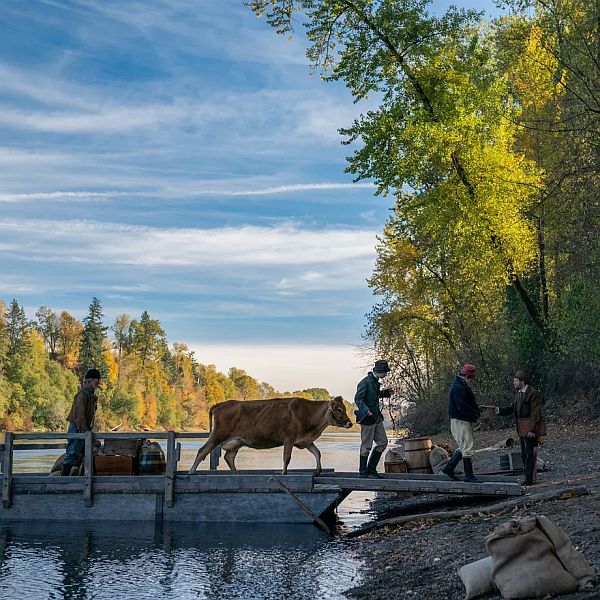
Reichardt: It was! I picked the kind of cow I wanted, a Jersey cow, and then they’d send me videos of the cows, and I saw this one and I loved her. We trained her to ride on a ferry, because cows don’t swim. But it was very superficial casting—I was looking for the prettiest cow.

Bong: With Okja, because we didn’t have an actual animal on set, the director of photography and I were quite lonely. So we actually created a stuffy that was the size of Okja so that the actors could touch and interact with it. With First Cow, I’m sure it was more comfortable. [Raises an image of the Okja puppet on his iPad.]

Reichardt: It’s so big! She’s still so beautiful!


Bong, do you always work with the same cinematographer?

Bong: With Mother, Snowpiercer, and Parasite, it was one cinematographer; his name is Hong Kyung-pyo. With Okja, I worked with Darius Khondji. I think any foreign productions I do now will be with Darius, and any Korean films will be with Hong. Do you work with the same cinematographer?

Reichardt: It was different every time, and then from Meek’s Cutoff on, always with Christopher Blauvelt. I like working with him so much—you’re not starting from the beginning every time.

Sims: Director Bong, I know you’re developing two projects right now—one English-language and one Korean. Can you work on multiple scripts at the same time?

Bong: Only in the very early stages. Once I start writing, I can only work on one project, and the same goes for preproduction. I’m always jealous of directors who can do projects in between TV shows. How about you, Kelly?

Reichardt: One project for me, too. I teach in the fall every year, and I make my class somehow wrap around all the things I want to research for the film I’m making. For this, I was showing them Ugetsu and The Apu Trilogy and Woman in the Dunes, because I wanted to look at [films] where people are [living in hutches and] on dirt floors.

Bong: Whenever I watch your films, I always want to visit Oregon, but I’ve never been able to. I’m curious what that place means to you in your body of work.

Reichardt: Please come visit! We’ll show you everything! You know, I started going there because my friend Todd Haynes [the director of films such as Carol and Dark Waters] moved there. I’m from Miami, Florida, which is very flat and white with blue oceans, and [Oregon] was so different for me. It’s a very [geographically] diverse state—it has a desert, an ocean, an old-growth forest—and it’s not like California, where so much has been filmed. You can be a little bit off the radar.

Bong: Where is the forest that you shot First Cow in?

Reichardt: Everything is a one-hour radius from Portland. You can go a very short way and be in the forest.

Sims: Did you shoot in an Academy aspect ratio [which is very square] because of the forest?

Reichardt: I really like the square. There’s room up top and on the bottom for the trees, and for the close-ups, it’s so nice. And the economy of it: It’s not capturing grand landscapes, but people who have very small lives.

Bong: Even when you see the forest, it feels very personal and intimate. I can’t imagine [the film] where you see more of what’s left and right in the image. The relationship these two men share [in First Cow] is so uniquely subtle and beautiful, and I think the aspect ratio really helped in establishing that.

Sims: That’s noticeable when we’re first introduced to King Lu: It’s very dark, and he’s naked in the forest, and the mood and the situation feels very enclosed.

Reichardt: This was, on a practical basis, the hardest scene, because of the darkness. I was trying to shoot day-for-night and not have it look too hokey, because it’s tricky to light that, but then it actually became night—the final product is a mix—and so I found it really challenging. We also shot it early on, and these actors didn’t really know each other yet, and we’re in the forest and it’s cold. So Orion [who plays King] is very vulnerable—he’s surrounded by this crew and he’s sitting there naked! In the story, they’re just meeting each other, so maybe the awkwardness works.

Bong: That first encounter between the two men is so subtle and delicate. Although the character is naked, you can’t really see his skin color, so it’s almost like the two characters have the same skin color.

Reichardt: Because of the way we shot it, they both look kind of green! Everybody in Oregon then was an immigrant, besides the indigenous people. This moment is so dark in America, you know, with the fierceness against immigration and the false narrative that we’ve [been] some white nation for forever. So I didn’t want [the message] to be too pointed, but it’s there.

Bong: How did you find Orion? I assume it’s the first time you’ve worked with him.

Reichardt: It was a very long search. I was Skyping with actors in China who didn’t speak any English, wondering if they could learn the lines in time, as well as learning a Native American language. Orion finally came to us and read maybe four times over a month or two, and he just kept coming back to my mind. We didn’t really have any references to connect over, with film or music. He loves Shrek, you know; we’re not on the same wavelength! But he was so game, and always interesting.


Bong: The chemistry between the two men is amazing. They both feel so vulnerable.

Reichardt: When we were shooting, we had them go into the woods for three or four nights with a survivalist. They learned how to build a fire without matches and to trap, and it was cold and rainy. We did this instead of rehearsing—this is how they bonded.

Sims: Do either of you favor rehearsals before you start filming?

Bong: I don’t really like rehearsals, but my films often involve a lot of complicated camera movements, so for those we will have physical rehearsals where we coordinate the blocking. But I try to keep that as short as possible. I really like shooting when it feels like people aren’t ready and things aren’t meticulously set up. I want to capture the awkwardness you find in those moments on the camera. It produces a strange sense of reality, though it’s not always easy.

Reichardt: I can’t afford to have [rehearsals]! In Meek’s Cutoff, which was a Western, we had a pioneer camp so [the actors] could learn to walk oxen and things like that. But I’m not into rehearsing—just having people learn how to do chores.

Bong, I have to go, but I wanted to thank you! I really appreciate your voice. I’ve been going through your list of new filmmakers you like, and it’s turning me on to new things. It’s so inclusive.

Bong: Some films are more poetic and more beautiful when you go into them not knowing anything about them, and I think your films are always like that. With First Cow, it’s something that a filmmaker like me could never imitate—so I’m very jealous.

Reichardt: [Waves hand dismissively.] Oh, come on. Come to Portland, Bong! Come to Oregon! There’s no show business there, we can just go out to eat, and Todd Haynes and I will just take you out into the woods.

The Director Whose Movies Make Bong Joon Ho Jealous.  The Oscar-winning Parasite filmmaker spoke with his hero Kelly Reichardt over videochat. The result was as delightful and nerdy as you might imagine. By David Sims. The Atlantic ,  March 4, 2020.


10/03/2019

Redefining the Western


What is a  feminist Western? It’s not a Western that merely “contains a woman,” which is how Lindy West memorably panned the 2015 film Jane Got a Gun. After all, what seems like the “most salient fact about the Western,” writes the literary critic Jane Tompkins, is that “it is a narrative of male violence.” It’s hard to watch their ostensible heroes when intractable manhood has so disrupted our social fabric. But what if those intractable heroes were women?

Several films in the last decade have run with this conceit: riffing on the masculinist genre, they don’t merely contain women, but their plots are generated by women and their stakes are for women. These recent films include Meek’s Cutoff (2010), True Grit (2010), and The Keeping Room (2014), which pick up the thread of idiosyncratic forerunners like Johnny Guitar (1954) and Forty Guns (1957). But two films that really crack open the feminist Western come from unlikely places: Indonesia and Pakistan. Marlina the Murderer in Four Acts (2017, dir. Mouly Surya) is a “satay Western” set on the desert island of Sumba, and My Pure Land (2017, dir. Sarmad Masud) is based on a real property conflict in Sindh, Pakistan. Both explore the possibilities of women-centric Westerns and attest to the quintessentially American genre’s enduring vitality abroad.

Marlina is the story of a young widow who avenges her attempted gang rape by poisoning and beheading her perpetrators. Its eponymous heroine carries her rapist’s severed head on horseback across a sunbaked island in an attempt to report her assault and seek justice. The film uses the Western’s genre conventions like a Trojan horse to relate a story from an indigenous society that is exotic even to most Indonesians.
Sumba is a dry island between Bali and Timor-Leste, many of whose inhabitants still practice an animist religion called Marapu. Marlina is one of them. By the time you’ve registered the click of her horse’s hooves, the panoramic shots of a dry landscape, and the monosyllabic dialogue, you are already deep within a story of a woman’s brutal assault. Her society is isolated, mystical, and patriarchal. Her intended rapists make her cook them chicken stew before they assault her, a demand whose logic is taken at face value. The characters wear red and blue Sumbanese hand-looms. The corpse of her recently deceased husband sits in Marlina’s modest house, wrapped in a woven shroud, which reflects the real Sumba tradition of keeping the dead around until you can afford their elaborate funeral.
In swift opening scenes, Marlina cooks dinner for and then murders five of her seven potential rapists, taking the head of their leader with her as totem and evidence. Marlina is a textbook genre protagonist: terse and impassive, she treads softly on a barren landscape, intent on vengeance. The lushly shot film revels in the notion of revenge as a feminist project.

My Pure Land, the feature debut of the British-Pakistani director Masud, is ripped from a real story of a mother and her daughters who defended their home from hundreds of armed bandits in rural eastern Pakistan. Filmed in Pakistan, it was the United Kingdom’s first Urdu-language entry for the Best Foreign Language Film Oscar. My Pure Land is based on the country’s ubiquitous and dangerous property disputes, of which there are over one million pending cases today, according to a title card in the film. Its major set piece is an armed standoff in which the teenage sisters Nazo and Saeda, their mother, and a young male friend fight off the sisters’ uncle and his hired squad of 200 armed bandits. The backstory is filled in, somewhat unevenly, through flashbacks: the girls’ uncle promises to take the house; their father teaches the girls to shoot; the uncle gets the father thrown in jail. In a typical Western move, the father tries to resolve the property through legal channels but is rebuffed. “Until one or two people die,” says the local police chief, there’s nothing they can do. They must take justice into their own hands.
My Pure Land’s breakout star is Suhaee Abro, a classically trained dancer, who plays Nazo, the elder daughter. Holding off the siege in elegant salvars, a long braid, and ramrod posture, Nazo reveals girlish reluctance in flashbacks, but, by the time of the main action, has become a terse, hardened sharpshooter. “In this world, nothing is more important than your honor,” says the girls’ father, who raises them like sons before he’s imprisoned. “Not even your life.” The dialogue would not be out of place in an American frontier town, but it shows why the Western stands to benefit from a change of location: it’s no longer a throwback. A Western set in a contemporary honor-code-bound society in Sindh or Sumba doesn’t have to be a period piece.


The film’s plot echoes that of The Keeping Room, an American nouveau Western from 2014 in which two sisters and their slave try to defend their farmstead near the end of the Civil War. (The Keeping Room co-stars Hailee Steinfeld, who has become something of a subgenre heroine, also starring in True Grit.) While the American property dispute had to be situated more than a century ago, My Pure Land is contemporary and requires no such transposition. Watching these films, it seems obvious that the genre that most celebrates and dramatizes vengeance would prove ripe for feminist storytelling. These “feminist Westerns” focus on women seeking justice, while retaining many of the visual and narrative tropes of the genre. Righteous fury is their topos; redress is their aim.
Marlina’s last scene is of a childbirth. If it is a little on the nose to follow so many gruesome deaths with a birth, it nevertheless goes far beyond what one expects to see on the screen of a “Western.” It is a reminder that there is much more of women’s lives to be shown within the genre than bar maids and victims. In My Pure Land, the dacoit recruited by the girls’ uncle implies that if he lets his men into the house, they will probably rape his family members. It’s a chilling threat that, again, feels surprising for its inclusion: rape is not usually considered a problem in the Western. But as the girls’ uncle memorably says in a moment of frustration in My Pure Land: “It’s different, these women have guns!”
The so-called death of the Western is a periodic refrain of critics, who have been prematurely eulogizing the genre for decades: “The [Western] hero represents a way of life that is becoming antiquated,” wrote Pauline Kael of Akira Kurosawa’s Yojimbo in 1961. “The solitary defender of justice is the last of the line; the era of lawlessness is over, courts are coming in […] The Westerner, the loner, must take the law into his hands for one last time.” But the individual fighting for justice in a lawless world will never be out of date when there is a constantly replenished supply of lawless worlds.

And precisely because of the Western’s unusual saturation of visual and narrative tropes, the genre is capacious and adaptable. Marlina, for instance, is set in a barren land (but on an island, and in Indonesia); it features a gang of bandits (who ride motorbikes); and has horses (indigenous Sandalwood Ponies). My Pure Land also has a gang of bandits and wide-open dusty landscapes, as well as a property dispute and a prolonged shoot-out. The distinctive and repeated elements of the Western can foster creativity, much like the metrical constraints of a sonnet.

Indeed, the genre has always acquired new life abroad. Sergio Leone made A Fistful of Dollars (1964), the first Spaghetti Western, because he thought American Westerns were losing their edge. A foreign critical eye was also instrumental to constructing the genre itself. Film scholar Tom Conley has argued that French theoretical texts like André Bazin’s “The Evolution of the Western” were foundational to the Western’s genre identity. In this vein, Marlina’s director Mouly Surya, a 38-year-old Indonesian woman, said pithily at a press screening in Jakarta that she thought of “[her] Western as a lens into the Eastern.”

The ingenuity of these two films does not come at the expense of the American Western, which has been quietly pushing its own boundaries. Little Woods, a 2018 film by the American director Nia DaCosta, tells the story of two sisters trawling the boomtowns and desolate landscapes of North Dakota to get enough money for one of their abortions. Tessa Thompson, who starred in the film, described DaCosta’s vision for a “modern Western” that specifically addressed “the gendered experience of poverty.” Set in the present-day United States, it requires no major change of place or time, just of perspective. And though it is not focused on women, it’s irresistible to briefly also mention the Chinese film director Chloé Zhao’s virtuosic 2017 Western The Rider, which was set, filmed, and cast on-site at the Pine Ridge Reservation in South Dakota — another community that would never have provided protagonists for the midcentury Western canon.


If there is anything that feels dated about the new feminist Westerns within the greater cultural moment, it is their focus on the lone crusader pursuing individual justice, as opposed to a broad coalition demanding structural change. The latter possibility has been the revelation and promise of #MeToo, as Moira Donegan wrote in the Guardian last year. “One approach is individualist, hard-headed, grounded in ideals of pragmatism, realism and self-sufficiency,” she writes. (These are the structuring values of the Western.) “The other is expansive, communal, idealistic and premised on the ideals of mutual interest and solidarity.” So while the pursuit of justice is certainly a resonant feminist narrative, we have been learning, of late and en masse, that it doesn’t have to be sought alone.
Does this doom the project of the feminist Western? I think not. The sea change in the pursuit of women’s justice comes only on the tails of thousands of single stories, the building blocks of the movement. Individual stories of injustice can do collective political work. Here’s to more feminist Westerns: may we make them, watch them, and create a world in which they really are all period pieces.

How Do You Solve a Problem Like the Western? By Krithika Varagur. Los Angeles Review of Books,  February 22, 2019.


When I started taking film classes in college, I was skeptical of westerns: the gunshots, the whiskey, the grudges held by machismo-oriented cowboys falsely worshipped for their towering egos. The genre didn’t seem worth sentimentalizing so much as critiquing for its apparent racism, sexism, and xenophobia. The first picture to upend my outlook was Johnny Guitar (1954). A vibrantly campy Technicolor with subtle indictments against mob psychology, McCarthyism, and sexual repression, the Nicholas Ray–directed movie stars Joan Crawford as a barkeeper forced to defend her recently opened business against a herd of angry townspeople eager to accuse her of criminal association. The truth is, they just don’t like her. She’s a newcomer, an outsider, and, worst of all, a woman with ambitions, content to live on her own. “She thinks she’s a man,” one employee grumbles, and something similar could be said for many of the women featured in the Anthology Film Archives series “Women of the West” (August 31–September 16), a slate of western films, old and recent alike, starring female protagonists. Curated by Hannah Greenberg, the program succeeds on multiple fronts, challenging traditional conceptions of the genre while also giving viewers a chance to expand their very definition of what constitutes feminism, as this roster of gunslingers, tramps, and so-called “Indian lovers” proves just how versatile and deceptively progressive the western genre could be.

It’s unfortunate that Crawford only starred in one western — not only because she looks amazing in denim, but also because she has exactly the type of soaring persona required for playing a classic frontier hero, walking into rooms with steely confidence. Thankfully we have Barbara Stanwyck to fill her boots, a queen of the range if there ever was one. She’s the star of Anthony Mann’s The Furies (1950), the program’s opening-night film and one of the most richly scripted and Shakespearean of screen westerns. Stanwyck stars as Vance Jeffords, a daddy’s girl whose blind trust in her wealthy father, T.C. (Walter Huston), slowly fizzles as he tries to dictate her personal life and financial standing.

Most summaries of The Furies claim that Vance’s clash with her father stems from the arrival of a persnickety stepmother (Judith Anderson). But the issue is more complicated than that, having less to do with paternal possessiveness than with Vance’s desire for greater self-determination. She wants partial control of the family estate as well as the right to choose her own husband; T.C., who craves control, responds by bringing home a new wife, cutting his daughter’s ties with the family business, and violently removing the Spanish-speaking natives who had been living peacefully on his land. Vance had always treated the natives as friends, while T.C. and his investors considered them squatters, thieves, illegal aliens. Their differences in opinion are at the core of The Furies, and one of the reasons its politics remain resonant today. Vance’s loyalty to her values and the actions she takes to exact revenge against her father and his monopolizing ways make her one of the most stirring of western heroines.

Stanwyck’s biting convictions also energize Allan Dwan’s The Cattle Queen of Montana (1954), a more straightforward western about a woman on a quest to reclaim the ranch that’s been stolen from her father. The perpetrator of the theft is a wealthy white landowner involved in shady deal-making with a group of native men whom he’s managed to manipulate by turning them into whiskey-starved alcoholics. A pointed statement about the machinations of power, Cattle Queen also sees Stanwyck trading barbs with a young Ronald Reagan and befriending some beneficent natives who are themselves seeking to restore their reputation in the eyes of narrow-minded whites.

Here and in other selections from the series, women are depicted as in alliance with “the other.” Their internal sense of justice is utilitarian, asking what is the most good for the most amount of people. So in addition to shooting guns, wearing jeans, and boasting nicknames, these heroines serve as voices of reason in an otherwise lawless land, subverting common Hollywood stereotypes of women as compromising femme-fatale figures, the cause of man’s fall from grace. But not all the “Women of the West” are rollicking female iterations of the John Wayne mold. For a more restrained audacity, one need only turn to Michelle Williams and director Kelly Reichardt’s collaboration in Meek’s Cutoff (2011). Though the film remains underappreciated, it’s a commendably brave western, straying from virtually every trademark of the genre and rejecting all traces of power from the standard masculine cowboy archetype. Earlier in his life, Stephen Meek (Bruce Greenwood) would have been considered a hero, glorified for his arrogance and graphic tales of native-directed barbarism. Now he’s a liar and a cheat, the jabbering idiot who led a caravan of covered wagons into the most dried-up, deserted corners of the Oregon Trail.

The pacing of Reichardt’s film is almost punishingly slow, but each shot is so deeply considered that it’s hard not to feel riveted by the currents of quiet intensity lurking in the fathomless horizon between land and sky. Will these people find water? Will they kill Meek? Will they go crazy and die? The tedium of the travel is relived with occasional breaks to fix a broken wheel, wash a bowl, or abandon a too-heavy heirloom. It’s during one of those pauses that Meek attempts to explain to the God-fearing, bonnet-wearing ladies in his crew why women represent chaos and men destruction. Emily (Williams) isn’t convinced. “You don’t need to patronize me, Mr. Meek,” she tells him matter-of-factly, and in her calmly stated impatience, one can sense her turning into a new sort of western hero: one who privileges hard-nosed common sense over unchecked ego.

It’s somewhat fitting that Anthology’s “Women of the West” would debut only six weeks after the close of the Quad Cinema’s series “The New York Woman.” If place determines plot and character — a symbiosis implied by the concepts of these programs — then it’s interesting to reflect on how the manmade metropolis of the city poses uniquely different problems for heroines than the valleys and vistas of the American frontier. While the women of the westerns are primarily moral agents grappling with issues of land, cattle, and pride, women of the modern city are prototypically identity-seekers, driven by their desires for self-growth in a bustling society. Whether it’s Crawford defending her right to run a business, Stanwyck claiming her right to own land, or Williams sewing the moccasin of a native man nobody else is willing to understand, the protagonists of“Women of the West” broaden the scope of screen feminism, questing as they do for peace, prosperity, and equality amid the mountain-dotted landscapes that have formed the backbone of some of the movies’ — and America’s — founding mythologies.

Joan Crawford, Barbara Stanwyck, and the Stealth Feminism of the Screen Western. By  Erica Peplin. Village Voice , August 31, 2018. 


The western is an iconic genre tied to the very genesis of cinema itself, but it doesn’t have the currency it held decades ago. That’s why it’s such a thrill to see Chloe Zhao’s “The Rider” and Valeski Grisebach’s “Western” — two highlights from this year’s New York Film Festival — reshape the genre from the ground up.

It’s only possible to appreciate that if you consider how far the genre has come. The western reigned Hollywood for decades—particularly from the ‘30s to the ‘60s. The genre’s appeal was that its unequivocal good vs. evil narrative could translate to any cultural zeitgeist. It wasn’t until Sergio Leone’s spaghetti westerns and Sam Peckinpagh’s “The Wild Bunch” that the genre began to shed its pat moralism and embrace the nihilistic recalcitrance of the late ‘60s and ‘70s. Post-Vietnam westerns became sites of gritty ambiguity and the heroic cowboy’s metamorphosis into an anti-hero with obscure ethics. Since these films questioned and subverted the western genre’s ideologies, they became known as “revisionist westerns.”

This label has since developed into an umbrella term that encompasses the many guises of contemporary western cinema. These films either imbue the western’s generic tropes within the modern era (“No Country for Old Men,” “Ain’t Them Bodies Saints”), focus on the genre’s marginalized characters, particularly women (“The Homesman,” “Jane Got a Gun”), or are a pastiche (“In a Valley of Violence,” “Slow West”). Even though contemporary westerns have splintered off into a wide range of defining narrative and formal qualities, “The Rider” and “Western” still manage to reinvigorate the genre.

Both movies employ a unique docu-fiction style, both Chloe Zhao and Valeski Grisebach cast actors to play versions of themselves and constructed narratives loosely based on their lives — and neither movie relied on a traditional screenplay. These inventive techniques provide a sense of candid verisimilitude rarely seen in the scrupulously-constructed western genre.

It is rare to see female directors behind the camera of male-centric westerns, and it is Zhao and Grisebach’s feminine perspective that attests to their fine critique of the gender structures reinforced by western cinema. These women dismantle the mythological masculinity of the iconic cowboy figure, fracturing the impetus of the “strong, silent type” through a sensitive examination of his vulnerabilities and rejection of masculine expectations. The directors also recodify other formal and narrative elements of the western, particularly the civilization versus wilderness conflict.
As a rodeo prodigy, Brady (Brady Jandreau) cannot stave off his zealous desire for life on the frontier—so much so that he’s willing to endanger his well-being. Despite a painful and traumatic head injury, he continues to pursue what he believes is his God-given vocation. “Once a cowboy, always a cowboy,” Brady reminds himself, and nothing will stand in the way of his indefatigable commitment to riding horses.

Zhao pictures this pious act with an exquisite cinematic beauty and poetic reverence; shot in slow motion, the viewer reveres each muscular ripple of the regal galloping creature’s back and lingers on Brady in a gentle repose as the breeze rustles his hair. Zhao also conveys Brady’s idolatry of the frontier through stunning Fordian landscapes of pastel-purple skies and golden sunsets that are so expansive they seem to swallow up his tiny figure. When juxtaposed against the harsh fluorescents of his monotonous dollar store job, the exteriors of his Midwestern home seem positively mythical.
Being a cowboy is the very fabric of Brady’s identity. His stalwart father (Tim Jandreau) encourages him to “be a man” in the model of western genre heroes past, a paragon of immutable strength, and continue riding. With his monk-like taciturnity and obdurate gaze, Brady certainly embodies the “strong, silent type,” but when his injury worsens and hands frequently freeze up in a fist, Brady fights the urge to speak up. His cowboy friends—who have all endured their fair share of rodeo wounds— insist that he must “ride through the pain.” But what happens when the pain is truly too great? Does admitting that make him any less of a man? His best friend and ex-rodeo star (Lane Scott) left paralyzed after a riding accident should serve as a cautionary tale, but somehow he motivates Brady to persevere.


Brady is just as devoted to his family as he is horses. Left without a mother, he cares tremendously for his sister with developmental disabilities. On the other hand, Meinhard of “Western” (Meinhard Neumann), the “strong silent type,” embodies the preeminent shot in “The Searchers”; like John Wayne’s character, he has no familial ties and is caught between a proverbial doorway that either leads into the embrace of community or enables him to retreat back into the darkness of his nomadism.
“There’s nothing to keep me at home,” is one of the few autobiographical facts he admits, along with his past as a Foreign Legion soldier. Despite his pacifism—“violence isn’t my thing”—he’s ready to defend his friends when needed, as demonstrated in one scene when he swiftly threatens an interloper with a gun after he dares to cross his new friend. The reformed fighter and outlaw, or a man who has buried the violent sins of his past, is a common western archetype.

Disgusted by his cruel boss, a brute who teases women and steals the community’s water supply, Meinhard rejects the herd mentality of his savage and hyper-masculine construction crew who infiltrate the Bulgarian countryside. Eventually, Meinard discovers a white horse, its color symbolic of a peace offering for the suspicious but congenial inhabitants of the nearby village. His conflict diverges from Brady of “The Rider” because he wishes to abandon the frontier and find solace in others, leading him to construct a makeshift family of his own out of the villagers. Griesbach also displaces the western’s American setting for Bulgaria and reconfigures the xenophobic cowboy vs. Indians narrative through the tense German and Bulgarian relations.

Both “Western” and “The Rider” are distinct portraits that revitalize the contemporary western. While the definition of a western today is multifarious—no singular aspect emblematic of its makeup— “The Rider” and “Western” stand apart from all others through the combination of their feminine perspective, rejection of the cowboy figure’s masculinity, and docu-drama styles. If they provide us a window into the modern state of the genre, it looks a lot brighter than it did a few years ago.


Westerns, Redefined: How Two New Movies Provide Fresh Meaning to a Dated Genre.  By  Caroline Madden .  Indie Wire , October 12 , 2017. 


Even before its Venice premiere last year, Lean on Pete was dubbed “Andrew Haigh’s Wendy and Lucy”. Both films follow a homeless outsider’s journey across the American west with an animal companion. More importantly, Haigh and Kelly Reichardt, (who directed Wendy and Lucy) are cut from the same cloth, both aesthetically and in their outlook on the world. Their work is patient, subdued, and focuses on the quiet lives of lonely people.

Now that Haigh has contributed to the western genre in which Reichardt so often operates, their similarities are even more evident. Classic westerns of the ‘50s and ‘60s often told the story of ‘great men’: heroes or outlaws whose names are spoken with fear or reverence by the townspeople. Films like Butch Cassidy and the Sundance Kid and The Outlaw Josey Wales even mythicised these names further by using them as a title. These were often stories of masculine white male cowboys traversing the sprawling American west on horseback, the fates of lowly villagers and vulnerable women in their hands.

Haigh and Reichardt both set their films against that traditional western landscape and follow the journey of a lone wolf character. But at every turn, Haigh and Reichardt subvert western tropes in an effort to truthfully depict life in this isolated and disenfranchised part of America. Perhaps that’s because Haigh and Reichardt are outsiders to the genre themselves. Neither grew up in the American west: Haigh is British, and Reichardt is from Miami. Both are members of marginalised groups who would have been sidelined or ignored in a Clint Eastwood or John Wayne western (Haigh is gay and Reichardt is a woman). Why indulge the heteronormative, white male gaze when you don’t benefit from it? Their approach to this often-stereotyped genre is quietly radical. It insists that their lives are just as worthy of the big-screen treatment as the sweeping adventures of a muscular, stoic man in a cowboy hat.

With Lean on Pete, Andrew Haigh chooses to centre a powerless protagonist. Charley (Charlie Plummer) isn’t a saviour; he needs saving. Westerns often follow a man’s journey to rescue a woman in distress, but Charley is looking for his long-lost aunt because he needs her. Yes, this is a white, male figure crossing the American west with a horse, but Charley has none of the advantages of most western heroes. He’s poor, scrawny, and lacks confidence. He has no capacity to assert masculine dominance — not even by riding his stolen racehorse, Lean on Pete, who is too weak to support Charley’s weight. His journey across the desert is not an epic, exciting adventure; it nearly kills him.
Similarly, Reichardt doesn’t just re-examine the traditional hyper-masculine western hero; she completely re-defines who that hero can be. Reichardt has set all but one of her films in the midwest (her debut, River of Grass, took place in Miami). She set about questioning our expectations of cinematic stories in that setting, often focusing on the place of women within midwest society. Meek’s Cutoff is a period piece about pioneers travelling across Oregon in the 1800s, privileging the perspectives of the often silent and powerless women. Wendy and Lucy is about a homeless woman fending for herself, with nobody but her dog for company. Certain Women tells three lonely women’s stories about searching for connection or resigning themselves to solitude. Reichardt’s women tend to be self-sufficient and are rarely defined by the men around them — and if that isn’t the case, as with Meek’s Cutoff, it’s to prove a well made point about patriarchal dominance and internalised misogyny.

The image conjured up by a classic western is a lonesome cowboy riding his horse off into the sunset. Reichardt and Haigh both subvert this image, disempowering it. Both Charley and Wendy are lone figures traversing the midwest, but they never dominate their animals by riding them. The closest Reichardt’s films come to an act of heroism is not an action-packed rescue mission but a woman selflessly giving up her best friend. Like Charley, Wendy finds solace through caring for her animal companion. Pete is too weak to be ridden, and Lucy is a dog. Both animals demand the kind of care and attention that Wendy and Charley desperately desire for themselves but are powerless to provide to their animal companions. Pete gets hit by a car, and Wendy decides to leave Lucy with an elderly couple who can better take care of her.

Reichard and Haigh use cinematography to subvert the western’s insistence on the power of the west itself. Classic westerns were often about conquering the land; they were shot in cinemascope aspect ratio to ensure the terrain of the west looms large in the frame. To take just one example, The Magnificent Seven is filled with romantic wides of the band of rebels travelling across the plains, dwarfed by their majestic surroundings. But Lean on Pete uses the squarer 1.85:1 aspect ratio, and Reichardt’s films operate between 4:3 and 1.85:1. Haigh’s and Reichardt’s protagonists don’t waste time marvelling at the landscape. There’s enough to concern them in the foreground of their lives for them to bother with its backdrop. The landscape is merely their environment, not a sight to behold, so it’s shot to reflect the characters’ state of mind rather than to let us marvel at its beauty. The only time Charley is reduced to a small figure in a vast landscape, it’s at his lowest, loneliest point, which communicates how Charley feels — small and powerless.

While traditional western leads tend to be dominant, stoic, and powerful men, Haigh’s and Reichardt’s marginalised characters are compelling because they don’t conform to that archetype. Unburdened by white male narcissism, they are more emotional and sensitive. Charley’s youth makes him vulnerable, but his steadfast, almost innocent belief that a loving home is out there gives him the titanic resilience required to keep moving when it looks like all hope is lost. Wendy has nothing, but her compassion for Lucy keeps her striving to find a home for the two of them. What would be weaknesses in a cowboy are virtues to Reichardt, Haigh — and their audiences.

Reichardt’s films in particular make seemingly powerless characters compelling by underlining their strengths. In Reichardt’s Certain Women, The Rancher (Lily Gladstone) is the youngest of the three lead women and the most evidently an outsider, as a queer Native American woman who lives on an isolated ranch away from town. She is unbearably lonely but not yet jaded by the world, so she has an immense capacity for love and a yearning for connection. In Meek’s Cutoff, the Indigenous man captured by a group of settlers might seem the most vulnerable, but ultimately, being an outsider to their group allows him to outsmart the settlers and take agency over their fates. He tells them that he’ll lead them to water, but it’s up to him whether he fulfills that promise or leads them to their deaths, instead.


Most of all, Reichardt and Haigh resist the western’s narrative simplicity: the idea that these characters can triumph, and their stories can end. There are no easily defeatable villains for Reichardt’s and Haigh’s outsiders to combat, so there’s little of the catharsis that you might find in the action-packed finale of a classic western centred on conquest. The forces holding these outsiders are either so huge and systemic (sexism, racism, homophobia, poverty) that they can never be completely eradicated, or internal demons that stop characters from finding peace in themselves. 

Meek’s Cutoff and Wendy and Lucy end on notes of ambiguity, as we’re left to wonder whether these characters will overcome what holds them back. Charley’s and The Rancher’s stories end in a new beginning. Their triumph is that they’re able to carve out a little more space for themselves to live stable lives. Charley finally gets to stay in one place and start being a normal teenager. We leave him when he finds a safe home where he can start building his identity and make memories with his aunt.
The Rancher’s long journey to meet her object of desire ends in rejection, leaving her heartbroken. It’s not a grand romantic finale, or even a particularly optimistic ending: she’s given a reality check that her dreams of love and a more exciting life might not come true. But this realisation allows the Rancher to return to her lonely, comfortable life on the ranch with a greater understanding of her place in the world. It may not be epic or life-affirming, but it’s the truth.

Haigh and Reichardt are modernizing the western. By Orla Smith.  Seventh Row  , June 18, 2018. 


When you picture what a modern auteur of the American West should look like, Chloé Zhao isn’t the stereotypical choice by a long shot. But now with her second, Spirit Award–nominated feature film The Rider, the Beijing-raised writer-director has established herself as a distinctive poet of the Plains, particularly of South Dakota’s Pine Ridge Indian Reservation, and the dramatic Badlands National Park that intersects it. Her 2015 debut, the coming-of-age feature Songs My Brothers Taught Me, was her first dispatch from the region; now The Rider, which opens in limited release this week, announces her as a major filmmaking voice.

Like Songs before it, The Rider is a vérité hybrid, starring ex-rodeo cowboy Brady Jandreau as Brady, a Lakota ex-rodeo cowboy coming to terms with the head injury that has forced his early retirement. His family and friends also star as themselves, including Lane Scott, another real-life rodeo star who suffered significant brain damage after an auto accident. The world of rodeo riding will be exotic to many viewers, but Zhao’s film immerses the viewer rather than overexplaining its world. “I’m not an intellectual and I can’t make films from an intellectual perspective,” she told me when I talked to her this week.

 But make no mistake: Zhao is not a passive filmmaker, and there are sequences she has composed in The Rider that will stand as some of the most breathtaking of the year. I talked to her about her intuitive approach to filmmaking, rethinking the Western, how an adolescent obsession with Mongolia brought her to the Dakotas.

EY : I don’t know if I mentioned this before, but I went to school with Alex O’Flinn, your editor. ? 

CZ : Oooh. Alex is so great.

ET : Totally. And it’s such a great editing job too. I think this time, watching it again, I had a new appreciation for it. ?

CZ : I’m so happy he got nominated for that. [Note: O’Flinn was nominated for a 2018 Independent Spirit Award for Best Editing.] With my first film it was such a difficult thing to have a film [shot] like this, and then to have someone come in later [to edit it.] Because we never got money before we made the film. That was after editing it, showing a cut to people, and then they come in with money. So my first conversation with Alex, I was like, “Oh, I feel really good about this. He’s gonna get it.” Because his process is very … a traditional, conventional editor is not going to thrive in this sort of situation. The way me and Alex collaborate, and our temperament just works so great together.


EY : There are many aspects of the film that walk up to that line of documentary, but I think the editing might be the most important. It’s so integral to communicating these sort of unspoken themes and making these connections between the characters and their environment. ?

CZ : You really find moments in the editing, because when you’re shooting … I mean, one thing that me and my DP [Joshua James Richards] have learned is that when these amazing moments happen spontaneously, just calm the fuck down. And then get coverage, because we can use that. That’s what I learned from my first film.

EY : The scene that makes me think of that is the one where Brady is trying to break the horse. It feels like it’s almost one unbroken shot, and it’s so tense, but also intimate in a really unexpected way. At the last screening I was at, I heard a woman behind me exhale once the scene was over — it’s that gripping. Did that moment take you by surprise at all?

CZ : No, I mean that horse, Jim — we know that horse. I’ve known that horse for a year. I knew that horse was gonna be like that, and Brady’s been training that horse for a while. But when we were editing, it was me and Alex, and we were really trying to figure out how long we could keep these moments going. Is the audience going to get bored? We really want to show him [working with the horse], but how long can we show it? Because we’ve seen it so many times. But we really wanted people to see that he’s doing it for real, you know?

EY : But a person, say, stepping off a New York City street to see this in a theater is getting thrown into this completely different place and tempo. It automatically kind of resets your clock, and makes you sit up and pay attention to everything. ?

CZ : That’s what Alex was so great to remind me of. He’d always say, “Chloé, I know you feel like this is a lot, but people are just seeing it [for the first time] … You think this is boring, but don’t take it out because people are going to [get it.]”

 EY :  I’ve been thinking about how you shot this landscape, and in general, the way images of wide open country and pastoral America have been used over time. I think as critics we tend kind of use the same language over and over to describe it. Like “stunning landscapes,” “big skies.” But I sense that there are a lot of unique choices going into how you shot The Rider. It has a depth to it that not every movie about the American West has. ?

CZ : I think sometimes you have to be very specific to be universal, and we were in this little area that I know, which is the Badlands in the southwest of South Dakota. And that didn’t come from, like, “I have an idea of what America should look like; I’ll call a location scout and find something that looks like what I think America should look like.” I ended up there, so that’s what America gave me. And so when you have a very good relationship with that landscape, you just show up to shoot. And so do the people in it. So I think all [those relationships] build up these layers that might be the reason why it feels different.
And also because I lived in that landscape for so long, as a city girl, I understand that there’s nothing romantic about it. It’s scary and brutal and beautiful at the same time. There’s both violence and nurture in that nature, and these people live their lives and risk their lives and are nurtured by it every day. So I can’t pinpoint the exact plan, but it was both me and the cinematographer, who has really an eye for finding both the beauty and the roughness in that landscape. And even in the editing, we tried to show this landscape from Brady’s perspective. So the people are really part of that landscape.


EY : The light and the time of day I noticed a lot — the quality of light. ?

CZ : Yeah. People were asking me about, like, “How do choose which part of the Badlands to shoot and all that?” One thing with the Plains is, it looks the same wherever you point the camera. It’s all about the time of the day, and how much moisture there is — the season. I know I’ve gotta shoot in September or October. It’s one of the most beautiful times. In November, you risk a storm coming in, the Badlands change color. So that will dictate our shoot — we don’t shoot until 2 p.m., and we shoot until the sun goes down, and we look at the clouds.
It’s very similar to how Brady works with the horses. They would come out later in the day because it’s hot. They would make this decision based on weather, and so would we. Sometimes film shoot [schedules] don’t make these decisions.

EY : I wouldn’t have even thought about that. I mean, I grew up in the Midwest, and not too far from there, but I never went to the Badlands the entire time I lived there.?

CZ : It’s called the Badlands for a reason. It’s very interesting, I saw in a little booklet in one of the gas stations, it says it’s the kind of place where it really attracts a specific type of people, and it’s either for you, or really not for you. And those people have remained there for generations.

EY : Your previous film, Songs My Brothers Taught Me, was also shot there. What brought you to that region initially?

CZ : There were a lot of things that lead to it. It’s very much … there was a lot of luck involved, you know, and it definitely goes back, way back. I lived in Beijing and I fantasized about Mongolia, inner Mongolia. I had been there before and it was something very freeing to me — with the sunsets, all that stuff. This was all in my head.
 But I ignored that completely until I was about to turn 30, and I was in my senior year of film school, and I realized, I don’t really think I can do a film in New York. I’ve gotta go somewhere else. I wanted to go somewhere where time has a different value than here, because you have to change your lifestyle completely to of rediscover yourself. You can’t just go out of town on a weekend. So I kind of got myself out of New York and got a driver’s license and drove west. Also, at that time, it just so happened that the media was really interested in Pine Ridge and all the struggles young people there were going through at the time.
And I saw these images [coming from Pine Ridge,] and I just was struck by the contradictions of a young man on a horse — a dark-skinned Lakota boy on a horse, but he’s in an urban hip-hop culture outfit, and he’s next to this really terrible government housing that looks like part of the projects, but then behind him is the most gorgeous sunset in the Badlands. So you’re like, “What is happening here?” And also, you know, seeing light-skinned Indian cowboys, you see these images and you’re like, “Okay. Something is going on there.”


EY : It’s a kind of cultural fusion that isn’t exactly the first thing you think of when you think of the American “melting pot.” You talk about knowing that you needed to leave New York to tell a story, even having come there from somewhere else. It seems to me a lot of people come from all over to New York or L.A. to start their careers as filmmakers, and in some ways that’s great, but also a lot of diversity of perspective can get sanded away. ?

CZ : I was living in Williamsburg, you know? It’s not New York’s fault, but it’s more like when everyone is so conforming to a style and a trend, and when there’s so many of them, it’s hard to keep track of who you are. And as a filmmaker, even just the noise itself, the industry, the constant opinions. Who are you really underneath? And I’ll go on retreats into the mountains and come back to New York. There’s nothing romantic about it — it’s literally just so I can be with myself, without the phone, and without a signal.

EY : For The Rider, how much formal research did you do on the life of a rodeo cowboy, and how much were you just sort of immersing yourself? Maybe there’s a lot of overlap between the two. But how much did it feel like you had to do homework?

CZ : Very little homework. Because again, I’m not an intellectual, and I can’t make films from an intellectual perspective. I can’t, I wish I could. So research wouldn’t help me. A lot of watching, listening, spending time with people, and just also trusting that you are gonna stay true … It’s all in how you conduct your set and how you plan on making the film. If you’re gonna do it in a way that everything has to stop for you, then [the defense] of your authenticity is going to be dramatically weaker. But if you know you don’t have money, you don’t have a lot of support … then you just go with what’s there. That’s a good gatekeeper. It’s difficult, because you’re making a movie. You need some things to show up on time and to be happening on time, so you have to write a story that doesn’t rely on these huge plot points.

EY : So you can be more flexible.?

CZ : Yeah.

EY : I did a Q&A with [The Florida Project director] Sean Baker last fall, and he makes such a clear point of distinguishing between first-time actors and nonprofessional actors. He had an experience with an actor years ago where people in the press were calling him a “nonprofessional actor,” but the guy was in fact trying to break into acting. But there was this underlying attitude of, “Well, he’s not a real actor.” ?

CZ : And what’s a real actor, you know?

EY : Right.?

CZ : Sean’s a longtime friend. I’ve heard him saying that. We’ve talked about this. Werner Herzog said it best. He said, “There’s no such thing as actors and nonactors, there’s only authentic performances and non-authentic performances.” You have somebody who went to, like, Strasberg School or wherever, Juilliard, and then try to play a cowboy. And, look, Paul Newman did a great job of it back in the day, but that person could just as easily do a terrible job. So the idea of an actor being someone who can act is … What’s a professional actor? Does it mean that person can act better than the other person?


EY : It feels more like a professional delineation. Like, you decided to act, as opposed to being a rodeo rider, for example.?

CZ : Yeah, so I guess therefore you’re SAG maybe, if you are an actor, and then you are … I guess this profession should be respected … I can understand that for the purpose of unions and stuff like that. If you’re going to get technical. But to suggest … I guess it’s sad for someone who wants to act to be called “nonprofessional.”

 EY : Yeah, there’s some invisible line where people believe that you’re serious about it.?

CZ : Well, when it comes to the horse training, you have professional horse training and then you have every shade of horse training below that. So I think acting’s the same. Where do you draw the line? Is Brady a professional actor now or is he still a nonactor? Because he’s not pursuing this full time, but now he has acted.

EY : I was going to ask about him pursuing it.?

CZ : He should. I think the right role needs to come along and he’ll see if it makes sense, but would you call him a nonactor, or …?

EY : I mean, no. But when I first saw the film last year, I definitely left thinking of it as a “nonprofessional actor role.” And then the second time, what really hit me was the scene late in the film after he visits [Jandreau’s real-life friend] Lane again in rehab, and he just breaks down in the car. And that performance, I mean, you couldn’t create that any other way. But it’s a real work of acting and directing, and it’s not some piece of found art.?

CZ : That also was shot a week later. You know, he’s getting in the car, we’re chatting, and I have to get him into the mood. That’s acting, you know?

EY :   Did he have a really instinctive feel for that? How to bring that emotion up?


CZ : Well, we were going use Lane [as a focus for the emotion of the scene.] But he was actually so happy after seeing Lane the week before — “Look at the work he’s done, I’m so happy.” So we had to go back to … it’s a lot of memory stuff. Same with working with professional actors, no difference. Childhood memories. But the environment maybe was a little bit different, in that it was just me and him. No cameraperson, no sound person. We were just driving around by ourselves. And if we had a professional actor that would have maybe been [different]. But even when I’m working with professional actors, I would still want to clear the set when it comes to very personal things.

EY : So, The Rider has just been on a nonstop festival tour this past year. I’m sure you’re totally exhausted, and I don’t know how much you’re thinking about where you’re headed next as a filmmaker. ?

CZ : Yeah, The Rider came, as I told you earlier, as such a quick turnaround, so I’ve been developing stuff along the way. I’m working on a historic Western about Bass Reeves, who was a U.S. deputy marshal working in Indian territory. He was born into slavery but escaped in the Civil War and lived among the tribes. So it’s his life story. And then a small little road movie, and a little sci-fi.


EY : Nice. It’s been so interesting, between your film and Dee Rees with Mudbound last year, and a few others, seeing these genres like the Western or the historical drama getting a new perspective from artists that don’t usually tell these stories. I think that’s been really a joy. Because I’m not the number-one historical-drama fan. ?

CZ : Me neither.

EY : But if there’s new perspective on it, I’m all there for it. ?

CZ : Well, there’s a reason why we’re not a fan of it. It’s the same as me not watching a lot of Westerns growing up. There’s a reason, because there’s not much we can relate to.


Chloé Zhao Is Rethinking the Western. By Emily Yoshida. Vulture  , April 12 , 2018. 


Walking through a rapidly gentrifying neighborhood of Portland, Ore., in July, Kelly Reichardt noticed a group of teenage street punks. They had dreadlocks and dogs and dirty clothing emblazoned with hand-drawn anarchy symbols. Reichardt faltered for a moment, and then crossed the street. She told me that she suspected one of them had begun shooting up on a garage roof next door to the house where she was staying. “My instinct is to call the cops,” she said. “But then it’s like, God, whose side am I on?”

The scene would have played differently in one of Reichardt’s films. Her moment of hesitation would have been barely perceptible; her lines would have been cut. The camera might have lingered sympathetically on the pockmarked face of one teenager before panning back to Reichardt’s. Her reaction would have been inscrutable.

Reichardt, who is 52, has made a career of silence and suggestion — of casting an attentive but unobtrusive gaze on people who can never quite seem to win. She is interested, she says, in characters “who don’t have a net, who if you sneezed on them, their world would fall apart.”
Like her films, Reichardt is short and lean and soft-spoken. It is difficult not to feel brash in her company. You want to whisper, and whatever intimacy is established seems tenuous. The vibration of a cellphone is enough to break the spell. We met at the small cottage Reichardt rents for a few months each year in Portland, where she socializes with a small coterie of artists, including her occasional writing partner, the Oregon-based novelist Jon Raymond, and Todd Haynes, who has executive-produced five of her six feature films. Reichardt regularly shoots her films in this corner of the country, using the backdrop of Oregon’s conifer forests, high deserts and shabby strip malls to portray lives led on society’s outer rim. “The characters are just sort of an extension of the landscape they’re in,” Reichardt said, after we sat down to lunch at the kind of self-conscious cafe that would never appear in one of her movies. “They’re a product of the places they’re from and their troubles — their everyday troubles.”

Whether set on a cooperative farm (“Night Moves,” a 2013 eco-terrorism thriller) or in a desolate parking lot (“Wendy and Lucy,” a recession-era character study), her films are all, in their own strange way, westerns. The shots are rife with the genre’s archetypal motifs — horses, trains, buttes — and the quiet stories she tells, of lonesome, seminomadic searchers struggling to maintain dignity in the face of seemingly insurmountable odds, fill the screen as forcefully as any film that John Wayne was ever in. Reichardt’s protagonists tend not to be men, however, but emotionally inarticulate women, whose problems the supposedly civilizing force of frontier justice never proves strong enough to fix.

While a lone man can be a hero — readily and right from the start — a lone woman is cause for concern. Despite their painterly settings and near-silent soundscapes, Reichardt’s films are animated by a sustained unease. The viewer anticipates a threat that could but never quite does progress to a state of emergency. A car crash produces no injuries. A nocturnal encounter with intoxicated homeless men does not result in sexual violence. An old man gives every indication he could die at any moment but does not. The menace is durational and transforms the audience into participants in a kind of endurance art. It’s the low-grade but unrelenting sense of hazard that is a woman’s experience of merely moving through the world, an anxiety so quiet and constant it can be confused for nothing more than atmosphere.

The daughter of a crime-scene detective and an undercover narcotics agent, Reichardt grew up in Miami, which she alternately describes as “survivors playing canasta,” a “cultural void” and “the place, from the third grade on, I fantasized about getting out of.” Thurston Moore, of Sonic Youth, who was born in the same hospital as Reichardt and spent his early years in South Miami, once told her that he saw an ad in a local paper that read, “If anyone’s ever heard of the Clash, please call me.” “That,” Reichardt said, “is the best description of the Miami I grew up in.”

She dropped out of high school after 11th grade, worked in a clog shop for a while and a record store for a little longer and eventually caught a ride to Boston in the middle of winter. “I had never seen snow before, and I was there in my little Miami clothes,” Reichardt said. “In my mind it was a blizzard, but it was probably just snowing.” She arrived at a friend’s empty apartment, settled in and, as she recalls, “was sitting there pondering how my new life was going to go” when she heard a knock at the door. “There were two people there,” Reichardt says. “Now I understand the get-up, but there they were in Salvation Army granny clothes and combat boots and he had his shaved head.” She had never seen such people and couldn’t even tell how old they were. “They were like, ‘We live across the street and our freezer’s broken and we have some hamburger meat in that fridge.’ And I looked, and indeed there was hamburger meat in the fridge. And they said, ‘So you want to come have spaghetti with us?’ ” 

The dinner was Reichardt’s first introduction to any sort of life outside the mainstream. She began sleeping on her neighbors’ couches, attending their parties. She took night classes to get access to equipment, which she used to film their projects; the films, in turn, became her application to art school. After graduating from the School of the Museum of Fine Arts, she moved to New York City and, after a few years, began writing her first feature film, “River of Grass.” 

Reichardt once described “River of Grass,” which was met with positive if not career-catalyzing reviews, as “a road movie without the road, a love story without the love and a crime story without the crime.” It was released in 1994, a full 12 years before her next movie. She spent half that time couch-surfing, including a few months in Hollywood, trying and failing to get something made in a place that, as she realizes now, required skills like pitching and schmoozing that she didn’t even knew existed. “I came back to New York thinking: This is torturous. What do I even like about this?” she said. “The answer, it turned out, was: I like holding my camera. I like shooting and thinking about frames.”

She went back to making short Super 8 films, mostly shot outside. “They were really not good,” she insists. Still, one made it to the Venice Film Festival. “Of course my producer and I weren’t invited to any of the parties,” she said. “So we sat on the riverbank and watched these parties that were happening on boats. It really was an epiphany. I thought, This is exactly where I want to be: not at the party but on the bank of a river, with my friend, looking on at it.”

She used $30,000 she inherited from a great-aunt to make “Old Joy,” a misanthropic buddy film shot on 16-millimeter and co-starring the indie-rock musician Will Oldham. Since then, Reichardt has worked continuously, releasing a new film every two or three years. For her, this pace is an act of self-preservation. “I’m not great with the production of real life — the car, the insurance, the dentist — all those things that seem to mount up if you don’t have a project and become the meat of your day,” she told me.

If Reichardt’s ineffectual years in Hollywood taught her anything, it was the value of identifying undesirable ways of working and living — and then developing the confidence to avoid them. She lives alone in a rent-stabilized apartment in New York and maintains a normal person’s sense of money. “It’s still like a house,” she says when the budgets for her pared-down productions come up. In exchange for working outside the system, she has earned the privilege of final cut. “Nobody comes into my editing room, ever,” she told me. “Art by committee is a really bad idea.”

“Certain Women,” her latest film and arguably the most precise expression of Reichardt’s vision to date, is a triptych based on three short stories by the Montana-raised author Maile Meloy. It follows a small-town lawyer (Laura Dern) trying fruitlessly to convince a man injured on a contracting job that making a claim against his former employer would be hopeless; an unhappily married couple (Michelle Williams plays the wife) in the midst of harvesting sandstone for a weekend house; and a recent law-school graduate (Kristen Stewart) who becomes the object of fixation for a reclusive female ranch hand. Though each restrained vignette is connected by only a blink-and-you-miss-it narrative delicacy, an active loneliness unites the characters, whose inner desolation seems at least in part a reaction to the barren winter plains of southern Montana. Like so many of Reichardt’s protagonists, each of the women is a “figure of repose,” to quote Robert Warshow’s famous essay “The Westerner” — people whose “melancholy comes from the ‘simple’ recognition that life is unavoidably serious.”

Williams, who has acted in three of Reichardt’s films, characterizes the director’s work as “38 things buried under the semblance of nothing.” When she first read the script for “Certain Women,” she thought there were pages missing. “As an actor, you cling to things like back story, what your character says and does,” Williams told me. “But silent communication is actually how we experience our lives. ... We go along all day without saying anything that you can really pin something to, nothing someone could point to and say, ‘Hey, it hurt me when you said this.’ ”
Like the Dardenne brothers or the Italian Neo-Realists or a mud-encrusted Robert Altman on the set of “McCabe and Mrs. Miller,” Reichardt is devoted to showing the texture of genuine hardship. She is preoccupied with the cruelty of inattention and the rote motions that make up a person’s day. Where does someone who lives in a car brush her teeth each morning? What does someone working two jobs look like, move like at the end of the day, knowing she’s about to get up and do it all again?
Reichardt, as if in solidarity with her characters, is herself made uncomfortable by comfort. She embraces a grueling production process that mimics the precarious existences she shows on-screen. When critics and cinephiles lament the demise of low-budget filmmaking, they’re almost always talking about projects that cost many times more than Reichardt’s. “Certain Women,” which was made for around $2 million, is by far her most expensive film to date. Her 2006 movie, “Old Joy,” cost $100,000; “Wendy and Lucy,” from 2008, $300,000.


You can romanticize it — and maybe it is adding something — but it also just means that I’m not getting paid, and I’m in my 50s,” she jokes. Gus Van Sant likes to remind Reichardt that with more money come new problems. “I’m sure it’s absolutely true,” she acknowledges, “but I think I’d like to try some of those other problems.”


Of her many inhospitable sets, the one for “Meek’s Cutoff,” a re-enactment of an ill-fated Oregon Trail journey and Reichardt’s only “true” western, was the most hostile. There were rattlesnakes and tornado-speed winds; it was 110 degrees during the day and 20 degrees at night. Actors came down with heatstroke and hypothermia. “Google is not research,” she said. “Research is a lived thing.”
Reichardt elicits unparalleled performances in part by creating conditions under which actors cannot act. Frequent appearances by animals force improvisational gestures, as does bad weather on set, which is incorporated into scenes instead of avoided through expensive scheduling changes. It was well below freezing and gray when “Certain Women” began filming in Montana last spring, and by lunch the camera crew was in tears. Nobody but the actors and a limited crew were present — no studio executives, no onlookers. “No one really wants to sit out in 18-degree weather and see what you’re doing,” Reichardt explained. “They’re hard places to get to by design, and it makes for an insular, private world.”

Last October, five months after filming had wrapped, I visited Reichardt at Skywalker Ranch, George Lucas’s Arcadian 6,000-acre estate in Northern California, where various rooms and buildings — sound-editing suites, mixing stages, screening rooms — are routinely rented out by Hollywood postproduction crews.

With the state-of-the-art technology and all the parking lots hidden from sight, the grapevine-trellised campus looked like a wellness spa or the location of a rigorously hashtagged six-figure wedding. Guests can swim, ride bikes, drink proprietary wine and eat gourmet meals prepared with vegetables grown on the premises. She was grateful for it, but the entire setup agitated her. It was too nice.
Reichardt was there to get through a few efficient days in the studio with Kent Sparling, a sound designer with whom she worked on “Night Moves.” The two had already clocked nearly 100 hours side by side in foam-padded rooms, and their rapport was one of affectionate bickering. Like everyone else who comes into contact with Reichardt, Sparling — who is known for being exacting about his work and whose credits include films as diverse as “Lost in Translation” and “The Simpsons Movie” — seemed almost careless by comparison.

The rural Montana that Reichardt captured on camera six months earlier now needed to sound as subtly correct as it looked. The bird calls were a source of unyielding tension. In an attempt to muffle out a line of dialogue spoken by a child, Sparling suggested inserting some chirps. “We’ve got a little peeper bird,” he offered, while scanning his list of audio files. Reichardt asked, “Does that exist in Montana?” Sparling groaned. “Are we really going there?” Reichardt nodded. He played the clip and then said, “I think the peeper’s too quiet anyway.” They went on like this: Sparling playing warblers, Reichardt looking up online the ones she liked to see if they were regionally and seasonally appropriate. A pheasant was proposed, as was a grouse. “We’re near a river, so maybe there’s a wood duck?” Reichardt wondered aloud. Sparling played her a wood duck. The quack was boisterous, almost funny. Reichardt, perhaps the only person in the world who could find a bird call gauche, yelped. “God, no, not the duck!”

Sparling, impatient, suggested a bird from Florida, and Reichardt laughed. “What was the first conversation I ever had with you?” she asked. “It was, ‘Do you care about birds?’ Wasn’t that the first question I ever asked when I met you? I’m pretty sure it was.”

Slowly, slowly throughout the morning they finessed their way through seconds of footage. Tinkering with the rumble of a truck engine, Reichardt instructed: “Let’s embrace it but not embellish it.” While editing a conversation that takes place inside a car, she argued with Sparling about how best to retain both the dialogue and the sounds of the road. “Let’s get the air and the wind and the trees and the gravel and the tires and just forget about what they say,” Sparling joked punishingly. “You want your unbuttered toast buttered!” Reichardt smiled, and said, “Well, yeah, a little bit.”

They continued. Noises that Reichardt turned down or cut out included a single wind chime, a barely audible breeze, the rustling of a tent. The already-quiet scene grew quieter, stiller. At one point, the sound of a tarp wrinkling was inappropriately amplified. No moviegoer would notice it, but that wasn’t the point. Despite initial adjustments, the whirring was still apparent. Reichardt asked Sparling to lower the levels again; he did, but it wasn’t enough. Reichardt looked despondent. In a signal of forfeit, she sighed, shrugged and said, “Maybe the world is just too loud.”

The Quiet Menace of Kelly Reichardt’s Feminist Westerns. By Alice Gregory. The New York Times, October 14, 2016.