Showing posts with label United Kingdom. Show all posts

29/05/2025

Ithell Colquhoun, Painter, Occultist, Poet and Author


 Radical, esoteric, and defiantly independent, Ithell Colquhoun (1906–1988) remains one of the most enigmatic figures in British surrealism. A painter, poet, and occultist, her practice dissolved the boundaries between gender, sexuality, and spiritual inquiry, positioning her as a visionary far ahead of her time. Having debuted at Tate St Ives in February 2025, Ithell Colquhoun: Between Worlds comes to Tate Britain from June and promises to be the largest exhibition of her work ever staged, featuring over 170 works, including rare archival material and pieces never before displayed publicly.

Below, in the lead-up to this major exhibition coming to Tate Britain, we delve into the life and work of Colquhoun to explore some of the facets of her legacy that make her such an intriguing figure.

 Rewriting the myth: Queer Feminism in Colquhoun’s Surrealism

 In 1927, Colquhoun enrolled at the Slade School of Fine Art, where she developed her distinctive approach to symbolism and composition. She was awarded joint first prize in the Summer Composition Competition for “Judith Showing the Head of Holofernes”, an early highlight in the exhibition’s curatorial journey. Reimagining the biblical tale of Judith – the widow who seduces and beheads the Assyrian general Holofernes to protect her people – Colquhoun renders feminist vengeance through a surrealist lens. 


 Dreamlike fragmentation liberates Judith from the constraints of passive femininity, transforming her into an archetype of mystical, embodied power. As in many of Colquhoun’s early works, the female figures are imbued with a striking masculinity – more muscular and heroic than their male counterparts, their bold, fleshy limbs and austere stances confronting the viewer with authority rather than subservience. Her reworkings of myth often centre the sacred androgynous body, eroticism between women, and archetypes that resist binary structures – offering an ecstatic, visionary model of queer embodiment that feels startlingly contemporary.

 Esoteric Foundations : Occult Influences and the Surrealist Rift

From an early age, Colquhoun was drawn to the esoteric. In 1928, she joined the Quest Society, founded by George Robert Stow Mead, former secretary to Helena Blavatsky of the Theosophical Society. The Society aimed to synthesise religion, philosophy, and science through esoteric traditions, and it laid the foundations for Colquhoun’s lifelong spiritual inquiries.

She later affiliated herself with other occultist groups such as the Hermetic Order of the Golden Dawn and the Ordo Templi Orientis (OTO), drawing deeply from ceremonial magic, alchemy, and mystical symbolism. During her time at the Académie Colarossi in Paris, she was also exposed to the work of Salvador Dalí and other surrealists, expanding her interest in automatism and psychoanalytic theories of the unconscious. Colquhoun frequently corresponded with surrealist André Breton and remained deeply engaged with surrealist thought, even as her own practice increasingly veered toward mystical and feminist territory beyond the movement’s patriarchal centre.

Though aligned with British surrealism until 1940, Colquhoun eventually broke away from the movement, finding its increasingly orthodox politics incompatible with her pluralistic worldview. Her estrangement marked a decisive shift away from British modernism and toward a mystical, deeply personal exploration of inner and outer landscapes. “Symbolic scenes of ‘mind pictures’ may be dredged up from the depths of fantasy life,” she wrote, viewing her artistic practice not only as a creative technique but as a mode of divination – capable of accessing realms beyond temporal or bodily experience.


 Mysticism of the Land: Cornwall and the Sacred Feminine

In 1958, amid a growing sense of estrangement from the artistic mainstream, Ithell Colquhoun relocated to the remote village of Paul in West Penwith, Cornwall – a landscape she had long regarded as sacred. Steeped in myth and mysticism, the region’s ancient wells, megalithic stones, druidic relics, and carved crosses became more than just motifs in her work; they formed the living architecture of her spiritual imagination. Here, she devoted herself to painting, writing, and esoteric study, weaving together Celtic history, poetic vision, and occult philosophy. For Colquhoun, the Cornish landscape functioned as both psychic terrain and spiritual archive – a liminal space where her artistic, mystical, and intellectual pursuits could converge.

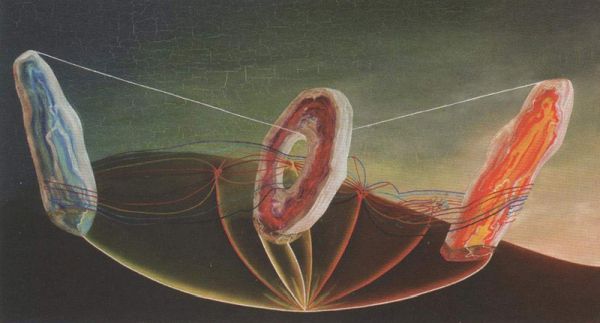
For Colquhoun, myth was not merely inherited – it was alive, continually generated by the unconscious in dialogue with land and archetype. She often invoked sacred geography in her art. Works such as Dance of the Nine Maidens (1940) and Dance of the Nine Opals (1942) depict local rock formations as sentient, mythic figures. The Cornish stones are anthropomorphised, dancing, dreaming, almost breathing – inviting the viewer into a dreamtime where history, magic, and geology converge. Her sketch of Dance of the Nine Opals reveals a meticulous sensitivity to the energetic webs that pulse beneath the surface – currents invisible to the untrained eye yet charged with historical, folkloric, and mystical significance. 


The Alchemical Body : Eroticism, Energy an the Feminine

Throughout her career, Colquhoun sought to map the hidden correspondences between plants, planets, body parts, and sacred geometry. Her work is charged with symbolic energy – merging anatomical forms with botanical structures, sexual imagery with cosmic diagrams.


 In “Attributes of the Moon” (1947) Colquhoun conjures the landscape not as passive but as generative, and feminine, expressing a vision of the feminine as protean and plural – a living system of symbols in continual metamorphosis. In “The Anatomy” (1942), a yonic work that evokes the enfolding architecture of caves, Colquhoun draws on the elemental symbolism of the earth as womb – simultaneously a site of concealment, transformation, and power. The image recalls the myth of Daphne, metamorphosed into a laurel tree by her father, a river god, to escape the sexual pursuit of Apollo. “The Anatomy” not only asserts the generative force of the feminine, but also reframes retreat and metamorphosis as acts of self-preservation and agency.

Archives of Magic : Colquhoun’s Library of the Occult

A pivotal starting point for the 2025 exhibition was Tate’s acquisition of Colquhoun’s personal archive from the National Trust in 2019. Comprising over 5,000 items, including sketches, writings, and unpublished diagrams, the collection reveals the extent of her devotion to the mystical arts.


 Her personal library – now housed in the Tate Archives – includes over 300 volumes on Greek mythology, alchemy, surrealism, Kabbalah, and ceremonial magic. Among them are The Golden Dawn (1937), The Kabbalah Unveiled (1887), Liber 777 by Aleister Crowley (1909), Dreams and Dream Stories by Anna Kingsford (1888), and Witchcraft Today by Gerald Gardner (1954). Together, they trace a lineage of esoteric thought through which Colquhoun developed her own queer, visionary cosmology.

A Radical Legacy

Colquhoun’s work dissolves conventional frameworks of gender, art, science, and spirit. She crafted a language in which imagination was not fantasy but a form of knowledge; where women could be both warriors and mystics; where eroticism was a divine force; and where the land itself was alive with memory and myth.

In our current cultural moment – one increasingly attuned to questions of fluid identity, ecological consciousness, and spiritual resurgence – Colquhoun’s legacy feels not only relevant but radical.

 Ithell Colquhoun: A queer, occultist artist who created between worlds. By Isabella Greenwood. Dazed, May 27, 2025.


 Tate 


Excellent long read.

Ithell Colquhoun: Mantic Stains, Sex & Surrealism by Andy Wilson. The Traveller in the Evening, March 7, 2025.


On a hillside not far from Land’s End, at the boundary of four parishes, stands the Mên Scryfa: perhaps Britain’s most resilient standing stone.

It is a slab of granite about six feet tall, likely first erected in the Bronze Age, and now set in the middle of a field (where it has served as a scratching post for itchy cows). Draw closer and you see a faint Latin inscription on its surface: “Rialobranus, son of Cunovalus”. The writing is a later addition from the 5th-6th century AD: two figures unknown, likely of noble blood. Run your fingers across the wonky lettering — feel the grooves in the granite, rough-textured as an oyster shell — and you almost sense an uncertainty in the scribe, recording the names in this novel Roman script.

By the 18th century Mên Scryfa had fallen down. It was re-erected in 1825, toppled again by treasure hunters in 1862 and put right again soon after. In June 2023, vandals set the stone ablaze with petrol and dug a ditch in a bid to topple it a third time (without success). On my visit last month, the lichen lost to the fire had started to return. The scorch marks were gone.

The Cornish hedgerows were thin on my visit to Mên Scryfa, the winter air sharp and clear, and so there were sightlines to other prehistoric monuments nearby: ancient barrows, quoits — and megaliths on the horizon that you had to fix your gaze upon a while to be sure they were not figures watching the Atlantic sunset, but cold sightless stones present there for thousands of years.

Here you understand a truth likely evident to Rialobranus, Cunovalus or their scribe. That Cornish granite is a stubborn material: hard to displace and prone to remembering the names of those etched into its grain after they have passed. Perhaps father and son expected a record of their dynasty would perish in parchment, but might endure for eternity if carved into a Bronze Age standing stone.

Penwith (meaning “the headland at the end”) marks the southwestern tip of the British mainland: a hook-shaped peninsula buttressed against the Atlantic by its steep granite cliffs. It counts as one of Europe’s densest prehistoric landscapes: filled with relics from the Neolithic, Bronze Age and Iron Age past. In antiquity this area was a centre for mining: gold and tin were exported through prehistoric seaways. Cornish tin is found in the Nebra sky disc: an Early Bronze Age artefact, discovered in Germany in 1999, that is perhaps humanity’s oldest depiction of the night sky.

For much of winter the peninsula is besieged by gales. For much of summer it is braced against a headwind of mass tourism from the opposite direction. Crowds rush down the A30 to visit the tourist attraction at Land’s End: to watch 4D films, enjoy the Wallace and Gromit experience and take a selfie with the famous sign. For charity cyclists, Penwith flashes by in a flood of endorphins as they begin the long ride north to John O’Groats in Scotland.

I had visited on a beach holiday in August, but exploring its prehistoric sites in midwinter I was in another country. Holiday cottages were untenanted and unlit. Little drifts of storm-blown sand lay unshovelled by front doors. In one, a model boat placed in the window had cobwebs for rigging.

The roads were silent too. Rather than hunting for expensive beachfront parking, my quarry was potholed lay-bys on country lanes. Rather than scrumming through bank holiday crowds, I knocked on farmhouse doors, looking for someone, anyone to direct me to an obscure megalith I had spied on an OS map. Mostly I was alone with the stones — without company but for starling murmurations roused from the hedgerows when a five-bar gate clanged shut behind me.

There was another reason I was here. Tate St Ives has just opened the first major exhibition of Ithell Colquhoun — a painter and writer, much of whose creative output was inspired by Penwith’s ancient landscapes. Born in the hills of Assam in 1906, Colquhoun was a colourful figure. She had studied at the Slade, saw Dali lecture in London and was photographed by Man Ray holding a sheaf of wheat in Paris. She was ostracised by other figures in British surrealism because of her involvement in the occult, but hers was the life of a spiritual seeker.


Countless artists had come to St Ives for its famous light: many sought pastoral visions in Penwith’s fishing villages. Colquhoun came here to paint something beyond the visible: currents of mysterious energy she perceived flowing between ancient sites, cryptic stone circles whose meaning she sought to decode. In her 1957 book The Living Stones, she wrote of “stones that whisper, stones that dance, that play on pipe or fiddle, that tremble at cockcrow, that eat and drink, stones that march as an army — these unhewn slabs of granite hold the secret of the country’s inner life.” This new exhibition was seen by some as being a risky move for Tate: even 36 years after her death there was concern her art might seem too “woo-woo” for Anglo-Saxon sensibilities. But then, strike out beyond the gallery, drive west down the narrowing lanes of Penwith, and you soon remember this is no Anglo-Saxon land.

To cross the River Tamar into Cornwall is to cross a boundary whose subtleties maps don’t represent. In the minds of Penwith locals, a second threshold — the River Hayle — separates their own peninsula from the rest of the county. Penwith was reputedly home to the last native speakers of the Cornish language, and is where Cornwall’s granite backbone breaks out from beneath sedimentary rocks to reach the surface. Here — like Iona, Bardsey, Finistère — there is the sense that Celtic blood runs thickest where the last land succumbs to the sea.

Ithell Colquhoun understood this distinction when she came here in the 1940s. Boarding a Penzance-bound train at Paddington, she was escaping a bombed-out capital, a failed marriage and an unfulfilled love with a woman she had met in a hotel in Mykonos. In Penwith she immediately sensed a change: a “tingling magnetism” and “a balsamic quality of the air that never fails to bring healing”. She had found her cure.

She rented a corrugated iron studio in Lamorna, on Penwith’s southern coast. Where much of the peninsula is moorland dotted with hawthorn and blackthorn, the valley at Lamorna is jungly and — even on my winter visit — faintly tropical. There were bamboo groves and palm fronds rustling in the breeze. Colquhoun wrote of the Penzance dragon trees and other exotic species sustained by the Gulf Stream. Her studio had neither electricity nor a loo but she set to work: painting to the morning song of turtle doves in the valley. Lying in bed after dark, she felt the wings of bats from the attic touching her forehead. To her mind the peninsula was an enchanted land: both Atlantis and Avalon, its “Druidic” temples and Celtic saints manifestations of a deeper power in the granite bedrock. Where others considered it peripheral or at the end of the world, Colquhoun envisaged it a sacred centre of the planet.

Today her former studio — Vow Cave — is a private holiday home. Skylights have been fitted where the bats roosted. The retreat evoked in The Living Stones seems distant, but the prehistoric sites she painted nearby are unchanged. One afternoon I set out to explore some of them in the company of Matthew Shaw and Lally MacBeth, a couple who are the founders of Stone Club, a Cornwall-based organisation celebrating prehistoric landmarks. They first bonded over a shared love of Colquhoun’s work.

We stopped at the Merry Maidens: a late Neolithic to early Bronze Age stone circle that Colquhoun portrayed in Dance of the Nine Opals (1942). We drove down the single-track lane depicted in “Landscape with Antiquities (Lamorna)” (1950). We stopped for lunch at The Kings Arms in Paul — the village where Colquhoun later lived, before passing away in a nearby nursing home in 1988. A group of pagans were sitting at the next table, whispering plans for an evening ritual at a nearby site. “So we do three clockwise perambulations . . . ” 


 Ritual practices also continue at Penwith’s strangest prehistoric landmark: Mên-an-Tol. The centrepiece of this roughly 3,000-year-old site is a stone with a hole, depicted in Colquhoun’s painting “Sunset Birth” (1942). Folklore tells that women who crawl through it naked will be healed of infertility — early drafts of Sunset Birth show a feminine figure levitating in the circle. “You occasionally see half-dressed people hiding in the bushes,” Lally told me. “Some Cornish women even talk about having their own ‘Mên-an-Tol baby’.”

 Ancient sites like Mên-an-Tol were launch pads for Colquhoun’s imagination: prompts for deep time dreams. Her paintings are testament to how objects of such unfathomable antiquity invite a perspective that transcends ordinary sight. But exploring the St Ives exhibition, you sense there is also something unspoken. At the time Colquhoun was working, ley lines and earth energies were a novel idea — they are now universally regarded as pseudoscience. Her interpretation of stone circles as abodes of the divine feminine was once a fashionable one — it is also without evidence.

The function and meaning of those prehistoric sites she painted is uncertain, dating as it does to an unrecorded past. The esoteric, tantric and classical allusions in her art and writing are visionary, but they are also only projections. In one sense Colquhoun was radical. In another, she belonged to a long-established tradition: an outsider in Cornwall, in love with a half-imaginary land. 


In the 1980s, encampments of new age travellers were often pitched up by the stone circles of Penwith. Now they are gone but at the centre of the peninsula I tracked down Palden Jenkins, a self-described “aged hippy”. He had lived in Glastonbury and been an activist in Palestine before moving in his sixties to take up residence in a caravan near the Penwith village of Sancreed, with its granite 15th-century church and even older holy well, where pilgrims still come to tie cloth offerings to the trees.

Jenkins runs Ancient Penwith (ancientpenwith.org), a project to map what he described as a “landscape temple”, the network of ancient sites relaying energy in the manner of a “circuit board”. He instinctively understood Colquhoun’s paintings: he too felt the difference when he stepped on to the granite west of Penzance. Palden had been given a terminal bone marrow cancer diagnosis in 2019. He had been a champion fell runner in his youth: now it entailed a similar effort to walk to the Bronze Age barrows on nearby farmland, to have a smoke, reflect and heal.

“Strictly speaking I shouldn’t be alive now,” he told me. “I can’t put that down solely to visiting ancient sites. But they do have an effect on me: like an energy bath. Healing doesn’t always mean getting better, but helping you deal with the situation you have. You have to make peace with your death.”

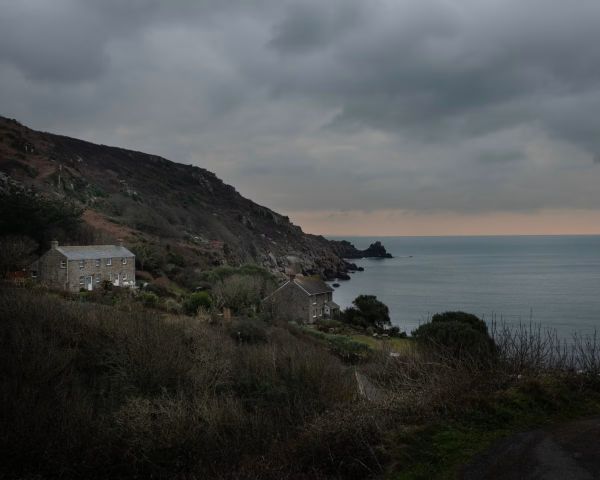
A stone jetty extends out into a Cornish cove at dusk Lamorna Cove at dusk I drove a final lap around the peninsula. I passed the Mên Scryfa, guarding the boundary of four parishes, and the green valley at Lamorna, of which Colquhoun had written: “here, to exist here was enough.” Lastly, a couple of miles inland from Sennen Cove, I climbed Chapel Carn Brea, Penwith’s most southwesterly hill and itself supposedly a point of convergence for energy lines.

It was a bright, blustery morning. The Isles of Scilly were visible across a shining sea. Even a sceptic could discern energy flows from the summit. Above were the crooked vapour trails of planes changing course as they entered UK airspace. Below, undersea cables relayed power and information across the ocean, out of sight. But most perceptible was the Gulf Stream wind, making landfall after crossing endless leagues of open ocean. And the action of the waves all along that granite peninsula — crashing on the first and last rocks of England. Which, of course, were not quite England at all.

Cornwall’s mystical far west — in the footsteps of Ithell Colquhoun. By Oliver Smith. Financial Times, February 12, 2025.


Lamorna is a small village on the Cornish coast, in the far southwest of Britain. The expansive skies and landscapes of the area have long been a draw for artists, most famously painters associated with the Newlyn school such as Laura Knight, Alfred Munnings and Lamorna Birch. Less well known are the ground-breaking queer artists who set down roots in the village: Marlow Moss, Gluck and Ithell Colquhoun. In this film, we tell their story, and the story of the Cornwall where they lived and loved: a place of international modernism, Celtic spiritualism and the queer avant-garde.

Queer Cornwall: Marlow Moss, Gluck and Ithell Colquhoun in Lamorna. Tate, October 29, 2021.


  Ithell Colquhoun’s reputation as a Surrealist artist, writer and occultist has been surging in recent years. Most know her through her quirky travelogues of Ireland and Cornwall Crying of the Wind: Ireland(1955) and The Living Stones: Cornwall (1957), her Surrealist occult novel Goose of Hermogenes (1961), or perhaps her idiosyncratic account of the history of the Golden Dawn, The Sword of Wisdom (1975). Her visual art has been less accessible until recently, but is becoming more widely known with recent, beautifully illustrated publications featuring her Taro (tarot) deck and her color study of the Sephiroth of the Tree of Life, The Decad of Intelligence. Her genius is evident, yet so much about this brilliant and eccentric figure remains elusive. As I eagerly await the publication of my own biography of Colquhoun, Genius of the Fern Loved Gully (coming soon from Strange Attractor Preess), I thought I might delight you all with a topic I don’t address in the book in any great depth: Colquhoun seemed to have a weird thing about exploring base bodily functions with some delight. We don’t see this in just a few isolated literary incidents, urination and defecation are deliberate themes, explored sometimes with a strange intimate aside, and sometimes in rather perplexing detail.


 Now, it should be noted that Colquhoun wasn’t ever one to shy away from bold and socially prohibited imagery, particularly when it came to sex and bodies. In the 1930s and early 1940s her paintings went from somewhat suggestive studies of plants to vulvic tree trunks and full-frontal male nudes. Her private erotic studies also spared no detail. In her writings, Colquhoun’s treatment of bodily functions was not limited to urination and defecation. Her vignettes and prose poems referred to excreta on a number of occasions, however elimination appears in rather distinctive contexts. In various short pieces, Colquhoun writes of menstruation, skin conditions, scabs, open sores, and some weird brown fluid that seeped out of her navel at some stage which fascinated her. It is clear that she wishes to confront her audience with images that are in many ways completely ordinary yet rarely acknowledged in polite company. These explicit depictions are even more radical coming from a woman writer, when women are, even to this day, generally expected to keep our bodily fluids well out of sight and out of mind. Part of Colquhoun’s approach may have been a Surrealist exercise. Surrealism was and is disruptive to its very core, seeking to unlock the unconscious and to display taboo, dismemberment and horror, often with a generally Freudian sensibility. Yet while Colquhoun’s work can occasionally be macabre, and certainly shocking, she generally does not focus on the overtly morbid (although there are some exceptions). While there is no doubt that some of her prose was meant to shock, the clinical way in which she writes of things that drip and ooze itself is oddly alienating.

Colquhoun’s writing style in general leans toward cold observation, and this is true of even her most Surrealist writings. Although she uses thick description with respect to color and setting and her imagery is consistently rich, even the most bizarre activities in Colquhoun’s writings, including, sex, magic, incest and cannibalism, are depicted quite dispassionately. Colquhoun’s unpublished autobiography Until Twelve, likely written in the 1940s, would have us believe that keen observation was a trait she admired in herself from a very young age. Although her writings about her childhood observations are clearly filtered through an adult lens, she didn’t flinch from honest, seemingly detached reporting of her youthful encounters with sex, menstruation and the pubescent development of young bodies. Her short prose poems from the 1940s and 1950s retain an icy, objective flavor, reading as field notes from an anthropological expedition even when describing edgy subjects such as the prostitutes she carefully observed in her short prose poem titled Sligo Street, 1939. However, her depictions of waste elimination, while also taboo, offer different challenges to the viewer, and perhaps also some opportunities.

Although Colquhoun’s depictions of bodily waste were often matter of fact, they were also ironically tinged with the wider grasping of the ultimate which marked her life’s work. Despite the somewhat clinical treatment, Colquhoun juxtaposes urination and defecation with moments of wonder and transcendence, placing the sacred and profane in proximity, forcing the reader to accept the holy nature of the physical body. In one short prose poem, “Alchemical Text” the physics of urination encourage a meditation upon gender equality and embodiment:


 He said, quoting a sage, that every girl had her roots in earth. I said, where does every boy have his roots? He answered “In the sphere where fireworks explode”. I understood by this the polarity of alchemical earth and air, but wondered if it were valid. For if this distinction was, as it must have been, based upon different methods of making water, then certainly a girl’s water goes directly downwards into the earth; but a boy’s also must eventually return there, and for all its rocket like soaring, is bound at last for earth. “[1]

Another short piece “Images of Joy”, likely written in the 1940s or possibly late 1930s is a short recollection, likely from her time in Greece in the early 1930s, where Colquhoun has an uncommonly aesthetic response to the fecal remains of a wandering peasant:

I was sitting on a rock between mountains and sea and the sun was blazing down on the aloes, and I thought I was alone. But presently I heard a step and a peasant came along who thought he was alone and let down his pants and had a good shit. It was done in a minute with complete simplicity; he pulled them up again, not wiping his arsehole with so much as a leaf, fastened his belt and walked away.

I went forward to look at what he had done; it was beautiful, three concentric rings of golden brown, decorated like a cake with olive stones and shreds of tomato peel. The topmost ring ended in a little point aiming at the sky. I think the whole lot must have come away clean without leaving a trace; perhaps the intestine had come out a little way like an animal’s to form a funnel, though maybe there was a small stain on his trousers all the same. “[2]

 In two of Colquhoun’s longer form writings she juxtaposes urination with sacred sites and landscape. In, The Blue Anoubis, her unpublished 1966 travelogue about Egypt, she describes hiking up her skirts to pee behind a pyramid.[3] In her slightly earlier Surrealist novel I Saw Water, about an order of parthenogenic nuns existing in a shadowy afterlife, Colquhoun much more irreverently counterpoints the body and the altar as sites of sacred activity. The central character of the story, a postulant at the nunnery, finds herself exploring the convent church, when, at one of the altars in a side chapel, she lifts the top off the altar to find it covering a cistern. Overtaken by the urge to urinate she relieves herself in it, wiping herself with letters she finds in her pockets. She only gives the incident the briefest thought when a priest arrives, appearing to not have noticed or cared. Is the implication one of sacrilege, as she uses the altar in a way clearly unintended, or was the altar actually covering up a toilet? The sacred and the profane blur, or perhaps they were always one and the same. [4]


It is likely that Colquhoun was working to prompt a spiritual shift in the reader by elevating the debased and by making no one thing greater than any other. A key may lie in comment she makes in another short essay “Hexentanz”, which details sticky bodily fluids and the taste of ear wax: “Life is not beautiful but it is rich: All must be accepted.” [5] A lifelong animist with an interest in Tantra, Colquhoun wished to confront generally accepted standards of sacrality by uplifting and acknowledging that which is most degraded. While still quite young, at the age of 24, she delivered a paper to the Search Society, a group of occult writers and thinkers led by her distant cousin Edward Garstin, titled “The Connection Between Mysticism and Blasphemy”. Here she challenges standard conventions of blasphemy by arguing that the blasphemous creates the conditions for divine encounters:

Thus, though the blasphemer may be said to lower the divine, while the mystic raises himself to meet his Lord, yet in fact both perform the same process, that of bringing the divine and the human into contact. Since any vehicle cannot be unworthy of divinity, the doctrine of the Incarnate God and the whole train of sacramental teaching that follows in its wake is in this sense blasphemous...”[6]

By collapsing the categories of the sacred and the blasphemous one can reach an experience where nothing can be destroyed. She states “Where there is nothing, there is God.” “And if all can be destroyed, why, let there be destruction.” During the late 1920s and early 1930s Colquhoun also encountered Hindu Tantra, a tradition with which she felt some affinity due to her birth in the north of India, through the writings of John Woodroffe (Arthur Avalon) and those of her cousin Edward Garstin. It seems quite possible that as she developed as a writer and artist that she extended her ideas about blasphemy into breaking taboos as a way of experiencing enlightenment and non-attachment as part of a Tantrically inspired esoteric framework.


Were Colquhoun’s literary scatological episodes a Surrealist exercise in shattering taboos? Simple juxtaposition of opposing images? Tantrically inspired sacramental meditations? Regardless of intent, she was likely considering some aspect of spiritual refinement, hoping to bring her audience along with her, changing our perspectives and cultivating a new way of seeing. Can’t exactly say that this tendency endeared her to publishers, but I don’t think she ever believed that her work was for the masses anyway.

Notes

Images © Samaritans, Noise Abatement Society and Spire Healthcare.

1. “Alchemical Text” in Shillitoe, Richard (ed). Medea’s Charms: Selected Shorter Writings of Ithell Colquhoun. (London: Peter Owen Publishers, 2019) p. 116.

2. “Images of Joy” ibid. pp. 132–133, and in the Tate Hyman Kreitman Archives at TGA 929/2/1/52/38.

3. Colquhoun, Ithell, The Blue Anoubis unpublished mss, c. 1967. Tate Hyman Kreitman Archives, TGA 929/2/1/6/8

4. Colquhoun, Ithell, (eds.) Richard Shillitoe and Mark Morrison, I Saw Water: An Occult Novel and Other Selected Writings (University Park, Penn State University Press, 2014). Kindle edition, location 1435.

5. “Hexentanz” exists in several versions. This quote was from the mss. TGA 929/2/1/52/56

5. Colquhoun, Ithell “The Connection Between Mysticism and Blasphemy” c. 1928/1929 unpublished mss. Tate Hyman Kreitman Archives, TGA 929/2/3/2


Ithell Colquhoun’s Peculiar Scatological Proclivities. By Amy Hale. Medium, May 4, 2020


 Writer and researcher Dr. Richard Shillitoe discusses the life and work of British artist, writer and occultist Ithell Colquhoun. As the talk sets out to show, she took her inspiration from the spiritual world as much as she did from the natural world, making extensive use of automatic drawing and painting methods as well as the contents of her dreams.

Ithell Colquhoun (1906-1988) is one of the 20th century’s most significant British surrealist artists. The daughter of a senior civil servant in India, she studied at the Slade School of Fine Art (1927-31) and had an award-winning painting exhibited in 1931 at the Royal Academy. She travelled widely in Mediterranean countries and lived in London before spending the greater part of her adult life in Cornwall where she painted, wrote and pursued extensive occult research. In 1940 she was ejected from the London Surrealist Group for refusing to compromise her occult interests. Her paintings have appeared in solo exhibitions as well as being shown in major art galleries. A significant body of Colquhoun’s artworks and archives were acquired by Tate in 2019, gifted by the National Trust. Her fame as a writer is largely based on a hermetic novel, Goose of Hermogenes, and two highly personal travelogues The Crying of the Wind: Ireland and The Living Stones: Cornwall. She also published Sword of Wisdom, the authoritative biography of MacGregor Mathers, the founder of the Hermetic Order of the Golden Dawn. She died in Cornwall in 1988.

Dr Richard Shillitoe is an independent researcher. His book Ithell Colquhoun: Magician Born of Nature (2010) includes an extensive catalogue of Colquhoun’s artwork. He co-edited the first publication of Colquhoun’s novel I Saw Water (2014) and edited the illustrated edition of her first novel Goose of Hermogenes (2018). He has recently published Medea’s Charms (2019), a volume of Colquhoun’s poems, essays and short stories. He maintains the website www.ithellcolquhoun.co.uk

  
Magician Born of Nature: the Life and Work of Ithell Colquhoun. Drawing Room, October 13, 2020


14/11/2021

The Case of Ewan Forbes


Ewan Forbes’ case is as significant to the trans experience as Oscar Wilde’s is to gay men. With the difference that whereas everyone knows about Oscar, what happened with Ewan has been hidden in the deepest secrecy. But the repercussions which arose from his case transformed trans lives for the worse in ways that are still being felt today, more than 50 years later.”
 
Via Zoom from her home in south-east London, Zoë Playdon, emeritus professor of medical humanities at the University of London, is talking about The Hidden Case of Ewan Forbes, her enthralling and explosive first book for a non-academic readership. It concerns a transgender man, born the Honourable Elisabeth Forbes-Sempill into an aristocratic Scottish landowning family in 1912. With the financial means to procure synthetic hormones pre-puberty, and the ongoing support of his remarkably progressive mother Gwendolen, Ewan Forbes proceeded to live his life as a man, quietly and without scrutiny, just as he wished. He was able to correct his birth certificate, and in 1952, he married his wife Patty. But then in 1965, after the death of his elder brother William, he was forced to defend his gender in an extraordinary and at times horrifically intrusive court case, in order to prove that the Forbes of Craigievar baronetcy should pass to him, over a male cousin who claimed he was next in line.
 
The case took place behind closed doors, and afterwards was hushed up, the documentation placed entirely off limits, until the 1990s, when then home secretary Michael Howard ordered its disclosure after repeated requests by the former Labour MP Lynne Jones, with whom Playdon founded the Parliamentary Forum on Gender Identity in 1994. And the reason Playdon believes Forbes’ case was concealed from public scrutiny for so long? Because it provides a potential legal precedent not only for trans rights, but also for overturning the tradition of male primogeniture that has underpinned the British establishment for centuries.
 
Playdon came to this shocking conclusion after going through the 500 pages of transcripts which document this watershed case. Then her agent, Sarah Ballard at United Agents, suggested that she make Ewan Forbes the focus for telling the story of how trans people had previously enjoyed full equality and “how that equality had been quite deliberately removed”. And so now in The Hidden Case of Ewan Forbes, drawing on more than 30 years’ experience of frontline work in LGBTI human rights—including legal cases where she worked with the likes of Baroness Helena Kennedy QC—Playdon blows this astonishing case wide open. Alongside Forbes’ story, she charts the shifting sands in how the medical profession has treated trans people. And she also takes in the experiences of other trans men and women, including painter Lili Elbe, upon whose life a novel and subsequent film, “The Danish Girl”, was loosely based; as well as 1960s Vogue model and trans activist April Ashley MBE.
 
The counter argument
 
What Playdon documents runs entirely counter to our received view that the 1960s heralded a more liberal era in terms of our attitudes to sex and gender. She argues that in the intervening five decades since Forbes’ case was heard, trans rights have increasingly been undermined. Our now-systemic transphobia has resulted partly, she shows, from relatively recent pseudo-science which has led being trans to be equated with mental illness, despite a lack, says Playdon, of “scientific, objective evidence for this”. While in the 1930s, medicine recognised that birth sex might be fluid rather than fixed as male or female, the medical and legal narrative dating from the 1960s that surrounds trans people to this day is quite wrong, she says. “If we take Ewan as our starting point, we can draw on 100 years of trans experience which shows that there have never been any problems around the self-determination of trans people, or around elective medical procedures. And yet suddenly there is this desire to close all of that experience down.”
 
I’m interested to know how Playdon’s varied and distinguished CV as a teacher, senior civil servant, academic (she has five degrees, including two doctorates) and as an LGBTI activist has coalesced in the writing of The Hidden Case of Ewan Forbes, a remarkable blend of history, medicine, law, politics and dogged detective work. “My discipline of medical humanities is a relatively new subject, concerned with improving patient care by the application of humanities thinking. In terms of my own, practice-based medical humanities, we work directly with clinicians, often senior consultants and GPs, to help them make changes to improve both their working lives, and quality of life and care for their patients. If I had to point to the thread that runs all the way through my career, it would be the fact that I have always been concerned with change directed at improving equality.”


Her preoccupation with Forbes’ case began as a research project after she had retired, in the wake of the Succession to the Crown Act of 2013, which removed the precedence accorded to the male gender in terms of the royal succession. “I had always known the broader concept of primogeniture was an issue in trans civil liberties, but I thought that after the Act of 2013, things would get sorted. In the past few years, the issue of male primogeniture has repeatedly been raised in parliament, but each time the matter has been closed down. And the only reason for that, as far as I can see, is the self-interest of a small number of extremely wealthy, aristocratic people”.
 
Ironically, Ewan Forbes himself was born into such privilege: his mother Gwendolen was a close friend of Queen Mary, and her husband John (the so-called “Auld Laird”) was aide-de-camp to King George V. But while this initially enabled Forbes to access the pioneering endocrinal treatment he needed, the legal case later exposed him, as a member of the landed gentry, to a level of public and press scrutiny that was intensely painful to such a private and upstanding individual. Without going into spoiler details here, it was a case he eventually won and went on to prove he was able to occupy the position and responsibilities of his title as ably as any cis man. But with the hushing up of the case, the repercussions for trans people were profound.
 
My conversation with Professor Playdon—who was born into a working-class family in the Black Country, and was the first person in her family to go to university—is characterised by an openness and a geniality that is worlds away from the polarised vitriol which characterises much of the current so-called debate around trans rights. Her dry and subversive sense of humour is frequently on display; at one point she reminds me that we all start out as biologically female in the womb, and “then if you’re unlucky you get to be male”.
 
But, I say, it must be demoralising, not to say distressing, after more than 30 years of frontline campaigning for LGBTI rights, still to be fighting the same battles. How does she keep herself going? “I think I’m probably a hopeless optimist. I believe ultimately in the goodness of people. I think people do want to do the right thing, it’s just a question of taking some time and patience so they can understand what’s at stake. At the end of the day, the job of a philosopher is to make arguments available, not to impose them. You have to give people the opportunity to change. And that’s really been my whole career: making the ethical argument, and saying to people, ‘If you go down that route, this is the suffering you will cause. Is that really want you want to do?’”
 
Book extract
 
Most people are unaware that until the late 1960s, trans people lived in complete legal equality with everyone else. Ewan was the reason that changed, and since his life spanned nearly the entirety of the twentieth century, it gives us a glimpse into almost a hundred years of trans history. His story begins in the Victorian period, when the Viennese professor of sexology, Richard von Krafft-Ebing, published the first medical description of being trans, and it ends in the present day, with increasing attacks on trans people’s human rights in the US and the UK.
 
It draws on five years of research, 30 years of frontline LGBTI activism, and a lifetime in academia. Ewan’s hidden court case, finally decided in 1968, marks a tipping point between the trans equality that existed in the past and today’s trans discrimination. More broadly, it is also a story of how freedoms we all take for granted can be instantly lost.
 
Zoë Playdon | 'I think I’m probably a hopeless optimist. I believe ultimately in the goodness of people'. The Bookseller, August 13, 2021. 


The Hidden Case of Ewan Forbes: Interview With the Author. By Andy Reid. Anchor FM, November 1, 2021


Zoë Playdon is the author of the new book The Hidden Case of Ewan Forbes and the Unwritten History of the Trans Experience. It focuses on a landmark legal case in the UK. Playdon is the Emeritus Professor of Medical Humanities at the University of London.
 
Q: What inspired you to write this book about Ewan Forbes and his legal case?
 
A: Few people know that for decades, trans people self-identified, accessed affirmative medical care, corrected their birth certificates, and lived unproblematically in complete equality with everyone else.
 
But in 1970 UK trans people were stripped of their civil liberties, became socially excluded, and were subjected to an abusive medical regime that included conversion therapy and compulsory sterilisation.
   
Ewan’s legal case, decided in 1968, precipitated those changes, which damaged the lives of countless trans people. All the records of Ewan’s case were removed from public eye, the press gagged, and everyone involved in it sworn to secrecy, and so this crucial piece of trans history is unknown.
 
I felt it was important for people to know that trans equality used to be straightforward, and that it was deliberately removed to solve a political, constitutional problem – securing male-primogeniture inheritance to the British throne – which no longer exists.
 
Q: How would you characterize the attitude in Britain toward trans people in Ewan’s younger days and during the time of his case?
 
A: Ewan was born in 1912 – he’s the earliest example I have of a UK trans boy self-identifying and getting affirmative medical care – at a time when there was a well-established scientific recognition that some people have variations in sex characteristics that position them between typical male-female binaries.
 
So he grew up in a general social environment that accepted that some people’s sex was different from that assigned at birth.
 
In the 1930s, it was generally trans men, like the athlete Mark Weston, who attracted public attention and it was believed that trans men vastly outnumbered trans women, who were considered a rarity.
 
But in the 1950s, the world-wide publicity given to Christine Jorgensen in the US and to Roberta Cowell in the UK shifted that perception, and in the early 1960s, the publicity given to model and actress April Ashley cemented the social image of trans people as exquisitely beautiful “sex changes,” with trans women believed to vastly outnumber trans men. In fact, the issue wasn’t numbers but visibility.


Apart from these exceptional, well-known examples, trans people, both men and women, simply went through supportive medical and legal processes and lived their lives like anyone else.
 
No one knew they were trans, or if they did know, they regarded it as a purely personal matter of private medical history. This was the case for Ewan until he was in his 50s.
 
But in 1966, when his cousin John announced that he was taking Ewan to court to prove that he “is now and has all along been of the female sex,” Ewan knew, as a doctor, that the medical climate was changing dramatically.
 
A group of US psychiatrists, notably John Money, Richard Green, and Robert Stoller, were busy claiming that being trans was a mental illness caused by inadequate parenting, and that they could remedy it.
 
In 1962, the first Gender Identity Research Clinic was opened at the University of California, Los Angeles, to “cure” trans and gay people by a range of measures: aversion conditioning using either emetics or electric shocks, frontal lobotomy, psychotherapy, and electro-convulsive therapy.
 
Of course, it was nonsensical pseudo-science, but in an aggressive turf war with endocrinology, psychiatry won.
  
In the UK, the affirmative care given by surgeon Lennox Broster and his team was being replaced by a psychiatric model led by John Randell at Charing Cross Hospital, who saw his role as being to
“breed out of our genetic inheritance those with psychopathic and adverse genetic propensities.”
 
The new medical environment would classify Ewan as a floridly psychotic lesbian with a perjured marriage: both he and his wife Patty would be liable to two years’ imprisonment, their lives ruined.
 
Ewan was much-loved by his community, but he was lucky to escape the systemic transphobia that overtook the UK from 1970 onwards.
 
Q: How did you research the book and did you learn anything that especially surprised you?
 
A: Oh, I was constantly getting surprises, and sometime really big ones.
 
The first was that it took two years and the intervention of the Home Secretary to gain access to documents that should have been in the public record. 
 
My starting point for writing was the court record of Ewan’s legal case, 500 pages of back-and-forth questions and answers. I went through it line by line, reconstructing what had happened in court, how the evidence had been presented and the narrative of Ewan’s life.
 
The next shock was that a trans man had inherited a male-line primogeniture baronetcy, something that we could never imagine happening today.
 
Clearly, something had changed, and so I backtracked to the first clinical categorisation of trans people in 1886 and went forward through medical literature, legal cases, and newspaper reports in the first part of the 20th century.
 
From that, and from the work of other historians, including unpublished doctoral theses, it became evident that for almost 80 years, being trans was classified as a variation of sex development, an intersex condition, and that the regimen was self-identification, affirmative medical care, correction of birth certificate, and an unremarkable life as an equal citizen.
 
And sadly, that was the next big shock, because since Ewan’s case, trans equality has been made to feel like an impossible dream.
 
Of course, I wanted to know what had happened after Ewan won his case. How had trans people suddenly been stripped of their civil liberties and what had the experience of that been like? So the next step was to work forward from Ewan’s case to the present day.
 
What I found was a mass of documents produced by trans activists in the 1970s and 1980s, all trying to make sense of what had happened to them.
 
It is really distressing material to read: a group of people who have suddenly been completely dispossessed and made subject to medical abuse, with no idea of why this has happened, and not even aware of what they were now allowed to do or be.
 
And like other ghetto archives, it is a very moving record of people trying to survive, and being obliged to accept the cruellest of conditions for survival: no employment rights, dismissal for being trans, unable to marry or adopt, and if unable to pay car parking fines, then sent to the wrong sex prison where women, certainly, were raped without it counting legally as rape.
 
They learned to expect to lose their jobs, homes, family, and friends, to be expelled from their church, sports teams, clubs, and societies. They knew they must never question their psychiatrist and must obey all their demands without argument, or they would get no healthcare.
 
To survive, the best chance was to move to another city, never speak of their past, not take any job with a pension or health insurance or social security or other benefits that required a birth certificate, and to accept that every interaction with officialdom would be exposing and humiliating because they would use birth names, pronouns, and titles.
 
The best to hope for was to live in hiding, hope not to get beaten or raped on the streets, and accept that if that did happen, the police would not investigate or provide any protection.
 
That was the legal regime until 1996, when the landmark case P v S and Cornwall County Council restored employment rights, and the official medical regime until the UK government accepted formally in 2002 that being trans was not a mental illness. I think that is the next shock for readers – that these events are so recent.
 
And the final shock for me was to discover how entrenched the British Establishment are in their protection of primogeniture.
 
When it was removed from the monarchy in 2013, there was a general expectation that it would be removed across the aristocracy as well. But now there have been six separate bills, one a year, entered into Parliament to try to end primogeniture – and they have all failed.
 
Q: What do you see as the legacy today of Ewan Forbes and of his legal case?
 
A: I see it as a dual legacy, both sweet and sour.
 
On the sweet side, we know that trans children were self-identifying and receiving affirmative medical care a hundred years ago, and that Ewan led a happy, fulfilled life. That puts the present moral panic about supporting trans children into a new perspective.


It’s also helpful to know that for a long time, it was believed that there were more trans boys than girls, then that switched to a belief that there were more trans women than trans men: it reminds us of the historical and scientific fact that we have no statistical records of the incidence of trans people, and that trans visibility is and has always been dependent on social nurturance.
 
And I think it is reassuring for the future to know that trans equality existed for many decades without being in any way socially problematic.
 
On the sour side, though, comes the uncomfortable truth that Ewan had to quite literally fight for his life in desperate circumstances, and that the consequence of his victory was a political crisis that was solved by putting trans people outside the social pale.
 
Two things, I think, are very hard to come to terms with.
 
The first is that historically, when we find a specific group stripped of their human rights, socially excluded, reviled by the media, and subjected to sterilisation, we term that not just a eugenic project, but genocide. It is unspeakably distressing to have to consider the possibility that the UK government effectively carried out such a project against its own citizens.
 
The second difficult thing to acknowledge is that it happened so recently and that most British citizens knew nothing about it. History was occluded by a social memory in which trans people had always been pushed to the social margins, and that this was justified because they weren’t “real men” or “real women.”
 
As we know from other periods in recent European history, once you’ve decided some individuals don’t count as “real people,” it becomes permissible to say or do whatever you like to them.
 
Those kinds of brutalities are not just devastating for the people themselves but are irreparably damaging to the societies that permit them.
 
Putting these two items together, Ewan’s legacy, perhaps, is to invite us to look at the century of trans lives that his life spanned and to ask ourselves, do we want our society to continue that kind of injustice?
 
Q: What are you working on now?
 
 A: Two quite different things. With my colleague Professor Jo Winning at Birkbeck College, I’m planning a research symposium on trans narratives, for 2022, to think about how we can create, structure, and critique histories that represent trans lives authentically.
 
I’m also continuing to work with my colleague Dr. Lisa Fenton at the University of Cumbria to develop our ground-breaking master’s degree in Bushcraft – Wilderness Living Skills, as it is called in the US – as part of a wider ecological initiative.
 
Finding better ways of treating each other and the world we live in seems to me crucially important for social justice and for species survival.
 
Q: Anything else we should know?
 
A: I’m absolutely delighted that in spite of the restrictions imposed by the Covid pandemic, we can still talk virtually to each other – but I’m also so disappointed, since I was really looking forward to visiting and spending time in the US, talking about these issues and getting to know each other better!
 
  
Book Q&As with Deborah Kalb. Deborah Kalb Books blogspot, November 3, 2021. 


A narrative has developed about the position of transgender people today that has become so widely accepted as to be assumed as fact: that it is only in the past few decades that trans people have begun to enjoy any rights; that trans women have always been more prominent than trans men; and most of all, that in recent years, trans people have been seeking to gain more rights than they’ve ever had before.
 
A new book, The Hidden Case of Ewan Forbes by Zoe Playdon, upends all of this. The Emeritus Professor of Medical Humanities at the University of London has unearthed a legal case that 50 years ago changed everything for trans people, but which has been kept secret at the highest levels ever since.
 
The purpose, it seems, of this blackout was to uphold the patriarchal structure underpinning the monarchy, aristocracy, and hereditary peerages – the right of inheritance by the firstborn son. Or, to use the formal term, male primogeniture. The effect was to remove the human rights of transgender people that had previously existed – and in silence.
 
 
Alongside a distinguished career in academia, Professor Playdon has been involved in human rights work for 30 years, during which she co-founded in 1994 the Parliamentary Forum on Gender Identity. Her manner is understated and learned, even as the scandalous tale unfolds. Books are piled up all around her.
 
She first suspected something important had been buried in 1996, while helping lawyers with a case about trans rights in the High Court of Justice, which failed, baffling everyone.
 
 “I knew that there was something about primogeniture that was a stumbling block,” she tells me via video call. This sense was emboldened by an informant, the lawyer Terrence Walton, who had worked on a famous early case involving trans rights, who told her “‘there are some interests that it is more important to protect than the rights of individuals’. I thought, ‘we’re not going to actually get trans equality until the issue of primogeniture is dealt with.’”
 
Playdon hoped that after the Succession to the Crown Act in 2013, which removed male primogeniture from the monarchy, something would shift. But after the Act, several attempts to end the same among hereditary peers unexpectedly didn’t pass, and certain trans rights cases stalled. By then, Playdon had retired so was able to devote five years of digging to find out what happened, and why.
 
“I knew that in the past, trans people had corrected their birth certificates,” she says. “All the way through up to 1970, the path was: self-identify, get affirmative medical care, correct your birth certificate, and live equally. After 1970, that’s gone.”
 
The reason, she discovered, lay with the case of Ewan Forbes. “So I went through 500 pages of court transcripts, and reconstructed what had happened on those four days in court. I was really quite shocked.”
 
Ewan Forbes was born into a landed, aristocratic family in Aberdeenshire, in 1912. He was the youngest of three, with an older brother and sister. Ewan was assigned female at birth and named Elizabeth, but from the age of six, his parents became aware that the baby of the family was at odds with more than just his name. He was already living determinedly as a boy. They called him Benjie.
 
Due to the wealth and connections of Forbes’ supportive mother Lady Gwendolyn, at 15, he was taken to a range of specialists across Europe and given synthetic testosterone, which had only just become available. It prompted a male puberty (complete with spots and stubble) which supported the fact that throughout his young life he presented as and considered himself a boy.
 
In her book, Playdon reveals that in the 1930s, the media ran stories “predominantly about trans men”, and that “being trans was a mystery and trans women, who were considered far rarer than trans men, were especially mysterious”.
 
At the time, trans people could take hormones, have gender confirmation surgery, and then change their birth certificates. There were no panels of psychiatrists and endocrinologists, as we have today, deciding whether to grant you a gender recognition certificate, which since the 2004 Gender Recognition Act has provided certain legal protections. There was no need; you could simply change your birth certificate and therefore other necessary paperwork.
 
It was the case of Ewan Forbes that changed that. He became a GP, corrected his birth certificate, and married a woman. Having been accepted as a man, he never considered that it all might be threatened until his father, Lord Sempill, died, and then his elder brother, William, in 1965.
 
As the second son, Forbes would inherit both paternal titles: the barony and the baronetcy, which could only be passed down the male line. But a cousin called John “turns up at William’s funeral”, says Playdon, and tells him he’ll contest the succession in court “because you’re not a real man”.
 
What followed in 1968 was a trial in which Forbes fought for his male birth certificate to be judged legitimate. His defence had to contend with a recent and radical change in medical thinking. Up until the 1960s, doctors largely regarded trans people as intersex; that is, a physiological difference in which individuals have elements of both sexes.
 
This idea was then engulfed by a new American psychiatric ideology, “which classifies being trans as a mental illness,” says Playdon, “as floridly psychotic”. The only way for Forbes to bypass this legally would be to prove he had physical male traits.
 
If he lost, he faced jail, because if declared female his marriage would be deemed perjured. If the case were held in open court, the media would have exposed the most intimate parts of his life and anatomy.
 
Forbes requested that the trial be conducted privately. “John says, ‘All right, provided Ewan agrees to a private medical examination by my experts, and pays all my legal fees,’” says Playdon. Forbes agreed.
 
The experts’ conclusion was that “Ewan has female anatomy with some male characteristics,” says Playdon. Although the examiners didn’t know Forbes had been taking testosterone, this wasn’t enough. Forbes procured some testes tissue and passed it off as his own.
 
“He wins,” says Playdon. “But it causes a constitutional crisis. A trans man won a primogeniture baronetcy. It could be used as precedent, not just for trans people, but crucially for primogeniture. What if an older sister of the heir turns out to be trans? Or the person you’re sure is heir is trans and no longer eligible?”
 
So the case was covered up. “Everyone involved in the trial was sworn to secrecy, and the trial was removed from public life,” says Playdon. The Home Office did not respond to her request for details in 1996. She enlisted an MP to ask the Lord Advocate (the chief legal officer for the Scottish government and crown) for the files, who initially denied that a “judgement was ever issued” before adding that “it would not be appropriate for me to… disclose the details”.
 
Finally, it took a complaint to the then Home Secretary, Michael Howard, to begin to gain access to the legal documents in 1998.
 
But the effect on trans people had already been dramatic. In 1970, April Ashley, who had become the first well-known trans woman in Britain after being outed by a tabloid, was seven years into her marriage with the aristocrat Arthur Corbett. But it was failing. Rather than divorce her and give her money, Corbett attempted to have the marriage annulled, asserting that she was male.
 
This was despite Ashley having had lower surgery, and Corbett being fully aware before they married in Gibraltar. But she had not corrected her birth certificate.
 
The judge sided with the aristocrat and swore the lawyers to secrecy about the Forbes trial. During Ashley’s case, the judge “creates a sex test which dis-authenticates her,” says Playdon. Ashley was subjected to the most invasive genital examinations imaginable – twice – because after the expert clinicians concluded that she “had a perfectly usual vagina” the judge demanded they look again. After which, in defiance of their report, the judge declared her a “homosexual transvestite who’s mentally ill” and with a “supposed vagina”, says Playdon.
 
Ashley lost. It was this case that set the legal precedent, blocking legal rights for trans people, preventing the correction of birth certificates, while the opposing precedent was suppressed. It would be decades before any rights were reinstated.
 
Playdon’s book, which constitutes one of the most important pieces of investigative journalism ever written about trans people, has already been optioned for film adaptation. But she is particularly pleased by its timing amid a media moral panic and far-right backlash against trans people.
 
“Because it feels as though people need to know [about this],” she says. “Before we start getting too worked up, can we just remember that for decades and decades you just self-identified, got elective medical care, changed your birth certificate, and lived in equality?”
 
Instead, the fear and silence surrounding the Forbes case reversed progress, without anyone knowing why, which flourished into today’s ahistorical assumptions. “Things have become skewed further and further and further,” she says, “into a really very sinister place.”
 
The secret court case 50 years ago that has robbed transgender people of their rights ever since. By Patrick Strudwick.  i News, November 10, 2021. 


Ewan Forbes was born Elisabeth Forbes to a wealthy landowning family in 1912. It quickly became clear that the gender applied to him at birth was not correct, and from the age of six he began to see specialists in Europe for help. With the financial means of procuring synthetic hormones, Ewan was able to live as a boy, and then as man, and was even able to correct the sex on his birth certificate in order to marry.

 
Then, in 1965, his older brother died and Ewan was set to inherit the family baronetcy. After his cousin contested the inheritance on the grounds that it could only be inherited by a male heir, Ewan was forced to defend his male status in an extraordinary court case, testing the legal system of the time to the limits of its understanding.
 
In The Hidden Case of Ewan Forbes, Zoë Playdon draws on the fields of law, medicine, psychology and biology to reveal a remarkable hidden history, uncovering for the first time records that were considered so threatening that they had been removed from view for decades.
 
Bloomsbury

Zoë Playdon Website


As the ongoing war against abortion rights tells us, people who are not in power have no guaranteed stability of status. When autonomy is granted and easily taken away, whole groups of citizens may experience unpredictable swings in their legal rights, social customs and ability to be heard. Zoë Playdon’s erudite, passionate, occasionally frustrating, yet ultimately persuasive new book, “The Hidden Case of Ewan Forbes: And the Unwritten History of the Trans Experience,” encapsulates this reality by telling three stories at once.
 
At the center is a biography of Ewan Forbes, a Scot of wealth and lineage born in 1912, assigned female at birth and raised, at least initially, as a girl, and of his struggle to be seen by the state as the man he knew himself to be. This account is contextualized by a rich and riveting social history of trans people’s rocky road to cultural acceptance in the West, from the early 20th century up to the current day. Within this frame, Playdon, an emeritus professor of medical humanities at the University of London, situates the specific story of the wavering right of trans people in Britain to correct their birth certificates. In this way she intertwines individual, social and legal history in a manner that is mostly illuminating. And she shows how fluctuations in the rights of trans people evolved in tandem and in conflict with those of gay men, women and lesbians.
 
Playdon argues that trans people benefited from the publication in 1886 of “Psychopathia Sexualis,” an influential medical book by the German psychiatrist Richard von Krafft-Ebing. The book was primarily intended, she maintains, for use by the courts, in order to help juries distinguish between people who engaged in criminal sexual behavior (gay men) and those who were merely biologically different (trans). Krafft-Ebing presented trans identity as a form of “physical intersex,” and argued that it should be accepted. Today we increasingly understand that sexuality, biology and gender can represent three separate experiences. But in the Victorian era, these three categories were collapsed into one. While gay men and lesbians were regarded as lawbreakers and subjected to awful medical punishments, trans people were seen as simply moving from one binary pole to another — from man to woman or vice versa.
 
In 1910, Magnus Hirschfeld, a gay German Jewish sexologist, published “The Transvestites,” in which he differentiated cross-dressing, trans and homosexuality while defending all three. He opened his Institute of Sexual Science in central Berlin in 1919, when Ewan Forbes was 6 and playing in the Scottish heather, already asserting his maleness. Hirschfeld worked closely with endocrinologists developing early hormone therapies. In 1931 his institute carried out the first documented gender confirmation surgery, a vaginoplasty for a trans woman named Dorchen Richter. The next year, 19-year-old Forbes moved to Munich for psychotherapy and hormone injections. He reported growing facial hair and developing acne, often associated with testosterone shots.
 
While trans women were far more numerous and visible in the climactic years of gay liberation between the 1960s and 1990s, Playdon shows us that in the 1930s trans men were overwhelmingly featured in popular news stories about “sex changes.” “Being trans was a mystery,” she writes, and “trans women, who were considered far rarer than trans men, were especially mysterious.”
 
All that changed when the Nazis came to power, and imposed their view of both transsexuals and homosexuals as degenerates. Gay men and trans women were made to wear the pink triangle, while lesbians and trans men got the black “antisocial” triangle shared with communists and intellectuals. All were sent to concentration camps. At the same time, psychiatrists working with the U.S. Army during World War II promoted the idea of homosexuality as a pathology and worked to eliminate queer people from American military service.


In 1946, while Forbes was starting his career as a medical doctor in Scotland, a fellow physician named Michael Dillon, a British trans man, published “Self: A Study in Ethics and Endocrinology.” He argued that trans people are who they say they are; they are not pretending or passing. As Playdon paraphrases Dillon’s thesis, “They are both the same as and different from” other men and women, a complex concept of biological similarity and variability that ran counter to rigid ideas about gender, sex and sexuality that were to become both popular and legally inscribed in the postwar period.
 
These two concepts — the individual’s self-perception and the punitive control of the state — converged in Forbes’s life in 1950, when he and Isabella “Patty” Mitchell, a Scotswoman and farmer’s daughter, decided to marry. Marriage would be illegal with a female indication on Forbes’s birth certificate. Using his wealth, position and connections to other powerful men, he obtained an “M” on his birth certificate in 1952 and proceeded to the altar. The wedding was held in the couple’s home, in what a local newspaper described as a ceremony conducted “in the greatest secrecy.” Forbes told his friends that he had corrected a “grievous error” that had occurred at his birth when he had been mistakenly registered as a girl instead of a boy.
 
“Male-line primogeniture,” the British law guaranteeing that particular titles and land pass via inheritance through male heirs, has long been a foundational power grab for British men, and is, remarkably, still being debated in the case of some titled lines within the aristocracy. With his male gender certified on his birth certificate, Forbes was in a position to inherit his father’s estate. But there was one obstacle: his cousin John.
 
According to the terms of Forbes’s father’s will, his estate and title (a baronetcy) passed to Forbes’s older brother, William, and, at his death, to his male offspring. In the event William had no sons (as was the case), the estate and title would pass to Forbes’s father’s brother or, if he had died, his male heir: John. Abetted by Forbes’s older sister, Margaret, who had a fraught relationship with Forbes and agreed to attest to his female status at birth, John filed a legal claim to the baronetcy. Reluctantly, Forbes decided to file a counterclaim. Not to do so, Playdon writes, “would be tantamount to stating that he was not the next heir because he was not a man.” (In an effort to placate John, Forbes had already handed over much of his father’s estate.)
 
Before the title contest could play out in court, however, Margaret, a lesbian who lived with her female partner and was thus subject to the same indignities and threats that her brother wanted to avoid, reconciled with him and prevailed on John to agree to let the hearing take place in private.
 
Playdon sees Margaret’s initial alliance with John as a betrayal, but Forbes’s lack of solidarity with his sister’s gender and sexual exclusion could be described in similar terms. Apparently it never occurred to him to protest Margaret’s own inability as a woman to claim either the estate or the title. She was killed in a car accident a few months before the hearing took place, and in 1968 the baronetcy was awarded to her brother.
 
Britain’s system of common law is based on the “doctrine of precedent”; one key legal judgment affects all subsequent related decisions. So having all judgments publicly available is necessary for British people to know what rights they can rely on. However, because Forbes’s case — including the traumatic and humiliating process of having to provide evidence of his maleness in court — was heard in closed session before a single judge, the decision failed to be recognized as the precedent it should have been, becoming unavailable to future generations of trans people who found themselves in a similar predicament. In 2004, Britain passed the Gender Recognition Act, allowing citizens to change their gender. But rather than authorizing corrections to the original birth certificate, the law calls for the issuing of a second birth certificate, made out in the “acquired gender.” The implication, Playdon writes, is that “trans people are masquerading as real people, just as their faux birth certificates are masquerading as real ones.”
 
In other words, the victory Forbes won more than 50 years ago has yet to fully translate to the lives of those who followed him. In the end, his inspiring and impressive commitment to self-define coexists with his failure to imagine the equality of women, including lesbians, in his own time, or how future trans people could have benefited from knowledge of his struggle — and his achievement.
 
 
The Hidden Case of Ewan Forbes
And the Unwritten History of the Trans Experience
By Zoë Playdon
Illustrated. 368 pp. Scribner. $27.
 
The Secret 53-Year-Old British Case That Could Have Legalized Trans Identity. By  By Sarah Schulman. The New YorkTimes  , November  2, 2021


The life story of Sir Ewan Forbes – a Scottish aristocrat and trans man who fought a bitter court battle over a title – is innately dramatic. Born in 1912, the fourth child of John Forbes-Sempill, baronet of Craigievar, Ewan was thought to be a girl at birth and christened Elisabeth. But from the earliest age, he identified as male. So pronounced was his masculinity that by the time he was six, his mother was encouraging family members to call him “Benjie” and consulting paediatricians about possible medical interventions.
 
After a sometimes difficult adolescence and various treatments, Elisabeth became Ewan. He qualified as a doctor, and began working as a GP in Alford, Aberdeenshire, with little controversy. When he fell in love with his housekeeper Isabella, known as Patty, his birth certificate was amended – as was possible back then – so he could marry her.
 
Wedlock was one thing, though; inheritance another. The rule of primogeniture decreed that when Forbes’s older brother William died in 1966, the baronetcy should pass to the next male sibling. That ought to have been Ewan. But not everyone agreed. One cousin, John, mounted a legal challenge on the basis Ewan "is now, and has been all along, of the female sex".
 
 
Zoë Playdon’s book, The Hidden Case of Ewan Forbes, recounts these events and, more importantly, the extraordinary ones that followed. Emeritus professor in medical humanities at the University of London, she stumbled across the legal challenge while fighting for trans equality in 1996. She and some lawyers had taken a High Court action to allow trans people to once again amend their birth certificates. That right had been swept away by a precedent-setting case known as Corbett v Corbett in 1969. Then, a judge dissolved the marriage between trans woman April Ashley and her husband Arthur Corbett on the grounds that Ashley had always been a man and could not alter her birth certificate.
 
Playdon’s side lost the case, but remained mystified. They knew people had successfully altered their birth certificates in the past and could not understand what had prompted the change. But then one of the lawyers was contacted by Ashley’s solicitor, Terrence Walton. He said that before going into court in 1969, he had been called into the judge’s chamber and shown a previous case, then sworn to secrecy.
 
That case was Forbes’s. And now, Playdon is revealing the details Walton couldn’t. Preparation for the court battle had been traumatic. Forbes was subjected to intimate physical examinations by a specialist who pronounced him to have two X chromosomes and therefore to be genetically female. But then Forbes did something audacious. He told doctors a coughing fit had caused a “testicle” to suddenly descend. He performed his own "biopsy" and sent the specimen to a lab.
 
Forbes's claim was medically impossible; he must have bought the testis sample and faked the biopsy. But it was impossible to disprove. Eventually, the judge found in his favour. Forbes gained the title and kept his marriage. But, according to Walton, the case had led to a "blanket ban" on altering future birth certificates because “there are some interests it is more important to protect than the rights of the individuals”.
 
The victory proved pyrrhic for Forbes, too. The widespread conviction that he had committed perjury affected his standing. He deregistered himself from the General Medical Council and became moody and irascible.
 
The case of Ewan Forbes was a landmark, and kudos to Playdon for unearthing it. But her book is not without its problems. The first – not Playdon’s fault – is that a lack of first-hand material means we don’t get a feel for Forbes as a person. He never wrote in any detail about how it felt to be presented to the Queen as a “debutante” while sporting HRT-induced hair on his chin, or to have his genitalia the subject of legal speculation. There is no suggestion he ever embraced the role of trans campaigner.
 
The reader, then, relies on Playdon’s ability to enter that imaginative space. But she has so fully embraced the role of trans campaigner, she sacrifices nuance for polemic. Take her treatment of Forbes’s older sister Margaret. Margaret initially sided with John, providing a written statement to the effect that her brother had been brought up as a girl. Later she changed her mind but she died before she could alter her testimony.
 
Playdon has no time for Margaret. She makes reference to her "deadnaming" Ewan. And, of course, Margaret was in the wrong. But it doesn’t take much fellow feeling to understand why she behaved as she did. As a lesbian, she was barred from marrying her own partner. Yet she watched Forbes change sex and marry his. In addition, the rule of primogeniture discriminates against women. Whether Forbes was male or female, she was the older sibling. No wonder she felt resentment. I would have liked to have seen that intersection of injustices properly acknowledged, and the emotional conflicts more fully explored.
 
Instead, Playdon attempts to write a definitive history of transphobia, weaving reports and symposiums in and out of her account of Forbes's life. Every line of thinking she agrees with is legitimate; everything she disagrees with is “pseudo-medicine”, which is not to say that she is wrong, just that the black-and-white way in which she presents her argument has the effect of undermining it.
 
This is not helped by her comparison of the subtle shift in official policy on trans people to "the quiet bureaucratic process" that led to the Holocaust, or her habit of dismissing wholesale media representations of trans people such as Coronation Street's Haley Cropper.
 
The irony is that a greater focus on the human story with all its sadnesses might have played to her advantage.
 
At present in the UK, trans men and women still require a Gender Recognition Certificate to legally change sex and even those who obtain one cannot inherit a title. Playdon’s aim is to convince the reader of the virtues of self-identification. In the end, though, it was the ability to empathise with Forbes's suffering, much more than her proselytizing, that left me wondering why society makes it so difficult for trans people to be themselves.
 
The Hidden Case of Ewan Forbes by Zoë Playdon, reviewed by Dani Garavelli. The Herald of Scotland, November 13, 2021. 


It was an announcement whose brevity masked one of the more remarkable stories in north-east life from the 1950s. And it appeared in the Press & Journal on September 12 1952: “Dr E Forbes-Sempill henceforth wishes to be known as Dr Ewan Forbes-Sempill”.  (…)
And the interest in the person at the centre of these events – which is currently being turned into a TV drama – was heightened by the fact that the “Dr E Forbes-Sempill” in question was Elizabeth Forbes-Sempill: a birth registration which Ewan subsequently described as “a ghastly mistake” and which cast a cloud over the early years of his life in Aberdeenshire.

Press and Journal, November 8, 2021. 

Press and Journal November 1, 2021.